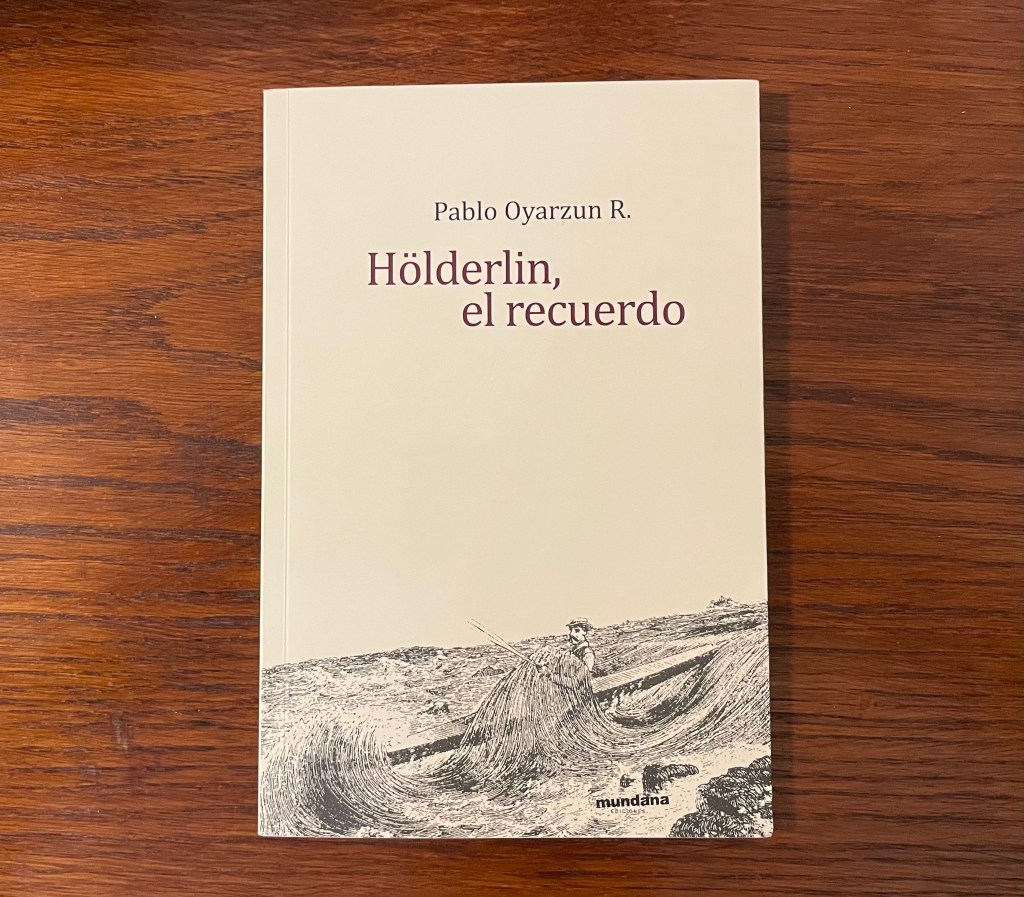
Enamoured psyche. On Pablo Oyarzun’s Hölderlin, el recuerdo (2025). by Gerardo Muñoz

The concluding verses of Hölderlin’s “Andenken” (“Rembrance” or “Memoria”), “Yet what remains, the poets found” stands as one of the preeminent testaments of modern poetry, and in Heidegger’s famous characterization, as a declaration of the task of the poet. At least since the time of Stefan George and Max Kommerell, the figure of poet or Dichter, a hyperbolic figure of illumination and guidance caught in the net of poetry and philosophy, was already dependent on Hölderlin’s mysterious words. What remains in what the poet remembers and clears for foundation? What is the relationship between remembrance and what is ‘found’ or ‘established’? “Andenken / Remembrance” is a hymn from the late period, which means that it must be read in consistency with Höderlin’s poetological framework as it reaches its maximum degree of intensity in its declaration and deliverance. Pablo Oyarzun’s most recent Hölderlin, el recuerdo (Mudana ediciones, 2025) is a powerful and subtle contribution to the understanding of this poem that measures up to the task in its attention to lexicon and structure, metaphysical condensation, and the vortex of ‘memory’ that discloses the poem. One of the merits of Oyarzun’s philosophical hermeneutics, if we can call it that, resides in its refusal to incorporate philosophical doctrines to inform the major questions of the hymn; rather, he favors the very unfolding of the poem ramping its internal structure for possibilities (Oyarzun 18-19). Rereading “Remembrance” opens a path between philosophy and poetry in the dawn of the realization of metaphysics, whose price was paid by crushing the possible and the voice of the poem. 

For Oyarzun the poet’s remembrance is that of appropriation of what is proper, and thus inappropriable, and to which the hymn can only ‘thank’ in the way of thinking as figure in the face of the unfathomable. Following Heidegger’s reading to a point, to give thanks is also to welcome and greet that lets humans and things be in their truth; since greeting always assumes otherness as foreign into presence (Oyarzun 29-30). And in presence life acquires texture, depth, singularization, but also conversation; a reminder that will control the rhythm of Hölderlin’s hymn. What is brought to presence, then, is neither a possession nor a legible inheritance, but the non-synthetizable modulation of what is proper in virtue of being absolutely alien (Oyarzun 34). What is recalled in this poem that remembers and thinks the unthinkable? Is it just a stage for Hölderlin to poetically transfigure his well known travels in Bordeaux? Oyarzun tells us that even if that is to be taken into account, the foreigner path is only essential as a way of homecoming, making the site (and song) into the hymn (Oyarzun 42). There is relation to the absolute other, but only as transitory to becoming and divine destiny in the world: “…el espíritu ama, porque precisamente así, ensa autoalienación puede transitar a lo otro que lo otro, es decir, apropiarse de lo propio […] el pensamiento del Ereignis está condicionado estructuralmente poesía ex-propiación, por ese retraimiento, distracción o retiro (Entzug), solo puede el cual se da lo propio (Oyarzun 54-55). Höderlin’s poem sings from the lacuna of its own expropriation of the abode. And that abode is ultimately the unworking of remembrance and memory that is defaced in being absolutely intimate and irreducible.

In order to elucidate the contours of this memory and its oblivion, Oyarzun follows Dieter Heinrich observation that: “este movimiento [of remembrance as transcendence] conocedor de su propio curso y a la vez desviado del mismo, aspirando a un conocimiento en que algo perdurable (lasting), con gratitud, reine aún en la superación – esto es remembranza” (Oyarzun 61). What is remembrance if not what unweaves time? It is not an actual faculty of human psychology, nor a spectral incorporation of a missing object; rather, it is the non-syntheizable partition between language and the wound of existence; a separation that is only redeemed in the way of remembrance that deposes an ideal recollection of missing facts in preparation for recomposition. Oyarzun’s reading will depend on clearing the notion of severability as a condition for remembering and forgetting as it makes an entry into the poem’s final verse about the “fixating eyes of love” (den Blick heften). Helena Cortés Gabaudán translates it as “y el amor también fija aplicadamente los ojos” [1]. “Y también”, “but also”, a conjunction of persistence that Oyarzun reads as an inexorable attachment to memory and separation, and the memory of separation (Oyarzun 68). Because there is no sliding towards remembrance without departure, coming into the presence welcomes the memory that, in that very moment, has transformed our souls. 

Ultimately, for Oyarzun the vortex of Hölderlin’s “Andenken” is love understood as the supreme citation that enacts the place of both thanking and remembering: “Amar es recordar, frecuentar con el recuerdo (el pensamiento), lo amado, incluso allí donde lo amado está presente, porque así lo resguarda de la mera posesión y agradece su presencia. Amar es pensar-en, un modo, tal vez el más entrañable, de Andenken, amor” (Oyarzun 73-74). And this means that what remains and endures, as Adorno observed in his well known essay on parataxis in Hölderlin’s late poetry, is neither of the logical nor of the temporal indexes, but the event of language as originary creation and donation without contestation (Oyarzun 77). This is the instance where Hölderlin’s strange case of the divinization of the word – and this is the particularity of the hymn form, an element that is never teased out by Oyarzun – becomes absolute and intransigent. It is Höderlin’s absolute proximity with the classical world, but also its radical separation in the post-mythical world of dissenchantment. It can be said that that what endures ‘thanks’ the love of remembrance in its persistence of the word that does not allow history and the crisis of tradition: “en nombre de la cosa que queda, en la fragilidad de su tiempo, que es ese mismo quedar” (Oyarzun 79). 

The poem becomes the verbal and sayable site where the poetizing resides, as well as the greeting and farewell of departure, just like the spectral sailors of the poem. What endures intimately can be called love as a form of the immemorial (Oyarzun 80). And that is because in inscribing, or holding on to the irreducible origin, poetics becomes the supreme form of love – the love in separation – of an expropriated language that welcomes us home in conversation with friends. This attests to the spirit of Hölderlin’s well known letter to his friend Böhlendorff in 1802: “A los artistas les hace falta la psyche entre amigos, el nacimiento del pensamiento en la conversación y la carta. De lo contrario, no gozamos de nada de esto para nosotros mismos” [2]. And this intoxicated love in language that departs from separation situates Hölderlin as radically different from the Chirstian agape and its bond of perfect unity for securing salvation (Colossians 3:14). A salvation that Hölderlin overcame in the drama of Empedocles, enacting the impossible incorporation of the aorgic physis through the writing of the tragic myth. 

Now we are also able to understand why Hölderlin transited to the hymn as the supreme form of the poem; not because because it is the origin or its last stage, but a suspension of language retrieved is gathered in the two moments of salutation and farewell, celebration and lamentation [3]. The hymnal dimension of the poem becomes language as such, which Oyarzun calls the immemorial without ever alluding to the notion of hymn. Indeed, the love of remembrance only becomes possible as a disjointed factum of experience anchored in its abyssal noncorrespondence  (Oyarzun 84). Thus, to remember is to love the caducity of life – “este ya no es la signatura indeleble del amor”, as beautifully expressed by Oyarzun – in a world in which the testament of language awaits no resurrection. 

Notes 

1. Friedrich Hölderlin. Poesía esencial (La Oficina, 2017), Trad. Helena Cortés, 129. 

2. Friedrich Hölderlin. Correspondencia completa (Ediciones Hiperión, 1990), trads. Helena Cortés & Arturo Leyte, 554. 

3. Nicoletta Di Vita, Il nome e la voce: Per una filosofia dell’inno (Neri Pozza, 2022), 246-247.

Hölderlin’s song. Provisional annotations. by Gerardo Muñoz

There is a moment in Hölderlin’s late hymn “Friedensfeier” (1801) where communication is strictly defined as becoming a song. The verses in question are about midway into the poem, and we read read the following: 

“Viel hat von Morgen an, 

Seit ein Gespräch wir sind und hören voneinander, 

Erfahren der Mensch; bald sind wir aber Gesang.”

“Mucho ha, desde la mañana, 

desde que diálogo somos y oímos unos de otros, 

aprendido el ser humano; pronto empero seremos canto”.

This is the Spanish rendition by the Venezuelan poet and translator Verónica Jaffé [1]. These lines stand for Hölderlin’s unique effort during the years 1800-1804 to substantially qualify what he had confessed to his mother as his true task: to live a serene or quiet life. I think this Spanish translation is much closer to the original German. Jaffé hangs on the present perfect with conviction: “Mucho ha…”, as if knowledge remained at a distance in the metric while becoming a temporal duration, a form of experience. This is the poetic “strict mediacy” for Hölderlin that can only be cultivated [2]. And it is only through the duration of experience that one will become a song (“seremos canto”). We are not yet there, hence the apostrophe. In the late period, duration meant dealing directly with Pindar. Thus, the song is something other than language – even if announced through language. But it is a paratactic dispersion that seeks to free the pure voice. In one of the “Pindar fragments”, this is what Hölderlin claims: “then only the difference between species makes a division in nature, so that everything is therefore more song and pure voice than accent of need or on the other hand language”. [3]

I am caught up in the moment of “division in nature”. The subtraction from representational language allows for the true appearance of a more originary separation, where the song can finally emerge in its proper attunement with the world. The becoming song is another form of separation, which institutes the passage from the Empedocles (tragic sacrifice) to the Pindaric relation to the divine. This is the “highest” poetic challenge for Hölderlin – an impossible task after the fleeing of the gods. It is definitely maddening. Nevertheless, the song remains. It puts us in nearness in a postmythical world without recoiling back to the image of the tragic. Indeed, as Hölderlin says in passing in “The Ground of Empedocles”, his time already “did not demand a song” [4]. The passion for natural unity was an Olympic illusion whose retribution could only become romantic debris as the exclusive possession of the dichter. On the contrary, the clearing for the song has emancipated itself from the exclusivity of the modern autonomy of dichtung as mimetically separated from the experience of life. This is what the song wants to pursue before the closure of a significant (and signifying) world. Fundamentally, this means a subtraction from the continuum of language, and thus a form of prophecy as elaborated by Gianni Carchia in a difficult passage from “Dialettica dell’immagine”: 

“Where music and prophecy, in the inexhaustibility of their tension – an endless effort to overcome the Babel dissipation of language by freeing the residual state of the unexpressed – testify to a disposition to meet precisely in what passes, in pure transience, the need for salvation and the idea of fulfillment, beauty as a totalitarian and exclusive appearance is, on the other hand, nothing but the product of an arrest in the dynamics of the spirit which withdraws from the horror of worldly laceration to seek refuge on the scene circular and static of the eternal”. [5]

If the song addresses the prophetic it is because language has fallen to the fictitious needs that arrest the experience of the human being into the exclusivity of rhetorical force and poetic genius. Is not the song a refusal of both? A refusal now aimed at the “highest” task – that is, the serene life? Against the exclusivity of appearance that Carchia points to, what appears discloses a different sense of law. A few verses in the same poem, in fact, we are confronted with the “law of destiny”: when there is serenity (or peace) there are also words. And a few lines after: “the law of love” is equilibrium from “here” to the “sky”. What appears there is the landscape that comes through in a pictorial depiction: “[Sein bild….Und der Himmel word wie eines Mahlers Haus Wenn seine Gemälde sind aufgestellt] / “[su cuadro e imagen….y el cielo se vuelve como de un pintor una casa cuando sus cuadros de exponen]”.

Does not this also speak to the insufficiency of language, which justifies the step into a folded painting? There is a painting and a vanishing image, but also the painter marveled at gleaming finished masterpieces. Is painting the original placeholder for the song as originary attunement of life? Perhaps. But in its enactment it also means that the song is impossible to disclose except through pictorial invocation. It is a painting of a life in the world, and nothing less. The transfiguration of the law places men no longer into undisputed submission, whether in its positive or natural determinations, but rather of a “strict mediacy” that is ethical in nature. A third way of the law that does not renounce the problem of separation.

Monica Ferrando has insisted upon the enormous importance of this conception: the fact that Pindar’s nomoi, in fact, relates to the nomos mousikos, which is fundamentally dependent on gathering substance of the song [6]. The strict mediacy finds itself between the mortal and the immortal. It is definitely not a “return to the state of nature”, and I do not see how it could be reduced to “genius”, except as an ethics whereby appearing is no longer at the service of objectivity [7]. Adorno was of course right: it is a ruthless effort to deal with disentanglement of nature – and the nature of reason – but only insofar as it is a return to the song. Or, at least, to have a path toward the song: a lyricism of the indestructible against the closure of a finite time dispensed and enclosed.

.

.

Notes

1.  Friedrich Hölderlin. “Fiesta de Paz”, in Cantos hespéricos (La Laguna de Campona, 2016), Traducción y Versiones Libres de Veronica Jaffé, 93. I thank Philippe Theophanidis the exchange initial exchanges on these verses.

2. Friedrich Hölderlin. “Pindar fragments”, in Essays and Letters (Penguin Classics, 2009), 566. Kindle Version. 

3.Ibid., 565.

4. Friedrich Hölderlin. “The Ground of the Empedocles”, in Essays and Letters (Penguin Classics, 2009), 465. Kindle Version. 

5. Gianni Carchia. “Dialettica dell’immagine: note sull’estetica biblica e cristiana”, in Legittimazione dell’arte (Guida Editori, 1982), 21.

6. Lucia Dell’Aia. “Il Regno d’Arcadia: intervista a Monica Ferrando”, in Il mito dell’Arcadia (Ledizioni, 2023), 121. 

7. T.W. Adorno. “Parataxis: On Hölderlin’s Late Poetry”, in Notes to Literature (Columbia University Press, 1992), 148-149.

Hölderlin in Agamben. by Gerardo Muñoz

There is no question that Hölderlin occupies a central place in Giorgio Agamben’s work, although he always appears within a specific strategic deployment. Of course, it might be the case that Hölderlin is always present in instances where he is not directly cited or thematized, but in the following note I want to record four instances where Hölderlin appears in different phases of Agamben’s thinking. These notes are preliminary for a larger work in progress that looks at the status of the comic as a potential force for a transfigured politics, which is informed, although not limited by Hölderlin’s work. Hölderlin occupies, after all, the entry point to L’uso dei corpi (2014) in relation to the well-known maxim “the use of the proper”; the territory where the (modal) ontology will be measured. However, esoterically Agamben’s incorporation of the German poet suggest a ‘way out’ from the tragic politicity of modernity. It might useful here to recall Schmitt’s annotation in Glossarium about what Hölderlin symbolized in the larger picture of modern German thought: “Youth without Goethe (Max Kommerell), that was for us since 1910 in concrete youth with Hölderlin, i.e. the transition from optimistic-ironic-neutralizing genius (genialismus) to pessimistic-active-tragic genialism (genialismus). But it remained within the genialistic framework, yes, deepened it into infinite depths. Norbert von Hellingrath is more important than Stefan George and Rilke.” (18.5. 1948) [1]. To overturn Hölderlin as the figure of the tragic caesura and witness to the crisis of “distance” in modernity is most definitely at stake here in order to avoid (subjective) conditions for something like an Enlightenment renewal. More broadly, it could be productive to think of Hölderlin as the poetic site that grants Agamben a possibility of thinking the event beyond the dependency of messianism and history, now displaced by the relation between language and world. 

a) As early as in Stanzas (1977) Agamben writes about Hölderlin: “The name of Hölderlin – of a poet, that is, for whom poetry was above all problematic and whom often hoped that it could be raised to the level of the mēchane (mechanical instrumental) of the ancients so that its procedures could be calculate and taught – and the dialogue that with its utterance engages a thinker who no longer designs his own mediation with the name of “philosophy”, are invoked here to witness the urgency, for our culture, of rediscovering the unity of our own fragmented word” (xvii) [2]. Hölderlin occupies here the site of antiphilosophy, in which the event of language does not longer coincide with a structure of the subject, but of the potentiality of “saying”; a sayability in which fragmentation removes any commanding closure of language. The event of appearing and bring to conclusion (in the book on Paul, Agamben will associate it with the rhetorical figure of the enjambment in the poem) gains primacy over formalization. 

b) In another early book, L’uomo senza contenuto (1994) Agamben takes up the question of fragmentation of language in Hölderlin but this time provides a specific category: rhythm. On the chapter about the original structure of the work of art he writes: “Everything is rhythm, the entire destiny of man is one heavenly rhythm, must as every work of art is one rhythm, and everything swings from the poetizing lips of the god”. This statement was passed down to us by Hölderlin’s own hand. […]. What Hölderlin’s sentence says appears at first blush too obscure and general to tempt us to take into consideration in a philosophy query on the work of art. However, if we want to submit to its proper meaning, that is, if we want, in order to corrupt to it, to make it first of all into a problem for us, then the question that immediately arises is: what is rhythm, which Hölderlin attributes to the work of art as it original characteristic?” (94) [3]. So, the category of rhythm “holds men” epochally as a form of incommensurable distance with the world, which Agamben relates to an-archic original structure of dwelling. For Agamben this step-back to the “original site” vis-à-vis rhythm releases “art” as poesis from a productivist “destiny”. So, it would be obvious to say that rhythm, insofar it abolishes the production, it also thematizes the ethical life as the form of life (which is why Agamben also attaches Hölderlin as a counter-figure of the notion of “vocation”) [4]. There is no form of life without rhythm in nearness to the common ground. 

c) In Autoritratto nello studio (2017), Agamben glosses (a) and (b), that is, he recognizes the importance of Von Hellingrath reconstruction of the late Hölderlin of the Pindaric translations and the fragmentary syntax, but now situates him at the center of modernity. Agamben writes: “Walser noted, as Hölderlin before him, that the world had become simply unhabitable. And there was not even the possibility of amending it…I am convinced that Hölderlin in his last thirty years of this life was not unhappy, as some professors of literature tend to describe him. On the contrary, Hölderlin was able to dream at his house without worrying about duties. The Tubingen tower and the clinic of Herisau: these are two places that we should never cease to reflect upon. What took place behind these walls – the rejection of reason by these two poets [Walser and Hölderlin] – is the most powerful rejection against our civilization” (140-141) [5]. So here Hölderlin, like Walser, is an epochal gestalt capable of generating the separation between thinking and doing, world and experience, which became totalized in the legitimacy of the modern. What could be interpreted as ‘domestic interiority’ for the poet becomes a symptom of a radical form of dwelling at the end of reason subsumed by nihilism.

d) Finally, in a recent essay published this year entitled “Hölderlins antitragische Wendung”, Agamben goes a step further to qualify Hölderlin’s breakthrough, taking radical distance from his relation to the tragic and identifying him as a poet that must be read in a comic register. This is all the more surprising given that, as Agamben himself notes, there is almost no mention of comedy in Hölderlin’s prose, except in the review of Siegfried Schmid’s play The Heroine. And although it is true one could argue that Hölderlin undertook a destruction of the tragic poet in The death of Empedocles, as far as I am aware there has been no interpretation of Hölderlin as opening to the “comedy of life”, except for a brief mention, almost in passing, about his laughter by the Italian poet Andrea Zanzotto [6]. Agamben concludes his essay suggesting that: “With this concept of “ordinary life” I should like to conclude my reflections, at least for the time being. Isn’t it precisely this ordinary life, what in the thirty-six years in the tower, Hölderlin’s life and poetry – or his “poetry” – have persistently sought to carry it out in an exemplary and funny way? And isn’t “ordinary” life the same as the “living” life (to live according to habitus and habits), which is distant and perfect in the last tower poems: When people go into the distance, living life …?” In any case, if Hegel defines the idyll as “the half descriptive, half lyrical poems […] and mainly nature, the seasons, etc., the subject matter”; then the tower poems – this extreme, incomparable poetic legacy of the West – are an idyll of the genre” (40) [7]. And here Hölderlin appears not just as another figure in “the age of the poets” (and the genialismus‘ commanding force), but rather as the moment in which the problem of life opens to its inoperosità. The unity of humanity now navigates the fragmented reality not through the subject, but rather through the singular form of life. Comedy, then, in the idyll genre in which life is freed from both desire and liberty.

.

.

Notes 

1. Carl Schmitt. Glossarium: Aufzeichnungen aus den Jahren 1947 bis 1958 (Duncker & Humblot, 2015). 114.

2. Giorgio Agamben. Stanzas: Word and Phantasm in Western Culture (University of Minnesota Press, 1993).  

3. Giorgio Agamben. The Man without Content (Stanford U Press, 1999). 

4. Giorgio Agamben. “Vocazione e voce”, in La potenza del pensiero (Neri Pozza, 2005). 77-89.

5. Giorgio Agamben. Autoritratto nello studio (nottetempo, 2017). 

6. Andrea Zanzotto. “Con Hölderlin, una leggenda”, in Friedrich Hölderlin: Tutte le liriche (Mondadori, 2001). i-xxiv.

7. Giorgio Agamben. “Hölderlins antitragische Wendung”, Studi Germanici, 17, 2020. 27-40.