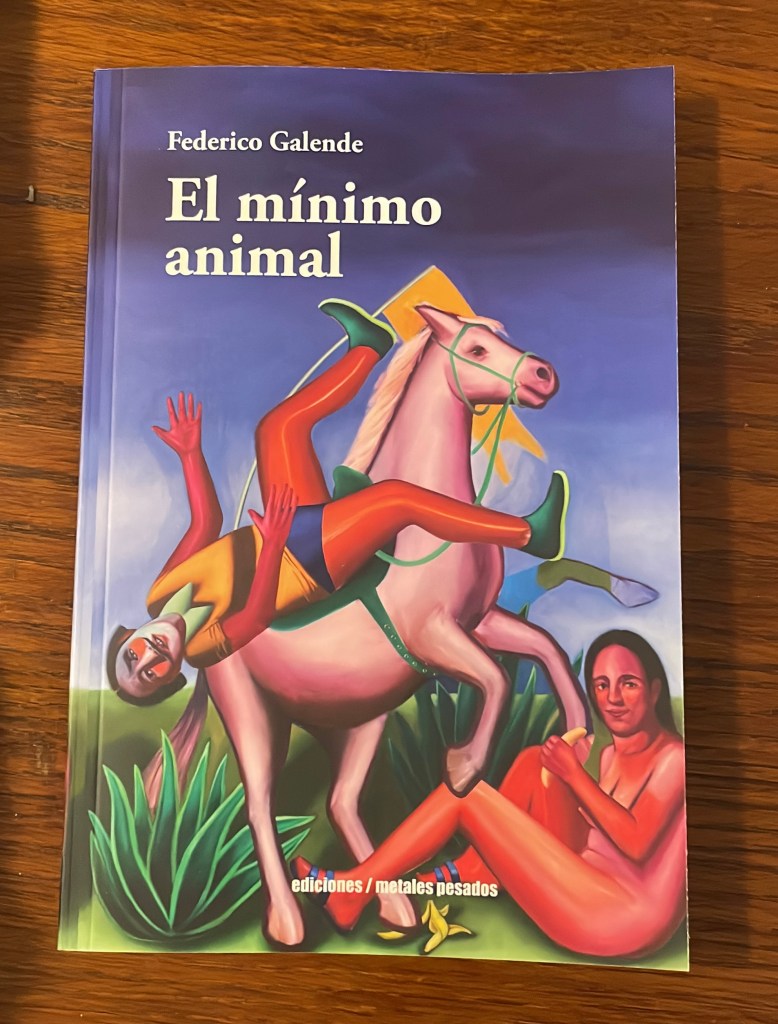
The vanishing horse. On Federico Galende’s El mínimo animal (2025). by Gerardo Muñoz

Federico Galende’s most recent essay El mínimo animal (ediciones metales pesados, 2025) is freestyle mediation on the singular animal that is the horse. When we say ‘horse’ we immediately dispense a bulky package: it is Pech Merle cave paintings and Franz Marc; it is Kafka’s parable of the racing red Indian, the agonizing horse in Picasso’s Guernica, as well as Juan José Saer’s mutilated horses in Nadie Nada Nunca (1980). Galende’s tiny mare, however, is first and foremost a memory of his childhood in the green grasslands of Córdoda that, we are told, had a big white spot in her muzzle. The first pages are spectacularly bucolic in a sedative language that retrieves a descriptive pollination of events and figures. But immediately the book gains depth and surprising detours. Galende notes that the relationship between humans and the horse differents slightly from that of pets, not as a question of scale, but primarily as complicity in language that shares the solitude between species: “…porque la del animal es una compania ofrecido a la soledad de lo humano en cuanto especie” (Galende 23). Avoiding the humanist temptation that makes the animal into a fantasy of the human, Galende’s situates the horse an experience beyond language. Is not this common solitude – that a few pages before Galende refers just in passing as ‘nocturnal communism’, in an esoteric allusion to his book on the cinema of Akis Kaurimakis – what has been usurped by the total domestication of species in a world that walks towards extinction? Galende’s El mínimo animal (2025) is an exercise in retrieving this innocence abode of man and animal in their reciprocal, and yet intransigent, mutation between worlds.

As a painterly writer, Galende is in full awareness that he must first interrupt the heraldic density of this animal. Because we know that the horse is an emblem of St. Paul’s way Damascus as much as it is one of modernity’s energy and mobilization. Galende is quite aware of it: the notion of “horse power” registers the unity of measurement of potential power for engines and motors. And just like the steamboat and gaslight, the horse stands a figure that unleashed a civilization defined by development and domestication of the world. The horse entered history through the main door of modern spiritualization (Galende does not elaborate on Napoleon’s famous horseback riding entrance in Germany, avoiding an image that is perhaps too obvious, already “manoseada”), allowing for social stabilization and homogenous time; the arrow of progress that underpins subjective historical consciousness. Galende writes, for instance: “De ser una masa abstracta que rodea la tierra, el espacio se convertía en una línea delgada, con la historia estirando un hilo la materia cósmica de la simultaneidad. Ahora, gracias al caballo, se tenía acceso a los lugares más retirados, solo que a causa de la velocidad de se los pasaba por alto de modo que lo que hasta allí había reinado de la imaginación comenzó a ser parte de lo accesorio, de lo circunstancial” (Galende 82). 

The unification of the planet under the nomoi of depredation would not have been possible without the domestication of the horse to coerce the acceleration of time as the index over space. As a cypher of time, the horse started to pop up everywhere progress made a violent incursion. This is perhaps why Galende, in a poetic style that seeks no conceptual scaffolding for self-assertion, claims that in its mystery the horse is not embedded in an ideal of freedom – which will be the freedom already fallen prey to the tribulations of civilization and the political world – as being in the world as such, without the pretensions of overcoming it; remaining a witness to permanent discontent in the open distance of some meadows (Galende 61). Can a notion of freedom be rethought from the figure of the horse at the end of history? Galende does not provide an answer, and his muteness is an attempt to resist transforming the horse into an apodictic symbolon of human anthropology transpiring meaning where there is none. The horse – and perhaps all animals are – stands for muteness and companionship without the burden of proof.

Perhaps the ultimate meaning in El mínimo animal (2025) can only be grasped in those silences, in what remains unthought and unsaid, which is another way of saying that Galende has provided the essay not only of form but of a soul. All things considered, the mystery of horse is a passing memory of the modern: speed, total mobilization, energy dispensation, the unity of a compact and legible world. What remains of the horse after the watershed of modern times; literally its exhaustion? Ultimately, the horse as species recalls the “specio”, which means to see, and to have the visibility for discernment; to be able to see with a sensible eye that blushes at the world before it crumbles into despair and conflagration at the threshold of the Anthropocene. And in many ways we are already there. Galende’s musings speak to an abundance trimmed by a trotting horse that only reappears in a poetizing that is capable of thinking and loving what has passed, like the epoch of horses. For Galende the horse is thus always sub specie aeternitatis. Towards the end of the book, and condensing Gottfried Benn’s argument on style as ranking higher than truth, Galende makes an open apology for appearance, that is rigorously eternal because it is concrete and unforgettable (Galende 91). 

Of course, the same can be said of Galende’s serpentine, courteous light prose – like a horse, that is, “una elegancia contenida” – that refuses the monumental and sterile retrievals of sedimented and dusty knowledge on the horse or any other animal (Galende 43). In this sense, Galende’s horse differs fundamentally from Blumenberg’s lion in its refusal to make of the species an anthropological metaphor, that is, a mere creed for the human bonum commune to stabilize social reality. Departing from the offerings of a meandering memory, Galende’s tiny animal is a vanishing horse that interrogates what it means to inhabit the space of non-relation that opens up when the modern scheme based on production, progress, and energy comes a halt. It is this “nothingness” what the vanishing horse reveals beyond itself, as Galende writes:

“Retirándose, el caballo le estaba advirtiendo a todo el siglo XX que la historia de retira con ellos y el mundo también, y todo lo que siguio 4 después de que por inercia ese siglo hiciera desfilar frente a sus narices las profecías más disparatadas…Pero no esperar nada no significa estar consciente de no esperar; puede ser al revés, que la nada sea una intersección invisible entre un sinfín de velocidades insustanciales. La aceleración de la vida – para decir lo con una expresión manoseada -…sirve para compensar este vacío que dura…” (Galende 87). 

In the stretched historicity of boredom and nothingness, memory awaits and assaults like an incoming galloping horse. And when Galende speaks of the “nothingness” that mediates between the temporalities of human action he is indexing the fabric of life; since authentic life only happens, as Don Delillo claims at the opening lines of Point Omega (2011) not when words have been spoken or inventions patented, but in the self-awareness of microscopic fragments of facticity. It is at this moment, when history unravels as a farcical script of putative norms of human action, and imagination can begin to gather species outside itself; in this way, perhaps once and for all, leaving behind the atrophies of nihilism already deposited in a language of strange instruments and recyclable data.

Just like Marguerite Duras’ Little Horses of Tarquinia (1953), where the Etruscan sculpture of a winged horse fails to enter the plot of a community of friends at a beach-town; Galende’s horse also disappears in the concluding pages of the book. In fact, there are two disappearances: first, the equestrian statue of Baquedano in Plaza Italia after the October social revolt of 2019; and, more importantly, that of his childhood mare in the hills of Córdoba. The vanishing horse at the limit of prose recalls the reality of the living for which there is no tropology: “…nunca conocí a ese ser, así como no es possible – nunca jamás – conocer a los seres ni tampoco el fin de ninguna historia” (Galende 110). As the horse makes his exit, we can only be sure that life has taken place elsewhere. Only because it has been transfigured in thought, Galende is able to seize a glimpse of it; a glimpse that is imperceptible and diluted before vanishing forever.

Quod natis exitus. by Gerardo Muñoz

In Book V of his Latin Language, and immediately after commenting the duality of Earth and Sky, Varro writes an enduring and yet enigmatic gloss of worldly life. In Roland Kent’s translation from 1938 we read: “Inasmuch as the separation of life and body is the exitus, ‘way out’ for all creates born, from that comes exitium, ‘destruction’, just as when they ineunt ‘go into’ unity, it is their initia, ‘beginnings’ [1]. It is probable that Kent had to leave the latinized terms next to familiar reiteration of modern English in order to allow the text to breath in all of its complexity, for what is Varro ultimately attempting to tell us can very depending what we want to stress, and how we read in the scope of his discussion starting in section 58. Is it that life is always marked by the wound of separation with the natural world? Or that destruction and caducity (exitium) is a necessary condition for all new beginnings, as if life understood as an enclosed organism or entity is always insufficient, because of the order of excess at the very moment that it recognizes its propriety? This excess is what cannot be contained in neither life nor in social form or political mediation; it is the initia of thought in its relation to phenomena of the world but without ever being reduced in them. In this sense, there can only be a beginning in the passion that thought grants to the separation from the world. 

This is perhaps what Pindar had in mind when writing in Isthmian 8 – in clear tone of his disenchantment before political strife – of a need to return to a shared language among friends (a language that cannot be that of the rhetorical antinomies of the polis): “It is always best to look at each thing right at our feet / for treacherous time hangs over men and twist awry the path of life. But even those things may be healed by men if freedom is with them; and a man should give care to [that] noble hope” [2]. In his commentary on these lines C.M. Bowra notes that the awry and treacherous time of life that Pindar refers is not just a personal account, but rather a state of the world of his own generation and friends [3]. Politics brings to ruin; it brings fear, but more importantly it brings oblivion to the nearness of each and every thing that stamps irreducibility. But what Bowra does not thematize is the central stress of these lines; mainly, that the Ancient poet makes a plea to the examination of proximity and nearness “look at each thing right at our feet”. The plea to take care of a true life harmonized is preoccupied with this lying out before our feet is so inapparent that it provides texture and rhythm to every appearance; it is so invisible that it can disclose the very possibility of the beginning or end of a visible world. 

It seems that Pindar’s solicitation of proximity speaks to Varro’s initia; but not because there is something like a true origin or original position (a category that modern political thought later elevate to the physics of social stratification and positional distribution), but rather because another idea of “freedom” can be rethought from the excess of what appears spatially in the world; an absolute instance of appropriation beyond life. This is perhaps beautifully expressed in one of Cézanne’s most acute images of his creative process: “I breathe the virginity of the world…a sharp sense of nuances works on me. At that moment I am as one with my paintings” [4]. Before painting and creation there is a sensuous region in which the separation of objects and subjects do not longer sustain totality except as catastrophe or force.

This means that to disclose regions of life in the world is not just about the claim of autonomy and normativity of a place; on the contrary, it is the very inapparent, almost imperceptible, possibility that lies in the wrinkled proximity when we withdraw from things ad they seem. Quod natis exitus – because we are always exiled from each and every place, it is through the thinking of the inconspicuous of each and every being that revisitation of an ethical life calls on us from the outside. Ultimately, the ethical life is nothing but the imperative of «lech lechà» in a separation that unites when overcoming the deceit of time. 

Notes 

1. Varro. On the Latin Language, Books 5-7 (Loeb Classical Library, 1951), 59. 

2. Pindar. “Isthmian 8”, in Pindar (Loeb Library, 1997), 211.

3. C.M. Bowra. Pindar (Oxford University Press, 1964), 114. 

4. Joachim Gasquet. Cézanne: A memoir with conversations (Thames&Hudson, 1991), 45.

Casa Bayona’s pensive slave. by Gerardo Muñoz

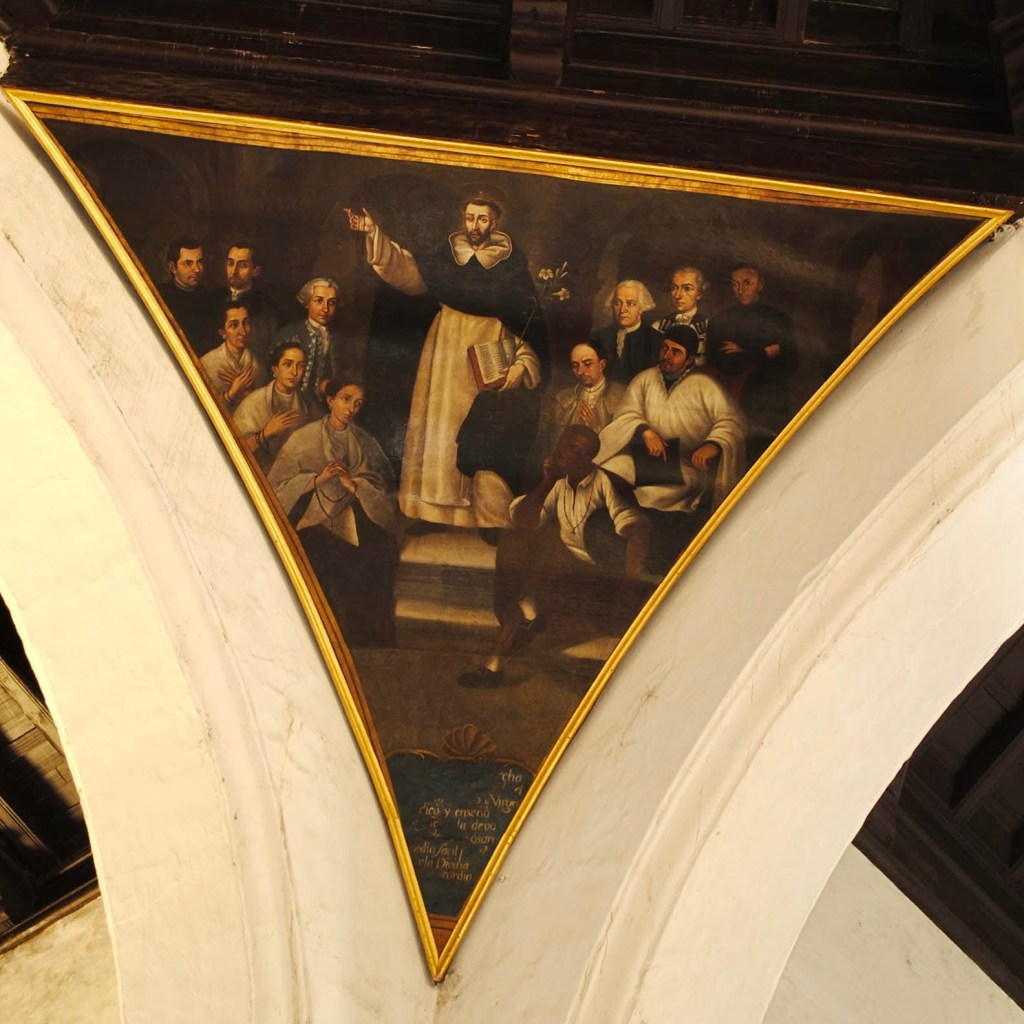
In the Church Santa María del Rosario of Havana there is a pendentive cycle completed in the 1770s painted by the baroque artist José Nicolás de Escalera – whom according to Guy Pérez Cisneros, was truly the first professional Cuban painter of the tradition – that includes a black slave in a pensive pose seating on a lower step, just below a Dominican priest who figures prominently in the middle of the picture holding a Bible and raising his right arm forward [1]. It has been noted that the figure of the black slave is also the first portrait of a slave in the New World, and its meaning has been highly disputed. The enigmatic slave or liberto portrait shows the man in a thinking pose, with a folded long white shirt, and what seems to be a wooden rosary hanging in plain sight. It is hard to make the details of his facial expressions, but it is obvious that his gaze is neither upwards nor directed at the viewer, but rather suspended, as if were, in a moment of attention and rest (and also listening?). The context here is fundamental, since Santa María del Rosario Church was commissioned by the Count of Bayona, a wealthy member of the sacarocracia (sugar plantation owner) after a previous church was burned to the ground by a slave revolt that took place in 1727 in an act of complete defiance to Christian indoctrination. 

The event that only has come down to us in just a handful of mentions and erasures of the colonial archive is featured prominently, as we know, in Manuel Moreno Fraginals’ El Ingenio when the historian documents the spiritual schism of the eighteenth century colonial plantations of the island. According to Fraginals’ historical account, the slave insurrection in the plantation took place in the wake of a theatrical enactment proposed by the Count of Casa Bayona in an act of repentance and humility aiming to mimic a well known moment of the Christian story: one day the Count washed the feet of twelve slaves, and when he finished he made them sat with him for dinner. Later that afternoon the slaves revolted and burnt down the whole sugar mill, including the chapel, to the ground. The episode ended with a plantation mayoral officer hunting down the runaway slaves, who was ordered to place the heads of the dead slaves high in spikes for the Count and everyone to see them [2]. It is an early staging of visibility and bodily dominion that the modern epoch will take to its final conclusion. 

The portrayal of human suffering was a symptom of the impossible hegemony of christianization of body and soul that the missionary Nicolás Duque de Estrada decades later will try to deploy in his pedagogical treatise Explicación de la doctirna cristiana acomoada a la capacidad de los negros bozales (1823), which argued that obedience of slaves could be achieved by implating “guilt” and work ethic in the affective interiority, in the forum internum of their souls. But even Estrada was of the fact that after sixteen hour workdays the Christian ascesis was imperceptible and little more than convoluted chatter to the ears of the slave. It is almost as if the slave, separated from the politico-theological inscription of salvation, was already outside the subjective domination of productive bondage and political freedom.

When Escalera was commissioned to do the cycle of frescos at Santa María del Rosario he was asked to combine a twofold narrative: the history of Christian salvation and the story of the Casa Bayona. At the center of the altar piece is the world as a common house or oikos, that carries history and its bodily sovereignty forward. One possible reading of the pensive slave shown in Santa María del Rosario’s pendentive is to assume that this figure is completely outside the eschatological vision embodying a sense of freedom that only painting could have documented in its unique and mute language. This raises the question about the relation between painting and freedom in which the figural emerges unmistakably fixed beyond historical narration. Although writing about Cézanne’s late work, Kurt Badt once suggested that there is no such a thing as the representation of freedom, but rather “painting generates a concept of freedom as two-faced: negatively, it is liberation from isolation and resistance, positively to the serious gentleness of freedom….expression in freedom to the scene from nature, which declares the world to be existing together, a mutual self-supporting and carrying of things” [3]. The pensive slave portrayed in the pendentive does not embody freedom understood as the spiritual accumulation of rights and duties known to the order of historical transformation; rather is an absolute pictorial appearance of freedom because it embodies, in its non-separation of life and thought, a static moment of a being that contemplates the liberty of his potency.

What is striking about the collective portrait where Escalera inserted the former slave is what we can call, following Bernard Berenson, a dimension of the ineloquent that appears just as “mute, with no urgent communication to make, and no thought of rousing us with look and gesture. If they express anything it is the character, essence rather than momentary feeling or purpose. They manifest potentiality rather than activity. It is enough that they exist in themselves” [4]. In the pensive gesture of his pose, the slave is the untouched existence and the revolt that rips the escathological narrative that ordains the interiors of Santa María del Rosario. Malraux once noted that the age of the divine disdained the realistic portrait of an ordinary person, because he was too distant and mundane from the stone conclave of the gaze of the gods. The slave’s inexpressive ‘naturalness’ refrains from partaking into a mood compensated by the semantic compulsion of the colonial painter, because his naturalness discloses the indestructible soul that has transfigured the realm of the divine. 

The unfathomable mystery of the pensive slave or liberto is the obscure and yet luminous portrait of a life in thought that is, at the same time, the thought of a life that is forever inexpressive, and as such the highest state of imperturbable freedom in the aftermath of worldly destruction. The ‘gentleness of freedom’ that Badt locates at the heart of painting is the imperative of the stream that carries, and yet restrains, thought and appearance into the figure of life. The freedom that anchors painting – because such freedom is never realized in painting except as vulgarity – becomes a tacit secret for which ultimately there is no image.  

Notes 

1.Guy Pérez Cisneros. Características de la evolución de la pintura en Cuba (Ministerio de Educación, 1959).

2. Manuel Moreno Fraginals. El Ingenio (Crítica, 2001), 99.

3. Kurt Badt. The Art of Cézanne (Faber & Faber, 1965), 314.

4. Bernard Berenson. Piero Della Francesca: The Ineloquent in Art (Chapman & Hall 1954), 7.