One is always struck by the pictorial intensity of Massacio’s “Expulsion from the Garden of Eden” fresco (1425) at Santa Maria del Carmine Chapel. It has something to do with the unbounded expressivity swirled by an acoustic of lamentation that springs from both faces at once. The nakedness in movement only comes second. If it is right to call it ‘modern’ is precisely because of its polarity between movement and paralysis, light and shadow, the formation of the lines delineating the bodies and the free-style strokes that carry Massacio’s picture to a strict and unsurpassed balance. It is a picture of the gathering of lamentation and pain, which confirms Ernesto de Martino’s intuition that in the ritual of mourning weeping and crying is also accompanied by an act of self-defacement, such as covering the face or bring the face as close as possible to the lower body position. Adam’s pain is reinforced by the hand that covers and pulls the face downwards, almost making it disappear. In a way, his walkout of Paradise is already the stroll of a nobody.
There is perhaps an intimate relationship between defacement and pain. In his short gloss on this work, Robert Longhi notes that the source of strength of Massacio’s work is given by the intensity of light that bathes the bodies of Adam and Eve in its purest naked form [1]. This total exposition is the cause of sin that, as a great historian of religion has brought to our attention, presupposes the entire carnalization of both body and soul after being thrown into the soteriological world of the living [2]. From now on, human life vested in pain means paying the price of the destruction of the soul for the protected and preventive set up in the world.
The sinful life – a life that will have to be chosen but punished justly – entails the consummation of pain as the central tonality of post-felix culpa existence. In other words, it is not that life is shameful because it has been dispossessed (or because it recognizes itself possessed); it is dispossessed because it can no longer look at the world outside the blinding light of programmed obsolescence towards death without transcendence. And the liquidation of transcendence means that human beings become faceless entities in a world that will forever become unfathomable.
In our days – a present marked by absolute secularization of ancient religious somatic religiosity and magical traces – the phenomenon of defacement and the faceless far from disappearing is all over the world around us. The ritualistic mask which provided transcendence to the living presence of the divine gods has now become a symbol of social shame self-imposed by arbitrary and ever-increasing moral mandates. In a sense, we have not yet left the path initiated in Massacio’s Adam and Eve fresco, and who knows if we’ll ever exit it in the ongoing destruction of the human species. We do know, however, that any meaningful change of the current state of things can only take place starting at the divine surface of the face, as Carlo Levi so eloquently understood it in the postwar years:
“Only a genuine revolution succeeds in changing the way people look, their facial expressions, the light in their eyes, the charm of their smiles. Christianity appeared with new faces, or taught a new way of looking at them. If we go through the streets and compare the faces we see with our memory of them, we won’t recognize persons any more. It is something that anticipates reality, as if prophetically, the universal change that for almost two centuries now has been shaping new faces throughout the whole world”. [3]
Notes 1. Roberto Longhi. Breve pero auténtica historia de la pintura italiana (Machado Libros, 2023), 114. 2. Paula Fredriksen. Sin: The Early History of an Idea (Princeton University Press, 2012), 116. 3. Carlo Levi. La doppia notte dei tigli (Einaudi, 1959), 109.
What comes after state form? The grounds for a self-evolving civil war at the heart of the social is what opens up in the wake of the collapse of the categories and grammar of modern politics. Stasiology becomes the fundamental unit to grasp the decoupling of the liberal state from its fixed guarantees and duties. Already during the crisis of legitimation of the seventies, we were told that the modern secular liberal state can no longer guarantee the conditions that made it possible, in the famous hypothesis developed by Böckenförde. The stasiological paradigm thoroughly governs the once implied mediations, social forms, and positive juridical norms of state-society internal mechanics without reminders and procedures. This is why all calls for political realism today are futile and insufficient; the only real existing realism is the one that must be confronted with increasing categorial inversions that ultimately channel the passage from a sufficiently ordered polity (the equilibrium of commerce and virtues) to the conflagration of the civil war as the production of social fabric.
All of this is implicit and glossed in Rodrigo Karmy’s excellent essay Stasiología: guerra civil, formas de vida, capitalismo (Voces Opuestas, 2023) in which the empty performance in the stage of fictitious contemporary sovereignty exchanged for the effective precautionary inversions that have become operative at a planetary scale: republicanism has given in to empire; the horizon of “liberty” nows entails dispossession and domination; authoritative and legitimate rule now means interpretative and exceptional discretionary execution; and, civil society (the modern civilizational unity for social cohesion) has become an axiomatic nexus to manage the tractions and turbulence of total economy (equivalence). The current state of things could not be more grim – and everything that passes through the sign of “order” (orderability, ordinary, ordo) elevates in the name of an self-sufficient abstraction that government paranoia to guide every deviation. The Leviathan stage has zoomed in into the pastoral exercise of uncontested dominion. Those that have claimed that the polis – precisely, as the sphere of social exchange and masquerade, in other words, of practical nihilism – is defunct are perhaps right in stating that its autonomy was destined to become the sheltered territory for pirates, delinquents, and the mafia. What is civil society today if not the confluence or the commuting space of the concert of all existing indirect powers?
For Karmy, abstraction and inversal do not mean just arbitrariness and formlessness lacking description. There is some rationality to what is arbitrary and anarchic in how the public powers are conjoined, distributed, and organized under several logistical units of optimal endurance: a) an axiomatic method that is immanent, flexible, and technologically sophisticated in its aversion to civil war; b) there is a process of exposition and vigilance that, conflating oikos and polis, makes hostis and inimicus indistinguishable, and by extension, coextensive to a global police (just as predicted by Carl Schmitt in the prologue to the Italian edition of The Concept of the political) that can manage and intervene in world-events as without residue. Expressively, Karmy reminds us, the police apparatus becomes the composition of cybernetic deployment based on the capillary consortium of information, reproduction, and differentiations. c) And finally, there is a nomic coupling between politics and geopolitics as the univocal destiny of a planetary humanity as a nihilistic mastery over nature, passions, and geographical localities. But if a century ago Benjamin suggested in One-Way Street (1928) that the power of the proletariat amounted to the measure of its convalescence, it seems that this is a materialist ideal that also has sunk deep into the anomia of the seas. Neither a “collective and sensible” proletariat nor a mobilized pacifist can enact the much expected epochal katechon; the immanent subject of Empire is already invested in the paradigm of force and counter-force, reinforcing what Karmy sees as the global practical and rhetorical geopolitics as an ongoing polemos: “Toda guerra es, ante todo, una guerra contra el pensamiento, Por eso abunda el análisis geopolítico” (Karmy 79). The manifest destiny of geopolitical grounding (knowledge, measurement, exposition) can only admit voluntary servitude towards the conflagration and the distributions of dominance and “influence” that has only intensified from the Iraq invasion of the early millennium to the Covid-19 pandemic techno-administrative measures.
But geopolitical dominance can no longer be said to integrate – there are too many cracks and holes in what it is still called, by inertia (Karmy calls it the ‘Newtonian hypothesis’) , the autonomy of the social. Similarly, its universality is a fallen one; but not because it has accepted the Augustuinian saeculum against the Pelagian heresy, but rather because its unitary mold consists in an internal stasis fractured within: a schism of every community from itself, a separation between things and forms in the originary sense of the Greek polis. Could another nomoi be recovered here? This is the last question posed by Karmy’s Stasiología (2023) through the poetic scene of Guadalupe Santa Cruz, whose turn to the garden is an involuntary act that gathers whatever is left of an ethical life from the ongoing devastation enacted by the barbarism of civilization. The garden is the threshold to a world according to Karmy reading Santa Cruz: “…al borde del mundo, el jardín es la figura que remite al cultivo de estilo, cuidado de la potencia de la imaginación, en último término, lo que designa un gesto” (Karmy 102-103). It is no coincidence that gesture and gestar is a polysemic term that allows to comprehend the figural and self-evolving of a transformation of life; “freedom” is not to deploy internal force towards the appropriation of advantageous outcomes and interest, but of the possibility of delineating the appearance of “a life” holding the unmeasurable world in proximity [1]. It is at this point where forms color how we become who we are.
What must be saved is not “life itself”, but rather the theōs between world and existence that opens “new possibilities” that is anti-scientific precisely because it is not incorporated by the pressure of objective absorption. The theōs is the invisible deviation from the worldly necessity of how things should be and what our lives should aspire to become; and only in this sense we are all martyrs as witnesses to this nearness. Extracting a further consequence from Karmy’s Stasiología (2023) one could claim that every desertion from geopolitical destiny – its unspeakable misery, its blatant bad faith, its farcical prepotence that forces a parodic eschatology – presupposes a return to a new life, which has always began at the surface of our face, as if anticipating reality prophetically: “Only a genuine revolution succeeds in changing the way people look, their facial expressions, the light in their eyes, the charm of their smiles. Christianity appeared with new faces, or taught a new way of looking at them. It is something that anticipates reality, as if prophetically, the universal change that for almost two centuries now has been shaping new faces throughout the whole world.” [2]. If the acclamations for a “New Man” concerned the humanist aspiration of the productive modernity; the vita nova concerns, first and foremost, the conservation of the partition of the soul, the only true entity of alienability where life conquers death. The practice of stasilogy sets out an exercise of this elegant depiction: allowing invisibility to prefigure and breach a new life from the trenches of a never ending struggle.
.
Notes
1. Monica Ferrando. “Gestare la figura. Note sulla pittura e il suo gesto”, Giardino di studi filosofici, Quodlibet, 2018.
2. Carlo Levi. The Two-Fold night: A narrative of travel in Germany (Cresset Press, 1962), 109.
Pasolini never ceased reflecting upon the painterly nature of the image outside of both literalness and abstraction. In Pasolini we are accustomed to be exposed to a set of antinomies: image and depiction, tradition and the primordial, figuration and the tactile, the world and its fragments. The publication of his miscellaneous writings on painting (and painters of the Italy of the 1950s-1960s) Heretical Aesthetics: Pasolini on painting (Verso, 2023), edited by Ara Merjian and Alessandro Giammei, provides depth and substance to document Pasolini’s insistence to the pictorial activity as an index of unmediated expressivity against the domestication of the accelerated capitalist form that soon enough will generate devastating consequences for idiomaticity and the pregramatical expression of a living culture. It is not too far-fetched to claim that painting remained for him a necessary condition of the cinematic; a specific craft that fundamentally rejected the impulse to naturalness and its mimetic performance. Pasolini remains attached to painting as a form of embodiment, a corporeal resource, and an energetic surface of positioning of light.
After all, as the editors of the book remind us at the outset, Pasolini was after the “plasticity of the image” (37). And plasticity pushes the dexterity of human creativity, but it is something else as well: it is a line of expansion into the prehistoric when it comes to the frontier of appearance. And perhaps Pasolini would have agreed with Gianni Carchia’s indictment in Il mito in pittura (1987) that the attempt of realizing appearance – even at the cost of failing at it – is the fundamental metaphysical node in which the entire history of Western painting stands. A good painting elevates itself to supreme theology, as Luca Giordano said of Velázquez. The problem of appearance in Pasolini’s scene of writing on painting is registered through partial indications: the tone of detailism, the violent and free moving impressionism, the struggle for stylistic contamination, or in the “fragmentary chromatic and interrupted aesthetic” (114). Pasolini’s eye is always accessible to the transient and expressive in a picture.
But the Italian filmmaker struggles with description of paintings, as if possessed by a permanent impatience that harbors his recurrent shortcomings. And he was not unaware: “I am not fluent in the terminology of painting, so forgive me if I sound less specific” (134). It is a declaration that does not only appear once in this collection. One could speculate that this dilemma is resolved by Pasolini in three ways: first, he can choose the painters from a personal criteria that would justify his awareness of painting as a prehistoric cultural activity. Secondly, Pasolini repeatedly alludes to the teaching of the great Italian art historian Roberto Longhi – who was responsible for the first formal analysis of Piero de la Francesca’s pictorial oeuvre – as companion and a maestro that during the Fascist interwar period gifted his students (and Pasolini among them) a different reality through commentaries on the seminal works of Italian Renaissance painting (155). Longhi’s anti-iconographical approach to the pictorial tradition allowed Pasolini a sense touch – not less real than the physical hand that caresses another body or hard surface – and the inexorable mystery-like quality of plasticity. Thirdly, Pasolini avoids coming near a possible ontological description of what, in fact, painting as such stands for him. Does it have an autonomous specificity, or an internal grammar, or perhaps an intricate dependence on other artistic activities (poetry, cinema, social criticism, politics)? Pasolini wanted to understand painting as a force of absorption even if ultimately blinding to the spectator. Nonetheless, Pasolini’s commentaries is rigid at the abyss between what painting is (or should be) and the painters or pictures that he explores in these pages.
This abyssal between word and depiction vouches for Pasolini’s unresolved tension with the nature of painting; a picture is always already dependent or attached to a peripheral phenomena that moves beyond the modern vista’s fulfillment towards totality. In fact, there are a few moments where painting is qualified, as in the text on Carlo Levi: “We are in the presence of something mysterious, ineffable. To speak about that something I can only fumble in the dark, since O a, without a proper terminology…but this ‘something’ is a mystery to me” (176). Or, when in the fragment “Dialectal painting” he suggests that “ [the dialectal tone] is not for the objective content of its figure sand landscapes, but also for the tone he uses to represent it (a tonalism drawn, we could say, from a crepuscular post-impressionism)” (81). Both fragments – so distant from each other in time; one from the fifties and the one on Levi from the seventies – provide an approximate orientation of Pasoloni’s fixation of painting in its specific muteness. This is not because it lacks language, but rather because it only speaks in its own dialect. A painted picture is always about resolving a situated uncanny appearance.
And for Pasolini only the partial profile of a picture – its superficial depth and strength of figuration, but also its lack of sentimentality and abandonment of lyricism that he would come to associate with the bourgeoisie worldview – was capable of dialectical valance, thus upending its misstep into the vulgarity of the “equality predestined and predetermined…the representation of such a world excludes the very possibility of dialectics” (186). This was his indictment of Warhol’s homogenous silkscreen prints and the general phenomenon of Pop Art and the neovvanguardias as coordinated efforts to surpass all that was past and present collapsing into “the voice of the homo technologicus…replacing history with a surreptitious and sacral prediction of history” (147). Bernard Berenson would have agreed to this: the inception of ‘knowing’ over seeing will only secure further mimetic and mystified (through mechanized and applied models in advance) points of departure for a subject of consciousness directed towards history. This is why for Pasolini the avant-garde can only “make the definition of that moment zero [of absolute beginning] profoundly insincere” (149). Painting and tradition walk along the abyss of nihilism. Only negatively can we say that for Pasolini painting is, then, an earthly activity; it is about being in the world in spite of the state of the world; attached to seeing even if the blurred limits perturb the open horizon.
The allure of a lagging postmodern and mechanized painting – but isn’t’ the eclipse of painting for the epoch as such? – for Pasolini exchanges, rather too quickly, lyricism (dependent on the romantic subject that attains it) for nuanced poetic sayability. After all, one of the most straightforward assumptions entertained by Pasolini is that “a painter is a poet who is never forced by circumstances to write in prose…” (106). A remark that comes very close to Poussin’s assertion that painting is an endeavor about the mute nature of things. The muteness of painting has granted artists the possibility to evoke the picture from poetry, as if word and image by entering into proximity can finally participate, side by side, into the mystery of appearance withdrawing from the “adumbrations of our present image-world”, as T.J. Clark recognizes it. There is something to be said in this respect about Pasolini’s long poem “Picasso” (1953) where the medium of poetry touches Picasso’s canvas only to flee from its empty abstraction, disclosing the cunning negation of the world. Or to use a trope common to Clark’s art criticism: Picasso’s fall of Icarus lacks any possible awakening in the present.
Pasolini’s last verse of the poem expresses what for him painting should avoid: “Sunday air…and his error is here [Picasso’s], in this absence. / The exit to / eternity lines not in this desired and premature love. Salvation is to be sought by staying in hell, with a marmoreal will to understand it. A society fated to lose its way is always bound to lose it: a person, never” (75-76). For him painting and Paradise are not meant to cohabitation – which bears witness to Pasolini’s long lasting commitment to the fallen modern world ascertained by the promethean durable struggle. Painting is poetically affirmed by retaining to what does not come to pass: the convulsions of this world. But a question remains: should not the distance implicated in seeing be sufficient in a fading world? Traversing this distance is the inherent divine task of painting; or, as Pasolini simply called it: “exquisite, mysterious – a new religion of things”.
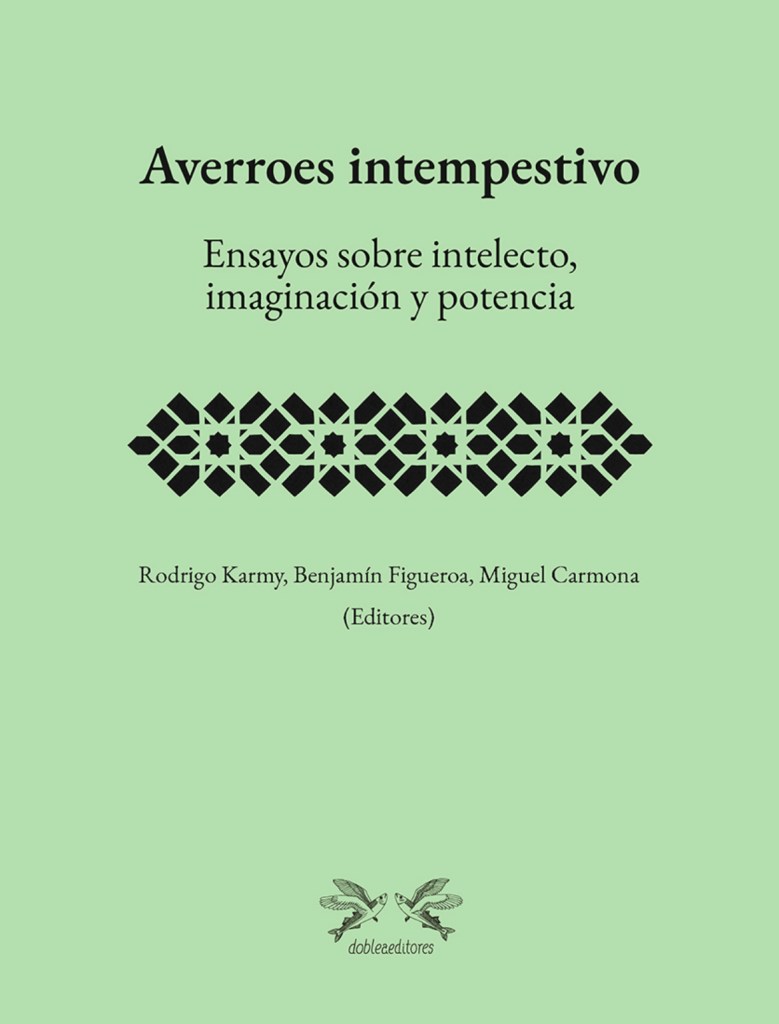
¿Por qué volver Averroes en nuestro tiempo? Se pudieran enumerar muchas razones, alguna de ellas de justificación de corte universitaria o histórica. Averroes porque quiero aprender del mundo árabe medieval sin teleologías historicistas. Averroes porque es un nombre intermitente en los textos que leemos y discutimos. Averroes porque convoca, pero también hay bastante más. Decir Averroes sigue siendo nombrar uno de los márgenes de la tradición filosófica occidental, aunque también es cierto que marginados hay y siempre habrán muchos; y, sin embargo, nos seguimos ocupando de Averroes y no de los otros que en realidad no interesan. Sin embargo, es probable que no seamos nosotros los interesamos en Averroes, sino el viejo comentador quien permanece como una sombra insondable que acecha a todo pensamiento y reflexión atenta. Por eso es por lo que tienen razón los editores del excelente volumen colectivo Averroes intempestivo (Doblea editores, 2022) al decir que el averroísmo es un espectro que recorre la imaginación a pesar de carecer de una arquitectónica sistemática de conceptos morales, políticos, u ontológicos. Aunque es gracias a esta misma razón que el averroísmo sobrevivió a lo largo de siglos, tras su exilio de la universidad medieval, en el extrañamiento lingüístico de la poesía, como señalan Agamben & Brenet en Intelletto d’amore (Quodlibet, 2020).
En efecto, no podemos hacer una historia de la sensación y de la experiencia de la lengua desde el concepto, sino que tenemos que contar con el espectro averroísta para esta génesis. El averroísmo es la verdadera marca de la philia en la filosofía, lo cual implica un paso atrás de la objetivación del mundo, la sistematización metafísica y sus tribulaciones, o el ordenamiento teológico de lo político aunque sin abstraerse de la configuración de la realitas. En tanto que potencia de lo impensado, la figura de Averroes sigue inspirando la incesante aventura de todo pensamiento sereno y medido (no hay que olvidar que, en su relato sobre Averroes, Jorge Luis Borges pone en escena justamente la búsqueda sobre la pérdida absoluta de la modernidad: la comedia) que autoafirma la separación originaria con el mundo bajo la fuerza del medio de la imaginación y de los sentidos.
De ahí que uno de los aciertos inmediatos de Averroes intempestivo (2022) – que recoge una serie de estudios que en muchos casos exceden los límites académicos propios de la una práctica del objeto de estudio en cuestión – es hacer patente un Averroes que en su excentricidad filosófica es tan moderno como cualquier referente de la modernidad occidental. Desde luego, Averroes, como luego Hölderlin, son portadores de un gesto de pensamiento en el cual se tematiza lo más “ajeno” (o lo extraño, diría Brenet en su lectura) en proximidad con lo que es “propio”. ¿Qué más arduo que el uso de la potencia al vernos asediados por la propia contemplación de la teoría? El sentido de lo “ajeno” en la relectura de Averroes en torno al corpus griego (los corpi filosóficos de Platón y Aristóteles) – así como luego lo llevaría a cabo Hölderlin con la tragedia de Empédocles o en los himnos pindáricos – es la exposición de la potencia a ser lo que somos en el medio de las cosas y de nuestras pasiones. El estudio o el pensamiento se vuelven exigencias éticas: estilos de estar en el mundo. En otras palabras, en Averroes lo ajeno cobra un sentido de expresión que solo puede ser registro de lo acontecido, y no de lo temporalmente inscrito en un mundo entregado a la eficacia administrativa de personas y objetos en la economía pastoral de las almas de los vivientes. Como lo demuestra con contundencia argumentativa Rodrigo Karmy en su ensayo “El monstruo Averroes”, la gnoseología Averroes supuso una dificultad mayor para la confección de la antropología tomista al desligar la voluntad subjetiva de los presupuestos necesarios del derecho natural [1]. El averroismo es otro nombre para el verdadero antipersonalismo sin recaer en la negatividad de lo sacro.
Al final , la monstruosidad de Averroes, como sugiere Karmy, consintió en una operación deflacionaria de la substancia calificada del hombre, por lo tanto abandonado las categorías hidráulicas de la culpa, la responsabilidad, de los actos, y toda la dimensión sacrificable de la persona propia de la filosofía de la historia cuyo coste ha sido el al nihilismo y su voluntad de poder. Averroes es un pensador que, previendo el nihilismo del valor como apropiación del mundo, hizo posible una antropología erótica y poética para expresar otra forma de estar verdaderamente en libertad. De ahí que Averroes tampoco encarne un gnosticismo ni una religión secularizada en nombre de la inmanencia absoluta (algo que solo puede devenir en el momento de la traducción de la irreductibilidad de las cosas a la iconocidad objetual, como hemos argumentado en otro lugar), sino que es un pensador de la individuación desde los acontecimientos que afectan a cada una de las formas de vida [2].
Si en la lectura de Averroes, la potencia es una forma sensible fundamentalmente atélica – en separación con su actualización de las obras – esto supone que el verdadero sentido de cada vida es la afirmación de nuestras pasiones para la que no hay objeto ni orientación ni orden (en la doble acepción de la palabra), tal y como el derecho natural intentó formalizar la mediación entre moral y principios para el actuar. Estas son las condiciones teológicas que dan lugar al sobrevenido de la voluntad que se somete a la comunión de salvación para garantizar su sentido de libertad. Aquí también otro de los aciertos que recorre los ensayos de este estupendo libro colectivo; a saber, ofrecernos un Averroes que no es ajeno a la política, sin que esto implica abonar las condiciones sustancialitas de aquella eficacia teológica sobre la contigencia (esencialmente temporalista). En este sentido, Averroes aparece como una tercera figura en la partición entre una legitimidad propia de un positivismo excluyente, y la de un derecho natural cuyo “ideal” de justicia y bien común depende de la dimensión impolítica de la antropología de la especie. Y esta tercera postura se define como la prioridad del acontecimiento mediante la cual se vuelve posible dar forma a nuestras pasiones. En el momento en el que las pasiones se vuelven pulsiones idólatras – como en nuestro actual mundo de pasarelas, influencers, y guardianes de la pobreza del valor – la erótica del intelecto ya ha degenerado en un sadismo que, en virtud de la posesión sobre la mera corporalidad, lleva a la caducidad inerte. Es aquí donde podemos situar el punto en el que el uso se transforma en abuso (ius abutendi). Pero si la norma se ecargará de regular el abuso y el derecho natural a tipificar un cúmulo de bienes del ‘buen uso’; la lección exotérica de Averroes reside en la posibilidad de asumir un uso que, en su separabilidad con el mundo, hace viable la libertad en las pasiones. O lo que es lo mismo: en los medios con los que dispone cada singular exponiendose eróticamente al mundo.
La abnegada actualidad de Averroes reside en el hecho de que es un pensador excéntrico no porque suministre una antropología del juicio reflexivo; sino más bien porque transforma nuestro sentido del ser a una potencia en desobra con efectos irreversibles para nuestra concepción de la libertad. Por eso, lo importante no es que Averroes apueste por un sentido de la irreversibilidad en el plano de la historia o de la negativa a ser dominado (ideal republicano); sino más bien se trata de un sentido de la irreversibilidad en el registro de las pasiones, del afectar, y de nuestros contactos con lo ajeno. Todo esto nutre la dimensión modal del ser humano a partir de la separabilidad de sus acontecimientos. Ya siglos más tarde el escritor Carlo Levi diría en Miedo a la libertad desde un averroísmo intuitivo: lo esencial no es ser libre de las pasiones, sino poder estar en libertad en las pasiones [3]. No debemos hacer nada con el averroismo, pues el averroismo solo es teoría en tanto que pensamiento que ya nos atraviesa. Así, el averroísmo no es una analítica de los conceptos ni una ontología de la acción o del derecho, sino un estilo en separación del mundo que en su opacidad huye de la domesticación de lo social como imperio psíquico de los valores.
En este sentido, la imputación de Ramón Llull de los averroístas como grupos clandestinos al interior de lo sociedad, debe entenderse como la vivencia desvivida, siempre renuente de las determinatio de la obra, de la obligación, y de la servidumbre de una voluntad ilimitada a las particiones substantivas de lo común [4]. En su clandestinidad comunicacional, el averroísmo es otro nombre para la intuición que siempre ha excedido las normas de la ciudad y sus trámites civiles. Averroismo: lo que conseguido la felicidad en los acontecimientos de lo que sentimos, pensamos y hablamos. Por lo tanto, la impronta del averroísmo es la indefinición absoluta de la vida feliz. Una felicidad que se recoge en la separabilidad del dominio de los sacerdotes y de sus comuniones subsidiadas en la eterna fe de la salvación.
.
.
Notas
1. Rodrigo Karmy & Benjamín Figueroa & Miguel Carmona, Editores. Averroes intempestivo: ensayos sobre intelecto, imaginación y potencia (Doblea editores, 2022), 198.
2. Sobre la relación entre uso y objetivación en la filosofía de Emanuele Coccia, ver mi ensayo “En el reino de las apariencias: sobre la cosmología”, Ontología de las superficies: ensayos averroístas sobre Emanuele Coccia (Universidad Iberoamericana AC, 2021).
3. Carlo Levi. Paura della libertà (Neri Pozza, 2018).
4. Francesco Márquez Villanueva. “El caso del averroísmo popular español”, en Cinco siglos de Celestina: aportaciones interpretativas (Universidad de València Servicio de Publicaciones, 1997), 128.
In a recent entry in his Quodlibet roster entitled “Sul diritto di resistenza“, Giorgio Agamben takes up once more time the question of civil war, but this time tested against the “right to resistance” (diritto di resistenza) as included in many Western constitutions. What is interesting in this note is that the for the first time – as far as I know, although it complements superbly an old intervention a propos of the publication of Tiqqun, along with Fulvia Carnevale and Eric Hazan – Agamben lays out quite explicitly how the “planetary civil war” tips the enumerated constitutional right of resistance on its head, making it indistinguishable from the management of civil war and the blurring of the category of formal enemy and that of the terrorist.
Indeed, the very notion of “planetary civil war” in an unified society without a strong discriminatory principle of enmity turns politics, as Carl Schmitt noted in his prologue to the 1971 Italian edition of The Concept of the Political, into something like a world police [1]. And the historical present has given Schmitt his due. Following Schmitt’s sound diagnosis, Agamben says nothing different, although this is the thesis that marks the limit of Schmitt’s modern categorical delimitations as well. In other words, if the unity of friend-enemy collapses, and now there is only the stratified value of association based on moral justifications, how can one speak of the “political” in this scenario (it is no longer about war, as we commented in a previous occasion). Is there even one?
And, if the political collapses so do the total sum of actions oriented as political resistance, and even resistance to the collapse of the political. For Schmitt it is very clear that it is even the internal exhaustion of the juridical order (ius publicum europeum) insofar as positivism is concerned, leading the way to the rise of what he called a world legal revolution consistent with what Karl Loewenstein already in the 1930s had termed “militant democracy” (1937). Once the modern state loses its monopoly on the legitimacy of authority, then anyone can establish an authoritative force; while, in turn, every enmity becomes a potential absolute enmity (even more so in legality, as we clearly see in the American context). In this sense, it is a misnomer to call a state “the state” if its function becomes a full equipped instrument of the optimization of civil war that rests on a sort of dual structure: on the one hand there is civil war at the limit of the collapse of legitimacy, but also the total domination that incorporates stasis as a functioning vector of its regulatory order.
In this sense, the advent of civil war after the collapse of the state is not a return to the confessional civil wars of early modern Europe, but rather the total unification of state and society without residue. So, if “right to resistance” presupposes not just the formal limitation of enmity but also the separation of society and state, it only makes sense that this category becomes defunct once the social emerges as proper site of the total administration: “the reunification gave us a new tyrant: the social” [2]. This entails that proper civil resistance is already subsumed in the process of civil war in the threshold of the political. In the context of civil war, resistances can mean both administration of the stasis, and the embedded position of a sacrificial subject, which has been costly (and it remains so) for the any calls for contestation, striking, or insubordination. Resistance here could only amount as a shadow apocalypticism. And sacrifice insofar as it is the fuel of any philosophy of history, merely relocates the energy of hostilities as measured by the factors of optimization.
It is only implicitly that Agamben concludes by suggesting that any “true resistance” must be imagined as a form of life in retreat from the social and its sacrificial idiolatry, from which one must draw its consequences or effects. This is the grounds of an ethical life, but also the way of reimagining another possibility of freedom, which in the brilliant definition of Carlo Levi, it means to live in freedom within our passions instead of being free of passions (precisely, because no principle can determine the true object of our passions, this demands a total reworking of modern notions of liberal and republican determinations of liberty) [3]. The time of the civil war, then, is best understood as a time of the affirmation of the conatus essendi, which rediscovers freedom through the sense of the event insofar as we are capable of attuning to the separability from any principle of socialization.
.
Notes
1. Carl Schmitt. “Premessa all’edizione italiana”, Le categorie del politico (ll Mulino 1972), 34.
2. Tiqqun. Introduction to Civil War (Semiotext, 2010), 61.
2. Carlo Levi. Paura della libertà (Neri Pozza, 2018), 45.



 Infrapolitical Reflections