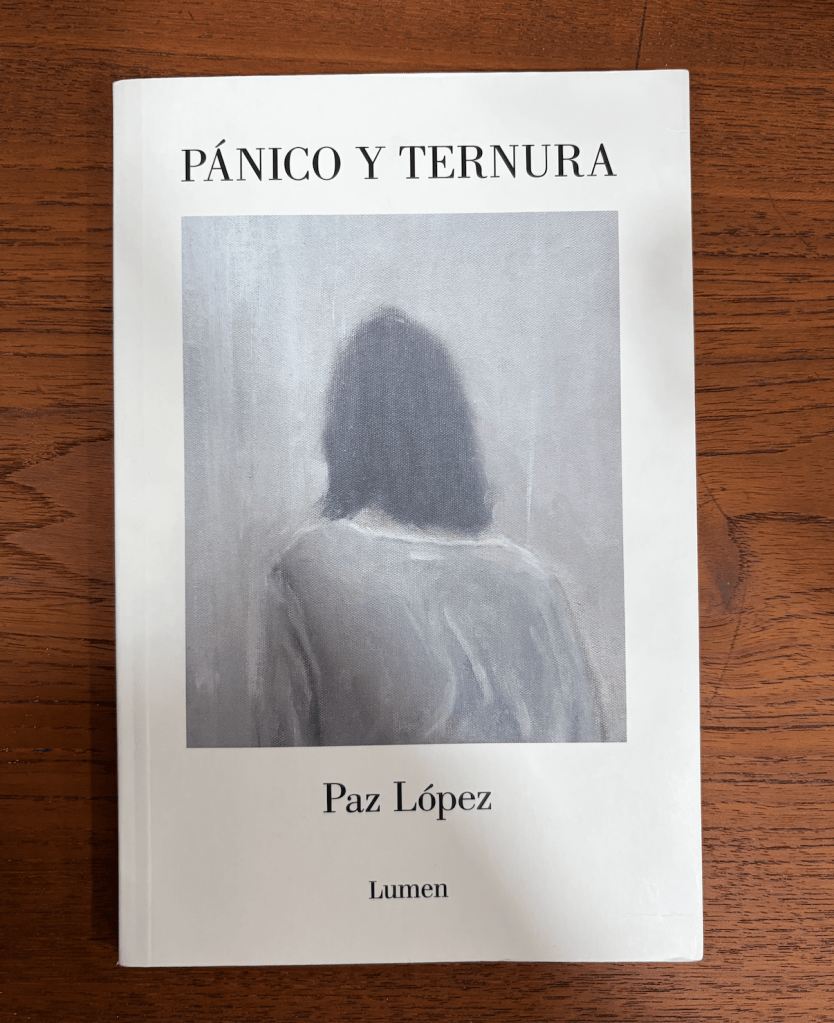
Breathing in the pain of the world. On Paz López’s Pánico y Ternura (2026). by Gerardo Muñoz

Paz López’s Pánico y Ternura (2026) opens with an analogy between life and school that immediately places us in attention to her writing: “Entramos a la vida como entra un niño a la escuela: mirando hacia atrás, con los ojos llorosos buscando la mano de quien hace un rato nos había variado el pelo, la nariz, las rodillas heridas, los diminutos labios” (López 14). Although the synecdoche (“la mano”) does not reveal to whom it belongs, in a way the mother is spectrally present, a figure overtly present in Paz’s writing. We enter life in the wake of separation and caesura, and that is the site of the original wound that will lead to all sorts of civilizational and mimetic compulsions that unfortunately we know too well. And yet, López does not say we enter the “law” (although this is also presupposed of course), but rather we enter school. Our civilization has slandered and tainted the notion of “schooling” and “school” to such an extent that we have entirely forgotten the fact that school is schola; that is, time of rest and interruption, “free time”, a lagging duration of contemplation of language and being, and of being in language. And if the notion of “school” is under ruthless attack in our present by an infantry of pedagogues and technicians, it is mainly due to the fact that what is being threatened is the very possibility of a form of life. Of course, our epoch is one in which the chatter of “life” is continuous and intoxicating, but the form of life is something altogether different: it entails to inhabit a space of a convergent and planar movement between language and world. 

This is one of the regions that opens in López’s book; one out of many, allow me to follow it. As López says toward the end of the essay: “…cada vez que hay un corte tenemos la posibilidad de inventar una nueva lengua, de poner de movimiento el mundo” (López 128). It would be too convenient to follow up this claim and say that this is precisely what Paz López does in her writing; clearing language in order for a tonos or a vibration of the voice to unearth tropes that have been traced almost at the level of the flesh. This is something to this autographic practice that moves gently without fetishing the body and its materiality. Ultimately, a body is always more than surface. I want to retain from López’s scene of writing a responsive form of thought that in its inconspicuous relation to writing it refrains from the certitude of both philosophy and the letter. López’s search could perhaps be one of “tanteo”, a beautiful Spanish verb that refers to the hand that seeks and reaches out for something in space, and in my memory it immediately recalls some short stories of Carmen Martín Gaite’s fiction where this gesture figures in a cinematic fashion. Hence, for López ‘tanteo’ is to refuse the hell of a world of acrimonious security and confirmations that discards the inexorable presence of doubts and fissures (López 39). But the hand that seeks is also not a pure gesture in the void; it is one that asymptotically discloses an erotic mediation with the passing world without ever abandoning it; yet unequivocally assertive in the lamentation of the state of the world (López 56). 

In other words, because we can seek (here López is enrolled in the school of Hölderlin), there is no end to the world now configured as a fragile fishing net of relations, unsaid words, glances, and incommensurable distances that make up, without exhausting it, the spectacle of life. Not “this life”, of course. For López, the brutality of our times (I am less prudent and I will say ‘onto-theology’) is precisely the general concerted opinion that we are all owners of our own little and mediocre lives, the last avatar of a self-serving will to power. Rather, for López life is always elsewhere, and this is why the “escape” or “exile” from oneself is not a place of arrival or destiny, but precisely the disposition that is always traversing every relation and every touch between bodies and souls (López 65). We are creatures of the outside, and by extension, only the cohabitation of the outside, can redeem the pain of the original laceration, as in the first image of the infant walking his path to school with his eyes turned. This is not a messianic or monastic retreat, it does not depend on the parousia, but rather one of poetic dwelling in the spaces that are both familiar and strange. It is only in them (through them) that we can only cultivate through the garden of our language. López’s anti-messianic orientation, devoid of the fiction of future time and its anxieties, is proportionally a prose of hanging spaces, of curvatures of language that affects the reader deeply without ever renouncing to the beauty that thinking that defies being brutalized through the crushing weight of technical terms or philosophical concepts. 

In this sense, López’s writing is already an autographic writing at the threshold of onto-theology convinced that only style through the resources of the voice is the path that mitigates between poetry and philosophy, painting and memory, experiences and the unlived. López’s prose, if anything, is a lot about “gathering” through the tenderness; a contact where image and eros become the medium of life: “No es eso también la ternura, una forma de “recortar nuevos espacios en el vacío informa del exterior y conquistarlos a la medida de la vida (Claudio Magris)?” (López 94). To gather and to cut through the spaces: this is the highest task of the ethics of a form of life that requires a new theology of the sensible. Theology can be taken as a strange word in López’s lexicon, and I do not think that it appears even once in Pánico y Ternura. And yet, López’s proposal is completely theological if we take the theos as the highest and most beautiful light that can nominally allow for depth through the analogy of things in the net of the world. Hence, the importance of the sighting to the inner most depth in some moments of López’s writing, such as when she ponders on the fact that every time that she plunges eyes on a minuscule element or figure of the world, she senses that “se revela el elemento bestial que se enceuntra en el centro de nuestro mundo, como si la mirada fuera un cordon umbilical….amarrados todavia al vientre brumoso del origen” (López 121). And theology is not just the highest, but also the science of the first things: through the piercing expression of our senses, we elevate ourselves not with some revealed transcendence, but with the proximity with the things that have found us. 

And yet we have been automatized – this is the sensible devastation that Pánico y Ternura is responding to without ever taking a political stance, because politics is thoroughly insufficient – to see every-thing, and every being at all times; all entities realized in the feast of interchangeability and availability. The heliotropic force of modernity now truly blinds and burns our skin, which means that no access to the solar totality of social existence can guarantee anything except continuous conflagration and commanded muteness. We cannot but feel “panic” in this current predicament López is completely right. Thus, we must find the flickering light and flames elsewhere, such as in the lamp of a dark night that can illuminate the page of a book that keeps us in attention without any real purpose. Nabokov’s suggestion comes to mind: in the lamp of our study, we reject the nihilist demands of the cacophonous social world. Paz López has given us a delicious essay to read under this tenuous light. It is a present memory of an abode that keeps the secret of secrets, a resting place of the soul where still some melody is heard.

Those wonderful clouds. On Victoria Cirlot’s Imágenes Negativas (2026). by Gerardo Muñoz

First published in the Chilean publishing house Mundana back in 2016 and long out of print, Victoria Cirlot’s Imágenes Negativas: las nubes en la tradición mística y en la modernidad (2026) finally appears in a new and upgraded edition from Siruela Ediciones. This short essay, initially a conference delivered at the Universidad Católica de Valparaíso, is another contribution to Cirlot’s important work on European mystical tradition of European early modernity, but like other of Circlot’s book its value also resides in its prudential contribution to contemporary thought. In this sense, Cirlot’s visual exploration of the cloud allows us to raise the question without much hesitation: what is a cloud in a field of vision, anyways? In Kurt Badt’s John Constable’s Clouds (1950), a book that is curiously missing from Cirlot’s commentary and bibliography, the cloud is merely a modern phenomenon in painting; a specular effect of the rise of meteorology in post-Enlightenment England that paved the way for a new construction of the modern landscape painting.

If Cirlot does not need to follow Badt’s insights, it is due to the fact that she wants to take a step back, even if her point of departure is Von Dillis’ drawings from the nineteenth century that she encountered in the Alte Pinakothek in Munich. These are relatively small works, and more profusely unfinished than Constable’s cloud exercises in oil painting. I seriously wonder if Cirlot’s would have taken another direction in her analysis if she had confronted another series of cloud paintings of the modern tradition. Perhaps not. Following Gombrich’s dictum that clouds are accidental forms reserved in the mind and extended to the pictorial space, Cirlot immediately goes on to document the long mystical tradition where the cloud stands for theos gnophos, or the incandescent light that descend from the divinity right into the human’s heart (Cirlot 18). In the mystical tradition the cloud of the story of Moses, later deployed as a trope by Pseudo-Dionysus and Gregory of Nyssa, the cloud refuses to be an accident of substance; it is rather the image of substance itself: the impossibility of knowing and having access to the divine, and thus the need for the recollection of the light of ignorance. 

If mysticism and painting go hand in hand it is because what the divine cannot be said in language, but it be disclosed through the spectacular persuasion of an image that is carved in the veil of theology. In this way, the cloud is a bit like a dress in a painting, both conceptually and figuratively: Cirlot does not fail to note that in Medieval representations one can grasp the figure of God swerving in a cloud before a horned Moses, but it is also the turbulence in the depth of the picture that allows for the ascension of the gaze that fails to establish a horizon and the linear perspective. Although Cirlot does not put it in this way – she is obviously more refined and attentive to her historical sources – one could easily find an opposition between clouds (and perhaps clouding of the background of a picture, an activity) and horizon of pictorial representation. It is in this sense that Cirlot defines the “via negativa” that clouds appeal to the impossible knowledge of God (in my translation): “The images of ascension and clouds are modes of making visible the negative way of the proximity with God…the fact that the experience of god takes place through the mode of negative images is something that persist from Pseudo-Dionysus to Mechthild of Magdeburg, and San Juan de la Cruz” (Cirlot 23-25).

In other words, the cloud is the non-human figure of a mode of cohabitation in God – Cirlot goes as far as quoting that it is the medium, “el entre”, the incommensurable distance between the sensible being and god (Cirlot 27). This is why the cloud, in virtue of what it discloses in its non-disclosure, is a bit like a hole in the picture, and we fail to account for its potency to stabilize its mystery through the categories of the autonomy of the work of art. This is why it is very fruitful when Cirlot tells the reader that the cloud defies vision in its very appearance, since through its clearing and light, it can only “sense through the inner soul” (Cirlot 30). This was also present, at least residually in Badt’s Constable Clouds, when referring to the externalization of the clouds as the spiritual organ of the living. But it is precisely this exteriority that defies the epistemological grounds of meteorological knowledge that would facilitate the technical ability to condense the cloud into force and energy, whose ultimate expression is crowned in a work such as Hans Haacke’s Condensation Cube (1963). A fallen cloud from the sky that can only be experienced in the abstraction degrees and measurements of its objective “data”. 

There is an intimate and communicate vessel between painting and clouds that can be derived from Imágenes Negativas (2026), and that can be sound in the state of imperturbable contemplation where life and thought convergence without the energy of struggle that would define modern artistic creation and its fall into autonomization (Cirlot 33). If painting is to release and live as a mode folded in God; the modern sensibility would require the energy of creation in order to open the passage between worlds. Following Puech’s important work on Gnosticism, Cirlot sees that the nebular trope of the cloud persists in modernity well beyond San Juan de la Cruz: one can sense in the attempts to “escape this world” – from Piranesi’s ladders to Thomas De Quincety’s prose, and of course, Charles Bauderlaire – a hymnal longing for the clouds that depends on the energy of the reversibility of the modern seen as a form of confinement (and from the pictorial space, I would argue also as the triumph of flatness in modern painting) (Cirlot 44). The cloud becomes a window for gnostic imagination, although this could very well be a sort of self-serving pleonasm, given that the “possible” of the gnostic remnant in the work of art only appears as momentary reversibility; a temporality that necessarily subsists without transforming the plane of sensibility. These are wonderful experiments in poetry, painting, photography; and yet, the negative, I take it, cannot be refused its place in the historical wealth of  historical capture of exteriority. Both Hölderlin and Baudealire’s clouding of poetry is already the document of the impossible attempt to live the serene life in god. Thus, any attempt at a full-fleshed exodus via negativa, runs into catastrophe and possibly madness in the wake of disenchantment. 

In her final and short essay of the volume, titled “La estrella y la nube”, Cirlot speaks of the return of the cloud in modern photography, concrete the work of André Kertész, as ‘laceration in the sky” (“agujerear el cielo”), or a tear in the heavens (Cirlot 60). The passage here appeals to an inverse tonality, where lamentation becomes an inexorable dimension of affection in the world now organized through massification and urbanization of all spaces. Disenchantment is ultimately spatial enclosure. But this tear in the sky is a remnant of a memory of the divine, as well as the absence of the divine in the world; the failure of establishing a transcendence with the unknown and the inapparent. But it is thanks to Victoria Cirlot’s pictorial explorations that we can raise these questions, which are also more than mere questions pertinent to theology and art.  

The face of pain. by Gerardo Muñoz

One is always struck by the pictorial intensity of Massacio’s “Expulsion from the Garden of Eden” fresco (1425) at Santa Maria del Carmine Chapel. It has something to do with the unbounded expressivity swirled by an acoustic of lamentation that springs from both faces at once. The nakedness in movement only comes second. If it is right to call it ‘modern’ is precisely because of its polarity  between movement and paralysis, light and shadow, the formation of the lines delineating the bodies and the free-style strokes that carry Massacio’s picture to a strict and unsurpassed balance. It is a picture of the gathering of  lamentation and pain, which confirms Ernesto de Martino’s intuition that in the ritual of mourning weeping and crying is also accompanied by an act of self-defacement, such as covering the face or bring the face as close as possible to the lower body position. Adam’s pain is reinforced by the hand that covers and pulls the face downwards, almost making it disappear. In a way, his walkout of Paradise is already the stroll of a nobody. 

There is perhaps an intimate relationship between defacement and pain. In his short gloss on this work, Robert Longhi notes that the source of strength of Massacio’s work is given by the intensity of light that bathes the bodies of Adam and Eve in its purest naked form [1]. This total exposition is the cause of sin that, as a great historian of religion has brought to our attention, presupposes the entire carnalization of both body and soul after being thrown into the soteriological world of the living [2]. From now on, human life vested in pain means paying the price of the destruction of the soul for the protected  and preventive set up in the world. 

The sinful life – a life that will have to be chosen but punished justly – entails the consummation of pain as the central tonality of post-felix culpa existence. In other words, it is not that life is shameful because it has been dispossessed (or because it recognizes itself possessed); it is dispossessed because it can no longer look at the world outside the blinding light of programmed obsolescence towards death without transcendence. And the liquidation of transcendence means that human beings become faceless entities in a world that will forever become unfathomable. 

In our days – a present marked by absolute secularization of ancient religious somatic religiosity and magical traces – the phenomenon of defacement and the faceless far from disappearing is all over the world around us. The ritualistic mask which provided transcendence to the living presence of the divine gods has now become a symbol of social shame self-imposed by arbitrary and ever-increasing moral mandates. In a sense, we have not yet left the path initiated in Massacio’s Adam and Eve fresco, and who knows if we’ll ever exit it in the ongoing destruction of the human species. We do know, however, that any meaningful change of the current state of things can only take place starting at the divine surface of the face, as Carlo Levi so eloquently understood it in the postwar years: 

“Only a genuine revolution succeeds in changing the way people look, their facial expressions, the light in their eyes, the charm of their smiles. Christianity appeared with new faces, or taught a new way of looking at them. If we go through the streets and compare the faces we see with our memory of them, we won’t recognize persons any more. It is something that anticipates reality, as if prophetically, the universal change that for almost two centuries now has been shaping new faces throughout the whole world”. [3]


Notes 
1. Roberto Longhi. Breve pero auténtica historia de la pintura italiana (Machado Libros, 2023), 114.
2. Paula Fredriksen. Sin: The Early History of an Idea (Princeton University Press, 2012), 116.
3. Carlo Levi. La doppia notte dei tigli (Einaudi, 1959), 109.