Painting, the last metaphysical activity. by Gerardo Muñoz

In his old book The Art of Cézanne (1965), the German art historian Kurt Badt makes a remarkable affirmation in dialogue with Hans Sedlmayr’s indictment about the crisis of modern art: “In him [Cézanne], in fact, painting ‘emerges as the last metaphysical activity within European nihilism – Nietzsche’s view of the great art of his time in general” [1]. Badt’s affirmation must be first understood contextually as a response to Sedlmayr’s thesis laid out in Verlust der Mitte (1951) that argues that the post-impressionist painter was the last attempt at visual order within the convoluted modern crisis of art, still committed to “represent what pure vision can discover in the visible world…without adulteration” [2]. The subtlety  of Badt’s disagreement with Sedlmayr is notable, since for him Cézanne does not stand for a painter of chaos and subjectivity; on the contrary, the painter unequivocally enters in relation to nihilism. At that instance painting and nihilism are positioned polemically face to face. So, what could painting as the last metaphysical activity mean after all? Why is it that painting obstructs or stuns the total exposure of nihilism? Instead of retracting painting to an ‘origin’, what if we understand its ontological contour as an excess within and beyond nihilism? 

In his recent book Tiempo roto (2024), Alberto Moreiras returns to Martin Heidegger’s Le Thor Seminar of 1969 to emphasize how in the epoch subsumed by the Gestell, and thus nihilism, the fundamental opening that exceeds the frame is an übermass, or overabundance of presence [3]. This might be a productive way to think about ‘painting as the last metaphysical activity’ in the era of Gestell, because it inscribes a relation to the visible always in relation to the appropriation of its excess. In the Zähringen seminar (1973) Heidegger will call this relation a phenomenology of the inapparent, which one could very well extend to the praxis of painting as the relation between unconcealment and concealment in the way that Daniel Aresse discusses it in the pictorial world of Vermeer (a polarity that in Cézanne no longer pertains to play of optic illusions but of the disclosure of the world). This cojoining of the inapparent is more beautiful than any possible world visible ordering, because it exceeds the frame of the visible [4]. In this way, Cézanne is not just a painter that exchanges roles with the thinker (as in the relationship between dichter and gedanke) it is rather that he remains the most faithful exponent of painting as the ontic region of the phenomenology of the inapparent or übermass. 

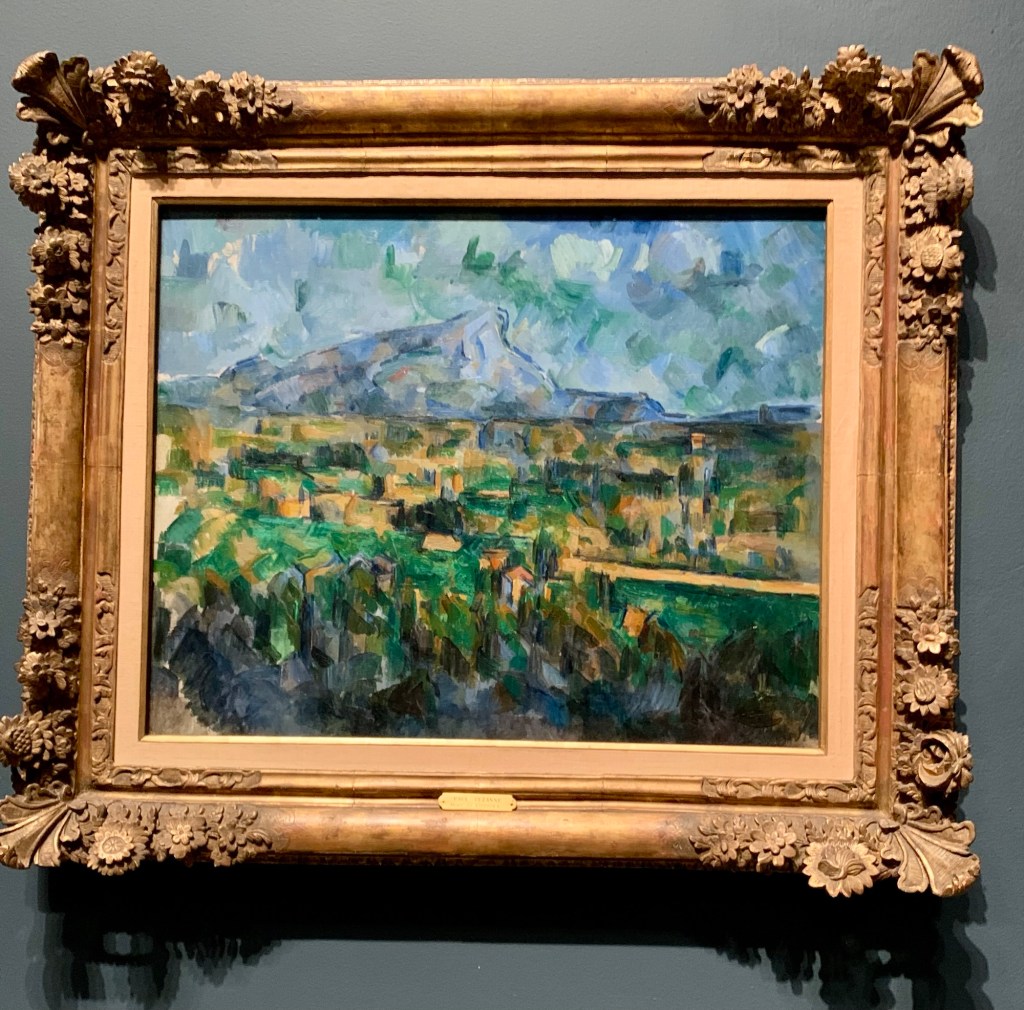
In a session of the Zollikon Seminars (May 1965), Heidegger introduces Cézanne’s landscape as a counterpoint of the hermeneutical circle of perception and calculative intuition. Heidegger writes quite succinctly: “For instance, a painting by Cézanne of Mont St. Victoire cannot be comprehended [erfassen] by calculation. Certainly, one could also conduct chemical research on such a picture. But if one would like to comprehend it as a work of art, one does not calculate, but sees it intuitively. Is the painting, therefore, something psychological, since we have just heard that the psychological is what can be comprehended intuitively? No, the painting is not something psychological. Obviously, the above-mentioned “simple principle” for distinguishing psyche and soma is not simple at all” [5]. This is so because for Heidegger the figure of the mountain (a figure among others) in Cézanne’s work is not the cause of the decision of painting; it is rather the ground (Grund) that orients a certain disposition towards the opening of any given form. One could say that the motif of the mountain is the ground that dispenses the relation to the excess or the inapparent while being entirely visible. 

As such, the activity of painting is not just a capacity or disposition that allows representation; on the contrary, the pictorial praxis qua praxis remains attached to the notion of truth as unconcealment and concealment in the hegemonic structure of Gestell and the objective sciences for which there is none. This allows to throw light into the rather underworked suggestion advanced by Badt that painting remains the last metaphysical activity of the arts, which does not presuppose understanding the “painterly” as a quality or autonomous sphere of human action, but rather an original gesture of presencing the non-presence, and in this way to remain in what I am willing to call the imperturbable.

It has been registered that at one point during the sessions at Le Thor, Heidegger also made the curious assertion that only Cézanne had taken a path towards thinking (in painting) similar to his own turning away from Western ontotheological dispensation into another beginning [6]. This might be because painting is neither the archaic residue of the human hand, nor the pictorial index of image; its fulfillment lies in the excessive proximity to truth that eternally reveals the permanence of the invisible. 

Notes 

1. Kurt Badt. The Art of Cezanne  (University of California Press, 1965), 181.

2. Hans Sedlmayr. Art in Crisis: The Lost Center (Transaction Publishers, 2007), 131.

3. Alberto Moreiras. Tiempo roto: vivir el antropoceno (Palinodia, 2024), 113.

4. Martin Heidegger. Four Seminars (Indiana University Press, 2003), 8.

5. Martin Heidegger. Zollikon Seminars (Northwestern University Press, 1987), 79.

6. Giorgio Agamben. Il tempo del pensiero (Giometti & Antonello, 2022), 57-60.

*Image: Mont Sainte-Victoire, by Paul Cézanne. Philadelphia Museum of Art. Photograph from personal archive.

Under a single statement: on Christopher Neve’s Immortal Thoughts: Late Style (2023). by Gerardo Muñoz

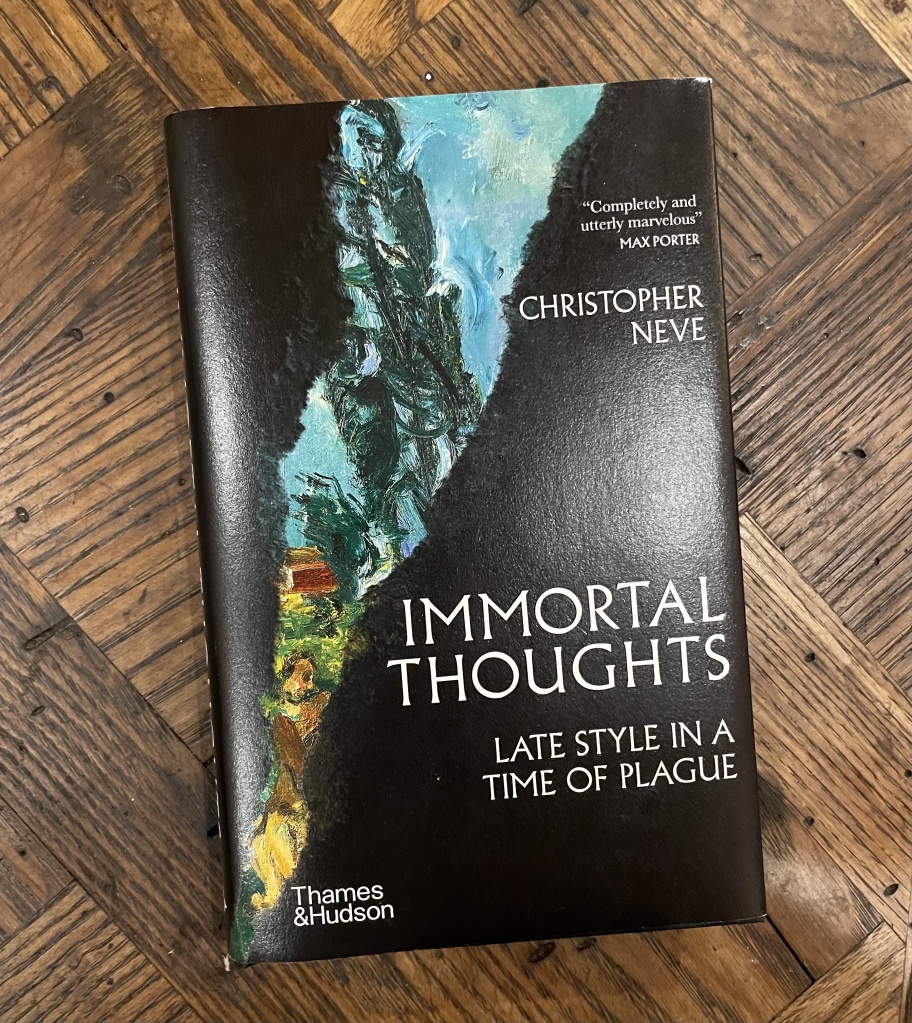
In his Immortal Thoughts: Late Style in a Time of Plague (Thames & Hudson, 2023), Christopher Neve ponders whether there is something like an “experience” of late style in painting. He immediately sets up himself to the task in the last works of great modern masters, from Cézanne to Soutine. The notion of “late style” can only be raised at the definitive end of the artist’s path. The old age style is an aspotilla no longer dependent on approval and excellence; it favors inner capacity and dexterity of seeing. This is why late style is, probably, always self-transformative: it poses the notion of work under erasure as it comes near the zenith of retraction. For Adorno late style registers the failure of synthesis as well as the force of dissociation in the permanence of the catastrophic. Neve will perhaps agree this much: painting is not about fixing temporality (the density of the history, the vulgarity of the contemporary, the monumentality of the past); rather what remains is the fugitive scene of depiction. If the question of “late style” is immensely difficult to raise, that is because it resists conceptualization: it merely seeks to denote achievement and the ruinous; appearance and retreat; unlearning schematics and producing “from life” itself, to put it with Poussin’s pictorial vocabulary. Late style is not about the moment of judgement and recapitulation – it is what depiction can achieve in the twilight of creative powers. As Goethe once defined old age: “Old age is gradual retreat from appearance”. But this retreat animates the space that had remained secluded in the order of temporal abstraction.

There is no theory (and there will never be) of late style of pictorial representation. It is a question that merits the weight of description – which Neve combines, quite successfully, with that of emblematic instances of the artists’ form of life. In other words, late style does not require conceptual renditions; it demands the elaboration of strong descriptions that can grasp the resonance of a fundamental ethos. Neve glosses Delacroix’s ethical imperative: ‘only in old age does a painter finally know what sort of artist he should have been all along’. In late style there is coming to conclusion because there is a path for homecoming. This ethical dimension of the artist is neither regulated by form nor by epistemological conditions. Late style implies a stripping away of things; it bares a specific nudity: it can reveal interiority (the invariant) without argumentative absorption. If anything else, it is the non-knowledge of the gesturing hand. Neve points calls this “statement” when offering a treatment of Rembrandt’s old age: “…technique and the process of getting older, and that this was somehow done all in one, summed up and expressed undeniable and in confidence of one blow and as a single statement. And I wished that all painting could be like this” (46). We suppose Neve’s desire as hyperbolic, since painting under a single statement also implies the moment when the picture approaches the abyss between the hand and the order of reality.

Painting gravitates towards a single statement when it surpasses life by taking death seriously. There is much truth in reminding that the work of art aspires to its bare lyrical moment of decline and unworking of itself – this was also Cézanne’s moment of “not being able to realize!”- in order to flee from the objective fixation of the “thisness of nature”. Painting assembles a transfigurative force against the temporal succession of the pro-duction of a specific work on a surface. As expressed by the old Pisarro from the window of his studio quoted by Neve: “A little more work before dying” (54). True, nothing else but painting mattered to Pisarro, as Neve reminds us. Now, does this mean that he is holding on to the unchanged and muted essence of things as a “metaphysical solace” in the face of the whirling of a world in chaos? Perhaps there is something to this suspicion that must be reckoned with – painting comes close to theological presuppositions insofar as creation unsettles a disenchanted world and its fictitious mimesis. Alas, this is a question not fully posed by Neve, but it is also one of the ways in which his book could travel without much effort. The question of immortality of a picture has a point of departure here. But is immortality conceivable as a form of solace and fallen piety? One should refuse to ask this question in the form of generality. The works Titian, Goya, Cézanne, the dreary and posthumous glory of Velázquez or the suffering Soutine during the Nazi occupation are all efforts to pose the problem of late style painting as the ethical attunement of each artist.

In the most elevated and charged moment of Neve’s efforts to grapple with the notion of style he recurs to Soutine (and it requires us to turn to the picture “Children playing at Champigny” from 1942): “What you are seeing, when Soutine paints the Auxerre trees, is what I think happens in the work of most of the artists I haven written about here. This storm of temperament is true painting, an inexplicable combination of seeing, feeling, memory, response, imagination, and profound oddness. And so he turns away in exhaustion” (122). Late style registers the collapse of a possible fulfillment with the world by indexing a detour to the point where realization seeks to “return to simplicity and order”. Truth indicates the literal thereness on the surface devoid of illusions. So, solace does not have the last word; this is not how a painting subsists under a single statement. And that accounts for the ultimate risk: the ethical presupposition of painting exposes the artist to the “terrible freedom” as the distance between the passions (temperament) and the gesture within profound disorder and arbitrariness of nature.


Someone like Carlo Levi will find himself at home: true freedom cannot begin by the suppression of the passions in the name of interests; rather, the burden of freedom is the caesura of passions that displaces the otherwise inexorable fear of civilizational progress. Painting as the event of truth dethrones fear as the primary attunement in reality. Through our emperament one finds the exit from alienation, gathering the moment of depiction into order. There is a gentleness of freedom in the mutual self-supporting carrying of things, as Kurt Badt saw in Cézanne’s old style. And this might be the tragic element of painting and its fundamental antinomy.

For Neve this means nothing shorter than “the world reduced to a series of prodigious impulses, the revelation of the inner intact, the change taken to see the universe in a new light at the risk of failing utterly” (130). Late style is what reveals inner intact to the fruition of exteriority – this is the compass of visibility. A failed world followed by decline – two terms where mythic transfiguration moves painting to the eccentric luminosity of altering the jarring relation with the world. Old style enacts a catastrophe that refuses the insolvency of pulsation that binds character to the harmony of form. One might add that it could very well be that painting is, as revealed in the abyssal caesura of a late style, a stated mystery: a passionate life that profoundly perturbs the world, a transcendence that falls into an irrevocable eternity.