The legend of modern political theology is well known, and it has received extensive research and documentation. Less so is the legend of the theology of the visible as it relates to the problem of liturgy. For some time now some of us have pondered on a curious historical coincidence: the fact that in 1922 Pavel Florenski and Carl Schmitt, two epigonal figures that confronted head on Western modernity with its theological substratum, wrote parallel texts with strong positions regarding the same problem. I am of course referring to “The liturgy as a synthesis of the arts” (1922), and Roman Catholicism and Political Form (1922). From the strictly philological point of view, even the genesis of these two programmatic texts have a parallel development that go back to 1918, as can be seen in Schmitt’s only theological text entitled “The visibility of the Church” and Florenski’s “The reverse perspective”.
Why would two distinct thinkers confront the theological-pictorial in this specific historical dispensation of Western secularization? And, why does liturgy in the early twentieth century become a central problem for thought well beyond the walls of the Church and its ministries? What are the relations and divergences between theologia and visibility in the wake of the rise of European nihilism? If we press on the year 1922, it begs to ask why the problem of the “synthesis of arts” – theology as nothing more than the visible and a mode of seeing, to put it in Florenski’s own words – becomes so medular in European thought; and, under what conditions this emerges, given that already since the time of Johannes Vermeer, as Gregor Weber and Daniel Arasse have studied, the theological was already a fundamental topological injunction of specular understanding. These are questions that we hope to elucidate by closely examining both texts side by side with the working hypothesis that the theos – not theology as a science of Church dogmatics, which has little interest in the wake of the death of the unitary God, heis theos – but rather as a topological or choratic expression of facticity, as well as mediation with the disclosure of the world.
Almost parallel to the developmental height of the autonomy of art, it seems that both Schmitt and Florenski sought to come to terms in their own ways with the lagging energy of a specific topos of the theological trace: liturgy. It is then our task while reading these texts to ask why did liturgy become the site of inscription necessary to render legible the mediation, and possible transfiguration, of the theological as a first order question for the West. If theologian Laurence Hemming in Worship as a Revelation: The Past Present and Future of Catholic Liturgy (2008) is correct in saying that our age sees everything in terms of manufacture and efficacy mimicking the notion of “sacred worship” in liturgy, it becomes necessary for us today to understand the theological assumptions, as well of the possibilities, of the theos and the mystery at the very granular level of desecularization.
We thus propose a minor pictorial-theological legend of 1922 between Florenski and Schmitt – that is also that of the proximity and separation between East and West, theology and the pictorial, the visible and the invisible, revelation and authority – that could shed light on some of these concerns that continue to nourish discussions that have yet to find its proper treatment and productive assessment.
*
*This short text is meant as a working hypothesis for a forthcoming reading / study on Florenski/Schmitt and the question of the pictorial and liturgy set to begin in November 2025.
Almost at the end of the Cold War, arguably the most important natural law jurist of the West, John Finnis, published a very acrimonious and provocative essay in dialogue with the Christian theological morality and dogmatic tradition entitled “Nuclear Deterrence and the End of Christendom” (1988). In many respects, this essay speaks volumes to our present, but it also solicits new questions around limits that have been severely traspassed in the current atomic age headed towards extinction. It is worth noting that from the outset, Finnis reminds us how a fellow Catholic liberal theologian, Jacques Maritain in a lecture of 1955, claimed with surprising conviction that “America is today the area in the world in which…the notion of Christian-inspired civilization is more part of the national heritage than any other spot-on earth. If there is any hope for the sprouting of a new Christendom in the modern world, it is in America…” [1]. If this sounds completely analogous to the current program of “national conservatism” that today animates American political elites, defined by the ruthless attempt at the convergence of instrumental Christian vocation and political imperium, it is because these prophetic words have been thoroughly realized.
Finnis does not hesitate to put his thumb on the theological monstrosity maintained by Maritain at mid century – although he does not say it explicitly, it is a concrete restitution of imperial Eusebianism decades before denounced by Erik Peterson in his famous essay on political monotheism – that by accepting nuclear deterrence as a form of uncontested ‘minor evil’ in face of the Soviet menace Christians were endorsing heretic positions at odds with the teachings of the Second Vatican Council. As Finnis argues, the logical structure itself of nuclear deterrence, precisely due to its affirmative promise to exclude “target populations”, fails to differentiate between combatants and non-combatants in an endgame that promises the potential massacre of innocent human beings [2]. This means, first and foremost, that nuclear deterrence (as well as its new preventive forms that have become normalized among global hegemonic powers) terrorize human communities as a direct public act of forthcoming devastation [3].
Even though Finnis does not stop to reflect about the notion of “public act”, it is very clear that this action, insofar as it is a linguistic act, aims at the effective cancellation of the possibilities of language and communication. Nuclear deterrence and proliferation are instruments that speak publicly, and that by doing so, it contributes to the atrophy of human language. As a rebuttal to Maritain’s celebratory artificial gnosis, Finnis sees in the language of nuclear deterrence coincides with the language of ‘utopia’ as a new absolutization of morality. This means that Maritain’s philosophical error – which Finnis calls the “theologian’s position”, since it also implicates an official sector of the Church – is to abandon practical reason of allocated goods (including human life) in the name of a comprehensive aim of building a civilizational “Christendom” coupled in a national community [3]. But whoever fully identifies the spiritual-providential realm with the political-legislative order is already at the mercy of an utopian project embedded in the sacrificial structure promoted by nuclear deterrence.
Towards the end of his essay, Finnis laments (implicitly repeating Karl Barth’s well-known 1930s essay but in an opposite direction) that the relationship between Church and State from the point of view of the atomic age and nuclear deterrence has now been completely altered. From now on, the atomic age demands a Christian vocation based on conscience. Specifically, Finnis calls for a position of refusal and minoritarian observance against the general options of radical evil: “The choice to reverence human life by refusing to participate in public choices to destroy it, is thus a choice is material of the Kingdom and has real and truly lasting effects…even when worldly wisdoms understand it only as a choice of greater evil’ [4]. And citing Cardinal Ratzinger, Finnis endorses the position of Christians as “belonging to a minority” finding courage in nonconformity within the normative order of social space [5]. The Finnis-Ratzinger’s position was still oriented by a Catholic commitment to dogmatics and public reason and virtue, which depends on the luminosity of the subject of religion.
But the objection of conscience is a subjective reduction of modern secularization. In this sense, it might be pertinent to compare Finnis’ position to Ivan Illich’s own stance in the wake of nuclear testing in Germany in the 1980s, which he witnessed in “horrified silence…in order to make the horror visible” [6]. For Illich, who had come to see the triumph of civilizational mysterium iniquitatis in the institutional deformity of the conspiratio of the human species towards controlled subjectivity (conjutario) amounting to “intolerable realities”. The language of Christian prophecy is not the same as the language of silence, because only in the second we can become witnesses through the voice of pain and experience, because pain can uplift a contact with the world without redemption. As Illich made clear in his text “The Eloquence of Silence”, it is through the condition of silence that the word can become flesh and prepare a new life. It is very telling that in a later footnote to the essay in the 2011 edition, Finnis appears doubtful about the religious ground stating that: “Over twenty years later, the unsatisfactory state of Catholic teaching on the matter remains just as it was in 1988” [7]. What changed? At the end of the eighteenth century Novalis had noted that for any orientation of public reason in the West to materialize there needs to be a substrate of the divine mystery, but this is precisely the substrate that desecularization has effectively untied and obliterated from the public. A public where general annihilation percolates without restraints.
.
.
Notes
1. John Finnis. “Nuclear Deterrence and the End of Christendom” (1988), in Religion and Public Reasons, Collected Essays: Volume V (Oxford University Press, 2011),
2. Ibid., 280.
3. Ibid., 286-287.
4. Ibid., 288.
5. Ibid., 289.
6. David Cayley. Ivan Illich: An Intellectual Journal (The Penn State University Press, 2021), 80.
7. John Finnis. “Nuclear Deterrence and the End of Christendom” (1988), 290.
In his war diary Seven days on the roads of France June 1940 (2012), which recounts his itinerant vicissitudes in occupied France, the Russian theologian Vladimir Lossky makes an explicit case for the emergence of a third way beyond conservation and destruction, and its modern ideological avatars that led astray into the modern catastrophe; that is, the social revolution and conservative reaction cloaked under “traditionalism”. As it has been recently glossed, Lossky was not the only person from the East to be preoccupied with putting a halt to the eternal dialectical movement of destruction and conservation only fueling historical abstraction. Indeed, immediately in wake of the Russian Revolution, the poet Alexander Blok, in an epistolary exchange with Vladimir Mayakovsky, and anticipating the bewildering enthusiasm of the revolutionary energy, also demanded an effective exit from servitude so that “a third thing appears, equally dissimilar to construction and destruction” [1]. It matters little whether Lossky knew about Blok’s “third figure”, although it is at the same time impossible not to have it in mind when reading his own annotation in the June 16th entry of his diary, which does seem to offer a answer to Blok’s proposal:
“Nonetheless, revolutionaries are always in the wrong since, in their juvenile fervour for everything new, in their hopes for a better and a way of life built on justice they always base themselves on theories that are abstract and artificial, making a clean sweep of living tradition, which is after all, founded on the experience of centuries. Conservatives are always wrong, too…for in their desire to preservice ancient institutions that have withstood the test of time, they destroy the necessity of renewal and man’s yearning for a better way of life. Is there, then, a third way? Another destiny for society than of always being subject to the threat of revolutions which destroy life, or reactionary attitudes which mummify it? Or is this the inevitable fate of all terrestrial cities, the nature of their existence? In fact, only in the Church can we find both a Tradition that knows no revolution and at the same time, the impetus towards a new life that has no end. Which is why she is in possession of those infinite resources upon which may draw all who are called to govern the perishable cities of this world” [2].
It is no surprise that for both Blok and Lossky, the fundamental tension in the amphibology between conservation and rupture rests on the problem of “tradition”; given that, as Blok had also eloquently written in his letter to his fellow poet: “a breach with traditions is a tradition”. This is something that an artist like Kazimir Malevich understood well in his programmatic text about museums in the wake of the revolution (“On the Museum”, 1919): the turn into ashes of all the works of art altered their aura, but it left in place the topological frame and it still produced an image; in order words, the destructive artworks still demanded a museological space for storage, thus enacting new principles of the triumphant revolution. Understood in this sense, tradition is merely the retroactive accumulation of practices by the archē that orients its development retroactively from the point of view of the present with provisions towards the administration of the future. But, how did Lossky understand by the notion of “Tradition”? Rereading the fragment of his war diary entry, it would seem that this notion merely rests on the dogmatic transformations within the Church, and in this sense, a conceptual elucidation similar to the doctrinal exegesis not very different from John Henry Newman’s An essay on the development of Christian doctrine (1845). However, in his important essay “Tradition and Traditions”, Lossky attempts at defining the site and tension of the tradition, which he notes that in the language of theology it has been a term left vague and repeatedly undefined [3]. Lossky writes with sharp precision: “Tradition sometimes receives that of a teaching kept secret, not divulged, lest the mystery be profaned by the uninitiate” [4]. Thus, Tradition is the positive and textual scripture that registers the Word, but it is not exhausted in the positive scriptural authority.
At the heart of Lossky’s argumentation about the theological meaning of Tradition, is the fact that it exceeds both textual sources and narrative mastery and transmission. In fact, the theology garment of Tradition belongs to the mystery of revelation shared in conspiracy, rumors or whispers [5]. And although, in his essay Lossky reaffirms himself that Tradition is the invisible intertwined with the Church – what keeps the “critical spirit of the institution” for the incorporation of new dogmatic definitions – it is nonetheless important to note that for the theologian, Tradition as “opposed to the reality of the word, it would be necessary to say that Tradition is Silence” [6]. In this sense, Tradition is that which is created and transmitted but that no one has the right nor the authority to speak through its incommunicable name. Is Tradition transmitted at all? If it is not through the written word, how can there be any continuity? This is the ultimate lacuna of the theological underpinning of Tradition for Lossky: Tradition can only be properly understood as the crafting of a “unique mode of receiving truth”; in order words, it names the contact between revelation and the witness who receives its ‘fullness of knowledge’, which far from mastering the totality, it points to “the external limit…the narrow door which leads to the knowledge of Truth” [7]. As Monica Ferrando has recently glossed from Plato’s philosophical corpus, any robust conception of Tradition should be understood as that which maintains an absolute inseparability between wonder and salvation, as well as bridging invention and received grace (charîs) [8]. One step at a time, we invent traditions whenever we are thinking through the abyss that separates our language from the inheritance bestowed upon us. Tradition moves in every ethical position of thought overcoming the pseudo-authorization of alienated and metaphorical knowledge of the past.
But if the Church is no longer the institutional site for the keeping of the impossibility of the transmission and renewal of Tradition and revealed Truth – subsumed to the mysterium iniquitatis that works against the possibility of the rendition of the eternal life of a permanent vita nova – it entails that one can still hold on to Lossky’s assertion that the task is to be attentive to the ossified expressions and reified appearances of Truth against the “living Spirit of Truth”. Hence, to insist on the restitution of the Church in our current predicament, would place us on the side of instrumentalized and subject-oriented salvation that turns away from the active kingdom that is the only passage from the world of the living to that of the dead. The traditionalists or integralists are incompetent representatives of the Tradition in this sense: as Von Balthasar once argued, they lack the humor and contact with the invisible to apprehend the mystery that arrives without solicitation, as pure depotentialization [9]. In a godless world of the secularized gnosis of political force – that is, after the fleeing of the gods – perhaps theology could only be understood as the path of Tradition of uncountable wonders and the event of speech that produces an unworldly sensation within this world. Tradition brings the world beyond its shape and legibility. In this sense, we are always participants of Truth that the world cannot retain, and thus keepers of an enduring secret that will ineluctably outlive us.
Victoria Cirlot’s vibrant short book, Taüll: liturgia y visión en los ábsides románicos catalanes (Mudito&Co, 2023) focuses on the well-known apse fresco panels of the Romanesque Saint Climent Church (Lleida) dating back to the twelfth century now housed in the Museo Nacional de Arte de Catalunya (MNAC), whose central figure is a Maesteis domini elevated to representation of the highest celestial cosmos. In another sense, Taüll should also be read (and perhaps the obligatory accent here is necessary) as a synthesis of Cirlot’s own work on the theological infusion of visuality and what it means to “see” and “being seeing” in a world that strives for legibility. Cirlot has no ‘presentist’ anxieties about the Romanesque period – its iconographic and overtly enigmatic depiction – but it is not difficult to think of the Christian temple as an aesthetic laboratory, or artist studio, in which the liturgical dimension functioned not much so much as a private space for the faithful, but rather as a site of encounters and vital experience (Cirlot 11).
The liturgical performance depended on visual arrangement that opened visions of the inner sense, which Cirlot quoting Saint Augustine calls acies anime — transcendence through a sensible awakening that encompassed all the senses. Following Pavel Floresnky in his study about the Church as the synthesis of the arts, Cirlot attempts to portray the impossible experience at Tüll as the site of the life of the spirit; that is, where the spirit is transformed and released (Cirlot 12). Before there is acclamation and synthesis, there is an unfathomable experience facilitated by the liturgical imagery which is a passage or a preparation of sorts.
It is almost impossible for us today – situated at the threshold of the autonomization of the arts and the division of its practices – to grasp the antecedent image (imago) through figures of what will only later be seen. Cirlot quotes Saint Paul to anchor this difficult chiasmatic movement of veiling-unveiling: “Now we see through a mirror, an enigma, but later we will see face to face (Cor.1.13) (Cirlot 22). Is the pictorial unveiling, or rather veiling, the juxtaposition of the image in space what will ultimately solve the enigma of unmediated appearance? And could appearance be released without its dependence on the mystery that prescribes the image making and destruction well into the totalization of modern pseudos at the art of depiction? There are conscious echos of Carchia’s thinking (in my reading of Cirlot, that is), which I think help to grant a bit more breathing space, as it were, to Cirlot’s unelaborated suggestion that “Pero la pintura es el fruto, no de una percepción sensible, sino del ojo visualiza eso que tiene que ser despertado en la interacción de los sentidos físicos” (Cirlot 23).
To paint, or the painterly activity, is the gathering of an inner vision, where there is no more separation between the autonomous senses (visions, touch, flavor). Cirlot notes how the detailing of the querubin angel having small eyes painting on their hands would confirm this thesis. The movement of the hands registers a vision that touches the proximity of the specular Glory of transcendence. Following Henry Corbin, Cirlot can remind us that the angel for the mystical tradition is an entity whose “being is only vision” (Cirlot 28). In turn, the all-seeing angel is not a bird’s view (I guess today we will also say a drone commanded from a computing application) that has total vision over the terrestrial grid; it is more a vision that is able to see each thing — given that his divine vision he can see God in everything, and things in themselves because the painterly eye can only look outwards through the inner eye of the heart (Cirlot 38). In fact, the heart’s eye is a retreat from the world of countable and visual things, as transcendence becomes the mere contact of the senses with the divine.
Part of the difficulty of grasping what is taking place at the Saint Climent of Taüll apse resides in a gesture that is the inversion of pictorial verisimilitude, if one is to take up Michael Fried’s thesis in Absorption and Theatricality (1980) as a reduction of disenchanted pictorial representation. In other words, the pictorial manifestation at Tüll is neither theatrical nor figural absorption for the spectators, but it was rather an experience with the liturgical mystery that strived in the liberation of the soul at the uncharted height of God itself (Cirlot 40). And perhaps of being a mode, among many, with the presence of God in things, and things and names as already expressing the unavowable nature of the divine. Cirlot’s thesis gains traction and depth at this point, since the central task of pictorial creation at Tüll is to find the means of granting visible to what must remain invisible (the Holy Trinity and the Eucharist mysterium) that breaks away from the implementation of imitatio naturae (Cirlot 44). This also speaks as to why Cirlot, with prudential reasons, never speaks of an aesthetic sublime that this pictorial commitment with the theos and experience clearly appears to reject. In the sublime construction, sense has been subordinated to the negative position, by which the return of representation will reveal itself in its erasure.
The seemingly absorptive theatricality does not stand up to the highest music of the aspirations at Tüll. Once again Florensky appears as a central interpretive key for Cirlot: the iconomic and atmospheric opening of Romanesque art frees contemplation to a degree in which vision and the outside of life entangle to such a degree that no autonomization of the ‘aesthetic experience’ can formalize the sensorial gathering of the invisible upwards where “el alma no podía descansar”, or where the soul knows no rest. One can also recall Kurt Badt when writing about Constable meteorological landscape: such opening in the picture is the true organ of sentiment. But “that world is long gone” – the world of visual liturgical at Taüll – concludes Cirlot, and something similar could be said of the practice of painting. The minimal lesson at Taüll is as simple as it is difficult: any access to the world today requires to divest from the hand of technē so that the hand of pictura can take hold of the fleeting mystery of a life experienced. Such is the enduring vital vision at Taüll.
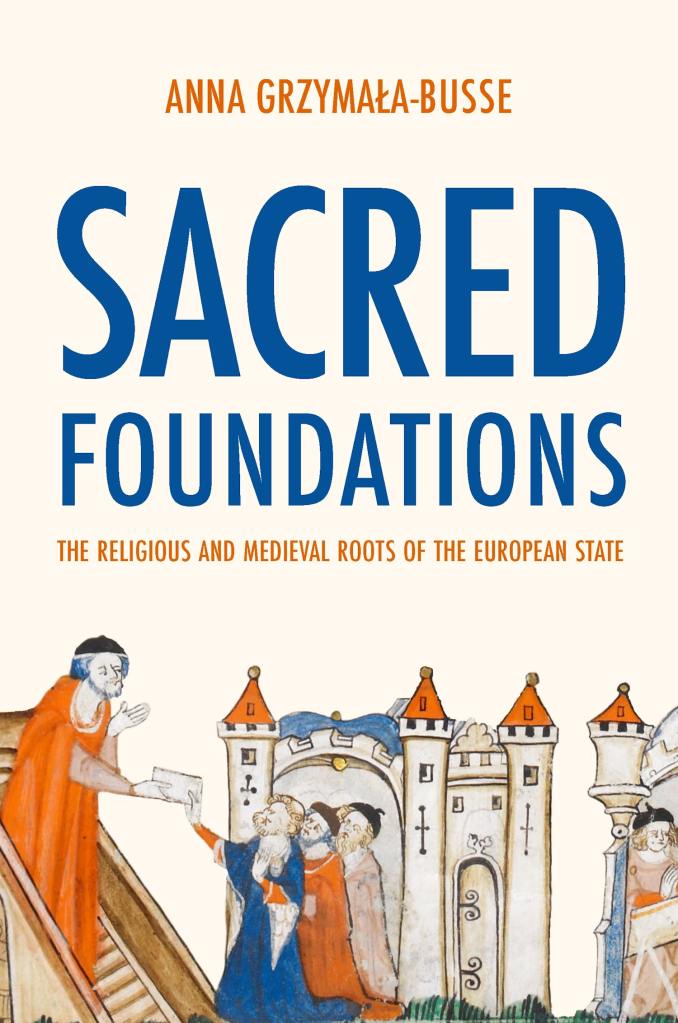
Anna Grzymala-Busse’s recent study Sacred Foundations: The Religious and Medieval Roots of the Modern State (Princeton U Press, 2023) makes a compelling historical and data analysis grounded case for the emergence of the modern state through the process of the Church’s autonomization in its ongoing disputes with the European monarchs across the centuries. This process of the secularization of ecclesiastical forms (conciliarism, legal administration, the uniformity of procedures, rules for governing institutions, the emergence of educational training and mechanisms for political representation and fiscal control, etc), however, is silent about two defining features of the modern secular state. And I do not think it is an exaggeration to say that these two elements bring forth the way in which political authority was established after the victory of modern European Enlightenment. Busse’s book, if anything, has the felicity of putting in perspective, even if only in negative, the two pieces of the puzzle: a) coercion as guarantee by a legal process (not just the monopoly of force); b) and the inter-institutional coordination that we tend to associate with a ‘principle of an internal rule of recognition’ between different spheres of bureaucratic rationality. Busse admits for (a) that “….the authority of the people over the whole Church was not statelike. It depends on moral authority and influence, not on coercive control. Both kings and popes cajoled, convinced, and threatened rather than demanded or extracted force” (Busse, 78). But ruling on morality and influence are two weak presuppositions to guarantee systemic, homogeneous and uniform process required by institutional authority.
In other words, the Church was able to construct forms of civil mediations, although it lacked the power of efficacy; that is, a coherent set of reasons for action that would define a strong concept of sovereign authority as service (to put it in Raz’s well-known formulation). The classical apothegm by which ‘kings rule rule but do not govern’ (Rex regnat sed non gubernat) now is protracted by the exercise of an efficacious rule, which means laying out a combination of forms and a well-ordered power over coercive forms. In fact, this is one feature that will define the legitimacy of the Enlightenment according to historian Franco Venturi; the discovery of punishment understood within the scheme of a trade off between the “necessity of the right to punish when man was not able to re-establish communism” [1]. Hence, the genesis of modern legitimation is not exclusively “a given” vis-a-vis the structure of separation of powers and the ultimate source of the plenitudo potestatis; rather, it requires a second-step rule, as it were, to convalidate the specificity of institutional authority with ample concrete efficacy of police powers in charge of compliance and punishment. The reach and exercise of public police powers and the systematic ordering of penal codes through a criminal procedure and its guarantees (reasonable doubt, fair trial and due process, no crime published without a previous enacted law, nullum crimen sine lege) is what renders effective and “energic” the principle of authority.
Now, broadly speaking, when it comes to (b) Busse admits that (and this is in spite of its institutional schemes) laying down justice “…the church relied on secular enforcement, for example when it came to religious orthodoxy. […] The carrying out of sentences against heretics and apostates lay in secular hands – those found guilty were handed over the temporal authorities so as to not sully the clergy. Legal coevolution and influence, the struggles between popes and monarchs, and the diffusion of both canon law and personnel into the juridical systems were critical to the rise of constitutionalism and the rule of law in Europe” (Busse, 132-133). This asymmetry between two systems of legal jurisdiction confirm the inexistence of a strong internal rule of recognition that for H.L.A. Hart defines any robust modern legal system of public law. The internal rule of recognition, one must remember, is not a set of principles or norms for social action, but rather the internal mediation between a legislative authority and its internal obedience within a concrete application thereof. The internal rule of recognition binds a central authority with its specific formal enforcement in institutional union of primary rules and secondary rules to avoid the pathology of uncertainty. This is thoroughly absent from the free-floating institutional forms of the medieval church whose principal construction of primary rules was divorced from the objective and rational procedures of its internal coherence (the rule of recognition) that would ground, in time and place, the otherwise abstract primary norm and the pressure of contested social conflict.
But going straight to the crux of the matter, it follows that medieval templates as superbly redrawn in Busse’s studies lack the two fundamental determinations that ground the modern concept of law: law as the necessarily monopoly over coercion (the Austin thesis), and the concept of law as the construction of an internal rule of recognition to unite primary and secondary rules (the Hart thesis). But insofar as all major modern political concepts and mediations are secularized forms of religious and medieval forms – something we can say that Busse’s scholarship also confirms – we can then say that modern legitimacy will consist in the congruence of these two determinations to organize the mediations between civil society and state. Already in his early The value of the state and the significance of the individual (1914), Carl Schmitt will note of this formal transplant: “…the Catholic doctrine of the Pope as the infallible interpreter of the natural moral law and of the content of revelation, who receives the competence to declare state statutes that stand in contradiction with the moral law or ius divino-naturale to be non-obligatory in conscience. The exercise of his potestas indirecta which is regarded as an act of jurisdiction, and which is held, by many canonists, to be determinative of a statute’s validity in state law – contains real vis coactiva, even where the expression potestas directiva is employed in place of potestas indirecta (Suárez, de fide cath, 3.22.1)” [2].
For Schmitt, then, the process of rationalization between ecclesiastical form and the modern legal norms of the state is very much straightforward. This is what constitutes the very texture of secular modernity. But as we know, for Schmitt the secularization of forms was not enough – it must be said that he himself did not negate in his theory of adjudication of his constitutional thought – which is why the construction parameters of his ‘political theology’ proposes supplemental safeguards to isolate law and power, extending the power of secularization into the decision of the potentia dei asoluta (at times this was contained in the theological figure of the Katechon) [3]. But as Carlo Galli has noted, Schmitt’s political theology is far from a “political christology” or a substantive theological politics grounded in natural law; rather it is a resolute affirmation to defend any concrete order from the potential fallouts of the secularized cornerstones of rational neutralization (potentia directiva and potestas coactivva) of state authority [4]. Neither mechanic state forms nor a higher source of morality (natural law) would define the modern law; rather the autonomy of the political in the existential situation could provide the sufficient energy to avoid the self-defeating circularity of ius revolutionis (this is what most of the times is obliterated from the so called question of “decisionism”)[5]. If Busse is correct in making the case that all modern institutions have sacred medieval foundations; Schmitt’s concurrence in the wake of modern secularization will be to define the energy of the political as the defining element that must stand as the threshold of formal transplantations to have a chance within nihilism and against nihilism. It is both things. In other words, formlessness is the constitutive dimension of political forms; an element that defines, in my view at least, the strongest practical element of what it is to inherit a Christian political foundation. The process of secularization is thus infinite and groundless, ultimately without a moral foundation and universal design. Among its many achievements, a book like Sacred Foundations: The Religious and Medieval Roots of the Modern State (Princeton U Press, 2023) has the ability to refine what political theology is, what it meant, and what to make of its endurance and possible iterations in our present.
.
.
Notas
1. Franco Venturi. Utopia and Reform in the Enlightenment (Cambridge University Press, 1971), 116.
2. Carl Schmitt. The value of the state and the significance of the individual, in Carl Schmitt’s Early Legal-Theoretical Writings (Cambridge University Press, 2022), eds. Zeitlin & Vinx, 215.
In his chapter on the radical theology of abundance and ethics of Karl Barth, Mårten Björk discloses a central concept to the reformist theologian: the suum cuique, a term that prima facie could be rendered in natural law definition of legal justice, inherited from Roman lawyer Ulpian, as “may all get their due”. In the thomist tradition the legal notion of epikeia promptly became equity as the moral supervision of law’s principle (ius) understood as the application of the fair and the objective good. The justification of the balancing of aequum became a regulatory mediation on the grounds of a fictive principle of nature as moral reasoning, which has been well documented by Stephen Humphreys [1]. What makes Barth’s drawing on the notion of suum cuique in his interwar pamphlet Church and State (originally entitled Justification and Law, 1938), on the contrary, is precisely that it is not reducible to equity, but rather as Björk explains it: “the limit to our life, a limit brought forth by death itself, is in the end the vast chams that posits the creature as create of God…and this has ethical and political consequences” [2]. This is telling, and my aim here is to supplement the discussion in “Abundance and Scarcity” by showing its radical asymmetry with the reasonableness of the natural law. Barth’s anti-activist Church (although not neutral in the wake of the total state of the 30s) and apathy towards morality, stands as a sui generis bearing.
First, in the moral natural law tradition of equity (epikeia) “giving each one their due” becomes a strict legal-authoritative command principle on the reasonableness of nature centered on the ontology of the person. It is quite the opposite for Barth who does not favor a constant moral adjudication, since the separation between Church and State presupposes a previous divine justification that belongs exclusively to the Church, but not to the state. In fact, law practiced on the condition of natural principles will undermine the authority of the liberal positivist state, which Barth defends vehemently, making the case for its coherence with the teachings of the New Testament: “The democratic conception of the state is justifiable expansion of the of the New Testament…Christians must not only endure the earthly state but they must will it as a just state, not as a “Pilate” state” [3]. It is not surprising, then, that Barth wrote this tract openly defending the authority of the modern positivist state, contrasting it to the anti-statist unjust pretarian judgement of the trial of Jesus. This makes sense given that the pretorian ius honorarium could be understood, at least in part, as belonging to the tradition of the moral balancing of equity between morality and norms (just as the two irreducible kingdoms) [4]. Barth’s defense of the positivist state is even contrasted to natural law, which for Barth is incommensurable with the word of God: “We cannot measure what law is [in the State] by any idea of natural law…” [5].
Accepting the primacy of the equity of a substantive bonum will not only serve to override the authority of the state, but also, and more importantly, to flatten out theology’s monopoly over divine justification. At this point Barth is quite explicitly in saying that this is what took place – and I think he is correct, specially if we take into account that the degenerate legality in Nazi Germany and Stalinist Russia was not an abuse of positivism, but a consequence of the open-ended common and natural law principles to the point of distortion – in the wake of fascism and Bolshevism in the interwar years of Europe. Barth writes with this in mind against artificial heavens on earth, as part of a hyperbolic “politicizing from above”:
“Fascism and Bolshevism alike will be dethroned and the true order of human affairs will arise. Not as heaven (not even a miniature heaven) on earth! No, this “true order” will be able to arise only upon this earth and within the present age, but this will take the place really and truly, already upon this earth, and this present age, in this world of sin and sinners…this is what the Church has to offer to the state…” [6].
The political domination of the total state amounted to a conflation between the lapsarian condition of man and the theology of eternal life. The passage or mediation between the two dimensions, which he also described as a “tailor made garment” was the suum cuique, understood as a limit to life and death beyond morality and biological reductions. Barth insisted on the principle of separation in face of every temptation of technico-rational closures. Thus, by externalizing divine justification to the sphere of theological eternity, Barth’s conception of “giving one’s due” was radically disambiguated from the Nazi motto “Jedem das Seine” (to each his own) in the concentration camp of Buchenwald in 1937, made possible by the opened force of common law adjudication against the state positivist authority (understood by Nazi legal scholars as “too Jewish”). This was the barbaric dereliction of duty of the state becoming what Barth called a “clerical state” [7]. Barth’s ethical limit on finite and eternal life, so well reconstructed in Björk’s brilliant monograph, can only be a witness to a ‘world passeth away’ to which no priestly jurists have the last word unless catastrophic consequences are expected. The ethical response to the lapsarian condition was a radical drift from the dangers of natural absolute rationalism that was directly implicated in the arousal of immanent powers and the reduction of the population as mere administration of doctrine of last things through consciousness and not grace. The suum cuique introduced a radical exteriority in which all men became “strangers” (to the Church, national identity, the community, to the social) whose proper involvement pertained to the eternal mystery of life and death.
.
.
Notes
1. Stephen Humphreys. “Equity before ‘Equity’”, Modern Law Review, 2022, 1-37.
2. Mårten Björk. The politics of immortality in Rosenzweig, Barth, and Goldberg: Theology and Resistance Between 1914-1945 (Bloomsbury, 2022), 115.
3. Karl Barth. “Church and State”, in Community, State, and Church (Anchor Books, 1960), 146.
The conservative Spanish political theorist Jesus Fueyo used to say that given that politics is not strictly a science, it always requires an attitude to vest the political. This holds true especially for the reactionary tradition given their sharp and distinctive rhetorical style, which at times it can outweigh the substantive orientation of its principles, doctrines, and immediate commitments. The attitude towards the political defines and frames the energy of the political, and it helps to define a politonomy, or the laws of its political conception. This is particularly relevant in Joseph De Maistre’s work, who doctrinally was a monarchist, legitimist, and, if we are to take Isaiah Berlin’s words, also a dogmatic precursor of fascism [1]. For a classical liberal like Berlin, De Maistre’s critique of liberalism all things considered (contractualism, deism, separation of powers, public deliberation, and individual civil liberties) amounted to a fascist threat. This reading crosses the line towards doctrinal and substance but it says little about its politonomy. On the contrary, what surprises (even today, as I was rereading some of his works) about De Maistre is the recurrent emphases on political autonomy, which automatically puts him in the modernist camp against doctrinal theologians and otherworldly moralists who do not truly classify as counterrevolutionaries. But insofar as the counterrevolution presupposes the revolutionary event, we are inhabiting the modern epoch. Furthermore, and as Francis Oakley has shown, even De Maistre’s classical ultramontane book The Pope (1819) emphases the authority of the pope against history, tradition, and the conciliarist structure of the Church [2]. In this sense, De Maistre taken politonomically is no different from Hamilton’s energetic executive or the sovereign decisionism that put an end to the confessional state.
In fact, De Maistre’ conception of politics measures itself against a “metaphysics of politics” which he links to German universality of the modern subject and Protestantism. Against all ideal types, for De Maistre politics is always best understood as politonomy; that is, a second order political authority that validates itself against the insecurity, unpredictability, and radical disorder of the modern revolutionary times [3]. For the counterrevolutionary position to take hold, the volatile modern reality of the political needs first to be accepted as well as the positivist emergence of modern constitutionalism. Indeed, De Maistre’s critique of written constitutions in the “Essay on the Generative Principle of Political Constitutions” is leveled against the assumption that text is all there is to preserve order and institutional arrangement.
De Maistre argues that there is also an unwritten dimension that functions to preserve authority and genealogical force of the political regarding who has the last word in all matters of public decisions (something not too strange in contemporary jurisprudence). Of course the function of the unwritten for De Maistre has a divine origine but its assignment is to control the proliferation of discussion that weakens institutional authority, thus pouring a war over the meaning of words (this was the same problem that Hobbes confronted regarding interpretation). De Maistre’s attack against textualism and incredulity of the written text of positive law was exerted in the name of a defense of a sovereign transcendence as the sole guardian of the institutional stability [4]. This is why De Maistre defends a combination of traditional unwritten Common Law with sovereign rule guarding institutional continuity. The politonomic condition elucidates that institutional arrangement is proper to a concrete order, and not doctrinally about the Church regarding secular temporal matters. This is why the Pope enjoys sovereign immunity from the doctrinal production of the Church that allows for the emerge of politonomy.
In a way this becomes even more obvious from what at first appears as De Maistre’s most controversial and antimodern treatise Letters on the Spanish Inquisition, where he takes neither the role of the theologian nor of Hispanic monarchic providence, but rather that of modern autonomy of the political conditioned by civil power: “…any great political disorder – any attack against the body of the state – be prevented or repelled by the adoption of energetic means” [5]. Notwithstanding the different ends, this is not very different from The Federalist’s conception of executive power as energetic for second order of institutional threats. What’s more, emptying all christological substances of the Inquisition, De Maistre defines its practice from a politonomical viewpoint: “The Inquisition in its origin was an institution demanded and reestablished by the King of Spain, under very difficult and extraordinary circumstances…under control, not of the priesthood, but of the civil and royal authority” [6]. For De Maistre even a religious and clearly antimodern institution like the Inquisition was a first a political institution that was required to obey the “lawful and written will of the Sovereign” [7].
This polarity also attests to De Maistre’s politonomy: in a context where positive sola scriptura triumphed, he recommended the internal genealogical control and sovereign decisionism; whereas in monarchical Spain where no revolution had taken place, the Inquisition had to respond to norms, written laws, and civil power. This could explain at least two things: on the one hand, why De Maistre’s political philosophy was discarded and regarded with suspicious by Hispanic royalists and Carlists; and secondly, why De Maistre understood political economy in his text on commerce and state regulation regarding grain trade in Geneva [8]. Here one can see how the structure of politonomy aims at regulating the constant friction of norm and the exception in a specific institutional arrangements. To return to our starting point: the reactive attitude towards subjective politics was also modern insofar as it breaks radically with the classical view of politics that understood itself as oriented towards the good, the virtuous, and equity balancing (epikeia). If modern politics opens as an abyssal fracture, then politonomy is always the management of a catastrophic, fallen, and demonic dimension of politics. Thoroughly consistent with the dialectic of the modern epoch and its oppositorum, politics becomes destiny precisely because religious sacrifice has ceased to guarantee social order in the temporal kingdom. Politonomy emergences as the formal science of the second-best; that is, an effective way, by all means necessary, of administrating aversion given that “sovereignty is always taken and never given” [9].
.
.
Notes
1. Isaiah Berlin. “Joseph De Maistre and the Origins of Fascism”, in The Crooked Timber of Humanity (Princeton U Press, 1990), 91.
2. Francis Oakley. The Conciliarist Tradition Constitutionalism in the Catholic Church (Oxford U Press, 2003). 201.
3. Joseph De Maistre. “Essay on the Generative Principle of Political Constitutions and Other Human Institutions”, in Major Works, Vol.1 (Imperium Press, 2021). 4.
4. Ibid., 42-43.
5. Joseph De Maistre. On the Spanish Inquisition (Imperium Press, 2022). 6
6. Ibid., 18.
7. Ibid., 49.
8. Joseph de Maistre. “Report on the commerce of grain between Carauge and Geneva”, in The More Moderate Side of Joseph de Maistre (McGill Queen U Press, 2005), 230.
9. Joseph de Maistre. St. Petersburg Dialogues (McGill Queen U Press, 1993), 263.




 Infrapolitical Reflections