American apocalypticism. On Pierpaolo Ascari’s Fine di mondo: dentro al rifugio antiatomico da giardino (2024). by Gerardo Muñoz

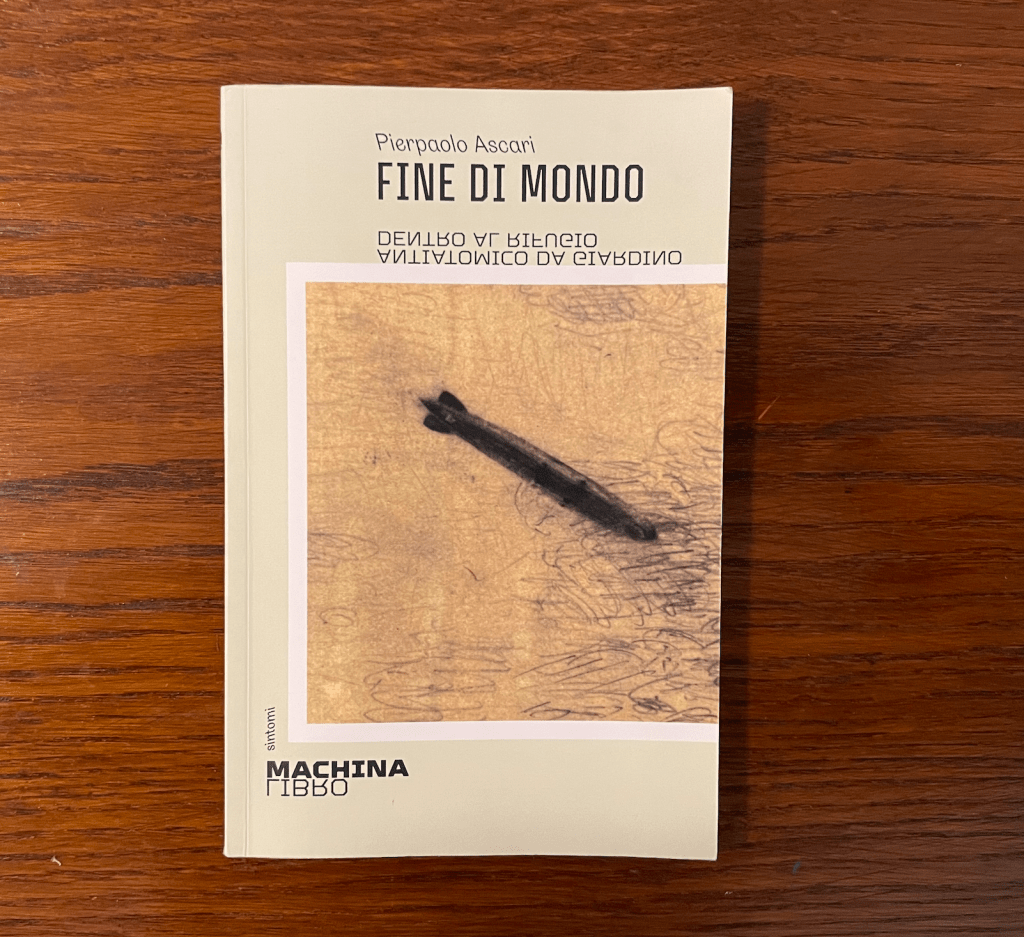
Pointing to a methodological clarification, Pierpaolo Ascari’s Fine di mondo: dentro al rifugio antiatomico da giardino (DeriveApprodi, 2024) opens with an untimely advice: the threat of atomic extermination of human life can only be told and appealed through the irony deployed in all areas of consumerist culture. Undoubtedly, this fits pretty well to the case on point, since American modernization is both the hotbed of Hollywood and the atomic bomb, two poles of the regime of a vicarious life consisted with Henry Adams’ well-known assertion that, in spite of everything, America civilizational passion has always been generalized optimism. And it is not surprising that Stanley Kubrick, when asked about the thesis of Dr. Strangelove (1964), also claimed that the only possible form to tell a story about the bomb of total extermination was through a black comedy (Ascari 11). This self-serving optimism is tested in Ascari’s Fine di mondo (2024) by looking at the construction of an apocalyptic underworld fantasy; that is, in the garden of anti-atomic sheltering that reveals the true arcana of modern Americanism as a subterfuge – but also a civil current in plain sight – parallel to the rise of mechanized labor under the conditions of the triumphant Fordism. Of course, now that our farewell to Fordism has been longed trumpeted, it does not take much to see that what remains is the infrastructure of schizophrenia and general terror in the social fabric that colors the specific tune of American apocalypticism. Ascari’s book is a superb elaboration of this tonality as historically rooted and articulated, but also open to its (pseudo)theological mutations undergoing in our present. 

On the surface, Ascari’s Fine di mondo (2024) is a short compendium of the civil responses and techniques towards atomic destruction and survival; but, more deeply, is also a history of Americanism as a historical project committed to a long process of civil domestication, enclosure, and endurance of survival. Of course, the nuances here are important to grasp the subtle hypothesis of Ascari’s working scene, since we also know that modernity at large (considering both its contingency and contradiction as features of its emergence) was also a process of an optimized gnosis through alienation and the enclosure of private property towards commerce stabilization and productive growth (the nomos). But for Ascari the specificity of the American nomoi through the lenses of atomic sheltering and refuge implies a microphysis; that is, a “way of life” validated through theological premises tailored in the organization of subjective deificatio (Ascari 23). This means that the apocalyptic apparatus driving American philosophy of history is not just one of realization towards the absolute objectivation of the world – even if such endeavor is necessary and preparatory – but rather that the sheltering and self-imposed domestication of human existence has become naturalized as a threshold of the conditions of finite human life. The paradigm of sheltering as the unit of survival is a form of self-regulation of grace that is consistent with the evangelical dispensationalism and technical election analyzed in Monica Ferrando’s recent important book.

The concrete examples abound in Ascari’s short but densely illustrated book: from the Civil Protection comic to the details of the emergence of “do it yourself” assemble manuals (discussed in the correspondence between Adorno and Sohn-Rethel); from the Hulk to Godzilla in a post-atomic bombed world; form the resilient speeches on atomic menace by JFK to a 1950s study conducted at Princeton University that reassured that “fathers” will get to know their children better in conditions of total sheltering even if it results in an “ethics of the jungle” (Ascari 34). Following Guy Oakes’ groundbreaking The Imaginary War: Civil Defense and American Cold War Culture (1994), what is distilled in Ascari’s pop culture puzzle is the panorama of the “Cold War” not as a war that did not take place between two imperial powers; but rather a total war that took place beneath the crust of the earth (and this is why the topoi of the refugee becomes so telling) and at the thicket of human existence waged as psychic management of the civil sphere. In fact, the “imaginary war” is nothing else than the stazion once social life that has yet to cease to exist in our days (Ascari 48-49). 

For Ascari this implied an interiorization of the ‘sublime’ in the reification of the social fabric, which cannot be divorced from the lobotomized subjectivity of the crisis of “social man” that Gianni Carchia identified as the steering project of post-enlightenment Romantic negativity. In the turbid vaults of the self-made man we encounter the liquidation of everything that is living and the projection of fictitious death that clings into “salvation” in spite of absolute destruction; because, after all, those that survive total destruction are only there to confirm the soteriological greatness of the American destiny (Ascari 78-79). The thorough “Ubu” dimension of American psychic political power definitely speaks to this well sedimented conviction of sacrificial subjectivity. Who does not remember the glorious chants for resilience and isolation of the American political elites during the peak of the COVID19 crisis management? If it came to no one’s surprise that a large majority of Americans accepted the pandemic arbitrary rules (monetized whenever needed, it goes without saying), it was because the American subjectivity has been adapted for quite too long to the ongoing separation of refugee and domestication. After reading Ascari, in fact, we think whether the emergency policies were not just another episode in the history of American sheltering now extended at a planetary scale.

There is another idiosyncrasy to American apocalypticism that must be accounted for. And this is introduced towards the end of Fine di mondo (2024), when Ascari quotes Ernesto De Martino about nuclear war; mainly, that when it comes to atomic annihilation there is no longer the symbolic mythic-ritualistic process of reintegration, but rather the mere technification of the hand that gathers scientific knowledge in convergence with the death drive” (Ascari 81). In other words, this technico-apocalypticism brings to absolute unity the originary response of the human species (the movement of the hand) with the organization of scientific rationality that, like Günther Anders saw, brings no re-symbolization of the principle of reality, but rather it can only reaffirm the layering of the principle of reality to govern over it (Ascari 85). In a way, if it as if the essence of American apocalypticism is instituted as if beyond time, since the endurance of a “time of the end” means that the triumphant death (and the dead fueling the demagoguery of its process) foreclosing the symbolization without an exit. Indeed, an apocalypse without redeeming kingdom. For Ascari the only anticipation – primordial mechanism of anthropological capacity – is that of “money”, and hence the dominance of the principle of general equivalence entails gaining the temporal illusion of some distance from the ongoing production of death. But it is evident to anyone today, as it was said not long ago, that the true dead are those petit bourgeoisie living in the American suburbs. And they keep coming as the embers of domestic happiness try to ferociously shut down the latency of a piercing pain. 

Yes, the nature of permanent apocalypticism confirms that the true and final object of techno-capitalist force has always been the possibility of multiple life worlds. And its erosion implies the endless possibility of ordering the life of the city, as Elon Musk just a couple of weeks ago told the former president of the Republican Party: “Hiroshima and Nagasaki were bombed and now they are full cities again. Yeah, it is not as scary as people think”. If the enterprise of civilization has largely been understood as springing from the crust of the earth upwards, one of the important lessons of Ascari’s Fine di mondo is that it trains us to look downwards and inwards as the cruxes of America’s persistent government over the garden of our souls. 

The face of pain. by Gerardo Muñoz

One is always struck by the pictorial intensity of Massacio’s “Expulsion from the Garden of Eden” fresco (1425) at Santa Maria del Carmine Chapel. It has something to do with the unbounded expressivity swirled by an acoustic of lamentation that springs from both faces at once. The nakedness in movement only comes second. If it is right to call it ‘modern’ is precisely because of its polarity  between movement and paralysis, light and shadow, the formation of the lines delineating the bodies and the free-style strokes that carry Massacio’s picture to a strict and unsurpassed balance. It is a picture of the gathering of  lamentation and pain, which confirms Ernesto de Martino’s intuition that in the ritual of mourning weeping and crying is also accompanied by an act of self-defacement, such as covering the face or bring the face as close as possible to the lower body position. Adam’s pain is reinforced by the hand that covers and pulls the face downwards, almost making it disappear. In a way, his walkout of Paradise is already the stroll of a nobody. 

There is perhaps an intimate relationship between defacement and pain. In his short gloss on this work, Robert Longhi notes that the source of strength of Massacio’s work is given by the intensity of light that bathes the bodies of Adam and Eve in its purest naked form [1]. This total exposition is the cause of sin that, as a great historian of religion has brought to our attention, presupposes the entire carnalization of both body and soul after being thrown into the soteriological world of the living [2]. From now on, human life vested in pain means paying the price of the destruction of the soul for the protected  and preventive set up in the world. 

The sinful life – a life that will have to be chosen but punished justly – entails the consummation of pain as the central tonality of post-felix culpa existence. In other words, it is not that life is shameful because it has been dispossessed (or because it recognizes itself possessed); it is dispossessed because it can no longer look at the world outside the blinding light of programmed obsolescence towards death without transcendence. And the liquidation of transcendence means that human beings become faceless entities in a world that will forever become unfathomable. 

In our days – a present marked by absolute secularization of ancient religious somatic religiosity and magical traces – the phenomenon of defacement and the faceless far from disappearing is all over the world around us. The ritualistic mask which provided transcendence to the living presence of the divine gods has now become a symbol of social shame self-imposed by arbitrary and ever-increasing moral mandates. In a sense, we have not yet left the path initiated in Massacio’s Adam and Eve fresco, and who knows if we’ll ever exit it in the ongoing destruction of the human species. We do know, however, that any meaningful change of the current state of things can only take place starting at the divine surface of the face, as Carlo Levi so eloquently understood it in the postwar years: 

“Only a genuine revolution succeeds in changing the way people look, their facial expressions, the light in their eyes, the charm of their smiles. Christianity appeared with new faces, or taught a new way of looking at them. If we go through the streets and compare the faces we see with our memory of them, we won’t recognize persons any more. It is something that anticipates reality, as if prophetically, the universal change that for almost two centuries now has been shaping new faces throughout the whole world”. [3]


Notes 
1. Roberto Longhi. Breve pero auténtica historia de la pintura italiana (Machado Libros, 2023), 114.
2. Paula Fredriksen. Sin: The Early History of an Idea (Princeton University Press, 2012), 116.
3. Carlo Levi. La doppia notte dei tigli (Einaudi, 1959), 109.

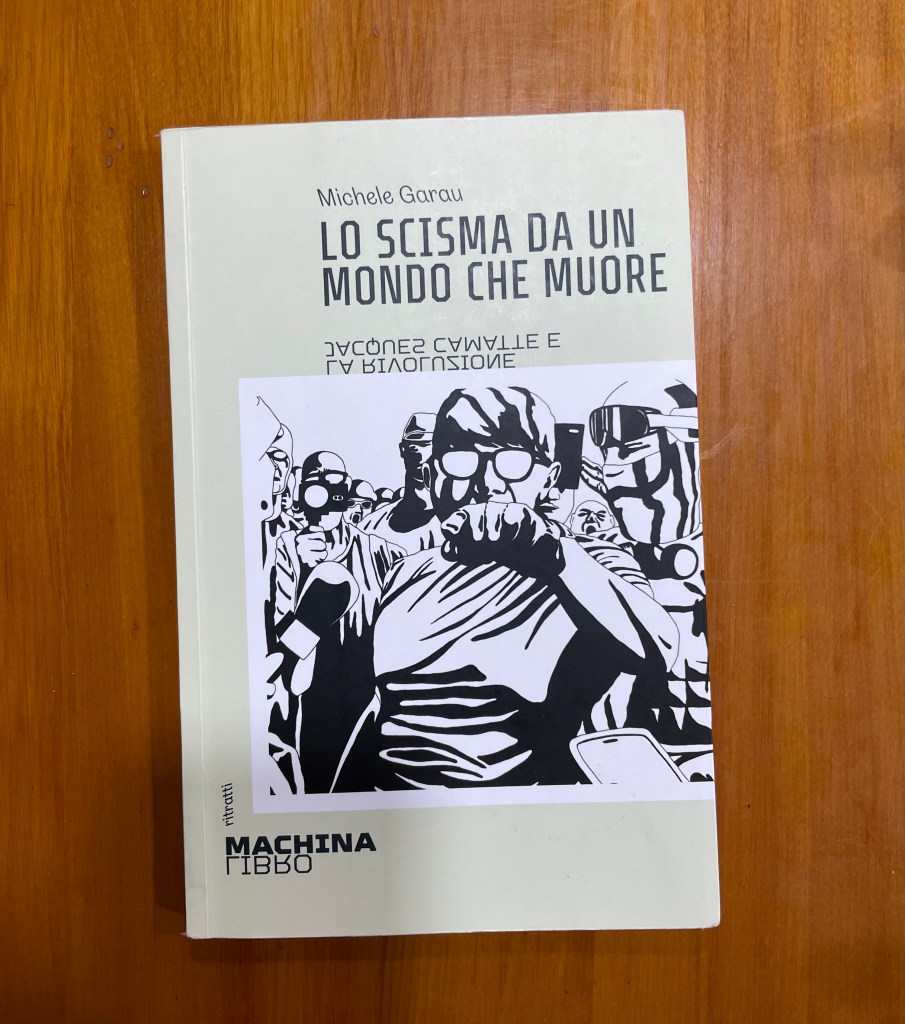
The absorption of the sky of politics. On Michele Garau’s Lo scisma da un mondo che muore: Jacques Camatte e la rivoluzione (2024). by Gerardo Muñoz

We must welcome that Michele Garau has written the first monograph on Jacques Camatte’s thought in any language, although the book, Lo scisma da un mondo che muore: Jacques Camatte e la rivoluzione (DeriveApprodi, 2024) it is also more ambitious than a mere philological reconstruction of the thinker of Invariance. Of course, not that there is anything particularly wrong with philological or archival work; rather, it is also that Lo scisma da un mondo che muore (2024) tries to think with Camatte (and also beyond some of his potential impasses) the historical bifurcation of a watershed moment in the history of humankind through the realization of the “capitalist revolution” as an autonomous colonization of every form of exteriority (Garau 7). If Camatte’s work has been only selectively considered in our ongoing discussions – while completely ignored at large by the so-called contemporary theory, which I guess it is an uplifting symptom – is precisely because he poses a challenge for a possible breakthrough in times of stagnation, while firmly announcing a much needed farewell to the modern revolution. But who would want to jump on that wagon when precisely voluntarism, prosthetic revolutionary cosmetic, and fictive communitarianism are all necessary platitudes to hold on to the illusion of ground right above the abyss? It is a rhetorical question, of course, but also one that Camatte move passed it in the in the decades of sixties and seventies observant to the material transformation of the working class, and the overall lesson of Amadeo Bordiga’s communism of the human species, which has also been rendered opaque and fossil-like by the victorious force of cultural hegemony and the whole grammatical structure of Gramsci’s thought in postwar political thought (and some will say well into our very present in the most recent cycle of failed left-populism). We said ‘farewell’ and this act, for Camatte after Bordiga’s teaching, means that the revolution has already taken place and must be perceived in the perspective of the crisis of negativity and the inception of the real absorption of capitalist development (Garau 14). 

Hence, new challenges lay ahead, which implies the abandonment of the historical and temporal productivity of revolutionary time – and Garau does an excellent mapping of bourgeois revolutionary thinking from Abbe Sieyès to Saint Just to later formulations of the Leninist paradigm of the dictatorship of the proletariat – which in the grand scene of modernity oriented the economy between form and function, but also between thought and action. If the epoch is said to be ‘anarchic’ is mainly because all these mediations and exclusive autonomous spheres have collapsed unto each other, and to favor one over the other is to work within the fiction of ideological reproduction at best. After Bordiga – Garau claims glossing Camatte, although there are nuances that I cannot consider in the space of this short commentary – the temporalization of the ius revolutionis can only bear in mind the crisis of presence (De Martino) as a suspension of exteriority that liberates right unto real subsumption. This means, following the recently polished phrase of Bordiga from his article “Tempo di abiuratori di scismi” (1965), that all revolutions are born and deployed as the affirmation of the schism. “Schism” or “scisma” — and one is reminded or taken back to a theological terrain, and not just as mitigated by the old ecclesiastical memories of the “Great Schism”, but because “schism” is also the “stazion” that fractures the visible-invisible legacy of form of the Church’s Trinitarian doctrine, and which is still the esoteric boiling point of the myth of political theology. This is a detour around Garau-Camatte-Bordiga’s intuition, since none of this is explicitly thematized in the book, nor should it be. It suffices that it opens to this question, given that Camatte’s own grammar of exhaustion – “extinction”, “inversion”, “autopoiesis”, “critique of organization”, “wandering” (erranza) – distill the echoes of an apocalyptic movement proper to the modern anthropological crisis, to put in terms of Ernesto de Martino.

Be as it may, the longue durée of civilizational development of Western revolutions (Edward Gibbon would claim at least since the reconstitution of the Christian Empire) there has been a process of adequation to invariant processes of capitalist accumulation that its substrate (whether permanent, uneven, natural law justified) becomes isomorphic to the structural needs of capitalist autonomization. In a cogent reading of Sieyes with Saint-Just in the framework of the French Revolution, Garau demonstrates how the genesis of modern politics and its categorial scaffolding (localization, constituent power, social unity, subject of rights, and representation) presuppose a thoroughly new vision to make the human community a clean slate for surface legibility (Garau 42). If the civil concept of the ancient polis was measurement and exchange; the crafting of high-modern state politics that took off in the eighteenth century was much thicker and spatially robust dynamics so that the ‘laws of commerce’ and population disciplining could come to fruition with its necessary infrastructural support. The schism was always a perturbation of the “sphere of politics” (and also of politics as a translucent sphere that can be observed, stabilized, and managed), and thus a great scandal.

Hence, the critique of political economy in the history of marxism was never able to untangle this mutual correspondence. For Garau at this point one can locate the difference between Camatte’s thought and Italian operaismo; given that Italian workerism at mid-century was never able to overcome the dialectic between the valence of value form and the theory of the production of capital. Whereas for Mario Tronti the struggle was still to be inscribed in to confrontation between the proletariat qua labor power; for Camatte the “invarianza” is not an permanent stage within the history of class struggle or Marxism, but of the human community and its resistance against the real subsumption of the material community (Garau 48). Decoupling the history of the working class as constitutive of productionism from the human community, allows Camatte, in the wake of Bordiga’s communism, to register the subsumption of capital as it collapses into dialectical negativity. Hence, communism is neither produced nor organized as operaismo always thought (Garau 26-27). And citing a passage from “Against domestication”, Garau argues that for Camatte the history of the proletariat struggle after 1945 is only the struggle to maintain the myth of the proletariat as the subject of a historical breakthrough (Garau 73). This is a staggering affirmation, and one that most definitely produces a theoretical schism. But the schism is also against the fictionalization of a subject of history, which has also been integrated into the emptying of social reality as we have come to know it in the final triumph of the fictive unto itself (Garau 93). 

There is the triumph of the fictive and expansive force of capital despotism, and then there is the struggle for the originary community (Gemeinwesen), which as Gianni Carchia argued in his “Glosa sull’umanismo” (1977) was still enmeshed in the contradiction between humanism and anti-humanism obstructing the vascular movement of non-identical fragments imploding the social. Is this getting at an impasse of Camatte’s own effort of thought to find an exit route? As an intelligent book, Lo scisma da un mondo che muore (2024), refuses to give an essay in the last three pages of the essay, although this difficulty is an object of attention. For instance, Garau writes in one of the clearest elaborations to tackle the problem directly: “La comunità deve allora essere riscoperta in una memoria della specie che finisce per radicarsi, questo è il rischio, esclusivamente in un bagaglio biologico. Nell’esaurimento delle strutture sociali preesistenti, dei linguaggi e degli schemi culturali, delle intelaiature rappresentative e cognitive, nella colonizzazione delle capacità psichiche, affettive, simboliche, è davvero possibile individuare un resto intoccabile dall’antropomorfosi del capitale che non debba essere, invece, creato dal nulla? C’è una «parte irriducibile», come scriveva Bataille, rispetto alle unità di misura del dispotismo economico? Non è semplice rispondere” (Garau 124).

In light of this rumination, Garau also attends to the cycle of contemporary revolts, which might stand as an instance of linguistic and existential struggle against domestication and the crisis of presence (Cesarano), and that might be capable of “absorbing the sky of politics into the most simple and elements components” (Garau 124-125). This is a great image, and one that has pictorial density and durability for thought even if it lacks specific elaboration. To absorb the open sky is to confront the exteriority of the world only as transfigured and brought back as a gathering of experience. The great German critic Kurt Badt comes to mind when writing about Constable: “the sky’s the organ of sentiment”. The embarrassing loss of the world today is fundamentally the destruction of the right attunement to our relation to the opening registered by what gleams above our heads. And perhaps this is a way to measure the capacity for non-movements rather than thinking that movements can disclose the sky. To this end, what could it mean to absorb the sky of politics – which is also a way to refuse the politics of sky, that is, the total planetary grand designs of geopolitical Tianxia? The irreductible may not be reduced to a substance, nor an ontological science nor a vitalist return to an originary community (if only mediated by the restriction of the archaic myth); but precisely that positionality of contact between what is exterior to life itself. To dislodge thought from all political plotting of objectivation and its plastic ligament of social adaptation. A life beyond itself that endures, and perhaps will outlive this dying world.