Reformation and administration. by Gerardo Muñoz

The dispute concerning the legitimacy of modernity also implies the question of the reformation, which transferred the power away from the hands of priests into a new priesthood of everyman’s consciousness. This was the Lutheran self-affirmation of economic theology (it has been laid out by Monica Ferrando’s recent work). The new priesthood implied a consolidation of the power over interpretation, since the biblical sources were now opened to battle over meaning itself. The interests over the Hebrew sources were not new, as a contemporary scholar has shown, but it was of central interest to the hermeneutics of sola scriptura over the scrutiny of the canons [1]. If this is the case, how come Thomas Hobbes account of the religious sources point to a different dimension of revelation? As we know, Hobbes was not alien to the ancient Hebrew sources, but his treatment and conclusions were entirely misplaced. Here I want to briefly account for this divergence.

In reality, it was Carl Schmitt who best confronted this problem in a late essay form 1964, published in “Der Staat, “Die Vollendete Reformation” by asserting that Hobbes’ place in the constellation of the modern political theology of the reform was rooted in the invention of the autonomy of the political. Schmitt works his way through Hobbes’ second bibliography in a subtle way, reminding us that the theorem “Jesus is the Christ” meant the artificial creation of a political technique over the battle over “meaning and truth” that fueled the European wars of religion. Hobbes, contrary to the theologians, became the founder of a counter-power: the confrontation between Leviathan and Behemoth. Indeed, for Hobbes the “reformed theologian” stands as the Behemoth, but it has yet to come to terms with the question posed by Leviathan as who will decide. This is for Schmitt the kerygmatic theme of the New Testament, which will only be decided at the end of times, but meanwhile the decision through authority is the only way in which the problem of “civil war could be neutralized. As a commentator of his time, Schmitt was directing a direct arrow to Rudolf Sohm’s idea of reform, which ultimately coincided with an economic theology bypassing the fact that the era of concrete political theology had its ultimate principle in authority of the sovereign’s decision [2]. 

Although never registered directly, the lesson of Hobbes for Schmitt resided in circumventing the rationality of the scientist and the technocrat, going as far as to mention Simone Weil’s critique of the codependency of the total state with the essence of technology [3]. The question of decision was Hobbes’ metaphysical solution to an “intra-evangelical war”, which introduced the immanentization of indirect powers unto the flatten space of civil society. In other words, for Schmitt, the true father of the “spirit and letter” of the Reformation was neither Luther nor Calvinism, but Hobbes’ Leviathan insofar as it was able to offer a third option against the secularization of a universal priesthood of the autonomous economic theology. But this is only the beginning of the problems, since we know that Hobbes’ political philosophy was dependent on “civil society” preparing the conditions for the liquidation of anti-normative decisionism. Schmitt himself was aware of this towards the end of his monograph on Hobbes as a farewell to state form. Hence, the epoch of political theology was brought to an end not through reformation, but through the ever-expansion of the operative sphere of the concept of the civil. The triumphant economic theology that has only intensified well into our days adequates to the fullest extent to the infrastructure of Hobbes’s project. 

If this is the case, the differentiation that Schmitt establishes in Political Theology II between ius reformandi and ius revolutionis collapses, given that the solicitation of the autonomy of the social requires an ever-expanding outsourcing of administrative apparatus that will turn legality into the bin of administrative application (Verwaltungsrechts einzufügen unwissenschaftlich) [4]. And in the face of administration political theology loses its grip, and economic theology silently takes hold. The subsequent internal triumph of the verwaltungsrechts einzufügen will bring to an end the epoch of political theology. The ideal of the Reform took this challenge and brought it to the very anthropological core of humanity.

.

.

Notes 

1. Eric Nelson. The Hebrew Republic (Harvard University Press, 2010), 8.

2. Carl Schmitt. “Die vollendete Reformation: Bemerkungen und Hinweise zu neuen Leviathan-Interpretationen”, Der Staat, Vol.4, 1965, 51-69.

3. Ibid., 66. 

4. Ibid., 67.

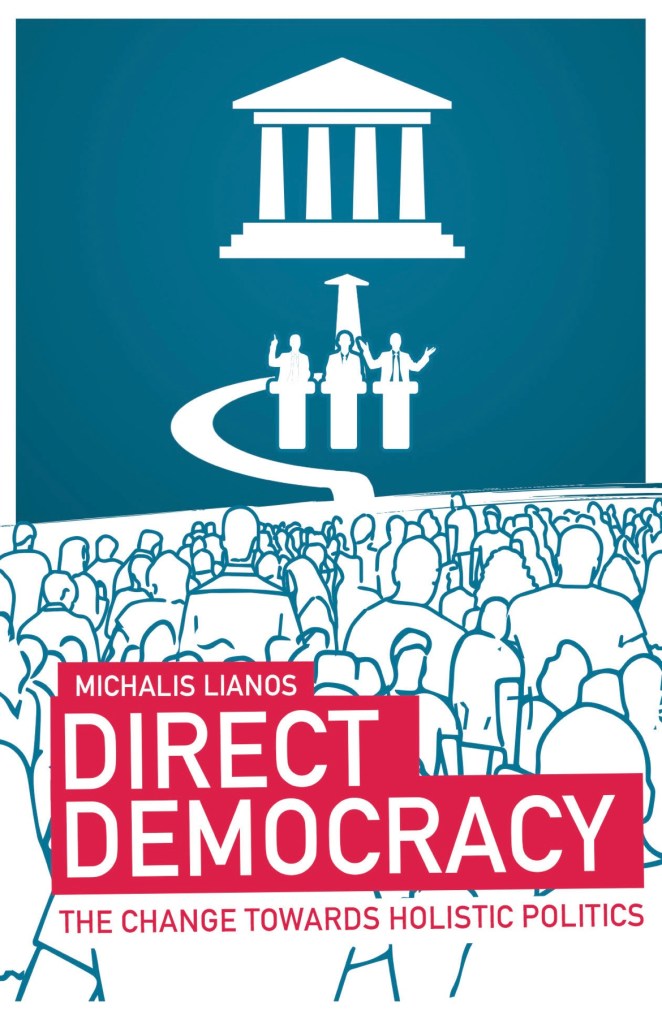
Can holistic politics do the heavy lifting? On Michalis Lianos’ Direct Democracy: The Change Towards Holistic Politics (2022). by Gerardo Muñoz

Michalis Lianos’ Direct Democracy: The Change Towards Holistic Politics (2022) defines itself as a social manifesto to confront the transformation of the nature of political power, public institutions, and the tradition of political representation inherited from the Enlightenment and the French Revolution. This is something that Michalis Lianos – one of the most interesting sociologists of social control of his generation – had already alluded to in his writing during the cycle of revolts of the Yellow Vests in France [1]. In more than one way, Direct Democracy: The Change Towards Holistic Politics (2022) is an expansion of this intuition; although, unlike most manifestos, the book does not take up the tone of denunciation and rupture, but rather of extreme prudence to construct and adequate itself to the complexity of our contemporary societies to a new regime of power distribution and individual empowerment. The total political alienation from public deliberation and participation is, according to Lianos, what stands in the way of people’s common interests. Institutions, political parties, the formalist separation of powers, and the legislative bodies (now in the hands of administrative agencies and corporate firms) have been radically disconnected from people’s lives to the point of becoming endogamic in its practices of decision making and public governance.

No one today can doubt the univocal distrust on all things political (a sentiment dating back to the Romantic age if we are to believe Carl Schmitt) which reminds us that the most interesting social insurrections in recent times have been against the democratic neutralization of the specific metropolitan and capital organization of administrative power. In the face of this schism, Lianos proposes a move towards direct democracy that can short circuit these institutional actors and partisan interests in order to revitalize people’s empowerment. The realization of direct democracy presupposes – and this Lianos’ propositional reinvention of the unity of politics – what he terms a new ‘Holistic Politics”, which he understands as a new civic attitude and a culture between citizens in a “holistic away, as a whole” (Lianos 2022, 2). The aim is to empower and lower public and private decision making at the scale of people’s life consistent with “social trust as the key for a happy collective life” (Lianos 2022, 3). The operative notion of Holistic Politics is, then, both a model of institutional design through the problem of scale; and, at the same time, a reassessment of the epistemological grounds of social action. In other words, for Lianos Holistic Politics should not be oriented towards putting the right answers in any social project, but rather to “ask society the right questions each time” (Lianos 2022, 9). We presume that what is “right” in the “right questions” point to an existential need of the whole, since given the plasticity of Holistic Politics, it cannot appeal directly to neither social facts (since these are always changing) nor a stable legislative agenda of higher representatives (there are inexistent for direct democracy). Regardless of these specificities, Holistic Politics does impose a need that the direct democracy will demand a greatest individual and community participation on fundamental issues raised by the social assembly list of objectives as raised by anyone in the community.

Lianos defines the problem of mitigating social issues within the framework of Holistic Politics in this way: “Holistic Politics recognizes that the most basic political process is the equal right of anyone to put forward issues for discussion and decision. So it is constantly vigilant to ensure, with specific measures that wherever exercises power is required to give answers as to the issues and priorities raised but never to ask the questions or influence how they are put. Issues are raised and ranked in order by the citizens themselves” (Lianos 2022, 15). Lianos is aware that every form of established institutional behavior ends up becoming a social habit (it has what some political scientists called, at least years back, “institutional stickiness”) , and this is why rules for immersion in social interaction must change on a regular basis (Lianos 2022, 17). It is true that rules are the infrastructure to limit social actions (this is, in fact, its unlimited possibilities); although, it begs to ask to what extent the regular change of social rules do not become in itself a habit within the very logic of exchange that defines structurally the social. To put it in different terms, it is insufficient to think, as Lianos does, that capitalism is a concentration of all entities into money form; rather, it is because there is an anterior civil form of exchange that the problem of value always emerges as an indirect force against the unit of the political (Lianos 2022, 21). If one changes the lens from strict capitalist exchange to the problem of value, then it becomes clear that what first appears as an alteration of rules in social facts could, potentially, constitute itself as an aleatory imposition of values, where the “happy life” of some could amount to the valorized “hellish life” of others. Holistic Politics in the same way that it does not say anything about values, it remains silent about the problem of institutions, even though institutions are far from being part of the stagnation of representative democracy that Lianos wants to surpass.

The central question for Holistic Politics is whether it can do the heavy lifting that it promises to accomplish. Can Holistic Politics really open up a way out of the current poverty of the species in the wake of social and civilizational collapse? Lianos seems to be aware of this question if only in passing, as he writes on the subdivision on “Foreigners”: “Holistic Politics is an approach for the entire human species at its present stage of development” (Lianos 2022, 41). This ‘present stage of development’ of the human species remains largely unqualified, and Lianos takes the route of geopolitics and the necessity to overcome the classical separation of powers. But to the extent that we are taking recourse to the human species, there is a fundamental topological and territorial dimension that we are sidestepping too quickly. At bottom the human species is a creature that steps on the Earth crust, and which today have been designated in relation (whether included or excluded) to the metropolitan regime of concentrated and amalgamated reserves for production and consumption [2]. We can say that this is the last expression of civil nihilism: the capability of putting to work; or rather, of the power to put into energy certain elements in any given structure of exchange. And we are barely raising the question here that lingers from Lianos’ assumption. It suffices to say that the spatial composition of the human species today is erased from Lianos’ Holistic Politics, which is raises enormous doubts as to whether a social assembly, the rotation of social rules, and the redesigning of democratic voting can really do the heavy lifting for what is required for this “moment” of the human species. If this is so, then Lianos’s Direct Democracy has not moved past the Atlantic republicanist tradition that placed voting and participation at heart of the democratic polity (this is the heart of the Federalist, as Sanford Levison argued a few years ago). Holistic Politics in this outlook is probably the last residue of modern politics now grafted into the regime of social organization. But we would like to be as precise as possible about this affirmation.

Towards the end of the manifesto Michalis Lianos argues that Holistic Politics brings the individual and society face to face (Lianos 2022, 114). But if this is endgame of Holistic Politics it is also where we found ourselves in the gridlock of social denomination as an extensive (and intensive) regime of adaptation; of forever changing norms, of arbitrary rule making and rule erecting, and governing through contingent situation through the balancing of cost and benefit rationality of social cohesion. In this sense, the conception of the “overall point of view of the social experience” can describe the social composition, but it cannot transcend, as alteration and changing based on needs and values is already folded within it (Lianos 2022, 90). I take it that something analogous could be said of the problem of equity and proportionality in relation to adjudication and the rule of law in the paradigm of Holistic Politics, since what has triumphed in advanced societies of the West is not the fossilized conception of the separation of powers and the empire of judges and courts, but rather the expansion of equity and balancing of principles based on a cost & benefit rationalization to adjust and transform always already mutating social facts (Lianos 2022, 105).

Insofar as it is committed to the primacy of principles of equity and balancing, Holistic Politics does not breach the current framework of value distribution for specific ends of social reproduction (Lianos might say that his ends are better and stronger since he has done away with political representation, but we are also aware that there is an autonomy of value that can be operative on the borders of the political, in fact, it no longer depends on the political unit). There is an interesting discussion by Lianos on the question of failure and social expectations in Holistic Politics – to take up failure beyond the economic penalties and social mortification of the current neoliberal regime – that open up new possibilities only insofar as we move then from and against the infrastructure of the civil exchange principle for social action. Perhaps the realism that Direct Democracy (2022) appeals to has also something to tell us here, since the current collapse of the social regime is one in which failure is abundant, regularly optimized, and rendered productive through forms that accrue greater and intensive force of valorization. But can the irruption of failure in Holistic Politics be taken as a hole within the scheme of valorization? Perhaps it is in this schism where the question of the present stage of the human-species and a politics of experience can be posited against the grain of total social subsumption. The task of a different democratic imagination should depart from this void.

.

.

Notes 

1. Michalis Lianos. “La política experiencial o los chalecos amarillos como pueblo”, traducción & introducción por Gerardo Muñoz, eldiario, Noviembre 2019: https://www.eldiario.es/interferencias/politica-experiencial-chalecos-amarillos-pueblo_132_1289123.html

2. Amadeo Bordiga. The Human Species and the Earth’s Crust (Pattern Books, 2020), 30-31. 

Police and Schools: two vectors of American civility. by Gerardo Muñoz

The conservative journalist David French has recently reported an interesting empirical fact about the social reality in the United States: according to a recent Gallup survey that measures public confidence in American public institutions, there are two institutions defended and discredited by both left and right: those on the conservative right expressed confidence in the police (about 70% or so), and those on the progressive left expressed confidence in schools and higher education (about the same percentage). This is an interesting fact only for the reason that it reveals with immense clarity – very much against French’s political idealism of overcoming the caesura – the two effective vectors of American civil society: police and schooling. In fact, aside from their divergent emphasis, progressives and conservatives agree fundamentally that policing and schooling are the indispensable elements in this moment of civil society. Let’s call it the “high modernist moment of the metropolis”.

This is why to any attentive observer of American reality, police and schooling are so intertwined and mingled with each other that it becomes impossible to separate them, and not just because there is police presence on university campuses or because the police articulates a discourse of “community” and educational instruction in their daily practice. Police and Schools are two vectors in the structure of civil society in the wake of the collapse of modern politics. In other words, what emerges after the end of politics in America is the intersection between police and school as two intersecting poles that sustain, nurture, and reproduce the axiomatic organization of civil society.

The zone of convergence of police and school is culture. Now culture should not be understood as symbolic distribution of mass consumption and public goods, but more specifically as a flexible regime of adaptation whose proper end is the optimization of the civil order. Hence, the fascination and continuous arousal of “cultural battles” in the public spheres is nothing but empty chatter of the same end: the acceleration of techniques and symbolic amalgamations in a social roundup of self-governance. When Sir Ernest Barker defined the necessity of civility as the precondition of the commonwealth, he took for granted that culture was meant to maximize singular character and conduct [1]. On the contrary, today the maximization of culture presupposes a paideia that revokes every character in the name of a flattening conduct that must be adaptive to the ends of abstract civil organization of values. If civility for Barker was condensed in the figure of the “gentleman”, in contemporary America, the figure is the nowhereman: an all-capable human-species that must adapt to the latest marching order and its temporal justifications. In this context, the police and school are elevated from social institutions to productive vectors of civil cohabitation.

It is still striking today to read what theologian Karl Barth wrote in 1928: “In paradise there were no schools and no police. Similarly, and in view of its intensity we must say specifically there was no gentleman unseen, and all the more penetrating “they” of costumes” [2]. And for Barth, it is only in the wake of Romanticism – in this way confirming Gianni Carchia’s important thesis about the consolidation of a subjective romantic modernity – that the police and the school was unleashed against every costume and against everything that stood in its way. Social abstraction is incapable of grasping this stealth transformation. And it cannot see it due to the fact that romantic civility offers, in return, a fundamental oblivion: eternal security within a hellish reality. All things considered, this is also why the United States remains the beacon of endless optimism – while being a deadly playground. The vectors of policing and schooling grammar of force expulses any possible ethical notion of paradisal life.

.

.

Notes. 

1. Ernest Barker. Traditions of Civility (Cambridge University Press, 1948), 137.

2. Karl Barth. Ethics (Wipf and Stock, 2013), 390.

A noncatastrophic politics. Some notes on Erich Unger’s Politics and Metaphysics (1921). by Gerardo Muñoz

Erich Unger’s Politics and Metaphysics (1921), published just a year before Political Theology (1922), fully captures the spirit of the epoch: it is the moment when politics becomes catastrophic; a vehicle for war conflagration, an instrument for the acceleration of technology, and the spatial fragmentation of civil society and state. The overcoming of man through technology meant a new ‘reality principle’ in which the species were forced to adapt to an abstract process of catastrophic metabolic regulation. Unger’s essay, thoroughly ignored at the time of its publication, was a product of what in Political Theology (1922) was labeled as the force of indirect immanent powers. And from his side, Walter Benjamin, in his preparatory notes for his essay on violence, made the obscure remark that Unger’s Politics and Metaphysics (1921) ultimately favored the ‘overcoming of capitalism’ through errancy (at times translated as “migration”, which has been recently corrected by Fenves & Ng’s critical edition of the “Critique of Violence”) [1]. Indeed, in his short tract, Unger called for a “non-catastrophic politics”, which he understood as coming to terms with the problem of metaphysical structuration and positionality, and for politics to have a chance a principle of exodus was needed. This goes to show why Schmitt reacted against this spirit of the epoch, going as far as to say that his “concept of the political ” was the unified response to a sentiment of a whole generation, as well as the detector of enemies of the political demarcation [2]. In contrast, for Unger modern political autonomy had collapsed, and catastrophe now expressed itself as a civilizational problem of living forms, and so it demanded a confrontation with the problem of unity and separation of politics and metaphysics.

Politics is not metaphysics, but it had to be confronted with it if a non-catastrophic politics is to be imagined. This meant a new conception of the problem of “life”, which in Unger’s speculative philosophy received its historicity from immanence through the temporality of the tragic. The psychic separation between metaphysics and politics (a politics of the subject and subjection) meant fundamentally a catastrophic politics, which Unger read against the backdrop of the Oskar Goldberg’s Hebrew speculative reversal as a new re-constitution of the people (Volk) outside the fixation of the state. All of this is connected to his previous work on the stateless dimension of the Hebrew people in a short tract entitled Die staatslose Bildung eines jüdischen Volkes (1922). For Unger, the Hebrew prophetic rulers were not just a form of government, but rather also of healers, practitioners of a “techné alupias” of psychic intensification in the business of instituting an autoregulation between the metaphysical and the political.

The contrast with Carl Schmitt’s position is, once again, illuminating to say the least: whereas the figure central to Schmitt’s juridical thinking is that of the Pauline Katechon, the restrainer against the apocalyptic catastrophe; for Unger, no stranger to theological myth, appealed to a Parakletos of a universal People (Volk), coming to one as a single consciousness against unreality. The theological drama that informed the positions of both Schmitt and Unger, recasted the problem of separation the central concern of a particular thinking in a time of constituent power (and its infrastructure in the principle of civil society). But whereas Schmitt’s Katechon depends on an institutional mediation conditioned by revelation and authority; Unger’s non-catastrophic politics evokes a ‘people’ emptied of patrimony as reservoir of new energies for the unification of reality against psychic imbalance. Against the “relentless forms of domination”, Unger did not appeal to institutional mediation of the moderns, but instead to the interiority of the species that, in turn, required a “political principle of exodus”:

The principle of the exodus can end the civil war and represent the presupposition for the emergence of real political units, thus putting an end to those centrifugal tendencies which are lethal for any real synthesis. This principle of separation of communities operates an external delimitation of the Material to give rise to a possible real unity. It now considers establishing the basic regulatory principles of its internal structure.” [3]

The principle of exodus of politics meant, all things considered, the opening the metaphysical order of the possible against what was understood as domination of the species within the paradigm of civil war. It is telling that for Unger, like for Carl Schmitt, the true force to be confronted is that of the stasiological force, or nihilism, as the condition for the catastrophic politics in the perpetuity of separation during time of finality (Endgultigkeit) in historical transformation. For Unger this was no easy task, nor fully passive and open to gnostic reversal. On the contrary, it is connected to “a kind of intellectual orientation required of anything who might wish to understand this reflection” [4]. This is ultimately tied to Unger’s most enduring idea in Politics and Metaphysics (1922) – at least for some of us that look with suspicion anything that the contemporary has to offer today, or that has ever offered – which is the metapolitical universities, not mere supplementary communities against the politics of catastrophe, but rather practical forms of encounter, languages, and exercises in thought that return the dignity to the shipwrecked fragments in the field of immanence.

Unger knew very well that there was no absolute “exteriority”, and so the defense of a metapolitical university was offered not as a “new political unit” of intellectuals leading the masses, but something quite different: the encounter of a finality that is not knowledge but “the effective treatment of the concrete” elevating itself from mundane understanding of social knowledge [5]. This is no collective practice either, since the discriminatory point assumes the internal perspective of the instance of “intensification” [6]. And intensification is not executed from the coordinates immanence of the social but rather as a ‘possibility of an elevation (Steigerbarkeit) capable of returning to reality against a non-catastrophic politics. For Unger the notion of elevation – necessarily to destroy the compulsory mimesis and automatic recursiveness of subjection – is predicated as a path of innerness, “that is, in the inclusion of originally alien psychical factors within a single consciousness” [7]. The metapolitical universities were, hypothetically, hubs for the concrete practice of elevation vacant of any universal pretensions of unreality. Here Unger, like Schmitt, does not propose an exodus from politics, but rather an elevation to a coming politics whose mediation is neither annihilation nor exchange, but rather the imagination and concrete practice of organization. The question, of course, is whether the politics of exodus today has not also collapsed to the catastrophic (no longer an exception to it but immanent to the logic of equivalence), which means implies a relocation: the practice of the metapolitical university, mutatis mutandi, now presupposes an exodus from politics.

.

.

Notes 

1. Peter Fenves & Julia Ng (eds.). Walter Benjamin: Toward The Critique of Violence: A Critical Edition (Stanford University Press, 2022), 92.

2. Carl Schmitt. Glossarium: Anotaciones desde 1947 hasta 1958 (El Paseo, 2019), 240. 

3. Erich Unger. Politica e metafisica (Edizioni Cronopio, 2009), 87.

4. Ibid., 92.

5. Ibid., 23.

6. Ibid., 100.

7. Ibid., 24.

The regime of adaptation. by Gerardo Muñoz


The collapse of the categorial and formal mediations proper to the foundations of modern politics open up a regime of adaptation as optimized administration. In a concrete sense the well-known Böckenförde formula comes to a closure as it is realized: the liberal secularized state draws its life from preconditions it can no longer guarantee. The fulfillment of secularization entails, paradoxically, a re-theologization of the separation between the species and the experience of the world already leaving behind the temporality of the saeculum. It is no coincidence that three excellent new books recently published and discussed – Conspiracionist Manifiesto (2022), The Politics of Immortality (2022) by Marten Björk, and Adapt! A New Political Imperative (2022) by Barbara Stiegler – share a common thread: the emergence of the regulatory system of adaptation in the wake of the end of political liberalism.

In other words, the marginalization of the logic of representation, the erasure of institutional mediations, and the depolitization of life (which also entails that everything becomes measurable to the value of the political) entails the intensification of a process of abstraction that is deployed on the surround of the human species itself, increasingly optimized given the contingent transformations and irruptions. The Conspiracionist Manifiesto goes as far as to claim that the current articulation of domination should be understood as a full restitution of the nineteenth century project of positivism as the integration of science and life. Comte and his followers, in fact, thought of positivism as a world religion concerning the reproduction of life whose aim was the general crafting of society as an plastic integral organism.

The acceleration of adaptation presupposes the triumph of immanence that was already exerting its force as an indirect power in the nineteenth century drift by romantic subjectivism and expansion of conditions for action in civil society. In the regime of adaptation, the realization of action, devoid of institutional justified reasons, becomes allocated in the processes of production fitted to the incessant demand for adaptation. It is obvious that the acceleration of immanence – first expressed in the subject’s will to power and now folded into the willing slave of adaptation – has intensified in the last years or so, coinciding with the pandemic event and the generic systematization of health understood as a set of coping techniques of behavior.

Already in the 1990s, in an unpublished lecture in Hannover, Ivan Illich described adaptation as an systematization of health: “Adaptation to the misanthropic genetic, climatic, chemical and cultural consequences of growth is now described as health. Neither the Galenic-Hippocratic representations of a humoral balance, nor the Enlightenment utopia of a right to “health and happiness”, nor any Vedic or Chinese concepts of well-being have anything to do with survival in a technical system” [1].

Insofar as it is concerned with the captive reproduction of life, the regime of adaptation puts to rest any believe in positive biopolitics or the community as exception to the social. Yes, this includes even the “community of friends” that Carlo Michelsteader, in his Il dialogo della salute thought as too much of a rhetorical illusion predicated on the exclusion of suffering and death: “In the friendly communities that emerge in light of common vanity, every one lives thanks to the death of those outside the community” [2]. In short, the regime of adaptation solicits nothing else than the task of coming to terms with the principle of the civil (truly the condition of state’s authority), which in even as far as in Roman law made possible the extraneous movement of the subjectum iuris as total equivalence. The predicament of the regime of adaptation – and its irreversible apparatus of administrative law – obliges us to imagine something other than civility (the principle from the Roman Empire to the modern to put it in Cooper Francis’ terms) but without sidestepping into the barbarism of ergonomic processes that are now at the center of what is understood as life. Barbarism and civility’s straight line now bends towards adaptation.

.

.

Notes 

1. Ivan Illich. “Health as one’s own responsibility. No, thank you!”, Speech given in Hannover, Germany, September, 1990.

2. Carlo Michelstaedter. Il dialogo della salute e altri dialoghi (Adelphi, 1988).

The faction difficulty. by Gerardo Muñoz

The central contribution of American republican political thought is arguably the way it found a solution to the problem of factions, a legendary difficulty that not only has not disappeared but rather intensified in our present. For the enlightened republicans of the eighteenth century, well versed in the classical tradition and the histories of Florentine medieval strife, factionalism was the cardinal difficulty of social order; how to best deal with conflicting loyalties and the perpetuation of violence for virtuous and at times times even springing from “idleness and courage of the youth”, as told by Carol Lansing’s scholarship [1]. The existence of differences and cleavages in the society ultimately meant the brewing of an ephemeral coalitions and private masters, which, in turn, often resulted in the thorough expulsion of the enemies from the polis. These unregulated clashes of authorities and private actors was called by the fourteenth century jurist Bartolus of Saxoferrato a seventh form of government mixture: a “monstrous government”. The problem of faction will emerge for the moderns as the condition that prompts the articulation of a governmental rationality capable of constructing the homogeneity of social living. In other words, the modern classical homogeneity of the civil society is the creation of the domestication of factions as social grouping units to be obtained and arranged as an indirect power from within to transform ‘barbarism’ to civilization. David Hume’s political writings – and in particular his “Idea of a Perfect Commonwealth” (1752), which was highly influential to the Federalists, understood that the threat is of “factions” required a new framework: politics had to be reduced to a science [2]. What could politics as science entail? We are not yet in the administrative rationality and professional political vocation of Max Weber’s sociology. The scientific reduction meant a paradigmatic transformation of classical politics properly understood (virtuous, moral, and just) into an economic determination in which interests took the center stage over the combustion of the passions. The new science of politics implied a retooling of the problem of factions by decompressing the clustered interests of unaccounted and disloyal factional expansion under governmental action. For Hume the passage from passions to interests entailed a descaling of factionalism on one hand, while an expansion of a robust form of government over a large territory on the other.

However, if for Hume factions are still an impolitical unit of association that must be minimized, it is James Madison in “Federalist 10” who achieves the complete “scientific” aspiration of political construction over factions as inseparable from the Social ahead of the industrial modern economic division of labor. In fact, as Douglass Adair reminds us, this particular essay of the Federalist Papers only became important towards the end of the nineteenth century in the wake of industrialization and economic power groups; that is, at a moment when indirect economic powers began to exert their influence into the institutional and regulatory composition of the state [3]. One could say that it is only at the outset of the triumph of economic “Americanism” that the Madisonian framework on factions is situated in its proper tripartite structure: factions are conditioned by positive liberty and make up the totality of the economic interests that make up civil society. Indeed, for Madison factions as expressions of the nature of man, and their existence detail degrees of activities in civil society [4]. In a way there is no civil society without factions, and there are only factions because there is civic Liberty.

Madison even constructs a naturalist analogy: what unrestrained Liberty is to faction, air is to a propagating fire. The activity and energy of factionalism is exclusively understood as one of economic interests which, insofar as it is conditioned by positive, differentiated, and unregulated liberty that expresses the unequal distribution of property that characterizes the essence of the social. The new science of government in this framework becomes clear: the end of government is neither properly about political enmity in relation to the state nor about suppressing and limiting factions, but rather about the optimization of the effects of factions. Madison writes in the groundbreaking moment of “Federalist 10”: “The interference to which we are brought is that the causes of faction cannot be removed from that relief is only to be sought in the means of controlling its effects” [5]. The optimized logistics of factionalism displaces the modern hobbesian picture of the sovereign state to a minimalist and compensatory nature to attenuate public order against “local and particular state legislatures” [6]. The optimization of factions now appears as the dominant aspect of a fundamental cybernetics that seeks to isolate, fragment, and juxtapose the conflagration of factions without losing the barring of state energetic durability. The faction difficulty lays bare the arcanum at the center of the res publica politics: the administration and reproduction of civil conflict.

The consolidation of the cybernetic solution to the faction difficulty emerges as an upgraded version of state auctoritas whose aim is to establish a balance between public opinion as distrust over “dispute”: “communication is always checked by distrust in proportion to the number whose concurrence is necessary” [7]. If communication becomes a strict science of regulating the means of expression (itself a medium), political authority is superseded over a constant war over words and force of exchange. This means that rather than putting an end to the stasiological tension through a political mediation of the state, the problem of faction reveals that stasis becomes an instrument to manage effects, produce legislative, and translate interests in the struggle of social differences. It goes without saying that perhaps the modernist differentiation between state and civil society in light of the problem of faction loses its predominance, as an entirely new framework emerges: a monstrous socialization that takes the form of a productive stasiology given that if “men were angels no government would be necessary” [8]. The irony is that the auxiliary precautions of factions is a secularized form (or at least one could trace it to) of the ministry of the angels. This reality demands a new ethic of the passions against both the vigorous indirect struggle of factionalism (and its modern rendition in the party form) and the axiological arrangement of interests that made the foundation of the social community possible.

.

.

Notes 

1. Carol Lansing. “Violence and Faction”, in The Florentine Magnates: Lineage and Faction in a Medieval Commune (Princeton U Press, 2014), 181.

2. David Hume. “Idea of a Perfect Commonwealth”, in Political Writings (Hackett Publishing, 1994), 240-252.

3. Douglass Adair. “The Tenth Federalist Revisited”, The William and Mary Quarterly, Vol. 8, No. 1, 1951, 48-67.

4. Alexander Hamilton, James Madison, & John Jay. “Federalist 10”, in The Federalist Papers (Mentor, 1961). 79.

5. Ibid., 80.

6. Ibid., 83.

7. Ibid., 83.

8. “Federalist 51”, in The Federalist Papers (Mentor, 1961), 322.

John Rawls and the justice of civil war. by Gerardo Muñoz

Nowhere in his published work does John Rawls treats the concept of civil war explicitly or by that matter in relation of his concept of political liberalism, although it is central to genesis. In a Spring semester of 1969 lecture at Harvard University, which remains for the most part unknown and only alluded by specialists of his (although never subject to substantive treatment), “Moral Problems: Nations and War”, Rawls takes up the problem on its merits [1]. This is a lecture that took place in the wake of the Vietnam war, the post-1968 context, and during the years of the definite settling of “global civil war” intensifying in every corner of the world. There is little that Rawls when treating the problem of war within the tradition of liberalism, was also aware of the factical nature of war of his present; that is, the transformation of war as a legitimate declaration between nations (at that point outlawed by the international Kellogg-Briand Pact) to a predominately a war within nations, that is, a permanent civil war. In this lecture – which one does not need to summarize given its broad historical strokes and technical determinations – Rawls crafts an typology wars in international law, as construed by the ius gentium, a theme that will later be the subject of his late book in international relations principles Laws of the People (1993). What is surprising is that in this typology, Rawls defines civil war as a thorough conflict aiming at “social justice” to transform the state. A civil war, then, is no longer what precedes the foundation of ‘legitimate authority’ proper to sovereignty, but it is rather the means by which something like “justice” becomes the mediation of the “Social”.

From this it follows, that for Rawls civil wars either neither wars of aggression or wars of sessions, two forms that would be exclusionary to his definition grounded on ‘Justice’. Hence, the “justification” of civil war could only be a just war insofar as its aim grounded in social justice as the effective realization of the well-being of all the inhabitants of the polity. For Rawls this was the ‘active’ continuation of the ideal of the French Revolution of 1789. Indeed, one could claim that for Rawls civil war is the continuation of revolution after the principle of universal recognition was achieved through rights. The ideal of Justice, then, was never the well-ordered natural law theory of revolutionary change (endorsed by many Jacobins, such as Saint-Just), but rather an intra-level recognition of social rules within the plural system of value differences. Coinciding with the development of positive law as grounded in social facts and guided by a ‘rule of recognition’ (in H.L.A Hart’s well-known elaboration), Rawls’ theory of civil war was the mechanism for a social fact-based conception of justice that was predicated in the optimization of risks, regulations, and re-distrubution of post-recognition equity of the activist state. Indeed, social justice insofar it was no longer merely sovereign authority, took the function of social facts through the administration of a permanent social civil war.

Neither an event nor an exception, civil war for Rawls is a free-standing metapolitical paradigm of the new “transformative” conception of the Social ordered purposely around the principle of Justice. Paradoxically, the conditions of promoting “social justice” (whose echoes we still hear today from the political class as well as from the jargon of academic political ideology) is not limited to the “veil of ignorance” or the “originary position” for social action, but rather in the actualization of a latent stasiological paradigm. This esoteric unity is neither an exception nor a deviation from Rawls’ mature political thinking around social justice; but as all true political paradigms, an invariant mode of his thinking. This is why he points in the 1969 lecture the Spanish civil war as paradigm of stasis as social justice, and in his essay “My religion”, the American Civil War led by the exceptional executive authority of Abraham Lincoln as necessary to the “original sin” of human slavery [2]. And as Eric Nelson has convincingly argued, the anti-pelagian conception of sin in Rawls’ thought amounts to a secularized theodicy of social force: a regulatory physics in the aftermath of the crisis of the sovereign state. Although ignored by Nelson, the full picture of Rawlsian conception of the “Social” is not complete if one does not take into account the stasiological paradigm that legitimizes the aims of social justice. And if the internal conflict is latent within the Trinitarian ontology (as Political Theology II suggests) there is little doubt that the transformative model of Liberalism rather than moving the conditions of politics forward, ends up descending to the terrain of Christian political theology that it never abandoned.

But is it even ‘transformative’ within the conditions of the Christian model that it allegedly secularized? Is the primacy on social justice on civil war truly a political theology, or rather the consequential triumph of theology over the institutionality to restrain the ballistic aspiration of social hegemony? Both questions collapse if tested on the grounds offered by Carl Schmitt regarding both political theology and the critique of moral neutralization of values as direct application of the principle of Justice, which would turn social relations into pure subjection, a form of Homo homini Radbruch (Rabruch referring to the Radbruch formula of an unjust of law as non-law, thus requiring principles) [3]. What is “just” to a hegemonic stance indicates a clear crisis of institutional deficiency in the face of what values determine the scope and content of the “Just”.

Similarly, the transformative conception of Rawlsian “activist liberalism” is closer to the realism of latent civil war than what the Christian idea required on a thing and minimalist basis; which, according to Ladner implied retreat form the social as well as from liturgical participation. On the contrary, rather than moral unity, reform entailed a separation, solus ad solum, in order to transform the habits and costumes without direct enforcement [4]. Contrary to the Christian monastic ius reformandi, Rawls’ renovation of political liberalism, vis-à-vis the civil war paradigm, accepted the hellish reality of the social by affirming “social justice” as the only real means for subjective social cohesion. And if the just war principle stood largely under the guidance of positive sovereign rules and commands; the deployment of justice of civil war will be based on the exertion of principles and higher content without end. The true efficacy of civil war alien to the concept of the political, made possible a regime of socialization on the mere basis of values stratification and moral abstraction.

.

Notes 

1. John Rawls. “Moral Problems: Nations and War”, Spring 1969, Harvard University. Harvard U Library Archives. 

2. John Rawls. “On my religion”, in A brief inquiry into the meaning of sin and faith (Harvard U Press, 2009), 263.

3. Carl Schmitt. “Un jurista frente a sí mismo: entrevista de Fulco Lanchester a Carl Schmitt”, Carl-Schmitt-Studien, 1. Jg. 2017, 212.

4. Gerhart B. Ladner. The Idea of Reform: Its Impact on Christian Thought and Action (Harper Torchbooks, 1969), 322.

Second thoughts on Giorgio Agamben and civil war. by Gerardo Muñoz

In a recent entry in his Quodlibet roster entitled “Sul diritto di resistenza“, Giorgio Agamben takes up once more time the question of civil war, but this time tested against the “right to resistance” (diritto di resistenza) as included in many Western constitutions. What is interesting in this note is that the for the first time – as far as I know, although it complements superbly an old intervention a propos of the publication of Tiqqun, along with Fulvia Carnevale and Eric Hazan – Agamben lays out quite explicitly how the “planetary civil war” tips the enumerated constitutional right of resistance on its head, making it indistinguishable from the management of civil war and the blurring of the category of formal enemy and that of the terrorist.

Indeed, the very notion of “planetary civil war” in an unified society without a strong discriminatory principle of enmity turns politics, as Carl Schmitt noted in his prologue to the 1971 Italian edition of The Concept of the Political, into something like a world police [1]. And the historical present has given Schmitt his due. Following Schmitt’s sound diagnosis, Agamben says nothing different, although this is the thesis that marks the limit of Schmitt’s modern categorical delimitations as well. In other words, if the unity of friend-enemy collapses, and now there is only the stratified value of association based on moral justifications, how can one speak of the “political” in this scenario (it is no longer about war, as we commented in a previous occasion). Is there even one?

And, if the political collapses so do the total sum of actions oriented as political resistance, and even resistance to the collapse of the political. For Schmitt it is very clear that it is even the internal exhaustion of the juridical order (ius publicum europeum) insofar as positivism is concerned, leading the way to the rise of what he called a world legal revolution consistent with what Karl Loewenstein already in the 1930s had termed “militant democracy” (1937). Once the modern state loses its monopoly on the legitimacy of authority, then anyone can establish an authoritative force; while, in turn, every enmity becomes a potential absolute enmity (even more so in legality, as we clearly see in the American context). In this sense, it is a misnomer to call a state “the state” if its function becomes a full equipped instrument of the optimization of civil war that rests on a sort of dual structure: on the one hand there is civil war at the limit of the collapse of legitimacy, but also the total domination that incorporates stasis as a functioning vector of its regulatory order.

In this sense, the advent of civil war after the collapse of the state is not a return to the confessional civil wars of early modern Europe, but rather the total unification of state and society without residue. So, if “right to resistance” presupposes not just the formal limitation of enmity but also the separation of society and state, it only makes sense that this category becomes defunct once the social emerges as proper site of the total administration: “the reunification gave us a new tyrant: the social” [2]. This entails that proper civil resistance is already subsumed in the process of civil war in the threshold of the political. In the context of civil war, resistances can mean both administration of the stasis, and the embedded position of a sacrificial subject, which has been costly (and it remains so) for the any calls for contestation, striking, or insubordination. Resistance here could only amount as a shadow apocalypticism. And sacrifice insofar as it is the fuel of any philosophy of history, merely relocates the energy of hostilities as measured by the factors of optimization.

It is only implicitly that Agamben concludes by suggesting that any “true resistance” must be imagined as a form of life in retreat from the social and its sacrificial idiolatry, from which one must draw its consequences or effects. This is the grounds of an ethical life, but also the way of reimagining another possibility of freedom, which in the brilliant definition of Carlo Levi, it means to live in freedom within our passions instead of being free of passions (precisely, because no principle can determine the true object of our passions, this demands a total reworking of modern notions of liberal and republican determinations of liberty) [3]. The time of the civil war, then, is best understood as a time of the affirmation of the conatus essendi, which rediscovers freedom through the sense of the event insofar as we are capable of attuning to the separability from any principle of socialization.

.

Notes

1.  Carl Schmitt. “Premessa all’edizione italiana”, Le categorie del politico (ll Mulino 1972), 34.

2. Tiqqun. Introduction to Civil War (Semiotext, 2010), 61.

2. Carlo Levi. Paura della libertà (Neri Pozza, 2018), 45.

Homo Lupus Felix: Against Civilization. Notes for a presentation in the Eckhardt S. Program, Lehigh University. by Gerardo Muñoz

There is no question that Alice Rohrwacher’s Lazzaro felice (2018) is a marvelous cinematic work insofar as it measures up against the epoch by radically questioning the principles that have upheld what we know as civilization. This slight adjustment is critical given that ideology, political economy, or subject oriented frameworks of analysis have become insufficient to deal with the crisis of civilization. As a matter of fact, they have become functional (mere deployments of technique, to put it in Willy Thayer’s vocabulary) to the infrastructure, and its specific philosophy of History that promotes the maintenance of Order after the liquidation of its legitimacy. I would like to clarify that I am understanding civilization in a twofold register: as a genetic process of human anthropology based on the matrix of “appropriation, distribution, and production” of the world (a techno-political grid popularized by Carl Schmitt); but also as the total realization of an economic or political theology, which we can directly link to the function of “credit” (and the process of abstract dialectic between credit and debt, as a ground of a new “faith”) that is deployed as the medium of the total sum of social relations that commands beings in the world. Civilization is the general matrix of a process of optimal rationalization of the events that take place in the world, making us potential reactionary agents of the time of its phenomenality.

Aside from all the Christian and religious imaginary, Lazzaro felice is a theological film, but only insofar as it takes the irruption of the mythical remnant very seriously. There is something to be said here – and I think the film stresses this in several parts of the story – between religion and theology, dogma and the spiritual (anima), and the sacred and the commandment solicited by faith (pistis). In other words, Lazzaro felice enacts a destruction of a political theology by insisting on the civilizatory decline towards reproduction of as mere life of survival; a life that is delegated to the abstract faith of credit. In this sense, it is no mistake that Lazzaro’s homicide takes place in a bank and executed by the community of believers (capital, in the end, has already been incarnated; it is the Subject). The laboratory where this takes place is the metropolis, which as I have argued elsewhere is the site of devastation and optimization life in our epoch, which unifies world and life putting distance into crisis, in a suspense of the experiential [1]. The consumption of the new political theology of unreserved equivalence between humans and objects is what Rohrwacher interrupts through the fable of the beatitude of Lazzaro as a life to come in the threshold of the highest phase of the metropolitan stagnation. I will limit my commentary here to three nodes that allow the Lazzaro felice to expand this critique of civilization and the principle of the “civil society”, a notion that we will return to.

First, there is the fable, a capsule of an ancient gnostic wisdom. The fable is what can radically alter evil by tipping its objective realism into a real of the imagination against the grammar of order. Avoiding the order of narration based to account for the history of progress and developmentalism from the rural to the civilization of the metropolis, Rohrwacher’s strategy resorts to the ancient craft of the fable. This is fundamental for a number of reasons. First of all, because the fable allows to withdrawal from pure counter-narrative of historical development and its justifications that allow for the interruption of the time of development, while offering a possibility of an otherwise transformation of the world. This is the gnostic texture of the fable that Hans Blumenberg identified in this form, since obscuring of the distinction between humans and animals relaxes the burden of proof of the absolutism of reality as predicated in the matter of facts [2]. It through fables that something escapes, because there is always an image that escapes the narration of the events of this world. But the fable also offered something else: the beginning of myth as the site of legitimation for foundations of social relations. This is why, as T.J. Clark has reminded recently, Hegel associated the fable with the origin of master and slave dialectic, as a new form of domination of world once the world’s enchantment and mystery was dissolved: “In the slave, prose begins” [3].

The end of a paractical poetics? Perhaps. This means that the price to be paid to enter into the prose of “civilization” is to assimilate the unfathomable and invisible contours of the world into the polemos of storytelling; to be a subject of a story, and as a result, of historical transition. This is what civilization mobilizes through the fable as its posited legitimacy. It is in the fable where the abyss that separates us from the world becomes animated, ordered, and narrated in order for the apparatus of production to commence. It seems to me that Alice Rohrwacher goes to arcanum of civilization when she treats the fable of the wolf, which has functioned to legitimize the passage from the state of nature to the modern concept of the civil in Hobbes’s theory of the state. We should remember the brief fable in Lazzaro felice:

“Let me tell you the story of the wolf. A very old wolf had become decrepit, he could hunt wild animals anymore. So, he was excluded from the pack…and the old wolf went to houses, to steal animals, checks and sheep. He was hungry. The villagers tried to kill him in every way possible, but they didn’t succeed…as if he were invisible.”

It is a remarkable fable that inverts the political fiction of the wolf in Hobbes; mainly: a man is an arrant wolf to another man (homo homini lupus), which justifies the exodus from the state of nature as the “miserable condition of civil war” between men. The stakes are clear: by repressing civil war (stasis), civil society emerges as a divided but unified body under a sovereign principle of authority [2]. The wolf is first established as creature of fear and depredation in order to allow for the principle of civilization to emergence as uncontested and necessary. The fable of the wolf is the protofigure that guards the history of perimeters of civilization as a way to pacify and repress the latency of civil war. Rohrwacher, against the Hobbes political fable, gives us a fable of the wolf that not only is uncapable of waging life as war, but that it enacts full refusal and desertion to be hunted; that is, to be invisible, which ultimately entails a life not outside of a politics of hunting and the secondary pacification by which the end of hunting mutates to the enclosure of domestication [4]. 

If the wolf stands for the invisible it is because it occupies the excess of total legibility of a new civil order, that is, of a world administered by technique of order. The wolf is a prefiguration of the invisible that is improper to every life (and thus to all biopolitical domestication proper to civilization) in the passage from the organic community of the living to the civilizatory topos of the metropolis. The wolf condenses the instructive character in every life; that is, what cannot be reduced to the fiction or the depredatory total war of the civilization nor the fiction of the community lacking an open relation to the world.  This fable, then, is not just what unveils the fictional grounds of the legitimacy of civilization (its “black magic” under the light of rationality and control) but also what reprepares another community. A community in which what we have in common is not an attribute, a substance, or an identity, but an irreducible ethical relation in which civil war cannot equate total hostility and what establishes an absolute difference between life and the “principle of the civil” that formalized the aspiration of isonomic equality:

“The immemorial bad reputation of the wolf (wolf bashing) informs us about one of the oldest tricks of civilization. This consists of bearing the weight of predation on what is heterogeneous to it. To be able to say that man is a wolf of man, the wolf must first have been disguised as a “predator.” We do not mean that the wolf is gardener of daisy flowers, we mean that he behaves neither as a tyrant nor as a bloodthirsty animal, and even less as an individualist (the famous “lone wolf”). In fact, the wolf may have taught communism to humans. The cub that opens its eyes among humans recognizes them as part of its clan. Two lessons: 1) friendship ignores categories; 2) the common is the place where we open our eyes to the world. What the human, for his part, has “taught” to the wolf – like an angry father yelling at his son “I’ll teach you!” – is the servility of the good puppy and the good cop”. [5]. 

               The end of the film comes full circle with the only condition of finding a way out, producing a break in the infrastructure of the domestication, opening a path within and against the metropolis. It is almost as if the film, like in life, was a preparation for the moment of exodus and retreat. In fact, the wolf deserts the metropolis passing through and beyond the highway in plain rush hour. According to Alice Rohrwacher, the wolf leaving the city and not being seen was a reinforcement of the invisible ethical dimension that is proper to every life (an ethos, which in the old Pindaric sense that refers not only our character, but also, and more fundamentally to our abode and habits that are world-forming), and that is devastated by the anthropological crisis of the species in the wake of the process of civilization [6]. However, the wolf exit from the metropolis is not an abandonment of the world in the manner of a monastic communitarian retreat; but rather the pursuit of liberating an encounter with the events of the world foreclosed by topological circulation of credit that amounts to borrowed life without destiny. 

Now to the question that signals an instance of construens in what follows the desertion: what about happiness? It is here, it seems to me, where the beatitude of Lazzaro could be thought as an ethical form of life – as preparation to learn to how live a life against the abstract processes of domestication – that exceeds the two hegemonic paradigms of happiness offered by Western civilization: on the one hand, happiness understood as an equilibrium operative to virtue (aretē); or, on the other, the community of salvation as a compensatory effect for the structural gap of the fallen subject, original sin (felix culpa). One could clearly see that politics at the level of civilization could now be defined as the instrument that manages the production of happiness as a temporal exception in life, but never a defining form of our character.

The wolf that is Lazzaro’s form of life – at a posthistorical threshold that dissolves the anthropological divide man and animal – offers us a third possibility: happiness understood as the refusal to partake in the promises of civilization in order to attune oneself to an errancy of life that allows itself to be hunted by an experiential imbuing of the world. Happy Lazzaro? Yes, but never a Sisyphus who is incapable of experiencing the vanishing horizon between earth and sky in infinite divisibility of the world. The wolf unleashed traverses a geography against domestication, revoking the phantasy of home (the oikos). I will let the last words be made by some fellow-travelers contemporary American thinkers: “Civilisation, or more precisely civil society, with all its transformative hostility was mobilized in the service of extinction, of disappearance. Fuck a home in this world, if you think you have one.” [7].

=

Notes

1. Gerardo Muñoz. “Dix thèses sur Lazzaro felice” en tant que forme de vie”, Lundi Matin, May 2019: https://lundi.am/Dix-theses-sur-Lazzaro-felice-en-tant-que-forme-de-vie

2. Hans Blumenberg. “Of Nonunderstanding: Glosses on Three Fables” (1984), in History, Metaphors, Fables (Cornell University Press, 2020), 562-566.

3. T. J. Clark. “Masters and Fools”, LRB, vol.43, No.18, September 2021. 

4. Thomas Hobbes. Man and Citizen (De Homine and De Cive) (Hackett, 1991), 11.

5. “Éléments de descivilisation” (part 2), Lundi Matin, april 2019:  https://lundi.am/Elements-de-decivilisation-Partie-2

6. Jerónimo Aterhortúa Arteaga. “Creer en las imágenes: entrevista a Alice Rohrwacher.”, Correspondencias, May 2021: http://correspondenciascine.com/2021/03/creer-en-las-imagenes-entrevista-a-alice-rohrwacher/

7. Stefano Harney & Fred Moten. The Undercommons: Fugitive Planning & Black Study (Minor Compositions, 2013), 132.