Police and Schools: two vectors of American civility. by Gerardo Muñoz

The conservative journalist David French has recently reported an interesting empirical fact about the social reality in the United States: according to a recent Gallup survey that measures public confidence in American public institutions, there are two institutions defended and discredited by both left and right: those on the conservative right expressed confidence in the police (about 70% or so), and those on the progressive left expressed confidence in schools and higher education (about the same percentage). This is an interesting fact only for the reason that it reveals with immense clarity – very much against French’s political idealism of overcoming the caesura – the two effective vectors of American civil society: police and schooling. In fact, aside from their divergent emphasis, progressives and conservatives agree fundamentally that policing and schooling are the indispensable elements in this moment of civil society. Let’s call it the “high modernist moment of the metropolis”.

This is why to any attentive observer of American reality, police and schooling are so intertwined and mingled with each other that it becomes impossible to separate them, and not just because there is police presence on university campuses or because the police articulates a discourse of “community” and educational instruction in their daily practice. Police and Schools are two vectors in the structure of civil society in the wake of the collapse of modern politics. In other words, what emerges after the end of politics in America is the intersection between police and school as two intersecting poles that sustain, nurture, and reproduce the axiomatic organization of civil society.

The zone of convergence of police and school is culture. Now culture should not be understood as symbolic distribution of mass consumption and public goods, but more specifically as a flexible regime of adaptation whose proper end is the optimization of the civil order. Hence, the fascination and continuous arousal of “cultural battles” in the public spheres is nothing but empty chatter of the same end: the acceleration of techniques and symbolic amalgamations in a social roundup of self-governance. When Sir Ernest Barker defined the necessity of civility as the precondition of the commonwealth, he took for granted that culture was meant to maximize singular character and conduct [1]. On the contrary, today the maximization of culture presupposes a paideia that revokes every character in the name of a flattening conduct that must be adaptive to the ends of abstract civil organization of values. If civility for Barker was condensed in the figure of the “gentleman”, in contemporary America, the figure is the nowhereman: an all-capable human-species that must adapt to the latest marching order and its temporal justifications. In this context, the police and school are elevated from social institutions to productive vectors of civil cohabitation.

It is still striking today to read what theologian Karl Barth wrote in 1928: “In paradise there were no schools and no police. Similarly, and in view of its intensity we must say specifically there was no gentleman unseen, and all the more penetrating “they” of costumes” [2]. And for Barth, it is only in the wake of Romanticism – in this way confirming Gianni Carchia’s important thesis about the consolidation of a subjective romantic modernity – that the police and the school was unleashed against every costume and against everything that stood in its way. Social abstraction is incapable of grasping this stealth transformation. And it cannot see it due to the fact that romantic civility offers, in return, a fundamental oblivion: eternal security within a hellish reality. All things considered, this is also why the United States remains the beacon of endless optimism – while being a deadly playground. The vectors of policing and schooling grammar of force expulses any possible ethical notion of paradisal life.

.

.

Notes. 

1. Ernest Barker. Traditions of Civility (Cambridge University Press, 1948), 137.

2. Karl Barth. Ethics (Wipf and Stock, 2013), 390.

A noncatastrophic politics. Some notes on Erich Unger’s Politics and Metaphysics (1921). by Gerardo Muñoz

Erich Unger’s Politics and Metaphysics (1921), published just a year before Political Theology (1922), fully captures the spirit of the epoch: it is the moment when politics becomes catastrophic; a vehicle for war conflagration, an instrument for the acceleration of technology, and the spatial fragmentation of civil society and state. The overcoming of man through technology meant a new ‘reality principle’ in which the species were forced to adapt to an abstract process of catastrophic metabolic regulation. Unger’s essay, thoroughly ignored at the time of its publication, was a product of what in Political Theology (1922) was labeled as the force of indirect immanent powers. And from his side, Walter Benjamin, in his preparatory notes for his essay on violence, made the obscure remark that Unger’s Politics and Metaphysics (1921) ultimately favored the ‘overcoming of capitalism’ through errancy (at times translated as “migration”, which has been recently corrected by Fenves & Ng’s critical edition of the “Critique of Violence”) [1]. Indeed, in his short tract, Unger called for a “non-catastrophic politics”, which he understood as coming to terms with the problem of metaphysical structuration and positionality, and for politics to have a chance a principle of exodus was needed. This goes to show why Schmitt reacted against this spirit of the epoch, going as far as to say that his “concept of the political ” was the unified response to a sentiment of a whole generation, as well as the detector of enemies of the political demarcation [2]. In contrast, for Unger modern political autonomy had collapsed, and catastrophe now expressed itself as a civilizational problem of living forms, and so it demanded a confrontation with the problem of unity and separation of politics and metaphysics.

Politics is not metaphysics, but it had to be confronted with it if a non-catastrophic politics is to be imagined. This meant a new conception of the problem of “life”, which in Unger’s speculative philosophy received its historicity from immanence through the temporality of the tragic. The psychic separation between metaphysics and politics (a politics of the subject and subjection) meant fundamentally a catastrophic politics, which Unger read against the backdrop of the Oskar Goldberg’s Hebrew speculative reversal as a new re-constitution of the people (Volk) outside the fixation of the state. All of this is connected to his previous work on the stateless dimension of the Hebrew people in a short tract entitled Die staatslose Bildung eines jüdischen Volkes (1922). For Unger, the Hebrew prophetic rulers were not just a form of government, but rather also of healers, practitioners of a “techné alupias” of psychic intensification in the business of instituting an autoregulation between the metaphysical and the political.

The contrast with Carl Schmitt’s position is, once again, illuminating to say the least: whereas the figure central to Schmitt’s juridical thinking is that of the Pauline Katechon, the restrainer against the apocalyptic catastrophe; for Unger, no stranger to theological myth, appealed to a Parakletos of a universal People (Volk), coming to one as a single consciousness against unreality. The theological drama that informed the positions of both Schmitt and Unger, recasted the problem of separation the central concern of a particular thinking in a time of constituent power (and its infrastructure in the principle of civil society). But whereas Schmitt’s Katechon depends on an institutional mediation conditioned by revelation and authority; Unger’s non-catastrophic politics evokes a ‘people’ emptied of patrimony as reservoir of new energies for the unification of reality against psychic imbalance. Against the “relentless forms of domination”, Unger did not appeal to institutional mediation of the moderns, but instead to the interiority of the species that, in turn, required a “political principle of exodus”:

The principle of the exodus can end the civil war and represent the presupposition for the emergence of real political units, thus putting an end to those centrifugal tendencies which are lethal for any real synthesis. This principle of separation of communities operates an external delimitation of the Material to give rise to a possible real unity. It now considers establishing the basic regulatory principles of its internal structure.” [3]

The principle of exodus of politics meant, all things considered, the opening the metaphysical order of the possible against what was understood as domination of the species within the paradigm of civil war. It is telling that for Unger, like for Carl Schmitt, the true force to be confronted is that of the stasiological force, or nihilism, as the condition for the catastrophic politics in the perpetuity of separation during time of finality (Endgultigkeit) in historical transformation. For Unger this was no easy task, nor fully passive and open to gnostic reversal. On the contrary, it is connected to “a kind of intellectual orientation required of anything who might wish to understand this reflection” [4]. This is ultimately tied to Unger’s most enduring idea in Politics and Metaphysics (1922) – at least for some of us that look with suspicion anything that the contemporary has to offer today, or that has ever offered – which is the metapolitical universities, not mere supplementary communities against the politics of catastrophe, but rather practical forms of encounter, languages, and exercises in thought that return the dignity to the shipwrecked fragments in the field of immanence.

Unger knew very well that there was no absolute “exteriority”, and so the defense of a metapolitical university was offered not as a “new political unit” of intellectuals leading the masses, but something quite different: the encounter of a finality that is not knowledge but “the effective treatment of the concrete” elevating itself from mundane understanding of social knowledge [5]. This is no collective practice either, since the discriminatory point assumes the internal perspective of the instance of “intensification” [6]. And intensification is not executed from the coordinates immanence of the social but rather as a ‘possibility of an elevation (Steigerbarkeit) capable of returning to reality against a non-catastrophic politics. For Unger the notion of elevation – necessarily to destroy the compulsory mimesis and automatic recursiveness of subjection – is predicated as a path of innerness, “that is, in the inclusion of originally alien psychical factors within a single consciousness” [7]. The metapolitical universities were, hypothetically, hubs for the concrete practice of elevation vacant of any universal pretensions of unreality. Here Unger, like Schmitt, does not propose an exodus from politics, but rather an elevation to a coming politics whose mediation is neither annihilation nor exchange, but rather the imagination and concrete practice of organization. The question, of course, is whether the politics of exodus today has not also collapsed to the catastrophic (no longer an exception to it but immanent to the logic of equivalence), which means implies a relocation: the practice of the metapolitical university, mutatis mutandi, now presupposes an exodus from politics.

.

.

Notes 

1. Peter Fenves & Julia Ng (eds.). Walter Benjamin: Toward The Critique of Violence: A Critical Edition (Stanford University Press, 2022), 92.

2. Carl Schmitt. Glossarium: Anotaciones desde 1947 hasta 1958 (El Paseo, 2019), 240. 

3. Erich Unger. Politica e metafisica (Edizioni Cronopio, 2009), 87.

4. Ibid., 92.

5. Ibid., 23.

6. Ibid., 100.

7. Ibid., 24.

A memory of Jean Franco (1924-2022). by Gerardo Muñoz

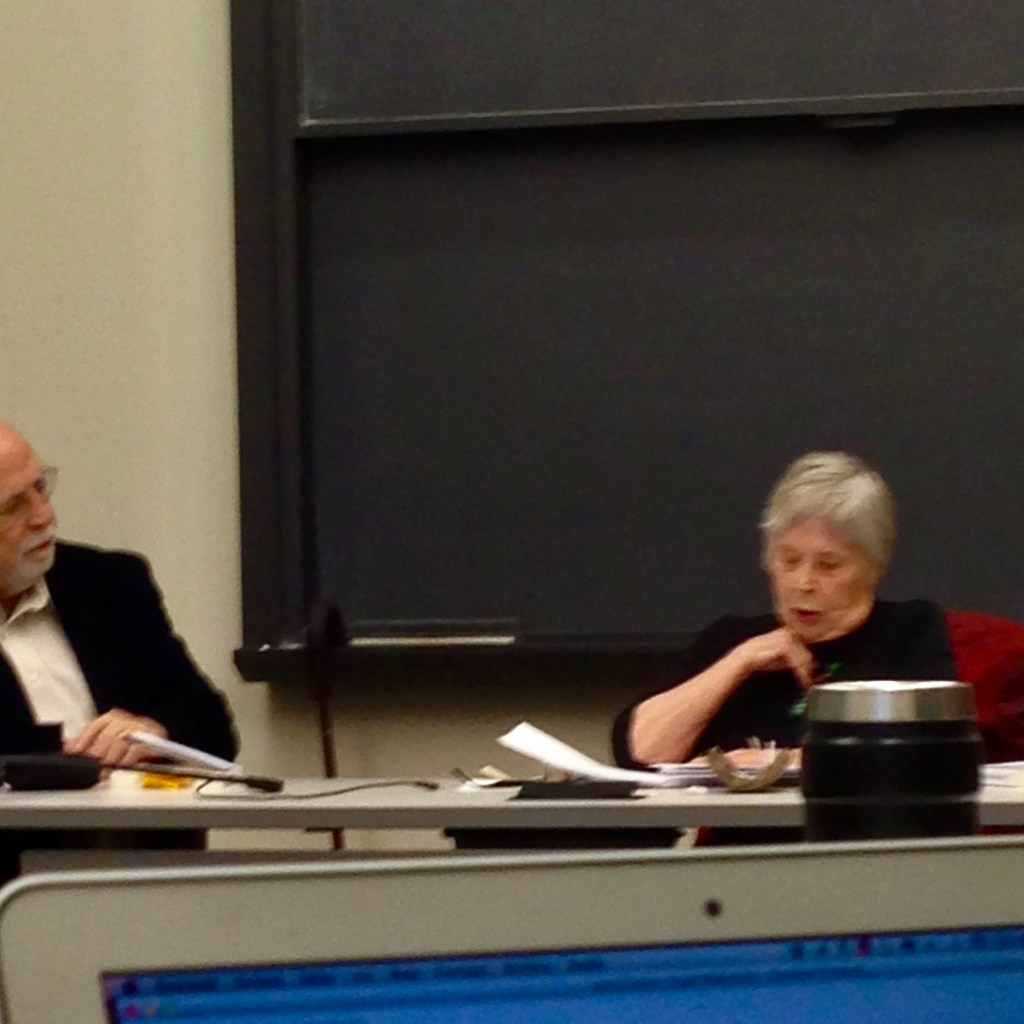
Jean Franco, pioneer of Latin American Cultural Studies and witness to its Cold War gigantomachy, passed away a couple of weeks in December at age 98. She remained lively and curious even at the very end of her scholarly life, and for some of us that saw her in action she embodied the memory of the century. The photograph above is of Jean’s visit to Arcadio Díaz Quiñones graduate seminar in the fall of 2015 where she discussed some of the main arguments of her last book Cruel Modernity (Duke U Press, 2014), a cartography showing the definite closure of the Latin American insomnia for political modernity in light of its most oblique mutations: narcoviolence, the emergence of a dualist state structure, and new global economic forces that putted an end to the vigil of the revolutionary enterprise. I write “definite” purposely, since Jean’s own The Decline and Fall of the Lettered City (Harvard U Press, 2002) already hinted at a certain exhaustion (to borrow the strategic term of Alberto Moreiras also writing during these years), most definitely a thorough disillusion, in the sense deployed by Claudio Magris, of cultural substitution for the belated state-making modernization. The function of “culture” (and its hegemonic state apparatus) was always insufficient, dragging behind, or simply put, unintentionally laboring for the cunning of a project forever postponed in the sweatshop of the newest ideologue, or for the hidden interests of the “local” marketplace of moral academicism. All of this has come crashing down rather quickly even if the demand for culturalist janitorial or housekeeping services are still in demand to sustain the illusion sans reve et sans merci.

What always impressed me about Franco’s scholarship was her intellectual honesty to record, even if through an adjacent detours and academic finesse, the destitution of all the main categories of the Latin American modern wardrobe: developmentalism, state-civil society relations, the intellectual, cultural hegemony, revolutionary violence, the “rights revolution”, and the intra-national spatiality (rural/metropolitan divide). From now on it is hard to say that there is a “task of the critic”, if we are to understand the critic in the Kantian aspiration of sponsoring modern values and perceptiveness to an enthusiastic disposition (definitely optimistic towards action) to transforming the present. As a witness to the twilight of the Latin American modern epoch, Franco univocally resisted the inflationary, value-driven, demand for politicity and ‘more politics’. This is why her attitude remained at the threshold of any given effective political panaceas or half-baked illusions.

Does her biographical experience say anything to this particular inclination? It is difficult to say, although as a witness of the century Jean had lived through the coup in Guatemala in 1954, visited the Cuban Revolution during its most “intense years” of the sugar cane milestone (La Zafra de los Diez Millones), and followed with attentiveness the rise and transformation of the Southern Cone dictatorships in the 1980s coupled with the irreversible social transformation of neoliberalism in the 1990s signaling the effective end to regional integration in the face of planetary unity. All of this to say that I find it hard – at least leaving aside the many nuances – to see in Jean’s scholarly witness an enthusiasm for the Latin American Pink Tide, the communal state, or abstract regional historicizing that could finally bring about the moral universe of the national-popular state (as if said moral realization would be anything worthwhile, which we some of us seriously doubt). If Jon Beasley-Murray once said that John Beverley was the “Latin American unconscious”, I guess it is fair to claim that Jean Franco was an authentic Latin americanist realist; that is, someone that was up to task to see in the face of the tragic, the cruel, and the heinous as the proper elements of the interregnum. Or to better qualify this: she was a worldly realist, leaving aside utopias and its abstractions. At the end end of the day, Leninists are also realists, or at least claim to be so. What places Jean’s earthly realism apart from the Leninist realism is the subtraction from the seduction of Idealization, which even in the name of the “idea” (“the idea of communism”, say) or “immanent higher causes” must bear and render effective the logic of sacrifice at whatever cost, even the real sense of freedom if demanded by the party, the leader, or the community. This is why at the closure of Latin American modernizing enterprise communitarian arrangements, posthistorical subjects / identities, or grand-spaces that mimic the constitution of Earth are foul dishes for a final banquet. It is always convenient to refuse them.


Going back to my conversations with Franco at Princeton, and some exchanges a few months later in a cafe near Columbia University, for her there was remaining only the anomic geography of Santa Teresa in Bolaño’s 2666, a novel that charts the current ongoing planetary civil war in the wake of the crisis of modern principles of political authority. I can recall one remark from Jean during these exchanges: “¿Y quién pudiera mirar hacia otra parte?” This is the general contour of her witnessing: how not to look somewhere else? In other words, how not to look here and now, into the abyss that is no longer regional or national, Latin American or cultural specific, but rather proper to our own civilization? A civilization is, after all, nothing but the organization of a civis, which has now abdicated to both the metropolitan dominium, as well as the campo santo of sacrificed life at the hand of techno-administrative operators (the new praetorian guard) of a well lighted and fully integrated Earth.

There is no alternative modernity, decolonial state, or hegemonic culture that will not serve to the compensatory and sadistic interests of the cruel policing of death and value, as the only masters in town. We are in Santa Teresa as a species of energy extraction. Can reflection be courageous enough to look through and against them? This is the lasting and eternal question that Franco left for those who are willing to see. It does not take much, although it amounts to everything: mirar / to gaze – in an opening where human form is lacking and categories are wretched – is the the most contemplative of all human actions. Whatever we make of it, this practice now becomes the daring task of the coming scholar.

The politics of schism: theses on Dionys Mascolo’s La révolution par l’amitié (2022). by Gerardo Muñoz

1. Remembrance without restitution. The publication of Dionys Mascolo’s essays in La révolution par l’amitié (La fabrique, 2022) opens a path to a singular thinking that refused to conform to a master thinking, and even less what has come to us as political theory, or radical critique. Theory and critique have shown their resilient adaptiveness to university discourse. Thinking, on the contrary, moves annexes a relation with the missing word. This caesura negates the closure of both politics and community, it shows its insufficiency. In a letter to Maurice Blanchot regarding his ceased friend Robert Antelme, Mascolo comes to terms with this specific question: the remembrance of what loss in the actual word is – the voice of his friend Robert Antelme – what cannot be posited as a restitution of representation, but rather as effective effort to transcend mutism and silence that would have sunk writing into a pathos not short of a “miserabilist” stance [1]. The exigency of language is absolute. In an analogous way, we can say that the writing in La revolution par l’amité (La fabrique, 2022) is not a matter of restituting the history of Marxism, the intellectual debates of French theory, or even the burial site of a thinker that rejected repeatedly the metaphysical function of the public intellectual (a sort of captain at the steering wheel of public opinion, a cybernetician); but rather the remembrance that thinking is the irreductible site of common to the species. Remembrance has no “archive” and it does not produce anything; on the contrary, it invites a path to thinking in order to bring the absolutism of reality to an end.

2. The irreducibility of the species. For Mascolo – as for Nicola Chiaromonte – the stimmung of the modern age is not a lack of faith, but a bad faith subscribed by the subject of knowledge, a guardian of the nexus of legitimacy. In his practice of writing, Mascolo explored something like a countermovement to the rationality of the intellectual posture, in which communication ceases to be a common means in order to become a production of ends and instrumentality. Hence, what Mascolo called the “part irreductible” – and its “doubt in any system of organized ideas in sight” – is the only intuition of the unity of the species in communication. And if the intellectual is an organic unity of hegemony that replaces the function of the priest in the Church bureaucracy and its paideia (recall Antonio Gramsci’s “organic intellectual”), for Mascolo irreducibility in the sharing of thought in communication is “not political” as he states in Autour d’un effort de mémoire – Sur une lettre de Robert Antelme (1987). This step back from the production of modern politics thoroughly imagines another figure of communism. It is at this point where the whole Cold War polemics between humanism and anti-humanism is destituted internally: the species finds a way out of political domestication.

3. Communism of thought. We can understand why for Mascolo “the word communism really belongs more to Hölderlin than to Marx, as it designates all the possibilities of thought; that which escapes in thinking, and only that can constitute its work (oeuvre)” [2]. In other words, communism for Mascolo is not a matter of doctrine or an Idea, nor about philosophy of history and its inversion; it is not about a political subject or a unity of organization of political force; communism is a use of thought in language in proximity with what escapes in every communication. The inoperative communism, hence, is only possible in friendship, as a continuous experimentation of taste that cannot coincide with a community form. As Mascolo writes in his essay on Antelme: “We did not live in community. This is a deceptive word…we existed in a sentiment of mutual gift of freedom” (53). Any reinvention of a politics to come after the collapse of authority must commence with this rejection of a compensatory communitarian closure. Today only a conspiratio between friends can animate a new field of intensification for renewal.

4. Refusal and friendship. Even in his earliest stages of writing such as “Refus incoditionnel” (1959), the condition for friendship for Mascolo is to refuse the current state of things; to retreat from the demand of reality in order to survive in the imagination of the shared word. In this sense, the thematic of friendship does not make subjects of duty towards a social bond, but rather a secret in the word designated by separation. Friendship floats high above symbolic representation, as it moves to an inclination that is singulare tantum. If modern politics thought itself as a repression and administration of the hostis; for Mascolo the practice of friendship is the sacred space that is never inherited, but, precisely the dwelling of those who “seek” after in the wake of the homelessness of man and nature. This is analogous to Hölderlin’s allowance of thought which moves in passion while accounting for the abyss of our relationship with the world (aorgic) of originary detachment.

5. Revolution as style. In a brief text on the Cuban revolution of 1959, originally written for the collective exhibition Salón de Mayo in Havana, Mascolo says a new revolution in the island could potentially offer a the opportunity of a new style [3]. Of course, as soon as Fidel Castro supported the Soviet invasion of Czechoslovakia in 1968, it was clear that such promised crumbled, and that the Revolution will fall well within the paradigm of the metaphysics of historical project and the subject (“a new man”). But what is style? Once again, this speaks directly to Mascolo’s passion for the irreductible outside of the subject, and for this reason never alienated from the schism of the species. The notion of style relates fundamentally to our exposition to the outside, to the event of expropriation, which defines our fidelity to the invariant dimension of our character. A new style, therefore, is not something to be produced, an effect of the subject, but rather the unit of an ethical practice in our encounter with the outside. If the apparatus of the revolution was instituted as a the production of a civilization; the fidelity to a style names the modes of life that cannot be oriented towards a specific work. A new aberrant freedom emerges.

6. Saint-Just’s ethos. Mascolo never ceased to reflect on the ethical determination of politics, against politics, and for a transfigurative notion of a politics for the here and now. And he dwelled on this problem in his writings on the ethical figure of Saint-Just during the French Revolution (“Saint Just” and “Si la lecture de Saint-Just est possible”). Unlike the monumental historiographies – both left and right, revolutionary and conservative, historicist or revisionist – that situated the revolutionary under the sign of Terror and Revolution, of will power and the emergency of Jacobinism; for Mascolo Saint-Just stands a figure that keeps an important secret. And this is it: “the inhumanity of Saint Just is that unlike many men, he does not possess many lives but only one” (130). This is a concrete definition of a ethos that is irreducible to the “monstrous arts of government” in an epoch where the political had become the secularization of fate. In the same way that Hölderlin turned his gaze towards the impossible and concealed distance of the moderns in relation to truth of the Greeks, for Mascolo’s Saint-Just the legitimacy of the modern universalization (in the State, the Subject, the Social) does not have the last word. The ethos of life keeps the remembrance of an abyss of the monstrosity of historical universality and the social equality.

7. Borrowed existence. Dionys Mascolo lived at the dusk of the modern arch of the revolution, whether understood as eschatology or a conservation of the natural order of the species, as Saint-Just proposed against the Rousseaunian social contract and the Hobbesian mechanical Leviathan in exchange for authority. We have already crossed this threshold, and we are in the desert of the political, retreating on its shadow fallen into administration of fictive hegemonies. Hence, the question of an ethos of existence becomes even more pressing from Mascolo’s thematic of friendship in order to refuse what he calls in “Sur ma propre bêtise et celle de quelues autres”, a “borrowed existence in a comedy that feels as if we are being watch by God alone” (219). Indeed, as some have diagnosed with precision, the religion of our time is absolute immanence, the full disposition of the tooling of our means [4]. A cybernetic dreamworld, whose pathetic figure is the “influencer” (a few strata beneath the luminosity of the intellectual). This can only fix us into the stupidity of intelligence of the species: specialized intelligence, in other words, prisoners in the sea of nihilism. The intelligence of the species, on the contrary, is the cunning (methis) of the fox: a way out in spite of the swelling tides. But against the nihilism of a borrowed life of immanence (beatitude of the impersonal, and iconicity of things), Mascolo’s thought insists stubbornly in friendship as the initiation in an uncharted path to reenter the world once again.

.

.

Notes 

1. Dionys Mascolo. Autour d’un effort de mémoire: Sur une lettre de Robert Antelme (Maurice Nadeau, 1987). 

2. Ibid., 50.

3. Dionys Mascolo. “Cuba premier territoire libre du socialisme”, in A la recherche d’un communisme de pensée (fourbis, 1993).

4. Lundi Matin. “Éléments de descivilisation. Partie 4”, Lundi Matin, 2019: https://lundi.am/Elements-de-decivilisation-Partie-4

Homo Lupus Felix: Against Civilization. Notes for a presentation in the Eckhardt S. Program, Lehigh University. by Gerardo Muñoz

There is no question that Alice Rohrwacher’s Lazzaro felice (2018) is a marvelous cinematic work insofar as it measures up against the epoch by radically questioning the principles that have upheld what we know as civilization. This slight adjustment is critical given that ideology, political economy, or subject oriented frameworks of analysis have become insufficient to deal with the crisis of civilization. As a matter of fact, they have become functional (mere deployments of technique, to put it in Willy Thayer’s vocabulary) to the infrastructure, and its specific philosophy of History that promotes the maintenance of Order after the liquidation of its legitimacy. I would like to clarify that I am understanding civilization in a twofold register: as a genetic process of human anthropology based on the matrix of “appropriation, distribution, and production” of the world (a techno-political grid popularized by Carl Schmitt); but also as the total realization of an economic or political theology, which we can directly link to the function of “credit” (and the process of abstract dialectic between credit and debt, as a ground of a new “faith”) that is deployed as the medium of the total sum of social relations that commands beings in the world. Civilization is the general matrix of a process of optimal rationalization of the events that take place in the world, making us potential reactionary agents of the time of its phenomenality.

Aside from all the Christian and religious imaginary, Lazzaro felice is a theological film, but only insofar as it takes the irruption of the mythical remnant very seriously. There is something to be said here – and I think the film stresses this in several parts of the story – between religion and theology, dogma and the spiritual (anima), and the sacred and the commandment solicited by faith (pistis). In other words, Lazzaro felice enacts a destruction of a political theology by insisting on the civilizatory decline towards reproduction of as mere life of survival; a life that is delegated to the abstract faith of credit. In this sense, it is no mistake that Lazzaro’s homicide takes place in a bank and executed by the community of believers (capital, in the end, has already been incarnated; it is the Subject). The laboratory where this takes place is the metropolis, which as I have argued elsewhere is the site of devastation and optimization life in our epoch, which unifies world and life putting distance into crisis, in a suspense of the experiential [1]. The consumption of the new political theology of unreserved equivalence between humans and objects is what Rohrwacher interrupts through the fable of the beatitude of Lazzaro as a life to come in the threshold of the highest phase of the metropolitan stagnation. I will limit my commentary here to three nodes that allow the Lazzaro felice to expand this critique of civilization and the principle of the “civil society”, a notion that we will return to.

First, there is the fable, a capsule of an ancient gnostic wisdom. The fable is what can radically alter evil by tipping its objective realism into a real of the imagination against the grammar of order. Avoiding the order of narration based to account for the history of progress and developmentalism from the rural to the civilization of the metropolis, Rohrwacher’s strategy resorts to the ancient craft of the fable. This is fundamental for a number of reasons. First of all, because the fable allows to withdrawal from pure counter-narrative of historical development and its justifications that allow for the interruption of the time of development, while offering a possibility of an otherwise transformation of the world. This is the gnostic texture of the fable that Hans Blumenberg identified in this form, since obscuring of the distinction between humans and animals relaxes the burden of proof of the absolutism of reality as predicated in the matter of facts [2]. It through fables that something escapes, because there is always an image that escapes the narration of the events of this world. But the fable also offered something else: the beginning of myth as the site of legitimation for foundations of social relations. This is why, as T.J. Clark has reminded recently, Hegel associated the fable with the origin of master and slave dialectic, as a new form of domination of world once the world’s enchantment and mystery was dissolved: “In the slave, prose begins” [3].

The end of a paractical poetics? Perhaps. This means that the price to be paid to enter into the prose of “civilization” is to assimilate the unfathomable and invisible contours of the world into the polemos of storytelling; to be a subject of a story, and as a result, of historical transition. This is what civilization mobilizes through the fable as its posited legitimacy. It is in the fable where the abyss that separates us from the world becomes animated, ordered, and narrated in order for the apparatus of production to commence. It seems to me that Alice Rohrwacher goes to arcanum of civilization when she treats the fable of the wolf, which has functioned to legitimize the passage from the state of nature to the modern concept of the civil in Hobbes’s theory of the state. We should remember the brief fable in Lazzaro felice:

“Let me tell you the story of the wolf. A very old wolf had become decrepit, he could hunt wild animals anymore. So, he was excluded from the pack…and the old wolf went to houses, to steal animals, checks and sheep. He was hungry. The villagers tried to kill him in every way possible, but they didn’t succeed…as if he were invisible.”

It is a remarkable fable that inverts the political fiction of the wolf in Hobbes; mainly: a man is an arrant wolf to another man (homo homini lupus), which justifies the exodus from the state of nature as the “miserable condition of civil war” between men. The stakes are clear: by repressing civil war (stasis), civil society emerges as a divided but unified body under a sovereign principle of authority [2]. The wolf is first established as creature of fear and depredation in order to allow for the principle of civilization to emergence as uncontested and necessary. The fable of the wolf is the protofigure that guards the history of perimeters of civilization as a way to pacify and repress the latency of civil war. Rohrwacher, against the Hobbes political fable, gives us a fable of the wolf that not only is uncapable of waging life as war, but that it enacts full refusal and desertion to be hunted; that is, to be invisible, which ultimately entails a life not outside of a politics of hunting and the secondary pacification by which the end of hunting mutates to the enclosure of domestication [4]. 

If the wolf stands for the invisible it is because it occupies the excess of total legibility of a new civil order, that is, of a world administered by technique of order. The wolf is a prefiguration of the invisible that is improper to every life (and thus to all biopolitical domestication proper to civilization) in the passage from the organic community of the living to the civilizatory topos of the metropolis. The wolf condenses the instructive character in every life; that is, what cannot be reduced to the fiction or the depredatory total war of the civilization nor the fiction of the community lacking an open relation to the world.  This fable, then, is not just what unveils the fictional grounds of the legitimacy of civilization (its “black magic” under the light of rationality and control) but also what reprepares another community. A community in which what we have in common is not an attribute, a substance, or an identity, but an irreducible ethical relation in which civil war cannot equate total hostility and what establishes an absolute difference between life and the “principle of the civil” that formalized the aspiration of isonomic equality:

“The immemorial bad reputation of the wolf (wolf bashing) informs us about one of the oldest tricks of civilization. This consists of bearing the weight of predation on what is heterogeneous to it. To be able to say that man is a wolf of man, the wolf must first have been disguised as a “predator.” We do not mean that the wolf is gardener of daisy flowers, we mean that he behaves neither as a tyrant nor as a bloodthirsty animal, and even less as an individualist (the famous “lone wolf”). In fact, the wolf may have taught communism to humans. The cub that opens its eyes among humans recognizes them as part of its clan. Two lessons: 1) friendship ignores categories; 2) the common is the place where we open our eyes to the world. What the human, for his part, has “taught” to the wolf – like an angry father yelling at his son “I’ll teach you!” – is the servility of the good puppy and the good cop”. [5]. 

               The end of the film comes full circle with the only condition of finding a way out, producing a break in the infrastructure of the domestication, opening a path within and against the metropolis. It is almost as if the film, like in life, was a preparation for the moment of exodus and retreat. In fact, the wolf deserts the metropolis passing through and beyond the highway in plain rush hour. According to Alice Rohrwacher, the wolf leaving the city and not being seen was a reinforcement of the invisible ethical dimension that is proper to every life (an ethos, which in the old Pindaric sense that refers not only our character, but also, and more fundamentally to our abode and habits that are world-forming), and that is devastated by the anthropological crisis of the species in the wake of the process of civilization [6]. However, the wolf exit from the metropolis is not an abandonment of the world in the manner of a monastic communitarian retreat; but rather the pursuit of liberating an encounter with the events of the world foreclosed by topological circulation of credit that amounts to borrowed life without destiny. 

Now to the question that signals an instance of construens in what follows the desertion: what about happiness? It is here, it seems to me, where the beatitude of Lazzaro could be thought as an ethical form of life – as preparation to learn to how live a life against the abstract processes of domestication – that exceeds the two hegemonic paradigms of happiness offered by Western civilization: on the one hand, happiness understood as an equilibrium operative to virtue (aretē); or, on the other, the community of salvation as a compensatory effect for the structural gap of the fallen subject, original sin (felix culpa). One could clearly see that politics at the level of civilization could now be defined as the instrument that manages the production of happiness as a temporal exception in life, but never a defining form of our character.

The wolf that is Lazzaro’s form of life – at a posthistorical threshold that dissolves the anthropological divide man and animal – offers us a third possibility: happiness understood as the refusal to partake in the promises of civilization in order to attune oneself to an errancy of life that allows itself to be hunted by an experiential imbuing of the world. Happy Lazzaro? Yes, but never a Sisyphus who is incapable of experiencing the vanishing horizon between earth and sky in infinite divisibility of the world. The wolf unleashed traverses a geography against domestication, revoking the phantasy of home (the oikos). I will let the last words be made by some fellow-travelers contemporary American thinkers: “Civilisation, or more precisely civil society, with all its transformative hostility was mobilized in the service of extinction, of disappearance. Fuck a home in this world, if you think you have one.” [7].

=

Notes

1. Gerardo Muñoz. “Dix thèses sur Lazzaro felice” en tant que forme de vie”, Lundi Matin, May 2019: https://lundi.am/Dix-theses-sur-Lazzaro-felice-en-tant-que-forme-de-vie

2. Hans Blumenberg. “Of Nonunderstanding: Glosses on Three Fables” (1984), in History, Metaphors, Fables (Cornell University Press, 2020), 562-566.

3. T. J. Clark. “Masters and Fools”, LRB, vol.43, No.18, September 2021. 

4. Thomas Hobbes. Man and Citizen (De Homine and De Cive) (Hackett, 1991), 11.

5. “Éléments de descivilisation” (part 2), Lundi Matin, april 2019:  https://lundi.am/Elements-de-decivilisation-Partie-2

6. Jerónimo Aterhortúa Arteaga. “Creer en las imágenes: entrevista a Alice Rohrwacher.”, Correspondencias, May 2021: http://correspondenciascine.com/2021/03/creer-en-las-imagenes-entrevista-a-alice-rohrwacher/

7. Stefano Harney & Fred Moten. The Undercommons: Fugitive Planning & Black Study (Minor Compositions, 2013), 132.

Three ideas for a discussion on «Éléments de décivilisation» by Gerardo Muñoz.

[These are some preliminary notes for an ongoing discussion on Lundi Matin’sÉléments de décivilisation’’, a text that condenses a series of problems dealing with, although by no means, limited to infrapolitical reflection, the event, world, and the question of civilization in the wake of the ruin of hegemonic principles. This particular essay, more than content, raises the question of the status of the style of thought; and, in broad terms, I tend to link the notion of style to the constitution of an ethos. But let me offer three theses to open the discussion in very broad terms. What follows is the reconstruction of three brief points in a recent group meeting about this text.] 

i. The priority of the event. For me at least it is very important to consider that Éléments de décivilisation’’ moves away from at least two important precedents of a common intellectual orbit: messianism and the political theory of modern sovereignty. Of course, this is important for many reasons, but most it speaks to what I would call a strong opposition between thought and philosophy (favoring the first over the second). These two registers open important distinctions, such as, for instance, a displacement between historical temporality (messianism) to a notion of the taking place (the event or encounter) as exteriority. Whereas we were told that the “event is the enemy within Empire” (Gloss in Thesis 60 of Introduction à la guerre civile) , now we have a more through sketch about the way in which the form-of-life is not a category reducible to vitalism or the problem of the subject, but rather about the play between form and event. Here I think that Carlo Diano’s Forma ed evento (1952) is crucial as a backdrop that is not just philosophically (Aristotelian formalization against Stoic predication), but rather a sound position of thinking in relation to what has been passed down as “civilization”. 

ii. Civilization as a principle. Now, the question of civilization raises to a problem of thought insofar as is neither an ontological problem nor an operative idea in the history of intellectual concepts. Civilization becomes the apparatus by which the total regimen of production in any given epoch is structured to establish an order. And here order is both authority and police. To put it in juridical terms: the first secures legitimacy while the second posits the flexible energy of legality and execution. This is the same problem in the relation to the world. In other words, civilization means enclosing, domesticating, and producing. By the same token, civilization is the operative domain by which nomōs, history and the subject come together in virtue of their separation. Is not this the very issue in the Greek polis in the wake of the discovery of measurement, isonomy, and the distribution of the goods in which hegemony replaces the basileus (Vernant)? It is one of the merits of the text not having understood this problem at the level of an “archeology of Western political thought” (Agamben), but rather as an evolving transhistorical process that binds the axis of domination and power to the axis of anthropology and domestication. Civilization, then, would name the total apparatus of hegemony under which politics falls as a problem of metaphysical structure (I have tried this problem in recent positions here). Whether there is an assumed anthropological anarchy at the level of substance, capable of “inversion” (Camatte), is something that must be explored in further detail. 

iii. Happiness cuts absolute immanence. My last point. I would like to insist on something that Rodrigo Karmy mentioned recently: “Happiness is the unthought of the Weestern tradition”. I agree with Karmy not on the basis that there has not been any reflection of “happiness” in the tradition, but rather that this reflection has either been a) subordinated to politics or economics (Jeffersonian “happiness” conditioned by commerce); or, as a moral virtue of self-regulation and privation. But it seems to me that “Elements” wants to offer something else in a very novel way. It is here where the question of violence must be inscribed. A curious displacement since violence has been thought in relation to beauty, but not happiness. The violence at the level of forms puts us in proximity with the event at the end of life itself. In this sense, the Pacôme Thiellement footnote is important:

“l y a deux lumières: il y a la lumière d’avant la nuit et il y a la lumière d’après. Il y a celle qui était là au début, l’aube radieuse du jour d’avant, et puis il y a celle qui a lutté contre les ténèbres, la lumière qui naît de cette lutte : l’aube scintillante du jour d’après. Il n’y a pas seulement deux lumières, il y a aussi deux joies : il y a la joie d’avant la peine et il y a celle d’après. La joie originelle, la joie innocente, primitive, cette joie est sublime, mais c’est juste un cadeau de la vie, du ciel, du soleil… La joie qui vient après la peine, c’est le cadeau que tu te fais à toi-même : c’est la façon dont tu transformes ta peine en joie, l’innocence que tu réussis à faire renaître des jours d’amertume et des nuits de bile noire. C’est le moment où tu commences à vivre, mais vivre vraiment, parce que tu commences à renaître de toutes tes morts successives. C’est le moment où tu t’approches de la divinité ou du monde”. This position  – which I think it is prevalent throughout the text – allows the opening of a series of articulations:

a) it is no longer happiness an effect on the subject, which has only grown in the Spectacle or consumption; that is happiness as an exception to life.

b) it is not that happiness is a theological state of ‘blessed life’, which would presuppose the transmutation of sin and thus overcoming of the non-subject. This position depends on conditions of mythic-history and theology.

c) It is rather that happiness is the way in which the singular gathers his possibilities in use without enclosing the other possibles. To live a life among the fragmentation of the use of our disposed potentialities is a way to violently cut the seduction of absolute immanence in which style is diluted. Play could name the variations of use. But there is a second order risk in what constitutes “play”: a transfiguration of politic as civil war. The problem becomes how to think of ‘play’ (i. messianic abandonment, ii. political intensification – insurrection, or the separation between rhythm and voice, a poesis). I am interested in pushing for the third figure of play; a third figure in which the event and happiness impose a new division of souls, moving away from the separation from life.