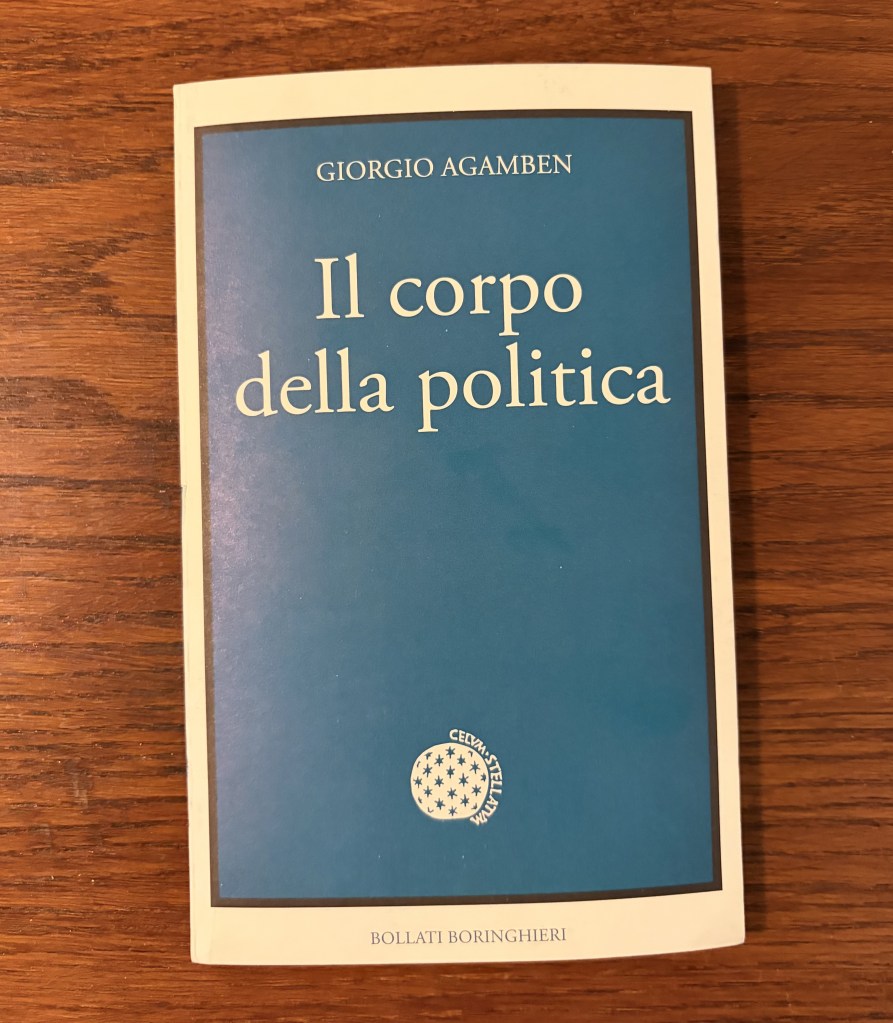
One of the decisive lessons of Giorgio Agamben’s archeological examination of Western politics is that the imperative to confront the closure of representation, sooner or later it must also come to terms with the notion of the body (corpo) as a central metapolitical condition in the genesis of modernity. If L’uso dei corpi (Neri Pozza, 2014) brought to its final stage the philosophical exploration of Western ontology of politics defined by efficacy and realization; in most recent opuscules, Agamben has shown how the fixation and regulation of the body is also embedded in the regions of language and sensation of human life as well. In this sense, it is impossible not to read Il corpo della politica (Bollati Boringhieri, 2026) along with Il corpo della lingua (Einaudi, 2024), as two parallel commentaries on the defining stature of political representation. If a new beginning is one of the decisive questions of our times, then one of the pending tasks is precisely to think the body (corpo) against the ontotheological assumptions of calculative reason.
Similar to Il corpo della lingua (2024), Il corpo della politica (2026) starts with the treatment of the Copernican revolution of bodies in Hobbes and Newton, which in the face of the cosmological infinity inscribed a notion of two bodies in order to allow for representation within spatial coordinates. In other words, Hobbes’ artificial sovereign represented by the mortal god Leviathan (state normative authority) will have an autonomous colorary in the autonomy of the subject that will become “political” as long as it becomes coterminous with the civic body of the “People”. Thus, to speak of “bodies” is not just to rationalize physicality in space – although it is also this from a technical viewpoint that state legibility will soon demand of the incipient civil society – but more importantly, it entails the administration of energy and movement (in Agamben’s well known lexicon, the domestication of potency to the realization of purposeful ends). For Agamben, Spinoza’s conatus, which appears in the Baroque period in critical dialogue with Hobbesian and Newtonian frameworks should be read precisely a way to think past the body as substance, following the steps of the tradition of ancient Stoicism in which beings are corporeal insofar as they are in tension with the world, allowing the tonos or acoustics to animate being in its movement towards preservation and exposure (Agamben 20-21).
If all beings are traversed by a tonos – a tension that crosses as its medium in virtue of its contact with the world – this means that they are no longer defined by a substance, but as intensity within a field of forces once thrown in the world. As Agamben writes in passing with explicit confrontation with Heidegger’s Being and Time: “…con la tesi perentoria ‘l’essenza dell’esserci giace (liegt) nell’esistenza’. L’esserci è stato “gettato” nel mondo, ma si direbbe che, una volta gettato, non cade in piedi, ma giace (liegen significa innanzitutto essere sdraiato). E questa concezione sub-stanziale dell’essere che il conatus mette radicalmente in questione” (Agamben 23). In an archeological gesture that is already signatura of his work, Agamben reminds us that Hobbes’ substantive and artificial division of the “two bodies” that anchors modern politics can be traced to the corpus mysticum and the theological debates concerning transubstantiation that will later be recasted in the intersecting works of both Ernst Kantorowicz and Carl Schmitt, in which the impolitical dimension of the multitude becomes political through the artifice of decision and representation of a unified and indivisible body (Agamben 25-26).
The catastrophe of modern politics takes place when the body, once reduced to a substance and computable object in space, ceases to be understood as an inteusum or intensity of an irreducible multitude that expressed a generic and universal human species, as it was for Dante: “La politico – il finis totius humanae civilitatis che Dante intende definirie nel suo trattato – è ancora una volta un campo di tensioni interne allo stesso genere umano e questa intensità ha la foram di una moltitudine” (Agamben 39). In other words, for Agamben following the implicit tonus present in Dante’s Monarchia, the political is neither action nor mediation, but what names the very site of the possible. Agamben calls the hypothesis of an “anarchic politics” (politica anarchica), which no longer defines itself in relation to a formal mediation of government and state, but rather as the intensity of the multitude through the generic being (Marx) or the universal humanity (Dante) that takes the form of sensible Empire devoid of principial politics mediated by constituent power (Agamben 47).
Where does the multitude dwell outside the constituted representation of a community of belonging or the social mediation of the state? Already in 1990s Agamben had written a gloss on the politics of exile collected in Mezzi senza fine (1996), and the last part of Il corpo della politica (2026) he returns to philosophical and theological notion of the exile vis-a-vis the historical experience of the Jewish tradition as an errant or stateless people, as Erich Unger called it in 1922, whose existence has been defined by exile or galut (Agamben 48). It is a bit of a misnomer to call the exilic experience a “politics”, since for Agamben the authentic tradition of exile does not entail the right or duty fixed to a community of belonging; rather, what outlives the law is the only path capable of deposing it (in the manner of Paul, that is, as katargeo). In this way, justice is now understood not as a procedure in a normative system, but as a written tradition that can only be studied and reflected upon and ultimately experienced as a state of passivity.
Hence, the exilic experience is the caesura between language and world, in which we touch the exteriority with a renewed intimacy that unfolds the uncommunicative solitude that keeps the mystery of our use of language. Following the neoplatonic formulation “phygé monou pros monon” – understood by Erik Peterson as an expressive mystical relation of a “fuga di un solo presso un solo” – there is intimacy and authentic belonging whenever there is sensible separation in being (Agamben 55). Following Plutarch and Plato, for Agamben the exilic dimension is the very home of philosophy and thought, which confirms, against Crito’s suggestions at the end of Socrates’ life, that there life outside of the polis and the conglomerate of the demos, because life is outside itself once it is assimilated in the virtuality of a divine that nourishes its own potency. In what stands as one of the most precise formulations of the pheugein (exile) condition as a figure of existence, Agamben writes of its precise ascesis:
“La celebre definizione ascetica della fuga dal mondo come assimilazione a Dio andrà resa, pertanto, restituendo tutta la sua forza alla metafora politica: “l’assimilazione a Dio virtualmente un esilio” (kata ton dynaton significa qui, secondo il sense più proprio del termine dynatos, “virtualmente, secondo la potenza). L’affermazione e tanto piu significativa in quanto, con queste parole, Platone rompe con l’insegnamento socratico del Critone, secondo cui la possibilità di phygé offerta al condannato non potrà che essere rifiutata, perché non vi è vita possibile fuora dalla polis” (Agamben 57).
This region that precedes and exceeds politics – in the language of Sophocles, the well known ypsipolis apolis – is akin to the tone that runs to the forgetting of any substantive ontology of politics that seeks to subsumes life into the confinement of external forces. It is in this paradoxical situation of assimilation in exile, and a permanent exile that assimilates itself in God as shared thought that politics can be transfigured as an apodemia that refuses the closure of life into principles of government and dominium, and away from the community form of propriety and rooted belonging. Agamben recalls that in the history of Christianity, it is the time of the parish (paroikias) what allows the soul to live in earth as foreigner and exile, in proximity of the medium of the kingdom, and that only later with Saint Augustine it was transformed into a territorial institution for the communio and communal salvation (Agamben 60-61). In the paroikias, Agamben returns to the kingdom not as a retheologization of the politics, but as a figural parable in which a poetic dwelling is enacted in the measureless passivity of a form of life, a project consistent with the formulation of the singular whatever being articulated in La comunita che viene (1990).
The assimilation in the exile of the divine, which recalls the forgetting of oneself and the god announced by Hölderlin in“Note on the Oedipus”, is refined in the last essay of the book entitled “Il corpo dell’Europa”, which reproduces a lecture delivered in Venice in May 2024 about idea of Europe. As a sort of concluding reflection or apostilla, we are now able to say that for Agamben the only possibility of dwelling in the vestiges of the European tradition and memory is to rescue, from the wreckage of its history, the sediments of a texture of the phygén: to be exiled is not just a vitalist affirmation of this life, but more importantly, it also implies disclosing the possibilities buried in the past with the dead, that is, in contact not only with Gaia, but also in the downward movement to the domus of the infraworld (a figure that receives a novel treatment Agamben’s recent book La lingua che resta). Agamben exemplifies this exile with the dead with three poetic moments of high european modernism: Ezra Pound’ Cantos, T.S. Eliot’s The Wasteland, and Eric Auerbach’s masterpiece Mimesis written from his exile in Turkey – and of course, we could also think here of Kafka’s parables and Joseph Roth’s narratives of Jewish errancy; as well as Alexandre Lerrnet Holenia’s phantasmatic crumbling of Empire in The Standard and Osip Mandelstam’s “The Fourth Prose”, where the end of the work leads to the human voice as the supreme poetic task in the face of nihilism and political totalitarianism.
It should be clear, however, that the problem is not found a temporary refuge or a last stand in the fortress of modern literature, but of coming to terms with the phygé as a fundamental problem of language that, in virtue of its unique and irreplaceable experience, delivers a world nested in the affection of remembrance. As Agamben asks towards the end of the lecture: “Is there a sensibility and a form of life that we can call European?” (Agamben 82). This question can only be answered when we dwell and assimilate into the exile of thought that harbors the residues, figures, and voices that speak to us from the dead in a tradition because it is no longer transmitted, we can only access it poetically. In the only moment that the word anima (soul) appears in the text, in the very last sentences, it becomes clear that it is only in the intensity of thought that life accounts for the inseparability of the body and the soul that historical abstraction has rendered oblivious and alien from the tonos of presence. We are not yet ready to declare a return to the appearance between being and world, and for that very reason even the presence of the divine, as Agamben says following Isaac Luria, is itself exiled from the creation of the world until the advent of the tiqqun in the night of restitution. The exilic dwelling of life outside itself is marked by this sort of secret unfaithfulness in the absence of the god. In the meantime, the task of an ethical life is to passively reside in an exile where the reality of the soul returns what is possible and breathable to the appearance of the real.

