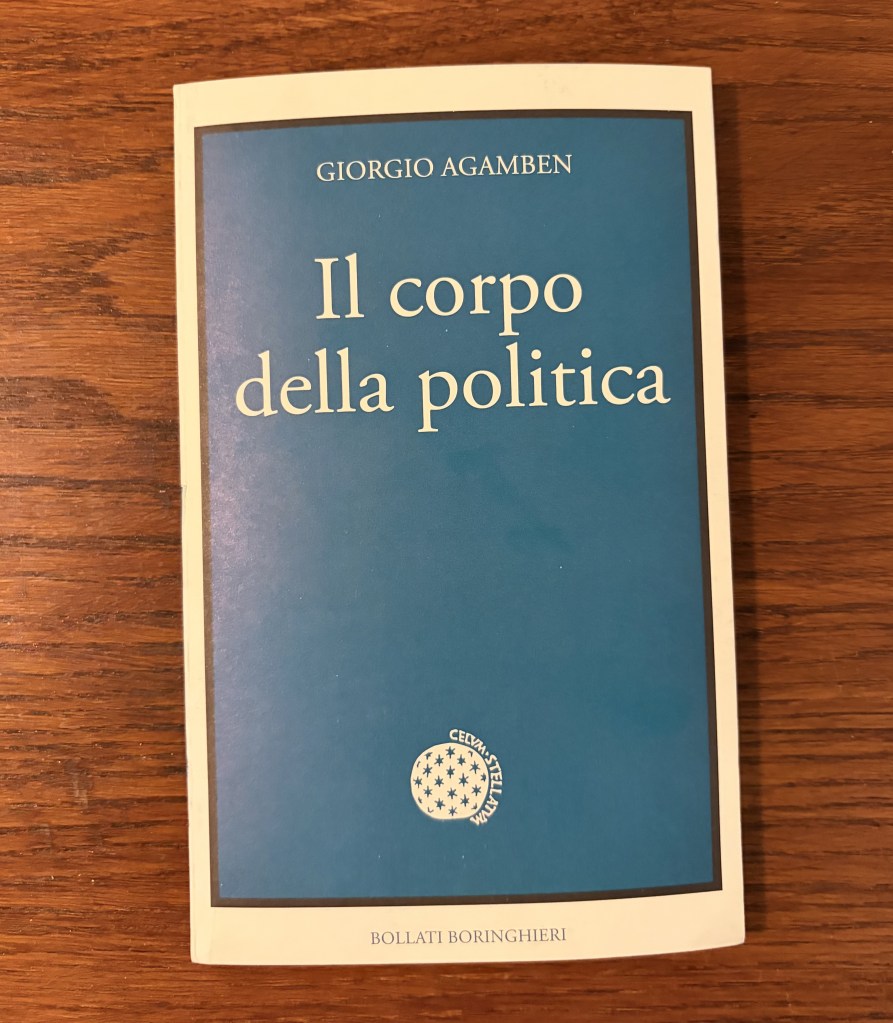
Assimilation in exile. On Giorgio Agamben’s Il corpo della politica (2026). by Gerardo Muñoz

One of the decisive lessons of Giorgio Agamben’s archeological examination of Western politics is that the imperative to confront the closure of representation, sooner or later it must also come to terms with the notion of the body (corpo) as a central metapolitical condition in the genesis of modernity. If L’uso dei corpi (Neri Pozza, 2014) brought to its final stage the philosophical exploration of Western ontology of politics defined by efficacy and realization; in most recent opuscules, Agamben has shown how the fixation and regulation of the body is also embedded in the regions of language and sensation of human life as well.  In this sense, it is impossible not to read Il corpo della politica (Bollati Boringhieri, 2026) along with Il corpo della lingua (Einaudi, 2024), as two parallel commentaries on the defining stature of political representation. If a new beginning is one of the decisive questions of our times, then one of the pending tasks is precisely to think the body (corpo) against the ontotheological assumptions of calculative reason.

Similar to Il corpo della lingua (2024), Il corpo della politica (2026) starts with the treatment of the Copernican revolution of bodies in Hobbes and Newton, which in the face of the cosmological infinity inscribed a notion of two bodies in order to allow for representation within spatial coordinates. In other words, Hobbes’ artificial sovereign represented by the mortal god Leviathan (state normative authority) will have an autonomous colorary in the autonomy of the subject that will become “political” as long as it becomes coterminous with the civic body of the “People”. Thus, to speak of “bodies” is not just to rationalize physicality in space – although it is also this from a technical viewpoint that state legibility will soon demand of the incipient civil society – but more importantly, it entails the administration of energy and movement (in Agamben’s well known lexicon, the domestication of potency to the realization of purposeful ends). For Agamben, Spinoza’s conatus, which appears in the Baroque period in critical dialogue with Hobbesian and Newtonian frameworks should be read precisely a way to think past the body as substance, following the steps of the tradition of ancient Stoicism in which beings are corporeal insofar as they are in tension with the world, allowing the tonos or acoustics to animate being in its movement towards preservation and exposure (Agamben 20-21). 

If all beings are traversed by a tonos – a tension that crosses as its medium in virtue of its contact with the world – this means that they are no longer defined by a substance, but as intensity within a field of forces once thrown in the world. As Agamben writes in passing with explicit confrontation with Heidegger’s Being and Time: “…con la tesi perentoria ‘l’essenza dell’esserci giace (liegt) nell’esistenza’. L’esserci è stato “gettato” nel mondo, ma si direbbe che, una volta gettato, non cade in piedi, ma giace (liegen significa innanzitutto essere sdraiato). E questa concezione sub-stanziale dell’essere che il conatus mette radicalmente in questione” (Agamben 23). In an archeological gesture that is already signatura of his work, Agamben reminds us that Hobbes’ substantive and artificial division of the “two bodies” that anchors modern politics can be traced to the corpus mysticum and the theological debates concerning transubstantiation that will later be recasted in the intersecting works of both Ernst Kantorowicz and Carl Schmitt, in which the impolitical dimension of the multitude becomes political through the artifice of decision and representation of a unified and indivisible body (Agamben 25-26).

The catastrophe of modern politics takes place when the body, once reduced to a substance and computable object in space, ceases to be understood as an inteusum or intensity of an irreducible multitude that expressed a generic and universal human species, as it was for Dante: “La politico – il finis totius humanae civilitatis che Dante intende definirie nel suo trattato – è ancora una volta un campo di tensioni interne allo stesso genere umano e questa intensità ha la foram di una moltitudine” (Agamben 39). In other words, for Agamben following the implicit tonus present in Dante’s Monarchia, the political is neither action nor mediation, but what names the very site of the possible. Agamben calls the hypothesis of an “anarchic politics” (politica anarchica), which no longer defines itself in relation to a formal mediation of government and state, but rather as the intensity of the multitude through the generic being (Marx) or the universal humanity (Dante) that takes the form of sensible Empire devoid of principial politics mediated by constituent power (Agamben 47). 

Where does the multitude dwell outside the constituted representation of a community of belonging or the social mediation of the state? Already in 1990s Agamben had written a gloss on the politics of exile collected in Mezzi senza fine (1996), and the last part of Il corpo della politica (2026) he returns to philosophical and theological notion of the exile vis-a-vis the historical experience of the Jewish tradition as an errant or stateless people, as Erich Unger called it in 1922, whose existence has been defined by exile or galut (Agamben 48). It is a bit of a misnomer to call the exilic experience a “politics”, since for Agamben the authentic tradition of exile does not entail the right or duty fixed to a community of belonging; rather, what outlives the law is the only path capable of deposing it (in the manner of Paul, that is, as katargeo). In this way, justice is now understood not as a procedure in a normative system, but as a written tradition that can only be studied and reflected upon and ultimately experienced as a state of passivity.

Hence, the exilic experience is the caesura between language and world, in which we touch the exteriority with a renewed intimacy that unfolds the uncommunicative solitude that keeps the mystery of our use of language. Following the neoplatonic formulation “phygé monou pros monon” – understood by Erik Peterson as an expressive mystical relation of a “fuga di un solo presso un solo” – there is intimacy and authentic belonging whenever there is sensible separation in being (Agamben 55). Following Plutarch and Plato, for Agamben the exilic dimension is the very home of philosophy and thought, which confirms, against Crito’s suggestions at the end of Socrates’ life, that there life outside of the polis and the conglomerate of the demos, because life is outside itself once it is assimilated in the virtuality of a divine that nourishes its own potency.  In what stands as one of the most precise formulations of the pheugein (exile) condition as a figure of existence, Agamben writes of its precise ascesis: 

“La celebre definizione ascetica della fuga dal mondo come assimilazione a Dio andrà resa, pertanto, restituendo tutta la sua forza alla metafora politica: “l’assimilazione a Dio virtualmente un esilio” (kata ton dynaton significa qui, secondo il sense più proprio del termine dynatos, “virtualmente, secondo la potenza). L’affermazione e tanto piu significativa in quanto, con queste parole, Platone rompe con l’insegnamento socratico del Critone, secondo cui la possibilità di phygé offerta al condannato non potrà che essere rifiutata, perché non vi è vita possibile fuora dalla polis” (Agamben 57).

This region that precedes and exceeds politics – in the language of Sophocles, the well known ypsipolis apolis – is akin to the tone that runs to the forgetting of any substantive ontology of politics that seeks to subsumes life into the confinement of external forces. It is in this paradoxical situation of assimilation in exile, and a permanent exile that assimilates itself in God as shared thought that politics can be transfigured as an apodemia that refuses the closure of life into principles of government and dominium, and away from the community form of propriety and rooted belonging. Agamben recalls that in the history of Christianity, it is the time of the parish (paroikias) what allows the soul to live in earth as foreigner and exile, in proximity of the medium of the kingdom, and that only later with Saint Augustine it was transformed into a territorial institution for the communio and communal salvation (Agamben 60-61). In the paroikias, Agamben returns to the kingdom not as a retheologization of the politics, but as a figural parable in which a poetic dwelling is enacted in the measureless passivity of a form of life, a project consistent with the formulation of the singular whatever being articulated in La comunita che viene (1990).

The assimilation in the exile of the divine, which recalls the forgetting of oneself and the god announced by Hölderlin in“Note on the Oedipus”, is refined in the last essay of the book entitled “Il corpo dell’Europa”, which reproduces a lecture delivered in Venice in May 2024 about idea of Europe. As a sort of concluding reflection or apostilla, we are now able to say that for Agamben the only possibility of dwelling in the vestiges of the European tradition and memory is to rescue, from the wreckage of its history, the sediments of a texture of the phygén: to be exiled is not just a vitalist affirmation of this life, but more importantly, it also implies disclosing the possibilities buried in the past with the dead, that is, in contact not only with Gaia, but also in the downward movement to the domus of the infraworld (a figure that receives a novel treatment Agamben’s recent book La lingua che resta). Agamben exemplifies this exile with the dead with three poetic moments of high european modernism: Ezra Pound’ Cantos, T.S. Eliot’s The Wasteland, and Eric Auerbach’s masterpiece Mimesis written from his exile in Turkey – and of course, we could also think here of Kafka’s parables and Joseph Roth’s narratives of Jewish errancy; as well as Alexandre Lerrnet Holenia’s phantasmatic crumbling of Empire in The Standard and Osip Mandelstam’s “The Fourth Prose”, where the end of the work leads to the human voice as the supreme poetic task in the face of nihilism and political totalitarianism. 

It should be clear, however, that the problem is not found a temporary refuge or a last stand in the fortress of modern literature, but of coming to terms with the phygé as a fundamental problem of language that, in virtue of its unique and irreplaceable experience, delivers a world nested in the affection of remembrance. As Agamben asks towards the end of the lecture: “Is there a sensibility and a form of life that we can call European?” (Agamben 82). This question can only be answered when we dwell and assimilate into the exile of thought that harbors the residues, figures, and voices that speak to us from the dead in a tradition because it is no longer transmitted, we can only access it poetically. In the only moment that the word anima (soul) appears in the text, in the very last sentences, it becomes clear that it is only in the intensity of thought that life accounts for the inseparability of the body and the soul that historical abstraction has rendered oblivious and alien from the tonos of presence. We are not yet ready to declare a return to the appearance between being and world, and for that very reason even the presence of the divine, as Agamben says following Isaac Luria, is itself exiled from the creation of the world until the advent of the tiqqun in the night of restitution. The exilic dwelling of life outside itself is marked by this sort of secret unfaithfulness in the absence of the god. In the meantime, the task of an ethical life is to passively reside in an exile where the reality of the soul returns what is possible and breathable to the appearance of the real.

Osculum pacis. by Gerardo Muñoz

It has taken Pope Francis’s public letter addressed to the Bishops of the United States to put in perspective how late American imperial politics in matters of immigration and probably other spheres of social life is not only at odds with the Christian vocation, but even waging war against the very dogma of Christian revelation. The reminder does not come completely out of context, since as we know, the marching band of intellectuals that for a long time have defended a “Christian postliberal” transformation – some of which not long ago offered theological justifications for the Church as the universal ark for migrants – given the current hegemonic configuration find themselves as mere scribes of whatever is enacted by unilateral executive command. The impossibility of enacting a transitional political theology evidences the emptying of politics into a technical mobilization of apocalyptical overtones, as clearly defended by Peter Thiel. The attempts to pilotage a planetary gnosis to his own image in the last stage of imperial stagnation, definitely supports Francis’ assertion politics today is built “on the basis of force, and not on the truth about equal dignity….begins badly and will end badly”.  But in a way, this “end” has already taken place through the revocation of the ethical tenor of the Christian mystery. 

It comes to no surprise, then, that if the erosion of an ethics is at stake, that Pope Francis would allude to the parable of the Good Samaritan and fraternity, something that he has explored previously in the encyclical “Fratelli Tutti” [1]. It is also important to note that Francis is not opposing the Good Samaritan to the ordo amoris; rather the operation is more subtle: for any community to be organized around ordo amoris, there needs to be a space for the infinite discovery that the Good Samaritan parable solicits of every Christian’s responsability. According to Francis: “The true ordo amoris that must be promoted is that which we discover by meditating constantly on the parable of the “Good Samaritan” (cf. Lk10:25-37), that is, by meditating on the love that builds a fraternity open to all, without exception”. In other words, and implicitly taking distance from the Calvinist dependency on community of salvation, the Pontifex is disclosing the memory of an ethical vocation that cannot end in social norms or national unity without exteriority. The communitarian ordo at times could also amount to oppressive familiarity, as it appears in Corrado Alvaro’s Revolt in Aspromonte: “Village life seemed to him a strange invention, a protective agreement between people who were afraid”. Thus, what the Samaritan teaches human beings is that there are no ethical standards for which we can respond, since every encounter opens up a ‘decision of existence’ before an absolute other beyond the sacramental duty of “I ought”. 

Who is this “other human being” that now becomes your brother? As we know, in Ivan Illich’s late work the ethical inflection of the Good Samaritan illuminates the true character of our poetic relationality and creative act: “You can recognize the other man who is out of bounds….and create the supreme form of relatedness which his not given by creation but created by you. Any attempt to explain this “ought” as corresponding to a norm takes away the mysterious greatness from this act” [2]. Indeed, Illich goes further in telling us that the suppression of the ethical decision of encountering the Samaritan can only leave us with a “liberal fantasy…where bombing our neighbor for his own good” [3]. Just like today the moral justifications of “ordo amoris” or the administrative allocation of a substantive “common good” can produce justifications for mass deportation of immigrants and dividing the social space between citizens and noncitizens (removing the foundation of ius soli) can become the strange patent of a monstrous theological manipulation. 

The ethical mystery exemplified by the parable of the Good Samaritan introduced into history a new conception of “brotherhood” that was not conditioned by national, political, or family affiliations, but by a common vocation expressed upon acting through mercy and charity. Belonging to the “human fraternity” allows me to decide who is my brother through the osculum pacis – a conspiratorial mouth-to-mouth kiss that creates proportionality and peace through the encounter that yields mutual creation. Before the Samaritan we give everything without waiting for anything in return, as required by any true ethical disposition. As the scholar of Ancient Christianity, Christine Mohrman once noted, the osculum pacis was a universal relationship of the human species through their voices coming together to assert external political peace as well as interior health of the soul [4]. If the predatory programs of mass deportations and intensification of hostilities between nations have come to forefront in our days, this is due to the fact that the overall end is not to piecemeal ordo amoris coordinated by state social policies, but rather a permanent assault against the association of the free souls constitutive of the osculum pacis. 

In light of the theological drama of Christianity, nationalism can only be taken as a symptom of brute force and inequity (radical evil). As Erik Peterson reminded in his essay “Das Problem des Nationalismus im alten Christentum” (1951), the cult and strife between nations and imagined communities, at least for the Chirstian vocation, do not have any traction, since the warring angels of nationalities have been overcome by the event of resurrection [4]. The ‘strange career’ of American political Catholicism is precisely that through a technocratic administration of social pain and spectacular delirium, it can only offer an noncorporeal ideal of ordo amoris “in the service of a single nation which seeks to establish its supremacy, by identify its own interest with that of humankind”, as Peterson observed  in the wake of European nationalism, but that it applies today to the letter with little variations [6].

In vain should we attempt to pin down the osculum pacis as professionalization of care or the hospitalization of pain that have become practices of a “corrupted core of a very clear and powerful ideal of democracy”. In the disjointed time that characterizes the end of political theology and its warring nomoi, the osculum pacis will be not be found in those that attempt to conjure a “Christian civilization”, but only in those that dwell in the state of adelphos, faithful to the scandal of peace and the endless conspiracy of speech. 

Notes 

1. Pope Francis. “Encyclical Letter Fratelli Tutti (On Fraternity and Social Friendship), 2020: “By his actions, the Good Samaritan showed that “the existence of each and every individual is deeply tied to that of others: life is not simply time that passes; life is a time for interactions”: https://www.vatican.va/content/francesco/en/encyclicals/documents/papa-francesco_20201003_enciclica-fratelli-tutti.html 

2. Ivan Illich. The Rivers North of the Future (Anansi, 2005), 207. 

3. Ibid., 208.

4. Christine Mohrmann. “Quelques traits caractéristiques du latin des chrétiens”, in Études sur le latin des chrétien (Edizione Di Storia E Letteratura, 1961) , 29-30.

5. Erik Peterson. “Das Problem des Nationalismus im alten Christentum”, Theologische Zeitschrift, 7, 1951, 81-91.

6. Erik Peterson. “Die Frage nach dem Menschen”, in Offenbarung des Johannes und Politisch-theologische Texte (Echter Verlag, 2004), 250.

Jesus as gardener in the landscape. by Gerardo Muñoz

A reproduction of Titian’s early work “Noli Me Tangere” (~1514) cannot do justice to its majestical prudence if contemplated directly on the walls of the National Gallery. To use the terms “majestical prudence” might be a bit of a misnomer, but at least it allows to be slide into what entails the central enigma of the picture: its underemphasized contours of the biblical encounter from John 20:15, in which the resurrected Christ appears to Mary Magdalene as a gardener. A lot has been made about the Giorginesque influence on the picture, but it seems to me that the underemphasized composition speaks to the real triumph of Titian’s masterpiece. This is a triumph achieved not so much through the imports of allegory and pagan motifs, but rather as a complex web of distances untangled in the picture: the distance between Christ’s gaze with Magdalene’s upward look, but also the solitary tree inclined leftward, which compensates for the downwards light jerk movement of Christ as he takes distance to escape touching.

I have said nothing of the deep and overpainted deep blue sea in the background; or the receding landscape in the distance with a flock of sheep, high grasesses, barns, and a modest castle to the upper right side of the picture. A little man walks his dog, and we guess he is moving towards the sheep. Or perhaps not. The underemphasized and inconspicuous composition of the picture is precisely in the formulation of distances; invisible distances that allows the gathering of proximity. Only in this minimalist case can the painting be described as giorgenesque. Herbert Cook in his monograph on Giorgione captures this balance by what he calls invisible threads: “Peculiar, however, to an artist of genius is the subtlety of composition, which is held together by invisible threads, for nowhere else, perhaps, has Giorgione shown a greater mastery of line.” [1]. This is also a fair treatment of what holds up the elements in Titian’s picture.

Now, the invisible threads in “Noli me Tangere” do not merely substantiate the networks of lines; rather they also bring the picture to a point of a distant presence. This is what we are able to perceive when confronted with the painting in the walls of the National Gallery. There is another more straightforward way of stating the same: there is something “earthy” to Titian’s rendering of John 20:15, and by “earthy” we attempt to point to point at the distribution of distances between earth, sky, and landscape. This also implies how bodies move in it. It does not take much to document it: one could start by attending to Magdalene’s merciful arm raising to Christ’s cloaked body, followed by his holding of the hoe, which immediately swayes us to the tree. Magdalene’s left hand on an ointment vase reinstates the dowards movement to the ground. The earthly character is the tension elaborated by these distances – a very modern sensation that we will not get in the later pictures of resurrection in the glorious skies of redemption, as noted by Erwin Panoksky [2]. The earthly deposes the relieves of both glory and incarnation. Titian wants to give us the picture of a resurrection in a world that passes by as it retains its tranquility, which painting can only provide us through a non-emphatic incorporation of its distancing.

This could very well account for the assumption that “Noli Me Tangere” becomes a decisive “stepping stone in the evolution of modern culture…from the Byzantine theology to Pantheism and spiritual freedom” [3]. The fact that Renaissance painting was absorbent to the pagan myths is something that has been studied by the major art historians of the twentieth century, so one could also take Richter’s thesis somewhere else. Pantheism is not about the symbolic restitution of specific iconography or motifs, but it is rather the exposition of a particular experience: Jesus as gardener services the disclosure of an unmediated world granted by the perception of distances. The mistaken perception of Jesus as gardener can only be understood, even if momentarily, as undoing the work of Adam, only to be resumed and “served” (ābad) by the Savior [4]. But this might be reading too much “meaning” into the picture, which is deliberately underemphasized in its avoidance to allegorical weight.

To any modern attentive observer, it becomes impossible not to bring into the picture the early modern dispute between gardeners and architects. This opposition does not justify Titian’s “Noli Me Tangere’”, but it does serve (at least it serves me) to insist on the open relation between gardening and the disclosing of an unmediated world, which stands as a theological idiom of the picture. It is most definitely a picture of a resurrected life that is only apprehended by the possibility of immersing itself in the rhythms of the invisible that pertain the world. So, we do not have to wait for the late mysterious and dark Titian to find a full coincidence between painting and thought. “Noli me Tangere ” seems to tell us that there is thought whenever there is earthy grounding in the bifurcation between bodies and things in space.

And so, we can return to the thin blue sea on the left side of the painting, which magically brings all the earthly elements to the forefront. It is the ultimate distance, as well as the unbreachable region where all elements converge (pay attention to the vegetation and the clouds literally becoming blue) sharply on the horizon. It is also the most emphatic instance of the picture; the lacunae that guarantees the masterful structure of invisible threads that ultimately pins its intimate proximity to natural dissolution.

.

.

Notes 

1. Herbert Cook. Giorgione (George Bells & Sons, 1900), 41.

2. Erwin Panofsky. Problems in Titian: Mostly Iconographic (NYU Press, 1969), 40-41.

3. George M. Richter. “The problem of the Noli Me Tangere”, The Burlington Magazine for Connoisseurs, V.65, July 1934, 10.

4. Nicolas Wyatt. “When Adam Delved: The Meaning of Genesis III 2″, Vetus Testamentum, Vol.38, 1988, 121.