On reciprocity. by Gerardo Muñoz

Surely friendship does not depend on obligations or frequency, but it does posit expectations on something like a movement of reciprocity. In fact, movement (κίνηση) and reciprocity are so intertwined that without it, there would not be any separation, only a compact bundle in unity without relations. But, what is at bottom reciprocity? If this notion merits anything thought at all, it must be removed from any conception of exchange in the manner of the quid pro quo and the the ius talionis, where at first sight reciprocity seems to reside as a form of levelling differentiated quantities. In social exchange there is levelling but surely there is no reciprocity except by the legal force enacted by the pressure of duties and obligations. Already in the nineteenth century, at outset of bourgeois society, Søren Kierkegaard with extreme lucidity denounced social levelling as a form of glittering vice: “The idolized positive principle of sociality in our time is the consuming, demoralizing principle, which in the thraldom of reflection transforms even virtues into vitia splendida. Levelling is not a single individual’s action but an activity of reflection in the hands of an abstract power” [1]. 

What is reciprocal in social exchange is no longer the incommensurable relation between beings, but the enactment of language saturated by its own completion, which is the aim of social organization. If there is no reciprocity in the age of kallopismata orphnes as the reduction of rhetorical language it is because there is no longer a missing word in the event of communication, given that, potentially, everything has been already communicated (it is obvious that today this process can only intensify with the planetary deployment of Artificial Intelligence). The only determination of reciprocity that should be of interest is the one that accounts for the lacunae in language that halts force of social levelling. To reciprocate does not mean to give each his due that defines the Western legal operation; it is rather the mutual codependency in the unforfeited event of language. 

At this point, an etymological observation might be useful. In On the Latin Language, Varro records reciproca as a condition of elasticity; that is, a present quality that allows a thing to return to the position from which it has started. Reciprocare thus entails to move to and fro, and to demand [2]. But if we adapt this observation into the sphere of language, we immediately notice that in language there is no previous position nor set origin, which means that reciprocity can only be the undisclosed and disclosed movement of language. Breathing, articulating, speaking: the animus that escapes from the mouth as a mirror of the god of words. The erosion of reciprocity in modern society, thus, goes deeper than the first appearance in fact that human beings are witnesses to a crisis of communication; more importantly, humans have ceased to sense reciprocity because they believe that there is only god where language is mute, and there is language when gods are extinct. Such is the long vigil of computing language as an idol that is neither divine nor of the essence of the human voice. To reciprocate today means to re-divinize the world through words; and through our words greet incoming worlds.

Notes 

1. Søren Kierkegaard. “The results of observing two ages”, in A Literary Review (Penguin, 2001), 76. 

2. Varro. On the Latin Language, Vol.1 (Loeb Classical Library, 1938), 335.

We are all mystics. by Gerardo Muñoz

It is too often that we hear a common critique raised against the theoretical skepticism of the primacy of politics in the form of an alleged prefigured “mysticism”, as if the destructive operation against sufficient political reason would entail an ineffable silence. It is a striking claim because there is some truth to it. But we must also question its assumption: can the proponents of political primacy ascertain a ground that can escape the mystical position that it seeks to avoid? The task of intellectual history is infinite and rewarding, but that does not mean this enterprise can positively mobilize a breakthrough within the epochal collapse of modern politics. If this is true, then it would follow that everyone is, more or less, a defaced mystic, insofar mysticism is the condition that runs against the limits of language and the current of the negative. In the same way an American judge famously said that ‘we are all [legal] originalists now’, one could very well say that ‘we are all mystics now’. It all depends where we put the emphasis and the tone. 

If we are to reject the totality of political administration and intraworldly legitimacy, this does not necessarily mean that we can immediately sketch what a coming politics would look like. According to Karl Barth in his Ethics, the position of mysticism always denotes a weak “us” that emerges from disobedience with respect to the world; concretely, against the system of planning and delegated orders (schools and the police). So mysticism is an archirealist position because it traverses the world, but only to depose the transcendental closure of its authority. In this way, the skepticism against the mystical position, perhaps unconsciously, is also an indirect skepticism against anti-social stance that is deficient from the vantage point of advantageous political realism. But the insistence of political realism is only anti-mystical on the surface, because it depends on an article of faith on the social reproduction and the overall general political economy between subjects and objects, value and the administration of life. 

The mystic cannot be confused with a guru, a magnetic theologian, nor a priest in robes. On the contrary, the mystic is a sibling to the pícaro, a figure of the Spanish Golden Age, that made his life unarrating the social protocols of the emergent social space, revealing and subverting the “autoridades postizas” (fictional authorities) of his epoch, according to the beautiful formulation of Santa Teresa de Ávila. Whoever has read any of the Spanish picarescas will immediately recall that the pícaro does not endorse static or monastic life of interiority, he upholds a temporality of life that coincides with the events of a world that becomes unfixed and betrayed. And the pícaro lives and outlives himself in this gestaltic confrontation. This vital mysticism in how he uses the world is more practical than any political justification for consensual common action.

It is worth noting that Carlo Michelstaedter in a gloss on courage and the persuaded life, divided the world – and his world was that of the Austro-Hungarian interregnum, a transitional epoch of decline filled with specters and monstrosities, very much like ours – between mystics and the dishonest or tricksters, but only the first could be named “heroes” because only them knew the secret of their unique persuasion unto death, renouncing to petty morality, self-interest, and social orders [1]. The mystic inhabits not just the silence that arrests the truth for which he cannot speak; more fundamentally, he also exerts, in every act, the task of freedom as embedded in thought and contemplation of the soul, that according to Michelsteadter is a personal struggle that bends to the real gnosis, “because to know oneself is ultimately to know the universe and to name it…only there is life” [2].

Notes 

1. Carlo Michelstaedter. La melodía del joven divino (Sexto Piso, 2009), 43. 

2. Ibid., 53.

A Peitho relief. by Gerardo Muñoz

There is a small marble Roman relief of Peitho (it is about 15” x 5” wide) of what used to be a larger decorative plate illustrating Helen being persuaded by Aphrodite to accept her husband’s voyage to Troy. The personification of Peitho in the form of a seating lady accompanying Aphrodite is not rare in classical representation, and if we are to follow Friedrich W. Hamdorf’s genealogy, it was actually the norm when it came to visual depiction of the deity [1]. What is striking in this Roman relief of Peitho is precisely the unassuming silence of the figure, who is merely gazing down and touching a dove or bird with her right hand and sunk in thought. Is not this mystical silence what bathes the mythical figure of Peitho, which according to Euripides has no other sanctuary than that of language?

The Peitho relief stands as a fragmentary of an ancient memory where the event of language implicated persuasion instead of commanding; a sensibility of saying instead of legitimate validation; granting space for the poetizing in the world instead of rationalizing, in the advent of the polis and the bios politikos, the transcendental condition of the political community [2]. Peitho will become rhetorical once it has taken the autonomos form of the transaction and the mutilated word by which nothing is ever said except a lethargy of the immanent movement of the logos. In the Roman relief Peitho does not communicate because she dwells in the poetic lacuna of language. 

In fragment 81 of Aeschylus’ Niobe we read a mysterious outline of Peitho: “Death desires no gifts; one can gain nothing by making sacrifice…from him, alone among divinities, Persuasion stands aloof.” The ossification of language in hand with the general autonomization of rhetorical separation, in the words of Gianni Carchia, will mark the destitution of Peitho’s poetic magic allowing death to speak through the fierce instrument of demagoguery and and the production of justifiable certainties [3]. In a world without the irruption of the mythic-magical element personified by Peitho, there is only general declensions towards persuasion as a form of predication: to convince, to obey, to follow, and to concede belief as persuasion was transformed linguistically [4]. It is no surprise that the civilizational decline of the mythos of Peitho coincides with the rise of the rhetorical techné that guaranteed the autonomization of the world (private & public, appearance & truth); but, most fundamentally, the stabilization of the resource of rule-based lexicon as the dominion over exteriority.  

Even the Sophist Gorgias in his Encomium of Helen defines Peitho as “Language is a power ruler who with a tiny and invisible body accomplishes deeds most devine” [5]. The process of deification of language (in the sense of the sources of archê) can topple the divine in order to mobilize all the energies no longer in the “uninterest encounter between souls” (Carchia’s words), but rather by grounding a necessity that, first and foremost, establishes its ontological solvency in the unending rhetorical polemics. As the sensible myth of Peitho withers into organized grammar and rules of predication, it is noteworthy to recall that in the monotheist tradition the organization of the invisible in becomes colored by “faith” in the law. 

This could explain why Saint Paul seemed to have made a conscious attempt to oppose any remnant of the Hellenic persuasion (πειθώ) in favor of “demonstration of faith” (ἀποδείξις). As we read in Corinthians 2:4-5: “My words and proclamation were not based on the persuasion (πειθώ) of wisdom, but on demonstration (ἀποδείξις) of the Spirit and power… that your faith would not be  based on human wisdom, but on the power of God. Indeed, “apodeixis” (ἀποδείξις), the word deployed by Paul, will guarantee persuasion only in revelation and the Christian philosophy of history; meaning that Peitho will remain, like the Roman relief from the First Century, a mute aesthetic artefact and a petty reminder of the expulsion of ethōs from language. 

Notes 

1. Friedrich W. Hamdorf. “Peitho”, in Griechische Kultpersonifikationen der vorhellenistischen Zeit (Zabern, 1964), 64-65.

2. Francis Kane. “Peitho and the Polis”, Philosophy and Rhetoric, Vol.19, N.2, 1986, 118.

3. Gianni Carchia. “Eros y Logos: Peitho arcaica y retórica antigua”, in Retórica de lo sublime (Técnos, 1994), 23-24.

4. María Dolores Jimenez López, “‘Persuadir’ en griego: el marco predicativo de peitho”, in Word Classes and Related Topics in Ancient Greek (Peeters Louvain-La-Neuve, 2006), 175-176. 

5. Gorgias. Encomium of Helen (Bloomsbury, 2008), 44.

Tum Otheos: on a detail in a Van Eyck’s painting. by Gerardo Muñoz

Jan Van Eyck’s 1432 Portrait of a Man has the Greek inscription, and rendered in transliteration, that reads “Tum Otheos” (ΤΥΜ ωΘΕΟς) that has baffled art historians and specialists on the painter for a very long time. It is well known that Van Eyck, the pioneer of oil painting, was fond of leaving all forms of writing in his pictures in Greek, Hebrew, and trilingual idioms that through the centuries have become incomprehensible jottings [1]. At a time when Van Eyck was painting in Northern Europe, the magical efficacy over names and naming was a dominant cultural and religious belief, and the expanded arts of the ‘names of god’ were used to heal and relieve pain, and protect against potential enemies and keep demons at bay [2]. Following Hermann Usener, one could see how the original act of the naming of the gods was no longer tied to ‘momentary divinities’ (Augenblicksgötter), but rather they were functionalized to specific anthropological needs for survival. Nonetheless, it is quite ashtonishing to witness how the painting at year zero that Van Eyck embodies – the very birth of oil painting and the “coming to life” of the figure in depiction – coincided with a divinization itself of the expanded field of the arts [2].  

In Erwin Panofksy’s early interpretation the inscription “Tum Otheos” should be read in light of the musical revolution that had taken place between 1420-1440 in the Netherlands, where the ars nova meant a thorough musical renovation towards a new expressive energy and “exquisite sensibility” nourished by the myth of Timotheos, who was taken as the ancient model of sublime harmony of the new arts and style of bringing life into depiction [3]. Overtly dependent on the transmission of the ancient figure of sound, for Panofsky the inscription “Tum Otheos” pays homage to the lyre Timotheus of Miletus as creator of the “new music”. But, could the same be transplanted into painting? Could painting at “year zero” be taken as precisely this new tonality of the arts? 

A second possible rendition of “Tum Otheos” is one what has been merely registered, although not elaborated, by art historian Alfred Acres, for whom “tum otheos” is not indexing the ancient musician but more importantly, it is registering an event or what is taking place [4]. Thus, for Acres “Tum Otheos” should be read as “and then God”; as if the relationship between painter, depiction, and spectator was the very taking place of a minor and invisible god of creation that painting facilitates. It is not difficult to recall here what Luca Giordano said of Velazquez’s painting: “this is the Theology of Painting” [5]. Although directed at Las Meninas, one could perceive that in the early stages of the secularization of the forms of the modern, the nexus between theology and painting becomes a clandestine partnership that resists its full integration into the autonomization of forms of representation. In other words, there is always a theos reminder in the act of depiction that is irreducible to the general economy of forms, as if the dissonance of the soul endured underneath at the nearness granted by the concrete realization of a picture. “And then God”, as proposed by Acres, should not be taken merely as the eruption of the divine in the symbolic structuration of the world, but rather as the very act of naming that allows divinization to continue in spite of the closure announced by the flight of the gods. 

Just one year after Van Eyck’s Portrait of a Man (1432) where the inscription “Tum Theos” appears, in Italy Alberti will write in his De Pictura that the gesture of painting “possess a truly divine power in that not only does it make the absent present (as they say of friendship), but it also represents the dead to the living many centuries later, so that they are recognized by spectators with please and deep admiration for the artist” [6]. And if Postel is right that Van Eyck’s Arnolfini masterpiece is one in which the picture reconvenes the dead bride and the rich merchant into pictorial space, then one could deduce that for the Flemish artist the divinity of painting is defined as the only passage left to the moderns to negate the world of the living and inhabit the invisible world of the dead against the coming of the monothematic world-image and its material crust of Gaia [7]. “Tum Otheos” – and then God – is literally registering the transfigured and expressive dimension of painting; that is, the taking place of depiction and its secret fidelity to what appears only to banish and become forever unfathomable. 

Notes 

1. Susan Frances Jones. “Jan van Eyck’s Greek, Hebrew and Trilingual Inscriptions”, in Van Eyck Studies, September 2012, 294.

2. Noa Turel. Living Pictures: Jan van Eyck and Painting’s First Century (Yale University Press, 2020).

3. Erwin Panofsky. “Who Is Jan van Eyck’s “Tymotheos”?, Journal of the Warburg Studies, 1949, 88-89. 

4. Alfred Acres. Jan van Eyck within His Art (Reaktion Books, 2023), 177.

5. Daniel Arasse. Take a Closer Look (Princeton U Press, 2013), 134.

6. Leon Battista Alberti. On Painting (Penguin Classics, 1991), 60.

7. Jean-Philippe Postel. El affaire Arnolfini: Investigación sobre un cuadro de Van Eyck (Acantilado, 2023).

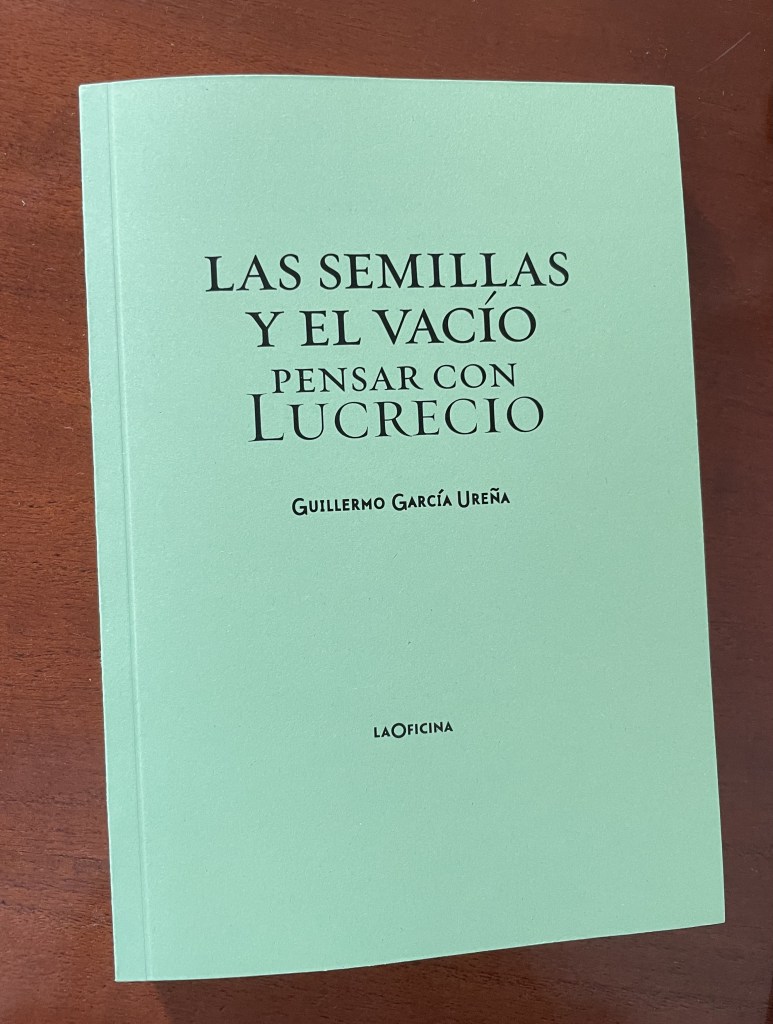
Naturae species ratioque. On Guillermo García Ureña’s Las semillas y el vacío: pensar con Lucrecio (2023). by Gerardo Muñoz

Lucretius’ poem De rerum natura is one of the most used and abused texts of the tradition, and like all classics it has had the most diverse receptions imaginable: the poem of modern science, a baroque expression of creationism for the English metaphysical poets, the precursor of historical materialism and atheism, and a tract of scientific positivism that laid the foundation for the regulation of nineteenth century social order. Once a text becomes an emblem, it usually means that it has lost its prehistoric imprint and place in the tradition. Against this backdrop, Guillermo García Ureña’s just published Las semillas y el vacío: pensar con Lucrecio (La Oficina, 2023) has the prudential gesture of disclosing the great Roman poem to its fundamental structure; attentively listening to its original complex articulation difficult to grasp with the categories of modern philosophical thought. In this sense, Ureña’s purpose is not to deploy another “philosophical account” of De rerum natura – endorsing and subscribing the influence of Epicurus and its later resonances in modern theories of physicalism and materialism of the continental schools – but rather to engage in its own ground exerting an original philological exploration of the text that opens up an array of different problems for thought. Whoever is looking for a “theory” of Lucretius will find none in this brilliant and well articulated essay. But the reader will find, nonetheless, a comprehensive hermeneutics of a text that stands as a threshold between the closure of Greek classical antiquity and the Roman reintegration of the tradition. Now, for Ureña De rerum natura proem discloses the originary understand of the epic, or épos, through which the stability of the things as they appear takes place; whether it is the Muses, the gods, being and language, the simulacra or the soul, the physical declination of creation (the atomic clinamen) and the final document of language invigorated in the corpus of the poem itself. De rerum natura is both a cosmology and a poetics with the ambition of elucidating the most obscure things of this world: Lucretius’ text defies a fixed representation through a choreography (a term that it is not used by Ureña, it must be said) that discloses the possibilities of worlds; the combination of worlds only to posit the question of how to live within them, which is another way of saying how to account for a form of life.

One of Ureña’s commitments is to hold on to Lucretius’ aesthetic and philosophical autonomy. This implies treating the influence of Epicureanism with great care; engaging with Epicurus insofar as the aesthetic autonomy and its loci of poetization reject the classical structure of the epic hero incarnated by the soteriological impulse of the great poet-philosopher (we know that this is the same problem that centuries later Hölderlin will identify through the tragic drama of Empedocles). Lucretius is writing after the twilight of the classical Greek genres. Furthermore, there is no community under an organized program of leadership and telos; on the contrary, there is only an existence that “one day will want to desert all of us” (41). True, the Epicurean notion of serenity (ataraxía) is retained and treasured; but only as the aspiration of every living being who seeks to transfigure the shadows of superstitiousness and fear that govern over the perceptive mediating forces in the world. In this sense, to dwell in the world does not consist in the limitless relationship with the simulacra; it is rather, the self-transformative exercise of freeing possibilities within the void in which forms of life can emerge. As Ureña reminds, the rainfall of the atom is as fast as that of thought itself. It is already an image of thought, as well as the figure of imagination. And the image of thought validates the history of cosmos as a patchwork of accumulations and deflections, creations and destructions, repetitions and disintegrations in a swerve of forms that infinitely recline on its ethical possibilities (139). It is altogether interesting that Ureña reminds us that, in fact, De rerum natura is not interested in staging the things in Nature; on the contrary, at the center there is the question of the ‘nature of things’ in the luminous expression of their irreducibility. This is what modern onto-theological closure brings to a process of domestication, whether through the composition of the civil structure (limitless exchange according to philosopher Felipe Martínez Marzoa, who figures prominently in Ureña’s book) or through the progressive historical structure commanded by the essence of technology that blurs the relations between forms and techniques.

If De rerum natura abandons universal history and historical narration, it is because its structure is profoundly kenotic: it can only be assigned as contingent historical transmission of the most immediate and sensorial (not necessarily “true” in the metaphysical sense) that allows the convergence of the history of forms of life and natural history (140). The operation of subtraction implies the transfiguration of freedom through the becoming of forms – their interests, constructions, and pacts (foedera naturae) as guarantee for a plastic relationship between things in a world that is always already a fragment in the void. The highly attractive Lucretian notion of foedera or “pact” (that expresses separation in coming together: a com-pact that de-compacts) is almost the inversion of the modern principle of irreversibility, if one were to take Hans Blumenberg’s  legitimation hypothesis at face value. And this is so because a foedus or pact is insufficiently strong to resist the impact of the clinamen, but indispensable for the emergence of a body that materializes its own fate towards dissolution.

The lack of unity of being allows for the existence of simulacra as that which does not have sufficient matter to compose itself as foedera; and so, it is a material semblance as an image without figure that makes it an ephemeral entelechy. In this choreography between the downwards of atoms and ephemeral intermittence of events the taking place of the world emerges a topoi of a combination of rhythms that intertwine the weight of bodies and the animation of souls. The possible combination and stylization of multiplicities in separation is the way in which a form of life emerges as the desertion from superstition and fear that hinges upon the irreversible stabilization of a principle of reality. Ureña does not go this far into the wager of Lucretius’s text – and he does not have to in his close reading of the text – but it is precisely this thick dimension of the ethical primacy that makes Lucretius’ dislocated comprehension of materiality a vibrant tune against the weight of alienation that we are still struggling to abandon.

The struggle against the alienated life – the alienation from the world, and the external manipulation of the simulacra that has become a gnostic planetary form of “TV Democracy’ (Schmitt) of the “society of the spectacle” (Debord), which implies the usurpation of our imaginal and erotic relationship with the world – well understood, does not mean to relocate the confrontation at the level of political order; it rather, rests on what we have understood by order and disorder for the reconstitution of a happy or contemplative life (naturae species ratioque). This serene life declines the offer to negotiate at the arena of sacrifice and legitimate domination, favoring the event of friendship. At this point Lucretius comes closest to Epicurus’s society of friends – studied by Carlo Diano in an important 1966 conference in relation to the organization of the passions and the transmission of love – that can guarantee a content life in the presence of “other joyous gazes” (glossing Diano’s terms) away from the persistence of war and the compensatory administration of pain. This is the ultimate treat of De rerum natura: the exemplary dimension of the serene life takes shape through the community of friends, the civilizational invariant of the human experience (prehistoric times, the classical epoch, and in our times) that abandons the paradigm of perpetual war that obfuscates omnia cordi.

It is not too ambitious to claim that only at this point we finally grasp the full extent of the Lucretian épos: not just an ephemeral and contingent declension of the primacy of atoms in the void; but, more importantly, it can disclose the irreducibility of an experience with friends. Ureña wisely closest his book with an image of the “buena vida en compañía” (the good life in companion) that insists that serenity is only possible (or desirable) in the open landscape, a nowhere-land of an eternal foedera (or a sinousia, as it appears in Plato’s Symposium) that even if temporarily too short-lived or inconsequential it paints an earthly paradise just above the grass: “poder tendernos unos juntos a otros en el césped suave, cabe un arroyuelo, a la sombra de un árbol copudo, y regalar el cuerpo sin grandes dispendios; sobre todo si el cielo sonríe y la estación del año esparce de flores el verdor de la hierba (II, 29-33)” (203). It is this inconspicuous and mute experience that strangely holds on to the passing of the world.

The politics of schism: theses on Dionys Mascolo’s La révolution par l’amitié (2022). by Gerardo Muñoz

1. Remembrance without restitution. The publication of Dionys Mascolo’s essays in La révolution par l’amitié (La fabrique, 2022) opens a path to a singular thinking that refused to conform to a master thinking, and even less what has come to us as political theory, or radical critique. Theory and critique have shown their resilient adaptiveness to university discourse. Thinking, on the contrary, moves annexes a relation with the missing word. This caesura negates the closure of both politics and community, it shows its insufficiency. In a letter to Maurice Blanchot regarding his ceased friend Robert Antelme, Mascolo comes to terms with this specific question: the remembrance of what loss in the actual word is – the voice of his friend Robert Antelme – what cannot be posited as a restitution of representation, but rather as effective effort to transcend mutism and silence that would have sunk writing into a pathos not short of a “miserabilist” stance [1]. The exigency of language is absolute. In an analogous way, we can say that the writing in La revolution par l’amité (La fabrique, 2022) is not a matter of restituting the history of Marxism, the intellectual debates of French theory, or even the burial site of a thinker that rejected repeatedly the metaphysical function of the public intellectual (a sort of captain at the steering wheel of public opinion, a cybernetician); but rather the remembrance that thinking is the irreductible site of common to the species. Remembrance has no “archive” and it does not produce anything; on the contrary, it invites a path to thinking in order to bring the absolutism of reality to an end.

2. The irreducibility of the species. For Mascolo – as for Nicola Chiaromonte – the stimmung of the modern age is not a lack of faith, but a bad faith subscribed by the subject of knowledge, a guardian of the nexus of legitimacy. In his practice of writing, Mascolo explored something like a countermovement to the rationality of the intellectual posture, in which communication ceases to be a common means in order to become a production of ends and instrumentality. Hence, what Mascolo called the “part irreductible” – and its “doubt in any system of organized ideas in sight” – is the only intuition of the unity of the species in communication. And if the intellectual is an organic unity of hegemony that replaces the function of the priest in the Church bureaucracy and its paideia (recall Antonio Gramsci’s “organic intellectual”), for Mascolo irreducibility in the sharing of thought in communication is “not political” as he states in Autour d’un effort de mémoire – Sur une lettre de Robert Antelme (1987). This step back from the production of modern politics thoroughly imagines another figure of communism. It is at this point where the whole Cold War polemics between humanism and anti-humanism is destituted internally: the species finds a way out of political domestication.

3. Communism of thought. We can understand why for Mascolo “the word communism really belongs more to Hölderlin than to Marx, as it designates all the possibilities of thought; that which escapes in thinking, and only that can constitute its work (oeuvre)” [2]. In other words, communism for Mascolo is not a matter of doctrine or an Idea, nor about philosophy of history and its inversion; it is not about a political subject or a unity of organization of political force; communism is a use of thought in language in proximity with what escapes in every communication. The inoperative communism, hence, is only possible in friendship, as a continuous experimentation of taste that cannot coincide with a community form. As Mascolo writes in his essay on Antelme: “We did not live in community. This is a deceptive word…we existed in a sentiment of mutual gift of freedom” (53). Any reinvention of a politics to come after the collapse of authority must commence with this rejection of a compensatory communitarian closure. Today only a conspiratio between friends can animate a new field of intensification for renewal.

4. Refusal and friendship. Even in his earliest stages of writing such as “Refus incoditionnel” (1959), the condition for friendship for Mascolo is to refuse the current state of things; to retreat from the demand of reality in order to survive in the imagination of the shared word. In this sense, the thematic of friendship does not make subjects of duty towards a social bond, but rather a secret in the word designated by separation. Friendship floats high above symbolic representation, as it moves to an inclination that is singulare tantum. If modern politics thought itself as a repression and administration of the hostis; for Mascolo the practice of friendship is the sacred space that is never inherited, but, precisely the dwelling of those who “seek” after in the wake of the homelessness of man and nature. This is analogous to Hölderlin’s allowance of thought which moves in passion while accounting for the abyss of our relationship with the world (aorgic) of originary detachment.

5. Revolution as style. In a brief text on the Cuban revolution of 1959, originally written for the collective exhibition Salón de Mayo in Havana, Mascolo says a new revolution in the island could potentially offer a the opportunity of a new style [3]. Of course, as soon as Fidel Castro supported the Soviet invasion of Czechoslovakia in 1968, it was clear that such promised crumbled, and that the Revolution will fall well within the paradigm of the metaphysics of historical project and the subject (“a new man”). But what is style? Once again, this speaks directly to Mascolo’s passion for the irreductible outside of the subject, and for this reason never alienated from the schism of the species. The notion of style relates fundamentally to our exposition to the outside, to the event of expropriation, which defines our fidelity to the invariant dimension of our character. A new style, therefore, is not something to be produced, an effect of the subject, but rather the unit of an ethical practice in our encounter with the outside. If the apparatus of the revolution was instituted as a the production of a civilization; the fidelity to a style names the modes of life that cannot be oriented towards a specific work. A new aberrant freedom emerges.

6. Saint-Just’s ethos. Mascolo never ceased to reflect on the ethical determination of politics, against politics, and for a transfigurative notion of a politics for the here and now. And he dwelled on this problem in his writings on the ethical figure of Saint-Just during the French Revolution (“Saint Just” and “Si la lecture de Saint-Just est possible”). Unlike the monumental historiographies – both left and right, revolutionary and conservative, historicist or revisionist – that situated the revolutionary under the sign of Terror and Revolution, of will power and the emergency of Jacobinism; for Mascolo Saint-Just stands a figure that keeps an important secret. And this is it: “the inhumanity of Saint Just is that unlike many men, he does not possess many lives but only one” (130). This is a concrete definition of a ethos that is irreducible to the “monstrous arts of government” in an epoch where the political had become the secularization of fate. In the same way that Hölderlin turned his gaze towards the impossible and concealed distance of the moderns in relation to truth of the Greeks, for Mascolo’s Saint-Just the legitimacy of the modern universalization (in the State, the Subject, the Social) does not have the last word. The ethos of life keeps the remembrance of an abyss of the monstrosity of historical universality and the social equality.

7. Borrowed existence. Dionys Mascolo lived at the dusk of the modern arch of the revolution, whether understood as eschatology or a conservation of the natural order of the species, as Saint-Just proposed against the Rousseaunian social contract and the Hobbesian mechanical Leviathan in exchange for authority. We have already crossed this threshold, and we are in the desert of the political, retreating on its shadow fallen into administration of fictive hegemonies. Hence, the question of an ethos of existence becomes even more pressing from Mascolo’s thematic of friendship in order to refuse what he calls in “Sur ma propre bêtise et celle de quelues autres”, a “borrowed existence in a comedy that feels as if we are being watch by God alone” (219). Indeed, as some have diagnosed with precision, the religion of our time is absolute immanence, the full disposition of the tooling of our means [4]. A cybernetic dreamworld, whose pathetic figure is the “influencer” (a few strata beneath the luminosity of the intellectual). This can only fix us into the stupidity of intelligence of the species: specialized intelligence, in other words, prisoners in the sea of nihilism. The intelligence of the species, on the contrary, is the cunning (methis) of the fox: a way out in spite of the swelling tides. But against the nihilism of a borrowed life of immanence (beatitude of the impersonal, and iconicity of things), Mascolo’s thought insists stubbornly in friendship as the initiation in an uncharted path to reenter the world once again.

.

.

Notes 

1. Dionys Mascolo. Autour d’un effort de mémoire: Sur une lettre de Robert Antelme (Maurice Nadeau, 1987). 

2. Ibid., 50.

3. Dionys Mascolo. “Cuba premier territoire libre du socialisme”, in A la recherche d’un communisme de pensée (fourbis, 1993).

4. Lundi Matin. “Éléments de descivilisation. Partie 4”, Lundi Matin, 2019: https://lundi.am/Elements-de-decivilisation-Partie-4

Event and retreat: on the autonomy of the Cuban contemporary art scene. by Gerardo Muñoz

Event and the problem of sequence. According to Carlo Diano some historical epochs are prone to being inclined towards events rather than forms; that is, they allow the proliferation of states in the world rather than allocating forms to make sense of what has taken place [1]. Since 1959 – but also before this historical demarcation if one considers the failure of the bourgeois Republic and the apparatus of transculturation – the Cuban Revolution was poor in both form and events. Indeed, the institutionalization of the revolution has attempted at all costs to police the excess of both of these poles of world-making. On the one hand, the historical development of 59 secured an event that translated itself as historical and national necessity to legitimatize the production of a new “revolutionary subject” (el Hombre Nuevo); and, on the other, it assigned the supreme form of political unity in the charismatic authority of the Fidel Castro as the principle of a new political legitimacy [2]. It is against this historical frame that the event of 27N that gathered young artists, intellectuals, and writers at the doors of the Ministry of Culture should be measured up: the November gathering was an exodus from the total narrative of the revolution by insisting on the contingency of an event that affirmed a relative autonomy from the state as well as a separation between state and civil society. More than a set of clear demands at the level of objectives, political calculation, and cultural reabsorption to the logistics of the state; the 27N event in its outermost radiant potentiality was a breakthrough as a vital discontent of the youth that attuned itself to an experiential politics that have characterized the cycle of recent revolts of the past five years or so from Paris to Santiago de Chile and Quito, to the hinterlands of United States that no longer seek a modification of the social, but more fundamentally a thorough exodus from it.

I am not saying that they all recent revolts are homologous processes (or events of the same intensity or destructive vocation), but they do share the ecstatic vitality that posits experience over the technified and well-organized planning proper to the vanguard artist invested in mass conduction. Of course, giving primacy to the force of the event raises the question about both temporal and spatial sequence: in what way could those fragments, affects, and gestures transformed by the event mitigate their swerve without succumbing to the re-totalization of political recognition? There is no doubt that this has happened to the 27 Movement by virtue of the actualization of the phantasy of a movement. But a movement is the force that unifies political will, concentrates degrees of intentionality, and crafts a specific subjective discipline against any deviation from its rectilinear force [2]. We can call the phase of the “movement” a mediatized sequence that limits the possibilities of autonomous forms to effectively renounce the limits of totalization. Rather, given the experiential dimension of the contemporary events, it seems to me that the emphasis today should be placed at the level of genesis of forms, which implies connecting rhythmically the fragments within a sequence as a response to the metaphorical articulation of parts into a ‘movement’. In this sense, the sequence in the aftermath of an event must rethought against the grain of the category of ‘movement’, which in political modernity dialeticized the parts into in a temporal suspension unto the homogenous field of historical reabsorption. The force of the event, on the contrary, is what can render destitute the seduction of historical narrativization; or, for that matter, the assumption that political action still has transformative capacities within the set of developmental strategies of subjection, sacrifice, and voluntarism, all elements at the service of the metaphysical grid that constitutes the infrastructure of the philosophy of History. 

The hypothesis of the artistic legal turn. It should not come as a surprise that the limits of the movement demands that we raise questions about the functionalization of the militant in contemporary artistic practice. We should be willing and able to abandon the figure of the militant as always already positioned as a reactionary subject, which transfers military force to unified energies of the cause established by the movement [3]. It should be remembered here that the theoretical grounds of “activist” relational aesthetic was rooted in the transposition of the post-foundational theory of hegemony in Laclau & Mouffe’s theorization as a regulatory principle in the field of artistic practices [4]. But the price to be paid here is enormous, given that the artistic gesture and the possibilities of imagination are now folded unto the ground of “political action” recasting the old semblance of vanguard to achieve cultural domination. But since no cultural hegemony is ever fulfilled, it follows that political hegemony becomes a vector for the valorization of available strategies. It is no surprise, then, that artistic practice, once it turns to activism, becomes a pedagogical tool for and by militant subjects to stabilize the ascesis of self-consciousness. In sacrificing the autonomy of forms, militant subjectivity mirrors an intra-communitarian domination premised on policy and calculation to the idea. In other words, situating the set of strategies at the level of hegemony means necessarily that we have to accept the conditions already in place. What really changes is merely the site of subjection. It seems to me that this same issue is behind a nascent “legal turn” by which the artistic practice centers around drafting, contesting, and exercising pressure against the state by means of its own legal pathways. The problem with this strategy is that, as any jurist knows well, law is constituted of the pole of legality the pole of legitimacy. The turn towards legality becomes accepts the pragmatic conditions of norms and rules but leaves untouched the crisis of legitimacy that it seeks to transform.

In other words, whereas artistic imagination should be able to destitute the objective conditions of any given reality to new set of operations of transformation; the strife over legality ends up, at times counter-intentionally (and in a preserve way, generating unintended consequences), those very goals that it wants to endorse. In the Cuban case this is even more so, given that “fidelismo” far from being a set of original ideological principles or an unambiguous political philosophy guided by principles, has morphed into an all-encompassing institutional fabric that sustains the total state vis-à-vis a juristocratic operation of the legal order. Borrowing the terms from the discussions about the limits of constitutional transformation in Chile in the wake of the post-dictatorship transition to democracy, one could argue that the performance of the legal operation becomes the juristocratic tool to transform the relations between political life and imagination within the framework of given social relations [5]. Hence, if the artist pretends to incarnate a new version of the old paradigm of the “artist as jurist” soliciting the sovereignty of the creator over the vocation of the politician, one should expect the boundaries of the legal dominium of the state to expand, as it has happened with the reiterated executive administrative decrees deployed to normalize the rule of the state of exception. To break this cycle of legal administration, the artistic practice must affirm a disjointed zone between life and artistic autonomy over the excessive boundaries of the law. In fact, legality and policing should be understood as the two poles of the optimization of control once legitimacy no longer works to bind a political community. 

Retreat and obstruction. The minimal condition of any sequence in the aftermath of the event resides in how we protect the surround against the logistics of state policy, cultural administration, and political militancy [6]. These three vectors are the agents of hegemonic intervention against the unregulated proliferation of forms in the wake of the event. Recently, I have called this autonomous self-defense of forms a diagonal that moves against and outside the political demand [7]. The failure of not retreating from the foreclosure of subjective politics (of reducing a form of life to a subject of the political) entails that action will always be on the side of reaction. As Elena V. Molina has brought to attention on several occasions, the reactive action is so not because of ideological color or political affinity, but rather because it remains inscribed within the coordinates that the state has assigned it in order to generate responsive relays or bring to exhaustion the emergence of a new sequence. Rather, in the gesture of retreat (which can be read in the works of Camila Lobón’s infantile books, the opaque graphism of Esequiel Suarez, the sensible violence of Raychel Carrión’s drawings, or the youthful vitalism of the Mujercitos Collective), the possibilities lay on the side de-subjection against both the movement and the state in favor of an infinite practice of autonomy driven by the turbulence of the imagination. What is at stake is a radical abandonment of the historiographical machine that delimits and polices the mediations between culture and state in order to open up a new reservoir of existential gestures in order to break from the previous historical epoch.

The growing autonomy of the contemporary visual arts scene announces this oblique passage from willful political dissent across ideological lines proper of the Cold War to a play of gestures that unleash a new vitality capable of defictionalizing the historical process of the state and its moral demands. Contrary to the notion of action, the gesture does not seek mimetic repetition and reproduction, but rather the preparation of an experience here and now. In a society that is subsidiary on moral conducts and expectations; the gesture, in the words of contemporary Cuban artist Claudia Patricia Pérez, becomes a way to obstruct the efficacy of power relations [8]. There is no doubt that the force of the gesture is a nascent strategy for transforming contemporary Cuba, but the scene of the visual arts is the vital field where the storming of the imagination can unclutter a hastened path outside the ruins of the civilization of the state and the stagnant epochality of the revolutionary process.  

.

.

Notes

1. Carlo Diano. Form and Event: Principles for an Interpretation of the Greek World (Fordham University Press, 2020).

2. Nelson Valdés. “El contenido revolucionario y político de la autoridad carismática de Fidel Castro”, Revista Temas, N.55, 4-17, septiembre de 2008.

3. Giorgio Cesarano wrote in Chronicle of a masked ball (1975): “Neo-Leninists perceive the disintegration of the capitalist system as if they could anticipate, in their methods, their role as true inheritors of power…the distance between militants and militarists is only expressed as a transfer of force.”

4. This was Claire Bishop’s argument in her essay “Antagonism and Relational Aesthetics”, October, 110, Fall 2004, 51-79.

5. On the notion on the “crítica de la operación efectiva del derecho”, see my conversation with Chilean philosopher Sergio Villalobos-Ruminott, “Soberanía, acumulación, infrapolítica”, Lobo Suelto, 2015: http://anarquiacoronada.blogspot.com/2015/04/soberania-acumulacion-infrapolitica.html  

6. Stefano Harney & Fred Moten. The Undercommons: Fugitive Planning & Black Study (Autonomedia, 2013).

7. Gerardo Muñoz. “La diagonal que nos separa de la política”, Columna Cultural, mayo de 2021: https://in-cubadora.org/2021/06/02/gerardo-munoz-·la-diagonal-que-nos-separa-de-la-politica-un-comentario-a-la-conversacion-con-leandro-feal

8. Personal communication with the artist, June 2021.

  • This text was written as an intervention in the panel “The Art of Protest” organized by the Biennial of the Americas, Denver, June 24, 2021. Image: Collage by Claudia Patrica Pérez.

A gloss on the “element” of love. by Gerardo Muñoz

It might be the case that the self-evident nature of love as an affection proves itself lacking mediation in thought, insofar as it is a resource of mediation between thought and the world. In this sense, it is true that what one “loves” resists to be grasped as an object of representation or exposition; it is a question of limits, and those limits posit the question of the world. Now, love gives form, but it is not in itself a form or a mandate or an object. This means that love is outside of reality; indeed, it is the absolute indifference between object and world.

The question perhaps is one regarding proximity and distance. The problem of “nearness”, which is why in the text one reads the orphic inscription: “When we are in nearness to which we love we then go through the other side of the mirror.” Of course, what is interesting it not the “other side”, but rather to have become transformed by something without ever being entirely dissolved. Amor fati? Perhaps. In the transient path of the night one is opened to the condition of the “moon hunter”, in which one path reveals itself as the question of destiny (“one life”). The trick is that no path is ever ‘obligatory’, but rather validated by an access to an experience. Now, it is obvious that love cannot exhaust an experience, but there is no experience that is not affected by love, since it is this affection what inscribes the limit of a world without the fantasy of possession and abuse. 

Another moment: “In abusing something we no longer love; and even in the pleasure that were invested in we do not love”. Here the exotic (extemporaneous) nature of love becomes visible: no love is exhausted in materiality and form. Love is ex-scription: it demands exodus as homecoming. However, no fundamental fantasy of love can validate what is granted to us by the irreducibility of an experience. Perhaps this is after all what Gianni Carchia, reading Schelling called the “transfiguration with the divine”. Or, as I would like to call it, the intromission with the invisible [1]. In the invisible we carve out the limits of our deconstitution with our world in which our existence is possible through separation. 

There might a rebuttal, although it might not be one after all. It is a recent suggestion by a friend who claimed in a psychoanalytic speculation that: “Perhaps after all ‘love’ is a Christian invention, a compensatory and necessary one for the fact that we do not communicate”. There might be a few ways to respond to this claim; the first one being that the task of the transfiguration of love responds, precisely, to the subordinated status of love as mere compensation to the subject of sin and thus of the pleasure principle. The existence that can traverse the pleasure principle of the subject could be said to have gained reentry into a happy life capable of outsourcing the succession of infinite deaths while in life. 

Contrary to life or death, love might be another name for the orphic passage between the two states of potentiality; that is, of pure affection and the opening of the impotential in every life. To experience the death of what is possible as transient to the time of existence opens the path towards a “life to come…in underground streams” (Auden). If love is to be taken as compensatory to the impossibility of communication, then there is a love of thinking, but not necessarily a thinking of love. It is strange that philosophy – just as “liberty” for political thought – fails when measuring itself up to a thinking of love, a vertigo before the immemorial attunement to the state of mousikos. Such is the taking place among the things that we have surprised in the world, but only accessible to those who “seek” outside reality. 

.

Notes 

1. Gianni Carchia. “Indifferenza, eros, amore: la critica dell’essere spirituale nella “filosofia della libertà” di Schelling”, in L’amore del pensiero (Quodlibet, 2000), 101-121.

Three ideas for a discussion on «Éléments de décivilisation» by Gerardo Muñoz.

[These are some preliminary notes for an ongoing discussion on Lundi Matin’sÉléments de décivilisation’’, a text that condenses a series of problems dealing with, although by no means, limited to infrapolitical reflection, the event, world, and the question of civilization in the wake of the ruin of hegemonic principles. This particular essay, more than content, raises the question of the status of the style of thought; and, in broad terms, I tend to link the notion of style to the constitution of an ethos. But let me offer three theses to open the discussion in very broad terms. What follows is the reconstruction of three brief points in a recent group meeting about this text.] 

i. The priority of the event. For me at least it is very important to consider that Éléments de décivilisation’’ moves away from at least two important precedents of a common intellectual orbit: messianism and the political theory of modern sovereignty. Of course, this is important for many reasons, but most it speaks to what I would call a strong opposition between thought and philosophy (favoring the first over the second). These two registers open important distinctions, such as, for instance, a displacement between historical temporality (messianism) to a notion of the taking place (the event or encounter) as exteriority. Whereas we were told that the “event is the enemy within Empire” (Gloss in Thesis 60 of Introduction à la guerre civile) , now we have a more through sketch about the way in which the form-of-life is not a category reducible to vitalism or the problem of the subject, but rather about the play between form and event. Here I think that Carlo Diano’s Forma ed evento (1952) is crucial as a backdrop that is not just philosophically (Aristotelian formalization against Stoic predication), but rather a sound position of thinking in relation to what has been passed down as “civilization”. 

ii. Civilization as a principle. Now, the question of civilization raises to a problem of thought insofar as is neither an ontological problem nor an operative idea in the history of intellectual concepts. Civilization becomes the apparatus by which the total regimen of production in any given epoch is structured to establish an order. And here order is both authority and police. To put it in juridical terms: the first secures legitimacy while the second posits the flexible energy of legality and execution. This is the same problem in the relation to the world. In other words, civilization means enclosing, domesticating, and producing. By the same token, civilization is the operative domain by which nomōs, history and the subject come together in virtue of their separation. Is not this the very issue in the Greek polis in the wake of the discovery of measurement, isonomy, and the distribution of the goods in which hegemony replaces the basileus (Vernant)? It is one of the merits of the text not having understood this problem at the level of an “archeology of Western political thought” (Agamben), but rather as an evolving transhistorical process that binds the axis of domination and power to the axis of anthropology and domestication. Civilization, then, would name the total apparatus of hegemony under which politics falls as a problem of metaphysical structure (I have tried this problem in recent positions here). Whether there is an assumed anthropological anarchy at the level of substance, capable of “inversion” (Camatte), is something that must be explored in further detail. 

iii. Happiness cuts absolute immanence. My last point. I would like to insist on something that Rodrigo Karmy mentioned recently: “Happiness is the unthought of the Weestern tradition”. I agree with Karmy not on the basis that there has not been any reflection of “happiness” in the tradition, but rather that this reflection has either been a) subordinated to politics or economics (Jeffersonian “happiness” conditioned by commerce); or, as a moral virtue of self-regulation and privation. But it seems to me that “Elements” wants to offer something else in a very novel way. It is here where the question of violence must be inscribed. A curious displacement since violence has been thought in relation to beauty, but not happiness. The violence at the level of forms puts us in proximity with the event at the end of life itself. In this sense, the Pacôme Thiellement footnote is important:

“l y a deux lumières: il y a la lumière d’avant la nuit et il y a la lumière d’après. Il y a celle qui était là au début, l’aube radieuse du jour d’avant, et puis il y a celle qui a lutté contre les ténèbres, la lumière qui naît de cette lutte : l’aube scintillante du jour d’après. Il n’y a pas seulement deux lumières, il y a aussi deux joies : il y a la joie d’avant la peine et il y a celle d’après. La joie originelle, la joie innocente, primitive, cette joie est sublime, mais c’est juste un cadeau de la vie, du ciel, du soleil… La joie qui vient après la peine, c’est le cadeau que tu te fais à toi-même : c’est la façon dont tu transformes ta peine en joie, l’innocence que tu réussis à faire renaître des jours d’amertume et des nuits de bile noire. C’est le moment où tu commences à vivre, mais vivre vraiment, parce que tu commences à renaître de toutes tes morts successives. C’est le moment où tu t’approches de la divinité ou du monde”. This position  – which I think it is prevalent throughout the text – allows the opening of a series of articulations:

a) it is no longer happiness an effect on the subject, which has only grown in the Spectacle or consumption; that is happiness as an exception to life.

b) it is not that happiness is a theological state of ‘blessed life’, which would presuppose the transmutation of sin and thus overcoming of the non-subject. This position depends on conditions of mythic-history and theology.

c) It is rather that happiness is the way in which the singular gathers his possibilities in use without enclosing the other possibles. To live a life among the fragmentation of the use of our disposed potentialities is a way to violently cut the seduction of absolute immanence in which style is diluted. Play could name the variations of use. But there is a second order risk in what constitutes “play”: a transfiguration of politic as civil war. The problem becomes how to think of ‘play’ (i. messianic abandonment, ii. political intensification – insurrection, or the separation between rhythm and voice, a poesis). I am interested in pushing for the third figure of play; a third figure in which the event and happiness impose a new division of souls, moving away from the separation from life.