Morin’s autocritique and the human species. by Gerardo Muñoz

Edgar Morin’s memoir of the interwar years, Autocritique (1970), is a coherent elaboration of the early disaffection with the official culture of the Communist Party years, and the nihilist production of justifications to outlive the suppression of life into the abstraction of dogmatic principles. There are some harsh pages in Autocritique that color the general party-line position against the emerging critique of Stalinism. Let us just take this example: “The nonnegotiable and intransigent position against any anti-stalinsim would compensate for a life without principles with the enactment of a set of principles without life” [1]. It does not require much self-reflection to see that this formulation – the production of abstract reasoning in the name of boundless defense of principles – seeks to legitimize the dialectical ruse that indexes the general sense that “life does not live”, if one were to paraphrase Fernand Kürnberger. The self-assumed nihilism and bad faith denounced in the pages of Autocritique was not just that sacrifice was the abstract historical assumption of liberation, but rather that the reality of sacrifice was unbearable for many; specially for those who found themselves in a situation to suffer it [2]. And part of the memoiralist reconstruction by Morin is to leave all this behind, and in the effort to do so, also embrace a political option beyond the collapse of the historical utopia. 

Of course, there is some ambiguity here, and to put it in this way it is already a form of understatement. About halfway through the book, Morin recalls that Elio Vittorini had told them [Antelme and Mascolo, his two good buddies during the postwar years] that communist culture had a saturation of politicization within itself; and, already in 1949, this saturation of politics had calcified  into a “policing control within politics” [3]. In other words, the postwar Cold War context was the consummation of the static politics of the previous decade, only that now it was co-extensive with planetary gigantism as two formations of civilizational states (Americanism and the Soviet Union). Could there have been an option for a different political elaboration, to put in Morin’s own terms; that is, a communism without the iron law (and lawlessness) of objective-driven efficacy and efficiency? (This second was Morin’s term) [4]. Morin does not have a positive answer to this question at least in 1970. However, we can reconstruct a possible answer by taking into account at least two divergent symptoms. First, is Morin’s critical target: political stalinism as hyperbolic of the communist aspiration and necessary culmination, which had cut through the thicket of the gordian knot of historical dialetics movement for emancipation.

Let’s take this moment: “Stalinism was monstrous, I myself perceived in 1949. But this monstrosity had tainted the most admirable form conceived by man: communism. Now evil and good would intertwine in an intimate way….and the attempt to eliminate the cancer’s cause was not, at the sametime, also a form to suppress the fountain of life” [5]. If anything this is a symptom that for Morin, it seems to me, that communism cuts through political ideology, and cannot be contained otherwise. At the same time, the leveling of the critique at this height entails that Morin’s own leveled critique is still prey to ideological determinations blanketed as political rationality. In fact this is something that Autocritique never abandons; and, perhaps its retention indexes its impasse, which is also the impasse of the political subjectivity. 

The second symptom is that Morin never dares to mention Robert Antelme’s The Human Species as a touchtone memoir of the experience of the camp, and the camp as hyperbolic of the destruction of politicity. Of course, the strongest distillation of Antelme’s book is not waged at the level of political ideology, but rather about rather at the level of the human species as the final destination of infinite destruction (because he can be infinitely destroyed in virtue of its indestructible irreducibility) that brings back the indivisible origin of the human species. Of course, this rings true with Amadeo Borgida’s thesis that ideological determination puts emphasis on the individual (in positive or negative sense), whereas communism attends to the human species as the ground level of the species [6]. 

Needless to say, what is realized in both Stalinism and Nazism, albeit their different designs and orientations, is the confused struggle of the separation within what is unfathomable kernel of the human species (this is after all the naturalist project of Hitler’s Black Earth). And what Antelme discovers – although the verb discovering here is providing a scientific optic that is not too appropriate – is that the human species is at the ground of needs, but insofar as the need of the human species transcends itself to its biological reduction. Perhaps this is where the thorny question of “ethics” should be situated; a question that, in return, will also put in perspective our distance with the generation of Rue Saint Benoit and the humanist-nonhumanist polemic regarding the miraculous transcendence of human beings in the world. Was not this Antelme’s definition in the “The Smiling Angel”: “The only transcendence is the relation between beings”? Morin’s concluding remarks in Autocritique decisively go to the heart of this question, which is worth citing in full: 

“Ethics is an existential feeling, like the feeling of freedom, answered by every science, by every look at the past as well as by every forecast of the future, but which is the lifeblood of the lived present. And this sap of what has been lived, a paradoxical thing, is the presence in our inner core of the ought-to-be, of the ideal, of the negation, that is, of the virtual and the imaginary. And everything that eliminates the ought, the denial, the ideal, the imaginary and the virtual, concerns what is dead and fossilized. The only thing we can do is become aware of this contradiction. Perhaps a new conception of the world, where the relationship between what is called real and what is called virtual will have taken on a new meaning, will allow us to progress further.” [7]. 

At the end of Autocritique Morin seems ready to accept the magical and mystified dimension of reification, a necessary philosophical and practical technical anthropology invest a new ordered relationship with the world. But this is also symptomatic of Morin’s subjectivism and humanism that stops him at the nearness of the question of the human species. He never arrives there, or he stops too short. This is the distance that keeps illumination at hand; that is, that stubbornly insists on holding to modernity’s capacity for reinvention and, upholds the dialectics between critique and autonomous freedom. But, this is precisely what is no longer what could suffice the opening of “a new conception of the world today”, even if the gordian knot is precisely at the conjuncture of ethics, language, and existence. No subject without critique, and no critique without the emergence of a new subject. As such, self-critique becomes an unconvincing condition to advance towards a beaten and well known path.

Notes 

1. Edgar Morin. Autocrítica (Editorial Kairós, 1976), 117

2. Ibid., 45. 

3. Ibid., 163. 

4.Ibid., 72. 

5. Ibid., 162. 

6. Amadeo Bordiga. “Specie umana e crosta terrestre” (1952), in Drammi gialli e sinistri della moderna decadenza sociale (Iskra, 1978), 94.

7. Edgar Morin. Autocrítica (Editorial Kairós, 1976), 266-267.

Pasternak’s symbolism and immortality. by Gerardo Muñoz

“Symbolism and immortality”, was the title of a talk that a very young Boris Pasternak gave in 1913 to a group of students, although the paper was finalized around 1917. It has been known that the integral version was destroyed or misplaced, and only a synthesis was preserved in the author’s papers, which provides access to the thicket of the argument, which concerned ultimately the immortality of artistic creation and the transhistorical participation of the human species in the enduring process. Pasternak himself inscribes this lecture at the heights of his ars poetica: “My main purpose was to put forward the proposal that perhaps this maximally subjective and universally human corner or lot of the soul was art’s immemorial area of activity and its chief content. And, further, that although the artist is of course mortal like everybody else, the happiness of existence which he has felt is immortal and can be felt through his works by others centuries after him” [1]. Unlike the contentious positions about the creative genius and the orientation of the poet (dichter als Führer) that soon enough will inform the thick aura of European modernism in the age of dissonance, for Pasternak in the 1910s (the same decade as the early Lukacs and the youthful Michelstaedter), creation concerned a gathering of experience outside subjectivity; it was fundamentally the experience of the outside beyond the subject, which could only be cultivated by the poetic sensibility’s relation to that outside. It is not clear where there was a figural specificity to the notion of “poet” that Pasternak advances; but, what is essential, is that the poetic task was only possible through a spiritual formation and deployment of symbolization, that is, of the transfigurative use of language. 

Pasternak does not distinguish between vulgar and crafted poetic language; rather he uses the term symbolism to account for the sensible immortal reservoir that is transmitted in the stratification of the genesis of the human race. It is not of minor importance that Pasternak is writing in the dawn of a concrete materialist revolution, in which possession is only registered, counted, and even “destroyed” as mere “stuff”, thus incapable of solving the crisis of the transmission of tradition and blind to the problem of sense. Indeed, perhaps the revolution can only deepen the epochal crisis of symbolization. Pastnark will write affirmatively: “Immortality takes possession of the contents of the soul…in pure form this is what symbolism teaches” [2]. In a conception that is strikingly similar to Warburg & Saxl’s conception of the symbol (and history now designed as a study of the coagulation of symbologies) as a surplus discharged of energy as the reservoir of human sensation and formulas of imagination (the pathos formulae); the attunement towards symbolization never amounts to an accumulation of meaning and narration, but rather it is what preserves the earliest and purest stages of human expression, as argued by Saxl [3].

This is why there is no immortality except in the beginning: the real process of the anthrogenesis is only accessible in those moments of passion and experience while “being observant and drawing from nature”, Pasternak will claim in his talk. The immortality to be retained, it seems now clear, is not that of a future and postponed soteriological communal “life”; it is rather a life that clings to the ordinary and intuitive symbolism that resists the monstrous numbing of fictitious life commanded by the blackmail of the reality principle required by orderability. In this light, perhaps Alfred Metraux is right in that going beyond the neolithic age marked a catastrophic wandering for human beings. (And is not the poetic instantiation a painful reminder of this?)

The stratification of symbolism was of a higher reality; a playful dance between the figure and the non-figural, between the visible and the invisible, between the countable and the non-countable. Pasternak situates this tendency under the sign of “theos“, a religious character in which the texture of the soul is able to find some breathing space as condition of possibility for the opening of symbolism. Modernity is many things at once, but for Pasternak what was being “withered away” at the altar of morality and politics, Church and State (his terms verbatim) was precisely the historical draught of the symbolic man: “The communion of mortals is immortal and that life is symbolic, because it is full of meaning” [4]. This means that there is no community of salvation that serves as the general economy transport between the two kingdoms; if there is a Kingdom it is only of the symbolization of the irreducibility of souls, that can only enjoy immortality in the renunciation of what the materialist and survivalist life is capable of offering in detriment of the experiential possibilities of creation and language when grasping the sense of deathlessness. 

In the life of civil society you will live organized only unto death, without any experience of immortal death of any other, given that death has become mere transaction, a burdensome logistical ritual, a common spectacle. And this is why Pasternak, unlike the Cold War pawn that sometimes he was forced to embody, gradually became convinced that poetic existence could only take place outside the Social with no role or mission to subscribe to: “Do not reserve a poet’s position: it is a dangerous, if not empty” [5]. What was at stake was not a “new life” but a second birth (title of his own poetry collection, Vtoroe Roshdenie from 1934) to plunge into the depth of symbolization. The task is not to invent anything “new” (that modern fetishism), but to regain the life of the soul where the origin commences: “…and here art stops, And earth and fate breath in your face” [6]. It is a mysterious and impossible portrait of a face that reckons with the passing of the symbol and its absolute mystery. The very texture of expressivity that, against all odds, lingers on.

Notes 

1. Boris Pasternak. An essay in Autobiography (Collins and Harvill Press, 1919), 69.

2. Boris Pasternak. “Symbolism and immortality”, in The Marsh of Gold: Pasternak’s Writing on Inspiration and Creation (2008), 40-41.

3. Fritz Saxl. “The expressive gestures of Fine Arts”, in Lectures V1-V2 (Warburg Institute, 1957). 

4. Boris Pasternak. “Foreword”, in Selected Poems (Penguin Books, 1983), 14.

5.  Boris Pasternak. “To a Friend”, in  Selected Poems (Penguin Books, 1983), 100.

6. Boris Pasternak. “Second Birth”, in Selected Poems (Penguin Books, 1983), 109.

In search of an adventure. Commentary on Marguerite Duras’ The Little Horses of Tarquinia (1953). by Gerardo Muñoz

It is not until the last third part of Marguerite Duras’ The Little Horses of Tarquinia (1953) when the reader encounters a mention to the Etruscan relic alluded by Jacques, one of the characters in the circle of friends that vacation in Italy, who passes the days drinking ‘bitter camparis’ and complaining about the nauseating and scorching presence of the summer heat. And if it were not for the title of the novel the reader could easily dismiss it as a contingent regional reference: “I looked at the map last night…After leaving Rome, I could stop at Tarquinia to see Ludi’s little Etruscan horses. After all the time he has been bending our ears about them” [1]. The ‘little horses’ are brought out a few pages before the end of the novel where Ludi, their Italian friend, goes back and forth whether to go and show them the horses figurines or not. It goes without saying that it would be an enormous distaste to press on the Etruscan reference for any deeper meaning, or to claim that Duras deployed the ancient piece as a tongue in cheek symbol for the bunch of friends roaming around the beach shores. It clarifies very little or too much as an generic reading hypothesis.

In any case, what is relevant is that their trip to encounter the horses of Tarquinia never takes place stressing the real lacuna of the narrative, which is not so much paying a visit to an ancient civilization, as much as underlying a possibility, an afterthought, a pulsating desire towards its displacement; or, in a way, the outside of life that part of the real texture of existence. A reminder that life (a happier life?) is always somewhere else, and definitely away from the excruciating heat of an Italian summer in which no compensatory activity (drinking campari, chatter among friends, having food, meeting new faces) can wrestle the desire for exodus. In The Little Horses of Tarquinia (1953) very little happens in terms of the organization of the narrative, and that is precisely because the domain of the possible might have been Duras’ central commitment when writing the novel: nothing will happen, not even the fleeting thought of paying the visit to the tombs of the Etruscans. Thus, the heavy weight of a narrative without events opens the incandescent proximity between life and nihilism in a strangely accommodating setting. It is summer after all, which means tranquil life of boredom, repetition, serene gazing, and the monotonous. Children catching lizards or sleeping through the night, and very little else.

According to Laure Adler, Duras’ sea novels (The Sea Wall, Gibraltar, Little Horses) wanted to persist “in search of an adventure. But afterwards everything comes together to form a whole” [2]. This holds true only at a very rudimentary and superficial level, but it does not hold to any serious scrutiny. The Little Horses of Tarquinia (1953) is a novel in which the writing of adventure takes a very specific form: life detached from the event of the adventure. This is the reason why the adventure is not only missing from the sequence of contingent incidents, but rather it is alien to the character; as if the radical separation from character and destiny would be transplanted into a self-reflective consciousness arrested in time and space. The adventure at the closure of modern sensibility and its dialectical valence around a “worldview” is precisely that there is a coming to presence of the fact of this poverty of adventure has become its uttermost inexistence: “For a long time I had bright colored dreams of imaginary cities, where I could do what I liked, and look for adventure. But the dreams were not enough, and no I’ve turned a little mean” [3].

The end of the texture of adventure between world and existence marks the commencement of the self-autonomous subject that can narrativize the concrete order of his dreams precisely because he is convinced that they will never be accomplished in this world. After all, as Lukács claims in his Soul and Form, the adventure is no epic for epic’s sake, but a “communion of feeling, of experience, an infinitely powerful experience of the world’s many colored richness expressed in a varied series of endless adventures” [4]. In the adventure one freely becomes who one will be. Hence, the adventure named the freedom of sensible experience between language and world, coming to near convergence only so that its final separation could set to start the inconspicuous ethos of life. In this sense, the longing for adventure in Duras’ The Little Horses of Tarquinia could be said to allegorize the chattering of experience, whose tiny pieces are ultimately picked up by the synthetic apprehension of the dialogue of chatter among friends. The empty chatter takes place once the path of language as transformative of a life becomes separated from the course of the human species. The extreme comedy of the rhetorical dialogue is that it functions as a cure for the abyss of its own separation from life.

Hence, the “dia-logos” ends up suturing that dregs of the fictitious waste required to translate the language of meaning (logos) into practical action at the expense of a life that begins to move, inadvertently, across a groundless world [5]. This is why the central character in The Little Horses of Tarquinia (1953) calls the boundless dialogue that they are engaged in as “a confusion of voices…from open windows, and was dissipated in the sunshine” [6]. It is not that there is never continuity between what is being said; rather, it is that dialogue is always a re-statement of either the case, the command or the subjective piety that in the suppression of real pain proper to a alienated life can only engage in the melodramatic gossip over the accessories of life. In other words, dialogic communication can only speak in the name of quotidian vulgarity. Language becomes, as Duras writes in one of the most memorable lines of the novel: “an endless chain of reciprocal waiting” [7]. It does not take much to apprehend at this point the signifier rotation in every dialogue. Waiting, but towards what? The waiting is eternal and illusionary, since the capture into the sedentary surplus of “dialogue” has already taken you to the final destination where everything is sufficient; what remains is the generalized effect of unhappy consciousness from the irrevocable sense of abstraction.

The expressivity of the dialogues of the French bourgeoisie of The Little Horses of Tarquinia (1953) was already the indication that their wordlessness differs a whole lot from the musical infraworld of the Etruscans horses and tombs. Yes, something very precious was lost once civilization becomes entangled with the infinite realization of a schizophrenic subject that is the effect of endless chattering and utterly silence. In other words, the character of The Little Horses of Tarquinia (1953) talk quite a lot – they never stop talking – but they are not towards a path of language in search for a missing word that marks every true adventure. And this is the adventure where thought and language bind with one another in search for the unfathomable exteriority that is always unknown. And we know that for Duras the encounter with exteriority is the imprint of intelligence, the coefficient of real and enduring thinking. As one of the characters says at one point: “Possibly it may be that there is nothing that cuts one off from the unknown so much as friendship” [8]. I take it that for Duras the Party form (and even the obligations of fictive intellectual communities and all forms of political dilettantism) was very much her preoccupation here: the militancy of friendship could very well stage the last character in the play of historical nihilism. At the expense of avoiding being “nobody” anyone could assume the faceless “friend”, as soon enough cybernetics will end up promoting in their contactless subjective networks. The agonizing sun of a vacation (exclusive in its temporality) is already foreshadowing artificial radiation and nuclear reserve as the sole container of life on earth. In this scenario visiting Tarquinia is an escape of sorts – downwards to the night but also to a vita nova – although, ultimately, it does not take place. And Duras seems to tells us: true experience falls catastrophically on the other side of writing, on the unlived.

Against the therapeutic community of friendship, one can juxtapose the unpredictability of encounter in which no friend will be crushed by the rhetorical compression of the dia-logos and its discomfort. In friendship I can embrace and release without obligations. And if friendship exists it is through a negative community that is never one with allocated leisure time; and; like love, it does not solicit holidays: “you have to live with it fully, boredom and all, there is no holiday from it” [9]. In such scenario “we would not want to change the world”, but perhaps begin inhabiting it away from the sun of exposure and recognition that clears a menacing landscape without horizon. And if according to Kurt Badt, the sky is the organ of sentiment, then one must come to the conclusion that the characters of The Little Horses of Tarquinia (1953), as pathetic as they are, are congenital witnesses of this truth; even if they could only carry it for a moment in order to instantly betray it [10].

Notes

1. Marguerite Duras. The Little Horses of Tarquinia (Riverrun Press Inc, 1985), 54. 

2. Laure Adler. Marguerite Duras: A Life (University of Illinois Press, 1987), 187.

3. Marguerite Duras. The Little Horses of Tarquinia, 139.

4. Georgy Lukács, “Richness, Chaos, and Form”, in Soul and Form (Columbia University Press, 2010), 167.

5. Vincenzo Vitiello. “Sobre el lugar del lenguaje”, in La palabra hendida (Ediciones del Serbal, 1990), 164. 

6. Marguerite Duras. The Little Horses of Tarquinia, 149.

7. Ibid., 87.

8. Ibid., 84.

9. Ibid., 213.

10. Kurt Badt.  John Constable’s Clouds (Routledge & Kagan Paul, 1950), 101.

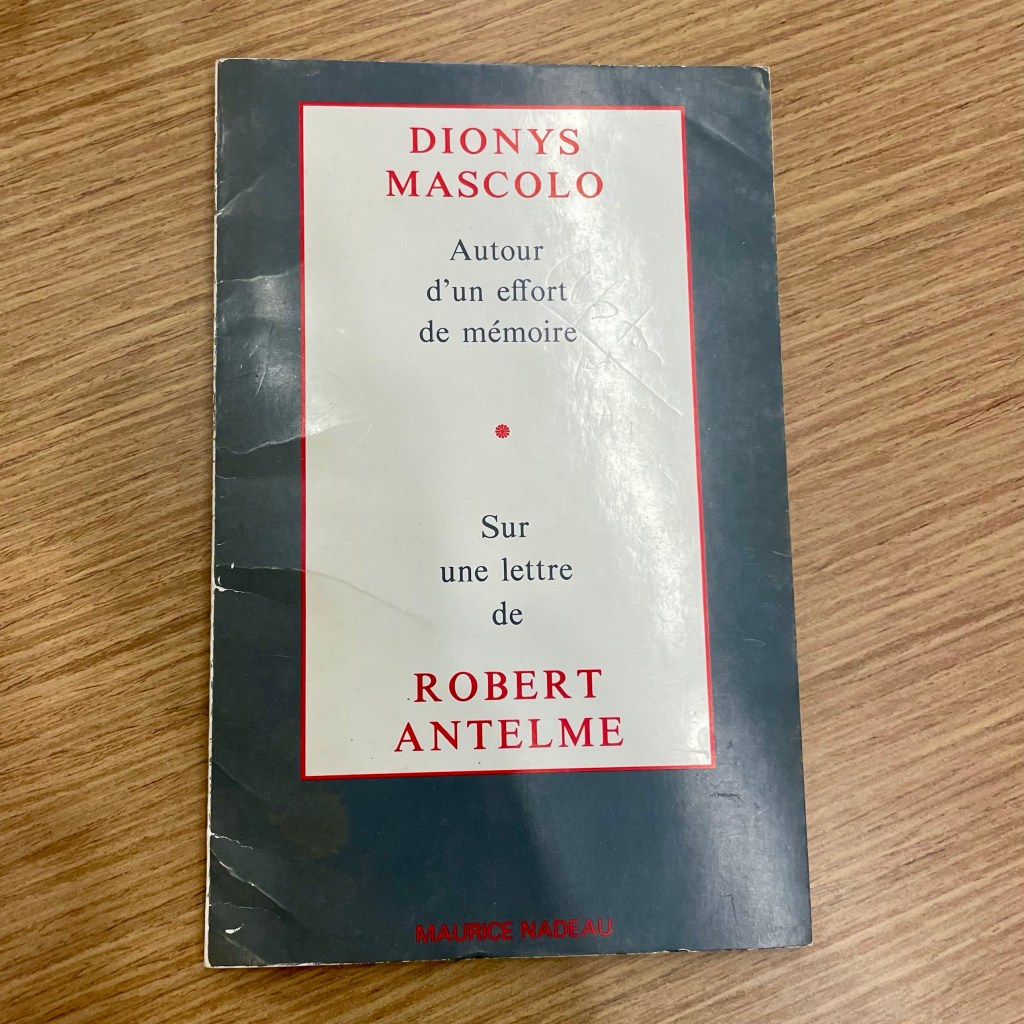
The missing word. A note on Dionys Mascolo’s Autour d’un effort de mémoire: sur une lettre de Robert Antelme (1987). by Gerardo Muñoz

Rereading Dionys Mascolo’s Autour d’un effort de mémoire: sur une lettre de Robert Antelme (1987) in preparation for an upcoming course with Philippe Theophanidis, one gets the sense of beginning backwards or at the very end, since this late essay is a recapitulation of what the Rue Saint-Benoît Group embodied and stood for. And it is so obvious that for Mascolo what is at stake in Antelme’s letter is not a particular practice of confession (and the coupling of secrecy and extraction), but rather an integral register of an experience that belongs to “friendship in thought without reserve” [1]. And that it would not have been possible without friends, as simple as that. Of course, the condition of possibility of this shared thought in friendship has less to do with general principles, norms, or creative acts, and more with what Mascolo does not hesitate to qualify as “a sensibility that was common to us”. 

What is this sensibility, and is it possible to describe it? This is a question that I do not think that is attempted to be resolved in Mascolo’s commentary nor in Antelme’s letter so consumed by its internal lacunae and effacement (I am definitely not capable of saying a word about it at the moment, and this might be one of the questions in the ongoing dialogue in the seminar). Mascolo does offer a little more when he states that this sensibility, however broad and partial, was always elevated against all totalitarianisms that were hegemonizing the political positions of the epoch. Obviously, it names the political totalitarianism (Fascist and state planned communism alike), but also the “the soul of the project” (‘est l’âme du projet  et sa forme aboutie’) that must retract from it [2]. The last pages of Mascolo’s reflection is a shallow-deep, an insinuation, into the possibility of saying something in relation to this difficult proximity. 

Hence, against total subsumption of life into political planning (whether on the right or left, whether ecclesiastical or in the name of the secularized forms of militant communist parties), Mascolo’s insistence on the ‘soul of the project’ is sustained by the “missing word” give that dispenses human necessities as infinite. He writes: “Et par mille et mille détours, il me (nous) fallait toujours en revenir au même point : Je suis ce qui me manque est la sentence que je porte (nous portons) inscrite à l’intérieur du front. La moindre des choses alors est de proposer que, sauf mensonge, elle vaut pour tout homme”. [3]. But what could it mean that “what I am” is always constituted by the missing word? It is definitely not a substantive attribute to a person (and thus what I can acquire), but a word that in its ideal absence and lack of epistemological validity stands as a form of seeking (zēteîn) that Nicoletta Di Vita has recently linked to the form of the ancient hymn [4]. The missing word is the passive and pure voice that calls out the rhetorical fiction of political totalitarianism. In other words, the missing word does not enact a present state of things, articulating the denomination in language with distinct objects of the world; it only has transformative weight when revealing what remains under the capes of morality.

This is why the experience of the camp constitutes a central threshold: on the one hand, it is an extreme and sharpened image of social alienation between classes; and, on the other, it is the experience that by depriving the human of its humanity it brings to an effective end the polarity between rich and poor that structured the economy of salvation and damnation of Western civilization. This is what Antelme describes in his essay “Poor Man – Proletarian – Deportee”, which according to Mascolo brings the rich to a psychotic night of desperation towards destruction and death of the specie. Hölderlin’s definition that “we have become poor in order to become rich” as a clement predicament in the face of the modern is here-forth suspended in the spiritual crisis generated by the social engineering whose most extreme case is the model of the camp.

And yet the missing word remains irreducible even after the corrupted stage of innocence and the impossibility of redemption. Mascolo, reader of Nietzsche, does not believe in the theos. This is why for him the missing word, far from being an apostrophe that offers consolation in the wake of the catastrophe, it remains concretely attached to the experience of the friend that no longer finds solace in abstract peace, but in the profound musicality of what remains inconsolable: “cette heureuse absence de paix qui est sa musique profonde, et que donne en partage l’être aimé, l’inconsolable qui console” [5]. This transfigured word – the unending capacity for hymn in the human, its nomoi mousikos – is both an excess to memory and appearance, and perhaps, more importantly, an excess to the experience of living and the dead. And is not this “seeking” passage of the missing word what the Rue Saint-Benoît Group was obsessively after?

Notes 

1. Dionys Mascolo. Autour d’un effort de mémoire: sur une lettre de Robert Antelme (Maurice Nadeau, 1987), 82.

2. Ibid., 83.

3. Dionys Mascolo. Autour d’un effort…,82.

4.  Nicoletta Di Vita, Il nome e la voce. Per una filosofia dell’inno (Neri Pozza, 2022), 27.

5. Dionys Mascolo. Autour d’un effort…, 89.

The Rue Saint-Benoît Group. Introduction for a 2024 seminar. by Gerardo Muñoz & Philippe Theophanidis.

The Rue Saint-Benoît Group, organized by Marguerite Duras, Robert Antelme, and Dionys Mascolo and other fellow-travelers of the interwar years can hardly be defined as a political movement, a literary school, nor an intellectual community with a direct orientation or aesthetic program. In fact, the Saint-Benoît Group (transnational in its composition) understood itself as a shared experience of thought that gravitated under the words of the German poet Friedrich Hölderlin: “The life of the mind among friends, thought is formed in the exchange of the written word and for those who seek”. It is also known that Hölderlin was the quintessential poet dwelling in the fracture between tradition and modernity, the flight of the gods and the eclipse of the poetic in the wake of a consummated technological Prometheism. To affirm Hölderlin’s words entails to confront the difficult questions of language and the voice as conditions for thought. How can we think of an intellectual experience in which friendship becomes inseparable from thought; and, at the same time, when thought becomes a condition for the endurance of friendship? And to what extent could this double register allow for a reinvention of the autonomy of politics in the wake of the crisis of Humanism? 

These are the enduring questions that the experiential setting of the Saint-Benoît Group bequeaths to us today. If the Saint-Benoît experience has remained opaque and invisible even within monumental historiographic narratives of twentieth-century ideas, it is because only seldom have these problems been rightly posed. Under the sign of a “friendship of thought” – a transfigurative plane that immediately resonates with the immaterial common intellect, the Heideggerian incursion on the task of thinking, and the revival of a sensible Platonism – the members of the Saint-Benoît Group witnessed the catastrophe of modern politics in real time; such as, although not limited to, the concentration camp, the postcolonial wars of liberation, communist totalitarianism, and the exhaustion of the fundamental categories of political Liberalism. Taking distance from the elaboration of a normative political theory, the Saint-Benoît Group favored the heterogeneity of stylistic endeavors and expressive acts in order to grapple with the crisis of experience. And it is to their specific scenes of writing that we must attend to in a systematic and careful way. 

In this eight-week course we will explore the diversity of the writings of the group, including figures such as Dionys Mascolo, Robert Antelme, Marguerite Duras, Maurice Blanchot, Elio Vittorini and other fellow-travelers to explore questions concerning the nexus between experience and creation (both of us have worked on some of these writers intermittently in the past couple of years). To the extent that we still live among the ruins of the legitimacy of modern politics, the contestatory style of Saint-Benoît Group still raises the question about the human species within our civilizational collapse.

What type of authority emerges from their writings, communication, and imagination of a fractured humanity? And how could the concept of ‘revolution’ be transformed from its moral and technical elaborations that hegemonized the twentieth century? We are aware that the Saint-Benoît Group has no “lesson” to be extracted and made “actual”; rather, we are interested in what we would call a “gesture of thinking” that prepares the condition for a life in freedom within and beyond the contours of the polis

*For those interested in registering for the eight week seminar beginning in February 2024, please consider signing up at 17/instituto de estudios críticos: https://17instituto.org, or by writing to extension@17edu.org.

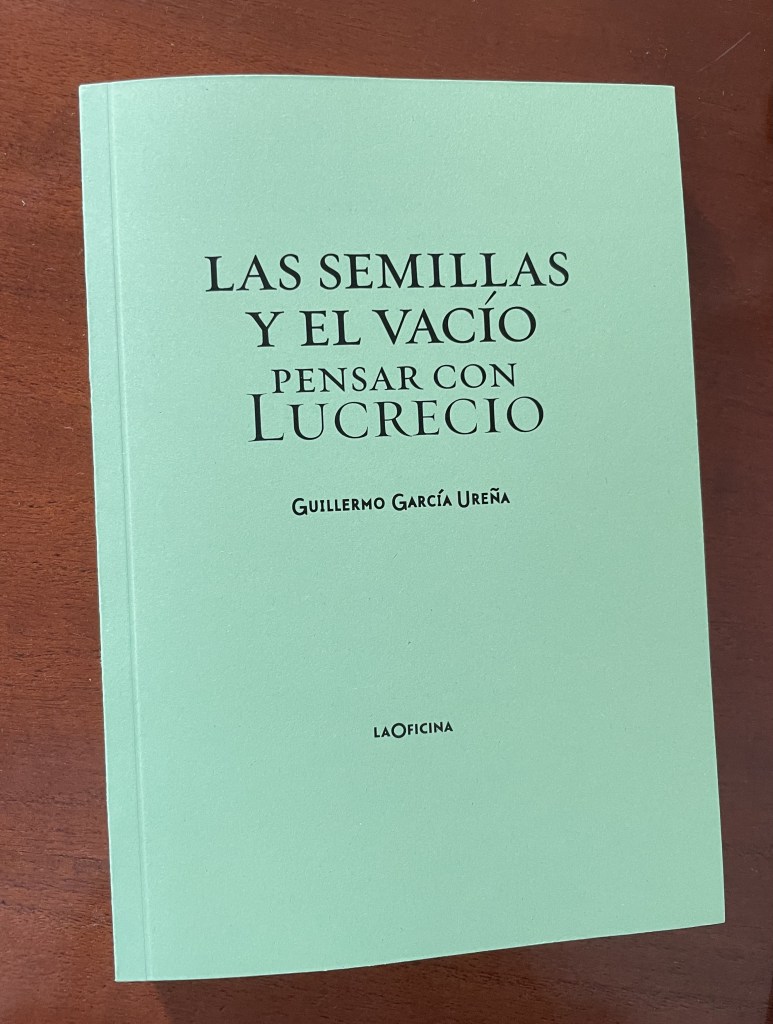
Naturae species ratioque. On Guillermo García Ureña’s Las semillas y el vacío: pensar con Lucrecio (2023). by Gerardo Muñoz

Lucretius’ poem De rerum natura is one of the most used and abused texts of the tradition, and like all classics it has had the most diverse receptions imaginable: the poem of modern science, a baroque expression of creationism for the English metaphysical poets, the precursor of historical materialism and atheism, and a tract of scientific positivism that laid the foundation for the regulation of nineteenth century social order. Once a text becomes an emblem, it usually means that it has lost its prehistoric imprint and place in the tradition. Against this backdrop, Guillermo García Ureña’s just published Las semillas y el vacío: pensar con Lucrecio (La Oficina, 2023) has the prudential gesture of disclosing the great Roman poem to its fundamental structure; attentively listening to its original complex articulation difficult to grasp with the categories of modern philosophical thought. In this sense, Ureña’s purpose is not to deploy another “philosophical account” of De rerum natura – endorsing and subscribing the influence of Epicurus and its later resonances in modern theories of physicalism and materialism of the continental schools – but rather to engage in its own ground exerting an original philological exploration of the text that opens up an array of different problems for thought. Whoever is looking for a “theory” of Lucretius will find none in this brilliant and well articulated essay. But the reader will find, nonetheless, a comprehensive hermeneutics of a text that stands as a threshold between the closure of Greek classical antiquity and the Roman reintegration of the tradition. Now, for Ureña De rerum natura proem discloses the originary understand of the epic, or épos, through which the stability of the things as they appear takes place; whether it is the Muses, the gods, being and language, the simulacra or the soul, the physical declination of creation (the atomic clinamen) and the final document of language invigorated in the corpus of the poem itself. De rerum natura is both a cosmology and a poetics with the ambition of elucidating the most obscure things of this world: Lucretius’ text defies a fixed representation through a choreography (a term that it is not used by Ureña, it must be said) that discloses the possibilities of worlds; the combination of worlds only to posit the question of how to live within them, which is another way of saying how to account for a form of life.

One of Ureña’s commitments is to hold on to Lucretius’ aesthetic and philosophical autonomy. This implies treating the influence of Epicureanism with great care; engaging with Epicurus insofar as the aesthetic autonomy and its loci of poetization reject the classical structure of the epic hero incarnated by the soteriological impulse of the great poet-philosopher (we know that this is the same problem that centuries later Hölderlin will identify through the tragic drama of Empedocles). Lucretius is writing after the twilight of the classical Greek genres. Furthermore, there is no community under an organized program of leadership and telos; on the contrary, there is only an existence that “one day will want to desert all of us” (41). True, the Epicurean notion of serenity (ataraxía) is retained and treasured; but only as the aspiration of every living being who seeks to transfigure the shadows of superstitiousness and fear that govern over the perceptive mediating forces in the world. In this sense, to dwell in the world does not consist in the limitless relationship with the simulacra; it is rather, the self-transformative exercise of freeing possibilities within the void in which forms of life can emerge. As Ureña reminds, the rainfall of the atom is as fast as that of thought itself. It is already an image of thought, as well as the figure of imagination. And the image of thought validates the history of cosmos as a patchwork of accumulations and deflections, creations and destructions, repetitions and disintegrations in a swerve of forms that infinitely recline on its ethical possibilities (139). It is altogether interesting that Ureña reminds us that, in fact, De rerum natura is not interested in staging the things in Nature; on the contrary, at the center there is the question of the ‘nature of things’ in the luminous expression of their irreducibility. This is what modern onto-theological closure brings to a process of domestication, whether through the composition of the civil structure (limitless exchange according to philosopher Felipe Martínez Marzoa, who figures prominently in Ureña’s book) or through the progressive historical structure commanded by the essence of technology that blurs the relations between forms and techniques.

If De rerum natura abandons universal history and historical narration, it is because its structure is profoundly kenotic: it can only be assigned as contingent historical transmission of the most immediate and sensorial (not necessarily “true” in the metaphysical sense) that allows the convergence of the history of forms of life and natural history (140). The operation of subtraction implies the transfiguration of freedom through the becoming of forms – their interests, constructions, and pacts (foedera naturae) as guarantee for a plastic relationship between things in a world that is always already a fragment in the void. The highly attractive Lucretian notion of foedera or “pact” (that expresses separation in coming together: a com-pact that de-compacts) is almost the inversion of the modern principle of irreversibility, if one were to take Hans Blumenberg’s  legitimation hypothesis at face value. And this is so because a foedus or pact is insufficiently strong to resist the impact of the clinamen, but indispensable for the emergence of a body that materializes its own fate towards dissolution.

The lack of unity of being allows for the existence of simulacra as that which does not have sufficient matter to compose itself as foedera; and so, it is a material semblance as an image without figure that makes it an ephemeral entelechy. In this choreography between the downwards of atoms and ephemeral intermittence of events the taking place of the world emerges a topoi of a combination of rhythms that intertwine the weight of bodies and the animation of souls. The possible combination and stylization of multiplicities in separation is the way in which a form of life emerges as the desertion from superstition and fear that hinges upon the irreversible stabilization of a principle of reality. Ureña does not go this far into the wager of Lucretius’s text – and he does not have to in his close reading of the text – but it is precisely this thick dimension of the ethical primacy that makes Lucretius’ dislocated comprehension of materiality a vibrant tune against the weight of alienation that we are still struggling to abandon.

The struggle against the alienated life – the alienation from the world, and the external manipulation of the simulacra that has become a gnostic planetary form of “TV Democracy’ (Schmitt) of the “society of the spectacle” (Debord), which implies the usurpation of our imaginal and erotic relationship with the world – well understood, does not mean to relocate the confrontation at the level of political order; it rather, rests on what we have understood by order and disorder for the reconstitution of a happy or contemplative life (naturae species ratioque). This serene life declines the offer to negotiate at the arena of sacrifice and legitimate domination, favoring the event of friendship. At this point Lucretius comes closest to Epicurus’s society of friends – studied by Carlo Diano in an important 1966 conference in relation to the organization of the passions and the transmission of love – that can guarantee a content life in the presence of “other joyous gazes” (glossing Diano’s terms) away from the persistence of war and the compensatory administration of pain. This is the ultimate treat of De rerum natura: the exemplary dimension of the serene life takes shape through the community of friends, the civilizational invariant of the human experience (prehistoric times, the classical epoch, and in our times) that abandons the paradigm of perpetual war that obfuscates omnia cordi.

It is not too ambitious to claim that only at this point we finally grasp the full extent of the Lucretian épos: not just an ephemeral and contingent declension of the primacy of atoms in the void; but, more importantly, it can disclose the irreducibility of an experience with friends. Ureña wisely closest his book with an image of the “buena vida en compañía” (the good life in companion) that insists that serenity is only possible (or desirable) in the open landscape, a nowhere-land of an eternal foedera (or a sinousia, as it appears in Plato’s Symposium) that even if temporarily too short-lived or inconsequential it paints an earthly paradise just above the grass: “poder tendernos unos juntos a otros en el césped suave, cabe un arroyuelo, a la sombra de un árbol copudo, y regalar el cuerpo sin grandes dispendios; sobre todo si el cielo sonríe y la estación del año esparce de flores el verdor de la hierba (II, 29-33)” (203). It is this inconspicuous and mute experience that strangely holds on to the passing of the world.

Hölderlin on the serene life. by Gerardo Muñoz


In a letter from the beginning of 1799 addressed to his mother, Hölderlin makes a sort of confession that fully illuminates (in a multum in parvo fashion) what he understood as a quiet or serene life. Or at least, it allows to grasp how he comes to envision it and towards what end. At first sight, what is striking is its bare literalness, too strange for a poet, and too mundane if it were not for its intrinsic lyricism. It is a lyricism that comes forth effortlessly, which speaks to the quality of its furtive testimony. Literalness is also described in its engagement with the world – and, more fundamentally, the sufficient condition for sense to emerge. This is the fragment in question (from Helena Cortés’ translation of the correspondence):

“No quise rechazar de plano para tener por si acaso una vía de escape, y sobre todo puesto que se ofrece a buscarme una plaza que consiste en acompañar a la universidad a un jovencito. Conocer más mundo (conocer el pueblo alemán le es tan necesario, especialmente a todo el que quiera convertirse en un escritor alemán, como conocer el suelo al jardinero) es al fin y al cabo la única compensación que me puede ofrecer una situación tan fatigosa, y lo alejado del lugar, que de todos modos muy lejos no puede estar de alguna universidad, me parece más ventajoso que perjudicial durante un par de años en los que aun no puedo contar con gozar de una vida tranquila entre los míos”. [1]. 

There is little doubt that the world disclosed here is well within the bourgeois interiority: there is economic calculation and anticipation. At this time Hölderlin was being offered the position of a preceptor to a university student. But there is hardly only this. There is also the affirmation of fleeing from what this world has to offer – and this means quite a lot in the early quarters of the Enlightenment. Una vía de escape – for Hölderlin the way out is not merely from economic hardship, but also the possibility to retain a certain knowledge that he dares to qualify as “of the world”: “to know the world, which is the only compensation to a fatigued situation and the remoteness of place”. Loss of fixity to place demands access to the world.

This is not your expected aesthetic education of man. The subject of the Enlightenment – its commitment to historical abstraction and the possession of aesthetic form as mediation to totality – prevails at the epistemic register at the cost of rescinding the dislocation from nature. By contrast, the knowledge implicated in knowing thy world should be like that of the soil with the gardener (pay attention to how Hölderlin inverts subject and thing: it is the ground that becomes accustomed to the gardener, and not the other way around). But at the threshold of the eighteenth century, Hölderlin’s “vía de escape” was also compensatory to the fatigue of a nascent epoch of the subject. The compensation did not entail an excess of knowledge; it was rather knowledge a way to disengage with the presupositions grounding the historical epoch.

This seems to me the operation at work in Hölderlin’s epistolary confession. Carchia was right in positing Hölderlin’s poetological aspiration of spirit and nature was entirely pre-Olympian, which requires subtracting himself from the modern parody of cultic romanticism [2]. A way out appears in cleared space when serene life is finally realized between friends; that is, among those that I make as friends (“los míos”). Poetry and making are here at their closest proximity cutting through the thicket of experience. This is what it means to know thy world. At the center of Hölderlin’s ethics there is a sense of distance – the waiting for a serene life in which language will finally gather itself unto presence. Ultimately, this is the plain literalness that the 1799 letter offers us.

.

.

Notes

1. Friedrich Hölderlin. Correspondencia completa, traducción de Helena Cortés y Arturo Leyte (Libros Hiperión, 1990), 467.

2. Gianni Carchia. “Introduzione” to Walter Otto’s Il poeta e gli antichi dèi (Guida Editori, 1991), 8.

On the community of friendship. by Gerardo Muñoz

There is no surprise that the growth of social fragmentation runs parallel to appeals to community and communitarian affirmations. For anyone today in the university (at least in the United States, but I am told that the trend is similar across parts of Europe and elsewhere) it is easy to see that all initiatives and justifications for actions (an art curatorial project, a library event, you name it) is almost always done in the name of the community. The communitarian affirmation emerges to help cure the otherwise too crude and unbearable wounds of the social bond and the community of the species (Gemeinwesen). A friend was on point recently in defining these communities of obligation, participation, and self-valorization as a minima societas; a mini society that helps to create the illusion that “Society”, somehow, is still here.

As we know, this is not far off from Edmund Burke’s famous theory of “little platoons” meant to orient humanity towards the virtues of public affections. The collapse of civil-society and state mediations realized the Burkean predicament to its integral idealization, which is why today radical Marxist, academic bureaucrats, postliberal nationalists, experts in mental health and psychiatric treatments, contemporary art curators and even special units of the police can all agree that community is the highest value that must protected and sustained. In this framework, there is no outside to the community, and every outside becomes integrated into the community as a value.

The community lodges the artificial allure to retract from catastrophe, but it does so by reproducing the catastrophic it seeks to avoid: that is, by negating the possibility of exteriority of every community sustained by the affective transmission of vanity and recognition. This is why to speak of community of friendship is a misnomer at best, which introduces a great amount of confusion between these two forms of contact. In a fabulous moment in his Il dialogo della salute, Carlo Michelstaedter goes as far as to write that: “In the communities of friendship that are born from a common vanity, every life off the death of those who are already outside the community. Everyone in its own solitude swallows with an empty stomach the sour implications of these lethal conversations. But these are the companies that please men”.

It is a remarkable passage that exposes the irredeemable position of a community of friendship, which ultimately subsumes the friend into the logistics of debt, obligation, and recognition and satisfaction. As in Mary McCarthy’s novel The Oasis (1949) about a group of disaffected antinuclear intellectuals who form a community in the mountains of New England, every community of friendship is destined to the worst catastrophe imaginable sacrificing both friendship and the world through the circulation of value.

Precisely, if friendship means anything, is that it is on the other side of valorization that permanently conflates language and directives of action. What happens in McCarthy’s The Oasis is precisely that language becomes a medium for directives and exchange, and friendship a hellish reality of ‘those who belong’ but now have nowhere to go.

The impossibility of separating community and friendship will only perpetuate the politics of catastrophe that has colored the entire course of Western political modernity. The Spanish political leader Pablo Iglesias recently captured the bad faith of our times: “Puede que la manifestación no tenga un impacto político inmediato pero del mismo que los católicos se encuentran en misa nosotros nos encontramos, nos abrazamos en las movilizaciones. Somos parte fundamental de una comunidad.”

For sure, a magnetic secularized religious liturgy lives on Iglesias’ candid heart. But we know that the partition of friendship is neither an offshoot nor a declension of a substantive community; it is what takes place on the other side of pathetic valorization.

Clandestine life in the open. by Gerardo Muñoz

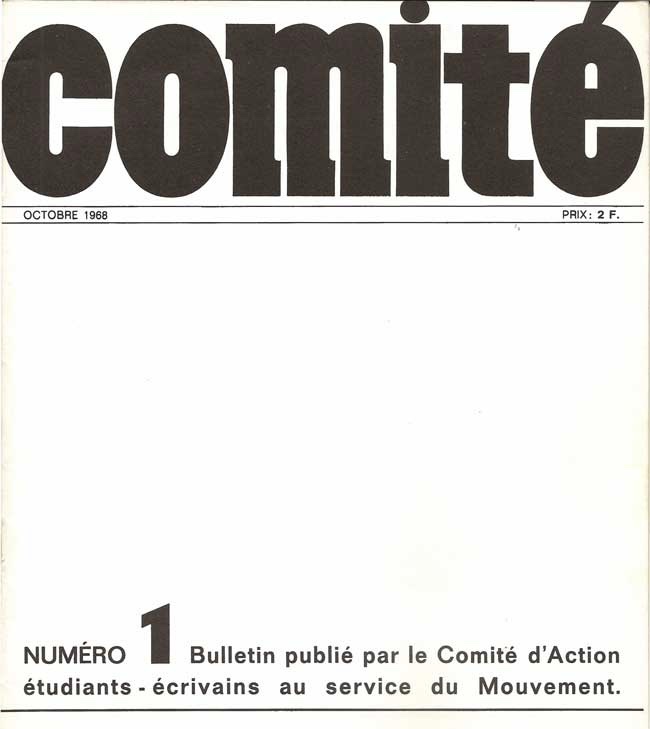
In the very last article that Maurice Blanchot wrote for the collective publication Comité in the wake of May 68, he draws a scenario that is still very much with us in the present. The “realism” is almost outstanding when Blanchot writes the following: “…from now on I will hold onto an exigency: to become fully conscious that we at the end of history, so that most of our inherited notions, beginning with the from the revolutionary tradition, must be reexamined and, as such, refuted. Let us put everything into question, including your own certainties and verbal hopes. The revolution is behind us: it is already an object of consumption, and occasionally, of enjoyment.” [1]. There was no question that the crisis of the very foundation of modern political thought has collapsed, including, as it couldn’t be otherwise, the generative principle of revolution. Blanchot did not even attempt to convince himself that the revolution could be brought back in an astronomical sense to revitalize a naturalism previous to Rousseau’s social contract.

So, for Blanchot the revolution was over, and yet, whatever it was that followed had no name. What was left, then? In order to avoid paralysis, Blanchot toyed during those months at the Comité (September-December 1968) with two possible maneuvers. The first position resided in what he called the “movement of possible speech” in order to establish an ardent and rigorous relation between the sequence of the French May and the Czech May, Soviet domination and Gaullian State. Blanchot called for (in the spirit of Bataille) a “transgressive speech”: “the impetus of outrageous, ways speaking beyond, spilling over, and thus threatening everything that contains and has limits” [2]. But we know that transgression is still within the logistics of the administration of order and temporal containment of the regulated exception. This was, in fact, the very rupture of the revolutionary break that was in crisis.

But Blanchot was up to something along with his friend Dionys Mascolo in thinking through language and communication as a path towards the outside. Hence the second option, which is really a third option (after the sleepwalking of ideological revolutionary ‘racketing’ of voluntarism); mainly, what he calls, although does not get to tease it out, the “clandestine resistance in the open”. Blanchot only tells us what he is thinking about through a recent example: some members of the Czech resistance when law was suspended had to confront the raw enemy military power, but they also experienced a freedom “through words and through writing than ever before”, tells us Blanchot. But this still does not explain much, given that if there is a naked military power threatening us, how could something like a clandestine form of life take place in the open? And at what risk?

I think one way to read this incorrectly or insufficiently would be to think of Blanchot’s suggestions as a sort of martyrdom or self-immolation. But it is no less true that Blanchot wanted to avoid a sort of Batallian “inner experience” or monastic xeniteia. Thus, he “refused” the fiction of self-clandestine life as sponsored by the Situationists; while, at the same time, also rejecting subjective revolutionary militancy. A third way emerges: the clandestine life into presence by way of friendship. A new “estilo de vida”, which I think could be read in the way that cryptojews and averroists lived in early Modern Spain: “a modo de sociedades secretas o semi-clandestinas, deben haber concebido la filosofía como un estilo de vida para sus iniciados…” [3]. Unlike the bogus image of the secret society as an alienated community of knuckleheads, I think what emerges in the clandestine open region is a form of shared friendship that does not retreat from the world, but rather that is capable of living in it. This was most definitely the transformative practice that during these years, Dionys Mascolo, dared to call the communism of thought that for him belonged to Hölderlin rather than to Marx. If open conspiracy is an act of the sharing and participating in language without meaning or command dependence, then this is already a poetic practice. After all, for Hölderlin the poets reveal an originary loss from nature. It is no surprise that Hölderlin favors a world opening even after the destruction of the leader-figure of the poet (Empedocles).

So, there is only clandestine life in the open when the sharing of language among friends take place (an event). This use of language is always harboring on the threshold of the last word to come. In short, the clandestine form of life has nothing oblique with respect to the world – it is not necessarily the space of an infinite night of contemplation, and it is also indifferent about fugitivity – it demands a return to appearance by way of experience. This might explain what Gilles Deleuze tells Dionys Mascolo at the end of their correspondence about friendship and thought: “it is a question of what we call and experience as philosophy” [4]. This form of experiential thought against the dissatisfaction of political domestication points a way out. For Blanchot this was a “fragmentary, lengthy, and instantaneous” path; a conspiratio unlocked by philia.

.

.

Notes

1. Maurice Blanchot. “On the Movement”, in Political Writings 1953-1993 (Fordham University Press, 2010), 106.

2. Maurice Blanchot. “Clandestine resistance in the open”, in Political Writings 1953-1993 (Fordham University Press, 2010), 106.

3. Francisco Márquez Villanueva. “El caso del averroísmo popular español”, in Cinco Siglos de La Celestina: aportaciones interpretativas (1997), 121-134.

4. Gilles Deleuze. “Correspondence with Dionys Mascolo”, in Two Regimes of Madness (Semiotexte, 2007), 332-338.

The politics of schism: theses on Dionys Mascolo’s La révolution par l’amitié (2022). by Gerardo Muñoz

1. Remembrance without restitution. The publication of Dionys Mascolo’s essays in La révolution par l’amitié (La fabrique, 2022) opens a path to a singular thinking that refused to conform to a master thinking, and even less what has come to us as political theory, or radical critique. Theory and critique have shown their resilient adaptiveness to university discourse. Thinking, on the contrary, moves annexes a relation with the missing word. This caesura negates the closure of both politics and community, it shows its insufficiency. In a letter to Maurice Blanchot regarding his ceased friend Robert Antelme, Mascolo comes to terms with this specific question: the remembrance of what loss in the actual word is – the voice of his friend Robert Antelme – what cannot be posited as a restitution of representation, but rather as effective effort to transcend mutism and silence that would have sunk writing into a pathos not short of a “miserabilist” stance [1]. The exigency of language is absolute. In an analogous way, we can say that the writing in La revolution par l’amité (La fabrique, 2022) is not a matter of restituting the history of Marxism, the intellectual debates of French theory, or even the burial site of a thinker that rejected repeatedly the metaphysical function of the public intellectual (a sort of captain at the steering wheel of public opinion, a cybernetician); but rather the remembrance that thinking is the irreductible site of common to the species. Remembrance has no “archive” and it does not produce anything; on the contrary, it invites a path to thinking in order to bring the absolutism of reality to an end.

2. The irreducibility of the species. For Mascolo – as for Nicola Chiaromonte – the stimmung of the modern age is not a lack of faith, but a bad faith subscribed by the subject of knowledge, a guardian of the nexus of legitimacy. In his practice of writing, Mascolo explored something like a countermovement to the rationality of the intellectual posture, in which communication ceases to be a common means in order to become a production of ends and instrumentality. Hence, what Mascolo called the “part irreductible” – and its “doubt in any system of organized ideas in sight” – is the only intuition of the unity of the species in communication. And if the intellectual is an organic unity of hegemony that replaces the function of the priest in the Church bureaucracy and its paideia (recall Antonio Gramsci’s “organic intellectual”), for Mascolo irreducibility in the sharing of thought in communication is “not political” as he states in Autour d’un effort de mémoire – Sur une lettre de Robert Antelme (1987). This step back from the production of modern politics thoroughly imagines another figure of communism. It is at this point where the whole Cold War polemics between humanism and anti-humanism is destituted internally: the species finds a way out of political domestication.

3. Communism of thought. We can understand why for Mascolo “the word communism really belongs more to Hölderlin than to Marx, as it designates all the possibilities of thought; that which escapes in thinking, and only that can constitute its work (oeuvre)” [2]. In other words, communism for Mascolo is not a matter of doctrine or an Idea, nor about philosophy of history and its inversion; it is not about a political subject or a unity of organization of political force; communism is a use of thought in language in proximity with what escapes in every communication. The inoperative communism, hence, is only possible in friendship, as a continuous experimentation of taste that cannot coincide with a community form. As Mascolo writes in his essay on Antelme: “We did not live in community. This is a deceptive word…we existed in a sentiment of mutual gift of freedom” (53). Any reinvention of a politics to come after the collapse of authority must commence with this rejection of a compensatory communitarian closure. Today only a conspiratio between friends can animate a new field of intensification for renewal.

4. Refusal and friendship. Even in his earliest stages of writing such as “Refus incoditionnel” (1959), the condition for friendship for Mascolo is to refuse the current state of things; to retreat from the demand of reality in order to survive in the imagination of the shared word. In this sense, the thematic of friendship does not make subjects of duty towards a social bond, but rather a secret in the word designated by separation. Friendship floats high above symbolic representation, as it moves to an inclination that is singulare tantum. If modern politics thought itself as a repression and administration of the hostis; for Mascolo the practice of friendship is the sacred space that is never inherited, but, precisely the dwelling of those who “seek” after in the wake of the homelessness of man and nature. This is analogous to Hölderlin’s allowance of thought which moves in passion while accounting for the abyss of our relationship with the world (aorgic) of originary detachment.

5. Revolution as style. In a brief text on the Cuban revolution of 1959, originally written for the collective exhibition Salón de Mayo in Havana, Mascolo says a new revolution in the island could potentially offer a the opportunity of a new style [3]. Of course, as soon as Fidel Castro supported the Soviet invasion of Czechoslovakia in 1968, it was clear that such promised crumbled, and that the Revolution will fall well within the paradigm of the metaphysics of historical project and the subject (“a new man”). But what is style? Once again, this speaks directly to Mascolo’s passion for the irreductible outside of the subject, and for this reason never alienated from the schism of the species. The notion of style relates fundamentally to our exposition to the outside, to the event of expropriation, which defines our fidelity to the invariant dimension of our character. A new style, therefore, is not something to be produced, an effect of the subject, but rather the unit of an ethical practice in our encounter with the outside. If the apparatus of the revolution was instituted as a the production of a civilization; the fidelity to a style names the modes of life that cannot be oriented towards a specific work. A new aberrant freedom emerges.

6. Saint-Just’s ethos. Mascolo never ceased to reflect on the ethical determination of politics, against politics, and for a transfigurative notion of a politics for the here and now. And he dwelled on this problem in his writings on the ethical figure of Saint-Just during the French Revolution (“Saint Just” and “Si la lecture de Saint-Just est possible”). Unlike the monumental historiographies – both left and right, revolutionary and conservative, historicist or revisionist – that situated the revolutionary under the sign of Terror and Revolution, of will power and the emergency of Jacobinism; for Mascolo Saint-Just stands a figure that keeps an important secret. And this is it: “the inhumanity of Saint Just is that unlike many men, he does not possess many lives but only one” (130). This is a concrete definition of a ethos that is irreducible to the “monstrous arts of government” in an epoch where the political had become the secularization of fate. In the same way that Hölderlin turned his gaze towards the impossible and concealed distance of the moderns in relation to truth of the Greeks, for Mascolo’s Saint-Just the legitimacy of the modern universalization (in the State, the Subject, the Social) does not have the last word. The ethos of life keeps the remembrance of an abyss of the monstrosity of historical universality and the social equality.

7. Borrowed existence. Dionys Mascolo lived at the dusk of the modern arch of the revolution, whether understood as eschatology or a conservation of the natural order of the species, as Saint-Just proposed against the Rousseaunian social contract and the Hobbesian mechanical Leviathan in exchange for authority. We have already crossed this threshold, and we are in the desert of the political, retreating on its shadow fallen into administration of fictive hegemonies. Hence, the question of an ethos of existence becomes even more pressing from Mascolo’s thematic of friendship in order to refuse what he calls in “Sur ma propre bêtise et celle de quelues autres”, a “borrowed existence in a comedy that feels as if we are being watch by God alone” (219). Indeed, as some have diagnosed with precision, the religion of our time is absolute immanence, the full disposition of the tooling of our means [4]. A cybernetic dreamworld, whose pathetic figure is the “influencer” (a few strata beneath the luminosity of the intellectual). This can only fix us into the stupidity of intelligence of the species: specialized intelligence, in other words, prisoners in the sea of nihilism. The intelligence of the species, on the contrary, is the cunning (methis) of the fox: a way out in spite of the swelling tides. But against the nihilism of a borrowed life of immanence (beatitude of the impersonal, and iconicity of things), Mascolo’s thought insists stubbornly in friendship as the initiation in an uncharted path to reenter the world once again.

.

.

Notes 

1. Dionys Mascolo. Autour d’un effort de mémoire: Sur une lettre de Robert Antelme (Maurice Nadeau, 1987). 

2. Ibid., 50.

3. Dionys Mascolo. “Cuba premier territoire libre du socialisme”, in A la recherche d’un communisme de pensée (fourbis, 1993).

4. Lundi Matin. “Éléments de descivilisation. Partie 4”, Lundi Matin, 2019: https://lundi.am/Elements-de-decivilisation-Partie-4