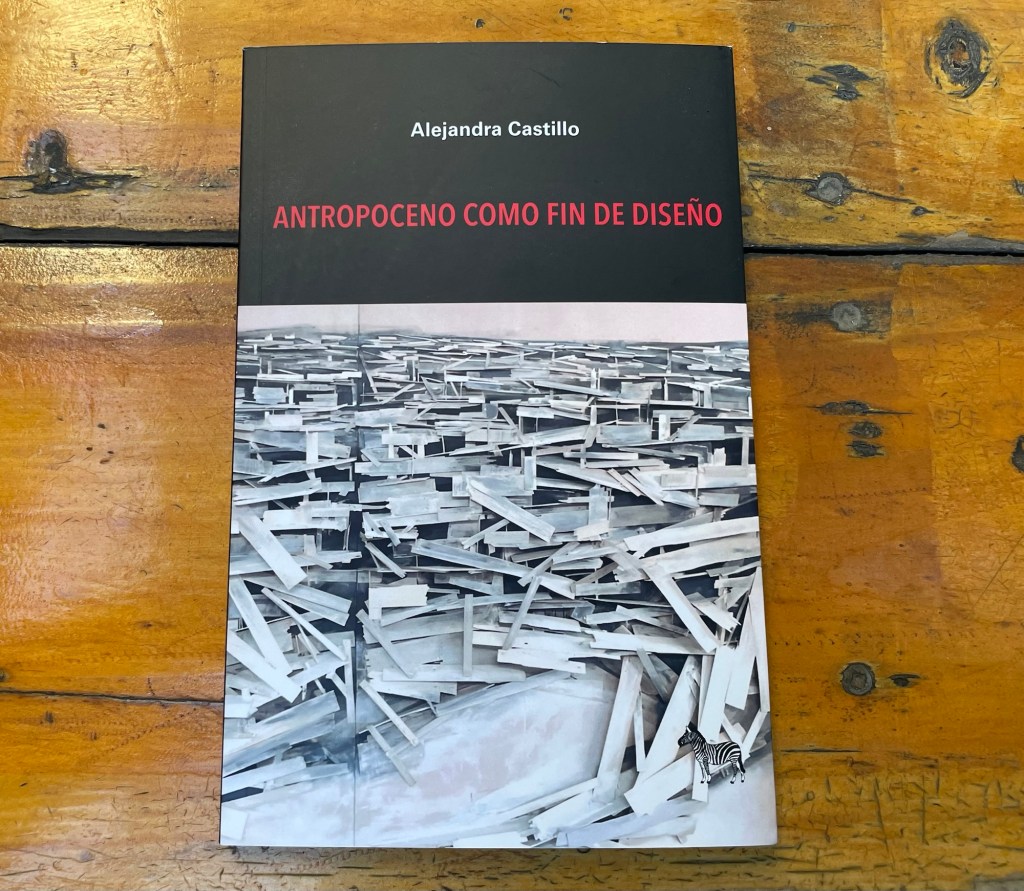
The wreckage of design. On Alejandra Castillo’s Antropoceno como fin de diseño (2025). by Gerardo Muñoz

Only in rare occasions the operation of thinking finds angular or lateral points of escape. This is the gesture that characterizes Alejandra Castillo’s theoretical writing, and is particularly bright in her most recent book Antropoceno como fin de diseño (La Cebra, 2025). The zigzagging entry is an intuition that is also a guiding thread: the force of real subsumption of capitalist domination depends on the operation of design. Of course, in design one hears not only blueprint and form, but also designation, and thus the specular regime of visibility, orderability, quantification. It is the world of physiocratic forestry. In fact, Castillo’s succinct definition of the metapolitical condition of design is offered to the reader at the entrance: “Design is the figure that thinks always in advance (por adelantado) (Castillo 12). Design calculates and locates. It is through the operation of design that legibility becomes adequated to political representation so that the state can manage and attenuate the deployment of its forms and the circulations of relations of totality (Castillo 13). The design is what is common to the worker, the engineer, and the lawyer. This is why design for Castillo design is an efficacious nexus that connects the separation of objectivity and the life worlds. Understood in this sense, “design” is analogous to the enframing of the world that intensifies in the age of technology and rhetoric. But in the watershed of the end of modernity, the hegemony of design collapses, while it becomes a temporal “self-design” submerged in all spheres of expressive enactments. 

The end of the second vector of the zigzag outlined in the essay is found precisely at this conjuncture: the anthropocene brings the humanist projections and design to a final wreckage. This is means that capitalist form is not formless because it has managed to subsume the time of life as exception to labour; time is a wreckage because design no longer coincides with the world of forms, as it has temporalized experience into total transparency without reminder. For Castillo this means that in the anthropocene there is no longer “struggle for visibility”, as everything has been rendered exposed and hollow; de-substantialized in the very fabric of subjectivity (in the early millennium some called this new hyperbolic figure the Bloom). Implicitly in Castillo’s writing is the assumption that the mediation between politics and design has been severed, and the new securitarian imperium can only immunize itself against the very site that in modern times granted its legitimacy (civil society, constituent power) (Castillo 37). 

The end of design means the absolutization of design, a new carceral imperative for adaptation that makes any claim to subjectivity an endorsement of the prison of the ego. To live in a post-designed unworldly condition means not only to come face to face with the homogenous space of cultural exchange into image; it is also a new imperative that requires that “you must submit, without knowing to what; subject to what is the case anyway, and which, as a reflex to its power and commonsense, everyone believes anyway” [1]. The end of design paves the way for new plastic forms of domination towards an integral planetary unity. 

Bordiga claimed throughout his work that the democratic design was perhaps the best fitting system for the versatility of capitalist accumulation and relentless expansion. This is why in all the political cases that Castillo introduces in a text in a manner of a shadow play do not pretend to offer a new theory of ideology, but rather show how democratic design is a one-piece suit that fits all without any needs for “ideal types” to fix normativity and institutional arrangements. Indeed, there is no longer anything like an “extreme political right” – and this is just a tweak from Castillo’s vocabulary, who does insist on the term throughout the essay – but rightward figures of the political that desperately cling to any form to distract from the abyss of social legitimation. Ultimately, the ruling over this void will be  – in many ways already is – the continuation of war in the social fabric; and stasis will require new stealth development of technologies of containment that Palantir’s Alex Karp has called the new “lethal form”. This means that democratic design is not only expressively a system of sentencing to death; it is in virtue of the exchange of social forms, an inverted negation of human finitude. The point of despair would incite some to look again in the cabinet of forms; a knee-jerk reaction to the irruption of the Anthropocene against the total sum of possible designs. 

Of course, this is also what Alejandra Castillo’s Antropoceno como fin de diseño (2025) avoids at all costs. Towards the last pages of the book, Castillo calls for a transformative turn that departs from the body; a corporeal insurrection that, in refusing the rectilinear and heteronormative political corpus of the modern epoch (no coincidence that Hobbes was both the founder of the autonomy of civil as well as of the physics of the body of matter in space), is capable of responding to the call of the anthropocene in all of its profuse conflictivity. Castillo proposes the necessity to gravitate towards a “maximum distance” against the general design of orderability of public domination (Castillo 77). But this can only be understood as an incommensurable distance that dissolves the ontotheological separation of subject and object of the state of confinement.

The political constitution of a corpus appears as the promise of an exit from the temporalization of the post-auratic literalism that, according to Michel Fried, dominated the structure of the object-oriented work of art, as compensatory to the corrosion of political forms and presentist autonomy [2]. Castillo does not seek to revive a last gasp of auratic objectification, which amounts to the sleepwalking condition of the image world of mere survival. In soliciting a maximum distance to what is closest (in fact, a body), Castillo invites us, as both promise and commitment, to think at the end of nondependency – not the “independence” that carries the traces of the fictitious individuality- from the crutches of design to finally conquer another liberty beyond terror and prevention; a life imbricated in the nonbeing of place (ecology) with others.

Notes 

1. Thedor W. Adorno. “The Cultural Industry: A Resumé”, in Without Model (Seagull Books, 2023), 58.

2. Michael Fried. “Art and Objecthood”, in Art and Objecthood: Essays and Reviews (University of Chicago Press, 1998), 172.

The world has been posthegemonic. by Gerardo Muñoz

In a recent text published at Verso Blog, entitled “The Coming Post-Hegemonic World”, Michael Hardt and Sandro Mezzadra make a case for a “turn to a post-hegemonic model” that will challenge the consensus of global in the coming era. In many ways, this era is already here with its diverse and multifaceted (in terms of intensities, forces, and leverages) of protracted and bizarre nationalisms, which as Jamie Merchant has teased out brilliantly, amount to desperate attempts to offer a belated response to the decline of growth as one more stage for containing rampant processes of accumulation via state capacities. For Hardt & Mezzadra, this “posthegemonic world to come” is characterized by a global spatial reconfiguration of capital – accommodating the logistics of regional spaces of influences and exchange across the planet – and on the other, an increasingly “domestic sphere of authoritarian rule” promoted by new accelerated initiatives at generating social homogeneity in the wake of rushing fragmentation hand in hand with a war regime that has utterly scrapped ideals about “strategic autonomy” in order to trumpet an arm race (nuclear weapons included), as it is currently unfolding in Europe. 

One can claim that this posthegemonic world is one that firmly assumes the consequences of two interdependent vectors that imploded within the project of political modernity: the end of  economic growth (thus validating the law of the fall of profit outlined in Capital V.III), and the liquidation of the principle of legitimacy that for two centuries accommodated the legislative sources of the state authority in democratic constituent power. For Hardt & Mezzadra posthegemony means global fragmentation, authoritarianism, and spatial remaking; however, one should also say that it means, the opening towards stagnation, the collapse of political unity of the state, and most recently the total discredit of the foolish leftist hypothesis that promoted a “rainbow social equivalent coalitions” to push for compensatory, and in every instance insufficient and moribound, populist resurgences elevated through the combustion of ethereal but effective rhetoric (in fact, my argument in a new short book, La fisura posthegemónica, is that the push for political hegemony of the last decades only cosigned forms of consensual totalization at the expense of the production of subalternization and social death).  

Even taken as a descriptive and normative condition of the current state of Western politics, the posthegemonic situation lays bare the reciprocal impasse of the claim of its opposition: in other words, one should also put to rest social mobilization that characterized the politics of High Modernity, since ultimately movements (and total mobilization as an apparatus of social energy transfer) presupposes that “every social structure, that it can receive what form required the needs of the political adventure…total mobilization signifies nothing other that the effort to reduce the social substance to a kind of plastic”, as Gérard Granel once defined it. Hence when Hardt & Mezzadra claim that the “effective rebellion must be rooted in social movements envisioning a life beyond the rule of capital”, they are inadvertently refusing to come to terms with the factical posthegemonic reality that they are describing, which is no longer driven by expansive economic growth, but rather by stagnation, and inoperativity at planetary scale that is maintained through the a global veneer of production into regimes of competitive accumulation (of territory, contractual debt, fiscal regulation, executive taxation or tariffs, and increasing arbitrary monetary regulations in the global system) for marginal profitability, as Paul Mattick argues in his recent The Return of Inflation (2023). 

This means that there is no outlook towards ‘social mobilization’ that does not serve the subjective productivity of real subsumption, since its ultimate goal is to anaxate social energy into the force of (un)productive labor. This form of dilatant mobilization can only serve the master of illusionary hegemony, and thus promote functional and unwarranted servitude everywhere. Indeed, only a reprobate can be immune to the moralist or the realist conditions of hegemony. If push comes to shove, the posthegemonic factical world of stagnation and political fragmentation already here proves that the ongoing irruption of non-movements are irreducible to the modern movement’s energy; and that life never fully coincides with political claim to rule and legitimacy, even less so in the becoming-world of Production. 

Ultimately, this posthegemonic fissure outlives the crumbling hegemonic world of principial High Modernism and no ‘international movement’ can piece it back together again. We are all posthegemonic now, but only if one takes up this predicament seriously and candidly.

Two observations on the Non Kongress bulletins. by Gerardo Muñoz

I have read with genuine interest the five bulletins put out by the organizers of the Non-Kongress meeting, and it is only fair that I put some preliminary comments with no other purpose than to highlight a few points (I take it that other will have theirs, and I am looking forward to this discussion). To start somewhere, I will first say that I am fond of the open balance sheet format that puts on the table hot-button issues without exhausting all them. The starting point is broad and clear: our current predicament is one marked by the collapse of the ground of politics and the total absorption of politics into a social-moral designs. These days I also come from drafting a preliminary – an in a way a bit autobiographical – balance sheet of the last decade of (failed) debates in contemporary Spanish leftist politics (2014-2024), which allows for reflection of a contemporary sequence, draw a few conclusions, and move on. If we do this something has already change, and we have avoided the anxiety of feeling that everything must be said. The momentary arousal provided by rhetorical completion pays the price of immobility and confiscates the truly important thing: what will never be thoroughly said, or stated only indirectly, is the condition for any true communication of thought to have a chance even if it rarely happens. This aspiration is sincere and from its inception it already puts university discourse (and its experts in the intellectual division of labor) in trance. And this trance opens a region that allows for something to emerge in a new light sin sanata.

The five-installment bulletin seems to provide two general movements: an analytical sketch of current domination and several conditions for “refusal” or “exodus” under the generic designation of “destitution”. On the first level (the analytics of domination) the bulletin suggests that the configuration of power is organized as an imbrication between the scientific medical apparatus, the expansion of infrastructures and digitalization, and an administration of morality as stratification of values in social optimization that were effectively accelerated in the wake of the Covid19 policy directives. And it is also obvious that what also binds these three different strategies and domains is the administration of the hollow and the fictitious subject as the last subject of nihilism (nothingness as unconstrained force) for ecological catastrophe. Now it is utterly clear that – in aftermath of the gran designs of productive modernization and formal labor productivity – the true and ultimate objective of capital is the world; and, more concretely, the human species’ exposure to worldly phenomena. Hence, there is an implicit, not totally fleshed out, latency in the bulletins which one could situate under the turn towards territoriality, location, place, and fragmentation of the earth. Of course, there is ample risk here to assume that locality (communes, community, autonomous zone) is just an exception to planetary unification that labors negatively for the ongoing destruction; a sort of ‘partisan’ Benedictine community under the shadow of Empire. This is why it is important that Hugh Farrell reminds that any territorial program can no longer be unliteral and must be opened to the contamination of the experiences must incorporate play and openness to its outside [1].

This is touching the limit of the defunct strategy of occupation in which the spatial unity accomplishes the self-police work through the veiling of the good conscious subjective militancy, as I recently also saw in the Pro-Palestinian university encampments in the US [2]. More than a decade ago, Alberto Moreiras warned about the ontotheological determination of locationality as a fold of identity, and he called for a “dirty atopianism” against the allure of compensatory critical regionalisms, and which we can connect (with all the caveats necessary) to the form of countercommunity and the difficult problem of the non-site of the khorā that marks an unbreachable limit to the totalization of the ground of the polis and the political [3]. Life or existence at the end of the day is not “this body” or “this thought”; it is how this inclination connects to the surround of the world. And here is yet another problem, which is delicate as it is difficult to untangle: the need to for a reinvention of a concept after the destruction of its civilization diffuse uses in the Western tradition: “freedom”. We do not need Shelley to tell us, but it is always useful to recall it again: “…the state of probation in which we now reside is merely a preparatory stage in which….to fit us for a more exalted state of existence, is not the deprivation of liberty the deepest, the severest of injuries?” [4].

It is only now that we can understand that liberty of the subject – and the political subject of liberty – was a ragged garment when compared to the freedom of the surround — think paintings of Cézanne as a gesture of gathering to “declare the essence of the world to be existing together, a mutual self-supporting and carrying of things”, states an eminent art historian [5]. Political language, or the intensification of language through the lexicon of politics is too vulgar to do the work and the heavy lifting; we have to be capable, I think, to look elsewhere (say, painting) for claims of a transfigurative sense of what it means to grasp this notion of liberty that takes us to the very beginning. It is a difficult problem, no doubt, but against immediacy, the sensorial must be expanded beyond its commonplace allocation into the latent or full-fledged central conflict. Those images are also too poor of world; even if we know that the world “can have no temporal view of things…the world pass into nothing in the very multiplicity of its instancing” [6].

The fifth bulletin calls for an “ethical ground”, but immediately passes to claim a “politics of destitution”, which is overtly anchored in the recent cycle of “experiential revolts” as stable instances of this passing world that does not succumb to conclusion. I guess it all depends how much weight – or how deep down – one is willing to exert on this figure. Or how extensive the figure is — for someone like Rodrigo Karmy, the revolt is the turbulence of imagination itself. But the question remains as well: does not revolt, as prefiguration of a politics to come, or as a politics of destitution, run the risk of assuming a general central framework of entering into the world? If the precondition for the accumulation of freedom of the surround is given by the belligerent loss of fear of solitude, then this could mean, among other things, that the revolt does not stand as the exclusive theater of opposition or refusal [7]. The freeing of the instancing of the world means that there are multiple ways in which existence deals with the increasing pain at the end of social cohesion. The end of the Social bond entails the intensification of pain as the fundamental stimmung of our times.

.

.

Notes

1.Hugh Ferrell. “The Strategy of Composition”, Ill Will, January 2023: https://illwill.com/composition

2. Gerardo Muñoz. “Reporte desde Columbia: Gaza contra el encierro”, Revista Disenso 2024: https://revistadisenso.com/reporte-desde-columbia/

3. Alberto Moreiras. The Exhaustion of Difference (Duke U Press, 2001) 23.

4. Percy Shelley. “Poetical Essay on the Existing State of Things” (1811): https://poeticalessay.bodleian.ox.ac.uk

5. Kurt Badt. The Art of Cézanne (University of California Press, 1965).

6. Cormac McCarthy. The Crossing (1995), 154.

7. Moses Dobruska. “How it All Began: The Strasbourg Theses”, Ill Will 2023: https://illwill.com/how-it-all-began

Emergency and the abdicating liberal executive. by Gerardo Muñoz


Over at the newspaper Perfil, the constitutional scholars Andrés Rosler and Guillermo Rosler have an excellent critical analysis of the omnibus emergency decree (“Decreto de Necesidad y Urgencia”) proposed by the newly minted Argentine President Javier Milei, which has the alberdinian ringtone in its title “Proyecto de Ley de Bases y Puntos de Partida para la Libertad de los Argentinos”. As members of his cabinet have described without vacillation, the aspiration of the legislative package has the high aspiration of enacting a true political revolution in the name of unmediated “civilization freedom” against the institutions and mediations of the state. Rosler & Jensen make a good case that Milei is far from being the ‘founding father’ of the instrumentalization of executive emergency; and in fact, at least since the the transition to democracy of the 1980s, Argentine executive power has increasingly become a normalized standard of broad executive decrees against the letter and spirit of Article 99 of the Argentinian Constitution. As a matter of habit and precedent, the exceptional character of the emergency decree over time has sort of become the supra-institutional norm of governance, thus blurring the state of emergency from the normal course of institutional mediations and consequential remedies. Paradoxically, Milei’s revolutionary force expresses more of a continuity with the collapse of the liberal modern state than a counter-revolutionary seeking a strong formal stabilization between the economic interests and state functions. 

As an addenda to Rosler & Jensen’s illuminating piece, I wanted to register the symptomatic and perhaps unique paradox of the revolutionary executive command; mainly, that at the same time that it discharges an ambitious and total encompassing legislative omnibus bill for the emergency, its purpose differs from the classical conception of political decision that seeks to harmonize a strong state and a sound economy, as Carl Schmitt famously argued in the 1930s. Indeed, Schmitt argues in “Strong State and Sound Economy” (1932) that authority emerges from success and achievement between the spheres. Now this success presupposes not only the effective deployment of state institutions (“the constitutional legalization of new institutions”), but also that the autonomy of the political system guarantees the separation between the unity of the state and the plurality of civil society [1]. This means that even if Milei’s libertarian ideal of a strong financial state is taken at face-value, the betrayal on the autonomy of the political reveals the feeble dimension of his executive force; a self-defeating overreach that, similar to the ways of the Trump presidency (2016-2020) in the United States, ends up revealing the executive weakness with respect to the conservation of the autonomy of the political [2].

In other words, by disdainfully acting through an unbounded economic ideal to disarm the state, the executive also abdicates his energetic capacity to reorganize the chaos from partisan, ideological, and economic interests in the long run. In his proposal to the business class to consolidate the authority of the state, Schmitt advised about the necessity of a robust and independent neutral bureaucracy for legislative deference and operative allocation of reasonable decision-making regulations. This allows us to differentiate another structural disparity between the Argentine and the North-American forms of executive power: whereas the first tends to maximize the power of its office through a vicarious political charisma that leads to its own abdication; the hamiltonian energetic executive (Federalist 70) has drifted towards a process of abdication or self-evolving expansion and containment within the principal tracks of a gigantic administrative apparatus. The picture in question is, of course, one of paradox: this means that the presidentialist model of the Latin Americanist design, at least broadly speaking, differs substantially from the energetic American model, precisely because every attempt to enact hegemonic force ultimately shrinks the overall reach of the administrative execution. Hence when Rosler & Jensen write about the executive that “…nuestra Constitución no adoptó un modelo de ejecutivo fuerte de impronta alberdiana, con amplias facultades, sino que se inspiró en el modelo norteamericano en donde este tipo de decretos no existe”, they only partially give capture the full picture. In other words, the contrast is not merely at the level of executive forms of potestas (executive order without Congress authorization and “Decreto de Necesidad y Urgencia”), but also, and more importantly, at the very capacities for abdication and abnegation of delegated power within the two institutional arrangements where the administrative institutional building from within plays a fundamental role in the functioning of formal liberal political designs. 

In fact, if we are to follow Rosler & Jensen’s astute intuition that Milei is nothing new under the sun, we could say that his executive habits, now cloaked under extreme commercial faith of the “invisible hand” of the market, follows to the letter the political tradition of the liberal criollo political class that the republican theorist Juan Bautita Alberdi criticized in the nineteenth century. As he wrote in his posthumous writings: “Argentine liberals are platonic lovers of a deity they have neither seen nor known. Being free for them does not consist in governing themselves, but in governing others. The position of the government: that’s all about freedom. The government’s monopoly: that’s all about liberalism…Liberalism, as we have to respect the discontent of other officials against us, is something that does not fit into the head of an Argentine liberal. The dissident is an enemy; the dissent of opinion is war, hostility, which authorizes repression and death” [3]. In this strong cautionary denunciation, Alberdi’s well-crafted portrait of Liberalism has at least two conjoined features that adds sharp historical relief: the deficiency of Liberalism was always the aspiration of unconstrained freedom (of interest) suppressing the autonomy of the political and dissent (the enemy), while increasing the frontiers of government over the space of civil society. In effect, the sovereign exception (broadly applies to Latin America) can be said to have been an exception to neutralize the very condition of exceptionality constitutive of sovereignty’s exclusionary political theology.

This will remind us, at least axiomatically, that Saint-Just’s maxim that a government ruled by hegemonic underpinning tends to produce only monsters and absolute enemies meets the truth of a historical pathology. In a wider panorama of Latin American political thought, the ideals of Liberalism have only fomented the administration of political stasis or civil war over the spiritual unity of constituent power in which the state and its institutions have been too fragile to overcome throughout its different renditions (the criollo oligarchic state, the national popular, the socialist welfare state, and the openly revolutionary socialist states) [4]. In contrast to the constitutional ‘royalism’ of the original North American republican organization of public powers and its abnegating executive office (a war of independence waged against the British Parliament), taking a look at contemporary presidential power allows us to derive the different compensatory strategies in confronting the collapse of the legitimacy of the modern legislative state [5]. The so-called “revolution of freedom” (with the consumer citizen at the center stage of the always unfinished and ongoing coercive consent required by the passive revolution) mandated by the executive against the institutional fabric is ultimately a renewed attempt at conserving the root and branch of the hegemonic logistics at the heart of the region’s post-independence apparent state and its rocky historical development.

Notes 

1. Carl Schmitt. “Strong State and Sound Economy: An Address to Business Leaders” (1932), appendix in Renato Cristi’s Carl Schmitt and Authoritarian Liberalism (University of Wales Press, 1998), 221.

2. I argued for this position in several publications a few years ago, see for example Gerardo Muñoz, “¿Se avecina un momento Weimar en los Estados Unidos?”, La voz de los que sobran (Chile), November 2020: https://lavozdelosquesobran.cl/opinion/se-avecina-un-momento-weimar-en-los-estados-unidos/07112020 

3. Juan Bautista Alberdi. Escritos Póstumos: Del Gobierno en Sudamérica (1896), Vol.IV, 188.

4. The continuity of stasis at the foundation in the region is something that can be derived from Rafael Rojas’ historiographical contribution Los derechos del alma: ensayos sobre la querella liberal-conservadora en Hispanoamérica 1830-1870 (Taurus, 2014)

5. Eric Nelson. The Royalist Revolution: Monarchy and the American Founding (Harvard University Press, 2014). 

A memory of Jean Franco (1924-2022). by Gerardo Muñoz

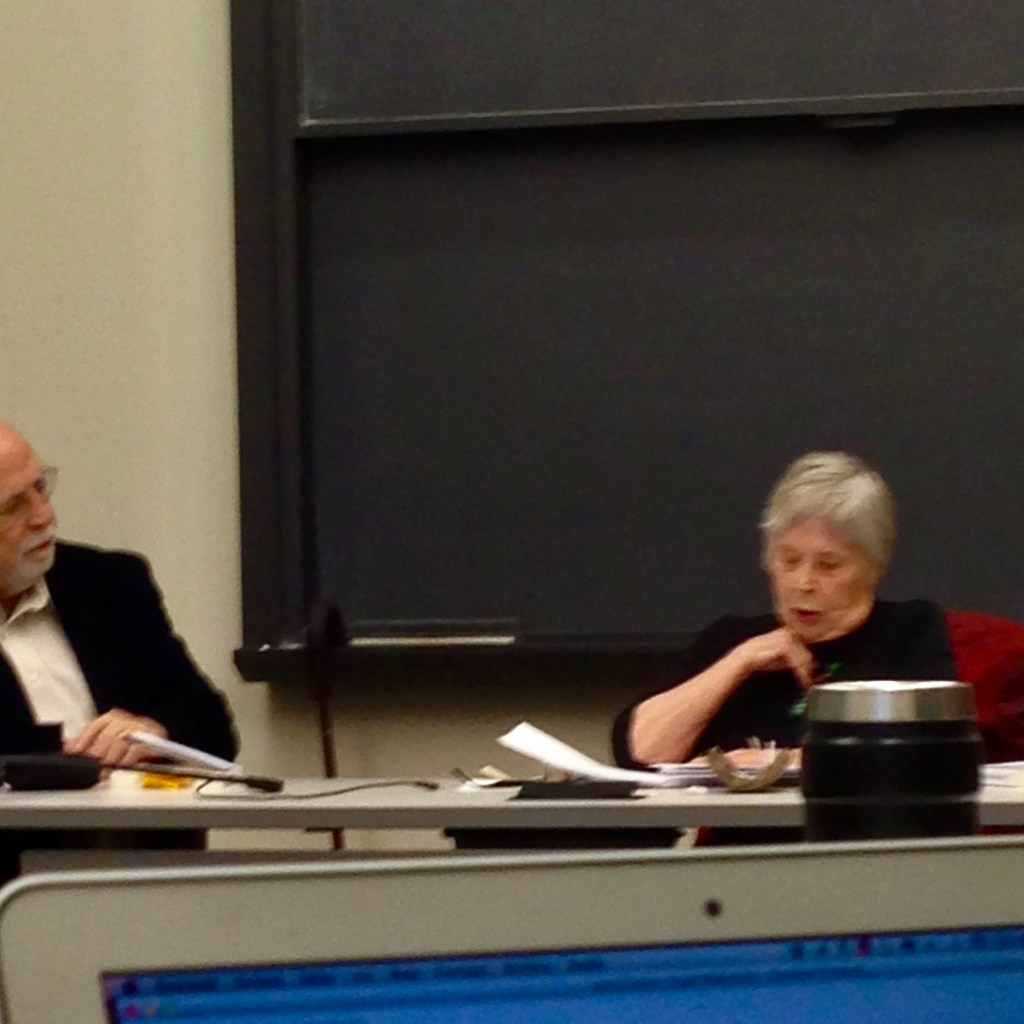
Jean Franco, pioneer of Latin American Cultural Studies and witness to its Cold War gigantomachy, passed away a couple of weeks in December at age 98. She remained lively and curious even at the very end of her scholarly life, and for some of us that saw her in action she embodied the memory of the century. The photograph above is of Jean’s visit to Arcadio Díaz Quiñones graduate seminar in the fall of 2015 where she discussed some of the main arguments of her last book Cruel Modernity (Duke U Press, 2014), a cartography showing the definite closure of the Latin American insomnia for political modernity in light of its most oblique mutations: narcoviolence, the emergence of a dualist state structure, and new global economic forces that putted an end to the vigil of the revolutionary enterprise. I write “definite” purposely, since Jean’s own The Decline and Fall of the Lettered City (Harvard U Press, 2002) already hinted at a certain exhaustion (to borrow the strategic term of Alberto Moreiras also writing during these years), most definitely a thorough disillusion, in the sense deployed by Claudio Magris, of cultural substitution for the belated state-making modernization. The function of “culture” (and its hegemonic state apparatus) was always insufficient, dragging behind, or simply put, unintentionally laboring for the cunning of a project forever postponed in the sweatshop of the newest ideologue, or for the hidden interests of the “local” marketplace of moral academicism. All of this has come crashing down rather quickly even if the demand for culturalist janitorial or housekeeping services are still in demand to sustain the illusion sans reve et sans merci.

What always impressed me about Franco’s scholarship was her intellectual honesty to record, even if through an adjacent detours and academic finesse, the destitution of all the main categories of the Latin American modern wardrobe: developmentalism, state-civil society relations, the intellectual, cultural hegemony, revolutionary violence, the “rights revolution”, and the intra-national spatiality (rural/metropolitan divide). From now on it is hard to say that there is a “task of the critic”, if we are to understand the critic in the Kantian aspiration of sponsoring modern values and perceptiveness to an enthusiastic disposition (definitely optimistic towards action) to transforming the present. As a witness to the twilight of the Latin American modern epoch, Franco univocally resisted the inflationary, value-driven, demand for politicity and ‘more politics’. This is why her attitude remained at the threshold of any given effective political panaceas or half-baked illusions.

Does her biographical experience say anything to this particular inclination? It is difficult to say, although as a witness of the century Jean had lived through the coup in Guatemala in 1954, visited the Cuban Revolution during its most “intense years” of the sugar cane milestone (La Zafra de los Diez Millones), and followed with attentiveness the rise and transformation of the Southern Cone dictatorships in the 1980s coupled with the irreversible social transformation of neoliberalism in the 1990s signaling the effective end to regional integration in the face of planetary unity. All of this to say that I find it hard – at least leaving aside the many nuances – to see in Jean’s scholarly witness an enthusiasm for the Latin American Pink Tide, the communal state, or abstract regional historicizing that could finally bring about the moral universe of the national-popular state (as if said moral realization would be anything worthwhile, which we some of us seriously doubt). If Jon Beasley-Murray once said that John Beverley was the “Latin American unconscious”, I guess it is fair to claim that Jean Franco was an authentic Latin americanist realist; that is, someone that was up to task to see in the face of the tragic, the cruel, and the heinous as the proper elements of the interregnum. Or to better qualify this: she was a worldly realist, leaving aside utopias and its abstractions. At the end end of the day, Leninists are also realists, or at least claim to be so. What places Jean’s earthly realism apart from the Leninist realism is the subtraction from the seduction of Idealization, which even in the name of the “idea” (“the idea of communism”, say) or “immanent higher causes” must bear and render effective the logic of sacrifice at whatever cost, even the real sense of freedom if demanded by the party, the leader, or the community. This is why at the closure of Latin American modernizing enterprise communitarian arrangements, posthistorical subjects / identities, or grand-spaces that mimic the constitution of Earth are foul dishes for a final banquet. It is always convenient to refuse them.


Going back to my conversations with Franco at Princeton, and some exchanges a few months later in a cafe near Columbia University, for her there was remaining only the anomic geography of Santa Teresa in Bolaño’s 2666, a novel that charts the current ongoing planetary civil war in the wake of the crisis of modern principles of political authority. I can recall one remark from Jean during these exchanges: “¿Y quién pudiera mirar hacia otra parte?” This is the general contour of her witnessing: how not to look somewhere else? In other words, how not to look here and now, into the abyss that is no longer regional or national, Latin American or cultural specific, but rather proper to our own civilization? A civilization is, after all, nothing but the organization of a civis, which has now abdicated to both the metropolitan dominium, as well as the campo santo of sacrificed life at the hand of techno-administrative operators (the new praetorian guard) of a well lighted and fully integrated Earth.

There is no alternative modernity, decolonial state, or hegemonic culture that will not serve to the compensatory and sadistic interests of the cruel policing of death and value, as the only masters in town. We are in Santa Teresa as a species of energy extraction. Can reflection be courageous enough to look through and against them? This is the lasting and eternal question that Franco left for those who are willing to see. It does not take much, although it amounts to everything: mirar / to gaze – in an opening where human form is lacking and categories are wretched – is the the most contemplative of all human actions. Whatever we make of it, this practice now becomes the daring task of the coming scholar.