Charity and faith. by Gerardo Muñoz

In a letter dated from January of 1962 to his friend Carlos M. Luis, José Lezama Lima makes a case for the intimate relation between language and charity: “What lasts [la cantidad] is only possible through faith. Because what lasts with faith is charity. Omnis credit – believe all things. Charity is belief in anticipation. And what is poetry (the image), but this superabundance of charity that always presupposes creation? [1]. The question in the last sentence – a question that could have only come from a great poet – is not all naive, since it is also a slight displacement from the canonical source underlying the notion of charity. In fact, the expression caritas omnia credit comes from Saint Augustine’s Confessions (Book X, Section 3), where the Church Father treats the reception of his testimony to the rational knowledge of the “hearing of men” who will be attending to his words [2].

This means that for parole to be heard and enunciated in its original presence, there has to be a gathering in charity that makes not just ‘true’, but most importantly, a garment of faith in the occurrence of language. This means that for Lezama Lima, there was no distinction between “theological language” and “language as such”, or “poetic register”, since they are all participants in the mystery of charity, because only charity can welcome language as abode. Poetics as such is understood as facticity of parole. But for Lezama, the word depends on having grasped the motion of charity. 

Lezama’s test for Carlos M. Luis was quite high: if you lose your faith, you would have given up on language as creation. This was not a new problem for the poet who already in his essay “La dignidad de la poesía”, mentions caritas omnia credit, as a process of destruction of representational (merely transactional and duty driven language) communication that arrives at the order of charity through language as intangible and inexistent by virtue of transcending what does not exists, thus manifesting itself as possible [3]. This is the moment in which the charity of language appears as both presence and promise, and what Lezama calls “el resurgimiento del verbo” (the reemergence of the word). Poetics is thus neither the subject matter of poets, nor the master dogma of theologians; rather it is the faith in language that once enunciated it can only move towards a greater opacity of the shadow of mystery. This is why a great Christian theologian says that charity (agape) is partial knowledge of the divine, otherwise there will be only a detestable army of mere academics, scribes, and administrative experts  [4]. 

In other words, charity does not belong exclusively to the Saints, but it runs through All Souls and its dead. The long history of the Church has betrayed the parole of charity, going as far as transforming it into a social mechanism of distributed goods that has become known as the subsidiarity principle. But for Lezama Lima, in an esoteric pauline tone, charity had nothing to do with political absorption and pastoral power; it was fundamentally a problem of language as a relation of reciprocity between beings in order to subsist as species, to paraphrase a well versed French priest on the matter [5].

In our days we see that “believing in language” has become in the public the inverse: non-belief through credit; that is only after possessing it (I do not need to believe in you insofar your credit validates who you are). It has been noted that by a kind of philological accident in the history of secularization, the word charity in English came to be understood one handedly as almsgiving and subsidiarity over the original divine love, which is love supreme in language. A language that does not unify, but that creates ethical relations; in fact, this might be the only uninstructed means of allowing them to fruition. 

Notes 

1. José Lezama Lima. Cartas a Eloísa y otra correspondencia (Verbum, 2013), 324.

2. Saint Augustine. Confessions (Penguin Books, 1961), 208.

3. José Lezama Lima. “La dignidad de la poesía”, in Obras Completas, Tomo II (Aguilar Editor, 1977), 774.

4. Claude Tresmontant. Saint Paul and the mystery of Christ (Harper & Brothers, 1957), 157.

5.G. Desbuquois, S.J. Charity (Fides Publishers, 1965), 33.

Marruz’s Mount of Transfiguration. by Gerardo Muñoz

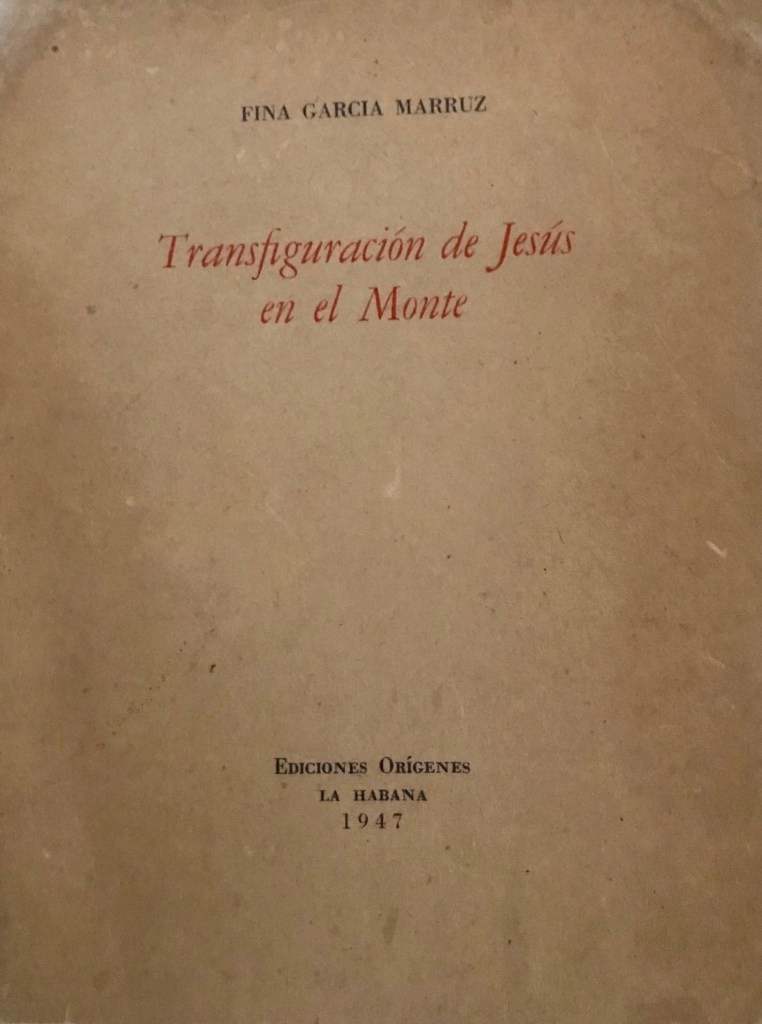
In 1947, the very young Cuban poet Fina García Marruz published the liturgical poem Transfiguración de Jesús en el Monte (Ediciones Orígenes, 1947), which stands in the modernist tradition series of attempts to probe the divine nature of language after the flight of gods and the triumph of the new secular jargons. If earlier in the century a well known Italian philosopher will predict that the international language of the future will be that of technical terms; the English Catholic poet David Jones, will reaffirm that we are “living in a world where the symbolic life (the life of the true cultures, of institutional religion and of all artists) is progressive eliminated – the technician is master. In a manner of speaking the priest and the artists are already in the catacombs, but separate catacombs – for the technician divides to rule” [1]. And if “liturgy” originally meant “public service” and the sphere of gestures, as suggested by Lubienska de Lenval, then Transfiguración has to be read, even into our days, as an attempt for language to measure to the transfiguration of revelation, in which the poem is a sacramental form that retracts language to possibilities of retaining communication.

In fact, Transfiguración de Jesús en el Monte, reinforcing the liturgical repetitions of an hymn and a sacred chant, enacts a flowing rhythm (“en tanto que”) that assesses the limits of the ineffable; a pure exteriority that is the negative or wound of language without ever being able to transcend it. In this sense, Marruz’s poem is only the poetic anabasis to the impossibility of a guided sacrament to organize interiority and visibility. Only the mystical can mediate between exteriority and the crisis of appearance. In an almost programmatic fashion, we read in the second part of the poem: “oh, difícilmente podríamos comprenderlo / Él se ha vuelto totalmente exterior como la luz; / Él ha rehusado la intimidad y se ha echado totalmente fuera de sí mismo” [2]. Transfiguration is the event that exiles oneself from the self (phygé), and in which language can generate contact with something other than its own conventions. This is why they [the witnesses and the martyrs] cannot provide an account about the transfigured revelation – just like anyone cannot truly provide a narrative, except by betraying the experience – except by their hearts as if being mysteriously called by a singular name (“ellos sienten que dentro de su corazón alguien / los ha llamado misteriosamente por su nombre”). 

How can language disclose a sense of exteriority that is capable of moving past the autonomy of signification and self-referentiality of language? Can language befall into exteriority? Marruz provides an answer to this question, which can be taken as her contribution to the aporias of modern poetics: poetry can only attune to transfiguration as a cohabitual of a communicating being. In the year that the poem was published, Marruz also wrote in the winter issue of 1947 Orígenes a dense essay titled “Lo Exterior en la Poesía” (“The exterior in poetry) where she claims that “the heart of poem is always outside of it – it should not be that the poet can offer infinite variations of a secret self-possessed knowledge, but rather to rediscover the liturgy of the real; the extreme degree of visibility, which is also its great escape” [3]. What could the “liturgia de lo real” have meant for Marruz in 1947? Marruz does provide a clearcut theological definition of the exteriority as the “angelic”, which does corroborate the hymnological dimension of language, a transcendence between beings of the invisible. The liturgy of the real that defines the exteriority of the poetics of life does not entail a Romantic elevation by the Poet, but the effort to animate reality beyond an alienated monologue. This is why Marruz writes that “only a dialogue can realize an impossible communication, mystical, whenever it does take place in all of its purity” [4].

In 1947 Marruz went a step further than her fellow poets Gaztelu & Lezama Lima, who had defined transfiguration as a learning exercise of the potentia dei of the divine (“a todo transfigurarse sigue una suspension y el ejercicio del Monte era solo un aprendizaje”) [5]. Read side by side with Antelme’s Angel of Reims, one could very well say that for Marruz there is an event of transfiguration whenever transcendence delivers communication between beings, soul to soul; a relation that can one truly speak of the ungrounded and commencement. The liturgy clamored in language is not the memory of an original Adam severed from Nature, but the transfiguration of a linguistic relationship with the world. This might be the secret to Marruz last two verses: “como la infancia que acuña nuestro Rostro allí / donde no puede ser despertado”. If transfiguration also entails recapitulation, this means that this is not a process of forward becoming, but of retaining the atemporal detention that, like that of childhood, traces our silhouette as both figural and pure presence in the bushes of language. 

Notes 

1. David Jones. “Religion and the Muses” (1941), in Epoch and Artist (Faber&Faber, 1959), 134.

2. Fina García Marruz. Transfiguración de Jesús en el Monte (Orígenes, 1947), 6.

3. Fina García Marruz. “Lo Exterior en la Poesía”, 19. 

3. Fina García Marruz. “Lo Exterior en la Poesía”, 22

4. Ángel Gaztelu & José Lezama Lima. Editorial: “Éxtasis de la Sustancia Destruida”, Nadie Parecía, Número IX, Nov, 1943, 1.

The Etruscan bona lux in Paradiso. by Gerardo Muñoz

In Chapter Ten of Paradiso, José Lezama Lima’s magnus opus, we encounter a curious dialogue between Cemí and Fronesis colored by a fortuitous reference to the Etruscan world, which speaks to the poet’s profane, and at times monstrous form of Catholicism. As it is known, even for an ecclesiastical authority like Tertulian, all Etruscan mythological and iconographical inventions had to be incorporated into the Roman civilizational state in order to wipe out the barbaric fraudsters and con artists soothsayers and liver readers out of date from the new revelation [1]. I have recently written on Lezama’s transfigurative Etruscan theology into his conception of the poetic image, therefore here I will only note how this particular transfiguration is enacted in the very existential outlook of the characters in novel. It seems to me that confirms that for Lezama the Etruscan sensibility was not to be understood solely as a resource of his complex poetics, but rather as an ethical form pertaining to the demonic in life. It is no surprise, then, that this happens in the reiteration of the encounter – the whole of Paradiso as the memorable final lines emphatically show is about recommencement of the unfolding of life – between the two friends: 

Bona lux, como saludaban los etruscos – le dijo Cemí… Ex templo, en seguida entre los romanos. Todo lo que no es en seguida es demoníaco, dice Kierkegaard. La vaciedad de la mañana se había trocado de pronto en la alegría del encuentro. – Vamos en seguida al cafecito de enfrente para hablar un poco – a Fronesis le pareció que la palabra cafecito, dicha por Cemí, bailaba en la mañana” [2]. 

I have not been able to find or corroborate that Etruscans, whose language is still a linguistic mystery, in fact greeted each other with something slightly similar to ‘bona lux’ as Lezama makes Cemí say. And it is still strange to think of Etruscans in relation to light and the morning phase of the day. What could it mean in this context where a minimal theory of the encounter is sketched (‘the encounter had brought happiness to the emptiness of the morning’) that Lezama explicitly identified the alleged mysterious Etruscans with a “good” light or illumination that is self-transformative? Lezama could have known the work of pioneer English archeologist George Denis, whose Cities and Cemeteries of Etruria (1848) reminds us how even in the tomb underworld of the Etruscans, there were always banquets decorated by lamp lights, erecting a threshold between the noche oscura of the infraworld of the dead, and the colorful landscape of the living image merging without reminder thanks to the bona lux of the encounter [3]. Is this it, then, a folded communion between the interiority of the dead and the exteriority world of the living? Obviously, nothing could more alien from Lezama’s intricate poetic world than a direct metaphoric restitution of the Etruscan world fixed in the autonomy of modern poetry, which will amount to a desperate attempt to deify language through a ‘spiritual drama’ as the conquering of self-absorptive verbal immediacy (it is in fact “en seguida” of the presentist time of response). 

As Lezama had written in the gloss “Conocimiento de salvación” (1939): “Todos los grandes intentos poéticos contemporáneos, desde la poesía pura hasta el surrealismo, no son otra cosa que un esfuerzo desesperado por prolongar la percepción de temporalidad rapidísima, o trocar el estado sensible – ocupado según Schiller en mantener al hombre en los límites del tiempo – en ajustada percepción” [4]. But what is suspended here is the possibility that living poetically and sensibly – the dwelling of a serene life encountering in company of others, that is, in concordia – validates the attunement of life with its demon. And this was at the heart of Lezama’s perception of the Etruscan everlasting mystery: not simply what remains foreclosed in the arcanii of the infraworld, but the liberation of human potentiality through the grasping of its prophetic images: “Los etruscos ofrecían una palabra misteriosa, el potens, si es posible, a esto se añade el hoc age, házlo, es decir si es posible hazlo. El potens por la imagen hace posible la sobrenaturaleza” [5]. The potens stands in as the name for the incommensurable distance of living among things (theín). Hence, the only common good resides between things, and not in a substantive higher source.

In a thorough rejection of the supreme moral order proper to rationalist natural law, Lezama will take the enlightened pictorial sense of the Etruscans as the realm of possibilities that can organize life in the  presence of what it has discovered: “un splendor formae…las imágenes como interposiciones de la distancia entre las cosas…ya no su enemistad, sino una llaneza de inmediato” [6]. The enlightened form produced by the encounter realizes a state of happiness that, thanks to the free use of language – the spoken word as the greeting voice in this case – it enacts a dance beyond sense becomes moving. This is why it is through the unknowable charitas of language that human beings become equals to the momentary gods of things in the world. Or at least puts them in proximity. One can believe that is the occasion for the gleaming abundance of  bona lux – the mystery where something finally begins. 

Notes 

1. Lucy Shipley. The Etruscans (Reaktion Books, 2023), 163.

2. José Lezama Lima. Paradiso (Ediciones Cátedra, 1980), 478.

3. George Denis. The Cities and Cemeteries of Etruria (John Murray Street, 1848), 37.

4. José Lezama Lima. “Conocimiento de salvación”, in Analectra del reloj (Origenes, 1953), 251-252.

5. José Lezama Lima. “Apuntes para una conferencia sobre Paradiso”, en Paradiso (ALLCA XX, 1996), 712.

6. José Lezama Lima. “Las imágenes posibles”, in Analectra del reloj (Origenes, 1953), 179.

Lezama Lima and the Etruscan way. by Gerardo Muñoz

Towards the end of his life, poet José Lezama Lima will mysteriously begin to sign the letters to his friends and family as “the Trocadero Etruscan”, a “member of the Etruscan religiosity”, and even the “man who lives in the Etruscan village” [1]. Why call himself an “Etruscan” in this particular moment of his life, and what could it possibly mean? The question about the meaning of the Etruscan authorial mask has been so thoroughly ignored by the literary critics that commentators at their best have noted that “being Etruscan” merely stands for his “cosmopolitanism” and “well-learned Europeanism”. Of course, this explains little to nothing. A sophisticated poet such as Lezama Lima, who ruminate over every single word he would write, could not have ignored that the Etruscans, unlike the civilized Romans and the Latin authorities, was a remnant to the very civilizational enterprise; a prehistoric people poor in written culture, achieved expressivity by the whole outlook of their form of life. And as in the case of Hölderlin’s adoption of different nom de plume (Scardanelli, Killalusimeno, Scaliger Rosa, etc), Lezama’s becoming Etruscan points to something so fundamental that if underscored we would fail to grasp the endgame of his vital poetic experience. The transfiguration of the name does not merely stand as a metaphor; rather it points to a distant figure that will finally dissolve him so that his immortal voice could continue to live on.

Indeed, the self-identification as an Etruscan for Lezama became a subterfuge to flee a political reality – his political reality, entirely structured by the revolutionary gigantic productivism and subjectivism – through a poetic refraction that would free an ethos from the overpowering of alienated autonomous space of the linguistic reproduction of social life. If at first glance it seems like a paradox that Lezama will adopt the Etruscan figure for his antisocial ethos – a civilization lacking written records or high literary achievements, a religious community known for its necropolis – this strangeness will ultimately prove that behind the Etruscan name there was no poetic exclusivity of the poet’s genius, but rather, as he claims in “A partir de la poesía”, the possibility for a divinization of reality to retreat from the historical epoch. In fact, Etruscan culture for Lezama was not a mere archeological ornament, but one of the “imaginary eras” of the West; that is, a stage of condensed and unnumbered imaginative possibilities resistant to griping subsumption and totalization of values. The Etruscan was the mythic remnant through the pantheistic divinization between language and the world. As Lezama writes glossing, in passing, Vico:

“Vico cree que las palabras sagradas, las sacerdotales, eran las que se transmitían entre los etruscos. Pero para nosotros el pueblo etrusco era esencialmente teocrático. Fue el más evidente caso de un pueblo surge en el misterio de las primeras inauguraciones del dios, el monarca, el sacerdote, y el pueblo unidos en forma indiferenciada … .les prestaba a cada una de sus experiencias o de sus gestos, la participación en un mundo sagrado. […] Pues en aquel pueblo, el nombre y la reminiscencia, animista de cada palabra, cobran un relieve de un solo perfil” [2]. 

The divinization of the Etruscans stubbornly insisted on the wonder of things. The human participation in divinity is no longer about founding a new theocracy or a “theocratic politics” in the hands of a ‘mystic accountant’ that would finally put the nation back in track (into the res publica), as Lezama would solicit out of desperation in the 1950s diaries [3]. On the contrary, for Etruscan people the fundamental tonality was the divine music of experience. Of course, we know that D.H. Lawrence captured this when claiming in his Etruscan Places (1932) that “the Etruscans are not a theory or a thesis. If they are anything, they are an experience. An experience that is always spoilt” [4]. And this experience (like every true experience) needs to be necessarily spoiled, which ultimately means that it cannot be mimetically rendered, arbitrarily modified, or subsumed into the order of idealization. But all of this is merely redundant, since the Etruscan inscription is what accounts for the limit to civilization, becoming the impossibility of the destruction of myth in the arrival of modern aesthetic autonomy. Thus, for Lezama the Etruscan way had something of a persistent cure against the ongoing civilizational disenchantment, even if it does not cease to appear in the modern attitude. In fact, Lezama writes that: “Rimbaud is the best reader of the Etruscan liver” (“hígrado etrusco”) to describe the dislocated position of the poet in the modern world of technology [5]. In the Etruscan cosmology, the liver was a symbolon of the vision of the cosmos registering the divisions of the spheres in the sky through the divine naming of the gods; it is the figure by which the poet guards the desecularizing remnant of the prehistoric inception of myth [6]. But this does not mean that Lezama will look at himself in the mirror of Rimbaud’s symbolist alchemy.

Rimbaud as an Etruscan is the poet who descends into hell because his lyricism can bear the pain in the disruption of language after the archaic peitho. Does the possibility mean a travel back in historical time? Not the least, as Lezama knew how to let go of storytelling and historical necessity. This is why Etruscans stand for an image or a sort of handwoven picture (the hand will make a comeback, as we will see) to gain vision. And this is one case on point: the Etruscan stands paradigmatically to the “sufficient enchantment” (“la cantidad hechizada”) , which discloses a higher knowledge of the soul (psychê) in the taking place of poetic errancy: “Sabemos que muchas veces el alma, al escaparse de su morada, tripulaba un caballo inquieto, afanoso de penetrar en las regiones solares” [7]. To wrestle against the historical reduction of autonomy of the modern age means to find this enchanted sufficiency necessarily for myth remnant to elevate itself against the aesthetic mediation that, in the words of Gianni Carchia, had become a consoling surrogate of the emptied historical time [8]. An entirely other conception of freedom is firmly implicated the Etruscan way: the gathering of the enchanted poetic dwelling to dissolve a reality that had become too thick in the business of brute force purporting to call ‘what’s out there’. The Etruscan reintroduces a divine nominalism of pure exteriority.

However, the Etruscan way does not commute with things of the world; rather, his soul unbinds the empirical limit of death to overcome death, and learn to live as if it were already dead. The trespassing of death through the poetic enchantment – which Lezama will also call an ‘potens etrusca’, or the Etruscan potentiality- will multiply the invisible possibilities against the rhetorical closure of reality legitimation. By accepting the thick of the dead as an illuminated presence, the Etruscans draw out the most important consequence: learning to live among the dead as the ultimate form of a dignified life. This is why D.H. Lawrence reminds us that the underworld of the Etruscans – their refusal of reality, the embrace of their dead, the augurium – was after all “a gay place…For the life on earth was so good, the life below could but be a continuation of it. This profound belief in life, acceptance of life, seems characteristic of the Etruscans. It is still vivid in the painted tombs. They are by no means downtrodden menials, let later Romans say what they will” [9].

If civilization is a construction that takes place at the crust of the Earth as some have claimed; the way of the Etruscan is a downward declination away from the architectural reduction of world sensing [10]. For Lezama the Etruscan dreams of a civilization submerged in the depths that only an acoustic totality that bear witness to its sensorial gradation: “Esas civilizaciones errantes por debajo del mar, sumergidas por el manteo de las arenas o por las extensivas exigencias…reaparecen, a veces, en los sueños de los campesinos” [11]. Hence, the fundamental dignity of poetry resides in the mythical homecoming that guards the possibility for what remains inexistent: “this is why the poet lives in the Etruscan world of the birth of fire” [12]. And although the Etruscan stands as one of the worlds in possession of an imaginary epoch (the other two for Lezama being the Catholic world and the feudal feudal Carolingian Empire), it is only in the Etruscan where the resurrection had taken the transubstantiation in the name itself; even if the price was its own liquidation as a historical people that refused to be incorporated into the doxa of postmythical order [13].  

The fiery force of the mythic peitho outlives and predates the political epoch of the nomos of fixation organized as “One People, One State, One Language” [14]. As Lezama explains in “La dignidad de la poesía”: “…el odio en la polis contra el daimon socrático, hizo que la nueva doxa no logra sustituir a cabalidad el período mítico….Si por lo mitos, los dioses se irritable con la felicidad de los de los mortales, pero al menos, se interesaban por sus destinos; en la nueva doxa, la poesis se extinguía – el daimon individual reemplazando al destino individual liberado de la polis” [15]. The primacy of myth as orientation to happiness should make clear that for Lezama the poetics of naming follows the overflow of its permanent modalization [16]. The Etruscan way marks the path for the irrevocable retreat from the space of the polis where civilization will be erected on the grounds of deliating ethos and daimon, polis and poesis, and ultimately life and death as a rubric of a new science of separation. The fact that the civilization of social reproduction has been erected on the basis of the destruction of the chthonic underworld speaks to the systematic erasure from the dead as a vital extension of life [17]. The poetic natality of the Etruscans will only be cultivated, as Aby Warburg suggests, from the assumption of deep superstition in the face of the placement of political autonomy, which allows for the persistence of the image as inseparable from the needs and uses of the living [18]. And only persistence could prepare the final triumph over death.

19
[19]

Towards the later phase of his work, the poet seems to never want to abandon the Etruscan inframundo. Lezama returns to the Etruscan scene towards the end and unfinished novel, Oppiano Licario (1977), in which the central character Fronesis describes at length the mutation of reality following the footsteps at a distance of Ynaca Licario slowly merging into the Tarquinia necropolis painted wall, which is accompanied by a visual reproduction of the Etruscan tomb:

“El sacerdote, en el lateral izquierdo, hace gestos de ensalmo en torno a una espiga de triga. Un pájaro que se acerca queda detenido sin poder posarse en el ámbito hechizado de la hoja. En el lateral derecho, el sacerdote repite idéntico rito, pero ahora de la raíz colorida hace saltar la liebre que cavaba en las profundidades. El aire cubría como unas redes de secreta protección en torno de la mutabilidad de las hojas y de la inmovil jactancia de los troncos. Una indetenible pero resguardada evaporación alcanza aquella llanura con los muertos …La conversación subterránea era el símbolo del vencimiento de la muerte. [20]

The ongoing conversation (the shared word koina ta philōn) in a mysterious divine language had triumphed over death because it had overcome death and the sight of death. It is no longer the transposition of a historical sublime that must protect experience from the fixity of the human corpse, since the soul can escape the limit of form. In passing through and embracing death, the Etruscan validated their passions for mirrors and the palm, which according to Lezama is the true keep of the appearance of the uttermost revealing of the face in its own irreducible ethos. The possibility (potens etrusca) of defeating death while in life finds in the Etruscan appearance Lezama’s most intimate poetic arcana: the persistence of the anima renounces symbolic legibility as too innocuous and ornamental; where the flags of victories now resembled an accumulation of well settled defeats nurtured in the name of the muteness over “life”.

The Etruscan distance mysterium validated myth as the affirmation of the cosmos as based on the potentiality of contemplative imagination [21]. Lezama will call this distance the “eros de la lejanía” (Eros of distance) in the experience of the inframundo that will break through by affirming the possibilities of divine naming as a correlative causation in the world [22]. As Lezama tells his sister in a letter from 1966, he had already assumed to have crossed the bridge between the dead and the living: “Para mi ya ha sucedido todo lo que podía tocarme….Pues creo ya haber alcanzado en mi vida esa unidad entre los vivientes y los que esperan la voz de la resurrección que es la supresa contemplación” [23]. Or yet again: “El que está muerto en la muerte, vive, pero el que está muerto en la vida, es la única forma para mi conocida de la vida en su turbión, en su escala musical, en su fuego cortado” [24]. To scale up life to the higher music is the final trope of happiness as already dead. The Etruscan dirita vía of descension – “a weight going down” of stepping into the Earth, as Ruskin would have it – achieves the arrest of the divine contact between the voice and the dead [25]. It is for us to raise this mirror before our impoverished and fictive unswerving reality.

.

.  

Notes 

1. José Lezama Lima. Cartas a Eloísa y otra correspondencia (1939-1976) (Verbum, 1998), 230.

2.  José Lezama Lima. “A partir de la poesía”, in Obras Completas, Tomo II (Aguilar, 1977), 831.

3.  José Lezama Lima. Diario (Verbum, 2014), 87.

4. D. H. Lawrence. Etruscan Places (The Viking Press, 1957),  90.

5. José Lezama Lima. “La pintura y la poesía en Cuba”, in Obras Completas, Tomo II (Aguilar, 1977), 968 

6. Gustav Herbig. “Etruscan Religion”, in Encyclopedia of Religion and Ethics, Volume V (Dravidians-Fichte, 1912), 533.

7. José Lezama Lima. “Introducción a los vasos órficos”, Obras Completas, Tomo II (Aguilar, 1977), 861. 

8. Gianni Carchia. Orfismo e tragedia (Quodlibet, 2019), 81.

9. D.H. Lawrence. Etruscan Places (The Viking Press, 1957), 31.

10. Amadeo Bordiga. “Specie umana e crosta terrestre”, in Drammi gialli e sinistre della moderna decadenza sociale (Iskra, 1978). 

11. José Lezama Lima. “Estatuas y sueños”, in Obras Completas, Tomo II (Aguilar, 1977), 449.

12.  José Lezama Lima. “La dignidad de la poesía”, in Obras Completas, Tomo II (Aguilar, 1977), 774. 

13. Ibid., 776.

14. Erich Unger. Die staatslose Bildung eines jüdischen Volkes (Verlag David, 1922).

15.  José Lezama Lima. “La dignidad de la poesía”, in Obras Completas, Tomo II (Aguilar, 1977), 777.

16. Monica Ferrando. “Presentazione”, in Hermann Usener, Triade: saggio di numerologia mitologica (Guida Editori, 1993).

1176.  Giorgio Agamben. “Gaia e Ctonia”, Quodlibet, 2020 https://www.quodlibet.it/giorgio-agamben-gaia-e-ctonia 

18. Aby Warburg. The Renewal of Pagan Antiquity (Getty, 1999), 189.

19. Image included in Chapter VII of Oppiano Licario (Cátedra, 1989), 375. 

20. José Lezama Lima. Oppiano Licario (Cátadra, 1989), 374.

21. Aby Warburg’s treatment of the symbolic mediation between myth and distance appears at the center of his essay on Pueblo Indians. See, Aby Warburg, El ritual de la serpiente (Sexto Piso, 2022), 66.  And also, Franz Boll, Vita Contemplativa (Heidelberg, 1920), who connects contemplari to the augur’s spatiality of the templum.

22. José Lezama Lima. Cartas a Eloísa y otra correspondencia (1939-1976) (Verbum, 1998), 411.

23. Ibid., 109.

24. Ibid., 266. 

25. John Ruskin. The Letters of John Ruskin (George Allen, 1909), 133.

Sundays outside history: some observations on Eliseo Diego’s La Calzada de Jesús del Monte (1949). by Gerardo Muñoz

The origin of Eliseo Diego’s mythical poetic collection En la Calzada de Jesús del Monte (1949) is so well known and recorded that it has been completely forgotten even by its most copious commentators. In his short memoralist essay “Un día ceremonial”, written decades after the publication of the poem, José Lezama Lima wrote the following: “En uno de sus ceremoniales litúrgicos, en un día de nuestro santo, nos reunimos en la iglesia de Bauta. En esa ocasión Eliseo Diego leyó su “Primer discurso” de En la Calzada de Jesús del Monte. Era un precioso y sorprendente regalo, suficientemente para llenar la tarde con aquella palabra que nace para uno de los más opulentamente sobrios destinos poéticos que hemos tenido…Cuando se publicó En la calzada de Jesús del Monte, el júbilo que me produjo fue esencialmente poético. En unos versos de circunstancia amistosa he intentado decir la alegría que me produce ese libro que traía esclarecimientos para nuestro paisaje y su acercamiento” [1]. At the center in this confession is not only the centrality of a poetic liturgical practice that vested the friendship of the origenistas poets, but more fundamentally the efficacy of the poetic word that Lezama describes as a “júbilo poético” or poetic happiness. It is a strange remark (like almost everything written by Lezama), since En la calzada de Jesús del Monte has been largely read as the litany of a domestic space (a “gran casa de todos”) consumed by dread experienced at the turn of the mid-century failed and stagnated republic.

The intuition raised by Lezama, although not elaborated, still haunts us: in what sense is En la calzada de Jesus del Monte about poetic happiness and what could stand for? We can go astray if we claim that happiness is a particular substantive and representational content of the poetic word. Indeed, there is really no event of happiness in En la calzada de Jesus del Monte except for the taking place of the poetic word fully estranged and foreign from its own place of annunciation. This seems to confirm Diego’s poetic vortex who writes in the dedicación of the book: “A poem is nothing more than a few words told one afternoon to a group of friends” [2]. However, this only deepens the mystery, since whoever tries to find concrete friends in En la calzada de Jesús del Monte (1949) will find none. Solitude abounds and expands throughout spaces. Lezama attempted to elevate the secret of friendship from thought to the liturgical enactment in search for transcendent meaning. Indeed, the emphasis on the mystery of liturgy is emphatic and compressed in Lezama’s programmatic memory about the almost ecclesiastical origins of the poem. I would like to suggest another path for the mysterious and inapparent force of the poem, which is no longer situated at the liturgical aesthetic experience, but rather in the mystery of a felicitous life at the threshold of history. If anything is disclosed throughout the pages of En la calzada de Jesús del Monte this is, precisely, that things appear to dwell in their place, even if no one is around and no community could stand for its reverence. Indeed, the poetic event dwells in an existential solitude before a changing world now fallen into pure disenchantment.

The happiness that falls from the poem, then, is not merely about the execution of the word or the unity of form, but it consists of something previous, altogether different: a mysterious shadow of the enchanted myth. In En la calzada de Jesús del Monte (1949) we are exposed to a poetic language that gathers in a desecularized dimension that suspends what Gianni Carchia identified as the postmythical form of mystery that seems to anticipate the semblance of historical order [3]. But Diego’s En la calzada de Jesús del Monte transfigures mystery to the point of disclosing the limit where life and redemption from the material world take place; namely, in the Sunday of life. But, unlike for Carchia, this poetic transfiguration takes place within the grammar of Christian theology and not the Greek classical past. Here Diego’s poetic mysterium differs fundamentally from the liturgical mystery, which presupposes a “fundamental sacrifice” that allows the temporal sequence of the end of time as the motor for universal religious redemption [4]. By contrast, Diego’s idea of a poetic mystery (which is also the mystery of the poem, which he never ceased to reflect upon through his life) is spatially dispersed, redeeming eternal life from the visibility of worldly phenomena. As Diego writes in an essay defining his conception of the theological mystery: “Primero les haré una confesión…no veo por la sala ningún hábito de Santo Domingo. Uno no debe jugar con los Misterios Mayores, y ninguno es mayor que el Misterio de los Tres que son Uno. Pero, ¿acaso no hizo Él a las ballenas y a los colibríes? ¿Acaso él no sonríe con la infinitud de sus peces y sus insectos? No creo que me tome a mal esta broma que hago como un niño pequeño que pretende jugar con su padre” [5].

By separating the “mayor mystery” of the Trinity from the minor mysteries of imaginative creations of the world (fables, poetry, child’s play), Diego was able to displace the grandiose stage of the liturgical mystery emphasizing the role that humor plays in the affective realization of the kingdom. In other words, it is most definitely the case that the mystery and the poetic musicality compose the parabolic nature of a transfigured kingdom that accompanies the inner existence of each and every human being [6]. Furthermore, this is why the Calzada is a defined in “Primer Discurso” as a pantheistic kingdom: “mi reino, en esta isla pequeña rodeada de Dios por todas partes / en ti ciego mis descanso” [7]. The happiness of the poetic effect in En la calzada de Jesús del Monte is the consummation of an eternal life that, by withdrawing itself from the representation of historical time, can outlive both dread and death. However, in its call for “eternity”, it is language itself that becomes a mode within a series of uncountable events: “sigo pensando, aquí, mi amigo, sucediéndome. / Luego de la primera muerte, señores, las imágenes … .Porque soy reciente, de ayer mismo” [8]. The “sigo sucediéndome”, a modal attempt at transforming life through event diffuses life and death like “Abel y Cain reunidos en Adán, como la muerte” [9]. The transfiguration of liturgical mystery does not evoke a christological arcana, but the overcoming of the civilizational myth of fratricide only to find “unity” in the eternal paradise evoked through Adam. As Diego will also write in an essay about the work of British novelist Jean Rhys: “…el sentido de orar para convertirse en símbolo del misterio de vivir: nuestro jardín era grande y hermoso como aquel jardín de la Biblia – el árbol de la vida crecía allí, nos dice, en medio del terror de una violencia que no entiende” [10]. The reemergence of the myth of an enchanted Edenic garden through the poem?

The fact that Diego chose to write En la calzada de Jesús del Monte as a series of poems and not a novel speaks to his resistance to metaphorize the Garden of Eden outside of the world, overly compensated through a figural postmythical semblance that could have only been taken as a form of parody. On the contrary, En la calzada de Jesús del Monte evokes the original paradise as a recurring and parabolic Sunday of life. A life of nothingness: “si la nada / es también el dormir, pesadamente / la caída sin voz entre la sombra… el Paraíso / realizado en la tierra, como un nombre!” [11]. What cuts through between the forms of the world is the poetic parabola that put us in nearness to the limit of the mystery and the unspeakable. This is what poet Fina García Marruz beautifully captured in one of the most outstanding essays on En la calzada de Jesus del Monte where the weight of the question is meshed with the eros of the poem’s parabola: “Todo arte es, o debería ser, arte de amor, qué es arte de re respeto, la estrategia de una amorosa retirada. Donde el yo se manifiesta en exceso, invade los otros límites, incendia el mundo, pero el verdadero sol del centro, como en Heráclito, no rebasa sus medidas” [12].

García Marruz will even allude to a “magical distance” to elucidate Diego’s poetic measureless opening to proximity: “para el dulce tamaño de la vida que miden estas distancias” [13]. The distances modulate situated existence against the reduction of ordered historical time: “El sitio donde gustamos las costumbres / aquí no pasa nada, no es más que la vida” [14]. As an authentic habitante Diego’s parabola solves the problem of the eclipse of historical time (the ruins of the first morning of historical development) through a descension to spatial detachment where the rest of Sunday is achieved amidst the dust of the world (“como el polvo del mundo”). And from the vantage point of every concrete experience and every limit, life emerges from the dead before a ruinous world marked by the failed Republic. This was a Republic that could not be named (“Yo no sé decirlo: la República”) in a paradoxical display of expository nominalism. As Diego writes in “El sitio en el que tan bien se está”: “en la penumbra como deshabitado sueño” [15]. At the height of 1949, En la calzada de Jesús del Monte was the most rigorous attempt to retreat from this penumbra of historical political life and its daydreaming.

This is the open secret of the actual city street, La Calzada de Jesús del Monte (Havana), during the first decades of the twentieth century, which according to historian Emilio Roig de Lauschering was the only route of communication between the hinterland and the new urban community: “La Calzada de Jesús del Monte que después se llamó después Calzada de Jesús del Monte por haber construido una ermita en la pequeña eminencia donde se encuentra la iglesia parroquial de Jesús del Monte…[…] Pero la Calzada de Jesús del Monte fue desde remotos tiempos hasta no hace mucho la vía principal de entrada y salida entre la población y el campo” [16]. In the late 1940s, la Calzada de Jesús del Monte was already a ‘deshabitado sueño’ as symbolized by dust, debris, oblivion, and death announced by the abstract time of modernization. En la calzada de Jesús del Monte, however, does not cross the path nor seeks a communication between the limits, but rather it opts to dwells on it.

This might be, indeed, Diego’s most important and subtle difference with Lezama’s defense of a liturgical surplus (even ex ecclesia cult of friendship, Freundschaftsdichtung, as a surrogate for national salvation) as if he had found a refuge in the mysterious parish of the Calzada Jesus del Monte or Bauta [17]. Diego’s transfiguration of history placed him at Sabbath in possession of “poderosas versiones de su vida” (“strong modes of his own life”) [18]. But the Sabbath is not a mere memory of a defeated religious community, but as Hermann Cohen argued, a spatial and institutional habit of a people coinciding with the cycles of a bright moonlight [19]. This is why imagination in En la calzada de Jesus del Monte is not enough, and the poet laments: “de tanto imaginarla mi corazón iba callando”. The eternal life of Sundays finds a retreat in the sabbatical experience against the historical time of normality and its revolutionary cycles that demystifies the thingly destruction in which civilization had declined at the end of times. Diego’s La Calzada de Jesús del Monte enshrined the only access to the transfiguration of the mystery: a sabbatical rest disambiguated from the monotone idleness posed by postmythical romanticism [20]. It was in the threshold of parabolic dwelling where En la Calzada de Jesús del Monte remained faithful neither to religious idolatry nor to a free-standing mysterium, but only to the feast of a sabbatical life “como un asno, en perpetuo domingo” (like a donkey, in a perpetual sunday) [21]. The donkey is the transfiguration that must carry this weight. And withdrawing from Juan Vives’ known fable about the peasant who sacrificed a donkey when realizing that he was drinking the moon reflected on a bucket of water, En la calzada de Jesus del Monte stubbornly trumpets not the entry to a “poetic enlightenment”, but the dwelling into the eternal Sunday where poetry is not a resource of radiant sacrifice of beauty, but the prophecy for both silence and sound [22].

.

.

Notes 

1. José Lezama Lima. “Un día ceremonial”, in Imagen y Posibilidad (Editorial Letras Cubanas, 1992), 48-50.

2. Eliseo Diego.  En la Calzada de Jesús del Monte (Editorial Pre-Textos, 2020), 103.

3. Gianni Carchia. Dall’Apparenza al Mistero, in Immagine e verità: Studi sulla tradizione classica, Edizioni di Storia e Letteratura, Roma, 2003.

4. Odo Casel. Misterio del culto en el cristianismo (Cuadernos Phase, 2006), 82.

5. Eliseo Diego. “Viaje al centro de la tierra”, in Flechas en vuelo: ensayos selectos (Editorial Verbum, 2014), 162.

6. Giorgio Agamben. “Parabola e Regno”, in Il fuoco e il racconto (nottetempo, 2014), 25-37.

7. Eliseo Diego, En la Calzada de Jesús del Monte (Editorial Pre-Textos, 2020). 

8. Ibid., 115.

9.  Ibid., 117.

10. Eliseo Diego. “Una Iglesia no muy británica: Jean Rhys y su ancho mar”, in Flechas en vuelo: ensayos selectos (Editorial Verbum, 2014), 124.

11.  E. Diego, 119.

12. Fina García Marruz. “Ese breve domingo de la forma”, in Hablar de la poesía (Editorial Letras Cubanas, 1986), 398.

13. E. Diego, 131.

14. Ibid., 177.

15. Ibid., 184. 

16. Emilio Roig de Leuchsenring. La Habana: Apuntes Históricos (Editora del Consejo Nacional de Cultura, 1963), 111.

17. Wolfdietrich Rasch. Freundschaftskult und Freundschaftsdichtung im Deutschen Schrifttum des 18. Jahrhunderts (Halle-Saale, 1936).

18. Ibid., 157.

19. Hermann Cohen. “The Sabbath in its Cultural-Historical Significance”, The Reform Advocate, February 10, 1917, 5-6.

20. José Lezama Lima claims in “Pascal y la poesía”: “En la tradición de Pitágoras, que creía que sólo el símbolo daba el signo y que la escritura, tesis incomprehensible para el contemporáneo romanticismo antisignario, nace de un misterio, no de la horticultura de la pereza”, in Algunos tratados en La Habana (Anagrama, 1971), 166.

21. E. Diego, 147.

22. The fable is told by Hans Blumenberg: “The Spanish humanist Juan Luis Vives recorded the fable of a peasant who killed a donkey because it swallowed the moon while drinking from a bucket, and because the world could sooner do without a donkey than without heaven’s lamp”, in “Glosses on Three Fables” (1984), History, Metaphors, Fables: A Hans Blumenberg Reader (Cornell University Press, 2020), 604.

Infrareligion in the abyss: on Jaime Rodriguez Matos’ Writing of the Formless: José Lezama Lima and the End of Time. By Gerardo Muñoz.

writing-of-the-formless_2017Jaime Rodriguez Matos’ Writing of the Formless: José Lezama Lima and the End of Time (Fordham U Press, 2016) is an ambitious and truly mesmerizing mediation on the Cuban poet José Lezama Lima in light of contemporary theoretical debates concerning the status of the political in the wake of Modernity’s decline into nihilism. Rodriguez Matos’ sophisticated intervention attempts to accomplish several objectives at once, and in this sense, the book does not pretend to be an exegetical or philological contribution to scholarly debates on the poet. Rather, in the book, Lezama is taken as a poet-thinker of the informe, whose main import into Western history of writing and thought is that of a ‘writing of the formless’ (Rodriguez Matos 171). In its totality, the whole book is a groundwork for such a claim, and it works through a series of tropologies, figures, and debates that extend from Lezama’s specific cultural Cuban context and its readers, to a set of wider debates pertinent to Left-Heideggerianism, political theology, or the event (although by no means, is the complex set of debates reducible to these three philosophical indexes).

If one were to describe the project in its most far-reaching ends, Writing of the Formless is important yet for another reason: by handling several topologies of Lezama Lima’s oeuvre, we are offered an in-depth analysis of the intricate conceptual wager in infrapolitics, or in infrapolitical-deconstruction, which as Rodriguez Matos suggests, is the provenance of Lezama Lima’s contribution as a critical task. The book is divided in two parts. In the first one, four chapters grid an explication of the problem of time, as well as that of the formless, revolution, and nihilism. In the second, Rodriguez Matos engages in an innovative reading of different zones in Lezama Lima that evidence the destruction of principial politics, and the opening towards an (infra)politics of the void. In this review, I can hardly do justice to a book that I truly consider a masterwork of contemporary thought. In my opinion, this monograph comes as close as it gets to being flawless in establishing conceptual premises and argumentative deployment. In what follows I will map some provocative elements of his exposition, in hope that it will be a starting point for a discussion with those critically engaging Latin America, the political, and the stakes of thought in our time.

The point of departure of Writing of the Formless is the temporal question (in Latin America, although it is not localized here as a site of privilege) of Modernity, which is registered as a Janus face machine: on one end, the linear time of Hegel’s philosophy of history; and on the other, the teleological time of the messianic redemption and reservoir to many salvific political theologies. Early in the book, Rodriguez Matos sets up to establish the conditions that guide the development of his task:

“But it now it seems that in fact modernity, and not any possible redemption or liberation from its political and economic deadlocks, is itself a mixed temporality that is constantly battling between a circular and a linear time – a linear time of alienation and a circulation teleological time of redemption. The two need to be taken together, even in the very (im)possibility of such a synthesis. And this would mean that modernity is no longer the other of the revolutionary interruption of empty chronological time; rather, these are two sides of a single coin” (Rodriguez Matos 33).

By way of this dual apparatus of time, it becomes clear that linear time represents the time of alienation, where the eternal return marks its radical detachment only to become the engine of the theological messianic interruption. The two temporalities that frame Modernity, according to Rodriguez Matos, are a policing force, as well as “a residual effect or the symptom of the emergence of order itself” (Rodriguez Matos 22). And it is this formal legislation that synthesizes a duality that veil, in a variety of effective techniques, the formless of any foundation. Throughout the book the formless has different dispositions, such as the “intemporal”, “time of the absence of time”, or Lezama’s own “muerte del tiempo”. These all play key strategic functions and deconstructive relays. It might be the case, at least implicitly, that Rodriguez Matos knows that the history of metaphysics to cover up the void is, at the same time, the narrative produced by its apparatuses. What is important, however, is that by allocating these two times, Rodriguez Matos is able to set up what was otherwise obstructed: mainly, the time of void, which falls right beneath all principial politics, always in retreat and outside legitimizing messianic and developmental policity of Western modernity that governs both the time of the One and that of the multiple. Lezama is the figure that mobilizes a drift away from these two modalities:

“…beyond the politization of politics, and beyond the image of time as synthetic operation, what remains is the possibility of thinking with the poet beyond the current apparatus of academic-imperial) knowledge and all of its returns” (Rodriguez 25).

One would not exaggerate much in concluding that Lezama Lima as a thinker of the informe becomes the necessary antidote and hospitable dispensary against the philological exercises of the traditional belleletrism, but also of decolonial and neocommunist designs that, although attempting at the surface to break-away with imperial semblances, end up carrying the guise of principial politics as the highest flagpole for self-legitimation.

The reading of the informe allows us to move beyond the temporal dichotomy between revolution and conservation, messianic originalism (such as that of catholic, later convert post-socialist official poet Cintio Vitier), and the multiplicity of historical time (such as that endorsed by Rafael Rojas, Cuba’s most sophisticated neo-republican intellectual historian). It must be noted, however, that many other intellectuals and thinkers are tested on this basis. The common ground shared by diverse thinkers such as Rafael Rojas, Ernesto Laclau, Cintio Vitier, Walter Benjamin, Bruno Bosteels, Alain Badiou, and those that subscribe to post-foundationalism becomes clear: mainly, the assumption that the crisis of nihilism of temporality can be amended by always providing an adjustment for the abyss. In this way, Rodriguez Matos offers a frontal critique of any claim instantiated in hegemonic phantasms: “Our task remains to think time in all its radical complexity – that is, to think time as something other than a solution” (Rodriguez Matos 44). Writing of the Formless stands up to this deliverance.

There are many important elements that come forth in this argumentation, one of them being that the covering of the formless, or the lack of foundation, is usually articulated through a master and masterable political theology. It is not just Rodriguez Matos who arrives at this conclusion, but also Bruno Bosteels by way of observing the inscription of Christianity in many of contemporary thinkers of the Left. In a passage cited by Rodriguez Matos from Marx and Freud in Latin America, we read: “All these thinkers [Badiou, Negri, Zizek], in fact, remain deeply entangled in the political theology of Christianity – unable to illustrate the militant subject except through the figure of the saint” (Rodriguez Matos 44). It is even more perplexing then, that Bosteels’ own solution to this problem ends up being just more political theology by way of Leon Rozitchner’s reading of Saint Augustine, and merely exchanging the category of the saint for that of the militant subject, even though this is already part of the history of alienation of Christianity [1]. But the reason for this might be, as Rodriguez Matos thematizes a few pages later, that any predicament for politization as supreme value today needs to ascertain some sort of militant subject of the event in order to guarantee a consensus on “contemporaneity”, and in this way avoids what the present is or what it actually stands for (Rodriguez Matos 109).

The chapters 2 (“Sovereignties, Poetic, and Otherwise) and three (“The Mixed Times of the Revolution”) attend to how the question of time was conceived within the Cuban Revolution. This framing, one must first note, already dislocates the grounds of the discussion centered on the sovereign or the caudillo, a fetish so dear to both revolutionary and liberal imaginations when confronting the ‘Latinamericanist object’. Hence, in chapter two, Rodriguez Matos advances a demolishing reading of the temporality of foquismo, although not on the grounds that one could have imagined. From a historiographical standpoint, it is common to agree on the fact that that both Guevara and Debray’s formulations have little substance in historical experience, since they are theoretical fictions that develop to master a non-repeatable event (the Cuban Revolution), which was far from being successful solely because of the foco guerrillero in the first place. But this is not Rodriguez Matos’ critique. The argument is set up to make the claim that the Revolution, in order to become flesh and conceive the unity and sameness with the people, theory must be first discarded (Rodriguez Matos 60). Rather mysteriously, in foquismo it is the people that ‘act’, while Guevara becomes its narratological supplement. This is the inversion of the Leninist principle that alleged that in order for a revolution to materialize it needs a good theory beforehand.

Guevara, in Rodriguez Matos, takes the role of the anti-Lenin. In fact, in a strange way, Che appears as a sort of naturalist-philosopher: “…what Guevara is after is the same time that was at issue in Marti: the idealism of the Revolution has to become a force of nature, sprouting in the wind without being cultivated…in all its originary ontological stability, phusis) and the people, without the transubstantiation of the idea into flesh yielding intimate unity, and without this force of nature forging revolutionary ideology…this passage would be nothing but the declaration of one individual from Argentina who has recently landed in a foreign land…” (Rodriguez Matos 60). Guevara is a hopeless romantic, who recaps the Romantic ideal of the fragmented temporality in the pedagogical poem, only that for him the impolitical people are in a “time out of joint”. This is why they must also become a New Man. The catastrophe of foquismo, is thus not merely at the level of a massive historical evidence, but an afterfact of a metaphysics that is already one step away from thinking the void, while formalizing it through a dialectical moment. Rodriguez Matos stages the central problem, just after having glossed Guevara’s revolutionary thought:

“For the metaphysics in question already relies heavily on the form in which it makes multiple small narratives. For the metaphysics in question already relieves heavily on the form in which it makes multiple temporalities appears together. That is, modernity is fundamentally and internally committed to the constant confrontation of disparate forms of time. Instead, I suggest taking a closer look at the time of lost time, the time of the void, and what might happen when it is not filled in but, rather, allowed to resonate in all its formlessness.” (Rodriguez Matos 61).

How should we understand this echo? The turn to Celan and Heidegger’s immersion in noise and the ontological difference validates immediately any vacillation in the answer, since what is at stake is ultimately to think not the “standstill of all time” of the messianic force, but our being in time understood as our most basic and intimate relation that we have with time (Rodriguez Matos 70). It is only this absent time of the formless that will be one of majesty, capable of undoing sovereign authority and its governability over the singular.

The third chapter moves against the belief that Lezama Lima can be grasped in interested disputes regarding his intellectual provenance, political ideology, or assumed Catholicism (origenismo). This is an arduous task, but Rodriguez Matos makes it look easy through a threefold operation. First, Lezama is moved beyond the antinomies of secularization and aesthetics, placed in the proper site of the religion of the formless (we will come back to this). Secondly, Rodriguez Matos confronts Lezama’s own interpretation of the Revolution as parusia or Second Coming, which coincides perfectly with Guevara’s own model of the “ways things are” that folds revolutionary Cuba into globalization due an ingrained total administrate apparatus over life (Rodriguez Matos 93).

This entails that revolutions, if we take the Cuban experience as metonymic of the phenomenon, are always already biopolitical experiences, even though Rodriguez Matos does not frame it in such terms. Third, by understanding the ‘mixed’ temporality of communism and revolutionary politics as convergent with the temporality of capitalism, we come to understand that the second is always on reserve in the backdrop of the state and its institutions (Rodriguez Matos 96-97). In sum, the superposition of revolutionary times with the time of capital is here shown, once again, to be two sides of the same dual narrative of modernity that turns away from the abyss at the heart of politics. This complicates many, if not all, of the assumptions that Cuban transitologists have disputed with very futile outcomes, in my opinion, in the last decade.

Finally, the fourth chapter “Nihilism: Politics as the Highest Value” rightly places the question of nihilism at the center. This is a return to the question of political theologies discussed above. Whereas many of the thinkers on both sides, republicanist and communist alike, take up the question of nihilism, the result, according to Rodriguez Matos, is that it is presented as a fight against those that think the problem of nihilism. Thus, the “banality of nihilism must be dismissed or critiqued” (Rodriguez Matos 104). The operation rests on the fact that the question of being must be avoided at all costs. And this is achieved in at least two main forms: discarding nihilism by proposing a “multiplicity of times” (Rojas), or by proposing a “living philology” (Vitier, Bosteels) that would be able to restitute a truth of a text of the past to give proper political ground (Rodriguez Matos 115). Now the tables are turned, and those that seek to cover the void, as if that were an option, appear as agents of a true nihilistic force.

The second part of the book titled “Writing the Formless,” provides a roaming through Lezama’s conceptualization of the void against politico-theological closure, arriving at the unthought sites of the ontological difference after Heidegger and deconstruction, and moving into infrapolitics. This is an exemplary section in the sense that Rodriguez Matos warns that he is in no position to offer a transhistorical formal theory of Lezama’s writing, and in this way he calmly avoids the universitarian-Master demand for a totalizing expertise of lezamianos. This operation is undertaken not for the sake of confrontation against Lezama specialists, but rather due to a more modest motive: it is not the point that drives Writing of the Formless. Anyone to counter argue on this level is rather to sidestep its most important contribution of this book. Finally, Rodriguez Matos lays out what is at stake, which is tailored as a question that by far exceeds Lezama Lima as a single corpus:

“Ultimately what is at issue whether there is a difference between those texts of the Western tradition that forget the question of being and those whose starting point is the challenge and the difficulty that the question poses, the challenge and the resistance involved in dealing with the ground that is and is not there in its absence. What is at stake is whether or not it is possible to imagine a writing and a thought that do not simply fall silent in order to guarantee the continuity of the narrative of legitimacy and sovereign authority in the poem or in politics – but the link between these two is also at issue here. That is, whether or not it is possible for posthegemonic infrapolitics to be something other than the trace of politics” (Rodriguez Matos 136).

What immediately follows is a series of closely knit constellations of the writing of the formless as absent time in Lezama, which I can only register here without much commentary: Lezama’s own critique of T.S. Eliot’s notion of the difficult, a critique of Garcia Marruz’s reading of the aposiopesis as rhetoric’s hegemonic property, Lezama’s understanding of Aristotelian metaphoricity; Lezama’s philosophy of an atopical One, and finally Rodriguez Matos’ own conceptual position of Lezama as an infrareligious and infrapolitical figure that pushes politico-theological legislation of principles to their very limit into a ‘nonsynthesizable reminder’ [sic] (Rodriguez Matos 154). Further, Lezama’s vitalist response to the Platonist pros hen, unlike the immanentist modern reversal, concludes in a Platonist affirmation instead of an overcoming of Platonism (Rodriguez Matos 139). Rodriguez Matos intelligently resolves this bizarre multiplicity vis-à-vis a parallel reading of Paul Claudel, who rejects aposteriori knowledge in exchange for the cognizant objectification of God before the sovereignty of the Poet. Although I am left thinking about the status of Neo-Platonism as it relates to the discussion of Christian Trinitarian thought [2].

But Rodriguez Matos goes further, and the Lezama that emerges from this destructive multi-level procedure is one that resists alleogrization, taking cue from Alberto Moreiras’ pioneering reading in Tercer Espacio (1999), as well as a privileged and secured position of a profane materialism over the question of form. And it is also in this very instance where Rodriguez Matos opens up to a complicated debate, which although unresolved, is the most striking and illuminating kernel of his book. In short: does ‘the roaming of the formless’ [sic] in Lezama offer something other than a trace of politics? I want to suggest, from my first reading of what is certainly a complex conversation, that this remains unresolved in Writing of the Formless. Let’s consider a key moment at the end of the book:

“For part of what I am calling attention to is the fact the staging of the formless in Lezama involves a thematization and an awareness of what should only be there as trace. This awareness goes beyond a more familiar claim regarding the self-deconstruction of discourses of their own accord – this is, after all, also what the trace is supposed to underscore. I would like to read this excess of awareness as a radicalization of deconstruction” (Rodriguez Matos 176).

This radicalization will entail leaving behind the moment of ecriture, which characterized the first wave of deconstruction in literary fixation and textual playfulness. Infrapolitics will be, programmatically speaking, post-deconstruction, or what Moreiras has recently called a second turn towards instituted deconstruction [3]. But the question remains: is infrapolitics then, a trace of politics? It is an unresolved question, but perhaps the most important one. Rodriguez Matos leaves us a clue at the very end of the book. When discussing the baroque – and let’s not lose sight of the fact of how late the question arrives, which is a merit and not a pitfall – Rodriguez Matos cites a letter of Lezama to Carlos Meneses: “I think that by now the baroque has begun to give off a stench” (Rodriguez Matos 181). The Baroque has come become an exchangeable token for the Boom, the last stage of identitarian transaction. But it is more than this: the baroque can no longer account for the informe at the heart of the image and rhythm.

Let’s probe this further. If the baroque is now exhausted, it is because all politics of the frame are insufficient to cope with the formless. The primacy of the critique of political economy today, for example, remains just one of its last formal avatars. But one could also respond to Rodriguez Matos’ final invitation, and say that while the aesthetic program of the baroque is demolished or turned into ashes, perhaps a trace of it remains in posthegemonic politics. To the extent that we understand the baroque as a political of self-affirmation against Imperium beyond hegemony, the baroque necessarily entails a republicanist politics [4].

In other words, while the infrareligious trace depends on the abyss, posthegemonic politics of republicanism sprouts from the baroque in early modernity against any imperial and counter-imperial conversions. Rodriguez Matos interchangeably speaks of infrapolitics and posthegemony throughout the book, therefore this nuance could be taken as a radicalization of the second term in line with the disclosure regarding the baroque. Post-deconstructive infrapolitics remains open. But if Lezama’s legacy is waged on having confronted the formless abyss of the absent time; perhaps, the author of Dador can also reemerge as a political thinker and existential representative not of Paradise, but of the secret Republic. This will entail a republicanism that, in each and every single time, does not longer participate in the eternal arcanum.


.

.

Notes

  1. This does not mean that St. Augustine cannot be read against the myth of political theology. Such is the task that José Luis Villacañas has accomplished in his Teología Political Imperial: una genealogía de la division de poderes (Trotta, 2016). In my view, Rozitchner’s La Cosa y la Cruz (1997) is a flagrant misreading of Augustinian anti-political-theology in exchange for a superficial materialist affective analysis. Although I do not have space to discuss this at length, I must note that Rodriguez Matos’ discussion of contemporary materialisms is also a timely warning about the easy exists that the so-called “materialisms” offer today as an effective transaction in contemporary thought. For his discussion of materialism see, pgs. 104-108.
  1. The question of Neo-Platonism is a fascinating story by itself, which speaks about the multiple in the One. Pierre Hadot studied its influenced in debates of early Trinitarian thought in his work of Marius Victorinus; recherches sur sa vie et ses œuvres (Paris: Etudes augustiniennes, 1971). Now, it seems that Lezama Lima himself was not foreign to Plotinus and Neoplatonism, which he linked it to the emergence of the modern poem. In fact, while reading Writing of the Formless, I revisited my copy of Lezama Lima’s unpublished notes in La Posibilidad Infinita: Archivo de José Lezama Lima, ed. Iván González Cruz (Verbum Editorial 2000). It was interesting to find that in “Oscura vencida”, a fragment from 1958, Lezama writes: “Si unimos a Guido Cavalcanti, March, Maurice Sceve, John Donne, en lo que puede ser motejados de oscuros, con distintos grados de densidad, precisamos que sus lectores, puede ser los más distinguidos cortesanos, o estudiantes que versifican cuando la hija del tabernero inaugura unos zarbillos…Con una apresurada lectura de la Metafísica de Aristóteles, sobre todo su genial concepto del tiempo que pasa a Hegel (sic) y a Heidegger; con cuatro diálogos platónicos, donde desde luego no faltara el Parménides. Con algunas añadiduras de Plotino sobre la sustancia y el uno…ya está el afanoso de la voluptuosos métrica en placentera potencialidad para saborear una canción medieval, un soneto del renacimiento florentino, o una ingenua aglomeración escolástica que se quiere sensibilizar, o una súmala de saber infantil, regida por un pulso que no se abandonó a la plácida oficiosa…” (252). This does not necessarily dodge Rodriguez Matos’ discussion of Claudel, but complicates it, since the trinity also merges at different points throughout the book. My question is whether any discussion of Trinitarian co-substantialism is still embedded in metaphysical structuration as potentia absoluta, or if Lezama’s informe is a Parthian attack against this influential model of absolute potentiality by turning it into a monstrous infrareligion. At stake here is also the issue of ‘reversibility’ that is obliquely exposed at the end of the book (Rodriguez Matos 189).
  1. See Alberto Moreiras, “Comentario a Glas, de Jacques Derrida”. https://infrapolitica.wordpress.com/2017/01/13/comentario-a-glas-de-jacques-derrida-notas-para-la-presentacion-de-la-nueva-traduccion-espanola-clamor-publicada-en-madrid-la-oficina-2016-y-hecha-por-muchos-autores-con-copyright-de-cristina/
  1. The question of the republicanist politics, Imperium, and the baroque is studied in detailed in Ángel Octavio Álvarez Solis’ La República de la Melancolía: Politica y Subjetividad en el Barroco (La Cebra, 2015).