Casa Bayona’s pensive slave. by Gerardo Muñoz

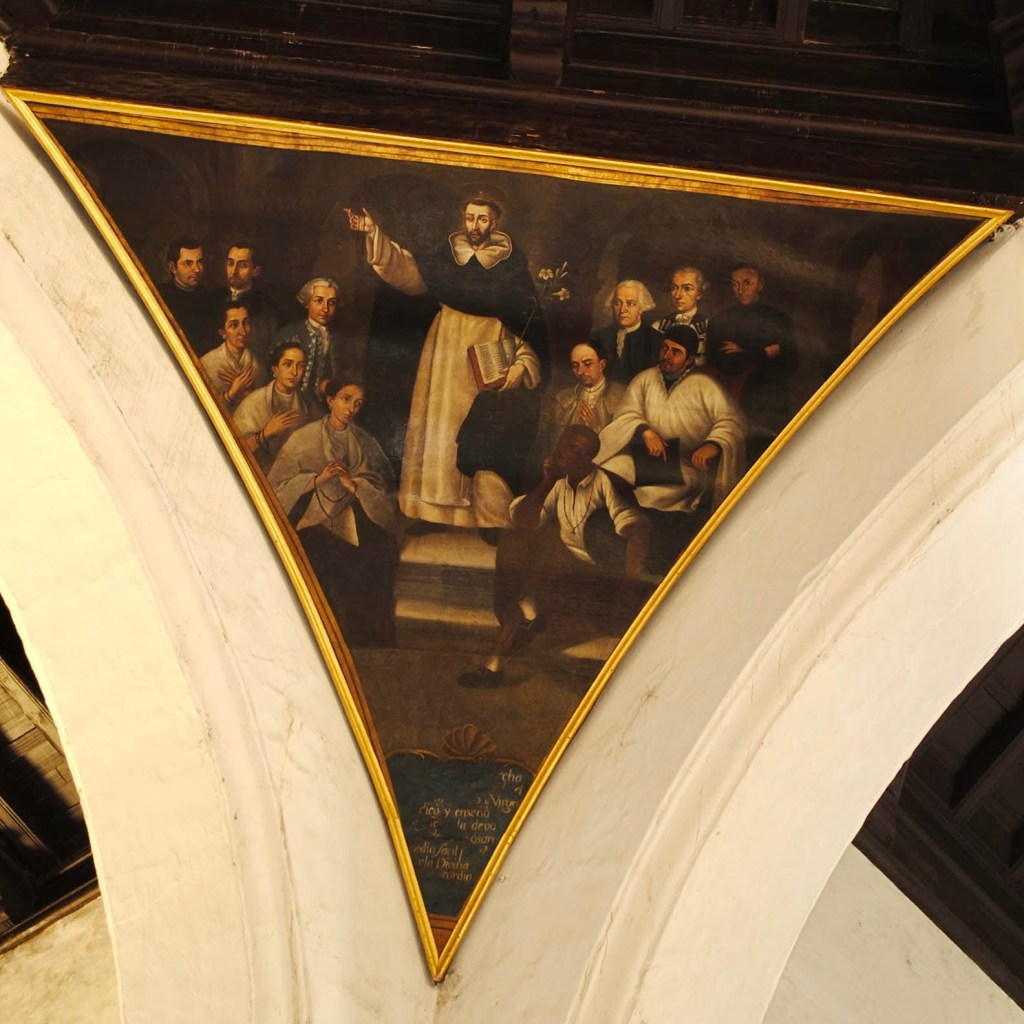
In the Church Santa María del Rosario of Havana there is a pendentive cycle completed in the 1770s painted by the baroque artist José Nicolás de Escalera – whom according to Guy Pérez Cisneros, was truly the first professional Cuban painter of the tradition – that includes a black slave in a pensive pose seating on a lower step, just below a Dominican priest who figures prominently in the middle of the picture holding a Bible and raising his right arm forward [1]. It has been noted that the figure of the black slave is also the first portrait of a slave in the New World, and its meaning has been highly disputed. The enigmatic slave or liberto portrait shows the man in a thinking pose, with a folded long white shirt, and what seems to be a wooden rosary hanging in plain sight. It is hard to make the details of his facial expressions, but it is obvious that his gaze is neither upwards nor directed at the viewer, but rather suspended, as if were, in a moment of attention and rest (and also listening?). The context here is fundamental, since Santa María del Rosario Church was commissioned by the Count of Bayona, a wealthy member of the sacarocracia (sugar plantation owner) after a previous church was burned to the ground by a slave revolt that took place in 1727 in an act of complete defiance to Christian indoctrination. 

The event that only has come down to us in just a handful of mentions and erasures of the colonial archive is featured prominently, as we know, in Manuel Moreno Fraginals’ El Ingenio when the historian documents the spiritual schism of the eighteenth century colonial plantations of the island. According to Fraginals’ historical account, the slave insurrection in the plantation took place in the wake of a theatrical enactment proposed by the Count of Casa Bayona in an act of repentance and humility aiming to mimic a well known moment of the Christian story: one day the Count washed the feet of twelve slaves, and when he finished he made them sat with him for dinner. Later that afternoon the slaves revolted and burnt down the whole sugar mill, including the chapel, to the ground. The episode ended with a plantation mayoral officer hunting down the runaway slaves, who was ordered to place the heads of the dead slaves high in spikes for the Count and everyone to see them [2]. It is an early staging of visibility and bodily dominion that the modern epoch will take to its final conclusion. 

The portrayal of human suffering was a symptom of the impossible hegemony of christianization of body and soul that the missionary Nicolás Duque de Estrada decades later will try to deploy in his pedagogical treatise Explicación de la doctirna cristiana acomoada a la capacidad de los negros bozales (1823), which argued that obedience of slaves could be achieved by implating “guilt” and work ethic in the affective interiority, in the forum internum of their souls. But even Estrada was of the fact that after sixteen hour workdays the Christian ascesis was imperceptible and little more than convoluted chatter to the ears of the slave. It is almost as if the slave, separated from the politico-theological inscription of salvation, was already outside the subjective domination of productive bondage and political freedom.

When Escalera was commissioned to do the cycle of frescos at Santa María del Rosario he was asked to combine a twofold narrative: the history of Christian salvation and the story of the Casa Bayona. At the center of the altar piece is the world as a common house or oikos, that carries history and its bodily sovereignty forward. One possible reading of the pensive slave shown in Santa María del Rosario’s pendentive is to assume that this figure is completely outside the eschatological vision embodying a sense of freedom that only painting could have documented in its unique and mute language. This raises the question about the relation between painting and freedom in which the figural emerges unmistakably fixed beyond historical narration. Although writing about Cézanne’s late work, Kurt Badt once suggested that there is no such a thing as the representation of freedom, but rather “painting generates a concept of freedom as two-faced: negatively, it is liberation from isolation and resistance, positively to the serious gentleness of freedom….expression in freedom to the scene from nature, which declares the world to be existing together, a mutual self-supporting and carrying of things” [3]. The pensive slave portrayed in the pendentive does not embody freedom understood as the spiritual accumulation of rights and duties known to the order of historical transformation; rather is an absolute pictorial appearance of freedom because it embodies, in its non-separation of life and thought, a static moment of a being that contemplates the liberty of his potency.

What is striking about the collective portrait where Escalera inserted the former slave is what we can call, following Bernard Berenson, a dimension of the ineloquent that appears just as “mute, with no urgent communication to make, and no thought of rousing us with look and gesture. If they express anything it is the character, essence rather than momentary feeling or purpose. They manifest potentiality rather than activity. It is enough that they exist in themselves” [4]. In the pensive gesture of his pose, the slave is the untouched existence and the revolt that rips the escathological narrative that ordains the interiors of Santa María del Rosario. Malraux once noted that the age of the divine disdained the realistic portrait of an ordinary person, because he was too distant and mundane from the stone conclave of the gaze of the gods. The slave’s inexpressive ‘naturalness’ refrains from partaking into a mood compensated by the semantic compulsion of the colonial painter, because his naturalness discloses the indestructible soul that has transfigured the realm of the divine. 

The unfathomable mystery of the pensive slave or liberto is the obscure and yet luminous portrait of a life in thought that is, at the same time, the thought of a life that is forever inexpressive, and as such the highest state of imperturbable freedom in the aftermath of worldly destruction. The ‘gentleness of freedom’ that Badt locates at the heart of painting is the imperative of the stream that carries, and yet restrains, thought and appearance into the figure of life. The freedom that anchors painting – because such freedom is never realized in painting except as vulgarity – becomes a tacit secret for which ultimately there is no image.  

Notes 

1.Guy Pérez Cisneros. Características de la evolución de la pintura en Cuba (Ministerio de Educación, 1959).

2. Manuel Moreno Fraginals. El Ingenio (Crítica, 2001), 99.

3. Kurt Badt. The Art of Cézanne (Faber & Faber, 1965), 314.

4. Bernard Berenson. Piero Della Francesca: The Ineloquent in Art (Chapman & Hall 1954), 7.

Name and Liberty. by Gerardo Muñoz

Back in the fall of 2020, we discussed a book entitled Intifada: una topología de la imaginación popular (2020), written by Rodrigo Karmy, which considered the implications between the forms of contemporary revolts for the common imagination. It has been said with good reasons that the health-administrative controls deployed during the COVID-19 brought to a halt the high tides of revolts against the experiential discontent in the social fabric. The wearing out and domestication of experience has proved, at least for now, its stealth efficacy and unilateral success. However, what some of us did not see at the time was that this energy over protracted containment was also being waged at the very substance of language. This has now come forth in the wake of recent events at university campuses where administrative authorities, opinion writers, and legal analysts have suggested that a particular word, “intifada”, should be proscribed and effaced from campus life. One should not waste time considering the etymology, semantic reach, and political deployment of this term – for this there is already Karmy’s elegant and dense articulation of the term.

What has completely gone unnoticed in the current chatter about “intifada” is the fact that the full realization of a “rhetorical society” entails, necessarily, an ongoing preventive civil war over what is perceived as “sayable”. This means that containment does not only reach to the moment the realization of action (and its reason or justification of an act); but rather that it fully extends about what might be said potentially. The various calls – on the left and right, from the legal analysts to the pundits and some of the academic administrations – against “intifada” is not merely substantive (or at least it does not stop at this specific threshold); it is a preventive reaction against the very possibility of the name and naming. The act of naming is intimately related to the exterior events in the world; therefore, the proscription of naming is one more step in the domestication process in which the human specie is tore not only from establishing a contact with the world, but also incapable of accessing it through the specific density of naming.  

The paradoxical situation of this interregnum is that, on one hand, the collapse of modern political authority that founds the Liberal State (non veritas facit legem) as an overcoming of language and truths, has led straight into the rhetoric inflation where naming is sacrificed and language codified into a second order normativity that imposes arbitrary obligations on what is licit and illicit. This is why the First Amendment of the United States Constitution – and total constitutionalism writ large – becomes the construction zone that allows the contingent justification of “time, place, and manner” under the civil right of “freedom of speech”, which turns naming into an ominous and terrible shadow; an unwarranted apostrophe. The almost anecdotal proscription over “intifada” reveals the heteronomic dominion over interiority; that is, over the possibility of saying.

I can recall how Quentin Skinner told some of us at Princeton years ago that a fundamental characteristic of unfreedom, broadly considered, begins when you think twice about whether it is convenient or prudent to say what you think. Of course, I do not think he favored a position of imprudence and generalized cacophony. I take it that he meant that the end of liberty begins when the possibility of naming disappears: “Between the motion and the act falls the shadow”. Fixation and transparency is the evolving grammar of the day. Can language subsist in such an impoverished minimum overseen by the general governmental logistics? As a preamble, one can say that in the current moment any conception of liberty begins with the opaque exercise of naming.

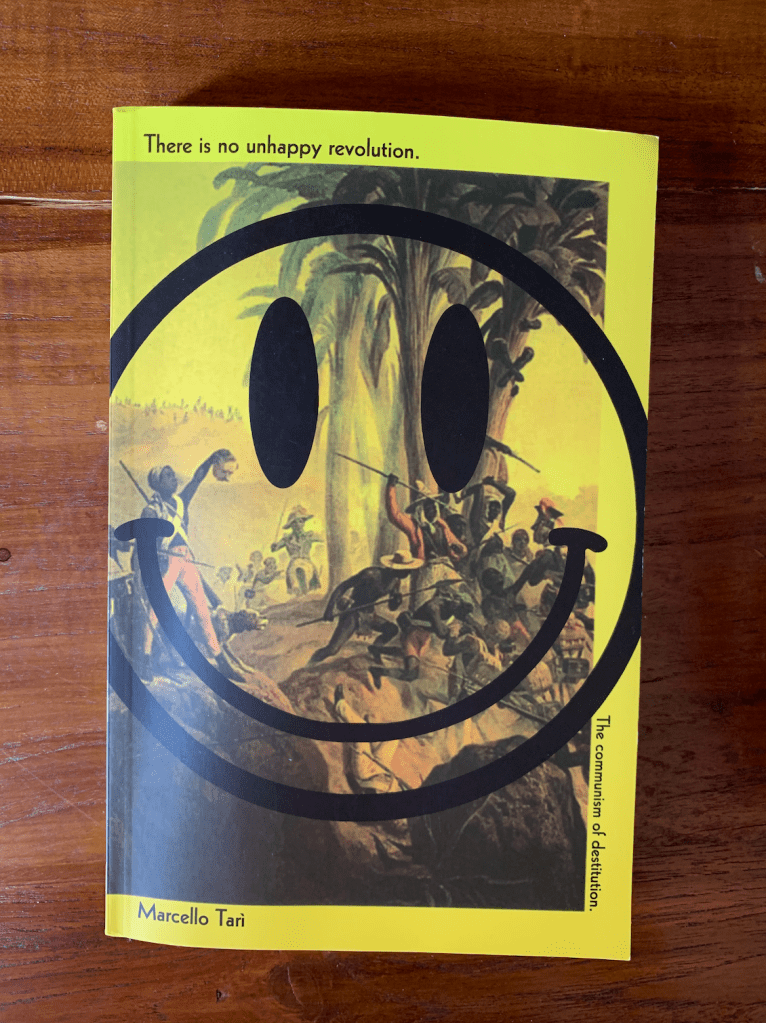
Revolutionary becoming and infrapolitical distance: on Marcello Tarì’s There is no unhappy revolution: the communism of destitution (2021) by Gerardo Muñoz

Marcello Tarì’s book There is no unhappy revolution: the communism of destitution (Common Notions, 2021), finally translated into English, is an important contribution in the ongoing discussions about politics and existence. It is also an exercise that pushes against the limits of contemporary political thought in the wake of the ruin of the grammars and vocabularies of the modern politics and the rise of the techno-biopolitics of governmentality. More importantly, the operation of Tarì’s book escapes the frame of “critique”, abandoning any false exits to regain the legacy of the Enlightenment and of “judgement” in hopes to reinstate the principles of thought and action in the genesis of the legitimation of the modern social contract. But the radicality of the horizon of destitution – which we have come to understand vis-à-vis the work of Giorgio Agamben, and the Invisible Committee – is first and foremost a thematization of the proximity between thinking and politics against the historical stagnation of a historical subsumed by the total technification of value (the principle of general equivalence). Since Tarì’s book is composed of a series of very heterogenous folds and intersections (literally a toolbox in the best sense of the term), in what follows I would like to sketch out a minor cartography to push the conditions forward that the book so elegantly proposes in three registers: the question of “revolutionary becoming” (the kernel of Tarì’s destituent gesture), the hermeneutics of contemporary domination, and the limits of political militancy.

Revolutionary becoming. Marcello Tarì correctly identifies the problem the epoch as fundamentally being about the problem of revolution. However, the notion of revolution must be understood outside the continuation of the modern horizon of the Leninist technique of the revolutionary vanguard nor party, the “revolution within the revolution”, and any appropriation of the “General Intellectual”. At the end of the day, these were all forms of scaling the desire as cathexis for the matrix of production. On the contrary, the problem of revolution is now understood in the true Copernican sense; mainly, how to inscribe an excentric apositionality within any field of totalization. When this is done, we no longer participate in History, but rather we are “freeing a line that will ultimately go down in History, but never coming from it”. Tarì argues that the field of confrontation today is no longer between different principles of organizing revolutionary strategies and even less about ideological critique; nor is communism an “Idea” (as it was thought just a decade ago in discussion that were philological rather than about thinking communism and life); the new epochal exigency is how to put “an end to the poverty of existence” (3). The potentiality of this transformation at the level of factical life, is what Tarì situates under the invariant of “communism”: “…not as an idea of the world, but the unraveling of a praxis within the world” (35). This communism requires a breakthrough in both temporal and spatial determinations, which prepares a dwelling in absolute relation with the outside (49). This revolutionary tonality is one closer to messianic interruption of historical time capable of destituting “actual state of things” governed the metaphysical apparatus of production and objetivation of the world, which depends on the production of the political subject. In an important moment of the book, Tarì writes: “…. only the revolutionary proletarian dimension can grasp the political as such, the true break from the current state of things. The real alternative to modern politics is thus not to be ground in what we usual can an “anti-politics”, which is merely a variation of the same there, but instead in a revolutionary becoming” (50).

The revolutionary becoming is a transformative intensity of singularization, which ceases to become a subject in virtue of becoming a “non-subject” of the political (67), which about a decade ago Alberto Moreiras announced to escape the dead end of the hegemony-subalternity controversy (one should note here that the fact that the Left today has fully subscribed the horizon of hegemony is something that I think it explains many of the deficits of the different experiments in a realization of a progressive political strategy). And this becoming revolutionary, in virtue of ceasing to be a subject (person, vanguard, multitude, worker) entails a new shift from action to use, and from technico-rationality to an opening of the sensible and singular means (metaxy). Again, Tarì’s continues as follows: “Becoming revolutionary…. means utilizing fantasy, freeing the imagination, and living all of this with the enthusiasm of a child” (75). The notion of “happiness” at stake in the book it is played out against the determination of the subject and the processes of incarnations (Karmy) that have haunted the modern revolutionary paradigm as always-already integrated into the metaphysics of the philosophy of history. 

 Metropolitan domination. Secondly, Tarì’s book locates the metastasis of domination at the level of a new spatial organization of the world in the apparatus of the metropolis. As we know the metropolis is not just an urban transformation of the Western form of the urbs and the polis, but rather the force of appropriation of the world into interconnectivity and surface in order to optimize, administer, and reproduce flows of the total fictionalization of life. The gesture towards the outside that crosses over Tarì’s book entails an exodus from the metropolitan structure that makes uninhabitable experience. This takes place by a process of domesticating its possibilities into the order of sameness (crisis of appearance) and translating our proximity with things into the regime of objects. What is stake in the metropolis – if we think of the most recent revolts in Santiago de Chile, Paris with the to the hinterlands of United States and Italy – if not precisely a response against the metropolitan machination “aiming at the destruction of every possibility of having any experience of the world and existence itself” (84). This why the intensity of any contemporary revolt today is proportional to the experiential texture of its composition and modes of evasion. Of course, Tarì correctly identifies the metropolis as an expanded field of cybernetic inter-connectivity, which, as I would argue is not merely the production of “bad substance” (to use Tiqqun’s Bloomian lexicon), but also a recursive dominion over the medium (metaxy) in which experience and the singular autopoiesis labors for the optimization and hylomorphic regimes that administer civil war. In this sense, destitution names an exodus from the metropolitan technical order and the sensible reproduction of the medium. It is in the outside the metropolis that the ongoing process of communization can free an infinite process of communization and forms of life.

Residual militancy and infrapolitics. But does not the exodus or the destitution of the metropolis – opening to singular experience, love, friendship, and the use of one’s disposable means and inclination – presuppose also a step back from a political determination, in other words, a fundamental separation from coterminous between existence and politics? At the end of the book, Tarì claims that “whenever anything reaches a certain level of intensity it becomes political” (117). But is the intensification of thinking or love or friendship always necessarily political? Tarì writes a few pages later that: “love is continually traversed by a line of extreme intensify, which makes it an exquisitely political affect” (126). But does not the politization of love depends on a certain commitment (a “faith”) to a residual militancy, even if it is a militancy posited as the principle of anarchy? But perhaps this is the difficulty at stake: since anarchy is only entails the “anarchy of phenomena” in reality, postulating a political principle as counter-exposition, however tenuous, might not be enough. For this reason, the crisis of appearance today needs a step back from the heliopoliticity of exposition. In an essay written a couple of years ago, Alberto Moreiras thematized this difficulty vis-à-vis Scürmann’s principle of anarchy, which I think is worth quoting: “The Schürmannian principle of anarchy could then be thought to be still the subjective reaction to the epochal dismantling of ontology (as metaphysics). But, if so, the principle of anarchy emerges, plainly, as principle, and principle of consciousness. Anarchy runs the risk of becoming yet another form of mastery, or rather: anarchy, as principle, is the last form of mastery.  At the transitional time, posited as such by the hypothesis of metaphysical closure, metaphysics still runs the show as consolation and consolidation” [1]. 

If politics remains the central condition of existence, then it follows that it depends on a second-degree militancy that can govern over the dispersion of the events and this ultimately transfers the force of steering (kubernates) to mitigate the crisis of thought and action in the sea of “absolute immanence”. But immense is also a contemporary fundamental fantasy [2]. Against all “faith” in absolute immanence we need to cut through in its letting be (poein kata phusin) of the abyssal relation between existence and politics. This originary separation is an infrapolitical step back that solicits a distance an irreducible distance between life, events, and community form. The commune would be a secondary condition of political organization, but the existential breakthrough never coincides with community, except as a “common solitude”. Secondly, the infrapolitical irreducibility between politics and existence wants to reject any compensatory temporal politico-theological substitution, which also includes the messianic as a paradigm still constitutive of the age of Christian community of salvation and the efficacy of deificatio. The existential time of attunement of appropriation with the improper escapes the doble-pole paradigm of political theology, which has been at the arcana of both philosophy of history as well as the messianic inversion. A communism of thought needs to produce a leap outside the politico-theological machine which has fueled History as narrativization and waged against happiness [3]. Attuning oneself to the encounter or the event against the closure of the principle of reality might be a way out from the “hegemonic phantasm” of the political, which sacrifices our infinite possibilities to the logistics of a central conflict. If civil war is the side of the repressed in Western politics, then in the epoch of the ruin of authority it opens an opportunity to undue the measurement (meson) proper to the “Social”, which is now broken at the fault lines as Idris Robinson has put it [4]. It is only in this way that we can move outside and beyond the originary positionality of the polis whose “essence never coincides with politics” [5]. The saving of this irreducible and invisible distance prepares a new absolute proximity between use and the world. 

.

.

Notes 

1. Alberto Moreiras. “A Negation of the Anarchy Principle, Política Comun, Vol. 2017: https://quod.lib.umich.edu/p/pc/12322227.0011.003?view=text;rgn=main

2. Lundi Matin. “Éléments de decivilisation” (3): “It is also about the creed of the dominant religion: absolute immanence. Doing itself, designed to obey the modes of proceeding from production, is in advance conforming and consecrated. On this sense, no matter what you do, you bend the spine in front of the cult dominant. If all things count, none has a price, and everything is sacrificeable.”. https://lundi.am/Elements-de-decivilisation-Partie-3

3. This is why Hegel claims in his lectures on the Philosophy of History that: “History is not the soil in which happiness grows. The periods of happiness in it are the blank pages of history”. The revolutionary overflow of happiness is only possible as an exodus from the theological political structure of historical production. Here the question of style is emerges as our defining element. 

4. Gerardo Muñoz. “The revolt eclipses whatever the world has to offer”: a conversation with Idris Robinson”, Tillfällighetsskrivande, May 2021: https://www.tillfallighet.org/tillfallighetsskrivande/the-revolt-eclipses-whatever-the-world-has-to-offernbsp-idris-robinson

5. Gerardo Muñoz. “Some Notes Regarding Hölderlin’s “Search for the Free Use of One’s Own”, January 2019: https://infrapoliticalreflections.org/2019/01/14/some-notes-regarding-holderlins-search-for-the-free-use-of-ones-own-by-gerardo-munoz/