There is a small marble Roman relief of Peitho (it is about 15” x 5” wide) of what used to be a larger decorative plate illustrating Helen being persuaded by Aphrodite to accept her husband’s voyage to Troy. The personification of Peitho in the form of a seating lady accompanying Aphrodite is not rare in classical representation, and if we are to follow Friedrich W. Hamdorf’s genealogy, it was actually the norm when it came to visual depiction of the deity [1]. What is striking in this Roman relief of Peitho is precisely the unassuming silence of the figure, who is merely gazing down and touching a dove or bird with her right hand and sunk in thought. Is not this mystical silence what bathes the mythical figure of Peitho, which according to Euripides has no other sanctuary than that of language?
The Peitho relief stands as a fragmentary of an ancient memory where the event of language implicated persuasion instead of commanding; a sensibility of saying instead of legitimate validation; granting space for the poetizing in the world instead of rationalizing, in the advent of the polis and the bios politikos, the transcendental condition of the political community [2]. Peitho will become rhetorical once it has taken the autonomos form of the transaction and the mutilated word by which nothing is ever said except a lethargy of the immanent movement of the logos. In the Roman relief Peitho does not communicate because she dwells in the poetic lacuna of language.
In fragment 81 of Aeschylus’ Niobe we read a mysterious outline of Peitho: “Death desires no gifts; one can gain nothing by making sacrifice…from him, alone among divinities, Persuasion stands aloof.” The ossification of language in hand with the general autonomization of rhetorical separation, in the words of Gianni Carchia, will mark the destitution of Peitho’s poetic magic allowing death to speak through the fierce instrument of demagoguery and and the production of justifiable certainties [3]. In a world without the irruption of the mythic-magical element personified by Peitho, there is only general declensions towards persuasion as a form of predication: to convince, to obey, to follow, and to concede belief as persuasion was transformed linguistically [4]. It is no surprise that the civilizational decline of the mythos of Peitho coincides with the rise of the rhetorical techné that guaranteed the autonomization of the world (private & public, appearance & truth); but, most fundamentally, the stabilization of the resource of rule-based lexicon as the dominion over exteriority.
Even the Sophist Gorgias in his Encomium of Helen defines Peitho as “Language is a power ruler who with a tiny and invisible body accomplishes deeds most devine” [5]. The process of deification of language (in the sense of the sources of archê) can topple the divine in order to mobilize all the energies no longer in the “uninterest encounter between souls” (Carchia’s words), but rather by grounding a necessity that, first and foremost, establishes its ontological solvency in the unending rhetorical polemics. As the sensible myth of Peitho withers into organized grammar and rules of predication, it is noteworthy to recall that in the monotheist tradition the organization of the invisible in becomes colored by “faith” in the law.
This could explain why Saint Paul seemed to have made a conscious attempt to oppose any remnant of the Hellenic persuasion (πειθώ) in favor of “demonstration of faith” (ἀποδείξις). As we read in Corinthians 2:4-5: “My words and proclamation were not based on the persuasion (πειθώ) of wisdom, but on demonstration (ἀποδείξις) of the Spirit and power… that your faith would not be based on human wisdom, but on the power of God. Indeed, “apodeixis” (ἀποδείξις), the word deployed by Paul, will guarantee persuasion only in revelation and the Christian philosophy of history; meaning that Peitho will remain, like the Roman relief from the First Century, a mute aesthetic artefact and a petty reminder of the expulsion of ethōs from language.
.
.
Notes
1. Friedrich W. Hamdorf. “Peitho”, in Griechische Kultpersonifikationen der vorhellenistischen Zeit (Zabern, 1964), 64-65.
2. Francis Kane. “Peitho and the Polis”, Philosophy and Rhetoric, Vol.19, N.2, 1986, 118.
3. Gianni Carchia. “Eros y Logos: Peitho arcaica y retórica antigua”, in Retórica de lo sublime (Técnos, 1994), 23-24.
4. María Dolores Jimenez López, “‘Persuadir’ en griego: el marco predicativo de peitho”, in Word Classes and Related Topics in Ancient Greek (Peeters Louvain-La-Neuve, 2006), 175-176.
5. Gorgias. Encomium of Helen (Bloomsbury, 2008), 44.
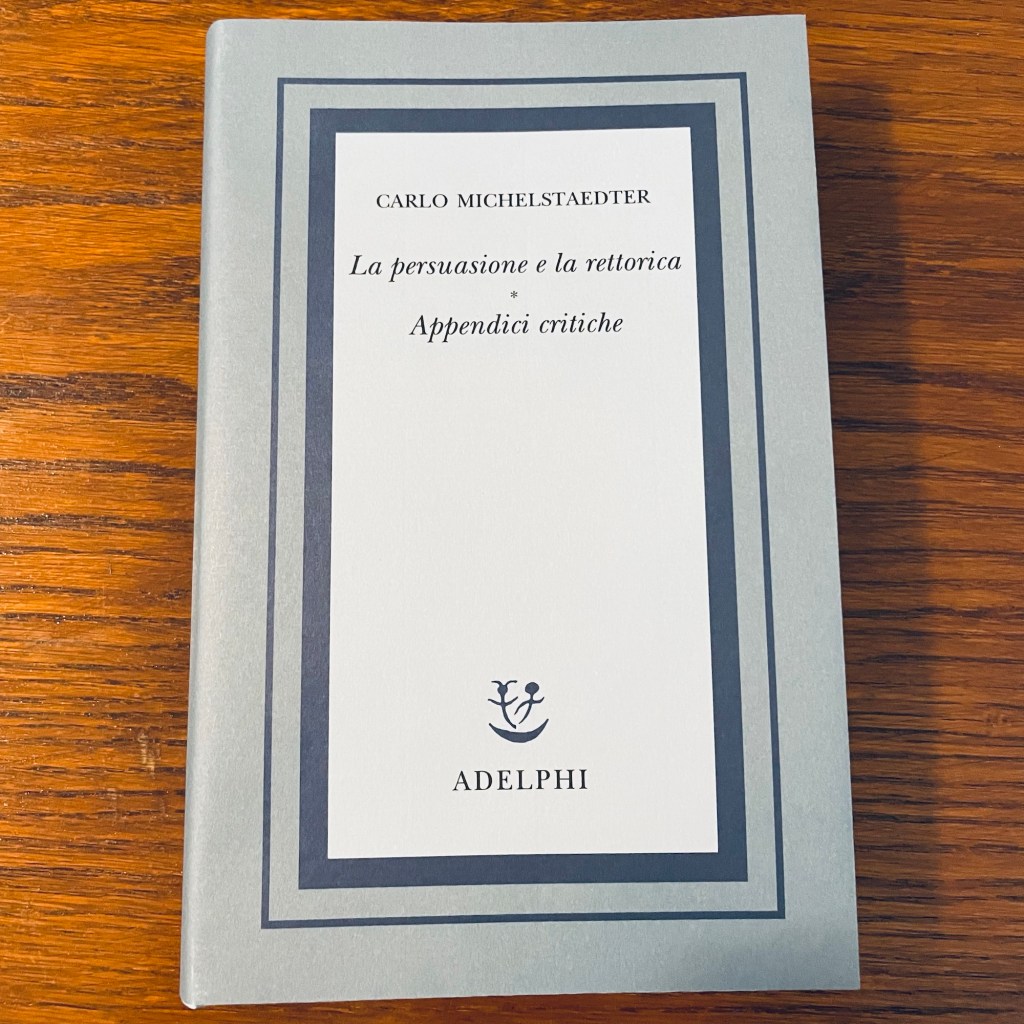
In the following months some of us will offer an eight week seminar exclusively dedicated to a close and analytical reading of the enigmatic work La persuasione e la rettorica (1910) by Italian thinker Carlo Michelsteadter (1887-1910). Ever since his death – as can be easily gasped by Giovanni Papini’s obituary in 1917 – there has been an aura of mystery around the infamous philosophical suicide of Michelsteadter that only parallels that of Socrates’ hemlock or Otto Weiniger’s self-inflected gunshot. Of course, we will be less interested in the biographical motives, and if push comes to shove attention to this detail will be elaborated in light of the nexus of his thought to the event of his death.
La persuasione e la rettorica (1910) offers a unique theoretical elaboration about the civilizational decline of the “living” into the rhetorical deferment of life as realized in the organization of social alienation. And for Michaelsteadter there is no other purpose of rhetorical form than the absolute submission to the general abstraction that defaces the event of pain. It is no accident that he was also interested in the thematics of health and ancient techniques of pain-relief (the techné alupias, for instance), even if underdeveloped in his thinking given his sudden premature death. So, it is for us, his posthumous readers, to take these sets of issues and move them forward in our present any way we can. This is part of the task that motivates putting together this seminar after a series of conversations with friends and interlocutors.
La persuasione e la rettorica (1910) deploys the classical metaphysical tradition through the ancient poles of “rhetoric” and “persuasion”, where the second (the ancient Peithò) seeks to return the voice and expression to the problem of pain as an ineffable type of speech (Logos) that refuses the elevation of force that harbors the circulation of violence and the administration of social death. The ancient notion of the Peithò withdraws echoes of the mythical inception and the sacred, as also reminded by Aristophanes: “Persuasion’s only shrine is eloquent speech (Logos)…And I Persuasion (Peitho), the most lovely word” (The Frogs, 1391-1395). Where and how do we attune ourselves to the peitho today – the imperative of the eros of the word in the wake of the regime of social production of pain?
In the aftermath of the collapse of the cycle of civilizational secularization, it is only obvious that all these questions stratified in the tradition once again become attractive and pertinent. In this light, we think that Michelstaedter’s thought still offers us a series of significant hypotheses to think through the crisis of social man and the domination of the civil that colors our current predicament, where the question of “pain” is still an understudied problem. Throughout this course we will address notions such as rhetoric and persuasion, life and communication, nihilism and values, the logic of capital and the social bond, or the notion of world and pain. Our aspiration when approaching Carlo Michelsteadter’s work is to develop reflective conditions to address the thorny issue of an ethics of pain that so thickly enmeshed in our historical moment.
.
.
‡: Information about the registration to the seminar will be made available at Revista Disenso in upcoming days. The seminar will run every other week for a period of eight sessions (roughly from the beginning of September to early December, 2024).
Few characters are more memorable in the first book of Plato’s The Republic than the sophist Thrasymachus, whose shadow is still very much looming around us given that it is obvious that today everything in our contemporary world is optimized through force. Thrasymachus’s strict identification of reserve power (potentia) with justice (ius) is in many respects prophetic, since it already subordinates the ideal of justice with practical reason and effective norms, a crowning achievement of modern political power. This is why Leo Strauss could claim in The City and Man that Thrasymachus’ position is ultimately a defense of the thesis of “legal positivism” that brings to fruition the legitimate order and the police powers of the city. In other words, Thrasymachus discovered that the requirements for the permanence of an active social order of a police entails the mediation of the two dimensions of legal authority: obedience and the internal recognition of a secondary rule that liquidates the possibility of raising the question of what is “just” (now internal to the organization of internal powers). If the aim of “justice” becomes the optimal application of effective rules and norms that provide the services of the city, then political rule becomes an infallible and uncontested logic. Politics is ultimately force, and force is the energy organized by politics in the city.
As Strauss writes: “Thrasymachus acts like the city, he resembles the city, and this means according to a way reasonably acceptable to both…Thrasymachus is the city. It is because he is the city that he maintains the thesis of the city regarding justice and that he is angry at Socrates for his antagonism to the thesis of the city. Thrasymachus’ rhetoric was especially concerned with both arousing and appeasing the angry passions of the multitude, with both attacking a man’s character and counteracting such attacks, as well as with play-acting as an ingredient of oratory” [1]. Well before the general equivalent of contractual commercial relations, Thrasymachus’ rhetorical deployment functioned as a techne alupias against the unwarranted passions of human beings. And, contrary to the common opinion that separates the craft of sophistry from the unity of rational discourse (logos), Thrasymachus’ defense of force presupposes the autonomy of language in the rhetorical construction (very much like modern poetry centuries later) to serve as the hospice of rational pondering in the polis. To make language the exclusive battle ground: even in antiquity it was said of Thrasymachus, “you are just like your name, bold in battle”. And Plato wanted to hold on to this picture. This ultimately means – and it is still at the center of our contemporary predicament – that the coming of the “Social man” in the city is only possible on the condition of a primary transformation of the event of language and the speaking being. This is why if Thrasymachus was the “pioneer of rhetoric and elocution”, as it has been claimed, it is only because his appeal to the pragmatics of political power was mediated by the invention of the ‘mystery of the prose style’; that is, of reducing the non-grammatical mediation to the orderability of a prose adjusted as an instrument to the world [2]. The enslavement of the passions is the commencement of the social prose in which we are forced to act in our alienated roles.
Only when language becomes rhetorical communication it is possible to grasp the world as a case of an entity of legibility and knowability, where reasons (inclusive and exclusive, that is, as what can be delegated for my own interests) and political rule converge without residue. What will become obvious through the cybernetic dominion over “information”, it was first elaborated as the pressure of rhetoric where the logical force of predication took its force to disclaim myth as the unappropriated experience of worldly phenomena. The art of rhetoric does not render “truth” obsolete; it rather incorporates theoretical and systemic deductions – a flattening of logos without myth -, so that the event of truth can no longer stand as the unsurveyed horizon of the intelligibility [3]. The consolidation of force means this much: that Thrasymachus’ prose of the world is not just an exclusive political program of the “fictitious”, as much as a program for the total attainability of the world; a world that by becoming fully accessible and objective, it pays the high price of eclipsing the presence of things, and the event of truth and naming in language. A world without kallipolis that will only distribute and perpetuate ad infinitum injustice as the corollary for the triumph of immanence of force.
.
.
Notes
1. Leo Strauss. The City and Man (University of Chicago Press, 1964), 78.
2. Bromley Smith. “Thrasymachus: a pioneer rhetorician”, Quarterly Journal of Speech, 1927.
3. Gianni Carchia. “La persuasión y la retórica de los sofistas”, in Retórica de lo sublime (Tecnos, 1994), 60.
The fact that there is a continuous and secret communication between painting and tradition is something that has been registered in the genesis of myth well into aesthetic autonomy of modernity and the artificious equivalence of difference that regulates the temporal caducity of the new [1]. In a specific sense, the crisis of tradition in the contingency of the modern has the activity of painting as a privileged site because it holds the outside together in a perpetual unveiling; as if the human species were permanently exiting the shadows of the cave every time a hand strokes an animated brush over a surface. Painting clears the site of the inaccessible so that true life can emerge without the crutches of incorporated scripts of social organization. But what could it mean to think of ‘tradition’ in a painterly manner? In a poem of 1945, unequivocally entitled “Tradition”, Wallace Stevens seems to offer a response and an outlook for our consideration.
In a conversationalist style, Stevens thinks that tradition is an uncontrolled question insofar as it can only be assessed through poetic form. Of course, for Stevens the character of tradition could not be grasped neither in a compilation of well delineated forms nor detailed through “a set of laws…to identify it is not tradition” [2]. As it was for Hölderlin’s practice relation to Greek antiquity, tradition is something that is always missed or unfulfilled from its uttermost strangeness. It is, as he asks in the fifth stanza “an unfamiliar sum, a legend scrawled in a script we cannot read?” [3]. The illegible transcription of what is passed as tradition holds to the incommensurability between what remains unfamiliar and what is already familiar and perceptible. We must resist the attempt at disambiguation, since any relation to tradition must be anachronistic as Nicoletta Di Vita has suggested [4]. Thus, for Stevens “tradition is always near”, at hand. And the hand calls forth the mystery of painting. It keeps a world at the threshold of the verbal. The placement of nearness, however, will be on the side of formlessness that characterizes the genesis of one’s existence. In other words, the true task of approaching tradition is neither at the level of the construction of forms nor about the analogical pairing of historical evolution; it is the painterly relationship between life and the experience in the world that precedes and outlives the time of life. This is what Stevens will denote a “ascending the Humane”; meaning a life qualified by fulfilling the adventure of a destiny that is capable of addressing the outside. In the most emphatic verses of “Tradition”, Stevens shows his absolute nearness to what he has in mind:
“Ascending the humane. This is the form
Tradition wears, the clear, the single form,
The solid shape, Aenas seen, perhaps,
By Nicolas Poussin, yet nevertheless
A tall figure upright in a giant’s air.” [5].
The use of “form” in the first verse is most definitely mischievous, but it is also the playful ambiguity that Stevens wants to bring to our attention. One way to read it is to circle back to the sense in which the painterly becomes the utile passage between life and world. After all, tradition “wears” the dress of nature, although this is only facilitated by the sensible activity of painting. Exactly a decade later in the essay “The Whole Man” (1955), and speaking directly to the rise of cybernetics and technico-political technicians that had consolidated their mastery over the events of the world, Stevens will suggest that “Modern art often seems to be an attempt to bridge the gap between facts and miracle…to succeed in doing this, if it can be done at all, seems to be exclusively the task of the specialist, that is to say, of the painter” [6]. Why the painter and not the poet? At a very general level, the two figures are interchangeable; however, if one takes the painterly mediation, it becomes possible to claim that painting has a more subtle expressive footing in showing the nearness of tradition.
Painting is the non-language that gathers the formless tune of tradition: “The vigor of art perpetuates itself through generations of form. But if the vigor of art is itself formless, and since it is merely a principle it must be, its form comes from those in whom the principle is active, so that generations of form come from generations of men. The all-round man is certain to scrutinize form as he scrutinizes men, that is to say, in relation to all past forms” [7]. Thus, for Stevens the possible tradition is that which creates a space in which a new life can take place in the world attentive to the transmission of forms. Of course, not any world, but to “live in the world but outside of existing conceptions of it” [8]. This is why Steevns will differentiate between two modalities of the task of poetry: the poetry of rhetoric and the poetry of experience; favoring the second because of how it folds our existence within the given order of space and time.
Is not painting, precisely, a frozen instant in the spatial and temporal coherence that reveals, in turn, a hidden harmony that never fully coincides with nature nor stands in opposition to it? [9]. This is why “tradition wears” but it is also the transitory body of Aenas, which Stvevens inserts in the poem as a matter of ut pictura poesis in relation to Nicolas Poussin’s “Venus presenting arms to Aenas” (1639), which is ultimately the story of the persuasion unto one’s destiny. As it is well known, Poussin captures in a sequence Aenas being directed to his destiny invested in the arms of war. But where is destiny embodied for Stevens? Is it in the gesticulating figure of Aenas or in floating Venus that occupies the central sky of the landscape? It is almost as if Stevens acquired, as Walter Friedlander said of late Poussin, a “sublime vagueness” in visibility of the inner workings of imagination drifted from the physical imbalance of the activity of imitation [10].
After all, for Stevens Poussin stood precisely as the source of partition and the miniscule, confirming the primacy of “imagination” against the rhetorical compression that renders legible the modern abstraction [11]. Following André Gide who had had written on Poussin’s work, Stevens repeats without any elaboration that Poussin is to be taken “little by little” (peu à peu), so that only then its pictorial absorption can unfold against what at first sight appears as a theatrical and self-enclosed translucid stage. This is the distant ‘traditionalism’ that Stevens wanted to reject if the work of art was to endure, and still have the vigor to generate a tranquil and peaceful state of mind solicited by the late Poussin. Painting could only be expressed as a ‘mode’ — which for Poussin stood for moderation and restraint, but more importantly as the condition of a certain sensible order “by which the thing keeps itself in existence” both firmly and invisibly, that is, beyond enunciation [12]. Otherwise, as Gerald Cohen once claimed, tradition becomes the thing that you can only hold on to when it has relaxed its hold on you ceasing to color the genesis of life [13]. And while tradition cannot be fully absorbed by rules or forms of pictorial depiction, it does retain the “good that we have loved”, dispensing a noeud vital in which the divine (theos) disengages us from the compression of objective reality and into the nearness of the eternal. This is the integrity of painting that allows Stevens to proclaim the ascendance of the supreme human “good”: tradition is kept alive by the soul of an erotic deification. After all, “God and imagination are one” Stevens will suggest in the fragments of Adagia [14]. Against the edifice of sedimentation and rupture, repetition and originality, possession and abstraction; tradition will name the disembodied genesis of appearing between things in a “reflected seeming-so”.
.
.
Notes
1. Gianni Carchia. “Per un’estetica dellainvecchiato”, in Dario Lanzardo, Dame e cavalieri nel Balon di Torino (Mondadori, 1984).
2. Wallace Stevens. “Tradition”, in Collected Poetry and Prose (Library of America, 1997), 595-596
3. Ibid., 595.
4. Nicoletta Di Vita. Il nome e la voce (Neri Pozza, 2022), 28.
5. Ibid., 596.
6. Wallace Stevens. “The Whole Man: Perspectives, Horizons”, in Collected Poetry and Prose (Library of America, 1997), 874.
7. Ibid., 875.
8. Wallace Stevens. “From Adagia”, in Collected Poetry and Prose (Library of America, 1997), 904.
9. Monica Ferrando. “L’ultimo quadro di Poussin”, in L’oro e le ombre (Quodlibet, 2015), 82.
10. Walter Friedlander. Nicolas Poussin: A New Approach (Harry Abrams, 1964), 82.
11. Wallace Stevens. “Tradition”, in Collected Poetry and Prose (Library of America, 1997), 737.
12. Cited in Étienne Gilson’s Painting and Reality (Cluny Media, 2020), 173.
13. G. A. Cohen. “Rescuing Conservatism: A Defense of Existing Value”, in Finding oneself in the other (Princeton U Press, 2013), 155.
14. Wallace Stevens. “From Adagia”, in Collected Poetry and Prose (Library of America, 1997), 914.
Back in the fall of 2020, we discussed a book entitled Intifada: una topología de la imaginación popular (2020), written by Rodrigo Karmy, which considered the implications between the forms of contemporary revolts for the common imagination. It has been said with good reasons that the health-administrative controls deployed during the COVID-19 brought to a halt the high tides of revolts against the experiential discontent in the social fabric. The wearing out and domestication of experience has proved, at least for now, its stealth efficacy and unilateral success. However, what some of us did not see at the time was that this energy over protracted containment was also being waged at the very substance of language. This has now come forth in the wake of recent events at university campuses where administrative authorities, opinion writers, and legal analysts have suggested that a particular word, “intifada”, should be proscribed and effaced from campus life. One should not waste time considering the etymology, semantic reach, and political deployment of this term – for this there is already Karmy’s elegant and dense articulation of the term.
What has completely gone unnoticed in the current chatter about “intifada” is the fact that the full realization of a “rhetorical society” entails, necessarily, an ongoing preventive civil war over what is perceived as “sayable”. This means that containment does not only reach to the moment the realization of action (and its reason or justification of an act); but rather that it fully extends about what might be said potentially. The various calls – on the left and right, from the legal analysts to the pundits and some of the academic administrations – against “intifada” is not merely substantive (or at least it does not stop at this specific threshold); it is a preventive reaction against the very possibility of the name and naming. The act of naming is intimately related to the exterior events in the world; therefore, the proscription of naming is one more step in the domestication process in which the human specie is tore not only from establishing a contact with the world, but also incapable of accessing it through the specific density of naming.
The paradoxical situation of this interregnum is that, on one hand, the collapse of modern political authority that founds the Liberal State (non veritas facit legem) as an overcoming of language and truths, has led straight into the rhetoric inflation where naming is sacrificed and language codified into a second order normativity that imposes arbitrary obligations on what is licit and illicit. This is why the First Amendment of the United States Constitution – and total constitutionalism writ large – becomes the construction zone that allows the contingent justification of “time, place, and manner” under the civil right of “freedom of speech”, which turns naming into an ominous and terrible shadow; an unwarranted apostrophe. The almost anecdotal proscription over “intifada” reveals the heteronomic dominion over interiority; that is, over the possibility of saying.
I can recall how Quentin Skinner told some of us at Princeton years ago that a fundamental characteristic of unfreedom, broadly considered, begins when you think twice about whether it is convenient or prudent to say what you think. Of course, I do not think he favored a position of imprudence and generalized cacophony. I take it that he meant that the end of liberty begins when the possibility of naming disappears: “Between the motion and the act falls the shadow”. Fixation and transparency is the evolving grammar of the day. Can language subsist in such an impoverished minimum overseen by the general governmental logistics? As a preamble, one can say that in the current moment any conception of liberty begins with the opaque exercise of naming.
Towards the end of his life, poet José Lezama Lima will mysteriously begin to sign the letters to his friends and family as “the Trocadero Etruscan”, a “member of the Etruscan religiosity”, and even the “man who lives in the Etruscan village” [1]. Why call himself an “Etruscan” in this particular moment of his life, and what could it possibly mean? The question about the meaning of the Etruscan authorial mask has been so thoroughly ignored by the literary critics that commentators at their best have noted that “being Etruscan” merely stands for his “cosmopolitanism” and “well-learned Europeanism”. Of course, this explains little to nothing. A sophisticated poet such as Lezama Lima, who ruminate over every single word he would write, could not have ignored that the Etruscans, unlike the civilized Romans and the Latin authorities, was a remnant to the very civilizational enterprise; a prehistoric people poor in written culture, achieved expressivity by the whole outlook of their form of life. And as in the case of Hölderlin’s adoption of different nom de plume (Scardanelli, Killalusimeno, Scaliger Rosa, etc), Lezama’s becoming Etruscan points to something so fundamental that if underscored we would fail to grasp the endgame of his vital poetic experience. The transfiguration of the name does not merely stand as a metaphor; rather it points to a distant figure that will finally dissolve him so that his immortal voice could continue to live on.
Indeed, the self-identification as an Etruscan for Lezama became a subterfuge to flee a political reality – his political reality, entirely structured by the revolutionary gigantic productivism and subjectivism – through a poetic refraction that would free an ethos from the overpowering of alienated autonomous space of the linguistic reproduction of social life. If at first glance it seems like a paradox that Lezama will adopt the Etruscan figure for his antisocial ethos – a civilization lacking written records or high literary achievements, a religious community known for its necropolis – this strangeness will ultimately prove that behind the Etruscan name there was no poetic exclusivity of the poet’s genius, but rather, as he claims in “A partir de la poesía”, the possibility for a divinization of reality to retreat from the historical epoch. In fact, Etruscan culture for Lezama was not a mere archeological ornament, but one of the “imaginary eras” of the West; that is, a stage of condensed and unnumbered imaginative possibilities resistant to griping subsumption and totalization of values. The Etruscan was the mythic remnant through the pantheistic divinization between language and the world. As Lezama writes glossing, in passing, Vico:
“Vico cree que las palabras sagradas, las sacerdotales, eran las que se transmitían entre los etruscos. Pero para nosotros el pueblo etrusco era esencialmente teocrático. Fue el más evidente caso de un pueblo surge en el misterio de las primeras inauguraciones del dios, el monarca, el sacerdote, y el pueblo unidos en forma indiferenciada … .les prestaba a cada una de sus experiencias o de sus gestos, la participación en un mundo sagrado. […] Pues en aquel pueblo, el nombre y la reminiscencia, animista de cada palabra, cobran un relieve de un solo perfil” [2].
The divinization of the Etruscans stubbornly insisted on the wonder of things. The human participation in divinity is no longer about founding a new theocracy or a “theocratic politics” in the hands of a ‘mystic accountant’ that would finally put the nation back in track (into the res publica), as Lezama would solicit out of desperation in the 1950s diaries [3]. On the contrary, for Etruscan people the fundamental tonality was the divine music of experience. Of course, we know that D.H. Lawrence captured this when claiming in his Etruscan Places (1932) that “the Etruscans are not a theory or a thesis. If they are anything, they are an experience. An experience that is always spoilt” [4]. And this experience (like every true experience) needs to be necessarily spoiled, which ultimately means that it cannot be mimetically rendered, arbitrarily modified, or subsumed into the order of idealization. But all of this is merely redundant, since the Etruscan inscription is what accounts for the limit to civilization, becoming the impossibility of the destruction of myth in the arrival of modern aesthetic autonomy. Thus, for Lezama the Etruscan way had something of a persistent cure against the ongoing civilizational disenchantment, even if it does not cease to appear in the modern attitude. In fact, Lezama writes that: “Rimbaud is the best reader of the Etruscan liver” (“hígrado etrusco”) to describe the dislocated position of the poet in the modern world of technology [5]. In the Etruscan cosmology, the liver was a symbolon of the vision of the cosmos registering the divisions of the spheres in the sky through the divine naming of the gods; it is the figure by which the poet guards the desecularizing remnant of the prehistoric inception of myth [6]. But this does not mean that Lezama will look at himself in the mirror of Rimbaud’s symbolist alchemy.
Rimbaud as an Etruscan is the poet who descends into hell because his lyricism can bear the pain in the disruption of language after the archaic peitho. Does the possibility mean a travel back in historical time? Not the least, as Lezama knew how to let go of storytelling and historical necessity. This is why Etruscans stand for an image or a sort of handwoven picture (the hand will make a comeback, as we will see) to gain vision. And this is one case on point: the Etruscan stands paradigmatically to the “sufficient enchantment” (“la cantidad hechizada”) , which discloses a higher knowledge of the soul (psychê) in the taking place of poetic errancy: “Sabemos que muchas veces el alma, al escaparse de su morada, tripulaba un caballo inquieto, afanoso de penetrar en las regiones solares” [7]. To wrestle against the historical reduction of autonomy of the modern age means to find this enchanted sufficiency necessarily for myth remnant to elevate itself against the aesthetic mediation that, in the words of Gianni Carchia, had become a consoling surrogate of the emptied historical time [8]. An entirely other conception of freedom is firmly implicated the Etruscan way: the gathering of the enchanted poetic dwelling to dissolve a reality that had become too thick in the business of brute force purporting to call ‘what’s out there’. The Etruscan reintroduces a divine nominalism of pure exteriority.
However, the Etruscan way does not commute with things of the world; rather, his soul unbinds the empirical limit of death to overcome death, and learn to live as if it were already dead. The trespassing of death through the poetic enchantment – which Lezama will also call an ‘potens etrusca’, or the Etruscan potentiality- will multiply the invisible possibilities against the rhetorical closure of reality legitimation. By accepting the thick of the dead as an illuminated presence, the Etruscans draw out the most important consequence: learning to live among the dead as the ultimate form of a dignified life. This is why D.H. Lawrence reminds us that the underworld of the Etruscans – their refusal of reality, the embrace of their dead, the augurium – was after all “a gay place…For the life on earth was so good, the life below could but be a continuation of it. This profound belief in life, acceptance of life, seems characteristic of the Etruscans. It is still vivid in the painted tombs. They are by no means downtrodden menials, let later Romans say what they will” [9].
If civilization is a construction that takes place at the crust of the Earth as some have claimed; the way of the Etruscan is a downward declination away from the architectural reduction of world sensing [10]. For Lezama the Etruscan dreams of a civilization submerged in the depths that only an acoustic totality that bear witness to its sensorial gradation: “Esas civilizaciones errantes por debajo del mar, sumergidas por el manteo de las arenas o por las extensivas exigencias…reaparecen, a veces, en los sueños de los campesinos” [11]. Hence, the fundamental dignity of poetry resides in the mythical homecoming that guards the possibility for what remains inexistent: “this is why the poet lives in the Etruscan world of the birth of fire” [12]. And although the Etruscan stands as one of the worlds in possession of an imaginary epoch (the other two for Lezama being the Catholic world and the feudal feudal Carolingian Empire), it is only in the Etruscan where the resurrection had taken the transubstantiation in the name itself; even if the price was its own liquidation as a historical people that refused to be incorporated into the doxa of postmythical order [13].
The fiery force of the mythic peitho outlives and predates the political epoch of the nomos of fixation organized as “One People, One State, One Language” [14]. As Lezama explains in “La dignidad de la poesía”: “…el odio en la polis contra el daimon socrático, hizo que la nueva doxa no logra sustituir a cabalidad el período mítico….Si por lo mitos, los dioses se irritable con la felicidad de los de los mortales, pero al menos, se interesaban por sus destinos; en la nueva doxa, la poesis se extinguía – el daimon individual reemplazando al destino individual liberado de la polis” [15]. The primacy of myth as orientation to happiness should make clear that for Lezama the poetics of naming follows the overflow of its permanent modalization [16]. The Etruscan way marks the path for the irrevocable retreat from the space of the polis where civilization will be erected on the grounds of deliating ethos and daimon, polis and poesis, and ultimately life and death as a rubric of a new science of separation. The fact that the civilization of social reproduction has been erected on the basis of the destruction of the chthonic underworld speaks to the systematic erasure from the dead as a vital extension of life [17]. The poetic natality of the Etruscans will only be cultivated, as Aby Warburg suggests, from the assumption of deep superstition in the face of the placement of political autonomy, which allows for the persistence of the image as inseparable from the needs and uses of the living [18]. And only persistence could prepare the final triumph over death.
[19]
Towards the later phase of his work, the poet seems to never want to abandon the Etruscan inframundo. Lezama returns to the Etruscan scene towards the end and unfinished novel, Oppiano Licario (1977), in which the central character Fronesis describes at length the mutation of reality following the footsteps at a distance of Ynaca Licario slowly merging into the Tarquinia necropolis painted wall, which is accompanied by a visual reproduction of the Etruscan tomb:
“El sacerdote, en el lateral izquierdo, hace gestos de ensalmo en torno a una espiga de triga. Un pájaro que se acerca queda detenido sin poder posarse en el ámbito hechizado de la hoja. En el lateral derecho, el sacerdote repite idéntico rito, pero ahora de la raíz colorida hace saltar la liebre que cavaba en las profundidades. El aire cubría como unas redes de secreta protección en torno de la mutabilidad de las hojas y de la inmovil jactancia de los troncos. Una indetenible pero resguardada evaporación alcanza aquella llanura con los muertos …La conversación subterránea era el símbolo del vencimiento de la muerte. [20]
The ongoing conversation (the shared word koina ta philōn) in a mysterious divine language had triumphed over death because it had overcome death and the sight of death. It is no longer the transposition of a historical sublime that must protect experience from the fixity of the human corpse, since the soul can escape the limit of form. In passing through and embracing death, the Etruscan validated their passions for mirrors and the palm, which according to Lezama is the true keep of the appearance of the uttermost revealing of the face in its own irreducible ethos. The possibility (potens etrusca) of defeating death while in life finds in the Etruscan appearance Lezama’s most intimate poetic arcana: the persistence of the anima renounces symbolic legibility as too innocuous and ornamental; where the flags of victories now resembled an accumulation of well settled defeats nurtured in the name of the muteness over “life”.
The Etruscan distance mysterium validated myth as the affirmation of the cosmos as based on the potentiality of contemplative imagination [21]. Lezama will call this distance the “eros de la lejanía” (Eros of distance) in the experience of the inframundo that will break through by affirming the possibilities of divine naming as a correlative causation in the world [22]. As Lezama tells his sister in a letter from 1966, he had already assumed to have crossed the bridge between the dead and the living: “Para mi ya ha sucedido todo lo que podía tocarme….Pues creo ya haber alcanzado en mi vida esa unidad entre los vivientes y los que esperan la voz de la resurrección que es la supresa contemplación” [23]. Or yet again: “El que está muerto en la muerte, vive, pero el que está muerto en la vida, es la única forma para mi conocida de la vida en su turbión, en su escala musical, en su fuego cortado” [24]. To scale up life to the higher music is the final trope of happiness as already dead. The Etruscan dirita vía of descension – “a weight going down” of stepping into the Earth, as Ruskin would have it – achieves the arrest of the divine contact between the voice and the dead [25]. It is for us to raise this mirror before our impoverished and fictive unswerving reality.
.
.
Notes
1. José Lezama Lima. Cartas a Eloísa y otra correspondencia (1939-1976) (Verbum, 1998), 230.
2. José Lezama Lima. “A partir de la poesía”, in Obras Completas, Tomo II (Aguilar, 1977), 831.
3. José Lezama Lima. Diario (Verbum, 2014), 87.
4. D. H. Lawrence. Etruscan Places (The Viking Press, 1957), 90.
5. José Lezama Lima. “La pintura y la poesía en Cuba”, in Obras Completas, Tomo II (Aguilar, 1977), 968
6. Gustav Herbig. “Etruscan Religion”, in Encyclopedia of Religion and Ethics, Volume V (Dravidians-Fichte, 1912), 533.
7. José Lezama Lima. “Introducción a los vasos órficos”, Obras Completas, Tomo II (Aguilar, 1977), 861.
8. Gianni Carchia. Orfismo e tragedia (Quodlibet, 2019), 81.
9. D.H. Lawrence. Etruscan Places (The Viking Press, 1957), 31.
10. Amadeo Bordiga. “Specie umana e crosta terrestre”, in Drammi gialli e sinistre della moderna decadenza sociale (Iskra, 1978).
11. José Lezama Lima. “Estatuas y sueños”, in Obras Completas, Tomo II (Aguilar, 1977), 449.
12. José Lezama Lima. “La dignidad de la poesía”, in Obras Completas, Tomo II (Aguilar, 1977), 774.
13. Ibid., 776.
14. Erich Unger. Die staatslose Bildung eines jüdischen Volkes (Verlag David, 1922).
15. José Lezama Lima. “La dignidad de la poesía”, in Obras Completas, Tomo II (Aguilar, 1977), 777.
18. Aby Warburg. The Renewal of Pagan Antiquity (Getty, 1999), 189.
19. Image included in Chapter VII of Oppiano Licario (Cátedra, 1989), 375.
20. José Lezama Lima. Oppiano Licario (Cátadra, 1989), 374.
21. Aby Warburg’s treatment of the symbolic mediation between myth and distance appears at the center of his essay on Pueblo Indians. See, Aby Warburg, El ritual de la serpiente (Sexto Piso, 2022), 66. And also, Franz Boll, Vita Contemplativa (Heidelberg, 1920), who connects contemplari to the augur’s spatiality of the templum.
22. José Lezama Lima. Cartas a Eloísa y otra correspondencia (1939-1976) (Verbum, 1998), 411.
23. Ibid., 109.
24. Ibid., 266.
25. John Ruskin. The Letters of John Ruskin (George Allen, 1909), 133.



 Infrapolitical Reflections