The love of painting. by Gerardo Muñoz

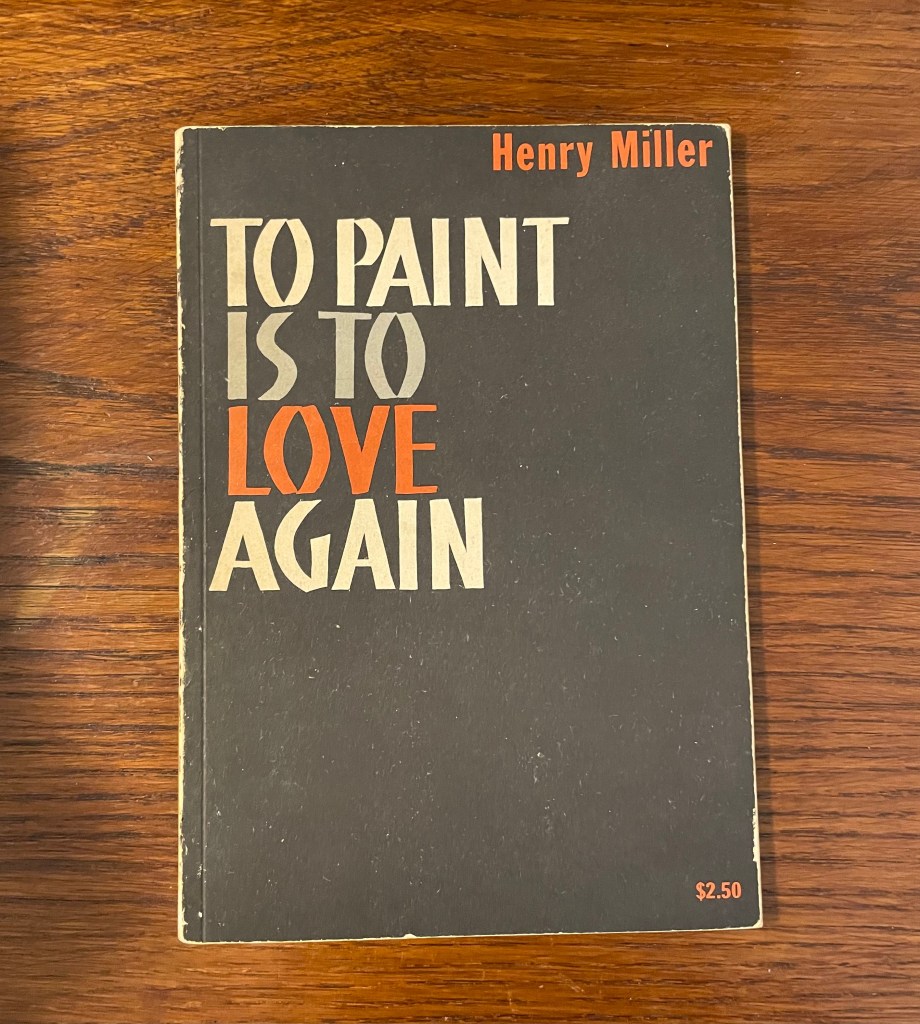
There might very well be an internal affinity between painting and love that at some point it becomes indistinguishable. A painterly picture can become love unquenched for that which remains persistently fixed and unrealizable. In one of the short essay books of his Big Sur period, Henry Miller asked this very question of painting. For him panting had a wondering origin that crosses the hand, undoing what we can easily enact. The erotic dimension of painting, thus, has nothing to do with the image or figure of the beloved, but rather with a specular limitation staged in the ability to allow the unseen to be incorporated in the visible scheme of the world. Only if we are able to see – and by the same token, only if there we are facing an event of painting – can something like use can be liberated from the constraints of mimetic compulsion. Miller writes in To Paint is to Love Again (1960): 

“To paint is to love again. It is only when we look with eyes of love that we see as the painter sees. His is a love, moreover, which is free of possessiveness. What the painter sees he is duty bound to share. Usually he makes us see and feel what ordinarily we ignore or are immune to a certain manner of approaching the world tells us, in effect, that nothing is vile or hideous, nothing is stale, flat or unpalatable unless it is our power of vision. To see is not merely to look. One must look-see .See into and around. Or, as John Marin, once put it – “art must show what goes on in the world” [1]. 

The place of painting for Miller is an imperturbable state that refuses to be fixated on objects, but in the invisible region (as in the figure of the chora) that allows for the thing in the world to be used. This is why Miller considered Japanese watercolor and prints an absolute primer of the pictorial: it taught him the appearance of worlds within the world, regionalizing the surroundings never logically stated unto itself, which in modernity it became the catastrophic horizon of autonomy towards its posterior liquidation. This is why Miller, very much like Carlo Levi, understood that the crisis of painting in the Western tradition ultimately signaled a general sense of social terror as a new phase of human desperation attenuated by the circulation of social fictions. 

At the height of the the closure of civilization, painting reemerged, if Kurt Badt’s axiom is correct, as the last metaphysical activity of human praxis. A metaphysical activity that holds on to the experience of belief in suspended appearance of originary anthropogenesis. For Miller, in painting as much as in love “one must be a true believer” [2]. And this assertion must be understood in the backdrop of Miller’s experiential retreat in the landscape of Big Sur: an experience away from the closure of American city life in research of a “feeling of aloness as spiritual achievement”, as a relation of oneself towards disclosure [3]. In this sense, the painter is a counter-social figure that, refusing to make stir in the world, turns to serenity, silence, and to the pressing contours of the unfathomable beyond any prefiguration. The believer in painting – who is a figure of belief in the desert, after the flight of the gods in the nocturnal vigil of history – is the thrust to the experience of things without barristers or shortcuts to what is revealed.

The age of automation in mid-century transformation of American industrial production serves as the historical backdrop of Miller’s indictment regarding the poverty and eventual disappearance of painting due to the autonomization of human praxis and the gigantic scale in spatial organization. Following Georges Duhamel’s prognosis in America: the menace (1931), he shared the intuition that the crisis of dexterity meant the impossibility of realizing painting, now situated beyond the grasp of human absorption [4]. A land without landscape that, as Adorno noted, bears no traces of the human hand. And this was seen already in the 1950s when the rise of abstract expressionism in North American announced not just the end of easel painting, but the funeral of the whole pictorial tradition. The barbarism of gigantic and unlimited Americanism would run counter to painting as a sensorial activity that embraced the vital limitations of its region. 

Miller’s insistence on painting was an eulogy to a life as experience – painting is indistinguishable from the hands and souls of the painters that he encountered and shared his life – and the value of poverty as absolute necessity for a life that regionalizes our contact with the world. It was through the love of painting that humanity could only restore its divine presence without rest.

Notes 

1. Henry Miller. To Paint is to Love Again (Cambria Books, 1960), 17. 

2. Ibid., 39

3. Henry Miller. Big Sur and the Oranges of Hieronymus Bosch (New Directions, 1957), 34.

4. Georges Duhamel. America: the menace (Houghton Mifflin, 1931), 85.
Gethsemane as experience. by Gerardo Muñoz

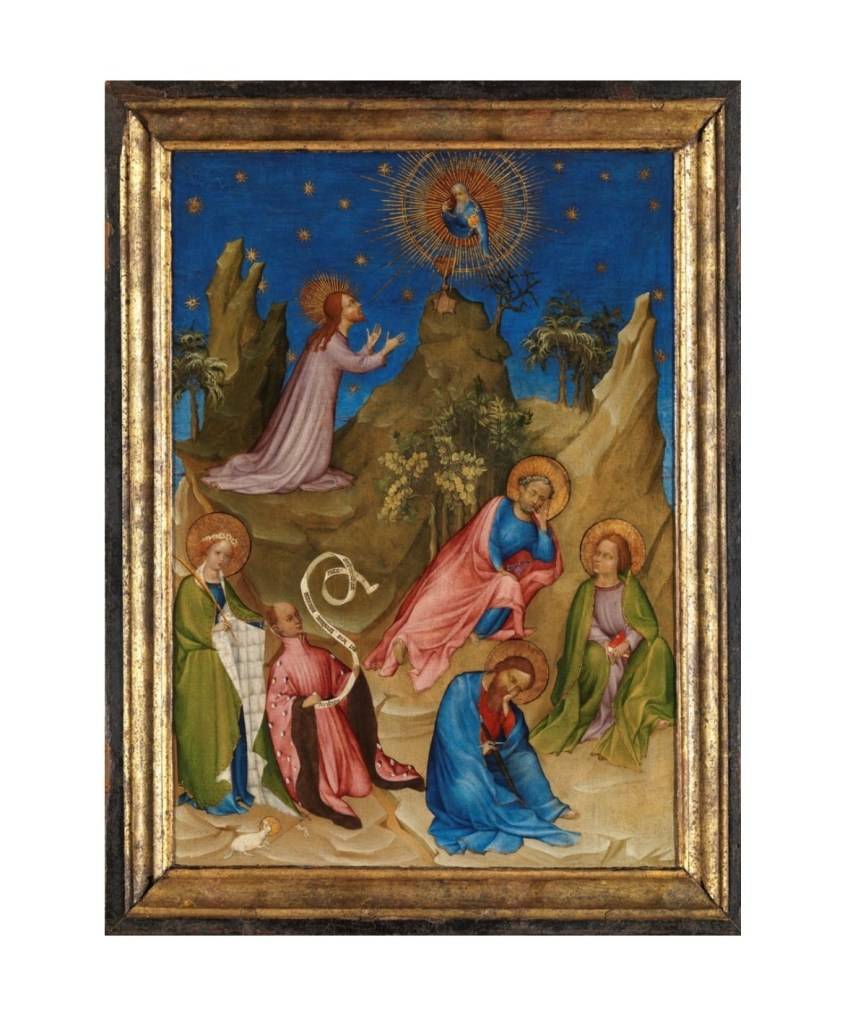
There is a panel in the Museo del Prado titled “Agony in the Garden”, attributed to the French painter Colart de Laon (1377) whose religious work barely survives (this panel is, in fact, one piece from an original triptych). The scene portrays the well known stay of Jesus in the Garden of Gethsamane on the Mount of Olives, where solitude and abandonment prepares the interval for the moment of transfiguration. If anything, Gethsamane is an experience of inwardness outside itself, which the painter has marvelously captured in the figure of Jesus raising his hands in supplication to the starry skies and god. Or so we think. The crisp blue tone of the sky immediately reminds the view of the vault of the Villa Farnesina that Fritz Saxl has interpreted as the transmission of a previous pagan astrological faith in the pictorial composition. The intense blue tone coupled with the emphatic stars arrest our imagination, but also that of the humane and worldly Christ.

What kind of experience is to look up into the firmament from man’s place on Earth and the cosmos? And what are we to make of the inability of the civilized human being to look into the blue depth not as a mirror of Nature, but of the non-totalizable and irreducible experience of solitude? It must be said that in a post-mythical world, the increasing loss of the opening of the sky goes hand in hand with the boundless loss of the Earth. And this is why we are tempted to read Colart de Laon’s picture as a gesture that renders legible the passage of the same movement: the Jesus that raises his hands outwards to the sky; and, simultaneously, the dozing Jesus that inhabits the contemplative state at the center bottom of the picture. To live in the world is defined neither by the experience of the time of arrival of the sky nor by the inward experience of the soul, but by the ability of transiting from one state to the other. And only there the worldly divine can be disclosed beyond the sclerosis of form.

This might also explain why Søren Kierkegaard following the German hymnist Gerhard Tersteegen could write in a gloss of his diaries that Jesus arises from the love feat into the path of Gethsemane: “It is always this way: Gethsemane lies closest to the highest bliss” [1]. The highest place is not the moment of absolute transcendence through faith; it is the secret that for Tersteegen expresses a kenotic hymn that empties life in the direction of poverty and death. In other words, the “highest bliss” is the experience of expropriation of every life; making life and death become indistinguishable in the vacillating night. A night beyond time and without god.  

Perhaps not just the “religious experience”, but all experience has as its central paradigm, the highest bliss in the face of death in which language can only account for it in its muteness and reverence. This is not an experience of vital teleology of humanity, but of a furtive relation. “Hacía sobre ella la experiencia”, as a Chilean writer once put it in the imperfect tense. But this can only mean to do an experience on the dissolution of oneself. 

Notes 

1. Søren Kierkegaard. Journals and Notebooks V.7 (Princeton University Press, 2014), 368.

Zoning and the inalienable. By Gerardo Muñoz

The notion of “zoning” in American public law refers to the compartmentalization of land use (residential, governmental, industrial, among others), as well as the “zones” of the administrative framework that dispenses its delegated power. It is a common fact that the Fifth Amendment of the United States Constitution, which includes the “Taking Clause”, states that taking territory must always be equitable compensated. The Fourteenth Amendment included during Reconstruction implements a non-discriminatory standard into zoning as division of space for political representation, and what is usually referred as “redistricting” in any given state. This means that the operative semantic and legal field of “zoning” refers simultaneously to both land as property, and territory as a spatial index of political representation. Of course, modern revolutions, whether in 1776 or in 1789, were stealth transformations of space into these two tier units of alienated property and representation, as we know from the territorial census in the aftermath of the French Revolution.

Likewise, the framework of Americanism as a political civilization is that of landsurveying, which ultimately means not just to make coterminous sovereign authority to territorial limitations, but to make transactions between world forms (territory and its inhabitants). If “zoning” has become a fundamental point of contention in all spheres of American life – from housing to development, from political representation to governmental “taking”, from wildlife sites to the circulation of good and services of the metropolis – is because the essence of Calvinism was fundamentally a settler cosmos that reduced life to usurpation of territory. In this sense, Bruno Maçaes is right that in the age of planetary Americanism the predominant form of domination is world-building and world-destroying. The perpetual social war over “zoning” is precisely the movement of building and destroying life-worlds through the linguistic justification of the administrative legal apparatus. 

In his forgotten book Nomos and Physis: Origin and Meaning of One (1945) on the severability of the two notion of “order” in Ancient Greece, Felix Heinimann notes that the triumph of nomos over physis implied a separation from the world of “reality” and “deeds” from that of rhetorical language that came to dominate it (nomos). In the present, the separation between nomoi and physis is the void that is perpetually governed by the attenuation of zoning: the creation of artificial worlds, but, at the same time, the composition of artificial languages. But the paradox is the following: the world of nomoi ceases to have any contact with that of physis; and physis, the natural world, becomes an artificial life world only responsive to irreflexive and undetermined practices of social exchange. This means that zoning is the vector of force that constantly separates human beings from both the world and language, and ultimately stripped its “humanity” from the species-being. 

As the zoning process plunges extensively into all spheres of practical and intellectual relations of human beings, an increasingly grouping of unalienable life emerges in a polar night. Here solitude in language brings forth the warmth of the unalienable. Perhaps it is in this night, where a trivial amor mundi will be cultivated for other generations, as beautifully suggested by Tim Ingold. A vita nota that will only commence on the lines that are invisible and opaque to the shining surfaces of zoning.