The irreducible in language: a note on Robert Antelme’s L’espèce humaine (1947). by Gerardo Muñoz

At the outset of L’espéce humaine (1947), Robert Antelme discloses the difficulty between language and experience that lays at the heart of the book, and which is never thoroughly assumed at the level of form in the novel. L’espèce humaine (1947) is ultimately not an account about the impossibility of describing what took place in the camps; from the banal physical violence to the desperate hunger, from the microaggressions to the slightest movements and carnage of bodies in space; from the joyful smiles in the most miserable of scenario where the ultimate goal was for the human life to slowly rot; the sequence of actions engage in no struggle to bring to a crisis the level of representation. And Antelme goes into painstaking efforts to give us a full picture of what took place, only to never talk about it again in writing or in personal conversations as Marguerite Duras tells us [1]. So, what to make of Antelme’s initial affirmation in the “Forword” where he states that: “…during the first days after our return, I think we were all prey to a genuine delirium. We wanted at last to speak, to be heard. We were told that by itself our physical appearance was eloquent enough; but we had only just returned, with us brought back our memory of our experience, an experience that was still very much alive and we felt a frantic desire to describe it as such as it had been…[..]. No sooner would we begin to tell our story than we would be checking over it. And then, even to us, what we had to tell would start to seem unimaginable” [2]. The unimaginable for Antelme is a sort of threshold of language; a limit for the unrestricted, that is, for what could allow for an experiment of language after the catastrophe, or in the wake of the civilizational catastrophe that is consummated in the camp. 

This delirium and anxiety over language – to tell it now and how it happened and to tell “the world”, only to immediately acknowledge the impossible task of doing so – does not take place at the order of the narrative; it is first and foremost something that we get a glimpse of at the end of the book as the liberating soldiers enter the rubbled towns only to encounter the incontinence of the survivors “talk and talk, and pretty soon he isn’t listening anymore” [3]. At that moment, the face to face between human beings will follow “to a kind of infinite, untransmittable knowledge”, Antelme tells us [4]. But what type of untransmittable and nocturnal knowledge is Antelme referring to here? It is not about some ethical exigency of the defacement of experience through linguistic construction; it is rather the torrential and densely weight of description and events, that numbs and deposes language in the very mediation of its effective sayability. The experience of human suffering and domination is untransmittable not because there is a deficit in language or the effacement of representation; but, on the contrary, precisely because there an excess of language that flattens irreducible suffering to an anaphoric socialization of speech that tacitly accepts inhumanity at face value. And that socialized distribution of speech underserves suffering, in virtue of equalizing an expansive chatter that neutralizes in survival the inherent pain of the irreducible human species within the imposible ordeal of total annihilation. 

Antelme’s L’espéce humaine  is stubbornly nominalistic in its thick descriptions of things and events, and it wants to avoid metaphoric transports. He prefers to call things as he sees it and get to the thicket of things in the most nauseating of repetitions. In a way, the hellish atmosphere of the concentration camp resides in the slow moving degradation of human life deprived of the world. However, there is one moment where Antelme resorts to calling a situation ‘hell’; that is, precisely, to an account of the transparent use of language, the raw incontinence and commanding force towards exteriority, as if there is no longer a caesura or separation between being and language once enunciation has been homogenized as commanding force. This is a language without a secret or unsaid, moving against the outside of consciousness in the same depretatory form as the same administrative machinery that has lifeless bodies as its target. In this way, language being turned into the force of speech will not only foreclose itself to the world, but it will signal the very intangibility by virtue of the flattening of verbal communication as an immediate and furious call to an annihilation of appearance. Antelme writes in this admirable moment – one of those instances where description of the state of things is incepted by the negation of the very conditions that allow for the narrative order: 

“Degradation, and flabbiness of language. Mouths whence nothing any longer ever came that was ordered, or strong enough to last. A weakly woven cloth fraying to bits. Stencens succeeded one another, contradicted one another, expressed a kind of belched up wrtnessness; a bile of words. They were all jumbled together: the son of a bitch who’d done it, the wife left on her own, food, drink, the old lady’s tear, the fuck in the ass, and so on; the same mouth could say it all, one thing after the other. It came forth all by itself; it would be empty. It only stopped at night. Hell must be like that, a place where everything that’s said, everythat’s expressed, comes forth equalized with everything else, homogenized, like a drunkard’s puke” [5]. 

The incontinence of language at the limit of what can be said is a secondary hell; that is, the last contortion that the inhumanity of the human can offer outwards in order to outlive in a moment of minimal pleasure, since the absolute pain of a glacial existence has been deprived of any real contact with the world and things. It is a linguistic hell – the looping language of the camp, will only mirror also the linguistic codification that around the same years will be elevated to the paradigm of cybernetics and the regime of information theory – will now appear as a unified block of application, enforcement and extraction. Hence, we should take Antelme at his word: language has become “flabby”, and it is a “puke”. It is circulation without sense, as in the looping mechanics of the furnaces charted by the Nazi engineers that appears in the recent sequence of the film Zone of interest (2023). It is not that sayability loses it claim to the autonomy of its form before an event; it is also that by virtue of its own degradation against the erasure of events, it can only be unified, packed, homogenized and rendered into equivalence in the wake of the absolute triumph of the historical project of alienation and external objectivity.  

The passage of the old hymnal texture of language as solace and lamentation could only entail the conservation of communication, which for Theodor Adorno writing during the same years as Antelme (1946-1947) will deduce as the “techniques of insolence enabling each individual to spread around him the glacial atmosphere whose shelter he can thrive” [6]. That the experience of the camp for Antelme ultimately meant that the “executioner can kill a man but cannot change him into something else”, must be placed in tension with the epochal transformation of a hellish experience of language at the service of the nihilistic service of equivalence that unveils its purest semblance at the camp [7]. The unitary reduction between the “socialized Man” and the “deportee” enters into a proper focus that Antelme was able to grasp with uttermost honesty: “…that there is no inherent difference between the “normal” system of man’s exploitation and that of the camps. That the camps are simply a shepherd image of the more or less hidden hell in which most people still live” [8]. At the risk of an overtly mannerist claim, it seems to me that the kernel of Antelme’s intellectual effort is to withdraw from the condition of hell that is condensed in the block of ice fixated in the ruinous material of language [9]. Memory, experience, friendship, truth, writing, the soul – these are all tools to chip against the brute reification of the glacial subjection at the price of ultimate solitude. Is there anything else worth a shot? In the last pages of L’espéce humaine, Antelme returns to the question of “freedom”, only to claim that “to be free” implies to “say no to everything” – and could we also refuse the language as it declines into flabbiness, equivalence, and its putrid decline, as overflowing mountain of trash that covers up the ongoing pain of the human species? [10].  

Sure thing, the hölderlinean enduring and difficult task of the “free use of one’s own” appears here with some urgency as the requirement of traversing the attunement to pain. Antelme seems to have wanted to offer a negative theology to “forever starting anew”, in which the irreducible of human sayability is posited as the condition of the “only transcendence between beings” [11]. “To speak, in a word, is to seek the source of meaning in the prefix that the words exile, exodus, existence, exteriority, and estrangement are committed to unfolding in various modes of experience;  a prefix that for us designates distance and separation” [12]. Aren’t distance and separation two conditional criteria for grounding the irreducible? The habitation of the speaking being can harbor the contours of the unfathomable expression on the reverse of social tribulations, which is always the primal nomos of equivalence. Allowing the expansion of the irreducible as a the site of an ordinary accumulation of freedom preserves a sensible region for what takes place (“whatever happens” — and is not this taking place the opening of the non-site of the chorá?) in a language attuned to the relentless event that has forever touched us. This is already the site of the unimaginable beyond and away from the language of survival that permeates everything in both times of peace and of war. 

Notes 

1. Marguerite Duras. El dolor (Alianza editorial, 2019 ), 71.

2. Robert Antelme. The Human Race (The Malboro Press, 1998), 3.

3. Ibid., 289.

4.Ibid., 290.

5.  Ibid., 135. 

6.  Theodor Adorno. Minima Moralia: Reflections from the damaged life (Verso, 2020), 33

7. Robert Antelme. The Human Race (The Malboro Press, 1998), 220.

8. Robert Antelme. “Poor Man – Proletarian – Deportee”, in On Robert Antelme’s The Human Race Essays and Commentary (The Marlboro Press, 2003), 22. Dionys Mascolo makes more or less the same claim in Autour d’un effort de mémoire: sur une lettre de Robert Antelme (1987) when speaking about the stratification of species in the camps and the division of classes in society: “l’intuition aveuglante de tous les survivants est celle d’avoir fait quant à eux, sous une forme extrême, cette expérience: que l’organisation de la société en classes telle que nous la vivons est déjà une image de la division de cette société en espèces, comme dans les camps”, 87.

9. Robert Antelme. “Revenge?”, in On Robert Antelme’s The Human Race Essays and Commentary (The Marlboro Press, 2003), 15.

10.  Robert Antelme. The Human Race (The Malboro Press, 1998), 291..

11. Robert Antelme. “The Smiling Angel: Rheims Cathedral”, in On Robert Antelme’s The Human Race Essays and Commentary (The Marlboro Press, 2003), 10. 

12. Maurice Blanchot. “The Indestructible”, in The Infinite Conversation (University of Minnesota Press, 1992). 

Elio Vittorini on the time of existence. by Gerardo Muñoz

In Elio Vittorini’s short travel book Sardegna come un’infanzia (1957), entirely composed of painterly vignettes of his visit in the thirties, there is one of them that immediately jumps out at the reader, because it is the only moment where the radiance of the image and the possibilities of thought touch each other without any reservation. It is almost the moment in which the senses of what is felt and seen mysteriously touches a region that is not entirely political, even though it figures as the highest ‘political moment’ in Vittorini’s chronicle.

Vittorini is observing the ordinary lives of the common people in Sardinia when all the sudden he writes the following: “Now, and in spite of everything, those sitting down, almost drowsy and without much to do, are in life. The others in the struggle are not, especially if they fall into consciousness by the struggle and the movement, without understanding any other pleasure than that of the full warehouse. The secret is to struggle for existence, but without being colonized by the struggle’s idealism…in this way, there will be true life in the very roaming path. I have always understood activism for activism’s sake as the business of flies that, once they have taken off, they begin to scratch their head or sharpen their legs” [1]. It is almost as if written the parable of the fly is written for our times, where so many are blinded by the secularization of a Jesuit figure of the militant. The activity of fly, just like that of the political militant, falls into the pretense, thanks to the allure of his self-consciousness, that something moves in spite of its complete paralysis. The fly only moves in the metaphysical abstraction from ideal projection to material outcome and preconceived ends that it knows beforehand. Nothing moves and nothing ever can amount to a discovery or an event. The fly will recurrently miss the world because it has become obsessed by the illusion of its movement, convincing itself that flying over fresh dung is something entirely different.

The political subject is primarily the subject of the accumulated freedom, but it can rarely grasp ‘a way out’, as Peter Red claims in Kafka’s “A Report to an Academy”. Vittorini’s roaming and inert path is the sentiment of true life (“the serene truth of life”, he will say in a few pages later), which is always on the predicated on the possibility of experience against the crust of ideological falsification – even when this process is narrated from the point of view of the proletariat as the motor of the dialectic of history of its self-overcoming to completion. The ‘secret is to struggle for existence’, which entails how to grasp life as utterly outside that can only be shaped by a contact with the world. Perhaps by “sensing” the world without ever becoming its master; rather, what’s involved is a task of a cultivation that must remain singular by virtue of its own irreductibility. 

And in a way, this was Vittorini’s own heterodox understanding of communism where there is according to him there was no “collective building of the soul, but rather the destitution of false differences so that once those regulated differences are abolished, new possibilities of absolute differences can flourish” [2]. This is why Vittorini could not find solace in the political militant or the engaged intellectual, except as figures already acting as smugglers of the planned obsolescence of a civilization overtly defended by those facilitating its own demise [3]. In the landscape of Sardinia – by the most passive of roles, he was merely a theōrós after all – Vittorini unravels the metapolitical blackmail of the epoch in order to conquer the most essential and inapparent: the time of existence in a minuscule world within worlds – and thus, always in a permanent state of infancy – that treasures something immense because it will be forever remain unknowable.

Notes 

1. Elio Vittorini. Sardegna come un’infanzia (Mondadori, 1957), 64.

2. Dionys Mascolo & Edgard Morin. “Une interview d’Elio Vittorini”, Les Lettres françaises, 27 juin 1947: https://entetement.com/une-interview-delio-vittorini/ 

3. Elio Vittorini. “La civilización no es algo que defender” (1937), in Diario en público (Gadir, 2008), 86.

The Etruscan bona lux in Paradiso. by Gerardo Muñoz

In Chapter Ten of Paradiso, José Lezama Lima’s magnus opus, we encounter a curious dialogue between Cemí and Fronesis colored by a fortuitous reference to the Etruscan world, which speaks to the poet’s profane, and at times monstrous form of Catholicism. As it is known, even for an ecclesiastical authority like Tertulian, all Etruscan mythological and iconographical inventions had to be incorporated into the Roman civilizational state in order to wipe out the barbaric fraudsters and con artists soothsayers and liver readers out of date from the new revelation [1]. I have recently written on Lezama’s transfigurative Etruscan theology into his conception of the poetic image, therefore here I will only note how this particular transfiguration is enacted in the very existential outlook of the characters in novel. It seems to me that confirms that for Lezama the Etruscan sensibility was not to be understood solely as a resource of his complex poetics, but rather as an ethical form pertaining to the demonic in life. It is no surprise, then, that this happens in the reiteration of the encounter – the whole of Paradiso as the memorable final lines emphatically show is about recommencement of the unfolding of life – between the two friends: 

“Bona lux, como saludaban los etruscos – le dijo Cemí… Ex templo, en seguida entre los romanos. Todo lo que no es en seguida es demoníaco, dice Kierkegaard. La vaciedad de la mañana se había trocado de pronto en la alegría del encuentro. – Vamos en seguida al cafecito de enfrente para hablar un poco – a Fronesis le pareció que la palabra cafecito, dicha por Cemí, bailaba en la mañana” [2]. 

I have not been able to find or corroborate that Etruscans, whose language is still a linguistic mystery, in fact greeted each other with something slightly similar to ‘bona lux’ as Lezama makes Cemí say. And it is still strange to think of Etruscans in relation to light and the morning phase of the day. What could it mean in this context where a minimal theory of the encounter is sketched (‘the encounter had brought happiness to the emptiness of the morning’) that Lezama explicitly identified the alleged mysterious Etruscans with a “good” light or illumination that is self-transformative? Lezama could have known the work of pioneer English archeologist George Denis, whose Cities and Cemeteries of Etruria (1848) reminds us how even in the tomb underworld of the Etruscans, there were always banquets decorated by lamp lights, erecting a threshold between the noche oscura of the infraworld of the dead, and the colorful landscape of the living image merging without reminder thanks to the bona lux of the encounter [3]. Is this it, then, a folded communion between the interiority of the dead and the exteriority world of the living? Obviously, nothing could more alien from Lezama’s intricate poetic world than a direct metaphoric restitution of the Etruscan world fixed in the autonomy of modern poetry, which will amount to a desperate attempt to deify language through a ‘spiritual drama’ as the conquering of self-absorptive verbal immediacy (it is in fact “en seguida” of the presentist time of response). 

As Lezama had written in the gloss “Conocimiento de salvación” (1939): “Todos los grandes intentos poéticos contemporáneos, desde la poesía pura hasta el surrealismo, no son otra cosa que un esfuerzo desesperado por prolongar la percepción de temporalidad rapidísima, o trocar el estado sensible – ocupado según Schiller en mantener al hombre en los límites del tiempo – en ajustada percepción” [4]. But what is suspended here is the possibility that living poetically and sensibly – the dwelling of a serene life encountering in company of others, that is, in concordia – validates the attunement of life with its demon. And this was at the heart of Lezama’s perception of the Etruscan everlasting mystery: not simply what remains foreclosed in the arcanii of the infraworld, but the liberation of human potentiality through the grasping of its prophetic images: “Los etruscos ofrecían una palabra misteriosa, el potens, si es posible, a esto se añade el hoc age, házlo, es decir si es posible hazlo. El potens por la imagen hace posible la sobrenaturaleza” [5]. The potens stands in as the name for the incommensurable distance of living among things (theín). Hence, the only common good resides between things, and not in a substantive higher source.

In a thorough rejection of the supreme moral order proper to rationalist natural law, Lezama will take the enlightened pictorial sense of the Etruscans as the realm of possibilities that can organize life in the  presence of what it has discovered: “un splendor formae…las imágenes como interposiciones de la distancia entre las cosas…ya no su enemistad, sino una llaneza de inmediato” [6]. The enlightened form produced by the encounter realizes a state of happiness that, thanks to the free use of language – the spoken word as the greeting voice in this case – it enacts a dance beyond sense becomes moving. This is why it is through the unknowable charitas of language that human beings become equals to the momentary gods of things in the world. Or at least puts them in proximity. One can believe that is the occasion for the gleaming abundance of  bona lux – the mystery where something finally begins. 

Notes 

1. Lucy Shipley. The Etruscans (Reaktion Books, 2023), 163.

2. José Lezama Lima. Paradiso (Ediciones Cátedra, 1980), 478.

3. George Denis. The Cities and Cemeteries of Etruria (John Murray Street, 1848), 37.

4. José Lezama Lima. “Conocimiento de salvación”, in Analectra del reloj (Origenes, 1953), 251-252.

5. José Lezama Lima. “Apuntes para una conferencia sobre Paradiso”, en Paradiso (ALLCA XX, 1996), 712.

6. José Lezama Lima. “Las imágenes posibles”, in Analectra del reloj (Origenes, 1953), 179.

Thrasymachus, the paradigm of force. by Gerardo Muñoz

Few characters are more memorable in the first book of Plato’s The Republic than the sophist Thrasymachus, whose shadow is still very much looming around us given that it is obvious that today everything in our contemporary world is optimized through force. Thrasymachus’s strict identification of reserve power (potentia) with justice (ius) is in many respects prophetic, since it already subordinates the ideal of justice with practical reason and effective norms, a crowning achievement of modern political power. This is why Leo Strauss could claim in The City and Man that Thrasymachus’ position is ultimately a defense of the thesis of “legal positivism” that brings to fruition the legitimate order and the police powers of the city. In other words, Thrasymachus discovered that the requirements for the permanence of an active social order of a police entails the mediation of the two dimensions of legal authority: obedience and the internal recognition of a secondary rule that liquidates the possibility of raising the question of what is “just” (now internal to the organization of internal powers). If the aim of “justice” becomes the optimal application of effective rules and norms that provide the services of the city, then political rule becomes an infallible and uncontested logic. Politics is ultimately force, and force is the energy organized by politics in the city. 

As Strauss writes: “Thrasymachus acts like the city, he resembles the city, and this means according to a way reasonably acceptable to both…Thrasymachus is the city. It is because he is the city that he maintains the thesis of the city regarding justice and that he is angry at Socrates for his antagonism to the thesis of the city. Thrasymachus’ rhetoric was especially concerned with both arousing and appeasing the angry passions of the multitude, with both attacking a man’s character and counteracting such attacks, as well as with play-acting as an ingredient of oratory” [1]. Well before the general equivalent of contractual commercial relations, Thrasymachus’ rhetorical deployment functioned as a techne alupias against the unwarranted passions of human beings. And, contrary to the common opinion that separates the craft of sophistry from the unity of rational discourse (logos), Thrasymachus’ defense of force presupposes the autonomy of language in the rhetorical construction (very much like modern poetry centuries later) to serve as the hospice of rational pondering in the polis. To make language the exclusive battle ground: even in antiquity it was said of Thrasymachus, “you are just like your name, bold in battle”. And Plato wanted to hold on to this picture. This ultimately means – and it is still at the center of our contemporary predicament – that the coming of the “Social man” in the city is only possible on the condition of a primary transformation of the event of language and the speaking being. This is why if Thrasymachus was the “pioneer of rhetoric and elocution”, as it has been claimed, it is only because his appeal to the pragmatics of political power was mediated by the invention of the ‘mystery of the prose style’; that is, of reducing the non-grammatical mediation to the orderability of a prose adjusted as an instrument to the world [2]. The enslavement of the passions is the commencement of the social prose in which we are forced to act in our alienated roles.

Only when language becomes rhetorical communication it is possible to grasp the world as a case of an entity of legibility and knowability, where reasons (inclusive and exclusive, that is, as what can be delegated for my own interests) and political rule converge without residue. What will become obvious through the cybernetic dominion over “information”, it was first elaborated as the pressure of rhetoric where the logical force of predication took its force to disclaim myth as the unappropriated experience of worldly phenomena. The art of rhetoric does not render “truth” obsolete; it rather incorporates theoretical and systemic deductions – a flattening of logos without myth -, so that the event of truth can no longer stand as the unsurveyed horizon of the intelligibility [3]. The consolidation of force means this much: that Thrasymachus’ prose of the world is not just an exclusive political program of the “fictitious”, as much as a program for the total attainability of the world; a world that by becoming fully accessible and objective, it pays the high price of eclipsing the presence of things, and the event of truth and naming in language. A world without kallipolis that will only distribute and perpetuate ad infinitum injustice as the corollary for the triumph of immanence of force.

Notes 

1. Leo Strauss. The City and Man (University of Chicago Press, 1964), 78.

2. Bromley Smith. “Thrasymachus: a pioneer rhetorician”, Quarterly Journal of Speech, 1927.

3. Gianni Carchia. “La persuasión y la retórica de los sofistas”, in Retórica de lo sublime (Tecnos, 1994), 60.

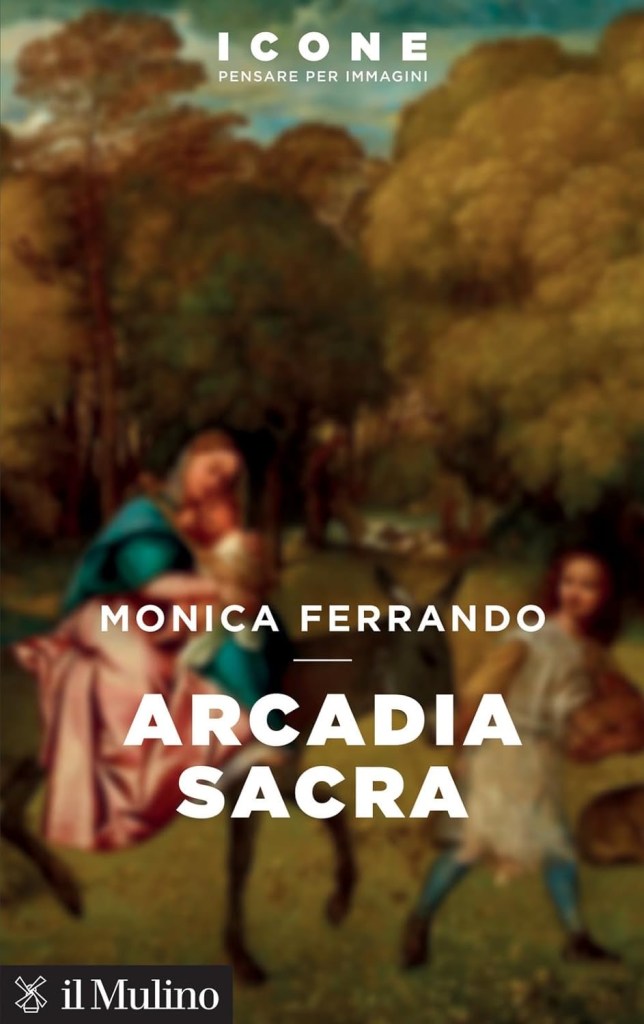
Living among the gods. On Monica Ferrando’s Arcadia Sacra (2024). by Gerardo Muñoz

For anyone familiar with the delicate thought of Monica Ferrando, the short book just published, Arcadia Sacra (Il Molino, 2024), makes it impossible not to read it in light of her the two previous works, the ambitious Il regno errante (Neri Pozza, 2018) that reconstructs the political paradigm of the nomos of Arcadia, and L’elezione e la sua ombra: Il cantico tradito (2022), which brought to light the corrupted meaning of a theopoetic understanding of “election” and its appropriation by an effective economic theology apparatus that governs over the destiny of the modern edifice. Arcadia Sacra continues Ferrando’s highly original reconstruction of the unforgettable myth of Arcadia within the obscure setting of secular  modernization in which painting itself has come into crisis to the point of utter obsolescence. We might be the first epoch in the history of humanity (or even prehistoric, since painting goes back to the non-original origin of the caves, as Ferrando has argued) in which painting itself is lacking and almost non-existent [1]. And although Ferrando does not allude to the present directly, it goes without saying that by choosing as her focal point Titian’s early picture “The Flight into Egypt” (1508), the vision deployed in the essay can only speak to us as urgently, where the thematics confronted by the Renaissance of Venetian painting returns to our present in a fractured flash: imperial conflagration, unlimited deployment of force, usurpation of territory and  multiplication of legal checkpoints, and the accelerated disconnection between architecture and nature, color the ongoing devastation of the vantage point of the landscape now eclipsed by the radiant artificial confinements of the contemporary metropolitan designs.  

Already during his postwar years in the United States, Theodor Adorno observed how the unbounded sadness of the American landscape has nothing to do with an inhuman romantic sublime; it was rather that the landscape feels as if it bears no traces of the human hand [2]. If Americanism configures the long lasting night of planetary nihilism; this is so, not only due to capitalist subsumption and production of human life, but fundamentally because of the inherent obliviousness of the  landscape that forecloses dwelling in the world. But the myth of Arcadia, as Ferrando will insists, is no utopia nor crafted rhetoric (the bucolic genre as an aesthetic compensation to the normative grid of the social bond); it is also the question about the earthly ground of existence, and the necessary attunement with the things that have been domesticated into order of the metaphysics of idolatry and objectivity (Ferrando 28). In this sense, Arcadia does not name another world to come; it is a world that has been registered many times, reappearing whenever the hand reaches out in proximity as if caressing the landscape’s skin.

The mytho-poetical deployment of Arcadia returns amidst a world in conflagration, and for Ferrando this has fundamental political implications insofar as it shows a way out from the grammar at the service of force and political dominion of commanders and soldiers – which is always already exercised as legitimate to coerce and to become a tool for the regulation of abstract mediations – into the voice of poets, painters, and shepherds (Ferrando 51). Arcadia reveals that the human species is a ductile animal that can sense by the ability to touch and use. This is why Arcadia stands as a third space outside the political dichotomy of empire and republicanism, between the struggle of usurpation and conquest, and the techno-political administration of common goods of social distribution and institutional delegation. The abstract humanism of the Renaissance, as Heidegger once claimed alluding to Machiavelli’s political thought, is also the commencement of a specific political technology rooted in certainty and justification that can only conceive representation as the ground for the production of an “effective truth” [3]. The virtuous homini militari of the Italian city states anticipate the neutralization of force as legitimate rule that will prepare the stage of modern political realism based on fear and normative rule of law. The final efficacy of force is to transform the sense of the world into a mere object, as Weil clearly understood it in her essay on Homer’s Iliad. One of the key insights of Ferrando’s Arcadia Sacra (2024) is that it shows that, parallel to the revolution in political technologies taking place in Renaissance Humanism, the image of Arcadia was being rediscovered in treatises and paintings in order to remain faithful to a different attunement of the nomoi, in which the philosophy of history of sacrifice, endless civil wars, and destruction of the Earth do not constitute true destiny (Ferrando 14). In an exoteric way – and it is so, because the craft of the painter is, precisely, depiction and figuration of the nakedness of what appears before our vision-  painters like Titian, Veronese, and Bellini, became witnesses to the acquiescence of the nomos mousikos, which far from soliciting the conceptual density of a theory of Justice; it registered the preeminent condition of poetizing nature of  living in the vanishing world. Indeed, it was in the musical nomos where the soul could establish the communication between exteriority and interiority within the gleaming order of things. 

If Heidegger in The Origin of the Work of Art suggests that the erection of work occupies the open space of this clearing; Ferrando will thematize how Boccaccio’s understanding of the Earth as radiantly divine was drawing upon the tradition of Arcadia will emerge as the pictorial space of the artists to disclose the vibrant sense of a necessary freedom (Ferrando 43). This means that living among the gods is not reducible to panentheism, if understood as oppositional to monotheism; rather, it was the opening to the event that gathered forms of life,  creations,  affections, and territories. In other words, there will always be gods whenever the world is not enclosed into the homogenous surface of a unified planetarity. And is not painting the quasi-originary activity of human anthropogenesis (the event of being in the world as such) the  sensible evidence that negates any conceptual and political translation directed towards action and justification? After all, painting is, among other things, the business of depicting mute things, as Nicolas Poussin famously claimed. 

But muteness must be qualified and expanded, since Arcadia is no asylum or final refuge of man. Titian’s “The Flight into Egypt” depicts a rite of passage, but also opens to a set of rhythmic connected activities that lead to the landscape. Thus, as Monica Ferrando reminds us, building from her previous Il regno errante, Arcadia is also the material experimentation of acoustic energy; music, or the the nomos mousikos, no longer guided by the command of political service, directed by attunement of the lyre and the syrinx, will speak the unwritten language of the human soul. Painting and music convergence at the nonsite of permanent formlessness. And it is rhythmic music allowing improvisation and experimentation that reimagines a different conception of the polis; a transfiguration of political life, in which the principle of civility in all of its complexity (citizenship, objective transference and negation, civilizational fortitude) will no longer articulate the principal axis of the human commonwealth. Neither a source of higher natural law nor a mere expansion of positive norms, the nomos of Arcadia for Ferrando entails: “inalterabile a unire intimamente musica e legge, entrambe  ágrapha, non scritte, se non nel cuore. L’interdipendenza tra modi della musica e nomoi della città, che sarebbe vano interpretare secondo un rapporto causale, trova nella stessa parola nomos un compendio inesauribile, ribadito nella Politeia: «Non si introducono mai cambiamenti nei modi della musica senza che se ne introducano nei più importanti nomoi della polis” (Ferrando 54). The separation of law from music – as Ferrando will say for poetry and philosophy in later pages – will ultimately lead to the moral struggle towards the rise of the fictitious (and whoever can impose it through their effective hegemony) against the emergence of the “love of thought” (l’amore del pensiero) (Ferrando 57). In this sense, the moralization of justice and its conversion into a specific historical grammar (lex scripta in the juridical apparatus) will ground the order of the polis in which the human will be absolutely sacred so that the sacred nearness between existence and the world – the atopia where the promise of happiness can take place – will vanish forever. As Carlo Levi saw clearly during the postwar years, the rise of the political administration of fear will coincide with the decline of painting as the source of being in liberty within the senses [4]. And, in our days, the historical termination of secularization can only be felt like an unending glacial interregnum (it is no surprise that Disney’s epochal blockbuster is precisely a defense of alienation of a cold being in a Frozen castle) in which the prehistoric reminiscence of the garden can only appear as an afterthought or mere representation, always out of reach, and viciously grazed by wild beasts before our own eyes.  

But seeing is already an exercise in prefiguration of a world that returns where painting stands as the medium for a mediation between the formlessness and the soul. This is why, above all, pictorial space is a privileged surface from which to flee our condition of unworldly inmates of our times. In a certain way, painting does not just bring to bear truth against the regime of calamitous fictions; it is also bears witness, as Ferrando states towards a high moment of Arcadia Sacra (2024), to the rediscovery of a new mental space that revives the attunement to a state of the world no longer reduced to the depredatory practices of civilizational extraction and consented servitude (Ferrando 77). The tradition of painting is not just a collection of forms and artistic conventions, but the ongoing concert that facilitates our movement (and being moved) towards happiness.

This is the promise of the itinerant Mary’s passive and inclined face in Titian’s early masterpiece. It does not come to surprise that for Ferrando, the mother dwells among the gods of peace, in contrast to the figures of the commander or the inquisitorial or priestly judge that monitor an endless narrative of intra-species civil war (Ferrando 63). It should not go without saying that at the same time that some contemporary scholars in the face of a historical crisis of legitimation attempt to revive the aura of the homini militari, the precepts of the ragion di stato and the technical virtues of the charismatic Prince; it has been the work of Monica Ferrando, in fully in display in Arcadia Sacra (2024), that invites us to turn to the counters of eros of painting that, almost stubbornly, transmit to us the infinite possibilities of life among the green blades of grass in Pan’s spiritual land (Ferrando 82) [5]. The sacredness of Arcadia resides in this unbounded exteriority that thanks to the mystery of the mother, is always commencing; and, having achieved happiness, it wants to know nothing about bring the world to conclusion. Beneath the arcana imperii (Rome) and the bylaws of the polis (Athens), the landscape of Arcadia remains a harmonious passage of our cohabitation.   

Notes 

1. Monica Ferrando. “Editoriale”, De pictura 3, 2020: https://www.quodlibet.it/rivista/9788822011643 

2. Theodor W. Adorno. Minima Moralia: Reflections on a Damaged Life (Verso, 2005), 73.

3. Martin Heidegger. Acerca de Ernst Jünger (El Hilo de Ariadna, 2013), 113.

4. Carlo Levi. “Paura della pittura” (1942).

5. I am thinking here of the works of several American  historians of political thought and  legal scholars in recent years that have mobilized efforts to restore a “neoclassical”, Renaissance centered political tradition, as a response to the crisis of modern liberalism. The most prominent list includes, although it is not limited to James Hankins’ Virtue Politics: Soulcraft and Statecraft in Renaissance Italy (Harvard U Press, 2020), Harvey Mansfield’s Machiavelli’s Effectual Truth (Cambridge U Press, 2023), and Adrian Vermuele’s endorsement of Renaissance imperial categories such as Ragion di stato, Lex Regia and the tradition of the Mirror of Princes, see his “Sacramental Liberalism and Region di Stato” (2019) and “The Many and the Few: On the American Lex Regia” (2023). The pastiche of this neoclassical investment made possible by rhetorical and hermeneutical deployments of instrumentalized myth, it is something that I have taken note of in “¿Revival de la tradición legal clásica?” (2022). Drawing a parallel to this classical absorption in American political thought, one could say that this is a reiteration of what Monica Ferrando herself has analyzed in her chapter on German Romantic Neoclassicism and the Winckelmann aesthetic project in her L’elezione e la sua ombra. Il cantico tradito (Neri Pozza, 2022), except now that it lacks aesthetic meditations (there is no Dichter als Führer), thus culminating in the direct exercise of applied executive force. 

Tum Otheos: on a detail in a Van Eyck’s painting. by Gerardo Muñoz

Jan Van Eyck’s 1432 Portrait of a Man has the Greek inscription, and rendered in transliteration, that reads “Tum Otheos” (ΤΥΜ ωΘΕΟς) that has baffled art historians and specialists on the painter for a very long time. It is well known that Van Eyck, the pioneer of oil painting, was fond of leaving all forms of writing in his pictures in Greek, Hebrew, and trilingual idioms that through the centuries have become incomprehensible jottings [1]. At a time when Van Eyck was painting in Northern Europe, the magical efficacy over names and naming was a dominant cultural and religious belief, and the expanded arts of the ‘names of god’ were used to heal and relieve pain, and protect against potential enemies and keep demons at bay [2]. Following Hermann Usener, one could see how the original act of the naming of the gods was no longer tied to ‘momentary divinities’ (Augenblicksgötter), but rather they were functionalized to specific anthropological needs for survival. Nonetheless, it is quite ashtonishing to witness how the painting at year zero that Van Eyck embodies – the very birth of oil painting and the “coming to life” of the figure in depiction – coincided with a divinization itself of the expanded field of the arts [2].  

In Erwin Panofksy’s early interpretation the inscription “Tum Otheos” should be read in light of the musical revolution that had taken place between 1420-1440 in the Netherlands, where the ars nova meant a thorough musical renovation towards a new expressive energy and “exquisite sensibility” nourished by the myth of Timotheos, who was taken as the ancient model of sublime harmony of the new arts and style of bringing life into depiction [3]. Overtly dependent on the transmission of the ancient figure of sound, for Panofsky the inscription “Tum Otheos” pays homage to the lyre Timotheus of Miletus as creator of the “new music”. But, could the same be transplanted into painting? Could painting at “year zero” be taken as precisely this new tonality of the arts? 

A second possible rendition of “Tum Otheos” is one what has been merely registered, although not elaborated, by art historian Alfred Acres, for whom “tum otheos” is not indexing the ancient musician but more importantly, it is registering an event or what is taking place [4]. Thus, for Acres “Tum Otheos” should be read as “and then God”; as if the relationship between painter, depiction, and spectator was the very taking place of a minor and invisible god of creation that painting facilitates. It is not difficult to recall here what Luca Giordano said of Velazquez’s painting: “this is the Theology of Painting” [5]. Although directed at Las Meninas, one could perceive that in the early stages of the secularization of the forms of the modern, the nexus between theology and painting becomes a clandestine partnership that resists its full integration into the autonomization of forms of representation. In other words, there is always a theos reminder in the act of depiction that is irreducible to the general economy of forms, as if the dissonance of the soul endured underneath at the nearness granted by the concrete realization of a picture. “And then God”, as proposed by Acres, should not be taken merely as the eruption of the divine in the symbolic structuration of the world, but rather as the very act of naming that allows divinization to continue in spite of the closure announced by the flight of the gods. 

Just one year after Van Eyck’s Portrait of a Man (1432) where the inscription “Tum Theos” appears, in Italy Alberti will write in his De Pictura that the gesture of painting “possess a truly divine power in that not only does it make the absent present (as they say of friendship), but it also represents the dead to the living many centuries later, so that they are recognized by spectators with please and deep admiration for the artist” [6]. And if Postel is right that Van Eyck’s Arnolfini masterpiece is one in which the picture reconvenes the dead bride and the rich merchant into pictorial space, then one could deduce that for the Flemish artist the divinity of painting is defined as the only passage left to the moderns to negate the world of the living and inhabit the invisible world of the dead against the coming of the monothematic world-image and its material crust of Gaia [7]. “Tum Otheos” – and then God – is literally registering the transfigured and expressive dimension of painting; that is, the taking place of depiction and its secret fidelity to what appears only to banish and become forever unfathomable. 

Notes 

1. Susan Frances Jones. “Jan van Eyck’s Greek, Hebrew and Trilingual Inscriptions”, in Van Eyck Studies, September 2012, 294.

2. Noa Turel. Living Pictures: Jan van Eyck and Painting’s First Century (Yale University Press, 2020).

3. Erwin Panofsky. “Who Is Jan van Eyck’s “Tymotheos”?, Journal of the Warburg Studies, 1949, 88-89. 

4. Alfred Acres. Jan van Eyck within His Art (Reaktion Books, 2023), 177.

5. Daniel Arasse. Take a Closer Look (Princeton U Press, 2013), 134.

6. Leon Battista Alberti. On Painting (Penguin Classics, 1991), 60.

7. Jean-Philippe Postel. El affaire Arnolfini: Investigación sobre un cuadro de Van Eyck (Acantilado, 2023).

After plasticity: on Heretical Aesthetics: Pasolini on painting (2023). by Gerardo Muñoz

Pasolini never ceased reflecting upon the painterly nature of the image outside of both literalness and abstraction. In Pasolini we are accustomed to be exposed to a set of antinomies: image and depiction, tradition and the primordial, figuration and the tactile, the world and its fragments. The publication of his miscellaneous writings on painting (and painters of the Italy of the 1950s-1960s) Heretical Aesthetics: Pasolini on painting (Verso, 2023), edited by Ara Merjian and Alessandro Giammei, provides depth and substance to document Pasolini’s insistence to the pictorial activity as an index of unmediated expressivity against the domestication of the accelerated capitalist form that soon enough will generate devastating consequences for idiomaticity and the pregramatical expression of a living culture. It is not too far-fetched to claim that painting remained for him a necessary condition of the cinematic; a specific craft that fundamentally rejected the impulse to naturalness and its mimetic performance. Pasolini remains attached to painting as a form of embodiment, a corporeal resource, and an energetic surface of positioning of light.

After all, as the editors of the book remind us at the outset, Pasolini was after the “plasticity of the image” (37). And plasticity pushes the dexterity of human creativity, but it is something else as well: it is a line of expansion into the prehistoric when it comes to the frontier of appearance. And perhaps Pasolini would have agreed with Gianni Carchia’s indictment in Il mito in pittura (1987) that the attempt of realizing appearance – even at the cost of failing at it – is the fundamental metaphysical node in which the entire history of Western painting stands. A good painting elevates itself to supreme theology, as Luca Giordano said of Velázquez. The problem of appearance in Pasolini’s scene of writing on painting is registered through partial indications: the tone of detailism, the violent and free moving impressionism, the struggle for stylistic contamination, or in the “fragmentary chromatic and interrupted aesthetic” (114). Pasolini’s eye is always accessible to the transient and expressive in a picture.

But the Italian filmmaker struggles with description of paintings, as if possessed by a permanent impatience that harbors his recurrent shortcomings. And he was not unaware: “I am not fluent in the terminology of painting, so forgive me if I sound less specific” (134). It is a declaration that does not only appear once in this collection. One could speculate that this dilemma is resolved by Pasolini in three ways: first, he can choose the painters from a personal criteria that would justify his awareness of painting as a prehistoric cultural activity. Secondly, Pasolini repeatedly alludes to the teaching of the great Italian art historian Roberto Longhi – who was responsible for the first formal analysis of Piero de la Francesca’s pictorial oeuvre – as companion and a maestro that during the Fascist interwar period gifted his students (and Pasolini among them) a different reality through commentaries on the seminal works of Italian Renaissance painting (155). Longhi’s anti-iconographical approach to the pictorial tradition allowed Pasolini a sense touch – not less real than the physical hand that caresses another body or hard surface – and the inexorable mystery-like quality of plasticity. Thirdly, Pasolini avoids coming near a possible ontological description of what, in fact, painting as such stands for him. Does it have an autonomous specificity, or an internal grammar, or perhaps an intricate dependence on other artistic activities (poetry, cinema, social criticism, politics)? Pasolini wanted to understand painting as a force of absorption even if ultimately blinding to the spectator. Nonetheless, Pasolini’s commentaries is rigid at the abyss between what painting is (or should be) and the painters or pictures that he explores in these pages.

This abyssal between word and depiction vouches for Pasolini’s unresolved tension with the nature of painting; a picture is always already dependent or attached to a peripheral phenomena that moves beyond the modern vista’s fulfillment towards totality. In fact, there are a few moments where painting is qualified, as in the text on Carlo Levi: “We are in the presence of something mysterious, ineffable. To speak about that something I can only fumble in the dark, since O a, without a proper terminology…but this ‘something’ is a mystery to me” (176). Or, when in the fragment “Dialectal painting” he suggests that “ [the dialectal tone] is not for the objective content of its figure sand landscapes, but also for the tone he uses to represent it (a tonalism drawn, we could say, from a crepuscular post-impressionism)” (81). Both fragments – so distant from each other in time; one from the fifties and the one on Levi from the seventies – provide an approximate orientation of Pasoloni’s fixation of painting in its specific muteness. This is not because it lacks language, but rather because it only speaks in its own dialect. A painted picture is always about resolving a situated uncanny appearance.

And for Pasolini only the partial profile of a picture – its superficial depth and strength of figuration, but also its lack of sentimentality and abandonment of lyricism that he would come to associate with the bourgeoisie worldview – was capable of dialectical valance, thus upending its misstep into the vulgarity of the “equality predestined and predetermined…the representation of such a world excludes the very possibility of dialectics” (186). This was his indictment of Warhol’s homogenous silkscreen prints and the general phenomenon of Pop Art and the neovvanguardias as coordinated efforts to surpass all that was past and present collapsing into “the voice of the homo technologicus…replacing history with a surreptitious and sacral prediction of history” (147). Bernard Berenson would have agreed to this: the inception of ‘knowing’ over seeing will only secure further mimetic and mystified (through mechanized and applied models in advance) points of departure for a subject of consciousness directed towards history. This is why for Pasolini the avant-garde can only “make the definition of that moment zero [of absolute beginning] profoundly insincere” (149). Painting and tradition walk along the abyss of nihilism. Only negatively can we say that for Pasolini painting is, then, an earthly activity; it is about being in the world in spite of the state of the world; attached to seeing even if the blurred limits perturb the open horizon.

The allure of a lagging postmodern and mechanized painting – but isn’t’ the eclipse of painting for the epoch as such? – for Pasolini exchanges, rather too quickly, lyricism (dependent on the romantic subject that attains it) for nuanced poetic sayability. After all, one of the most straightforward assumptions entertained by Pasolini is that “a painter is a poet who is never forced by circumstances to write in prose…” (106). A remark that comes very close to Poussin’s assertion that painting is an endeavor about the mute nature of things. The muteness of painting has granted artists the possibility to evoke the picture from poetry, as if word and image by entering into proximity can finally participate, side by side, into the mystery of appearance withdrawing from the “adumbrations of our present image-world”, as T.J. Clark recognizes it. There is something to be said in this respect about Pasolini’s long poem “Picasso” (1953) where the medium of poetry touches Picasso’s canvas only to flee from its empty abstraction, disclosing the cunning negation of the world. Or to use a trope common to Clark’s art criticism: Picasso’s fall of Icarus lacks any possible awakening in the present.


Pasolini’s last verse of the poem expresses what for him painting should avoid: “Sunday air…and his error is here [Picasso’s], in this absence. / The exit to / eternity lines not in this desired and premature love. Salvation is to be sought by staying in hell, with a marmoreal will to understand it. A society fated to lose its way is always bound to lose it: a person, never” (75-76). For him painting and Paradise are not meant to cohabitation – which bears witness to Pasolini’s long lasting commitment to the fallen modern world ascertained by the promethean durable struggle. Painting is poetically affirmed by retaining to what does not come to pass: the convulsions of this world. But a question remains: should not the distance implicated in seeing be sufficient in a fading world? Traversing this distance is the inherent divine task of painting; or, as Pasolini simply called it: “exquisite, mysterious – a new religion of things”.

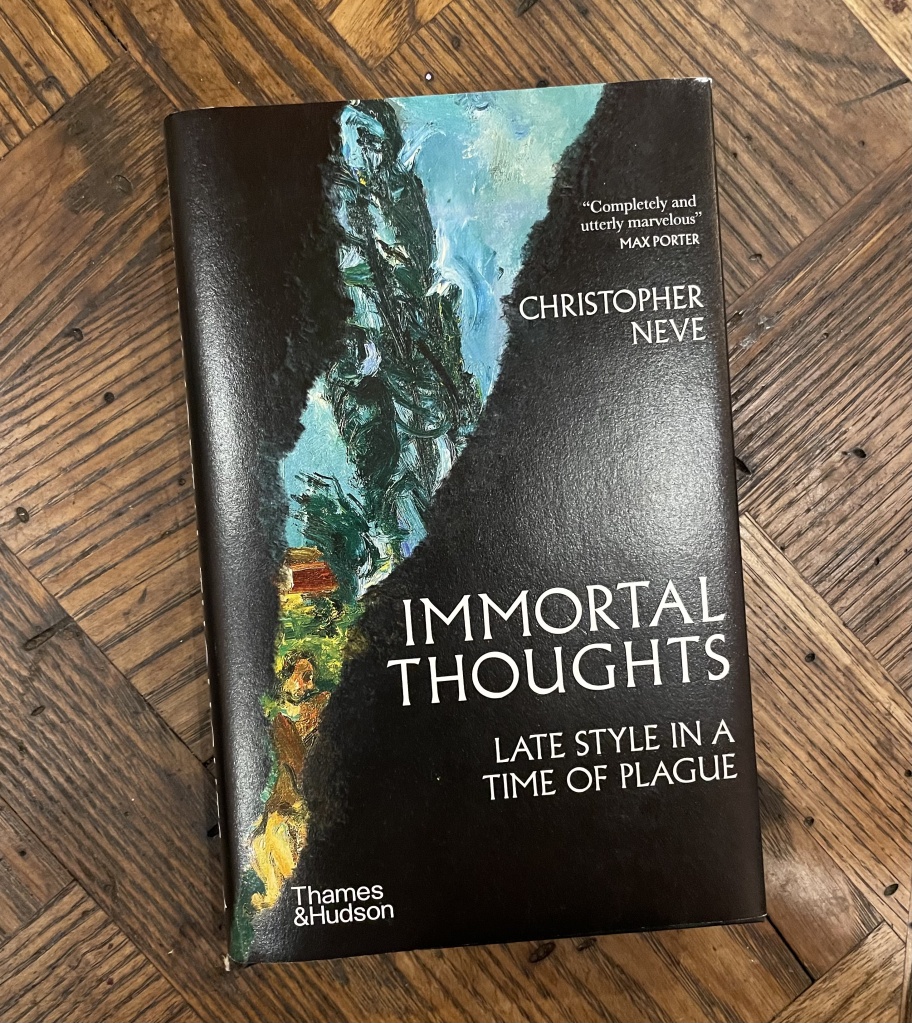
Under a single statement: on Christopher Neve’s Immortal Thoughts: Late Style (2023). by Gerardo Muñoz

In his Immortal Thoughts: Late Style in a Time of Plague (Thames & Hudson, 2023), Christopher Neve ponders whether there is something like an “experience” of late style in painting. He immediately sets up himself to the task in the last works of great modern masters, from Cézanne to Soutine. The notion of “late style” can only be raised at the definitive end of the artist’s path. The old age style is an aspotilla no longer dependent on approval and excellence; it favors inner capacity and dexterity of seeing. This is why late style is, probably, always self-transformative: it poses the notion of work under erasure as it comes near the zenith of retraction. For Adorno late style registers the failure of synthesis as well as the force of dissociation in the permanence of the catastrophic. Neve will perhaps agree this much: painting is not about fixing temporality (the density of the history, the vulgarity of the contemporary, the monumentality of the past); rather what remains is the fugitive scene of depiction. If the question of “late style” is immensely difficult to raise, that is because it resists conceptualization: it merely seeks to denote achievement and the ruinous; appearance and retreat; unlearning schematics and producing “from life” itself, to put it with Poussin’s pictorial vocabulary. Late style is not about the moment of judgement and recapitulation – it is what depiction can achieve in the twilight of creative powers. As Goethe once defined old age: “Old age is gradual retreat from appearance”. But this retreat animates the space that had remained secluded in the order of temporal abstraction.

There is no theory (and there will never be) of late style of pictorial representation. It is a question that merits the weight of description – which Neve combines, quite successfully, with that of emblematic instances of the artists’ form of life. In other words, late style does not require conceptual renditions; it demands the elaboration of strong descriptions that can grasp the resonance of a fundamental ethos. Neve glosses Delacroix’s ethical imperative: ‘only in old age does a painter finally know what sort of artist he should have been all along’. In late style there is coming to conclusion because there is a path for homecoming. This ethical dimension of the artist is neither regulated by form nor by epistemological conditions. Late style implies a stripping away of things; it bares a specific nudity: it can reveal interiority (the invariant) without argumentative absorption. If anything else, it is the non-knowledge of the gesturing hand. Neve points calls this “statement” when offering a treatment of Rembrandt’s old age: “…technique and the process of getting older, and that this was somehow done all in one, summed up and expressed undeniable and in confidence of one blow and as a single statement. And I wished that all painting could be like this” (46). We suppose Neve’s desire as hyperbolic, since painting under a single statement also implies the moment when the picture approaches the abyss between the hand and the order of reality.

Painting gravitates towards a single statement when it surpasses life by taking death seriously. There is much truth in reminding that the work of art aspires to its bare lyrical moment of decline and unworking of itself – this was also Cézanne’s moment of “not being able to realize!”- in order to flee from the objective fixation of the “thisness of nature”. Painting assembles a transfigurative force against the temporal succession of the pro-duction of a specific work on a surface. As expressed by the old Pisarro from the window of his studio quoted by Neve: “A little more work before dying” (54). True, nothing else but painting mattered to Pisarro, as Neve reminds us. Now, does this mean that he is holding on to the unchanged and muted essence of things as a “metaphysical solace” in the face of the whirling of a world in chaos? Perhaps there is something to this suspicion that must be reckoned with – painting comes close to theological presuppositions insofar as creation unsettles a disenchanted world and its fictitious mimesis. Alas, this is a question not fully posed by Neve, but it is also one of the ways in which his book could travel without much effort. The question of immortality of a picture has a point of departure here. But is immortality conceivable as a form of solace and fallen piety? One should refuse to ask this question in the form of generality. The works Titian, Goya, Cézanne, the dreary and posthumous glory of Velázquez or the suffering Soutine during the Nazi occupation are all efforts to pose the problem of late style painting as the ethical attunement of each artist.

In the most elevated and charged moment of Neve’s efforts to grapple with the notion of style he recurs to Soutine (and it requires us to turn to the picture “Children playing at Champigny” from 1942): “What you are seeing, when Soutine paints the Auxerre trees, is what I think happens in the work of most of the artists I haven written about here. This storm of temperament is true painting, an inexplicable combination of seeing, feeling, memory, response, imagination, and profound oddness. And so he turns away in exhaustion” (122). Late style registers the collapse of a possible fulfillment with the world by indexing a detour to the point where realization seeks to “return to simplicity and order”. Truth indicates the literal thereness on the surface devoid of illusions. So, solace does not have the last word; this is not how a painting subsists under a single statement. And that accounts for the ultimate risk: the ethical presupposition of painting exposes the artist to the “terrible freedom” as the distance between the passions (temperament) and the gesture within profound disorder and arbitrariness of nature.


Someone like Carlo Levi will find himself at home: true freedom cannot begin by the suppression of the passions in the name of interests; rather, the burden of freedom is the caesura of passions that displaces the otherwise inexorable fear of civilizational progress. Painting as the event of truth dethrones fear as the primary attunement in reality. Through our emperament one finds the exit from alienation, gathering the moment of depiction into order. There is a gentleness of freedom in the mutual self-supporting carrying of things, as Kurt Badt saw in Cézanne’s old style. And this might be the tragic element of painting and its fundamental antinomy.

For Neve this means nothing shorter than “the world reduced to a series of prodigious impulses, the revelation of the inner intact, the change taken to see the universe in a new light at the risk of failing utterly” (130). Late style is what reveals inner intact to the fruition of exteriority – this is the compass of visibility. A failed world followed by decline – two terms where mythic transfiguration moves painting to the eccentric luminosity of altering the jarring relation with the world. Old style enacts a catastrophe that refuses the insolvency of pulsation that binds character to the harmony of form. One might add that it could very well be that painting is, as revealed in the abyssal caesura of a late style, a stated mystery: a passionate life that profoundly perturbs the world, a transcendence that falls into an irrevocable eternity.

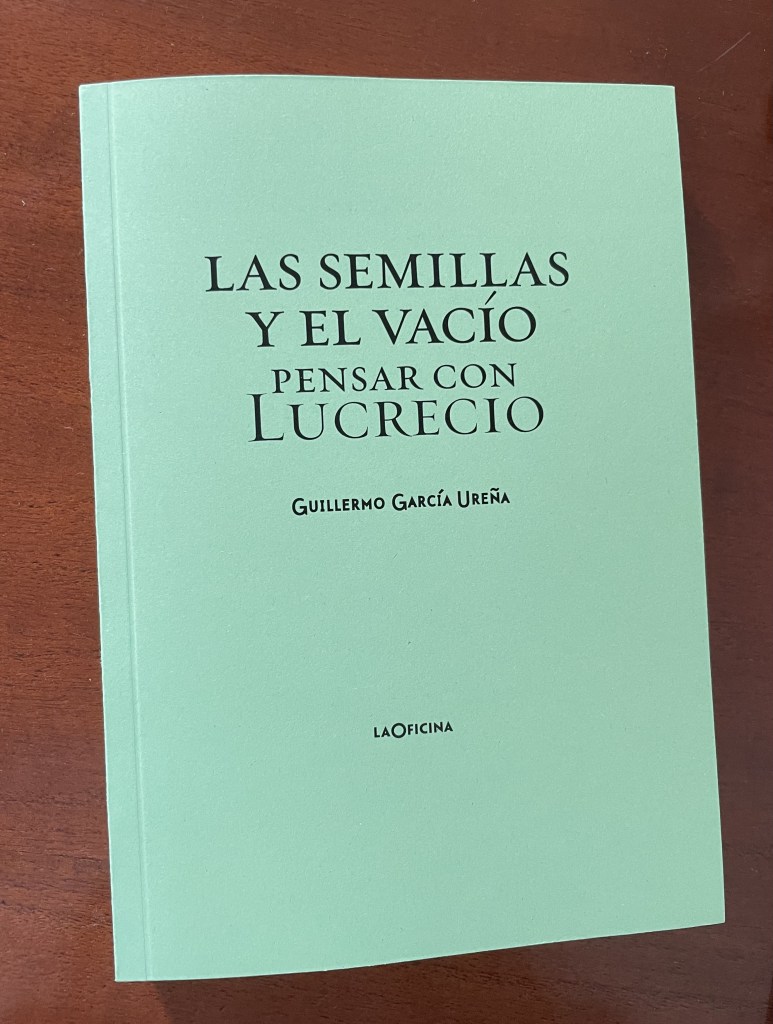
Naturae species ratioque. On Guillermo García Ureña’s Las semillas y el vacío: pensar con Lucrecio (2023). by Gerardo Muñoz

Lucretius’ poem De rerum natura is one of the most used and abused texts of the tradition, and like all classics it has had the most diverse receptions imaginable: the poem of modern science, a baroque expression of creationism for the English metaphysical poets, the precursor of historical materialism and atheism, and a tract of scientific positivism that laid the foundation for the regulation of nineteenth century social order. Once a text becomes an emblem, it usually means that it has lost its prehistoric imprint and place in the tradition. Against this backdrop, Guillermo García Ureña’s just published Las semillas y el vacío: pensar con Lucrecio (La Oficina, 2023) has the prudential gesture of disclosing the great Roman poem to its fundamental structure; attentively listening to its original complex articulation difficult to grasp with the categories of modern philosophical thought. In this sense, Ureña’s purpose is not to deploy another “philosophical account” of De rerum natura – endorsing and subscribing the influence of Epicurus and its later resonances in modern theories of physicalism and materialism of the continental schools – but rather to engage in its own ground exerting an original philological exploration of the text that opens up an array of different problems for thought. Whoever is looking for a “theory” of Lucretius will find none in this brilliant and well articulated essay. But the reader will find, nonetheless, a comprehensive hermeneutics of a text that stands as a threshold between the closure of Greek classical antiquity and the Roman reintegration of the tradition. Now, for Ureña De rerum natura proem discloses the originary understand of the epic, or épos, through which the stability of the things as they appear takes place; whether it is the Muses, the gods, being and language, the simulacra or the soul, the physical declination of creation (the atomic clinamen) and the final document of language invigorated in the corpus of the poem itself. De rerum natura is both a cosmology and a poetics with the ambition of elucidating the most obscure things of this world: Lucretius’ text defies a fixed representation through a choreography (a term that it is not used by Ureña, it must be said) that discloses the possibilities of worlds; the combination of worlds only to posit the question of how to live within them, which is another way of saying how to account for a form of life.

One of Ureña’s commitments is to hold on to Lucretius’ aesthetic and philosophical autonomy. This implies treating the influence of Epicureanism with great care; engaging with Epicurus insofar as the aesthetic autonomy and its loci of poetization reject the classical structure of the epic hero incarnated by the soteriological impulse of the great poet-philosopher (we know that this is the same problem that centuries later Hölderlin will identify through the tragic drama of Empedocles). Lucretius is writing after the twilight of the classical Greek genres. Furthermore, there is no community under an organized program of leadership and telos; on the contrary, there is only an existence that “one day will want to desert all of us” (41). True, the Epicurean notion of serenity (ataraxía) is retained and treasured; but only as the aspiration of every living being who seeks to transfigure the shadows of superstitiousness and fear that govern over the perceptive mediating forces in the world. In this sense, to dwell in the world does not consist in the limitless relationship with the simulacra; it is rather, the self-transformative exercise of freeing possibilities within the void in which forms of life can emerge. As Ureña reminds, the rainfall of the atom is as fast as that of thought itself. It is already an image of thought, as well as the figure of imagination. And the image of thought validates the history of cosmos as a patchwork of accumulations and deflections, creations and destructions, repetitions and disintegrations in a swerve of forms that infinitely recline on its ethical possibilities (139). It is altogether interesting that Ureña reminds us that, in fact, De rerum natura is not interested in staging the things in Nature; on the contrary, at the center there is the question of the ‘nature of things’ in the luminous expression of their irreducibility. This is what modern onto-theological closure brings to a process of domestication, whether through the composition of the civil structure (limitless exchange according to philosopher Felipe Martínez Marzoa, who figures prominently in Ureña’s book) or through the progressive historical structure commanded by the essence of technology that blurs the relations between forms and techniques.

If De rerum natura abandons universal history and historical narration, it is because its structure is profoundly kenotic: it can only be assigned as contingent historical transmission of the most immediate and sensorial (not necessarily “true” in the metaphysical sense) that allows the convergence of the history of forms of life and natural history (140). The operation of subtraction implies the transfiguration of freedom through the becoming of forms – their interests, constructions, and pacts (foedera naturae) as guarantee for a plastic relationship between things in a world that is always already a fragment in the void. The highly attractive Lucretian notion of foedera or “pact” (that expresses separation in coming together: a com-pact that de-compacts) is almost the inversion of the modern principle of irreversibility, if one were to take Hans Blumenberg’s  legitimation hypothesis at face value. And this is so because a foedus or pact is insufficiently strong to resist the impact of the clinamen, but indispensable for the emergence of a body that materializes its own fate towards dissolution.

The lack of unity of being allows for the existence of simulacra as that which does not have sufficient matter to compose itself as foedera; and so, it is a material semblance as an image without figure that makes it an ephemeral entelechy. In this choreography between the downwards of atoms and ephemeral intermittence of events the taking place of the world emerges a topoi of a combination of rhythms that intertwine the weight of bodies and the animation of souls. The possible combination and stylization of multiplicities in separation is the way in which a form of life emerges as the desertion from superstition and fear that hinges upon the irreversible stabilization of a principle of reality. Ureña does not go this far into the wager of Lucretius’s text – and he does not have to in his close reading of the text – but it is precisely this thick dimension of the ethical primacy that makes Lucretius’ dislocated comprehension of materiality a vibrant tune against the weight of alienation that we are still struggling to abandon.

The struggle against the alienated life – the alienation from the world, and the external manipulation of the simulacra that has become a gnostic planetary form of “TV Democracy’ (Schmitt) of the “society of the spectacle” (Debord), which implies the usurpation of our imaginal and erotic relationship with the world – well understood, does not mean to relocate the confrontation at the level of political order; it rather, rests on what we have understood by order and disorder for the reconstitution of a happy or contemplative life (naturae species ratioque). This serene life declines the offer to negotiate at the arena of sacrifice and legitimate domination, favoring the event of friendship. At this point Lucretius comes closest to Epicurus’s society of friends – studied by Carlo Diano in an important 1966 conference in relation to the organization of the passions and the transmission of love – that can guarantee a content life in the presence of “other joyous gazes” (glossing Diano’s terms) away from the persistence of war and the compensatory administration of pain. This is the ultimate treat of De rerum natura: the exemplary dimension of the serene life takes shape through the community of friends, the civilizational invariant of the human experience (prehistoric times, the classical epoch, and in our times) that abandons the paradigm of perpetual war that obfuscates omnia cordi.

It is not too ambitious to claim that only at this point we finally grasp the full extent of the Lucretian épos: not just an ephemeral and contingent declension of the primacy of atoms in the void; but, more importantly, it can disclose the irreducibility of an experience with friends. Ureña wisely closest his book with an image of the “buena vida en compañía” (the good life in companion) that insists that serenity is only possible (or desirable) in the open landscape, a nowhere-land of an eternal foedera (or a sinousia, as it appears in Plato’s Symposium) that even if temporarily too short-lived or inconsequential it paints an earthly paradise just above the grass: “poder tendernos unos juntos a otros en el césped suave, cabe un arroyuelo, a la sombra de un árbol copudo, y regalar el cuerpo sin grandes dispendios; sobre todo si el cielo sonríe y la estación del año esparce de flores el verdor de la hierba (II, 29-33)” (203). It is this inconspicuous and mute experience that strangely holds on to the passing of the world.

On Cézanne’s pink stripe tablecloth. by Gerardo Muñoz

The title of the painting is “Still Life with Apples” (1894) housed at the Getty. Like many of Cézanne’s pictures of the 1890s we have a sense of immediately entering into an space warped by distance and nearness that lavishly seals the scene. We feel that something has taken place; after all these are pictures of an event, but only concealed to us. We are given the sense of that experience, which is the fundamental thing to depict for Cézanne. Now, if Clark is correct, then it is true that Cézanne’s still life painting was meant to annihilate the objectivity of the world through a study and stubborn simplicity; although simplicity never amounts to synthesis. On the contrary, what preserves sensation over absorption remains at a distance: this is the narrowing act of simplicity as a fact of style [1]. The depiction of appearance is a problem for Cézanne precisely because painting now stood (late nineteenth century), as Kurt Badt well observed, as the last metaphysical activity in the face of Western nihilism [2]. There is nihilism, an unbridled chaos – and thus painting aspired to accomplish a different form of order, a transfiguration through sense. A higher order subtracted from representation. Thus, the outpouring of sense was everything to Cézanne; nothingless than the attunement of the relationship between depiction and nature. Thus, nearness and distance stands a problem in the picture itself: what is most apparent is what Cézanne seeks to qualify through depth and singular brittle rigidity.

As he would write to his friend Émile Bernard: “In order to make progress in realization, there is only nature, and an eye educated by contact with it….I mean that in an oregon, an apple, a ball, a head, there is a culminating point, and this point is always the closet to our eye, the edges of objects recede towards a centre placed at eye level. With only a little bit of temperament one can be a lot of painter. All you need is an artistic sensibility. And doubtless this sensibility horrifies the bourgeois” [2]. This is Cézanne’s permanent struggle (a non-subjective position, that is, anti-Romantic) struggle: the impossibility to “realize” and to complete a picture as the heart of the mysterious vortex of the execution of depiction. This clears the entrypoint to the problem of the “last metaphysical activity in the wake of nihilism” that Badt consigns to the activity of painting: pictorial art can reveal the unrealizable in every work; but it is no less true that all works fundamentally have an asymptotic inclination to the potential of realizing the idea. The achievement of that impossible nearness attest to the achievement of painting (or to its consummated failure).

The unrealizable in Cézanne’s painting, however, is not merely indexing the unfinished gesture of the brush in a scene or a series of selected objects; rather it is the condition of possibility for entering into the world through a medial common existence between things, however fragmentary within the whole. The unrealizable dimension is never a conscious attempt for a spatial unity to be fulfilled; it is alienable by a stylistic reduction at the moment in which it ceases to belong to the painter’s cognition. This is why Cézanne’s pictorial project – more so than Pisarro’s anarchic affinities and political flirtations in the late nineteenth century – has radical consequences for an opening of freedom that is grounded on the senses (and what it means to be ‘free in the senses and the passion’, in each temperament), allowing experience to decompress the formalistic representational conditions of bourgeois civility. Indeed, Cézanne’s work – and the world it depicts, the opening towards things as a whole but through separation, having in common precisely alienability – does not aspire to be legible in the social, which is the ideal space of exchange and metaphorization, recognition and reification as image. The social is the limitless spatiality in which anything can enter, as anything can stand for any other thing. Or, to put it more concisely: painting seeks to let things be things in their interchangeable nature (without the anxiety over fixing an image of Nature).

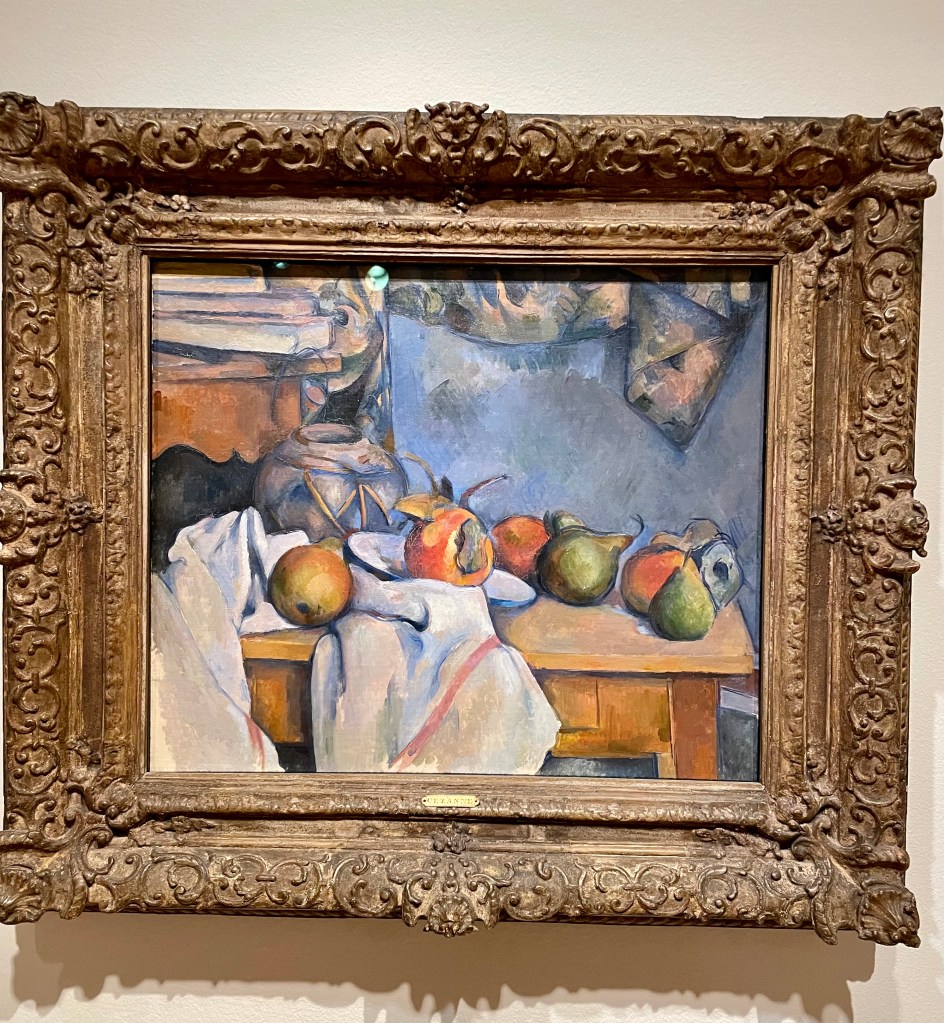
Paul Cézanne. “Ginger Pot with Pomegranate and Pears” (1893), Phillips Collection, Washington DC.

Cézanne inadvertently knows that whatever fate in the wake of nihilism awaits “painting” (soon to be utterly destroyed and displaced by the conceptual and object driven monstrosity of the modern vanguard), the effort to “realize” in painting meant holding to experience of depth as the only guarantee of an existential freedom. Surface and depth will remain on the side of the insistence of an appearance without predicates proper to theatricality. Kurt Badt poignantly captures this in Cézanne’s “old age style”: “There is no longer anything in our sensory experience of seeing which corresponds to what thus becoming visible; what is shown nis rather the visible picture of the concept of freedom. For the thing common to all these forms of the “style of old age” is two-faced: negatively it is a ligeration from isolation and resistance, possibly a liberation to the serious gentleness of freedom” [4]. And gentleness means letting things be: the serene elevation to irreducibility, upholding them only in the proclivity of its contact; never fully absorbed by surrounding and revealing its state of harmonious composition. The task of depiction in painting is the impossible task- but the task nonetheless thoroughly achievable through the hands of the painter – of coming as close as possible to what has actually been experienced. Having affirmed (not necessarily achieved) something like a fate-like divine temporality in painting is able to ground worldliness as transcendent only to let it fall immediately after. And what fate is to character, for Cézanne ‘that which is preserved unchanged’ is the supreme tonality of the pictorial task realized by the restraint of the artist [5].

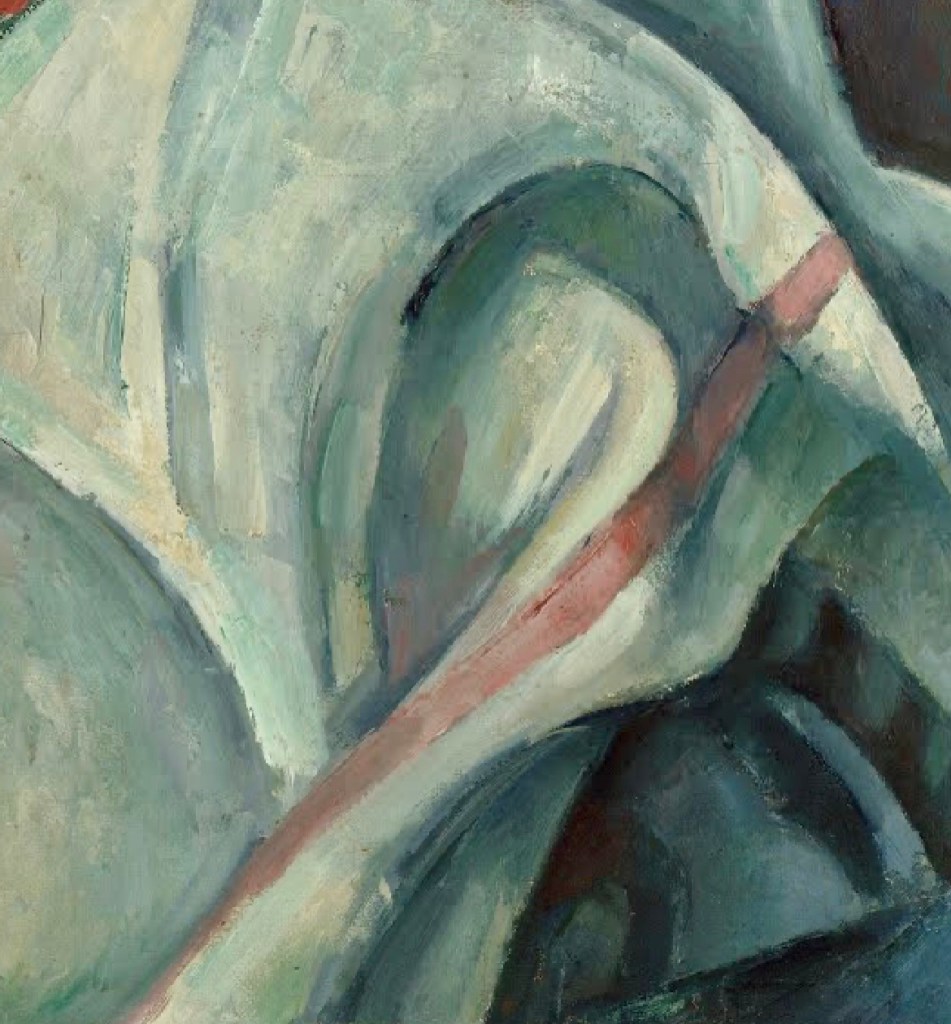
But precisely to depict immobility, the forever permanent, the befallen weight of the conatus essendi (what preserves itself as such), painting has to mobilize a minimum motion for the confluence of objects, planes, and emergence of depth. The pink stripe tablecloths that appear in several of the 1890s still life paintings with fruits can be very well taken as a multum in parvo of the declension in every realization. In a sense, then, the pink strip is a signature, as if were, of the gathering of things and depth at the price of unrealizing the closure of integral depiction. It is precisely the pink stripe in which it becomes realizable in a single brushstroke that the place of the line appears otherwise, crowning the mystery of painting as the clearest manifestation of a different musical order. It is the mysteriously nature of painting, which barely introduces itself as a line substitute for a color (the color of the tablecloth as a thing) that, while remaining visible to the viewer, cannot but reveal the invisible; that is, the temperament of the artist attuned to the muteness of painting, to say with Poussin. And perhaps this is the highest moment of depiction in the search for the “integrity” of “wholeness” that, in turn, grants the instance of the unconcealment of truth. A lace plotting what has already been validated in the irrevocable thereness of the most inapparent existence: an eternal state in the world.

.

.

Notes 

1. Maurice Denis. “Cézanne II”, The Burlington Magazine for Connoisseurs, Feb, 1910, 279.

2. Kurt Badt. The Art of Cézanne (University of California Press, 1965), 181.

3. The Letters of Paul Cézanne (Getty Museum, 2013), 342. 

4. Kurt Badt. The Art of Cézanne (University of California Press, 1965), 313-314.

5. Ibid., 161.