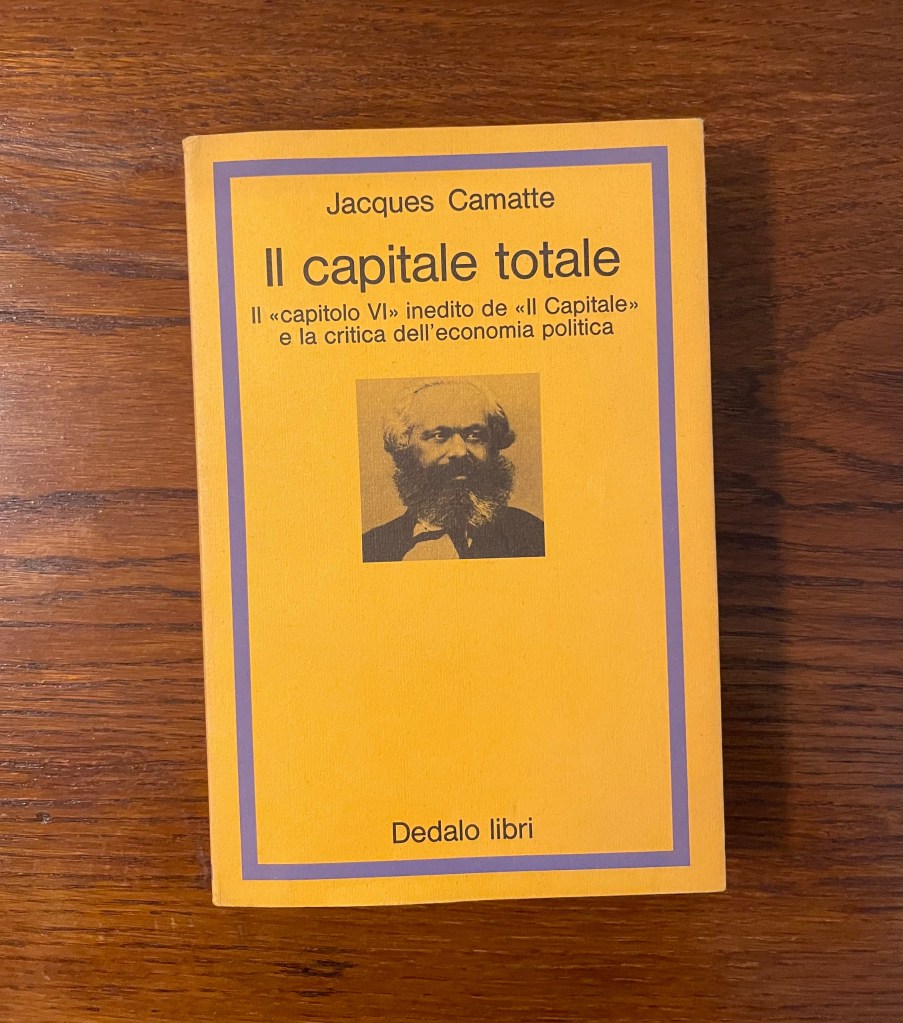
Dialogue with Jacques Camatte (1935-2025)

The passing of Jacques Camatte (1935-2025) a week ago from the writing of this text recalls a life that ostentatiously lingered in thought, and a thought that was entirely enmeshed and intertwined in the irreducibility of life. For some of us that had the good fortune to interact – however briefly and momentary, although every contact is always destinial and inescapable – Camatte transpired generosity and authenticity, and his voice evoked an almost Adanic happiness that has become rare among human beings. A common friend these days has recalled that somewhere in Camatte’s writing there is an endorsement of a capacious phrase from Chernyshevsky that could very well serve to remember his enduring ethical pursuit: ‘we have finally understood that the Earth is a place of life rather than judgement’. The opening the Earth as a dwelling place for life forms means that it is insufficient to conceive of domination as an organization of modes of production, since capital is first and foremost a spatial-temporal arrangement towards the future of the human species, and thus of a certain conquest of the world sensuous life. 

This was the outstanding triumph of real sumption: the modulated and ongoing alienation of the human community (Gemeinwesen) into a community of capital that has arrested time of life to the point of adjusting it to homogenized agony of historical time. Against the dynamic of revolution and counter-revolution that theologically exported the polarity of the eschaton and the ho katechon, already in the inception of 1970s Invariance Camatte called for an exteriority of any philosophy of history in order to rework of “a new relationship between human beings and nature”, and “breaking the lock that inhabits the creation of a new form of life”. The two citations in dialogue with each other come from “Against domestication” (1973) and the introduction to Urtext: frammento del testo originario di Critica dell’economia politica” (the 1977 Italian edition curated by Gianni Carchia), although these are variations from the depth of the emergence of the invariance of truth as a vantage point of the world. At the center is a form of life that renews the world that transitions beyond all forms of metaphysical logistics of appropriation, mere standing reserve, and the general arrangement for the mobilization of production. Any point of departure against domestication measures itself against the totality of this fluctuating dominion.

As it has been said of other great thinkers, Camatte’s ultimate passion was rooted in thinking one idea to the end and not of endorsing a system of concepts. For him it was the schism, that is, how to undo the historical process of domestication of a fictive community against the absorption of the increasing autonomization of fictive capital. The schism against the capitalist general equivalent also demands advancing a secondary schism against all humanism and its originary separation from nature. In schism, there is something of Gaunilo of Marmoutiers’ “thought of the word alone” that is receptive to the movement of the soul tries to account for the perceived voice. This precisely what Camatte carried as the lesson from Bordiga’s idiosyncratic original communist program: a movement against the historical benchmark of the development and political economy of growth, which will entail the exhaustion of the revolutionary horizon driven by an ideological political technification that tends to deepen the power towards the positionality of epochal nihilism expressed in the revitalization of strife and the ‘errancy of humanity’ (contrary to Martin Heidegger’s notion of errancy as a play between unconcealment and truth, for Camatte errancy is another name for the civilizational narrative that exemplifies the withering of the  human community into organized and protracted social reproduction and historical abstraction). Hence, as for Bordiga, Camatte conceived the ontology of communism as a world view (not as a political program oriented by concrete historical subject or distributive economic reproduction; not a soteriological dogma nor a transhistorical material idea); that is, broadly speaking, thinking the relationship between the human beings and the earth. A question more pressing than ever given the current planetary conflagration, which exposes the civilizational course that has lead to an inhospitable world where the survival of the human being has become the byproduct of an effective hostis of the community of capital integrated to the global surplus value accumulation.

In Camatte’s unrealized thought – but perhaps all forms of thinking are so – the bordigist gesture persists in locating the schism at the threshold of the force of real subsumption of the anthropomorphization of capital, where the notion of revolution itself is transfigured since, unlike Delacroix’s paradigmatic romantic painting, ‘liberty’ no longer guides the spirit of the “living”. Its redeeming voice also carries downwards unto the depth of the souls of the dead. Amadeo Bordiga himself in “Dialogato coi morti “(1956) writes that “The Revolution…it is always, in the course of an immense historical arc that will close as it opened and where it promised, where it has an appointment with many of the living, but certainly with the unborn, as with the dead: they knew that it never fails, never deceives”. True life can also take place with the nearness of that which seems remote (as Gustav Landauer once claimed: “For me, the dead also live”).

If both the collapse of the future and the increasing adaptation of social life has entered a gnostic dialectic of endless self-legitimation, it is paramount to capture not just the insurrectionary, but the resurrection flight in Camatte’s gesture that opens possibilities lodged in the dead as an emblem for the return to the world “full of joy and exuberant life”, as he wrote in an apostrophe in “Scatologie et résurrection” (1975): “I will draw from mother earth the vital and infinite power and I will resurface full of wisdom, joy and an exuberant life which will allow me to reach this human community…I will have left your world and been resurrected!” Does holding on to the unity of the Gemeinwesen require a theological undercurrent? Is not the passion for schism, and by the same token the stazion, the energy within the very dispensation withheld between mystery and revelation that has prompted the congenital forms of formal mediations and institutions for the political community? These are the questions that we are exposed to in the enduring task if we are to take seriously a continuous ‘dialogue with Camatte’, which carries the voices of the dead. Ultimately, any authentic conversation that dwells in thought does not have to invent anything new; we are depositories of an endless communication that is handed over, interrupted, and transmitted to anyone willing to hear and capable of being traversed by the shared word. 

In his last year of thinking, Camatte insisted on the notion of “inversion” in the wake of the civilizational phase of extinction, which would require deposing all forms of hostilities and bringing to an end the partisan positions invested in orienting technology and morality (nature) in their seditious defense of the real dominium over the passing of the world. For the current depressing (and depressed) times, writes Camattes in “Instauration du risque d’extinction” (2020), what could very well be a prelude to a return to the repressed allowing a return to the past to initiate an inversion that would allow liquidation of lall exhibition abandoning enmity. This is why, as he told me in an exchange that we undertook five years ago, “inversion cannot be a strategy, as it is totally outside of politics, which is the dynamic of organizing people, of controlling them”. A breakthrough, then, only as a mystical downwards leap into the past? Absolutely – but only insofar as the mystic is the ethical witness to his own openness to the word, and whose exodus from the social machination prepares a return to the world beyond the flattening and dominant language molded by rhetorical dishonesty or passive narcissism of the subjectivity.

This is why according to Carlo Michelstaedter to have courage in the world means to decide between two irreducible figures: the dishonest trickster, or the mystic in the desert. There are no third terms in between. And whereas the dishonest subject knows how to play the hand to his best outcome in each given moment; the mystic knows that his decisive moment is always commencing because the genesis of the human species has yet to take place. This beginning is always at the brink of an untimely auratic experience. And aura names the incommensurable distance from the rational containment of the world — unlike Teilhard de Chardin’s internal introspection in the noosphere that will bring the fullfilment of a spiritualized humanity upon Earth (realized in part by the unification of the sciences by cybernetics); in other words, an exodus from the temporal nominalism that inhabits another life attuned to its genesis: “devenu-devenant ce monde et sur cette vie autre au moment où s’effectue sa création”, he writes in “La séparation nécessaire et l’immense refus” (1979).

The visitation of Jacques Camatte in the world bears witness to that invisible freedom of the human species ready to jump and traverse the catastrophic trumpeting into the living and the dead, making possible the refractions of thinking as original texture of existence. From now on, the exodus from the immanence of this world will embrace a disempowered but perpetual dialogue with Camatte’s demure schism of the living. Indeed, we are always on the path to an earthly beginning. 

The irreducible in language: a note on Robert Antelme’s L’espèce humaine (1947). by Gerardo Muñoz

At the outset of L’espéce humaine (1947), Robert Antelme discloses the difficulty between language and experience that lays at the heart of the book, and which is never thoroughly assumed at the level of form in the novel. L’espèce humaine (1947) is ultimately not an account about the impossibility of describing what took place in the camps; from the banal physical violence to the desperate hunger, from the microaggressions to the slightest movements and carnage of bodies in space; from the joyful smiles in the most miserable of scenario where the ultimate goal was for the human life to slowly rot; the sequence of actions engage in no struggle to bring to a crisis the level of representation. And Antelme goes into painstaking efforts to give us a full picture of what took place, only to never talk about it again in writing or in personal conversations as Marguerite Duras tells us [1]. So, what to make of Antelme’s initial affirmation in the “Forword” where he states that: “…during the first days after our return, I think we were all prey to a genuine delirium. We wanted at last to speak, to be heard. We were told that by itself our physical appearance was eloquent enough; but we had only just returned, with us brought back our memory of our experience, an experience that was still very much alive and we felt a frantic desire to describe it as such as it had been…[..]. No sooner would we begin to tell our story than we would be checking over it. And then, even to us, what we had to tell would start to seem unimaginable” [2]. The unimaginable for Antelme is a sort of threshold of language; a limit for the unrestricted, that is, for what could allow for an experiment of language after the catastrophe, or in the wake of the civilizational catastrophe that is consummated in the camp. 

This delirium and anxiety over language – to tell it now and how it happened and to tell “the world”, only to immediately acknowledge the impossible task of doing so – does not take place at the order of the narrative; it is first and foremost something that we get a glimpse of at the end of the book as the liberating soldiers enter the rubbled towns only to encounter the incontinence of the survivors “talk and talk, and pretty soon he isn’t listening anymore” [3]. At that moment, the face to face between human beings will follow “to a kind of infinite, untransmittable knowledge”, Antelme tells us [4]. But what type of untransmittable and nocturnal knowledge is Antelme referring to here? It is not about some ethical exigency of the defacement of experience through linguistic construction; it is rather the torrential and densely weight of description and events, that numbs and deposes language in the very mediation of its effective sayability. The experience of human suffering and domination is untransmittable not because there is a deficit in language or the effacement of representation; but, on the contrary, precisely because there an excess of language that flattens irreducible suffering to an anaphoric socialization of speech that tacitly accepts inhumanity at face value. And that socialized distribution of speech underserves suffering, in virtue of equalizing an expansive chatter that neutralizes in survival the inherent pain of the irreducible human species within the imposible ordeal of total annihilation. 

Antelme’s L’espéce humaine  is stubbornly nominalistic in its thick descriptions of things and events, and it wants to avoid metaphoric transports. He prefers to call things as he sees it and get to the thicket of things in the most nauseating of repetitions. In a way, the hellish atmosphere of the concentration camp resides in the slow moving degradation of human life deprived of the world. However, there is one moment where Antelme resorts to calling a situation ‘hell’; that is, precisely, to an account of the transparent use of language, the raw incontinence and commanding force towards exteriority, as if there is no longer a caesura or separation between being and language once enunciation has been homogenized as commanding force. This is a language without a secret or unsaid, moving against the outside of consciousness in the same depretatory form as the same administrative machinery that has lifeless bodies as its target. In this way, language being turned into the force of speech will not only foreclose itself to the world, but it will signal the very intangibility by virtue of the flattening of verbal communication as an immediate and furious call to an annihilation of appearance. Antelme writes in this admirable moment – one of those instances where description of the state of things is incepted by the negation of the very conditions that allow for the narrative order: 

“Degradation, and flabbiness of language. Mouths whence nothing any longer ever came that was ordered, or strong enough to last. A weakly woven cloth fraying to bits. Stencens succeeded one another, contradicted one another, expressed a kind of belched up wrtnessness; a bile of words. They were all jumbled together: the son of a bitch who’d done it, the wife left on her own, food, drink, the old lady’s tear, the fuck in the ass, and so on; the same mouth could say it all, one thing after the other. It came forth all by itself; it would be empty. It only stopped at night. Hell must be like that, a place where everything that’s said, everythat’s expressed, comes forth equalized with everything else, homogenized, like a drunkard’s puke” [5]. 

The incontinence of language at the limit of what can be said is a secondary hell; that is, the last contortion that the inhumanity of the human can offer outwards in order to outlive in a moment of minimal pleasure, since the absolute pain of a glacial existence has been deprived of any real contact with the world and things. It is a linguistic hell – the looping language of the camp, will only mirror also the linguistic codification that around the same years will be elevated to the paradigm of cybernetics and the regime of information theory – will now appear as a unified block of application, enforcement and extraction. Hence, we should take Antelme at his word: language has become “flabby”, and it is a “puke”. It is circulation without sense, as in the looping mechanics of the furnaces charted by the Nazi engineers that appears in the recent sequence of the film Zone of interest (2023). It is not that sayability loses it claim to the autonomy of its form before an event; it is also that by virtue of its own degradation against the erasure of events, it can only be unified, packed, homogenized and rendered into equivalence in the wake of the absolute triumph of the historical project of alienation and external objectivity.  

The passage of the old hymnal texture of language as solace and lamentation could only entail the conservation of communication, which for Theodor Adorno writing during the same years as Antelme (1946-1947) will deduce as the “techniques of insolence enabling each individual to spread around him the glacial atmosphere whose shelter he can thrive” [6]. That the experience of the camp for Antelme ultimately meant that the “executioner can kill a man but cannot change him into something else”, must be placed in tension with the epochal transformation of a hellish experience of language at the service of the nihilistic service of equivalence that unveils its purest semblance at the camp [7]. The unitary reduction between the “socialized Man” and the “deportee” enters into a proper focus that Antelme was able to grasp with uttermost honesty: “…that there is no inherent difference between the “normal” system of man’s exploitation and that of the camps. That the camps are simply a shepherd image of the more or less hidden hell in which most people still live” [8]. At the risk of an overtly mannerist claim, it seems to me that the kernel of Antelme’s intellectual effort is to withdraw from the condition of hell that is condensed in the block of ice fixated in the ruinous material of language [9]. Memory, experience, friendship, truth, writing, the soul – these are all tools to chip against the brute reification of the glacial subjection at the price of ultimate solitude. Is there anything else worth a shot? In the last pages of L’espéce humaine, Antelme returns to the question of “freedom”, only to claim that “to be free” implies to “say no to everything” – and could we also refuse the language as it declines into flabbiness, equivalence, and its putrid decline, as overflowing mountain of trash that covers up the ongoing pain of the human species? [10].  

Sure thing, the hölderlinean enduring and difficult task of the “free use of one’s own” appears here with some urgency as the requirement of traversing the attunement to pain. Antelme seems to have wanted to offer a negative theology to “forever starting anew”, in which the irreducible of human sayability is posited as the condition of the “only transcendence between beings” [11]. “To speak, in a word, is to seek the source of meaning in the prefix that the words exile, exodus, existence, exteriority, and estrangement are committed to unfolding in various modes of experience;  a prefix that for us designates distance and separation” [12]. Aren’t distance and separation two conditional criteria for grounding the irreducible? The habitation of the speaking being can harbor the contours of the unfathomable expression on the reverse of social tribulations, which is always the primal nomos of equivalence. Allowing the expansion of the irreducible as a the site of an ordinary accumulation of freedom preserves a sensible region for what takes place (“whatever happens”and is not this taking place the opening of the non-site of the chorá?) in a language attuned to the relentless event that has forever touched us. This is already the site of the unimaginable beyond and away from the language of survival that permeates everything in both times of peace and of war. 

Notes 

1. Marguerite Duras. El dolor (Alianza editorial, 2019 ), 71.

2. Robert Antelme. The Human Race (The Malboro Press, 1998), 3.

3. Ibid., 289.

4.Ibid., 290.

5.  Ibid., 135. 

6.  Theodor Adorno. Minima Moralia: Reflections from the damaged life (Verso, 2020), 33

7. Robert Antelme. The Human Race (The Malboro Press, 1998), 220.

8. Robert Antelme. “Poor Man – Proletarian – Deportee”, in On Robert Antelme’s The Human Race Essays and Commentary (The Marlboro Press, 2003), 22. Dionys Mascolo makes more or less the same claim in Autour d’un effort de mémoire: sur une lettre de Robert Antelme (1987) when speaking about the stratification of species in the camps and the division of classes in society: “l’intuition aveuglante de tous les survivants est celle d’avoir fait quant à eux, sous une forme extrême, cette expérience: que l’organisation de la société en classes telle que nous la vivons est déjà une image de la division de cette société en espèces, comme dans les camps”, 87.

9. Robert Antelme. “Revenge?”, in On Robert Antelme’s The Human Race Essays and Commentary (The Marlboro Press, 2003), 15.

10.  Robert Antelme. The Human Race (The Malboro Press, 1998), 291..

11. Robert Antelme. “The Smiling Angel: Rheims Cathedral”, in On Robert Antelme’s The Human Race Essays and Commentary (The Marlboro Press, 2003), 10. 

12. Maurice Blanchot. “The Indestructible”, in The Infinite Conversation (University of Minnesota Press, 1992). 

In search of an adventure. Commentary on Marguerite Duras’ The Little Horses of Tarquinia (1953). by Gerardo Muñoz

It is not until the last third part of Marguerite Duras’ The Little Horses of Tarquinia (1953) when the reader encounters a mention to the Etruscan relic alluded by Jacques, one of the characters in the circle of friends that vacation in Italy, who passes the days drinking ‘bitter camparis’ and complaining about the nauseating and scorching presence of the summer heat. And if it were not for the title of the novel the reader could easily dismiss it as a contingent regional reference: “I looked at the map last night…After leaving Rome, I could stop at Tarquinia to see Ludi’s little Etruscan horses. After all the time he has been bending our ears about them” [1]. The ‘little horses’ are brought out a few pages before the end of the novel where Ludi, their Italian friend, goes back and forth whether to go and show them the horses figurines or not. It goes without saying that it would be an enormous distaste to press on the Etruscan reference for any deeper meaning, or to claim that Duras deployed the ancient piece as a tongue in cheek symbol for the bunch of friends roaming around the beach shores. It clarifies very little or too much as an generic reading hypothesis.

In any case, what is relevant is that their trip to encounter the horses of Tarquinia never takes place stressing the real lacuna of the narrative, which is not so much paying a visit to an ancient civilization, as much as underlying a possibility, an afterthought, a pulsating desire towards its displacement; or, in a way, the outside of life that part of the real texture of existence. A reminder that life (a happier life?) is always somewhere else, and definitely away from the excruciating heat of an Italian summer in which no compensatory activity (drinking campari, chatter among friends, having food, meeting new faces) can wrestle the desire for exodus. In The Little Horses of Tarquinia (1953) very little happens in terms of the organization of the narrative, and that is precisely because the domain of the possible might have been Duras’ central commitment when writing the novel: nothing will happen, not even the fleeting thought of paying the visit to the tombs of the Etruscans. Thus, the heavy weight of a narrative without events opens the incandescent proximity between life and nihilism in a strangely accommodating setting. It is summer after all, which means tranquil life of boredom, repetition, serene gazing, and the monotonous. Children catching lizards or sleeping through the night, and very little else.

According to Laure Adler, Duras’ sea novels (The Sea Wall, Gibraltar, Little Horses) wanted to persist “in search of an adventure. But afterwards everything comes together to form a whole” [2]. This holds true only at a very rudimentary and superficial level, but it does not hold to any serious scrutiny. The Little Horses of Tarquinia (1953) is a novel in which the writing of adventure takes a very specific form: life detached from the event of the adventure. This is the reason why the adventure is not only missing from the sequence of contingent incidents, but rather it is alien to the character; as if the radical separation from character and destiny would be transplanted into a self-reflective consciousness arrested in time and space. The adventure at the closure of modern sensibility and its dialectical valence around a “worldview” is precisely that there is a coming to presence of the fact of this poverty of adventure has become its uttermost inexistence: “For a long time I had bright colored dreams of imaginary cities, where I could do what I liked, and look for adventure. But the dreams were not enough, and no I’ve turned a little mean” [3].

The end of the texture of adventure between world and existence marks the commencement of the self-autonomous subject that can narrativize the concrete order of his dreams precisely because he is convinced that they will never be accomplished in this world. After all, as Lukács claims in his Soul and Form, the adventure is no epic for epic’s sake, but a “communion of feeling, of experience, an infinitely powerful experience of the world’s many colored richness expressed in a varied series of endless adventures” [4]. In the adventure one freely becomes who one will be. Hence, the adventure named the freedom of sensible experience between language and world, coming to near convergence only so that its final separation could set to start the inconspicuous ethos of life. In this sense, the longing for adventure in Duras’ The Little Horses of Tarquinia could be said to allegorize the chattering of experience, whose tiny pieces are ultimately picked up by the synthetic apprehension of the dialogue of chatter among friends. The empty chatter takes place once the path of language as transformative of a life becomes separated from the course of the human species. The extreme comedy of the rhetorical dialogue is that it functions as a cure for the abyss of its own separation from life.

Hence, the “dia-logos” ends up suturing that dregs of the fictitious waste required to translate the language of meaning (logos) into practical action at the expense of a life that begins to move, inadvertently, across a groundless world [5]. This is why the central character in The Little Horses of Tarquinia (1953) calls the boundless dialogue that they are engaged in as “a confusion of voices…from open windows, and was dissipated in the sunshine” [6]. It is not that there is never continuity between what is being said; rather, it is that dialogue is always a re-statement of either the case, the command or the subjective piety that in the suppression of real pain proper to a alienated life can only engage in the melodramatic gossip over the accessories of life. In other words, dialogic communication can only speak in the name of quotidian vulgarity. Language becomes, as Duras writes in one of the most memorable lines of the novel: “an endless chain of reciprocal waiting” [7]. It does not take much to apprehend at this point the signifier rotation in every dialogue. Waiting, but towards what? The waiting is eternal and illusionary, since the capture into the sedentary surplus of “dialogue” has already taken you to the final destination where everything is sufficient; what remains is the generalized effect of unhappy consciousness from the irrevocable sense of abstraction.

The expressivity of the dialogues of the French bourgeoisie of The Little Horses of Tarquinia (1953) was already the indication that their wordlessness differs a whole lot from the musical infraworld of the Etruscans horses and tombs. Yes, something very precious was lost once civilization becomes entangled with the infinite realization of a schizophrenic subject that is the effect of endless chattering and utterly silence. In other words, the character of The Little Horses of Tarquinia (1953) talk quite a lot – they never stop talking – but they are not towards a path of language in search for a missing word that marks every true adventure. And this is the adventure where thought and language bind with one another in search for the unfathomable exteriority that is always unknown. And we know that for Duras the encounter with exteriority is the imprint of intelligence, the coefficient of real and enduring thinking. As one of the characters says at one point: “Possibly it may be that there is nothing that cuts one off from the unknown so much as friendship” [8]. I take it that for Duras the Party form (and even the obligations of fictive intellectual communities and all forms of political dilettantism) was very much her preoccupation here: the militancy of friendship could very well stage the last character in the play of historical nihilism. At the expense of avoiding being “nobody” anyone could assume the faceless “friend”, as soon enough cybernetics will end up promoting in their contactless subjective networks. The agonizing sun of a vacation (exclusive in its temporality) is already foreshadowing artificial radiation and nuclear reserve as the sole container of life on earth. In this scenario visiting Tarquinia is an escape of sorts – downwards to the night but also to a vita nova – although, ultimately, it does not take place. And Duras seems to tells us: true experience falls catastrophically on the other side of writing, on the unlived.

Against the therapeutic community of friendship, one can juxtapose the unpredictability of encounter in which no friend will be crushed by the rhetorical compression of the dia-logos and its discomfort. In friendship I can embrace and release without obligations. And if friendship exists it is through a negative community that is never one with allocated leisure time; and; like love, it does not solicit holidays: “you have to live with it fully, boredom and all, there is no holiday from it” [9]. In such scenario “we would not want to change the world”, but perhaps begin inhabiting it away from the sun of exposure and recognition that clears a menacing landscape without horizon. And if according to Kurt Badt, the sky is the organ of sentiment, then one must come to the conclusion that the characters of The Little Horses of Tarquinia (1953), as pathetic as they are, are congenital witnesses of this truth; even if they could only carry it for a moment in order to instantly betray it [10].

Notes

1. Marguerite Duras. The Little Horses of Tarquinia (Riverrun Press Inc, 1985), 54. 

2. Laure Adler. Marguerite Duras: A Life (University of Illinois Press, 1987), 187.

3. Marguerite Duras. The Little Horses of Tarquinia, 139.

4. Georgy Lukács, “Richness, Chaos, and Form”, in Soul and Form (Columbia University Press, 2010), 167.

5. Vincenzo Vitiello. “Sobre el lugar del lenguaje”, in La palabra hendida (Ediciones del Serbal, 1990), 164. 

6. Marguerite Duras. The Little Horses of Tarquinia, 149.

7. Ibid., 87.

8. Ibid., 84.

9. Ibid., 213.

10. Kurt Badt.  John Constable’s Clouds (Routledge & Kagan Paul, 1950), 101.

Persuasion of the surround: a reply to Andrés Gordillo. by Gerardo Muñoz

The friend Andrés Gordillo has generously sustained an ongoing conversation in light of the talk delivered in Mexico on institution and immanence (a first reaction could be read here). In a recent note he brings many elements to the table, and his versatile writing makes it difficult – alas, this is a wish come true for any reader – to locate an univocal point of entry. This is perhaps because there is none. Andrés wants to keep us at the edge, and so he enacts the set up: there is communication, and because communication is the event of language, there is still the possibility of mystery. Many things already pop up here, but this might be doing injustice to Andrés’ elaborate draft. So, for the sake of the exchange, let me open the route by running through a moment that impacted my first reading. It is this moment: “El desencuentro que aviva la amistad de ambos personajes [Narcissus and Goldmund] es el de haber decidido resguardarse en la exterioridad de sus elecciones, ahí donde son obra del amor”.

This is a condensation of what the Hesse’s novel means to him; or, rather, how it speaks to him in light of a discussion regarding the dominance of the civil principle, and the question of an experiential dimension that we defined provokingly as a minor transcendence. I am not sure I am in the position to unpack Andrés’ thesis, if it is a thesis at all. I do remember a couple of years ago an exchange with Alberto Moreiras on the logic of the encounter and the misencounter related, precisely, to the problem of the eclipse of experience. This is the problem that keeps soliciting thought; it is the problem of thought itself.

However, I am getting ahead of myself. Andrés stages a complex framing: there is friendship as absolute difference (or in virtue of a fundamental misencounter), and then there is an exteriority of their existential decisions; that is, in the manner that they are irreductible to their being in the world. I spoke of framing purposely, since I find myself these days with Pablo Picasso’s “The Blue Room” (1901) from the early period that I encountered in Washington DC. It is a rather small picture – and to the viewer, the semi-statue like nude, a female figure it seems, comes to the forefront sliding downwards. A mysterious resonance dilates between things – and indeed, the objects in the room (the sheets, the rug, the bouquet of flowers, the paintings, the half-open window) feel like things. This is an intimate surround at the threshold of catastrophe, where things could be lost at any moment. And we know that epochally they soon were.

We are in a strange setting – and if it is strange to us it is because there is a sense to which alienation and solitude here is the fundamental harmony of dwelling. This is not yet the assumption into plain and continuous historical time that will amass things into objects. The “Blue Room” (1901) inscribes esoterically the thematics of pain – it is a work in which Picasso responds to his friend Carles Casagemas’ suicide that very same year. No metaphorical or allegorical reading will do the job to put us in “The Blue Room”. In the wake of an elliptical death, pain stands in, like the nude the water basin, as the irreductible to history and the menacing social sphere. I will bounce this to another moment of Andrés’ text: “Por ahora me siento inclinado a conversar: avanzar hacia un umbral que se desploma”. This ‘crumbling threshold’ now appears to me as a sound and prudent description of what “The Blue Room” (1901) was able to achieve. An experiential awakening against the conflagration of modern historical time: soon enough – and boy was it soon – the interior space of “The Blue Room” will multiply into infinite cells of the planetary designs in which social man will be just a potential inmate. This is why Picasso in 1901 speaks still today a strange language for us – it discloses a surround, an exteriority that we have been deprived of. It is a surround that is fully folded within.


If pictorial practice is not mere representation, but also, more fundamentally, a form of thought, then we can claim that “The Blue Room” (1901) attests to the proximity of the misencounter of friendship that outlives in the experience of the surround. And here the painter had no privileged position – he is no figure of genius, no commander of historical destiny, no magician of forms. He is also a befallen figure because he is the cipher of life. But to overcome the rhetorical surplus of socialization requires techniques in the face of the irruption of pain. Nothing less solicited Carlo Michaelsteadter when criticizing the reduction of the “man of society” to the pieties in “exchange for the tiny learned task and his submission, the security of all that human ingenuity has accumulated in society, what he would not otherwise obtain except by individual superiority, the potency of persuasion”, he wrote in Persuasione e la rettorica, another masterpiece of the 1900s. Yet, persuasion requires to be vigilant at the moment where things enter the historical penumbra and its rhetorical artifice; the reign of endless confusion amidst the most transparent and disingenuous computations.

How one becomes persuaded within a tonality, and remaining to be so – this is also a surrounding mystery of “The Blue Room” at the outset of the century. We still dwell in its dissonance.