We are all mystics. by Gerardo Muñoz

It is too often that we hear a common critique raised against the theoretical skepticism of the primacy of politics in the form of an alleged prefigured “mysticism”, as if the destructive operation against sufficient political reason would entail an ineffable silence. It is a striking claim because there is some truth to it. But we must also question its assumption: can the proponents of political primacy ascertain a ground that can escape the mystical position that it seeks to avoid? The task of intellectual history is infinite and rewarding, but that does not mean this enterprise can positively mobilize a breakthrough within the epochal collapse of modern politics. If this is true, then it would follow that everyone is, more or less, a defaced mystic, insofar mysticism is the condition that runs against the limits of language and the current of the negative. In the same way an American judge famously said that ‘we are all [legal] originalists now’, one could very well say that ‘we are all mystics now’. It all depends where we put the emphasis and the tone. 

If we are to reject the totality of political administration and intraworldly legitimacy, this does not necessarily mean that we can immediately sketch what a coming politics would look like. According to Karl Barth in his Ethics, the position of mysticism always denotes a weak “us” that emerges from disobedience with respect to the world; concretely, against the system of planning and delegated orders (schools and the police). So mysticism is an archirealist position because it traverses the world, but only to depose the transcendental closure of its authority. In this way, the skepticism against the mystical position, perhaps unconsciously, is also an indirect skepticism against anti-social stance that is deficient from the vantage point of advantageous political realism. But the insistence of political realism is only anti-mystical on the surface, because it depends on an article of faith on the social reproduction and the overall general political economy between subjects and objects, value and the administration of life. 

The mystic cannot be confused with a guru, a magnetic theologian, nor a priest in robes. On the contrary, the mystic is a sibling to the pícaro, a figure of the Spanish Golden Age, that made his life unarrating the social protocols of the emergent social space, revealing and subverting the “autoridades postizas” (fictional authorities) of his epoch, according to the beautiful formulation of Santa Teresa de Ávila. Whoever has read any of the Spanish picarescas will immediately recall that the pícaro does not endorse static or monastic life of interiority, he upholds a temporality of life that coincides with the events of a world that becomes unfixed and betrayed. And the pícaro lives and outlives himself in this gestaltic confrontation. This vital mysticism in how he uses the world is more practical than any political justification for consensual common action.

It is worth noting that Carlo Michelstaedter in a gloss on courage and the persuaded life, divided the world – and his world was that of the Austro-Hungarian interregnum, a transitional epoch of decline filled with specters and monstrosities, very much like ours – between mystics and the dishonest or tricksters, but only the first could be named “heroes” because only them knew the secret of their unique persuasion unto death, renouncing to petty morality, self-interest, and social orders [1]. The mystic inhabits not just the silence that arrests the truth for which he cannot speak; more fundamentally, he also exerts, in every act, the task of freedom as embedded in thought and contemplation of the soul, that according to Michelsteadter is a personal struggle that bends to the real gnosis, “because to know oneself is ultimately to know the universe and to name it…only there is life” [2].

Notes 

1. Carlo Michelstaedter. La melodía del joven divino (Sexto Piso, 2009), 43. 

2. Ibid., 53.

Justification and the demonic State. by Gerardo Muñoz

In the broadest sense of the term, questions about the law are predominantly about its justifications, and more specifically about where to locate the act of justifying. That one of the most important elaborations of exclusive positive authority was dependent on a theory of justification to transfer norms of authority (a theory labeled the “normal justification theory”) goes to show that the traditional opposition between positive law as pertaining to the sphere of rights and guarantees and natural law to that of justification comes short in the understanding of the internal development of judicial reasoning in the second half of the twentieth century that unsurprisingly coincides with the crisis of the secular liberal state [1]. The reliance on a “justification theory” will imply not only a new conception of legitimation, but also the outsourcing of the self-referential determination of “Nature” through which Roman Law constructed its principle of the rule of law and the validity of adjudication. As we know, Roman Law did not speak of “justification” but rather of necessity emanating from Nature, which could not oblige to performance or act through by what by nature is impossible or wrong [Ius plurimis modis dicitur: uno modo, cum id quod semper aequum et bonum est ius dicitur, ut est lus naturale]. The natural source of law, as famously defined by Ulpian in the Digest, is in this way permanently tilting between the good and the equitable (ius est ars boni et aequi). This is a matter of first principles of the law (ius), which did not solicit “argumentation” or second order reasoning to uphold its internal legal validity. 

The passage from natural necessity in the “hands of the priest”, in Ulpian’s conception, to the modern autonomy of justification takes place when principles are no longer the exclusive framework parameters for operative claims, but the very activity that defines the elasticity of an actual norm and its argumentation within a concrete positive order. This is one way in which one should define the specificity of the American practical legal order (not just its legal philosophies, which tends to run counter to this, cloaked under the vestigates of positivism vis-à-vis the letter and spirit of the Constitution) through juridical administration, whose structural polarity of command and justification defines the administrative process. Early in the twentieth century, Guglielmo Ferrero noted that one of defining characteristics of the American political model rested on a magistrate judicial power that fundamentally differed from European Common Law or positivist tradition in its practice [2]. Contrasting the independence of a limited bureaucracy to the predominance of an all encompassing “juridical administration”, Ferrero noted (although lacking the legal vocabulary to articulate it positively) that the administrative nexus will infinitely expand over social practical reasoning due to the unrestricted force of justification. And the need for justification is what outsources the ancient principles of natural law (ius) to the executive authority that renders operative every sphere of social action and interaction even if they are not explicitly declared prima facie by those principles. The efficacy of justification is the linguistic deployment – a rhetorical craft through rational argumentation – that will generate specific verisimilitude to the otherwise arbitrary and uncontested enactment of its principles. Justification could be said to appear as the work of language that provides internal cohesion of an array of coordinated conditions for secondary social actions. 

Since the inception of modern secularization, the nature of justification is the realization of the works without end, which inverts the notion of “justification” in the theological sphere that we owe to Paul. For the Apostle the idea of justification or dikaiōsis implies the making of righteousness through the soteriological narrative of Christianity that subsumes humanity’s fall (sin) for a redeeming liquidation of law. This means that man’s just act in faith generates “justification” (dikaiōsis) of life for all people (Roman 5:18). And as we read from Galatians 2:6: “Know that a person is not justified by the works of the law, but by faith in Jesus Christ. So we, too, have put our faith in Christ Jesus that we may be justified by faith”. The force of justification (dikaiōsis) trumps the production of the works of law that divides human beings in the immanence of this world between the saved and the condemned, the free and the imprisoned, the friend and the enemy. Whereas justification in the theological sense can only imply the ‘end of law’ for righteousness (Roman 10:4), in its late secularized rendition it implies exactly its distorted mirror image: to justify is transformed into the binding force over the void of authority that renders effective the hollow machinery of its own self-validation. 

It is telling that in an essay that was first published in German in 1938 under the title “Justification and Justice” (“Rechtfertigung Und Recht”), the German theologian Karl Barth takes note on the transformation of the State becoming “demonic” not due to its utter demise, but as a profanation of the theological justification of “unwarrantable assumption of autonomy as by the loss of its legitimate, relative independence, as by a renunciation of its true substance, dignity, function, and purpose…a renunciation which out in Caesar worship, the myth of the state and the like” [3]. The emergence of the “demonic nature” of the State was internal of its own making , since it conflated faith and people at the same level of social immanence, while preparing the actual realization of an authoritarian world without escape. Following Heinrich Schlier’s work on the figure of the State in the New Testament, Barth will suggest that this political totalization secularized the limit posited by the suum cuique of justification into an instrument of endless domination that characterized the emerging political reality. In fact, in his essay “The State according to the New Testament”, Schlier will define the phase of the demonic State as one colored by the inception of the sphragis, that is, “the sign of the state party as it were the secularized seal of baptism which levels all differences between men and only distinguishes between friend and energies of the ruling system. Those who refuse the new metaphysical slave are deprived of their economic foundations. Even economic life is directed by the spirit of the beast” [4]. 

Only in such context does the true light of the force of justification comes in full display: the sphragis can only labour to justify the vicarious social existence of the mystery of iniquity infinitely redressing itself as legal argumentation and juridical principles, administrative determinations and executive commands. And Schlier could not let the question pass: “What will Christians do in this situation? They will no longer want to have any part in this caricare of a state, they will “go out…they will simply be outlawed and persecuted” [5]. More than ever today, we are in desperate need of elaborating the elementary aspects of a political theory of demonology that defines a certain point where there is no turning back. To outlive persecution and tear the bond of justification shatters the civilizational course that has sublimated the end of time as an instrument of daemonic absorption into endless legal statues.

Notes 

1. Joseph Raz defines “normal justification thesis” of legal authority in this way: “I shall call it the normal justification thesis. It claims that the normal and primary way to establish that a person should be acknowledged to have authority over another person involves showing that the alleged subject is likely better to comply with reasons which apply to him (other than the alleged authoritative directives) if he accepts the directives of the alleged authority as authoritatively binding and tries to follow them, rather than by trying to follow the reasons which apply to him directly”, in “Authority and Justification”, Authority (NYU Press, 1990), 129.

2. Guglielmo Ferrero. “American characteristics” (1910), The Atlantic. 226. 

3. Karl Barth. Community, State, and Church (Peter Smith, 1968), 118.

4. Heinrich Schlier. “The State  according to the New Testament”, in The relevance of the New Testament (Herder and Herder, 1968), 236.

5. Ibid., 237.

Pasiones de Giorgio Cesarano: introducción a un dossier. por Gerardo Muñoz

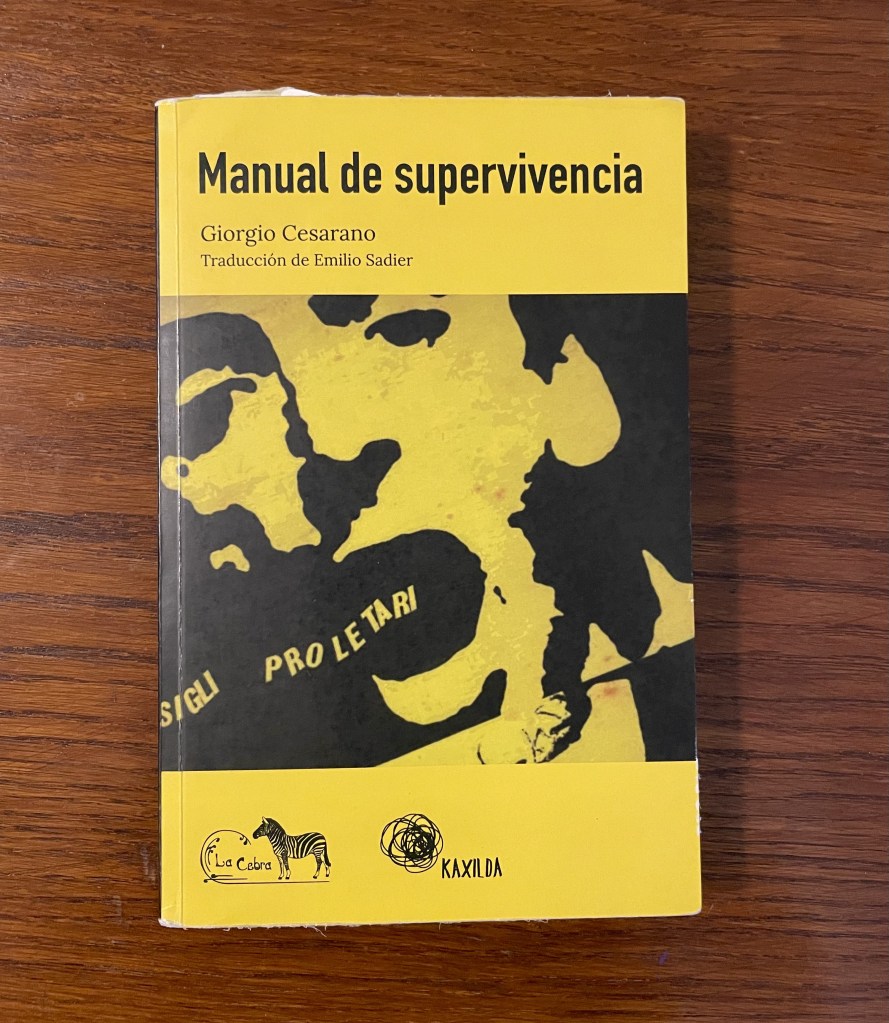
¿Es posible seguir insistiendo en la apertura del pensamiento contra el cierre de la época incrustada en la elipsis infernal de la supervivencia ventilada en las sombras del desierto nihílico y entregada a los aparatos de la reproducción social? Escribiendo en la convulsa década de los setenta – y que algunos pensadores han llamado, no sin razón, el “big bang” de la transformación geoeconómica del mundo donde la revolución queda finalmente liquidada – la apuesta de Giorgio Cesarano en Manuale di sopravvivenza (1974) -y su antecesor Apocalisse e rivoluzione (1973) co-escrito con Gianni Collu – sigue constituyendo un esfuerzo desmesurado y singular por encontrar una bifurcación por fuera de las anquilosadas formas de la antropomorfización capital que entonces ya aparecía como como el destino catastrófico de la especie humana reducido a la compulsiva maquinación de las totalidades ficticias [1]. 

En efecto, como observa Cesarano con un gran poder de síntesis: el triunfo revanchista de la fuerza de la subsunción real, en realidad, confirma que el verdadero y único objetivo del principio de equivalencia no tiene otro blanco que la usurpación de un mundo domesticado y desprovisto de acontecimientos. Un mundo hecho a la medida de las necesidades de sus inmates, tal y cómo lo había previsto John Cowper Powys en una de sus brillantes pesadillas literarias [2]. Pero este es el mundo que hemos heredado y que seguimos atravesando, aunque algunas décadas nos separen de la provocación que a la altura de 1974 Cesarano alzaba ante las herraduras dialécticas de la época. En realidad, era una provocación asumida desde la posibilidad de la afirmación de una gnosis – algo que, como sabemos había aprendido gracias al diálogo sostenido con algunos representantes de la corriente bordiguista de la cultura radical del pensamiento italiano y de su estrato poético, como lo confirma en La casa di Arimane (1979) de Domenico Ferla – aunque sin abandonar la posibilidad de un movimiento en retroceso de éxodo, capaz de integrar un nuevo programa de emancipación de la comunidad real de la especie (Gemeinwesen) contra todas las celdas de la objetualidad y sus satisfacciones reguladas.  

Un arduo primer paso: la retracción como rechazo de la hostilidad generalizada contra la presencia. Así, en un momento de Manual Cesarano podía escribía: “Ahora tener origen como fin es un programa perfectamente realista” [3]. Un realismo que optaba por abandonar el produccionismo apocalíptico al interior de la filosofía de la historia del capital en la metástasis de sus representaciones sociales. O bien, como escribe en uno de los momentos más emblemáticos contra la reificación del sujeto del saber y de la conciencia en Manual de supervivencia: “…el decrépito-infante Yo se tambalea….Se desvanecerá, morirá finalmente, lo mataremos cualquiera sea la máscara que lleve en ese instante. Porque el fin es el origen, el nacimiento de una comunidad-especie realizada, el nacimiento continuo de la presencia coherencia, la afirmación del ser inobjetivo….El fin del Yo marcará el principio de la presencia” [4]. Volver a la prehistoria, entonces, para desembotar el dominio cibernético de la optimización biopolítica administrativa de la vida que domicilia a la especie humana en el armazón de la producción de lo ficticio. Así, el vaciamiento paulatino de la vida tendrá en cada ápice de la simbolización el sol irradiante de la justificación y de la expansión del verosímil retórico de una comunidad abstracta. Por lo tanto, para Cesarano, la embestida contra la reificación del “Yo” debe su destitución a la intempestividad de la pasión del pensamiento como contraofensiva ante el ascenso depredador de la fuerza de la objetivación. Justo en este umbral Cesarano inscribe la partida para la época del agotamiento del reino de las formas y de la crisis de la legitimación política: “No es una clase de lo social, entonces, la que realizará la abolición de las clases emancipándose, sino que la negación de lo “social” y de sus clases, efectuada por el cuerpo proletarizado de la especie, emancipará a la especie de la “sociedad” como comunidad ficticia, prehumana” [5]. Apostar por particiones de valor social (el infinito juego de la hegemonía without end) solo podía perpetuar el espesor de la más rampante agonía.

De la misma manera que la crisis histórica validada por la astucia negativa del proceso infinito de acumulación apela a nuevas artes de estabilización y optimización de la abstracción Social (el paradigma de la unificación cibernética que Cesarano logra identificar en un momento de reestructuración de los propios mecanismos de la gobernabilidad del liberalismo tardío y de la consumación de la mediatización de los entes) de su propia incesante reproducción; para Cesarano toda “critica radicale” – que debe ser asumida como crítica en suspenso, más allá de todo sujeto posicional y posicionado en la estructura del movimiento humanista de la negatividad dialéctica – ya no se caracteriza por funcionamientos programáticos preelaborados mediante el rigor epistémico de la vanguardia militante o justificados en la divisa de la objetividad metodológica; se trata, en última instancia, de constituir espacios sensibles que despejen la desficcionalización absoluta de un movimiento existencial y de estilo cuyo único programa histórico se constataba mediante la inalienabilidad de la comunidad de la especie humana: la irreductibilidad de la pasión [6].

Si la modernidad consistió en la domesticación de las pasiones con el fin de impulsar el rendimiento objetivo y alienado de la diversificación de los intereses diagramados en el valor, ahora se trata de afirmar la liberación del yo como fractal de la no-objetualidad de mis pasiones sin que ésta sea entendida como una mera compensación traducida a la autonomía postromántica del arte [7]. La pasión del pensamiento en Cesarano es condición hiperbólica de una erótica que desoculta la chôra de lo inconmensurable; esto es, la distancia que marca el encuentro entre los restos del mundo natural y el uso vocativo de la lengua: “….ese paso de acercamiento, es abrazo de amor y de lucha, parece tanto más absurdo cuanto más lo cotidiano parece desierto. Es en este movimiento que cada uno podrá, encontrándose en la persistencia del deseo resistente a la aniquilación objetual, descubrir en sí mismo la presencia de ese programa histórico que es la pasión y sentirse listo” [8]. La autoafirmación de la génesis inconclusa de la pasión descentra el nudo gordiano de el terror de una vida sometida al proceso de adaptación en el que la máquina y la humanidad se cierran sobre si mismas.

Pero la pasión es el recurso que valida el recorrido ético de la apropiación de mi existencia; esto es, no es ni condición antropológica ni forma en la que puedo orientar mi relación con lo inefable del mundo. Y dado que nunca sabemos realmente qué constituye el objeto de la pasión – al menos que este dispuestos a abdicar la pasión a la matriz recursiva de lo objetual – la existencia sólo puede darse en la disponibilidad de la vida misma cuando ésta coexiste con la laguna de la pasión y del asombro en el mundo. Dicho en otras palabras, de nada vale “vivir por una pasión” como suele decir el automatismo retórico del contrabando de las pasiones y de la propaganda de agitación social; el valor absoluto radica allí donde la pasión se deja vivir en el movimiento finito de una vida que no puede ser otra, y que solo se mide con respeto a las propias conquistas o encuentros que marcan el ritmo de un destino. En este sentido, como escribe Cesarano en la glosa “Erotismo y Barbarie” (1974) que incluimos en este dossier: “La pasión es el sentido de lo sagrado que se demuestra como tal” [9]. La tonalidad sagrada de la pasión es aquello que no puede ser verbalizado como imperativo o veneración externa para la promoción servil de los hombres-masas orientados a la infinita idolatría sacrificial que, en el curso de la secularización cristiana, implicó el triunfo ficticio del ordenamiento del principio civil [10]. Para Cesarano, las pasiones de la especie es el no-lugar – de ahí que sea una chôra, un lugar de contacto imaginal con la expresión que solicita siempre en cada caso el umbral del afuera – mediante el cual la vida encuentra formas contra la supervivencia y la agobiante auto-aniquilación que el logos descarga sobre cada exigencia vital. 

Sin muchos más rodeos podemos decir que el programa de la pasión sigue abierto en una época, la nuestra, cuyo régimen cibernético-administrativo sobre todos los ámbitos del viviente ha conseguido intensificarse con mayor ferocidad en el punto más álgido de nuestra civilización. Como si se tratase de un don fortuito, la excelente y cuidada traducción en castellano del mítico libro de Giorgio Cesarano por Emilio Sadier publicada en La Cebra y Kaxilda finalmente nos facilita una conversación que, a pesar de haber sido postergada durante tanto tiempo, regresa con la intensidad y el brillo de una voz entonada desde las catacumbas para confirmarnos que no todo ha quedado obliterado. Sobre esos restos se arremolina la ascesis singular de la pasión común de los hombres póstumos tras un mundo que se eclipsa. Y de este modo regresa la conquista singular de los encuentros, la despotencialización del ego, y el recogimiento de una morada en la insondable piel de las estrías del mundo. El dossier que presentamos a continuación sobre el pensamiento y la poética de Cesarano no pretende constituir otro gesto que aquel que contribuye, a su manera, a la continua “comunicación entre almas” al interior de una época que continúa encandilada en la fuerza de la objetivación y la producción de la impaciencia [11]. Y cómo intuía Cesarano en unos versos de su temprano L’erba bianca (1959): “…la buena canción tardó demasiado, pero había que esperar en el vacío para dejar resonar al corazón. Ahora lo sabes, hoy toda fortuna se ha disipado” [12]. ¿Nos hemos disipado también nosotros? Allí donde las pasiones toman la palabra y los tintes del alma dilatan su expresión las dudas para semejante interrogación disminuye y se disipa. Así, atravesados por el timbre de la pasión, moramos en la inesencia, pero sin realmente pertenecer a ella.  

*Esta es la introducción al dossier sobre el pensamiento de Giorgio Cesarano que preparé a raiz se la publicación en castellano de Manual de supervivencia (Kaxilda, La Cebra 2024), y de próxima aparición en la revista chilena Escrituras americana en la primavera de 2025.

Notas 

1. Willy Thayer. ‘”Fin del trabajo intelectual y fin idealista/capitalista de la historia en la ‘era de la subsunción real del capital’”, en El fragmento repetido: escritos en estado de excepción (ediciones metales pesados, 2008).

2. John Cowper Powys. The Inmates (Macdonald, 1952).

3. Giorgio Cesarano. Manual de supervivencia (La Cebra, Kaxilda 2023), 112.

4. Ibid., 49-50.

5. Ibid., 130.

6. Furio di Paola. “Dopo la dialettica”, Aut Aut, N.165-166, 1978, 63-103.

7. Para la elaboración de este argumento, ver el ensayo de Gianni Carchia, “Modernità anti-romantica”, en Pharmakos: Il mito trasfigurato (Ernani Stampatore, 1984), 9-13.

8. Giorgio Cesarano. Manual de supervivencia (La Cebra, Kaxilda 2023), 75.

9. Giorgio Cesarano. “Erotismo o Barbarie (1974)”, incluido en traducción al castellano en este dossier. 

10. Carlo Levi. Paura della libertà (Neri Pozza, 2018), 120.

11. Gianni Carchia. “Tragedia y persuasion: nota sobre Carlo Michelstaedter”, en Retórica de lo sublime (Editorial Tecnos, 1994), 35.

12. Giorgio Cesarano. “A un amico”: “So che per te di troppo tardarono / il bacio dell’amata e la buona canzone / ma bisognava saper asperttare / e lungamente e a vuoto lasciar risuonare il cuore. / Ora lo sai, chiusa ogni ventura.”, en L’erba bianca (Schwarz Editore, 1959), 39.

Vladimir Lossky’s third way. by Gerardo Muñoz

In his war diary Seven days on the roads of France June 1940 (2012), which recounts his itinerant vicissitudes in occupied France, the Russian theologian Vladimir Lossky makes an explicit case for the emergence of a third way beyond conservation and destruction, and its modern ideological avatars that led astray into the modern catastrophe; that is, the social revolution and conservative reaction cloaked under “traditionalism”. As it has been recently glossed, Lossky was not the only person from the East to be preoccupied with putting a halt to the eternal dialectical movement of destruction and conservation only fueling historical abstraction. Indeed, immediately in wake of the Russian Revolution, the poet Alexander Blok, in an epistolary exchange with Vladimir Mayakovsky, and anticipating the bewildering enthusiasm of the revolutionary energy, also demanded an effective exit from servitude so that “a third thing appears, equally dissimilar to construction and destruction” [1]. It matters little whether Lossky knew about Blok’s “third figure”, although it is at the same time impossible not to have it in mind when reading his own annotation in the June 16th entry of his diary, which does seem to offer a answer to Blok’s proposal:

“Nonetheless, revolutionaries are always in the wrong since, in their juvenile fervour for everything new, in their hopes for a better and a way of life built on justice they always base themselves on theories that are abstract and artificial, making a clean sweep of living tradition, which is after all, founded on the experience of centuries. Conservatives are always wrong, too…for in their desire to preservice ancient institutions that have withstood the test of time, they destroy the necessity of renewal and man’s yearning for a better way of life. Is there, then, a third way? Another destiny for society than of always being subject to the threat of revolutions which destroy life, or reactionary attitudes which mummify it? Or is this the inevitable fate of all terrestrial cities, the nature of their existence? In fact, only in the Church can we find both a Tradition that knows no revolution and at the same time, the impetus towards a new life that has no end. Which is why she is in possession of those infinite resources upon which may draw all who are called to govern the perishable cities of this world” [2]. 

It is no surprise that for both Blok and Lossky, the fundamental tension in the amphibology between conservation and rupture rests on the problem of “tradition”; given that, as Blok had also eloquently written in his letter to his fellow poet: “a breach with traditions is a tradition”. This is something that an artist like Kazimir Malevich understood well in his programmatic text about museums in the wake of the revolution (“On the Museum”, 1919): the turn into ashes of all the works of art altered their aura, but it left in place the topological frame and it still produced an image; in order words, the destructive artworks still demanded a museological space for storage, thus enacting new principles of the triumphant revolution. Understood in this sense, tradition is merely the retroactive accumulation of practices by the archē that orients its development retroactively from the point of view of the present with provisions towards the administration of the future. But, how did Lossky understand by the notion of “Tradition”? Rereading the fragment of his war diary entry, it would seem that this notion merely rests on the dogmatic transformations within the Church, and in this sense, a conceptual elucidation similar to the doctrinal exegesis not very different from John Henry Newman’s An essay on the development of Christian doctrine (1845). However, in his important essay “Tradition and Traditions”, Lossky attempts at defining the site and tension of the tradition, which he notes that in the language of theology it has been a term left vague and repeatedly undefined [3]. Lossky writes with sharp precision: “Tradition sometimes receives that of a teaching kept secret, not divulged, lest the mystery be profaned by the uninitiate” [4]. Thus, Tradition is the positive and textual scripture that registers the Word, but it is not exhausted in the positive scriptural authority. 

At the heart of Lossky’s argumentation about the theological meaning of Tradition, is the fact that it exceeds both textual sources and narrative mastery and transmission. In fact, the theology garment of Tradition belongs to the mystery of revelation shared in conspiracy, rumors or whispers [5]. And although, in his essay Lossky reaffirms himself that Tradition is the invisible intertwined with the Church – what keeps the “critical spirit of the institution” for the incorporation of new dogmatic definitions – it is nonetheless important to note that for the theologian, Tradition as “opposed to the reality of the word, it would be necessary to say that Tradition is Silence” [6]. In this sense, Tradition is that which is created and transmitted but that no one has the right nor the authority to speak through its incommunicable name. Is Tradition transmitted at all? If it is not through the written word, how can there be any continuity? This is the ultimate lacuna of the theological underpinning of Tradition for Lossky: Tradition can only be properly understood as the crafting of a “unique mode of receiving truth”; in order words, it names the contact between revelation and the witness who receives its ‘fullness of knowledge’, which far from mastering the totality, it points to “the external limit…the narrow door which leads to the knowledge of Truth” [7]. As Monica Ferrando has recently glossed from Plato’s philosophical corpus, any robust conception of Tradition should be understood as that which maintains an absolute inseparability between wonder and salvation, as well as bridging invention and received grace (charîs) [8]. One step at a time, we invent traditions whenever we are thinking through the abyss that separates our language from the inheritance bestowed upon us. Tradition moves in every ethical position of thought overcoming the pseudo-authorization of alienated and metaphorical knowledge of the past.

But if  the Church is no longer the institutional site for the keeping of the impossibility of the transmission and renewal of Tradition and revealed Truth – subsumed to the mysterium iniquitatis that works against the possibility of the rendition of the eternal life of a permanent vita nova  – it entails that one can still hold on to Lossky’s assertion that the task is to be attentive to the ossified expressions and reified appearances of Truth against the “living Spirit of Truth”. Hence, to insist on the restitution of the Church in our current predicament, would place us on the side of instrumentalized and subject-oriented salvation that turns away from the active kingdom that is the only passage from the world of the living to that of the dead. The traditionalists or integralists are incompetent representatives of the Tradition in this sense: as Von Balthasar once argued, they lack the humor and contact with the invisible to apprehend the mystery that arrives without solicitation, as pure depotentialization [9]. In a godless world of the secularized gnosis of political force – that is, after the fleeing of the gods – perhaps theology could only be understood as the path of Tradition of uncountable wonders and the event of speech that produces an unworldly sensation within this world. Tradition brings the world beyond its shape and legibility. In this sense, we are always participants of Truth that the world cannot retain, and thus keepers of an enduring secret that will ineluctably outlive us. 

Notes 

1. Philippe Theophanidis. “Alexander Blok: ‘A breach with traditions is a tradition'”, October 13, 2024: https://aphelis.net/breach-with-traditions-alexander-blok/ 

2. Vladimir Lossky. Seven days on the roads of France June 1940 (St. Vladimir’s Seminary Press, 2012), 54.

3. Vladimir Lossky. “Tradition and Traditions”, in In the image and likeness of God (St. Vladimir’s Seminary Press, 1974), 141.

4. Ibid., 144-145.

5. Ibid., 146.

6. Ibid., 150.

7. Ibid., 162. 

8. Monica Ferrando. “La libera grazie della tradizione”, in Un anno con Platone (Neri Pozza, 2024), 424.

9. Hans Urs Von Balthasar. The Office of Peter And the Structure of the Church (Ignatius Press, 2013), 403.

American apocalypticism. On Pierpaolo Ascari’s Fine di mondo: dentro al rifugio antiatomico da giardino (2024). by Gerardo Muñoz

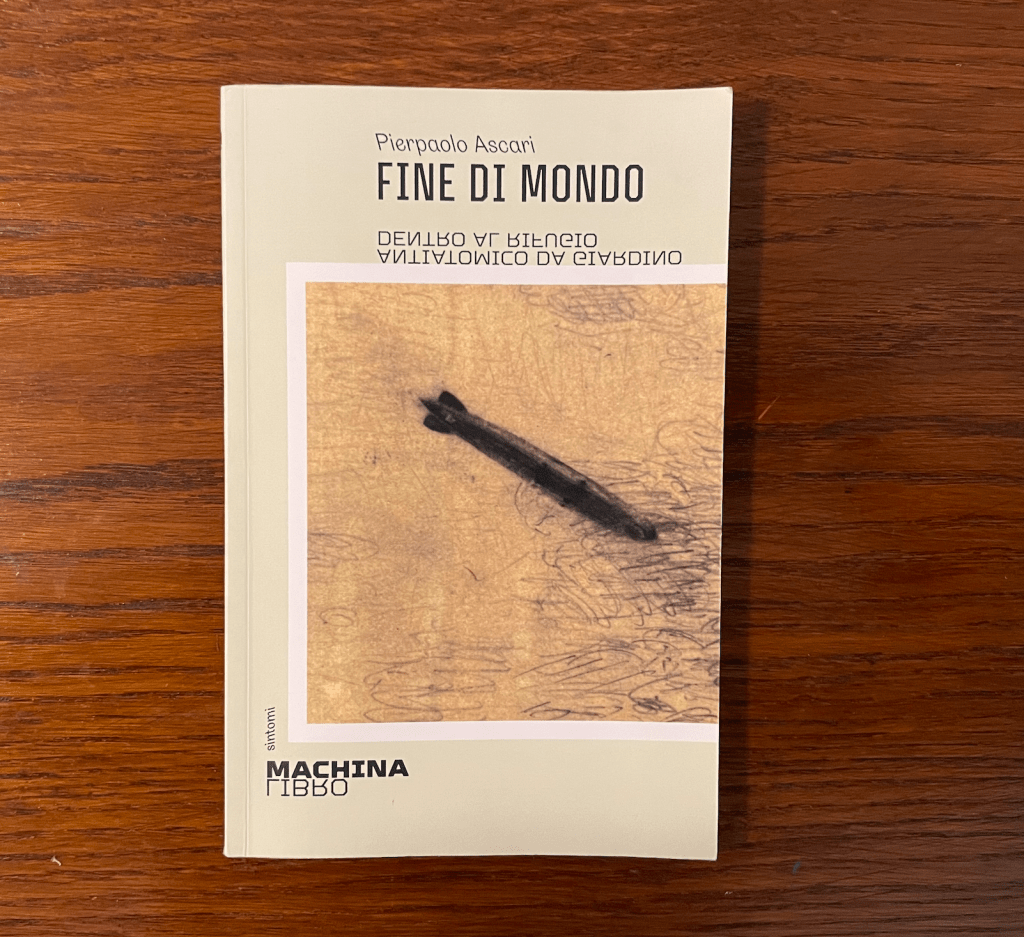
Pointing to a methodological clarification, Pierpaolo Ascari’s Fine di mondo: dentro al rifugio antiatomico da giardino (DeriveApprodi, 2024) opens with an untimely advice: the threat of atomic extermination of human life can only be told and appealed through the irony deployed in all areas of consumerist culture. Undoubtedly, this fits pretty well to the case on point, since American modernization is both the hotbed of Hollywood and the atomic bomb, two poles of the regime of a vicarious life consisted with Henry Adams’ well-known assertion that, in spite of everything, America civilizational passion has always been generalized optimism. And it is not surprising that Stanley Kubrick, when asked about the thesis of Dr. Strangelove (1964), also claimed that the only possible form to tell a story about the bomb of total extermination was through a black comedy (Ascari 11). This self-serving optimism is tested in Ascari’s Fine di mondo (2024) by looking at the construction of an apocalyptic underworld fantasy; that is, in the garden of anti-atomic sheltering that reveals the true arcana of modern Americanism as a subterfuge – but also a civil current in plain sight – parallel to the rise of mechanized labor under the conditions of the triumphant Fordism. Of course, now that our farewell to Fordism has been longed trumpeted, it does not take much to see that what remains is the infrastructure of schizophrenia and general terror in the social fabric that colors the specific tune of American apocalypticism. Ascari’s book is a superb elaboration of this tonality as historically rooted and articulated, but also open to its (pseudo)theological mutations undergoing in our present. 

On the surface, Ascari’s Fine di mondo (2024) is a short compendium of the civil responses and techniques towards atomic destruction and survival; but, more deeply, is also a history of Americanism as a historical project committed to a long process of civil domestication, enclosure, and endurance of survival. Of course, the nuances here are important to grasp the subtle hypothesis of Ascari’s working scene, since we also know that modernity at large (considering both its contingency and contradiction as features of its emergence) was also a process of an optimized gnosis through alienation and the enclosure of private property towards commerce stabilization and productive growth (the nomos). But for Ascari the specificity of the American nomoi through the lenses of atomic sheltering and refuge implies a microphysis; that is, a “way of life” validated through theological premises tailored in the organization of subjective deificatio (Ascari 23). This means that the apocalyptic apparatus driving American philosophy of history is not just one of realization towards the absolute objectivation of the world – even if such endeavor is necessary and preparatory – but rather that the sheltering and self-imposed domestication of human existence has become naturalized as a threshold of the conditions of finite human life. The paradigm of sheltering as the unit of survival is a form of self-regulation of grace that is consistent with the evangelical dispensationalism and technical election analyzed in Monica Ferrando’s recent important book.

The concrete examples abound in Ascari’s short but densely illustrated book: from the Civil Protection comic to the details of the emergence of “do it yourself” assemble manuals (discussed in the correspondence between Adorno and Sohn-Rethel); from the Hulk to Godzilla in a post-atomic bombed world; form the resilient speeches on atomic menace by JFK to a 1950s study conducted at Princeton University that reassured that “fathers” will get to know their children better in conditions of total sheltering even if it results in an “ethics of the jungle” (Ascari 34). Following Guy Oakes’ groundbreaking The Imaginary War: Civil Defense and American Cold War Culture (1994), what is distilled in Ascari’s pop culture puzzle is the panorama of the “Cold War” not as a war that did not take place between two imperial powers; but rather a total war that took place beneath the crust of the earth (and this is why the topoi of the refugee becomes so telling) and at the thicket of human existence waged as psychic management of the civil sphere. In fact, the “imaginary war” is nothing else than the stazion once social life that has yet to cease to exist in our days (Ascari 48-49). 

For Ascari this implied an interiorization of the ‘sublime’ in the reification of the social fabric, which cannot be divorced from the lobotomized subjectivity of the crisis of “social man” that Gianni Carchia identified as the steering project of post-enlightenment Romantic negativity. In the turbid vaults of the self-made man we encounter the liquidation of everything that is living and the projection of fictitious death that clings into “salvation” in spite of absolute destruction; because, after all, those that survive total destruction are only there to confirm the soteriological greatness of the American destiny (Ascari 78-79). The thorough “Ubu” dimension of American psychic political power definitely speaks to this well sedimented conviction of sacrificial subjectivity. Who does not remember the glorious chants for resilience and isolation of the American political elites during the peak of the COVID19 crisis management? If it came to no one’s surprise that a large majority of Americans accepted the pandemic arbitrary rules (monetized whenever needed, it goes without saying), it was because the American subjectivity has been adapted for quite too long to the ongoing separation of refugee and domestication. After reading Ascari, in fact, we think whether the emergency policies were not just another episode in the history of American sheltering now extended at a planetary scale.

There is another idiosyncrasy to American apocalypticism that must be accounted for. And this is introduced towards the end of Fine di mondo (2024), when Ascari quotes Ernesto De Martino about nuclear war; mainly, that when it comes to atomic annihilation there is no longer the symbolic mythic-ritualistic process of reintegration, but rather the mere technification of the hand that gathers scientific knowledge in convergence with the death drive” (Ascari 81). In other words, this technico-apocalypticism brings to absolute unity the originary response of the human species (the movement of the hand) with the organization of scientific rationality that, like Günther Anders saw, brings no re-symbolization of the principle of reality, but rather it can only reaffirm the layering of the principle of reality to govern over it (Ascari 85). In a way, if it as if the essence of American apocalypticism is instituted as if beyond time, since the endurance of a “time of the end” means that the triumphant death (and the dead fueling the demagoguery of its process) foreclosing the symbolization without an exit. Indeed, an apocalypse without redeeming kingdom. For Ascari the only anticipation – primordial mechanism of anthropological capacity – is that of “money”, and hence the dominance of the principle of general equivalence entails gaining the temporal illusion of some distance from the ongoing production of death. But it is evident to anyone today, as it was said not long ago, that the true dead are those petit bourgeoisie living in the American suburbs. And they keep coming as the embers of domestic happiness try to ferociously shut down the latency of a piercing pain. 

Yes, the nature of permanent apocalypticism confirms that the true and final object of techno-capitalist force has always been the possibility of multiple life worlds. And its erosion implies the endless possibility of ordering the life of the city, as Elon Musk just a couple of weeks ago told the former president of the Republican Party: “Hiroshima and Nagasaki were bombed and now they are full cities again. Yeah, it is not as scary as people think”. If the enterprise of civilization has largely been understood as springing from the crust of the earth upwards, one of the important lessons of Ascari’s Fine di mondo is that it trains us to look downwards and inwards as the cruxes of America’s persistent government over the garden of our souls.