
The idea of a world state. by Gerardo Muñoz

As a theme for his 1949 Aquinas Lecture at Marquette University, an American scholar, Robert Hutchins, decided to titled his conference “St. Thomas and the World State”. It is obvious that Hutchins had fresh in his mind the fact that the long European Civil War of the twentieth century, which included two World Wars, was a direct consequence of warring nationalisms and militarized nations that in our times it is once again has lavishly returned with even higher lethal consequences. There is a major historical difference, however; and that is the fact that whereas the nationalisms of the twentieth century were distinct territorial struggles in the wake of crumbling empires, the emergence of the new nationalisms are concerted, nourished, and aligned to the global commanding American imperialism. The techno-political ideal of an influential figure on American elites such as Peter Thiel takes the form of warring nations and firms against the possibility of a global world state to secure peace, interdependence, and free movement of populations across borders and communities [1]. It is fair to say that contemporary technopolitical dominance is a combination of imperial and national forces through the perpetual administration of anomia or lawlessness. 

What is striking about Hutchins’ 1949 lecture is that although Aquinas’ philosophy of law has been traditionally understood as the most important source of natural law, in his proposal Thomas’ actuality is able to fulfill positive law against the instrumental morality of nationalist empires (the United States and the Soviet Union then) that “in the absence of positive law; they may be expected to break the peace” [2]. For anyone that knows the emergence of the European state as coterminous with the secular authority of legal positivism will find this emphasis contradictory at best. The very notion of positive law requires principles of sovereign authority and normative internal recognition of its command coordination in order to consolidate a stable political form over time. This is a contradiction that Hutchins was aware of throughout his lecture. Consider, as an example, when he claims that: “The origin and meaning of the saying that a state has the natural right to sovereignty therefore, is that one state may not forcibly impose its will upon another. It means that Catholicism should oppose the foundations of a world state by force” (36). 

Or, when glossing over the obvious tension between the right of national sovereignty and a potential international federal state in the views of popes and Catholic thinkers: “I think they know that the national state is no longer the perfect community and that positive law is required to make the world community an effective political organization. I believe that they are making two points that are of the utmost importance: first, they are saying that any world government must be a federal government; and second, they see that world must come into existence by consent and not by conquest” (34). However, any student of modern political thought knows that consent and coercion are two internal modalities of governance for legitimate rule. Hutchins’ notion of “consent”, along with positive law, remains not only unthematized, but dependent on a circular of definition of law; that is, the “common good”, which is not a political concept, but a theological and moral notion extracted from the philosophy of history of Christian salvation. 

Towards the end of the lecture, Hutchins goes beyond strict positive law as if searching for some substantive ground: “…the West should not only survive, but also revive and rescue a deeper conception of human civilization than the one recently current, which enters around a religion of progress by resourceful greed and technological mastery of non-human nature” (42). But Hutchins’ plea for the retrieval of a past memory of the West runs astray when it relocates Church and State into a dual predicament of a new world state for peace on the conditions of the same structure of political theology that are no longer operative, but that actually make up the very ground of the modern collapse into nihilism – nihilism that political form does not remain immune to, quite the contrary. In fact, it is the most salient symptom of civilizational collapse. In the same way that Ernst Jünger immediately after the war called for the subsidiary spiritual assistance of the churches in the face of technological power- “the true conquest of nihilism and attainment of peace will be possible only with the help of the churches” – Hutchins will also repeat that only the conjointment of Church and State “must now work together for world peace founded on university charity…and universal democracy” (44) [3]. And the same thesis has found a clear expression in Pope Francis’ Apostolic Letter Candor Lucis Aetenae (2021): “To restore order and salvation, faith and reason, Beatrice and Virgil…Church and Empire are called to operate in harmony” [4]. This speaks directly to what we have recently called the plasticity inherent in the historical adaptations of thomism in social life [5].

This plasticity amounts to the administration of desperate souls from the structures of the state and Churches, without ever transforming the mere survival of life on Earth. This leaves us with the notion of kingdom, which Hutchins introduces in opposition to the political community of city life (polis), but only to reabsorb it into the order of political theology. And it is at this threshold, that we can claim that the kingdom is not a political theological category, but an experiential allowance in which life, the dead and languages occur beyond and before political determinations. It is no surprise, then, that Ivan Illich called the kingdom primarily a mystical experience: “I will dare to formulate a hypothesis: the kingdom is what constitutes the authentic mystical experience, if the mystic knows what experience is really constituted by. The mystical experience of the believer is the conscious experience of the kingdom before the parousia. The mystical experience is the fruit of love, and, therefore, it is also accessible to every lover. The awareness about its meaning is the fruit of faith…” [6]. 

We tend to forget that both national units and the contemporary empires of world building and destruction have been first and foremost enemies of spoken living languages and idioms. On the one hand, the historical grammars to build the unity of people’s official language, and in our days the rise of Artificial Intelligence has clearly become the last stage through which power abandons languages to computational and rhetorical obsolescence. This opening towards awareness is not an article of faith through consent nor a moral predicament that can be adequate prima facie into a political register; it is fundamentally a linguistic experience that allows for the delicate cultivation of peaceful coexistence taking place not in a world, but between them: “To learn a language in a human and mature way way is to accept the responsibility for its silences and sounds. The gift a people gives us in their language is more a gift of the rhythm, the mode, and the subtleties of its system of silences than its system of sounds…The greater the distance between two worlds, the more this silence of interest is a sign of love” [7]. 

.

.

Notes 

1. “Apocalypse Now? Peter Thiel On Ancient Prophecies And Modern Tech,” in conversation with Peter Robinson, October 2024, Hoover Institute: https://youtu.be/wTNI_lCvWZQ?si=M8-qrBh-G7bYZPfw

2. Robert M. Hutchins. St. Thomas and The World State (Marquette University Press, 1948), 15. 

3. Ernst Jünger. The Peace (Henry Regnery Company, 1948), 69. 

4. Pope Francis. “Apostolic Letter Candor Lucis Aeternae (2021)”: https://www.vatican.va/content/francesco/en/apost_letters/documents/papa-francesco-lettera-ap_20210325_centenario-dante.html 

5. Gerardo Muñoz. “The social efficacy of thomism”, Infrapolitical Reflections, August 2025: https://infrapoliticalreflections.org/2025/08/31/the-social-efficacy-of-thomism-by-gerardo-munoz/

6. Ivan Illich. “Concertning Aesthetic and Religious Experience”, in The Powerless Church and other selected writings, 1955-1985 (University of Penn State Press, 2018), 86.

7. Ivan Illich. “Missionary Silence”, in The Church, Change, and Development (Urban Center Training Press, 1970), 121.

De Certeau’s untold night. by Gerardo Muñoz

The highest poetic moment in Michel De Certeau’s La culture au pluriel (1974) appears in the concluding pages where the historian resorts to a hunting image: “Culture is an untold night in which the revolutions of earlier times are dormant, invisible, folded into practices – but fireflies, and sometimes great nocturnal birds, cutting through it – as thrusts and creations that trace the promise of another day to come” [1]. This is De Certeau’s trope that stands for culture as opening of possibilities, the shoreline where administrators and technicians (his own terms) do not dare to cross and will probably never adventure. This is the site (the night, la noche oscura, which has a ringtone of the mystical tradition that the author knew perfectly well) where De Certeau wants to posit the possibilities of new struggles of cultural alterities [2]. A book in 1974 means many things, but for De Certeau it is an incursion into the collapse of his historical present, already showing full fledged signs of the crisis of legitimation, erosion of institutional trust, and the decomposition of social forms across Western symbolic realities. It is the nascent confirmation of the ascent of real subsumption, a term that does not appear in De Certeau’s book, although it informs it, even if negatively (the Italian Fiat wildstrikes makes a surprising cameo in the last paragraphs). Where to look, then?  

De Certeau’s answer read today does bring much naivete: cultural alterity. But this notion, which is reworked and contested in concrete fields of human activities (the university and schools, the new technological society and communication, social practices intertwined in popular and elite culture, power relations and post-statist configurations) do not appeal to the identitarian cosmopolitan horizon prima facie anchored in the diversity administration of a well integrated, albeit exploited planetary humanity. One senses that for De Certeau the nineteenth century “Social Question” has become the “cultural question” as the unit of the national sovereign state wanes and reacts. With the crisis of legitimation as backdrop, De Certeau sees the rise of a new subjectivity that he calls the new “militants without a cause”, a battalion of “exiles” that will only tacitly accept credible cultural imprints [3]. He wants to work with “culture” because at bottom De Certeau is both a historian and a realist. This new erosion of civil society-State relations entails a “new exile is in the works” [4]. And for De Certeau the exile, since biblical times, is seeking a new Earth where to “land”. 

In 1974, De Certeau’s invitation was to create the conditions for pluralist cultural landings that will foster, in the night of waiting, a new politics. But, could the same be said today even assuming concrete situations and the infuriating image of migration as a token for the workings of hegemonic politics? Does Gaia not alert us that we must “land” somewhere else on Earth? The anger and dissatisfaction that De Certeau cautiously predicated head on is already here in the form of what some of us have theorized as ongoing social stasis that is integrated in every social mediation. In the global metastasis of the 1970s De Certeau could claim that “behind anger there is the desire to create a polis and a politics; there is a desire to organize the conditions of life….” [5].

We are far removed from this desire, and even the most prominent cycle of revolts of the decade have refused in the solicitation of a new politics or a political horizon; and, even if, almost like weeds in cracks of piled urban ruins, we see again and again the last residues of the desire for hegemonic representation of the totality (the People, the Movement, the Class). In this light – now it is our own epoche – culture can only be compensatory, and still very much a symptom of the closure of exteriority. “Where there is no longer an imaginable outside we lose the possibility of an inside”, Moreiras wrote at the turn of the century against every form of culturalism [6]. Of course, De Certeau was well aware of it, which is why his proposal to cultural alterity retains zones of hermeneutical ambiguity many decades later [7]. For instance, he writes when commenting on neo-nationalist regional movements (Quebec, Catalonia, Occitania) that “cultural claims appear to be a reminder and a compensation” [8]. 

And recent events have proven De Certeau correct: what is Catalan nationalism – whether left or right, although ideological division is not a substantive difference – if not a compensatory rhetorical ruse to mobilize regional political elites to feed off the stagnant resources of a waning state form? The rhetoric of “political foundation” in the Catalan case created an “cultural alterity” that depended on the high illusion of hegemonic politics; a politics solely based on the “bad faith” of escalating and superposing values (“Spanish” v. “Catalan”) as the combustion of a fractured political social contract that ultimately deepens its fragmentation. De Certeau noted – cited with the long Augustunian tradition of political liberalism – that politics cannot bring happiness, but only create its conditions. However, today even this liberal ideal fails to account for its true source: our metapolitical collapse at the twilight of secularization means that the revival of the “social bond” is not to be found in the demand of new political principles, however narrowly or broadly defined. De Certeau in 1974 aspired at giving politics one more chance pulling it to the facticial heterogeneity of culture: “a politics that discovers in the diversity of the sky a generical….linked to the ambition of beginning over again, that is, of living” [9].

And indeed, we must begin all over again, but is really the only possibility? I believe that there are symptoms elsewhere in La culture au pluriel, and these concern language. In the second chapter, referring to the crisis of speech, De Certeau refers to the “denaturing act” of speech, as communication enters the regimen of commercial language and new computational masteries (what Jaime Semprún called neo-language) [10]. The crisis of language in the ascent of a new expressivity renders communication obsolete and obtuse; parasitic, or mushroom-like, as Hugo Von Hofmenthal had already noted in his Letter to Lord Chandos. Speech becomes a new form of blasphemy, something confirmed in recent years in the United States, which takes itself also as the homeland of “Free Speech” is increasingly under heavy surveillance by constitutionalism of codified parameters of “time, place, and manner”.

De Certeau shows himself highly consternated about blasphemous language, which is also conspiratorial language; the language that dwells on the reverse of social normativity and legal codification. But this perhaps the only language today can properly speak of pain without recurring to the transactions of violence; especially of the numbing violence of a neo-language that can communicate “everything” insofar as it ceases to communicate to no one. Could the “untold night”, that is also the night of the “unthought”, be the site of the preservation of another use of language, of nurturing language, descending into the hymnic sources of the sayable – thus, inverting the denaturing of historical severability – a language embedded in silence, in the protofigure of the mystic, assuming “the immediacy of nature and experience, to contact of things, one by one, in their primal disorder”? [11]. Ultimately, whatever the night will tell will only be possible through and in language. 

Notes 

1. Michel De Certeau. Culture in the Plural (University of Minnesota Press, 1997), 138.

2. Ibid., 11.

3. Ibid., 7.

4. Ibid., 8.

5. Ibid., 11.

6.  Alberto Moreiras. The Exhaustion of Difference: The Politics of Latin American Cultural Studies (Duke U Press, 2001), 21. 

7. Michel De Certeau. Culture in the Plural (University of Minnesota Press, 1997), 78.

8. Ibid., 70. 

9. Michel De Certeau. Culture in the Plural (University of Minnesota Press, 1997), 100.

10. Jaime Semprún. Defensa e ilustración de la neolengua (Ediciones El Salmón, 2018). 

11. Nicola Chiaromonte. “An Age of Bad Faith”, in The Paradox of History (University of Pennsylvania Press, 1985), 148. On the hymnic dimension of human speech, see the study undertaken by Nicoletta Di Vita, Il nome e la voce. Per una filosofia dell’inno (Neri Pozza, 2022).

Following the heart’s voice. On Chaim Bialik’s Halakhah e Aggadah: sulla legge ebraica (2025). by Gerardo Muñoz

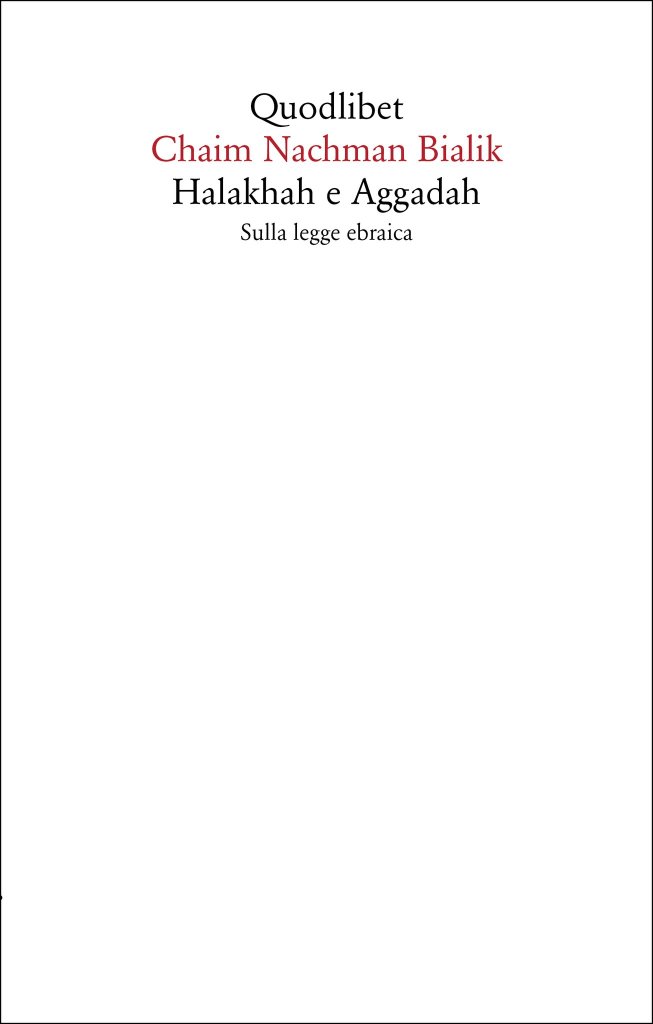
If the modern age is characterized by the triumphant claim to legitimacy thanks to some major forgetting, then there is much to learn from Chaim Bialik’s 1917 enduring essay on Jewish Law, Halakhah e Aggadah: Sulla Legge ebraica (Quodlibet, 2025), which has just been republished in a very timely fashion in Italian. Bialik in 1917 means being in good company of many other names: Franz Kafka and Gustav Landauer, Walter Benjamin and Martin Buber, Ahad Ha’am and Carlo Michelstaedter, and many other names that surely have been eroded by the dust of historical time. This very erosion is at the center of Bialik’s essay that in the thunderstorm of the First Great War, the imperial consolidation of political Zionism, and the disintegration of the Austro-Hungarian Empire where many Jewish marranos dwelled, decides to take a step back from the modern acceleration and ask about the two poles of Ancient Judaic Law: the Haggadah and Halakhah. Immediately taking distance from the modern scheme of positive law and natural law, norms and principles, Bialik reminds us that Haggadah and Halakhah are two faces of the divine dispensation of Judaic law, in which temporal continuity and the statute, the heart and the shelter appear to communicate each and every time through the life of a people (5). 

As someone writing in the waning of Halakhah due to modern secularism, Bialik’s essay is first and foremost invested in preserving the Halakhah as a living tradition, “an art of concrete life” that allows for the form of life of human beings in the world (7). It is from Bialik’s essay where Walter Benjamin in the 1934 Kafka essay would later incorporate the notion that Judaic law as void of content, open to the pure means of its own transmissibility. But perhaps in Benjamin’s materialist rendition Bialik’s central notion of the Hallakah is also blurred, since for the Jewish theologian what is central is the spiritual formation of the soul, a sort of subterranean facticity that is passed throughout the ages, just like that Chrisitan masons built major Medieval cathedrals across the centuries (11) (the metaphor is indeed his). The Halakhah insofar as it inspires the soul is an endless formation, although it is also “the imagination of becoming a living soul, with a body and a sense of beauty” (13). The Halakhah is a region of de-autonomized sublime that Bialik compares to a crossgenerational Shabbat in which a people are observant to a way of living in its own becoming (14). In other words, the Halakhah is not a moral principle for personal virtue as arete as in the ancient metaphysical ethics; it is the absorption of the life of the community into the “voice of the heart” that can regenerate forms of sensible wisdom (16). It is wisdom without a master or priest that teaches the law, since it is not a knowledge that must be interrupted through mental capacities. According to Bialik’s theory, once the Jewish people are thrown into a temporality of dilation, what appears to shine in a powerful light is the cultivation of a life against the abuse and corruption of historical obsolescence. As Bialik writes in one of the most striking passages of his essay:

“Che questi «vasi di vita» siano rimasti da parte per qualche tempo non significa che siano inutili. È una grande legge: ogni forma di vita durante la sua creazione, finché dura questo periodo, rappresenta a sua volta un contenuto nello spirito del suo creatore. Appena la sua creazione è compiuta, essa si separa, si confonde con le altre, e ormai priva di essenza propria decade a strumento: chiunque vi trova quel che vi mette ogni volta che la usa. Essa deve tutto all’uomo e allo spirito dell’uomo a cui tocca in sorte come un bene abbandonato. Se egli vi mette oro, troverà oro; se polvere, polvere. Se non sa cosa mettervi, può anche lasciare che questo strumento arrugginisca. Ma quell’uomo non deve dire: lo strumento è inservibile, da buttare; deve dire invece: io sono povero!” (19).

This means that for Bialik the theological conception of “creation” does not stand for a mythical origin unconcealed by some authority; rather, it is a “vase of life” that allows life to be attuned to the the spirit of the creator, and for the creator to be rendered unfinished because the texture of the form of life is always to be written. At bottom, this modal structure of theological interdependency is at the heart of Bialik’s underappreciated theory of the letter and spirit of law that still resonates in our days. It is not that there is unwritten tradition and then it becomes a written norm to adjudicate the force of law (as in the current American jurisprudential debates about the “History and Tradition” test); on the contrary, Bialik’s legal contribution, well beyond the confines of Ancient Judaic Law, is that there is an abyss in the soul in every enigmatic life because the legal force cannot yet (and cannot for a long time) adjudicate a resolute execution of judgment (23). Counterintuitively, we can thus say that to really “live in the Law” cannot be expressively taken to be to defend court orders and police powers, but rather to allow life to live concretely as enigmatic life that is deprived of temporary ad hoc fictions suited to social domination. That is to say, to live according to the law means coherently with the Hakkhalah entails to an awareness that the law remains fully unknown, in this way incapable of becoming a part of social and penal organization that in our days it has thoroughly transformed the legal systems of the West (37).

This is why Bialik also includes a strong warning towards the end of Halakkah e Aggadah: the rise of substantive qualifications of Judaic culture (Jewish art, education, work, nationalism, theology) bending towards identitarian abstractions amount to what he called “ethereal love” (38). This ethereal love not only dissolves into the solution of modern humanism, but betrays the enigmatic form of Jewish life in the time of dilated waiting. A time of dilation (Aufschub) that does not mean that there is nothing to do – consummated boredom and alienated experience – it is rather the opening to a whole field of possibilities and relations, of worlds and the attunement of the imagination in its exposure. This non-closure of the theological experience provided by the fine attunement of the heart cannot be properly called political; which is why Bialik understood the land of Palestine as a vitam nomoi and not one of nationalist settlement validated by the institutional authority of the modern state.

As Andrea Cavalletti records in his illuminating Postface Bialik telling Hannah Arendt: “La mia convinzione politica, se ve n’è una, è anarchica” (64). Like in Oskar Goldberg’s theology, what is at stake in Bialik is an anarchic Hebraism that allows the presence of God in the world to deter the emergence of poisonous deifications (the individual and the state). Far away instrumentally infused pseudo-messianic overtones of an “elected People” for historical assertion and depredation, Bialik understood that only in the free relation between Halakhah and Haggadah, could the gordian knot of life and law be considered if we are to avoid the slippage into the seductions of the ethereal forces.

The world has been posthegemonic. by Gerardo Muñoz

In a recent text published at Verso Blog, entitled “The Coming Post-Hegemonic World”, Michael Hardt and Sandro Mezzadra make a case for a “turn to a post-hegemonic model” that will challenge the consensus of global in the coming era. In many ways, this era is already here with its diverse and multifaceted (in terms of intensities, forces, and leverages) of protracted and bizarre nationalisms, which as Jamie Merchant has teased out brilliantly, amount to desperate attempts to offer a belated response to the decline of growth as one more stage for containing rampant processes of accumulation via state capacities. For Hardt & Mezzadra, this “posthegemonic world to come” is characterized by a global spatial reconfiguration of capital – accommodating the logistics of regional spaces of influences and exchange across the planet – and on the other, an increasingly “domestic sphere of authoritarian rule” promoted by new accelerated initiatives at generating social homogeneity in the wake of rushing fragmentation hand in hand with a war regime that has utterly scrapped ideals about “strategic autonomy” in order to trumpet an arm race (nuclear weapons included), as it is currently unfolding in Europe. 

One can claim that this posthegemonic world is one that firmly assumes the consequences of two interdependent vectors that imploded within the project of political modernity: the end of  economic growth (thus validating the law of the fall of profit outlined in Capital V.III), and the liquidation of the principle of legitimacy that for two centuries accommodated the legislative sources of the state authority in democratic constituent power. For Hardt & Mezzadra posthegemony means global fragmentation, authoritarianism, and spatial remaking; however, one should also say that it means, the opening towards stagnation, the collapse of political unity of the state, and most recently the total discredit of the foolish leftist hypothesis that promoted a “rainbow social equivalent coalitions” to push for compensatory, and in every instance insufficient and moribound, populist resurgences elevated through the combustion of ethereal but effective rhetoric (in fact, my argument in a new short book, La fisura posthegemónica, is that the push for political hegemony of the last decades only cosigned forms of consensual totalization at the expense of the production of subalternization and social death).  

Even taken as a descriptive and normative condition of the current state of Western politics, the posthegemonic situation lays bare the reciprocal impasse of the claim of its opposition: in other words, one should also put to rest social mobilization that characterized the politics of High Modernity, since ultimately movements (and total mobilization as an apparatus of social energy transfer) presupposes that “every social structure, that it can receive what form required the needs of the political adventure…total mobilization signifies nothing other that the effort to reduce the social substance to a kind of plastic”, as Gérard Granel once defined it. Hence when Hardt & Mezzadra claim that the “effective rebellion must be rooted in social movements envisioning a life beyond the rule of capital”, they are inadvertently refusing to come to terms with the factical posthegemonic reality that they are describing, which is no longer driven by expansive economic growth, but rather by stagnation, and inoperativity at planetary scale that is maintained through the a global veneer of production into regimes of competitive accumulation (of territory, contractual debt, fiscal regulation, executive taxation or tariffs, and increasing arbitrary monetary regulations in the global system) for marginal profitability, as Paul Mattick argues in his recent The Return of Inflation (2023). 

This means that there is no outlook towards ‘social mobilization’ that does not serve the subjective productivity of real subsumption, since its ultimate goal is to anaxate social energy into the force of (un)productive labor. This form of dilatant mobilization can only serve the master of illusionary hegemony, and thus promote functional and unwarranted servitude everywhere. Indeed, only a reprobate can be immune to the moralist or the realist conditions of hegemony. If push comes to shove, the posthegemonic factical world of stagnation and political fragmentation already here proves that the ongoing irruption of non-movements are irreducible to the modern movement’s energy; and that life never fully coincides with political claim to rule and legitimacy, even less so in the becoming-world of Production. 

Ultimately, this posthegemonic fissure outlives the crumbling hegemonic world of principial High Modernism and no ‘international movement’ can piece it back together again. We are all posthegemonic now, but only if one takes up this predicament seriously and candidly.

Osculum pacis. by Gerardo Muñoz

It has taken Pope Francis’s public letter addressed to the Bishops of the United States to put in perspective how late American imperial politics in matters of immigration and probably other spheres of social life is not only at odds with the Christian vocation, but even waging war against the very dogma of Christian revelation. The reminder does not come completely out of context, since as we know, the marching band of intellectuals that for a long time have defended a “Christian postliberal” transformation – some of which not long ago offered theological justifications for the Church as the universal ark for migrants – given the current hegemonic configuration find themselves as mere scribes of whatever is enacted by unilateral executive command. The impossibility of enacting a transitional political theology evidences the emptying of politics into a technical mobilization of apocalyptical overtones, as clearly defended by Peter Thiel. The attempts to pilotage a planetary gnosis to his own image in the last stage of imperial stagnation, definitely supports Francis’ assertion politics today is built “on the basis of force, and not on the truth about equal dignity….begins badly and will end badly”.  But in a way, this “end” has already taken place through the revocation of the ethical tenor of the Christian mystery. 

It comes to no surprise, then, that if the erosion of an ethics is at stake, that Pope Francis would allude to the parable of the Good Samaritan and fraternity, something that he has explored previously in the encyclical “Fratelli Tutti” [1]. It is also important to note that Francis is not opposing the Good Samaritan to the ordo amoris; rather the operation is more subtle: for any community to be organized around ordo amoris, there needs to be a space for the infinite discovery that the Good Samaritan parable solicits of every Christian’s responsability. According to Francis: “The true ordo amoris that must be promoted is that which we discover by meditating constantly on the parable of the “Good Samaritan” (cf. Lk10:25-37), that is, by meditating on the love that builds a fraternity open to all, without exception”. In other words, and implicitly taking distance from the Calvinist dependency on community of salvation, the Pontifex is disclosing the memory of an ethical vocation that cannot end in social norms or national unity without exteriority. The communitarian ordo at times could also amount to oppressive familiarity, as it appears in Corrado Alvaro’s Revolt in Aspromonte: “Village life seemed to him a strange invention, a protective agreement between people who were afraid”. Thus, what the Samaritan teaches human beings is that there are no ethical standards for which we can respond, since every encounter opens up a ‘decision of existence’ before an absolute other beyond the sacramental duty of “I ought”. 

Who is this “other human being” that now becomes your brother? As we know, in Ivan Illich’s late work the ethical inflection of the Good Samaritan illuminates the true character of our poetic relationality and creative act: “You can recognize the other man who is out of bounds….and create the supreme form of relatedness which his not given by creation but created by you. Any attempt to explain this “ought” as corresponding to a norm takes away the mysterious greatness from this act” [2]. Indeed, Illich goes further in telling us that the suppression of the ethical decision of encountering the Samaritan can only leave us with a “liberal fantasy…where bombing our neighbor for his own good” [3]. Just like today the moral justifications of “ordo amoris” or the administrative allocation of a substantive “common good” can produce justifications for mass deportation of immigrants and dividing the social space between citizens and noncitizens (removing the foundation of ius soli) can become the strange patent of a monstrous theological manipulation. 

The ethical mystery exemplified by the parable of the Good Samaritan introduced into history a new conception of “brotherhood” that was not conditioned by national, political, or family affiliations, but by a common vocation expressed upon acting through mercy and charity. Belonging to the “human fraternity” allows me to decide who is my brother through the osculum pacis – a conspiratorial mouth-to-mouth kiss that creates proportionality and peace through the encounter that yields mutual creation. Before the Samaritan we give everything without waiting for anything in return, as required by any true ethical disposition. As the scholar of Ancient Christianity, Christine Mohrman once noted, the osculum pacis was a universal relationship of the human species through their voices coming together to assert external political peace as well as interior health of the soul [4]. If the predatory programs of mass deportations and intensification of hostilities between nations have come to forefront in our days, this is due to the fact that the overall end is not to piecemeal ordo amoris coordinated by state social policies, but rather a permanent assault against the association of the free souls constitutive of the osculum pacis. 

In light of the theological drama of Christianity, nationalism can only be taken as a symptom of brute force and inequity (radical evil). As Erik Peterson reminded in his essay “Das Problem des Nationalismus im alten Christentum” (1951), the cult and strife between nations and imagined communities, at least for the Chirstian vocation, do not have any traction, since the warring angels of nationalities have been overcome by the event of resurrection [4]. The ‘strange career’ of American political Catholicism is precisely that through a technocratic administration of social pain and spectacular delirium, it can only offer an noncorporeal ideal of ordo amoris “in the service of a single nation which seeks to establish its supremacy, by identify its own interest with that of humankind”, as Peterson observed  in the wake of European nationalism, but that it applies today to the letter with little variations [6].

In vain should we attempt to pin down the osculum pacis as professionalization of care or the hospitalization of pain that have become practices of a “corrupted core of a very clear and powerful ideal of democracy”. In the disjointed time that characterizes the end of political theology and its warring nomoi, the osculum pacis will be not be found in those that attempt to conjure a “Christian civilization”, but only in those that dwell in the state of adelphos, faithful to the scandal of peace and the endless conspiracy of speech. 

Notes 

1. Pope Francis. “Encyclical Letter Fratelli Tutti (On Fraternity and Social Friendship), 2020: “By his actions, the Good Samaritan showed that “the existence of each and every individual is deeply tied to that of others: life is not simply time that passes; life is a time for interactions”: https://www.vatican.va/content/francesco/en/encyclicals/documents/papa-francesco_20201003_enciclica-fratelli-tutti.html 

2. Ivan Illich. The Rivers North of the Future (Anansi, 2005), 207. 

3. Ibid., 208.

4. Christine Mohrmann. “Quelques traits caractéristiques du latin des chrétiens”, in Études sur le latin des chrétien (Edizione Di Storia E Letteratura, 1961) , 29-30.

5. Erik Peterson. “Das Problem des Nationalismus im alten Christentum”, Theologische Zeitschrift, 7, 1951, 81-91.

6. Erik Peterson. “Die Frage nach dem Menschen”, in Offenbarung des Johannes und Politisch-theologische Texte (Echter Verlag, 2004), 250.

The last stage of embalmed decay. by Gerardo Muñoz

The techno-administrative organization of the world that is showing off its force these days is only possible thanks to a previous devastation of the opacity of language, which ultimately connects human beings and the world. It is also the mysterious vortex of the breaking point of humanity into being, of which today there is only remembrance and scholastic teaching but seldomly authentic expression. When politicians, engineers, and social functionaries stubbornly distract us with open attempts to decimate secondary languages, prohibiting the annunciation of words through the legal enforcement of “place and manner” norms, and elevate abhorrent structures of linguistic commands and information as units of social interaction, it is obvious that the collapse has already happened. It also means that in terms of “Social” planning humanity has ceased to exist under the shadow of speech, to use an expression from Helene Lubienska. Hence, it is all the more absurd to confront this transformation with a strategy of multiplication of rhetorical codified languages that merely deepen the schism between the expressivity of language and their worlds. It suffices to say that any recognition of a para-official language of social interaction plays into the fictitious polarity of homogeneous globality and reified nationalism –  the constitution of print nationalism being the historical destruction of minor and dispersed languages of remote places and villages for the sake of the organization of a productive fictitious historical subject.

We must ponder what it means that the current imperial world order is one that does not offer a language, let alone the flourishing of minor or ‘vulgar’ languages as in the Latin Middle Ages, but rather an exit from language, which is the cybernetic project of codifying flows of information and looping inputs in which asymptotically humanity surrenders their languages. In past imperial adventures, language was either a tool to subordinate the world of the colonized, or it was a lingua franca of elites (administrators and the clergy) that allowed for the real existing languages in the territories integrated precisely by their exclusion or subalternity to the civilizing regime guided by literacy. The sharp contrast with today it is striking, since it is all too clear that the project of cybernetics, and its most recent avatar “Artificial Intelligence” (AI), is fundamentally an Empire that does not even require to rule and neutralize the “civil war over words” that Thomas Hobbes repudiated in the European confessional state, since its ultimate goal is not political statecraft, but the regulation of unworldly bodies of social reproduction. 

This is why some contemporary engineers have said that AI requires “a reconfiguration of the social contract”, with the caveat that it would necessarily be a “social contract beyond language and thus without politics”. The last social dispensation at the hands of engineers is the human soul, as it has been said. For this conception of language, it matters to only understand it as a semiotic reduction of the expressive human being to naked animality as the general form of the posthistorical being in the present. It is noteworthy that a great North American writer, Cormac McCarthy, while working on this problem of language at the Santa Fe Institute scientific research program (a central hub of American developments for artificial science and the unification of the sciences), reached the conclusion that language must be understood in relation to a virus: “a virus nicely machined. Offer it up, Turn it sligh, Push it in, Click. Nice Fit. But the scrap heap will be found to contain any number of viruses that did not fit…The facts of the world do not for the most part come in narrative form. We have to do that” [1]. The “unruly nature” of language, precisely because it does not fit into the biological pattern of virological model, must be mastered into an accompanying narrative of the social world, taking the copula and grammar as the final functionalization of the fictitious community. The artificiality of language is a civilizational decay that takes place not as heteronomic cooptation by technological advancement, but within its own internal abdication of its voice and mystery. 

It is precisely this internal threat that the American sinologist Ernest Fenollosa sought to expose in the most polemical moment of his posthumous tract The Chinese Written Character as a Medium for Poetry (Stanley Nott, 1936) – an essay that was restituted, let us not forget, by Ezra Pound precisely to confront the pauperization of ‘Basic English’ as the standard of linguistic use – in which he writes the following observation about the extreme filing of words: “Languages today are thin and cold because we think less and less into them. We are forced, for the sake of quickness and sharpness, to file down each word to its narrowest edge of meaning. Nature would seem to have become less like a paradise and more and more like a factory. We are content to accept the vulgar misuse of the moment. A late stage of decay is arrested and embalmed in the dictionary” [2]. Fenollosa could not have foreseen that the posthistorical epoch – an epoch of the most furious abandonment of thinking – there was nothing else to file in terms of the expressivity and poetic soil of speech. The course of American artificial humanity is not a human with a pocket-dictionary; it is something way more grotesque: an animal that can repeat and chatter sounds and symbols severed of its proximity with any linguistic inherence and the sensorial worlds. And it goes without saying that the engineering plan against the poetic soil of speech, as North American poet understood well, means that this war is waged against the last reserve; that is, the ethos understood as ‘the cave of everyone’s inner being’. 

Notes 

1. Cormac McCarthy. “The Kekulé Problem”, Nautilus, April 2017: https://nautil.us/the-kekul-problem-236574/

2. Ernest Fenollosa. The Chinese Written Character, edited by Ezra Pound (Stanley Nott, 1936), 28.