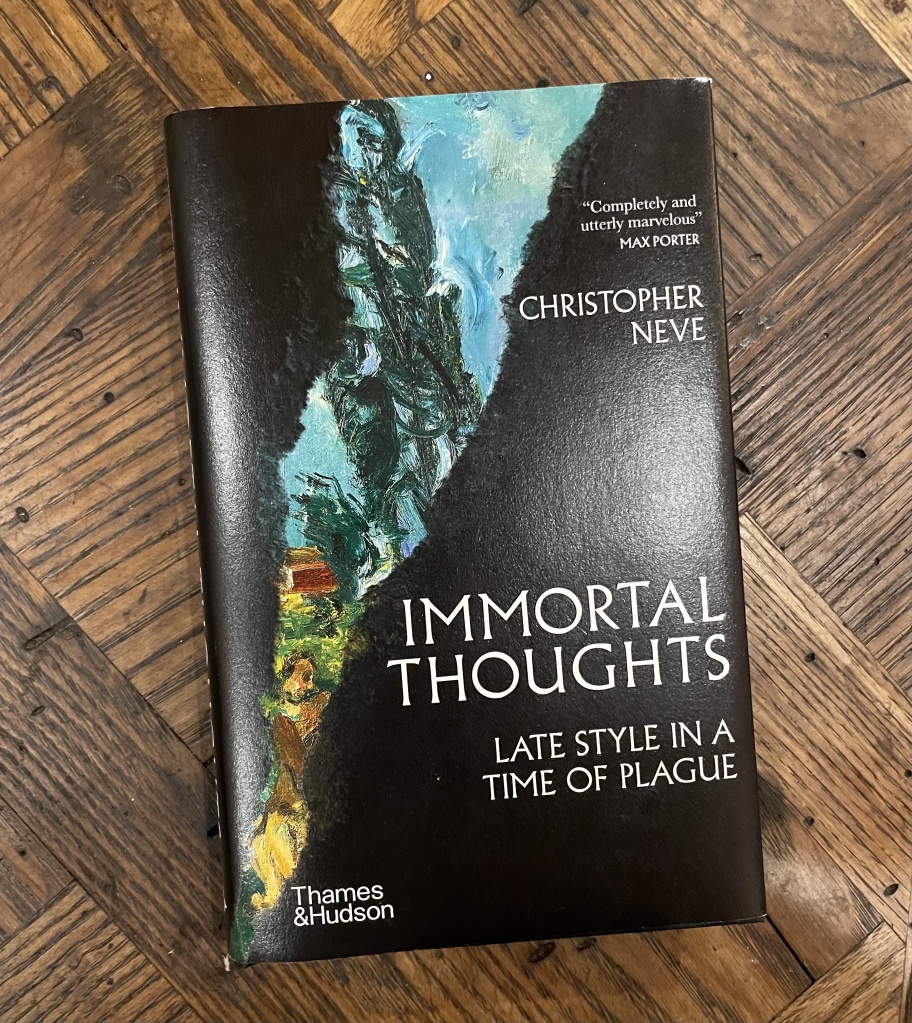
In his Immortal Thoughts: Late Style in a Time of Plague (Thames & Hudson, 2023), Christopher Neve ponders whether there is something like an “experience” of late style in painting. He immediately sets up himself to the task in the last works of great modern masters, from Cézanne to Soutine. The notion of “late style” can only be raised at the definitive end of the artist’s path. The old age style is an aspotilla no longer dependent on approval and excellence; it favors inner capacity and dexterity of seeing. This is why late style is, probably, always self-transformative: it poses the notion of work under erasure as it comes near the zenith of retraction. For Adorno late style registers the failure of synthesis as well as the force of dissociation in the permanence of the catastrophic. Neve will perhaps agree this much: painting is not about fixing temporality (the density of the history, the vulgarity of the contemporary, the monumentality of the past); rather what remains is the fugitive scene of depiction. If the question of “late style” is immensely difficult to raise, that is because it resists conceptualization: it merely seeks to denote achievement and the ruinous; appearance and retreat; unlearning schematics and producing “from life” itself, to put it with Poussin’s pictorial vocabulary. Late style is not about the moment of judgement and recapitulation – it is what depiction can achieve in the twilight of creative powers. As Goethe once defined old age: “Old age is gradual retreat from appearance”. But this retreat animates the space that had remained secluded in the order of temporal abstraction.
There is no theory (and there will never be) of late style of pictorial representation. It is a question that merits the weight of description – which Neve combines, quite successfully, with that of emblematic instances of the artists’ form of life. In other words, late style does not require conceptual renditions; it demands the elaboration of strong descriptions that can grasp the resonance of a fundamental ethos. Neve glosses Delacroix’s ethical imperative: ‘only in old age does a painter finally know what sort of artist he should have been all along’. In late style there is coming to conclusion because there is a path for homecoming. This ethical dimension of the artist is neither regulated by form nor by epistemological conditions. Late style implies a stripping away of things; it bares a specific nudity: it can reveal interiority (the invariant) without argumentative absorption. If anything else, it is the non-knowledge of the gesturing hand. Neve points calls this “statement” when offering a treatment of Rembrandt’s old age: “…technique and the process of getting older, and that this was somehow done all in one, summed up and expressed undeniable and in confidence of one blow and as a single statement. And I wished that all painting could be like this” (46). We suppose Neve’s desire as hyperbolic, since painting under a single statement also implies the moment when the picture approaches the abyss between the hand and the order of reality.
Painting gravitates towards a single statement when it surpasses life by taking death seriously. There is much truth in reminding that the work of art aspires to its bare lyrical moment of decline and unworking of itself – this was also Cézanne’s moment of “not being able to realize!”- in order to flee from the objective fixation of the “thisness of nature”. Painting assembles a transfigurative force against the temporal succession of the pro-duction of a specific work on a surface. As expressed by the old Pisarro from the window of his studio quoted by Neve: “A little more work before dying” (54). True, nothing else but painting mattered to Pisarro, as Neve reminds us. Now, does this mean that he is holding on to the unchanged and muted essence of things as a “metaphysical solace” in the face of the whirling of a world in chaos? Perhaps there is something to this suspicion that must be reckoned with – painting comes close to theological presuppositions insofar as creation unsettles a disenchanted world and its fictitious mimesis. Alas, this is a question not fully posed by Neve, but it is also one of the ways in which his book could travel without much effort. The question of immortality of a picture has a point of departure here. But is immortality conceivable as a form of solace and fallen piety? One should refuse to ask this question in the form of generality. The works Titian, Goya, Cézanne, the dreary and posthumous glory of Velázquez or the suffering Soutine during the Nazi occupation are all efforts to pose the problem of late style painting as the ethical attunement of each artist.
In the most elevated and charged moment of Neve’s efforts to grapple with the notion of style he recurs to Soutine (and it requires us to turn to the picture “Children playing at Champigny” from 1942): “What you are seeing, when Soutine paints the Auxerre trees, is what I think happens in the work of most of the artists I haven written about here. This storm of temperament is true painting, an inexplicable combination of seeing, feeling, memory, response, imagination, and profound oddness. And so he turns away in exhaustion” (122). Late style registers the collapse of a possible fulfillment with the world by indexing a detour to the point where realization seeks to “return to simplicity and order”. Truth indicates the literal thereness on the surface devoid of illusions. So, solace does not have the last word; this is not how a painting subsists under a single statement. And that accounts for the ultimate risk: the ethical presupposition of painting exposes the artist to the “terrible freedom” as the distance between the passions (temperament) and the gesture within profound disorder and arbitrariness of nature.
Someone like Carlo Levi will find himself at home: true freedom cannot begin by the suppression of the passions in the name of interests; rather, the burden of freedom is the caesura of passions that displaces the otherwise inexorable fear of civilizational progress. Painting as the event of truth dethrones fear as the primary attunement in reality. Through our emperament one finds the exit from alienation, gathering the moment of depiction into order. There is a gentleness of freedom in the mutual self-supporting carrying of things, as Kurt Badt saw in Cézanne’s old style. And this might be the tragic element of painting and its fundamental antinomy.
For Neve this means nothing shorter than “the world reduced to a series of prodigious impulses, the revelation of the inner intact, the change taken to see the universe in a new light at the risk of failing utterly” (130). Late style is what reveals inner intact to the fruition of exteriority – this is the compass of visibility. A failed world followed by decline – two terms where mythic transfiguration moves painting to the eccentric luminosity of altering the jarring relation with the world. Old style enacts a catastrophe that refuses the insolvency of pulsation that binds character to the harmony of form. One might add that it could very well be that painting is, as revealed in the abyssal caesura of a late style, a stated mystery: a passionate life that profoundly perturbs the world, a transcendence that falls into an irrevocable eternity.
The title of the painting is “Still Life with Apples” (1894) housed at the Getty. Like many of Cézanne’s pictures of the 1890s we have a sense of immediately entering into an space warped by distance and nearness that lavishly seals the scene. We feel that something has taken place; after all these are pictures of an event, but only concealed to us. We are given the sense of that experience, which is the fundamental thing to depict for Cézanne. Now, if Clark is correct, then it is true that Cézanne’s still life painting was meant to annihilate the objectivity of the world through a study and stubborn simplicity; although simplicity never amounts to synthesis. On the contrary, what preserves sensation over absorption remains at a distance: this is the narrowing act of simplicity as a fact of style [1]. The depiction of appearance is a problem for Cézanne precisely because painting now stood (late nineteenth century), as Kurt Badt well observed, as the last metaphysical activity in the face of Western nihilism [2]. There is nihilism, an unbridled chaos – and thus painting aspired to accomplish a different form of order, a transfiguration through sense. A higher order subtracted from representation. Thus, the outpouring of sense was everything to Cézanne; nothingless than the attunement of the relationship between depiction and nature. Thus, nearness and distance stands a problem in the picture itself: what is most apparent is what Cézanne seeks to qualify through depth and singular brittle rigidity.
As he would write to his friend Émile Bernard: “In order to make progress in realization, there is only nature, and an eye educated by contact with it….I mean that in an oregon, an apple, a ball, a head, there is a culminating point, and this point is always the closet to our eye, the edges of objects recede towards a centre placed at eye level. With only a little bit of temperament one can be a lot of painter. All you need is an artistic sensibility. And doubtless this sensibility horrifies the bourgeois” [2]. This is Cézanne’s permanent struggle (a non-subjective position, that is, anti-Romantic) struggle: the impossibility to “realize” and to complete a picture as the heart of the mysterious vortex of the execution of depiction. This clears the entrypoint to the problem of the “last metaphysical activity in the wake of nihilism” that Badt consigns to the activity of painting: pictorial art can reveal the unrealizable in every work; but it is no less true that all works fundamentally have an asymptotic inclination to the potential of realizing the idea. The achievement of that impossible nearness attest to the achievement of painting (or to its consummated failure).
The unrealizable in Cézanne’s painting, however, is not merely indexing the unfinished gesture of the brush in a scene or a series of selected objects; rather it is the condition of possibility for entering into the world through a medial common existence between things, however fragmentary within the whole. The unrealizable dimension is never a conscious attempt for a spatial unity to be fulfilled; it is alienable by a stylistic reduction at the moment in which it ceases to belong to the painter’s cognition. This is why Cézanne’s pictorial project – more so than Pisarro’s anarchic affinities and political flirtations in the late nineteenth century – has radical consequences for an opening of freedom that is grounded on the senses (and what it means to be ‘free in the senses and the passion’, in each temperament), allowing experience to decompress the formalistic representational conditions of bourgeois civility. Indeed, Cézanne’s work – and the world it depicts, the opening towards things as a whole but through separation, having in common precisely alienability – does not aspire to be legible in the social, which is the ideal space of exchange and metaphorization, recognition and reification as image. The social is the limitless spatiality in which anything can enter, as anything can stand for any other thing. Or, to put it more concisely: painting seeks to let things be things in their interchangeable nature (without the anxiety over fixing an image of Nature).
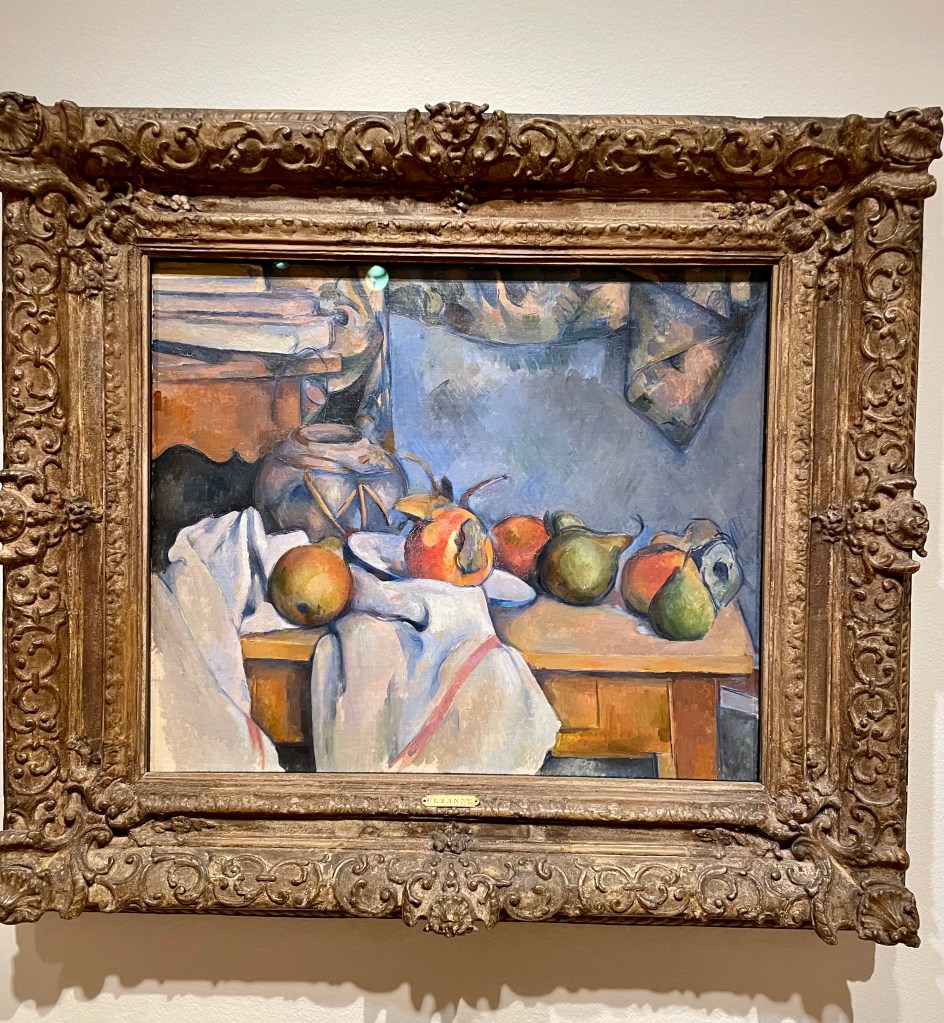
Paul Cézanne. “Ginger Pot with Pomegranate and Pears” (1893), Phillips Collection, Washington DC.
Cézanne inadvertently knows that whatever fate in the wake of nihilism awaits “painting” (soon to be utterly destroyed and displaced by the conceptual and object driven monstrosity of the modern vanguard), the effort to “realize” in painting meant holding to experience of depth as the only guarantee of an existential freedom. Surface and depth will remain on the side of the insistence of an appearance without predicates proper to theatricality. Kurt Badt poignantly captures this in Cézanne’s “old age style”: “There is no longer anything in our sensory experience of seeing which corresponds to what thus becoming visible; what is shown nis rather the visible picture of the concept of freedom. For the thing common to all these forms of the “style of old age” is two-faced: negatively it is a ligeration from isolation and resistance, possibly a liberation to the serious gentleness of freedom” [4]. And gentleness means letting things be: the serene elevation to irreducibility, upholding them only in the proclivity of its contact; never fully absorbed by surrounding and revealing its state of harmonious composition. The task of depiction in painting is the impossible task- but the task nonetheless thoroughly achievable through the hands of the painter – of coming as close as possible to what has actually been experienced. Having affirmed (not necessarily achieved) something like a fate-like divine temporality in painting is able to ground worldliness as transcendent only to let it fall immediately after. And what fate is to character, for Cézanne ‘that which is preserved unchanged’ is the supreme tonality of the pictorial task realized by the restraint of the artist [5].
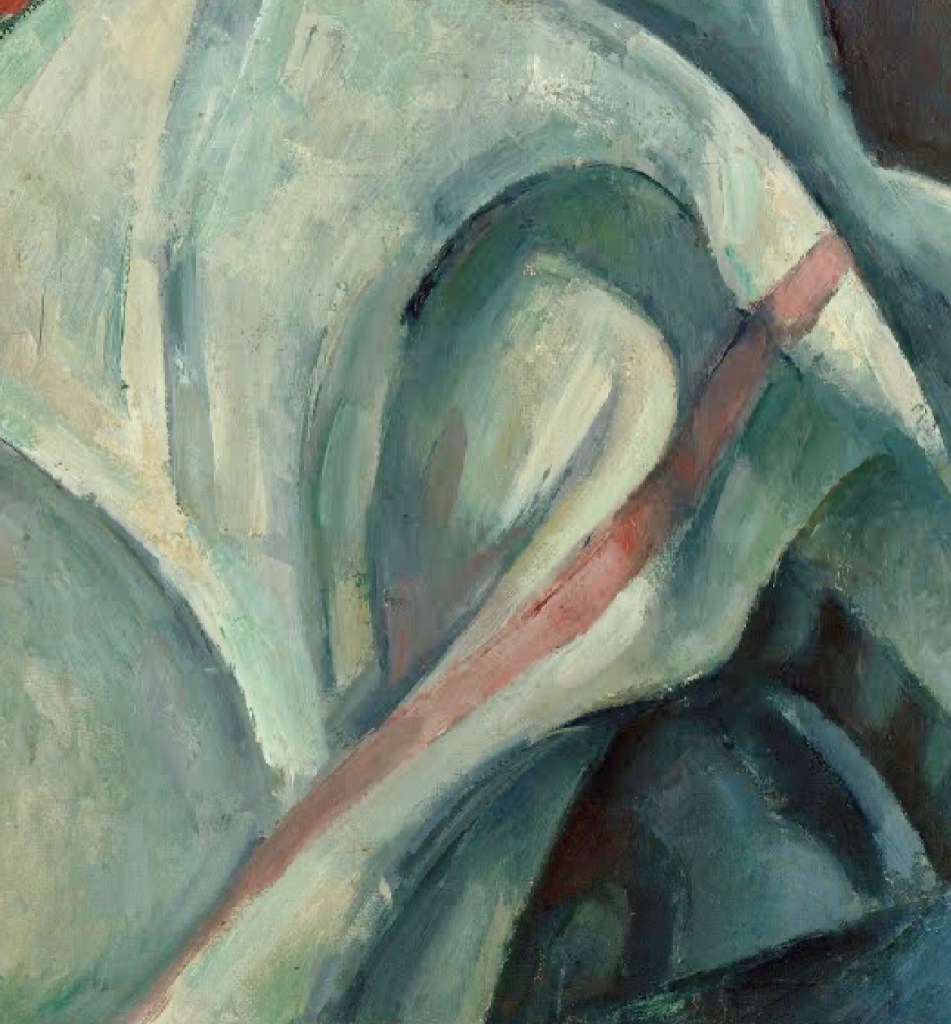
But precisely to depict immobility, the forever permanent, the befallen weight of the conatus essendi (what preserves itself as such), painting has to mobilize a minimum motion for the confluence of objects, planes, and emergence of depth. The pink stripe tablecloths that appear in several of the 1890s still life paintings with fruits can be very well taken as a multum in parvo of the declension in every realization. In a sense, then, the pink strip is a signature, as if were, of the gathering of things and depth at the price of unrealizing the closure of integral depiction. It is precisely the pink stripe in which it becomes realizable in a single brushstroke that the place of the line appears otherwise, crowning the mystery of painting as the clearest manifestation of a different musical order. It is the mysteriously nature of painting, which barely introduces itself as a line substitute for a color (the color of the tablecloth as a thing) that, while remaining visible to the viewer, cannot but reveal the invisible; that is, the temperament of the artist attuned to the muteness of painting, to say with Poussin. And perhaps this is the highest moment of depiction in the search for the “integrity” of “wholeness” that, in turn, grants the instance of the unconcealment of truth. A lace plotting what has already been validated in the irrevocable thereness of the most inapparent existence: an eternal state in the world.
.
.
Notes
1. Maurice Denis. “Cézanne II”, The Burlington Magazine for Connoisseurs, Feb, 1910, 279.
2. Kurt Badt. The Art of Cézanne (University of California Press, 1965), 181.
3. The Letters of Paul Cézanne (Getty Museum, 2013), 342.
4. Kurt Badt. The Art of Cézanne (University of California Press, 1965), 313-314.
It has been said repeatedly – in the best hyperbolic spirit, no doubt – that Chile always stands, regardless of the angle from which we are looking, for what is to come in our epoch. The Chilean laboratory prefigures the coming mutations and solidifies the effective tendencies of public powers. The 2019-2023 political cycle is no different: it began with the experiential revolt at the heart of the metropolitan center, and it culminated with yet another constitutional scene seeking to replace the “constitución tramposa” now at the mercy of those that hold a deep admiration for the post-dictatorship subsidiary state. The newly elected advisors and experts will place the final cap to the momentum of institutional transformation, which welcomes back the official garments of public legality, official languages, and grammars of public security. And even if it is true, as Rodrigo Karmy has argued, that the most recent electoral results confirm the exhaustion of the Chilean post-dictatorship regime, the question posed to us is what capacity can constitutionalism and the constituent scene contribute for any possible transformation. [1]. In other words, can a breakthrough be produced from within the conditions of constitutionalism? As Martin Loughlin has recently demonstrated, our historical epoch is one marked by the irreversible triumph of constitutionalism; a design that differs from the modern constitutional state of representation and legislative legitimacy, envisioning an encompassing “dynamic order of an evolving society rather than an authoritative text, the basic ideals of constitutionalism have been realized” [2]. Constitutionalism emerges in the wake of the end of the liberal presuppositions of modern political theology and everything that it implies for the stability, separation, and judicial control of public powers.
The system of constitutionalism presupposes a total governmental nexus whose legality (discretionary, exceptional, based on the application of general principles / ius) will be treated as “an order of values that evolves as social conditions change” [3]. The passage into an administrative system of legal order presupposes a suture between principles and political necessity, state and civil society, economic rationality and executive planning and oversight. The old paradigm of the modern “dual state”, theorized by Ernst Fraenkel in the 40s have now supplied an internal abdication of positivist jurisprudence and minimalist constitutional framework, paving the way for the total constitutionalization as a flexible art of governance. Although it has been said that the first constitutional drafting of the new Chilean constitution was confusing and overtly ideological (a “magical realist” menu of rights and everything under the sun, one contemporary jurist called it), there is still something to say about the veneer of “social rights” within the epochal system of constitutionalism [4]. It is at times forgotten that the abundance of enumerated social rights implies the infrastructure of constitutionalism to bind legal, political, and social spheres into a regulatory apparatus without fissures. To govern the social means steering over the abstraction of social values. There are good reasons to discharge skepticism against constitutionalism, and they keep coming. Of course, the argument of skepticism, alas, rarely has good press (it fails to provide an insight into totality, Max Horkheimer famously argued), but I do think it is necessary to reclaim skepticism in the wake of the systematization of public constitutional principles [5]. Skepticism demands separation from constitutional absolutism and the legal nexus in which social action interaction finds itself. The skeptical position in the face of constitutionalism at its most minimalist bearing insists in the separation of life from law, of experience from political order, of expression from the order of rhetorical mimesis. The skeptic might not want to negative law as authority; but it wants to refuse the post-authoritarian conflation of life and social rule underpinning political domination.
To be able to see beyond the framework of constitutionalism is the task at hand, especially when the old predicates around the political subject and the social contract make their way back from a position of weakness and desperation (another way of saying that morality returns as nihilism). But one does understand its success: it is a compensatory psychic mechanism for the ongoing existential pain under the abstract orderability of the world. And where there is pain, there is also an accumulation of experience that pokes through the fictive state of things, refusing the objective staging of phenomena. Simply, it refuses to be absorbed by what’s available. At this point it becomes impossible not to recall the October revolt for one particular motive: mainly, that its emergence did not favor social demands nor was it driven by the grammar of a political program. Every experiential uprising has an aesthetic dimension – or even better, pictorial set up, a canvas of everyday life– that we have yet to rediscover. Painting from real life is no easy thing, some painters have told us. And something similar goes for the revolt: an alteration of gestures, inscriptions, graffitis, and corporal tracings, dissonances and masks color the expressive discharge against the pledge of objective realism and the police of languages. Indeed, pictorial skepticism can only emerge when there is an excess to representation; that is, when there is a sensible stubbornness to enter into contact with the unfathomable of the world as such. The world and its others, one should say. This pictorial dislocation of reality dispenses a rhythmic structure of the senses that is neither chaos nor destruction, but an arrangement of a different sort: the communication between souls (from soul to soul, Rimbaud had said) without regulatory mediations through the tokens of recognition and filiation. The rhythmic movements provide a spatial continuation devoid of justifications [6]. This is why pictorial semblance tells us something that language or the science of politics cannot. How can we last together as a community that is not?
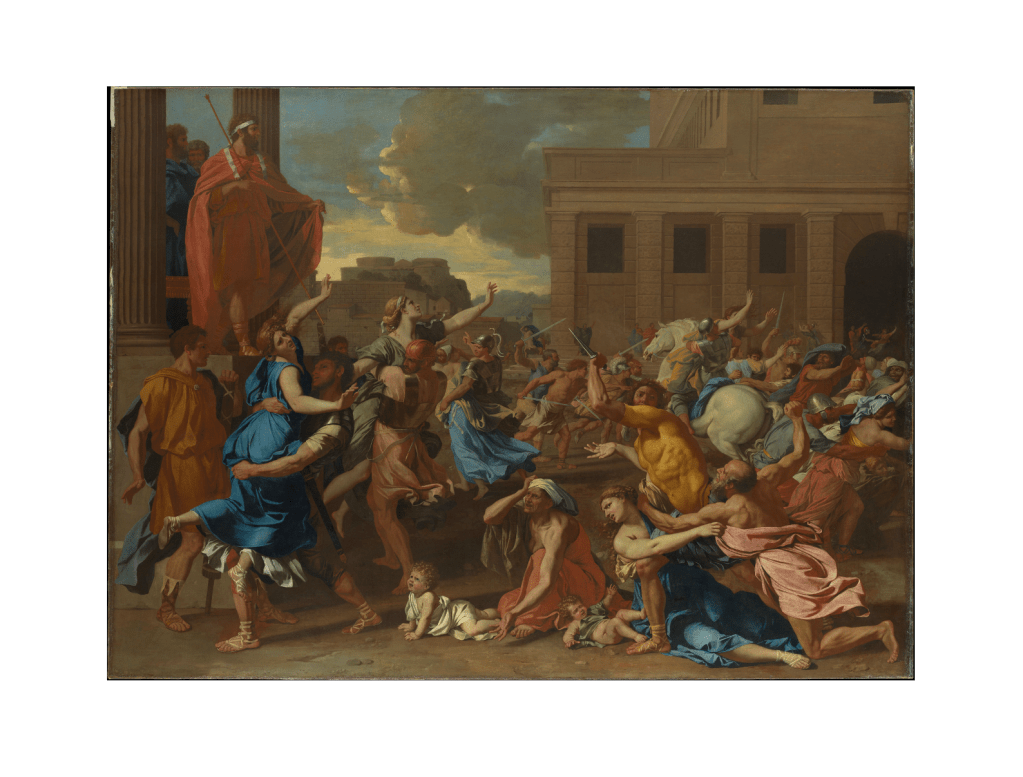
Pictorial dislocation wants to claim distance and separation the non-totalizable while being there. Let us take a painting like Nicolas Poussin’s The Abduction of the Sabine Women (1633-1634): here we have a complex composition ordered around rhythms and modes of figures and distances; the possibilities of communication between forms and the expressivity of the figures hold everything as if in a state of grace. What is striking in the picture is the subtle mounting of activities and gestures without ever falling into the sublimation of the concept. There are no guidelines, and yet we feel that everything communicates. Or to put it in Poussin’s pictorial terminology: “what follows is unlearnable” [7]. I do not think that the painter tried to posit a negative foundation of knowledge for an even higher learning; rather the unlearnable is a practical activity (a gesture, a word, a contact) that is both unique and indispensable; impossible to let itself be arranged into a set of alienated function for a task. Poussin reminds us of the unknowability of rhythms taking place: an uncompressed experience outside the force of systematization. We need thought to incorporate something like this exercise in rhythm.
It does not come as a surprise that a conservative scholar during the first months of the October revolt hypostatized the event as a “gnostic program” claiming that: “Plato’s philosophy offered a simple solution to the gnostic problem: instead of adapting the world to our desire, the task is to adapt the soul of the world…we now know that public order is the our most urgent occupation” [8]. Needless to say, and as Díaz Letelier noted at the time, this was a political Platonism devoid of chōra as a nonsite of our sensible imagination that allows the renewal of the creative experience with the world [9]. There is no ‘common sense’ as the pragmatists of realism assert with conviction; there is only the sensorial passage allowed by the chōra. This is what constitutionalism needs to pacify and incorporate: the battle over the status of the soul at a moment in which material goods and its economic arrangement (and in the Chilean case, its negative subsidiarity principle) becomes insufficient for the psychic production of a rectilinear subject (a masculine subject, Alejandra Castillo would claim) [10]. The postliberal constitutionalism as it stands (and it is postliberal because it cannot longer said to appeal to an internal principle of positive norm nor to a source of ‘Higher Law’, but to the executive command of the principle); a world legal revolution of governmental administration of anomia, amounts to a systematic offensive that exceeds mere material appropriation or personal liquidation. And this is so, because its ultimate mission is the “soul murder” (seleenmord) that currently stands as the basic unit of the ensemble to govern over socialization[11]. Constitutionalism now appears as the last avatar of Americanism. Perhaps there is no higher and modest task at hand than affirming the medium of the chōra that preexists the submission of life into the polis, and which retains, like the pictorial gesture, the unlearnable and the unadaptive. Only this could slowly render another possible sense in the relationship between liberty and law.
.
.
Notes
* This text was in preparation for the conversation panel on the current legal and political cycle in contemporary Chile with Alejandra Castillo, Rodrigo Karmy, and Philip Wohlstetter that took place in May 31, 2023 at the Red May Seattle Forum. The conversation is now archived here.
5. Max Horkheimer. “Montaigne and the Function of Skepticism”, in Between Philosophy and Social Science: Selected Early Writings (MIT Press, 1993), 265-313.
10. Carlos Frontaura. “Algunas notas sobre el pensamiento de Jaime Guzmán y la subsidiariedad”, in Subsidiariedad en Chile: Justicia y Libertad (Fundación Jaime Guzmán, 2016), 123.
11. Ernst Jünger. The Forest Passage (Telos Press, 2003), 93.
Nietzsche in Italy (Pushkin Press, 2023) by Guy de Pourtalès, originally published in 1929, has a particular texture that makes it inadequate to consider it a standard intellectual biography. Pourtalès does not follow the contours of the psychological and chronological construction; rather he is more interested in sketching out the telluric effects on the transformative tonality in the thinker’s soul. Nietzsche’s radiant affinity to Italy and “latinity” has been well known, and at stake there is the possibility of finding an exit from the grandiose enactments of the German romantic gestalt. For Pourtalès, “latinity” is the prescription that Nietzsche writes out for himself in order to maintain sanity in the world; and, ultimately, to find its own destiny and path in the face of modern nihilism. Sure thing, Italy is many things for Nietzsche: it is the zenith of his poetic relationship with the Wagners but also their farewell in Sorrento; it is Venetian music and pleasant weather; it is the open and physical form of a possible community of the Free Spirits and artistic expressivity. And Italy is also a refuge from brewing culture of force in the North through the Renaissance uomini singulari where music persists, as he writes to his friend Peter Gast: “Life without music is imply a mistake, enfeeblement, an exile” (94). Pourtalès narrative collage (the different vignettes of Nietzsche’s visits and residencies in the Italian geography) detects the philosopher’s fundamental existential homecoming: a melody of the soul in a world increasingly organized through the chaos as the essence of force. To be attuned to the melody of the soul becomes the task of the artist: “to hear and see beyond the vast “lost time” of humanity what others no longer hear or see, but just unwittingly hum as a tune, vague and wordless”, writes Pourtalès (41).
And if music is an aesthetic form of prophecy, Pourtalès’ sheds light on Nietzsche’s insistence to become a prophet of the age of nihilism: wrestling with the poignant homelessness in the human world of a postmythical age. Pourtalès insists that the “Italian experience” opens up for Nietzsche multiple possibilities to confront the Wagnerian solution through the concretion of the forced and unhealthy (these are Pourtalès’ terms) aesthetic formalization of the mythic redemption. The Nietzschean attempt (the beloved and unresolved versuch) is the final confrontation of “music versus music”, since “all philosophy is a series of events of the soul and finds its symbol only in music” (49) explains Pourtalès. This is what Italy seems to be providing Nietzsche with: the withdrawal from the intoxication of the “Wagnerian flame without being consumed by it” (66). This entails an acceptance to pain without instrumentalizing the rewards provided by the genial artistic form of the Gesamtkunstwerk and the enslaving commandments of Christianity. Wagner and Christianity now stand in the way of the path of destiny without paying dues to mimetic investments. This is Nietzche’s last battle, and thanks to Pourtalès we realize that Italy becomes the battleground for an ultimate detachment. But is it successful? Is Nietzsche as the artistic genialismus prophet able to accomplish the radical abandonment?
This is the resolute ambiguity in Nietzche’s proximity and distance from the Italian tonality. Indeed, Nietzsche seems never to have abandoned the rhetoric of the genialismus. Pourtalès quotes him: “Italian genius is by far the one which makes the freest and most subtle use of what it has borrowed…..and is thus the richest genius, the one with the most to give” (89). At times Nietzsche’s words about Italians or latinity is a metonymic for Christianity, his ultimate confrontation after Wagner, because to overcome Christianity implies to embrace the melody of life. This is why for Nietzsche Jesus is a higher form of life, whose kingdom is, according to Pourtalès (resonating here with the late work of Von Balthasar), “that of children, his faith is without rancor and without reprimand; it lives, it is itself its own miracle and reward” (100). The transfiguration of Christianity becomes a path to arrive at the very attunement of life itself, although this requires understanding love so that the “Kingdom of heaven becomes a state of the heart” (100). This nomos of the heart is Nietzsche’s ultimate and impossible search; perhaps one that does not truly find the path to a proper homecoming.
Was it due to Nietzsche’s failed efforts at finding the melody of the soul in his ruthless, cuerpo a cuerpo (“Dionysius against The Crucified”), struggle against Christianity? Were the terms of the prophetic transfiguration a mere illusion of guidance and redemptive incarnation? To put it in Cowper Powys’ lucid observation: “If Nietzsche had not been obsessed by Christianity he would have thought of Life before Christ came”. Pourtalès does provide us with another hypothesis: “Perhaps amongst the last things he [Nietzsche] understood was the profound speech of this piano, of this fiend, whose inner music he had always been the only one to hear. But no thought, no word emerged from this ruinate soul. Nietzsche expired, walled up his silence” (110-111). In Pourtalès’ interpretation, Nietzche’s lacked the central aspiration of melody of the soul: “knowing how to love”, which is obviously the unlearned lesson from the Italian landscape and the world of visuality. The fact that Nietzsche had no patience for painting according to Pourtalès says a lot regarding his incapability for an erotic mediation to escape spiraling towards madness in a desperate effort for completion. I am not saying that painting could have saved Nietzsche; but, as the last active metaphysical activity in modern nihilism (Kurt Badt), pictorial persistence is the ultimate exercise to hold on to the world from the point of view of one’s daimon. Pictorial persistence clears the illusionary strife over concepts of the tradition. Pourtalès’s Nietzsche in Italy (2023), even if only obliquely, is as lucid of a portrait as we might get in order to raise this question in a serious fashion.
Towards the end of his life, poet José Lezama Lima will mysteriously begin to sign the letters to his friends and family as “the Trocadero Etruscan”, a “member of the Etruscan religiosity”, and even the “man who lives in the Etruscan village” [1]. Why call himself an “Etruscan” in this particular moment of his life, and what could it possibly mean? The question about the meaning of the Etruscan authorial mask has been so thoroughly ignored by the literary critics that commentators at their best have noted that “being Etruscan” merely stands for his “cosmopolitanism” and “well-learned Europeanism”. Of course, this explains little to nothing. A sophisticated poet such as Lezama Lima, who ruminate over every single word he would write, could not have ignored that the Etruscans, unlike the civilized Romans and the Latin authorities, was a remnant to the very civilizational enterprise; a prehistoric people poor in written culture, achieved expressivity by the whole outlook of their form of life. And as in the case of Hölderlin’s adoption of different nom de plume (Scardanelli, Killalusimeno, Scaliger Rosa, etc), Lezama’s becoming Etruscan points to something so fundamental that if underscored we would fail to grasp the endgame of his vital poetic experience. The transfiguration of the name does not merely stand as a metaphor; rather it points to a distant figure that will finally dissolve him so that his immortal voice could continue to live on.
Indeed, the self-identification as an Etruscan for Lezama became a subterfuge to flee a political reality – his political reality, entirely structured by the revolutionary gigantic productivism and subjectivism – through a poetic refraction that would free an ethos from the overpowering of alienated autonomous space of the linguistic reproduction of social life. If at first glance it seems like a paradox that Lezama will adopt the Etruscan figure for his antisocial ethos – a civilization lacking written records or high literary achievements, a religious community known for its necropolis – this strangeness will ultimately prove that behind the Etruscan name there was no poetic exclusivity of the poet’s genius, but rather, as he claims in “A partir de la poesía”, the possibility for a divinization of reality to retreat from the historical epoch. In fact, Etruscan culture for Lezama was not a mere archeological ornament, but one of the “imaginary eras” of the West; that is, a stage of condensed and unnumbered imaginative possibilities resistant to griping subsumption and totalization of values. The Etruscan was the mythic remnant through the pantheistic divinization between language and the world. As Lezama writes glossing, in passing, Vico:
“Vico cree que las palabras sagradas, las sacerdotales, eran las que se transmitían entre los etruscos. Pero para nosotros el pueblo etrusco era esencialmente teocrático. Fue el más evidente caso de un pueblo surge en el misterio de las primeras inauguraciones del dios, el monarca, el sacerdote, y el pueblo unidos en forma indiferenciada … .les prestaba a cada una de sus experiencias o de sus gestos, la participación en un mundo sagrado. […] Pues en aquel pueblo, el nombre y la reminiscencia, animista de cada palabra, cobran un relieve de un solo perfil” [2].
The divinization of the Etruscans stubbornly insisted on the wonder of things. The human participation in divinity is no longer about founding a new theocracy or a “theocratic politics” in the hands of a ‘mystic accountant’ that would finally put the nation back in track (into the res publica), as Lezama would solicit out of desperation in the 1950s diaries [3]. On the contrary, for Etruscan people the fundamental tonality was the divine music of experience. Of course, we know that D.H. Lawrence captured this when claiming in his Etruscan Places (1932) that “the Etruscans are not a theory or a thesis. If they are anything, they are an experience. An experience that is always spoilt” [4]. And this experience (like every true experience) needs to be necessarily spoiled, which ultimately means that it cannot be mimetically rendered, arbitrarily modified, or subsumed into the order of idealization. But all of this is merely redundant, since the Etruscan inscription is what accounts for the limit to civilization, becoming the impossibility of the destruction of myth in the arrival of modern aesthetic autonomy. Thus, for Lezama the Etruscan way had something of a persistent cure against the ongoing civilizational disenchantment, even if it does not cease to appear in the modern attitude. In fact, Lezama writes that: “Rimbaud is the best reader of the Etruscan liver” (“hígrado etrusco”) to describe the dislocated position of the poet in the modern world of technology [5]. In the Etruscan cosmology, the liver was a symbolon of the vision of the cosmos registering the divisions of the spheres in the sky through the divine naming of the gods; it is the figure by which the poet guards the desecularizing remnant of the prehistoric inception of myth [6]. But this does not mean that Lezama will look at himself in the mirror of Rimbaud’s symbolist alchemy.
Rimbaud as an Etruscan is the poet who descends into hell because his lyricism can bear the pain in the disruption of language after the archaic peitho. Does the possibility mean a travel back in historical time? Not the least, as Lezama knew how to let go of storytelling and historical necessity. This is why Etruscans stand for an image or a sort of handwoven picture (the hand will make a comeback, as we will see) to gain vision. And this is one case on point: the Etruscan stands paradigmatically to the “sufficient enchantment” (“la cantidad hechizada”) , which discloses a higher knowledge of the soul (psychê) in the taking place of poetic errancy: “Sabemos que muchas veces el alma, al escaparse de su morada, tripulaba un caballo inquieto, afanoso de penetrar en las regiones solares” [7]. To wrestle against the historical reduction of autonomy of the modern age means to find this enchanted sufficiency necessarily for myth remnant to elevate itself against the aesthetic mediation that, in the words of Gianni Carchia, had become a consoling surrogate of the emptied historical time [8]. An entirely other conception of freedom is firmly implicated the Etruscan way: the gathering of the enchanted poetic dwelling to dissolve a reality that had become too thick in the business of brute force purporting to call ‘what’s out there’. The Etruscan reintroduces a divine nominalism of pure exteriority.
However, the Etruscan way does not commute with things of the world; rather, his soul unbinds the empirical limit of death to overcome death, and learn to live as if it were already dead. The trespassing of death through the poetic enchantment – which Lezama will also call an ‘potens etrusca’, or the Etruscan potentiality- will multiply the invisible possibilities against the rhetorical closure of reality legitimation. By accepting the thick of the dead as an illuminated presence, the Etruscans draw out the most important consequence: learning to live among the dead as the ultimate form of a dignified life. This is why D.H. Lawrence reminds us that the underworld of the Etruscans – their refusal of reality, the embrace of their dead, the augurium – was after all “a gay place…For the life on earth was so good, the life below could but be a continuation of it. This profound belief in life, acceptance of life, seems characteristic of the Etruscans. It is still vivid in the painted tombs. They are by no means downtrodden menials, let later Romans say what they will” [9].
If civilization is a construction that takes place at the crust of the Earth as some have claimed; the way of the Etruscan is a downward declination away from the architectural reduction of world sensing [10]. For Lezama the Etruscan dreams of a civilization submerged in the depths that only an acoustic totality that bear witness to its sensorial gradation: “Esas civilizaciones errantes por debajo del mar, sumergidas por el manteo de las arenas o por las extensivas exigencias…reaparecen, a veces, en los sueños de los campesinos” [11]. Hence, the fundamental dignity of poetry resides in the mythical homecoming that guards the possibility for what remains inexistent: “this is why the poet lives in the Etruscan world of the birth of fire” [12]. And although the Etruscan stands as one of the worlds in possession of an imaginary epoch (the other two for Lezama being the Catholic world and the feudal feudal Carolingian Empire), it is only in the Etruscan where the resurrection had taken the transubstantiation in the name itself; even if the price was its own liquidation as a historical people that refused to be incorporated into the doxa of postmythical order [13].
The fiery force of the mythic peitho outlives and predates the political epoch of the nomos of fixation organized as “One People, One State, One Language” [14]. As Lezama explains in “La dignidad de la poesía”: “…el odio en la polis contra el daimon socrático, hizo que la nueva doxa no logra sustituir a cabalidad el período mítico….Si por lo mitos, los dioses se irritable con la felicidad de los de los mortales, pero al menos, se interesaban por sus destinos; en la nueva doxa, la poesis se extinguía – el daimon individual reemplazando al destino individual liberado de la polis” [15]. The primacy of myth as orientation to happiness should make clear that for Lezama the poetics of naming follows the overflow of its permanent modalization [16]. The Etruscan way marks the path for the irrevocable retreat from the space of the polis where civilization will be erected on the grounds of deliating ethos and daimon, polis and poesis, and ultimately life and death as a rubric of a new science of separation. The fact that the civilization of social reproduction has been erected on the basis of the destruction of the chthonic underworld speaks to the systematic erasure from the dead as a vital extension of life [17]. The poetic natality of the Etruscans will only be cultivated, as Aby Warburg suggests, from the assumption of deep superstition in the face of the placement of political autonomy, which allows for the persistence of the image as inseparable from the needs and uses of the living [18]. And only persistence could prepare the final triumph over death.
[19]
Towards the later phase of his work, the poet seems to never want to abandon the Etruscan inframundo. Lezama returns to the Etruscan scene towards the end and unfinished novel, Oppiano Licario (1977), in which the central character Fronesis describes at length the mutation of reality following the footsteps at a distance of Ynaca Licario slowly merging into the Tarquinia necropolis painted wall, which is accompanied by a visual reproduction of the Etruscan tomb:
“El sacerdote, en el lateral izquierdo, hace gestos de ensalmo en torno a una espiga de triga. Un pájaro que se acerca queda detenido sin poder posarse en el ámbito hechizado de la hoja. En el lateral derecho, el sacerdote repite idéntico rito, pero ahora de la raíz colorida hace saltar la liebre que cavaba en las profundidades. El aire cubría como unas redes de secreta protección en torno de la mutabilidad de las hojas y de la inmovil jactancia de los troncos. Una indetenible pero resguardada evaporación alcanza aquella llanura con los muertos …La conversación subterránea era el símbolo del vencimiento de la muerte. [20]
The ongoing conversation (the shared word koina ta philōn) in a mysterious divine language had triumphed over death because it had overcome death and the sight of death. It is no longer the transposition of a historical sublime that must protect experience from the fixity of the human corpse, since the soul can escape the limit of form. In passing through and embracing death, the Etruscan validated their passions for mirrors and the palm, which according to Lezama is the true keep of the appearance of the uttermost revealing of the face in its own irreducible ethos. The possibility (potens etrusca) of defeating death while in life finds in the Etruscan appearance Lezama’s most intimate poetic arcana: the persistence of the anima renounces symbolic legibility as too innocuous and ornamental; where the flags of victories now resembled an accumulation of well settled defeats nurtured in the name of the muteness over “life”.
The Etruscan distance mysterium validated myth as the affirmation of the cosmos as based on the potentiality of contemplative imagination [21]. Lezama will call this distance the “eros de la lejanía” (Eros of distance) in the experience of the inframundo that will break through by affirming the possibilities of divine naming as a correlative causation in the world [22]. As Lezama tells his sister in a letter from 1966, he had already assumed to have crossed the bridge between the dead and the living: “Para mi ya ha sucedido todo lo que podía tocarme….Pues creo ya haber alcanzado en mi vida esa unidad entre los vivientes y los que esperan la voz de la resurrección que es la supresa contemplación” [23]. Or yet again: “El que está muerto en la muerte, vive, pero el que está muerto en la vida, es la única forma para mi conocida de la vida en su turbión, en su escala musical, en su fuego cortado” [24]. To scale up life to the higher music is the final trope of happiness as already dead. The Etruscan dirita vía of descension – “a weight going down” of stepping into the Earth, as Ruskin would have it – achieves the arrest of the divine contact between the voice and the dead [25]. It is for us to raise this mirror before our impoverished and fictive unswerving reality.
.
.
Notes
1. José Lezama Lima. Cartas a Eloísa y otra correspondencia (1939-1976) (Verbum, 1998), 230.
2. José Lezama Lima. “A partir de la poesía”, in Obras Completas, Tomo II (Aguilar, 1977), 831.
3. José Lezama Lima. Diario (Verbum, 2014), 87.
4. D. H. Lawrence. Etruscan Places (The Viking Press, 1957), 90.
5. José Lezama Lima. “La pintura y la poesía en Cuba”, in Obras Completas, Tomo II (Aguilar, 1977), 968
6. Gustav Herbig. “Etruscan Religion”, in Encyclopedia of Religion and Ethics, Volume V (Dravidians-Fichte, 1912), 533.
7. José Lezama Lima. “Introducción a los vasos órficos”, Obras Completas, Tomo II (Aguilar, 1977), 861.
8. Gianni Carchia. Orfismo e tragedia (Quodlibet, 2019), 81.
9. D.H. Lawrence. Etruscan Places (The Viking Press, 1957), 31.
10. Amadeo Bordiga. “Specie umana e crosta terrestre”, in Drammi gialli e sinistre della moderna decadenza sociale (Iskra, 1978).
11. José Lezama Lima. “Estatuas y sueños”, in Obras Completas, Tomo II (Aguilar, 1977), 449.
12. José Lezama Lima. “La dignidad de la poesía”, in Obras Completas, Tomo II (Aguilar, 1977), 774.
13. Ibid., 776.
14. Erich Unger. Die staatslose Bildung eines jüdischen Volkes (Verlag David, 1922).
15. José Lezama Lima. “La dignidad de la poesía”, in Obras Completas, Tomo II (Aguilar, 1977), 777.
18. Aby Warburg. The Renewal of Pagan Antiquity (Getty, 1999), 189.
19. Image included in Chapter VII of Oppiano Licario (Cátedra, 1989), 375.
20. José Lezama Lima. Oppiano Licario (Cátadra, 1989), 374.
21. Aby Warburg’s treatment of the symbolic mediation between myth and distance appears at the center of his essay on Pueblo Indians. See, Aby Warburg, El ritual de la serpiente (Sexto Piso, 2022), 66. And also, Franz Boll, Vita Contemplativa (Heidelberg, 1920), who connects contemplari to the augur’s spatiality of the templum.
22. José Lezama Lima. Cartas a Eloísa y otra correspondencia (1939-1976) (Verbum, 1998), 411.
23. Ibid., 109.
24. Ibid., 266.
25. John Ruskin. The Letters of John Ruskin (George Allen, 1909), 133.
Here is a little masterpiece by Pierre Bonnard at the Phillips Collection, “Interior with boy” (1910). Its simplicity does not shy away from the fact that it is a picture struggling with the problem of sensation as the highest task of painting. Bonnard is most definitely working on the threshold of Pissarro for whom the supreme mystery of a picture at the turn of the century is the act of wrestling with sensation as the world is coming to an eclipse. Or, to put it in a straightforward manner: departing from the objectivized world. If there is anything at the outset of the first decade of the twentieth century – from the stretch of 1890s to the 1910s – is the vibrant undertone of a conscious sense of what experience has become in the world. Painting, it would seem, takes up the challenge of this seeming aspect of life among things.
For Bonnard this means disclosing what appears for the first time: “to show what one sees when one enters a room all of a sudden”. And this is what “Interior with boy”(1910) is showing us: peeking into a room with a boy sitting at a table quietly reading or going through something. The object is dissolved. We are not sure what the boy is doing. But, does it matter? The painting works around this silent vortex (although silent might not be the exact word). The figure does emphatically grows out the different color blocks of the interior (there is a solid black line that makes his body stand out). The effort of painting is achieving the seemingly weightless there-ness of the figure, blending itself to its surround, and gathering a strong sense of its appearance.
As Bonnard would tell Matisse years later: “I see things differently every day, the sky, objects, everything changes continually; you can drown in it. But that is what brings life” [1]. For Bonnard it is not that painting gifts the events of the world with life; rather it brings the event of life away from the drowsiness of the temporal organization of its own elements. Painting is not disorganized for the sake of disorganization; it organizes life around its unmitigated appearance where form does not have the last word. Hence the insufficiency of the question “What is the boy really doing?”. The attempt to define it would ruin the experience of the painting – the subtle but well placed magenta hue connects a fragment of the back door with the boy’s downwards face, and finally to the left corner of the table. In a superficial sense the magenta is a schism of light coming through the picture, but it is also a diagonal that registers the dissonance of the painting, and thus, its ultimate mystery. Can painting integrate dissonance? The early Lúkacs seem to have thought against it. This is what he had to say in Soul and Form (1910):
“In painting there cannot be dissonance— it would destroy the form of painting, whose realm lies beyond all categories of the temporal process; in painting, dissonance has to be resolved, as it were, ante rem, it has to form an indissoluble unity with its resolution. But a true resolution— one that was truly realized— would be condemned to remain an unresolved dissonance in all eternity; it would make the work incomplete and thrust it back into vulgar life.” [2].
But does painting need to find a resolution to dissonance, or is it quite the contrary? Bonnard’s search for the ante rem is not the sensorial apprehension to this dilemma; it is what refuses recoiling to “vulgar life”. But the passage from Soul and Form (1910) allows me to claim that the vulgarity of life begins when things start to tip towards the end of appearance; that is, when the soul disappears and the only thing remaining is the aggregation of allocated forms for sake of ‘originality’. If anything is achieved, then, in Bonnard’s “Interior with boy” (1910) is that it folds the question of dissonance to the task of painting while acknowledging that the taking place of life is always unattainable; as invisible as the boy’s inscrutable undertaking can be.
.
.
Notes
1. Bonnard/Matisse Letters Between Friends: 1925-1946 (H.N. Abrams, 2007), 62. 2. Gyorgy Lukács. “Longing and Form”, in Soul and Form (Columbia University Press, 2010), 123.
A reproduction of Titian’s early work “Noli Me Tangere” (~1514) cannot do justice to its majestical prudence if contemplated directly on the walls of the National Gallery. To use the terms “majestical prudence” might be a bit of a misnomer, but at least it allows to be slide into what entails the central enigma of the picture: its underemphasized contours of the biblical encounter from John 20:15, in which the resurrected Christ appears to Mary Magdalene as a gardener. A lot has been made about the Giorginesque influence on the picture, but it seems to me that the underemphasized composition speaks to the real triumph of Titian’s masterpiece. This is a triumph achieved not so much through the imports of allegory and pagan motifs, but rather as a complex web of distances untangled in the picture: the distance between Christ’s gaze with Magdalene’s upward look, but also the solitary tree inclined leftward, which compensates for the downwards light jerk movement of Christ as he takes distance to escape touching.
I have said nothing of the deep and overpainted deep blue sea in the background; or the receding landscape in the distance with a flock of sheep, high grasesses, barns, and a modest castle to the upper right side of the picture. A little man walks his dog, and we guess he is moving towards the sheep. Or perhaps not. The underemphasized and inconspicuous composition of the picture is precisely in the formulation of distances; invisible distances that allows the gathering of proximity. Only in this minimalist case can the painting be described as giorgenesque. Herbert Cook in his monograph on Giorgione captures this balance by what he calls invisible threads: “Peculiar, however, to an artist of genius is the subtlety of composition, which is held together by invisible threads, for nowhere else, perhaps, has Giorgione shown a greater mastery of line.” [1]. This is also a fair treatment of what holds up the elements in Titian’s picture.
Now, the invisible threads in “Noli me Tangere” do not merely substantiate the networks of lines; rather they also bring the picture to a point of a distant presence. This is what we are able to perceive when confronted with the painting in the walls of the National Gallery. There is another more straightforward way of stating the same: there is something “earthy” to Titian’s rendering of John 20:15, and by “earthy” we attempt to point to point at the distribution of distances between earth, sky, and landscape. This also implies how bodies move in it. It does not take much to document it: one could start by attending to Magdalene’s merciful arm raising to Christ’s cloaked body, followed by his holding of the hoe, which immediately swayes us to the tree. Magdalene’s left hand on an ointment vase reinstates the dowards movement to the ground. The earthly character is the tension elaborated by these distances – a very modern sensation that we will not get in the later pictures of resurrection in the glorious skies of redemption, as noted by Erwin Panoksky [2]. The earthly deposes the relieves of both glory and incarnation. Titian wants to give us the picture of a resurrection in a world that passes by as it retains its tranquility, which painting can only provide us through a non-emphatic incorporation of its distancing.
This could very well account for the assumption that “Noli Me Tangere” becomes a decisive “stepping stone in the evolution of modern culture…from the Byzantine theology to Pantheism and spiritual freedom” [3]. The fact that Renaissance painting was absorbent to the pagan myths is something that has been studied by the major art historians of the twentieth century, so one could also take Richter’s thesis somewhere else. Pantheism is not about the symbolic restitution of specific iconography or motifs, but it is rather the exposition of a particular experience: Jesus as gardener services the disclosure of an unmediated world granted by the perception of distances. The mistaken perception of Jesus as gardener can only be understood, even if momentarily, as undoing the work of Adam, only to be resumed and “served” (ābad) by the Savior [4]. But this might be reading too much “meaning” into the picture, which is deliberately underemphasized in its avoidance to allegorical weight.
To any modern attentive observer, it becomes impossible not to bring into the picture the early modern dispute between gardeners and architects. This opposition does not justify Titian’s “Noli Me Tangere’”, but it does serve (at least it serves me) to insist on the open relation between gardening and the disclosing of an unmediated world, which stands as a theological idiom of the picture. It is most definitely a picture of a resurrected life that is only apprehended by the possibility of immersing itself in the rhythms of the invisible that pertain the world. So, we do not have to wait for the late mysterious and dark Titian to find a full coincidence between painting and thought. “Noli me Tangere ” seems to tell us that there is thought whenever there is earthy grounding in the bifurcation between bodies and things in space.
And so, we can return to the thin blue sea on the left side of the painting, which magically brings all the earthly elements to the forefront. It is the ultimate distance, as well as the unbreachable region where all elements converge (pay attention to the vegetation and the clouds literally becoming blue) sharply on the horizon. It is also the most emphatic instance of the picture; the lacunae that guarantees the masterful structure of invisible threads that ultimately pins its intimate proximity to natural dissolution.
.
.
Notes
1. Herbert Cook. Giorgione (George Bells & Sons, 1900), 41.
The friend Andrés Gordillo has generously sustained an ongoing conversation in light of the talk delivered in Mexico on institution and immanence (a first reaction could be read here). In a recent note he brings many elements to the table, and his versatile writing makes it difficult – alas, this is a wish come true for any reader – to locate an univocal point of entry. This is perhaps because there is none. Andrés wants to keep us at the edge, and so he enacts the set up: there is communication, and because communication is the event of language, there is still the possibility of mystery. Many things already pop up here, but this might be doing injustice to Andrés’ elaborate draft. So, for the sake of the exchange, let me open the route by running through a moment that impacted my first reading. It is this moment: “El desencuentro que aviva la amistad de ambos personajes [Narcissus and Goldmund] es el de haber decidido resguardarse en la exterioridad de sus elecciones, ahí donde son obra del amor”.
This is a condensation of what the Hesse’s novel means to him; or, rather, how it speaks to him in light of a discussion regarding the dominance of the civil principle, and the question of an experiential dimension that we defined provokingly as a minor transcendence. I am not sure I am in the position to unpack Andrés’ thesis, if it is a thesis at all. I do remember a couple of years ago an exchange with Alberto Moreiras on the logic of the encounter and the misencounter related, precisely, to the problem of the eclipse of experience. This is the problem that keeps soliciting thought; it is the problem of thought itself.
However, I am getting ahead of myself. Andrés stages a complex framing: there is friendship as absolute difference (or in virtue of a fundamental misencounter), and then there is an exteriority of their existential decisions; that is, in the manner that they are irreductible to their being in the world. I spoke of framing purposely, since I find myself these days with Pablo Picasso’s “The Blue Room” (1901) from the early period that I encountered in Washington DC. It is a rather small picture – and to the viewer, the semi-statue like nude, a female figure it seems, comes to the forefront sliding downwards. A mysterious resonance dilates between things – and indeed, the objects in the room (the sheets, the rug, the bouquet of flowers, the paintings, the half-open window) feel like things. This is an intimate surround at the threshold of catastrophe, where things could be lost at any moment. And we know that epochally they soon were.
We are in a strange setting – and if it is strange to us it is because there is a sense to which alienation and solitude here is the fundamental harmony of dwelling. This is not yet the assumption into plain and continuous historical time that will amass things into objects. The “Blue Room” (1901) inscribes esoterically the thematics of pain – it is a work in which Picasso responds to his friend Carles Casagemas’ suicide that very same year. No metaphorical or allegorical reading will do the job to put us in “The Blue Room”. In the wake of an elliptical death, pain stands in, like the nude the water basin, as the irreductible to history and the menacing social sphere. I will bounce this to another moment of Andrés’ text: “Por ahora me siento inclinado a conversar: avanzar hacia un umbral que se desploma”. This ‘crumbling threshold’ now appears to me as a sound and prudent description of what “The Blue Room” (1901) was able to achieve. An experiential awakening against the conflagration of modern historical time: soon enough – and boy was it soon – the interior space of “The Blue Room” will multiply into infinite cells of the planetary designs in which social man will be just a potential inmate. This is why Picasso in 1901 speaks still today a strange language for us – it discloses a surround, an exteriority that we have been deprived of. It is a surround that is fully folded within.
If pictorial practice is not mere representation, but also, more fundamentally, a form of thought, then we can claim that “The Blue Room” (1901) attests to the proximity of the misencounter of friendship that outlives in the experience of the surround. And here the painter had no privileged position – he is no figure of genius, no commander of historical destiny, no magician of forms. He is also a befallen figure because he is the cipher of life. But to overcome the rhetorical surplus of socialization requires techniques in the face of the irruption of pain. Nothing less solicited Carlo Michaelsteadter when criticizing the reduction of the “man of society” to the pieties in “exchange for the tiny learned task and his submission, the security of all that human ingenuity has accumulated in society, what he would not otherwise obtain except by individual superiority, the potency of persuasion”, he wrote in Persuasione e la rettorica, another masterpiece of the 1900s. Yet, persuasion requires to be vigilant at the moment where things enter the historical penumbra and its rhetorical artifice; the reign of endless confusion amidst the most transparent and disingenuous computations.
How one becomes persuaded within a tonality, and remaining to be so – this is also a surrounding mystery of “The Blue Room” at the outset of the century. We still dwell in its dissonance.
There is a painting from the early sixteenth century at the galleries of the University of Bologna that depicts the gruesome death of Saint Cassian of Imola at the hands of his own students. The story goes that Cassian was a fleeing Christian in the Roman Empire who found a teaching position in the town of Imola, until he was discovered and exposed. In the saints’ hagiographies, it is emphasized his passion concerning reading and writing for his students. This would confirm the high price of Cassian’s punishment: torture and death at the hands of young students (some allegedly even brought their sharpened styli). The Bologna painting is, in fact, a miniature of about five by seven inches, and it depicts eight young students striking at a naked and tied up Cassian. The anonymous painter has chosen carefully to have all of the figures turn away from the spectator, except for a student in the far right corner of the painting who seems to be holding a sort of bowl in the air. He seems disengaged from the frenzied mob. And yet, there are no wounds or bruises in Cassian’s body, which could be an allegorical statement by the painter about the martyrdom condition, or, more literally, the plain fact that the cruel feast has just begun. Cassian’s face is monotone, and one of disbelief, but not yet of someone consumed by the ecstasy of bodily suffering. He is definitely humiliated amidst such violent and naked act. This is highlighted by the stage-like setting of the assault, which does not seem to be taking place somewhere outside, but rather in a strange room whose only way out is a dark and ominous black counter to the left side of the painting.
This black square immediately recalls martyrdom. And yes, in modernity this means David’s Death of Marat (1793) floating figure who stands as the secularized martyr at the year zero of modern representation. In the early modern bolognese painting we are far from there, but the resources at the painter’s disposal (myth, depth, and figure) speak to a postreligiousity at the threshold of a new historical time. Strangely, the figure of Saint Cassian as represented here by the anonymous bolognese painter throws a shadow to our present, given that the teacher or professor has been sacrificed, not so much the literal violence of his students, but by the an even greater disposition towards a shameless nakedness driven by value and a complicit abandonment of its mission. In the United States at least, the long dispensation of the “closing of the American mind” – driven by competition, ranking, placement, mentorship, cultural wars, and identity politics – entails the uttermost collapse of the teacher into the administrator and facilitator of a rather unknown enterprise.
Even in 1983 Carl Schmitt could identify the martyrdom of Saint Cassian as an emblem of the professor betrayed by his former students: “I have also been stabbed by my students”, he will confess to Lanchester [1]. So, just four decades ago the teacher could still stand as an object of fidelity and betrayal. It would be hard to make the case for this hypothesis today, since the pain of the teacher is no longer of betrayal, but of indifference insofar as he can be disposed of. In this sense, only something that possesses a certain aura can be said to be betrayed; while something that can be discarded altogether is something that has seen better days and no longer has value. And if universities and schools today have become larger centers of monotony and alienation of the most basic activities (such as discussion, reading and writing), this is because both students and professors have been, for the most part, replaced by “mentors” and consumers” under the holy contract of hypocrisy, the true and last ethics of the enlightened metropolitan class.
Anyone that has ever had the good fortune to encounter a good teacher or professor will know that his example springs not from what he knows or professes to know, but rather from what he can transpire unto others: to search of a form of one’s own path. The ethos of a teacher has little do with specialization or success, and everything to the incarnation of a gestalt that is not accidental or transient, but perpetually springing from its myth, as Carchia suggested for the work of art [2]. And myth is the sensorial mediation that resists to be instrumentalized into the endless amassing of value by the powerful administrative subjects. This amounts to saying that the teacher finds self-legitimization in its capacity to inspire the shared sense of wonder of the inaccessible.
Or, at least, this has been the teacher at its most groundbreaking moments. The eradication of teaching – which like mostly every other area foreclosed by the crisis of the human experience was unveiled during the years of the pandemic – and its complete abdication to models of “leadership” and “training” (under the fictitious rubric of the syllabus as an economic contract) is the bleakest of the futures that Cassiano could have taken. A nihilist future that, it goes without saying, will be void of martyrs and myths.
.
.
Notes
1. Carl Schmitt. “Un jurista frente a sí mismo: entrevista de Fulco Lanchester a Carl Schmitt”, CSS, 1, 2017, 220.
2. Gianni Carchia. Il mito in pittura: la tradizione come critica (Celuc Libri, 1987), 155.


 Infrapolitical Reflections