Seeing in the dark. On Michael Lobel’s Van Gogh and the End of Nature (2024). by Gerardo Muñoz

Michael Lobel’s new monograph on Van Gogh’s work, Van Gogh and the End of Nature (Yale University Press, 2024) undertakes a systematic effort, brilliantly argued and researched, at showing the redeeming visual capacities of the nineteenth century painter towards the natural world. If we call it redeeming it is because in more than one way, Van Gogh, in the last three decades of the modernizing century, was painting at the threshold of nature that soon enough was assaulted by the copious designs of modern industrialization, energy production, and the application of its effective scientific techniques over all spheres of life. It is the final culmination of the disenchantment of the world, and so also the moment of great temptations, such as standing up against it through the metaphorization of the imago naturae in one last desperate attempt at salvation through a reified ideal representation. Lobel’s art historical work shows us along the way that Van Gogh’s situation was far more complex, and that a French critic’s quip that he merely “captured nature with a soul” in his pictures requires specification and analytical comprehension within the context of the century of steam (Lobel 2). 

In other words, Van Gogh is not a painter of a return to the conscience of the “Beautiful Soul” that has interiorized the exhaustion of artistic imagination; implicitly throughout Lobel’s monograph is the well grounded intuition that Van Gogh was an artist of the depth of vision without necessarily translation their specular commitment to the efficacy of realism. Immersed in his age as every artist obviously is, Van Gogh’s vision is mediated and conditioned by the effects of modernization that will severely affect the act of looking and gazing. This is not exclusively reduced to the new subject of labour production of the industrial age, although certainly there in his mining drawings, but also ecological transformations such as pollution, gaslight, geographical sites, the new chemistry of color pigments, and the tonality of human expressivity (the hues of a human face) in its new surroundings. Although there is no ambition in offering (or modifying) a theory of modernity in Lobel’s account of Van Gogh, one is reminded in the historical documentation the total and integral dimension of modernity in terms of its spatial totality: the essence of modernity was a revolution in the immanence of forms and perceptions that transcended the mere mechanization of the atmospheric designs.

Thus, when Van Gogh gazed at a peasant field and saw the isolated and orderly harvest he was simultaneously preferring the composition of the color palette of a painter that is now conscious of the material elements of his process of production (Lobel 9). But the colors return to the field, and this already provides us with a symptom of Van Gogh’s pictorial signature – which again runs implicitly throughout the book without ever coming to the forefront – about retaining the outlook towards nature and the natural world, which for the painter it becomes the enduring task to be resolved in manifold ways. But there is one way in which Van Gogh tries to tackle this drift to the infinite vanishing of nature: the capacity to move visually through space. To this end, Lobel does well to remind us that Van Gogh, perhaps more than any other artist of his time, was able to travel places thanks to the new rail system efficiently connecting regions and cities that made his work possible (Lobel 28). But besides the autobiographical standpoint, what is noteworthy is how Van Gogh trained his vision to capture industrial air pollution, trainlines, malformations of the land the end of Parisian Montmartre, and of course, the starry skies of Arles transformed by the new coal driven modern gas lamps. In all of these figural vistas, Van Gogh is always situated somewhere above the territory looking outwards, and in this way, attentive to the transformation of the exterior world; insisting whether there is any exteriority out there in the world at all (it does seem he thought there were).

Van Gogh prefigures as a painter of the eclipse of the world because it is a world in which the very notion of horizon (and thus of landscape) enters into a terminal crisis. Lobel brings to our attention Avenue de la Gare with Plane (1888) that captures this problem: here is a picture where the line of the horizon in the foreground mutates into the main PLM train line from Arles to Marseille (Lobel 33). The rail line cuts through the horizon becoming the new transcendental vector of progress; the axis of movement that carries the world forward. And yet there is something visually “earthly” in Van Gogh’s pictorial works that drives our gaze downwards; it is a symptom of its grounded vision, but also, for Lobel, of his tense relation with the temporal mobilization of modernity, as if seeking rest and detention (Lobel 43). What are the sources of this tension? Does it mean that it is never resolved? These are questions that are poorly tackled in Lobel’s book, and that remain attached strictly to art historical documentation and archival sources. But these are nonetheless fundamental questions de ayer y hoy, as the Spanish saying goes.

One could linger in the question of visual grounding in Van Gogh’s work – a perspective (although not just an optical question) that permeates his work, even when there is no outside field as a visual referent, such as the well known The Night Café (1888), where the billiard table seems to slide down towards the spectator, making the true and ultimate actor of the painting the intense and palpable wooden floor (Lobel 90). But the same could apply to the perspective of the Roi Canal or the starry skies over the Rhône, the examples abound. Is there something about vision and grounding that offers a point of entry into Van Gogh’s proposal to look into the cage of modernity one last time in order to find some non-space solace of the resting gaze? Could one argue that this “tension” – between horizontal closure and downwards grounding – his personal response to what T.J. Clark called when analyzing Pissarro, the “ongoing vileness of our epoch of transition”? [1]. It is hard to tell because, unlike Pissarro, Lobel tells us nothing about Van Gogh’s political views. 

However, we do know that at a young age Van Gogh wanted to pursue theological studies that he soon gave up for visual arts (Lobel 74). Could it be that his insistence towards the ground is resolutely theological, as if he wanted to retain the god of place (theos aisthetos) as the ungraspable region for extraction and production, the new axiological order of the industrial age? Lobel’s does well to cite Victor Hugo at the beginning of the second chapter “Earth” about the outskirts quarries and sewages of Montmartre: “a variety of those misshapen fungi from the underside of civilization” (Lobel 68). It all seems that even when he was not attending to capture the limits of Montmartre, the fields of Arles, or the domestic spaces, Van Gogh’s provokes a downward descension into the ground that invites any participating space. Looking at the vanishing world one last time needs a ground from which to stand and retain a sensible distance; that very distance that the nascent bourgeois world will effectively dissolve giving up on the cohabitation between life and nature into generic and massive alienation. 

The question of the ground perspective is also corroborated by Van Gogh’s interest in strong and emphatic hues for his picture, learning from the previous generation of artists that “all the colors that Impressionism has made fashionable are unstable” (Lobel 149). In other words, the effect of color for the Impressionists, including Seurat and Pissarro, is too dialectical, which means that the tension evolving from the ground is immediately resolved between color and form, the orderly and the interdependence of the composition for stable appearance. This allows us to consider that one of Van Gogh’s key signatures – his almost bombastic and expressive use of colors – have something intimate, and perhaps also secret, to the spatial-temporal closure of modernity and its contingencies. I do accept Lobel’s suggestion that Van Gogh seized the opportunity of new industrial non-natural hues in order to mitigate the coming lackluster world oriented towards production, extraction, and human survival. For Van Gogh color becomes the barrister to gaze firmly upon the fleeting temporization of the highly visible and transparent world of disenchantment and total organization.

But to say color is also an artifice or short for the insistence on light, which is not the light of the new immanent world, but certainly a painterly light that transcends immanence by insisting on the irrevocable character of places, arrangements, inhabitation, and contingency of phenomena. This is painting at its best against the vile epoch of transition, that has extended itself as the transition of the end of the modern epoch into our present. The ruins of Van Gogh’s industrial materials allow Michael Lobel to come full circle about Van Gogh’s inscription in the modern age (Lobel 153). But we should not let go of the idea that while materials do decompose and rot, the painter’s ultimate material utensil is nothing but light, and this means “a thinking of light, an image that is aware of the relation that light has with things. This matter is equally concrete”, as Monica Ferrando has recently advised [2]. Is not the descending lux the sensorial condition for disclosing the gradual proximity between vision and ground? It is with this exterior lighting as pictorial praxis that Van Gogh stood as a madman and a witness to the endless night of our disappearing our world.

Notes 

1. T.J. Clark. “We Field-Women”, Farewell to an idea: Episodes from a History of Modernism (Yale University Press, 1999), 109. 

2. Monica Ferrando. “From History to Anarchy: The Painting of Louis Comtois in the Thought of Reiner Schürmann”, Philosophy Today, Vol.68, Fall 2024, 875.

Painting, the last metaphysical activity. by Gerardo Muñoz

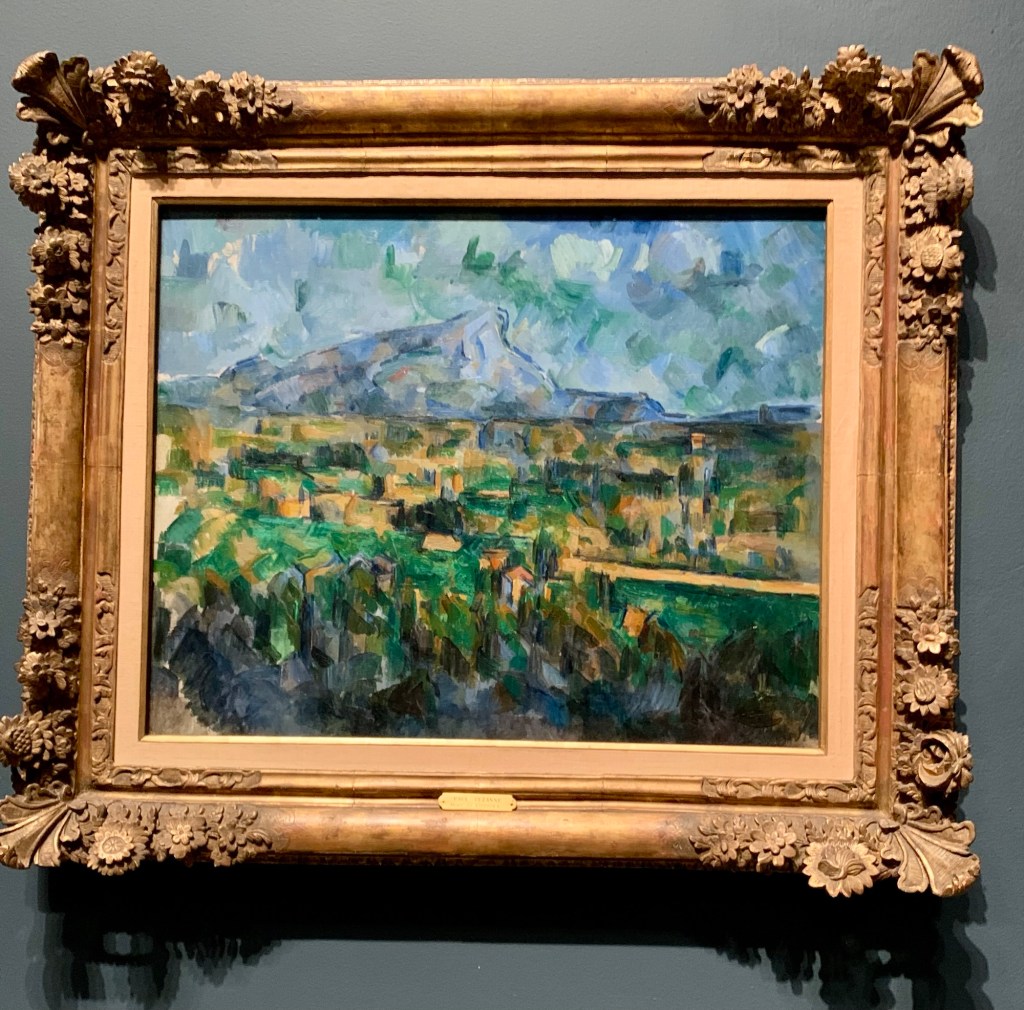
In his old book The Art of Cézanne (1965), the German art historian Kurt Badt makes a remarkable affirmation in dialogue with Hans Sedlmayr’s indictment about the crisis of modern art: “In him [Cézanne], in fact, painting ‘emerges as the last metaphysical activity within European nihilism – Nietzsche’s view of the great art of his time in general” [1]. Badt’s affirmation must be first understood contextually as a response to Sedlmayr’s thesis laid out in Verlust der Mitte (1951) that argues that the post-impressionist painter was the last attempt at visual order within the convoluted modern crisis of art, still committed to “represent what pure vision can discover in the visible world…without adulteration” [2]. The subtlety  of Badt’s disagreement with Sedlmayr is notable, since for him Cézanne does not stand for a painter of chaos and subjectivity; on the contrary, the painter unequivocally enters in relation to nihilism. At that instance painting and nihilism are positioned polemically face to face. So, what could painting as the last metaphysical activity mean after all? Why is it that painting obstructs or stuns the total exposure of nihilism? Instead of retracting painting to an ‘origin’, what if we understand its ontological contour as an excess within and beyond nihilism? 

In his recent book Tiempo roto (2024), Alberto Moreiras returns to Martin Heidegger’s Le Thor Seminar of 1969 to emphasize how in the epoch subsumed by the Gestell, and thus nihilism, the fundamental opening that exceeds the frame is an übermass, or overabundance of presence [3]. This might be a productive way to think about ‘painting as the last metaphysical activity’ in the era of Gestell, because it inscribes a relation to the visible always in relation to the appropriation of its excess. In the Zähringen seminar (1973) Heidegger will call this relation a phenomenology of the inapparent, which one could very well extend to the praxis of painting as the relation between unconcealment and concealment in the way that Daniel Aresse discusses it in the pictorial world of Vermeer (a polarity that in Cézanne no longer pertains to play of optic illusions but of the disclosure of the world). This cojoining of the inapparent is more beautiful than any possible world visible ordering, because it exceeds the frame of the visible [4]. In this way, Cézanne is not just a painter that exchanges roles with the thinker (as in the relationship between dichter and gedanke) it is rather that he remains the most faithful exponent of painting as the ontic region of the phenomenology of the inapparent or übermass. 

In a session of the Zollikon Seminars (May 1965), Heidegger introduces Cézanne’s landscape as a counterpoint of the hermeneutical circle of perception and calculative intuition. Heidegger writes quite succinctly: “For instance, a painting by Cézanne of Mont St. Victoire cannot be comprehended [erfassen] by calculation. Certainly, one could also conduct chemical research on such a picture. But if one would like to comprehend it as a work of art, one does not calculate, but sees it intuitively. Is the painting, therefore, something psychological, since we have just heard that the psychological is what can be comprehended intuitively? No, the painting is not something psychological. Obviously, the above-mentioned “simple principle” for distinguishing psyche and soma is not simple at all” [5]. This is so because for Heidegger the figure of the mountain (a figure among others) in Cézanne’s work is not the cause of the decision of painting; it is rather the ground (Grund) that orients a certain disposition towards the opening of any given form. One could say that the motif of the mountain is the ground that dispenses the relation to the excess or the inapparent while being entirely visible. 

As such, the activity of painting is not just a capacity or disposition that allows representation; on the contrary, the pictorial praxis qua praxis remains attached to the notion of truth as unconcealment and concealment in the hegemonic structure of Gestell and the objective sciences for which there is none. This allows to throw light into the rather underworked suggestion advanced by Badt that painting remains the last metaphysical activity of the arts, which does not presuppose understanding the “painterly” as a quality or autonomous sphere of human action, but rather an original gesture of presencing the non-presence, and in this way to remain in what I am willing to call the imperturbable.

It has been registered that at one point during the sessions at Le Thor, Heidegger also made the curious assertion that only Cézanne had taken a path towards thinking (in painting) similar to his own turning away from Western ontotheological dispensation into another beginning [6]. This might be because painting is neither the archaic residue of the human hand, nor the pictorial index of image; its fulfillment lies in the excessive proximity to truth that eternally reveals the permanence of the invisible. 

Notes 

1. Kurt Badt. The Art of Cezanne  (University of California Press, 1965), 181.

2. Hans Sedlmayr. Art in Crisis: The Lost Center (Transaction Publishers, 2007), 131.

3. Alberto Moreiras. Tiempo roto: vivir el antropoceno (Palinodia, 2024), 113.

4. Martin Heidegger. Four Seminars (Indiana University Press, 2003), 8.

5. Martin Heidegger. Zollikon Seminars (Northwestern University Press, 1987), 79.

6. Giorgio Agamben. Il tempo del pensiero (Giometti & Antonello, 2022), 57-60.

*Image: Mont Sainte-Victoire, by Paul Cézanne. Philadelphia Museum of Art. Photograph from personal archive.

Acies animi pictura. On Victoria Cirlot’s Taüll (2023). by Gerardo Muñoz

Victoria Cirlot’s vibrant short book, Taüll: liturgia y visión en los ábsides románicos catalanes (Mudito&Co, 2023) focuses on the well-known apse fresco panels of the Romanesque Saint Climent Church (Lleida) dating back to the twelfth century now housed in the Museo Nacional de Arte de Catalunya (MNAC), whose central figure is a Maesteis domini elevated to representation of the highest celestial cosmos. In another sense, Taüll should also be read (and perhaps the obligatory accent here is necessary) as a synthesis of Cirlot’s own work on the theological infusion of visuality and what it means to “see” and “being seeing” in a world that strives for legibility. Cirlot has no ‘presentist’ anxieties about the Romanesque period – its iconographic and overtly enigmatic depiction – but it is not difficult to think of the Christian temple as an aesthetic laboratory, or artist studio, in which the liturgical dimension functioned not much so much as a private space for the faithful, but rather as a site of encounters and vital experience (Cirlot 11). 

The liturgical performance depended on visual arrangement that opened visions of the inner sense, which Cirlot quoting Saint Augustine calls acies anime — transcendence through a sensible awakening that encompassed all the senses. Following Pavel Floresnky in his study about the Church as the synthesis of the arts, Cirlot attempts to portray the impossible experience at Tüll as the site of the life of the spirit; that is, where the spirit is transformed and released (Cirlot 12). Before there is acclamation and synthesis, there is an unfathomable experience facilitated by the liturgical imagery which is a passage or a preparation of sorts. 

It is almost impossible for us today – situated at the threshold of the autonomization of the arts and the division of its practices – to grasp the antecedent image (imago) through figures of what will only later be seen. Cirlot quotes Saint Paul to anchor this difficult chiasmatic movement of veiling-unveiling: “Now we see through a mirror, an enigma, but later we will see face to face (Cor.1.13) (Cirlot 22). Is the pictorial unveiling, or rather veiling, the juxtaposition of the image in space what will ultimately solve the enigma of unmediated appearance? And could appearance be released without its dependence on the mystery that prescribes the image making and destruction well into the totalization of modern pseudos at the art of depiction? There are conscious echos of Carchia’s thinking (in my reading of Cirlot, that is), which I think help to grant a bit more breathing space, as it were, to Cirlot’s unelaborated suggestion that “Pero la pintura es el fruto, no de una percepción sensible, sino del ojo visualiza eso que tiene que ser despertado en la interacción de los sentidos físicos” (Cirlot 23). 

To paint, or the painterly activity, is the gathering of an inner vision, where there is no more separation between the autonomous senses (visions, touch, flavor). Cirlot notes how the detailing of the querubin angel having small eyes painting on their hands would confirm this thesis. The movement of the hands registers a vision that touches the proximity of the specular Glory of transcendence. Following Henry Corbin, Cirlot can remind us that the angel for the mystical tradition is an entity whose “being is only vision” (Cirlot 28). In turn, the all-seeing angel is not a bird’s view (I guess today we will also say a drone commanded from a computing application) that has total vision over the terrestrial grid; it is more a vision that is able to see each thing — given that his divine vision he can see God in everything, and things in themselves because the painterly eye can only look outwards through the inner eye of the heart (Cirlot 38). In fact, the heart’s eye is a retreat from the world of countable and visual things, as transcendence becomes the mere contact of the senses with the divine. 

Part of the difficulty of grasping what is taking place at the Saint Climent of Taüll apse resides in a gesture that is the inversion of pictorial verisimilitude, if one is to take up Michael Fried’s thesis in Absorption and Theatricality (1980) as a reduction of disenchanted pictorial representation. In other words, the pictorial manifestation at Tüll is neither theatrical nor figural absorption for the spectators, but it was rather an experience with the liturgical mystery that strived in the liberation of the soul at the uncharted height of God itself (Cirlot 40).  And perhaps of being a mode, among many, with the presence of God in things, and things and names as already expressing the unavowable nature of the divine. Cirlot’s thesis gains traction and depth  at this point, since the central task of pictorial creation at Tüll is to find the means of granting visible to what must remain invisible (the Holy Trinity and the Eucharist mysterium) that breaks away from the implementation of imitatio naturae (Cirlot 44). This also speaks as to why Cirlot, with prudential reasons, never speaks of an aesthetic sublime that this pictorial commitment with the theos and experience clearly appears to reject. In the sublime construction, sense has been subordinated to the negative position, by which the return of representation will reveal itself in its erasure. 

The seemingly absorptive theatricality does not stand up to the highest music of the aspirations at Tüll. Once again Florensky appears as a central interpretive key for Cirlot: the iconomic and atmospheric opening of Romanesque art frees contemplation to a degree in which vision and the outside of life entangle to such a degree that no autonomization of the ‘aesthetic experience’ can formalize the sensorial gathering of the invisible upwards where “el alma no podía descansar”, or where the soul knows no rest. One can also recall Kurt Badt when writing about Constable meteorological landscape: such opening in the picture is the true organ of sentiment. But “that world is long gone” – the world of visual liturgical at Taüll – concludes Cirlot, and something similar could be said of the practice of painting. The minimal lesson at Taüll is as simple as it is difficult: any access to the world today requires to divest from the hand of technē so that the hand of pictura can take hold of the fleeting mystery of a life experienced. Such is the enduring vital vision at Taüll.

An epoch unmoved (III). by Gerardo Muñoz

I find myself returning to Ramón Williams’ photograph “The Iceberg” (2013). It is a rather simple composition, but one that builds a strange and uncanny sense of place. It liberates a vista, but it cut through a solid structure that forecloses the horizon with a harsh juxtaposition. This rocky texture becomes one with the sea. Interior and exterior, forefront and background appear at a level of proximity that the movement of de-structuring assists in framing. Williams’ picture draws us towards a non-object: the very possibility of view. It is an experiment with a sense of surface that recalls another geological time; a sense that all too quickly recoils back to earth. It puts us near the matter of view. By liberating the eye, a clear sense of the world takes place.

Now, to be moved in an epoch of closure means that we narrow on the constraint. This is Williams’ challenge: the all too rocky surface bestows a sense of distance, and thus, an outside. This is no longer an abstraction of the medium or an effect of ‘theatricality’. Presumably, all of that is dissolved under the condition of the view. We are standing somewhere; not precisely in water, nor in the city. “The Iceberg” is a farewell to the metropolis at the moment in which desertion is no longer an aspiration but a taking place. There is no horizon and no time either leaving or coming. We are in a lapsus of inhabiting a fragment of the world. Here I experience the outside. Is not this what remains on the other side of the unmoved? I take this to be the question prompted by Williams’ picture.

I want this photograph to speak to me about desertion from the world unmoved. We can recall that Agamemnon uses a specific word to describe his conundrum: lipanous. Specifically, he asks: “How should I become a deserter (pōs liponaus genōmai)?” As it has been explained, the condition of lipanous is not just anyone, but a deserter from a ship. It is no longer how I can lead myself astray from the tasks of the heedless navigator, nor if I can pretend to be an ally in a ship possessed by a silent mutiny. The lipanous, on the contrary, moves beyond alliance and helpless dissensus towards a movement that experiences the clear. This means that the task of a deserter in thought is facilitated by the view. It is no longer language as an exteriority of things; it is how things become irreducible to the language in a decentered image without objects. Whereas in the city I can identify volumes; as a lipanous I am granted a new vision.

Here poetry assists us in a movement towards self-recension. Jana Prikyl writes in a wonderful verse: “Appian way, autobahn – those folks’ wildest dreams too were escape routes.” Obviously, these roads cannot longer prepare a flight. The Appian road and autobahn are civilizational tracks of a world now lost. This is at the heart of Williams’ craft: the course of de-civilization begins with lipanous at the level of the most apparent; not in the sea and most definitively not at ground level. Prikyl writes in the next verse: “with maybe a girl in evening dress waking onboard that takes vision.”

This little thought experiment doubles Williams’ phototactic concern by asking the following: how do we take a vision of a lighted world as a natural element for inclination? What ‘moves’ here is no longer the instantaneous stimulus of the waking to the vision. It is a via di uscita. But a vision of a particular kind, in which I am forced to be a deserter – chipped from the mast of the world into the melody with the true things (étuma).


*Image: Ramón Williams, “The Iceberg” (2013).