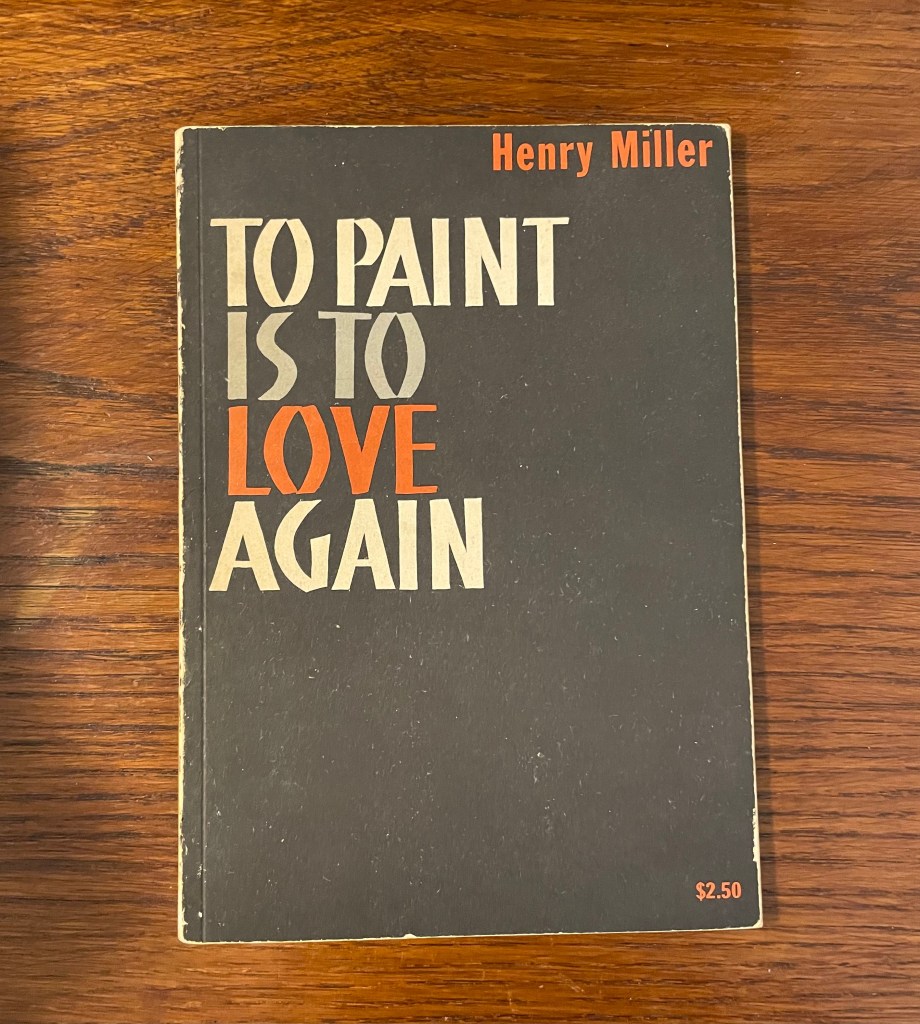
The love of painting. by Gerardo Muñoz

There might very well be an internal affinity between painting and love that at some point it becomes indistinguishable. A painterly picture can become love unquenched for that which remains persistently fixed and unrealizable. In one of the short essay books of his Big Sur period, Henry Miller asked this very question of painting. For him panting had a wondering origin that crosses the hand, undoing what we can easily enact. The erotic dimension of painting, thus, has nothing to do with the image or figure of the beloved, but rather with a specular limitation staged in the ability to allow the unseen to be incorporated in the visible scheme of the world. Only if we are able to see – and by the same token, only if there we are facing an event of painting – can something like use can be liberated from the constraints of mimetic compulsion. Miller writes in To Paint is to Love Again (1960): 

“To paint is to love again. It is only when we look with eyes of love that we see as the painter sees. His is a love, moreover, which is free of possessiveness. What the painter sees he is duty bound to share. Usually he makes us see and feel what ordinarily we ignore or are immune to a certain manner of approaching the world tells us, in effect, that nothing is vile or hideous, nothing is stale, flat or unpalatable unless it is our power of vision. To see is not merely to look. One must look-see .See into and around. Or, as John Marin, once put it – “art must show what goes on in the world” [1]. 

The place of painting for Miller is an imperturbable state that refuses to be fixated on objects, but in the invisible region (as in the figure of the chora) that allows for the thing in the world to be used. This is why Miller considered Japanese watercolor and prints an absolute primer of the pictorial: it taught him the appearance of worlds within the world, regionalizing the surroundings never logically stated unto itself, which in modernity it became the catastrophic horizon of autonomy towards its posterior liquidation. This is why Miller, very much like Carlo Levi, understood that the crisis of painting in the Western tradition ultimately signaled a general sense of social terror as a new phase of human desperation attenuated by the circulation of social fictions. 

At the height of the the closure of civilization, painting reemerged, if Kurt Badt’s axiom is correct, as the last metaphysical activity of human praxis. A metaphysical activity that holds on to the experience of belief in suspended appearance of originary anthropogenesis. For Miller, in painting as much as in love “one must be a true believer” [2]. And this assertion must be understood in the backdrop of Miller’s experiential retreat in the landscape of Big Sur: an experience away from the closure of American city life in research of a “feeling of aloness as spiritual achievement”, as a relation of oneself towards disclosure [3]. In this sense, the painter is a counter-social figure that, refusing to make stir in the world, turns to serenity, silence, and to the pressing contours of the unfathomable beyond any prefiguration. The believer in painting – who is a figure of belief in the desert, after the flight of the gods in the nocturnal vigil of history – is the thrust to the experience of things without barristers or shortcuts to what is revealed.

The age of automation in mid-century transformation of American industrial production serves as the historical backdrop of Miller’s indictment regarding the poverty and eventual disappearance of painting due to the autonomization of human praxis and the gigantic scale in spatial organization. Following Georges Duhamel’s prognosis in America: the menace (1931), he shared the intuition that the crisis of dexterity meant the impossibility of realizing painting, now situated beyond the grasp of human absorption [4]. A land without landscape that, as Adorno noted, bears no traces of the human hand. And this was seen already in the 1950s when the rise of abstract expressionism in North American announced not just the end of easel painting, but the funeral of the whole pictorial tradition. The barbarism of gigantic and unlimited Americanism would run counter to painting as a sensorial activity that embraced the vital limitations of its region. 

Miller’s insistence on painting was an eulogy to a life as experience – painting is indistinguishable from the hands and souls of the painters that he encountered and shared his life – and the value of poverty as absolute necessity for a life that regionalizes our contact with the world. It was through the love of painting that humanity could only restore its divine presence without rest.

Notes 

1. Henry Miller. To Paint is to Love Again (Cambria Books, 1960), 17. 

2. Ibid., 39

3. Henry Miller. Big Sur and the Oranges of Hieronymus Bosch (New Directions, 1957), 34.

4. Georges Duhamel. America: the menace (Houghton Mifflin, 1931), 85.

Decline and renaissancing. by Gerardo Muñoz

There is something to be said about the facticity of epochal decline, and the reiterated attempts to call for its overcoming. But both decline and renewal are so interconnected in the Western dispensation of community and institutional organization that any attempt to surpass only deepens and pushes onwards the pendular movement between rise and fall towards generic equilibrium and social stabilization. Oswald Spengler understood well that decline situates civilization at the center of Western internal historical development just as birth presupposes death; thus, civilization is merely the coagulation of vital energies to overcome the emergence of decline. The genesis of civilization into final decline should at least elicit a question to break this ongoing circularity: what does it mean to hold to decline without converting its minimal energy into the orientation of a new horizontal epoch? The end of growth (economic stagnation) realized in real subsumption and the autonomization of value also allows us to formulate the question in the following terms: what does it mean to seize the fall of the rate of profit affirming demobilization and the inoperative nature of life beyond its conversion into the movement of energetic production that characterized the epoch of production through the historical figure of the worker? 

Ultimately, this is a question about how to represent (or how to avoid representation) an ethical orientation of life. At the turn of the twentieth century, it was noted that the ethical bourgeois form of life was conditioned by the sense of “community upon all men” around utility of life’s functions subsumed by work, and work as the sole purpose and meaning of life. The definite character of modern social life can be said to compensate for decline for giving up the incommensurability of life forms; that is, what Lukács also called the temporality of the “genius, in the sense that [the genius] can never be measured against anything, whether interior or exterior” [1]. Confronting this very question at the threshold of the crisis of the transmission of forms in Antiquity, Bernard Berenson in The Arch of Constantine: the Decline of Form (1954) offers a distinct position: the moment for seizing decline should be a deliberate prospect of gazing backwards; a facilis descensus that will disclose something entirely different deprived of the race towards “newness” promised by temporal futurity and its social spheres rhetorically organized. In a remarkable moment of his book, Berenson writes that: “Except in unique moments like the fifth century in Hellas or some three thousand years earlier in Egypt and Sumeria, conscious, deliberate, purposeful art is constantly looking backwards – renaissancing – if I may be allowed this uncouth but necessary verb-striving to recapture some phase of its choice in the art of the past, or at least to model itself or draw inspiration from it” [2].

In other words, there is only “renaissancingif one is able to traverse the decline of the past in the fullest sense of its inheritance of its formal stratification. The perpetual infantilism of the modern ethical outlook is that it tries to claim its definite character in irreversibility in order to exit the downwards path of decline through abundance and vulgarity (and we know from Ruskin that vulgarity is one of the forms that death takes unto the living).

For Berenson there seems to be authentic renaissancing at the level of life forms – of that incommensurable generality of human concrete and practical creation – by holding on to epochal decline, and not through state cultural policies that have sedimented the disappearance of forms of art legitimized by a “critic that will discover a deep meaning, a strange beauty, a revelaning newness in what you have done” [3]. The vicious modern liquidation of the free interplaying creation of forms of life and their external model of appearances is paid with the ascension of the rhetorical utility that will alleviate, at least momentarily, the sentiment of the decline proper to the transmission of dissolution. Whatever redemption creation can offer in the muddled waters of decline, the modern autonomy of reified forms, pushing upwards towards “newness”, will separate the sensorial transformation of life to the homogenous representation of communitarian representative order that puts an end to mood and solitude.

What Berenson calls “renaissancing” of factical experience nourishes the unrealized instances of the tradition not towards the breakthrough of a historical epoch (something like a virtuous mythic age of “Renaissance”) that can be posited by way of general background principles nor through the enforcement of a common social morality; rather the incorporated memory of the past is transformed to its very end because in its liquidation “true life” beyond measure reemerges. Berenson will state quite enigmatically that “style cannot be manufactured by taking thought” independently [4]. This is what Hölderlin had in mind when in a moment of “The Fatherland in Decline” from his theory of the tragic and its passage of dissolution: “The new life, which was to dissolve and did in fact dissolve, is not actually the ideally old, the dissolution of which was necessary, exhibiting its peculiar character between being and nonbeing…thus dissolution, as necessary, when seen from the point of view of ideal remembrance” [5]. It is this remembrance of dissolution that reveals decline as a felicitous fall without judgment that brings the appearance of life outside the irreversibility of the modern historical progress that has accumulated the oblivion of possible worlds.

This is why Hölderlin will also claim in his “The Perspective from which we look at Antiquity” (1799) that the ‘general decline of all peoples’ is due to the inheritance of forms of “an almost boundless prior world, which we internalize either through learning or experience and exerts pressure on us” [6]. To take up decline in a serious way means that we proceed from the formlessness of life, and not from the mimetic drive that expresses, in the name of ‘originality and autonomy’, the civilizational alienation towards the most distant (Antiquity) and the most near (ethos). We can then say that in decline the most distant and the irreducible becoming allows the ascension of ethical life. In this way, we can authoritatively say that there is only hope and redemption in decline because new life flourishes in a time of prudens futuri temporis exitum (“Prudently the god covers the outcome of the future in dark night”) that will transcend itself by becoming into what ceases and ultimately is.

Notes 

1. Georg Lukács. “The Bourgeois Way of Life and Art for Art’s Sake”, in Soul and Form (Columbia University Press, 2010), 76. 

2. Bernard Berenson. The Arch of Constantine: the Decline of Form (1954), 36.

3. Ibid., 64.

4. Ibid., 22.

5. Friedrich Hölderlin. “The Fatherland in Decline”, in The Death of Empedocles (Suny Press, 2008), 154.

6. Friedrich Hölderlin. “The Perspective from which We Have to Look at Antiquity”, in Essays and Letters on Theory (Suny Press, 1988), 39-40.

Justification and the demonic State. by Gerardo Muñoz

In the broadest sense of the term, questions about the law are predominantly about its justifications, and more specifically about where to locate the act of justifying. That one of the most important elaborations of exclusive positive authority was dependent on a theory of justification to transfer norms of authority (a theory labeled the “normal justification theory”) goes to show that the traditional opposition between positive law as pertaining to the sphere of rights and guarantees and natural law to that of justification comes short in the understanding of the internal development of judicial reasoning in the second half of the twentieth century that unsurprisingly coincides with the crisis of the secular liberal state [1]. The reliance on a “justification theory” will imply not only a new conception of legitimation, but also the outsourcing of the self-referential determination of “Nature” through which Roman Law constructed its principle of the rule of law and the validity of adjudication. As we know, Roman Law did not speak of “justification” but rather of necessity emanating from Nature, which could not oblige to performance or act through by what by nature is impossible or wrong [Ius plurimis modis dicitur: uno modo, cum id quod semper aequum et bonum est ius dicitur, ut est lus naturale]. The natural source of law, as famously defined by Ulpian in the Digest, is in this way permanently tilting between the good and the equitable (ius est ars boni et aequi). This is a matter of first principles of the law (ius), which did not solicit “argumentation” or second order reasoning to uphold its internal legal validity. 

The passage from natural necessity in the “hands of the priest”, in Ulpian’s conception, to the modern autonomy of justification takes place when principles are no longer the exclusive framework parameters for operative claims, but the very activity that defines the elasticity of an actual norm and its argumentation within a concrete positive order. This is one way in which one should define the specificity of the American practical legal order (not just its legal philosophies, which tends to run counter to this, cloaked under the vestigates of positivism vis-à-vis the letter and spirit of the Constitution) through juridical administration, whose structural polarity of command and justification defines the administrative process. Early in the twentieth century, Guglielmo Ferrero noted that one of defining characteristics of the American political model rested on a magistrate judicial power that fundamentally differed from European Common Law or positivist tradition in its practice [2]. Contrasting the independence of a limited bureaucracy to the predominance of an all encompassing “juridical administration”, Ferrero noted (although lacking the legal vocabulary to articulate it positively) that the administrative nexus will infinitely expand over social practical reasoning due to the unrestricted force of justification. And the need for justification is what outsources the ancient principles of natural law (ius) to the executive authority that renders operative every sphere of social action and interaction even if they are not explicitly declared prima facie by those principles. The efficacy of justification is the linguistic deployment – a rhetorical craft through rational argumentation – that will generate specific verisimilitude to the otherwise arbitrary and uncontested enactment of its principles. Justification could be said to appear as the work of language that provides internal cohesion of an array of coordinated conditions for secondary social actions. 

Since the inception of modern secularization, the nature of justification is the realization of the works without end, which inverts the notion of “justification” in the theological sphere that we owe to Paul. For the Apostle the idea of justification or dikaiōsis implies the making of righteousness through the soteriological narrative of Christianity that subsumes humanity’s fall (sin) for a redeeming liquidation of law. This means that man’s just act in faith generates “justification” (dikaiōsis) of life for all people (Roman 5:18). And as we read from Galatians 2:6: “Know that a person is not justified by the works of the law, but by faith in Jesus Christ. So we, too, have put our faith in Christ Jesus that we may be justified by faith”. The force of justification (dikaiōsis) trumps the production of the works of law that divides human beings in the immanence of this world between the saved and the condemned, the free and the imprisoned, the friend and the enemy. Whereas justification in the theological sense can only imply the ‘end of law’ for righteousness (Roman 10:4), in its late secularized rendition it implies exactly its distorted mirror image: to justify is transformed into the binding force over the void of authority that renders effective the hollow machinery of its own self-validation. 

It is telling that in an essay that was first published in German in 1938 under the title “Justification and Justice” (“Rechtfertigung Und Recht”), the German theologian Karl Barth takes note on the transformation of the State becoming “demonic” not due to its utter demise, but as a profanation of the theological justification of “unwarrantable assumption of autonomy as by the loss of its legitimate, relative independence, as by a renunciation of its true substance, dignity, function, and purpose…a renunciation which out in Caesar worship, the myth of the state and the like” [3]. The emergence of the “demonic nature” of the State was internal of its own making , since it conflated faith and people at the same level of social immanence, while preparing the actual realization of an authoritarian world without escape. Following Heinrich Schlier’s work on the figure of the State in the New Testament, Barth will suggest that this political totalization secularized the limit posited by the suum cuique of justification into an instrument of endless domination that characterized the emerging political reality. In fact, in his essay “The State according to the New Testament”, Schlier will define the phase of the demonic State as one colored by the inception of the sphragis, that is, “the sign of the state party as it were the secularized seal of baptism which levels all differences between men and only distinguishes between friend and energies of the ruling system. Those who refuse the new metaphysical slave are deprived of their economic foundations. Even economic life is directed by the spirit of the beast” [4]. 

Only in such context does the true light of the force of justification comes in full display: the sphragis can only labour to justify the vicarious social existence of the mystery of iniquity infinitely redressing itself as legal argumentation and juridical principles, administrative determinations and executive commands. And Schlier could not let the question pass: “What will Christians do in this situation? They will no longer want to have any part in this caricare of a state, they will “go out…they will simply be outlawed and persecuted” [5]. More than ever today, we are in desperate need of elaborating the elementary aspects of a political theory of demonology that defines a certain point where there is no turning back. To outlive persecution and tear the bond of justification shatters the civilizational course that has sublimated the end of time as an instrument of daemonic absorption into endless legal statues.

Notes 

1. Joseph Raz defines “normal justification thesis” of legal authority in this way: “I shall call it the normal justification thesis. It claims that the normal and primary way to establish that a person should be acknowledged to have authority over another person involves showing that the alleged subject is likely better to comply with reasons which apply to him (other than the alleged authoritative directives) if he accepts the directives of the alleged authority as authoritatively binding and tries to follow them, rather than by trying to follow the reasons which apply to him directly”, in “Authority and Justification”, Authority (NYU Press, 1990), 129.

2. Guglielmo Ferrero. “American characteristics” (1910), The Atlantic. 226. 

3. Karl Barth. Community, State, and Church (Peter Smith, 1968), 118.

4. Heinrich Schlier. “The State  according to the New Testament”, in The relevance of the New Testament (Herder and Herder, 1968), 236.

5. Ibid., 237.

A Peitho relief. by Gerardo Muñoz

There is a small marble Roman relief of Peitho (it is about 15” x 5” wide) of what used to be a larger decorative plate illustrating Helen being persuaded by Aphrodite to accept her husband’s voyage to Troy. The personification of Peitho in the form of a seating lady accompanying Aphrodite is not rare in classical representation, and if we are to follow Friedrich W. Hamdorf’s genealogy, it was actually the norm when it came to visual depiction of the deity [1]. What is striking in this Roman relief of Peitho is precisely the unassuming silence of the figure, who is merely gazing down and touching a dove or bird with her right hand and sunk in thought. Is not this mystical silence what bathes the mythical figure of Peitho, which according to Euripides has no other sanctuary than that of language?

The Peitho relief stands as a fragmentary of an ancient memory where the event of language implicated persuasion instead of commanding; a sensibility of saying instead of legitimate validation; granting space for the poetizing in the world instead of rationalizing, in the advent of the polis and the bios politikos, the transcendental condition of the political community [2]. Peitho will become rhetorical once it has taken the autonomos form of the transaction and the mutilated word by which nothing is ever said except a lethargy of the immanent movement of the logos. In the Roman relief Peitho does not communicate because she dwells in the poetic lacuna of language. 

In fragment 81 of Aeschylus’ Niobe we read a mysterious outline of Peitho: “Death desires no gifts; one can gain nothing by making sacrifice…from him, alone among divinities, Persuasion stands aloof.” The ossification of language in hand with the general autonomization of rhetorical separation, in the words of Gianni Carchia, will mark the destitution of Peitho’s poetic magic allowing death to speak through the fierce instrument of demagoguery and and the production of justifiable certainties [3]. In a world without the irruption of the mythic-magical element personified by Peitho, there is only general declensions towards persuasion as a form of predication: to convince, to obey, to follow, and to concede belief as persuasion was transformed linguistically [4]. It is no surprise that the civilizational decline of the mythos of Peitho coincides with the rise of the rhetorical techné that guaranteed the autonomization of the world (private & public, appearance & truth); but, most fundamentally, the stabilization of the resource of rule-based lexicon as the dominion over exteriority.  

Even the Sophist Gorgias in his Encomium of Helen defines Peitho as “Language is a power ruler who with a tiny and invisible body accomplishes deeds most devine” [5]. The process of deification of language (in the sense of the sources of archê) can topple the divine in order to mobilize all the energies no longer in the “uninterest encounter between souls” (Carchia’s words), but rather by grounding a necessity that, first and foremost, establishes its ontological solvency in the unending rhetorical polemics. As the sensible myth of Peitho withers into organized grammar and rules of predication, it is noteworthy to recall that in the monotheist tradition the organization of the invisible in becomes colored by “faith” in the law. 

This could explain why Saint Paul seemed to have made a conscious attempt to oppose any remnant of the Hellenic persuasion (πειθώ) in favor of “demonstration of faith” (ἀποδείξις). As we read in Corinthians 2:4-5: “My words and proclamation were not based on the persuasion (πειθώ) of wisdom, but on demonstration (ἀποδείξις) of the Spirit and power… that your faith would not be  based on human wisdom, but on the power of God. Indeed, “apodeixis” (ἀποδείξις), the word deployed by Paul, will guarantee persuasion only in revelation and the Christian philosophy of history; meaning that Peitho will remain, like the Roman relief from the First Century, a mute aesthetic artefact and a petty reminder of the expulsion of ethōs from language. 

Notes 

1. Friedrich W. Hamdorf. “Peitho”, in Griechische Kultpersonifikationen der vorhellenistischen Zeit (Zabern, 1964), 64-65.

2. Francis Kane. “Peitho and the Polis”, Philosophy and Rhetoric, Vol.19, N.2, 1986, 118.

3. Gianni Carchia. “Eros y Logos: Peitho arcaica y retórica antigua”, in Retórica de lo sublime (Técnos, 1994), 23-24.

4. María Dolores Jimenez López, “‘Persuadir’ en griego: el marco predicativo de peitho”, in Word Classes and Related Topics in Ancient Greek (Peeters Louvain-La-Neuve, 2006), 175-176. 

5. Gorgias. Encomium of Helen (Bloomsbury, 2008), 44.

Event and retreat: on the autonomy of the Cuban contemporary art scene. by Gerardo Muñoz

Event and the problem of sequence. According to Carlo Diano some historical epochs are prone to being inclined towards events rather than forms; that is, they allow the proliferation of states in the world rather than allocating forms to make sense of what has taken place [1]. Since 1959 – but also before this historical demarcation if one considers the failure of the bourgeois Republic and the apparatus of transculturation – the Cuban Revolution was poor in both form and events. Indeed, the institutionalization of the revolution has attempted at all costs to police the excess of both of these poles of world-making. On the one hand, the historical development of 59 secured an event that translated itself as historical and national necessity to legitimatize the production of a new “revolutionary subject” (el Hombre Nuevo); and, on the other, it assigned the supreme form of political unity in the charismatic authority of the Fidel Castro as the principle of a new political legitimacy [2]. It is against this historical frame that the event of 27N that gathered young artists, intellectuals, and writers at the doors of the Ministry of Culture should be measured up: the November gathering was an exodus from the total narrative of the revolution by insisting on the contingency of an event that affirmed a relative autonomy from the state as well as a separation between state and civil society. More than a set of clear demands at the level of objectives, political calculation, and cultural reabsorption to the logistics of the state; the 27N event in its outermost radiant potentiality was a breakthrough as a vital discontent of the youth that attuned itself to an experiential politics that have characterized the cycle of recent revolts of the past five years or so from Paris to Santiago de Chile and Quito, to the hinterlands of United States that no longer seek a modification of the social, but more fundamentally a thorough exodus from it.

I am not saying that they all recent revolts are homologous processes (or events of the same intensity or destructive vocation), but they do share the ecstatic vitality that posits experience over the technified and well-organized planning proper to the vanguard artist invested in mass conduction. Of course, giving primacy to the force of the event raises the question about both temporal and spatial sequence: in what way could those fragments, affects, and gestures transformed by the event mitigate their swerve without succumbing to the re-totalization of political recognition? There is no doubt that this has happened to the 27 Movement by virtue of the actualization of the phantasy of a movement. But a movement is the force that unifies political will, concentrates degrees of intentionality, and crafts a specific subjective discipline against any deviation from its rectilinear force [2]. We can call the phase of the “movement” a mediatized sequence that limits the possibilities of autonomous forms to effectively renounce the limits of totalization. Rather, given the experiential dimension of the contemporary events, it seems to me that the emphasis today should be placed at the level of genesis of forms, which implies connecting rhythmically the fragments within a sequence as a response to the metaphorical articulation of parts into a ‘movement’. In this sense, the sequence in the aftermath of an event must rethought against the grain of the category of ‘movement’, which in political modernity dialeticized the parts into in a temporal suspension unto the homogenous field of historical reabsorption. The force of the event, on the contrary, is what can render destitute the seduction of historical narrativization; or, for that matter, the assumption that political action still has transformative capacities within the set of developmental strategies of subjection, sacrifice, and voluntarism, all elements at the service of the metaphysical grid that constitutes the infrastructure of the philosophy of History. 

The hypothesis of the artistic legal turn. It should not come as a surprise that the limits of the movement demands that we raise questions about the functionalization of the militant in contemporary artistic practice. We should be willing and able to abandon the figure of the militant as always already positioned as a reactionary subject, which transfers military force to unified energies of the cause established by the movement [3]. It should be remembered here that the theoretical grounds of “activist” relational aesthetic was rooted in the transposition of the post-foundational theory of hegemony in Laclau & Mouffe’s theorization as a regulatory principle in the field of artistic practices [4]. But the price to be paid here is enormous, given that the artistic gesture and the possibilities of imagination are now folded unto the ground of “political action” recasting the old semblance of vanguard to achieve cultural domination. But since no cultural hegemony is ever fulfilled, it follows that political hegemony becomes a vector for the valorization of available strategies. It is no surprise, then, that artistic practice, once it turns to activism, becomes a pedagogical tool for and by militant subjects to stabilize the ascesis of self-consciousness. In sacrificing the autonomy of forms, militant subjectivity mirrors an intra-communitarian domination premised on policy and calculation to the idea. In other words, situating the set of strategies at the level of hegemony means necessarily that we have to accept the conditions already in place. What really changes is merely the site of subjection. It seems to me that this same issue is behind a nascent “legal turn” by which the artistic practice centers around drafting, contesting, and exercising pressure against the state by means of its own legal pathways. The problem with this strategy is that, as any jurist knows well, law is constituted of the pole of legality the pole of legitimacy. The turn towards legality becomes accepts the pragmatic conditions of norms and rules but leaves untouched the crisis of legitimacy that it seeks to transform.

In other words, whereas artistic imagination should be able to destitute the objective conditions of any given reality to new set of operations of transformation; the strife over legality ends up, at times counter-intentionally (and in a preserve way, generating unintended consequences), those very goals that it wants to endorse. In the Cuban case this is even more so, given that “fidelismo” far from being a set of original ideological principles or an unambiguous political philosophy guided by principles, has morphed into an all-encompassing institutional fabric that sustains the total state vis-à-vis a juristocratic operation of the legal order. Borrowing the terms from the discussions about the limits of constitutional transformation in Chile in the wake of the post-dictatorship transition to democracy, one could argue that the performance of the legal operation becomes the juristocratic tool to transform the relations between political life and imagination within the framework of given social relations [5]. Hence, if the artist pretends to incarnate a new version of the old paradigm of the “artist as jurist” soliciting the sovereignty of the creator over the vocation of the politician, one should expect the boundaries of the legal dominium of the state to expand, as it has happened with the reiterated executive administrative decrees deployed to normalize the rule of the state of exception. To break this cycle of legal administration, the artistic practice must affirm a disjointed zone between life and artistic autonomy over the excessive boundaries of the law. In fact, legality and policing should be understood as the two poles of the optimization of control once legitimacy no longer works to bind a political community. 

Retreat and obstruction. The minimal condition of any sequence in the aftermath of the event resides in how we protect the surround against the logistics of state policy, cultural administration, and political militancy [6]. These three vectors are the agents of hegemonic intervention against the unregulated proliferation of forms in the wake of the event. Recently, I have called this autonomous self-defense of forms a diagonal that moves against and outside the political demand [7]. The failure of not retreating from the foreclosure of subjective politics (of reducing a form of life to a subject of the political) entails that action will always be on the side of reaction. As Elena V. Molina has brought to attention on several occasions, the reactive action is so not because of ideological color or political affinity, but rather because it remains inscribed within the coordinates that the state has assigned it in order to generate responsive relays or bring to exhaustion the emergence of a new sequence. Rather, in the gesture of retreat (which can be read in the works of Camila Lobón’s infantile books, the opaque graphism of Esequiel Suarez, the sensible violence of Raychel Carrión’s drawings, or the youthful vitalism of the Mujercitos Collective), the possibilities lay on the side de-subjection against both the movement and the state in favor of an infinite practice of autonomy driven by the turbulence of the imagination. What is at stake is a radical abandonment of the historiographical machine that delimits and polices the mediations between culture and state in order to open up a new reservoir of existential gestures in order to break from the previous historical epoch.

The growing autonomy of the contemporary visual arts scene announces this oblique passage from willful political dissent across ideological lines proper of the Cold War to a play of gestures that unleash a new vitality capable of defictionalizing the historical process of the state and its moral demands. Contrary to the notion of action, the gesture does not seek mimetic repetition and reproduction, but rather the preparation of an experience here and now. In a society that is subsidiary on moral conducts and expectations; the gesture, in the words of contemporary Cuban artist Claudia Patricia Pérez, becomes a way to obstruct the efficacy of power relations [8]. There is no doubt that the force of the gesture is a nascent strategy for transforming contemporary Cuba, but the scene of the visual arts is the vital field where the storming of the imagination can unclutter a hastened path outside the ruins of the civilization of the state and the stagnant epochality of the revolutionary process.  

.

.

Notes

1. Carlo Diano. Form and Event: Principles for an Interpretation of the Greek World (Fordham University Press, 2020).

2. Nelson Valdés. “El contenido revolucionario y político de la autoridad carismática de Fidel Castro”, Revista Temas, N.55, 4-17, septiembre de 2008.

3. Giorgio Cesarano wrote in Chronicle of a masked ball (1975): “Neo-Leninists perceive the disintegration of the capitalist system as if they could anticipate, in their methods, their role as true inheritors of power…the distance between militants and militarists is only expressed as a transfer of force.”

4. This was Claire Bishop’s argument in her essay “Antagonism and Relational Aesthetics”, October, 110, Fall 2004, 51-79.

5. On the notion on the “crítica de la operación efectiva del derecho”, see my conversation with Chilean philosopher Sergio Villalobos-Ruminott, “Soberanía, acumulación, infrapolítica”, Lobo Suelto, 2015: http://anarquiacoronada.blogspot.com/2015/04/soberania-acumulacion-infrapolitica.html  

6. Stefano Harney & Fred Moten. The Undercommons: Fugitive Planning & Black Study (Autonomedia, 2013).

7. Gerardo Muñoz. “La diagonal que nos separa de la política”, Columna Cultural, mayo de 2021: https://in-cubadora.org/2021/06/02/gerardo-munoz-·la-diagonal-que-nos-separa-de-la-politica-un-comentario-a-la-conversacion-con-leandro-feal

8. Personal communication with the artist, June 2021.

  • This text was written as an intervention in the panel “The Art of Protest” organized by the Biennial of the Americas, Denver, June 24, 2021. Image: Collage by Claudia Patrica Pérez.