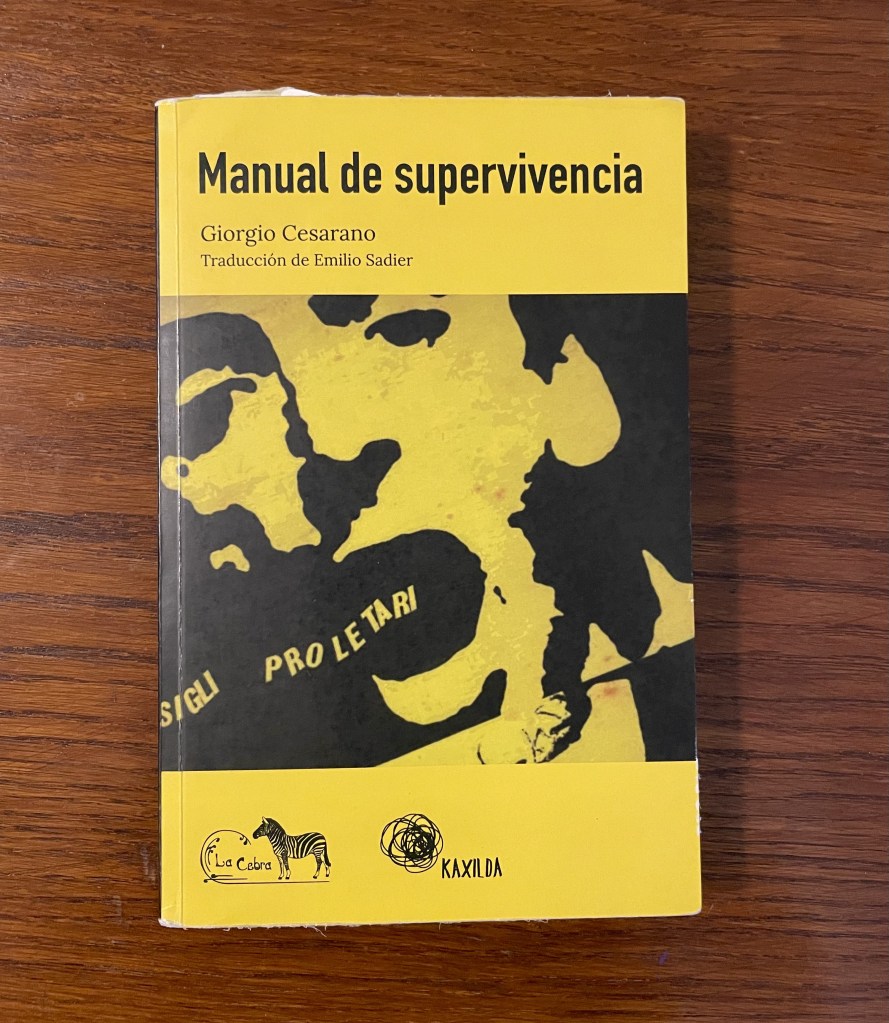
Pasiones de Giorgio Cesarano: introducción a un dossier. por Gerardo Muñoz

¿Es posible seguir insistiendo en la apertura del pensamiento contra el cierre de la época incrustada en la elipsis infernal de la supervivencia ventilada en las sombras del desierto nihílico y entregada a los aparatos de la reproducción social? Escribiendo en la convulsa década de los setenta – y que algunos pensadores han llamado, no sin razón, el “big bang” de la transformación geoeconómica del mundo donde la revolución queda finalmente liquidada – la apuesta de Giorgio Cesarano en Manuale di sopravvivenza (1974) -y su antecesor Apocalisse e rivoluzione (1973) co-escrito con Gianni Collu – sigue constituyendo un esfuerzo desmesurado y singular por encontrar una bifurcación por fuera de las anquilosadas formas de la antropomorfización capital que entonces ya aparecía como como el destino catastrófico de la especie humana reducido a la compulsiva maquinación de las totalidades ficticias [1]. 

En efecto, como observa Cesarano con un gran poder de síntesis: el triunfo revanchista de la fuerza de la subsunción real, en realidad, confirma que el verdadero y único objetivo del principio de equivalencia no tiene otro blanco que la usurpación de un mundo domesticado y desprovisto de acontecimientos. Un mundo hecho a la medida de las necesidades de sus inmates, tal y cómo lo había previsto John Cowper Powys en una de sus brillantes pesadillas literarias [2]. Pero este es el mundo que hemos heredado y que seguimos atravesando, aunque algunas décadas nos separen de la provocación que a la altura de 1974 Cesarano alzaba ante las herraduras dialécticas de la época. En realidad, era una provocación asumida desde la posibilidad de la afirmación de una gnosis – algo que, como sabemos había aprendido gracias al diálogo sostenido con algunos representantes de la corriente bordiguista de la cultura radical del pensamiento italiano y de su estrato poético, como lo confirma en La casa di Arimane (1979) de Domenico Ferla – aunque sin abandonar la posibilidad de un movimiento en retroceso de éxodo, capaz de integrar un nuevo programa de emancipación de la comunidad real de la especie (Gemeinwesen) contra todas las celdas de la objetualidad y sus satisfacciones reguladas.  

Un arduo primer paso: la retracción como rechazo de la hostilidad generalizada contra la presencia. Así, en un momento de Manual Cesarano podía escribía: “Ahora tener origen como fin es un programa perfectamente realista” [3]. Un realismo que optaba por abandonar el produccionismo apocalíptico al interior de la filosofía de la historia del capital en la metástasis de sus representaciones sociales. O bien, como escribe en uno de los momentos más emblemáticos contra la reificación del sujeto del saber y de la conciencia en Manual de supervivencia: “…el decrépito-infante Yo se tambalea….Se desvanecerá, morirá finalmente, lo mataremos cualquiera sea la máscara que lleve en ese instante. Porque el fin es el origen, el nacimiento de una comunidad-especie realizada, el nacimiento continuo de la presencia coherencia, la afirmación del ser inobjetivo….El fin del Yo marcará el principio de la presencia” [4]. Volver a la prehistoria, entonces, para desembotar el dominio cibernético de la optimización biopolítica administrativa de la vida que domicilia a la especie humana en el armazón de la producción de lo ficticio. Así, el vaciamiento paulatino de la vida tendrá en cada ápice de la simbolización el sol irradiante de la justificación y de la expansión del verosímil retórico de una comunidad abstracta. Por lo tanto, para Cesarano, la embestida contra la reificación del “Yo” debe su destitución a la intempestividad de la pasión del pensamiento como contraofensiva ante el ascenso depredador de la fuerza de la objetivación. Justo en este umbral Cesarano inscribe la partida para la época del agotamiento del reino de las formas y de la crisis de la legitimación política: “No es una clase de lo social, entonces, la que realizará la abolición de las clases emancipándose, sino que la negación de lo “social” y de sus clases, efectuada por el cuerpo proletarizado de la especie, emancipará a la especie de la “sociedad” como comunidad ficticia, prehumana” [5]. Apostar por particiones de valor social (el infinito juego de la hegemonía without end) solo podía perpetuar el espesor de la más rampante agonía.

De la misma manera que la crisis histórica validada por la astucia negativa del proceso infinito de acumulación apela a nuevas artes de estabilización y optimización de la abstracción Social (el paradigma de la unificación cibernética que Cesarano logra identificar en un momento de reestructuración de los propios mecanismos de la gobernabilidad del liberalismo tardío y de la consumación de la mediatización de los entes) de su propia incesante reproducción; para Cesarano toda “critica radicale” – que debe ser asumida como crítica en suspenso, más allá de todo sujeto posicional y posicionado en la estructura del movimiento humanista de la negatividad dialéctica – ya no se caracteriza por funcionamientos programáticos preelaborados mediante el rigor epistémico de la vanguardia militante o justificados en la divisa de la objetividad metodológica; se trata, en última instancia, de constituir espacios sensibles que despejen la desficcionalización absoluta de un movimiento existencial y de estilo cuyo único programa histórico se constataba mediante la inalienabilidad de la comunidad de la especie humana: la irreductibilidad de la pasión [6].

Si la modernidad consistió en la domesticación de las pasiones con el fin de impulsar el rendimiento objetivo y alienado de la diversificación de los intereses diagramados en el valor, ahora se trata de afirmar la liberación del yo como fractal de la no-objetualidad de mis pasiones sin que ésta sea entendida como una mera compensación traducida a la autonomía postromántica del arte [7]. La pasión del pensamiento en Cesarano es condición hiperbólica de una erótica que desoculta la chôra de lo inconmensurable; esto es, la distancia que marca el encuentro entre los restos del mundo natural y el uso vocativo de la lengua: “….ese paso de acercamiento, es abrazo de amor y de lucha, parece tanto más absurdo cuanto más lo cotidiano parece desierto. Es en este movimiento que cada uno podrá, encontrándose en la persistencia del deseo resistente a la aniquilación objetual, descubrir en sí mismo la presencia de ese programa histórico que es la pasión y sentirse listo” [8]. La autoafirmación de la génesis inconclusa de la pasión descentra el nudo gordiano de el terror de una vida sometida al proceso de adaptación en el que la máquina y la humanidad se cierran sobre si mismas.

Pero la pasión es el recurso que valida el recorrido ético de la apropiación de mi existencia; esto es, no es ni condición antropológica ni forma en la que puedo orientar mi relación con lo inefable del mundo. Y dado que nunca sabemos realmente qué constituye el objeto de la pasión – al menos que este dispuestos a abdicar la pasión a la matriz recursiva de lo objetual – la existencia sólo puede darse en la disponibilidad de la vida misma cuando ésta coexiste con la laguna de la pasión y del asombro en el mundo. Dicho en otras palabras, de nada vale “vivir por una pasión” como suele decir el automatismo retórico del contrabando de las pasiones y de la propaganda de agitación social; el valor absoluto radica allí donde la pasión se deja vivir en el movimiento finito de una vida que no puede ser otra, y que solo se mide con respeto a las propias conquistas o encuentros que marcan el ritmo de un destino. En este sentido, como escribe Cesarano en la glosa “Erotismo y Barbarie” (1974) que incluimos en este dossier: “La pasión es el sentido de lo sagrado que se demuestra como tal” [9]. La tonalidad sagrada de la pasión es aquello que no puede ser verbalizado como imperativo o veneración externa para la promoción servil de los hombres-masas orientados a la infinita idolatría sacrificial que, en el curso de la secularización cristiana, implicó el triunfo ficticio del ordenamiento del principio civil [10]. Para Cesarano, las pasiones de la especie es el no-lugar – de ahí que sea una chôra, un lugar de contacto imaginal con la expresión que solicita siempre en cada caso el umbral del afuera – mediante el cual la vida encuentra formas contra la supervivencia y la agobiante auto-aniquilación que el logos descarga sobre cada exigencia vital. 

Sin muchos más rodeos podemos decir que el programa de la pasión sigue abierto en una época, la nuestra, cuyo régimen cibernético-administrativo sobre todos los ámbitos del viviente ha conseguido intensificarse con mayor ferocidad en el punto más álgido de nuestra civilización. Como si se tratase de un don fortuito, la excelente y cuidada traducción en castellano del mítico libro de Giorgio Cesarano por Emilio Sadier publicada en La Cebra y Kaxilda finalmente nos facilita una conversación que, a pesar de haber sido postergada durante tanto tiempo, regresa con la intensidad y el brillo de una voz entonada desde las catacumbas para confirmarnos que no todo ha quedado obliterado. Sobre esos restos se arremolina la ascesis singular de la pasión común de los hombres póstumos tras un mundo que se eclipsa. Y de este modo regresa la conquista singular de los encuentros, la despotencialización del ego, y el recogimiento de una morada en la insondable piel de las estrías del mundo. El dossier que presentamos a continuación sobre el pensamiento y la poética de Cesarano no pretende constituir otro gesto que aquel que contribuye, a su manera, a la continua “comunicación entre almas” al interior de una época que continúa encandilada en la fuerza de la objetivación y la producción de la impaciencia [11]. Y cómo intuía Cesarano en unos versos de su temprano L’erba bianca (1959): “…la buena canción tardó demasiado, pero había que esperar en el vacío para dejar resonar al corazón. Ahora lo sabes, hoy toda fortuna se ha disipado” [12]. ¿Nos hemos disipado también nosotros? Allí donde las pasiones toman la palabra y los tintes del alma dilatan su expresión las dudas para semejante interrogación disminuye y se disipa. Así, atravesados por el timbre de la pasión, moramos en la inesencia, pero sin realmente pertenecer a ella.  

*Esta es la introducción al dossier sobre el pensamiento de Giorgio Cesarano que preparé a raiz se la publicación en castellano de Manual de supervivencia (Kaxilda, La Cebra 2024), y de próxima aparición en la revista chilena Escrituras americana en la primavera de 2025.

Notas 

1. Willy Thayer. ‘”Fin del trabajo intelectual y fin idealista/capitalista de la historia en la ‘era de la subsunción real del capital’”, en El fragmento repetido: escritos en estado de excepción (ediciones metales pesados, 2008).

2. John Cowper Powys. The Inmates (Macdonald, 1952).

3. Giorgio Cesarano. Manual de supervivencia (La Cebra, Kaxilda 2023), 112.

4. Ibid., 49-50.

5. Ibid., 130.

6. Furio di Paola. “Dopo la dialettica”, Aut Aut, N.165-166, 1978, 63-103.

7. Para la elaboración de este argumento, ver el ensayo de Gianni Carchia, “Modernità anti-romantica”, en Pharmakos: Il mito trasfigurato (Ernani Stampatore, 1984), 9-13.

8. Giorgio Cesarano. Manual de supervivencia (La Cebra, Kaxilda 2023), 75.

9. Giorgio Cesarano. “Erotismo o Barbarie (1974)”, incluido en traducción al castellano en este dossier. 

10. Carlo Levi. Paura della libertà (Neri Pozza, 2018), 120.

11. Gianni Carchia. “Tragedia y persuasion: nota sobre Carlo Michelstaedter”, en Retórica de lo sublime (Editorial Tecnos, 1994), 35.

12. Giorgio Cesarano. “A un amico”: “So che per te di troppo tardarono / il bacio dell’amata e la buona canzone / ma bisognava saper asperttare / e lungamente e a vuoto lasciar risuonare il cuore. / Ora lo sai, chiusa ogni ventura.”, en L’erba bianca (Schwarz Editore, 1959), 39.
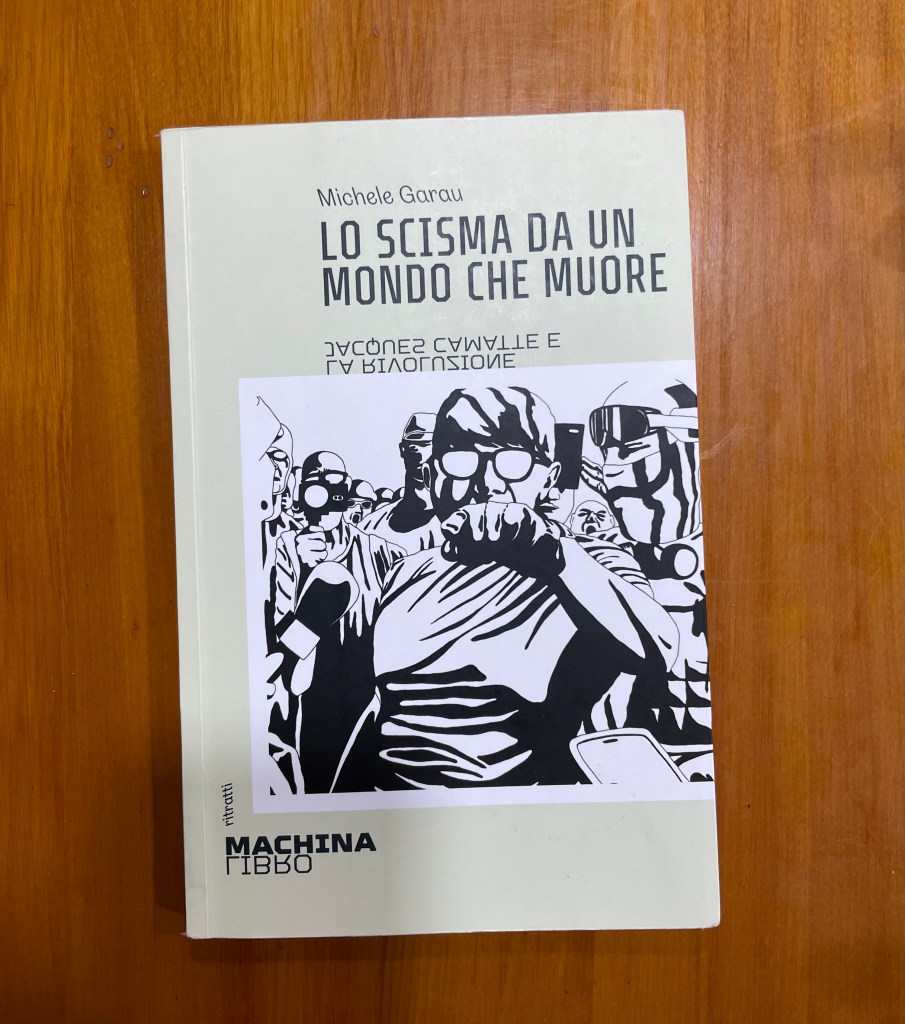
The absorption of the sky of politics. On Michele Garau’s Lo scisma da un mondo che muore: Jacques Camatte e la rivoluzione (2024). by Gerardo Muñoz

We must welcome that Michele Garau has written the first monograph on Jacques Camatte’s thought in any language, although the book, Lo scisma da un mondo che muore: Jacques Camatte e la rivoluzione (DeriveApprodi, 2024) it is also more ambitious than a mere philological reconstruction of the thinker of Invariance. Of course, not that there is anything particularly wrong with philological or archival work; rather, it is also that Lo scisma da un mondo che muore (2024) tries to think with Camatte (and also beyond some of his potential impasses) the historical bifurcation of a watershed moment in the history of humankind through the realization of the “capitalist revolution” as an autonomous colonization of every form of exteriority (Garau 7). If Camatte’s work has been only selectively considered in our ongoing discussions – while completely ignored at large by the so-called contemporary theory, which I guess it is an uplifting symptom – is precisely because he poses a challenge for a possible breakthrough in times of stagnation, while firmly announcing a much needed farewell to the modern revolution. But who would want to jump on that wagon when precisely voluntarism, prosthetic revolutionary cosmetic, and fictive communitarianism are all necessary platitudes to hold on to the illusion of ground right above the abyss? It is a rhetorical question, of course, but also one that Camatte move passed it in the in the decades of sixties and seventies observant to the material transformation of the working class, and the overall lesson of Amadeo Bordiga’s communism of the human species, which has also been rendered opaque and fossil-like by the victorious force of cultural hegemony and the whole grammatical structure of Gramsci’s thought in postwar political thought (and some will say well into our very present in the most recent cycle of failed left-populism). We said ‘farewell’ and this act, for Camatte after Bordiga’s teaching, means that the revolution has already taken place and must be perceived in the perspective of the crisis of negativity and the inception of the real absorption of capitalist development (Garau 14). 

Hence, new challenges lay ahead, which implies the abandonment of the historical and temporal productivity of revolutionary time – and Garau does an excellent mapping of bourgeois revolutionary thinking from Abbe Sieyès to Saint Just to later formulations of the Leninist paradigm of the dictatorship of the proletariat – which in the grand scene of modernity oriented the economy between form and function, but also between thought and action. If the epoch is said to be ‘anarchic’ is mainly because all these mediations and exclusive autonomous spheres have collapsed unto each other, and to favor one over the other is to work within the fiction of ideological reproduction at best. After Bordiga – Garau claims glossing Camatte, although there are nuances that I cannot consider in the space of this short commentary – the temporalization of the ius revolutionis can only bear in mind the crisis of presence (De Martino) as a suspension of exteriority that liberates right unto real subsumption. This means, following the recently polished phrase of Bordiga from his article “Tempo di abiuratori di scismi” (1965), that all revolutions are born and deployed as the affirmation of the schism. “Schism” or “scisma” — and one is reminded or taken back to a theological terrain, and not just as mitigated by the old ecclesiastical memories of the “Great Schism”, but because “schism” is also the “stazion” that fractures the visible-invisible legacy of form of the Church’s Trinitarian doctrine, and which is still the esoteric boiling point of the myth of political theology. This is a detour around Garau-Camatte-Bordiga’s intuition, since none of this is explicitly thematized in the book, nor should it be. It suffices that it opens to this question, given that Camatte’s own grammar of exhaustion – “extinction”, “inversion”, “autopoiesis”, “critique of organization”, “wandering” (erranza) – distill the echoes of an apocalyptic movement proper to the modern anthropological crisis, to put in terms of Ernesto de Martino.

Be as it may, the longue durée of civilizational development of Western revolutions (Edward Gibbon would claim at least since the reconstitution of the Christian Empire) there has been a process of adequation to invariant processes of capitalist accumulation that its substrate (whether permanent, uneven, natural law justified) becomes isomorphic to the structural needs of capitalist autonomization. In a cogent reading of Sieyes with Saint-Just in the framework of the French Revolution, Garau demonstrates how the genesis of modern politics and its categorial scaffolding (localization, constituent power, social unity, subject of rights, and representation) presuppose a thoroughly new vision to make the human community a clean slate for surface legibility (Garau 42). If the civil concept of the ancient polis was measurement and exchange; the crafting of high-modern state politics that took off in the eighteenth century was much thicker and spatially robust dynamics so that the ‘laws of commerce’ and population disciplining could come to fruition with its necessary infrastructural support. The schism was always a perturbation of the “sphere of politics” (and also of politics as a translucent sphere that can be observed, stabilized, and managed), and thus a great scandal.

Hence, the critique of political economy in the history of marxism was never able to untangle this mutual correspondence. For Garau at this point one can locate the difference between Camatte’s thought and Italian operaismo; given that Italian workerism at mid-century was never able to overcome the dialectic between the valence of value form and the theory of the production of capital. Whereas for Mario Tronti the struggle was still to be inscribed in to confrontation between the proletariat qua labor power; for Camatte the “invarianza” is not an permanent stage within the history of class struggle or Marxism, but of the human community and its resistance against the real subsumption of the material community (Garau 48). Decoupling the history of the working class as constitutive of productionism from the human community, allows Camatte, in the wake of Bordiga’s communism, to register the subsumption of capital as it collapses into dialectical negativity. Hence, communism is neither produced nor organized as operaismo always thought (Garau 26-27). And citing a passage from “Against domestication”, Garau argues that for Camatte the history of the proletariat struggle after 1945 is only the struggle to maintain the myth of the proletariat as the subject of a historical breakthrough (Garau 73). This is a staggering affirmation, and one that most definitely produces a theoretical schism. But the schism is also against the fictionalization of a subject of history, which has also been integrated into the emptying of social reality as we have come to know it in the final triumph of the fictive unto itself (Garau 93). 

There is the triumph of the fictive and expansive force of capital despotism, and then there is the struggle for the originary community (Gemeinwesen), which as Gianni Carchia argued in his “Glosa sull’umanismo” (1977) was still enmeshed in the contradiction between humanism and anti-humanism obstructing the vascular movement of non-identical fragments imploding the social. Is this getting at an impasse of Camatte’s own effort of thought to find an exit route? As an intelligent book, Lo scisma da un mondo che muore (2024), refuses to give an essay in the last three pages of the essay, although this difficulty is an object of attention. For instance, Garau writes in one of the clearest elaborations to tackle the problem directly: “La comunità deve allora essere riscoperta in una memoria della specie che finisce per radicarsi, questo è il rischio, esclusivamente in un bagaglio biologico. Nell’esaurimento delle strutture sociali preesistenti, dei linguaggi e degli schemi culturali, delle intelaiature rappresentative e cognitive, nella colonizzazione delle capacità psichiche, affettive, simboliche, è davvero possibile individuare un resto intoccabile dall’antropomorfosi del capitale che non debba essere, invece, creato dal nulla? C’è una «parte irriducibile», come scriveva Bataille, rispetto alle unità di misura del dispotismo economico? Non è semplice rispondere” (Garau 124).

In light of this rumination, Garau also attends to the cycle of contemporary revolts, which might stand as an instance of linguistic and existential struggle against domestication and the crisis of presence (Cesarano), and that might be capable of “absorbing the sky of politics into the most simple and elements components” (Garau 124-125). This is a great image, and one that has pictorial density and durability for thought even if it lacks specific elaboration. To absorb the open sky is to confront the exteriority of the world only as transfigured and brought back as a gathering of experience. The great German critic Kurt Badt comes to mind when writing about Constable: “the sky’s the organ of sentiment”. The embarrassing loss of the world today is fundamentally the destruction of the right attunement to our relation to the opening registered by what gleams above our heads. And perhaps this is a way to measure the capacity for non-movements rather than thinking that movements can disclose the sky. To this end, what could it mean to absorb the sky of politics – which is also a way to refuse the politics of sky, that is, the total planetary grand designs of geopolitical Tianxia? The irreductible may not be reduced to a substance, nor an ontological science nor a vitalist return to an originary community (if only mediated by the restriction of the archaic myth); but precisely that positionality of contact between what is exterior to life itself. To dislodge thought from all political plotting of objectivation and its plastic ligament of social adaptation. A life beyond itself that endures, and perhaps will outlive this dying world.

Hunger and gluttony after civilization. by Gerardo Muñoz

It could easily be argued that one of the central immaterial characters of Robert Antelme’s L’espèce humaine (1947) is the constant state of hunger. It is the more telling that Antelme – and it is also surprising that most of his relevant critics have been unattentive to this problem – does not reflect explicitly about the nature of hunger in his account, as if already hunger as “facticity” of the destruction of human experience in the camp was enough to show how the crisis of effective symbolization with the world means, ultimately, the struggle for the maintenance of the nutritional condition for survival [1]. It is a particular state of nutritional privation that colors not just every community or social relation in L’espèce humaine, but also every thought, passive meandering, and even moral clarity of the deportee life in the camp. The pathetic struggles over pieces of bread or scoops of putrid soup while deposing the human race from the world brings them back, at the level of consciousness, to the raw origins of its anthropological self-affirmation. And this means that every bite of food and every bit of  protein digested by the human being is only the antecedent of the future need to meet the elemental nutritional gain for survival. The ‘consciousness towards hunger’ colored in the camp becomes the mirror image of the incessant eating disorder of hypermodern social adaptation as two forms of predatory struggle over the exchange goods of the world. 

Excessive eating and nutritional deficiency are, in this sense, two pothistorical temporal circuit of human beings as a species of hunger and gluttony. About a decade ago a book entitled Hunger: the oldest problem (2014), written by Martín Caparrós, stood out as a proof of a materialist conception at a planetary scale, which for the novelist could easily be solved by drafting the legibility of material inequality and charting the regional disproportionate asymmetries between the “good eaters” (and good feeders), and those in permanent hunger, malnutrition, localized famine, and potential starvation. For Caparros, given the height of our “civilizational progress”, hunger revealed the “original plague of humanity….which now can be solved through a political decision” [2]. The substance of the “political decision” for hunger of the human race was as empty as the very nauseating fatigue of real starvation, although as a rhetorical ploy it does contribute, even against its own presuppositions, to the civilizational paradigm that structures the poles of gluttony and hunger that sustains the domestication of the human species in conformity – under the terror imposed by the glacial tonality of nihilism – with a ‘good enough life’, as an American cultural scholar univocally upheld it [3]. A deconstructed Michelin rated restaurant is as much of the ‘good enough life’ as the oversized pots of soup delivered by World Central Kitchen in any of the ongoing war zones.

A ‘good enough life’, always marching towards the absolute postponement of an absolute hunger in any part of the planet, whose most recent avatar (not the final by any means) is the well wrapped brown bag of “food app delivery” that is silently placed in front of your house door. The food delivery package, very much like the breadcrumbs of the concentration camp described in  L’espèce humaine, enter full circle even if the arrangement of symbolic reality says otherwise. It does not matter that there are human hand struggles for dregs in the camp while in civil society there is a seemingly untouched brown bag; what makes them equivalent is how the autonomization of hunger and gluttony have been deprived of everything except its own functionalization. In other words, the absolutization of gluttony and hunger as abstract nexus of social reproduction entails the complete devastation of commensality, and all features of experiential sharing that in the ancient tradition is gathered in the banquet or in wine festivities [4].

This absolute autonomization turns its back to the world, which has now been transformed as a mere reserve and container. This is why the analogies with the wild cornucopia of the elastic worlds of Gargantua or Pantagruel, or even the mythical land of Cockaigne fall short, and can only contribute to fetichize the problem of the “true hunger” of the human species beyond nutritional and biological  arrangement. The dialectical movement at work in the alleged returned to the primal anthropological condition comes at a price: the sensible and meaningful relation, which is no longer to be invented but rather to be renounced in the elaborate thickening of a social space organized through depredation and adaptation. In his Manuale di sopravvivenza, Giorigo Cesarano noted that the problem of hunger exceeded the political and biological determinations, since hunger was first and foremost the problem of the completion of nihilism – the only hunger was that of the wandering of the human species reveals the hunger of meaning as a the true double negation: 

“At the end of prehistoric times, the most ancient problem signals the return of the negative instinct: hunger. But this time is about the hunger of meaning  that exceeds, while bringing it to synthesis, the anxiety of survival as merely an animal and its false resolution as a life that transcendentals the idealist forms of the human “ideal”. …both the negative instinct and the rational separation, having conquered some coherence in its praxis, from a possible totality seeks to insert being in a real university in order to be known truly as such” [5].

In this dense moment of his book, Cesarano seems to be arriving at an important inflection point: that is, the primal instinct of hunger, precisely as fealt and maximized in the new existential poverty of the human experience, is already compensatory to the concrete realization of an absolute hunger of meaning that emerges in both the privative stage of hunger, and in the consummation of any imaginable and desirable meal. Hence, the return to the facticity of the prehistoric stage of instinct negativity is ultimately the final exclusive dish: the nothingness of nihilism to retain the illusion of, in the words of Antelme’s poem “The soup”, going to far (or as far as it needs to be that the “world doesn’t end” [6]. The anthropophagic energies are the last tools of self-burial of the bicameral man in the wake of intramundane extinction [7].

But the dialectical vengeance in the epoch of real subsumption is hereby expressed in its uttermost kernel: the material world can only take the image of a predatory park of hunters and preys, of eating and being eaten. In the privation of death, the fictitious life of being is already a form of expropriating death as ongoing struggle for survival and self-conquest of life’s own organic illness, as it appears in Anatole France’s fragment: “No, I would rather think that organic life is an illness peculiar to our unlovely planet. It would be intolerable to believe that throughout the infinite universe there was nothing but eating and being eaten” [8]. The poverty of a restricted vitalist self-reflection can only described the organization of the world as a civilization that resembles a Pac-Man maze of the circulation of the equivalent. It is not difficult agree with Adorno that this is a perfect image of the integral society without any residue – as it continues to be in any point of the planet – is the last possible well administered utopia.


Notes 

1. See the essays in the volume On Robert Antelme’s The Human Race: Essays and Commentaries (The Malboro Press, 2003), 55-203.

2. Martín Caparrós. Hunger: The Oldest Problem (Melville House, 2020).

3. Avram Alpert. The Good-Enough Life (Princeton University Press, 2022).

4. Albert Hirschman. “Melding the public and private spheres: taking commensality seriously”, in Crossing Boundaries: Selected Essays (Zone Books, 1998), 11-28.

5. Giorgio Cesarano. Manuale di sopravvivenza (Bollati Boringhieri, 2000), 70.

6. Robert Antelme. “The Soup”, in On Robert Antelme’s The Human Race: Essays and Commentaries (The Malboro Press, 2003), 36.

7. Julian Jayne. The Origin of Consciousness in the Breakdown of the Bicameral Mind (Msriner Book, 2000).

8. Theodor Adorno. Minima Moralia: Reflections from Damaged Life (Verso, 2020), 83-84.

Politics as our passion? by Gerardo Muñoz

Philippe Theophanidis has recently brought to my attention an emphatic statement in Dionys Mascolo’s Lettre polonaise sur la misère intellectuelle en France (1957): “La politique est notre passion. Nous en parlons, ne faisons que cela, et tout l’ennui du monde est dans ces dialogues-disputes, dans cette démarche perpétuellement contentieuse qui donne envie de s’occuper de n’importe quoi d’autre, de plaisanter, de se taire, de s’en aller” [1]. These are intense words not entirely divorced from a deep sense of desperation entangled with a commitment to realism – minimally understood as bringing into thought how things looked at the time. In a recent collaborative introduction to the writing scene of this group (preliminary work towards an upcoming seminar) – which included Mascolo, but also Duras, Vittorini, Blanchot, and other continental friends – we took into consideration how the heterogeneous and internal tensions were brought into bear in the effort to connect the creative act to the existential texture of communication and concrete world events [2]. 

Mascolo’s statement must be read as historically marked and situated, as who today could claim that “politics”, however broadly or loosely understood, is the exclusive “object” of our passion? Mascolo seems to have been aware of the subordination of passion into politics, leading to dialogues and disputes where nothing could facilitate the clearing of a way out. When politics becomes the final object of one’s passion it could only mean that the reign of chatter has liquidated our experience with the world. And it is at this point where the ‘missing word’ that attunes the search for one’s passion can regress as nihilism; that is, as mere force to steer rhetorical valence and representational exchange within the expansive intramural rules of civil society. Restricting one’s passion to the determination of politics merely inverts the order of modern legitimacy (i.e. the repression of passions by the interests), compressing both terms as a higher principle of politics. 

If at the outset of modernity contractualism suppressed the passions in exchange for sovereign security from the fear of violent death; in the attempt to elevate the passion to the grammatical height of politics, what is rendered obsolete is precisely the possibility of securing an existential site of freedom outside and beyond politics, that is, in the the nonplace of the passion itself. Of course, one could also read Mascolo’s apothegm in light of his revolutionary politics, in which the name of “politics” solicited the revolutionary emancipation of the civilizational alienation of the human species towards a transformative sequence beyond the scarcity of needs. But the problem of the category of revolution is that it remains tied to the very development of the legitimacy of the political and its erosion (for Edward Gibbon in Decline and Fall of the Roman Empire the configuration of the state is the crowning revolutionary event against disorderly barbarism), which the members of the Saint-Benoît Group were first hand witnesses in the postwar epoch.

I think this speaks to my suggestion that the assertion ‘politics is our passion’ was historically embedded; a sort of last breath of trying to hold onto the utopia that will soon crumble in every active paradigm of planetary order (postcolonial, Soviet state planning, European communism and social democracy). But at least – and this is what remains of interest, as I see it – the Rue Saint-Benoît friends had the courage to confront it in order to enact a farewell to the very assumption of ‘revolution’, which already in 1968 was clearly moot. In the words of Maurice Blanchot after the events of 1968: “…but from now on I will hold onto an exigency: to become fully conscious, and always anew, that we are at the end of history, so that most of our inherited notions, beginning with the one from the revolutionary tradition, must be revised and, as such, refuted. […]. Let us put everything into question, including our own certainties and verbal hopes. The revolution is behind us: it is already an object of consumption and, occasionally, of enjoyment. But what is before us, and it is terrible, does not have a name” [3]. Thus, to conflate “politics” as the passion could no longer offer solid ground in the intra-epochal interregnum of suspended historical time. Just a few years later, Duras will claim that politics had little to offer, since there is an “absolute equivalence between all political programs, and only right ideology seems to be able to do politics as such. We no longer believe in politics…there is only a burrow of hope. We must submit ourselves to the hard evidence of its total degradation” [4]. To dwell in a delimited burrow means a return to the rooting of place and new geographies beyond the temporal axis.

One can read both Duras and Blanchot’s elucidations of the collapse of modern politics and its negation (the ius revolutionis) as a corrective posture to move past Mascolo’s hope to make the unfathomable texture of one’s passion coincide with the object of a political project, even if understood as an archipolitics. But it is precisely in the abyss opened by a terrible and nameless epoch that a new light is casted on the free-standing and ungraspable nature of the passion; the irreducible law that establishes a contact between the ethical life and the world beyond objectivation as both excess and deficit of the tribulations of political order. Perhaps a modification to Mascolo’s thesis is now necessary: passion is what escapes every possible fall into the objective world, and for this very reason it is a ‘refusal’ of what the compensatory bond of politics can offer under the sermo humilis of stagnant artificial utopias. There is no political passion just like there is no political friend, since both friendship and one’s passion remains always objectless, only mediated by the overcoming of the preconditions of fear and of delegated life. In Manuale di sopravvivenza (1974), Giorgio Cesarano will claim that passion was the name of the coming historical program of a sensible presence resisting the “annihilating force of social objectivation” of the world [5]. And the Italian poet will define the passion as the sacred taking possession of the return to appearance. A transformation of politics could only emerge after one’s passion could finally prevail experientially against the terrible and nameless (and unnamed) world organized towards planned obsolescence and generalized humiliation. And it goes without saying that we are still very much our predicament. The caesura between passion and politics has now become spectacularly absolute and irreversible.

Notes 

1.  Dionys Mascolo. Lettre polonaise sur la misère intellectuelle en France (Éditions de minuit, 1957).

2. Gerardo Muñoz & Philippe Theophanidis. “¿Por qué volver a la Rue Saint-Benoît? Conversación sobre un seminario, Ficción de la razón, February 2024: https://ficciondelarazon.org/2024/02/26/gerardo-munoz-y-philippe-theophanidis-por-que-volver-a-la-rue-saint-benoit-conversacion-sobre-un-seminario/ 

3. Maurice Blanchot. “On the Movement” (1968), in Political Writings 1953-1993 (Fordham University Press, 2010), 109. 

4. Marguerite Duras. “Entrevista en A Fondo” (1979): https://www.youtube.com/watch?v=XmnVBenAoyw

5. Giorgio Cesarano. Manual de supervivencia (Kaxilda, La Cebra, 2023), 75. 

Notas adicionales a mi texto de intervención en el 17/Instituto, 8 de junio de 2020. por Gerardo Muñoz

Dada las limitaciones de espacio en las que he escrito el texto para la intervención en el marco de “¿Separación del mundo?” organizado en el 17/Instituto, quiero dejar aquí cinco notas que contribuyen a elucidar algunos elementos que de otra manera parecerían muy abstractos. Estas apostillas no buscan “desarrollar” las consecuencias del ‘position paper’ – cosa que haré en otro lugar y en otro momento – sino más bien acentuar algunos de los puntos de articulación. Es una lista preliminar, por lo que es probable que hayan otros elementos que solo podré asumir después de la sesión. De manera que, de momento, esta es una lista en construcción.

  1. En su reciente libro Neoliberalismo como teología politica (NED, 2020), José Luis Villacañas coloca como epígrafe la definición de Carl Schmitt sobre el destino como destino político. En los últimos días he tenido la oportunidad de intercambiar algunas ideas sobre esta tesis, por lo cual le estoy agradecido a Villacañas, quien, ante mi pregunta sobre la dimensión antropológica de la “teoría del mundo de la vida”, ha aceptado de que la política no es todo, pero que en la medida en que responde a un momento de irrupción de lo real, se entrega al mundo de la vida como necesariamente una automatización política. Obviamente, no podemos dejar de pensar en la dimensión técnica de esa instancia auto-afirmativa. El debate sigue estando en ese umbral: ¿es la automatización la salida a la crisis de las formas políticas modernas, o, más bien, debemos asumir una diferencia irreductible entre existencia y automatismo para evitar un principio de regulación hegemónica? Quizás no otra cosa pensaba Schmitt en su mitopoética de la historia expuesta en Hamlet o Hécuba (1956).
  2. Desde luego la metafórica de la “navegación” une a la figura del liponaus con la del kybernetes. En la medida en que la cuestión del “ritmo” está ligada al mundo marítimo según Emile Benveniste, podemos decir que el “gesto de la deserción” es una manera de liberar el ritmo que establece el kybernetes. En la cibernética contemporánea, en este sentido, no hay maquinación abstracta, sino el esfuerzo recursivo por homogenizar los ritmos del mundo de la vida.
  3. La temática del destino remite directamente al tema del carácter. Carácter aquí es justamente lo que está fuera de la persona y que, sin embargo, constituye una vida. Por ponerlo en términos de Sánchez Ferlosio: carácter es justo aquello que irrumpe como figura sin porqué. En el carácter se anuda el afuera y la anarquía en el nudo de la facticidad.
  4. Escribe Giorgio Cesarano en Manuale di supprevivenza (1975): “Inutile fuggire. Non esiste una sorte che eluda le « cose » e la cosalità; niente e nessuno regala avventure alternative; la sola avventura possibile è conquistarsi una sorte; il solo modo possibile per farlo è conquistarla a partire dal sito spazio-temporale in cui le « tue » cose ti stampano come una di loro; la sola lotta reale è fare in pezzi la cosalità che ti tiene contendendole ogni moto e ogni passo; pretendere di essere qui dove tutto te lo vieta; riconoscere la propria’ volontà radicale a partire dal cemento sotto il quale affondano le tue radici storiche; esigere dalle « cose »: dagli oggetti d’amore, dagli oggetti d’odio, dagli oggetti di dolosa indifferenza e persino dai poveri oggetti della «ricchezza» inanimata, di essere con te, in quanto tu sei e vuoi essere vivo.” (46).
  5. En su más reciente libro Imagen exote (Palinodia, 2020), Willy Thayer rescata la atopía de Ruiz en un gesto que define de manera análoga all lipanous. Escribe Thayer: “La imagen exote es una migrante, una mutante afirmativa de pasión, de pathos “feliz” …estas historias, esta demás decirlo, se cuenta que los puertos del mundo…Son muchas historias entrecruzadas”. Y luego afirma Thayer: “explorar una aventura es emprender un viaje que, como catástrofe, puede “producir un inédito”. A eso le llamo experiencia.