Movements at dusk. A note to a conversation. by Gerardo Muñoz

A recent roundtable entitled “American Constitutional Collapse”, organized at Red May, and now archived here, with Aziz Rana, Camila Vergara, and Michael Hardt should confront us with the limit of political form today. All the interventions were able to shed light on distinct angles of the current collapse of the American constitutional order, which has only intensified since the beginning of the new current administration, although its sedimentation, as it is well known, has deep historical legal-political itineraries. However, here I just want to register the question that I posed to the panel, which is one not alien to some of the chapters of La fisura posthegemónica (2025), and that concerns the exhaustion of constituent power. There are many ways of posing this question, but in the tradition of American republicanism, the most clearcut of the problem is to take seriously the end of historical social majorities as vehicles for enacting a ‘constitutional moment’ of democratic reformation.

Some of us remember that towards the end of the third volume of We The People: The Civil Rights Revolution (2014), Bruce Ackerman claims that in our epoch we might very well be entering into the dusk of social movements. Ackerman’s book is from 2014, that is, a couple of years before the landmark victory of Donald J. Trump’s first electoral victory of 2016, and written in the wake of the decision of Shelby County v. Holder (2013), which abolished substantive parts of the Voting Rights Act of 1965. The sequence of the last decade has only validated Ackerman’s intuition about the effective collapse of movements as the driving force of American ius reformandi within the constitutional order (in other countries is no different, take Chile for instance, which we discussed two years ago at Red May, and that is also the story of the the ills of transformative constitutionalism).

However, to anyone that has paid any attention to the political turmoil in the United States in the last decade, it is completely clear that the paralysis of the constitutional system is far from being a state rigidity or stability, but rather it has shown itself to measure every social pressure through an equal force of legal force, testing the durability, probing the reach, and outsourcing the validity of implicit norms and guardrails within the tripartite structure of powers through an enacted process that some American legal theorists have called “liquidation”; that is, the adjudication of fixing and enforcing textural legal provisions in historical time. This means that what animates the internal process of American law is no longer that axiological conditions of political republicanism – representation and minimalist judicial review, separation of powers and state authority, congressional representation and autonomy of the legislation – but rather a stasis, that is both paralysis with respect to the the formal aspiration of classical social representation; and, at the same time, total legal mobilization, in which social majorities are oriented under the nexus of the administrative presidency that can take (it has taken) priority over institutional mediation and process – if anything should be learned in the last decade is precisely the effects of Moore v. Harper (2023) on the doctrine of the independent state legislature (in spite of its ruling at the Supreme Court); and, most recently, the legal showdown regarding process (or lack thereof) and the suspension of habeas corpus for migrants residents and illegal aliens, which according to an American Federal Judge, could prefigure as a potential invasion.

We have good reasons to assume that mobilization and social movements from below can no longer stand as the source of constitutional change. They must be taken at face value in order to avoid rhetorical platitudes: mainly, that any movement today is a vector in the ongoing stasis and decomposition, that ultimately animates (even if against its own intentions, as the progressives seems to ignore) the verisimilitude of state form in the age of stagnation. But this is not very different from the inchoate promises of the new right-wing populism that projects new historical heights of economic growth in epochal decline (and now the progressive programmatic calls for technocratic abundance coextensive to the administrative state).

It is perhaps in demobilization and a de-socialization derives where other horizons might soon emerge. If the modern epochality was defined by the energetic transfer of total social movements, our epoch of collapse will be shaped by that of non-movements outside political hegemony. There is no doubt that it brings paralysis and distress to the political thinker looking for historical reiterations. But then again, the anxiety for mimesis before a breakthrough is always dreadfully sharp.

Osculum pacis. by Gerardo Muñoz

It has taken Pope Francis’s public letter addressed to the Bishops of the United States to put in perspective how late American imperial politics in matters of immigration and probably other spheres of social life is not only at odds with the Christian vocation, but even waging war against the very dogma of Christian revelation. The reminder does not come completely out of context, since as we know, the marching band of intellectuals that for a long time have defended a “Christian postliberal” transformation – some of which not long ago offered theological justifications for the Church as the universal ark for migrants – given the current hegemonic configuration find themselves as mere scribes of whatever is enacted by unilateral executive command. The impossibility of enacting a transitional political theology evidences the emptying of politics into a technical mobilization of apocalyptical overtones, as clearly defended by Peter Thiel. The attempts to pilotage a planetary gnosis to his own image in the last stage of imperial stagnation, definitely supports Francis’ assertion politics today is built “on the basis of force, and not on the truth about equal dignity….begins badly and will end badly”.  But in a way, this “end” has already taken place through the revocation of the ethical tenor of the Christian mystery. 

It comes to no surprise, then, that if the erosion of an ethics is at stake, that Pope Francis would allude to the parable of the Good Samaritan and fraternity, something that he has explored previously in the encyclical “Fratelli Tutti” [1]. It is also important to note that Francis is not opposing the Good Samaritan to the ordo amoris; rather the operation is more subtle: for any community to be organized around ordo amoris, there needs to be a space for the infinite discovery that the Good Samaritan parable solicits of every Christian’s responsability. According to Francis: “The true ordo amoris that must be promoted is that which we discover by meditating constantly on the parable of the “Good Samaritan” (cf. Lk10:25-37), that is, by meditating on the love that builds a fraternity open to all, without exception”. In other words, and implicitly taking distance from the Calvinist dependency on community of salvation, the Pontifex is disclosing the memory of an ethical vocation that cannot end in social norms or national unity without exteriority. The communitarian ordo at times could also amount to oppressive familiarity, as it appears in Corrado Alvaro’s Revolt in Aspromonte: “Village life seemed to him a strange invention, a protective agreement between people who were afraid”. Thus, what the Samaritan teaches human beings is that there are no ethical standards for which we can respond, since every encounter opens up a ‘decision of existence’ before an absolute other beyond the sacramental duty of “I ought”. 

Who is this “other human being” that now becomes your brother? As we know, in Ivan Illich’s late work the ethical inflection of the Good Samaritan illuminates the true character of our poetic relationality and creative act: “You can recognize the other man who is out of bounds….and create the supreme form of relatedness which his not given by creation but created by you. Any attempt to explain this “ought” as corresponding to a norm takes away the mysterious greatness from this act” [2]. Indeed, Illich goes further in telling us that the suppression of the ethical decision of encountering the Samaritan can only leave us with a “liberal fantasy…where bombing our neighbor for his own good” [3]. Just like today the moral justifications of “ordo amoris” or the administrative allocation of a substantive “common good” can produce justifications for mass deportation of immigrants and dividing the social space between citizens and noncitizens (removing the foundation of ius soli) can become the strange patent of a monstrous theological manipulation. 

The ethical mystery exemplified by the parable of the Good Samaritan introduced into history a new conception of “brotherhood” that was not conditioned by national, political, or family affiliations, but by a common vocation expressed upon acting through mercy and charity. Belonging to the “human fraternity” allows me to decide who is my brother through the osculum pacis – a conspiratorial mouth-to-mouth kiss that creates proportionality and peace through the encounter that yields mutual creation. Before the Samaritan we give everything without waiting for anything in return, as required by any true ethical disposition. As the scholar of Ancient Christianity, Christine Mohrman once noted, the osculum pacis was a universal relationship of the human species through their voices coming together to assert external political peace as well as interior health of the soul [4]. If the predatory programs of mass deportations and intensification of hostilities between nations have come to forefront in our days, this is due to the fact that the overall end is not to piecemeal ordo amoris coordinated by state social policies, but rather a permanent assault against the association of the free souls constitutive of the osculum pacis. 

In light of the theological drama of Christianity, nationalism can only be taken as a symptom of brute force and inequity (radical evil). As Erik Peterson reminded in his essay “Das Problem des Nationalismus im alten Christentum” (1951), the cult and strife between nations and imagined communities, at least for the Chirstian vocation, do not have any traction, since the warring angels of nationalities have been overcome by the event of resurrection [4]. The ‘strange career’ of American political Catholicism is precisely that through a technocratic administration of social pain and spectacular delirium, it can only offer an noncorporeal ideal of ordo amoris “in the service of a single nation which seeks to establish its supremacy, by identify its own interest with that of humankind”, as Peterson observed  in the wake of European nationalism, but that it applies today to the letter with little variations [6].

In vain should we attempt to pin down the osculum pacis as professionalization of care or the hospitalization of pain that have become practices of a “corrupted core of a very clear and powerful ideal of democracy”. In the disjointed time that characterizes the end of political theology and its warring nomoi, the osculum pacis will be not be found in those that attempt to conjure a “Christian civilization”, but only in those that dwell in the state of adelphos, faithful to the scandal of peace and the endless conspiracy of speech. 

Notes 

1. Pope Francis. “Encyclical Letter Fratelli Tutti (On Fraternity and Social Friendship), 2020: “By his actions, the Good Samaritan showed that “the existence of each and every individual is deeply tied to that of others: life is not simply time that passes; life is a time for interactions”: https://www.vatican.va/content/francesco/en/encyclicals/documents/papa-francesco_20201003_enciclica-fratelli-tutti.html 

2. Ivan Illich. The Rivers North of the Future (Anansi, 2005), 207. 

3. Ibid., 208.

4. Christine Mohrmann. “Quelques traits caractéristiques du latin des chrétiens”, in Études sur le latin des chrétien (Edizione Di Storia E Letteratura, 1961) , 29-30.

5. Erik Peterson. “Das Problem des Nationalismus im alten Christentum”, Theologische Zeitschrift, 7, 1951, 81-91.

6. Erik Peterson. “Die Frage nach dem Menschen”, in Offenbarung des Johannes und Politisch-theologische Texte (Echter Verlag, 2004), 250.

On the Highest Office. by Gerardo Muñoz

The Supreme Court of Colorado has recently upheld the constitutional argument developed by two constitutional scholars, William Baude & Michael Paulsen, that disqualifies former President Trump from a presidential nomination under section 3 of the Fourteenth Amendment of the US Constitution. According to this legal argument by one of the nation’s renowned legal originalists, any former public official who has taken an “oath” to the Constitution and engages in a rebellion or insurrection is disqualified from returning to public office as expressed in the letter of the Reconstruction Amendment. What is more, section three is ‘self-executing’, which means that it applies through adjudication by the courts without having to pass by legislative majority from Congress. Regardless of the future outcome of the contentious case, what is remarkable is how the development of American democracy – centered on the republicanist innovation of electoral power and voting, if we are to believe Sanford Levinson’s hypothesis – bends towards an executive constitutionalism that sits way above the political representation mediated by constituent power (Congressional authority) [1].

And insofar as to the normative nuances of the case are concerned, the application of section 3 of the Fourteenth Amendment does not express a constitutional crisis as much as it reveals the system of the constitution‘s arcana of power: “the officer” and the ‘highest office’. In fact, as many legal scholars have already noted, the center of the applicability of section 3 will be waged on whether the Presidential office qualifies as an “officer of the United States” or not [2]. Implicitly it should not be noted that this is the constitutional standard through which the case already presents itself. In other words, what is at stake in section is not only the betrayal of an oath, democratic legitimation, constitutional public meaning, or a violation of separations of power; what is at issue is the enduring force of an office and the command of the officer in a concrete institutional reality. 

And not just any office, but according to the opinion of the Colorado Supreme Court, it pertains to the “highest office” of the land, which is not lex scripta in Constitution but implicitly derived: “President Trump asks us to hold that Section 3 disqualifies every oath-breaking insurrectionist except the most powerful one and that it bars oath breakers from virtually every office, both state and federal, except the highest one in the land. Both results are inconsistent with the plain language and history of Section 3″ [3]. As in the allegorical ‘Commandant’ in Franz Kafka’s “In the Penal Colony”, the highest office follows the unwritten Executive office tradition in order to bar a former president (involved to some degree in an insurrection) for its own endurance: the being of command that must self-execute itself in order to be what it is, that is, the highest office [4]. The paradox, then, it is not just at the level of interpretative enterprises of a specific legal culture – in other words, what legal theory will allow judges to accept Trump as officer or non-officer of the executive branch, as Vermeule suggests – but rather, the fact that in order to preserve the veneer of democratic legitimation between the different conflicting public powers and its potential rise to “authoritarianism”, the highest office must rank at the center of the executive force of either general economy of deference and public legitimation [5]. This also speaks to the ‘royal’ tailoring of American republicanism (the monarchical force in the executive) in which the unbound dimension of the “highest office” also entails a constrained, impersonal, and thus anti-constituent dimension that shows its relief upsetting the modernist liberal forms of the separation of powers [6].

 From this picture it follows that the so-called post-liberal and virtuous calls for a neoclassical regime change perhaps have failed to grasp that this regime has always been beneath their own noses: the ‘highest office’ dispenses the soulcraft that subsumes civil society to the functions of the administrative state bypassing practical spheres of separation. If the arguments and debates about section 3 matter, it is precisely because it reveals the esoteric arcana (the highest office) of American structure of government runs parallel to its exoteric liturgical arcana (voting rights) – and, precisely, it it comes to no surprise that executive immunity under section 3 comes into full tension with voting rights in an unprecedented theater of active operations in which both levels of the arcanni convergence and collapse. In a way, this validates Carl Schmitt’s assumption that decision over exception is constitutive of every legal system, and that every legal system (insofar as it does not want to crumble under the abstraction of a general norm) arms itself with a sovereign decision. The highest office in the American constitutional system is the institution for the self-executing force of sovereign immunity. 

In this legal landscape, a recently published book, Of Rule and Office: Plato’s Ideas of the Political (2023), by classicist Melissa Lane aptly analyzes the binding notion of political rule with the public office in Plato’s Republic. In another epoch, the publication of such book would have been taken as a theoretical touchstone for either side of the constitutional crisis, since Lane’s intricate argument illuminates the original tension between political rule and office in a democratic polis; a highpoint of intensity that fractures office-holding (anarchos) as in the account of the “democratic man”  in the parabola of the young lotus-eater goes: “intolerance good breeding, anarchy freedom, extravagance magnificence, and shamelessness courage”  [7]. Thus, as Lane observes, the attitude of the anarchos is not merely achieving the erasure of power or government, but more specifically the destruction of the proper constitution of the office. It is also telling that the energy of the anarchos is not against the state or a “leader” (archontes), but oriented towards the civil magistrates and bureaucratic power; or, to put it in the language of modern American public law, against the administrative state. At the end of the day, the elemental unit of administrative law is the autonomy of the command of an agency / office of regulatory power dispensed from the Executive branch. And is not in the modern opposition of movement – institution the very friction between office and anarchos? If politics is reduced to this polarity, then there is no longer any paradoteon, a complex term that Plato in his late work associated with restraint and prudence when regulating music for the fulfillment of the kallipolis through the generations [8]. The highest office constitutes, in this way, an ur-officium, the arcana that binds the political system when all there is a system of commands.  

Notes 

1. Sanford Levinson. An Argument Open to All: Reading The Federalist in the 21st Century (Yale University Press, 2015). 

2. “Prof. Michael McConnell, Responding About the Fourteenth Amendment, “Insurrection,” and Trump”, The Volokh Conspiracy, August 2023: https://reason.com/volokh/2023/08/12/prof-michael-mcconnell-responding-about-the-fourteenth-amendment-insurrection-and-trump/ 

3. Supreme Court Case of Colorado, No.23S A300, 2023, page 84: https://www.courts.state.co.us/userfiles/file/Court_Probation/Supreme_Court/Opinions/2023/23SA300.pdf 

4. Giorgio Agamben. Opus Dei: An Archeology of Duty (Stanford University Press, 2013), 84.

5. Adrian Vermeule. “The Non-Originalist Decision That May Save Trump”, The New Digest, December 2023: https://thenewdigest.substack.com/p/the-non-originalist-decision-that 

6. Adrian Vermeule & Eric Posner. The Executive Unbound: After the Madisonian Republic (Oxford University Press, 2011), 5.

7. Melissa Lane. Of Rule and Office: Plato’s Ideas of the Political (Princeton University Press, 2023), 304-305.

8. Plato. The Laws (Penguin Books, 1970), 291, 802d.

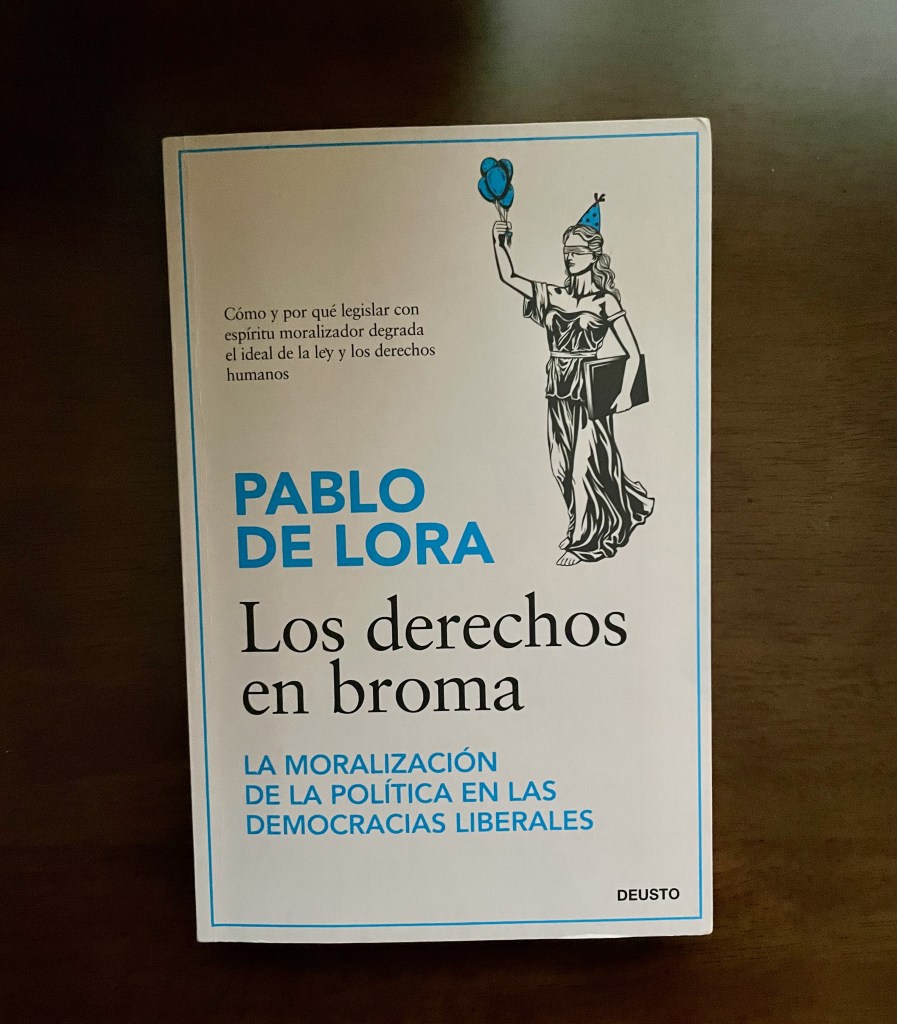
The nursery social state. On Pablo de Lora’s Los derechos en broma (2023). by Gerardo Muñoz

The crisis of the liberal legislative state is almost as old as the very project of the modern liberal state itself. And if we are to believe Carl Schmitt, the rise of the supreme values of the French revolution and ‘human rights’ (with its corollary of universal recognition within its normative system) also meant walking the fine line from the political theology of generative reform to the nihilism of ius revolutionis commanded by new discharges of individual will, political and technical movements, and immanent forces bringing the collapse of the separation between state and civil society. We are still living under its protracted shadow, albeit with a different intensity and intent. In his new book Los derechos en broma: la moralización de la política en las democracias liberales (Deusto, 2023), Pablo De Lora co-shares this point of departure, while daring to suggest a new sequence after the collapse of modern political form and legal order: we are currently living under a particular epochal transformation that is anti-legalist (sic) in nature – precisely because of its surplus of legal motorization – that erects a “nursery state” for the totality of the political community’s reasons and justification for action (De Lora 23). 

Although De Lora case studies shown are almost entirely derived from the Spanish and Latin American contemporary social contexts, I do think that his sharp diagnosis could be extended to the epoch itself without blurring the important nuances. This is an epoch of a reigning “emphatic constitutionalism” (Laporta) or the total Constitution (Loughlin), at the same time that it no longer takes too much effort to imagine a political community devoid of a legislative body, as one eminent constitutional scholar has said repeatedly [1]. We are already here. In other words, whether by excess or deficit, the overall purpose of moral driven legislation announces the internal transformation of modern politics as we know it, extending itself to a civilizational regression from the ideals and norms of the Enlightenment rooted in the fiction of the citizen, the binding of the social contract, and the invention of the principle of sovereign authority.

De Lora does not quite says it in this way, but I think I am not diverting too much of his cartography when extracting some of the central consequences of these internal moral substitutions that are palpable everywhere across the West: ecological legislation that increases social conductivity and expansion of natural destruction; ‘feminist’ anti-sexual aggression that leads to lowering of sentences for convicted sexual predators; the inflationary instrumental use of “Human Rights” for persons and things, but only defined narrowly by those that, under the thick haze of institutional hegemony, can deprive their political adversaries and enemies of the most basic legal guarantees of due process transforming them into non-persons. These ‘moral substitutions’ is part of the “ironic” and “futile” consequence of the sacralization of morality whose end is the management of the “social model” at all costs. According to Pablo De Lora, within the limits of confronting a social dilemma such as disability, the specificity of the “case” is turned on its head; what matters is the overall structural design of the social order and its infinite adaptive changes (De Lora 71-72).

This mutation generates all sorts of unintended consequences when the rhetoric of “social benefit” takes the lead. As De Lora writes: “No hay apoyo anticipado a la discapacidad mental sin reconocimiento de que el discapacitado mental no puede ejercer su autonomía en el futuro. Dicho de otro modo, la institución de las voluntades anticipada de la lógica desideratum de modelo “médico” de la discapacidad mental que se rehuye en beneficio del modelo social” (De Lora 85). And in spite of normative incoherence within an institutional system, the deflection to the “social model” requires ever-expanding commands, rules, principles, and hyper-amendments to guide the adverse proliferation of reasons for action within the social state (in the United States this is soften by the police powers of inter-agency statutes of the administrative state through cost&benefit balancing of discretionary principles under the supervision of the executive branch). This transformation entails the collapse of the internal mediation between the validity of norms and its foundation in social facts as in the classical construction. Thus, the expansion of value-driven legislation that also requires of specific adjudicative constitutional theories, such as legal interpretation and the theory of balancing of principles advocated by Robert Alexy, the sponsors of social neo-constitutionalism, but also the embedded dialogic ideological positions of constitutional scholars such as Roberto Gargarella (or in the United States context, the work of Mark Tushnet and the so-called anti-originalist ‘living constitutionalists’).

All things considered, the fundamental problem for De Lora is that this specific transformation enacts what he calls a “Estado parvulario” or ‘nursery state’ that he defines as: “El que denominado “Estado parvulario” da pábulo a que el poder público, en sus diversos instancias y encarnaciones, escamotee las realidades y consecuencias que conllevan algunas discapacidad per oa que lo haga de manera internamente inconsistente: tratando a los menores como adultos, pero sólo simbólicamente, y, en cambio, de manera efectiva, a todos los ciudada como menores, congénitamente desvalidos, incapaces de encarar la realidad” (De Lora 87). In the framework of the nursery state within its specific moral legislative apparatus, children become adults and the mature civil society regresses to an infantile stage. And like in a nursery setting, the democratic virtues pave the way for new dramatic effects where the function of rhetorical annunciation – so central for the any credentials of moral hegemony – forecloses the void between morality and politics in the wake of the unification that the social model requires to begin with (De Lora 89). 

This slippery slope can only lead straight to a sacralization of the political system that runs co-extensively with the infinite expansion of social rights; which, in turn, leads to an ever increasing conflict over the assumptions regarding its social facts (De Lora 151). In this narrow form, De Lora is audacious when citing Martin Loughlin’s recent indictment from his Against Constitutionalism (2022): “En la era de la Constitución total, el gobierno bajo el imperio de la ley ya no significa el gobierno sujeto a reglas formales independientemente pulgadas. Significa gobierno de acuerdo con principios abstractos de legalidad que adquieren significado sólo cuando son insuflados con valores…” (De Lora 188). And we know perhaps too well that values cannot be reasoned, but only weighted; values are commanded and taxed on the permanent devalorization of other values. This is why the rise of the value fabric of constitutionalism coincides with the ‘weighting’ proportionality of principles of law’s ideal social efficacy, to paraphrase Robert Alexy’s influential position as claim for “anti positivist legal justice” [2]. The nursery social state cannot be corrected merely from the position of the legislator; it can also be tracked as a triumph of moral jurisprudential theories of law that seek to overcome (and provide answers) to the overall crisis of institutional authority that characterized the so-called ordered liberty of the moderns. 

Is there anything to be done beyond a description? It is quite clear that Pablo De Lora’s ambition is not so much the proposition of a new political or legal philosophy as much as the sketch of the current epochal predicament in its current practice. This is already enough to welcome a robust analytical discussion of our predicament in Los derechos en broma (2023). However, there is a cobweb of affinities in De Lora’s own position towards the end of the book that, even if not fully developed, must be registered as a mode of conclusion. First, there is an affinity with John Hart Ely’s deferential conception of judicial power that aims at overseeing the procedural mechanism for the democratic deliberation and legislation over a hot-button issues. In this vein, De Lora shares Akhil Amar’s position regarding the overturning of Roe in the Dobbs’ decision; a conception that fully embodies judicial deference to diverse legislative majorities [3]. Secondly, De Lora favors a judicial minimalism associated with the doctrinal theory sponsored by James Bradley Thayer over the practice of judicial review of the Court (De Lora 233). And last, but not least, De Lora sees transformative potential in John Rawls’ assertion in his late Political Liberalism (1993) that the use of public reason is a comprehensive doctrine to deal with our fundamental disagreements and contentions over shared political values (De Lora 241).

I am not sure how deep or for how long does De Lora wants to go with Rawls; however, it is important to remember – and specially given the treatment of the ‘social model’ in the morality presented in Los derechos en broma (2023) – that insofar as social paternalism is concerned, Rawls’ late liberal political philosophy at the heart of the crisis of the secular liberal state amounts to a political conception that, as Eric Nelson has brilliantly shown, abandons the commitment of individual non-cooperation or refusal to cooperate with unjust moral legislative burdens, and thus making everyone stuck in the same ship [4]. This ship is the management and balancing of the totalization of the values being trafficked in the Social as ‘egalitarian’, although they are fully endowed as a seterological scheme of “election” (and who is elected) balanced by secondary compensations.

On a larger canvas, if the current political structure is defined as a nursery state of social rights, then this means that appealing to ideal positions of justified reasons, “diaphanous” deliberation, and well crafted citizen arguments belong to the age of maturity of the Enlightenment, but not to the stage of social infantile disorder. And demanding political qualifications to the contemporary citizen today is not only naif, but at odds with what what institutional thinking requires. In other words, the concrete transformation of the post-liberal state is one of permanent optimization of conflict, which is why John Gray has lucidly defined the (contemporary) ‘new Leviathans’ are “engineers of the soul” with broad and sweeping capacities to govern over every inch of the social space [5]. In the wake of these institutional mutations, the call endorse a “moral critique” might be taken as a post-enlightened lullaby that among the blasting and striding cries of infants of the nursery will most likely just pass unheard.

Notas 

1. Adrian Vermuele. “Imagine there is no Congress”, Washington Post, 2016: https://www.washingtonpost.com/news/in-theory/wp/2016/01/11/imagine-theres-no-congress/ 

2. Robert Alexy. “The Rationality of Balancing”, in Law’s Ideal Dimension (Oxford U Press, 2021), 122.

3. Akhil Reed Amar. “The end of Roe v. Wade”, The Wall Street Journal, 2022: https://www.wsj.com/articles/the-end-of-roe-v-wade-11652453609 

4. Eric Nelson. The Theology of Liberalism: Political Philosophy and the Justice of God (Harvard U Press, 2019), 164.

5. John Gray. The New Leviathans: Thoughts After Liberalism (Farrar, Straus, and Giroux, 2023), 5. 

The enemy from the argument of purity. by Gerardo Muñoz

A rebuttal against the notion of enemy frequently hinges on conflating the enemy with total enmity. It usually takes the form of a hypothetical: once an enemy is declared as such, is there anything that can deter the escalation into total enmity? The historical record provides analytical reassurance to the hypothetical, but it does not eliminate its generality, since its ultimate probe is conditioned by an ideal of conceptual purity. Not every hypothetical is idealistic, but every hypothetical exerted from purity is. This concerns any understanding of politics, given that the notion of the enemy presupposes an impure origin of conflict, threats, disorder, or unjustified propensity towards evil. If the enemy is best understood as an operative principle between repression and totalization of enmity, it also entails a rejection of purity as sacralization of the political.

The argument from purity has been deployed with equal force by both Liberalism and Marxism, although they are not the only two contenders. Whereas the first suppresses the enemy from civility and economic utility; for the second, there are no necessary enemies given that politics is a process that will culminate in moral emancipation. For both Liberalism and Marxism, the problem of separation is fixed in two opposite poles: for Liberalism the separation is originary and consubstantial to the genesis of modernity as the separation of Church and State; for Marxism, the separation comes to end in the future collapse of the alienation of ideal and manual labor, and state and civil society. The argument from purity liquidates the enemy as the operative function because it doesn’t consider conflict intra muros on its merits. It is always surpassed or to come.

From the argument of impurity, the notion of the enemy demands that the political be understood as here and now (more than temporal it is topological: externality). Let us consider Shakespeare’s Hamlet. It is a tragedy that stages the friction between the suppression of the political enemy in medieval society and the not-yet autonomy of the political of the moderns. In an old essay Leo Lowenstein noted that Hamlet is an existential limbo as to whether to judge and execute his father’s murderer, or to desist in his decision of revenge and become paranoid crossing the line into madness [1]. The world of Hamlet’s indecision is no longer that of imperium theologiae where the enemy is an entity to be deposed of; but rather it vacillates because it knows the fracture between wrongdoing and action, legality and legitimacy. The malaise of Hamlet condition is the impossibility of enemy mediation: “Shakespeare’s theatre, in general, and his Hamlet, in particular, are no longer ecclesiastical, in the medieval sense. On the other hand, they are not yet a political state theatre, in the concrete sense state and politics acquired on the Continent as a result of the development of state sovereignty.” [2]. The intrusion of historical time reminds us that original separation will not be enough in the face of a concrete conflict.

The tragic dimension in Hamlet is given negatively: the paralysis of not being able to establish the proper mediation to deal with political enmity. This paralysis – or the inconceivable regicide of naturalist theologians – can only amount to madness. Indeed, one becomes one’s enemy, because the enemy (the usurper King) lacks the mediation with its exteriority: “Hamlet is of the faction that is wronged / His madness is poor Hamlet’s enemy…That I have shot my arrow o’er the house / And hurt my brother” [3]. What does it mean to be one’s own enemy, and who could decide here? The incapability of generating an external hostis will prompt bad consciousness and perpetual resentment.

From the side of impurity, the enemy as “one’s own form” means a depersonalization of the political and the neutralization of the stasiological force that places reasons, justifications, and actions as primary ends. But a civil war waged on internal reasons do not imply mediation. From the argument of purity the dismissal of the enemy is no longer Hamlet’s negativity; it turns itself into subjectivism and unfettered self-autonomy that will require not the judge but the priest, and not political form but the police.

.

.

Notes 

1. Leo Lowenstein. “Terror’s Atomization of Man”, Commentary, 1946, 7.

2. Carl Schmitt. Hamlet or Hecuba: The Intrusion of the Time into the Play (Telos Press, 2009), 51.

3. William Shakespeare. The Tragedy of Hamlet (Signet Classics, 1987), 168. 

John Rawls and the justice of civil war. by Gerardo Muñoz

Nowhere in his published work does John Rawls treats the concept of civil war explicitly or by that matter in relation of his concept of political liberalism, although it is central to genesis. In a Spring semester of 1969 lecture at Harvard University, which remains for the most part unknown and only alluded by specialists of his (although never subject to substantive treatment), “Moral Problems: Nations and War”, Rawls takes up the problem on its merits [1]. This is a lecture that took place in the wake of the Vietnam war, the post-1968 context, and during the years of the definite settling of “global civil war” intensifying in every corner of the world. There is little that Rawls when treating the problem of war within the tradition of liberalism, was also aware of the factical nature of war of his present; that is, the transformation of war as a legitimate declaration between nations (at that point outlawed by the international Kellogg-Briand Pact) to a predominately a war within nations, that is, a permanent civil war. In this lecture – which one does not need to summarize given its broad historical strokes and technical determinations – Rawls crafts an typology wars in international law, as construed by the ius gentium, a theme that will later be the subject of his late book in international relations principles Laws of the People (1993). What is surprising is that in this typology, Rawls defines civil war as a thorough conflict aiming at “social justice” to transform the state. A civil war, then, is no longer what precedes the foundation of ‘legitimate authority’ proper to sovereignty, but it is rather the means by which something like “justice” becomes the mediation of the “Social”.

From this it follows, that for Rawls civil wars either neither wars of aggression or wars of sessions, two forms that would be exclusionary to his definition grounded on ‘Justice’. Hence, the “justification” of civil war could only be a just war insofar as its aim grounded in social justice as the effective realization of the well-being of all the inhabitants of the polity. For Rawls this was the ‘active’ continuation of the ideal of the French Revolution of 1789. Indeed, one could claim that for Rawls civil war is the continuation of revolution after the principle of universal recognition was achieved through rights. The ideal of Justice, then, was never the well-ordered natural law theory of revolutionary change (endorsed by many Jacobins, such as Saint-Just), but rather an intra-level recognition of social rules within the plural system of value differences. Coinciding with the development of positive law as grounded in social facts and guided by a ‘rule of recognition’ (in H.L.A Hart’s well-known elaboration), Rawls’ theory of civil war was the mechanism for a social fact-based conception of justice that was predicated in the optimization of risks, regulations, and re-distrubution of post-recognition equity of the activist state. Indeed, social justice insofar it was no longer merely sovereign authority, took the function of social facts through the administration of a permanent social civil war.

Neither an event nor an exception, civil war for Rawls is a free-standing metapolitical paradigm of the new “transformative” conception of the Social ordered purposely around the principle of Justice. Paradoxically, the conditions of promoting “social justice” (whose echoes we still hear today from the political class as well as from the jargon of academic political ideology) is not limited to the “veil of ignorance” or the “originary position” for social action, but rather in the actualization of a latent stasiological paradigm. This esoteric unity is neither an exception nor a deviation from Rawls’ mature political thinking around social justice; but as all true political paradigms, an invariant mode of his thinking. This is why he points in the 1969 lecture the Spanish civil war as paradigm of stasis as social justice, and in his essay “My religion”, the American Civil War led by the exceptional executive authority of Abraham Lincoln as necessary to the “original sin” of human slavery [2]. And as Eric Nelson has convincingly argued, the anti-pelagian conception of sin in Rawls’ thought amounts to a secularized theodicy of social force: a regulatory physics in the aftermath of the crisis of the sovereign state. Although ignored by Nelson, the full picture of Rawlsian conception of the “Social” is not complete if one does not take into account the stasiological paradigm that legitimizes the aims of social justice. And if the internal conflict is latent within the Trinitarian ontology (as Political Theology II suggests) there is little doubt that the transformative model of Liberalism rather than moving the conditions of politics forward, ends up descending to the terrain of Christian political theology that it never abandoned.

But is it even ‘transformative’ within the conditions of the Christian model that it allegedly secularized? Is the primacy on social justice on civil war truly a political theology, or rather the consequential triumph of theology over the institutionality to restrain the ballistic aspiration of social hegemony? Both questions collapse if tested on the grounds offered by Carl Schmitt regarding both political theology and the critique of moral neutralization of values as direct application of the principle of Justice, which would turn social relations into pure subjection, a form of Homo homini Radbruch (Rabruch referring to the Radbruch formula of an unjust of law as non-law, thus requiring principles) [3]. What is “just” to a hegemonic stance indicates a clear crisis of institutional deficiency in the face of what values determine the scope and content of the “Just”.

Similarly, the transformative conception of Rawlsian “activist liberalism” is closer to the realism of latent civil war than what the Christian idea required on a thing and minimalist basis; which, according to Ladner implied retreat form the social as well as from liturgical participation. On the contrary, rather than moral unity, reform entailed a separation, solus ad solum, in order to transform the habits and costumes without direct enforcement [4]. Contrary to the Christian monastic ius reformandi, Rawls’ renovation of political liberalism, vis-à-vis the civil war paradigm, accepted the hellish reality of the social by affirming “social justice” as the only real means for subjective social cohesion. And if the just war principle stood largely under the guidance of positive sovereign rules and commands; the deployment of justice of civil war will be based on the exertion of principles and higher content without end. The true efficacy of civil war alien to the concept of the political, made possible a regime of socialization on the mere basis of values stratification and moral abstraction.

.

Notes 

1. John Rawls. “Moral Problems: Nations and War”, Spring 1969, Harvard University. Harvard U Library Archives. 

2. John Rawls. “On my religion”, in A brief inquiry into the meaning of sin and faith (Harvard U Press, 2009), 263.

3. Carl Schmitt. “Un jurista frente a sí mismo: entrevista de Fulco Lanchester a Carl Schmitt”, Carl-Schmitt-Studien, 1. Jg. 2017, 212.

4. Gerhart B. Ladner. The Idea of Reform: Its Impact on Christian Thought and Action (Harper Torchbooks, 1969), 322.

Politics as substantive morality: Notes on Gramsci’s Prison Writings (VI). by Gerardo Muñoz

In section 79 of Gramsci’s Notebook 6 we are offered a strong definition of “politics” that I think illuminates the core of the Gramscian program fundamentally as a substantive morality. Gramsci writes the following against the “particularism” of normal associations (say the aristocracy, the elite, or the vanguard): “[an universal] association does not set itself up as a definite and rigid entity but as a something that aims to extend itself to a whole social grouping that is itself conceived as aiming to unify all humanity. All these relationships give a universal character to the group ethic that must be considered capable of becoming a norm of conduct for humanity as a whole. Politics is conceived a process that will culminate in a morality; in other words, politics is seen as leading towards a form of sociality in which politics and hence morality as well are both superseded.” (30). It is an astonishing definition, given the precise way it mobilizes the content of this new politics. Of course, there is the explicit the Hegelianism of the ‘universalist’ translation through the dialectical conflation between state and civil society, which just a few sections prior to 79, Gramsci deploys in order to posit the ultimate goal of communist society. 

But in this section he goes further, since it becomes clear that the state and civil society, as they march towards an ‘integral state’, dissolves politics into pure morality. But Gramsci immediately clarifies that it is not just a “morality” of a new dominant class (which could still be contested vis-a-vis other values), but rather a “morality that is superseded”. This is an absolute morality beyond value disputes. In other words, it is an absolute morality that needs to be so because state and civil society have become a unified whole. Concretely, this means the dissolution of politics and of any concrete order of the republican tradition, which recognizes that, precisely because civil war is the latent in the social, no morality can be granted hegemonic status. At bottom, this is the reason why we need politics and institutions to mitigate conflict. The Gramscian moral universe frames a world in which the conflict not only disappears, but rather it becomes pure morality towards a “substantive common good” in which every person is obliged to participate. Indeed, one could claim that the theory of hegemony as morality has never appeared as strongly as in this fragment. I think it is fair to say that the telos of hegemony is, in every case, a drive towards the consolidation of this uncontested morality. 

Needless to say, this is a frontal assault on positive law, which aimed, from Hobbes to H. L. Hart, to clearly differentiate between politics, institutions, and morals. In a surprising but direct way, Gramsci’s definition of politics as substantive morality is closer to the tradition of “Thomism” in at least three compartments of Aquinas’ thinking. First, because it posits a substantive morality as a unified conception of aims, which negates any competing positions between values. Secondly, the substantive morality of politics informs the Gramscian theory of the state, which, very much like the Thomist subsidiary structure, understands institutions not as a concrete order of conflict (stasis), but rather as a depository for the reproduction of civil society (that is why Gramsci also in notebook 6 will speak about the “state without a state”) in the image of the state. However, if we are to be fair to the natural law tradition, I think we can claim that Gramsci is really an archaic and not a “modern” (or revolutionary) Thomist, since even John Finnis in his Natural Law and Natural Rights (Oxford, 1980), in an attempt to square natural law with modern liberalism, countered Hart’s objection of unified moral aims in this way: “…there are basic aspects of human existence that are good leaving aside all the predicaments and implications…all questions of whether and how one is to devote oneself to these goods” (30). Finnis distinguishes between general principles and personal elaborations of aims. However, Gramsci is not interested in establishing generic “principles” for plural aims, but rather he seeks the actualization of a morality that is substantive because it is understood as “superseded as morality” as such. The kingdom of the Gramscian integral state is only realized if the heterogeneity of the social is captured by the hegemony of a supreme morality of Humanity. 

The distance between Gramscian moral politics and the modern natural law foundation (Fuller, Finnis) is driven home when later in section 88 of notebook 6 he claims that: “…one should not think of a “new liberalism” even if the beginning of an era of organic freedom were at hand” (76). This confirms that Gramsci is interested in crafting a morality tied to the efficacy of immanent individual ends and desires, and not at the level of generic principles of a common order. If one takes this moral politics seriously, then it becomes difficult (impossible, in my opinion), to square the primacy of this morality with positive law and the republican tradition at large. At its “best light”, the Gramscian absolute morality can only yield a faith in “Humanity”, which feeds from the production of enmity (turning dissent into ‘inhumanity’) in a civil war, as it cannot be otherwise.

A New Priest: Notes on Gramsci’s Pre-Prison Writings. by Gerardo Muñoz

While reading the articles of the young Antonio Gramsci (penned from 1914 to 1920) it becomes evident that he was a keen observer of the historical and geopolitical reality of his time. Gramsci was a realist thinker but of a strange kind. The emphasis on “faith”, for instance, runs through the articles conforming a providential design of history. There are many “entities” that incarnate this providentialism: the Party, the transitional state, the proletarian culture, the organizational discipline, and the productionism of the working class. In fact, all of these subjects are vicarious and obedient to historical developmentalism. In a way, Gramsci appears as a “new Priest” (humanist, Hegelian, and providential) rather than a “new Prince” (Machiavellian, contigent, desicionist), which has become the gentle image through which he is remembered today. The 1914-1920 newspaper articles are filled with theological deposits, but I will limit these notes to three subdivisions, which do not exhaust other possible combinations.

  • The Party. The conception of the “Party” is understood by Gramsci in the same way that official authorities of the Church understood the providential mission; that is, as “the structure and platform” for salvation. But it is also a subjunctivizing apparatus that demands submission and supreme cohesion under a party-culture. For instance, in “Socialism and Culture” (1916) he writes: “Culture is something quite different. It is the organization, the discipling of one’s inner self; the mastery of one’s personality, the attainment of a higher awareness, through which come to understand our value and plea within history, our proper function in life, our rights and duties” (9-10). So, for Gramsci, it is through the energic investment with the Party that one “becomes master of oneself, assert one’s own identity, to enter from choke and become an agent of order, but of one’s own order, one’s own disciplined dedication to an ideal” (11). In the same way that official Church administered the “soul” through a regulatory exercise of “sin”; Gramsci’s conception of the Party is limited to an administration of “revolutionary energy” vis-à-vis discipline and sacrifice in the name of an objective ideal of “philosophy of history”.


  • Faith. The notion of faith in Gramsci is intimately intertwined with History. To have faith is to “transcend” the otherwise empty void of History. In this well-known theological conception, faith is the force to have true “objects of History”. The object here means two things: both the intention and “end” to carry forth the revolutionary process. But faith here is nothing like the “knight of faith” who stands beyond the ethical and universalist positions. On the contrary, faith is always a communal faith of believers, whose are the resilient militants of the communist idea. As Gramsci says clearly in “The Conquest of the State” (1919): “And it must be ensured that the men who are active in them are communist, aware of the revolutionary mission that their institution must fulfill. Otherwise all our enthusiasm and faith of the working classes will not be enough to prevent the revolution from degenerating wretchedly…” (114). Or as confirmed in “History” (1916): “Our religion becomes, once again, history. Our father becomes; one again, man’s will and his capacity for action” (14). We see the double movement produced by the apparatus of “faith”: it unifies under a command (the Party), but it also instantiates an objectification to cover the void of History. Indeed, “life without an end’ is a ‘life not worth living”, says Gramsci. This particular instrumentalization of faith legitimizes the struggle against the bourgeois cosmos.


  • Order. Throughout these articles the defense of order is quite explicit. It is in this point where Gramsci comes closer to upholding a political theology that transposes the principles of liberalism unto “socialism”. He writes in “Three Principles and Three Kinds of Political order” (1917): “And the socialist program is a concrete universal; it can be realized by the will. It is a principle of order, of socialist order” (25). There is never a substantive idea of “order”, in the same way that there is no clear “transformation” of the state once the state has been occupied and functional to “administrating”, “managerial”, “productive systematization”, “vertical planning’, and “coordinating functions” (“The Conquest of the State”, 113). Gramsci goes as far as to say that “the proletarian state is a process of development…a process of organization and propaganda” (114). And although he claims that it is not, the occupation of the state is a pure “thaumaturgic” act pushed by the community of believers. Isn’t someone like Álvaro García Linera today a faithful follower of this strategy?

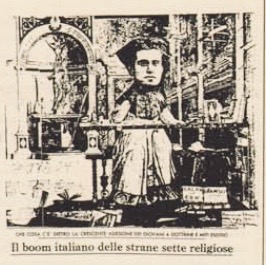
So, in this early Gramsci I find a priest rather than a modern prince. A priest driven by a substantive and coordinated theological effort to establish a voluntarist and teleological dogma for historical change, which really does not differ much from the principles of modern Liberalism and its potestas indirecta. It is interesting that in the last issue (1977) of the mythical Italian journal L’erba Voglio, there is a small satirical portrait of Gramsci dressed as a bishop with pen in hand, which speaks to the theological garments of Gramscianism well into our days. But the problem is not theology; it is rather that it is a theology of submission organized around order, reproduction, and history as idols in the name of consented domination.

Finally, I could very well imagine that some could rebuttal these theological imprints by claiming that this is only early Gramsci, and that things change later on. I am not too sure about this. It seems that this heuristic claim is analogous to Kafka’s “Leopards in the Temple” parable. In other words, isolating an “early” from a “late” Gramsci becomes a general ceremony to save the philosopher in spite of himself. But this is a self-defeating maneuvering from the very start.


*Image source: from the magazine L’erba Voglio, N.30, 1977.

Cuaderno de apuntes sobre la obra de Rafael Sánchez Ferlosio. Tercera Parte. Por Gerardo Muñoz

Non Olet (2003) es uno de los ensayos tardíos de Sánchez Ferlosio sobre materia económica. En realidad, su vórtice es la mutación del modelo de la producción al dominio del consumo. El aliento de las premisas del ensayo es muy ruskiano, aunque nunca se aluda a John Ruskin. Una mirada contramoderna como la Ruskin puede ayudarnos a desenmascarar las veleidades del valor como absoluto. Por eso hay que recordar que en Unto This Last, Ruskin argumentaba que el objetivo final de la economía política es siempre la glorificación exitosa del consumo, porque lo “usable” deviene sustrato de su sustancia hegemónica para perfeccionar el valor. Ruskin, por supuesto, no tuvo que esperar al declive histórico del trabajo y el cierre de la fábrica para darse cuenta. Ya todo estaba en el cosmos del liberalismo y del commerce.

El rastreo de Ferlosio se mueve en esta rúbrica. Para Ferlosio, la estructura tardía del capitalismo es esencialmente de equivalencia absoluta: “…el poder de determinación de la demanda y por lo tanto el poder determinante de la producción sobre el consumo, tendría el inimaginable porvenir de convertirse en el quid pro quo fundamental para el portentoso triunfo del liberalismo” (p.13). Ferlosio subraya que la “estructura de la demanda” es la unidad básica del este aparato del valor, ahora expuesto con la crisis de la forma tradicional del trabajo, puesta que hoy “el único capital humano que necesitan [las empresas] no es sino el que está compuesto de consumidores” (p.41). La intuición de Kojeve: si Marx fue el Dios, Ford fue su profeta.

No deja de curioso cómo la “demanda” también se ha convertido en el último resorte conceptual de la teoría política. No por gusto Jorge Dotti decía que la teoría del populismo era una mímesis de la equivalencia del dinero. En este nuevo absoluto, la brecha entre economía y política se rompe, haciendo del consumo la forma definitiva de la “Economía”. Por ejemplo, la noción de “ocio” entendida como tiempo de consumo es la expresión de una determinación compensatoria ya siempre entregada a la producción. En otras palabras, ahora producción y consumo son dos polos de una misma máquina que ha entrado en una zona de indeterminación (p.50).

Y es por esta razón que un marxista heterodoxo como Mario Tronti podía escribir en Operai e capitale (1966), que para luchar contra el capital la clase obrera debía primero luchar contra sí misma en cuanto capital. Es una sentencia dinámica, difícil de atravesar, y que coincide con la expansión del discurso de lo ilimitado. Hablar de un exceso en la exterioridad del Capital pone en crisis la negatividad de lo político. Así, se inaugura una nueva tiranía de los valores. Por esta razón, Ferlosio prefiere hablar de la Economía como “absoluta equivalencia, ajena a todo principium individuationis que pone en jaque a todas las formas de vida” (p.75).

La crisis de la negatividad es también agotamiento de la separación en la vida, esto es, de lo narrable como brillo de experiencia. Lo irónico de la economía moderna es que, a pesar de su origen como descarga contra el absoluto, su destino es la justificación de la rentabilidad como única verificación del valor” (p.81). El ethos económico moderno no es haber dejado atrás el peso de la contingencia del dios omnipotente, sino haber diferenciado el valor como una “función social” de las diferencias. Por eso es que Ferlosio no cree que podamos hablar de “sociedad civil” ni de “funciones sociales”, puesto que lo social ya presupone el valor como antesala de toda relación humana (p.106-107). Ferlosio escribe: “Bajo el omnímodo y omnipresente imperio de la “sociedad contractual”, todo queda indistintamente comprendido bajo el signo de las relaciones económicas. La sociedad no ya más que el sistema vascular para el fluido y el flujo de los intercambios económicos” (p.108). En efecto, ya no hay más “sociedad civil”, sino cómputo (cost & benefit) que sostiene la forma Imperio.

La estructura genérica de la sociedad consta de tres elementos – crédito, valor, y deber – que componen la máquina tripartita que produce al sujeto de consumo. De la misma manera en que la magia de la producción ha sido depuesta hacia el polo del consumo, ahora la existencia es depuesta como vida que debe ponerse en valor. Escribe Ferlosio: “Bajo la férula de la racionalidad económica, hoy coronada por el absolutismo de la hegemonía del a producción, no hay ya otra confirma de relación hombres que la de las relaciones contractuales; cualquier posible resto o renovado intento de relación no-contractual o está en precario o alcanza apenas una realidad fantasmagórica.” (p.158-159).

Un examen que nos toca de cerca: ¿no es la cultura de la culpa un modo contractual en todas relaciones sociales contemporáneas? ¿No ha sido el asenso de la identificación y la empatía, la nueva máscara obscena de la relación contractual entre personas? La función contractual no hay que entenderla como una esfera efectiva del derecho (no hay que firmar un documento en cada caso), sino como una función plástica del poder, ya sea como deber, como mandato, o como obligación. El agotamiento del contrato de la época del Trabajador, vuelve cada praxis humana una forma contractual. Es curioso que al mismo tiempo que se eliminan los contratos duraderos en la esfera laboral, toda experiencia con el mundo es hoy un contrato. Ferlosio nota un cambio importante: la palabra “caridad” (carus) paulatinamente fue reemplazada por “solidaridad”. ¿Y qué es la “solidaridad” (palabra que puede aparecer ya sea en el discurso de  una ONG, de una corporación de Wall-Street, o en el discurso piadoso de un profesor de Humanidades)?

La solidaridad es un término filtrado desde la esfera jurídica que apela al reconocimiento de un acuerdo previo. La solidaridad es el contrato con la Causa. Por eso sabemos que no hay solidaridad sin intereses y sin milicias. Sólo podemos ser solidario con la Humanidad, ya que en realidad reservamos el cariño para los amigos. La solidaridad despacha siempre a lo no-humano. Aunque lo no-humano realmente sea lo único importante; lo único que rompe la equivalencia general y que le devuelve la mueca mortal a la vida. De eso se trata: de devolverle al singular sus olores contra el non-olet genérico del Capital. Sánchez Ferlosio nos recuerda que hasta Edmund Burke tuvo “solidaridad” con los pobres en función de “la situación general de la humanidad” (p.161). Hoy cierta izquierda es burkeana porque sintetiza la solidaridad en nombre de una Humanidad que, por supuesto, cambia de rostro mensualmente. En efecto, las “Causas” no huelen.


Primera entrega

Segunda entrega

The triumph of res idiotica and communitarianism: on Patrick Deneen’s Why Liberalism Failed. By Gerardo Muñoz.

Patrick Deneen’s much-awaited book Why Liberalism Failed (Yale University Press, 2017) is a timely contribution that, in the wake of the Trump presidency, vehemently confirms the epochal crisis of political liberalism, the last standing modern ideology after the demise of state communism and short-lived fascist mass movements of the twentieth century. It is difficult to distinguish whether liberalism is still a viable horizon capable of giving shape to citizenship or if on the contrary, it endures as a residual form deprived of democratic legitimacy and popular sovereignty [1]. In fact, contemporary liberalism seems incapable of attending to social demands that would allow for self-renewal. In a slow course of self-abdication, which Carl Schmitt predicted during the Weimar Republic, liberalism has triumphed along the lines of a logical administration of identity and difference through depolitization that has mutated as a global war in the name of ‘Humanity’ [2]. The catastrophic prospect of liberalism is far from being a schmittian alimony of political exceptionalism. In fact, Mark Lilla in his recent The Once and Future Liberal (2017) claims, quite surprisingly, that the “liberal pedagogy of our time is actually a depolitizing force” [3]. What is at stake at the threshold of liberal politics is the irreducible gap between idealia and realia that stages a moment where old principles wane, no longer accounting for the material needs in our contemporary societies [4].

Deneen confronts the foundation of its idealia. Deneen’s hypothesis on the failure of liberalism does not follow either the track of betrayal or the path of abdication. Rather, Deneen claims that liberalism has failed precisely because it has remained “true to itself” (Deneen 30). In other words, liberalism has triumphed in its own failure, crusading towards liberation as a philosophy of history, while administrating and containing every exception as integral to its own governmentality. If modern liberalism throughout the nineteenth century (an expression of the Enlightenment revolutionary ethos) provided a political referent for self-government, the grounds for the rule of law, and the exercise of liberty against divine absolute powers (the medieval theology of the potentia absoluta dei); contemporary liberalism has found consolidation as a planetary homogeneous state that reintroduces a new absolutism that interrupts modern man’s self-affirmation against divine contingencies [5]. Since its genesis, liberalism was held by two main anthropological assumptions: individualism as the kernel for the foundation of negative liberty and the radical separation of the human from nature, both by way of an economic-political machine that liberates the individual at the same time that it expands the limits of the state. The rise of the securitarian state is the effective execution of this logic, by which politics centers on governing over the effects in a perpetual reproduction of its causes. These ontological premises are the underlying infrastructures of a two-headed apparatus that ensembles the state and the market in the name of the unrestrained conception of liberty. As Deneen argues: “…liberalism establishes a deep and profound connection; its ideal of liberty can be realized only through a powerful state. If the expansion of freedom is secured by law, then the opposite also holds true in practice: increasing freedom requires the expansion of law” (Deneen 49).

But the same holds true for the unlimited market forces that today we tend to associate with late-modern neo-liberal laissez-faire that presupposes the expansion of functional units of state planning as well as the conversion of the citizen as consumer. The duopoly of state-market in liberalism’s planetary triumph spreads the values of individual autonomy, even if this necessarily entails the expansion of surveillance techniques and the ever-increasing pattern of economic inequality within an infinite process of flexible accumulation and charity that maintain mere life. In this sense, globalization becomes less a form of cosmopolitan integration, and more the form of planetarization driven by the general principle of equivalence that metaphorizes events, things, and actions into an abstract process of calculability [6]. This new nomic spatialization, which for Deneen discloses the erosion of local communitarian forms of life as well as the capacity for national destiny, is the epochē of sovereignty as the kernel principle of liberalism. In other words, Liberalism’s sovereigntist traction was always-already exceptio through which the governance of the nomos is only possible as the effective proliferation and rule over its anomic excess.

The substantial difference with early forms of liberalism is that only in the wake of contemporary globalization and the post-industrial reorganization of labor, this exceptionalism  no longer functions as a supplement to the normative system, since it is what marks the subsumption of all spheres of action without reminder. In this scenario, liberalism is no longer a political ideology nor is it a horizon that orients a modern movement towards progress; its sole task is to control the imports of identity and difference within the social. One could say that liberalism is a technique for containing, in the way of a thwarted katechon, a society without limits. Paradoxically, liberalism, which once opposed sovereign dictatorship, now endorses a universality that cannot be transmitted, and a principle of democracy that has no people (populus).

In the subsequent chapters of Why Liberalism Failed, Deneen turns to liberalism’s imperial mission in four distinct social paradigms: culture, technology, the Liberal Arts in the university, and the rise of a new aristocracy. The commonality in each of these topoi is that in each and every one of these social forms, liberalism has produced the opposite of what it had intended. Of course, it did so, not by abandoning its core principles, but precisely by remaining faithful to them, while temporalizing the hegemony of the same as eternal. First, in the sphere of culture, Deneen argues that liberalism’s inclination towards an anticultural sentiment is consistent with multiculturalism as the “eviscerated and reduction of actual cultural variety to liberal homogeneity loosely dressed in easily discarded native garb” (Deneen 89). The culturalism promoted by liberalism is a process of deletion that knows only a fictive transmutation within the logic of ‘diversity’ and ‘inclusion’ that seeks to exhaust the cosmos of the singular. The price to be paid for policed inclusion of cultural differences into liberal anticultural norms, aside from leaving the economic accumulation untouched, is that it forces a form of consent that tailors the radically irreducible worldviews to standardized and procedural form of subjective recognition. Although Deneen does not articulate it in these terms, one could say that culturalism – which Deneen prefers to call liberalism anticulturalism-, amounts, in every instance, to a capture that supplies the maintenance of its hegemonic thrust.

Nowhere is this perceived with more force today than in liberal arts colleges and universities across the country, where from both ideological extremes, the Liberal Arts as a commitment to thinking and transmission of institutional knowledge is “now mostly dead on most campuses” (Deneen 113). From the side of the political conservative right, the way to confront the ongoing nihilism in the university, has been to completely abandon the liberal arts, pledging alliance to the regime of calculative valorization (the so called “STEMS” courses) on the basis of their attractive market demand. But the progressive left does not offer any better option, insisting by advancing the abstract “critical thinking” and one-sided ideological politization, it forgets that critique is always-already what feeds nihilism through the negative, which does little to confront the crisis in a democratic manner. The demise of the liberal arts in the contemporary university, depleted by the colonization of the dominance by principle of general equivalence, reduces the positionality of Liberal Arts to two forms of negations (critique and market) for hegemonic appropriation [7]. In one of the great moments of Why Liberalism Failed, Deneen declares that we are in fact moving slowly into the constitution of a res idiotica:

“The classical understanding of liberal arts as aimed at educating the free human being ids displaced by emphasis upon the arts of the private person. An education fitting for a res publica is replaced with an education suited for a res idiotica – in the Greek, a “private” and isolated person. The purported difference between left and right disappears as both concur that the sole legitimate end of education is the advance of power through the displacement of the liberal arts” (Deneen 112).

Liberalism idiotism is invariable, even when our conduct is within the frame of public exposition. One must understand this transformation not merely as a consequence of the external economic privation of the public university (although this adds to the decline of whatever legitimacy remains of the Liberal Arts), but more importantly as a privatization of the modes of the general intellect into a dogmatic and technical instrumentality that “can only show their worth by destroying the thing they studied” (Deneen 121). The movement of liberalization of higher education, both in terms of its economic indexes and flexible epistemic standardization, dispenses the increasing erosion of institutions, whose limits have now become indeterminate within the general mechanics of valorization. The res idiotica is the very exhaustion of the res publica within liberal technicality, where any form of impersonal commonality is replaced by the unlimited expansion of expressive subjectivism. In a total reversal of its own conditions of possibility, the outplay of the res idiotica is satisfied in detriment of any use of public reason and freedom, if by the latter we understand a commitment to the polis as a space in which the bios theoretikos was never something to be administered, but constructed every time [8]. The emergence of res idiotica coincides with the decline of politics as a force of democratization in the public use of reason.

In the economic sphere, the assault of the res publica entails the emergence of a new aristocracy, which as Deneen argues, was already latent in liberalism’s great ideologues’ (Locke, Mill, and Hayek) commitment to a ruling class formation and arbitrary economic distribution. For Deneen, one did not have to wait for Hayek’s experiments in active market liberalism to grasp that what J.S.Mill called “experiments of the living” as the promise of liberation from the social shackles, but only to consecrate an even more stealth system of domination between expert minorities rule and ordinary people. What remains of Liberalism in its material deployment is not much: a res idiotica that fails at constituting a public and civil society devoid of cives, and a state that expands the limits of administration in pursuit of freedom only to perpetuate an aristocratic class. In broad strokes, Deneen’s narrative about liberalism could be well said to be a story about how a “living body” (the People) became an absolute in absentia that only leave us with a practice of idolatry to a supreme and uncontested principle [9].

The idolatrous character of liberal principles is rendered optimal in recent theoretical claims against democracy, where the latter is seen as an obstacle for government rather than as the premise for the legitimacy of popular sovereignty. Hence, democracy is turned into a mechanical arrangement that includes whatever supports liberal assumptions and beliefs, and excludes all forms of life that it sees as a threat to its enterprise. In this way, liberalism today is a standing reserve that administers the proliferation of any expressive differential identities, while scaffolding an internal apparatus for self-reproduction. In one of the most eloquent passages of the book, Deneen evokes the anti-democratic shift of liberalism in the contemporary reflection:

“…the true genius of liberalism was subtly but persistently to shape and educate the citizens to equate “democracy” with the ideal of self-made and self-making individuals – expressive individualism – while accepting the patina of political democracy shrouding a power and distance government whose deeper legitimacy arises from enlarging the opportunity and experience of expressive individualism. As long as liberal democracy expands “the empire of liberty”, mainly in the form of expansive rights, power, and wealth, the actual absence of active democratic self-rule is not only an acceptable but a desired end”. Thus liberalism abandons the pervasive challenge of democracy as a regime requiring the cultivation of disciplined self-rule in favor of viewing the government as a separate if beneficent entity that supports limitless provision of material goods and untrammeled expansion of private identity” (Deneen 155-156).

The triumph of the res idiotica works in tandem with the expansion of the administrative state at the level of institutional reserve, and through the presidentialist charismatic populism in covering the void of an absent demos. These two cathetic instances of hegemonic closure maintain the democratic deficit that organizes the polis against any attempt at active dissent against the unlimited forms of commence and war that, according to Deneen, “have increasingly come to define the nation” (Deneen 172). At the very core of its innermost material practices, liberalism amounts to a technical-war machine that, in the name of a homogenous and uprooted ‘humanity’, liquidates the commitment to the res publica as the only political system that can uphold any form of consistent and durable endurance against the imbalanced domination of an unruly and anarchic power. If the political as a modern invention it is said to be a flight from the condition of servitude and slavish subordination, as Quentin Skinner has observed, we are in a position to claim that contemporary liberalism is as much a movement forward in unlimited freedom that articulates a regression to the form of dependence of the slave [10]. Once the singular is dependent on a power that he interiorizes as fully spectral and all encompassing, freedom amounts to a slave restraint over the potentiality of desiring and retreating. In the planetary stage governed by equivalence as the administration of cultural identity formation, the singular comes to occupy the position of the slave that, although is free to exercise his self-command in an unlimited region for self-recognition, any transgression of the normative regime is always-already anticipated by the securitarian apparatus. Politics, as we know it, has come to a close in the liberal paradigm.

Why Liberalism Failed does not shy away from offering a way out, a ‘what is to be done’ to the liberal dominium that puts in crisis the relations between thinking and action, imagination and political ideologies. For some contemporary thinkers (in particular, the post-Heideggerian tradition opened by the work of Reiner Schürmann and Giorgio Agamben) have endorsed a positivization of an-archy as a way for clearing the path beyond the saturation of apolitical liberalism [11]. But if we grant this speculative move, we forget that liberalism is an economy that governs the very excess of foundation that is already well within the anarchy principle. In other words, failure is not an exception or achievement or telos of liberal rationality; it is rather something like its irreducible latent force that gives semblance to the ‘actuality’ of the idolatrous principle. However, if liberalism is only semblance without material substance (barren from popular sovereignty), then it is no longer a constituted principle or archē. Anarchy is thus a false option, although it is not the option that Deneen subscribes. The question remains: what is to be done at the end of liberal politics that have brought to ruin the triad of action, freedom, and even citizenship?

Deneen’s wager is not an endorsement of a new and better theoretical articulation, but the affirmation of a community form that he associates with Tocquevillian ‘schoolhouse of democracy’ as well as with Wendell Berry’s practical communitarianism as a “rich and varied set of personal relations, a complex of practices and traditions drawn from a store of common memory and tradition, and a set go bonds forged between people and place that is not portable, mobile, fungible, or transferable” (Deneen 78). It is at this critical point in the conjuncture, where I see Deneen’s proposal as insufficient on grounds of both his own intellectual premises in his critique of liberalism, as well in relation to what the community form if understood as a locational and identitarian structure.

First, it is not very clear that community as understood here can do the work to retreat from liberal machination. The community form, assumed as a foreclosed and identitarian contained social form, can offer only a thetic instance of what liberalism promotes in its rule through management. The community as a countercultural reaction to liberalism’s promotion of identities leaves intact its own identitarian closure reduced to propriety and consensus [12]. Could one reconcile democracy with a communitarian horizon for a singular that opts for dissent against the communitarian majority? Probably not, because the horizon of communitarization, like that of liberalism, rests on the production of exclusion for anyone that chooses to retreat from the community. The fact that these questions are left unanswered by Deneen’s proposal is a sign the community form does not offer any substantial alternative to atomized identity. Rather, the community form only call to legitimacy is a set of metaphysical niceties such as ‘inheritance’, ‘location’, and ‘practicality’.

By subscribing to organic communitarianism, Deneen postulates a theoretical archē of the community that thrives on what it excludes in order to properly define and constrain itself. In other words, as conceived under the banner of “practical” (not ‘theoretical’) forms of life, the community form becomes an active self-reproductive logic that bars dissent before any threat from the outside. However, there is a second consideration when thinking about community form. Essentially, that it is not convincing that Deneen’s affirmation of the community can claim to be an exception to liberalism’s empire. By retorting that liberalism amounts to a “demolition that comes at the expense of these communities’ settled forms of life”, Deneen immunizes the community as an impolitical form that can be extracted from the logic of real subsumption (Deneen 143). In an ironic endgame, Deneen’s practical communitarianism as a ‘personalized and settled form of life’ recasts contemporary Marxist and current vice-president of Bolivia Alvaro Garcia Linera’s thinking of the community form as organic entelechy that accelerates use value against global transnational capitalism [12]. But whereas for the Bolivian thinker, the task amounts to an actualization of the community form in order to radically transform the state, in the case of Deneen’s proposal, the return to the communitarian patchwork amounts to the fantasy of a radical detachment from the administrative state and national popular structures. These two positions, although from opposing extremes of the ideological spectrum, do not provide an exit from the crisis of politics, but rather the full realization of politics as ongoing nihilism against the negative labor of liberalism. It would seem that the best that either the Left or the Right can offer today is a form of communitarianism.

If community form is always one of theological salvation – as a set of practices that would include care, humility, and modesty at the level of local communities (Deneen 191-192) – then this entails that communitarism works through a theological foundation of faith as the dissuasion of any possible instance of the profane interruption. As Elettra Stimilli has observed, the Christian community of salvation is always already consigns an unknown dimension of freedom, which reintroduces the dependence model of servitude [13]. The factical life of Christian community of faith can only be maintained as an ascetic practice for those that already within the parameters of its beliefs. In short, community form does not only leave unperturbed the functioning of the liberalism’s empire of liberty, and unfortunately can only provide the same broken idealia that fails to confront the interregnum that today names the fracture between theory and practice of the political.

Could it be, rather counter intuitively, that Patrick Deneen’s Why Liberalism Failed is actually an esoteric defense of liberalism? I would like to read the consequences of the book in that direction, by slightly displacing the question of liberalism to that of the anthropological genesis of modernity. This speaks to the book’s admirable tension between the triumphs of liberalism as a failure (or as always failing), while at the same time liberalism’s appeal to realize the admirable ideals that liberalism often only promised (Deneen 184). What if these aporias could allow us to rethink the Enlightenment as a project ‘to come’ that can guarantee open universal conditions for reform and in pursuit of modern man’s self-affirmative counter-communitarian, and institutional durability? What if the Enlightenment could desist on being a triumphalist account of humanist withdrawal, and instead be rendered as a project of radical deficiency, of the crisis of modern science, and the scope of singularity that can never amount to a metaphorization of the idea of liberty, but one that allows for the disturbance of myth (as well the theology) against transcendental action? [14]

The failed triumphalism of liberalism, and here I must agree with Deneen, was confined on its reducibility on subjectivation and subjectivity as an absolute anthropologism. This metaphysical anthropology, in fact, made the psychic life of the singular into identity reproduction between duty and guilt as the dual symptomology of becoming ‘subject’. Liberalism has been a compulsive and failed politics, not because of what it has not achieved by remaining all too faithful to its promises, but because it has substantially realized subjectivity as the uncontested hegemonic principle of the political. Against the servitude of liberalism’s imperial drive, and the communitarian countercultural obligations, the task remains to think the emergence of a universal, marrano, and non-subjective democratic enlightenment that could reinstate the res publica from within the ruins of the res idiotica, only if it is not already too late.

Notes

  1. The retraction of legitimacy in all political systems of the West has been argued by Giorgio Agamben in The Mystery of Evil: Benedict XVI and the End of Days (2017). Slightly in a different register, what I am arguing here is that the exhaustion of popular sovereignty in liberal hegemony, in part, is due to liberalism’s extreme distance, and at times even explicit rejection, from any transaction with the ‘popular’. At the same time, one could also claim that the emergence of populism in contemporary societies is a latent expression that seeks to ground popular mobilization to readdress the democratic deficit in technocratic governance.
  2. See La Guerra Globale (2002), by Carlo Galli.
  3. Mark Lilla. The Once and Future Liberal: After Identity Politics (2017). 137-138.
  4. The epigraph of Barbara Tuchman’s A Distant Mirror: The Calamitous 14th Century, we read: “When the gap between ideal and the real becomes too wide, the system breaks down. Legend and story have always reflected this in the Arthurian romances the Round Table is shattered from within. The sword is returned to the lake; the effort beings anew. Violent, destructive, greedy, fallible as he may be, man retains his vision or order and resumes his search”. The question is whether in the current interregnum the capacity for ‘myth’ can still provide a source to cope with the fissure between a desirable political horizon and a theoretical set of concepts capable of giving form to a new order.
  5. This is the argument for the legitimacy of modernity beyond the theological-political underpinnings in the wake of secularization advanced by Hans Blumenberg in The Legitimacy of the Modern Age (1985).
  6. Although the term general equivalent spans from Marx to Jean Luc Nancy to account for the logic of exchange, for an assessment of the question of equivalence as the logic of nihilistic measurement at a planetary scale, see “Infrapolitical Action The Truth of Democracy at the End of General Equivalence” (2016), by Alberto Moreiras at: https://quod.lib.umich.edu/p/pc/12322227.0009.004?view=text;rgn=main
  7. The insufficiency of hegemonic politics today has nothing to do with a partisan, theoretical, or ideological inclination. If we say that the theory of hegemony is no longer viable today, it is because it can only work as a collectivization of identity proliferation, whether in the form of the equivalent demand or in through the closure of the community form, failing to provide in either case for a demotic impersonal region. For the crisis of the modern university and the insufficiency of critique, see La crisis no moderna de la universidad moderna (1996), by Willy Thayer.
  8. As Arendt writes in her essay “What is Freedom?”: “The way of life chosen by the philosopher was understood in opposition to the bios theoretikos, the political way of life. Freedom, therefore, the very center of politics as the Greeks understood it, was an idea which almost by definition could not enter the framework of Greek philosophy”.
  9. I am thinking here of Adrian Vermeule’s important critique of the idolatrous conception of the separation of powers by legal liberalism in his most recent Law’s abnegation: from Law’s Empire to the administrative state (2017).
  10. Quentin Skinner. “A Genealogy of Liberty”, unpublished lecture read at Stanford University, October 2016.
  11. See, “On Constituting Oneself an Anarchistic Subject” (1986), by Reiner Schürmann.
  12. For an important assessment of the limits of the communitarian model, see “Consensus, Sensus Communis, Community” (2016), by Maddalena Cerrato, at https://quod.lib.umich.edu/p/pc/12322227.0010.005?view=text;rgn=main
  13. Elettra Stimilli. The Debt of the Living: Ascesis and Capitalism (2017). 9-10.
  14. This is the moment where Hans Blumenberg, who labeled himself as a disillusioned child of the Enlightenment, took maximum distance from the Kantian unlimited freedom as a necessary presupposition of reason: “However, the danger of using an absolute metaphorics for the idea of freedom can be discerned in Kant himself, and its grave, necessarily misleading consequences can be seen in the introduction of the conception of transcendental action. This makes it natural to regard as freedom anything that can be represented as a transcendental action of understanding”, in Shipwreck with spectator (1997), 101.