Vladimir Lossky’s third way. by Gerardo Muñoz

In his war diary Seven days on the roads of France June 1940 (2012), which recounts his itinerant vicissitudes in occupied France, the Russian theologian Vladimir Lossky makes an explicit case for the emergence of a third way beyond conservation and destruction, and its modern ideological avatars that led astray into the modern catastrophe; that is, the social revolution and conservative reaction cloaked under “traditionalism”. As it has been recently glossed, Lossky was not the only person from the East to be preoccupied with putting a halt to the eternal dialectical movement of destruction and conservation only fueling historical abstraction. Indeed, immediately in wake of the Russian Revolution, the poet Alexander Blok, in an epistolary exchange with Vladimir Mayakovsky, and anticipating the bewildering enthusiasm of the revolutionary energy, also demanded an effective exit from servitude so that “a third thing appears, equally dissimilar to construction and destruction” [1]. It matters little whether Lossky knew about Blok’s “third figure”, although it is at the same time impossible not to have it in mind when reading his own annotation in the June 16th entry of his diary, which does seem to offer a answer to Blok’s proposal:

“Nonetheless, revolutionaries are always in the wrong since, in their juvenile fervour for everything new, in their hopes for a better and a way of life built on justice they always base themselves on theories that are abstract and artificial, making a clean sweep of living tradition, which is after all, founded on the experience of centuries. Conservatives are always wrong, too…for in their desire to preservice ancient institutions that have withstood the test of time, they destroy the necessity of renewal and man’s yearning for a better way of life. Is there, then, a third way? Another destiny for society than of always being subject to the threat of revolutions which destroy life, or reactionary attitudes which mummify it? Or is this the inevitable fate of all terrestrial cities, the nature of their existence? In fact, only in the Church can we find both a Tradition that knows no revolution and at the same time, the impetus towards a new life that has no end. Which is why she is in possession of those infinite resources upon which may draw all who are called to govern the perishable cities of this world” [2]. 

It is no surprise that for both Blok and Lossky, the fundamental tension in the amphibology between conservation and rupture rests on the problem of “tradition”; given that, as Blok had also eloquently written in his letter to his fellow poet: “a breach with traditions is a tradition”. This is something that an artist like Kazimir Malevich understood well in his programmatic text about museums in the wake of the revolution (“On the Museum”, 1919): the turn into ashes of all the works of art altered their aura, but it left in place the topological frame and it still produced an image; in order words, the destructive artworks still demanded a museological space for storage, thus enacting new principles of the triumphant revolution. Understood in this sense, tradition is merely the retroactive accumulation of practices by the archē that orients its development retroactively from the point of view of the present with provisions towards the administration of the future. But, how did Lossky understand by the notion of “Tradition”? Rereading the fragment of his war diary entry, it would seem that this notion merely rests on the dogmatic transformations within the Church, and in this sense, a conceptual elucidation similar to the doctrinal exegesis not very different from John Henry Newman’s An essay on the development of Christian doctrine (1845). However, in his important essay “Tradition and Traditions”, Lossky attempts at defining the site and tension of the tradition, which he notes that in the language of theology it has been a term left vague and repeatedly undefined [3]. Lossky writes with sharp precision: “Tradition sometimes receives that of a teaching kept secret, not divulged, lest the mystery be profaned by the uninitiate” [4]. Thus, Tradition is the positive and textual scripture that registers the Word, but it is not exhausted in the positive scriptural authority. 

At the heart of Lossky’s argumentation about the theological meaning of Tradition, is the fact that it exceeds both textual sources and narrative mastery and transmission. In fact, the theology garment of Tradition belongs to the mystery of revelation shared in conspiracy, rumors or whispers [5]. And although, in his essay Lossky reaffirms himself that Tradition is the invisible intertwined with the Church – what keeps the “critical spirit of the institution” for the incorporation of new dogmatic definitions – it is nonetheless important to note that for the theologian, Tradition as “opposed to the reality of the word, it would be necessary to say that Tradition is Silence” [6]. In this sense, Tradition is that which is created and transmitted but that no one has the right nor the authority to speak through its incommunicable name. Is Tradition transmitted at all? If it is not through the written word, how can there be any continuity? This is the ultimate lacuna of the theological underpinning of Tradition for Lossky: Tradition can only be properly understood as the crafting of a “unique mode of receiving truth”; in order words, it names the contact between revelation and the witness who receives its ‘fullness of knowledge’, which far from mastering the totality, it points to “the external limit…the narrow door which leads to the knowledge of Truth” [7]. As Monica Ferrando has recently glossed from Plato’s philosophical corpus, any robust conception of Tradition should be understood as that which maintains an absolute inseparability between wonder and salvation, as well as bridging invention and received grace (charîs) [8]. One step at a time, we invent traditions whenever we are thinking through the abyss that separates our language from the inheritance bestowed upon us. Tradition moves in every ethical position of thought overcoming the pseudo-authorization of alienated and metaphorical knowledge of the past.

But if  the Church is no longer the institutional site for the keeping of the impossibility of the transmission and renewal of Tradition and revealed Truth – subsumed to the mysterium iniquitatis that works against the possibility of the rendition of the eternal life of a permanent vita nova  – it entails that one can still hold on to Lossky’s assertion that the task is to be attentive to the ossified expressions and reified appearances of Truth against the “living Spirit of Truth”. Hence, to insist on the restitution of the Church in our current predicament, would place us on the side of instrumentalized and subject-oriented salvation that turns away from the active kingdom that is the only passage from the world of the living to that of the dead. The traditionalists or integralists are incompetent representatives of the Tradition in this sense: as Von Balthasar once argued, they lack the humor and contact with the invisible to apprehend the mystery that arrives without solicitation, as pure depotentialization [9]. In a godless world of the secularized gnosis of political force – that is, after the fleeing of the gods – perhaps theology could only be understood as the path of Tradition of uncountable wonders and the event of speech that produces an unworldly sensation within this world. Tradition brings the world beyond its shape and legibility. In this sense, we are always participants of Truth that the world cannot retain, and thus keepers of an enduring secret that will ineluctably outlive us. 

Notes 

1. Philippe Theophanidis. “Alexander Blok: ‘A breach with traditions is a tradition'”, October 13, 2024: https://aphelis.net/breach-with-traditions-alexander-blok/ 

2. Vladimir Lossky. Seven days on the roads of France June 1940 (St. Vladimir’s Seminary Press, 2012), 54.

3. Vladimir Lossky. “Tradition and Traditions”, in In the image and likeness of God (St. Vladimir’s Seminary Press, 1974), 141.

4. Ibid., 144-145.

5. Ibid., 146.

6. Ibid., 150.

7. Ibid., 162. 

8. Monica Ferrando. “La libera grazie della tradizione”, in Un anno con Platone (Neri Pozza, 2024), 424.

9. Hans Urs Von Balthasar. The Office of Peter And the Structure of the Church (Ignatius Press, 2013), 403.
The soul of things. On Alice Rohrwacher’s Dopo il cinema: le domande di una regista (2023). by Gerardo Muñoz

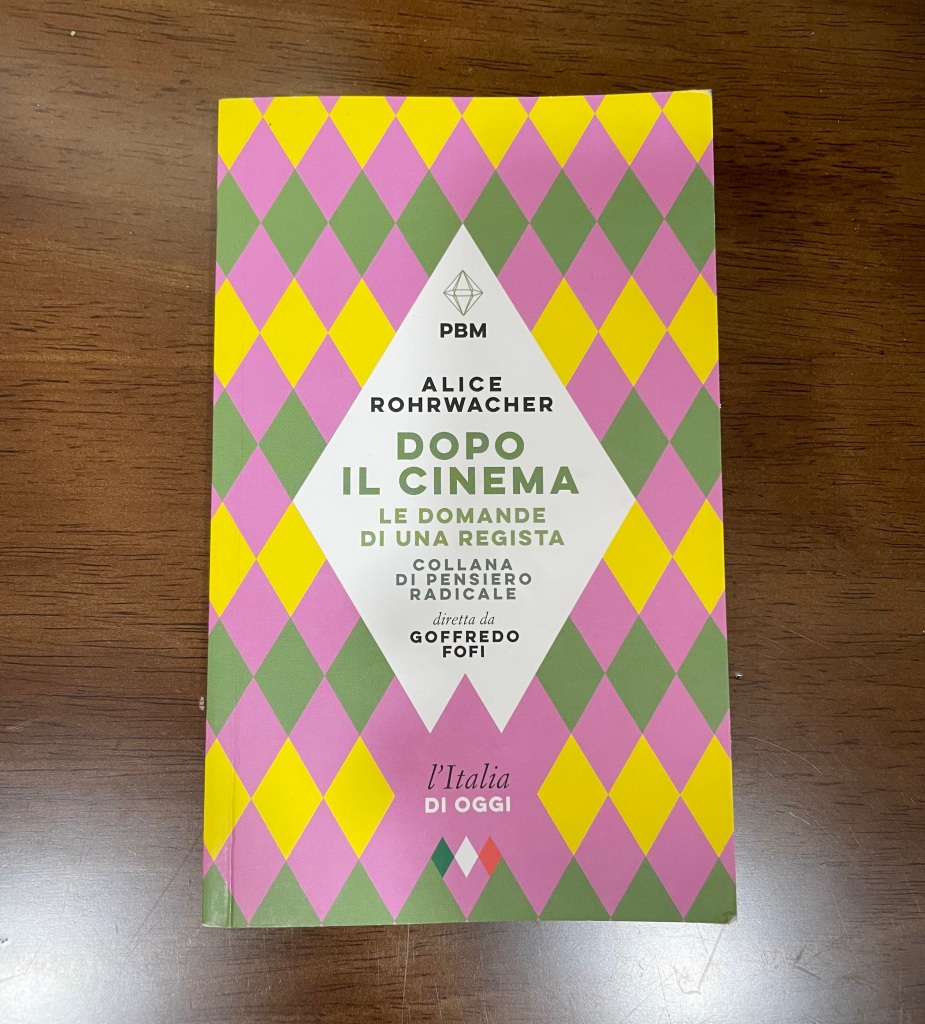
In the the long conversation Dopo il cinema: le domande di una regista (Edizioni e/o, 2023) conducted by Goffredo Fofi, the contemporary Italian filmmaker Alice Rohrwacher offers a series of reflections about the possibilities of artistic creation in the abysmal time of integrated spectacle that has fully brought to bear the erosion of the human capacity for attention and outward experience. Can cinema and film do anything in the wake of such humiliating and crushing reality? At first glance the late modernist critique of the value-driven image seems insufficient and merely rhetorical as the valence of dialectics has been dissolved in the pressure of real subsumption.  In a certain sense,  Dopo il cinema: le domande di una regista (2023) is a reflection written after the ambivalent commitment of cinema to awaken the spectator from the slumber of the absorption in order regime of standardization where the utopia of self-design realizes the objective abstraction in the acceleration of optimized and contained expressiveness. At no moment does Rohrwacher affirm that we are, indeed, “after cinema”, but throughout the dialogue the tone is that of  immediacy in an epoch that seems to be saturated by looping, real-time, and the intensification of life-exposure spectacle. If film is reduced to telling stories, then it falls into vulgarity, while contributing to the gigantic sedative layout that veils the annihilation of social reproduction. In  the last decade, Alice Rohrwacher has done a series of important and highly original films (Le meraviglie, Lazzaro felice, or La chimera) that signal a way out from the numbness of sight, relocating the  moving image to the mythic dialogue with the invisible, the mysterious, and the old craft of the fable narrative. Rohrwacher’s cinema is only magical to the extent that it subtract itself from the historical overindulgence that the autonomous historical man had to endure in its separation from nature.  

Filmmaking is no privilege site of creation, but if Ruíz was right, there are plenty of chamanic energies circumventing the cinematic experience. This is a prehistoric residue that, in her own style, Rohrwacher wants to hold on to. In Dopo il cinema  (2023), she admits that  any attempt to organize a new “political” cinema is out of question, as it was always grounded in the idealism of ‘consciousness’, which is now realized in the self-narcissistic exposition of the free-floating subject of market equivalence. Political cinema could only be arrogant and superfluous pedagogy at the mercy of the furious chatter of “cultural wars”. Is there a higher poverty? And yet this is what appears as ‘necessary ideological critique’ in some circles. In this sense, cinema is not the leading instrument for the work of imagination and Rohrwacher insistence on ‘creation’ drives the point home. Citing Elsa Morante (and perhaps implicitly Cristina Campo) Rohwacher defends the creation as an ongoing effort of a common intelligence to grasp the invisible and allow the eruption of joy in the life of characters. Similar to Robert Bresson who wanted the characters of his films to have an outlook as if they were castaways from the time of the first Adam in the earthly paradise; for Rohrwacher the thicket of creativity for our times is rooted in a contemplative gaze through which the external elements of the world can hone the one and true destiny of the irreducibility of the human species [1]. Rohrwacher’s assertion that she wants creation to establish proximity with the outside – devoid of attachment to religion, political parties, or moral principles –  presupposes a sound critique of all forms of idolatry that have modeled aesthetic production at the service of abstract historical needs (Rohrwacher 33). 

As a creator Alice Rohrwacher’s own point departure is thoroughly subtractive. This means leaving behind the subject of consciousness (the internal and self-sufficient producer of images, which today appears with the empty label of content creator), while opening the cinematic possibilities to the luminosity of a collective imagination in which the contemplation touches, albeit for a moment, the thought of the world (‘pensieri del mundo’) (Rohwacher 36). Obviously, this is no longer an artifice of cinema in its industrial and technological capacities; rather, it is the impersonal general intellect that refuses the integral planning that forecloses the wayward route of imagination, discovery, happiness, and the uncharted land in which the characters and spectators are taken by the seduction of the possibility of events (Rohrwacher 39). Whenever film, like a fairy tale, touches the truth of a not-yet administered world (an inapprehensible excess that resembles prophecy), then visual pedagogy ceases to be a task of cinema; rather, the process of film is one of “ex-ducere, cioè portare fuori, educare” (Rohrwacher 52). And as Cristina Campo understood well, the fairy tale (analogous to cinema for Rohrwacher) has at the center of its making the “raw material of existence…this material is the mystery of character…which maintains its traits to the end, and only be transformed by repeating the same errors, suffering the same defeats. The nature of this mystery is sometimes suggested with enchanting ambiguity” [2]. It is this ambiguity what expresses the caesura between existence and world – their strange noncoincidence – that has colored the experiential texture of Rohrwacher’s poetical cinema. 

The central characters of Rohrwahcer’s films (Lazzaro felice, La chimera) are symbolic personifications of forms of life that are neither alive nor dead; neither mythic nor mundane; neither fictional nor historical determined (each of her films are also landscapes of specific territorial Italian communes); there are both things at once, and they maintain their musical tonality in their own symbolic protuberance, precisely because they cannot be divided and forced into the civilizational narrative at the expense of the exhaustion of the mystery of form (Rohrwacher 63). In fact, Rohrwacher, so attuned to Joseph Roth’s indictment of the Hollywood’s hollow gestalt announced in the The Antichrist (1933), reminds us that the word “devil” (diaballo) implies cut and division; whereas, the symbol, cultivates and renews the mysterious enchanted dimension of the world in which no reified image (any image that could be potentially any other) can hold the human species as hostage in the  cacophonous prison of senselessness. And is not this radical evil – an assumed and distributed morality of the active consumer, who always works “for his own interest” – the most basic unit of the transmission of the image-spectacle from which one has to flee from? The mythic or fairy-tale-like leveling in Rohrwacher is no metaphoric transport; it becomes the cinematic potential to see the world with a clear third eye. 

No easy task of course. Deposing the fictitious machine entails exerting a movement of exodus towards the outside, which Rohrwacher assuredly calls the invisible as that which restitutes the soul of things. The symbol is a passage against the seduction of the pleasure principle of self-enjoyment and parodic personal heroisms. And this is perhaps the most powerful and original testament of Rohrwacher aesthetic sensibility in Dopo il cinema (2023): “Ma nel memento in qui quella cose emanano – direi irradiano – un’anima, subito ne abbiamo più cura, e la cura come abbiamo detto è un atto eversivo. Un’azione poetica” (Rohrwacher 64). And poetry remains not only the dwelling place of human beings; but, fundamentally, the lacuna in a world that refuses to come to completion. Perhaps ‘cinema’ – or, rather, ‘cinema after cinema’ – in Rohrwacher’s view only emerges as a gnostic symbol that prepares the birth of a new earth, as if planting a seed for seasonal germination (Rohrwacher 64). In each character, image, symbol, and gesture, Rohrwacher’s filmmaking plunders into the position of redemption against the cruel reduction of the objective madhouse: restituting the soul in things dignifies the inheritance of terrestrial human species as if it is always coming into presence for the very first time. The eros of cinema becoming an enduring task — and is not ultimately what we feel in each of Rohrwacher’s films? The joyous spirit of the saltimbanca: in and outside the world’s reality, the symbol lives and outlives the fixation of this world.

Notes 

1. Robert Bresson. Bresson on Bresson: Interviews 1943-1983 (nyrb, 2013), 277.

2. Cristina Campo. “On Fairy Tales”, in The Unforgivable (nyrb, 2024), 33.

Elio Vittorini on the time of existence. by Gerardo Muñoz

In Elio Vittorini’s short travel book Sardegna come un’infanzia (1957), entirely composed of painterly vignettes of his visit in the thirties, there is one of them that immediately jumps out at the reader, because it is the only moment where the radiance of the image and the possibilities of thought touch each other without any reservation. It is almost the moment in which the senses of what is felt and seen mysteriously touches a region that is not entirely political, even though it figures as the highest ‘political moment’ in Vittorini’s chronicle.

Vittorini is observing the ordinary lives of the common people in Sardinia when all the sudden he writes the following: “Now, and in spite of everything, those sitting down, almost drowsy and without much to do, are in life. The others in the struggle are not, especially if they fall into consciousness by the struggle and the movement, without understanding any other pleasure than that of the full warehouse. The secret is to struggle for existence, but without being colonized by the struggle’s idealism…in this way, there will be true life in the very roaming path. I have always understood activism for activism’s sake as the business of flies that, once they have taken off, they begin to scratch their head or sharpen their legs” [1]. It is almost as if written the parable of the fly is written for our times, where so many are blinded by the secularization of a Jesuit figure of the militant. The activity of fly, just like that of the political militant, falls into the pretense, thanks to the allure of his self-consciousness, that something moves in spite of its complete paralysis. The fly only moves in the metaphysical abstraction from ideal projection to material outcome and preconceived ends that it knows beforehand. Nothing moves and nothing ever can amount to a discovery or an event. The fly will recurrently miss the world because it has become obsessed by the illusion of its movement, convincing itself that flying over fresh dung is something entirely different.

The political subject is primarily the subject of the accumulated freedom, but it can rarely grasp ‘a way out’, as Peter Red claims in Kafka’s “A Report to an Academy”. Vittorini’s roaming and inert path is the sentiment of true life (“the serene truth of life”, he will say in a few pages later), which is always on the predicated on the possibility of experience against the crust of ideological falsification – even when this process is narrated from the point of view of the proletariat as the motor of the dialectic of history of its self-overcoming to completion. The ‘secret is to struggle for existence’, which entails how to grasp life as utterly outside that can only be shaped by a contact with the world. Perhaps by “sensing” the world without ever becoming its master; rather, what’s involved is a task of a cultivation that must remain singular by virtue of its own irreductibility. 

And in a way, this was Vittorini’s own heterodox understanding of communism where there is according to him there was no “collective building of the soul, but rather the destitution of false differences so that once those regulated differences are abolished, new possibilities of absolute differences can flourish” [2]. This is why Vittorini could not find solace in the political militant or the engaged intellectual, except as figures already acting as smugglers of the planned obsolescence of a civilization overtly defended by those facilitating its own demise [3]. In the landscape of Sardinia – by the most passive of roles, he was merely a theōrós after all – Vittorini unravels the metapolitical blackmail of the epoch in order to conquer the most essential and inapparent: the time of existence in a minuscule world within worlds – and thus, always in a permanent state of infancy – that treasures something immense because it will be forever remain unknowable.

Notes 

1. Elio Vittorini. Sardegna come un’infanzia (Mondadori, 1957), 64.

2. Dionys Mascolo & Edgard Morin. “Une interview d’Elio Vittorini”, Les Lettres françaises, 27 juin 1947: https://entetement.com/une-interview-delio-vittorini/ 

3. Elio Vittorini. “La civilización no es algo que defender” (1937), in Diario en público (Gadir, 2008), 86.

The Etruscan bona lux in Paradiso. by Gerardo Muñoz

In Chapter Ten of Paradiso, José Lezama Lima’s magnus opus, we encounter a curious dialogue between Cemí and Fronesis colored by a fortuitous reference to the Etruscan world, which speaks to the poet’s profane, and at times monstrous form of Catholicism. As it is known, even for an ecclesiastical authority like Tertulian, all Etruscan mythological and iconographical inventions had to be incorporated into the Roman civilizational state in order to wipe out the barbaric fraudsters and con artists soothsayers and liver readers out of date from the new revelation [1]. I have recently written on Lezama’s transfigurative Etruscan theology into his conception of the poetic image, therefore here I will only note how this particular transfiguration is enacted in the very existential outlook of the characters in novel. It seems to me that confirms that for Lezama the Etruscan sensibility was not to be understood solely as a resource of his complex poetics, but rather as an ethical form pertaining to the demonic in life. It is no surprise, then, that this happens in the reiteration of the encounter – the whole of Paradiso as the memorable final lines emphatically show is about recommencement of the unfolding of life – between the two friends: 

Bona lux, como saludaban los etruscos – le dijo Cemí… Ex templo, en seguida entre los romanos. Todo lo que no es en seguida es demoníaco, dice Kierkegaard. La vaciedad de la mañana se había trocado de pronto en la alegría del encuentro. – Vamos en seguida al cafecito de enfrente para hablar un poco – a Fronesis le pareció que la palabra cafecito, dicha por Cemí, bailaba en la mañana” [2]. 

I have not been able to find or corroborate that Etruscans, whose language is still a linguistic mystery, in fact greeted each other with something slightly similar to ‘bona lux’ as Lezama makes Cemí say. And it is still strange to think of Etruscans in relation to light and the morning phase of the day. What could it mean in this context where a minimal theory of the encounter is sketched (‘the encounter had brought happiness to the emptiness of the morning’) that Lezama explicitly identified the alleged mysterious Etruscans with a “good” light or illumination that is self-transformative? Lezama could have known the work of pioneer English archeologist George Denis, whose Cities and Cemeteries of Etruria (1848) reminds us how even in the tomb underworld of the Etruscans, there were always banquets decorated by lamp lights, erecting a threshold between the noche oscura of the infraworld of the dead, and the colorful landscape of the living image merging without reminder thanks to the bona lux of the encounter [3]. Is this it, then, a folded communion between the interiority of the dead and the exteriority world of the living? Obviously, nothing could more alien from Lezama’s intricate poetic world than a direct metaphoric restitution of the Etruscan world fixed in the autonomy of modern poetry, which will amount to a desperate attempt to deify language through a ‘spiritual drama’ as the conquering of self-absorptive verbal immediacy (it is in fact “en seguida” of the presentist time of response). 

As Lezama had written in the gloss “Conocimiento de salvación” (1939): “Todos los grandes intentos poéticos contemporáneos, desde la poesía pura hasta el surrealismo, no son otra cosa que un esfuerzo desesperado por prolongar la percepción de temporalidad rapidísima, o trocar el estado sensible – ocupado según Schiller en mantener al hombre en los límites del tiempo – en ajustada percepción” [4]. But what is suspended here is the possibility that living poetically and sensibly – the dwelling of a serene life encountering in company of others, that is, in concordia – validates the attunement of life with its demon. And this was at the heart of Lezama’s perception of the Etruscan everlasting mystery: not simply what remains foreclosed in the arcanii of the infraworld, but the liberation of human potentiality through the grasping of its prophetic images: “Los etruscos ofrecían una palabra misteriosa, el potens, si es posible, a esto se añade el hoc age, házlo, es decir si es posible hazlo. El potens por la imagen hace posible la sobrenaturaleza” [5]. The potens stands in as the name for the incommensurable distance of living among things (theín). Hence, the only common good resides between things, and not in a substantive higher source.

In a thorough rejection of the supreme moral order proper to rationalist natural law, Lezama will take the enlightened pictorial sense of the Etruscans as the realm of possibilities that can organize life in the  presence of what it has discovered: “un splendor formae…las imágenes como interposiciones de la distancia entre las cosas…ya no su enemistad, sino una llaneza de inmediato” [6]. The enlightened form produced by the encounter realizes a state of happiness that, thanks to the free use of language – the spoken word as the greeting voice in this case – it enacts a dance beyond sense becomes moving. This is why it is through the unknowable charitas of language that human beings become equals to the momentary gods of things in the world. Or at least puts them in proximity. One can believe that is the occasion for the gleaming abundance of  bona lux – the mystery where something finally begins. 

Notes 

1. Lucy Shipley. The Etruscans (Reaktion Books, 2023), 163.

2. José Lezama Lima. Paradiso (Ediciones Cátedra, 1980), 478.

3. George Denis. The Cities and Cemeteries of Etruria (John Murray Street, 1848), 37.

4. José Lezama Lima. “Conocimiento de salvación”, in Analectra del reloj (Origenes, 1953), 251-252.

5. José Lezama Lima. “Apuntes para una conferencia sobre Paradiso”, en Paradiso (ALLCA XX, 1996), 712.

6. José Lezama Lima. “Las imágenes posibles”, in Analectra del reloj (Origenes, 1953), 179.

After plasticity: on Heretical Aesthetics: Pasolini on painting (2023). by Gerardo Muñoz

Pasolini never ceased reflecting upon the painterly nature of the image outside of both literalness and abstraction. In Pasolini we are accustomed to be exposed to a set of antinomies: image and depiction, tradition and the primordial, figuration and the tactile, the world and its fragments. The publication of his miscellaneous writings on painting (and painters of the Italy of the 1950s-1960s) Heretical Aesthetics: Pasolini on painting (Verso, 2023), edited by Ara Merjian and Alessandro Giammei, provides depth and substance to document Pasolini’s insistence to the pictorial activity as an index of unmediated expressivity against the domestication of the accelerated capitalist form that soon enough will generate devastating consequences for idiomaticity and the pregramatical expression of a living culture. It is not too far-fetched to claim that painting remained for him a necessary condition of the cinematic; a specific craft that fundamentally rejected the impulse to naturalness and its mimetic performance. Pasolini remains attached to painting as a form of embodiment, a corporeal resource, and an energetic surface of positioning of light.

After all, as the editors of the book remind us at the outset, Pasolini was after the “plasticity of the image” (37). And plasticity pushes the dexterity of human creativity, but it is something else as well: it is a line of expansion into the prehistoric when it comes to the frontier of appearance. And perhaps Pasolini would have agreed with Gianni Carchia’s indictment in Il mito in pittura (1987) that the attempt of realizing appearance – even at the cost of failing at it – is the fundamental metaphysical node in which the entire history of Western painting stands. A good painting elevates itself to supreme theology, as Luca Giordano said of Velázquez. The problem of appearance in Pasolini’s scene of writing on painting is registered through partial indications: the tone of detailism, the violent and free moving impressionism, the struggle for stylistic contamination, or in the “fragmentary chromatic and interrupted aesthetic” (114). Pasolini’s eye is always accessible to the transient and expressive in a picture.

But the Italian filmmaker struggles with description of paintings, as if possessed by a permanent impatience that harbors his recurrent shortcomings. And he was not unaware: “I am not fluent in the terminology of painting, so forgive me if I sound less specific” (134). It is a declaration that does not only appear once in this collection. One could speculate that this dilemma is resolved by Pasolini in three ways: first, he can choose the painters from a personal criteria that would justify his awareness of painting as a prehistoric cultural activity. Secondly, Pasolini repeatedly alludes to the teaching of the great Italian art historian Roberto Longhi – who was responsible for the first formal analysis of Piero de la Francesca’s pictorial oeuvre – as companion and a maestro that during the Fascist interwar period gifted his students (and Pasolini among them) a different reality through commentaries on the seminal works of Italian Renaissance painting (155). Longhi’s anti-iconographical approach to the pictorial tradition allowed Pasolini a sense touch – not less real than the physical hand that caresses another body or hard surface – and the inexorable mystery-like quality of plasticity. Thirdly, Pasolini avoids coming near a possible ontological description of what, in fact, painting as such stands for him. Does it have an autonomous specificity, or an internal grammar, or perhaps an intricate dependence on other artistic activities (poetry, cinema, social criticism, politics)? Pasolini wanted to understand painting as a force of absorption even if ultimately blinding to the spectator. Nonetheless, Pasolini’s commentaries is rigid at the abyss between what painting is (or should be) and the painters or pictures that he explores in these pages.

This abyssal between word and depiction vouches for Pasolini’s unresolved tension with the nature of painting; a picture is always already dependent or attached to a peripheral phenomena that moves beyond the modern vista’s fulfillment towards totality. In fact, there are a few moments where painting is qualified, as in the text on Carlo Levi: “We are in the presence of something mysterious, ineffable. To speak about that something I can only fumble in the dark, since O a, without a proper terminology…but this ‘something’ is a mystery to me” (176). Or, when in the fragment “Dialectal painting” he suggests that “ [the dialectal tone] is not for the objective content of its figure sand landscapes, but also for the tone he uses to represent it (a tonalism drawn, we could say, from a crepuscular post-impressionism)” (81). Both fragments – so distant from each other in time; one from the fifties and the one on Levi from the seventies – provide an approximate orientation of Pasoloni’s fixation of painting in its specific muteness. This is not because it lacks language, but rather because it only speaks in its own dialect. A painted picture is always about resolving a situated uncanny appearance.

And for Pasolini only the partial profile of a picture – its superficial depth and strength of figuration, but also its lack of sentimentality and abandonment of lyricism that he would come to associate with the bourgeoisie worldview – was capable of dialectical valance, thus upending its misstep into the vulgarity of the “equality predestined and predetermined…the representation of such a world excludes the very possibility of dialectics” (186). This was his indictment of Warhol’s homogenous silkscreen prints and the general phenomenon of Pop Art and the neovvanguardias as coordinated efforts to surpass all that was past and present collapsing into “the voice of the homo technologicus…replacing history with a surreptitious and sacral prediction of history” (147). Bernard Berenson would have agreed to this: the inception of ‘knowing’ over seeing will only secure further mimetic and mystified (through mechanized and applied models in advance) points of departure for a subject of consciousness directed towards history. This is why for Pasolini the avant-garde can only “make the definition of that moment zero [of absolute beginning] profoundly insincere” (149). Painting and tradition walk along the abyss of nihilism. Only negatively can we say that for Pasolini painting is, then, an earthly activity; it is about being in the world in spite of the state of the world; attached to seeing even if the blurred limits perturb the open horizon.

The allure of a lagging postmodern and mechanized painting – but isn’t’ the eclipse of painting for the epoch as such? – for Pasolini exchanges, rather too quickly, lyricism (dependent on the romantic subject that attains it) for nuanced poetic sayability. After all, one of the most straightforward assumptions entertained by Pasolini is that “a painter is a poet who is never forced by circumstances to write in prose…” (106). A remark that comes very close to Poussin’s assertion that painting is an endeavor about the mute nature of things. The muteness of painting has granted artists the possibility to evoke the picture from poetry, as if word and image by entering into proximity can finally participate, side by side, into the mystery of appearance withdrawing from the “adumbrations of our present image-world”, as T.J. Clark recognizes it. There is something to be said in this respect about Pasolini’s long poem “Picasso” (1953) where the medium of poetry touches Picasso’s canvas only to flee from its empty abstraction, disclosing the cunning negation of the world. Or to use a trope common to Clark’s art criticism: Picasso’s fall of Icarus lacks any possible awakening in the present.


Pasolini’s last verse of the poem expresses what for him painting should avoid: “Sunday air…and his error is here [Picasso’s], in this absence. / The exit to / eternity lines not in this desired and premature love. Salvation is to be sought by staying in hell, with a marmoreal will to understand it. A society fated to lose its way is always bound to lose it: a person, never” (75-76). For him painting and Paradise are not meant to cohabitation – which bears witness to Pasolini’s long lasting commitment to the fallen modern world ascertained by the promethean durable struggle. Painting is poetically affirmed by retaining to what does not come to pass: the convulsions of this world. But a question remains: should not the distance implicated in seeing be sufficient in a fading world? Traversing this distance is the inherent divine task of painting; or, as Pasolini simply called it: “exquisite, mysterious – a new religion of things”.

Under a single statement: on Christopher Neve’s Immortal Thoughts: Late Style (2023). by Gerardo Muñoz

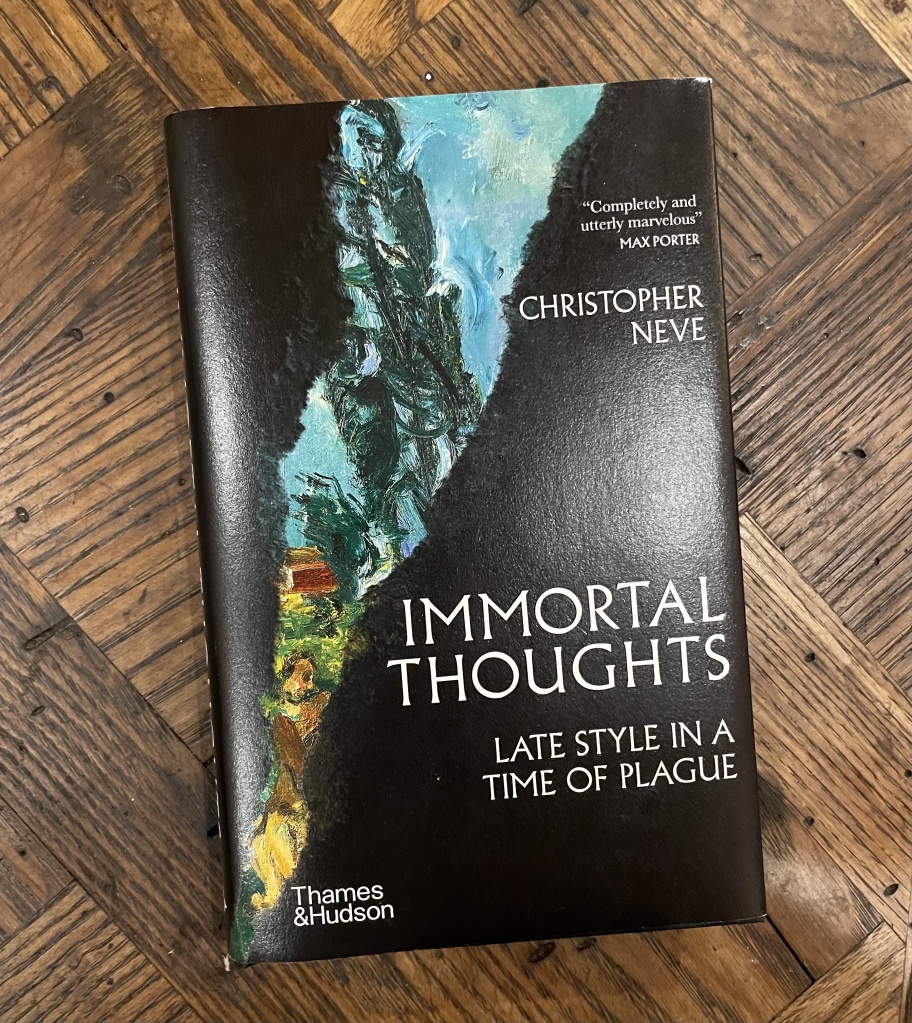
In his Immortal Thoughts: Late Style in a Time of Plague (Thames & Hudson, 2023), Christopher Neve ponders whether there is something like an “experience” of late style in painting. He immediately sets up himself to the task in the last works of great modern masters, from Cézanne to Soutine. The notion of “late style” can only be raised at the definitive end of the artist’s path. The old age style is an aspotilla no longer dependent on approval and excellence; it favors inner capacity and dexterity of seeing. This is why late style is, probably, always self-transformative: it poses the notion of work under erasure as it comes near the zenith of retraction. For Adorno late style registers the failure of synthesis as well as the force of dissociation in the permanence of the catastrophic. Neve will perhaps agree this much: painting is not about fixing temporality (the density of the history, the vulgarity of the contemporary, the monumentality of the past); rather what remains is the fugitive scene of depiction. If the question of “late style” is immensely difficult to raise, that is because it resists conceptualization: it merely seeks to denote achievement and the ruinous; appearance and retreat; unlearning schematics and producing “from life” itself, to put it with Poussin’s pictorial vocabulary. Late style is not about the moment of judgement and recapitulation – it is what depiction can achieve in the twilight of creative powers. As Goethe once defined old age: “Old age is gradual retreat from appearance”. But this retreat animates the space that had remained secluded in the order of temporal abstraction.

There is no theory (and there will never be) of late style of pictorial representation. It is a question that merits the weight of description – which Neve combines, quite successfully, with that of emblematic instances of the artists’ form of life. In other words, late style does not require conceptual renditions; it demands the elaboration of strong descriptions that can grasp the resonance of a fundamental ethos. Neve glosses Delacroix’s ethical imperative: ‘only in old age does a painter finally know what sort of artist he should have been all along’. In late style there is coming to conclusion because there is a path for homecoming. This ethical dimension of the artist is neither regulated by form nor by epistemological conditions. Late style implies a stripping away of things; it bares a specific nudity: it can reveal interiority (the invariant) without argumentative absorption. If anything else, it is the non-knowledge of the gesturing hand. Neve points calls this “statement” when offering a treatment of Rembrandt’s old age: “…technique and the process of getting older, and that this was somehow done all in one, summed up and expressed undeniable and in confidence of one blow and as a single statement. And I wished that all painting could be like this” (46). We suppose Neve’s desire as hyperbolic, since painting under a single statement also implies the moment when the picture approaches the abyss between the hand and the order of reality.

Painting gravitates towards a single statement when it surpasses life by taking death seriously. There is much truth in reminding that the work of art aspires to its bare lyrical moment of decline and unworking of itself – this was also Cézanne’s moment of “not being able to realize!”- in order to flee from the objective fixation of the “thisness of nature”. Painting assembles a transfigurative force against the temporal succession of the pro-duction of a specific work on a surface. As expressed by the old Pisarro from the window of his studio quoted by Neve: “A little more work before dying” (54). True, nothing else but painting mattered to Pisarro, as Neve reminds us. Now, does this mean that he is holding on to the unchanged and muted essence of things as a “metaphysical solace” in the face of the whirling of a world in chaos? Perhaps there is something to this suspicion that must be reckoned with – painting comes close to theological presuppositions insofar as creation unsettles a disenchanted world and its fictitious mimesis. Alas, this is a question not fully posed by Neve, but it is also one of the ways in which his book could travel without much effort. The question of immortality of a picture has a point of departure here. But is immortality conceivable as a form of solace and fallen piety? One should refuse to ask this question in the form of generality. The works Titian, Goya, Cézanne, the dreary and posthumous glory of Velázquez or the suffering Soutine during the Nazi occupation are all efforts to pose the problem of late style painting as the ethical attunement of each artist.

In the most elevated and charged moment of Neve’s efforts to grapple with the notion of style he recurs to Soutine (and it requires us to turn to the picture “Children playing at Champigny” from 1942): “What you are seeing, when Soutine paints the Auxerre trees, is what I think happens in the work of most of the artists I haven written about here. This storm of temperament is true painting, an inexplicable combination of seeing, feeling, memory, response, imagination, and profound oddness. And so he turns away in exhaustion” (122). Late style registers the collapse of a possible fulfillment with the world by indexing a detour to the point where realization seeks to “return to simplicity and order”. Truth indicates the literal thereness on the surface devoid of illusions. So, solace does not have the last word; this is not how a painting subsists under a single statement. And that accounts for the ultimate risk: the ethical presupposition of painting exposes the artist to the “terrible freedom” as the distance between the passions (temperament) and the gesture within profound disorder and arbitrariness of nature.


Someone like Carlo Levi will find himself at home: true freedom cannot begin by the suppression of the passions in the name of interests; rather, the burden of freedom is the caesura of passions that displaces the otherwise inexorable fear of civilizational progress. Painting as the event of truth dethrones fear as the primary attunement in reality. Through our emperament one finds the exit from alienation, gathering the moment of depiction into order. There is a gentleness of freedom in the mutual self-supporting carrying of things, as Kurt Badt saw in Cézanne’s old style. And this might be the tragic element of painting and its fundamental antinomy.

For Neve this means nothing shorter than “the world reduced to a series of prodigious impulses, the revelation of the inner intact, the change taken to see the universe in a new light at the risk of failing utterly” (130). Late style is what reveals inner intact to the fruition of exteriority – this is the compass of visibility. A failed world followed by decline – two terms where mythic transfiguration moves painting to the eccentric luminosity of altering the jarring relation with the world. Old style enacts a catastrophe that refuses the insolvency of pulsation that binds character to the harmony of form. One might add that it could very well be that painting is, as revealed in the abyssal caesura of a late style, a stated mystery: a passionate life that profoundly perturbs the world, a transcendence that falls into an irrevocable eternity.

Bonnard (1910): painting and dissonance. by Gerardo Muñoz


Here is a little masterpiece by Pierre Bonnard at the Phillips Collection, “Interior with boy” (1910). Its simplicity does not shy away from the fact that it is a picture struggling with the problem of sensation as the highest task of painting. Bonnard is most definitely working on the threshold of Pissarro for whom the supreme mystery of a picture at the turn of the century is the act of wrestling with sensation as the world is coming to an eclipse. Or, to put it in a straightforward manner: departing from the objectivized world. If there is anything at the outset of the first decade of the twentieth century – from the stretch of 1890s to the 1910s – is the vibrant undertone of a conscious sense of what experience has become in the world. Painting, it would seem, takes up the challenge of this seeming aspect of life among things.

For Bonnard this means disclosing what appears for the first time: “to show what one sees when one enters a room all of a sudden”. And this is what “Interior with boy”(1910)  is showing us: peeking into a room with a boy sitting at a table quietly reading or going through something. The object is dissolved. We are not sure what the boy is doing. But, does it matter? The painting works around this silent vortex (although silent might not be the exact word). The figure does emphatically grows out the different color blocks of the interior (there is a solid black line that makes his body stand out). The effort of painting is achieving the seemingly weightless there-ness of the figure, blending itself to its surround, and gathering a strong sense of its appearance. 

As Bonnard would tell Matisse years later: “I see things differently every day, the sky, objects, everything changes continually; you can drown in it. But that is what brings life” [1]. For Bonnard it is not that painting gifts the events of the world with life; rather it brings the event of life away from the drowsiness of the temporal organization of its own elements. Painting is not disorganized for the sake of disorganization; it organizes life around its unmitigated appearance where form does not have the last word. Hence the insufficiency of the question “What is the boy really doing?”. The attempt to define it would ruin the experience of the painting – the subtle but well placed magenta hue connects a fragment of the back door with the boy’s downwards face, and finally to the left corner of the table. In a superficial sense the magenta is a schism of light coming through the picture, but it is also a diagonal that registers the dissonance of the painting, and thus, its ultimate mystery. Can painting integrate dissonance? The early Lúkacs seem to have thought against it. This is what he had to say in Soul and Form (1910): 

“In painting there cannot be dissonance— it would destroy the form of painting, whose realm lies beyond all categories of the temporal process; in painting, dissonance has to be resolved, as it were, ante rem, it has to form an indissoluble unity with its resolution. But a true resolution— one that was truly realized— would be condemned to remain an unresolved dissonance in all eternity; it would make the work incomplete and thrust it back into vulgar life.” [2].

But does painting need to find a resolution to dissonance, or is it quite the contrary? Bonnard’s search for the ante rem is not the sensorial apprehension to this dilemma; it is what refuses recoiling to “vulgar life”. But the passage from Soul and Form (1910) allows me to claim that the vulgarity of life begins when things start to tip towards the end of appearance; that is, when the soul disappears and the only thing remaining is the aggregation of allocated forms for sake of ‘originality’. If anything is achieved, then, in Bonnard’s “Interior with boy” (1910) is that it folds the question of dissonance to the task of painting while acknowledging that the taking place of life is always unattainable; as invisible as the boy’s inscrutable undertaking can be.

.

.

Notes 

1. Bonnard/Matisse Letters Between Friends: 1925-1946 (H.N. Abrams, 2007), 62.
2. Gyorgy Lukács. “Longing and Form”, in Soul and Form (Columbia University Press, 2010), 123.

Persuasion of the surround: a reply to Andrés Gordillo. by Gerardo Muñoz

The friend Andrés Gordillo has generously sustained an ongoing conversation in light of the talk delivered in Mexico on institution and immanence (a first reaction could be read here). In a recent note he brings many elements to the table, and his versatile writing makes it difficult – alas, this is a wish come true for any reader – to locate an univocal point of entry. This is perhaps because there is none. Andrés wants to keep us at the edge, and so he enacts the set up: there is communication, and because communication is the event of language, there is still the possibility of mystery. Many things already pop up here, but this might be doing injustice to Andrés’ elaborate draft. So, for the sake of the exchange, let me open the route by running through a moment that impacted my first reading. It is this moment: “El desencuentro que aviva la amistad de ambos personajes [Narcissus and Goldmund] es el de haber decidido resguardarse en la exterioridad de sus elecciones, ahí donde son obra del amor”.

This is a condensation of what the Hesse’s novel means to him; or, rather, how it speaks to him in light of a discussion regarding the dominance of the civil principle, and the question of an experiential dimension that we defined provokingly as a minor transcendence. I am not sure I am in the position to unpack Andrés’ thesis, if it is a thesis at all. I do remember a couple of years ago an exchange with Alberto Moreiras on the logic of the encounter and the misencounter related, precisely, to the problem of the eclipse of experience. This is the problem that keeps soliciting thought; it is the problem of thought itself.

However, I am getting ahead of myself. Andrés stages a complex framing: there is friendship as absolute difference (or in virtue of a fundamental misencounter), and then there is an exteriority of their existential decisions; that is, in the manner that they are irreductible to their being in the world. I spoke of framing purposely, since I find myself these days with Pablo Picasso’s “The Blue Room” (1901) from the early period that I encountered in Washington DC. It is a rather small picture – and to the viewer, the semi-statue like nude, a female figure it seems, comes to the forefront sliding downwards. A mysterious resonance dilates between things – and indeed, the objects in the room (the sheets, the rug, the bouquet of flowers, the paintings, the half-open window) feel like things. This is an intimate surround at the threshold of catastrophe, where things could be lost at any moment. And we know that epochally they soon were.

We are in a strange setting – and if it is strange to us it is because there is a sense to which alienation and solitude here is the fundamental harmony of dwelling. This is not yet the assumption into plain and continuous historical time that will amass things into objects. The “Blue Room” (1901) inscribes esoterically the thematics of pain – it is a work in which Picasso responds to his friend Carles Casagemas’ suicide that very same year. No metaphorical or allegorical reading will do the job to put us in “The Blue Room”. In the wake of an elliptical death, pain stands in, like the nude the water basin, as the irreductible to history and the menacing social sphere. I will bounce this to another moment of Andrés’ text: “Por ahora me siento inclinado a conversar: avanzar hacia un umbral que se desploma”. This ‘crumbling threshold’ now appears to me as a sound and prudent description of what “The Blue Room” (1901) was able to achieve. An experiential awakening against the conflagration of modern historical time: soon enough – and boy was it soon – the interior space of “The Blue Room” will multiply into infinite cells of the planetary designs in which social man will be just a potential inmate. This is why Picasso in 1901 speaks still today a strange language for us – it discloses a surround, an exteriority that we have been deprived of. It is a surround that is fully folded within.


If pictorial practice is not mere representation, but also, more fundamentally, a form of thought, then we can claim that “The Blue Room” (1901) attests to the proximity of the misencounter of friendship that outlives in the experience of the surround. And here the painter had no privileged position – he is no figure of genius, no commander of historical destiny, no magician of forms. He is also a befallen figure because he is the cipher of life. But to overcome the rhetorical surplus of socialization requires techniques in the face of the irruption of pain. Nothing less solicited Carlo Michaelsteadter when criticizing the reduction of the “man of society” to the pieties in “exchange for the tiny learned task and his submission, the security of all that human ingenuity has accumulated in society, what he would not otherwise obtain except by individual superiority, the potency of persuasion”, he wrote in Persuasione e la rettorica, another masterpiece of the 1900s. Yet, persuasion requires to be vigilant at the moment where things enter the historical penumbra and its rhetorical artifice; the reign of endless confusion amidst the most transparent and disingenuous computations.

How one becomes persuaded within a tonality, and remaining to be so – this is also a surrounding mystery of “The Blue Room” at the outset of the century. We still dwell in its dissonance.

The political elite and the dead. by Gerardo Muñoz


Over the weekend, the Catalan journalist Enric Juliana interviewed Ramón Tamames, former member of the Spanish Communist Party (PCE) who embodies the living memory of the 1978 transition to democracy. Nowadays he is the main protagonist of the motion of confidence against the government coalition raised by the nationalist right-wing party Vox. There is no surprise (at least for those of us that follow closely the idas y venidas of Spanish politics) that a former member of the Communist Party makes amends with with the neo-sovereignist right. Even the Medieval jurist Bártolo de Sassoferrato centuries ago diagnosed that an epoch void of political authority, leads to a ‘monstrous form’ of arbitrary governance. This is not the place to analyze the cartoonish Vox-Tamames’ alliance. Rather, what generated a chilling effect while reading Juliana’s exchange was the moment when he asked about what he would have said to the communist prisoners in the Burgos correctional facilities in the aftermath of the Spanish Civil War. And, to this Tamames responded: “Están todos muertos”. They are all dead. It is a monstrous phrase voiced by a hyperbolic figure of the Spanish political elite. The answer is bold and lacerant because the message is stated without formal investidures or pathos: the dead are dead, and we own them nothing, since they are nothing. They are less than nothing.

It is no minor feature that historical communist parties during the twentieth century, in spite of the public and rhetorical monumentalization of their ‘heroic pantheon’, had little patience with the dead. This is why a motto in some socialist countries was, indeed, “los hombres mueren pero el Partido es Inmortal” (men died, but the Party is Immortal). So, by organizing immortality and the relation to the dead around the Party, historical communism was able to solve two problems at some: it was able to justify sacrifice in the name of a transcendent cause; and, at the same time, it introduced the dead corpse in Party as a government that kept operating even well beyond people had ceased to believe in it. I mention this because as a historical communist, Ramón Tamames is still embedded in this metaphysical enframing, only that now it takes different garments through a full erase of the dead that a posteriori justifies a concrete political action. 

I have underlined a few times already the fact that Tamames is a trained political elite, because his alignment with Vox is rooted in his alleged elite credentials. This is an important feature. I remember a few years ago that Mario Tronti told me, in a Weberian spirit, that a new epochal transformation of Western politics required the elaboration of an elite in possession of vocation and conviction. But this is, paradoxically, what Tamames has always stood for, regardless of his political commitments. The problem is that today the restitution of political elitism is not only insufficient, but it is also visibly catastrophic and opportunist. It is opportunist because it can only self-affirm itself as a supreme value in the world of the living, which necessarily entails killing, once again, the dead. Under this light one should reconsider what Carl Schmitt enigmatically writes in his Glossarium: “elite is that category which no one dares to write a sociology about” [1]. It seems, however, that the contrary is true: sociology is the predominant form of political elite, since its final aim is the reproduction of material social relations at the expense of the dead. As administrators of the public life of the city, the political elite must hide the cemeteries and the world of the dead away from the arcana of its public powers (this is very visible in Washington DC or Madrid). This void demands a  relation with the dead as a fictitious memory based on public memory, monumentalization, infinite naming, and cultural commodification in exchange for foreclosing the relation with the dead. This also explains why the epoch of high-secularization is fascinated with the investment of public memory and practices of memorialization which maintain the equilibrium and endurance of the society of the living against the dead. 

And isn’t Tamames’ depreciation of the dead just an expression of the attitude present during the high peak of the epidemic across Western metropolises? The corpses amassed in registrator hums outside hospitals in New York was a monstrous spectacle that bore witness to the disconnect between the living and the dead in the triumphant epoch of absolute immanence. What is important here, it seems to me, is that one cannot but expect this from a “political elite”; that is, a denegritation and blockage from a contact with the dead that is neither in the home nor in the city, but in the khora or the extra muros. Whenever this has been achieved, the political consequence has been, precisely, punitive acceleration, social death or expulsion. 

In a beautiful text written during the height of the epidemic controls, Monica Ferrando reminded us that the socratic philosophical ethos was not rooted in the space of the city, but rather in relation to the underworld that grants “freedom every time” [2]. In times gone awry, nothing is more urgent than to do away with the gatekeepers that keep society a total space of inmates, while making the whirling presence of the dead a silent echochamber between cemeteries, as a friend likes to put it. In a certain way, we are already dead, and it is only the fiction of political elitism (or the permanence of those that appeal to the “political elite”) that taxes death – and our dead – to the sensible modes that we relate with the mysterious and the unfathomable.

.

.

Notes 

1. Carl Schmitt. Glossarium: Anotaciones desde 1947 hasta 1958 (El Paseo Editorial, 2021), 351.

2. Monica Ferrando. “Terra Giustissima: sulle tracce dei morti”, Laboratorio Archeologia Filosofica, February, 2021: https://www.archeologiafilosofica.it/terra-giustissima-sulle-tracce-dei-morti/ 

Sundays outside history: some observations on Eliseo Diego’s La Calzada de Jesús del Monte (1949). by Gerardo Muñoz

The origin of Eliseo Diego’s mythical poetic collection En la Calzada de Jesús del Monte (1949) is so well known and recorded that it has been completely forgotten even by its most copious commentators. In his short memoralist essay “Un día ceremonial”, written decades after the publication of the poem, José Lezama Lima wrote the following: “En uno de sus ceremoniales litúrgicos, en un día de nuestro santo, nos reunimos en la iglesia de Bauta. En esa ocasión Eliseo Diego leyó su “Primer discurso” de En la Calzada de Jesús del Monte. Era un precioso y sorprendente regalo, suficientemente para llenar la tarde con aquella palabra que nace para uno de los más opulentamente sobrios destinos poéticos que hemos tenido…Cuando se publicó En la calzada de Jesús del Monte, el júbilo que me produjo fue esencialmente poético. En unos versos de circunstancia amistosa he intentado decir la alegría que me produce ese libro que traía esclarecimientos para nuestro paisaje y su acercamiento” [1]. At the center in this confession is not only the centrality of a poetic liturgical practice that vested the friendship of the origenistas poets, but more fundamentally the efficacy of the poetic word that Lezama describes as a “júbilo poético” or poetic happiness. It is a strange remark (like almost everything written by Lezama), since En la calzada de Jesús del Monte has been largely read as the litany of a domestic space (a “gran casa de todos”) consumed by dread experienced at the turn of the mid-century failed and stagnated republic.

The intuition raised by Lezama, although not elaborated, still haunts us: in what sense is En la calzada de Jesus del Monte about poetic happiness and what could stand for? We can go astray if we claim that happiness is a particular substantive and representational content of the poetic word. Indeed, there is really no event of happiness in En la calzada de Jesus del Monte except for the taking place of the poetic word fully estranged and foreign from its own place of annunciation. This seems to confirm Diego’s poetic vortex who writes in the dedicación of the book: “A poem is nothing more than a few words told one afternoon to a group of friends” [2]. However, this only deepens the mystery, since whoever tries to find concrete friends in En la calzada de Jesús del Monte (1949) will find none. Solitude abounds and expands throughout spaces. Lezama attempted to elevate the secret of friendship from thought to the liturgical enactment in search for transcendent meaning. Indeed, the emphasis on the mystery of liturgy is emphatic and compressed in Lezama’s programmatic memory about the almost ecclesiastical origins of the poem. I would like to suggest another path for the mysterious and inapparent force of the poem, which is no longer situated at the liturgical aesthetic experience, but rather in the mystery of a felicitous life at the threshold of history. If anything is disclosed throughout the pages of En la calzada de Jesús del Monte this is, precisely, that things appear to dwell in their place, even if no one is around and no community could stand for its reverence. Indeed, the poetic event dwells in an existential solitude before a changing world now fallen into pure disenchantment.

The happiness that falls from the poem, then, is not merely about the execution of the word or the unity of form, but it consists of something previous, altogether different: a mysterious shadow of the enchanted myth. In En la calzada de Jesús del Monte (1949) we are exposed to a poetic language that gathers in a desecularized dimension that suspends what Gianni Carchia identified as the postmythical form of mystery that seems to anticipate the semblance of historical order [3]. But Diego’s En la calzada de Jesús del Monte transfigures mystery to the point of disclosing the limit where life and redemption from the material world take place; namely, in the Sunday of life. But, unlike for Carchia, this poetic transfiguration takes place within the grammar of Christian theology and not the Greek classical past. Here Diego’s poetic mysterium differs fundamentally from the liturgical mystery, which presupposes a “fundamental sacrifice” that allows the temporal sequence of the end of time as the motor for universal religious redemption [4]. By contrast, Diego’s idea of a poetic mystery (which is also the mystery of the poem, which he never ceased to reflect upon through his life) is spatially dispersed, redeeming eternal life from the visibility of worldly phenomena. As Diego writes in an essay defining his conception of the theological mystery: “Primero les haré una confesión…no veo por la sala ningún hábito de Santo Domingo. Uno no debe jugar con los Misterios Mayores, y ninguno es mayor que el Misterio de los Tres que son Uno. Pero, ¿acaso no hizo Él a las ballenas y a los colibríes? ¿Acaso él no sonríe con la infinitud de sus peces y sus insectos? No creo que me tome a mal esta broma que hago como un niño pequeño que pretende jugar con su padre” [5].

By separating the “mayor mystery” of the Trinity from the minor mysteries of imaginative creations of the world (fables, poetry, child’s play), Diego was able to displace the grandiose stage of the liturgical mystery emphasizing the role that humor plays in the affective realization of the kingdom. In other words, it is most definitely the case that the mystery and the poetic musicality compose the parabolic nature of a transfigured kingdom that accompanies the inner existence of each and every human being [6]. Furthermore, this is why the Calzada is a defined in “Primer Discurso” as a pantheistic kingdom: “mi reino, en esta isla pequeña rodeada de Dios por todas partes / en ti ciego mis descanso” [7]. The happiness of the poetic effect in En la calzada de Jesús del Monte is the consummation of an eternal life that, by withdrawing itself from the representation of historical time, can outlive both dread and death. However, in its call for “eternity”, it is language itself that becomes a mode within a series of uncountable events: “sigo pensando, aquí, mi amigo, sucediéndome. / Luego de la primera muerte, señores, las imágenes … .Porque soy reciente, de ayer mismo” [8]. The “sigo sucediéndome”, a modal attempt at transforming life through event diffuses life and death like “Abel y Cain reunidos en Adán, como la muerte” [9]. The transfiguration of liturgical mystery does not evoke a christological arcana, but the overcoming of the civilizational myth of fratricide only to find “unity” in the eternal paradise evoked through Adam. As Diego will also write in an essay about the work of British novelist Jean Rhys: “…el sentido de orar para convertirse en símbolo del misterio de vivir: nuestro jardín era grande y hermoso como aquel jardín de la Biblia – el árbol de la vida crecía allí, nos dice, en medio del terror de una violencia que no entiende” [10]. The reemergence of the myth of an enchanted Edenic garden through the poem?

The fact that Diego chose to write En la calzada de Jesús del Monte as a series of poems and not a novel speaks to his resistance to metaphorize the Garden of Eden outside of the world, overly compensated through a figural postmythical semblance that could have only been taken as a form of parody. On the contrary, En la calzada de Jesús del Monte evokes the original paradise as a recurring and parabolic Sunday of life. A life of nothingness: “si la nada / es también el dormir, pesadamente / la caída sin voz entre la sombra… el Paraíso / realizado en la tierra, como un nombre!” [11]. What cuts through between the forms of the world is the poetic parabola that put us in nearness to the limit of the mystery and the unspeakable. This is what poet Fina García Marruz beautifully captured in one of the most outstanding essays on En la calzada de Jesus del Monte where the weight of the question is meshed with the eros of the poem’s parabola: “Todo arte es, o debería ser, arte de amor, qué es arte de re respeto, la estrategia de una amorosa retirada. Donde el yo se manifiesta en exceso, invade los otros límites, incendia el mundo, pero el verdadero sol del centro, como en Heráclito, no rebasa sus medidas” [12].

García Marruz will even allude to a “magical distance” to elucidate Diego’s poetic measureless opening to proximity: “para el dulce tamaño de la vida que miden estas distancias” [13]. The distances modulate situated existence against the reduction of ordered historical time: “El sitio donde gustamos las costumbres / aquí no pasa nada, no es más que la vida” [14]. As an authentic habitante Diego’s parabola solves the problem of the eclipse of historical time (the ruins of the first morning of historical development) through a descension to spatial detachment where the rest of Sunday is achieved amidst the dust of the world (“como el polvo del mundo”). And from the vantage point of every concrete experience and every limit, life emerges from the dead before a ruinous world marked by the failed Republic. This was a Republic that could not be named (“Yo no sé decirlo: la República”) in a paradoxical display of expository nominalism. As Diego writes in “El sitio en el que tan bien se está”: “en la penumbra como deshabitado sueño” [15]. At the height of 1949, En la calzada de Jesús del Monte was the most rigorous attempt to retreat from this penumbra of historical political life and its daydreaming.

This is the open secret of the actual city street, La Calzada de Jesús del Monte (Havana), during the first decades of the twentieth century, which according to historian Emilio Roig de Lauschering was the only route of communication between the hinterland and the new urban community: “La Calzada de Jesús del Monte que después se llamó después Calzada de Jesús del Monte por haber construido una ermita en la pequeña eminencia donde se encuentra la iglesia parroquial de Jesús del Monte…[…] Pero la Calzada de Jesús del Monte fue desde remotos tiempos hasta no hace mucho la vía principal de entrada y salida entre la población y el campo” [16]. In the late 1940s, la Calzada de Jesús del Monte was already a ‘deshabitado sueño’ as symbolized by dust, debris, oblivion, and death announced by the abstract time of modernization. En la calzada de Jesús del Monte, however, does not cross the path nor seeks a communication between the limits, but rather it opts to dwells on it.

This might be, indeed, Diego’s most important and subtle difference with Lezama’s defense of a liturgical surplus (even ex ecclesia cult of friendship, Freundschaftsdichtung, as a surrogate for national salvation) as if he had found a refuge in the mysterious parish of the Calzada Jesus del Monte or Bauta [17]. Diego’s transfiguration of history placed him at Sabbath in possession of “poderosas versiones de su vida” (“strong modes of his own life”) [18]. But the Sabbath is not a mere memory of a defeated religious community, but as Hermann Cohen argued, a spatial and institutional habit of a people coinciding with the cycles of a bright moonlight [19]. This is why imagination in En la calzada de Jesus del Monte is not enough, and the poet laments: “de tanto imaginarla mi corazón iba callando”. The eternal life of Sundays finds a retreat in the sabbatical experience against the historical time of normality and its revolutionary cycles that demystifies the thingly destruction in which civilization had declined at the end of times. Diego’s La Calzada de Jesús del Monte enshrined the only access to the transfiguration of the mystery: a sabbatical rest disambiguated from the monotone idleness posed by postmythical romanticism [20]. It was in the threshold of parabolic dwelling where En la Calzada de Jesús del Monte remained faithful neither to religious idolatry nor to a free-standing mysterium, but only to the feast of a sabbatical life “como un asno, en perpetuo domingo” (like a donkey, in a perpetual sunday) [21]. The donkey is the transfiguration that must carry this weight. And withdrawing from Juan Vives’ known fable about the peasant who sacrificed a donkey when realizing that he was drinking the moon reflected on a bucket of water, En la calzada de Jesus del Monte stubbornly trumpets not the entry to a “poetic enlightenment”, but the dwelling into the eternal Sunday where poetry is not a resource of radiant sacrifice of beauty, but the prophecy for both silence and sound [22].

.

.

Notes 

1. José Lezama Lima. “Un día ceremonial”, in Imagen y Posibilidad (Editorial Letras Cubanas, 1992), 48-50.

2. Eliseo Diego.  En la Calzada de Jesús del Monte (Editorial Pre-Textos, 2020), 103.

3. Gianni Carchia. Dall’Apparenza al Mistero, in Immagine e verità: Studi sulla tradizione classica, Edizioni di Storia e Letteratura, Roma, 2003.

4. Odo Casel. Misterio del culto en el cristianismo (Cuadernos Phase, 2006), 82.

5. Eliseo Diego. “Viaje al centro de la tierra”, in Flechas en vuelo: ensayos selectos (Editorial Verbum, 2014), 162.

6. Giorgio Agamben. “Parabola e Regno”, in Il fuoco e il racconto (nottetempo, 2014), 25-37.

7. Eliseo Diego, En la Calzada de Jesús del Monte (Editorial Pre-Textos, 2020). 

8. Ibid., 115.

9.  Ibid., 117.

10. Eliseo Diego. “Una Iglesia no muy británica: Jean Rhys y su ancho mar”, in Flechas en vuelo: ensayos selectos (Editorial Verbum, 2014), 124.

11.  E. Diego, 119.

12. Fina García Marruz. “Ese breve domingo de la forma”, in Hablar de la poesía (Editorial Letras Cubanas, 1986), 398.

13. E. Diego, 131.

14. Ibid., 177.

15. Ibid., 184. 

16. Emilio Roig de Leuchsenring. La Habana: Apuntes Históricos (Editora del Consejo Nacional de Cultura, 1963), 111.

17. Wolfdietrich Rasch. Freundschaftskult und Freundschaftsdichtung im Deutschen Schrifttum des 18. Jahrhunderts (Halle-Saale, 1936).

18. Ibid., 157.

19. Hermann Cohen. “The Sabbath in its Cultural-Historical Significance”, The Reform Advocate, February 10, 1917, 5-6.

20. José Lezama Lima claims in “Pascal y la poesía”: “En la tradición de Pitágoras, que creía que sólo el símbolo daba el signo y que la escritura, tesis incomprehensible para el contemporáneo romanticismo antisignario, nace de un misterio, no de la horticultura de la pereza”, in Algunos tratados en La Habana (Anagrama, 1971), 166.

21. E. Diego, 147.

22. The fable is told by Hans Blumenberg: “The Spanish humanist Juan Luis Vives recorded the fable of a peasant who killed a donkey because it swallowed the moon while drinking from a bucket, and because the world could sooner do without a donkey than without heaven’s lamp”, in “Glosses on Three Fables” (1984), History, Metaphors, Fables: A Hans Blumenberg Reader (Cornell University Press, 2020), 604.