We owe an untimely intuition about the enduring seduction of patriotism and nationalism to Leo Tolstoy’ essay “Patriotism and Government” (1900), in which he captured a paradoxical phenomenon: mainly, that at the same time that the integration of humanity and its historical consciousness reached its civilizational peak, patriotism instead of disappearing became increasingly more destructive and fierce. Looking at the outset of the First World War in Europe and its nascent total mobilization of industries, the Russian novelist claimed that, from that moment, government organization will depend on patriotism as a source to conduct total war within the human species. But what surprised Tolstoy – which has clear contemporary overtones in the impolitical movements that dominate Western societies – was the degree that this lethal patriotism infiltrated the very worldview and orientation of the Christian vocation. Tolstoy writes in the most most potent passage of the essay:
“All the peoples of the so-called Christian world have been reduced by patriotism to such a state of brutality, that not only those who are obliged to kill or be killed desire slaughter and rejoice in murder, but all the people of Europe and America, living peaceably in their homes exposed to no danger, are, at each war – thanks to easy means of communication and to the press – in the position of the spectators in a Roman circus, and, like them, delight in the slaughter, and raise the bloodthirsty cry, ‘Pollice verso.’ [1].
This should suffice to note that for Tolstoy patriotism is neither a political ideology nor a formal principle of community; patriotism is rather a social liturgy born of the absolute sacrazalization of human life and whose hyperbolic figure will be that of the war-slave trained to endure “the act” (especially the slave that participates in the carnage through his words and attention). And just like in a theater play or in the Catholic liturgy where there are “acts” (and the service can only subsist through its enactment), the unleashed force of patriotism becomes a form of destruction as the essence of government organization.
This is why for Tolstoy the inception of total war recalibrates the grotesque spectacle through the “hypnotism of patriotism”, positing a fictional belonging of salvation – that is nontheological because it is unredeemable – through the destruction of another community of the human species. True, the end of politics always results in war; although Tolstoy introduces a nuance to this axiom: war is able to subsist thanks to the self-affirmation of patriotism as the triumph of a wordless inhumanity.
It is no coincidence that Tolstoy observed the rise of patriotic strife in tandem with modern science as conquest over Nature and the reality of human experience [2]. Thus, government patriotism and instrumental sciences are two interconnected regimes of the organization inhumanity that speak the rhetoric of growth and prosperity as stagnation deepens. In our days, this social cohesion, as Tolstoy warned with precision more than a century ago, has entered a new phase of domination that some called a “lethal form” integrating technology and war without any reminder [3].
.
.
Notes
1. Leo Tolstoy. “Patriotism and Government” (1900), in Last Steps: The Late Writings (Penguin Books, 2009), 318.
2. Leo Tolstoy. “Modern Science” (1898), Last Steps: The Late Writings (Penguin Books, 2009), 252.
3. Alexander Karp. The Technological Republic (Crown Currency, 2025), 154.
Almost at the end of the Cold War, arguably the most important natural law jurist of the West, John Finnis, published a very acrimonious and provocative essay in dialogue with the Christian theological morality and dogmatic tradition entitled “Nuclear Deterrence and the End of Christendom” (1988). In many respects, this essay speaks volumes to our present, but it also solicits new questions around limits that have been severely traspassed in the current atomic age headed towards extinction. It is worth noting that from the outset, Finnis reminds us how a fellow Catholic liberal theologian, Jacques Maritain in a lecture of 1955, claimed with surprising conviction that “America is today the area in the world in which…the notion of Christian-inspired civilization is more part of the national heritage than any other spot-on earth. If there is any hope for the sprouting of a new Christendom in the modern world, it is in America…” [1]. If this sounds completely analogous to the current program of “national conservatism” that today animates American political elites, defined by the ruthless attempt at the convergence of instrumental Christian vocation and political imperium, it is because these prophetic words have been thoroughly realized.
Finnis does not hesitate to put his thumb on the theological monstrosity maintained by Maritain at mid century – although he does not say it explicitly, it is a concrete restitution of imperial Eusebianism decades before denounced by Erik Peterson in his famous essay on political monotheism – that by accepting nuclear deterrence as a form of uncontested ‘minor evil’ in face of the Soviet menace Christians were endorsing heretic positions at odds with the teachings of the Second Vatican Council. As Finnis argues, the logical structure itself of nuclear deterrence, precisely due to its affirmative promise to exclude “target populations”, fails to differentiate between combatants and non-combatants in an endgame that promises the potential massacre of innocent human beings [2]. This means, first and foremost, that nuclear deterrence (as well as its new preventive forms that have become normalized among global hegemonic powers) terrorize human communities as a direct public act of forthcoming devastation [3].
Even though Finnis does not stop to reflect about the notion of “public act”, it is very clear that this action, insofar as it is a linguistic act, aims at the effective cancellation of the possibilities of language and communication. Nuclear deterrence and proliferation are instruments that speak publicly, and that by doing so, it contributes to the atrophy of human language. As a rebuttal to Maritain’s celebratory artificial gnosis, Finnis sees in the language of nuclear deterrence coincides with the language of ‘utopia’ as a new absolutization of morality. This means that Maritain’s philosophical error – which Finnis calls the “theologian’s position”, since it also implicates an official sector of the Church – is to abandon practical reason of allocated goods (including human life) in the name of a comprehensive aim of building a civilizational “Christendom” coupled in a national community [3]. But whoever fully identifies the spiritual-providential realm with the political-legislative order is already at the mercy of an utopian project embedded in the sacrificial structure promoted by nuclear deterrence.
Towards the end of his essay, Finnis laments (implicitly repeating Karl Barth’s well-known 1930s essay but in an opposite direction) that the relationship between Church and State from the point of view of the atomic age and nuclear deterrence has now been completely altered. From now on, the atomic age demands a Christian vocation based on conscience. Specifically, Finnis calls for a position of refusal and minoritarian observance against the general options of radical evil: “The choice to reverence human life by refusing to participate in public choices to destroy it, is thus a choice is material of the Kingdom and has real and truly lasting effects…even when worldly wisdoms understand it only as a choice of greater evil’ [4]. And citing Cardinal Ratzinger, Finnis endorses the position of Christians as “belonging to a minority” finding courage in nonconformity within the normative order of social space [5]. The Finnis-Ratzinger’s position was still oriented by a Catholic commitment to dogmatics and public reason and virtue, which depends on the luminosity of the subject of religion.
But the objection of conscience is a subjective reduction of modern secularization. In this sense, it might be pertinent to compare Finnis’ position to Ivan Illich’s own stance in the wake of nuclear testing in Germany in the 1980s, which he witnessed in “horrified silence…in order to make the horror visible” [6]. For Illich, who had come to see the triumph of civilizational mysterium iniquitatis in the institutional deformity of the conspiratio of the human species towards controlled subjectivity (conjutario) amounting to “intolerable realities”. The language of Christian prophecy is not the same as the language of silence, because only in the second we can become witnesses through the voice of pain and experience, because pain can uplift a contact with the world without redemption. As Illich made clear in his text “The Eloquence of Silence”, it is through the condition of silence that the word can become flesh and prepare a new life. It is very telling that in a later footnote to the essay in the 2011 edition, Finnis appears doubtful about the religious ground stating that: “Over twenty years later, the unsatisfactory state of Catholic teaching on the matter remains just as it was in 1988” [7]. What changed? At the end of the eighteenth century Novalis had noted that for any orientation of public reason in the West to materialize there needs to be a substrate of the divine mystery, but this is precisely the substrate that desecularization has effectively untied and obliterated from the public. A public where general annihilation percolates without restraints.
.
.
Notes
1. John Finnis. “Nuclear Deterrence and the End of Christendom” (1988), in Religion and Public Reasons, Collected Essays: Volume V (Oxford University Press, 2011),
2. Ibid., 280.
3. Ibid., 286-287.
4. Ibid., 288.
5. Ibid., 289.
6. David Cayley. Ivan Illich: An Intellectual Journal (The Penn State University Press, 2021), 80.
7. John Finnis. “Nuclear Deterrence and the End of Christendom” (1988), 290.
In the broadest sense of the term, questions about the law are predominantly about its justifications, and more specifically about where to locate the act of justifying. That one of the most important elaborations of exclusive positive authority was dependent on a theory of justification to transfer norms of authority (a theory labeled the “normal justification theory”) goes to show that the traditional opposition between positive law as pertaining to the sphere of rights and guarantees and natural law to that of justification comes short in the understanding of the internal development of judicial reasoning in the second half of the twentieth century that unsurprisingly coincides with the crisis of the secular liberal state [1]. The reliance on a “justification theory” will imply not only a new conception of legitimation, but also the outsourcing of the self-referential determination of “Nature” through which Roman Law constructed its principle of the rule of law and the validity of adjudication. As we know, Roman Law did not speak of “justification” but rather of necessity emanating from Nature, which could not oblige to performance or act through by what by nature is impossible or wrong [Ius plurimis modis dicitur: uno modo, cum id quod semper aequum et bonum est ius dicitur, ut est lus naturale]. The natural source of law, as famously defined by Ulpian in the Digest, is in this way permanently tilting between the good and the equitable (ius est ars boni et aequi). This is a matter of first principles of the law (ius), which did not solicit “argumentation” or second order reasoning to uphold its internal legal validity.
The passage from natural necessity in the “hands of the priest”, in Ulpian’s conception, to the modern autonomy of justification takes place when principles are no longer the exclusive framework parameters for operative claims, but the very activity that defines the elasticity of an actual norm and its argumentation within a concrete positive order. This is one way in which one should define the specificity of the American practical legal order (not just its legal philosophies, which tends to run counter to this, cloaked under the vestigates of positivism vis-à-vis the letter and spirit of the Constitution) through juridical administration, whose structural polarity of command and justification defines the administrative process. Early in the twentieth century, Guglielmo Ferrero noted that one of defining characteristics of the American political model rested on a magistrate judicial power that fundamentally differed from European Common Law or positivist tradition in its practice [2]. Contrasting the independence of a limited bureaucracy to the predominance of an all encompassing “juridical administration”, Ferrero noted (although lacking the legal vocabulary to articulate it positively) that the administrative nexus will infinitely expand over social practical reasoning due to the unrestricted force of justification. And the need for justification is what outsources the ancient principles of natural law (ius) to the executive authority that renders operative every sphere of social action and interaction even if they are not explicitly declared prima facie by those principles. The efficacy of justification is the linguistic deployment – a rhetorical craft through rational argumentation – that will generate specific verisimilitude to the otherwise arbitrary and uncontested enactment of its principles. Justification could be said to appear as the work of language that provides internal cohesion of an array of coordinated conditions for secondary social actions.
Since the inception of modern secularization, the nature of justification is the realization of the works without end, which inverts the notion of “justification” in the theological sphere that we owe to Paul. For the Apostle the idea of justification or dikaiōsis implies the making of righteousness through the soteriological narrative of Christianity that subsumes humanity’s fall (sin) for a redeeming liquidation of law. This means that man’s just act in faith generates “justification” (dikaiōsis) of life for all people (Roman 5:18). And as we read from Galatians 2:6: “Know that a person is not justified by the works of the law, but by faith in Jesus Christ. So we, too, have put our faith in Christ Jesus that we may be justified by faith”. The force of justification (dikaiōsis) trumps the production of the works of law that divides human beings in the immanence of this world between the saved and the condemned, the free and the imprisoned, the friend and the enemy. Whereas justification in the theological sense can only imply the ‘end of law’ for righteousness (Roman 10:4), in its late secularized rendition it implies exactly its distorted mirror image: to justify is transformed into the binding force over the void of authority that renders effective the hollow machinery of its own self-validation.
It is telling that in an essay that was first published in German in 1938 under the title “Justification and Justice” (“Rechtfertigung Und Recht”), the German theologian Karl Barth takes note on the transformation of the State becoming “demonic” not due to its utter demise, but as a profanation of the theological justification of “unwarrantable assumption of autonomy as by the loss of its legitimate, relative independence, as by a renunciation of its true substance, dignity, function, and purpose…a renunciation which out in Caesar worship, the myth of the state and the like” [3]. The emergence of the “demonic nature” of the State was internal of its own making , since it conflated faith and people at the same level of social immanence, while preparing the actual realization of an authoritarian world without escape. Following Heinrich Schlier’s work on the figure of the State in the New Testament, Barth will suggest that this political totalization secularized the limit posited by the suum cuique of justification into an instrument of endless domination that characterized the emerging political reality. In fact, in his essay “The State according to the New Testament”, Schlier will define the phase of the demonic State as one colored by the inception of the sphragis, that is, “the sign of the state party as it were the secularized seal of baptism which levels all differences between men and only distinguishes between friend and energies of the ruling system. Those who refuse the new metaphysical slave are deprived of their economic foundations. Even economic life is directed by the spirit of the beast” [4].
Only in such context does the true light of the force of justification comes in full display: the sphragis can only labour to justify the vicarious social existence of the mystery of iniquity infinitely redressing itself as legal argumentation and juridical principles, administrative determinations and executive commands. And Schlier could not let the question pass: “What will Christians do in this situation? They will no longer want to have any part in this caricare of a state, they will “go out…they will simply be outlawed and persecuted” [5]. More than ever today, we are in desperate need of elaborating the elementary aspects of a political theory of demonology that defines a certain point where there is no turning back. To outlive persecution and tear the bond of justification shatters the civilizational course that has sublimated the end of time as an instrument of daemonic absorption into endless legal statues.
.
.
Notes
1. Joseph Raz defines “normal justification thesis” of legal authority in this way: “I shall call it the normal justification thesis. It claims that the normal and primary way to establish that a person should be acknowledged to have authority over another person involves showing that the alleged subject is likely better to comply with reasons which apply to him (other than the alleged authoritative directives) if he accepts the directives of the alleged authority as authoritatively binding and tries to follow them, rather than by trying to follow the reasons which apply to him directly”, in “Authority and Justification”, Authority (NYU Press, 1990), 129.
2. Guglielmo Ferrero. “American characteristics” (1910), The Atlantic. 226.
3. Karl Barth. Community, State, and Church (Peter Smith, 1968), 118.
4. Heinrich Schlier. “The State according to the New Testament”, in The relevance of the New Testament (Herder and Herder, 1968), 236.
In his most decisive confrontation with the scientific method and the legitimacy of science through objective knowledge, Carlo Michelstaedter introduces a rather loosely expression from Plato’s Gorgias to lever his position against the sufficiency of the scientific experiment: the “kallopismata” (καλλωπίσματα), which can be rendered as “embellishments” or “ornaments” that is constituted in figures such as matter, law, the final cause, or ruling principles (archein) that align the conditions for calculative and sufficient reasoning [1]. For Michelstaedter, the world of objectivation and scientific neutrality proceeds through figures of rhetorical ornamentation, kallopismata, which allows conquering the future; that is, what remains completely foreign and inaccessible to the domain of calculative reason waged upon a series of expressed goods.
It could be said that kallopismata is the artifice that allows the absorption of those goods to the historicity of civilization as they undergo their own ‘corruptio optimi pessima’ a process of functional realization of their entelechy: the desert becomes a cloister, the banquet an academic, the artist’s studio a school of beaux artists…imitative technique assumes the name of art; any virtuosity assumes the name of virtue [2]. In a language similar to that of Heidegger’s, Michelstaedter speaks of the constitution of an “exceptional machine”, which positions the organization of the world through rhetorical deployment (and it was not by coincide that Heidegger referred to Aristotle’s Rhetoric as “the first systematic hermeneutic of everydayness with one another”), and hence the fundamental metalinguistics of any social economy. The exceptional machination not only deploys generic meaning from the irreducibility of things, but also organizes the mediations between the subjective plane and the objective reality. In this way, the rise of the hegemony of science in the hands of the ‘pioneers of civilization’ and a “community of the wicked”, as Michelstaedter calls the endeavor of modern scientists, can violate nature offering security and comfort to the totality of mankind. This will explain their civilizational endurance and the recursive positionality for historical self-amendment and renewed adaptation.
How can this community of the wicked achieve absolute consent and domination through their practice? The domination over nature is not exclusively an anthropological process extended outwardly; it posits a nexus between interiority and exteriority where the question of language itself is entirely redefined. This is why the most stealth invention of the practice of scientists for Michelstaedter is to “infiltrate life with certain words….on which meaning unknowingly prop themselves for their daily needs, without acknowledging them they pass them on as they were received” [3]. The ultimate experiment of the techno-scientific understanding of the world amounts to the elaboration of cybernetics (a term that Michelstaedter never uses but that obviously colors the effect of his general scheme of civilizational nihilism); that is, the unification between the phenomena of the world and the human’s sayable language. To this end, Michelstadter will emphasize this proximity: “Technical terms give men a certain uniformity of language. In vain do the proponents of internally created international languages dream. The international language will be language of technical terms; of kallopismata orphnes, ‘ornaments of the darkness’ [4]. Whereas darkness denotes the harboring of language and its limit – and one can recall Fridugisus’ De nihilo et tenebris – its slow decay in darkness, kallopismata orphnes, outlives itself by the artificial luminosity that tears all mediation from the sensible world, now realized as fully alien to the appearance of truth and the truth of appearance. As Giorgio Agamben has noted, in what could be read as an esoteric gloss on the triumph of the kallopismata orphnes in our times, the technical question in the scientific paradigm is not merely a problem of the modes of techniques and instrumentalization, but more concretely a process that brings to an end the use of language as a sensible experience with the world [5]. And insofar as “sense” is only an idea of the sayable, it might as well be senselessness has been fully integrated into the infinite production of “informational differences” (“data run”), a final hypertrophied form of an unworldly logoi.
It would not have passed Michelstaedter that the context in which the degraded notion of kallopismata (embellishment, ornament, decoration as adjectives do the work, but one should also register the kallos, a central tonality in Plato’s musical thought) happens in a rebuttal of Callicles to Socrates’ critique of force and personal interest as requirement for a conception of Justice. In 492c of the Gorgias Callicles will reply to Scorates stating the following: “No, in good truth, Socrates—which you claim to be seeking—the fact is this: luxury and licentiousness and liberty, if they have the support of force, are virtue and happiness, and the rest of these embellishments (kallōpismata)—the unnatural covenants of mankind—are all mere stuff and nonsense” [6]. In other words, for Callicles anything that does not have the force of principle or justification has already fallen to the level of “stuff” and “nonsense”, even though that nonsense is itself the use of language in its contact with the “thereness” of appearances. It is no coincidence that in his lecture of ethics, Wittgestein will press upon the nonsensical expressions of language in order to elude the escaping and impossible essence of language every time that it seeks to move beyond the world” [7]. In other words, if Callicles is the hyperbolic figure of the rhetorician-scientist, what is at stake in the inception of kallōpismata as veil of language is nothing else than the effective liquidation of its ethical dimension, which in turn transforms the use of language into a mere coding instrument at the altar of philopsychia, or, in the words of Callicles, of empty “unnatural covenants” (para physin synthēmata), depleting language to exclusive semantic and and metaphoric correspondence [8]. In other words, the ascendancy of the nonlanguage of the kallopismata will now entail abandoning the imperative mode in which language and life can enter a secret relation as defined by itsuse[9].
Can one even speak of human life after the ascension of the kallopismata orphnes as the civilizational matrix of the world? A life without the use of language, under the veil of kallōpismata, represents an unprecedented milestone and perhaps something beyond the rhetorical enthymemes. Perhaps one could elucidate this point in this way: according to Hans Blumenberg, the most important rhetorical form ever invented was that of the prayer because through its practice one is ultimately trying to persuade a God. In contrast, in the complete darkness prefigured by kallōpismata orphnes that dwells in a civilization eclipse – the rise and fall of modern secularization and political idolatry – the gods can no longer be posited as exteriority towards the taming of the gnosis for the anthropological need of self-affirmation [10]. Because the process of fictitious anthropomorphism has reached its own limit to the point of becoming itself an “exceptional machine” (macchina eccezionale), the mystery of the senselessness of language has lost the world not necessarily by becoming mute and silent, but by enslaving itself to the endless chatter and infinite consensus by the moral equilibrium of the social age that for Michelstaedter ultimately meant “the machinery of dispersing interests, where the paths of existence are no longer clearly traced, but become confused and disappear; hence it is up to every existence to create the luminous path among the universal chaos; as if were, an art of practical life” [11]. It is that existential path granted by the nonsense of language (soul to soul) that grants beauty in the event of appearance, that cuts through and overcomes the civilizational allure of linguistic kallopismasta whose radiant heliotropism can only result in the most spectacular of blindness.
.
.
Notes
1. Carlo Michelstaedter. Persuasion and Rhetoric (Yale University Press, 2004), 98.
2. Ibid., 96.
3. Ibid., 98.
4. Ibid., 98.
5. Giorgio Agamben writes in “Sul dicibile e l’idea”, Che cos’è la filosofia? (Quodlibet, 2016): “Technics is not an “application of science”: it is the fundamental production of a science that no longer wants to save appearances, but obstinately tends to replace its hypothesis with reality, to “realize” them. The transformation of the experiments – which now takes place through machines there so complex that they do have anything to do with real conditions, but purport to force them – eloquently shows that the translation between languages is no longer at stake. As science that renounces saving appearances can only aim at their destruction; a philosophy that no longer calls itself into question through ideas, in language, loses its necessary connection with the sensible world”, 115. The attempt to escape appearance and experience to turn the world into a mimetic illusion administered by the aesthetic dominance of the pseudos was also elaborated by Gianni Carchia in his analysis of Plato’s aesthetics in L’estetica antica (Editori Laterza, 1999), 89-100.
6. Plato. Gorgias (Loeb, 1967), 413.
7. Ludwig Wittgstein. Lecture on Ethics (Wiley & Sons, 2014), 50-51.
8. Carlo Michelstaedter. Persuasion and Rhetoric (Yale University Press, 2004), 97.
9. Carlo Michelstaedter “Appendici I: Modi Della Significazione Sufficiente”, in La persuasione e la rettorica (Adelphi Edizioni, 1995), 142.
10. Hans Blumenberg. “Una aproximación antropológica a la actualidad de la retórica”, in La realida en que vivimos (Ediciones Paidós, 1999), 133. Philippe Theophanidis recently suggested in a discussion that we should read kallopismata orphnes in mind with the formulation “God help me”—because I haven’t the courage to help myself” that Michelstaedter introduces in the chapter “Rhetoric”, 69. “Notes on The Constitution of Rhetoric”, unpublished, February 2025.
11. Carlo Michelstaedter. Epistolario (Adelphi Edizioni, 1983), 159.
There is a small marble Roman relief of Peitho (it is about 15” x 5” wide) of what used to be a larger decorative plate illustrating Helen being persuaded by Aphrodite to accept her husband’s voyage to Troy. The personification of Peitho in the form of a seating lady accompanying Aphrodite is not rare in classical representation, and if we are to follow Friedrich W. Hamdorf’s genealogy, it was actually the norm when it came to visual depiction of the deity [1]. What is striking in this Roman relief of Peitho is precisely the unassuming silence of the figure, who is merely gazing down and touching a dove or bird with her right hand and sunk in thought. Is not this mystical silence what bathes the mythical figure of Peitho, which according to Euripides has no other sanctuary than that of language?
The Peitho relief stands as a fragmentary of an ancient memory where the event of language implicated persuasion instead of commanding; a sensibility of saying instead of legitimate validation; granting space for the poetizing in the world instead of rationalizing, in the advent of the polis and the bios politikos, the transcendental condition of the political community [2]. Peitho will become rhetorical once it has taken the autonomos form of the transaction and the mutilated word by which nothing is ever said except a lethargy of the immanent movement of the logos. In the Roman relief Peitho does not communicate because she dwells in the poetic lacuna of language.
In fragment 81 of Aeschylus’ Niobe we read a mysterious outline of Peitho: “Death desires no gifts; one can gain nothing by making sacrifice…from him, alone among divinities, Persuasion stands aloof.” The ossification of language in hand with the general autonomization of rhetorical separation, in the words of Gianni Carchia, will mark the destitution of Peitho’s poetic magic allowing death to speak through the fierce instrument of demagoguery and and the production of justifiable certainties [3]. In a world without the irruption of the mythic-magical element personified by Peitho, there is only general declensions towards persuasion as a form of predication: to convince, to obey, to follow, and to concede belief as persuasion was transformed linguistically [4]. It is no surprise that the civilizational decline of the mythos of Peitho coincides with the rise of the rhetorical techné that guaranteed the autonomization of the world (private & public, appearance & truth); but, most fundamentally, the stabilization of the resource of rule-based lexicon as the dominion over exteriority.
Even the Sophist Gorgias in his Encomium of Helen defines Peitho as “Language is a power ruler who with a tiny and invisible body accomplishes deeds most devine” [5]. The process of deification of language (in the sense of the sources of archê) can topple the divine in order to mobilize all the energies no longer in the “uninterest encounter between souls” (Carchia’s words), but rather by grounding a necessity that, first and foremost, establishes its ontological solvency in the unending rhetorical polemics. As the sensible myth of Peitho withers into organized grammar and rules of predication, it is noteworthy to recall that in the monotheist tradition the organization of the invisible in becomes colored by “faith” in the law.
This could explain why Saint Paul seemed to have made a conscious attempt to oppose any remnant of the Hellenic persuasion (πειθώ) in favor of “demonstration of faith” (ἀποδείξις). As we read in Corinthians 2:4-5: “My words and proclamation were not based on the persuasion (πειθώ) of wisdom, but on demonstration (ἀποδείξις) of the Spirit and power… that your faith would not be based on human wisdom, but on the power of God. Indeed, “apodeixis” (ἀποδείξις), the word deployed by Paul, will guarantee persuasion only in revelation and the Christian philosophy of history; meaning that Peitho will remain, like the Roman relief from the First Century, a mute aesthetic artefact and a petty reminder of the expulsion of ethōs from language.
.
.
Notes
1. Friedrich W. Hamdorf. “Peitho”, in Griechische Kultpersonifikationen der vorhellenistischen Zeit (Zabern, 1964), 64-65.
2. Francis Kane. “Peitho and the Polis”, Philosophy and Rhetoric, Vol.19, N.2, 1986, 118.
3. Gianni Carchia. “Eros y Logos: Peitho arcaica y retórica antigua”, in Retórica de lo sublime (Técnos, 1994), 23-24.
4. María Dolores Jimenez López, “‘Persuadir’ en griego: el marco predicativo de peitho”, in Word Classes and Related Topics in Ancient Greek (Peeters Louvain-La-Neuve, 2006), 175-176.
5. Gorgias. Encomium of Helen (Bloomsbury, 2008), 44.
Jan Van Eyck’s 1432 Portrait of a Man has the Greek inscription, and rendered in transliteration, that reads “Tum Otheos” (ΤΥΜ ωΘΕΟς) that has baffled art historians and specialists on the painter for a very long time. It is well known that Van Eyck, the pioneer of oil painting, was fond of leaving all forms of writing in his pictures in Greek, Hebrew, and trilingual idioms that through the centuries have become incomprehensible jottings [1]. At a time when Van Eyck was painting in Northern Europe, the magical efficacy over names and naming was a dominant cultural and religious belief, and the expanded arts of the ‘names of god’ were used to heal and relieve pain, and protect against potential enemies and keep demons at bay [2]. Following Hermann Usener, one could see how the original act of the naming of the gods was no longer tied to ‘momentary divinities’ (Augenblicksgötter), but rather they were functionalized to specific anthropological needs for survival. Nonetheless, it is quite ashtonishing to witness how the painting at year zero that Van Eyck embodies – the very birth of oil painting and the “coming to life” of the figure in depiction – coincided with a divinization itself of the expanded field of the arts [2].
In Erwin Panofksy’s early interpretation the inscription “Tum Otheos” should be read in light of the musical revolution that had taken place between 1420-1440 in the Netherlands, where the ars nova meant a thorough musical renovation towards a new expressive energy and “exquisite sensibility” nourished by the myth of Timotheos, who was taken as the ancient model of sublime harmony of the new arts and style of bringing life into depiction [3]. Overtly dependent on the transmission of the ancient figure of sound, for Panofsky the inscription “Tum Otheos” pays homage to the lyre Timotheus of Miletus as creator of the “new music”. But, could the same be transplanted into painting? Could painting at “year zero” be taken as precisely this new tonality of the arts?
A second possible rendition of “Tum Otheos” is one what has been merely registered, although not elaborated, by art historian Alfred Acres, for whom “tum otheos” is not indexing the ancient musician but more importantly, it is registering an event or what is taking place [4]. Thus, for Acres “Tum Otheos” should be read as “and then God”; as if the relationship between painter, depiction, and spectator was the very taking place of a minor and invisible god of creation that painting facilitates. It is not difficult to recall here what Luca Giordano said of Velazquez’s painting: “this is the Theology of Painting” [5]. Although directed at Las Meninas, one could perceive that in the early stages of the secularization of the forms of the modern, the nexus between theology and painting becomes a clandestine partnership that resists its full integration into the autonomization of forms of representation. In other words, there is always a theos reminder in the act of depiction that is irreducible to the general economy of forms, as if the dissonance of the soul endured underneath at the nearness granted by the concrete realization of a picture. “And then God”, as proposed by Acres, should not be taken merely as the eruption of the divine in the symbolic structuration of the world, but rather as the very act of naming that allows divinization to continue in spite of the closure announced by the flight of the gods.
Just one year after Van Eyck’s Portrait of a Man (1432) where the inscription “Tum Theos” appears, in Italy Alberti will write in his De Pictura that the gesture of painting “possess a truly divine power in that not only does it make the absent present (as they say of friendship), but it also represents the dead to the living many centuries later, so that they are recognized by spectators with please and deep admiration for the artist” [6]. And if Postel is right that Van Eyck’s Arnolfini masterpiece is one in which the picture reconvenes the dead bride and the rich merchant into pictorial space, then one could deduce that for the Flemish artist the divinity of painting is defined as the only passage left to the moderns to negate the world of the living and inhabit the invisible world of the dead against the coming of the monothematic world-image and its material crust of Gaia [7]. “Tum Otheos” – and then God – is literally registering the transfigured and expressive dimension of painting; that is, the taking place of depiction and its secret fidelity to what appears only to banish and become forever unfathomable.
.
.
Notes
1. Susan Frances Jones. “Jan van Eyck’s Greek, Hebrew and Trilingual Inscriptions”, in Van Eyck Studies, September 2012, 294.
2. Noa Turel. Living Pictures: Jan van Eyck and Painting’s First Century (Yale University Press, 2020).
3. Erwin Panofsky. “Who Is Jan van Eyck’s “Tymotheos”?, Journal of the Warburg Studies, 1949, 88-89.
4. Alfred Acres. Jan van Eyck within His Art (Reaktion Books, 2023), 177.
5. Daniel Arasse. Take a Closer Look (Princeton U Press, 2013), 134.
6. Leon Battista Alberti. On Painting (Penguin Classics, 1991), 60.
7. Jean-Philippe Postel. El affaire Arnolfini: Investigación sobre un cuadro de Van Eyck (Acantilado, 2023).
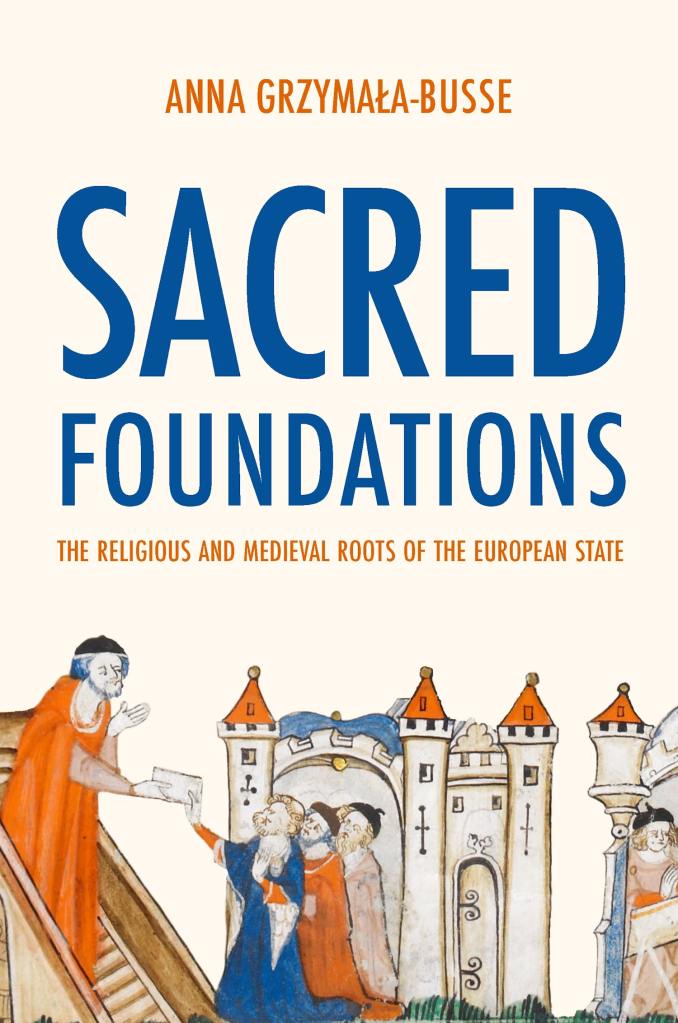
Anna Grzymala-Busse’s recent study Sacred Foundations: The Religious and Medieval Roots of the Modern State (Princeton U Press, 2023) makes a compelling historical and data analysis grounded case for the emergence of the modern state through the process of the Church’s autonomization in its ongoing disputes with the European monarchs across the centuries. This process of the secularization of ecclesiastical forms (conciliarism, legal administration, the uniformity of procedures, rules for governing institutions, the emergence of educational training and mechanisms for political representation and fiscal control, etc), however, is silent about two defining features of the modern secular state. And I do not think it is an exaggeration to say that these two elements bring forth the way in which political authority was established after the victory of modern European Enlightenment. Busse’s book, if anything, has the felicity of putting in perspective, even if only in negative, the two pieces of the puzzle: a) coercion as guarantee by a legal process (not just the monopoly of force); b) and the inter-institutional coordination that we tend to associate with a ‘principle of an internal rule of recognition’ between different spheres of bureaucratic rationality. Busse admits for (a) that “….the authority of the people over the whole Church was not statelike. It depends on moral authority and influence, not on coercive control. Both kings and popes cajoled, convinced, and threatened rather than demanded or extracted force” (Busse, 78). But ruling on morality and influence are two weak presuppositions to guarantee systemic, homogeneous and uniform process required by institutional authority.
In other words, the Church was able to construct forms of civil mediations, although it lacked the power of efficacy; that is, a coherent set of reasons for action that would define a strong concept of sovereign authority as service (to put it in Raz’s well-known formulation). The classical apothegm by which ‘kings rule rule but do not govern’ (Rex regnat sed non gubernat) now is protracted by the exercise of an efficacious rule, which means laying out a combination of forms and a well-ordered power over coercive forms. In fact, this is one feature that will define the legitimacy of the Enlightenment according to historian Franco Venturi; the discovery of punishment understood within the scheme of a trade off between the “necessity of the right to punish when man was not able to re-establish communism” [1]. Hence, the genesis of modern legitimation is not exclusively “a given” vis-a-vis the structure of separation of powers and the ultimate source of the plenitudo potestatis; rather, it requires a second-step rule, as it were, to convalidate the specificity of institutional authority with ample concrete efficacy of police powers in charge of compliance and punishment. The reach and exercise of public police powers and the systematic ordering of penal codes through a criminal procedure and its guarantees (reasonable doubt, fair trial and due process, no crime published without a previous enacted law, nullum crimen sine lege) is what renders effective and “energic” the principle of authority.
Now, broadly speaking, when it comes to (b) Busse admits that (and this is in spite of its institutional schemes) laying down justice “…the church relied on secular enforcement, for example when it came to religious orthodoxy. […] The carrying out of sentences against heretics and apostates lay in secular hands – those found guilty were handed over the temporal authorities so as to not sully the clergy. Legal coevolution and influence, the struggles between popes and monarchs, and the diffusion of both canon law and personnel into the juridical systems were critical to the rise of constitutionalism and the rule of law in Europe” (Busse, 132-133). This asymmetry between two systems of legal jurisdiction confirm the inexistence of a strong internal rule of recognition that for H.L.A. Hart defines any robust modern legal system of public law. The internal rule of recognition, one must remember, is not a set of principles or norms for social action, but rather the internal mediation between a legislative authority and its internal obedience within a concrete application thereof. The internal rule of recognition binds a central authority with its specific formal enforcement in institutional union of primary rules and secondary rules to avoid the pathology of uncertainty. This is thoroughly absent from the free-floating institutional forms of the medieval church whose principal construction of primary rules was divorced from the objective and rational procedures of its internal coherence (the rule of recognition) that would ground, in time and place, the otherwise abstract primary norm and the pressure of contested social conflict.
But going straight to the crux of the matter, it follows that medieval templates as superbly redrawn in Busse’s studies lack the two fundamental determinations that ground the modern concept of law: law as the necessarily monopoly over coercion (the Austin thesis), and the concept of law as the construction of an internal rule of recognition to unite primary and secondary rules (the Hart thesis). But insofar as all major modern political concepts and mediations are secularized forms of religious and medieval forms – something we can say that Busse’s scholarship also confirms – we can then say that modern legitimacy will consist in the congruence of these two determinations to organize the mediations between civil society and state. Already in his early The value of the state and the significance of the individual (1914), Carl Schmitt will note of this formal transplant: “…the Catholic doctrine of the Pope as the infallible interpreter of the natural moral law and of the content of revelation, who receives the competence to declare state statutes that stand in contradiction with the moral law or ius divino-naturale to be non-obligatory in conscience. The exercise of his potestas indirecta which is regarded as an act of jurisdiction, and which is held, by many canonists, to be determinative of a statute’s validity in state law – contains real vis coactiva, even where the expression potestas directiva is employed in place of potestas indirecta (Suárez, de fide cath, 3.22.1)” [2].
For Schmitt, then, the process of rationalization between ecclesiastical form and the modern legal norms of the state is very much straightforward. This is what constitutes the very texture of secular modernity. But as we know, for Schmitt the secularization of forms was not enough – it must be said that he himself did not negate in his theory of adjudication of his constitutional thought – which is why the construction parameters of his ‘political theology’ proposes supplemental safeguards to isolate law and power, extending the power of secularization into the decision of the potentia dei asoluta (at times this was contained in the theological figure of the Katechon) [3]. But as Carlo Galli has noted, Schmitt’s political theology is far from a “political christology” or a substantive theological politics grounded in natural law; rather it is a resolute affirmation to defend any concrete order from the potential fallouts of the secularized cornerstones of rational neutralization (potentia directiva and potestas coactivva) of state authority [4]. Neither mechanic state forms nor a higher source of morality (natural law) would define the modern law; rather the autonomy of the political in the existential situation could provide the sufficient energy to avoid the self-defeating circularity of ius revolutionis (this is what most of the times is obliterated from the so called question of “decisionism”)[5]. If Busse is correct in making the case that all modern institutions have sacred medieval foundations; Schmitt’s concurrence in the wake of modern secularization will be to define the energy of the political as the defining element that must stand as the threshold of formal transplantations to have a chance within nihilism and against nihilism. It is both things. In other words, formlessness is the constitutive dimension of political forms; an element that defines, in my view at least, the strongest practical element of what it is to inherit a Christian political foundation. The process of secularization is thus infinite and groundless, ultimately without a moral foundation and universal design. Among its many achievements, a book like Sacred Foundations: The Religious and Medieval Roots of the Modern State (Princeton U Press, 2023) has the ability to refine what political theology is, what it meant, and what to make of its endurance and possible iterations in our present.
.
.
Notas
1. Franco Venturi. Utopia and Reform in the Enlightenment (Cambridge University Press, 1971), 116.
2. Carl Schmitt. The value of the state and the significance of the individual, in Carl Schmitt’s Early Legal-Theoretical Writings (Cambridge University Press, 2022), eds. Zeitlin & Vinx, 215.
We had a very rich and productive conversation this week with Josep Rafanell i Orra around the new and updated edition of his book En finir avec le capitalisme thérapeutique (éditions météores, 2022). But here I just want to entertain an early moment in the book that has some importance for some ongoing discussions. In the introduction that he writes for the new edition, Rafanell engages in a rare and honest exercise in self-critique. This is what he writes:
“Dans mon livre, je défendais une politique du soin. Onze ans après, je me livrerai bien volontiers à une autocritique rétrospective : la politique me semble destinée, irrémédiablement, à devenir une métapolitique, si nous entendons par là l’inévitable ré-institution d’identités qu’il faut représenter. Retour éternel de la police avec la violence de ses abstractions. Je pense que la politique, le politique (que vaut-t-elle encore aujourd’hui cette distinction?) nous condamne à nous absenter des mondes pluriels de la communauté et à neutraliser les effectuations de la différence” [1].
A lot could change in a matter of a decade. Indeed, a lot has changed for some of us, and it seems that for Orra it is no different. He is willing to admit it. He is no longer interested in defending a “politics of care” (or a hyperbolic politics), and not because it has become a recursive cliché in the empty chatter of governing metropolitan progressivism (I think of NYC or Colau’s Barcelona), but more fundamentally because the full affirmation of politics today can only contribute to the ever expansive calculative scheme of representational politics; a representational enframing that has become defunct and emptied out with the rise of administrative rationality evolving from the internal premises of political liberalism. It is true that the liberal democratic project from its inception was too weak to deal with indirect powers, and its long-lasting solution has been to engage in practices of optimization and value dispensation. But no amount of social representation can minimize effective domination. No one could defend this except in bad faith. The destiny of politics now transformed into metapolitical saturation can only muster social existence into predatory lines.
But there is another sense in which the metapolitical collapse could be understood. At least this is where I would like to displace Rafanell’s lucid intuition: the metapolitical destiny of politics emerges in the wake of the fault line between the metapolitical conditions of politics and political representation and mediation as such. Obviously, this is the problem that, already in the 1960s, the German jurist Ernst Böckenförde had to confront in his now famous theorem: the liberal state lives through conditions that it can no longer guarantee or promote.
In other words, the metapolitical conditions required for secularization have evolved (now fully realized through the West with different intensities and semblances) into the collapse of society-state mediations, turning to police powers to maintain the ‘one piece garment’ of social life. Theoretically, the dissociation between politics and its metapolitical conditions has led to attempts at generating sedative hegemonies that are always furiously defended – even at the expense of their failures – through rhetorical bravado. So, the decline of metapolitical condition entails the passage from the conditions of social contact to the endgame of the flexible and coercive management of indirect powers.
.
Notes
1. Josep Rafanell i Orra. En finir avec le capitalisme thérapeutique (éditions météores, 2022), 21.
Mårten Björk’s The Politics of Immortality in Rosenzweig, Barth, and Goldberg: Theology and Resistance Between 1914-1945 (Bloomsbury, 2022) is a major contribution to the ongoing discussion on theology, politics, and life in our present. Indeed, this book of unmatched originality will radically change the coordinates that have structured these debates in and beyond the academic disciplines involved. First conceived as a longer dissertation entitled Life outside life and defended at Gothenburg University in 2018 (which included an voluminous and illuminating chapter on the work of German theologian Erik Peterson, not included in the published monograph and scheduled for publication in the near future) studies three figures of the German interwar period that confronted the civilizational catastrophe of the twentieth century and the rise of the regime of mass production. Through different conceptual elaborations in Franz Rosenzweig, Karl Barth, and the Oskar Goldberg Group (it also includes thinkers such as Adolf Caspary and Erich Unger) a unified thesis emerges: these thinkers crafted a fundamental response to the collapse of the legitimacy of the modern epoch through a radical imagination of immortality and eternal life (Björk 2022, 3). From an angular perspective, Björk’s book measures to Hans Blumenberg’s groundbreaking defense of the legitimacy of modernity through “self-affirmation” of the human; a philosophical anthropology predicament that today has become fully integrated into the arts of planetary destruction, although its genesis is to be captured in the first decades of twentieth century through the dawn of a new catastrophic politics (the term is coined by Erich Unger in his Politics and Metaphysics). In Björk’s account, these thinkers took the stance against the stimmung of the epoch, its historical closure as well as the immanence of nature in order to take up a historical collapse that was civilizational in nature.
It would be a common place to remind the readers of this book that the figures of the research (with the exception of Rosenzweig who in some corners has been taken as the greatest Jewish philosopher since Maimonides) have been unwarranted buried in the monumental and political historiographies of the period and in the edifice of normative Continental philosophies of the twentieth century. However, Björk’s monograph is no simple restitution of dead old men, as this would be too accommodating to the field of the history of philosophy. Behind these figures there are multiple strategic displacements that connect the destruction of biopolitics to the reformulation of ethics of the dead, as well as the revision of Judaic theological sources to execute an effective retreat from the collapse of civilization of the last 5000 years of the human species. In this quadrant there is also a timely gesture on the complicated relationship between Judaism and Christianity; a relation that the book never really solves, although it runs throughout the book flagged for possible future explorations. Methodologically, it is the field of “theology” (not of science of religions a la Weber) that returns to the center as a way to explored an unthought dimension of immortality – that Björk properly renders as life outside life, against all biopolitical saturation and ecological catastrophe of the natural world. It goes without saying that there is an untimely tone that directly speaks to our present. Indeed, it is the radical theological and cosmological presuppositions (outside the formalism of religion and the apocalyptic historical saeculum of the Church) where something like a radical new existence of what it means to live can be rethought. This is Björk’s fundamental invitation.
In “Yearning for a system: Franz Rosenzweig and the great paganism of life’, Björk offers an all-encompassing outlook to the work of the Jewish scholar whose famous Star of Redemption was also accompanied by an interest in European geopolitics of the first decades of the century. In the midst of the First World War, Rosenzweig witnessed the rise of a new paganism of the state as the acceleration of the struggle for life in the West reproducing forever war (Björk 2022, 29). For Rosenzweig modernity was not an authentic or unfinished secularization, but rather the institutionalization of a pagan order of depredatory confrontation that foreclosed the world without outside: absolute immanence now meant the subjectivation of new false gods of modern civilization ordered towards survival and struggle (Björk 2022, 25). Against this backdrop, Björk reads Rosenzweig’s Star as an original theosophy of redemption of the world that exceeds the national political counters, while offering a new planetary and universal dimension of salvation beyond the state as articulated in Globus. Furthermore, Björk notes that Rosenzweig saw himself as a sort of Jewish fighter in the defense for a new planetary community with “religion as an instrument for change” (Björk 2022, 53). Even though the language had residues of imperial imagination proper to the time, it is the theological vector that distorts the political register of the ground battle for survival. Here Judaism appears as a subtraction from conventional historicity by retreating to a prehistoric past where the ‘unity of the world’ had no nomoi, states, or borders (Björk 2022, 54). It should be noted that something similar was advocated in his 1922 booklet Die Staatslose Bildung eines Judischen Volkes about the stateless wandering of the Hebrew people, by Erich Unger who thought could show a way out of the decadence of Western civilization through the revitalization of ancient Judaism. The Jew had never been a member of the polis or a slave of the state, since the Judaic Kingdoms were ruled, as Björk explains, “by an antipolitical priesthood” or a “metapolitical priesthood and not political kingdoms” (Björk 2022, 61). The sharp contrast to the modern Judaic subtext is of importance: whereas Eric Nelson shows in The Hebrew Republic (2010), how the ancient Jewish sources influenced the constitution of the modern state theories of Thomas Hobbes and John Milton; the work of Unger and Rosenzweig centuries later, in the wake of the Weimar era, seeked to radically alienate the command of Judaic prophecy from the regulatory political and geopolitical techniques of anthropological modernity. The gap between the two, for Rosenzweig, would be the hope for eternal life against the management of survival to which modern political grammar succumbed without return (Björk 2022, 66).
But theology offers the route to imagination and vocabulary of restitution, and infinite recapitulation. To grossly synthesize Björk’s thesis: life is best understood as an endless dialogue with the dead. The second chapter “Abundance and scarcity” glosses aspects of Reformed theologian Karl Barth’s thought against the materialism of scarcity of the world and the principle of abundance proper to eternal life. By tracing Barth’s critical dialogue with Feaubach’s sociology of religion of the species-being (which radically impacted the way Marx and Marxism came to understand theology), Björk’s theology puts paradisal life at the center of the mission of salvation; a heretical notion that exceeds the predestination theology of grace deployed in the organization of the modern kakedomonic public powers of modernity (Björk 2022, 88). In this sense it is insufficient to define the capitalist religion as merely a cult without dogma or atonement; it is also, perhaps more fundamentally, an axiomatic system that accentuates the two-dimensional positionality of death and life without residue. For Barth, Björk reminds us, theology is a way out from the cultish axiomatics of the countable and measurable of the visible world: “Theology….seeks to open the believer to the belief in the invisible side of the reality of the world. Theology must become an investigation of this invisible world to which further posits that the visible world is related” (Björk 2022, 103). And Barth’s lifelong interest in the theology of resurrection was precisely a way to insist on the invisible register that conflates nature, morality, and survival of the living within the objective normativity of the world.
Perhaps the most interesting aspect of Barth’s theology discussed by Björk comes by way of the opposition of ethics and morality – this is elaborated as a rejection of the predicament of natural law’s imago naturae and its dependency on rationality – where the second is discarded as merely finite life unto directive command of the natural good. On the contrary, an ethics suspended by the postlapsarian stage is guided by the principle of suum cuique (Björk 2022, 114). The suum cuique (‘to each its own’), although prima facie echoes the Thomist epikeia, it is also free standing for something more: it is a limit to the irreducibility of life in relation to God, which cannot be inscribed in a system of balancing of moral principles in the hands of a sacerdotal authority. Whereas the moral principle of equity (epikeia) organizes the government of this world through principles and moral reasons for action; the suum cuique is the limit set upon our finite life and the eternal in the scope of the saeculum. Björk connects the notion of the suum cuique to the Barthian figure of the “strange saint” who “with tears and laughter provides God and in this provocation is obedient to the election that forms death into life” (Björk 2022, 116). The suum cuique, accepting the postlapsarian condition rejects the instrumentalization of original sin in order to become a “vast eon of the cosmos itself…temporal and finite but also eternalized as that which once was” (Björk 2022, 117). In this way, the suum cuique prepares the paradisal affirmation of every unlived life, an anathema to the thomist substantiation of merely personal dignity and the exceptional mechanism of individual mediation with the economy of election and grace.
The theological exploration of modality of being – this is one of Björk’s implicit lessons in the book – never truly disappears in modernity, but rather reemerges in unexpected spheres. The politics of immortality does not pretend to exhaust this problem. But it is in the last chapter on the enigmatic figure of Oskar Goldberg where this theme is best explored as the true meaning of a life outside life at the center of the book’s conceptual development. Oskar Goldberg is one of the most enigmatic figures of the Weimar era; a magnetic personality that gathered diverse personalities from all corners of the intellectual milieu. He was looked with high suspicion by Thomas Mann, who portrayed him as a mystical undemocratic thinker in Doctor Faustus, but also dismissed by Walter Benjamin and Gershom Scholem (it only suffices to look at the correspondence collected in Scholem’s Walter Benjamin: The Story of a Friendship). A scholar with strong and sedimented knowledge in the Talmud and Ancient Judaism, Goldberg developed a highly sophisticated and speculative theology of the transcendental organism, to put it in Bruce Rosenstock’s terms, which provided an original formulation of a transcendent being based on the Torah in the wake of the new biological theories of the species (the work of Driesch, Uexküll, Spemann, among others) [1]. The biological and mystical vocabulary of Goldberg aroused immediate skepticism from the German intellectual class, but Björk convincingly shows that Golberg’s project was not an arabesque of a madman, but rather a very peculiar modal speculative system that seekd to confront the 5000 years of the civilization of fixation of the Western transition from the society of myth to the civilization of production and psychic energy imbalance (Björk 2022, 127). For Goldberg the passage from the prehistoric stage of myth to the inauguration of the religion of the state meant the sedimentation of a civilizational regimen oriented towards production, devastation, and positionality (Theophanidis recently expressed the proximity between Goldberg’s fixation and Heidegger’s Gestell, unexplored in Björk’s book). Björk is attentive to the fact that Goldberg was not just a proper name but also the constitution of a sort of ‘metapolitical university’ that gathered diverse figures, such as the economic historian and political thinker Adolf Caspary or the philosopher Erich Unger, both who developed their own critique of technological domination under the shadow of Goldberg. Thus, the critique of civilization is not to be taken as an abstract mysticism; for Björk, the concrete effects can be read in Caspary’s forgotten The Machine Utopia (1927), which criticized the utopia of machine civilization proper to both Soviet Bolshevism and Western capitalism – two social orders that shared the same the same historical horizon: reproduction and accumulation of surplus value (Björk 2022, 142).
In this framework, and against the historicist analytics of Marxism, for the Goldberg circle class antagonism and division of labor was not oriented towards emancipation, but rather towards the realization of a global total state. For the Goldberg circle to escape the civilization of the Behemoth of the industrial state required nothing short than a politics of errancy (defended by Unger in his Politics and Metaphysics of 1921) and the reversal to a modal relation with YHWH as an effective and potential dimension against the imbalance of an impoverished reality. Björk claims that for the Goldberg circle there were three possibilities of existence of coming to terms of the modern decline towards: civilizational fixation, myth, or Torah (Björk 2022, 154). And in different ways, they opted for the Torah, which implied not an identitarian reversal to a territorialized Volk but rather an infinite task of becoming immortal, given that our modes correspond to the nature of God and the world (Björk 2022, 166). The task was to depose the production of evil and suffering here and now as mobilized by the incarnation of historical progress. This infinite retreat from the materiality of the finite of the species was a way to open a new polytheism to the Ancient Hebrew metaphysics elaborated in Goldberg’s book, The Reality of the Hebrews (Die Wirklichkeit der Hebräer, 1925). In other words, to exit from the fixation of the 5000 years civilization required a passage to immortality as a way to “make us unadapted to the normal laws of evolution” and to the objective world (Björk 2022, 178).
Truth be told, immortality never disappears from modern political imagination and governmentality. Some of us still remember that one of the famous mottos of the Cuban Communist Party was: “Los hombres mueren, el Partido es Inmortal” (“Men die, but the Party is immortal”), which ultimately served to guarantee the idolatry of the state’s sacrificial principle through a continuous “lucha” (struggle) of everyday life under real-existing administrative communism. Likewise, in recent years Boris Groys has argued at length that immortality lives off in the topology of contemporary art, where archivization, spatial flexibility, and museification of the historical Vanguard stand in for the desire to become immortal [3]. This is, indeed, what Björk calls, following Blumenberg, the moralization of immortality whose political translation resulted in truly barbaric consequences that we are still suffering (Björk 2022, 186). Against all moralization and political instrumentalization of immortality, The Politics of Immortality in Rosenzweig, Barth, and Goldberg (2022) rises the theological mirror so that yet another anthropogenesis event through the “the Gnostic residue by insisting that the problem of evil could only be solved by God” (Björk 2022, 190). In other words, the problem of immortality restores the gnostic residue to its proper place beyond exceptionalism and anthropological humanism, since finitude (death) externalizes what is living, while “life” now becomes the meaning as its own otherness to the modes of God. Departing from the fourfold structure of the history of the modern error in Nietzsche’s typology, we could add a fifth: the error of conceiving the gnosis as worldly aspiration to domesticate exteriority as a forever postponed apocatastasis.
It is in the sense that Björk’s important book complements the unfinished elaboration on the gnosis undertaken by Giannia Carchia towards the end of his life: the exodus from the fiction of the subject and the person implies nothing short than the “resurrection of the human community capable of renewing the arc of history that appears so dramatically broken” [3]. Perhaps Carchia was a bit of an optimist here: the historical arch emanating from the potstlapsarian moment is now in ruins, but the gnostic residue remains once the darwinism of human-assertion has fallen flat into pieces across our planet (Björk 2022, 197). But Mårten Björk majestically teaches us that to keep insisting on life (on absolute life, on dignified life, or the monstrous “good enough life” recently proposed in a frank instance of academic nihilism) cannot but reproduce the civilization of calamities that has put the world in the road to extinction. In the current epochal implosion all these pieces are more apparent than in any other time in history. Yet, life is elsewhere, always escaping objectivity and immanence: “it is the invisibility of the wished, the desired and the dreamt. This is what human life entails. It is related to the wide world of what could have been or what should have been” (Björk 2022, 199). The modality of eternal life is also what value cannot apprehend, and for this reason what remains undialecticized, stubbornly disjointed from every unbearable fiction of the world. The Politics of Immortality (2022) is not only an exceptional book; it moves us to look to what always remains on the side of the invisible, to the unsaved in the exterior elan of every life, our lives.
.
.
Notes
1. Bruce Rosenstock. Transfinite Life: Oskar Goldberg and the Vitalist Imagination (Indiana University Press, 2017).
2. See, Boris Groys, Política de la inmortalidad (Katz editores, 2008), and “The Immortal Bodies”, Res, Vol.53-54, 2008.
3. Gianni Carchia. “Elaborazione della fine: mito, gnosi, modernità”, in L’amore del pensiero (Quodlibet, 2000), 150.



 Infrapolitical Reflections