Decline and renaissancing. by Gerardo Muñoz

There is something to be said about the facticity of epochal decline, and the reiterated attempts to call for its overcoming. But both decline and renewal are so interconnected in the Western dispensation of community and institutional organization that any attempt to surpass only deepens and pushes onwards the pendular movement between rise and fall towards generic equilibrium and social stabilization. Oswald Spengler understood well that decline situates civilization at the center of Western internal historical development just as birth presupposes death; thus, civilization is merely the coagulation of vital energies to overcome the emergence of decline. The genesis of civilization into final decline should at least elicit a question to break this ongoing circularity: what does it mean to hold to decline without converting its minimal energy into the orientation of a new horizontal epoch? The end of growth (economic stagnation) realized in real subsumption and the autonomization of value also allows us to formulate the question in the following terms: what does it mean to seize the fall of the rate of profit affirming demobilization and the inoperative nature of life beyond its conversion into the movement of energetic production that characterized the epoch of production through the historical figure of the worker? 

Ultimately, this is a question about how to represent (or how to avoid representation) an ethical orientation of life. At the turn of the twentieth century, it was noted that the ethical bourgeois form of life was conditioned by the sense of “community upon all men” around utility of life’s functions subsumed by work, and work as the sole purpose and meaning of life. The definite character of modern social life can be said to compensate for decline for giving up the incommensurability of life forms; that is, what Lukács also called the temporality of the “genius, in the sense that [the genius] can never be measured against anything, whether interior or exterior” [1]. Confronting this very question at the threshold of the crisis of the transmission of forms in Antiquity, Bernard Berenson in The Arch of Constantine: the Decline of Form (1954) offers a distinct position: the moment for seizing decline should be a deliberate prospect of gazing backwards; a facilis descensus that will disclose something entirely different deprived of the race towards “newness” promised by temporal futurity and its social spheres rhetorically organized. In a remarkable moment of his book, Berenson writes that: “Except in unique moments like the fifth century in Hellas or some three thousand years earlier in Egypt and Sumeria, conscious, deliberate, purposeful art is constantly looking backwards – renaissancing – if I may be allowed this uncouth but necessary verb-striving to recapture some phase of its choice in the art of the past, or at least to model itself or draw inspiration from it” [2].

In other words, there is only “renaissancingif one is able to traverse the decline of the past in the fullest sense of its inheritance of its formal stratification. The perpetual infantilism of the modern ethical outlook is that it tries to claim its definite character in irreversibility in order to exit the downwards path of decline through abundance and vulgarity (and we know from Ruskin that vulgarity is one of the forms that death takes unto the living).

For Berenson there seems to be authentic renaissancing at the level of life forms – of that incommensurable generality of human concrete and practical creation – by holding on to epochal decline, and not through state cultural policies that have sedimented the disappearance of forms of art legitimized by a “critic that will discover a deep meaning, a strange beauty, a revelaning newness in what you have done” [3]. The vicious modern liquidation of the free interplaying creation of forms of life and their external model of appearances is paid with the ascension of the rhetorical utility that will alleviate, at least momentarily, the sentiment of the decline proper to the transmission of dissolution. Whatever redemption creation can offer in the muddled waters of decline, the modern autonomy of reified forms, pushing upwards towards “newness”, will separate the sensorial transformation of life to the homogenous representation of communitarian representative order that puts an end to mood and solitude.

What Berenson calls “renaissancing” of factical experience nourishes the unrealized instances of the tradition not towards the breakthrough of a historical epoch (something like a virtuous mythic age of “Renaissance”) that can be posited by way of general background principles nor through the enforcement of a common social morality; rather the incorporated memory of the past is transformed to its very end because in its liquidation “true life” beyond measure reemerges. Berenson will state quite enigmatically that “style cannot be manufactured by taking thought” independently [4]. This is what Hölderlin had in mind when in a moment of “The Fatherland in Decline” from his theory of the tragic and its passage of dissolution: “The new life, which was to dissolve and did in fact dissolve, is not actually the ideally old, the dissolution of which was necessary, exhibiting its peculiar character between being and nonbeing…thus dissolution, as necessary, when seen from the point of view of ideal remembrance” [5]. It is this remembrance of dissolution that reveals decline as a felicitous fall without judgment that brings the appearance of life outside the irreversibility of the modern historical progress that has accumulated the oblivion of possible worlds.

This is why Hölderlin will also claim in his “The Perspective from which we look at Antiquity” (1799) that the ‘general decline of all peoples’ is due to the inheritance of forms of “an almost boundless prior world, which we internalize either through learning or experience and exerts pressure on us” [6]. To take up decline in a serious way means that we proceed from the formlessness of life, and not from the mimetic drive that expresses, in the name of ‘originality and autonomy’, the civilizational alienation towards the most distant (Antiquity) and the most near (ethos). We can then say that in decline the most distant and the irreducible becoming allows the ascension of ethical life. In this way, we can authoritatively say that there is only hope and redemption in decline because new life flourishes in a time of prudens futuri temporis exitum (“Prudently the god covers the outcome of the future in dark night”) that will transcend itself by becoming into what ceases and ultimately is.

Notes 

1. Georg Lukács. “The Bourgeois Way of Life and Art for Art’s Sake”, in Soul and Form (Columbia University Press, 2010), 76. 

2. Bernard Berenson. The Arch of Constantine: the Decline of Form (1954), 36.

3. Ibid., 64.

4. Ibid., 22.

5. Friedrich Hölderlin. “The Fatherland in Decline”, in The Death of Empedocles (Suny Press, 2008), 154.

6. Friedrich Hölderlin. “The Perspective from which We Have to Look at Antiquity”, in Essays and Letters on Theory (Suny Press, 1988), 39-40.

Vladimir Lossky’s third way. by Gerardo Muñoz

In his war diary Seven days on the roads of France June 1940 (2012), which recounts his itinerant vicissitudes in occupied France, the Russian theologian Vladimir Lossky makes an explicit case for the emergence of a third way beyond conservation and destruction, and its modern ideological avatars that led astray into the modern catastrophe; that is, the social revolution and conservative reaction cloaked under “traditionalism”. As it has been recently glossed, Lossky was not the only person from the East to be preoccupied with putting a halt to the eternal dialectical movement of destruction and conservation only fueling historical abstraction. Indeed, immediately in wake of the Russian Revolution, the poet Alexander Blok, in an epistolary exchange with Vladimir Mayakovsky, and anticipating the bewildering enthusiasm of the revolutionary energy, also demanded an effective exit from servitude so that “a third thing appears, equally dissimilar to construction and destruction” [1]. It matters little whether Lossky knew about Blok’s “third figure”, although it is at the same time impossible not to have it in mind when reading his own annotation in the June 16th entry of his diary, which does seem to offer a answer to Blok’s proposal:

“Nonetheless, revolutionaries are always in the wrong since, in their juvenile fervour for everything new, in their hopes for a better and a way of life built on justice they always base themselves on theories that are abstract and artificial, making a clean sweep of living tradition, which is after all, founded on the experience of centuries. Conservatives are always wrong, too…for in their desire to preservice ancient institutions that have withstood the test of time, they destroy the necessity of renewal and man’s yearning for a better way of life. Is there, then, a third way? Another destiny for society than of always being subject to the threat of revolutions which destroy life, or reactionary attitudes which mummify it? Or is this the inevitable fate of all terrestrial cities, the nature of their existence? In fact, only in the Church can we find both a Tradition that knows no revolution and at the same time, the impetus towards a new life that has no end. Which is why she is in possession of those infinite resources upon which may draw all who are called to govern the perishable cities of this world” [2]. 

It is no surprise that for both Blok and Lossky, the fundamental tension in the amphibology between conservation and rupture rests on the problem of “tradition”; given that, as Blok had also eloquently written in his letter to his fellow poet: “a breach with traditions is a tradition”. This is something that an artist like Kazimir Malevich understood well in his programmatic text about museums in the wake of the revolution (“On the Museum”, 1919): the turn into ashes of all the works of art altered their aura, but it left in place the topological frame and it still produced an image; in order words, the destructive artworks still demanded a museological space for storage, thus enacting new principles of the triumphant revolution. Understood in this sense, tradition is merely the retroactive accumulation of practices by the archē that orients its development retroactively from the point of view of the present with provisions towards the administration of the future. But, how did Lossky understand by the notion of “Tradition”? Rereading the fragment of his war diary entry, it would seem that this notion merely rests on the dogmatic transformations within the Church, and in this sense, a conceptual elucidation similar to the doctrinal exegesis not very different from John Henry Newman’s An essay on the development of Christian doctrine (1845). However, in his important essay “Tradition and Traditions”, Lossky attempts at defining the site and tension of the tradition, which he notes that in the language of theology it has been a term left vague and repeatedly undefined [3]. Lossky writes with sharp precision: “Tradition sometimes receives that of a teaching kept secret, not divulged, lest the mystery be profaned by the uninitiate” [4]. Thus, Tradition is the positive and textual scripture that registers the Word, but it is not exhausted in the positive scriptural authority. 

At the heart of Lossky’s argumentation about the theological meaning of Tradition, is the fact that it exceeds both textual sources and narrative mastery and transmission. In fact, the theology garment of Tradition belongs to the mystery of revelation shared in conspiracy, rumors or whispers [5]. And although, in his essay Lossky reaffirms himself that Tradition is the invisible intertwined with the Church – what keeps the “critical spirit of the institution” for the incorporation of new dogmatic definitions – it is nonetheless important to note that for the theologian, Tradition as “opposed to the reality of the word, it would be necessary to say that Tradition is Silence” [6]. In this sense, Tradition is that which is created and transmitted but that no one has the right nor the authority to speak through its incommunicable name. Is Tradition transmitted at all? If it is not through the written word, how can there be any continuity? This is the ultimate lacuna of the theological underpinning of Tradition for Lossky: Tradition can only be properly understood as the crafting of a “unique mode of receiving truth”; in order words, it names the contact between revelation and the witness who receives its ‘fullness of knowledge’, which far from mastering the totality, it points to “the external limit…the narrow door which leads to the knowledge of Truth” [7]. As Monica Ferrando has recently glossed from Plato’s philosophical corpus, any robust conception of Tradition should be understood as that which maintains an absolute inseparability between wonder and salvation, as well as bridging invention and received grace (charîs) [8]. One step at a time, we invent traditions whenever we are thinking through the abyss that separates our language from the inheritance bestowed upon us. Tradition moves in every ethical position of thought overcoming the pseudo-authorization of alienated and metaphorical knowledge of the past.

But if  the Church is no longer the institutional site for the keeping of the impossibility of the transmission and renewal of Tradition and revealed Truth – subsumed to the mysterium iniquitatis that works against the possibility of the rendition of the eternal life of a permanent vita nova  – it entails that one can still hold on to Lossky’s assertion that the task is to be attentive to the ossified expressions and reified appearances of Truth against the “living Spirit of Truth”. Hence, to insist on the restitution of the Church in our current predicament, would place us on the side of instrumentalized and subject-oriented salvation that turns away from the active kingdom that is the only passage from the world of the living to that of the dead. The traditionalists or integralists are incompetent representatives of the Tradition in this sense: as Von Balthasar once argued, they lack the humor and contact with the invisible to apprehend the mystery that arrives without solicitation, as pure depotentialization [9]. In a godless world of the secularized gnosis of political force – that is, after the fleeing of the gods – perhaps theology could only be understood as the path of Tradition of uncountable wonders and the event of speech that produces an unworldly sensation within this world. Tradition brings the world beyond its shape and legibility. In this sense, we are always participants of Truth that the world cannot retain, and thus keepers of an enduring secret that will ineluctably outlive us. 

Notes 

1. Philippe Theophanidis. “Alexander Blok: ‘A breach with traditions is a tradition'”, October 13, 2024: https://aphelis.net/breach-with-traditions-alexander-blok/ 

2. Vladimir Lossky. Seven days on the roads of France June 1940 (St. Vladimir’s Seminary Press, 2012), 54.

3. Vladimir Lossky. “Tradition and Traditions”, in In the image and likeness of God (St. Vladimir’s Seminary Press, 1974), 141.

4. Ibid., 144-145.

5. Ibid., 146.

6. Ibid., 150.

7. Ibid., 162. 

8. Monica Ferrando. “La libera grazie della tradizione”, in Un anno con Platone (Neri Pozza, 2024), 424.

9. Hans Urs Von Balthasar. The Office of Peter And the Structure of the Church (Ignatius Press, 2013), 403.

Holding on to painting. by Gerardo Muñoz

Paying a visit to a painter’s studio is a rare experience, but definitely gratifying. Or at least, it has been for a long time even before I could put it to words. At her studio, I confirm that Laura Carralero’s commitment to painting as a practical activity has an unfathomable dimension, and I was pleasantly surprised that she shared the same sentiment that our current epoch is not one in which painting has a minimal breathing space. And whenever painting emerges in the official market circuits of art, it seems that it is always already parasitical to some verbose rhetorical apparatus or heteronomic planning that distortions the painterly sentiment. But was not painting the task of speaking the engagement regarding  “mute things”, as Poussin would have it? There is little doubt that rhetorical inflation that thrives in mechanisms to legitimate art continuously devalorizes the mysterious proximity of painting with things in the world. We should reflect – or we should continue to reflect – about what it means to be in a point in the history of humankind where the obsolescence of painting and the disappearance of the dexterous achievement of the hand has thoroughly been realized (Focillon’s praise of the hand remains as actual as when it was first written: “The artist that cuts wood, twerks metal or rock keeps alive a very ancient human past that without which we would immediately cease to exist. Is not admirable to see in the mechanical age this stubborn human survivor of the ages of the hand?”) [1].

The task is immense and abnormal, and it defies (because it exceeds it) the theoretical concept and the absolutism of the philosopher. The engagement of the painters – a secret community that still exists here and there, in different geographies of the world – is precisely a keeping of the divine vortex of the human in the abyss without higher pretensions. And there is something stubbornly strange about painting against the mounting force of destruction. Although perhaps ‘resistance’ here means nothing but to hold on to the originary instance of appropriation of experience in the wake of the epochal mutation of anthropogenic composure; as if the end of the species is also pulsating its commencement.

Holding to painting is not just a substitute to the act of refusal (something that I have recently mapped out); rather, it refuses the very negation of the anthropological erosion in its soulful interaction with what it remains outside of language. To hold on to painting means to engage in the imperturbable: what discourse cannot mold and relocate; what previously is poor in language so that a new language, and thus a new world, could emerge anew among the rubble. In his forthcoming book Those Passions, T.J. Clark states, quite forcefully, that no political transformation or epochal breakthrough can emerge without a preliminary transformation in language; and, I am tempted to say, that practice of painting is the topoi in which eye, world, and hand come together in the very act of separation of said renewal.

The terror of painting – only aggravated in the last decades or so, although a process that took off the postwar years and continued into schools of art where militant pedagogues can only shout “don’t bother to paint!” – is the general stimulus of the reified world; a world in which the paradigm of “objethood” now stands as the compensatory empty experience for poignant idolization of nothingness and “mere stuff”. Sure, there is no return to painting in its grandiose historical sequences – Renaissance, French modern painting, the European Baroque, Van Eyck’s optical discoveries – which ultimately means that painting’s instantiation with the tradition is also bare and unexplored; or, absolutely uncharted whenever there the event of true painting. While I glance at Carralero’s diminutive wooden oil paintings I have this in mind at least. There is a return to the divinity of the icon, but it is not a restitution of its theological investiture and its purported liturgy; the pictorial exercise takes into account the structural void in which painting finds itself resisting, for better or worse, representational excess.

And this speaks, I take it, to the muteness of painting as such, which is also Carralero’s silence about the import of medieval icons into the present. In a way, the painterly operation (I realize that this expression is awful) is executed in a paradoxical redemption, since space always calls forth presentism, a here and now. One is reminded of Stevens’ verses in “Ordinary Evening in New Haven”: “To say good-bye to the past and to live and to be / in the present state of things as, say, to paint / In the present state of painting and not the state of thirty years ago”. The emphasis of the verse declines towards that injunction “as say, to paint”, which fixes a current state of being in the world where we are in it but outside of it. Is not this, precisely, another description of the “Just”? I am eager to work through painting’s stubborn position to this description, which means to hold on to the imperturbable. 

The imperturbable seems to me like a fitting term to grasp what Carralero is doing in her pictures, although with no pretensions to exhaust her pictorial adventure. The solemnity of the icon and its inverted gnosis yields something palpable as well as unattainable. What is being held is the vortex of painting’s mystery going back to Lascaux and ancient burial paintings. Carralero rationalizes her interest in medieval and Eastern European religious painting as a retreat from the unbreathable decay of contemporary pictorial practice as a general tendency. Here the renewal of painting is only possible through the sensible dimension of an integrative imagination. Hence, to live in the present, in the hour Stevens’ simile, is also to dwell in the flashes of painting’s general economy of sensible forms. A new history of freedom can take this as its point of departure; that is, to posit no longer the social functionalization of norms and rules for relations, but to expand the sensible space of the innumerable symbols of existence. 

In the well-known essay “The Pathology of Freedom”, Günther Anders says something significant about painting’s imperturbable nature: “Painting that fixes the aspect of a man or a thing in a picture seems as it were to repeat the act by which each thing is already condemned to itself” [2]. This “being-precisely-this” could be taken as the closure of contingency in relation to all possible forms; although it is also painting in which the contingency of the non-visible in the visible what arranges the possibility of what is precisely absolute contingent as absolute in each picture. This is why in great pictures we tend to feel that the consummation of form reveals as a necessary tradition that, by virtue of being thus, it assume the thisness of the particular rendition. This commitment that weighs heavy in each of Carralero’s paintings is a testamentary to the imperturbable even if we are already entering (or already in it) the eclipsing world of the mystery of the senses, a world that can no longer see the redeeming and unassuming vision that painting can offer.

Notes 
1. Henri Focillon. Elogio de la mano (UNAM, 2010), 131-132.

2. Günther Anders. “The Pathology of Freedom: An Essay on Non-Identification”, Deleuze Studies, Vol.3. 2009, 283.

Pasternak’s symbolism and immortality. by Gerardo Muñoz

“Symbolism and immortality”, was the title of a talk that a very young Boris Pasternak gave in 1913 to a group of students, although the paper was finalized around 1917. It has been known that the integral version was destroyed or misplaced, and only a synthesis was preserved in the author’s papers, which provides access to the thicket of the argument, which concerned ultimately the immortality of artistic creation and the transhistorical participation of the human species in the enduring process. Pasternak himself inscribes this lecture at the heights of his ars poetica: “My main purpose was to put forward the proposal that perhaps this maximally subjective and universally human corner or lot of the soul was art’s immemorial area of activity and its chief content. And, further, that although the artist is of course mortal like everybody else, the happiness of existence which he has felt is immortal and can be felt through his works by others centuries after him” [1]. Unlike the contentious positions about the creative genius and the orientation of the poet (dichter als Führer) that soon enough will inform the thick aura of European modernism in the age of dissonance, for Pasternak in the 1910s (the same decade as the early Lukacs and the youthful Michelstaedter), creation concerned a gathering of experience outside subjectivity; it was fundamentally the experience of the outside beyond the subject, which could only be cultivated by the poetic sensibility’s relation to that outside. It is not clear where there was a figural specificity to the notion of “poet” that Pasternak advances; but, what is essential, is that the poetic task was only possible through a spiritual formation and deployment of symbolization, that is, of the transfigurative use of language. 

Pasternak does not distinguish between vulgar and crafted poetic language; rather he uses the term symbolism to account for the sensible immortal reservoir that is transmitted in the stratification of the genesis of the human race. It is not of minor importance that Pasternak is writing in the dawn of a concrete materialist revolution, in which possession is only registered, counted, and even “destroyed” as mere “stuff”, thus incapable of solving the crisis of the transmission of tradition and blind to the problem of sense. Indeed, perhaps the revolution can only deepen the epochal crisis of symbolization. Pastnark will write affirmatively: “Immortality takes possession of the contents of the soul…in pure form this is what symbolism teaches” [2]. In a conception that is strikingly similar to Warburg & Saxl’s conception of the symbol (and history now designed as a study of the coagulation of symbologies) as a surplus discharged of energy as the reservoir of human sensation and formulas of imagination (the pathos formulae); the attunement towards symbolization never amounts to an accumulation of meaning and narration, but rather it is what preserves the earliest and purest stages of human expression, as argued by Saxl [3].

This is why there is no immortality except in the beginning: the real process of the anthrogenesis is only accessible in those moments of passion and experience while “being observant and drawing from nature”, Pasternak will claim in his talk. The immortality to be retained, it seems now clear, is not that of a future and postponed soteriological communal “life”; it is rather a life that clings to the ordinary and intuitive symbolism that resists the monstrous numbing of fictitious life commanded by the blackmail of the reality principle required by orderability. In this light, perhaps Alfred Metraux is right in that going beyond the neolithic age marked a catastrophic wandering for human beings. (And is not the poetic instantiation a painful reminder of this?)

The stratification of symbolism was of a higher reality; a playful dance between the figure and the non-figural, between the visible and the invisible, between the countable and the non-countable. Pasternak situates this tendency under the sign of “theos“, a religious character in which the texture of the soul is able to find some breathing space as condition of possibility for the opening of symbolism. Modernity is many things at once, but for Pasternak what was being “withered away” at the altar of morality and politics, Church and State (his terms verbatim) was precisely the historical draught of the symbolic man: “The communion of mortals is immortal and that life is symbolic, because it is full of meaning” [4]. This means that there is no community of salvation that serves as the general economy transport between the two kingdoms; if there is a Kingdom it is only of the symbolization of the irreducibility of souls, that can only enjoy immortality in the renunciation of what the materialist and survivalist life is capable of offering in detriment of the experiential possibilities of creation and language when grasping the sense of deathlessness. 

In the life of civil society you will live organized only unto death, without any experience of immortal death of any other, given that death has become mere transaction, a burdensome logistical ritual, a common spectacle. And this is why Pasternak, unlike the Cold War pawn that sometimes he was forced to embody, gradually became convinced that poetic existence could only take place outside the Social with no role or mission to subscribe to: “Do not reserve a poet’s position: it is a dangerous, if not empty” [5]. What was at stake was not a “new life” but a second birth (title of his own poetry collection, Vtoroe Roshdenie from 1934) to plunge into the depth of symbolization. The task is not to invent anything “new” (that modern fetishism), but to regain the life of the soul where the origin commences: “…and here art stops, And earth and fate breath in your face” [6]. It is a mysterious and impossible portrait of a face that reckons with the passing of the symbol and its absolute mystery. The very texture of expressivity that, against all odds, lingers on.

Notes 

1. Boris Pasternak. An essay in Autobiography (Collins and Harvill Press, 1919), 69.

2. Boris Pasternak. “Symbolism and immortality”, in The Marsh of Gold: Pasternak’s Writing on Inspiration and Creation (2008), 40-41.

3. Fritz Saxl. “The expressive gestures of Fine Arts”, in Lectures V1-V2 (Warburg Institute, 1957). 

4. Boris Pasternak. “Foreword”, in Selected Poems (Penguin Books, 1983), 14.

5.  Boris Pasternak. “To a Friend”, in  Selected Poems (Penguin Books, 1983), 100.

6. Boris Pasternak. “Second Birth”, in Selected Poems (Penguin Books, 1983), 109.

Tradition according to Wallace Stevens. by Gerardo Muñoz

The fact that there is a continuous and secret communication between painting and tradition is something that has been registered in the genesis of myth well into aesthetic autonomy of modernity and the artificious equivalence of difference that regulates the temporal caducity of the new [1]. In a specific sense, the crisis of tradition in the contingency of the modern has the activity of painting as a privileged site because it holds the outside together in a perpetual unveiling; as if the human species were permanently exiting the shadows of the cave every time a hand strokes an animated brush over a surface. Painting clears the site of the inaccessible so that true life can emerge without the crutches of incorporated scripts of social organization. But what could it mean to think of ‘tradition’ in a painterly manner? In a poem of 1945, unequivocally entitled “Tradition”, Wallace Stevens seems to offer a response and an outlook for our consideration. 

In a conversationalist style, Stevens thinks that tradition is an uncontrolled question insofar as it can only be assessed through poetic form. Of course, for Stevens the character of tradition could not be grasped neither in a compilation of well delineated forms nor detailed through “a set of laws…to identify it is not tradition” [2]. As it was for Hölderlin’s practice relation to Greek antiquity, tradition is something that is always missed or unfulfilled from its uttermost strangeness. It is, as he asks in the fifth stanza “an unfamiliar sum, a legend scrawled in a script we cannot read?” [3]. The illegible transcription of what is passed as tradition holds to the incommensurability between what remains unfamiliar and what is already familiar and perceptible. We must resist the attempt at disambiguation, since any relation to tradition must be anachronistic as Nicoletta Di Vita has suggested [4]. Thus, for Stevens “tradition is always near”, at hand. And the hand calls forth the mystery of painting. It keeps a world at the threshold of the verbal. The placement of nearness, however, will be on the side of formlessness that characterizes the genesis of one’s existence. In other words, the true task of approaching tradition is neither at the level of the construction of forms nor about the analogical pairing of historical evolution; it is the painterly relationship between life and the experience in the world that precedes and outlives the time of life. This is what Stevens will denote a “ascending the Humane”; meaning a life qualified by fulfilling the adventure of a destiny that is capable of addressing the outside. In the most emphatic verses of “Tradition”, Stevens shows his absolute nearness to what he has in mind: 

“Ascending the humane. This is the form 

Tradition wears, the clear, the single form,

The solid shape, Aenas seen, perhaps,

By Nicolas Poussin, yet nevertheless 

A tall figure upright in a giant’s air.” [5]. 

The use of “form” in the first verse is most definitely mischievous, but it is also the playful ambiguity that Stevens wants to bring to our attention. One way to read it is to circle back to the sense in which the painterly becomes the utile passage between life and world. After all, tradition “wears” the dress of nature, although this is only facilitated by the sensible activity of painting. Exactly a decade later in the essay “The Whole Man” (1955), and speaking directly to the rise of cybernetics and technico-political technicians that had consolidated their mastery over the events of the world, Stevens will suggest that “Modern art often seems to be an attempt to bridge the gap between facts and miracle…to succeed in doing this, if it can be done at all, seems to be exclusively the task of the specialist, that is to say, of the painter” [6]. Why the painter and not the poet? At a very general level, the two figures are interchangeable; however, if one takes the painterly mediation, it becomes possible to claim that painting has a more subtle expressive footing in showing the nearness of tradition.

Painting is the non-language that  gathers the formless tune of tradition: “The vigor of art perpetuates itself through generations of form. But if the vigor of art is itself formless, and since it is merely a principle it must be, its form comes from those in whom the principle is active, so that generations of form come from generations of men. The all-round man is certain to scrutinize form as he scrutinizes men, that is to say, in relation to all past forms” [7]. Thus, for Stevens the possible tradition is that which creates a space in which a new life can take place in the world attentive to the transmission of forms. Of course, not any world, but to “live in the world but outside of existing conceptions of it” [8]. This is why Steevns will differentiate between two modalities of the task of poetry: the poetry of rhetoric and the poetry of experience; favoring the second because of how it folds our existence within the given order of space and time. 

Is not painting, precisely, a frozen instant in the spatial and temporal coherence that reveals, in turn, a hidden harmony that never fully coincides with nature nor stands in opposition to it? [9]. This is why “tradition wears” but it is also the transitory body of Aenas, which Stvevens inserts in the poem as a matter of ut pictura poesis in relation to Nicolas Poussin’s “Venus presenting arms to Aenas” (1639), which is ultimately the story of the persuasion unto one’s destiny. As it is well known, Poussin captures in a sequence Aenas being directed to his destiny invested in the arms of war. But where is destiny embodied for Stevens? Is it in the gesticulating figure of Aenas or in floating Venus that occupies the central sky of the landscape? It is almost as if Stevens acquired, as Walter Friedlander said of late Poussin, a “sublime vagueness” in visibility of the inner workings of imagination drifted from the physical imbalance of the activity of imitation [10]. 

After all, for Stevens Poussin stood precisely as the source of partition and the miniscule, confirming the primacy of “imagination” against the rhetorical compression that renders legible the modern abstraction [11]. Following André Gide who had had written on Poussin’s work, Stevens repeats without any elaboration that Poussin is to be taken “little by little” (peu à peu), so that only then its pictorial absorption can unfold against what at first sight appears as a theatrical and self-enclosed translucid stage. This is the distant ‘traditionalism’ that Stevens wanted to reject if the work of art was to endure, and still have the vigor to generate a tranquil and peaceful state of mind solicited by the late Poussin. Painting could only be expressed as a ‘mode’ — which for Poussin stood for moderation and restraint, but more importantly as the condition of a certain sensible order “by which the thing keeps itself in existence” both firmly and invisibly, that is, beyond enunciation [12]. Otherwise, as Gerald Cohen once claimed, tradition becomes the thing that you can only hold on to when it has relaxed its hold on you ceasing to color the genesis of life [13]. And while tradition cannot be fully absorbed by rules or forms of pictorial depiction, it does retain the “good that we have loved”, dispensing a noeud vital in which the divine (theos) disengages us from the compression of objective reality and into the nearness of the eternal. This is the integrity of painting that allows Stevens to proclaim the ascendance of the supreme human “good”: tradition is kept alive by the soul of an erotic deification. After all, “God and imagination are one” Stevens will suggest in the fragments of Adagia [14]. Against the edifice of sedimentation and rupture, repetition and originality, possession and abstraction; tradition will name the disembodied genesis of appearing between things in a “reflected seeming-so”. 

Notes 

1. Gianni Carchia. “Per un’estetica dellainvecchiato”, in Dario Lanzardo, Dame e cavalieri nel Balon di Torino (Mondadori, 1984).

2. Wallace Stevens. “Tradition”, in Collected Poetry and Prose (Library of America, 1997), 595-596

3. Ibid., 595.

4. Nicoletta Di Vita. Il nome e la voce (Neri Pozza, 2022), 28.

5. Ibid., 596.

6. Wallace Stevens. “The Whole Man: Perspectives, Horizons”, in Collected Poetry and Prose (Library of America, 1997), 874.

7. Ibid., 875. 

8. Wallace Stevens. “From Adagia”, in Collected Poetry and Prose (Library of America, 1997), 904. 

9. Monica Ferrando. “L’ultimo quadro di Poussin”, in L’oro e le ombre (Quodlibet, 2015), 82.

10. Walter Friedlander. Nicolas Poussin: A New Approach (Harry Abrams, 1964), 82.

11. Wallace Stevens. “Tradition”, in Collected Poetry and Prose (Library of America, 1997), 737.

12. Cited in Étienne Gilson’s Painting and Reality (Cluny Media, 2020), 173. 

13. G. A. Cohen. “Rescuing Conservatism: A Defense of Existing Value”, in Finding oneself in the other (Princeton U Press, 2013), 155.

14. Wallace Stevens. “From Adagia”, in Collected Poetry and Prose (Library of America, 1997), 914. 

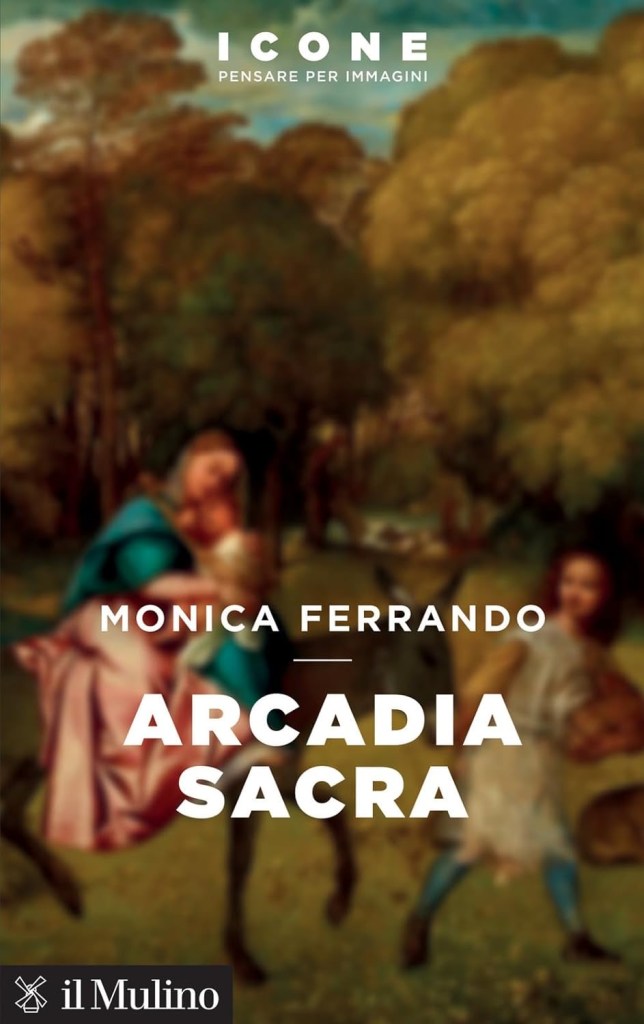
Living among the gods. On Monica Ferrando’s Arcadia Sacra (2024). by Gerardo Muñoz

For anyone familiar with the delicate thought of Monica Ferrando, the short book just published, Arcadia Sacra (Il Molino, 2024), makes it impossible not to read it in light of her the two previous works, the ambitious Il regno errante (Neri Pozza, 2018) that reconstructs the political paradigm of the nomos of Arcadia, and L’elezione e la sua ombra: Il cantico tradito (2022), which brought to light the corrupted meaning of a theopoetic understanding of “election” and its appropriation by an effective economic theology apparatus that governs over the destiny of the modern edifice. Arcadia Sacra continues Ferrando’s highly original reconstruction of the unforgettable myth of Arcadia within the obscure setting of secular  modernization in which painting itself has come into crisis to the point of utter obsolescence. We might be the first epoch in the history of humanity (or even prehistoric, since painting goes back to the non-original origin of the caves, as Ferrando has argued) in which painting itself is lacking and almost non-existent [1]. And although Ferrando does not allude to the present directly, it goes without saying that by choosing as her focal point Titian’s early picture “The Flight into Egypt” (1508), the vision deployed in the essay can only speak to us as urgently, where the thematics confronted by the Renaissance of Venetian painting returns to our present in a fractured flash: imperial conflagration, unlimited deployment of force, usurpation of territory and  multiplication of legal checkpoints, and the accelerated disconnection between architecture and nature, color the ongoing devastation of the vantage point of the landscape now eclipsed by the radiant artificial confinements of the contemporary metropolitan designs.  

Already during his postwar years in the United States, Theodor Adorno observed how the unbounded sadness of the American landscape has nothing to do with an inhuman romantic sublime; it was rather that the landscape feels as if it bears no traces of the human hand [2]. If Americanism configures the long lasting night of planetary nihilism; this is so, not only due to capitalist subsumption and production of human life, but fundamentally because of the inherent obliviousness of the  landscape that forecloses dwelling in the world. But the myth of Arcadia, as Ferrando will insists, is no utopia nor crafted rhetoric (the bucolic genre as an aesthetic compensation to the normative grid of the social bond); it is also the question about the earthly ground of existence, and the necessary attunement with the things that have been domesticated into order of the metaphysics of idolatry and objectivity (Ferrando 28). In this sense, Arcadia does not name another world to come; it is a world that has been registered many times, reappearing whenever the hand reaches out in proximity as if caressing the landscape’s skin.

The mytho-poetical deployment of Arcadia returns amidst a world in conflagration, and for Ferrando this has fundamental political implications insofar as it shows a way out from the grammar at the service of force and political dominion of commanders and soldiers – which is always already exercised as legitimate to coerce and to become a tool for the regulation of abstract mediations – into the voice of poets, painters, and shepherds (Ferrando 51). Arcadia reveals that the human species is a ductile animal that can sense by the ability to touch and use. This is why Arcadia stands as a third space outside the political dichotomy of empire and republicanism, between the struggle of usurpation and conquest, and the techno-political administration of common goods of social distribution and institutional delegation. The abstract humanism of the Renaissance, as Heidegger once claimed alluding to Machiavelli’s political thought, is also the commencement of a specific political technology rooted in certainty and justification that can only conceive representation as the ground for the production of an “effective truth” [3]. The virtuous homini militari of the Italian city states anticipate the neutralization of force as legitimate rule that will prepare the stage of modern political realism based on fear and normative rule of law. The final efficacy of force is to transform the sense of the world into a mere object, as Weil clearly understood it in her essay on Homer’s Iliad. One of the key insights of Ferrando’s Arcadia Sacra (2024) is that it shows that, parallel to the revolution in political technologies taking place in Renaissance Humanism, the image of Arcadia was being rediscovered in treatises and paintings in order to remain faithful to a different attunement of the nomoi, in which the philosophy of history of sacrifice, endless civil wars, and destruction of the Earth do not constitute true destiny (Ferrando 14). In an exoteric way – and it is so, because the craft of the painter is, precisely, depiction and figuration of the nakedness of what appears before our vision-  painters like Titian, Veronese, and Bellini, became witnesses to the acquiescence of the nomos mousikos, which far from soliciting the conceptual density of a theory of Justice; it registered the preeminent condition of poetizing nature of  living in the vanishing world. Indeed, it was in the musical nomos where the soul could establish the communication between exteriority and interiority within the gleaming order of things. 

If Heidegger in The Origin of the Work of Art suggests that the erection of work occupies the open space of this clearing; Ferrando will thematize how Boccaccio’s understanding of the Earth as radiantly divine was drawing upon the tradition of Arcadia will emerge as the pictorial space of the artists to disclose the vibrant sense of a necessary freedom (Ferrando 43). This means that living among the gods is not reducible to panentheism, if understood as oppositional to monotheism; rather, it was the opening to the event that gathered forms of life,  creations,  affections, and territories. In other words, there will always be gods whenever the world is not enclosed into the homogenous surface of a unified planetarity. And is not painting the quasi-originary activity of human anthropogenesis (the event of being in the world as such) the  sensible evidence that negates any conceptual and political translation directed towards action and justification? After all, painting is, among other things, the business of depicting mute things, as Nicolas Poussin famously claimed. 

But muteness must be qualified and expanded, since Arcadia is no asylum or final refuge of man. Titian’s “The Flight into Egypt” depicts a rite of passage, but also opens to a set of rhythmic connected activities that lead to the landscape. Thus, as Monica Ferrando reminds us, building from her previous Il regno errante, Arcadia is also the material experimentation of acoustic energy; music, or the the nomos mousikos, no longer guided by the command of political service, directed by attunement of the lyre and the syrinx, will speak the unwritten language of the human soul. Painting and music convergence at the nonsite of permanent formlessness. And it is rhythmic music allowing improvisation and experimentation that reimagines a different conception of the polis; a transfiguration of political life, in which the principle of civility in all of its complexity (citizenship, objective transference and negation, civilizational fortitude) will no longer articulate the principal axis of the human commonwealth. Neither a source of higher natural law nor a mere expansion of positive norms, the nomos of Arcadia for Ferrando entails: “inalterabile a unire intimamente musica e legge, entrambe  ágrapha, non scritte, se non nel cuore. L’interdipendenza tra modi della musica e nomoi della città, che sarebbe vano interpretare secondo un rapporto causale, trova nella stessa parola nomos un compendio inesauribile, ribadito nella Politeia: «Non si introducono mai cambiamenti nei modi della musica senza che se ne introducano nei più importanti nomoi della polis” (Ferrando 54). The separation of law from music – as Ferrando will say for poetry and philosophy in later pages – will ultimately lead to the moral struggle towards the rise of the fictitious (and whoever can impose it through their effective hegemony) against the emergence of the “love of thought” (l’amore del pensiero) (Ferrando 57). In this sense, the moralization of justice and its conversion into a specific historical grammar (lex scripta in the juridical apparatus) will ground the order of the polis in which the human will be absolutely sacred so that the sacred nearness between existence and the world – the atopia where the promise of happiness can take place – will vanish forever. As Carlo Levi saw clearly during the postwar years, the rise of the political administration of fear will coincide with the decline of painting as the source of being in liberty within the senses [4]. And, in our days, the historical termination of secularization can only be felt like an unending glacial interregnum (it is no surprise that Disney’s epochal blockbuster is precisely a defense of alienation of a cold being in a Frozen castle) in which the prehistoric reminiscence of the garden can only appear as an afterthought or mere representation, always out of reach, and viciously grazed by wild beasts before our own eyes.  

But seeing is already an exercise in prefiguration of a world that returns where painting stands as the medium for a mediation between the formlessness and the soul. This is why, above all, pictorial space is a privileged surface from which to flee our condition of unworldly inmates of our times. In a certain way, painting does not just bring to bear truth against the regime of calamitous fictions; it is also bears witness, as Ferrando states towards a high moment of Arcadia Sacra (2024), to the rediscovery of a new mental space that revives the attunement to a state of the world no longer reduced to the depredatory practices of civilizational extraction and consented servitude (Ferrando 77). The tradition of painting is not just a collection of forms and artistic conventions, but the ongoing concert that facilitates our movement (and being moved) towards happiness.

This is the promise of the itinerant Mary’s passive and inclined face in Titian’s early masterpiece. It does not come to surprise that for Ferrando, the mother dwells among the gods of peace, in contrast to the figures of the commander or the inquisitorial or priestly judge that monitor an endless narrative of intra-species civil war (Ferrando 63). It should not go without saying that at the same time that some contemporary scholars in the face of a historical crisis of legitimation attempt to revive the aura of the homini militari, the precepts of the ragion di stato and the technical virtues of the charismatic Prince; it has been the work of Monica Ferrando, in fully in display in Arcadia Sacra (2024), that invites us to turn to the counters of eros of painting that, almost stubbornly, transmit to us the infinite possibilities of life among the green blades of grass in Pan’s spiritual land (Ferrando 82) [5]. The sacredness of Arcadia resides in this unbounded exteriority that thanks to the mystery of the mother, is always commencing; and, having achieved happiness, it wants to know nothing about bring the world to conclusion. Beneath the arcana imperii (Rome) and the bylaws of the polis (Athens), the landscape of Arcadia remains a harmonious passage of our cohabitation.   

Notes 

1. Monica Ferrando. “Editoriale”, De pictura 3, 2020: https://www.quodlibet.it/rivista/9788822011643 

2. Theodor W. Adorno. Minima Moralia: Reflections on a Damaged Life (Verso, 2005), 73.

3. Martin Heidegger. Acerca de Ernst Jünger (El Hilo de Ariadna, 2013), 113.

4. Carlo Levi. “Paura della pittura” (1942).

5. I am thinking here of the works of several American  historians of political thought and  legal scholars in recent years that have mobilized efforts to restore a “neoclassical”, Renaissance centered political tradition, as a response to the crisis of modern liberalism. The most prominent list includes, although it is not limited to James Hankins’ Virtue Politics: Soulcraft and Statecraft in Renaissance Italy (Harvard U Press, 2020), Harvey Mansfield’s Machiavelli’s Effectual Truth (Cambridge U Press, 2023), and Adrian Vermuele’s endorsement of Renaissance imperial categories such as Ragion di stato, Lex Regia and the tradition of the Mirror of Princes, see his “Sacramental Liberalism and Region di Stato” (2019) and “The Many and the Few: On the American Lex Regia” (2023). The pastiche of this neoclassical investment made possible by rhetorical and hermeneutical deployments of instrumentalized myth, it is something that I have taken note of in “¿Revival de la tradición legal clásica?” (2022). Drawing a parallel to this classical absorption in American political thought, one could say that this is a reiteration of what Monica Ferrando herself has analyzed in her chapter on German Romantic Neoclassicism and the Winckelmann aesthetic project in her L’elezione e la sua ombra. Il cantico tradito (Neri Pozza, 2022), except now that it lacks aesthetic meditations (there is no Dichter als Führer), thus culminating in the direct exercise of applied executive force. 

Virgil in contemporary America. by Gerardo Muñoz

The well-established American Liberal historian of ideas, Mark Lilla, writes in his recent essay “The Once and the Now” an outlandish thesis: “the ideologies of modern fascism are all heirs to the Aeneid.” Any reasonable reaction should start not by disputing the content of such superficial assertion, but rather by raising the central question: what has taken place in America so that this level of intellectual putrefaction and conscious oblivion towards the past could take place, thus becoming permissible and reasonable? From where does the intellectual confidence emerge so that such a lethal rhetorical force can be deployed? At a high paced rate, the United States has become a beacon for an ongoing fascination over “fascism and anti-fascism” to the point of adapting an absolute form of parody in the “serious” forms of culture, academic production, and current event discussions.

Perhaps it is not that difficult to find an answer; and, one can say that once a culture repeatedly defines itself by the parameters of its parodic enactment is precisely a culture that has effectively ceased to exist. Carl Schmitt was up to something when he writes in Glossarium (an entry from 1953) that fascism after the war amounted to the ultimate victory of Stalinism over every other geopolitical actor in the Western world. The Cold War was also a battle for mimetic containment and pacification: the uttermost consummation to the highest case of metonymic endurance. The diffused “cultural war” in America in every symbolic dimensions of life (the media, the university, the political jargon, the legal profession, the community interaction, etc) shows that the victory has now reached definitive and unprecedented heights. It is true that fascism has always triggered a sort of libidinal drive – something that Susan Sontag knew well – in the societal attachment to symbolic production. In this sense there is little new here. But the novelty shows itself if one understands that the rhetoric of fascism has now become autonomous and sine qua non to cultural solvency into nihilism.

If Lilla’s remark caught my attention it is because it fully captures this transformation at the highest levels of the American elite. This transformation is nothing but the essence of Americanism as a fictive rhetorical parody of everything belonging to “Western culture”. This is why, regardless of ideological commitments (or precisely because of them), Americanism is in the business of an active forgetting of the West; while, at the same time, presuming credentials to be its most courageous defender. But it should be clear that Americanism’s defense of the West ultimately means the compulsive expansion of public opinion through a trivialization of the alienability of the past in its own ever-changing image.

In 1935, a short book appeared in Europe penned by Catholic intellectual Theodor Haecker that was entitled Virgil, Father of the West. This essay reminded its readers that culture in Virgil’s Aeneid and Georgics is best understood as the possibility of dwelling in the land through the cultivation of the Eros itself. In fact, Haecker will go on to write that the paradigm of Virgil’s Georgica should remain well into the end of the epoch as a solid commitment to the iustissima tellus against the “mysticism of the machine and the glorification of technology”. Almost a century after, Haecker’s hope in the possibility of cultivating homecoming has literally vanished. To any attentive observer it is clear that American intellectual elites have abdicated their commitment to iustissima tellus, while the marching orders of Americanism, driven by the artificial hells of the Metaverse and planetary conflagration, have already animated the flock through the gate leaving behind nothing but resilient and uninterrupted destruction.

The future of Saint Cassian. by Gerardo Muñoz

There is a painting from the early sixteenth century at the galleries of the University of Bologna that depicts the gruesome death of Saint Cassian of Imola at the hands of his own students. The story goes that Cassian was a fleeing Christian in the Roman Empire who found a teaching position in the town of Imola, until he was discovered and exposed. In the saints’ hagiographies, it is emphasized his passion concerning reading and writing for his students. This would confirm the high price of Cassian’s punishment: torture and death at the hands of young students (some allegedly even brought their sharpened styli). The Bologna painting is, in fact, a miniature of about five by seven inches, and it depicts eight young students striking at a naked and tied up Cassian. The anonymous painter has chosen carefully to have all of the figures turn away from the spectator, except for a student in the far right corner of the painting who seems to be holding a sort of bowl in the air. He seems disengaged from the frenzied mob. And yet, there are no wounds or bruises in Cassian’s body, which could be an allegorical statement by the painter about the martyrdom condition, or, more literally, the plain fact that the cruel feast has just begun. Cassian’s face is monotone, and one of disbelief, but not yet of someone consumed by the ecstasy of bodily suffering. He is definitely humiliated amidst such violent and naked act. This is highlighted by the stage-like setting of the assault, which does not seem to be taking place somewhere outside, but rather in a strange room whose only way out is a dark and ominous black counter to the left side of the painting.

This black square immediately recalls martyrdom. And yes, in modernity this means David’s Death of Marat (1793) floating figure who stands as the secularized martyr at the year zero of modern representation. In the early modern bolognese painting we are far from there, but the resources at the painter’s disposal (myth, depth, and figure) speak to a postreligiousity at the threshold of a new historical time. Strangely, the figure of Saint Cassian as represented here by the anonymous bolognese painter throws a shadow to our present, given that the teacher or professor has been sacrificed, not so much the literal violence of his students, but by the an even greater disposition towards a shameless nakedness driven by value and a complicit abandonment of its mission. In the United States at least, the long dispensation of the “closing of the American mind” – driven by competition, ranking, placement, mentorship, cultural wars, and identity politics – entails the uttermost collapse of the teacher into the administrator and facilitator of a rather unknown enterprise.

Even in 1983 Carl Schmitt could identify the martyrdom of Saint Cassian as an emblem of the professor betrayed by his former students: “I have also been stabbed by my students”, he will confess to Lanchester [1]. So, just four decades ago the teacher could still stand as an object of fidelity and betrayal. It would be hard to make the case for this hypothesis today, since the pain of the teacher is no longer of betrayal, but of indifference insofar as he can be disposed of. In this sense, only something that possesses a certain aura can be said to be betrayed; while something that can be discarded altogether is something that has seen better days and no longer has value. And if universities and schools today have become larger centers of monotony and alienation of the most basic activities (such as discussion, reading and writing), this is because both students and professors have been, for the most part, replaced by “mentors” and consumers” under the holy contract of hypocrisy, the true and last ethics of the enlightened metropolitan class.

Anyone that has ever had the good fortune to encounter a good teacher or professor will know that his example springs not from what he knows or professes to know, but rather from what he can transpire unto others: to search of a form of one’s own path. The ethos of a teacher has little do with specialization or success, and everything to the incarnation of a gestalt that is not accidental or transient, but perpetually springing from its myth, as Carchia suggested for the work of art [2]. And myth is the sensorial mediation that resists to be instrumentalized into the endless amassing of value by the powerful administrative subjects. This amounts to saying that the teacher finds self-legitimization in its capacity to inspire the shared sense of wonder of the inaccessible.

Or, at least, this has been the teacher at its most groundbreaking moments. The eradication of teaching – which like mostly every other area foreclosed by the crisis of the human experience was unveiled during the years of the pandemic – and its complete abdication to models of “leadership” and “training” (under the fictitious rubric of the syllabus as an economic contract) is the bleakest of the futures that Cassiano could have taken. A nihilist future that, it goes without saying, will be void of martyrs and myths.

.

.

Notes 

1. Carl Schmitt. “Un jurista frente a sí mismo: entrevista de Fulco Lanchester a Carl Schmitt”, CSS, 1, 2017, 220.  

2. Gianni Carchia. Il mito in pittura: la tradizione come critica (Celuc Libri, 1987), 155.