Thrasymachus, the paradigm of force. by Gerardo Muñoz

Few characters are more memorable in the first book of Plato’s The Republic than the sophist Thrasymachus, whose shadow is still very much looming around us given that it is obvious that today everything in our contemporary world is optimized through force. Thrasymachus’s strict identification of reserve power (potentia) with justice (ius) is in many respects prophetic, since it already subordinates the ideal of justice with practical reason and effective norms, a crowning achievement of modern political power. This is why Leo Strauss could claim in The City and Man that Thrasymachus’ position is ultimately a defense of the thesis of “legal positivism” that brings to fruition the legitimate order and the police powers of the city. In other words, Thrasymachus discovered that the requirements for the permanence of an active social order of a police entails the mediation of the two dimensions of legal authority: obedience and the internal recognition of a secondary rule that liquidates the possibility of raising the question of what is “just” (now internal to the organization of internal powers). If the aim of “justice” becomes the optimal application of effective rules and norms that provide the services of the city, then political rule becomes an infallible and uncontested logic. Politics is ultimately force, and force is the energy organized by politics in the city. 

As Strauss writes: “Thrasymachus acts like the city, he resembles the city, and this means according to a way reasonably acceptable to both…Thrasymachus is the city. It is because he is the city that he maintains the thesis of the city regarding justice and that he is angry at Socrates for his antagonism to the thesis of the city. Thrasymachus’ rhetoric was especially concerned with both arousing and appeasing the angry passions of the multitude, with both attacking a man’s character and counteracting such attacks, as well as with play-acting as an ingredient of oratory” [1]. Well before the general equivalent of contractual commercial relations, Thrasymachus’ rhetorical deployment functioned as a techne alupias against the unwarranted passions of human beings. And, contrary to the common opinion that separates the craft of sophistry from the unity of rational discourse (logos), Thrasymachus’ defense of force presupposes the autonomy of language in the rhetorical construction (very much like modern poetry centuries later) to serve as the hospice of rational pondering in the polis. To make language the exclusive battle ground: even in antiquity it was said of Thrasymachus, “you are just like your name, bold in battle”. And Plato wanted to hold on to this picture. This ultimately means – and it is still at the center of our contemporary predicament – that the coming of the “Social man” in the city is only possible on the condition of a primary transformation of the event of language and the speaking being. This is why if Thrasymachus was the “pioneer of rhetoric and elocution”, as it has been claimed, it is only because his appeal to the pragmatics of political power was mediated by the invention of the ‘mystery of the prose style’; that is, of reducing the non-grammatical mediation to the orderability of a prose adjusted as an instrument to the world [2]. The enslavement of the passions is the commencement of the social prose in which we are forced to act in our alienated roles.

Only when language becomes rhetorical communication it is possible to grasp the world as a case of an entity of legibility and knowability, where reasons (inclusive and exclusive, that is, as what can be delegated for my own interests) and political rule converge without residue. What will become obvious through the cybernetic dominion over “information”, it was first elaborated as the pressure of rhetoric where the logical force of predication took its force to disclaim myth as the unappropriated experience of worldly phenomena. The art of rhetoric does not render “truth” obsolete; it rather incorporates theoretical and systemic deductions – a flattening of logos without myth -, so that the event of truth can no longer stand as the unsurveyed horizon of the intelligibility [3]. The consolidation of force means this much: that Thrasymachus’ prose of the world is not just an exclusive political program of the “fictitious”, as much as a program for the total attainability of the world; a world that by becoming fully accessible and objective, it pays the high price of eclipsing the presence of things, and the event of truth and naming in language. A world without kallipolis that will only distribute and perpetuate ad infinitum injustice as the corollary for the triumph of immanence of force.

Notes 

1. Leo Strauss. The City and Man (University of Chicago Press, 1964), 78.

2. Bromley Smith. “Thrasymachus: a pioneer rhetorician”, Quarterly Journal of Speech, 1927.

3. Gianni Carchia. “La persuasión y la retórica de los sofistas”, in Retórica de lo sublime (Tecnos, 1994), 60.

Politics as our passion? by Gerardo Muñoz

Philippe Theophanidis has recently brought to my attention an emphatic statement in Dionys Mascolo’s Lettre polonaise sur la misère intellectuelle en France (1957): “La politique est notre passion. Nous en parlons, ne faisons que cela, et tout l’ennui du monde est dans ces dialogues-disputes, dans cette démarche perpétuellement contentieuse qui donne envie de s’occuper de n’importe quoi d’autre, de plaisanter, de se taire, de s’en aller” [1]. These are intense words not entirely divorced from a deep sense of desperation entangled with a commitment to realism – minimally understood as bringing into thought how things looked at the time. In a recent collaborative introduction to the writing scene of this group (preliminary work towards an upcoming seminar) – which included Mascolo, but also Duras, Vittorini, Blanchot, and other continental friends – we took into consideration how the heterogeneous and internal tensions were brought into bear in the effort to connect the creative act to the existential texture of communication and concrete world events [2]. 

Mascolo’s statement must be read as historically marked and situated, as who today could claim that “politics”, however broadly or loosely understood, is the exclusive “object” of our passion? Mascolo seems to have been aware of the subordination of passion into politics, leading to dialogues and disputes where nothing could facilitate the clearing of a way out. When politics becomes the final object of one’s passion it could only mean that the reign of chatter has liquidated our experience with the world. And it is at this point where the ‘missing word’ that attunes the search for one’s passion can regress as nihilism; that is, as mere force to steer rhetorical valence and representational exchange within the expansive intramural rules of civil society. Restricting one’s passion to the determination of politics merely inverts the order of modern legitimacy (i.e. the repression of passions by the interests), compressing both terms as a higher principle of politics. 

If at the outset of modernity contractualism suppressed the passions in exchange for sovereign security from the fear of violent death; in the attempt to elevate the passion to the grammatical height of politics, what is rendered obsolete is precisely the possibility of securing an existential site of freedom outside and beyond politics, that is, in the the nonplace of the passion itself. Of course, one could also read Mascolo’s apothegm in light of his revolutionary politics, in which the name of “politics” solicited the revolutionary emancipation of the civilizational alienation of the human species towards a transformative sequence beyond the scarcity of needs. But the problem of the category of revolution is that it remains tied to the very development of the legitimacy of the political and its erosion (for Edward Gibbon in Decline and Fall of the Roman Empire the configuration of the state is the crowning revolutionary event against disorderly barbarism), which the members of the Saint-Benoît Group were first hand witnesses in the postwar epoch.

I think this speaks to my suggestion that the assertion ‘politics is our passion’ was historically embedded; a sort of last breath of trying to hold onto the utopia that will soon crumble in every active paradigm of planetary order (postcolonial, Soviet state planning, European communism and social democracy). But at least – and this is what remains of interest, as I see it – the Rue Saint-Benoît friends had the courage to confront it in order to enact a farewell to the very assumption of ‘revolution’, which already in 1968 was clearly moot. In the words of Maurice Blanchot after the events of 1968: “…but from now on I will hold onto an exigency: to become fully conscious, and always anew, that we are at the end of history, so that most of our inherited notions, beginning with the one from the revolutionary tradition, must be revised and, as such, refuted. […]. Let us put everything into question, including our own certainties and verbal hopes. The revolution is behind us: it is already an object of consumption and, occasionally, of enjoyment. But what is before us, and it is terrible, does not have a name” [3]. Thus, to conflate “politics” as the passion could no longer offer solid ground in the intra-epochal interregnum of suspended historical time. Just a few years later, Duras will claim that politics had little to offer, since there is an “absolute equivalence between all political programs, and only right ideology seems to be able to do politics as such. We no longer believe in politics…there is only a burrow of hope. We must submit ourselves to the hard evidence of its total degradation” [4]. To dwell in a delimited burrow means a return to the rooting of place and new geographies beyond the temporal axis.

One can read both Duras and Blanchot’s elucidations of the collapse of modern politics and its negation (the ius revolutionis) as a corrective posture to move past Mascolo’s hope to make the unfathomable texture of one’s passion coincide with the object of a political project, even if understood as an archipolitics. But it is precisely in the abyss opened by a terrible and nameless epoch that a new light is casted on the free-standing and ungraspable nature of the passion; the irreducible law that establishes a contact between the ethical life and the world beyond objectivation as both excess and deficit of the tribulations of political order. Perhaps a modification to Mascolo’s thesis is now necessary: passion is what escapes every possible fall into the objective world, and for this very reason it is a ‘refusal’ of what the compensatory bond of politics can offer under the sermo humilis of stagnant artificial utopias. There is no political passion just like there is no political friend, since both friendship and one’s passion remains always objectless, only mediated by the overcoming of the preconditions of fear and of delegated life. In Manuale di sopravvivenza (1974), Giorgio Cesarano will claim that passion was the name of the coming historical program of a sensible presence resisting the “annihilating force of social objectivation” of the world [5]. And the Italian poet will define the passion as the sacred taking possession of the return to appearance. A transformation of politics could only emerge after one’s passion could finally prevail experientially against the terrible and nameless (and unnamed) world organized towards planned obsolescence and generalized humiliation. And it goes without saying that we are still very much our predicament. The caesura between passion and politics has now become spectacularly absolute and irreversible.

Notes 

1.  Dionys Mascolo. Lettre polonaise sur la misère intellectuelle en France (Éditions de minuit, 1957).

2. Gerardo Muñoz & Philippe Theophanidis. “¿Por qué volver a la Rue Saint-Benoît? Conversación sobre un seminario, Ficción de la razón, February 2024: https://ficciondelarazon.org/2024/02/26/gerardo-munoz-y-philippe-theophanidis-por-que-volver-a-la-rue-saint-benoit-conversacion-sobre-un-seminario/ 

3. Maurice Blanchot. “On the Movement” (1968), in Political Writings 1953-1993 (Fordham University Press, 2010), 109. 

4. Marguerite Duras. “Entrevista en A Fondo” (1979): https://www.youtube.com/watch?v=XmnVBenAoyw

5. Giorgio Cesarano. Manual de supervivencia (Kaxilda, La Cebra, 2023), 75. 

Tradition according to Wallace Stevens. by Gerardo Muñoz

The fact that there is a continuous and secret communication between painting and tradition is something that has been registered in the genesis of myth well into aesthetic autonomy of modernity and the artificious equivalence of difference that regulates the temporal caducity of the new [1]. In a specific sense, the crisis of tradition in the contingency of the modern has the activity of painting as a privileged site because it holds the outside together in a perpetual unveiling; as if the human species were permanently exiting the shadows of the cave every time a hand strokes an animated brush over a surface. Painting clears the site of the inaccessible so that true life can emerge without the crutches of incorporated scripts of social organization. But what could it mean to think of ‘tradition’ in a painterly manner? In a poem of 1945, unequivocally entitled “Tradition”, Wallace Stevens seems to offer a response and an outlook for our consideration. 

In a conversationalist style, Stevens thinks that tradition is an uncontrolled question insofar as it can only be assessed through poetic form. Of course, for Stevens the character of tradition could not be grasped neither in a compilation of well delineated forms nor detailed through “a set of laws…to identify it is not tradition” [2]. As it was for Hölderlin’s practice relation to Greek antiquity, tradition is something that is always missed or unfulfilled from its uttermost strangeness. It is, as he asks in the fifth stanza “an unfamiliar sum, a legend scrawled in a script we cannot read?” [3]. The illegible transcription of what is passed as tradition holds to the incommensurability between what remains unfamiliar and what is already familiar and perceptible. We must resist the attempt at disambiguation, since any relation to tradition must be anachronistic as Nicoletta Di Vita has suggested [4]. Thus, for Stevens “tradition is always near”, at hand. And the hand calls forth the mystery of painting. It keeps a world at the threshold of the verbal. The placement of nearness, however, will be on the side of formlessness that characterizes the genesis of one’s existence. In other words, the true task of approaching tradition is neither at the level of the construction of forms nor about the analogical pairing of historical evolution; it is the painterly relationship between life and the experience in the world that precedes and outlives the time of life. This is what Stevens will denote a “ascending the Humane”; meaning a life qualified by fulfilling the adventure of a destiny that is capable of addressing the outside. In the most emphatic verses of “Tradition”, Stevens shows his absolute nearness to what he has in mind: 

“Ascending the humane. This is the form 

Tradition wears, the clear, the single form,

The solid shape, Aenas seen, perhaps,

By Nicolas Poussin, yet nevertheless 

A tall figure upright in a giant’s air.” [5]. 

The use of “form” in the first verse is most definitely mischievous, but it is also the playful ambiguity that Stevens wants to bring to our attention. One way to read it is to circle back to the sense in which the painterly becomes the utile passage between life and world. After all, tradition “wears” the dress of nature, although this is only facilitated by the sensible activity of painting. Exactly a decade later in the essay “The Whole Man” (1955), and speaking directly to the rise of cybernetics and technico-political technicians that had consolidated their mastery over the events of the world, Stevens will suggest that “Modern art often seems to be an attempt to bridge the gap between facts and miracle…to succeed in doing this, if it can be done at all, seems to be exclusively the task of the specialist, that is to say, of the painter” [6]. Why the painter and not the poet? At a very general level, the two figures are interchangeable; however, if one takes the painterly mediation, it becomes possible to claim that painting has a more subtle expressive footing in showing the nearness of tradition.

Painting is the non-language that  gathers the formless tune of tradition: “The vigor of art perpetuates itself through generations of form. But if the vigor of art is itself formless, and since it is merely a principle it must be, its form comes from those in whom the principle is active, so that generations of form come from generations of men. The all-round man is certain to scrutinize form as he scrutinizes men, that is to say, in relation to all past forms” [7]. Thus, for Stevens the possible tradition is that which creates a space in which a new life can take place in the world attentive to the transmission of forms. Of course, not any world, but to “live in the world but outside of existing conceptions of it” [8]. This is why Steevns will differentiate between two modalities of the task of poetry: the poetry of rhetoric and the poetry of experience; favoring the second because of how it folds our existence within the given order of space and time. 

Is not painting, precisely, a frozen instant in the spatial and temporal coherence that reveals, in turn, a hidden harmony that never fully coincides with nature nor stands in opposition to it? [9]. This is why “tradition wears” but it is also the transitory body of Aenas, which Stvevens inserts in the poem as a matter of ut pictura poesis in relation to Nicolas Poussin’s “Venus presenting arms to Aenas” (1639), which is ultimately the story of the persuasion unto one’s destiny. As it is well known, Poussin captures in a sequence Aenas being directed to his destiny invested in the arms of war. But where is destiny embodied for Stevens? Is it in the gesticulating figure of Aenas or in floating Venus that occupies the central sky of the landscape? It is almost as if Stevens acquired, as Walter Friedlander said of late Poussin, a “sublime vagueness” in visibility of the inner workings of imagination drifted from the physical imbalance of the activity of imitation [10]. 

After all, for Stevens Poussin stood precisely as the source of partition and the miniscule, confirming the primacy of “imagination” against the rhetorical compression that renders legible the modern abstraction [11]. Following André Gide who had had written on Poussin’s work, Stevens repeats without any elaboration that Poussin is to be taken “little by little” (peu à peu), so that only then its pictorial absorption can unfold against what at first sight appears as a theatrical and self-enclosed translucid stage. This is the distant ‘traditionalism’ that Stevens wanted to reject if the work of art was to endure, and still have the vigor to generate a tranquil and peaceful state of mind solicited by the late Poussin. Painting could only be expressed as a ‘mode’ — which for Poussin stood for moderation and restraint, but more importantly as the condition of a certain sensible order “by which the thing keeps itself in existence” both firmly and invisibly, that is, beyond enunciation [12]. Otherwise, as Gerald Cohen once claimed, tradition becomes the thing that you can only hold on to when it has relaxed its hold on you ceasing to color the genesis of life [13]. And while tradition cannot be fully absorbed by rules or forms of pictorial depiction, it does retain the “good that we have loved”, dispensing a noeud vital in which the divine (theos) disengages us from the compression of objective reality and into the nearness of the eternal. This is the integrity of painting that allows Stevens to proclaim the ascendance of the supreme human “good”: tradition is kept alive by the soul of an erotic deification. After all, “God and imagination are one” Stevens will suggest in the fragments of Adagia [14]. Against the edifice of sedimentation and rupture, repetition and originality, possession and abstraction; tradition will name the disembodied genesis of appearing between things in a “reflected seeming-so”. 

Notes 

1. Gianni Carchia. “Per un’estetica dellainvecchiato”, in Dario Lanzardo, Dame e cavalieri nel Balon di Torino (Mondadori, 1984).

2. Wallace Stevens. “Tradition”, in Collected Poetry and Prose (Library of America, 1997), 595-596

3. Ibid., 595.

4. Nicoletta Di Vita. Il nome e la voce (Neri Pozza, 2022), 28.

5. Ibid., 596.

6. Wallace Stevens. “The Whole Man: Perspectives, Horizons”, in Collected Poetry and Prose (Library of America, 1997), 874.

7. Ibid., 875. 

8. Wallace Stevens. “From Adagia”, in Collected Poetry and Prose (Library of America, 1997), 904. 

9. Monica Ferrando. “L’ultimo quadro di Poussin”, in L’oro e le ombre (Quodlibet, 2015), 82.

10. Walter Friedlander. Nicolas Poussin: A New Approach (Harry Abrams, 1964), 82.

11. Wallace Stevens. “Tradition”, in Collected Poetry and Prose (Library of America, 1997), 737.

12. Cited in Étienne Gilson’s Painting and Reality (Cluny Media, 2020), 173. 

13. G. A. Cohen. “Rescuing Conservatism: A Defense of Existing Value”, in Finding oneself in the other (Princeton U Press, 2013), 155.

14. Wallace Stevens. “From Adagia”, in Collected Poetry and Prose (Library of America, 1997), 914. 

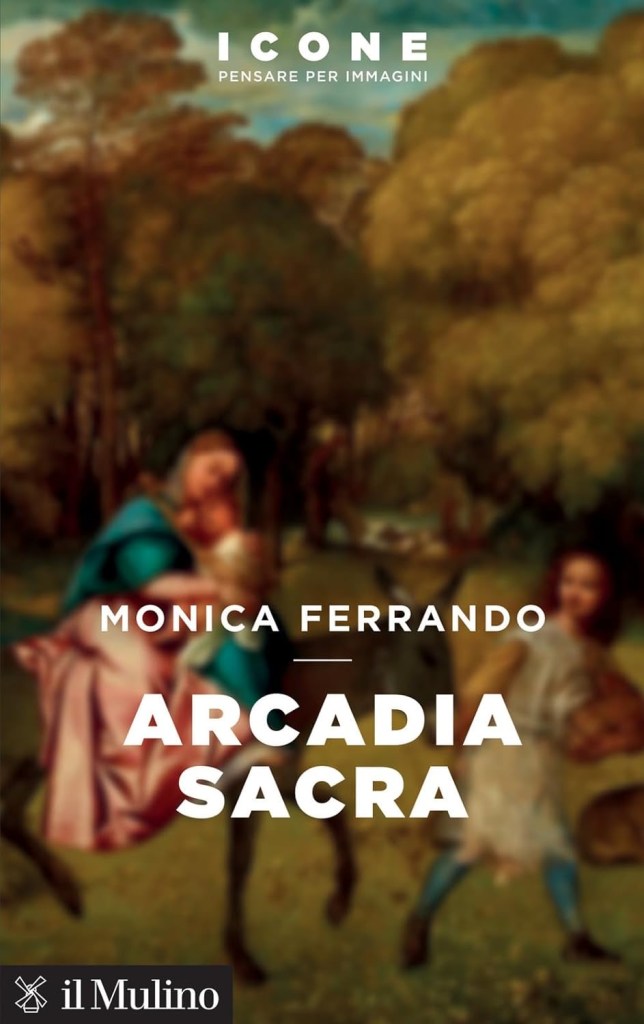
Living among the gods. On Monica Ferrando’s Arcadia Sacra (2024). by Gerardo Muñoz

For anyone familiar with the delicate thought of Monica Ferrando, the short book just published, Arcadia Sacra (Il Molino, 2024), makes it impossible not to read it in light of her the two previous works, the ambitious Il regno errante (Neri Pozza, 2018) that reconstructs the political paradigm of the nomos of Arcadia, and L’elezione e la sua ombra: Il cantico tradito (2022), which brought to light the corrupted meaning of a theopoetic understanding of “election” and its appropriation by an effective economic theology apparatus that governs over the destiny of the modern edifice. Arcadia Sacra continues Ferrando’s highly original reconstruction of the unforgettable myth of Arcadia within the obscure setting of secular  modernization in which painting itself has come into crisis to the point of utter obsolescence. We might be the first epoch in the history of humanity (or even prehistoric, since painting goes back to the non-original origin of the caves, as Ferrando has argued) in which painting itself is lacking and almost non-existent [1]. And although Ferrando does not allude to the present directly, it goes without saying that by choosing as her focal point Titian’s early picture “The Flight into Egypt” (1508), the vision deployed in the essay can only speak to us as urgently, where the thematics confronted by the Renaissance of Venetian painting returns to our present in a fractured flash: imperial conflagration, unlimited deployment of force, usurpation of territory and  multiplication of legal checkpoints, and the accelerated disconnection between architecture and nature, color the ongoing devastation of the vantage point of the landscape now eclipsed by the radiant artificial confinements of the contemporary metropolitan designs.  

Already during his postwar years in the United States, Theodor Adorno observed how the unbounded sadness of the American landscape has nothing to do with an inhuman romantic sublime; it was rather that the landscape feels as if it bears no traces of the human hand [2]. If Americanism configures the long lasting night of planetary nihilism; this is so, not only due to capitalist subsumption and production of human life, but fundamentally because of the inherent obliviousness of the  landscape that forecloses dwelling in the world. But the myth of Arcadia, as Ferrando will insists, is no utopia nor crafted rhetoric (the bucolic genre as an aesthetic compensation to the normative grid of the social bond); it is also the question about the earthly ground of existence, and the necessary attunement with the things that have been domesticated into order of the metaphysics of idolatry and objectivity (Ferrando 28). In this sense, Arcadia does not name another world to come; it is a world that has been registered many times, reappearing whenever the hand reaches out in proximity as if caressing the landscape’s skin.

The mytho-poetical deployment of Arcadia returns amidst a world in conflagration, and for Ferrando this has fundamental political implications insofar as it shows a way out from the grammar at the service of force and political dominion of commanders and soldiers – which is always already exercised as legitimate to coerce and to become a tool for the regulation of abstract mediations – into the voice of poets, painters, and shepherds (Ferrando 51). Arcadia reveals that the human species is a ductile animal that can sense by the ability to touch and use. This is why Arcadia stands as a third space outside the political dichotomy of empire and republicanism, between the struggle of usurpation and conquest, and the techno-political administration of common goods of social distribution and institutional delegation. The abstract humanism of the Renaissance, as Heidegger once claimed alluding to Machiavelli’s political thought, is also the commencement of a specific political technology rooted in certainty and justification that can only conceive representation as the ground for the production of an “effective truth” [3]. The virtuous homini militari of the Italian city states anticipate the neutralization of force as legitimate rule that will prepare the stage of modern political realism based on fear and normative rule of law. The final efficacy of force is to transform the sense of the world into a mere object, as Weil clearly understood it in her essay on Homer’s Iliad. One of the key insights of Ferrando’s Arcadia Sacra (2024) is that it shows that, parallel to the revolution in political technologies taking place in Renaissance Humanism, the image of Arcadia was being rediscovered in treatises and paintings in order to remain faithful to a different attunement of the nomoi, in which the philosophy of history of sacrifice, endless civil wars, and destruction of the Earth do not constitute true destiny (Ferrando 14). In an exoteric way – and it is so, because the craft of the painter is, precisely, depiction and figuration of the nakedness of what appears before our vision-  painters like Titian, Veronese, and Bellini, became witnesses to the acquiescence of the nomos mousikos, which far from soliciting the conceptual density of a theory of Justice; it registered the preeminent condition of poetizing nature of  living in the vanishing world. Indeed, it was in the musical nomos where the soul could establish the communication between exteriority and interiority within the gleaming order of things. 

If Heidegger in The Origin of the Work of Art suggests that the erection of work occupies the open space of this clearing; Ferrando will thematize how Boccaccio’s understanding of the Earth as radiantly divine was drawing upon the tradition of Arcadia will emerge as the pictorial space of the artists to disclose the vibrant sense of a necessary freedom (Ferrando 43). This means that living among the gods is not reducible to panentheism, if understood as oppositional to monotheism; rather, it was the opening to the event that gathered forms of life,  creations,  affections, and territories. In other words, there will always be gods whenever the world is not enclosed into the homogenous surface of a unified planetarity. And is not painting the quasi-originary activity of human anthropogenesis (the event of being in the world as such) the  sensible evidence that negates any conceptual and political translation directed towards action and justification? After all, painting is, among other things, the business of depicting mute things, as Nicolas Poussin famously claimed. 

But muteness must be qualified and expanded, since Arcadia is no asylum or final refuge of man. Titian’s “The Flight into Egypt” depicts a rite of passage, but also opens to a set of rhythmic connected activities that lead to the landscape. Thus, as Monica Ferrando reminds us, building from her previous Il regno errante, Arcadia is also the material experimentation of acoustic energy; music, or the the nomos mousikos, no longer guided by the command of political service, directed by attunement of the lyre and the syrinx, will speak the unwritten language of the human soul. Painting and music convergence at the nonsite of permanent formlessness. And it is rhythmic music allowing improvisation and experimentation that reimagines a different conception of the polis; a transfiguration of political life, in which the principle of civility in all of its complexity (citizenship, objective transference and negation, civilizational fortitude) will no longer articulate the principal axis of the human commonwealth. Neither a source of higher natural law nor a mere expansion of positive norms, the nomos of Arcadia for Ferrando entails: “inalterabile a unire intimamente musica e legge, entrambe  ágrapha, non scritte, se non nel cuore. L’interdipendenza tra modi della musica e nomoi della città, che sarebbe vano interpretare secondo un rapporto causale, trova nella stessa parola nomos un compendio inesauribile, ribadito nella Politeia: «Non si introducono mai cambiamenti nei modi della musica senza che se ne introducano nei più importanti nomoi della polis” (Ferrando 54). The separation of law from music – as Ferrando will say for poetry and philosophy in later pages – will ultimately lead to the moral struggle towards the rise of the fictitious (and whoever can impose it through their effective hegemony) against the emergence of the “love of thought” (l’amore del pensiero) (Ferrando 57). In this sense, the moralization of justice and its conversion into a specific historical grammar (lex scripta in the juridical apparatus) will ground the order of the polis in which the human will be absolutely sacred so that the sacred nearness between existence and the world – the atopia where the promise of happiness can take place – will vanish forever. As Carlo Levi saw clearly during the postwar years, the rise of the political administration of fear will coincide with the decline of painting as the source of being in liberty within the senses [4]. And, in our days, the historical termination of secularization can only be felt like an unending glacial interregnum (it is no surprise that Disney’s epochal blockbuster is precisely a defense of alienation of a cold being in a Frozen castle) in which the prehistoric reminiscence of the garden can only appear as an afterthought or mere representation, always out of reach, and viciously grazed by wild beasts before our own eyes.  

But seeing is already an exercise in prefiguration of a world that returns where painting stands as the medium for a mediation between the formlessness and the soul. This is why, above all, pictorial space is a privileged surface from which to flee our condition of unworldly inmates of our times. In a certain way, painting does not just bring to bear truth against the regime of calamitous fictions; it is also bears witness, as Ferrando states towards a high moment of Arcadia Sacra (2024), to the rediscovery of a new mental space that revives the attunement to a state of the world no longer reduced to the depredatory practices of civilizational extraction and consented servitude (Ferrando 77). The tradition of painting is not just a collection of forms and artistic conventions, but the ongoing concert that facilitates our movement (and being moved) towards happiness.

This is the promise of the itinerant Mary’s passive and inclined face in Titian’s early masterpiece. It does not come to surprise that for Ferrando, the mother dwells among the gods of peace, in contrast to the figures of the commander or the inquisitorial or priestly judge that monitor an endless narrative of intra-species civil war (Ferrando 63). It should not go without saying that at the same time that some contemporary scholars in the face of a historical crisis of legitimation attempt to revive the aura of the homini militari, the precepts of the ragion di stato and the technical virtues of the charismatic Prince; it has been the work of Monica Ferrando, in fully in display in Arcadia Sacra (2024), that invites us to turn to the counters of eros of painting that, almost stubbornly, transmit to us the infinite possibilities of life among the green blades of grass in Pan’s spiritual land (Ferrando 82) [5]. The sacredness of Arcadia resides in this unbounded exteriority that thanks to the mystery of the mother, is always commencing; and, having achieved happiness, it wants to know nothing about bring the world to conclusion. Beneath the arcana imperii (Rome) and the bylaws of the polis (Athens), the landscape of Arcadia remains a harmonious passage of our cohabitation.   

Notes 

1. Monica Ferrando. “Editoriale”, De pictura 3, 2020: https://www.quodlibet.it/rivista/9788822011643 

2. Theodor W. Adorno. Minima Moralia: Reflections on a Damaged Life (Verso, 2005), 73.

3. Martin Heidegger. Acerca de Ernst Jünger (El Hilo de Ariadna, 2013), 113.

4. Carlo Levi. “Paura della pittura” (1942).

5. I am thinking here of the works of several American  historians of political thought and  legal scholars in recent years that have mobilized efforts to restore a “neoclassical”, Renaissance centered political tradition, as a response to the crisis of modern liberalism. The most prominent list includes, although it is not limited to James Hankins’ Virtue Politics: Soulcraft and Statecraft in Renaissance Italy (Harvard U Press, 2020), Harvey Mansfield’s Machiavelli’s Effectual Truth (Cambridge U Press, 2023), and Adrian Vermuele’s endorsement of Renaissance imperial categories such as Ragion di stato, Lex Regia and the tradition of the Mirror of Princes, see his “Sacramental Liberalism and Region di Stato” (2019) and “The Many and the Few: On the American Lex Regia” (2023). The pastiche of this neoclassical investment made possible by rhetorical and hermeneutical deployments of instrumentalized myth, it is something that I have taken note of in “¿Revival de la tradición legal clásica?” (2022). Drawing a parallel to this classical absorption in American political thought, one could say that this is a reiteration of what Monica Ferrando herself has analyzed in her chapter on German Romantic Neoclassicism and the Winckelmann aesthetic project in her L’elezione e la sua ombra. Il cantico tradito (Neri Pozza, 2022), except now that it lacks aesthetic meditations (there is no Dichter als Führer), thus culminating in the direct exercise of applied executive force. 

In search of an adventure. Commentary on Marguerite Duras’ The Little Horses of Tarquinia (1953). by Gerardo Muñoz

It is not until the last third part of Marguerite Duras’ The Little Horses of Tarquinia (1953) when the reader encounters a mention to the Etruscan relic alluded by Jacques, one of the characters in the circle of friends that vacation in Italy, who passes the days drinking ‘bitter camparis’ and complaining about the nauseating and scorching presence of the summer heat. And if it were not for the title of the novel the reader could easily dismiss it as a contingent regional reference: “I looked at the map last night…After leaving Rome, I could stop at Tarquinia to see Ludi’s little Etruscan horses. After all the time he has been bending our ears about them” [1]. The ‘little horses’ are brought out a few pages before the end of the novel where Ludi, their Italian friend, goes back and forth whether to go and show them the horses figurines or not. It goes without saying that it would be an enormous distaste to press on the Etruscan reference for any deeper meaning, or to claim that Duras deployed the ancient piece as a tongue in cheek symbol for the bunch of friends roaming around the beach shores. It clarifies very little or too much as an generic reading hypothesis.

In any case, what is relevant is that their trip to encounter the horses of Tarquinia never takes place stressing the real lacuna of the narrative, which is not so much paying a visit to an ancient civilization, as much as underlying a possibility, an afterthought, a pulsating desire towards its displacement; or, in a way, the outside of life that part of the real texture of existence. A reminder that life (a happier life?) is always somewhere else, and definitely away from the excruciating heat of an Italian summer in which no compensatory activity (drinking campari, chatter among friends, having food, meeting new faces) can wrestle the desire for exodus. In The Little Horses of Tarquinia (1953) very little happens in terms of the organization of the narrative, and that is precisely because the domain of the possible might have been Duras’ central commitment when writing the novel: nothing will happen, not even the fleeting thought of paying the visit to the tombs of the Etruscans. Thus, the heavy weight of a narrative without events opens the incandescent proximity between life and nihilism in a strangely accommodating setting. It is summer after all, which means tranquil life of boredom, repetition, serene gazing, and the monotonous. Children catching lizards or sleeping through the night, and very little else.

According to Laure Adler, Duras’ sea novels (The Sea Wall, Gibraltar, Little Horses) wanted to persist “in search of an adventure. But afterwards everything comes together to form a whole” [2]. This holds true only at a very rudimentary and superficial level, but it does not hold to any serious scrutiny. The Little Horses of Tarquinia (1953) is a novel in which the writing of adventure takes a very specific form: life detached from the event of the adventure. This is the reason why the adventure is not only missing from the sequence of contingent incidents, but rather it is alien to the character; as if the radical separation from character and destiny would be transplanted into a self-reflective consciousness arrested in time and space. The adventure at the closure of modern sensibility and its dialectical valence around a “worldview” is precisely that there is a coming to presence of the fact of this poverty of adventure has become its uttermost inexistence: “For a long time I had bright colored dreams of imaginary cities, where I could do what I liked, and look for adventure. But the dreams were not enough, and no I’ve turned a little mean” [3].

The end of the texture of adventure between world and existence marks the commencement of the self-autonomous subject that can narrativize the concrete order of his dreams precisely because he is convinced that they will never be accomplished in this world. After all, as Lukács claims in his Soul and Form, the adventure is no epic for epic’s sake, but a “communion of feeling, of experience, an infinitely powerful experience of the world’s many colored richness expressed in a varied series of endless adventures” [4]. In the adventure one freely becomes who one will be. Hence, the adventure named the freedom of sensible experience between language and world, coming to near convergence only so that its final separation could set to start the inconspicuous ethos of life. In this sense, the longing for adventure in Duras’ The Little Horses of Tarquinia could be said to allegorize the chattering of experience, whose tiny pieces are ultimately picked up by the synthetic apprehension of the dialogue of chatter among friends. The empty chatter takes place once the path of language as transformative of a life becomes separated from the course of the human species. The extreme comedy of the rhetorical dialogue is that it functions as a cure for the abyss of its own separation from life.

Hence, the “dia-logos” ends up suturing that dregs of the fictitious waste required to translate the language of meaning (logos) into practical action at the expense of a life that begins to move, inadvertently, across a groundless world [5]. This is why the central character in The Little Horses of Tarquinia (1953) calls the boundless dialogue that they are engaged in as “a confusion of voices…from open windows, and was dissipated in the sunshine” [6]. It is not that there is never continuity between what is being said; rather, it is that dialogue is always a re-statement of either the case, the command or the subjective piety that in the suppression of real pain proper to a alienated life can only engage in the melodramatic gossip over the accessories of life. In other words, dialogic communication can only speak in the name of quotidian vulgarity. Language becomes, as Duras writes in one of the most memorable lines of the novel: “an endless chain of reciprocal waiting” [7]. It does not take much to apprehend at this point the signifier rotation in every dialogue. Waiting, but towards what? The waiting is eternal and illusionary, since the capture into the sedentary surplus of “dialogue” has already taken you to the final destination where everything is sufficient; what remains is the generalized effect of unhappy consciousness from the irrevocable sense of abstraction.

The expressivity of the dialogues of the French bourgeoisie of The Little Horses of Tarquinia (1953) was already the indication that their wordlessness differs a whole lot from the musical infraworld of the Etruscans horses and tombs. Yes, something very precious was lost once civilization becomes entangled with the infinite realization of a schizophrenic subject that is the effect of endless chattering and utterly silence. In other words, the character of The Little Horses of Tarquinia (1953) talk quite a lot – they never stop talking – but they are not towards a path of language in search for a missing word that marks every true adventure. And this is the adventure where thought and language bind with one another in search for the unfathomable exteriority that is always unknown. And we know that for Duras the encounter with exteriority is the imprint of intelligence, the coefficient of real and enduring thinking. As one of the characters says at one point: “Possibly it may be that there is nothing that cuts one off from the unknown so much as friendship” [8]. I take it that for Duras the Party form (and even the obligations of fictive intellectual communities and all forms of political dilettantism) was very much her preoccupation here: the militancy of friendship could very well stage the last character in the play of historical nihilism. At the expense of avoiding being “nobody” anyone could assume the faceless “friend”, as soon enough cybernetics will end up promoting in their contactless subjective networks. The agonizing sun of a vacation (exclusive in its temporality) is already foreshadowing artificial radiation and nuclear reserve as the sole container of life on earth. In this scenario visiting Tarquinia is an escape of sorts – downwards to the night but also to a vita nova – although, ultimately, it does not take place. And Duras seems to tells us: true experience falls catastrophically on the other side of writing, on the unlived.

Against the therapeutic community of friendship, one can juxtapose the unpredictability of encounter in which no friend will be crushed by the rhetorical compression of the dia-logos and its discomfort. In friendship I can embrace and release without obligations. And if friendship exists it is through a negative community that is never one with allocated leisure time; and; like love, it does not solicit holidays: “you have to live with it fully, boredom and all, there is no holiday from it” [9]. In such scenario “we would not want to change the world”, but perhaps begin inhabiting it away from the sun of exposure and recognition that clears a menacing landscape without horizon. And if according to Kurt Badt, the sky is the organ of sentiment, then one must come to the conclusion that the characters of The Little Horses of Tarquinia (1953), as pathetic as they are, are congenital witnesses of this truth; even if they could only carry it for a moment in order to instantly betray it [10].

Notes

1. Marguerite Duras. The Little Horses of Tarquinia (Riverrun Press Inc, 1985), 54. 

2. Laure Adler. Marguerite Duras: A Life (University of Illinois Press, 1987), 187.

3. Marguerite Duras. The Little Horses of Tarquinia, 139.

4. Georgy Lukács, “Richness, Chaos, and Form”, in Soul and Form (Columbia University Press, 2010), 167.

5. Vincenzo Vitiello. “Sobre el lugar del lenguaje”, in La palabra hendida (Ediciones del Serbal, 1990), 164. 

6. Marguerite Duras. The Little Horses of Tarquinia, 149.

7. Ibid., 87.

8. Ibid., 84.

9. Ibid., 213.

10. Kurt Badt.  John Constable’s Clouds (Routledge & Kagan Paul, 1950), 101.

Emergency and the abdicating liberal executive. by Gerardo Muñoz


Over at the newspaper Perfil, the constitutional scholars Andrés Rosler and Guillermo Rosler have an excellent critical analysis of the omnibus emergency decree (“Decreto de Necesidad y Urgencia”) proposed by the newly minted Argentine President Javier Milei, which has the alberdinian ringtone in its title “Proyecto de Ley de Bases y Puntos de Partida para la Libertad de los Argentinos”. As members of his cabinet have described without vacillation, the aspiration of the legislative package has the high aspiration of enacting a true political revolution in the name of unmediated “civilization freedom” against the institutions and mediations of the state. Rosler & Jensen make a good case that Milei is far from being the ‘founding father’ of the instrumentalization of executive emergency; and in fact, at least since the the transition to democracy of the 1980s, Argentine executive power has increasingly become a normalized standard of broad executive decrees against the letter and spirit of Article 99 of the Argentinian Constitution. As a matter of habit and precedent, the exceptional character of the emergency decree over time has sort of become the supra-institutional norm of governance, thus blurring the state of emergency from the normal course of institutional mediations and consequential remedies. Paradoxically, Milei’s revolutionary force expresses more of a continuity with the collapse of the liberal modern state than a counter-revolutionary seeking a strong formal stabilization between the economic interests and state functions. 

As an addenda to Rosler & Jensen’s illuminating piece, I wanted to register the symptomatic and perhaps unique paradox of the revolutionary executive command; mainly, that at the same time that it discharges an ambitious and total encompassing legislative omnibus bill for the emergency, its purpose differs from the classical conception of political decision that seeks to harmonize a strong state and a sound economy, as Carl Schmitt famously argued in the 1930s. Indeed, Schmitt argues in “Strong State and Sound Economy” (1932) that authority emerges from success and achievement between the spheres. Now this success presupposes not only the effective deployment of state institutions (“the constitutional legalization of new institutions”), but also that the autonomy of the political system guarantees the separation between the unity of the state and the plurality of civil society [1]. This means that even if Milei’s libertarian ideal of a strong financial state is taken at face-value, the betrayal on the autonomy of the political reveals the feeble dimension of his executive force; a self-defeating overreach that, similar to the ways of the Trump presidency (2016-2020) in the United States, ends up revealing the executive weakness with respect to the conservation of the autonomy of the political [2].

In other words, by disdainfully acting through an unbounded economic ideal to disarm the state, the executive also abdicates his energetic capacity to reorganize the chaos from partisan, ideological, and economic interests in the long run. In his proposal to the business class to consolidate the authority of the state, Schmitt advised about the necessity of a robust and independent neutral bureaucracy for legislative deference and operative allocation of reasonable decision-making regulations. This allows us to differentiate another structural disparity between the Argentine and the North-American forms of executive power: whereas the first tends to maximize the power of its office through a vicarious political charisma that leads to its own abdication; the hamiltonian energetic executive (Federalist 70) has drifted towards a process of abdication or self-evolving expansion and containment within the principal tracks of a gigantic administrative apparatus. The picture in question is, of course, one of paradox: this means that the presidentialist model of the Latin Americanist design, at least broadly speaking, differs substantially from the energetic American model, precisely because every attempt to enact hegemonic force ultimately shrinks the overall reach of the administrative execution. Hence when Rosler & Jensen write about the executive that “…nuestra Constitución no adoptó un modelo de ejecutivo fuerte de impronta alberdiana, con amplias facultades, sino que se inspiró en el modelo norteamericano en donde este tipo de decretos no existe”, they only partially give capture the full picture. In other words, the contrast is not merely at the level of executive forms of potestas (executive order without Congress authorization and “Decreto de Necesidad y Urgencia”), but also, and more importantly, at the very capacities for abdication and abnegation of delegated power within the two institutional arrangements where the administrative institutional building from within plays a fundamental role in the functioning of formal liberal political designs. 

In fact, if we are to follow Rosler & Jensen’s astute intuition that Milei is nothing new under the sun, we could say that his executive habits, now cloaked under extreme commercial faith of the “invisible hand” of the market, follows to the letter the political tradition of the liberal criollo political class that the republican theorist Juan Bautita Alberdi criticized in the nineteenth century. As he wrote in his posthumous writings: “Argentine liberals are platonic lovers of a deity they have neither seen nor known. Being free for them does not consist in governing themselves, but in governing others. The position of the government: that’s all about freedom. The government’s monopoly: that’s all about liberalism…Liberalism, as we have to respect the discontent of other officials against us, is something that does not fit into the head of an Argentine liberal. The dissident is an enemy; the dissent of opinion is war, hostility, which authorizes repression and death” [3]. In this strong cautionary denunciation, Alberdi’s well-crafted portrait of Liberalism has at least two conjoined features that adds sharp historical relief: the deficiency of Liberalism was always the aspiration of unconstrained freedom (of interest) suppressing the autonomy of the political and dissent (the enemy), while increasing the frontiers of government over the space of civil society. In effect, the sovereign exception (broadly applies to Latin America) can be said to have been an exception to neutralize the very condition of exceptionality constitutive of sovereignty’s exclusionary political theology.

This will remind us, at least axiomatically, that Saint-Just’s maxim that a government ruled by hegemonic underpinning tends to produce only monsters and absolute enemies meets the truth of a historical pathology. In a wider panorama of Latin American political thought, the ideals of Liberalism have only fomented the administration of political stasis or civil war over the spiritual unity of constituent power in which the state and its institutions have been too fragile to overcome throughout its different renditions (the criollo oligarchic state, the national popular, the socialist welfare state, and the openly revolutionary socialist states) [4]. In contrast to the constitutional ‘royalism’ of the original North American republican organization of public powers and its abnegating executive office (a war of independence waged against the British Parliament), taking a look at contemporary presidential power allows us to derive the different compensatory strategies in confronting the collapse of the legitimacy of the modern legislative state [5]. The so-called “revolution of freedom” (with the consumer citizen at the center stage of the always unfinished and ongoing coercive consent required by the passive revolution) mandated by the executive against the institutional fabric is ultimately a renewed attempt at conserving the root and branch of the hegemonic logistics at the heart of the region’s post-independence apparent state and its rocky historical development.

Notes 

1. Carl Schmitt. “Strong State and Sound Economy: An Address to Business Leaders” (1932), appendix in Renato Cristi’s Carl Schmitt and Authoritarian Liberalism (University of Wales Press, 1998), 221.

2. I argued for this position in several publications a few years ago, see for example Gerardo Muñoz, “¿Se avecina un momento Weimar en los Estados Unidos?”, La voz de los que sobran (Chile), November 2020: https://lavozdelosquesobran.cl/opinion/se-avecina-un-momento-weimar-en-los-estados-unidos/07112020 

3. Juan Bautista Alberdi. Escritos Póstumos: Del Gobierno en Sudamérica (1896), Vol.IV, 188.

4. The continuity of stasis at the foundation in the region is something that can be derived from Rafael Rojas’ historiographical contribution Los derechos del alma: ensayos sobre la querella liberal-conservadora en Hispanoamérica 1830-1870 (Taurus, 2014)

5. Eric Nelson. The Royalist Revolution: Monarchy and the American Founding (Harvard University Press, 2014). 

On the Highest Office. by Gerardo Muñoz

The Supreme Court of Colorado has recently upheld the constitutional argument developed by two constitutional scholars, William Baude & Michael Paulsen, that disqualifies former President Trump from a presidential nomination under section 3 of the Fourteenth Amendment of the US Constitution. According to this legal argument by one of the nation’s renowned legal originalists, any former public official who has taken an “oath” to the Constitution and engages in a rebellion or insurrection is disqualified from returning to public office as expressed in the letter of the Reconstruction Amendment. What is more, section three is ‘self-executing’, which means that it applies through adjudication by the courts without having to pass by legislative majority from Congress. Regardless of the future outcome of the contentious case, what is remarkable is how the development of American democracy – centered on the republicanist innovation of electoral power and voting, if we are to believe Sanford Levinson’s hypothesis – bends towards an executive constitutionalism that sits way above the political representation mediated by constituent power (Congressional authority) [1].

And insofar as to the normative nuances of the case are concerned, the application of section 3 of the Fourteenth Amendment does not express a constitutional crisis as much as it reveals the system of the constitution‘s arcana of power: “the officer” and the ‘highest office’. In fact, as many legal scholars have already noted, the center of the applicability of section 3 will be waged on whether the Presidential office qualifies as an “officer of the United States” or not [2]. Implicitly it should not be noted that this is the constitutional standard through which the case already presents itself. In other words, what is at stake in section is not only the betrayal of an oath, democratic legitimation, constitutional public meaning, or a violation of separations of power; what is at issue is the enduring force of an office and the command of the officer in a concrete institutional reality. 

And not just any office, but according to the opinion of the Colorado Supreme Court, it pertains to the “highest office” of the land, which is not lex scripta in Constitution but implicitly derived: “President Trump asks us to hold that Section 3 disqualifies every oath-breaking insurrectionist except the most powerful one and that it bars oath breakers from virtually every office, both state and federal, except the highest one in the land. Both results are inconsistent with the plain language and history of Section 3″ [3]. As in the allegorical ‘Commandant’ in Franz Kafka’s “In the Penal Colony”, the highest office follows the unwritten Executive office tradition in order to bar a former president (involved to some degree in an insurrection) for its own endurance: the being of command that must self-execute itself in order to be what it is, that is, the highest office [4]. The paradox, then, it is not just at the level of interpretative enterprises of a specific legal culture – in other words, what legal theory will allow judges to accept Trump as officer or non-officer of the executive branch, as Vermeule suggests – but rather, the fact that in order to preserve the veneer of democratic legitimation between the different conflicting public powers and its potential rise to “authoritarianism”, the highest office must rank at the center of the executive force of either general economy of deference and public legitimation [5]. This also speaks to the ‘royal’ tailoring of American republicanism (the monarchical force in the executive) in which the unbound dimension of the “highest office” also entails a constrained, impersonal, and thus anti-constituent dimension that shows its relief upsetting the modernist liberal forms of the separation of powers [6].

 From this picture it follows that the so-called post-liberal and virtuous calls for a neoclassical regime change perhaps have failed to grasp that this regime has always been beneath their own noses: the ‘highest office’ dispenses the soulcraft that subsumes civil society to the functions of the administrative state bypassing practical spheres of separation. If the arguments and debates about section 3 matter, it is precisely because it reveals the esoteric arcana (the highest office) of American structure of government runs parallel to its exoteric liturgical arcana (voting rights) – and, precisely, it it comes to no surprise that executive immunity under section 3 comes into full tension with voting rights in an unprecedented theater of active operations in which both levels of the arcanni convergence and collapse. In a way, this validates Carl Schmitt’s assumption that decision over exception is constitutive of every legal system, and that every legal system (insofar as it does not want to crumble under the abstraction of a general norm) arms itself with a sovereign decision. The highest office in the American constitutional system is the institution for the self-executing force of sovereign immunity. 

In this legal landscape, a recently published book, Of Rule and Office: Plato’s Ideas of the Political (2023), by classicist Melissa Lane aptly analyzes the binding notion of political rule with the public office in Plato’s Republic. In another epoch, the publication of such book would have been taken as a theoretical touchstone for either side of the constitutional crisis, since Lane’s intricate argument illuminates the original tension between political rule and office in a democratic polis; a highpoint of intensity that fractures office-holding (anarchos) as in the account of the “democratic man”  in the parabola of the young lotus-eater goes: “intolerance good breeding, anarchy freedom, extravagance magnificence, and shamelessness courage”  [7]. Thus, as Lane observes, the attitude of the anarchos is not merely achieving the erasure of power or government, but more specifically the destruction of the proper constitution of the office. It is also telling that the energy of the anarchos is not against the state or a “leader” (archontes), but oriented towards the civil magistrates and bureaucratic power; or, to put it in the language of modern American public law, against the administrative state. At the end of the day, the elemental unit of administrative law is the autonomy of the command of an agency / office of regulatory power dispensed from the Executive branch. And is not in the modern opposition of movement – institution the very friction between office and anarchos? If politics is reduced to this polarity, then there is no longer any paradoteon, a complex term that Plato in his late work associated with restraint and prudence when regulating music for the fulfillment of the kallipolis through the generations [8]. The highest office constitutes, in this way, an ur-officium, the arcana that binds the political system when all there is a system of commands.  

Notes 

1. Sanford Levinson. An Argument Open to All: Reading The Federalist in the 21st Century (Yale University Press, 2015). 

2. “Prof. Michael McConnell, Responding About the Fourteenth Amendment, “Insurrection,” and Trump”, The Volokh Conspiracy, August 2023: https://reason.com/volokh/2023/08/12/prof-michael-mcconnell-responding-about-the-fourteenth-amendment-insurrection-and-trump/ 

3. Supreme Court Case of Colorado, No.23S A300, 2023, page 84: https://www.courts.state.co.us/userfiles/file/Court_Probation/Supreme_Court/Opinions/2023/23SA300.pdf 

4. Giorgio Agamben. Opus Dei: An Archeology of Duty (Stanford University Press, 2013), 84.

5. Adrian Vermeule. “The Non-Originalist Decision That May Save Trump”, The New Digest, December 2023: https://thenewdigest.substack.com/p/the-non-originalist-decision-that 

6. Adrian Vermeule & Eric Posner. The Executive Unbound: After the Madisonian Republic (Oxford University Press, 2011), 5.

7. Melissa Lane. Of Rule and Office: Plato’s Ideas of the Political (Princeton University Press, 2023), 304-305.

8. Plato. The Laws (Penguin Books, 1970), 291, 802d.

Name and Liberty. by Gerardo Muñoz

Back in the fall of 2020, we discussed a book entitled Intifada: una topología de la imaginación popular (2020), written by Rodrigo Karmy, which considered the implications between the forms of contemporary revolts for the common imagination. It has been said with good reasons that the health-administrative controls deployed during the COVID-19 brought to a halt the high tides of revolts against the experiential discontent in the social fabric. The wearing out and domestication of experience has proved, at least for now, its stealth efficacy and unilateral success. However, what some of us did not see at the time was that this energy over protracted containment was also being waged at the very substance of language. This has now come forth in the wake of recent events at university campuses where administrative authorities, opinion writers, and legal analysts have suggested that a particular word, “intifada”, should be proscribed and effaced from campus life. One should not waste time considering the etymology, semantic reach, and political deployment of this term – for this there is already Karmy’s elegant and dense articulation of the term.

What has completely gone unnoticed in the current chatter about “intifada” is the fact that the full realization of a “rhetorical society” entails, necessarily, an ongoing preventive civil war over what is perceived as “sayable”. This means that containment does not only reach to the moment the realization of action (and its reason or justification of an act); but rather that it fully extends about what might be said potentially. The various calls – on the left and right, from the legal analysts to the pundits and some of the academic administrations – against “intifada” is not merely substantive (or at least it does not stop at this specific threshold); it is a preventive reaction against the very possibility of the name and naming. The act of naming is intimately related to the exterior events in the world; therefore, the proscription of naming is one more step in the domestication process in which the human specie is tore not only from establishing a contact with the world, but also incapable of accessing it through the specific density of naming.  

The paradoxical situation of this interregnum is that, on one hand, the collapse of modern political authority that founds the Liberal State (non veritas facit legem) as an overcoming of language and truths, has led straight into the rhetoric inflation where naming is sacrificed and language codified into a second order normativity that imposes arbitrary obligations on what is licit and illicit. This is why the First Amendment of the United States Constitution – and total constitutionalism writ large – becomes the construction zone that allows the contingent justification of “time, place, and manner” under the civil right of “freedom of speech”, which turns naming into an ominous and terrible shadow; an unwarranted apostrophe. The almost anecdotal proscription over “intifada” reveals the heteronomic dominion over interiority; that is, over the possibility of saying.

I can recall how Quentin Skinner told some of us at Princeton years ago that a fundamental characteristic of unfreedom, broadly considered, begins when you think twice about whether it is convenient or prudent to say what you think. Of course, I do not think he favored a position of imprudence and generalized cacophony. I take it that he meant that the end of liberty begins when the possibility of naming disappears: “Between the motion and the act falls the shadow”. Fixation and transparency is the evolving grammar of the day. Can language subsist in such an impoverished minimum overseen by the general governmental logistics? As a preamble, one can say that in the current moment any conception of liberty begins with the opaque exercise of naming.

The nursery social state. On Pablo de Lora’s Los derechos en broma (2023). by Gerardo Muñoz

The crisis of the liberal legislative state is almost as old as the very project of the modern liberal state itself. And if we are to believe Carl Schmitt, the rise of the supreme values of the French revolution and ‘human rights’ (with its corollary of universal recognition within its normative system) also meant walking the fine line from the political theology of generative reform to the nihilism of ius revolutionis commanded by new discharges of individual will, political and technical movements, and immanent forces bringing the collapse of the separation between state and civil society. We are still living under its protracted shadow, albeit with a different intensity and intent. In his new book Los derechos en broma: la moralización de la política en las democracias liberales (Deusto, 2023), Pablo De Lora co-shares this point of departure, while daring to suggest a new sequence after the collapse of modern political form and legal order: we are currently living under a particular epochal transformation that is anti-legalist (sic) in nature – precisely because of its surplus of legal motorization – that erects a “nursery state” for the totality of the political community’s reasons and justification for action (De Lora 23). 

Although De Lora case studies shown are almost entirely derived from the Spanish and Latin American contemporary social contexts, I do think that his sharp diagnosis could be extended to the epoch itself without blurring the important nuances. This is an epoch of a reigning “emphatic constitutionalism” (Laporta) or the total Constitution (Loughlin), at the same time that it no longer takes too much effort to imagine a political community devoid of a legislative body, as one eminent constitutional scholar has said repeatedly [1]. We are already here. In other words, whether by excess or deficit, the overall purpose of moral driven legislation announces the internal transformation of modern politics as we know it, extending itself to a civilizational regression from the ideals and norms of the Enlightenment rooted in the fiction of the citizen, the binding of the social contract, and the invention of the principle of sovereign authority.

De Lora does not quite says it in this way, but I think I am not diverting too much of his cartography when extracting some of the central consequences of these internal moral substitutions that are palpable everywhere across the West: ecological legislation that increases social conductivity and expansion of natural destruction; ‘feminist’ anti-sexual aggression that leads to lowering of sentences for convicted sexual predators; the inflationary instrumental use of “Human Rights” for persons and things, but only defined narrowly by those that, under the thick haze of institutional hegemony, can deprive their political adversaries and enemies of the most basic legal guarantees of due process transforming them into non-persons. These ‘moral substitutions’ is part of the “ironic” and “futile” consequence of the sacralization of morality whose end is the management of the “social model” at all costs. According to Pablo De Lora, within the limits of confronting a social dilemma such as disability, the specificity of the “case” is turned on its head; what matters is the overall structural design of the social order and its infinite adaptive changes (De Lora 71-72).

This mutation generates all sorts of unintended consequences when the rhetoric of “social benefit” takes the lead. As De Lora writes: “No hay apoyo anticipado a la discapacidad mental sin reconocimiento de que el discapacitado mental no puede ejercer su autonomía en el futuro. Dicho de otro modo, la institución de las voluntades anticipada de la lógica desideratum de modelo “médico” de la discapacidad mental que se rehuye en beneficio del modelo social” (De Lora 85). And in spite of normative incoherence within an institutional system, the deflection to the “social model” requires ever-expanding commands, rules, principles, and hyper-amendments to guide the adverse proliferation of reasons for action within the social state (in the United States this is soften by the police powers of inter-agency statutes of the administrative state through cost&benefit balancing of discretionary principles under the supervision of the executive branch). This transformation entails the collapse of the internal mediation between the validity of norms and its foundation in social facts as in the classical construction. Thus, the expansion of value-driven legislation that also requires of specific adjudicative constitutional theories, such as legal interpretation and the theory of balancing of principles advocated by Robert Alexy, the sponsors of social neo-constitutionalism, but also the embedded dialogic ideological positions of constitutional scholars such as Roberto Gargarella (or in the United States context, the work of Mark Tushnet and the so-called anti-originalist ‘living constitutionalists’).

All things considered, the fundamental problem for De Lora is that this specific transformation enacts what he calls a “Estado parvulario” or ‘nursery state’ that he defines as: “El que denominado “Estado parvulario” da pábulo a que el poder público, en sus diversos instancias y encarnaciones, escamotee las realidades y consecuencias que conllevan algunas discapacidad per oa que lo haga de manera internamente inconsistente: tratando a los menores como adultos, pero sólo simbólicamente, y, en cambio, de manera efectiva, a todos los ciudada como menores, congénitamente desvalidos, incapaces de encarar la realidad” (De Lora 87). In the framework of the nursery state within its specific moral legislative apparatus, children become adults and the mature civil society regresses to an infantile stage. And like in a nursery setting, the democratic virtues pave the way for new dramatic effects where the function of rhetorical annunciation – so central for the any credentials of moral hegemony – forecloses the void between morality and politics in the wake of the unification that the social model requires to begin with (De Lora 89). 

This slippery slope can only lead straight to a sacralization of the political system that runs co-extensively with the infinite expansion of social rights; which, in turn, leads to an ever increasing conflict over the assumptions regarding its social facts (De Lora 151). In this narrow form, De Lora is audacious when citing Martin Loughlin’s recent indictment from his Against Constitutionalism (2022): “En la era de la Constitución total, el gobierno bajo el imperio de la ley ya no significa el gobierno sujeto a reglas formales independientemente pulgadas. Significa gobierno de acuerdo con principios abstractos de legalidad que adquieren significado sólo cuando son insuflados con valores…” (De Lora 188). And we know perhaps too well that values cannot be reasoned, but only weighted; values are commanded and taxed on the permanent devalorization of other values. This is why the rise of the value fabric of constitutionalism coincides with the ‘weighting’ proportionality of principles of law’s ideal social efficacy, to paraphrase Robert Alexy’s influential position as claim for “anti positivist legal justice” [2]. The nursery social state cannot be corrected merely from the position of the legislator; it can also be tracked as a triumph of moral jurisprudential theories of law that seek to overcome (and provide answers) to the overall crisis of institutional authority that characterized the so-called ordered liberty of the moderns. 

Is there anything to be done beyond a description? It is quite clear that Pablo De Lora’s ambition is not so much the proposition of a new political or legal philosophy as much as the sketch of the current epochal predicament in its current practice. This is already enough to welcome a robust analytical discussion of our predicament in Los derechos en broma (2023). However, there is a cobweb of affinities in De Lora’s own position towards the end of the book that, even if not fully developed, must be registered as a mode of conclusion. First, there is an affinity with John Hart Ely’s deferential conception of judicial power that aims at overseeing the procedural mechanism for the democratic deliberation and legislation over a hot-button issues. In this vein, De Lora shares Akhil Amar’s position regarding the overturning of Roe in the Dobbs’ decision; a conception that fully embodies judicial deference to diverse legislative majorities [3]. Secondly, De Lora favors a judicial minimalism associated with the doctrinal theory sponsored by James Bradley Thayer over the practice of judicial review of the Court (De Lora 233). And last, but not least, De Lora sees transformative potential in John Rawls’ assertion in his late Political Liberalism (1993) that the use of public reason is a comprehensive doctrine to deal with our fundamental disagreements and contentions over shared political values (De Lora 241).

I am not sure how deep or for how long does De Lora wants to go with Rawls; however, it is important to remember – and specially given the treatment of the ‘social model’ in the morality presented in Los derechos en broma (2023) – that insofar as social paternalism is concerned, Rawls’ late liberal political philosophy at the heart of the crisis of the secular liberal state amounts to a political conception that, as Eric Nelson has brilliantly shown, abandons the commitment of individual non-cooperation or refusal to cooperate with unjust moral legislative burdens, and thus making everyone stuck in the same ship [4]. This ship is the management and balancing of the totalization of the values being trafficked in the Social as ‘egalitarian’, although they are fully endowed as a seterological scheme of “election” (and who is elected) balanced by secondary compensations.

On a larger canvas, if the current political structure is defined as a nursery state of social rights, then this means that appealing to ideal positions of justified reasons, “diaphanous” deliberation, and well crafted citizen arguments belong to the age of maturity of the Enlightenment, but not to the stage of social infantile disorder. And demanding political qualifications to the contemporary citizen today is not only naif, but at odds with what what institutional thinking requires. In other words, the concrete transformation of the post-liberal state is one of permanent optimization of conflict, which is why John Gray has lucidly defined the (contemporary) ‘new Leviathans’ are “engineers of the soul” with broad and sweeping capacities to govern over every inch of the social space [5]. In the wake of these institutional mutations, the call endorse a “moral critique” might be taken as a post-enlightened lullaby that among the blasting and striding cries of infants of the nursery will most likely just pass unheard.

Notas 

1. Adrian Vermuele. “Imagine there is no Congress”, Washington Post, 2016: https://www.washingtonpost.com/news/in-theory/wp/2016/01/11/imagine-theres-no-congress/ 

2. Robert Alexy. “The Rationality of Balancing”, in Law’s Ideal Dimension (Oxford U Press, 2021), 122.

3. Akhil Reed Amar. “The end of Roe v. Wade”, The Wall Street Journal, 2022: https://www.wsj.com/articles/the-end-of-roe-v-wade-11652453609 

4. Eric Nelson. The Theology of Liberalism: Political Philosophy and the Justice of God (Harvard U Press, 2019), 164.

5. John Gray. The New Leviathans: Thoughts After Liberalism (Farrar, Straus, and Giroux, 2023), 5. 

La vía abierta. Introducción a dossier sobre Uncanny Rest (2022) de Alberto Moreiras. por Gerardo Muñoz

El libro Uncanny Rest: For Antiphilosophy (2022), versión aumentada de Sosiego siniestro (2020), es el libro cuaderno de Alberto Moreiras que despliega una peculiar escena de escritura de los primeros meses del confinamiento en pandemia. Como todo libro verdadero (o escritura que entiende la verdad como una inexorable develación), las entradas del cuaderno se van haciendo al ritmo de su propia búsqueda. Tal cual como quería Miles Davis: “I’ll play it first and tell you what it is later”. Uncanny Rest tiene mucho de esto, y para quienes acompañamos de forma directa aquella constelación de apuntes, glosas, interrogaciones y susurros, no podemos dejar de leer todo tipo de partituras esotéricas. Se trata de un libro prolífico en registros e insinuaciones. En cualquier caso, Uncanny Rest (2022) es el libro más aventurero y dialogante de Alberto Moreiras, aunque esto tiene poco que ver con una capacidad afectiva para generar “consuelo” al interior de aquel tiempo enrarecido.

Cuando digo diálogo pienso concretamente en la palabra compartida, en la brecha entre palabra y pensamiento que para Alberto Moreiras – y ahora compruebo para mi sorpresa que ya en la primera entrada del libro versa sobre esto – es la sola vía abierta”.  ¿Tendremos el coraje necesario para emprender camino en ella? En efecto, nada le es ajeno a la escritura de Alberto para despejar ese encargo: un paseo con Teresa, un recuerdo juvenil que regresa en una fotografía; una conversación imposible o una pintura de Andrew Wyeth; la rememoración del mito de Tobías o el trazo de la figura sublime del piel roja acéfalo sobre el anómico desierto. Rastros de experiencia. Uncanny Rest es también el libro más feliz de Alberto Moreiras porque es el más especular; una tela donde comienzan a aparecer todo tipo de cosas – vivas y muertas, lejanas y próximas, posibles, existentes, e inaparentes – que actúan como un espejo de paciencia en el que escritura y pensamiento, allende de las inclinaciones personales, esbozan la búsqueda clemente en un tiempo espectral. 

La ‘sola vía abierta’ – a la que podemos ingresar desde la inaprensible soledad del pensamiento entre amigos – no se reduce al acontecimiento de los meses de la pandemia. De ahí que, a diferencia de tantos ensayos escritos durante aquel momento, no sería justo catalogar Uncanny Rest (2021) en el anaquel del global writing of COVID-19. Al contrario, Alberto aprovecha el tiempo de sosiego de la pandemia para tirar las tabas en el tablero de la época: lo central de nuestra vida es afirmar una vía de salida de la barbarie biopolítica y administrativa sobre la que Occidente pareciera haber colapsado irremediablemente.

Y si por todos lados – incluyendo desde la clase periodística a la “progresía filosófica” a los programas IA de Eric Schmidt o los nudges de Cass Sunstein – el ‘imperativo adaptativo’ no ha dejado de efectuarse como la nueva plasticidad regulativa de lo Social; la valentía de Uncanny Rest reside en haber percibido desde el ground zero las falsas salidas y los rat-holes que impiden ver lo esencial, lo duradero, o lo más alto que Alberto vincula al imperativo pindárico γένοι᾽ οἷος ἐσσὶ μαθών; esto es, ‘habiendo aprendido quién eres, debes convertirte en ese ser’. Creo que aún no hemos sabido cómo extraer todas las consecuencias de esa forma de vida que tiene algo de eternidad transfigurada, ciertamente de vida fuera de la vida contra toda vida delegada [2].

Los excelentes comentarios de Maddalena Cerrato, Mårten Björk, y Andrés Gordillo, más que reseñas protocolares y subsidiarias del libro, son ejercicios de escritura que facturan sobre la invitación a cabalgar sobre la única vía que resta: el pensamiento. Finalmente, el último texto en el carné es la versión escrita de la réplica que Alberto Moreiras ofreció a los participantes durante la presentación del libro durante la primavera de este año [3].

Notas 

* Esta introducción es parte del dossier que preparé sobre Uncanny Rest (2022) de Alberto Moreiras de próxima aparición en la revista chilena Escrituras americanas, primavera de 2024.

1. Barbara Stiegler. Adapt! On a New Political Imperative (2022). 

2. Mårten Björk. The Politics of Immortality in Rosenzweig, Barth, and Goldberg Theology and Resistance Between 1914-1945 (2021).

3. Conversaciones a la intemperie: Uncanny Rest (2022), de Alberto Moreiras, junto a Maddalena Cerrato, Andrés Gordillo, Mårten Björk, Gerardo Muñoz, y el autor, mayo de 2023: https://www.youtube.com/watch?v=I9Zs-FvdANE