The necessity of Penia. by Gerardo Muñoz

It is well known that Aristophanes’ late comic work on wealth, Plutus (388), provides us with what is perhaps the most dramatic and conceptual elaboration of the mythic personification of poverty (Penia) of late antiquity. What is remarkable is that in her self-presentation to the character Chremylus, Penia draws on a political parallelism that colors the ongoing crisis of governance of the ancient polis. If the Greek comedy is dependent on the function of the pólos (which is the vortex of movement that makes possible grasping the specificity of the being that is said), always prior to the arrangement of the polis, then it would follow that Aristophanes’ commentary on the centrality of Penia is neither mockery nor irony within the structure of the play, but rather an element fundamental to the historical presentation of the consciousness of historical public life. The emergence of Penia in Plutus is recorded in the lines 550-554 (a paraphrase might be adequate here): “Thrasybulus and Dionysius are one and the same according to you. No, my life is not like that and will never be. The beggar, whom you have depicted to us, never possesses anything. The poor man lives threfitly and attentively to his work; he has not got too much, but does not lack what he really needs” [1]. Poverty is an intimate relationship with needs; perhaps an unsaid relation, but one that must be accounted for nonetheless.

At her entrance into the play, we are told that Penia’s complexion is both mad (makaron) and tragic (tragōdikon); she could very well be an Erinyes companion from the underworld of the dead. Penia as a mythic figure is a fullfilled form of life. More importantly, what is crucial in the Plutus is that Penia defines herself in sharp contrast to the life of beggars or ptochos. This means that while the penetes is tied to a constitutive need as condition for a form of life; the ptochoi is a being that merely lives in a state of survival, and endures his absence of proper needs. Because Penia is contrasted to the destitute life embodied by ptochos, she can state in one moment primacy over wealth: “all your blessing….you have all that you need in abundance, thanks to me” [2]. Hence, as it has been noted, the irrevocable presence of Penia in the polis is the condition of possibility for Ploutus, god of wealth and abundance, shown in ancient representations as holding the flourishing cornucopia from the fertile harvest season. 

What is important to note is that the close and fluid relationship between Ploutus and Penia; that is, between abundance and need, far from being opposition is relational and nourished by its pólos. In this way, the being of need, the penetes, is only able to flourish if he is capable of attaining a free relation with its desire of its vital making, and not from an external power that can determine the functions directed to abstract modeling of population survival. If Aristophanes’ Penia is defined against the ptochos is not because there is a difference of degrees in terms of dispossession, negative or quantitative, but rather it is because it is a disjointed relationship between poverty as a transfigured life, and a life that become destitute because it has ceased to be attentive to its own needs. In the incommensurable ground of the polis, it could be said that the ptochoi were unformed lives that merely persisted in time on the margin of the system of relation of the human community, and for this reason they dwelled in a permanent state of apolis, since their only viable horizon was the result of economic abstraction for secondary needs. In other words, the beggars of the apolis are ultimately effects of economic forces that they do not control, precisely because they no longer have any existential relation with the realm of necessity, that is, with poverty as understood under the shadow of Penia. 

In this sense, the condition of beggar is an ultimate economic subjection that is already beyond the sufficient limitation of needs, and thus it has lost all contact with the world. It is has become deprived of the world without being truly dead. Here, one should not forget that as Plato registers the genetic relationship between Penia and Eros in an important moment of The Symposium: “Eros is the son of Poros and Penia, and partakes of the nature of both parents, the fertile vigor of the one, the wastrel neediness of the other. As he is a mean between mortal and immortal” [3]. But the erotic soul in the last resort is nothing but the desire for immortality; and, as a daimon, it mediates between passions and the beautiful, between the divine and the mortal, between need and wealth towards the depth of a harmous life [4]. As Sandrine Coin-Longeray has shown in her exemplary study, Penia (πενία) exceeds the effective qualification of the “good life” based on labour; rather it is a route of life that outlives itself in the erotic transfiguration of world towards the preservation of irreducible homeostasis of common life [5]. 

This is why Plato’s conception of the ‘happy city’ or the kallipolis was imagined as a deposition of the process of abstraction between “rich” and “poor” that ultimately has come to regulate the modern organization of social rationality proper to accumulation, production, and distribution to supply to rhe demand of ever expanding secondary needs in the general field of consumption. As Plato writes in Book III of The Laws in a section precisely dedicated to showing how to bring civil war to an end: “Because of all this, they were not intolerably poor, not driven by poverty to quarrel with each other; but presumably they did not grow rich either, in view of the prevailing lack of gold and silver. Now the community in which neither wealth nor poverty exists will generally produce the finest characters, because tendencies to violence and crime, and feelings of jealousy and envy, simply do not arise” [6]. The civilizational path undertaken by West since the rise of institutionalized isonomy could not be but exactly the opposite of the platonic deposition of the autonomy of alienated classes. Today it is all too apparent that every sphere of social reproduction stimulates a ferocious race to the bottom between a kleptocracy and a vast administered population of ptochoi that, precisely because they have no relation to Penia, is left pursuing compensatory reactions within the social mechanism of organized begging that they are forced to endure. Under the oblique light of Penia, it becomes clear that both redistributionist policies through state institutions, as well as the autonomous market initiatives of financial models tend to be two sides of the same defense of abstract abundance on the back of the human community of penetes

The negative subsumption of material needs, and thus of poverty into quantifiable assets that characterize abundance and growth at a civilizational scale – with the collaboration of all modern political ideologies without exception always oriented towards production – has contributed to thwart the path of Penia that is necessary to live freely between passions and needs. This is why in his 1945 lecture “Die Armut” (“Poverty”), Martin Heidegger, departing from a well-known intuition from Hölderlin, claimed that ‘being-poor’ does not mean the absence of some property or substance, but a relation to needs; because only in poverty do we preserve a free relation unto what we need (not-wedigkeit) as necessary. And only this can be taken as the true and ultimate wealth: ‘we have become poor in order to be rich’, means that only through the preserving necessity of Penia will there be a liberating dislocation for human life beyond the indigence of mere exchange and the endless struggle over material goods and the private property. As the world becomes a more vast wasteland of beggars and disposable bodies at the service of technology, Heidegger, in Eckhartian tenor, was not wrong to claim that poverty and Penia will ultimately be the ethical destiny of the people of the West only if they become attune to the divine overtone of poverty as their destiny. Thus, the only possible abundance in a declining world can be realized through the enduring necessity and disquiet return of the essence of poverty – to come near the nothing, because there we find the dearth of the earth. Indeed, as Penia says in Plutus before leaving the stage: “One day you will speedily send for me back” [7]. 

Notes 

1. Aristophanes. Plutus (Loeb 1946), 550-555, 421. 

2. Ibid., 501-511, 409.

3. Plato. The Symposium (Penguin Books, 1987), 203b, 82. 

4. F. M. Cornford. “The Doctrine of Eros in Plato’s Symposium” (1937), in The Unwritten Philosophy and Other Essays (Cambridge University Press, 1950), 74. 

5. Sandrine Coin-Longeray. Poésie de la richesse et de la pauvreté: Étude du vocabulaire de la richesse et de la pauvreté dans la poésie grecque antique, d’Homère à Aristophane: ἄφενος, ὄλβος, πλοῦτος, πενία, πτωχός (Publications de l’Université de Saint-Etienne, 2014), 153-56.

6. Plato. The Laws (Penguin Books, 1975), 122. 

7. Aristophanes. Plutus (Loeb 1946), 630, 421.
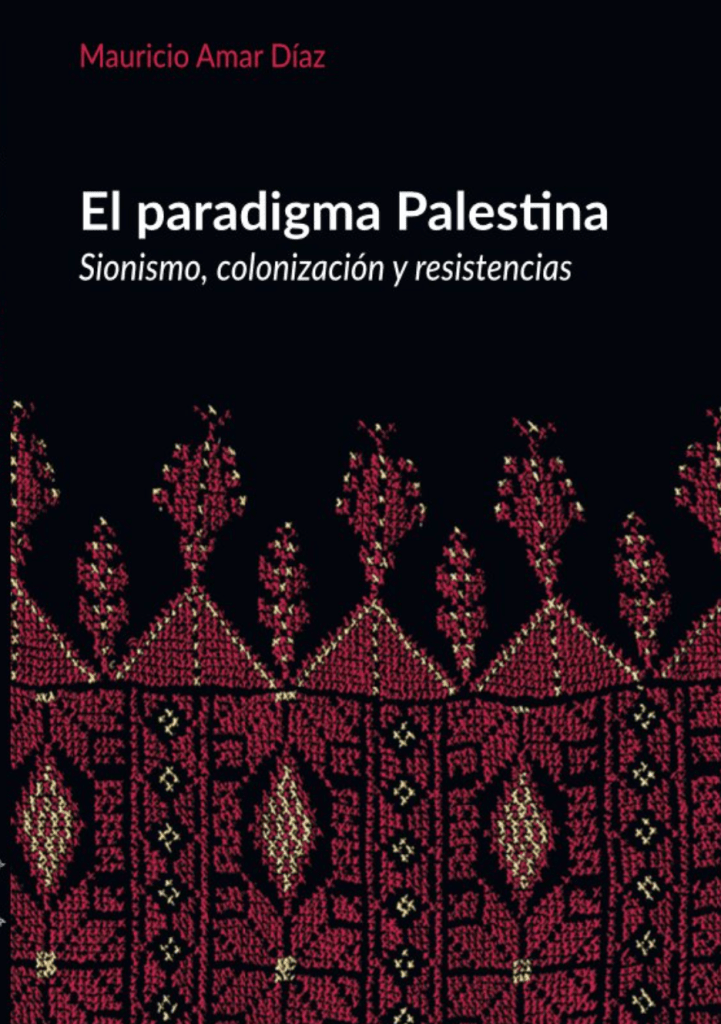
Of the destruction of worlds. On Mauricio Amar Díaz’s El Paradigma Palestina (2024). by Gerardo Muñoz

What does it take to destroy a world? It would seem that the question itself is too metaphoric and impertinent; perhaps also hyperbolic and presumptuous against the flight of the infinite embodied in worldling. But this is the question that we should direct ourselves to according to Mauricio Amar’s short and highly accessible book El Paradigma Palestina: Sionismo, Colonización, Resistencias (DobleaEditores, 2024), which is written in the wake of the ongoing war of annihilation in Gaza in order lay bare the paradigmatic abyss of social death in which humanity finds itself at the peak of its civilizational dominance. Amar does not use the term “paradigm” lightly, and nor is he interested, as recasted recently by none other than Steven Bannon citing Thomas Kuhn’s work about scientific revolutions, in posting a central conflict towards transformation; rather, one must situate this strategic conceptual deployment in light of the Chilean philosopher’s own work on imagination and use, which provides an irreducible and sensible texture to every emergence of a paradigm [1]. This means that if Palestine is, indeed, the paradigm of our epoch is precisely because it has no-space in the world – it is what can be infinitely be destroyed, as Maurce Blanchot famously said commenting Antelme’s work – and what illuminates the core and extension of the “integrated” planetary humanity oriented towards the administrative governmentality of contemporary Western democracies, and its corollary geopolitics of the total artificial spaces, as Bruno Maçaes has recently called it. Reading Amar one senses that under the name “Palestine” he is registering a limit to the Humanist force, where an existential claim reveals the maelstrom of an epoch that has resorted to a grotesque parody of the ancient homeric standards of domination and submission. It is the outlook that Simone Weil described as the paradigm of transforming the world into nonliving things.

If understood as a paradigm, Palestine reminds us that the homeric energy towards the aristocracy of equality through force and death among the human race never truly ceased, but only changed forms and cloaks throughout the ages. The post-mythic West seemed to have constructed itself through the repeated revolutions that accommodate justifications for usurpation and containment, self-deification and legibility of the territory at the service of a fictive ethnos. The belated nationalism of modern Zionism has had the paradoxical quality of being both a project of territorial usurpation after its illegalization in International Law (The Kellogg-Briand Pact of 1928); while, at the same time, a politico-theological configuration that, as Monica Ferrando has shown in L’elezione e la sua ombra: Il cantico tradito (2022), clings upon the manipulation of the theological election of “a People” in order to deploy the coterminous binding between community and territory justified through divine narration. The interdependence of the spiritual goal of Zion is only possible through the construction of a settler state, at the same time that the occupying state’s only legitimacy based on ‘one God, one People’ relies on the restitution of an instrumentalized form of the theological election. This is why for Amar the Zionist state building project is a the paradigm of a specific type of colonial governance whose end is not just to capture errant people into social subjects, but more fundamentally a translatio imperii that folds the Earth into a territorial nomoi of distinct multilevel functions: checkpoints, walls, vigilante control of movements, constructions and erasure of surfaces, administration of critical infrastructures, development of extractive resources, and finally the hunting down of humans that necessarily blurs the line between civil population and battlefield combatants. When Amar reminds us of Israel’s predominance in planetary security and warfare technology, one can immediately recall Emile Benveniste’s suggestion that “measurement” (med*-) and the proportional addition to produce objectivity, entails an efficacy of permanent dominance and governability whose main enterprise is the management of populations through the regime of accumulation. As Andreas Malm reminds us of the current cartography of Palestine: “The genocide is unfolding at a time when the state of Israel is more deeply integrated in the primitive accumulation of fossil capital than ever…This is the political economy of normalization: a sacralization of busines as usual that destroys first Palestine and then the earth” [2]. The ongoing devastation of Gaza is a window into the project as a whole: the necessary destruction of the worlds and the total artificiality of the life-worlds, always at the service of maintaining the needs of anthropological symbolizations.

For Amar this points to an epochal scenario of a people without world; and, following the lead of Sari Hanafi, he will claim that the paradigmatic mirroring of Palestine is also an spatial-cide, in which the living are deprived of a sense of inhabiting and roaming that brings to bear that the nakba is not something that has taken place in history once and for all, it is a catastrophic event that has not ceased from repeat itself, and whose ultimate intention is to suture the world and existence, the soul and the spirituality of the open atmosphere that is needed to sustain life. Reading Amar between the lines  – who towards the end of the book finds distant interlocutors in Darwish’s poetry, the philosophy of Gilles Deleuze, as well as in the glosses of Walter Benjamin on history and the prose of Edward Said – one learns that the true arcana of Palestinian resistance is also a secret promise for our apocalyptic times: to hold on to the world, so that we can all passionately land on the Earth and freely breath in its surroundings. The nexus of the Palestinian question and the intrusion of Gaia, although underdeveloped in Amar’s analysis, obliquely runs through a text that is also very much about the central question of ethics that never abandons thought: how to name what escapes without taking the world as such into an object to be possessed, destroyed, and remade anew as a hostile secular imago dei. The vindictive hyper-consciousness of the contemporary unmediated arcana imperii now reveals, as Amar says towards the end of he book, a mirror through which we can observe our own increasing domestication, in which the metropolis is just the luminescent and self-protected hub, but whole ultimate darkening shadow is the Gaza’s pile of rubbles resembling an open air necropolis (Amar 108-109). Through different arrangements of organized destruction, both the metropolis and the necropolis converge in their preeminent ‘struggle against space’ and its form of life for the sake of familiar pieties of enslaved survival of unworldly anomie (Amar 116). 

Does this mean that we are all “Palestinians”? Mauricio Amar’s El Paradigma Palestina (2024) rejects the all too well expected craft of solidarity and subjective identifications that can only work on the payroll of the gravediggers of the current civilizational project. On the contrary, if Palestine is our paradigm, and it remains so, it is because it can only refuse measurement and recognition in order to dwell in the only possible exteriority as embodied to Darwish’s poetry that Amar quotes towards to the end book: “Do not trust the poem / absent child / it is the throbbing of the abyss” (Amar 140). From the abyss we nourish the soul as the return to land on Earth prepares itself in order to no longer conquer a territory, an ancient tradition, or a “People” (ethnos), but to dwell on the nearness of a place that is an excess to every location or community of belonging (this is the false exit of the kibbutzim). We do not have political grammar to articulate what this integral freedom could mean, except that it is an exotic relation in Victor Segalen’s sense: a creation of a world alien from the compatible and petty one that currently drains us into its ongoing desperate destruction and passive enslavement [3]. Finally, like all authentic paradigms, it is worth noting that Paradigma Palestina (2024) teaches and preaches nothing; it only invites us into the swirling sensation that crosses over the imagination and the singing voice, from the world of the last remaining lives to the isles of the dead martyrs, and back. 

Notes 

1. Mauricio Amar. Ética de la imaginación: averroísmo, uso y orden de las cosas (Malamadre, 2018).

2. Andreas Malm. The Destruction of Palestine is the destruction of the Earth (Verso, 2025), 53.

3. Victor Segalen. Essay on Exoticism (Duke University Press, 2002), 24.

From the beginning (after a Berlin meeting). by Gerardo Muñoz

I am sure that others will draw their point of inflection, but for me the stakes of a recent Berlin meeting (already commented here) was laid out during the very first session when one of the “non-participants” – let’s call it like this to embrace the spirit of the meeting – spoke audaciously about the current predicament: there has been a thorough loss, nothing but defeat that is both irreversible and consummated at the level of subjectivity. Some of us remembered that T.J. Clark more than a decade ago in the pages of New Left Review took a similar position and was grilled for it. This tends to happen to any gesture that dares to push thought forward. In any case, the non-participant went further and called for a “new beginning”, a start from scratch, alluding to the underrated Revolution and counterrevolutionary in Germany (1851) by F. Engels, in which in fact this language is very much present. Engels wrote in the first article (the book is a collection of pieces published anonymously in the wake of the 1848 revolutions): “If, then, we have been beaten, we have nothing else to do but to begin again from the beginning. And, fortunately, the probably very short interval of rest which is allowed us between the close of the first and the beginning of the second act of the movement, gives us time for a very necessary piece of work: the study of the causes that necessitated both the late outbreak and its defeat; causes that are not to be sought for in the accidental efforts, talents, faults, errors, or treacheries of some of the leaders, but in the general social state and conditions of existence of each of the convulsed nations” [1]. 

Of course, “social or national conditions” are not “trapped in amber”, and I think that today one cannot take the national, local, or even regional contexts as sufficient to explain failure. The failure is civilizational, and raising the question of the “beginning” (or new beginnings) has a heideggerian overtone that is not facetious, but it is consistent with any exploration in the quadrant of critical-metaphysical commitments for thought (infrapolitical reflection has thematized it) [2]. This elaboration could be very well idiosyncratic, but I think it provides “grip” to the problem by not making concessions to well known junior partners of abstract politicization and ideological backlogging that like the Tortoise in the parable still fantasize with a breakthrough via yet another “textualist interpretation”; one more sophisticated mapping of political ecology or a collective hegemonic political theory department; or even a policy redistribution of a new Green Deal towards a new accumulation regime [3]. Perhaps they themselves do not believe any of the lies – for my part I think that they do not – and they endorse it for the sake of “bad faith”. But just in case, I think that raising the threshold at the highest point (ontotheology, civilization, the constitution of the polis) is a litmus test of separation against the new secular priests. These negative conditions already open a door to go through.

But there are also positive conditions for this “new beginning”: reopening the ethical intensity in retreat of political subjection; rejection of public chatter and freeing fugitive marranos; elaborating strong descriptions of the metamorphoses of domination; and avoiding the “revolt” as a compensatory category for of ius revolutionis in the epoch of real subsumption [4]. At the end of the day, it should not be forgotten that an-archy also means the turbulence of phenomena, in which every fragment moves in the direction of experience poking through the objectification of the world. This is “inapparent”, but it is for this very reason what is fundamental and invariant. 

The ‘new beginning’ in the wake of collapse can only conquer life to traverse the hunger of meaning that propels the fictional machine of ongoing nihilism, as Giorgio Cesarano warned. There is no historical or moral beginning; there is only the beginning in which existence is able to expand the originary accumulation of a sensible ethos. And it is at the very end, or almost at the end of everything, that true beginning commences. Whoever does not start from the beginning is either understudying the epoch, or mastering the evermore painful social roles. It is only in the direction towards beginning that can avoid the crushing weight of the post-neolithic condition (Métraux) that calls for a divestment of what reality can contrive for us. 

Notes 

1. Fredrich Engels. Revolution and counter-revolution in Germany (FLP, 1977), 3.

2. Alberto Moreiras, “La cuarta vía” (2022): “¿No se hace necesario hoy pensar, por lo tanto, otro comienzo del pensamiento, proponer otro comienzo que nos sustraiga al peligro del colapso mismo del mundo?  Quienes se oponen a ello, llamándolo arrogancia o presunción, llamando veneno a la propuesta misma, no son para mí ya distinguibles del avestruz que hunde la cabeza en la arena al verse atacada”. https://infraphilosophy.com/2022/02/18/la-cuarta-via-entre-parmenides-y-la-obligacion-reflexiva-conferencia-para-la-universidad-de-arizona-spanish-and-portuguese-department-borrador-3/

3. Zeit Der Ökologie. Das neue Akkumulationsregime (2024).

4. Conspiracist Manifesto (Semiotexte, 2023), 341.

Going nowhere: on Jason E. Smith’s Smart Machines and Service Work (2020). by Gerardo Muñoz

Jason Smith’s Smart Machines and Service Work (Reaktion Books, 2020) provides us with a renewed cartography of the labor transformations in the wake of automation and the cybernetic revolution, which has ultimately created a “vast service sector” (9). Although at first sight Smith’s book seems to be preoccupied with questions of technology innovation in the post-fordist epoch, the central vortex of the book sheds light on the notion of “servant economy” that has become the fast-evolving segment of today’s job-market. Smith notes that the expansion of the servant economy propelled by automation “poses special obstacles to organization and action in a fragmented workforce. The rise of the “servant economy”, increasingly forces workers into smaller, spatially dispersed workplaces, where they carry out labor-intensified production processes…. deemed low-skill occupations and therefore poorly paid” (14). The new region of the service economy is an effect of the exceptionality of capital form self-abdication where unemployment becomes an existential problem for the social fabric. 

The nuanced analysis undertaken by Smith shows how the fragmented spatialization of labor has become the byproduct of the automation in which control, optimization, and feedback ensemble a new regime of total calculation. Already in 1956, Friedrich Pollock warned of a potential “totalitarian government” that could lead to mass unemployment. Pollock’s Cold War predicament was not off target: the fear of totalitarian unemployment (Habermas would call it crisis of legitimation) was answered with a total (service) economy that compensated for the paradox of stagnation of profit growth. The encompassing force of real subsumption through compartmentalization of services rendered effective James Boggs’ “nowhere to go” in the final dispensation of historical capitalism.

The phase of stagnation announces the “productivity paradox”. Smith writes glossing Mason: “If ours is an age defined by monopolies, cheap credit, rent-seeking and asset bubbles, it is not due to the concerted efforts of elites keen to forestall or smother in the cradle a new, sustained period of productivity gains….despite claims to the contrary, the weather of stagnation and drift that has settle over the advanced capitalist economies since the 1970s, and special since the turn of the century is attributable in no small part technological inertia” (41). The boom of “diversionary gadgets” are on the side of unproductiveness; and, as Ure argues, “do nothing towards the supply of the physical necessities of society” (43). But perhaps diversion usage accounts for the mobilization of the medium of the new phase of automated capitalism. In other words, precisely because traditional form of political legitimacy has crumbled, zero value technology becomes the compensatory psychic equilibrium within the process of abstraction of profit. The subjective dimension of the “medium” in the new phase of automation operates to drive dynamism in the “historic low” of labor productivity growth and the disjointed structural relation between economic growth and rise in wages (64, 69).

One of the conclusions that one can derive from Smith’s rich political economy empirical analysis is that the expansion of the service economy is fundamentally an anti-institutional phenomenon, both at the level of social forms (unions, movements, legal grounds for disputes) as well as in terms of mediations of exchange (intellectual labor, shadow-work, spatial relations to urban centers, etc.). In this sense, the absolutization of the regional “service economy” is the reallocation of reduced labor. In the same way that all ‘originary accumulation’ is an ‘onging accumulation’; the “crisis” of the economy is always already the recurrent stagnation of growth. But Smith notes with precision: “services therefore appear to obscure more than it clarifies” (80). This new process of rationalization mobilizes the valorization of the outside, that is, of every non-market sphere. This process draws a specific ordo rationality: “The true “advances” such as they are, have been in the domination of the labor process by employers: their ability to coerce more labor out of a given hour by means of refinement in supervision, oversight, and workplace discipline” (112). 

Mirroring the optimal logistics of cybernetic and automation processes, one could claim that the expansion of the service economy initiates a regime of governmentality that allows for the attenuation and cost-benefit management of flows. Now I think one can clearly see that “service” is not just an avatar to formal processes of value, but also, as Ivan Illich showed, a secularized theological concept of the Christian notion of hospitality. According to Illich, hospitality was transformed into a use of power and money to provide services and needs [1]. For the ex-Catholic priest, this meant nothing less than the corruption of human freedom, which became tied to the logistics of equivalence. This is why, more than an economic theory, neoliberalism needs to defend an ever-expanding freedom of the subject. In the context of deep social atomization, the service economy self-legitimizes itself as absolute freedom in the social (141). 

At the end of the book, Smith notes that in the wake of automation the relation between political struggles and the new economic composition begin to diverge. There is on one side the model of the teachers and that of the expendables (146-147). In a sense, the “nowhere land” registered by Boggs in the 60s has only intensified, as modern politics forms no longer seem up to the task in the face of total extraction and exclusion. If we think of arguably the most successful leftist political strategy in the last decade or so (the strongest cases have been in Latin America and Spain), the left populism rooted in the theory of hegemony; it becomes clear that after the empirical analysis of Smart Machines, any set of ‘equivalential demands’ is already a demand for exploitation within the regime of the service economy. During this months of pandemic the right has been calling for the immediate reintegration into the economy, bring to bear the internal production at the heart of the project of hegemony. Rather than thinking about a new multitude or unified subject of class, the expendables that Smith situates at the outskirts of the metropolis (the ‘hinterland’), constitute perhaps a new experiential texture of life that is no longer moved by representation but rather expression; it is no longer defined by class, but consumption; it is not interested in negation, but rather in “discovery” (148). Indeed, the new marginalized surplus population does not constitute a new “subject”, but an energy that seeks an exodus from the ruins of the political given the collapse of the whole framework of leftist hegemony [2]. It seem reasonable to think that it is precisely in the threshold of Boggs’ call for a “discovery” (a movement of anabasis), devoid of place and time, where the unfathomable stagnation of our epoch is defied.

.

.

Notes

1. Ivan Illich. The Rivers North of the Future (Anansis, 2005). 

2. “Onwards Barbarians”, Endnotes, December 2020: https://endnotes.org.uk/other_texts/en/endnotes-onward-barbarians