In a letter written in 1969 to her friend Mary McCarthy, Hannah Arendt provides a striking description of the solitary condition of thought in language: “The silent dialogue of thought goes on between me and myself, but not between two selves. In thought, you are self-less – without age, without psychological attributes, not all as you say “really are” [1]. Thinking, she goes on to claim, puts into crisis all identity and nonsense, so that the inward searching can fold “outwardly” into the world. Arendt immediately notes that the passage from interiority to the outwardness does not express a fixed purpose; it is rather a motion through which “words become part of the world”. Thought can be said to express the coming into relation between language and world.
Further exploring the depth of the language that characterizes the “inner life” of thought, the philosopher immediately emphasizes its acoustic or tonal qualities, that is, “an inevitable noise of our apparatus, which Broch called Seeleenlärm, soul-noise. It is what makes us tick”. To be in thought, or in a way to thinking, means allowing the soul noise to buzz from beneath the skin. The Seeleenlärm does not coincide with language as concept or signification; it is rather the tear that allows for the emergence of language as imagination and thinking.
This operation is nothing more than the relation of language to its own impossibility or muteness in the region of the Seeleenlärm, and what artificial models of language cannot replicate. And although Arendt compares the soul noise to other functional organs of biological existence, it is only obvious that the harmony of the soul lacks a physical compartment, and can only be expressed in the possibilities that language bestows to thinking. The notion of Seeleenlärm, if we are to call it that, appears not in philosophical context, but in a literary one; that is, in Hermann Broch’s “Zerline’s Tale”, in which the soul voice is understood as the lacuna of sensation, having nothing special in terms of intellectual faculty or knowledge collectiom, it is the sensation that fill people’s empty and boring lives” [2]. Seeleenlärm determines thought, but it is not thinking as such; it is more like the suspension of temporalization and judgement in every living being. This is why it is not even coterminous with the passions, let alone love. Perhaps the Seeleenlärm can be said to occupy a third component (tertium comparationis) through which the human being structures the mystery of his spirit [3]. Is this third component that dissolves the self for the place for ethics? In Broch’s modernist aspirations, attuning to the noise of the soul meant the aesthetic reduction of a symbol to mediate “understanding from one person to another”.
But it should be obvious that the transition of Seeleenlärm to metaphoric understanding flattens the voidinto a conglomerate of selves that come into being by setting aside thought through the communication or artistic repression. In the reverse, one could imagine then that there is only thought when the suspension of any conglomerate or community ceases to communicate by resting on proximity to the hole of the soul voice in expression. The communication between souls – beyond the transport of the symbol, beyond separation ordered by discourse – can only be understood as the incommensurable in language. This is the instance where thinking takes flight because the invisible seeleenlärm transpires from its depths.
.
.
Notes
1. Hannah Arendt. Between Friends The Correspondence of Hannah Arendt and Mary McCarthy (Harcourt, 1995), 242-243.
2. Hermann Broch. “Zerline’s Tale”, in Selected Short Writings (Bloomsbury, 2006), 103.
3. Hermann Broch. “Some comments on the philosophy and technique of translating”, in Geist and Zeitgeist: The Spirit in an Unspiritual Age (Counterpoint, 2002), 122.
Understanding what the ancient Greeks thought of sayability in language is no easy task, but in Pindar’s Fragment 180 we can confirm that the use of language must come to terms with the internal lacuna of silence. Pindar says as a way of recommendation: “Do not break out useless speech in front of everybody; there are times when the path of silence is most trustworthy, but lofty discourse holds the sting of domination” [1]. Although this fragment has been read as a form of “prudential speech”, it might be more interesting to read it as a form of the inception of the sublime in language, which Longinus, although not referring directly to the same fragment, inscribed it under the idea of being ‘tongueless’ or aglossīa, which like Ajax’s silence says significantly more in its restrain than from saying something directly. Language becomes useless – that is, it ceases to have any use with itself – if it becomes a tactic to diminish any given rhetorical order. It is no surprise that in our time the predominant use of language takes the form of a transaction through technical terms that has no use of its own.
It has been shown that Pindar’s conception of language was not about representation, but rather about the voice or kompos that takes place whenever there is vibration or harmony in the collision or contact between two objects [2]. Of course, the truly originary collision in language is between the voice and the idea, where the cradle of language opens to its own poetic and ethical possibilities. Hence, if there is restraint and silence as constituent of language, it is because there is a rhythmic movement that accommodates without the intromission of an external force. Here, it is the well known definition of poetic creation that Pindar lays out in “Olympian 6”: “Upon my tongue I have the sensation of a clear-sounding whetstone, which I welcome as it comes over me with lovely streams of breath” [3]. What carries those streams of sounds?
The poet is not an independent creator with higher access to language; the poetic instance is only accessible to those who, in contact with inspiration, can sharpen their tongues to the use of one’s language. We are in language when we find ourselves in the direction of a “path of words” [4]. Thus, the contact of language is not with objects or entelechies of the visible world, it is first and foremost with the receiving movement of the voice as a “lovely streams of breath”. In this way, Pindar’s plea for silence is not to be understood as an active negation of “saying”, but of an internal lapse or suspension of language that allows the emergence of the truth of the voice. The absence of kompos turns language into an instrument that can only prepare and foment conflict and domination, seeking to overcome something that is ultimately captive of the common ground of an uninspired language. And this means that language without inspiration is not only a voice that has run astray from its rhythm, it is also a language that will only find war in its path.
.
.
Notes
1. Píndaro. “Fragmento 180”, in Obra completa (Cátedra, 2023), 410.
2. Helga Kriegler. Untersuchungen zu den optischen und akustischen Daten der bacchylideischen Dichtung (Verlag Notring, 1969), 90.
3. Píndaro. “Olympian 6”, in Obra completa (Cátedra, 2023), 90.
4. Píndaro. “Olympian 1”, in Obra completa (Cátedra, 2023), 90.
We owe an untimely intuition about the enduring seduction of patriotism and nationalism to Leo Tolstoy’ essay “Patriotism and Government” (1900), in which he captured a paradoxical phenomenon: mainly, that at the same time that the integration of humanity and its historical consciousness reached its civilizational peak, patriotism instead of disappearing became increasingly more destructive and fierce. Looking at the outset of the First World War in Europe and its nascent total mobilization of industries, the Russian novelist claimed that, from that moment, government organization will depend on patriotism as a source to conduct total war within the human species. But what surprised Tolstoy – which has clear contemporary overtones in the impolitical movements that dominate Western societies – was the degree that this lethal patriotism infiltrated the very worldview and orientation of the Christian vocation. Tolstoy writes in the most most potent passage of the essay:
“All the peoples of the so-called Christian world have been reduced by patriotism to such a state of brutality, that not only those who are obliged to kill or be killed desire slaughter and rejoice in murder, but all the people of Europe and America, living peaceably in their homes exposed to no danger, are, at each war – thanks to easy means of communication and to the press – in the position of the spectators in a Roman circus, and, like them, delight in the slaughter, and raise the bloodthirsty cry, ‘Pollice verso.’ [1].
This should suffice to note that for Tolstoy patriotism is neither a political ideology nor a formal principle of community; patriotism is rather a social liturgy born of the absolute sacrazalization of human life and whose hyperbolic figure will be that of the war-slave trained to endure “the act” (especially the slave that participates in the carnage through his words and attention). And just like in a theater play or in the Catholic liturgy where there are “acts” (and the service can only subsist through its enactment), the unleashed force of patriotism becomes a form of destruction as the essence of government organization.
This is why for Tolstoy the inception of total war recalibrates the grotesque spectacle through the “hypnotism of patriotism”, positing a fictional belonging of salvation – that is nontheological because it is unredeemable – through the destruction of another community of the human species. True, the end of politics always results in war; although Tolstoy introduces a nuance to this axiom: war is able to subsist thanks to the self-affirmation of patriotism as the triumph of a wordless inhumanity.
It is no coincidence that Tolstoy observed the rise of patriotic strife in tandem with modern science as conquest over Nature and the reality of human experience [2]. Thus, government patriotism and instrumental sciences are two interconnected regimes of the organization inhumanity that speak the rhetoric of growth and prosperity as stagnation deepens. In our days, this social cohesion, as Tolstoy warned with precision more than a century ago, has entered a new phase of domination that some called a “lethal form” integrating technology and war without any reminder [3].
.
.
Notes
1. Leo Tolstoy. “Patriotism and Government” (1900), in Last Steps: The Late Writings (Penguin Books, 2009), 318.
2. Leo Tolstoy. “Modern Science” (1898), Last Steps: The Late Writings (Penguin Books, 2009), 252.
3. Alexander Karp. The Technological Republic (Crown Currency, 2025), 154.
The highest poetic moment in Michel De Certeau’s La culture au pluriel (1974) appears in the concluding pages where the historian resorts to a hunting image: “Culture is an untold night in which the revolutions of earlier times are dormant, invisible, folded into practices – but fireflies, and sometimes great nocturnal birds, cutting through it – as thrusts and creations that trace the promise of another day to come” [1]. This is De Certeau’s trope that stands for culture as opening of possibilities, the shoreline where administrators and technicians (his own terms) do not dare to cross and will probably never adventure. This is the site (the night, la noche oscura, which has a ringtone of the mystical tradition that the author knew perfectly well) where De Certeau wants to posit the possibilities of new struggles of cultural alterities [2]. A book in 1974 means many things, but for De Certeau it is an incursion into the collapse of his historical present, already showing full fledged signs of the crisis of legitimation, erosion of institutional trust, and the decomposition of social forms across Western symbolic realities. It is the nascent confirmation of the ascent of real subsumption, a term that does not appear in De Certeau’s book, although it informs it, even if negatively (the Italian Fiat wildstrikes makes a surprising cameo in the last paragraphs). Where to look, then?
De Certeau’s answer read today does bring much naivete: cultural alterity. But this notion, which is reworked and contested in concrete fields of human activities (the university and schools, the new technological society and communication, social practices intertwined in popular and elite culture, power relations and post-statist configurations) do not appeal to the identitarian cosmopolitan horizon prima facie anchored in the diversity administration of a well integrated, albeit exploited planetary humanity. One senses that for De Certeau the nineteenth century “Social Question” has become the “cultural question” as the unit of the national sovereign state wanes and reacts. With the crisis of legitimation as backdrop, De Certeau sees the rise of a new subjectivity that he calls the new “militants without a cause”, a battalion of “exiles” that will only tacitly accept credible cultural imprints [3]. He wants to work with “culture” because at bottom De Certeau is both a historian and a realist. This new erosion of civil society-State relations entails a “new exile is in the works” [4]. And for De Certeau the exile, since biblical times, is seeking a new Earth where to “land”.
In 1974, De Certeau’s invitation was to create the conditions for pluralist cultural landings that will foster, in the night of waiting, a new politics. But, could the same be said today even assuming concrete situations and the infuriating image of migration as a token for the workings of hegemonic politics? Does Gaia not alert us that we must “land” somewhere else on Earth? The anger and dissatisfaction that De Certeau cautiously predicated head on is already here in the form of what some of us have theorized as ongoing social stasis that is integrated in every social mediation. In the global metastasis of the 1970s De Certeau could claim that “behind anger there is the desire to create a polis and a politics; there is a desire to organize the conditions of life….” [5].
We are far removed from this desire, and even the most prominent cycle of revolts of the decade have refused in the solicitation of a new politics or a political horizon; and, even if, almost like weeds in cracks of piled urban ruins, we see again and again the last residues of the desire for hegemonic representation of the totality (the People, the Movement, the Class). In this light – now it is our own epoche – culture can only be compensatory, and still very much a symptom of the closure of exteriority. “Where there is no longer an imaginable outside we lose the possibility of an inside”, Moreiras wrote at the turn of the century against every form of culturalism [6]. Of course, De Certeau was well aware of it, which is why his proposal to cultural alterity retains zones of hermeneutical ambiguity many decades later [7]. For instance, he writes when commenting on neo-nationalist regional movements (Quebec, Catalonia, Occitania) that “cultural claims appear to be a reminder and a compensation” [8].
And recent events have proven De Certeau correct: what is Catalan nationalism – whether left or right, although ideological division is not a substantive difference – if not a compensatory rhetorical ruse to mobilize regional political elites to feed off the stagnant resources of a waning state form? The rhetoric of “political foundation” in the Catalan case created an “cultural alterity” that depended on the high illusion of hegemonic politics; a politics solely based on the “bad faith” of escalating and superposing values (“Spanish” v. “Catalan”) as the combustion of a fractured political social contract that ultimately deepens its fragmentation. De Certeau noted – cited with the long Augustunian tradition of political liberalism – that politics cannot bring happiness, but only create its conditions. However, today even this liberal ideal fails to account for its true source: our metapolitical collapse at the twilight of secularization means that the revival of the “social bond” is not to be found in the demand of new political principles, however narrowly or broadly defined. De Certeau in 1974 aspired at giving politics one more chance pulling it to the facticial heterogeneity of culture: “a politics that discovers in the diversity of the sky a generical….linked to the ambition of beginning over again, that is, of living” [9].
And indeed, we must begin all over again, but is really the only possibility? I believe that there are symptoms elsewhere in La culture au pluriel, and these concern language. In the second chapter, referring to the crisis of speech, De Certeau refers to the “denaturing act” of speech, as communication enters the regimen of commercial language and new computational masteries (what Jaime Semprún called neo-language) [10]. The crisis of language in the ascent of a new expressivity renders communication obsolete and obtuse; parasitic, or mushroom-like, as Hugo Von Hofmenthal had already noted in his Letter to Lord Chandos. Speech becomes a new form of blasphemy, something confirmed in recent years in the United States, which takes itself also as the homeland of “Free Speech” is increasingly under heavy surveillance by constitutionalism of codified parameters of “time, place, and manner”.
De Certeau shows himself highly consternated about blasphemous language, which is also conspiratorial language; the language that dwells on the reverse of social normativity and legal codification. But this perhaps the only language today can properly speak of pain without recurring to the transactions of violence; especially of the numbing violence of a neo-language that can communicate “everything” insofar as it ceases to communicate to no one. Could the “untold night”, that is also the night of the “unthought”, be the site of the preservation of another use of language, of nurturing language, descending into the hymnic sources of the sayable – thus, inverting the denaturing of historical severability – a language embedded in silence, in the protofigure of the mystic, assuming “the immediacy of nature and experience, to contact of things, one by one, in their primal disorder”? [11]. Ultimately, whatever the night will tell will only be possible through and in language.
.
.
Notes
1. Michel De Certeau. Culture in the Plural (University of Minnesota Press, 1997), 138.
2. Ibid., 11.
3. Ibid., 7.
4. Ibid., 8.
5. Ibid., 11.
6. Alberto Moreiras. The Exhaustion of Difference: The Politics of Latin American Cultural Studies (Duke U Press, 2001), 21.
7. Michel De Certeau. Culture in the Plural (University of Minnesota Press, 1997), 78.
8. Ibid., 70.
9. Michel De Certeau. Culture in the Plural (University of Minnesota Press, 1997), 100.
10. Jaime Semprún. Defensa e ilustración de la neolengua (Ediciones El Salmón, 2018).
11. Nicola Chiaromonte. “An Age of Bad Faith”, in The Paradox of History (University of Pennsylvania Press, 1985), 148. On the hymnic dimension of human speech, see the study undertaken by Nicoletta Di Vita, Il nome e la voce. Per una filosofia dell’inno (Neri Pozza, 2022).
In an entry of Dopo Nietzsche (1974), Giorgio Colli states that after the overcoming of all values and taboos, the contending moral strife finds its highest value in hypocrisy. Colli goes on to say that “hypocrisy is the last bastion where moral forces have found their refuge” [1]. One can clearly see that for Colli hypocrisy as the highest value is quite distinct from morality, since it is the “refuge” where the contending moralities invest themselves in rhetorical encroachment. That hypocrisy has become – as Colli saw with clarity in the 1970s – the last alcove of humanity, means, for one thing, that the human species have ceased to have any faith in the language that they use, and that for this very reason there is only an estimation of rhetoric, procedure and technical terms abstracted from the sensible world. If understood as such, it would come to no surprise that the majority of public institutions in advanced societies are embracing, and for the most part promoting, the incorporation of Artificial Languages and Intelligence to organize the interactions of their lives. Ultimately, the order here is clear: it is not that new technological advances will lead to a rise in untruthfulness; rather, these instrumental mutations are a consequence of the deep hypocrisy that runs through the social bond.
In fact, one can only assume that Colli was pointing at something more profound and obscure in his gloss when he referred to hypocrisy as the last refuge, and in this sense he was pointing beyond Nietzsche. After all, Nietzsche understood hypocrisy as mimesis and appearance that if incorporated over a long period of time ceases to be hypocrisy to become real [2]. A series of good acts and deeds in the spirit of friendship makes a person benevolent. In the same way that Miguel de Unamuno’s San Manuel Bueno Martir through his public faith and habits, was a symbol of Catholic faith for all the believers of his tightly knit community in spite of his interior doubts (this is the Knight of Faith). Now, Colli is pointing to a second degree hypocrisy that is no longer explicated by mimicry, but by its dependence to an ethereal value that governs and justifies any set of given actions. The actions are no longer in relation to faith or non-faith, but are properly acts of “bad faith”, since they make belief captive to the justification of the highest moral value. This will be consistent with Nicola Chiaromonte’s description that the end of secularization is not an epoch lacking faith, but one that dwells in “bad faith”.
And what is ultimately “bad faith”? It is the realm of hypocrisy that, due to its impossibility of communication, understands its mission waged on the petty negation of one value over another. It is a mutation of Goethe’s nemo contra deum nisi deus ipse into the sphere of prevailing forces. The civilizational stage of enlightened hypocrisy prepares the human being to renounce the use of language and unmediated appearance. This means that the triumph of the technoadministration of the world would not be possible without the alluring refuge of hypocrisy that conquers reality through the very means that renders inaccessible the real presence of the world. It is not that politics and politicians have become hypocritical; it is that politics can only subsist thanks to its refuge in hypocrisy. The hypocrite is the last figure that steers in unworldliness.
..
Notes
1. Giorgio Colli. Dopo Nietzsche (Adelphi Edizioni, 1974), 50.
2. Friedrich Nietzsche. Human, All Too Human (Cambridge U Press, 1996), 39-40.
In the Spanish language there is a wonderful idiom that has gone out of fashion in our times to express a sudden silence: “ha pasado un ángel”, or an angel passed by. The phrase is commonly used whenever a sudden silence imposes itself in the middle of a conversation, which leads to obvious discomfort and embarrassment among those engaged. It is almost as if the invisible angel reminds human beings that conversation rests as much in words as in silence; and that the shadow of silence sooner or later interrupts any communicative practice. According to historians and lexicographers, the inception of this idiom into Spanish remains a curious enigma, since although used in early modernity it does not have a Latinized version, and its origins can only be traced to classical Greek antiquity. In fact, Plutarch notes in his De garrulitate that whenever silence is introduced in a meeting it is said that Hermes has joined the company [1]. The angel thus stands for the nonpresence of language in language, just like an icon is the sublimation of presence in pictorial representation.
We know that in Antiquity the angel as a minor divinity (angeloi) was a mediator between heaven and earth, only that in that moment that an ‘angel passed by’, it is not all clear on which side is there heaven and where earth [2]. In his beautiful book Angels & Saints (2020), Eliot Weinberger reminds us that for Saint Augustine the angels were first and foremost original gardeners of Paradise – given that they are free from felix culpa and sin – and that they are messengers between the living and the divine, as documented in the beggar Lazarous carried by angels to the bosom of Abraham [3]. Here it seems that the invisible inception of the angel relates fundamentally to the dead and conclusion, which also carries its aspiration in the lacunae of a conversation that reaches an impasse, and that for a moment effectively dies.
The angel that accompanies the dead and the poor – and thus our structural poverty in language, being in the language that always lacks a grasping signifier – is also confirmed by lexicographer Alberto Buitrago, who in his entry on the idiom writes that the expression has its origins in the fact that in antiquity whenever a dead person was mentioned or brought up in conversation there was a silence held, because it was thought that his “spirit” (his angel) had become present in its nonpresence of language [4]. Although Buitrago does not provide any documentation for his assertion, it does bring to bear that whenever we are in communication, whether we like it or not, we are in the communion of angels that are expressing the soul of the dead through the litany of their names.
This is why Antelme could suggest the similar enigmatic notion that being powerless and in poverty means to ‘have to forever be’ in a silence adjourned so that language can continue speaking. This is why perhaps the irruption of authentic silence has the effect of a certain petrification of the human expression, as masterfully captured in Velázquez’s Apollo in the Forge of Vulcan (1630). It is through silence that we encounter the divinity that for a moment places itself outside of language in order to contemplate it, letting the angel make his entrance. The language of computational machines is not only a language that has renounced its poetic and ethical instance; it is also a form of gated communication that has expelled itself from the angelic visitation of its own contemplation.
In a letter dated from January of 1962 to his friend Carlos M. Luis, José Lezama Lima makes a case for the intimate relation between language and charity: “What lasts [la cantidad] is only possible through faith. Because what lasts with faith is charity. Omnis credit – believe all things. Charity is belief in anticipation. And what is poetry (the image), but this superabundance of charity that always presupposes creation? [1]. The question in the last sentence – a question that could have only come from a great poet – is not all naive, since it is also a slight displacement from the canonical source underlying the notion of charity. In fact, the expression caritas omnia credit comes from Saint Augustine’s Confessions (Book X, Section 3), where the Church Father treats the reception of his testimony to the rational knowledge of the “hearing of men” who will be attending to his words [2].
This means that for parole to be heard and enunciated in its original presence, there has to be a gathering in charity that makes not just ‘true’, but most importantly, a garment of faith in the occurrence of language. This means that for Lezama Lima, there was no distinction between “theological language” and “language as such”, or “poetic register”, since they are all participants in the mystery of charity, because only charity can welcome language as abode. Poetics as such is understood as facticity of parole. But for Lezama, the word depends on having grasped the motion of charity.
Lezama’s test for Carlos M. Luis was quite high: if you lose your faith, you would have given up on language as creation. This was not a new problem for the poet who already in his essay “La dignidad de la poesía”, mentions caritas omnia credit, as a process of destruction of representational (merely transactional and duty driven language) communication that arrives at the order of charity through language as intangible and inexistent by virtue of transcending what does not exists, thus manifesting itself as possible [3]. This is the moment in which the charity of language appears as both presence and promise, and what Lezama calls “el resurgimiento del verbo” (the reemergence of the word). Poetics is thus neither the subject matter of poets, nor the master dogma of theologians; rather it is the faith in language that once enunciated it can only move towards a greater opacity of the shadow of mystery. This is why a great Christian theologian says that charity(agape) is partial knowledge of the divine, otherwise there will be only a detestable army of mere academics, scribes, and administrative experts [4].
In other words, charity does not belong exclusively to the Saints, but it runs through All Souls and its dead. The long history of the Church has betrayed the parole of charity, going as far as transforming it into a social mechanism of distributed goods that has become known as the subsidiarity principle. But for Lezama Lima, in an esoteric pauline tone, charity had nothing to do with political absorption and pastoral power; it was fundamentally a problem of language as a relation of reciprocity between beings in order to subsist as species, to paraphrase a well versed French priest on the matter [5].
In our days we see that “believing in language” has become in the public the inverse: non-belief through credit; that is only after possessing it (I do not need to believe in you insofar your credit validates who you are). It has been noted that by a kind of philological accident in the history of secularization, the word charity in English came to be understood one handedly as almsgiving and subsidiarity over the original divine love, which is love supreme in language. A language that does not unify, but that creates ethical relations; in fact, this might be the only uninstructed means of allowing them to fruition.
.
.
Notes
1. José Lezama Lima. Cartas a Eloísa y otra correspondencia (Verbum, 2013), 324.
2. Saint Augustine. Confessions (Penguin Books, 1961), 208.
3. José Lezama Lima. “La dignidad de la poesía”, in Obras Completas, Tomo II (Aguilar Editor, 1977), 774.
4. Claude Tresmontant. Saint Paul and the mystery of Christ (Harper & Brothers, 1957), 157.
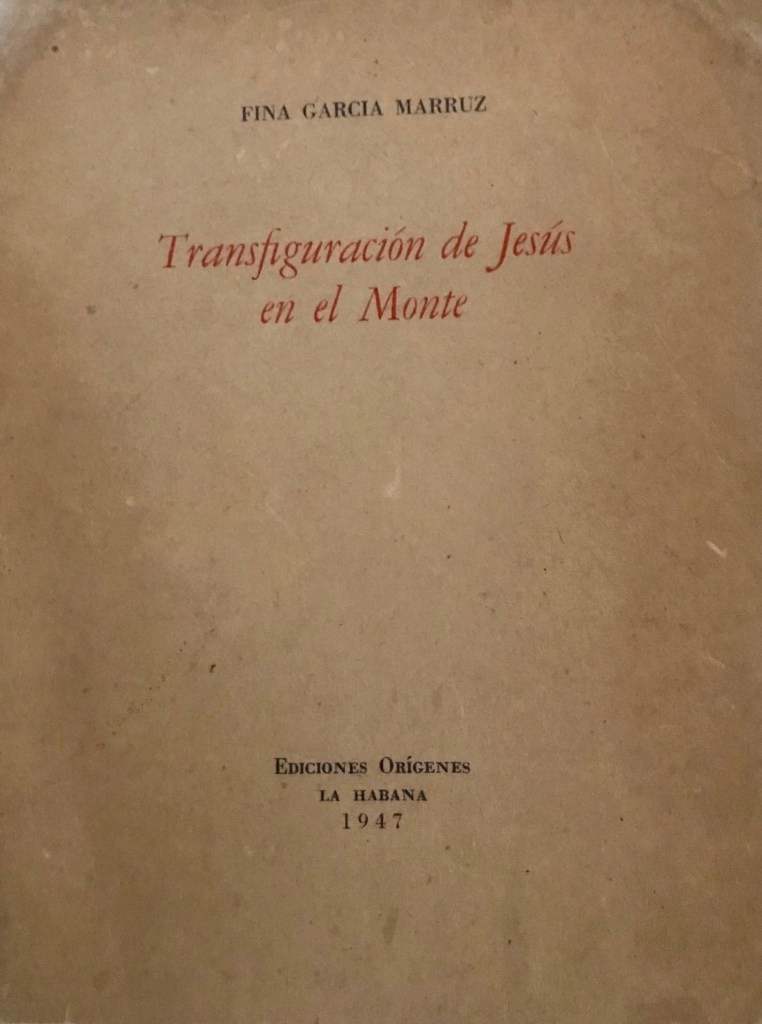
In 1947, the very young Cuban poet Fina García Marruz published the liturgical poem Transfiguración de Jesús en el Monte (Ediciones Orígenes, 1947), which stands in the modernist tradition series of attempts to probe the divine nature of language after the flight of gods and the triumph of the new secular jargons. If earlier in the century a well known Italian philosopher will predict that the international language of the future will be that of technical terms; the English Catholic poet David Jones, will reaffirm that we are “living in a world where the symbolic life (the life of the true cultures, of institutional religion and of all artists) is progressive eliminated – the technician is master. In a manner of speaking the priest and the artists are already in the catacombs, but separate catacombs – for the technician divides to rule” [1]. And if “liturgy” originally meant “public service” and the sphere of gestures, as suggested by Lubienska de Lenval, then Transfiguración has to be read, even into our days, as an attempt for language to measure to the transfiguration of revelation, in which the poem is a sacramental form that retracts language to possibilities of retaining communication.
In fact, Transfiguración de Jesús en el Monte, reinforcing the liturgical repetitions of an hymn and a sacred chant, enacts a flowing rhythm (“en tanto que”) that assesses the limits of the ineffable; a pure exteriority that is the negative or wound of language without ever being able to transcend it. In this sense, Marruz’s poem is only the poetic anabasis to the impossibility of a guided sacrament to organize interiority and visibility. Only the mystical can mediate between exteriority and the crisis of appearance. In an almost programmatic fashion, we read in the second part of the poem: “oh, difícilmente podríamos comprenderlo / Él se ha vuelto totalmente exterior como la luz; / Él ha rehusado la intimidad y se ha echado totalmente fuera de sí mismo” [2]. Transfiguration is the event that exiles oneself from the self (phygé), and in which language can generate contact with something other than its own conventions. This is why they [the witnesses and the martyrs] cannot provide an account about the transfigured revelation – just like anyone cannot truly provide a narrative, except by betraying the experience – except by their hearts as if being mysteriously called by a singular name (“ellos sienten que dentro de su corazón alguien / los ha llamado misteriosamente por su nombre”).
How can language disclose a sense of exteriority that is capable of moving past the autonomy of signification and self-referentiality of language? Can language befall into exteriority? Marruz provides an answer to this question, which can be taken as her contribution to the aporias of modern poetics: poetry can only attune to transfiguration as a cohabitual of a communicating being. In the year that the poem was published, Marruz also wrote in the winter issue of 1947 Orígenes a dense essay titled “Lo Exterior en la Poesía” (“The exterior in poetry) where she claims that “the heart of poem is always outside of it – it should not be that the poet can offer infinite variations of a secret self-possessed knowledge, but rather to rediscover the liturgy of the real; the extreme degree of visibility, which is also its great escape” [3]. What could the “liturgia de lo real” have meant for Marruz in 1947? Marruz does provide a clearcut theological definition of the exteriority as the “angelic”, which does corroborate the hymnological dimension of language, a transcendence between beings of the invisible. The liturgy of the real that defines the exteriority of the poetics of life does not entail a Romantic elevation by the Poet, but the effort to animate reality beyond an alienated monologue. This is why Marruz writes that “only a dialogue can realize an impossible communication, mystical, whenever it does take place in all of its purity” [4].
In 1947 Marruz went a step further than her fellow poets Gaztelu & Lezama Lima, who had defined transfiguration as a learning exercise of the potentia dei of the divine (“a todo transfigurarse sigue una suspension y el ejercicio del Monte era solo un aprendizaje”) [5]. Read side by side with Antelme’s Angel of Reims, one could very well say that for Marruz there is an event of transfiguration whenever transcendence delivers communication between beings, soul to soul; a relation that can one truly speak of the ungrounded and commencement. The liturgy clamored in language is not the memory of an original Adam severed from Nature, but the transfiguration of a linguistic relationship with the world. This might be the secret to Marruz last two verses: “como la infancia que acuña nuestro Rostro allí / donde no puede ser despertado”. If transfiguration also entails recapitulation, this means that this is not a process of forward becoming, but of retaining the atemporal detention that, like that of childhood, traces our silhouette as both figural and pure presence in the bushes of language.
.
.
Notes
1. David Jones. “Religion and the Muses” (1941), in Epoch and Artist (Faber&Faber, 1959), 134.
2. Fina García Marruz. Transfiguración de Jesús en el Monte (Orígenes, 1947), 6.
3. Fina García Marruz. “Lo Exterior en la Poesía”, 19.
3. Fina García Marruz. “Lo Exterior en la Poesía”, 22
4. Ángel Gaztelu & José Lezama Lima. Editorial: “Éxtasis de la Sustancia Destruida”, Nadie Parecía, Número IX, Nov, 1943, 1.
Surely friendship does not depend on obligations or frequency, but it does posit expectations on something like a movement of reciprocity. In fact, movement (κίνηση) and reciprocity are so intertwined that without it, there would not be any separation, only a compact bundle in unity without relations. But, what is at bottom reciprocity? If this notion merits anything thought at all, it must be removed from any conception of exchange in the manner of the quid pro quo and the the ius talionis, where at first sight reciprocity seems to reside as a form of levelling differentiated quantities. In social exchange there is levelling but surely there is no reciprocity except by the legal force enacted by the pressure of duties and obligations. Already in the nineteenth century, at outset of bourgeois society, Søren Kierkegaard with extreme lucidity denounced social levelling as a form of glittering vice: “The idolized positive principle of sociality in our time is the consuming, demoralizing principle, which in the thraldom of reflection transforms even virtues into vitia splendida. Levelling is not a single individual’s action but an activity of reflection in the hands of an abstract power” [1].
What is reciprocal in social exchange is no longer the incommensurable relation between beings, but the enactment of language saturated by its own completion, which is the aim of social organization. If there is no reciprocity in the age of kallopismata orphnes as the reduction of rhetorical language it is because there is no longer a missing word in the event of communication, given that, potentially, everything has been already communicated (it is obvious that today this process can only intensify with the planetary deployment of Artificial Intelligence). The only determination of reciprocity that should be of interest is the one that accounts for the lacunae in language that halts force of social levelling. To reciprocate does not mean to give each his due that defines the Western legal operation; it is rather the mutual codependency in the unforfeited event of language.
At this point, an etymological observation might be useful. In On the Latin Language, Varro records reciproca as a condition of elasticity; that is, a present quality that allows a thing to return to the position from which it has started. Reciprocare thus entails to move to and fro, and to demand [2]. But if we adapt this observation into the sphere of language, we immediately notice that in language there is no previous position nor set origin, which means that reciprocity can only be the undisclosed and disclosed movement of language. Breathing, articulating, speaking: the animus that escapes from the mouth as a mirror of the god of words. The erosion of reciprocity in modern society, thus, goes deeper than the first appearance in fact that human beings are witnesses to a crisis of communication; more importantly, humans have ceased to sense reciprocity because they believe that there is only god where language is mute, and there is language when gods are extinct. Such is the long vigil of computing language as an idol that is neither divine nor of the essence of the human voice. To reciprocate today means to re-divinize the world through words; and through our words greet incoming worlds.
.
Notes
1. Søren Kierkegaard. “The results of observing two ages”, in A Literary Review (Penguin, 2001), 76.
2. Varro. On the Latin Language, Vol.1 (Loeb Classical Library, 1938), 335.
In the late summer of last year, the painter Baruj Salinas (1935-2024) passed away at age 89. I was saddened to learn about his death many months after, and only because I had meant to write to him about a future encounter. For over fifteen years, I had contact with this extraordinary painter, and looking back into the past, my first visit to his studio in sunny South Florida when I was only a college student has become quite vivid and unforgettable. It was a rather small and unpretentious atelier filled with some cans and areca palms, and canvases everywhere. I remember that during my first visit he showed me an illustrated commemorative Torah on the five hundredth mark of the expulsion of the Jewish from Spain, of which only a few handmade copies were made (one of them was gifted to late Pope Francis). He was a painter that carried with him, very much like Edmond Jabès, a sort of clandestine culture of the sacred Book.
In fact, the last letter that he wrote to me in April of 2022, Baruj candidly recalled his early collaboration with the Spanish poet José Ángel Valente in Tres lecciones de tinibles (La Gaya Ciencia, 1981), for which he illustrated the pages with splattered Hebrew letters in magenta. I open one of the pages to “Guimel”: “El movimiento: exilio: regreso: vertigo: el solo movimiento es la quietud” writes the poet as if describing the pictorial gesture of Baruj. A life in double exile, Baruj’s painting oscillates between movement and repose, discharge and emptiness, figuration and the uttermost disintegration of the line.
If Baruj was arrested by the clandestine culture of the Book it was also due to his interest in the possibilities of language. This is a challenge whenever we confront a picture by Baruj: how can we assert in language what the picture is enacting without falling into the allure of ornamentation or the prescription of images in Jewish art? When I wrote about his work back in 2011 this ecstatic tension seemed attractive, but now I can only see it too emphatically invested. The truth is that language betrays what the movement of his painting resists time and again. And there is no such a thing as “Jewish Art”; in fact, whenever the topic came up (during those years I had taken a course on this tradition), the painter remained unaltered and quiet, keeping silence regarding its meaning, but insisting on the expressivity of his pictures.
Baruj’s abstraction befriends the persistence of everything living and thinking. The foam-like shapes levitate towards concrete forms of withdrawal and clearing of the pictorial space. This is why his friend María Zambrano, who wrote about his work, had suggested that in Baruj’s paintings emancipate “un pensar que se hace, como se hace aqui vida en su modalidad propia que es la pintura”. In Baruj, painting is an event that coincides with an image of thought, while the image of thought, stubbornly withdrawn from mimetic representation, materializes a proximity that only painting gives the world.
It is almost as if painting allows thought to breathe – and, in breathing, becoming extension, and thus a corpus in the world. This could perhaps explain why Baruj’s recurrent pictorial obsession was the landscape seen from high above, encircled by the aura of a clouded space. As Kurt Badt observed regarding the pictures of Constable, in painting the sky is the organ of sentiment; transcending the earthy attachment of our heavy footed existence. Before language, the light of painting circumvents the invisible space where all forms will fall into place accordingly. The hand of Baruj Salinas teaches us to orient ourselves in the divinity of appearance that is only eternal because it manages to be invisible between us.