In a letter written in 1969 to her friend Mary McCarthy, Hannah Arendt provides a striking description of the solitary condition of thought in language: “The silent dialogue of thought goes on between me and myself, but not between two selves. In thought, you are self-less – without age, without psychological attributes, not all as you say “really are” [1]. Thinking, she goes on to claim, puts into crisis all identity and nonsense, so that the inward searching can fold “outwardly” into the world. Arendt immediately notes that the passage from interiority to the outwardness does not express a fixed purpose; it is rather a motion through which “words become part of the world”. Thought can be said to express the coming into relation between language and world.
Further exploring the depth of the language that characterizes the “inner life” of thought, the philosopher immediately emphasizes its acoustic or tonal qualities, that is, “an inevitable noise of our apparatus, which Broch called Seeleenlärm, soul-noise. It is what makes us tick”. To be in thought, or in a way to thinking, means allowing the soul noise to buzz from beneath the skin. The Seeleenlärm does not coincide with language as concept or signification; it is rather the tear that allows for the emergence of language as imagination and thinking.
This operation is nothing more than the relation of language to its own impossibility or muteness in the region of the Seeleenlärm, and what artificial models of language cannot replicate. And although Arendt compares the soul noise to other functional organs of biological existence, it is only obvious that the harmony of the soul lacks a physical compartment, and can only be expressed in the possibilities that language bestows to thinking. The notion of Seeleenlärm, if we are to call it that, appears not in philosophical context, but in a literary one; that is, in Hermann Broch’s “Zerline’s Tale”, in which the soul voice is understood as the lacuna of sensation, having nothing special in terms of intellectual faculty or knowledge collectiom, it is the sensation that fill people’s empty and boring lives” [2]. Seeleenlärm determines thought, but it is not thinking as such; it is more like the suspension of temporalization and judgement in every living being. This is why it is not even coterminous with the passions, let alone love. Perhaps the Seeleenlärm can be said to occupy a third component (tertium comparationis) through which the human being structures the mystery of his spirit [3]. Is this third component that dissolves the self for the place for ethics? In Broch’s modernist aspirations, attuning to the noise of the soul meant the aesthetic reduction of a symbol to mediate “understanding from one person to another”.
But it should be obvious that the transition of Seeleenlärm to metaphoric understanding flattens the voidinto a conglomerate of selves that come into being by setting aside thought through the communication or artistic repression. In the reverse, one could imagine then that there is only thought when the suspension of any conglomerate or community ceases to communicate by resting on proximity to the hole of the soul voice in expression. The communication between souls – beyond the transport of the symbol, beyond separation ordered by discourse – can only be understood as the incommensurable in language. This is the instance where thinking takes flight because the invisible seeleenlärm transpires from its depths.
.
.
Notes
1. Hannah Arendt. Between Friends The Correspondence of Hannah Arendt and Mary McCarthy (Harcourt, 1995), 242-243.
2. Hermann Broch. “Zerline’s Tale”, in Selected Short Writings (Bloomsbury, 2006), 103.
3. Hermann Broch. “Some comments on the philosophy and technique of translating”, in Geist and Zeitgeist: The Spirit in an Unspiritual Age (Counterpoint, 2002), 122.
A good place to start on Tetsuro Watsuji’s Climate (1935) is by considering how the very notion of the Japanese fudo as it appears defined in the first pages of the text, as a “structural element of human existence”. Augustin Berque has proposed a slightly different translation: the “structural moment” that speaks semantically to the prefix *-med, that also recalls mediality, metaxy, and also the French ‘milieu’. In any case, “fudo” discloses an expressive instance of existence, but it is not overtly determined cultural or historical teleologies; rather fudo like Heidegger’s fourfold (das Geviert), brings into gathering wind and earth in which existence can only appear to exist in between as exteriority. Watsuji writes: “The structure of “ex-sistence” is, thus, something rather than to exist in the reality of the cold; it is rather to exist within other persons. To designate this reality we prefer the technical relation of intentional reality, used by phenomenologists, the Japanese expression term aidagara (interpersonal)” (†27).
Unless we know the language, we can only take Watsuji at his word when it comes to the Japanese, but all things considered it is at least obvious to say that fudo is not strictly a descriptive objective reality, but a relation of Being. Watsuji calls it a few pages later a “movement of negativity”: “…this is a ‘movement of negativity’. This is how the spatial-temporal structure of human existence comes to being like that of the climate and that of historicity” (33). The notion of existential transcendence that Watsuji wants to hold on to dwells between reality and existence, generating kimochi, or tonality / stimmung (38). The first question here is what to make of Watsuji’s typology of regional climate setting if these are not to be taken geographically or culturally as expressing locational structures for specific kimochi?
There are three types of climate regions for Watsuji: monsoon, desert, and meadow. One could imagine that these three ideal types as environmental arrangements in the disclosure of kimochi. Each region has its surroundings. For instance, the monsoon is defined by its humidity (47). For Watsuji each of the climatic regions will fundamentally generate different forms of social organization, and it is from this perspective that he interprets the civilizational rise of the West beginning in Ancient Greece. The emergence of the polis is understood as a direct relation with harvesting and later to a social bond determined by production and struggle (war). In the most clear elaboration of his interpretation of the polis, Watsuji writes: “With a slave system as through-point as this, the small number of people who comprised the polis were freed from the labours of the herdsman-farmer. […]. With the building of the polis one may begin to use the word ‘Greece’. If this be correct, Greece began with the conversion of the farmer-herdsman gained freedom from the restraints of nature” (82, 113). This restraint of nature is not just productive in the practical sense (attachment to agricultural life), but it is also of the order of the sensible: this is why Watsuji claims that the Greek classical culture possessed a commitment to a visuality of clearing that is ingrained in their architecture and temples in the open (115). And being in the cleared visual spaces demands the question of technique: “The life of the polis has at its center the artificial-technique in order to dominate the Mediterranean. The emergence of this form of life was the powerful instance that determined the destiny of the “West” (116). In this line, modern science is nothing but a consequential reduction of technique for the Greeks (117).
There is definitely some ambiguity here, since later on and following Komei, Watsuji claims that the emergence of machines in the West was only possible as a retreat from cold weather in the North, and thus a product of interiority (130). Could this mean that the all-clearing established in classical Greece – with its vantage point and all too visible sculptures without oblique point of view – contributed to the later historical production of reserved interiority? Watsuji seems to contrast the clearing in classical Greece with the opaque and gloomy clime of the Germanic lands. In fact, Watsuji says later that only in the shrouds of Germany could pure music be created, where light is not so keenly embodied (141, 111). Returning to the question of existential tonality, or the kimochi, I wonder if Watsuji’s subtle yet recurrent positioning of Western destiny has to do with an originary ethical deficit that is maintained from the depths of fudo as within and outside the clearing of nature. There might be a clue about this in “America’s National Character” (1943): “The true hidden reserves are in ethical strength and not in the power of quantity” [‡]. Is living proportionally in the fudo the ability to master this ethical orientation?
Session 2 (continued)
Having laid out his climate interpretation of the West, I think it is fairly easy to grasp the orientation in Watsuji’s monsoon specificity as a sharp contrast to the condition of its “structural moments”. In particular, the political contrast is implicitly established – and I say implicit because Watsuji never confronts it as the guiding principle of differentiation, although it bends that way. It caught my attention that, following the scholar Kateke Fumio, Watsuji will note at the outset that Chinese (Asian) subjectivity refuses any positing of the legitimacy of the state, and especially the fiscal state (we know from Schumpeter that the modern European state is the fiscal state), and they can only flee from such submission, although they are submissive in other ways, to force (shoguns, for instance) (157). The monsoon structure, hence, has primacy over the political sphere projecting a sort of permanent stagnation for historical development. The notion of akirame or “no bearing, nothing we can do”, a sense of overwhelming resignation, becomes the social tonality of the monsoon surrounding, which ultimately (Watsuji does not say it like this, but perhaps we can push the text in this direct) entails enduring stagnation. This perhaps highlights, quite convincingly, of a certain caducity in Watsuji’s monsoon type in our present epoch.
In the order of the political register, one could read Watsuji’s emphasis on the Japanese home in this direction; that is, the monsoon resignation leads to permanent homecoming. The monsoon region is the region where the oikos triumphed over the polis (180-181). If in the Greek world, legibility and the transparency of the grasping logos made the domestic space an exception to the social life, for Watsuji the Japanese dwelling space is not just a space of familiar gathering, it is also a cosmology and an ecology: “The Japanese consciousness took shape in the totality of the home” (184). (As a side note, I cannot but read this in light of Xi Jinping’s notion of the ‘ecological civilization’ as the master key for the planetary relevance of the CCP). Elevated to the rank of cosmology, the monsoon retreat into the home, does not become an all too easy path towards natural domestication?
In the Japanese home there is no separation – there are no locks and keys – says Watsuji, which introduces as a paradigm for a different form of sociality that differs from Western individuality around appropriation, assignation, and separability (201). This is true to some extent if we think about a spatial figure of Western civilization and enclosure, such as the castle. This is fundamentally different from the tokonama. For Watsuji, the structural moments of ambiance and surrounding generates specific mentis types, and thus concrete organizations of said space. I derive from Watsuji’s second part of the book that Western civilization revolved around the movement of total legibility and clearing (Greeks) that unfolded to separation and thus control over nature, resulting in a machine utopia as Adolf Caspary rightly called it. What about the monsoon specificity? There is retreat and resignation over the surrounding, which allows another mediation or in-betweenness with the natural world and exteriority, although this will entail stagnation in world historical terms.
The contrast between the West and China was already well established during the Enlightenment in the writings of Montesquieu, Voltaire, and other luminaires according to Federico Chabod. In fact, Chabod claims that the civilizational divide between the West and China is crucial to understanding both [‡ ‡ ‡ ]. Asking why an ancient civilization like the Chinese had made such little progress in two centuries (XVII-XVIII), Montesquieu for instance claims that an explanation is to be found in the sacred respect of this civilizational mentis for the transmission of its tradition. It is easily inferred from Watsuji that the monsoon ambient allows for a civilization of “Wisdom” in the deep sense that it “thanks” all the elements of the tradition that it receives. This is also a form of “resignation” proper to mezuru, a form of wonder and surprise that adds nothing new. When Kojeve referred to the end of history in the form of American animality and Japanese snobbism, I think he was crediting this inner Wisdom in the wake of stagnation and released resignation. Of course, we also wonder what Watsuji will say about the “ecological civilization” driven by China’s modernizing planetary project that, if we are to believe Adam Tooze, possesses the master key for world transformation in the notion of “development”. If true, this can only entail the triumph of Western machination through the labor of its others.
.
.
Notes
† All pages are referring to the Spanish edition, Tetsuro Watsuji, Antropología del paisaje: climas, culturas, y religiones (Ediciones Sígueme, 2016). All English translations rendered are mine.
José González Sainz’s new collection of short stories, Por así decirlo (Anagrama, 2024) offers a magisterial elaboration of the ongoing nihilism that has absorbed humanity into an autonomous object of its own shipwreck. Throughout the stylistically intricate narratives, it is easy to see that for Sainz the problem is not just about the extinction of humanity – its decline and fall, but rather about stumbling into the spectacle as if nothing is taking place. The consummation of nothingness exerts itself into the very consciousness to the point that the death of the living becomes transactional for the ongoing fictions regulated by expectation and prevention.
Obviously, these are broad strokes that say little of Sainz’s well-known narrative pointillism, in which not only every object but every distance is carved out and polished with striking vivacity (this opposition between style and worldliness underpins the sharp contrast of the process of absorption); but, there is a moment in the first story of the book that can arguably be elevated as an emblem of Sainz’s outlook towards a world that has ceased to be so. Without giving too much of the plot, the scene takes place in a plaza of a Spanish provincial town where a pseudo-conductor has taken over a classical music show and who will commit a horrifying act that day. The narrative will minimize the conductor’s act in order to focus on the mass of spectators who continue enjoying the spectacle with mounting euphoria. At the peak moment of the narrative event we read this elaboration on truth and music:
“Había leído alguna vez que la verdad es el auténtico principio de la música, y que está conmueve no es tanto porque complaza al odio como porque expresa las verdaderas tonalidades afectivas del alma. Eso es, porque su objeto es el alma. Pero si el alma está hoy desfigurada, se dejó continuar, si ya no es más que su propio espectáculo o su farce o bien ya no es nada y a lo mejor, puestos a pensar, no lo ha sido nunca, por qué no iba a ser lo que oía la verdadera musica. Se convenció y no se convenció; es decir, se convenció de que no estaba convencido de nada” (Sainz 45-46).
Reacting to his own bewildered reaction to the spectators’ absorption in the fictitious, the character of the pater familias realizes that perhaps even the musical redemptive quality – and that for this very reason that Plato wanted to regulate the distinct tonalities of the instruments in the Laws to charm the souls of the youth- now encompasses an immense rhetorical environment where elucidation of the sublime of art’s truth becomes impossible. As the irreducible communication between souls fades away, there is only a vicarious subject that echoes the resonances of the intruder conductor. For anyone that reads the story, it is quite obvious that Sainz is rewriting Elias Canetti’s figure of the orchestra conductor from Crowds and Power (1983). As a hypoerbolic figure of absolute power and the ‘illusion of persuasion’, for Canetti the gestural figure of the orchestra conductor embodies mastery of the objectivation of the world who cuts through the two sides of the moral predicament: what should take place, and what will never occur [1]. And very much in the vein of the kubernetes, the conductor exerts his power as the unifier of the events in the world. In other words, the dominion of the orchestra conductor is absolutely omniscient: he can not only order what comes out in every instrument, but he can also regulate the effects of the musical discharge into an enchanted uniform audience.
The orchestra conductor is the figure of an acoustic mastery where the price to be paid will be the collapse of the original sublime (hypsos) unto the autonomous form silencing the truth of the soul. This is why Gianni Carchia, reading Longine’s treatise of the sublime, defines the ancient conception of musical redemption a the condition of the communication between souls capable of repairing maladies while moving towards love (eros)” [2]. And the narrator asks rather naively: “But why can’t I not enjoy this as well? What do I see?” (Sainz 47). However, Sainz’s intruder conductor depersonalizes Canetti’s figure, since it is no longer about an illusionary act of generalized hysteria or collective hypnotism; the experience of the truth, granted by the by the sublime (hypnos), has become a matter of the steering of opinion, and the transference of brute force of decomposition. Ultimately, it is also the decomposition of language that turns the pseudo-sublime as a vessel of meaning. The movement of the tragic suspended produces a life without accidents, and the word of Lukács: “a flat and sterile, an endless plan without any elevations…dull repose in the lap of dry common sense” [3]. Through the orchestra conductor, the allure of animation becomes the last resort to bear the crushing weight of the flatness of fictitious living.
In the threshold of total integration of the spectacle, the dialectical force of absorption that once provided grounds for the aesthetic veneration of the work of art, unleashes the form of artificial sublime to endure the absence of beauty and truth once guarantee by the soul’s touch with the melodic. The fall of the sublime into a movable feast of a social attraction discloses the last stage of humanity’s errancy: living in the wordless night of endurance to merely survive.
It is no surprise that, in fact, the story ends with the pater familias retreating to his home to sleep. And from that from that day on – that is, after the conflagration with the orchestra conductor – he will become a sort vigil watchman for his son who, drenched in sweat, recounts sleepless nights haunted by nightmares of the traumatic afternoon. And he concludes: “Velar, que hermosa palabra” (Sainz 51). A trembling insistence of the pulsating hypnos in the psychotic night of a collapsed humanity? Or, on the contrary, a self-reflection on the kalos that has dissipated only to return as a reified word? Is this Sainz’s last attempt to hand out to offer the possibility of an enacted sublime through proximity – it is the proximity of fathers and sons, after all – that gathers the pain in a silent and defaced nocturnal vigil? We do know from Longinus that in some cases, silence can also be more sublime than any words [4]. It could very well be that, at least today, this answer remains veiled (velada) in the intimacy of its own untransmittable experience.
.
.
Notes
1. Elias Canetti. Masa y poder (Alianza editorial, 2013), 559.
2. Gianni Carchia. “De lo sublime de la poesía a la poesía de lo sublime: para una relectura del Pseudo-Longino”, en Retórica de lo sublime (Tecnos, 1994), 112.
3. Georg Lukács. “The metaphysics of tragedy”, in Soul and Form (Columbia University Press, 2010), 179.
4. Longinus. On the sublime (Clarendon Press, 1926), 14-15.
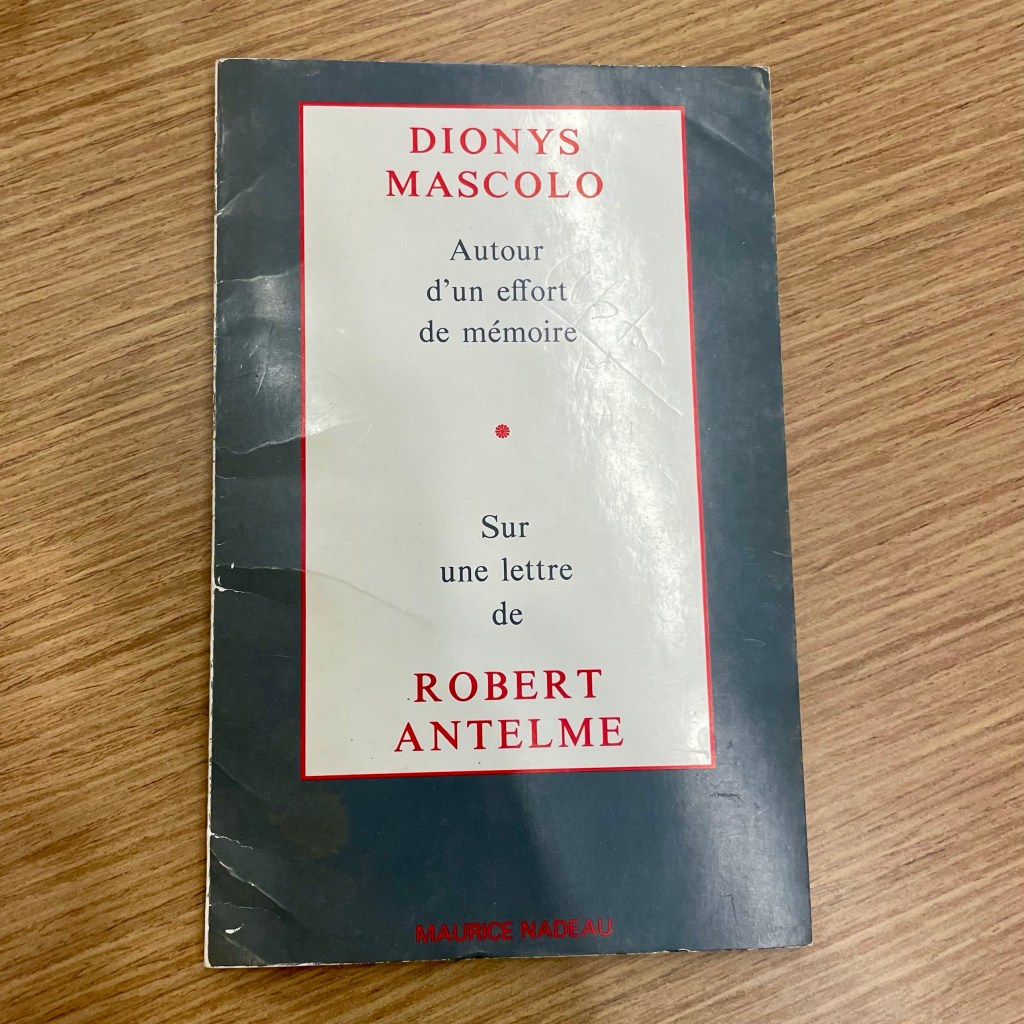
Rereading Dionys Mascolo’s Autour d’un effort de mémoire: sur une lettre de Robert Antelme (1987) in preparation for an upcoming course with Philippe Theophanidis, one gets the sense of beginning backwards or at the very end, since this late essay is a recapitulation of what the Rue Saint-Benoît Group embodied and stood for. And it is so obvious that for Mascolo what is at stake in Antelme’s letter is not a particular practice of confession (and the coupling of secrecy and extraction), but rather an integral register of an experience that belongs to “friendship in thought without reserve” [1]. And that it would not have been possible without friends, as simple as that. Of course, the condition of possibility of this shared thought in friendship has less to do with general principles, norms, or creative acts, and more with what Mascolo does not hesitate to qualify as “a sensibility that was common to us”.
What is this sensibility, and is it possible to describe it? This is a question that I do not think that is attempted to be resolved in Mascolo’s commentary nor in Antelme’s letter so consumed by its internal lacunae and effacement (I am definitely not capable of saying a word about it at the moment, and this might be one of the questions in the ongoing dialogue in the seminar). Mascolo does offer a little more when he states that this sensibility, however broad and partial, was always elevated against all totalitarianisms that were hegemonizing the political positions of the epoch. Obviously, it names the political totalitarianism (Fascist and state planned communism alike), but also the “the soul of the project” (‘est l’âme du projet et sa forme aboutie’) that must retract from it [2]. The last pages of Mascolo’s reflection is a shallow-deep, an insinuation, into the possibility of saying something in relation to this difficult proximity.
Hence, against total subsumption of life into political planning (whether on the right or left, whether ecclesiastical or in the name of the secularized forms of militant communist parties), Mascolo’s insistence on the ‘soul of the project’ is sustained by the “missing word” give that dispenses human necessities as infinite. He writes: “Et par mille et mille détours, il me (nous) fallait toujours en revenir au même point : Je suis ce qui me manque est la sentence que je porte (nous portons) inscrite à l’intérieur du front. La moindre des choses alors est de proposer que, sauf mensonge, elle vaut pour tout homme”. [3]. But what could it mean that “what I am” is always constituted by the missing word? It is definitely not a substantive attribute to a person (and thus what I can acquire), but a word that in its ideal absence and lack of epistemological validity stands as a form of seeking (zēteîn) that Nicoletta Di Vita has recently linked to the form of the ancient hymn [4]. The missing word is the passive and pure voice that calls out the rhetorical fiction of political totalitarianism. In other words, the missing word does not enact a present state of things, articulating the denomination in language with distinct objects of the world; it only has transformative weight when revealing what remains under the capes of morality.
This is why the experience of the camp constitutes a central threshold: on the one hand, it is an extreme and sharpened image of social alienation between classes; and, on the other, it is the experience that by depriving the human of its humanity it brings to an effective end the polarity between rich and poor that structured the economy of salvation and damnation of Western civilization. This is what Antelme describes in his essay “Poor Man – Proletarian – Deportee”, which according to Mascolo brings the rich to a psychotic night of desperation towards destruction and death of the specie. Hölderlin’s definition that “we have become poor in order to become rich” as a clement predicament in the face of the modern is here-forth suspended in the spiritual crisis generated by the social engineering whose most extreme case is the model of the camp.
And yet the missing word remains irreducible even after the corrupted stage of innocence and the impossibility of redemption. Mascolo, reader of Nietzsche, does not believe in the theos. This is why for him the missing word, far from being an apostrophe that offers consolation in the wake of the catastrophe, it remains concretely attached to the experience of the friend that no longer finds solace in abstract peace, but in the profound musicality of what remains inconsolable: “cette heureuse absence de paix qui est sa musique profonde, et que donne en partage l’être aimé, l’inconsolable qui console” [5]. This transfigured word – the unending capacity for hymn in the human, its nomoi mousikos – is both an excess to memory and appearance, and perhaps, more importantly, an excess to the experience of living and the dead. And is not this “seeking” passage of the missing word what the Rue Saint-Benoît Group was obsessively after?
__
Notes
1. Dionys Mascolo. Autour d’un effort de mémoire: sur une lettre de Robert Antelme (Maurice Nadeau, 1987), 82.
2. Ibid., 83.
3. Dionys Mascolo. Autour d’un effort…,82.
4. Nicoletta Di Vita, Il nome e la voce. Per una filosofia dell’inno (Neri Pozza, 2022), 27.
Jan Van Eyck’s 1432 Portrait of a Man has the Greek inscription, and rendered in transliteration, that reads “Tum Otheos” (ΤΥΜ ωΘΕΟς) that has baffled art historians and specialists on the painter for a very long time. It is well known that Van Eyck, the pioneer of oil painting, was fond of leaving all forms of writing in his pictures in Greek, Hebrew, and trilingual idioms that through the centuries have become incomprehensible jottings [1]. At a time when Van Eyck was painting in Northern Europe, the magical efficacy over names and naming was a dominant cultural and religious belief, and the expanded arts of the ‘names of god’ were used to heal and relieve pain, and protect against potential enemies and keep demons at bay [2]. Following Hermann Usener, one could see how the original act of the naming of the gods was no longer tied to ‘momentary divinities’ (Augenblicksgötter), but rather they were functionalized to specific anthropological needs for survival. Nonetheless, it is quite ashtonishing to witness how the painting at year zero that Van Eyck embodies – the very birth of oil painting and the “coming to life” of the figure in depiction – coincided with a divinization itself of the expanded field of the arts [2].
In Erwin Panofksy’s early interpretation the inscription “Tum Otheos” should be read in light of the musical revolution that had taken place between 1420-1440 in the Netherlands, where the ars nova meant a thorough musical renovation towards a new expressive energy and “exquisite sensibility” nourished by the myth of Timotheos, who was taken as the ancient model of sublime harmony of the new arts and style of bringing life into depiction [3]. Overtly dependent on the transmission of the ancient figure of sound, for Panofsky the inscription “Tum Otheos” pays homage to the lyre Timotheus of Miletus as creator of the “new music”. But, could the same be transplanted into painting? Could painting at “year zero” be taken as precisely this new tonality of the arts?
A second possible rendition of “Tum Otheos” is one what has been merely registered, although not elaborated, by art historian Alfred Acres, for whom “tum otheos” is not indexing the ancient musician but more importantly, it is registering an event or what is taking place [4]. Thus, for Acres “Tum Otheos” should be read as “and then God”; as if the relationship between painter, depiction, and spectator was the very taking place of a minor and invisible god of creation that painting facilitates. It is not difficult to recall here what Luca Giordano said of Velazquez’s painting: “this is the Theology of Painting” [5]. Although directed at Las Meninas, one could perceive that in the early stages of the secularization of the forms of the modern, the nexus between theology and painting becomes a clandestine partnership that resists its full integration into the autonomization of forms of representation. In other words, there is always a theos reminder in the act of depiction that is irreducible to the general economy of forms, as if the dissonance of the soul endured underneath at the nearness granted by the concrete realization of a picture. “And then God”, as proposed by Acres, should not be taken merely as the eruption of the divine in the symbolic structuration of the world, but rather as the very act of naming that allows divinization to continue in spite of the closure announced by the flight of the gods.
Just one year after Van Eyck’s Portrait of a Man (1432) where the inscription “Tum Theos” appears, in Italy Alberti will write in his De Pictura that the gesture of painting “possess a truly divine power in that not only does it make the absent present (as they say of friendship), but it also represents the dead to the living many centuries later, so that they are recognized by spectators with please and deep admiration for the artist” [6]. And if Postel is right that Van Eyck’s Arnolfini masterpiece is one in which the picture reconvenes the dead bride and the rich merchant into pictorial space, then one could deduce that for the Flemish artist the divinity of painting is defined as the only passage left to the moderns to negate the world of the living and inhabit the invisible world of the dead against the coming of the monothematic world-image and its material crust of Gaia [7]. “Tum Otheos” – and then God – is literally registering the transfigured and expressive dimension of painting; that is, the taking place of depiction and its secret fidelity to what appears only to banish and become forever unfathomable.
.
.
Notes
1. Susan Frances Jones. “Jan van Eyck’s Greek, Hebrew and Trilingual Inscriptions”, in Van Eyck Studies, September 2012, 294.
2. Noa Turel. Living Pictures: Jan van Eyck and Painting’s First Century (Yale University Press, 2020).
3. Erwin Panofsky. “Who Is Jan van Eyck’s “Tymotheos”?, Journal of the Warburg Studies, 1949, 88-89.
4. Alfred Acres. Jan van Eyck within His Art (Reaktion Books, 2023), 177.
5. Daniel Arasse. Take a Closer Look (Princeton U Press, 2013), 134.
6. Leon Battista Alberti. On Painting (Penguin Classics, 1991), 60.
7. Jean-Philippe Postel. El affaire Arnolfini: Investigación sobre un cuadro de Van Eyck (Acantilado, 2023).
Giorgio Agamben’s most recent La voce umana (Quodlibet, 2023) sets the scene with an elemental question: what is to call on something, and what is it to be called upon? The exploration around the notion of the voice (a sort of chorâ that falls between the different antinomies of human language, as we will soon learn) is far from new in Agamben’s work, who from the the early period of Il linguaggio e la morte (1982) directly confronted the negative foundation of phonê in relation to the closure of metaphysics. In a certain way, the perimeter of La voce umana (2023) is now deliberately limited to how the ‘mystery of the language’ is to be found in the unending event of the voice as the arcanum of anthropogenesis itself. At this stage of his investigations, the problem of the voice for Agamben designates a double movement of inflection and recapitulation: the voice proves the internal division of political life in the West; at the same time, it is also the most intense experience that a form of life can bestow the disclosure of the world. The attentive reader might recall the last pages of L’aperto: l’uomo e l’animale (2002) where the impasse of the anthropological machine was assigned by caesuras between human and animal, the semiotic and the semantic, the word and the name, redemption and the end of time, writing (gramma) and sound. But it is now with the voice that a clear way out becomes apparent. In the analytics of the voice klesis no longe stands as a political-theological category of the West; but, on the contrary, a call of language unto itself, the vocative that resists linguistic denomination and the free-standing outside the case and even language itself (“fuori lingua”) as suggested by Gustave Guillaume.
The vocative dimension of language is shown as pure means of the human experience: the apostrophe that calls something – as in Moby Dick’s majestic beginning “Call me Ishmael” – is already the call through the act of naming, and naming falling into the voice becomes the originary place of language in the denomination of speech (21). Irreductible to the antinomy of langue and parole, the semantic and the semiotic, the vocative texture of the voice emerges as the third figure that neither linguistics, philosophy of language, phonology, analytical linguistics, and biological cybernetics are capable of truly grasping. And this is so – Agamben does not says it in this brutish way – because there cannot be any theory of the voice and the vocative denomination; there can only be a poetics of the voice in which the transformative and self-generative experience with reality is staged: “Ma è possibile pensare il linguaggio prescindendo dal suo rifermenta lla realtà? La voce – il vocabolo – non designa soltanto un significant, chiama piuttosto un ente reale…non si limite a elencare segni in un lessico, ma annuncai ed encunia realtà” (36).
In my respects – and this is not the place to bring into focus Emile Benveniste’s last seminar on language and writing – Agamben’s treatment of the voice is nourished by pushing beyond the limits of the great twentieth century linguist who, for the most part, remained silent on the place of the voice. Not that there is a need for another substantive treatment of the vocative; in fact, one of the great achievements of La voce umana (2023) is precisely the archeological reconstruction of the Aristotelean “what is in the voice” (ta en té phonē) formula in which the classical metaphysical inception of language comes closest to the voice only to render it “articulate” and thus subordinated to the legibility of gramma or the written sign (42-44). And whatever one thinks of what constitutes the “primacy” of metaphysics in West (phone or gramma), what is important is the fact that domestication of language has been auxiliary by the “fundamental discipline of the West” (grammar) that sets off the immediate point of dialectical force between speech and the alphabetical inscription in the voice (45-46). Civilization is nothing more than the historical process of taming one’s voice.
At this point, it becomes clear that Agamben remains faithful to his old friend, the Spanish poet José Bergamín, whose bewildering essay from 1933 “La decadencia del analfabetismo” (“The decline of illiteracy”), argued precisely that the upwards movement of civilization of grammar and writing undermined the living voice and imagination of concrete and localized people (“pueblos minorías”) livelihood [1]. Indeed, it does not take much to see how the grammaticalization of human experience was a fundamental infrastructure for the consolidation of civil society grounded in the articulation of internal recognition of rules, normative directives, and binding statutory enforcement. The triumph of the order of grammar will only intensify the movement towards the total integration of every form of life into the fictive rhetorical space on behalf of what has already been stated without having to persuade, to put in Carlo Michaelstaedter’s terms that I do not think contradict the terms that Agamben extracts from his exegesis of the voice.
The political problems emerging from the confrontation with the voice are multiple. One can recall how in modernity, when “words have been liberated from their sacred denomination” (something pondered by Joseph De Maistre in his The Generative Principle of Political Constitutions as political revolution sets through universal recognition), the closure of the rhetoric embedded in “social life” captures the event of the voice into a stable communicative dimension of language (“suoni della lengua”), which for Agamben resembles the etymology of the word phònos: murder, that is, the self-conscious assassination of the voice at the altar of free-floating rhetoric and the order of discourse (50-51). By the same token, in our epoch every living being has the malleable equalizer and “amplifier” (a word used, indeed, by the Supreme Court of the United States when deciding the case that granted equity between finance campaign and ‘public use of language’) of words, but it is only rare to see anyone truly possessing a voice. If every entity in the world has been previously assigned and grammatically ordered, what is absent is precisely the chōra as the “invisible and formeless place” (‘invisibile e senza forma”) in which the intelligible pure state of the language in the voice. In this strict sense, whoever possesses a voice is one who dissolves the axiomatic arrangement of discourse only to transform the world as inhabited. This is why the voice remains not a threshold to semantic register or the written technology, but rather an unknown song (“canto ignoto”), as it was called by Benedictine monk Guido d’Arezzo. And this song, the voice, can be followed and deciphered but never truly mastered as absolute transparent knowledge (45).
And if music is an index of prophecy, as Gianni Carchia once suggested, then this means that the voice, like the mythic harmony of the spheres, is what exceeds the proper human as indivisible and non-exchangeable realized only here and now. The political consequences are immense, Agamben is right. This means that we need to restate the medial and geographical distances of the chorā over the orderly cultural exchange of the polis. As it has been noted, the rise of the city state is waged against the orphic poetic myth; in the same way that the Roman imperium was possible by the erasure of the Etruscan musical underworld. Agamben reminds us that the birth of biopolitics coincides with the historical invention of the science of language leading to the impoverishment of the intangible and expressive communication between souls. This is Agamben’s rendition that the task of philosophy – not historical benchmarks or epistemological categorizations – resides in the attunement to the highest hymn of expressive form as it has been studied by Nicoletta De Vita’s erudite monograph Il nome e la voce (2022). There is no philosophical or theological closure as long as the song remains.
We can say that wherever there is a chorā of the voice something like this minor transcendence of the original human being that retracts from the soteriological false exits that have devastated the anthropogenic event. And it occurs to me that we could thematize three areas of what this closure means for us today: first, the technification of politics in epoch has been reduced, precisely, to a discursive theory of articulation (of social demands) to craft the fictive totalization of hegemony; second, the collapse of the political representation within contemporary democracies has turned into the optimal organization of containing willful self-expression in light of the contingency of values of the dominant aesthetic regime; and finally, the very understanding of legal culture and constitutionalism in the West has shuffled different modalities of the written authorial intention to generate the internal rules of institutional and statutory norms only to expand police powers and codification of conducts. At the expense of the unknown song, all sorts of prosthetic contraptions have been erected to douse the prehistoric voice that nevertheless keeps overflowing and reemerging like the unnerving cracking squick of Kafka’s Josephine. It is this watershed mystery of the anthropogenesis with its philo-poetological density that calls on humanity by the highest superlative imaginable: its voice.
Written at a time when the sciences of biological life were becoming fully integrated to technological and procedural social experimentation, Elizabeth Sewell’s 1960 The Orphic voice (nyrb, 2022) dared to pose the question of poetic myth as the mirror of scientific transformation of the modern world. Given that myth reopens the question of poetry and the natural world, for Sewell the modern exposure entails a profound misunderstanding: it is not that myth has eclipsed from the developments of scientific regime, but rather that science is incapable of absorbing it through its formal explorations in a system of subdivisions, classifications, and applicabilities. But for Sewell, it is myth itself that conditions scientific activity, providing ground for the discovery of situations and play in the world of forms. In other words, it is the persistence of myth in biological imagination the real forgotten path in the crisis of the transmission of tradition in a world aligned by the movement of scientific objectivity. For Sewell’s understanding of myth, there is no positive dialectical movement between myth and calculative rationality; rather, myth is what stands for the irreducibility of life in the cosmos. It is the very mystery of the anthropogenesis of creation as pure metamorphosis of forms. Why Orpheus, then? For Sewell, the orphic figure becomes “myth as a living thought and the very type of thought in action, and for all those other self-reflecting forms; for the human organism as an indivisible whole trying to understand itself….for biology reflection on the whole span of life in which thinking man appears as the last enigmatic development” (41). Orphism is the natural prehistory of becoming. This implies nothing less than reminding modern science of its “mistaken mythology”; as it is poetry – not mathematics or a scientific theory of language – the proper site for the adventure of life.
The strange career of orphism in the modern age is one of struggle, according to Sewell. A “struggle” that accounts for change, process, organism, and life” in an epoch that thinks of itself as definite and irreversible; completing the demythologization of the old gods and the ultimate achievement of secularization. Unlike for Oskar Goldberg for whom the civilizational regime of fixation of humanity is a matter of thousands of years (at least since Cain); for Sewell it has only bern a couple of centuries that has led to an esoteric experimentation with natural history in the wake of his postmythical substitution. At bottom, her task is to bring together, once and for all, the voice of Orpheus and “natural history and poetry, had not parted company and it only remains to try to bring them, after their long and wintry estrangement, back to one another” (48). This is the central task of the modern poet, Sewell seems to tell us: to wrestle the potentiality of myth to craft the a “model of thought” that transfigures the logical framework of rational thought into a “flexible and plastic” (beweglichund bildsam) play between form and formlessness that becomes inalienable from the metamorphosis of nature. This does not mean that all modern poets are orphic; and, I am not sure that Sewell will go as far as to accept that all orphism comes in the form of poetry (this will be of scarce persuasion). What the Orphic voices are saying “is that the poet and his world is part of natural history…it is postlogic” (153). The postlogic stands a tenuous and loose term to avoid the supreme autonomy of reason of scientific modernity. Rather than a tool to understand the causation of natural processes, or a set of artificial strategies for representation, the postlogical poetics is the music of a world as being transformed through experience and immersion. It is no doubt strange that Sewell calls postlogical method to account for the permanent overflowing of the orphic voice; although it becomes clear that she wants to think of it as a utensil inseparable from the form that it makes. In other words, the “method” stands for the possibilities of use through the attunement with worldly phenomena. Postlogical method wants to give substance to how well we construct and tailor the potent infinity of form. As Sewell writes: “The method, the lute strung with the poet sings, consists in the use of the self, and mind, heart ,as well as intelligence, as an instrument of wider interpretation, with language assisting in the process” (168).
The free use of one’s own is surely the hardest task for the poet, as we already know from Hölderlin who grasped the crisis at the outset of Romantic modernity. The capacities of the orphic poet wants to wrestle the force of expression from the stage of history into the methodology of forms. This is what Sewell reads positively in Goethe’s Urworte and Urpflanze as the “methodology of transformations…the key to all the signs in nature” (274). It is noteworthy that Sewell does feel the need to revise Hölderlin’s poetological attempt at the insufficiency of the tragic poet embedded in the play of Empedocles mediation between the material craft of art and the aorgic excess of nature. And it is too bad that she does not (alas, Hölderlin remains the missing key for many of these problems). But it might be that for Sewell the orphic voice is not a transfigurative element, but rather the acoustic composition of the play between creation and decreation. In this sense, the bios orphikos is, not merely of this world, but also the immemorial journey to the infraworld sidestepping tragic overflowing. It is very late in her book that Sewell defines this pathways that transcends all form and contours of scientific vitality:
“The origins of all our bodily and mental powers are in an exact sense with the dead, in heredity and tradition; thus the dead are not wholly dead here within the living body. The heart and the center of the kingdom of the dead to which Orpheus goes in search of Eurydice is also the penetralia of the individual human life which pulsates and thinks…Anthropology suggest that the labyrinth of primitive man, the maze emblem and the real mazes of the caves, were capable also of being the body, and the site of a journey between the two worlds of living and dead. The orphic search here goes past Orpheus back into immemorial antiquity.” (326-327).
Immemorial antiquity – these are the wonderful markers of everything that Sewell’s book does not accomplish or flesh out in its voluminous 400 plus plages. But, it is only at this point that we are capable of understanding that what Sewell calls “biological thinking” has nothing to do with the basic mental capacities that dispenses the anthropological density of the modern reserve to self-assertion (in Blumenberg’s unsurpassed definition), and everything with a tradition of the immemorial that is creation’s most intense point of bifurcation between the living and the dead. The passage to this region becomes testament to the validity of one’s experience. This is also why the orphic voice cuts through the the subdivision of the polis and the modern autonomy of art; as it takes life through the fleeting instance of the freedom of forms in its non dependency with historical necessity and domestication, as Gianni Carchia lucidly reminded us [1].
The orphic immemorial will not appeal to a morality of nature based on its fictive aura of normative order, but rather, it will supply the potentiality of the taking place of language. Hence, it is no surprise that the taking place of the voice (its postlogical status) lifts the human outside of itself, at the same time that it retains its most absolute nearness to the symbolic strata of myth. Commenting on Wordsworth, Sewell writes: “…the first provisional conclusion on method in the poem: that each language is a treasure of the earth but that poetry is the more valuable (as if our word, postlogic, might here receive additional justification)” (358-359). The voice has never been an organ or a specific faculty that belongs properly to the human; it is the passage between humanity and its constitutive exteriority in the world. Like the harmony of the spheres, the voice registers tone in the wake of the impossibility of communicating in the murky waters of physis.
If at the turn of the century Aby Warburg had shown how modern technical civilization had ended up soaking the mythical force of the serpent from the stormy sky of the Pueblo Indians (and thus the luminous space of contemplation of man in the cosmos); Sewell’s extremely idiosyncratic essay shows, between lines and amidst rhetorical inflation, that the echoes of the mythic imagination are still an integral part of the sliding amore fati, whose “aim is the discovery of the world” (405) [2]. The lesson in our epoch becomes easily adapted: the ethical standard does not prove itself by appealing to norms and substitute fictive authorities, but rather in terms of how well one is able to attend to the incoming vibrations of forms. One can even go as far as contradict Sewell post factum and say that this is no longer a request to be made on science, which has fully ascended to the place of prima philosophia as prima politica. So, it is perhaps love (that figures so poorly in Sewell’s book in relation to the centrality of cerebral intelligence, barely making an appearance in the very last page) the symbol of the highest riches transfiguring myth into a voice that outlives the specter of humanity and the futility of the machine. If orphism means anything, it is that the voice implies withdrawing from the cacophony of a world that has imprisoned the living in the blistering entertainment of their own wrongdoing. “Flebile lingua murmurat exanimis”, signs Ovid — right, but who is still able to listen?
.
.
Notes
1. Gianni Carchia. Orfismo e tragedia: Il mito trasfigurato (Quodlibet, 2019),
2. Aby Warburg. “A lecture on Serpent Ritual”, Journal of the Warburg Institute, April 1939, 292.
Nietzsche in Italy (Pushkin Press, 2023) by Guy de Pourtalès, originally published in 1929, has a particular texture that makes it inadequate to consider it a standard intellectual biography. Pourtalès does not follow the contours of the psychological and chronological construction; rather he is more interested in sketching out the telluric effects on the transformative tonality in the thinker’s soul. Nietzsche’s radiant affinity to Italy and “latinity” has been well known, and at stake there is the possibility of finding an exit from the grandiose enactments of the German romantic gestalt. For Pourtalès, “latinity” is the prescription that Nietzsche writes out for himself in order to maintain sanity in the world; and, ultimately, to find its own destiny and path in the face of modern nihilism. Sure thing, Italy is many things for Nietzsche: it is the zenith of his poetic relationship with the Wagners but also their farewell in Sorrento; it is Venetian music and pleasant weather; it is the open and physical form of a possible community of the Free Spirits and artistic expressivity. And Italy is also a refuge from brewing culture of force in the North through the Renaissance uomini singulari where music persists, as he writes to his friend Peter Gast: “Life without music is imply a mistake, enfeeblement, an exile” (94). Pourtalès narrative collage (the different vignettes of Nietzsche’s visits and residencies in the Italian geography) detects the philosopher’s fundamental existential homecoming: a melody of the soul in a world increasingly organized through the chaos as the essence of force. To be attuned to the melody of the soul becomes the task of the artist: “to hear and see beyond the vast “lost time” of humanity what others no longer hear or see, but just unwittingly hum as a tune, vague and wordless”, writes Pourtalès (41).
And if music is an aesthetic form of prophecy, Pourtalès’ sheds light on Nietzsche’s insistence to become a prophet of the age of nihilism: wrestling with the poignant homelessness in the human world of a postmythical age. Pourtalès insists that the “Italian experience” opens up for Nietzsche multiple possibilities to confront the Wagnerian solution through the concretion of the forced and unhealthy (these are Pourtalès’ terms) aesthetic formalization of the mythic redemption. The Nietzschean attempt (the beloved and unresolved versuch) is the final confrontation of “music versus music”, since “all philosophy is a series of events of the soul and finds its symbol only in music” (49) explains Pourtalès. This is what Italy seems to be providing Nietzsche with: the withdrawal from the intoxication of the “Wagnerian flame without being consumed by it” (66). This entails an acceptance to pain without instrumentalizing the rewards provided by the genial artistic form of the Gesamtkunstwerk and the enslaving commandments of Christianity. Wagner and Christianity now stand in the way of the path of destiny without paying dues to mimetic investments. This is Nietzche’s last battle, and thanks to Pourtalès we realize that Italy becomes the battleground for an ultimate detachment. But is it successful? Is Nietzsche as the artistic genialismus prophet able to accomplish the radical abandonment?
This is the resolute ambiguity in Nietzche’s proximity and distance from the Italian tonality. Indeed, Nietzsche seems never to have abandoned the rhetoric of the genialismus. Pourtalès quotes him: “Italian genius is by far the one which makes the freest and most subtle use of what it has borrowed…..and is thus the richest genius, the one with the most to give” (89). At times Nietzsche’s words about Italians or latinity is a metonymic for Christianity, his ultimate confrontation after Wagner, because to overcome Christianity implies to embrace the melody of life. This is why for Nietzsche Jesus is a higher form of life, whose kingdom is, according to Pourtalès (resonating here with the late work of Von Balthasar), “that of children, his faith is without rancor and without reprimand; it lives, it is itself its own miracle and reward” (100). The transfiguration of Christianity becomes a path to arrive at the very attunement of life itself, although this requires understanding love so that the “Kingdom of heaven becomes a state of the heart” (100). This nomos of the heart is Nietzsche’s ultimate and impossible search; perhaps one that does not truly find the path to a proper homecoming.
Was it due to Nietzsche’s failed efforts at finding the melody of the soul in his ruthless, cuerpo a cuerpo (“Dionysius against The Crucified”), struggle against Christianity? Were the terms of the prophetic transfiguration a mere illusion of guidance and redemptive incarnation? To put it in Cowper Powys’ lucid observation: “If Nietzsche had not been obsessed by Christianity he would have thought of Life before Christ came”. Pourtalès does provide us with another hypothesis: “Perhaps amongst the last things he [Nietzsche] understood was the profound speech of this piano, of this fiend, whose inner music he had always been the only one to hear. But no thought, no word emerged from this ruinate soul. Nietzsche expired, walled up his silence” (110-111). In Pourtalès’ interpretation, Nietzche’s lacked the central aspiration of melody of the soul: “knowing how to love”, which is obviously the unlearned lesson from the Italian landscape and the world of visuality. The fact that Nietzsche had no patience for painting according to Pourtalès says a lot regarding his incapability for an erotic mediation to escape spiraling towards madness in a desperate effort for completion. I am not saying that painting could have saved Nietzsche; but, as the last active metaphysical activity in modern nihilism (Kurt Badt), pictorial persistence is the ultimate exercise to hold on to the world from the point of view of one’s daimon. Pictorial persistence clears the illusionary strife over concepts of the tradition. Pourtalès’s Nietzsche in Italy (2023), even if only obliquely, is as lucid of a portrait as we might get in order to raise this question in a serious fashion.
Monica Ferrando’s short but dense book L’elezione e la sua ombra: Il cantico tradito (Neri Pozza, 2022) refines our understanding of the secularization debate in the wake of the epochal crisis of modernity and planetary domination. For Ferrando this current domination is rooted in a specific retheologization that must be grasped at face value, no abstractions allowed. The force of theological domination, which has become a proper religious imperialism, expresses itself as a true corruptio optimi pessima, which Ferrando locates in a very precise intersection: the passage from the suppression of dilectio to an instrumental manifestation of electio that will culminate in the unleashed power to dominate not only the relation with the world, but the very existence of the species. If the Ancient covenant of early Judaism was a prophetic covenant with God, the force of predestination will suppress the mysterious relationship of blessed life to render a “selective process” of theological election [1]. It is only with the rise Protestantism, and Luther’s specific hermeneutical efforts to neutralize the messianic message of Paul’s Letters to Romans that election becomes the paradigm of a new government of the soul in this world, which will ultimately find its material legitimacy with the advent of the reproductive logic of capital. Implicitly building on the thesis of economic theology, for Ferrando the advent of the machine of election materializes in the theological reform that translates the universal salvation of the prophecy into a never before seen economy of the dispensing grace through wealth retribution for human labor [2].
The reformation based on dispensation (oikonomia) differed fundamentally from the Church’s idea of change rooted in the ius reformandi. As Gerhart Ladner shows, if the “idea of reform” up until modernity presupposed periods of spiritual reform through monastic experience in relation to wordly profane time, the apparatus of dispensation of election was oriented at securing an integral government rationality combining law, economy and subjective production without reminder [3]. In this light, the operation of the dispensation paradigm is twofold: on the one hand, it promotes an anti-Judaic operation of reducing Jews to a people of this world that will ultimately will be identified with political Zionism; and, on the other, it dismisses the coming of Christ as worthless, and in the best case as merely postponed [4]. For a reformed theologian like Karl Barth – at odds with the economic evangelism that ultimately triumphed in the United States and that now it extends across the global – there was only a ‘great dispensation’ putting end to the abstraction of value and the homogeneity of the time of production [5]. But more importantly for Ferrando, the triumph of the dispensatory paradigm entails a new fundamentalism of judgement based on “election” (in the broadest sense of value equity and competition) will appear as the only immanent force capable of considering every other religion and confession exterior to itself as “merely pagan and idolatrous” [6]. It would amount to the triumph of the self-made ‘gentleman’ over the outward message of Paul.
The dominance of dispensation meant a full convergence between salvation and profane economic life that will bring exteriority into a crisis in the deepest sense. This is why for the reformist mentality, its own modern image initiates the epoch of irreversibility; that is, the pure historical progress guided by the will of election and the work of grace as an exception to universal salvation. If the modern reform has been at times understood as the new regime of social pluralism and system of indirect separations (between Church and State, civil society and religion, the public and the private, etc) for Ferrando it is on the side of the theological presupposition where its most terrifying arcanum must be found: a dispensational theology whose main unity is the recurrent intrusion, training, modification, and discipline of the forum internum, that is, the administration of the consciousness of man. Whereas the felix culpa allowed for the mystery of repentance and universal salvation; the political meditation of election through accumulation and economic benefits will legitimize the new discourse on toleration, “liberty”, and even democracy as the distribution of surplus value. In this sense, Liberalism (with Locke and other thinkers of the English and Scottish Enlightenments) was born, as later understood by Carl Schmitt, with the structural weakness of “individual freedom” and maximized autonomy that will require the expanding checks of police and governmental penalties to cope with the production of effects. Of course, every deviation or movement that could put a halt to the fiction of election will find itself on the side of illegality, or turned into a remnant of a surreptitious past that must be overcome at all costs. This implied, as Ferrando reminds us, nothing less than a novel modification of the anthropogenesis of the human species.
It is one of Ferrando’s most daring and surprising tasks to show how the machine of election does not merely occupy the economic-political sphere, but that it will eventually also imply an aesthetic imperative in Northern European culture; specifically with the rise of German romantic response to the crisis of the Enlightenment and the question of “classicism” of the classical Greece. If according to Gianni Carchia the aesthetic dimension of modernity should be read as a compensatory answer to the futility of the romantic revolution in subjectivity; Ferrando’s complementation to the thesis brilliantly shows how this attempt was meant to fail at its original ground due to the mimetic appropriation and metaphorization of the Greek historical past in the aesthetics program of Winckleman and German Idealism (with the exception of Hölderlin’s fugitive position) [7]. The mimetic “hellenization” of German romanticism and its posterior afterlives (one thinks of the Stefan George Circle, and Max Kommerell’s Der Dichter als Führer) gave birth to a notion of “culture” that hinged upon the separation of the aesthetic and the religious spheres that had to sacrifice the appearance of beauty in order to attest for the dialectics of objective and subjective forms of the “Spirit”, and thus leading to the triumph of the grotesque and the aesthetic imperative of uniformity and museification. For Ferrando the German spirit of genialismus had as a mission the overcoming Latin, Mediterranean and Mesopotamian forms of life where the distinction between beauty and life never understood itself as a “culture” or objective project of enlightened intellectuals and artists on the mission to transform the contingency of poesis into the realization of the Idea [8].
Displacing this aesthetic dimension to the present, for Ferrando the intrinsic disconnect between appearance and substance of art’s truth emerges today in the predominant social morality of today’s global bourgeoisie: hypocrisy. It is in hypocrisy where today one can see the inflationary hegemony of discourse over the true organization of life that is proper to the dominant metropolitan class of the West, and its maddening obsession with identity politics or “race” oriented discourse as a moral inquisitorial abstraction (it is in this process that the notion of election appears in the least expected of places: sky color, language use, demands for inclusivity, and hyperconscious towards an invented past). The work of hypocrisy, in fact, appears as a secularized form of the dispensation paradigm that aims to normalize and domesticate every form of life that challenges its specular regime. This is why according to Ferrando – and I do not think she is incorrect in saying so – the possibility of art (especially that of “painting”), as the undisclosed of truth will disappear from human experience, as it has no place in the moral functionalism of ‘contemporary art’ nor in the discursive struggle over global communication and opinion battles (the so-called ‘cultural wars’) [9]. The aesthetic museification of the world liquidates the possibility of art’s truth. Paradoxically, in this new scenario everyone must declare himself “an artist” of their own emptiness: the nowhere men that stroll in the works of Robert Walser or Franz Kafka – who never declared themselves to be anything – in our present are flipped on their heads becoming informers of the regime of a universal politics of recognition and moral judgement [10]. These ‘bloomesque figures’ confirms in the last epochal dispensation of the Reformist revolution that the premises of subjective freedom, economic gain, and autonomy of value have culminated in a new aesthetic imperialism that is anthropological and rooted in the triumphant religion of immanence and the sacralization of ultimate values. The endgame has been dispensed in the creation of a “new man” through the sacrifice of every exteriority in man, that is, of the invisibility outside the fiction of his personality.
The paradigm that Ferrando is describing vis-a-vis the operative force of “election” is also one of profound irony, since the mechanism of predestination and election, by betraying prophetic dilectio (love), the “free election” of the moderns entails that everything can be elected at the expense of losing dilectio: the only path towards the mystery of life. This is what the epoch of irreversibility and the arrogance of historical progress has foreclosed and it is incapable of considering. But for Ferrando life remains an ethics, which she links to Eros, whose appeal to the law of the heart is neither religious nor political, but rather an instance to the disclosure of truth. As she beautifully writes towards the end of L’ elezione e la sua ombra (2022): “Occorre osservare che qui si tocca una sorta di grado zero teologico, che scivola nel mero «biologico» solo a patto di esautorare la sapienza della madre o, detto altrimenti, la sapienza come madre, custode di una legge non scritta, di un nomos del cuore, che non necessita di alcun mandato esterno per esercitare la conoscenza che gli è propria. Si apre insomma quello spazio, costantemente e variamente negato, ma imperturbabile, di cui solo la madre, in virtú di una sapienza propria della natura umana, può custodire la legge.” [11].
The foreclosure of the acoustic relation to prophecy documents the recurrent political interest in the subordination of music to the moral captivity of the reproduction of humanity [12]. On its reverse, the law of eros, prior to the moral domain of natural law and the authoritative domain of positive law, is the protection of the indestructible region of the human soul where no political, moral, or economic dispensation can exert its force. This is confirmed today by the monstrous techno-scientific interventions and dysphoric alterations in the life of children as the last utopia in the long dispensation of the anthropomorphism of capital legitimized by rhetorical force of an unending sermo homilis [13]. In this sense, what Ferrando accomplishes in this wonderful essay is to remind us that the event of theology remains outside the dominion of priests and bureaucrats and situated in the prophetic dimension of Eros (love) that guards the inclination towards beauty and the disposition to attune oneself to the prophecy of the world’s fulfillment [14]. Hence, it is not in the community or in an integralist Christian traditional family order where the sacred dimension of humanity can be retrieved; rather, for Ferrando it is in the non-knowledge reserved by the eros of the mother who never decides nor choses before law, whose nonverbal “tacit authenticity” (“tacita autenticità del legame materno”) unconceals a true experiential depth away from the the delirious cacophony of our world.
.
.
Notes
1. Monica Ferrando’s L’ elezione e la sua ombra: Il cantico tradito (Neri Pozza, 2022), 8-9.
2. Ibid., 22.
3. Gerhart B. Ladner. The Idea of Reform: Its Impact on Christian Thought and Action in the Age of the Fathers (Harvard University Press, 1959).
4. Monica Ferrando. L’ elezione e la sua ombra: Il cantico tradito (2022), 24.
5. Karl Barth. “The Great Dispensation”, Interpretation, V.14, July 1960, 311.
6. Monica Ferrando L’ elezione e la sua ombra: Il cantico tradito (2022), 30.
7. Gianni Carchia. “Modernità anti-romantica”, in Il mito trasfigurato (Ernani Stamptore, 1984).
8. Monica Ferrando. L’ elezione e la sua ombra: Il cantico tradito (2022), 60.
9. Ibid., 91-92.
10. Ibid., 94.
11. Ibid., 106.
12. On the controversy of music as a tool to tame human’s passions, see John Finnis’ “Truth and Complexity: Notes on Music and Liberalism”, American Journal of Jurisprudence, Vol. 62, 2017, 119-124.
13. Gianni Carchia. “Eros y Logos: Peitho arcaica y retórica antigua”, in Retórica de lo sublime (Tecnos, 1990), 29.
14. Gianni Carchia. “Dialettica dell’immagine: note sull’estetica biblica e cristiana”, in Legittimazione dell’arte (Guida Editores, 1982), 21.





 Infrapolitical Reflections