The hypnotism of patriotism. by Gerardo Muñoz

We owe an untimely intuition about the enduring seduction of patriotism and nationalism to Leo Tolstoy’ essay “Patriotism and Government” (1900), in which he captured a paradoxical phenomenon: mainly, that at the same time that the integration of humanity and its historical consciousness reached its civilizational peak, patriotism instead of disappearing became increasingly more destructive and fierce. Looking at the outset of the First World War in Europe and its nascent total mobilization of industries, the Russian novelist claimed that, from that moment, government organization will depend on patriotism as a source to conduct total war within the human species. But what surprised Tolstoy – which has clear contemporary overtones in the impolitical movements that dominate Western societies – was the degree that this lethal patriotism infiltrated the very worldview and orientation of the Christian vocation. Tolstoy writes in the most most potent passage of the essay:

All the peoples of the so-called Christian world have been reduced by patriotism to such a state of brutality, that not only those who are obliged to kill or be killed desire slaughter and rejoice in murder, but all the people of Europe and America, living peaceably in their homes exposed to no danger, are, at each war – thanks to easy means of communication and to the press – in the position of the spectators in a Roman circus, and, like them, delight in the slaughter, and raise the bloodthirsty cry, ‘Pollice verso.’ [1]. 

This should suffice to note that for Tolstoy patriotism is neither a political ideology nor a formal principle of community; patriotism is rather a social liturgy born of the absolute sacrazalization of human life and whose hyperbolic figure will be that of the war-slave trained to endure “the act” (especially the slave that participates in the carnage through his words and attention). And just like in a theater play or in the Catholic liturgy where there are “acts” (and the service can only subsist through its enactment), the unleashed force of patriotism becomes a form of destruction as the essence of government organization.

This is why for Tolstoy the inception of total war recalibrates the grotesque spectacle through the “hypnotism of patriotism”, positing a fictional belonging of salvation – that is nontheological because it is unredeemable – through the destruction of another community of the human species. True, the end of politics always results in war; although Tolstoy introduces a nuance to this axiom: war is able to subsist thanks to the self-affirmation of patriotism as the triumph of a wordless inhumanity.

It is no coincidence that Tolstoy observed the rise of patriotic strife in tandem with modern science as conquest over Nature and the reality of human experience [2]. Thus, government patriotism and instrumental sciences are two interconnected regimes of the organization inhumanity that speak the rhetoric of growth and prosperity as stagnation deepens. In our days, this social cohesion, as Tolstoy warned with precision more than a century ago, has entered a new phase of domination that some called a “lethal form” integrating technology and war without any reminder [3]. 

Notes 

1. Leo Tolstoy. “Patriotism and Government” (1900), in Last Steps: The Late Writings (Penguin Books, 2009), 318. 

2. Leo Tolstoy. “Modern Science” (1898), Last Steps: The Late Writings (Penguin Books, 2009), 252. 

3. Alexander Karp. The Technological Republic (Crown Currency, 2025), 154.

Hypocrisy as last refuge. by Gerardo Muñoz

In an entry of Dopo Nietzsche (1974), Giorgio Colli states that after the overcoming of all values and taboos, the contending moral strife finds its highest value in hypocrisy. Colli goes on to say that “hypocrisy is the last bastion where moral forces have found their refuge” [1]. One can clearly see that for Colli hypocrisy as the highest value is quite distinct from morality, since it is the “refuge” where the contending moralities invest themselves in rhetorical encroachment. That hypocrisy has become – as Colli saw with clarity in the 1970s – the last alcove of humanity, means, for one thing, that the human species have ceased to have any faith in the language that they use, and that for this very reason there is only an estimation of rhetoric, procedure and technical terms abstracted from the sensible world. If understood as such, it would come to no surprise that the majority of public institutions in advanced societies are embracing, and for the most part promoting, the incorporation of Artificial Languages and Intelligence to organize the interactions of their lives. Ultimately, the order here is clear: it is not that new technological advances will lead to a rise in untruthfulness; rather, these instrumental mutations are a consequence of the deep hypocrisy that runs through the social bond.

In fact, one can only assume that Colli was pointing at something more profound and obscure in his gloss when he referred to hypocrisy as the last refuge, and in this sense he was pointing beyond Nietzsche. After all, Nietzsche understood hypocrisy as mimesis and appearance that if incorporated over a long period of time ceases to be hypocrisy to become real [2]. A series of good acts and deeds in the spirit of friendship makes a person benevolent. In the same way that Miguel de Unamuno’s San Manuel Bueno Martir through his public faith and habits, was a symbol of Catholic faith for all the believers of his tightly knit community in spite of his interior doubts (this is the Knight of Faith). Now, Colli is pointing to a second degree hypocrisy that is no longer explicated by mimicry, but by its dependence to an ethereal value that governs and justifies any set of given actions. The actions are no longer in relation to faith or non-faith, but are properly acts of “bad faith”, since they make belief captive to the justification of the highest moral value. This will be consistent with Nicola Chiaromonte’s description that the end of secularization is not an epoch lacking faith, but one that dwells in “bad faith”. 

And what is ultimately “bad faith”? It is the realm of hypocrisy that, due to its impossibility of communication, understands its mission waged on the petty negation of one value over another. It is a mutation of Goethe’s nemo contra deum nisi deus ipse into the sphere of prevailing forces. The civilizational stage of enlightened hypocrisy prepares the human being to renounce the use of language and unmediated appearance. This means that the triumph of the technoadministration of the world would not be possible without the alluring refuge of hypocrisy that conquers reality through the very means that renders inaccessible the real presence of the world. It is not that politics and politicians have become hypocritical; it is that politics can only subsist thanks to its refuge in hypocrisy. The hypocrite is the last figure that steers in unworldliness.  

Notes 

1. Giorgio Colli. Dopo Nietzsche (Adelphi Edizioni, 1974), 50.

2. Friedrich Nietzsche. Human, All Too Human (Cambridge U Press, 1996), 39-40.

Kallopismata orphnes: the eclipse of language. by Gerardo Muñoz

In his most decisive confrontation with the scientific method and the legitimacy of science through objective knowledge, Carlo Michelstaedter introduces a rather loosely expression from Plato’s Gorgias to lever his position against the sufficiency of the scientific experiment: the “kallopismata” (καλλωπίσματα), which can be rendered as “embellishments” or “ornaments” that is constituted in figures such as matter, law, the final cause, or ruling principles (archein) that align the conditions for calculative and sufficient reasoning [1]. For Michelstaedter, the world of objectivation and scientific neutrality proceeds through figures of rhetorical ornamentation, kallopismata, which allows conquering the future; that is, what remains completely foreign and inaccessible to the domain of calculative reason waged upon a series of expressed goods. 

It could be said that kallopismata is the artifice that allows the absorption of those goods to the historicity of civilization as they undergo their own ‘corruptio optimi pessima’ a process of functional realization of their entelechy: the desert becomes a cloister, the banquet an academic, the artist’s studio a school of beaux artists…imitative technique assumes the name of art; any virtuosity assumes the name of virtue [2]. In a language similar to that of Heidegger’s, Michelstaedter speaks of the constitution of an “exceptional machine”, which positions the organization of the world through rhetorical deployment (and it was not by coincide that Heidegger referred to Aristotle’s Rhetoric as “the first systematic hermeneutic of everydayness with one another”), and hence the fundamental metalinguistics of any social economy. The exceptional machination not only deploys generic meaning from the irreducibility of things, but also organizes the mediations between the subjective plane and the objective reality. In this way, the rise of the hegemony of science in the hands of the ‘pioneers of civilization’ and a “community of the wicked”, as Michelstaedter calls the endeavor of modern scientists, can violate nature offering security and comfort to the totality of mankind. This will explain their civilizational endurance and the recursive positionality for historical self-amendment and renewed adaptation.

How can this community of the wicked achieve absolute consent and domination through their practice? The domination over nature is not exclusively an anthropological process extended outwardly; it posits a nexus between interiority and exteriority where the question of language itself is entirely redefined. This is why the most stealth invention of the practice of scientists for Michelstaedter is to “infiltrate life with certain words….on which meaning unknowingly prop themselves for their daily needs, without acknowledging them they pass them on as they were received” [3]. The ultimate experiment of the techno-scientific understanding of the world amounts to the elaboration of cybernetics (a term that Michelstaedter never uses but that obviously colors the effect of his general scheme of civilizational nihilism); that is, the unification between the phenomena of the world and the human’s sayable language. To this end, Michelstadter will emphasize this proximity: “Technical terms give men a certain uniformity of language. In  vain do the proponents of internally created international languages dream. The international language will be language of technical terms; of kallopismata orphnes, ‘ornaments of the darkness’ [4]. Whereas darkness denotes the harboring of language and its limit – and one can recall Fridugisus’ De nihilo et tenebris – its slow decay in darkness, kallopismata orphnes, outlives itself by the artificial luminosity that tears all mediation from the sensible world, now realized as fully alien to the appearance of truth and the truth of appearance. As Giorgio Agamben has noted, in what could be read as an esoteric gloss on the triumph of the kallopismata orphnes in our times, the technical question in the scientific paradigm is not merely a problem of the modes of techniques and instrumentalization, but more concretely a process that brings to an end the use of language as a sensible experience with the world [5]. And insofar as “sense” is only an idea of the sayable, it might as well be senselessness has been fully integrated into the infinite production of “informational differences” (“data run”), a final hypertrophied form of an unworldly logoi

It would not have passed Michelstaedter that the context in which the degraded notion of kallopismata (embellishment, ornament, decoration as adjectives do the work, but one should also register the kallos, a central tonality in Plato’s musical thought) happens in a rebuttal of Callicles to Socrates’ critique of force and personal interest as requirement for a conception of Justice. In 492c of the Gorgias Callicles will reply to Scorates stating the following: “No, in good truth, Socrates—which you claim to be seeking—the fact is this: luxury and licentiousness and liberty, if they have the support of force, are virtue and happiness, and the rest of these embellishments (kallōpismata)—the unnatural covenants of mankind—are all mere stuff and nonsense” [6]. In other words, for Callicles anything that does not have the force of principle or justification has already fallen to the level of “stuff” and “nonsense”, even though that nonsense is itself the use of language in its contact with the “thereness” of appearances. It is no coincidence that in his lecture of ethics, Wittgestein will press upon the nonsensical expressions of language in order to elude the escaping and impossible essence of language every time that it seeks to move beyond the world” [7]. In other words, if Callicles is the hyperbolic figure of the rhetorician-scientist, what is at stake in the inception of kallōpismata as veil of language is nothing else than the effective liquidation of its ethical dimension, which in turn transforms the use of language into a mere coding instrument at the altar of philopsychia, or, in the words of Callicles, of empty “unnatural covenants” (para physin synthēmata), depleting language to exclusive semantic and and metaphoric correspondence [8]. In other words, the ascendancy of the nonlanguage of the kallopismata will now entail abandoning the imperative mode in which language and life can enter a secret relation as defined by its use [9]. 

Can one even speak of human life after the ascension of the kallopismata orphnes as the civilizational matrix of the world? A life without the use of language, under the veil of kallōpismata, represents an unprecedented milestone and perhaps something beyond the rhetorical enthymemes. Perhaps one could elucidate this point in this way: according to Hans Blumenberg, the most important rhetorical form ever invented was that of the prayer because through its practice one is ultimately trying to persuade a God. In contrast, in the complete darkness prefigured by kallōpismata orphnes that dwells in a civilization eclipse – the rise and fall of modern secularization and political idolatry – the gods can no longer be posited as exteriority towards the taming of the gnosis for the anthropological need of self-affirmation [10]. Because the process of fictitious anthropomorphism has reached its own limit to the point of becoming itself an “exceptional machine” (macchina eccezionale), the mystery of the senselessness of language has lost the world not necessarily by becoming mute and silent, but by enslaving itself to the endless chatter and infinite consensus by the moral equilibrium of the social age that for Michelstaedter ultimately meant “the machinery of dispersing interests, where the paths of existence are no longer clearly traced, but become confused and disappear; hence it is up to every existence to create the luminous path among the universal chaos; as if were, an art of practical life” [11].  It is that existential path granted by the nonsense of language (soul to soul) that grants beauty in the event of appearance, that cuts through and overcomes the civilizational allure of linguistic kallopismasta whose radiant heliotropism can only result in the most spectacular of blindness. 

Notes

1. Carlo Michelstaedter. Persuasion and Rhetoric (Yale University Press, 2004), 98.

2. Ibid., 96.

3. Ibid., 98.

4. Ibid., 98.

5. Giorgio Agamben writes in “Sul dicibile e l’idea”, Che cos’è la filosofia? (Quodlibet, 2016): “Technics is not an “application of science”: it is the fundamental production of a science that no longer wants to save appearances, but obstinately tends to replace its hypothesis with reality, to “realize” them. The transformation of the experiments – which now takes place through machines there so complex that they do have anything to do with real conditions, but purport to force them – eloquently shows that the translation between languages is no longer at stake. As science that renounces saving appearances can only aim at their destruction; a philosophy that no longer calls itself into question through ideas, in language, loses its necessary connection with the sensible world”, 115. The attempt to escape appearance and experience to turn the world into a mimetic illusion administered by the aesthetic dominance of the pseudos was also elaborated by Gianni Carchia in his analysis of Plato’s aesthetics in L’estetica antica (Editori Laterza, 1999), 89-100.

6. Plato. Gorgias (Loeb, 1967), 413.

7. Ludwig Wittgstein. Lecture on Ethics (Wiley & Sons, 2014), 50-51.

8. Carlo Michelstaedter. Persuasion and Rhetoric (Yale University Press, 2004), 97.

9. Carlo Michelstaedter “Appendici I: Modi Della Significazione Sufficiente”, in La persuasione e la rettorica (Adelphi Edizioni, 1995), 142.

10. Hans Blumenberg. “Una aproximación antropológica a la actualidad de la retórica”, in La realida en que vivimos (Ediciones Paidós, 1999), 133. Philippe Theophanidis recently suggested in a discussion that we should read kallopismata orphnes in mind with the formulation  “God help me”—because I haven’t the courage to help myself” that Michelstaedter introduces in the chapter “Rhetoric”, 69. “Notes on The Constitution of Rhetoric”, unpublished, February 2025.

11. Carlo Michelstaedter. Epistolario (Adelphi Edizioni, 1983), 159.

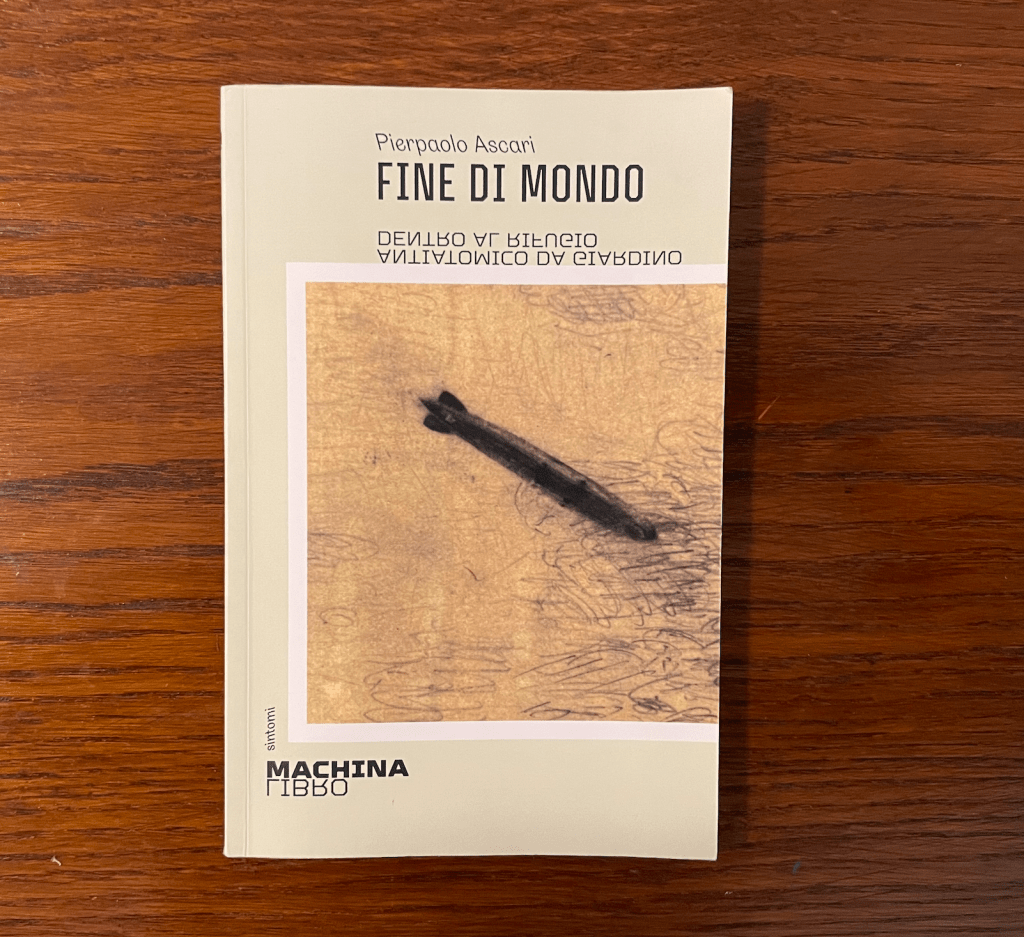
American apocalypticism. On Pierpaolo Ascari’s Fine di mondo: dentro al rifugio antiatomico da giardino (2024). by Gerardo Muñoz

Pointing to a methodological clarification, Pierpaolo Ascari’s Fine di mondo: dentro al rifugio antiatomico da giardino (DeriveApprodi, 2024) opens with an untimely advice: the threat of atomic extermination of human life can only be told and appealed through the irony deployed in all areas of consumerist culture. Undoubtedly, this fits pretty well to the case on point, since American modernization is both the hotbed of Hollywood and the atomic bomb, two poles of the regime of a vicarious life consisted with Henry Adams’ well-known assertion that, in spite of everything, America civilizational passion has always been generalized optimism. And it is not surprising that Stanley Kubrick, when asked about the thesis of Dr. Strangelove (1964), also claimed that the only possible form to tell a story about the bomb of total extermination was through a black comedy (Ascari 11). This self-serving optimism is tested in Ascari’s Fine di mondo (2024) by looking at the construction of an apocalyptic underworld fantasy; that is, in the garden of anti-atomic sheltering that reveals the true arcana of modern Americanism as a subterfuge – but also a civil current in plain sight – parallel to the rise of mechanized labor under the conditions of the triumphant Fordism. Of course, now that our farewell to Fordism has been longed trumpeted, it does not take much to see that what remains is the infrastructure of schizophrenia and general terror in the social fabric that colors the specific tune of American apocalypticism. Ascari’s book is a superb elaboration of this tonality as historically rooted and articulated, but also open to its (pseudo)theological mutations undergoing in our present. 

On the surface, Ascari’s Fine di mondo (2024) is a short compendium of the civil responses and techniques towards atomic destruction and survival; but, more deeply, is also a history of Americanism as a historical project committed to a long process of civil domestication, enclosure, and endurance of survival. Of course, the nuances here are important to grasp the subtle hypothesis of Ascari’s working scene, since we also know that modernity at large (considering both its contingency and contradiction as features of its emergence) was also a process of an optimized gnosis through alienation and the enclosure of private property towards commerce stabilization and productive growth (the nomos). But for Ascari the specificity of the American nomoi through the lenses of atomic sheltering and refuge implies a microphysis; that is, a “way of life” validated through theological premises tailored in the organization of subjective deificatio (Ascari 23). This means that the apocalyptic apparatus driving American philosophy of history is not just one of realization towards the absolute objectivation of the world – even if such endeavor is necessary and preparatory – but rather that the sheltering and self-imposed domestication of human existence has become naturalized as a threshold of the conditions of finite human life. The paradigm of sheltering as the unit of survival is a form of self-regulation of grace that is consistent with the evangelical dispensationalism and technical election analyzed in Monica Ferrando’s recent important book.

The concrete examples abound in Ascari’s short but densely illustrated book: from the Civil Protection comic to the details of the emergence of “do it yourself” assemble manuals (discussed in the correspondence between Adorno and Sohn-Rethel); from the Hulk to Godzilla in a post-atomic bombed world; form the resilient speeches on atomic menace by JFK to a 1950s study conducted at Princeton University that reassured that “fathers” will get to know their children better in conditions of total sheltering even if it results in an “ethics of the jungle” (Ascari 34). Following Guy Oakes’ groundbreaking The Imaginary War: Civil Defense and American Cold War Culture (1994), what is distilled in Ascari’s pop culture puzzle is the panorama of the “Cold War” not as a war that did not take place between two imperial powers; but rather a total war that took place beneath the crust of the earth (and this is why the topoi of the refugee becomes so telling) and at the thicket of human existence waged as psychic management of the civil sphere. In fact, the “imaginary war” is nothing else than the stazion once social life that has yet to cease to exist in our days (Ascari 48-49). 

For Ascari this implied an interiorization of the ‘sublime’ in the reification of the social fabric, which cannot be divorced from the lobotomized subjectivity of the crisis of “social man” that Gianni Carchia identified as the steering project of post-enlightenment Romantic negativity. In the turbid vaults of the self-made man we encounter the liquidation of everything that is living and the projection of fictitious death that clings into “salvation” in spite of absolute destruction; because, after all, those that survive total destruction are only there to confirm the soteriological greatness of the American destiny (Ascari 78-79). The thorough “Ubu” dimension of American psychic political power definitely speaks to this well sedimented conviction of sacrificial subjectivity. Who does not remember the glorious chants for resilience and isolation of the American political elites during the peak of the COVID19 crisis management? If it came to no one’s surprise that a large majority of Americans accepted the pandemic arbitrary rules (monetized whenever needed, it goes without saying), it was because the American subjectivity has been adapted for quite too long to the ongoing separation of refugee and domestication. After reading Ascari, in fact, we think whether the emergency policies were not just another episode in the history of American sheltering now extended at a planetary scale.

There is another idiosyncrasy to American apocalypticism that must be accounted for. And this is introduced towards the end of Fine di mondo (2024), when Ascari quotes Ernesto De Martino about nuclear war; mainly, that when it comes to atomic annihilation there is no longer the symbolic mythic-ritualistic process of reintegration, but rather the mere technification of the hand that gathers scientific knowledge in convergence with the death drive” (Ascari 81). In other words, this technico-apocalypticism brings to absolute unity the originary response of the human species (the movement of the hand) with the organization of scientific rationality that, like Günther Anders saw, brings no re-symbolization of the principle of reality, but rather it can only reaffirm the layering of the principle of reality to govern over it (Ascari 85). In a way, if it as if the essence of American apocalypticism is instituted as if beyond time, since the endurance of a “time of the end” means that the triumphant death (and the dead fueling the demagoguery of its process) foreclosing the symbolization without an exit. Indeed, an apocalypse without redeeming kingdom. For Ascari the only anticipation – primordial mechanism of anthropological capacity – is that of “money”, and hence the dominance of the principle of general equivalence entails gaining the temporal illusion of some distance from the ongoing production of death. But it is evident to anyone today, as it was said not long ago, that the true dead are those petit bourgeoisie living in the American suburbs. And they keep coming as the embers of domestic happiness try to ferociously shut down the latency of a piercing pain. 

Yes, the nature of permanent apocalypticism confirms that the true and final object of techno-capitalist force has always been the possibility of multiple life worlds. And its erosion implies the endless possibility of ordering the life of the city, as Elon Musk just a couple of weeks ago told the former president of the Republican Party: “Hiroshima and Nagasaki were bombed and now they are full cities again. Yeah, it is not as scary as people think”. If the enterprise of civilization has largely been understood as springing from the crust of the earth upwards, one of the important lessons of Ascari’s Fine di mondo is that it trains us to look downwards and inwards as the cruxes of America’s persistent government over the garden of our souls. 

On American despair. by Gerardo Muñoz

The rhetoric of “decadence” now prevalent in United States has reached such heights that, regardless of political orientation, it is clear that it has become a pretext for a desired take off and accession from the objective  stagnation and paralysis. Paradoxically, the assumption that there is “decadence” is revered as a moment of forthcoming light and rejuvenation; and, thus, as a “crisis” that can be identified and managed through the end. As it is well-known, for some critics of decadence the Golden age of American life was the landing on the moon and the population boom of the 1950s; technology and family. The elements are self-serving: to accelerate the reproduction of the human species, and to lead technological gigantism against new geopolitical competitors (AI, chip wars, Green economy, etc).

In the early twentieth century Americanism was a benefactor of private Fordism (everyone could enjoy his or her car, that is, their increasing isolation), but in principle things have not changed much a century later in terms of the outlook and the techno-administrative power. But the one thing that has changed is that the age of increasing productivity and formal production is no longer the objective coordinates of social relations; rather, depopulation and stagnation are the new variables that public powers that must be governed through its effective processes. Ultimately, this also implies that the waning of the high-modern state is no longer effective, and so the established discussion about “race to the bottom” fails to understand that there is no bottom. Hence, the only race is toward planetary destruction.   

And what is curious to note is that even those that have identified the epochal crisis of Liberalism can only exacerbate and contribute to the acceleration of the ongoing destruction with cultural and rhetorical veneers notwithstanding. The ‘postliberal’ commitment to the fantasy of a “new policy of re-industrialization” cunningly allows the autonomy of state-sovereign capacity as the main orientation within the growing desert of administrative functions. In fact, this is a fort da moment in which policy makers can be in favor of empowering the nexus between executive power and the federal bureaucracy; while, at the same time, the mouthpieces of these policies can promise a dismantling of the administrative state in a post-Chevron era. This schizophrenic position is not a symptom of mere anachronistic derailments of a political movements, it is also an expression of the desperate attempts of American failed (and to a large extent non-existent) political elites to find a formal mediation between state, administrative coordination, and constituent power, precisely because this nexus is broken and in shackles. 

And truth be told, no piecemeal or nudge-driven re-industrial protectionism is “enough” to cure the social angst and despair of contemporary American subjectivity at all levels of human experience. It has been two honest economists, Anne Case & Angus Deaton in the book Deaths of Despair and the Future of Capitalism (2021), who taken noted that what they call “deaths of despair” is the central social affection of contemporary America, which fuels the slow but steady self-annihilation of the life that no longer truly lives (and paralyzes the economic framework as well). And, in turn, what outlives the hegemony of social domination is the regulation of pain and despair as the last dispensation of this unliving.

The necessary oblivion of the social production of the deaths of despair is what remains necessary so that a pseudo-theological framework of imperial “decadence” can retain its competitive narratives in the abyss. The end of real forces of autonomous production have led the way into the production of pain, which as Gianni Carchia clearly saw in his reading of Michelstaedter (Retorica del sublime, 1990), is a form of active ethical communication between souls. For all the alleged talk about spiritualism, theology, and instrumentalized Christianity in times of “decadence”, the high point of Americanism remains a techno-administrative apparatus that can only produce and conceal the prolongation of social pain. Precisely, “the parabola of the impossible so that any notion of the ‘good’ fails to be affirmed in this world”. 

Planetary subsidiarity: an observation on Luigi Ferrajoli. by Gerardo Muñoz

I recently attended a conversation around Luigi Ferrajoli’s most recent book translated into Spanish, Por una Constitución de la Tierra (Trotta, 2022), where the eminent Italian legal positivist defends the construction of a world constitution. The proposal is meant to be taken at face value; that is, unlike world constitutionalism and constituent revolutions models, Ferrajoli departs from the fact that sovereign states are no longer efficient to deal with international indirect powers. For him, a global constitutionalization of the Earth will bring about much needed juridical protection to natural resources, commercial, and migratory disputes that, unlike the already existing international law decrees, will generate binding guarantees between the different global actors. There is a sharp realism in Ferrajoli’s proposal in at least two levels: on the one hand, the insufficiency of state sovereignty is incapable of stable and long term adjudication; and on the other, the lack of guarantees of international law not only do not prevent serious violations of human rights, but also repeatedly provoke it for special interests. What legal positivism promises to achieve at the national level becomes the mirror of international principles that appeal to the concrete techno-geopolitical equilibrium of a historical conjecture.

Perhaps Farrojoli is not willing to admit it, but the crisis of legality is now best understood as the loosening of the formal mediation between principles and norms, which can only complement each other through the executive force and expansion of police powers. This explains why the figure of “equity” has become predominant in both domestic and international legal systems, since ‘aequitas’ is what allows a broad discretionary rule making and norm elasticity in any given situation. It is not difficult  to identify the crystallization of “equity” as the highest axiom that seeks to hold up the structural positionality of social order. But an unchecked legality – now fully detached from modern judicial review – becomes increasingly removed from the conditions of secularized liberal politics. In fact, police powers and principles of equity are no longer dependent on judicial review; on the contrary, it is judicial review that becomes adapted to the balancing of equity of social principles. Obviously, this can only unleash an unbound legal process that is no longer rooted in  judicial minimalism or countermajoritarian rule. 

I am not sure that Ferrajoli is able to escape this problem; in fact, he seems to aggravate it when claiming that what we needed today was “something like a global principle of subsidiarity”. That a great European legal positivist philosopher fully coincided with anti-positivist jurist Adrian Vermeule’s “common good constitutionalism” based on delegated bureaucratic powers of the executive’s discretion, confirms the deep crisis of contemporary legal thought. But such collision is expected, given that the principle of subsidiarity is at the center of a project like that of a constitutionalization of the Earth: the subsidium is no longer understood here as the secularized meeting point between belief and reason, but rather as a policing reserve required to intervene whenever an perturbance  in equity takes place.

It does seem that application of a principle of global subsidiarity rather than crafting a new principle of authority is the result of a “unity of the world” that has turned the world increasingly smaller given the large scales of technological integration, as Carl Schmitt understood early in “La unidad del mundo” (1951). And technological integration presupposes the capacity for total legibility and total transparency, and thus total extraction – it is not difficult to see here a homologous ambition in the Chinese civilizational principle of Tianxia. In this framework, the subsidium can only become compensatory to the ongoing malignant epoch where all authority fails, and thus, in the words of Joseph Roth, “performs  unworthy imitations…with barbarism and falsehood” [1]. A global constitutionalism can only exist through the ongoing production and consumption of mimetic debris; and this is the anomic make-believe that shouts that the world will be given to us in return. 

.

.

Notes 

1. Joseph Roth. “Our homeland, our epoch”, in On the End of the World (Pushkin Press, 2013), 70.