A certain life. A note on Marguerite Duras’ La vie tranquille (1944). by Gerardo Muñoz


Let us imagine a person that in a short period of time finds himself haunted by successive deaths, abandonments, missed encounters, displacements, and lost possibilities – the list could go on. All of this amounts to a loss of world. This is obviously the narration of anyone’s life, and every moment of it would seem to imply an internal necessity of its unfolding as felt in the weight of its coming together in remembrance. Obviously factical life will continue on – and it always goes on – but the ultimate question will reside in the relationship between existence and the narrative order of that past. All of Duras’ narrative world is almost entirely a direct wrestling with the possibility of going against this specific weight of narrativization, because to narrate means to forget oneself from the experience of being in the world here and now. The demand of recollection imposes rhetorical limitations to the unfathomable present. Remembrance is the courtyard of historical and religious necessity where self-transformation takes a secondary role in a massive and alienated narrative of causes and reasons.

Duras’ first novel La vie tranquille (1944) reacts strongly against the burden of memory in the name of forgetting: “Once you lose the ability to forget you are deprived for a certain life” [1]. But what could a “certain life” amount to? Obviously, this forgetting here does not mean a neutralization of conflict in life (as in the status of a civil war in a political community); rather, it entails a sort of rebirth, in which the density of life refuses the crushing force of fictitious acceptance dispensed by the order of the past. That loosely defined “certain life” does not qualify nor situates “life” to the survival of “this life”; on the contrary, it seeks to open life to its open and self-evolving possibilities. In other words, there is “only one life” because there are only irruptions of the tragic possibilities that will always elicit a vita nova. The “certain life” that is always lacking allows the infinite possibilities of rebirth in the face of the eruption of the tragedy. And tragedy requires affirmation and exposition to the world in a strong sense. This could very well be the ultimate tone and color of the adventure for Duras.

Dionys Mascolo once wrote that Marguerite Duras’ literary and cinematic work is a transfigurative elaboration of the the tragic, and for this very reason the active undoing of the civilizational narrative at least since the humans of the neolithic that had resulted in the production of justifications and reasons to live “our life” [2]. And in a way the irruption of the tragic is the confirmation that civilization does not have the last word of absolute moral order. But life  – and this is the “mystery” coloring a good part of Duras’ imagination – is always about keep afloat the possibility of the certain life without the threats of self-absorption and destruction in the wake of nihilism and abstract political equality between beings in the world. A “certain life” (our certain life without qualifications other than being attuned to the object of our passions) is always elsewhere, and for this very same reason as a transfigured revelation outside of what appears as the enclosed necessities of ‘this life’. “A certain life” is a higher indented form of the theos unto life, whose transcendence is not regulated by an article of faith or the anthropological deficiency of sin (this is at bottom the difference between Christ and Saint Paul). In other words, the tranquil life that many readers have generally understood as wilful irony wrapping Duras’ narrative bears the truth to that life – the only one worth affirming as destiny – must always be outside itself. As the character of La vie tranquille (1944) confesses in one of the peak moments of the monologue in the second part of the novel:

“I’ve existed for twenty-five years. I was very little, then I grew and reached my size, the size I am now and that I’ll be forever. I could have died in one of the thousand ways people die, and yet I managed to cover twenty-five years of life, I am still alive, not yet dead. I breathe. From my nostrils emanates real breath, wet and warm. Without trying, I managed to die of nothing. It advances stubbornly, what seems halted, in this moment: my life. …My life: a fruit I must have eaten without tasting it, without realizing it, distractedly. I am not responsible for this age or for this image…” [3]. 

The bite into the fruit in this monologue differs from the metaphoric self-confession that ascertains the theological irreversibility of  original sin and felix culpa; it signals the passage of the narrative of life into denarrativization. Here a “certain life” might open against the fluvial current of the order of necessity that will make the subject into a bundle of legible and memorable infortunios. The passage to the tranquil or serene life, however, is not just grounded in the description of a trembling account of onself. In Duras, it has a proper name: thought. In fact, as we will find in the last part of the novel: “You must advance with the last of your powers;…with the power of thought” [4]. And following Mascolo to the letter, one could say that this ‘power’ is misplaced – it is not a power of the subject to force a will to do or act – it is rather a passion of thought (“la passion de la pensée”) that elevates itself against necessity and actualization through a “refusal” of any given historical order. 

This is to say, the breakthrough to the ‘certain life’ or the ‘serene life does not presuppose a counterpolitical strategy, as much as the movement of thought enacted in refusal as condition for any democratic requirement that no one can ultimately possess, as Duras a decade later will go on to write in the third issue of Le 14 Juillet [5]. The serene life is only possible as an infinite movement of denarrativization. The inhabitation of the world in La vie tranquille (1944) was already preparatory for the gesture of ‘refusal’ where a certain life follows a retreat from the hypsipolis apolis (superpolitical apolitical) into the existential xenikos of a contemplative life that is irreducible to both the principles of humanity and the normative regulations of social interaction. The serene life is only achieved when the separation of thought and life enters into the  incommunicable sense of persuasion (the ancient peitho) capable of decompressing the vector of force that has only produced a generic humanity of political depredation, acceptance, and excruciating tonality of boredom. Duras’ writing – at its best moments – is an intense search of this kind; a search does not end in neither politics nor literature, but on what remains outside of them.

Notes 

1. Marguerite Duras. The Easy Life (Bloomsbury Publishing, 2022), 90.

2. Dionys Mascolo. “Naissance de la tragédie”, in A la recherche d’un communisme de pensée (fourbis, 1993), 397.

3. Marguerite Duras. The Easy Life (Bloomsbury Publishing, 2022), 96-97.

4. Ibid., 114.

5. Marguerite Duras. “Responses à l’enquête auprès d’intelectuels français”, Le 14 Juillet, N.3., 1959, 5-6.
Elio Vittorini on the time of existence. by Gerardo Muñoz

In Elio Vittorini’s short travel book Sardegna come un’infanzia (1957), entirely composed of painterly vignettes of his visit in the thirties, there is one of them that immediately jumps out at the reader, because it is the only moment where the radiance of the image and the possibilities of thought touch each other without any reservation. It is almost the moment in which the senses of what is felt and seen mysteriously touches a region that is not entirely political, even though it figures as the highest ‘political moment’ in Vittorini’s chronicle.

Vittorini is observing the ordinary lives of the common people in Sardinia when all the sudden he writes the following: “Now, and in spite of everything, those sitting down, almost drowsy and without much to do, are in life. The others in the struggle are not, especially if they fall into consciousness by the struggle and the movement, without understanding any other pleasure than that of the full warehouse. The secret is to struggle for existence, but without being colonized by the struggle’s idealism…in this way, there will be true life in the very roaming path. I have always understood activism for activism’s sake as the business of flies that, once they have taken off, they begin to scratch their head or sharpen their legs” [1]. It is almost as if written the parable of the fly is written for our times, where so many are blinded by the secularization of a Jesuit figure of the militant. The activity of fly, just like that of the political militant, falls into the pretense, thanks to the allure of his self-consciousness, that something moves in spite of its complete paralysis. The fly only moves in the metaphysical abstraction from ideal projection to material outcome and preconceived ends that it knows beforehand. Nothing moves and nothing ever can amount to a discovery or an event. The fly will recurrently miss the world because it has become obsessed by the illusion of its movement, convincing itself that flying over fresh dung is something entirely different.

The political subject is primarily the subject of the accumulated freedom, but it can rarely grasp ‘a way out’, as Peter Red claims in Kafka’s “A Report to an Academy”. Vittorini’s roaming and inert path is the sentiment of true life (“the serene truth of life”, he will say in a few pages later), which is always on the predicated on the possibility of experience against the crust of ideological falsification – even when this process is narrated from the point of view of the proletariat as the motor of the dialectic of history of its self-overcoming to completion. The ‘secret is to struggle for existence’, which entails how to grasp life as utterly outside that can only be shaped by a contact with the world. Perhaps by “sensing” the world without ever becoming its master; rather, what’s involved is a task of a cultivation that must remain singular by virtue of its own irreductibility. 

And in a way, this was Vittorini’s own heterodox understanding of communism where there is according to him there was no “collective building of the soul, but rather the destitution of false differences so that once those regulated differences are abolished, new possibilities of absolute differences can flourish” [2]. This is why Vittorini could not find solace in the political militant or the engaged intellectual, except as figures already acting as smugglers of the planned obsolescence of a civilization overtly defended by those facilitating its own demise [3]. In the landscape of Sardinia – by the most passive of roles, he was merely a theōrós after all – Vittorini unravels the metapolitical blackmail of the epoch in order to conquer the most essential and inapparent: the time of existence in a minuscule world within worlds – and thus, always in a permanent state of infancy – that treasures something immense because it will be forever remain unknowable.

Notes 

1. Elio Vittorini. Sardegna come un’infanzia (Mondadori, 1957), 64.

2. Dionys Mascolo & Edgard Morin. “Une interview d’Elio Vittorini”, Les Lettres françaises, 27 juin 1947: https://entetement.com/une-interview-delio-vittorini/ 

3. Elio Vittorini. “La civilización no es algo que defender” (1937), in Diario en público (Gadir, 2008), 86.

Politics as our passion? by Gerardo Muñoz

Philippe Theophanidis has recently brought to my attention an emphatic statement in Dionys Mascolo’s Lettre polonaise sur la misère intellectuelle en France (1957): “La politique est notre passion. Nous en parlons, ne faisons que cela, et tout l’ennui du monde est dans ces dialogues-disputes, dans cette démarche perpétuellement contentieuse qui donne envie de s’occuper de n’importe quoi d’autre, de plaisanter, de se taire, de s’en aller” [1]. These are intense words not entirely divorced from a deep sense of desperation entangled with a commitment to realism – minimally understood as bringing into thought how things looked at the time. In a recent collaborative introduction to the writing scene of this group (preliminary work towards an upcoming seminar) – which included Mascolo, but also Duras, Vittorini, Blanchot, and other continental friends – we took into consideration how the heterogeneous and internal tensions were brought into bear in the effort to connect the creative act to the existential texture of communication and concrete world events [2]. 

Mascolo’s statement must be read as historically marked and situated, as who today could claim that “politics”, however broadly or loosely understood, is the exclusive “object” of our passion? Mascolo seems to have been aware of the subordination of passion into politics, leading to dialogues and disputes where nothing could facilitate the clearing of a way out. When politics becomes the final object of one’s passion it could only mean that the reign of chatter has liquidated our experience with the world. And it is at this point where the ‘missing word’ that attunes the search for one’s passion can regress as nihilism; that is, as mere force to steer rhetorical valence and representational exchange within the expansive intramural rules of civil society. Restricting one’s passion to the determination of politics merely inverts the order of modern legitimacy (i.e. the repression of passions by the interests), compressing both terms as a higher principle of politics. 

If at the outset of modernity contractualism suppressed the passions in exchange for sovereign security from the fear of violent death; in the attempt to elevate the passion to the grammatical height of politics, what is rendered obsolete is precisely the possibility of securing an existential site of freedom outside and beyond politics, that is, in the the nonplace of the passion itself. Of course, one could also read Mascolo’s apothegm in light of his revolutionary politics, in which the name of “politics” solicited the revolutionary emancipation of the civilizational alienation of the human species towards a transformative sequence beyond the scarcity of needs. But the problem of the category of revolution is that it remains tied to the very development of the legitimacy of the political and its erosion (for Edward Gibbon in Decline and Fall of the Roman Empire the configuration of the state is the crowning revolutionary event against disorderly barbarism), which the members of the Saint-Benoît Group were first hand witnesses in the postwar epoch.

I think this speaks to my suggestion that the assertion ‘politics is our passion’ was historically embedded; a sort of last breath of trying to hold onto the utopia that will soon crumble in every active paradigm of planetary order (postcolonial, Soviet state planning, European communism and social democracy). But at least – and this is what remains of interest, as I see it – the Rue Saint-Benoît friends had the courage to confront it in order to enact a farewell to the very assumption of ‘revolution’, which already in 1968 was clearly moot. In the words of Maurice Blanchot after the events of 1968: “…but from now on I will hold onto an exigency: to become fully conscious, and always anew, that we are at the end of history, so that most of our inherited notions, beginning with the one from the revolutionary tradition, must be revised and, as such, refuted. […]. Let us put everything into question, including our own certainties and verbal hopes. The revolution is behind us: it is already an object of consumption and, occasionally, of enjoyment. But what is before us, and it is terrible, does not have a name” [3]. Thus, to conflate “politics” as the passion could no longer offer solid ground in the intra-epochal interregnum of suspended historical time. Just a few years later, Duras will claim that politics had little to offer, since there is an “absolute equivalence between all political programs, and only right ideology seems to be able to do politics as such. We no longer believe in politics…there is only a burrow of hope. We must submit ourselves to the hard evidence of its total degradation” [4]. To dwell in a delimited burrow means a return to the rooting of place and new geographies beyond the temporal axis.

One can read both Duras and Blanchot’s elucidations of the collapse of modern politics and its negation (the ius revolutionis) as a corrective posture to move past Mascolo’s hope to make the unfathomable texture of one’s passion coincide with the object of a political project, even if understood as an archipolitics. But it is precisely in the abyss opened by a terrible and nameless epoch that a new light is casted on the free-standing and ungraspable nature of the passion; the irreducible law that establishes a contact between the ethical life and the world beyond objectivation as both excess and deficit of the tribulations of political order. Perhaps a modification to Mascolo’s thesis is now necessary: passion is what escapes every possible fall into the objective world, and for this very reason it is a ‘refusal’ of what the compensatory bond of politics can offer under the sermo humilis of stagnant artificial utopias. There is no political passion just like there is no political friend, since both friendship and one’s passion remains always objectless, only mediated by the overcoming of the preconditions of fear and of delegated life. In Manuale di sopravvivenza (1974), Giorgio Cesarano will claim that passion was the name of the coming historical program of a sensible presence resisting the “annihilating force of social objectivation” of the world [5]. And the Italian poet will define the passion as the sacred taking possession of the return to appearance. A transformation of politics could only emerge after one’s passion could finally prevail experientially against the terrible and nameless (and unnamed) world organized towards planned obsolescence and generalized humiliation. And it goes without saying that we are still very much our predicament. The caesura between passion and politics has now become spectacularly absolute and irreversible.

Notes 

1.  Dionys Mascolo. Lettre polonaise sur la misère intellectuelle en France (Éditions de minuit, 1957).

2. Gerardo Muñoz & Philippe Theophanidis. “¿Por qué volver a la Rue Saint-Benoît? Conversación sobre un seminario, Ficción de la razón, February 2024: https://ficciondelarazon.org/2024/02/26/gerardo-munoz-y-philippe-theophanidis-por-que-volver-a-la-rue-saint-benoit-conversacion-sobre-un-seminario/ 

3. Maurice Blanchot. “On the Movement” (1968), in Political Writings 1953-1993 (Fordham University Press, 2010), 109. 

4. Marguerite Duras. “Entrevista en A Fondo” (1979): https://www.youtube.com/watch?v=XmnVBenAoyw

5. Giorgio Cesarano. Manual de supervivencia (Kaxilda, La Cebra, 2023), 75. 

The missing word. A note on Dionys Mascolo’s Autour d’un effort de mémoire: sur une lettre de Robert Antelme (1987). by Gerardo Muñoz

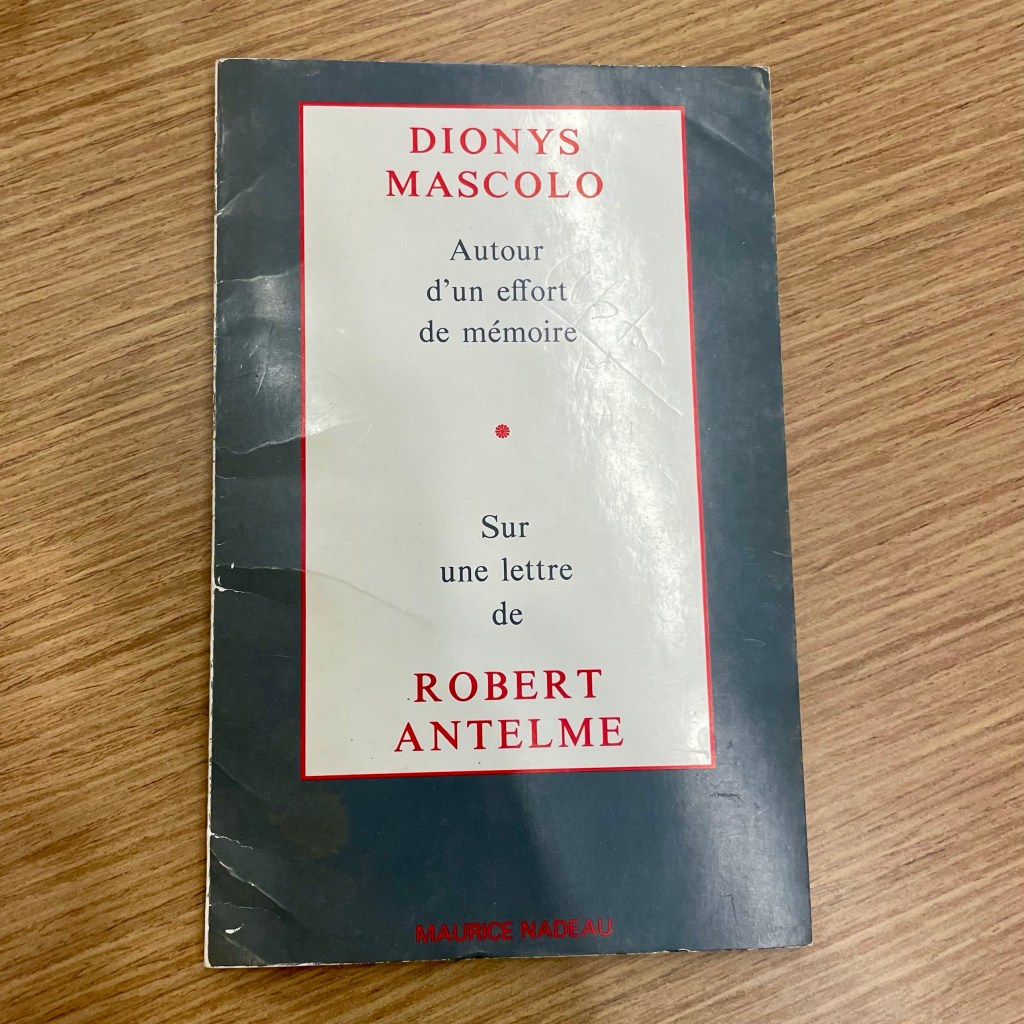
Rereading Dionys Mascolo’s Autour d’un effort de mémoire: sur une lettre de Robert Antelme (1987) in preparation for an upcoming course with Philippe Theophanidis, one gets the sense of beginning backwards or at the very end, since this late essay is a recapitulation of what the Rue Saint-Benoît Group embodied and stood for. And it is so obvious that for Mascolo what is at stake in Antelme’s letter is not a particular practice of confession (and the coupling of secrecy and extraction), but rather an integral register of an experience that belongs to “friendship in thought without reserve” [1]. And that it would not have been possible without friends, as simple as that. Of course, the condition of possibility of this shared thought in friendship has less to do with general principles, norms, or creative acts, and more with what Mascolo does not hesitate to qualify as “a sensibility that was common to us”. 

What is this sensibility, and is it possible to describe it? This is a question that I do not think that is attempted to be resolved in Mascolo’s commentary nor in Antelme’s letter so consumed by its internal lacunae and effacement (I am definitely not capable of saying a word about it at the moment, and this might be one of the questions in the ongoing dialogue in the seminar). Mascolo does offer a little more when he states that this sensibility, however broad and partial, was always elevated against all totalitarianisms that were hegemonizing the political positions of the epoch. Obviously, it names the political totalitarianism (Fascist and state planned communism alike), but also the “the soul of the project” (‘est l’âme du projet  et sa forme aboutie’) that must retract from it [2]. The last pages of Mascolo’s reflection is a shallow-deep, an insinuation, into the possibility of saying something in relation to this difficult proximity. 

Hence, against total subsumption of life into political planning (whether on the right or left, whether ecclesiastical or in the name of the secularized forms of militant communist parties), Mascolo’s insistence on the ‘soul of the project’ is sustained by the “missing word” give that dispenses human necessities as infinite. He writes: “Et par mille et mille détours, il me (nous) fallait toujours en revenir au même point : Je suis ce qui me manque est la sentence que je porte (nous portons) inscrite à l’intérieur du front. La moindre des choses alors est de proposer que, sauf mensonge, elle vaut pour tout homme”. [3]. But what could it mean that “what I am” is always constituted by the missing word? It is definitely not a substantive attribute to a person (and thus what I can acquire), but a word that in its ideal absence and lack of epistemological validity stands as a form of seeking (zēteîn) that Nicoletta Di Vita has recently linked to the form of the ancient hymn [4]. The missing word is the passive and pure voice that calls out the rhetorical fiction of political totalitarianism. In other words, the missing word does not enact a present state of things, articulating the denomination in language with distinct objects of the world; it only has transformative weight when revealing what remains under the capes of morality.

This is why the experience of the camp constitutes a central threshold: on the one hand, it is an extreme and sharpened image of social alienation between classes; and, on the other, it is the experience that by depriving the human of its humanity it brings to an effective end the polarity between rich and poor that structured the economy of salvation and damnation of Western civilization. This is what Antelme describes in his essay “Poor Man – Proletarian – Deportee”, which according to Mascolo brings the rich to a psychotic night of desperation towards destruction and death of the specie. Hölderlin’s definition that “we have become poor in order to become rich” as a clement predicament in the face of the modern is here-forth suspended in the spiritual crisis generated by the social engineering whose most extreme case is the model of the camp.

And yet the missing word remains irreducible even after the corrupted stage of innocence and the impossibility of redemption. Mascolo, reader of Nietzsche, does not believe in the theos. This is why for him the missing word, far from being an apostrophe that offers consolation in the wake of the catastrophe, it remains concretely attached to the experience of the friend that no longer finds solace in abstract peace, but in the profound musicality of what remains inconsolable: “cette heureuse absence de paix qui est sa musique profonde, et que donne en partage l’être aimé, l’inconsolable qui console” [5]. This transfigured word – the unending capacity for hymn in the human, its nomoi mousikos – is both an excess to memory and appearance, and perhaps, more importantly, an excess to the experience of living and the dead. And is not this “seeking” passage of the missing word what the Rue Saint-Benoît Group was obsessively after?

Notes 

1. Dionys Mascolo. Autour d’un effort de mémoire: sur une lettre de Robert Antelme (Maurice Nadeau, 1987), 82.

2. Ibid., 83.

3. Dionys Mascolo. Autour d’un effort…,82.

4.  Nicoletta Di Vita, Il nome e la voce. Per una filosofia dell’inno (Neri Pozza, 2022), 27.

5. Dionys Mascolo. Autour d’un effort…, 89.

The Rue Saint-Benoît Group. Introduction for a 2024 seminar. by Gerardo Muñoz & Philippe Theophanidis.

The Rue Saint-Benoît Group, organized by Marguerite Duras, Robert Antelme, and Dionys Mascolo and other fellow-travelers of the interwar years can hardly be defined as a political movement, a literary school, nor an intellectual community with a direct orientation or aesthetic program. In fact, the Saint-Benoît Group (transnational in its composition) understood itself as a shared experience of thought that gravitated under the words of the German poet Friedrich Hölderlin: “The life of the mind among friends, thought is formed in the exchange of the written word and for those who seek”. It is also known that Hölderlin was the quintessential poet dwelling in the fracture between tradition and modernity, the flight of the gods and the eclipse of the poetic in the wake of a consummated technological Prometheism. To affirm Hölderlin’s words entails to confront the difficult questions of language and the voice as conditions for thought. How can we think of an intellectual experience in which friendship becomes inseparable from thought; and, at the same time, when thought becomes a condition for the endurance of friendship? And to what extent could this double register allow for a reinvention of the autonomy of politics in the wake of the crisis of Humanism? 

These are the enduring questions that the experiential setting of the Saint-Benoît Group bequeaths to us today. If the Saint-Benoît experience has remained opaque and invisible even within monumental historiographic narratives of twentieth-century ideas, it is because only seldom have these problems been rightly posed. Under the sign of a “friendship of thought” – a transfigurative plane that immediately resonates with the immaterial common intellect, the Heideggerian incursion on the task of thinking, and the revival of a sensible Platonism – the members of the Saint-Benoît Group witnessed the catastrophe of modern politics in real time; such as, although not limited to, the concentration camp, the postcolonial wars of liberation, communist totalitarianism, and the exhaustion of the fundamental categories of political Liberalism. Taking distance from the elaboration of a normative political theory, the Saint-Benoît Group favored the heterogeneity of stylistic endeavors and expressive acts in order to grapple with the crisis of experience. And it is to their specific scenes of writing that we must attend to in a systematic and careful way. 

In this eight-week course we will explore the diversity of the writings of the group, including figures such as Dionys Mascolo, Robert Antelme, Marguerite Duras, Maurice Blanchot, Elio Vittorini and other fellow-travelers to explore questions concerning the nexus between experience and creation (both of us have worked on some of these writers intermittently in the past couple of years). To the extent that we still live among the ruins of the legitimacy of modern politics, the contestatory style of Saint-Benoît Group still raises the question about the human species within our civilizational collapse.

What type of authority emerges from their writings, communication, and imagination of a fractured humanity? And how could the concept of ‘revolution’ be transformed from its moral and technical elaborations that hegemonized the twentieth century? We are aware that the Saint-Benoît Group has no “lesson” to be extracted and made “actual”; rather, we are interested in what we would call a “gesture of thinking” that prepares the condition for a life in freedom within and beyond the contours of the polis

*For those interested in registering for the eight week seminar beginning in February 2024, please consider signing up at 17/instituto de estudios críticos: https://17instituto.org, or by writing to extension@17edu.org.

Clandestine life in the open. by Gerardo Muñoz

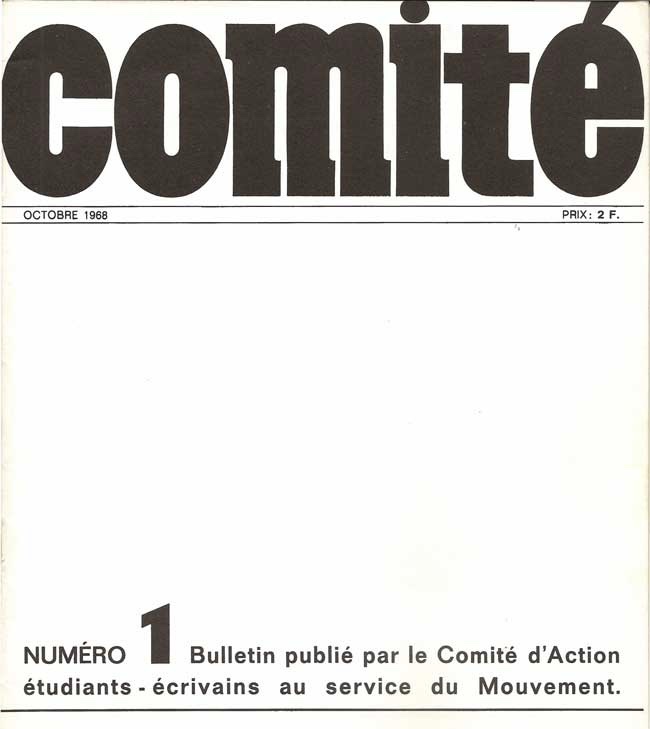
In the very last article that Maurice Blanchot wrote for the collective publication Comité in the wake of May 68, he draws a scenario that is still very much with us in the present. The “realism” is almost outstanding when Blanchot writes the following: “…from now on I will hold onto an exigency: to become fully conscious that we at the end of history, so that most of our inherited notions, beginning with the from the revolutionary tradition, must be reexamined and, as such, refuted. Let us put everything into question, including your own certainties and verbal hopes. The revolution is behind us: it is already an object of consumption, and occasionally, of enjoyment.” [1]. There was no question that the crisis of the very foundation of modern political thought has collapsed, including, as it couldn’t be otherwise, the generative principle of revolution. Blanchot did not even attempt to convince himself that the revolution could be brought back in an astronomical sense to revitalize a naturalism previous to Rousseau’s social contract.

So, for Blanchot the revolution was over, and yet, whatever it was that followed had no name. What was left, then? In order to avoid paralysis, Blanchot toyed during those months at the Comité (September-December 1968) with two possible maneuvers. The first position resided in what he called the “movement of possible speech” in order to establish an ardent and rigorous relation between the sequence of the French May and the Czech May, Soviet domination and Gaullian State. Blanchot called for (in the spirit of Bataille) a “transgressive speech”: “the impetus of outrageous, ways speaking beyond, spilling over, and thus threatening everything that contains and has limits” [2]. But we know that transgression is still within the logistics of the administration of order and temporal containment of the regulated exception. This was, in fact, the very rupture of the revolutionary break that was in crisis.

But Blanchot was up to something along with his friend Dionys Mascolo in thinking through language and communication as a path towards the outside. Hence the second option, which is really a third option (after the sleepwalking of ideological revolutionary ‘racketing’ of voluntarism); mainly, what he calls, although does not get to tease it out, the “clandestine resistance in the open”. Blanchot only tells us what he is thinking about through a recent example: some members of the Czech resistance when law was suspended had to confront the raw enemy military power, but they also experienced a freedom “through words and through writing than ever before”, tells us Blanchot. But this still does not explain much, given that if there is a naked military power threatening us, how could something like a clandestine form of life take place in the open? And at what risk?

I think one way to read this incorrectly or insufficiently would be to think of Blanchot’s suggestions as a sort of martyrdom or self-immolation. But it is no less true that Blanchot wanted to avoid a sort of Batallian “inner experience” or monastic xeniteia. Thus, he “refused” the fiction of self-clandestine life as sponsored by the Situationists; while, at the same time, also rejecting subjective revolutionary militancy. A third way emerges: the clandestine life into presence by way of friendship. A new “estilo de vida”, which I think could be read in the way that cryptojews and averroists lived in early Modern Spain: “a modo de sociedades secretas o semi-clandestinas, deben haber concebido la filosofía como un estilo de vida para sus iniciados…” [3]. Unlike the bogus image of the secret society as an alienated community of knuckleheads, I think what emerges in the clandestine open region is a form of shared friendship that does not retreat from the world, but rather that is capable of living in it. This was most definitely the transformative practice that during these years, Dionys Mascolo, dared to call the communism of thought that for him belonged to Hölderlin rather than to Marx. If open conspiracy is an act of the sharing and participating in language without meaning or command dependence, then this is already a poetic practice. After all, for Hölderlin the poets reveal an originary loss from nature. It is no surprise that Hölderlin favors a world opening even after the destruction of the leader-figure of the poet (Empedocles).

So, there is only clandestine life in the open when the sharing of language among friends take place (an event). This use of language is always harboring on the threshold of the last word to come. In short, the clandestine form of life has nothing oblique with respect to the world – it is not necessarily the space of an infinite night of contemplation, and it is also indifferent about fugitivity – it demands a return to appearance by way of experience. This might explain what Gilles Deleuze tells Dionys Mascolo at the end of their correspondence about friendship and thought: “it is a question of what we call and experience as philosophy” [4]. This form of experiential thought against the dissatisfaction of political domestication points a way out. For Blanchot this was a “fragmentary, lengthy, and instantaneous” path; a conspiratio unlocked by philia.

.

.

Notes

1. Maurice Blanchot. “On the Movement”, in Political Writings 1953-1993 (Fordham University Press, 2010), 106.

2. Maurice Blanchot. “Clandestine resistance in the open”, in Political Writings 1953-1993 (Fordham University Press, 2010), 106.

3. Francisco Márquez Villanueva. “El caso del averroísmo popular español”, in Cinco Siglos de La Celestina: aportaciones interpretativas (1997), 121-134.

4. Gilles Deleuze. “Correspondence with Dionys Mascolo”, in Two Regimes of Madness (Semiotexte, 2007), 332-338.

The politics of schism: theses on Dionys Mascolo’s La révolution par l’amitié (2022). by Gerardo Muñoz

1. Remembrance without restitution. The publication of Dionys Mascolo’s essays in La révolution par l’amitié (La fabrique, 2022) opens a path to a singular thinking that refused to conform to a master thinking, and even less what has come to us as political theory, or radical critique. Theory and critique have shown their resilient adaptiveness to university discourse. Thinking, on the contrary, moves annexes a relation with the missing word. This caesura negates the closure of both politics and community, it shows its insufficiency. In a letter to Maurice Blanchot regarding his ceased friend Robert Antelme, Mascolo comes to terms with this specific question: the remembrance of what loss in the actual word is – the voice of his friend Robert Antelme – what cannot be posited as a restitution of representation, but rather as effective effort to transcend mutism and silence that would have sunk writing into a pathos not short of a “miserabilist” stance [1]. The exigency of language is absolute. In an analogous way, we can say that the writing in La revolution par l’amité (La fabrique, 2022) is not a matter of restituting the history of Marxism, the intellectual debates of French theory, or even the burial site of a thinker that rejected repeatedly the metaphysical function of the public intellectual (a sort of captain at the steering wheel of public opinion, a cybernetician); but rather the remembrance that thinking is the irreductible site of common to the species. Remembrance has no “archive” and it does not produce anything; on the contrary, it invites a path to thinking in order to bring the absolutism of reality to an end.

2. The irreducibility of the species. For Mascolo – as for Nicola Chiaromonte – the stimmung of the modern age is not a lack of faith, but a bad faith subscribed by the subject of knowledge, a guardian of the nexus of legitimacy. In his practice of writing, Mascolo explored something like a countermovement to the rationality of the intellectual posture, in which communication ceases to be a common means in order to become a production of ends and instrumentality. Hence, what Mascolo called the “part irreductible” – and its “doubt in any system of organized ideas in sight” – is the only intuition of the unity of the species in communication. And if the intellectual is an organic unity of hegemony that replaces the function of the priest in the Church bureaucracy and its paideia (recall Antonio Gramsci’s “organic intellectual”), for Mascolo irreducibility in the sharing of thought in communication is “not political” as he states in Autour d’un effort de mémoire – Sur une lettre de Robert Antelme (1987). This step back from the production of modern politics thoroughly imagines another figure of communism. It is at this point where the whole Cold War polemics between humanism and anti-humanism is destituted internally: the species finds a way out of political domestication.

3. Communism of thought. We can understand why for Mascolo “the word communism really belongs more to Hölderlin than to Marx, as it designates all the possibilities of thought; that which escapes in thinking, and only that can constitute its work (oeuvre)” [2]. In other words, communism for Mascolo is not a matter of doctrine or an Idea, nor about philosophy of history and its inversion; it is not about a political subject or a unity of organization of political force; communism is a use of thought in language in proximity with what escapes in every communication. The inoperative communism, hence, is only possible in friendship, as a continuous experimentation of taste that cannot coincide with a community form. As Mascolo writes in his essay on Antelme: “We did not live in community. This is a deceptive word…we existed in a sentiment of mutual gift of freedom” (53). Any reinvention of a politics to come after the collapse of authority must commence with this rejection of a compensatory communitarian closure. Today only a conspiratio between friends can animate a new field of intensification for renewal.

4. Refusal and friendship. Even in his earliest stages of writing such as “Refus incoditionnel” (1959), the condition for friendship for Mascolo is to refuse the current state of things; to retreat from the demand of reality in order to survive in the imagination of the shared word. In this sense, the thematic of friendship does not make subjects of duty towards a social bond, but rather a secret in the word designated by separation. Friendship floats high above symbolic representation, as it moves to an inclination that is singulare tantum. If modern politics thought itself as a repression and administration of the hostis; for Mascolo the practice of friendship is the sacred space that is never inherited, but, precisely the dwelling of those who “seek” after in the wake of the homelessness of man and nature. This is analogous to Hölderlin’s allowance of thought which moves in passion while accounting for the abyss of our relationship with the world (aorgic) of originary detachment.

5. Revolution as style. In a brief text on the Cuban revolution of 1959, originally written for the collective exhibition Salón de Mayo in Havana, Mascolo says a new revolution in the island could potentially offer a the opportunity of a new style [3]. Of course, as soon as Fidel Castro supported the Soviet invasion of Czechoslovakia in 1968, it was clear that such promised crumbled, and that the Revolution will fall well within the paradigm of the metaphysics of historical project and the subject (“a new man”). But what is style? Once again, this speaks directly to Mascolo’s passion for the irreductible outside of the subject, and for this reason never alienated from the schism of the species. The notion of style relates fundamentally to our exposition to the outside, to the event of expropriation, which defines our fidelity to the invariant dimension of our character. A new style, therefore, is not something to be produced, an effect of the subject, but rather the unit of an ethical practice in our encounter with the outside. If the apparatus of the revolution was instituted as a the production of a civilization; the fidelity to a style names the modes of life that cannot be oriented towards a specific work. A new aberrant freedom emerges.

6. Saint-Just’s ethos. Mascolo never ceased to reflect on the ethical determination of politics, against politics, and for a transfigurative notion of a politics for the here and now. And he dwelled on this problem in his writings on the ethical figure of Saint-Just during the French Revolution (“Saint Just” and “Si la lecture de Saint-Just est possible”). Unlike the monumental historiographies – both left and right, revolutionary and conservative, historicist or revisionist – that situated the revolutionary under the sign of Terror and Revolution, of will power and the emergency of Jacobinism; for Mascolo Saint-Just stands a figure that keeps an important secret. And this is it: “the inhumanity of Saint Just is that unlike many men, he does not possess many lives but only one” (130). This is a concrete definition of a ethos that is irreducible to the “monstrous arts of government” in an epoch where the political had become the secularization of fate. In the same way that Hölderlin turned his gaze towards the impossible and concealed distance of the moderns in relation to truth of the Greeks, for Mascolo’s Saint-Just the legitimacy of the modern universalization (in the State, the Subject, the Social) does not have the last word. The ethos of life keeps the remembrance of an abyss of the monstrosity of historical universality and the social equality.

7. Borrowed existence. Dionys Mascolo lived at the dusk of the modern arch of the revolution, whether understood as eschatology or a conservation of the natural order of the species, as Saint-Just proposed against the Rousseaunian social contract and the Hobbesian mechanical Leviathan in exchange for authority. We have already crossed this threshold, and we are in the desert of the political, retreating on its shadow fallen into administration of fictive hegemonies. Hence, the question of an ethos of existence becomes even more pressing from Mascolo’s thematic of friendship in order to refuse what he calls in “Sur ma propre bêtise et celle de quelues autres”, a “borrowed existence in a comedy that feels as if we are being watch by God alone” (219). Indeed, as some have diagnosed with precision, the religion of our time is absolute immanence, the full disposition of the tooling of our means [4]. A cybernetic dreamworld, whose pathetic figure is the “influencer” (a few strata beneath the luminosity of the intellectual). This can only fix us into the stupidity of intelligence of the species: specialized intelligence, in other words, prisoners in the sea of nihilism. The intelligence of the species, on the contrary, is the cunning (methis) of the fox: a way out in spite of the swelling tides. But against the nihilism of a borrowed life of immanence (beatitude of the impersonal, and iconicity of things), Mascolo’s thought insists stubbornly in friendship as the initiation in an uncharted path to reenter the world once again.

.

.

Notes 

1. Dionys Mascolo. Autour d’un effort de mémoire: Sur une lettre de Robert Antelme (Maurice Nadeau, 1987). 

2. Ibid., 50.

3. Dionys Mascolo. “Cuba premier territoire libre du socialisme”, in A la recherche d’un communisme de pensée (fourbis, 1993).

4. Lundi Matin. “Éléments de descivilisation. Partie 4”, Lundi Matin, 2019: https://lundi.am/Elements-de-decivilisation-Partie-4

Friendship at the end of the world: On Frank Wilderson III’s Afropessimism (2020). by Gerardo Muñoz

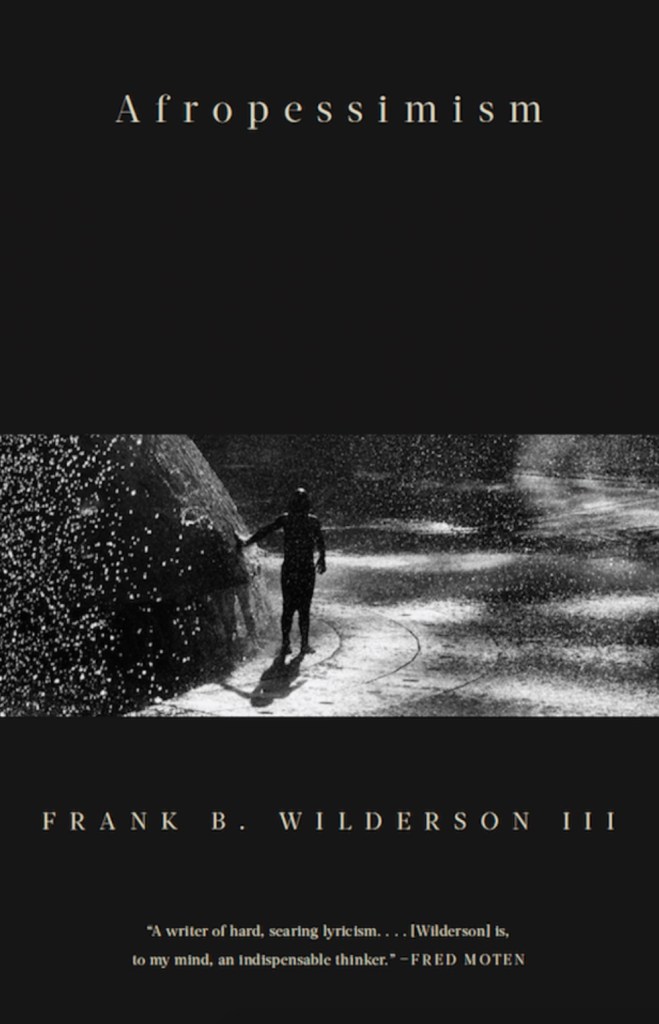
The publication of Frank Wilderson III’s Afropessimism (Liveright, 2020) marks an important break in contemporary thought, which has been seating comfortably for too long in the pieties of identity, culturalism, and politization. One of the most immediate effects of Afropessimism is how it unmasks the way in which identity and cultural hegemonic discourses, far from constituting a different horizon of the existing cliché, actually mitigate a spectacle of devices for the domestication of other possibilities of thought. Of course, some were aware of said spectacle, but now with Wilderson’s experiential writing the allure of subaltern subject position is finally destroyed from within. Wilderson’s account escapes two routes of the witness position: that of the personal memoir that contributes to a narrative of redemption; and on its reverse, that of testimonio, which in the postcolonial debates of the 1990s solicited a politics of alliance with the subaltern voice for a new politics of truth. In this sense, Wilderson’s Afropessimism is a post-hegemonic work through and through insofar as it destroys the hegemony of the citizen-subject of Liberalism, but also that of subaltern as a mere stock in the production of hegemony. As Wilderson claims early in the book “Black people embody a meta-aporia for political thought and action”, as such, Afropessimism is a radically unstable force that brings to bear the unthought of the most predomination critical paradigms of university discourse (Marxism, Postcolonial theory, feminism) as aggregation of politics of the subject  (13-14). 

Afropessimism is first and foremost a dislocation of the toolbox of critical of theory as always already complicit with the general movement of the imperial policing of thinking. The strategy is always the same when it comes to administrating a regime of reflexive order: posit a paradigm of a subject position and then mobilize it against other subjects. There is nothing radical about this validation; quite the contrary, it coincides with the arbitrary hierarchization of values proper to Liberalism’s current designs. Wilderson wants to destroy analogy just like he wants to be done with narrative of redemption, or ethical alliance since all of these are forms of reductions of the true experience of living at the “end of the world”. This is the apothegm from Fanon that creates the apocalyptic circuit in the book. What does it mean to live at the end of the world? This the vortex of Afropessimism, the atopic site that inscribes the existential conundrum of the Black form of life. The apocalyptic “end of the world” must be read as a concrete inhabitation of life, that is, “being at the end of the world entails Black folks at their best”, writes Wilderson (40). This entails that there is no world without Blacks, but Black experience is an incessant drift at the limit of the world as captured by the entrapment of Humanity. I take it that Wilderson means that “Afropessimism is Black folks at their best” in relation to a form of life at the level of experience that is not only constitutive of sociability, but that it also an intensity that rejects any domesticating efforts into a more “democratic” or “hegemonic” civil society. Under the rule of equivalent demands, where subjects and objects are exchanged (or camouflaged in the name of “Rights”), the Black can only constitute a “social death” that breaks any equilibrium, or that sustains the hylomorphism of its others (102). This goes to the heart of the articulation of hegemony, which for decades has been the leftist horizon of a good and democratic politics, but which for Wilderson amounts to the very logistics of the democratic plantation. In an important moment of the book, Wilderson argues against the theory of hegemony: 

“In the solicitation of hegemony, so as to fortify and extend the interlocutory life of civil society, ultimately accommodate only the satiable  demands  and  legible  conflicts  of civil society’s junior  partners  (such as immigrants, White women, the working class), but foreclose upon the  insatiable  demands and illegible  antagonisms of Blacks. In short, whereas such coalitions and social movements cannot be called the outright handmaidens of anti- Blackness, their rhetorical structures, political desire, and their emancipatory horizon are bolstered by a life- affirming  anti- Blackness; the death of Black desire.” (240)

There is no hegemony that is not conditioned by a non-subject, an abyss that marks the aggregation of their equivalent subjective demands. This is why the non-demand of the Black, who has nothing for exchange, remains at the limit of hegemony, or rather what I call a posthegemonic fissure, in which democratic desire and hegemonic articulation enter into an incommensurable zone. Given that blackness is the site of “social death…the first step toward the destruction if to assume one’s position and then burn the ship or the plantation from the inside out. However, as Black people we are often psychically unable and unwilling to assume this position. This is as understandable as it is impossible” (103). This is consistent with Wilderson’s label of Afropessimism as an aporetic meta-theoretical paradigm. The question of the possibility of an experiential exodus to an outside, and not just an internal limit to the metaphysics of Humanity is most definitely one question that one could raise about its “epistemological void” as parasitical to the infinite production of subjectivity (164). It is clear that by rejecting hegemony, Wilderson also has to give up any liberationist horizon at the service of a political project committed to Black emancipation. For Wilderson the legitimacy is somewhere else: “Afropessimism is not an ensemble of theoretical interventions that leads the struggle for Black liberation. One should think  of it as a theory  that is legitimate because it has secured a mandate from Black people at their best; which is to say, a mandate to speak the analysis and rage that most Black people are free only to whisper” (173). It is a rage that one could counterpose as the opposite of the subaltern politics of truth; in order words, it is a rage experienced against the “gratuitous violence” that divides the antagonism between a singular life and the world of the state of things and its people. 

The vortex of Wilderson’s Afropessisism, however, is not just the rejection of hegemonic articulation or the benevolent solidarity as administrated domination, it is rather the emphasis of a new world caesura that he frames in this way: “…the essential antagonism is the antagonism between Blacks and the world: the centrality of Black people’s social death, the grammar of suffering of the slave…” (174). This essential conflict stages the antagonism at the level of the debates about the frontier of Humanism, for which the Black, insofar as it is a figure of the non-subject, already acts an archipolitics that frees the intensification of any politics of liberation now transfigured as a liberation from politics [1]. This archipolitics dwells in the intensification of a non-identity that is irreducible to any hegemonic fantasy that labors on solidarity, equivalency, unity, program, demand, projection. And why not, also against the democratic polity (insofar as democracy cannot be thought outside the jointing of two apparatuses of civil society renewal: citizenship and mobilization). This archipolitics of Afropessimism puts into crisis the general categories of modern political thought, I am also tempting to limit this claim to the very notion of democratic practice as previously defined. Here the “legitimacy” that Wilderson evokes is no longer at the level of a new democratic renewal – which is always within the spirit of the modern liberal design; indeed, recently some have made legitimacy and hegemony conceptual couples – but rather as a poking outside the democratic imagination, which ultimately feeds Black social death, even when sustained by the social contract of hegemonic alliances.

Is there something beyond the subjection to alliance? In other words, what if being at the “end of the world” is also the time to undue the mystification of solidarity in the name of friendship? I agree with Jon Beasley-Murray, also writing about Frank Wilderson III, that the idea should not be to win over friends, but rather to suggest that friendship is still possible flight [2]. I would go as far as to call friendship an event of thought. Indeed, friendship has no stories to tell and does not seek redemption; it also betrays normative ethics each and every time. This is not to say that there such a thing as an archipolitics of friendship, nor a political program for a friendship of community. We have enough of that in every community form. Perhaps if we accept the event of singular friendship, we can move beyond the logistics of antagonism and hostility that are constitutive of Humanity, but irreducible to the specie that confronts the destiny of the inhuman. As a great thinker of the twentieth century wrote: “there are infinite possibilities of inhumanity in each man. There is no external enemy; this is why the tragic exists. This simple maxim confirms the fundamental thought of Robert Antelme. The “no-man” in man, attentive to perfection is what allows the sedimentation of the concentration camps. […] Friendship for me is not a positive thing nor a value, but rather a state, a multiplication of death, of interrogation, a neutral site where I can sense the unknown, the site where difference only expands in the place of its contrary – in proximity to death” [3]. One question that must accompany Wilderson’s formative book is whether the “spirit of friendship” with inhuman can be something like solace without redemption at the end of the world. Friendship could be understood here as the marker for the disunification of forms of life outside the condition of hostility without falling into nihilism. At the point, perhaps psychological categories such as optimism or pessimism now lose their relevancy as forms of life realize that they are already dwelling at the of the end of the world. 

Notes

  1. The conceptualization of Afropessisism as an archipolitics I owe to Alberto Moreiras. See his note “Whiteness and Humanity”, July 2020: “https://afropessimismandinfrapolitics.wordpress.com/2020/07/07/whiteness-and-humanity/
  2. 2. Jon Beasley-Murray. “Afropessimism”, July 2020: https://posthegemony.wordpress.com/2020/07/06/afropessimism/
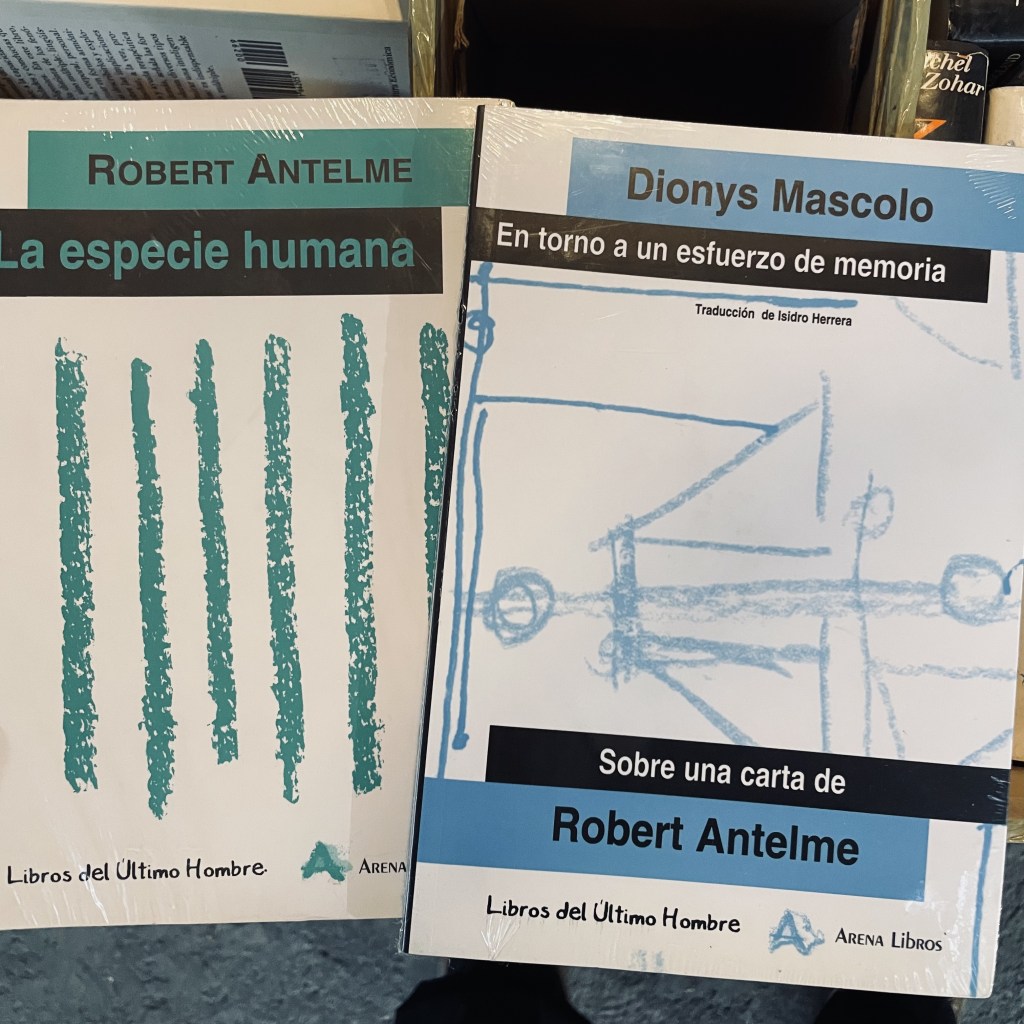
  3. Dionys Mascolo. En torno a un esfuerzo de memoria: sobre una carta de Robert Antelme. Madrid: Arena Libros, 2005. 57. The translation to English is mine. 

La izquierda aglutinante y el corte. por Gerardo Muñoz


Hay una máxima de Jean Gratien sobre Saint-Just cuya contundencia sigue latiendo en nuestro presente. Escribía Gratien: “La “inhumanidad” de Saint-Just radica en que no tuvo como los demás hombres varias vidas distintas, sino una sola”. Toda la miseria del izquierdismo político puede despejarse desde aquí. ¿En qué sentido? A primera vista esta máxima es una enmienda a toda la teoría de las esferas de acción del hombre moderno cuya saturación antropológica ha acabado dispensando al ‘sujeto deconstruido’ de la metrópoli. Pero no deseo recorrer este registro. En un segundo nivel, lo que Gratien buscaba elucidar era algo así como un ethos de la existencia capaz de cortar las compensaciones de toda política ideológica. Pensemos por un momento en qué significa esto hoy. Pensemos por un momento en la izquierda. ¿Tiene la izquierda hoy un programa solvente para la época que no sea sumatorio?

Mirando a diversas realidades es casi imposible divisar cuál es. Y sin embargo lo que sí tiene es lo que una vez el periodista militante Horacio Verbitksy (un ideólogo profesional) llamó una “aglutinación subjetivante”. Es una expresión notable porque condensa la cultura sumatoria de la izquierda. De ahí que el giro “tradicionalista” de la izquierda contemporánea tenga la forma de una bolsa de juguetes: leninismo, socialdemocracia, liberalismo, zapatismo, comunitarismo horizontal, sesentayochismo, filología marxiana del sur, movimiento de movimientos, latinoamericanismo, decolonialidad, etc. La lista es contingente a las demandas del presente. Como en la dogmática eclesiástica, lo importante no es definir un programa o asumir una postura en nombre de algo, sino fijar la jerarquía en el retablo. Para volver a Gratien: de lo que se trata es de retener esas muchas vidas compensatorias en lugar de una vida.

Esta actitud ante el mundo no es banal ni fortuita, al contrario, es la fuente misma de la mala fe que oxigena la idolatría. Y es una postura trágica en el sentido más fuerte de la palabra, puesto que una política que abandona “una vida” es una política que ya no tiene destino. No es casual, entonces, que la izquierda de la aglutinación termine encandilada con el principio de la “hegemonía” puesto que el hegemon es precisamente lo que ordena y gobierna sobre la dispersión de los fragmentos, lo que los vuelve lisos, y lo que termina garantizado el trámite equivalencial. En realidad, no hay diferencia alguna entre el partido de la aglutinación y la teoría de la hegemonía. La hegemonía es su último avatar.

Lo tragicómico de todo es que la hegemonía habla de “revolución” constantemente. Sin lugar a duda, en todo exceso retórico hay una compensación a un impasse práctico. Por eso la definición entre izquierda y revolución acuñada por Dionys Mascolo en un momento de casería de brujas sigue siendo tremendamente actual: “Todo lo que se designa como de izquierda es ya equívoco. Pero lo que se designa como «la izquierda» lo es mucho más. El reino de la izquierda se extiende desde todo aquello que no se atreve a ser franca y absolutamente de derecha, o reaccionario (o fascista), hasta todo aquello que no se atreve a ser francamente revolucionario” [1]. De nada sirve invocar infinitamente una tradición revolucionaria si se quiere ejecutar una revolución. De nada sirve llamarle al otro contrarevolucionario. Por eso hay izquierda por todas partes, pero ni de lejos una teoría revolucionaria. Pero sabemos que un corte contra la hegemonía es la apertura a otra cosa. Esta es la invitación a otro viaje.


  1. Dionys Mascolo. Sur le sens et l’usage du mot “gauche”. Paris: Nouvelles Èditions Lignes, 2011.