American apocalypticism. On Pierpaolo Ascari’s Fine di mondo: dentro al rifugio antiatomico da giardino (2024). by Gerardo Muñoz

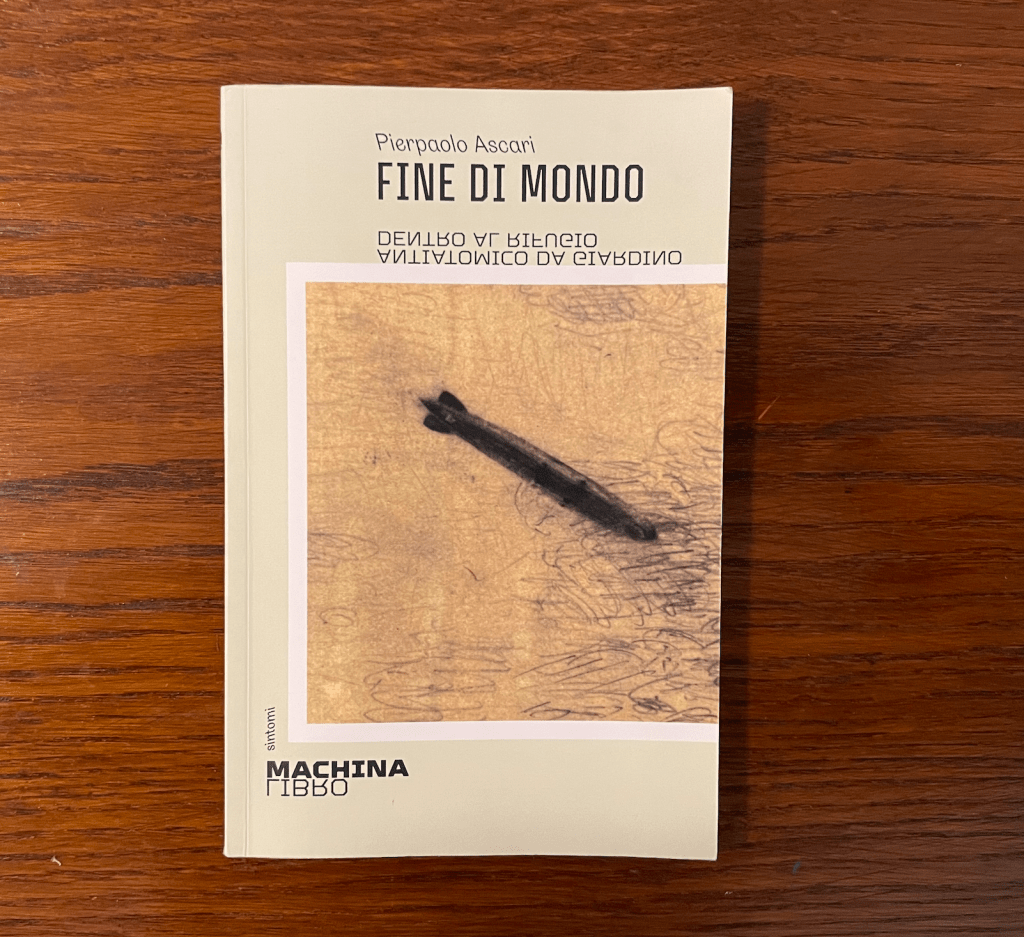
Pointing to a methodological clarification, Pierpaolo Ascari’s Fine di mondo: dentro al rifugio antiatomico da giardino (DeriveApprodi, 2024) opens with an untimely advice: the threat of atomic extermination of human life can only be told and appealed through the irony deployed in all areas of consumerist culture. Undoubtedly, this fits pretty well to the case on point, since American modernization is both the hotbed of Hollywood and the atomic bomb, two poles of the regime of a vicarious life consisted with Henry Adams’ well-known assertion that, in spite of everything, America civilizational passion has always been generalized optimism. And it is not surprising that Stanley Kubrick, when asked about the thesis of Dr. Strangelove (1964), also claimed that the only possible form to tell a story about the bomb of total extermination was through a black comedy (Ascari 11). This self-serving optimism is tested in Ascari’s Fine di mondo (2024) by looking at the construction of an apocalyptic underworld fantasy; that is, in the garden of anti-atomic sheltering that reveals the true arcana of modern Americanism as a subterfuge – but also a civil current in plain sight – parallel to the rise of mechanized labor under the conditions of the triumphant Fordism. Of course, now that our farewell to Fordism has been longed trumpeted, it does not take much to see that what remains is the infrastructure of schizophrenia and general terror in the social fabric that colors the specific tune of American apocalypticism. Ascari’s book is a superb elaboration of this tonality as historically rooted and articulated, but also open to its (pseudo)theological mutations undergoing in our present. 

On the surface, Ascari’s Fine di mondo (2024) is a short compendium of the civil responses and techniques towards atomic destruction and survival; but, more deeply, is also a history of Americanism as a historical project committed to a long process of civil domestication, enclosure, and endurance of survival. Of course, the nuances here are important to grasp the subtle hypothesis of Ascari’s working scene, since we also know that modernity at large (considering both its contingency and contradiction as features of its emergence) was also a process of an optimized gnosis through alienation and the enclosure of private property towards commerce stabilization and productive growth (the nomos). But for Ascari the specificity of the American nomoi through the lenses of atomic sheltering and refuge implies a microphysis; that is, a “way of life” validated through theological premises tailored in the organization of subjective deificatio (Ascari 23). This means that the apocalyptic apparatus driving American philosophy of history is not just one of realization towards the absolute objectivation of the world – even if such endeavor is necessary and preparatory – but rather that the sheltering and self-imposed domestication of human existence has become naturalized as a threshold of the conditions of finite human life. The paradigm of sheltering as the unit of survival is a form of self-regulation of grace that is consistent with the evangelical dispensationalism and technical election analyzed in Monica Ferrando’s recent important book.

The concrete examples abound in Ascari’s short but densely illustrated book: from the Civil Protection comic to the details of the emergence of “do it yourself” assemble manuals (discussed in the correspondence between Adorno and Sohn-Rethel); from the Hulk to Godzilla in a post-atomic bombed world; form the resilient speeches on atomic menace by JFK to a 1950s study conducted at Princeton University that reassured that “fathers” will get to know their children better in conditions of total sheltering even if it results in an “ethics of the jungle” (Ascari 34). Following Guy Oakes’ groundbreaking The Imaginary War: Civil Defense and American Cold War Culture (1994), what is distilled in Ascari’s pop culture puzzle is the panorama of the “Cold War” not as a war that did not take place between two imperial powers; but rather a total war that took place beneath the crust of the earth (and this is why the topoi of the refugee becomes so telling) and at the thicket of human existence waged as psychic management of the civil sphere. In fact, the “imaginary war” is nothing else than the stazion once social life that has yet to cease to exist in our days (Ascari 48-49). 

For Ascari this implied an interiorization of the ‘sublime’ in the reification of the social fabric, which cannot be divorced from the lobotomized subjectivity of the crisis of “social man” that Gianni Carchia identified as the steering project of post-enlightenment Romantic negativity. In the turbid vaults of the self-made man we encounter the liquidation of everything that is living and the projection of fictitious death that clings into “salvation” in spite of absolute destruction; because, after all, those that survive total destruction are only there to confirm the soteriological greatness of the American destiny (Ascari 78-79). The thorough “Ubu” dimension of American psychic political power definitely speaks to this well sedimented conviction of sacrificial subjectivity. Who does not remember the glorious chants for resilience and isolation of the American political elites during the peak of the COVID19 crisis management? If it came to no one’s surprise that a large majority of Americans accepted the pandemic arbitrary rules (monetized whenever needed, it goes without saying), it was because the American subjectivity has been adapted for quite too long to the ongoing separation of refugee and domestication. After reading Ascari, in fact, we think whether the emergency policies were not just another episode in the history of American sheltering now extended at a planetary scale.

There is another idiosyncrasy to American apocalypticism that must be accounted for. And this is introduced towards the end of Fine di mondo (2024), when Ascari quotes Ernesto De Martino about nuclear war; mainly, that when it comes to atomic annihilation there is no longer the symbolic mythic-ritualistic process of reintegration, but rather the mere technification of the hand that gathers scientific knowledge in convergence with the death drive” (Ascari 81). In other words, this technico-apocalypticism brings to absolute unity the originary response of the human species (the movement of the hand) with the organization of scientific rationality that, like Günther Anders saw, brings no re-symbolization of the principle of reality, but rather it can only reaffirm the layering of the principle of reality to govern over it (Ascari 85). In a way, if it as if the essence of American apocalypticism is instituted as if beyond time, since the endurance of a “time of the end” means that the triumphant death (and the dead fueling the demagoguery of its process) foreclosing the symbolization without an exit. Indeed, an apocalypse without redeeming kingdom. For Ascari the only anticipation – primordial mechanism of anthropological capacity – is that of “money”, and hence the dominance of the principle of general equivalence entails gaining the temporal illusion of some distance from the ongoing production of death. But it is evident to anyone today, as it was said not long ago, that the true dead are those petit bourgeoisie living in the American suburbs. And they keep coming as the embers of domestic happiness try to ferociously shut down the latency of a piercing pain. 

Yes, the nature of permanent apocalypticism confirms that the true and final object of techno-capitalist force has always been the possibility of multiple life worlds. And its erosion implies the endless possibility of ordering the life of the city, as Elon Musk just a couple of weeks ago told the former president of the Republican Party: “Hiroshima and Nagasaki were bombed and now they are full cities again. Yeah, it is not as scary as people think”. If the enterprise of civilization has largely been understood as springing from the crust of the earth upwards, one of the important lessons of Ascari’s Fine di mondo is that it trains us to look downwards and inwards as the cruxes of America’s persistent government over the garden of our souls. 

The absorption of the sky of politics. On Michele Garau’s Lo scisma da un mondo che muore: Jacques Camatte e la rivoluzione (2024). by Gerardo Muñoz

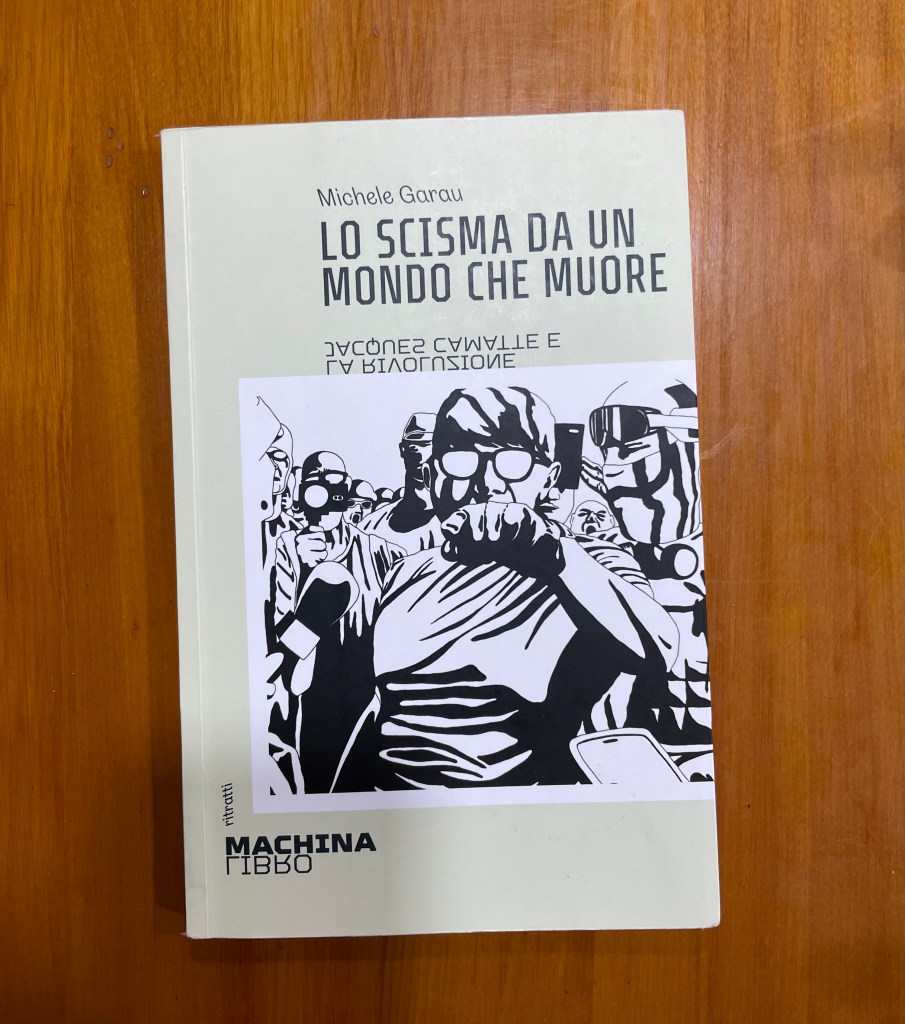
We must welcome that Michele Garau has written the first monograph on Jacques Camatte’s thought in any language, although the book, Lo scisma da un mondo che muore: Jacques Camatte e la rivoluzione (DeriveApprodi, 2024) it is also more ambitious than a mere philological reconstruction of the thinker of Invariance. Of course, not that there is anything particularly wrong with philological or archival work; rather, it is also that Lo scisma da un mondo che muore (2024) tries to think with Camatte (and also beyond some of his potential impasses) the historical bifurcation of a watershed moment in the history of humankind through the realization of the “capitalist revolution” as an autonomous colonization of every form of exteriority (Garau 7). If Camatte’s work has been only selectively considered in our ongoing discussions – while completely ignored at large by the so-called contemporary theory, which I guess it is an uplifting symptom – is precisely because he poses a challenge for a possible breakthrough in times of stagnation, while firmly announcing a much needed farewell to the modern revolution. But who would want to jump on that wagon when precisely voluntarism, prosthetic revolutionary cosmetic, and fictive communitarianism are all necessary platitudes to hold on to the illusion of ground right above the abyss? It is a rhetorical question, of course, but also one that Camatte move passed it in the in the decades of sixties and seventies observant to the material transformation of the working class, and the overall lesson of Amadeo Bordiga’s communism of the human species, which has also been rendered opaque and fossil-like by the victorious force of cultural hegemony and the whole grammatical structure of Gramsci’s thought in postwar political thought (and some will say well into our very present in the most recent cycle of failed left-populism). We said ‘farewell’ and this act, for Camatte after Bordiga’s teaching, means that the revolution has already taken place and must be perceived in the perspective of the crisis of negativity and the inception of the real absorption of capitalist development (Garau 14). 

Hence, new challenges lay ahead, which implies the abandonment of the historical and temporal productivity of revolutionary time – and Garau does an excellent mapping of bourgeois revolutionary thinking from Abbe Sieyès to Saint Just to later formulations of the Leninist paradigm of the dictatorship of the proletariat – which in the grand scene of modernity oriented the economy between form and function, but also between thought and action. If the epoch is said to be ‘anarchic’ is mainly because all these mediations and exclusive autonomous spheres have collapsed unto each other, and to favor one over the other is to work within the fiction of ideological reproduction at best. After Bordiga – Garau claims glossing Camatte, although there are nuances that I cannot consider in the space of this short commentary – the temporalization of the ius revolutionis can only bear in mind the crisis of presence (De Martino) as a suspension of exteriority that liberates right unto real subsumption. This means, following the recently polished phrase of Bordiga from his article “Tempo di abiuratori di scismi” (1965), that all revolutions are born and deployed as the affirmation of the schism. “Schism” or “scisma” — and one is reminded or taken back to a theological terrain, and not just as mitigated by the old ecclesiastical memories of the “Great Schism”, but because “schism” is also the “stazion” that fractures the visible-invisible legacy of form of the Church’s Trinitarian doctrine, and which is still the esoteric boiling point of the myth of political theology. This is a detour around Garau-Camatte-Bordiga’s intuition, since none of this is explicitly thematized in the book, nor should it be. It suffices that it opens to this question, given that Camatte’s own grammar of exhaustion – “extinction”, “inversion”, “autopoiesis”, “critique of organization”, “wandering” (erranza) – distill the echoes of an apocalyptic movement proper to the modern anthropological crisis, to put in terms of Ernesto de Martino.

Be as it may, the longue durée of civilizational development of Western revolutions (Edward Gibbon would claim at least since the reconstitution of the Christian Empire) there has been a process of adequation to invariant processes of capitalist accumulation that its substrate (whether permanent, uneven, natural law justified) becomes isomorphic to the structural needs of capitalist autonomization. In a cogent reading of Sieyes with Saint-Just in the framework of the French Revolution, Garau demonstrates how the genesis of modern politics and its categorial scaffolding (localization, constituent power, social unity, subject of rights, and representation) presuppose a thoroughly new vision to make the human community a clean slate for surface legibility (Garau 42). If the civil concept of the ancient polis was measurement and exchange; the crafting of high-modern state politics that took off in the eighteenth century was much thicker and spatially robust dynamics so that the ‘laws of commerce’ and population disciplining could come to fruition with its necessary infrastructural support. The schism was always a perturbation of the “sphere of politics” (and also of politics as a translucent sphere that can be observed, stabilized, and managed), and thus a great scandal.

Hence, the critique of political economy in the history of marxism was never able to untangle this mutual correspondence. For Garau at this point one can locate the difference between Camatte’s thought and Italian operaismo; given that Italian workerism at mid-century was never able to overcome the dialectic between the valence of value form and the theory of the production of capital. Whereas for Mario Tronti the struggle was still to be inscribed in to confrontation between the proletariat qua labor power; for Camatte the “invarianza” is not an permanent stage within the history of class struggle or Marxism, but of the human community and its resistance against the real subsumption of the material community (Garau 48). Decoupling the history of the working class as constitutive of productionism from the human community, allows Camatte, in the wake of Bordiga’s communism, to register the subsumption of capital as it collapses into dialectical negativity. Hence, communism is neither produced nor organized as operaismo always thought (Garau 26-27). And citing a passage from “Against domestication”, Garau argues that for Camatte the history of the proletariat struggle after 1945 is only the struggle to maintain the myth of the proletariat as the subject of a historical breakthrough (Garau 73). This is a staggering affirmation, and one that most definitely produces a theoretical schism. But the schism is also against the fictionalization of a subject of history, which has also been integrated into the emptying of social reality as we have come to know it in the final triumph of the fictive unto itself (Garau 93). 

There is the triumph of the fictive and expansive force of capital despotism, and then there is the struggle for the originary community (Gemeinwesen), which as Gianni Carchia argued in his “Glosa sull’umanismo” (1977) was still enmeshed in the contradiction between humanism and anti-humanism obstructing the vascular movement of non-identical fragments imploding the social. Is this getting at an impasse of Camatte’s own effort of thought to find an exit route? As an intelligent book, Lo scisma da un mondo che muore (2024), refuses to give an essay in the last three pages of the essay, although this difficulty is an object of attention. For instance, Garau writes in one of the clearest elaborations to tackle the problem directly: “La comunità deve allora essere riscoperta in una memoria della specie che finisce per radicarsi, questo è il rischio, esclusivamente in un bagaglio biologico. Nell’esaurimento delle strutture sociali preesistenti, dei linguaggi e degli schemi culturali, delle intelaiature rappresentative e cognitive, nella colonizzazione delle capacità psichiche, affettive, simboliche, è davvero possibile individuare un resto intoccabile dall’antropomorfosi del capitale che non debba essere, invece, creato dal nulla? C’è una «parte irriducibile», come scriveva Bataille, rispetto alle unità di misura del dispotismo economico? Non è semplice rispondere” (Garau 124).

In light of this rumination, Garau also attends to the cycle of contemporary revolts, which might stand as an instance of linguistic and existential struggle against domestication and the crisis of presence (Cesarano), and that might be capable of “absorbing the sky of politics into the most simple and elements components” (Garau 124-125). This is a great image, and one that has pictorial density and durability for thought even if it lacks specific elaboration. To absorb the open sky is to confront the exteriority of the world only as transfigured and brought back as a gathering of experience. The great German critic Kurt Badt comes to mind when writing about Constable: “the sky’s the organ of sentiment”. The embarrassing loss of the world today is fundamentally the destruction of the right attunement to our relation to the opening registered by what gleams above our heads. And perhaps this is a way to measure the capacity for non-movements rather than thinking that movements can disclose the sky. To this end, what could it mean to absorb the sky of politics – which is also a way to refuse the politics of sky, that is, the total planetary grand designs of geopolitical Tianxia? The irreductible may not be reduced to a substance, nor an ontological science nor a vitalist return to an originary community (if only mediated by the restriction of the archaic myth); but precisely that positionality of contact between what is exterior to life itself. To dislodge thought from all political plotting of objectivation and its plastic ligament of social adaptation. A life beyond itself that endures, and perhaps will outlive this dying world.

Two observations on the Non Kongress bulletins. by Gerardo Muñoz

I have read with genuine interest the five bulletins put out by the organizers of the Non-Kongress meeting, and it is only fair that I put some preliminary comments with no other purpose than to highlight a few points (I take it that other will have theirs, and I am looking forward to this discussion). To start somewhere, I will first say that I am fond of the open balance sheet format that puts on the table hot-button issues without exhausting all them. The starting point is broad and clear: our current predicament is one marked by the collapse of the ground of politics and the total absorption of politics into a social-moral designs. These days I also come from drafting a preliminary – an in a way a bit autobiographical – balance sheet of the last decade of (failed) debates in contemporary Spanish leftist politics (2014-2024), which allows for reflection of a contemporary sequence, draw a few conclusions, and move on. If we do this something has already change, and we have avoided the anxiety of feeling that everything must be said. The momentary arousal provided by rhetorical completion pays the price of immobility and confiscates the truly important thing: what will never be thoroughly said, or stated only indirectly, is the condition for any true communication of thought to have a chance even if it rarely happens. This aspiration is sincere and from its inception it already puts university discourse (and its experts in the intellectual division of labor) in trance. And this trance opens a region that allows for something to emerge in a new light sin sanata.

The five-installment bulletin seems to provide two general movements: an analytical sketch of current domination and several conditions for “refusal” or “exodus” under the generic designation of “destitution”. On the first level (the analytics of domination) the bulletin suggests that the configuration of power is organized as an imbrication between the scientific medical apparatus, the expansion of infrastructures and digitalization, and an administration of morality as stratification of values in social optimization that were effectively accelerated in the wake of the Covid19 policy directives. And it is also obvious that what also binds these three different strategies and domains is the administration of the hollow and the fictitious subject as the last subject of nihilism (nothingness as unconstrained force) for ecological catastrophe. Now it is utterly clear that – in aftermath of the gran designs of productive modernization and formal labor productivity – the true and ultimate objective of capital is the world; and, more concretely, the human species’ exposure to worldly phenomena. Hence, there is an implicit, not totally fleshed out, latency in the bulletins which one could situate under the turn towards territoriality, location, place, and fragmentation of the earth. Of course, there is ample risk here to assume that locality (communes, community, autonomous zone) is just an exception to planetary unification that labors negatively for the ongoing destruction; a sort of ‘partisan’ Benedictine community under the shadow of Empire. This is why it is important that Hugh Farrell reminds that any territorial program can no longer be unliteral and must be opened to the contamination of the experiences must incorporate play and openness to its outside [1].

This is touching the limit of the defunct strategy of occupation in which the spatial unity accomplishes the self-police work through the veiling of the good conscious subjective militancy, as I recently also saw in the Pro-Palestinian university encampments in the US [2]. More than a decade ago, Alberto Moreiras warned about the ontotheological determination of locationality as a fold of identity, and he called for a “dirty atopianism” against the allure of compensatory critical regionalisms, and which we can connect (with all the caveats necessary) to the form of countercommunity and the difficult problem of the non-site of the khorā that marks an unbreachable limit to the totalization of the ground of the polis and the political [3]. Life or existence at the end of the day is not “this body” or “this thought”; it is how this inclination connects to the surround of the world. And here is yet another problem, which is delicate as it is difficult to untangle: the need to for a reinvention of a concept after the destruction of its civilization diffuse uses in the Western tradition: “freedom”. We do not need Shelley to tell us, but it is always useful to recall it again: “…the state of probation in which we now reside is merely a preparatory stage in which….to fit us for a more exalted state of existence, is not the deprivation of liberty the deepest, the severest of injuries?” [4].

It is only now that we can understand that liberty of the subject – and the political subject of liberty – was a ragged garment when compared to the freedom of the surround — think paintings of Cézanne as a gesture of gathering to “declare the essence of the world to be existing together, a mutual self-supporting and carrying of things”, states an eminent art historian [5]. Political language, or the intensification of language through the lexicon of politics is too vulgar to do the work and the heavy lifting; we have to be capable, I think, to look elsewhere (say, painting) for claims of a transfigurative sense of what it means to grasp this notion of liberty that takes us to the very beginning. It is a difficult problem, no doubt, but against immediacy, the sensorial must be expanded beyond its commonplace allocation into the latent or full-fledged central conflict. Those images are also too poor of world; even if we know that the world “can have no temporal view of things…the world pass into nothing in the very multiplicity of its instancing” [6].

The fifth bulletin calls for an “ethical ground”, but immediately passes to claim a “politics of destitution”, which is overtly anchored in the recent cycle of “experiential revolts” as stable instances of this passing world that does not succumb to conclusion. I guess it all depends how much weight – or how deep down – one is willing to exert on this figure. Or how extensive the figure is — for someone like Rodrigo Karmy, the revolt is the turbulence of imagination itself. But the question remains as well: does not revolt, as prefiguration of a politics to come, or as a politics of destitution, run the risk of assuming a general central framework of entering into the world? If the precondition for the accumulation of freedom of the surround is given by the belligerent loss of fear of solitude, then this could mean, among other things, that the revolt does not stand as the exclusive theater of opposition or refusal [7]. The freeing of the instancing of the world means that there are multiple ways in which existence deals with the increasing pain at the end of social cohesion. The end of the Social bond entails the intensification of pain as the fundamental stimmung of our times.

.

.

Notes

1.Hugh Ferrell. “The Strategy of Composition”, Ill Will, January 2023: https://illwill.com/composition

2. Gerardo Muñoz. “Reporte desde Columbia: Gaza contra el encierro”, Revista Disenso 2024: https://revistadisenso.com/reporte-desde-columbia/

3. Alberto Moreiras. The Exhaustion of Difference (Duke U Press, 2001) 23.

4. Percy Shelley. “Poetical Essay on the Existing State of Things” (1811): https://poeticalessay.bodleian.ox.ac.uk

5. Kurt Badt. The Art of Cézanne (University of California Press, 1965).

6. Cormac McCarthy. The Crossing (1995), 154.

7. Moses Dobruska. “How it All Began: The Strasbourg Theses”, Ill Will 2023: https://illwill.com/how-it-all-began

The Empire’s garden. by Gerardo Muñoz

The European Union elections this spring restate what otherwise is already felt almost everywhere; mainly, that the destiny of politics has ceased to mean anything historically, and that political representation stands as a compensatory preamble and veneer to planetary conflagration, in which Europe has become a minoritarian and bystander actor. This also means that the histrionic reaction to this reality can only bring out its counters more sharply: both pro-nationalist sovereignty political platforms, and abstract administrative pro-union coalitions are junior partners of the current geopolitical planetary regime, and they merely differ in mild policy nuances, social spending allocations, and rhetorical probing that can also be as flexible as needed  (such is the case of Italy’s Giorgia Miloni who one morning can be in a Vox Party Congress in Madrid, and later in the afternoon receive orders from Ursula von der Leyen and the White House). 

The passage of destiny politics to the gigantism of geopolitics entails not just the erasure of the modern boundaries of enmity recognition, but also the introduction of an administrative plasticity that responds to ad hoc organizational and infrastructural planning, as symptomatic of the collapse of the subject of history into the dominance of the objective. The final stage of the “disenchantment of the world” that characterizes bureaucratic legibility finally appears as the reign of objectivity and the objective. And the concrescence of objecthood as the last avatar of the colonization of forms of life allows us to see how the compensatory constructions of ‘community’ – both the “European Union” and the multiple sovereign communities as reactions to it – repeatedly oscillate between communities of fictive identitarian belonging, and formal political communities devoid of constituent authority. Regardless of their contrasting designs and contrasts, both defenders of national sovereignty and the supra-national EU share the same allure of communitarian integralism: a community for the living, that is, for those integrated into the social apparatus of a well lighted and funded administered world. Respectively, we can see that the debate that took place in the late 1980s about negative community in Europe among philosophers (Jean Luc-Nancy, Maurice Blanchot, Giorgio Agamben) has not lost any of its poignant relevance, as the compensatory communitarian options multiply and spread without ever retreating from the summoned shadow of politica arcana. In a certain sense, the confabulation of communities of belonging and communities of faith are dispensable painkillers to the effective disintegration of the immanence of the social bond. This explains why “people” can only assent to them.

Both community form and political empire are united by a legislative political principle that today remains chattered in the final stage of intrahistorical collapse. There is no communitarian option today that does not end up living negatively on the hinterlands of the nexus of Empire; an exception to the nomic organization of the globe incapable of taking into account the inmates of community form. What is at stake is access to the world; an excess beyond communitarian identification and the administration of the waning politics of Empire.

One can, I think, read Josep Borrell’s words in a speech given at the European Diplomatic Academy in 2020 in this direction, where he calls Europe a well cultivated garden [1]. Obviously if we read it in a political key, Borrell’s address maintains the perennial framework of civilization and barbarism, and in his head the role of the ‘gardener’ is only a metaphoric deployment to exalt the morality of the squalid and humiliated European diplomats on the global stage. However, we know that there is much more to the earthly garden, which retreats already at the moment it is enunciated, since it is a mythic-poetic trope that colors the sensibility of concordia rather than elevating itself as a sociological category of political orientation. 

As Italian historian Flavio Cuniberto notes in his beautiful book Viaggio in Italia (2020), for a poet like Dante the meridional Mediterranean region was the garden of empire (“che’l giardin de lo imperio sia diserto”) which attunes itself to the measureless relation between earth, landscape, and life. Is not this what is preparatory – that is, what must be posited in sensibility and in imagination through style – before any reduction of life into community and political mediation? Have not we felt this dissolving transport before a landscape in the outskirts of Tuscany or Orvieto? And is not this what political ecology (Green New Deals) are after in their effort to foreclose the world? The garden unworks empirical objecthood through its very refusal to be integral to devastation, usurpation and destruction of loci. This is why for Henry Miller the only “ideal community” would have the garden as its evanescent topoi, a “god filled place” even for those that have no gods: 

“Even if it lasts for only a few moments, the privilege of looking at the world as a spectacle of unending life and not a repository of persons, creatures and objects to be impressed in our service, is something never to be forgotten. The ideal community, in a sense, would be loose fluid aggregation of an individual whole elected to be alone and detached to be at one with themselves and all that lives and breathes. It would be a God-filled community, even if none of its members believe in (a) God. It would be a paradise, even though the word had long disappeared from our vocabulary” [2]. 

Looking at the world as a spectacle – of course, this brings to mind Petrarch’s specular heights at Mount Ventoux, in which the possibility of seeing, for once, has the upper hand against the mastering the worldly phenomena at our “service” and proportionality. There is no utopia without this attempt to grasp the spectacle in its taking place, infinitely exceeding the rationality that vests reality into amorphous abstraction. Perhaps the garden is a figure of this necessity of irreducible outlook, which in Marvell’s language touches the ungraspable as it is inwardly felt: “Annihilating all that’s made / To a green thought in a green shade” [3]. The promise of a new life takes resource in the abode of that green shade.

Notes

1. Josep Borrell. “Les jardiniers européens doivent aller “dans la jungle”, Le Grand Continent, October 2022: https://legrandcontinent.eu/fr/2022/10/16/les-jardiniers-europeens-doivent-aller-dans-la-jungle/ 

2. Henry Miller. Big Sur and the oranges of Hieronomys Bosch (New Directions, 1957), 34. 

3. Andrew Marvell. “The Garden”, Selected Poems (Routledge, 2002), 60.

Elio Vittorini on the time of existence. by Gerardo Muñoz

In Elio Vittorini’s short travel book Sardegna come un’infanzia (1957), entirely composed of painterly vignettes of his visit in the thirties, there is one of them that immediately jumps out at the reader, because it is the only moment where the radiance of the image and the possibilities of thought touch each other without any reservation. It is almost the moment in which the senses of what is felt and seen mysteriously touches a region that is not entirely political, even though it figures as the highest ‘political moment’ in Vittorini’s chronicle.

Vittorini is observing the ordinary lives of the common people in Sardinia when all the sudden he writes the following: “Now, and in spite of everything, those sitting down, almost drowsy and without much to do, are in life. The others in the struggle are not, especially if they fall into consciousness by the struggle and the movement, without understanding any other pleasure than that of the full warehouse. The secret is to struggle for existence, but without being colonized by the struggle’s idealism…in this way, there will be true life in the very roaming path. I have always understood activism for activism’s sake as the business of flies that, once they have taken off, they begin to scratch their head or sharpen their legs” [1]. It is almost as if written the parable of the fly is written for our times, where so many are blinded by the secularization of a Jesuit figure of the militant. The activity of fly, just like that of the political militant, falls into the pretense, thanks to the allure of his self-consciousness, that something moves in spite of its complete paralysis. The fly only moves in the metaphysical abstraction from ideal projection to material outcome and preconceived ends that it knows beforehand. Nothing moves and nothing ever can amount to a discovery or an event. The fly will recurrently miss the world because it has become obsessed by the illusion of its movement, convincing itself that flying over fresh dung is something entirely different.

The political subject is primarily the subject of the accumulated freedom, but it can rarely grasp ‘a way out’, as Peter Red claims in Kafka’s “A Report to an Academy”. Vittorini’s roaming and inert path is the sentiment of true life (“the serene truth of life”, he will say in a few pages later), which is always on the predicated on the possibility of experience against the crust of ideological falsification – even when this process is narrated from the point of view of the proletariat as the motor of the dialectic of history of its self-overcoming to completion. The ‘secret is to struggle for existence’, which entails how to grasp life as utterly outside that can only be shaped by a contact with the world. Perhaps by “sensing” the world without ever becoming its master; rather, what’s involved is a task of a cultivation that must remain singular by virtue of its own irreductibility. 

And in a way, this was Vittorini’s own heterodox understanding of communism where there is according to him there was no “collective building of the soul, but rather the destitution of false differences so that once those regulated differences are abolished, new possibilities of absolute differences can flourish” [2]. This is why Vittorini could not find solace in the political militant or the engaged intellectual, except as figures already acting as smugglers of the planned obsolescence of a civilization overtly defended by those facilitating its own demise [3]. In the landscape of Sardinia – by the most passive of roles, he was merely a theōrós after all – Vittorini unravels the metapolitical blackmail of the epoch in order to conquer the most essential and inapparent: the time of existence in a minuscule world within worlds – and thus, always in a permanent state of infancy – that treasures something immense because it will be forever remain unknowable.

Notes 

1. Elio Vittorini. Sardegna come un’infanzia (Mondadori, 1957), 64.

2. Dionys Mascolo & Edgard Morin. “Une interview d’Elio Vittorini”, Les Lettres françaises, 27 juin 1947: https://entetement.com/une-interview-delio-vittorini/ 

3. Elio Vittorini. “La civilización no es algo que defender” (1937), in Diario en público (Gadir, 2008), 86.

Living among the gods. On Monica Ferrando’s Arcadia Sacra (2024). by Gerardo Muñoz

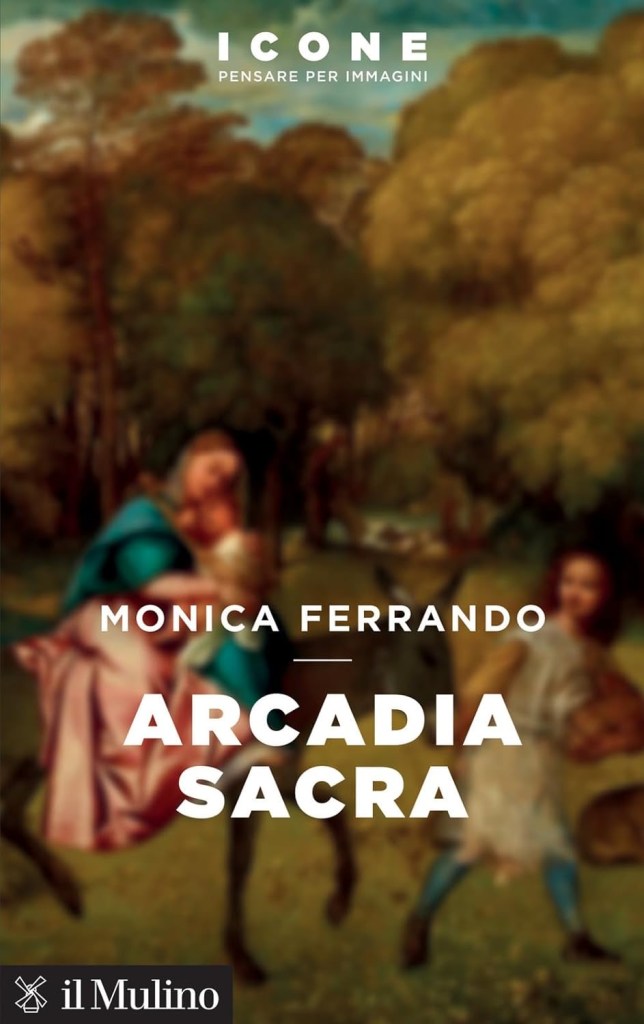
For anyone familiar with the delicate thought of Monica Ferrando, the short book just published, Arcadia Sacra (Il Molino, 2024), makes it impossible not to read it in light of her the two previous works, the ambitious Il regno errante (Neri Pozza, 2018) that reconstructs the political paradigm of the nomos of Arcadia, and L’elezione e la sua ombra: Il cantico tradito (2022), which brought to light the corrupted meaning of a theopoetic understanding of “election” and its appropriation by an effective economic theology apparatus that governs over the destiny of the modern edifice. Arcadia Sacra continues Ferrando’s highly original reconstruction of the unforgettable myth of Arcadia within the obscure setting of secular  modernization in which painting itself has come into crisis to the point of utter obsolescence. We might be the first epoch in the history of humanity (or even prehistoric, since painting goes back to the non-original origin of the caves, as Ferrando has argued) in which painting itself is lacking and almost non-existent [1]. And although Ferrando does not allude to the present directly, it goes without saying that by choosing as her focal point Titian’s early picture “The Flight into Egypt” (1508), the vision deployed in the essay can only speak to us as urgently, where the thematics confronted by the Renaissance of Venetian painting returns to our present in a fractured flash: imperial conflagration, unlimited deployment of force, usurpation of territory and  multiplication of legal checkpoints, and the accelerated disconnection between architecture and nature, color the ongoing devastation of the vantage point of the landscape now eclipsed by the radiant artificial confinements of the contemporary metropolitan designs.  

Already during his postwar years in the United States, Theodor Adorno observed how the unbounded sadness of the American landscape has nothing to do with an inhuman romantic sublime; it was rather that the landscape feels as if it bears no traces of the human hand [2]. If Americanism configures the long lasting night of planetary nihilism; this is so, not only due to capitalist subsumption and production of human life, but fundamentally because of the inherent obliviousness of the  landscape that forecloses dwelling in the world. But the myth of Arcadia, as Ferrando will insists, is no utopia nor crafted rhetoric (the bucolic genre as an aesthetic compensation to the normative grid of the social bond); it is also the question about the earthly ground of existence, and the necessary attunement with the things that have been domesticated into order of the metaphysics of idolatry and objectivity (Ferrando 28). In this sense, Arcadia does not name another world to come; it is a world that has been registered many times, reappearing whenever the hand reaches out in proximity as if caressing the landscape’s skin.

The mytho-poetical deployment of Arcadia returns amidst a world in conflagration, and for Ferrando this has fundamental political implications insofar as it shows a way out from the grammar at the service of force and political dominion of commanders and soldiers – which is always already exercised as legitimate to coerce and to become a tool for the regulation of abstract mediations – into the voice of poets, painters, and shepherds (Ferrando 51). Arcadia reveals that the human species is a ductile animal that can sense by the ability to touch and use. This is why Arcadia stands as a third space outside the political dichotomy of empire and republicanism, between the struggle of usurpation and conquest, and the techno-political administration of common goods of social distribution and institutional delegation. The abstract humanism of the Renaissance, as Heidegger once claimed alluding to Machiavelli’s political thought, is also the commencement of a specific political technology rooted in certainty and justification that can only conceive representation as the ground for the production of an “effective truth” [3]. The virtuous homini militari of the Italian city states anticipate the neutralization of force as legitimate rule that will prepare the stage of modern political realism based on fear and normative rule of law. The final efficacy of force is to transform the sense of the world into a mere object, as Weil clearly understood it in her essay on Homer’s Iliad. One of the key insights of Ferrando’s Arcadia Sacra (2024) is that it shows that, parallel to the revolution in political technologies taking place in Renaissance Humanism, the image of Arcadia was being rediscovered in treatises and paintings in order to remain faithful to a different attunement of the nomoi, in which the philosophy of history of sacrifice, endless civil wars, and destruction of the Earth do not constitute true destiny (Ferrando 14). In an exoteric way – and it is so, because the craft of the painter is, precisely, depiction and figuration of the nakedness of what appears before our vision-  painters like Titian, Veronese, and Bellini, became witnesses to the acquiescence of the nomos mousikos, which far from soliciting the conceptual density of a theory of Justice; it registered the preeminent condition of poetizing nature of  living in the vanishing world. Indeed, it was in the musical nomos where the soul could establish the communication between exteriority and interiority within the gleaming order of things. 

If Heidegger in The Origin of the Work of Art suggests that the erection of work occupies the open space of this clearing; Ferrando will thematize how Boccaccio’s understanding of the Earth as radiantly divine was drawing upon the tradition of Arcadia will emerge as the pictorial space of the artists to disclose the vibrant sense of a necessary freedom (Ferrando 43). This means that living among the gods is not reducible to panentheism, if understood as oppositional to monotheism; rather, it was the opening to the event that gathered forms of life,  creations,  affections, and territories. In other words, there will always be gods whenever the world is not enclosed into the homogenous surface of a unified planetarity. And is not painting the quasi-originary activity of human anthropogenesis (the event of being in the world as such) the  sensible evidence that negates any conceptual and political translation directed towards action and justification? After all, painting is, among other things, the business of depicting mute things, as Nicolas Poussin famously claimed. 

But muteness must be qualified and expanded, since Arcadia is no asylum or final refuge of man. Titian’s “The Flight into Egypt” depicts a rite of passage, but also opens to a set of rhythmic connected activities that lead to the landscape. Thus, as Monica Ferrando reminds us, building from her previous Il regno errante, Arcadia is also the material experimentation of acoustic energy; music, or the the nomos mousikos, no longer guided by the command of political service, directed by attunement of the lyre and the syrinx, will speak the unwritten language of the human soul. Painting and music convergence at the nonsite of permanent formlessness. And it is rhythmic music allowing improvisation and experimentation that reimagines a different conception of the polis; a transfiguration of political life, in which the principle of civility in all of its complexity (citizenship, objective transference and negation, civilizational fortitude) will no longer articulate the principal axis of the human commonwealth. Neither a source of higher natural law nor a mere expansion of positive norms, the nomos of Arcadia for Ferrando entails: “inalterabile a unire intimamente musica e legge, entrambe  ágrapha, non scritte, se non nel cuore. L’interdipendenza tra modi della musica e nomoi della città, che sarebbe vano interpretare secondo un rapporto causale, trova nella stessa parola nomos un compendio inesauribile, ribadito nella Politeia: «Non si introducono mai cambiamenti nei modi della musica senza che se ne introducano nei più importanti nomoi della polis” (Ferrando 54). The separation of law from music – as Ferrando will say for poetry and philosophy in later pages – will ultimately lead to the moral struggle towards the rise of the fictitious (and whoever can impose it through their effective hegemony) against the emergence of the “love of thought” (l’amore del pensiero) (Ferrando 57). In this sense, the moralization of justice and its conversion into a specific historical grammar (lex scripta in the juridical apparatus) will ground the order of the polis in which the human will be absolutely sacred so that the sacred nearness between existence and the world – the atopia where the promise of happiness can take place – will vanish forever. As Carlo Levi saw clearly during the postwar years, the rise of the political administration of fear will coincide with the decline of painting as the source of being in liberty within the senses [4]. And, in our days, the historical termination of secularization can only be felt like an unending glacial interregnum (it is no surprise that Disney’s epochal blockbuster is precisely a defense of alienation of a cold being in a Frozen castle) in which the prehistoric reminiscence of the garden can only appear as an afterthought or mere representation, always out of reach, and viciously grazed by wild beasts before our own eyes.  

But seeing is already an exercise in prefiguration of a world that returns where painting stands as the medium for a mediation between the formlessness and the soul. This is why, above all, pictorial space is a privileged surface from which to flee our condition of unworldly inmates of our times. In a certain way, painting does not just bring to bear truth against the regime of calamitous fictions; it is also bears witness, as Ferrando states towards a high moment of Arcadia Sacra (2024), to the rediscovery of a new mental space that revives the attunement to a state of the world no longer reduced to the depredatory practices of civilizational extraction and consented servitude (Ferrando 77). The tradition of painting is not just a collection of forms and artistic conventions, but the ongoing concert that facilitates our movement (and being moved) towards happiness.

This is the promise of the itinerant Mary’s passive and inclined face in Titian’s early masterpiece. It does not come to surprise that for Ferrando, the mother dwells among the gods of peace, in contrast to the figures of the commander or the inquisitorial or priestly judge that monitor an endless narrative of intra-species civil war (Ferrando 63). It should not go without saying that at the same time that some contemporary scholars in the face of a historical crisis of legitimation attempt to revive the aura of the homini militari, the precepts of the ragion di stato and the technical virtues of the charismatic Prince; it has been the work of Monica Ferrando, in fully in display in Arcadia Sacra (2024), that invites us to turn to the counters of eros of painting that, almost stubbornly, transmit to us the infinite possibilities of life among the green blades of grass in Pan’s spiritual land (Ferrando 82) [5]. The sacredness of Arcadia resides in this unbounded exteriority that thanks to the mystery of the mother, is always commencing; and, having achieved happiness, it wants to know nothing about bring the world to conclusion. Beneath the arcana imperii (Rome) and the bylaws of the polis (Athens), the landscape of Arcadia remains a harmonious passage of our cohabitation.   

Notes 

1. Monica Ferrando. “Editoriale”, De pictura 3, 2020: https://www.quodlibet.it/rivista/9788822011643 

2. Theodor W. Adorno. Minima Moralia: Reflections on a Damaged Life (Verso, 2005), 73.

3. Martin Heidegger. Acerca de Ernst Jünger (El Hilo de Ariadna, 2013), 113.

4. Carlo Levi. “Paura della pittura” (1942).

5. I am thinking here of the works of several American  historians of political thought and  legal scholars in recent years that have mobilized efforts to restore a “neoclassical”, Renaissance centered political tradition, as a response to the crisis of modern liberalism. The most prominent list includes, although it is not limited to James Hankins’ Virtue Politics: Soulcraft and Statecraft in Renaissance Italy (Harvard U Press, 2020), Harvey Mansfield’s Machiavelli’s Effectual Truth (Cambridge U Press, 2023), and Adrian Vermuele’s endorsement of Renaissance imperial categories such as Ragion di stato, Lex Regia and the tradition of the Mirror of Princes, see his “Sacramental Liberalism and Region di Stato” (2019) and “The Many and the Few: On the American Lex Regia” (2023). The pastiche of this neoclassical investment made possible by rhetorical and hermeneutical deployments of instrumentalized myth, it is something that I have taken note of in “¿Revival de la tradición legal clásica?” (2022). Drawing a parallel to this classical absorption in American political thought, one could say that this is a reiteration of what Monica Ferrando herself has analyzed in her chapter on German Romantic Neoclassicism and the Winckelmann aesthetic project in her L’elezione e la sua ombra. Il cantico tradito (Neri Pozza, 2022), except now that it lacks aesthetic meditations (there is no Dichter als Führer), thus culminating in the direct exercise of applied executive force. 

Towards a new life. On Rodrigo Karmy’s Stasiología (2023). by Gerardo Muñoz

What comes after state form? The grounds for a self-evolving civil war at the heart of the social is what opens up in the wake of the collapse of the categories and grammar of modern politics. Stasiology becomes the fundamental unit to grasp the decoupling of the liberal state from its fixed guarantees and duties. Already during the crisis of legitimation of the seventies, we were told that the modern secular liberal state can no longer guarantee the conditions that made it possible, in the famous hypothesis developed by Böckenförde. The stasiological paradigm thoroughly governs the once implied mediations, social forms, and positive juridical norms of state-society internal mechanics without reminders and procedures. This is why all calls for political realism today are futile and insufficient; the only real existing realism is the one that must be confronted with increasing categorial inversions that ultimately channel the passage from a sufficiently ordered polity (the equilibrium of commerce and virtues) to the conflagration of the civil war as the production of social fabric.

All of this is implicit and glossed in Rodrigo Karmy’s excellent essay Stasiología: guerra civil, formas de vida, capitalismo (Voces Opuestas, 2023) in which the empty performance in the stage of fictitious contemporary sovereignty exchanged for the effective precautionary inversions that have become operative at a planetary scale: republicanism has given in to empire; the horizon of “liberty” nows entails dispossession and domination; authoritative and legitimate rule now means interpretative and exceptional discretionary execution; and, civil society (the modern civilizational unity for social cohesion) has become an axiomatic nexus to manage the tractions and turbulence of total economy (equivalence). The current state of things could not be more grim – and everything that passes through the sign of “order” (orderability, ordinary, ordo) elevates in the name of an self-sufficient abstraction that government paranoia to guide every deviation. The Leviathan stage has zoomed in into the pastoral exercise of uncontested dominion. Those that have claimed that the polis – precisely, as the sphere of social exchange and masquerade, in other words, of practical nihilism – is defunct are perhaps right in stating that its autonomy was destined to become the sheltered territory for pirates, delinquents, and the mafia. What is civil society today if not the confluence or the commuting space of the concert of all existing indirect powers?

For Karmy, abstraction and inversal do not mean just arbitrariness and formlessness lacking description. There is some rationality to what is arbitrary and anarchic in how the public powers are conjoined, distributed, and organized under several logistical units of optimal endurance: a) an axiomatic method that is immanent, flexible, and technologically sophisticated in its aversion to civil war; b) there is a process of exposition and vigilance that, conflating oikos and polis, makes hostis and inimicus indistinguishable, and by extension, coextensive to a global police (just as predicted by Carl Schmitt in the prologue to the Italian edition of The Concept of the political) that can manage and intervene in world-events as without residue. Expressively, Karmy reminds us, the police apparatus becomes the composition of cybernetic deployment based on the capillary consortium of information, reproduction, and differentiations. c) And finally, there is a nomic coupling between politics and geopolitics as the univocal destiny of a planetary humanity as a nihilistic mastery over nature, passions, and geographical localities. But if a century ago Benjamin suggested in One-Way Street (1928) that the power of the proletariat amounted to the measure of its convalescence, it seems that this is a materialist ideal that also has sunk deep into the anomia of the seas. Neither a “collective and sensible” proletariat nor a mobilized pacifist can enact the much expected epochal katechon; the immanent subject of Empire is already invested in the paradigm of force and counter-force, reinforcing what Karmy sees as the global practical and rhetorical geopolitics as an ongoing polemos: “Toda guerra es, ante todo, una guerra contra el pensamiento, Por eso abunda el análisis geopolítico” (Karmy 79). The manifest destiny of geopolitical grounding (knowledge, measurement, exposition) can only admit voluntary servitude towards the conflagration and the distributions of dominance and “influence” that has only intensified from the Iraq invasion of the early millennium to the Covid-19 pandemic techno-administrative measures.

But geopolitical dominance can no longer be said to integrate – there are too many cracks and holes in what it is still called, by inertia (Karmy calls it the ‘Newtonian hypothesis’) , the autonomy of the social. Similarly, its universality is a fallen one; but not because it has accepted the Augustuinian saeculum against the Pelagian heresy, but rather because its unitary mold consists in an internal stasis fractured within: a schism of every community from itself, a separation between things and forms in the originary sense of the Greek polis. Could another nomoi be recovered here? This is the last question posed by Karmy’s Stasiología (2023) through the poetic scene of Guadalupe Santa Cruz, whose turn to the garden is an involuntary act that gathers whatever is left of an ethical life from the ongoing devastation enacted by the barbarism of civilization. The garden is the threshold to a world according to Karmy reading Santa Cruz: “…al borde del mundo, el jardín es la figura que remite al cultivo de estilo, cuidado de la potencia de la imaginación, en último término, lo que designa un gesto” (Karmy 102-103). It is no coincidence that gesture and gestar is a polysemic term that allows to comprehend the figural and self-evolving of a transformation of life; “freedom” is not to deploy internal force towards the appropriation of advantageous outcomes and interest, but of the possibility of delineating the appearance of “a life” holding the unmeasurable world in proximity [1]. It is at this point where forms color how we become who we are.

What must be saved is not “life itself”, but rather the theōs between world and existence that opens “new possibilities” that is anti-scientific precisely because it is not incorporated by the pressure of objective absorption. The theōs is the invisible deviation from the worldly necessity of how things should be and what our lives should aspire to become; and only in this sense we are all martyrs as witnesses to this nearness. Extracting a further consequence from Karmy’s Stasiología (2023) one could claim that every desertion from geopolitical destiny – its unspeakable misery, its blatant bad faith, its farcical prepotence that forces a parodic eschatology – presupposes a return to a new life, which has always began at the surface of our face, as if anticipating reality prophetically: “Only a genuine revolution succeeds in changing the way people look, their facial expressions, the light in their eyes, the charm of their smiles. Christianity appeared with new faces, or taught a new way of looking at them. It is something that anticipates reality, as if prophetically, the universal change that for almost two centuries now has been shaping new faces throughout the whole world.” [2]. If the acclamations for a “New Man” concerned the humanist aspiration of the productive modernity; the vita nova concerns, first and foremost, the conservation of the partition of the soul, the only true entity of alienability where life conquers death. The practice of stasilogy sets out an exercise of this elegant depiction: allowing invisibility to prefigure and breach a new life from the trenches of a never ending struggle.

Notes

1. Monica Ferrando. “Gestare la figura. Note sulla pittura e il suo gesto”, Giardino di studi filosofici, Quodlibet, 2018.

2. Carlo Levi. The Two-Fold night: A narrative of travel in Germany (Cresset Press, 1962), 109.

On Cézanne’s pink stripe tablecloth. by Gerardo Muñoz

The title of the painting is “Still Life with Apples” (1894) housed at the Getty. Like many of Cézanne’s pictures of the 1890s we have a sense of immediately entering into an space warped by distance and nearness that lavishly seals the scene. We feel that something has taken place; after all these are pictures of an event, but only concealed to us. We are given the sense of that experience, which is the fundamental thing to depict for Cézanne. Now, if Clark is correct, then it is true that Cézanne’s still life painting was meant to annihilate the objectivity of the world through a study and stubborn simplicity; although simplicity never amounts to synthesis. On the contrary, what preserves sensation over absorption remains at a distance: this is the narrowing act of simplicity as a fact of style [1]. The depiction of appearance is a problem for Cézanne precisely because painting now stood (late nineteenth century), as Kurt Badt well observed, as the last metaphysical activity in the face of Western nihilism [2]. There is nihilism, an unbridled chaos – and thus painting aspired to accomplish a different form of order, a transfiguration through sense. A higher order subtracted from representation. Thus, the outpouring of sense was everything to Cézanne; nothingless than the attunement of the relationship between depiction and nature. Thus, nearness and distance stands a problem in the picture itself: what is most apparent is what Cézanne seeks to qualify through depth and singular brittle rigidity.

As he would write to his friend Émile Bernard: “In order to make progress in realization, there is only nature, and an eye educated by contact with it….I mean that in an oregon, an apple, a ball, a head, there is a culminating point, and this point is always the closet to our eye, the edges of objects recede towards a centre placed at eye level. With only a little bit of temperament one can be a lot of painter. All you need is an artistic sensibility. And doubtless this sensibility horrifies the bourgeois” [2]. This is Cézanne’s permanent struggle (a non-subjective position, that is, anti-Romantic) struggle: the impossibility to “realize” and to complete a picture as the heart of the mysterious vortex of the execution of depiction. This clears the entrypoint to the problem of the “last metaphysical activity in the wake of nihilism” that Badt consigns to the activity of painting: pictorial art can reveal the unrealizable in every work; but it is no less true that all works fundamentally have an asymptotic inclination to the potential of realizing the idea. The achievement of that impossible nearness attest to the achievement of painting (or to its consummated failure).

The unrealizable in Cézanne’s painting, however, is not merely indexing the unfinished gesture of the brush in a scene or a series of selected objects; rather it is the condition of possibility for entering into the world through a medial common existence between things, however fragmentary within the whole. The unrealizable dimension is never a conscious attempt for a spatial unity to be fulfilled; it is alienable by a stylistic reduction at the moment in which it ceases to belong to the painter’s cognition. This is why Cézanne’s pictorial project – more so than Pisarro’s anarchic affinities and political flirtations in the late nineteenth century – has radical consequences for an opening of freedom that is grounded on the senses (and what it means to be ‘free in the senses and the passion’, in each temperament), allowing experience to decompress the formalistic representational conditions of bourgeois civility. Indeed, Cézanne’s work – and the world it depicts, the opening towards things as a whole but through separation, having in common precisely alienability – does not aspire to be legible in the social, which is the ideal space of exchange and metaphorization, recognition and reification as image. The social is the limitless spatiality in which anything can enter, as anything can stand for any other thing. Or, to put it more concisely: painting seeks to let things be things in their interchangeable nature (without the anxiety over fixing an image of Nature).

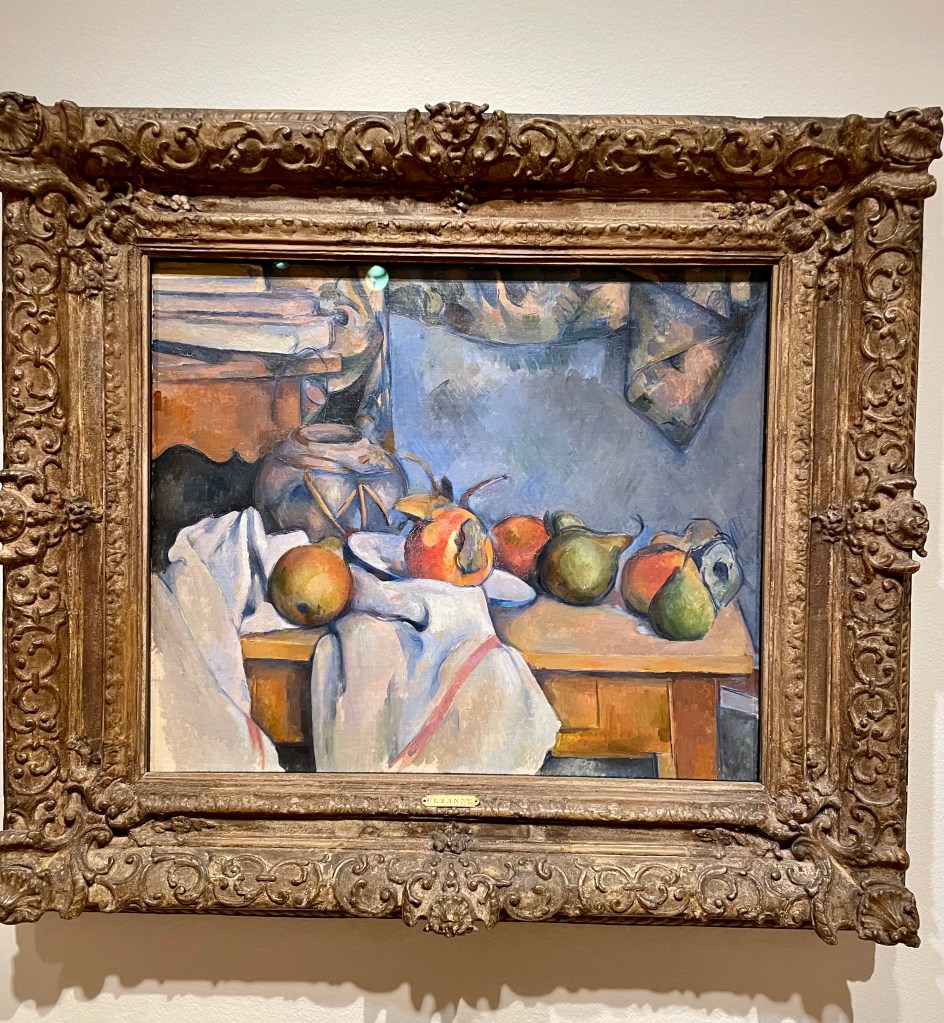
Paul Cézanne. “Ginger Pot with Pomegranate and Pears” (1893), Phillips Collection, Washington DC.

Cézanne inadvertently knows that whatever fate in the wake of nihilism awaits “painting” (soon to be utterly destroyed and displaced by the conceptual and object driven monstrosity of the modern vanguard), the effort to “realize” in painting meant holding to experience of depth as the only guarantee of an existential freedom. Surface and depth will remain on the side of the insistence of an appearance without predicates proper to theatricality. Kurt Badt poignantly captures this in Cézanne’s “old age style”: “There is no longer anything in our sensory experience of seeing which corresponds to what thus becoming visible; what is shown nis rather the visible picture of the concept of freedom. For the thing common to all these forms of the “style of old age” is two-faced: negatively it is a ligeration from isolation and resistance, possibly a liberation to the serious gentleness of freedom” [4]. And gentleness means letting things be: the serene elevation to irreducibility, upholding them only in the proclivity of its contact; never fully absorbed by surrounding and revealing its state of harmonious composition. The task of depiction in painting is the impossible task- but the task nonetheless thoroughly achievable through the hands of the painter – of coming as close as possible to what has actually been experienced. Having affirmed (not necessarily achieved) something like a fate-like divine temporality in painting is able to ground worldliness as transcendent only to let it fall immediately after. And what fate is to character, for Cézanne ‘that which is preserved unchanged’ is the supreme tonality of the pictorial task realized by the restraint of the artist [5].

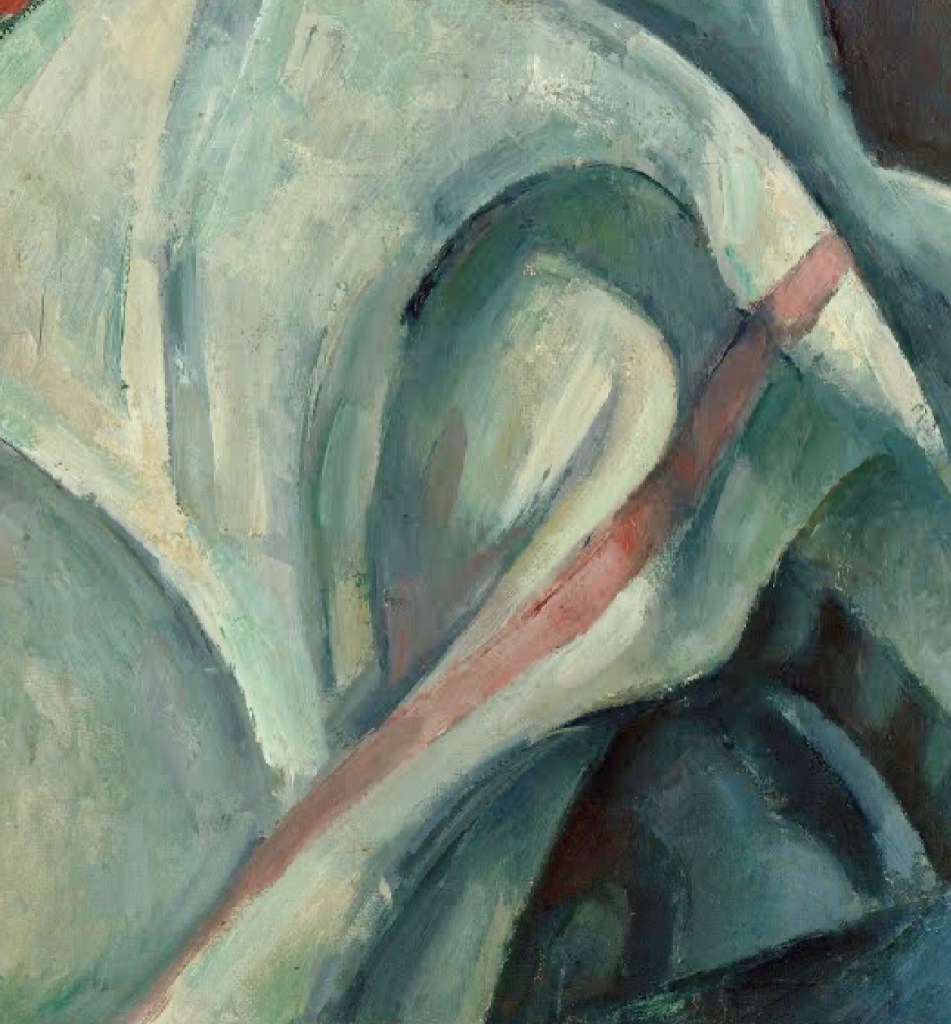
But precisely to depict immobility, the forever permanent, the befallen weight of the conatus essendi (what preserves itself as such), painting has to mobilize a minimum motion for the confluence of objects, planes, and emergence of depth. The pink stripe tablecloths that appear in several of the 1890s still life paintings with fruits can be very well taken as a multum in parvo of the declension in every realization. In a sense, then, the pink strip is a signature, as if were, of the gathering of things and depth at the price of unrealizing the closure of integral depiction. It is precisely the pink stripe in which it becomes realizable in a single brushstroke that the place of the line appears otherwise, crowning the mystery of painting as the clearest manifestation of a different musical order. It is the mysteriously nature of painting, which barely introduces itself as a line substitute for a color (the color of the tablecloth as a thing) that, while remaining visible to the viewer, cannot but reveal the invisible; that is, the temperament of the artist attuned to the muteness of painting, to say with Poussin. And perhaps this is the highest moment of depiction in the search for the “integrity” of “wholeness” that, in turn, grants the instance of the unconcealment of truth. A lace plotting what has already been validated in the irrevocable thereness of the most inapparent existence: an eternal state in the world.

.

.

Notes 

1. Maurice Denis. “Cézanne II”, The Burlington Magazine for Connoisseurs, Feb, 1910, 279.

2. Kurt Badt. The Art of Cézanne (University of California Press, 1965), 181.

3. The Letters of Paul Cézanne (Getty Museum, 2013), 342. 

4. Kurt Badt. The Art of Cézanne (University of California Press, 1965), 313-314.

5. Ibid., 161.

Bonnard (1910): painting and dissonance. by Gerardo Muñoz


Here is a little masterpiece by Pierre Bonnard at the Phillips Collection, “Interior with boy” (1910). Its simplicity does not shy away from the fact that it is a picture struggling with the problem of sensation as the highest task of painting. Bonnard is most definitely working on the threshold of Pissarro for whom the supreme mystery of a picture at the turn of the century is the act of wrestling with sensation as the world is coming to an eclipse. Or, to put it in a straightforward manner: departing from the objectivized world. If there is anything at the outset of the first decade of the twentieth century – from the stretch of 1890s to the 1910s – is the vibrant undertone of a conscious sense of what experience has become in the world. Painting, it would seem, takes up the challenge of this seeming aspect of life among things.

For Bonnard this means disclosing what appears for the first time: “to show what one sees when one enters a room all of a sudden”. And this is what “Interior with boy”(1910)  is showing us: peeking into a room with a boy sitting at a table quietly reading or going through something. The object is dissolved. We are not sure what the boy is doing. But, does it matter? The painting works around this silent vortex (although silent might not be the exact word). The figure does emphatically grows out the different color blocks of the interior (there is a solid black line that makes his body stand out). The effort of painting is achieving the seemingly weightless there-ness of the figure, blending itself to its surround, and gathering a strong sense of its appearance. 

As Bonnard would tell Matisse years later: “I see things differently every day, the sky, objects, everything changes continually; you can drown in it. But that is what brings life” [1]. For Bonnard it is not that painting gifts the events of the world with life; rather it brings the event of life away from the drowsiness of the temporal organization of its own elements. Painting is not disorganized for the sake of disorganization; it organizes life around its unmitigated appearance where form does not have the last word. Hence the insufficiency of the question “What is the boy really doing?”. The attempt to define it would ruin the experience of the painting – the subtle but well placed magenta hue connects a fragment of the back door with the boy’s downwards face, and finally to the left corner of the table. In a superficial sense the magenta is a schism of light coming through the picture, but it is also a diagonal that registers the dissonance of the painting, and thus, its ultimate mystery. Can painting integrate dissonance? The early Lúkacs seem to have thought against it. This is what he had to say in Soul and Form (1910): 

“In painting there cannot be dissonance— it would destroy the form of painting, whose realm lies beyond all categories of the temporal process; in painting, dissonance has to be resolved, as it were, ante rem, it has to form an indissoluble unity with its resolution. But a true resolution— one that was truly realized— would be condemned to remain an unresolved dissonance in all eternity; it would make the work incomplete and thrust it back into vulgar life.” [2].

But does painting need to find a resolution to dissonance, or is it quite the contrary? Bonnard’s search for the ante rem is not the sensorial apprehension to this dilemma; it is what refuses recoiling to “vulgar life”. But the passage from Soul and Form (1910) allows me to claim that the vulgarity of life begins when things start to tip towards the end of appearance; that is, when the soul disappears and the only thing remaining is the aggregation of allocated forms for sake of ‘originality’. If anything is achieved, then, in Bonnard’s “Interior with boy” (1910) is that it folds the question of dissonance to the task of painting while acknowledging that the taking place of life is always unattainable; as invisible as the boy’s inscrutable undertaking can be.

.

.

Notes 

1. Bonnard/Matisse Letters Between Friends: 1925-1946 (H.N. Abrams, 2007), 62.
2. Gyorgy Lukács. “Longing and Form”, in Soul and Form (Columbia University Press, 2010), 123.

Persuasion of the surround: a reply to Andrés Gordillo. by Gerardo Muñoz

The friend Andrés Gordillo has generously sustained an ongoing conversation in light of the talk delivered in Mexico on institution and immanence (a first reaction could be read here). In a recent note he brings many elements to the table, and his versatile writing makes it difficult – alas, this is a wish come true for any reader – to locate an univocal point of entry. This is perhaps because there is none. Andrés wants to keep us at the edge, and so he enacts the set up: there is communication, and because communication is the event of language, there is still the possibility of mystery. Many things already pop up here, but this might be doing injustice to Andrés’ elaborate draft. So, for the sake of the exchange, let me open the route by running through a moment that impacted my first reading. It is this moment: “El desencuentro que aviva la amistad de ambos personajes [Narcissus and Goldmund] es el de haber decidido resguardarse en la exterioridad de sus elecciones, ahí donde son obra del amor”.

This is a condensation of what the Hesse’s novel means to him; or, rather, how it speaks to him in light of a discussion regarding the dominance of the civil principle, and the question of an experiential dimension that we defined provokingly as a minor transcendence. I am not sure I am in the position to unpack Andrés’ thesis, if it is a thesis at all. I do remember a couple of years ago an exchange with Alberto Moreiras on the logic of the encounter and the misencounter related, precisely, to the problem of the eclipse of experience. This is the problem that keeps soliciting thought; it is the problem of thought itself.

However, I am getting ahead of myself. Andrés stages a complex framing: there is friendship as absolute difference (or in virtue of a fundamental misencounter), and then there is an exteriority of their existential decisions; that is, in the manner that they are irreductible to their being in the world. I spoke of framing purposely, since I find myself these days with Pablo Picasso’s “The Blue Room” (1901) from the early period that I encountered in Washington DC. It is a rather small picture – and to the viewer, the semi-statue like nude, a female figure it seems, comes to the forefront sliding downwards. A mysterious resonance dilates between things – and indeed, the objects in the room (the sheets, the rug, the bouquet of flowers, the paintings, the half-open window) feel like things. This is an intimate surround at the threshold of catastrophe, where things could be lost at any moment. And we know that epochally they soon were.

We are in a strange setting – and if it is strange to us it is because there is a sense to which alienation and solitude here is the fundamental harmony of dwelling. This is not yet the assumption into plain and continuous historical time that will amass things into objects. The “Blue Room” (1901) inscribes esoterically the thematics of pain – it is a work in which Picasso responds to his friend Carles Casagemas’ suicide that very same year. No metaphorical or allegorical reading will do the job to put us in “The Blue Room”. In the wake of an elliptical death, pain stands in, like the nude the water basin, as the irreductible to history and the menacing social sphere. I will bounce this to another moment of Andrés’ text: “Por ahora me siento inclinado a conversar: avanzar hacia un umbral que se desploma”. This ‘crumbling threshold’ now appears to me as a sound and prudent description of what “The Blue Room” (1901) was able to achieve. An experiential awakening against the conflagration of modern historical time: soon enough – and boy was it soon – the interior space of “The Blue Room” will multiply into infinite cells of the planetary designs in which social man will be just a potential inmate. This is why Picasso in 1901 speaks still today a strange language for us – it discloses a surround, an exteriority that we have been deprived of. It is a surround that is fully folded within.


If pictorial practice is not mere representation, but also, more fundamentally, a form of thought, then we can claim that “The Blue Room” (1901) attests to the proximity of the misencounter of friendship that outlives in the experience of the surround. And here the painter had no privileged position – he is no figure of genius, no commander of historical destiny, no magician of forms. He is also a befallen figure because he is the cipher of life. But to overcome the rhetorical surplus of socialization requires techniques in the face of the irruption of pain. Nothing less solicited Carlo Michaelsteadter when criticizing the reduction of the “man of society” to the pieties in “exchange for the tiny learned task and his submission, the security of all that human ingenuity has accumulated in society, what he would not otherwise obtain except by individual superiority, the potency of persuasion”, he wrote in Persuasione e la rettorica, another masterpiece of the 1900s. Yet, persuasion requires to be vigilant at the moment where things enter the historical penumbra and its rhetorical artifice; the reign of endless confusion amidst the most transparent and disingenuous computations.

How one becomes persuaded within a tonality, and remaining to be so – this is also a surrounding mystery of “The Blue Room” at the outset of the century. We still dwell in its dissonance.