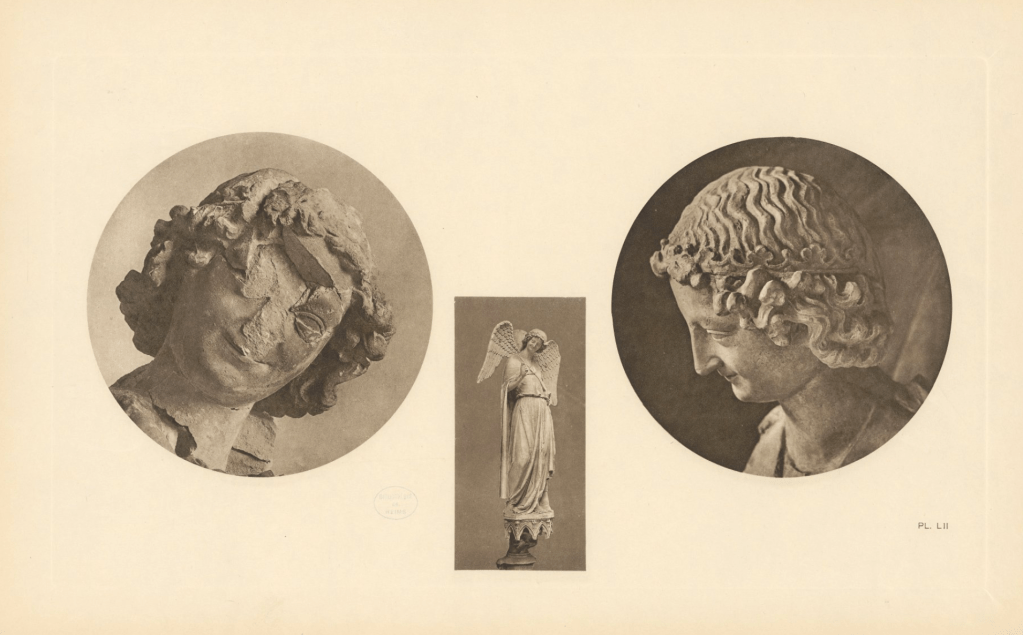
Among Robert Antelme’s posthumous writings the short text “L’ange au sourire” has a decisive place if we are to explain the transfigured theological experience of the French writer. To anyone familiar with French architecture history the title should sound familiar, since the ‘l’ange au sourire’ was already a common expression used by French scholars of architecture during the interwar years. Charles Sarazin, arguably the most important scholar of the architecture of Reims, penned a separata titled “Le Sourire de Reims” (1929), in which he celebrated the mysterious smile of the angel Gabriel that was severely damaged due to shell fire of the Cathedral during the fall of 1914 [1]. But a decade prior to the destruction, art historian Arthur Gardner, in a detailed essay on the sculptures of the facade of the Rheims Cathedral, also took note of this angel’s gaze writing that: “…the angel Gabriel of the Annunciation in which the French smile has almost become a grin, the beginning of the contorted expressions frequently found over the border in Germany.” [2]. The particular aspect of this unique angel’s face that Antelme undresses from the cloak of authority is also wonderfully documented in the photographic book by Pierre Antony-Thouret, who also showed pictorial interest in the way that angel Gabriel was chipped in a large area of the right frontal relief (image 1) [3].
Image 1. Reims au lendemain de la guerre (1928), plate 52.
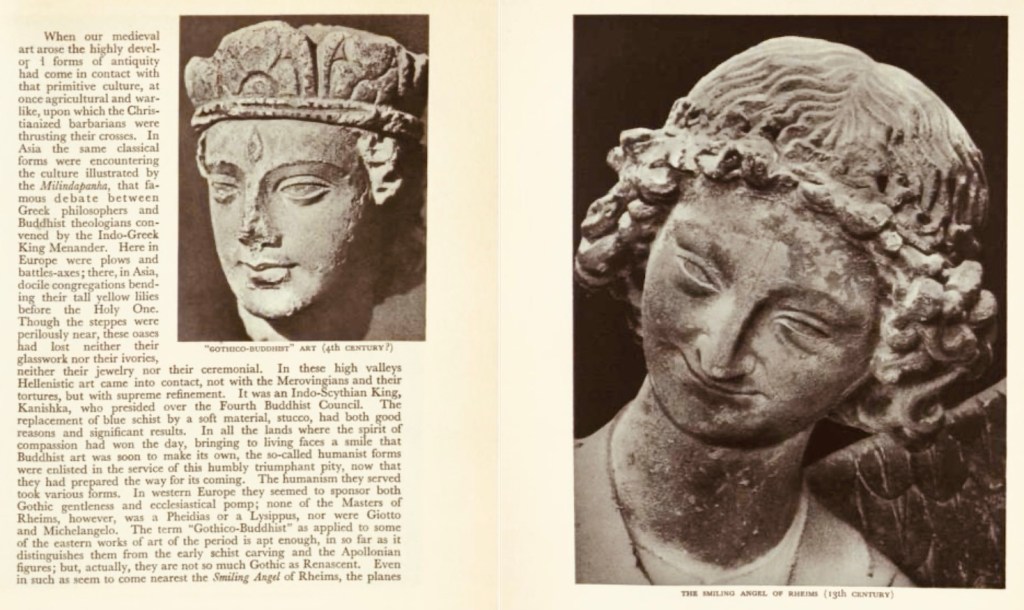
This curatorial context informs the historical background of Antelme’s reference to destruction and what he references as the crushed: “But not crushed by this building, or by that event, or by some power. It has always been crushed, crushed forever” [4]. For Antelme the tenuous, almost imperceptible, smile of the Angel of Rheims is what outlives absolute destruction because to be destroyed cannot be executed absolutely. It is the soul of existence that, because of its exteriority to history, is powerless “to have forever to be”. Even if this being has become petrified and immobile from its original plastic appearance auf vif of sacred art. This is what Malraux captured in his brief mention of the “L’ange au sourire” in The Voices of Silence (1951), where he also compares it to the Buddhist faces of Oriental sacred art (image 2): “The Smiling Angel of Rheims is a statue whose “stiffness” increased with every century; but at its birth it was a similar incarnate, a face that had suddenly come alive – like all faces sponsoring a discovery in the field of the lifelike” [5]. In order words, to see in the muteness of the face the nothingness that allows expressive relations to emerge in the open. This holds for Antelme’s description as well: “Radiant or hidden, inevitably it is there. Word, image, music: everything expresses it, and nothing. It lies at the heart of that realm where all relations are born. Forever starting anew. Possessing nothing, capable of nothing, it must be there, forever”.
Image 2. Angel of Rheims in The Voices of Silence (1964).
But what Antelme was able to capture through the smiling angel of the Rheims Cathedral was not a problem of iconology of art forms, but rather the very essence of the theological problem of angels as it relates to the poetics of life itself. The angel is not a promythical figure scaled to a specific historical moment, but an instantiation of the divine appeals to the withdrawal the possibilities and modes of the human being. This is why Antelme can state that “the only transcendence is the relation between beings”. Even in its muteness, the theologica depth of the angel is the poetic speech of divinity through a surge in language that has no end, but only celebration or hymnology.
This is why Erik Peterson writes towards the end of “The Book of Angels” about the intimate relation of angels in human existence: “A human being can draw near to the angels because the angel too – as its name already indicates – can draw near to humanity. […] The angels are more than poetic ornamentation left from the storehouse of popular fables, they belong to us. For us, they stand for a possibility of our being, a heightening and intensifying of our being – but for the possibility of a new faith…as a passion for mental clarity and an authentic existence” [6]. It is fair to say that, although the figure of the angel does not show again in Antelme’s work, all of his vision and witness accounts in the face of political horror must be placed in the endless vigil of a nocturnal life that is shared with the ethos of angels (utirur vigilis, angelorum vitam procul dubio meditatur).
.
.
Notes
1. Charles Sarazin. “Le Sourire de Reims” (s.l.n.d, 1929).
2. Arthur Gardner. “The sculptures of Rheims Cathedral”, The Burlington Magazine for Connoisseurs, V.26, 1914, 64.
3. Pierre Antony-Thouret. Reims au lendemain de la guerre: la cathédrale mutilée, la ville dévastée (Jean Budry, 1928).
4. Robert Antelme. Textes inédits sur l’Espèce humaine (Gallimard, 1996), 14.
5. Andre Malraux. The Voices of Silence (Secker & Warburg, 1964), 317.
6. Erik Peterson. “The Book of Angels”, in Theological Tractates (Stanford University Press, 2011), 139.
It could easily be argued that one of the central immaterial characters of Robert Antelme’s L’espèce humaine (1947)is the constant state of hunger. It is the more telling that Antelme – and it is also surprising that most of his relevant critics have been unattentive to this problem – does not reflect explicitly about the nature of hunger in his account, as if already hunger as “facticity” of the destruction of human experience in the camp was enough to show how the crisis of effective symbolization with the world means, ultimately, the struggle for the maintenance of the nutritional condition for survival [1]. It is a particular state of nutritional privation that colors not just every community or social relation in L’espèce humaine, but also every thought, passive meandering, and even moral clarity of the deportee life in the camp. The pathetic struggles over pieces of bread or scoops of putrid soup while deposing the human race from the world brings them back, at the level of consciousness, to the raw origins of its anthropological self-affirmation. And this means that every bite of food and every bit of protein digested by the human being is only the antecedent of the future need to meet the elemental nutritional gain for survival. The ‘consciousness towards hunger’ colored in the camp becomes the mirror image of the incessant eating disorder of hypermodern social adaptation as two forms of predatory struggle over the exchange goods of the world.
Excessive eating and nutritional deficiency are, in this sense, two pothistorical temporal circuit of human beings as a species of hunger and gluttony. About a decade ago a book entitled Hunger: the oldest problem (2014), written by Martín Caparrós, stood out as a proof of a materialist conception at a planetary scale, which for the novelist could easily be solved by drafting the legibility of material inequality and charting the regional disproportionate asymmetries between the “good eaters” (and good feeders), and those in permanent hunger, malnutrition, localized famine, and potential starvation. For Caparros, given the height of our “civilizational progress”, hunger revealed the “original plague of humanity….which now can be solved through a political decision” [2]. The substance of the “political decision” for hunger of the human race was as empty as the very nauseating fatigue of real starvation, although as a rhetorical ploy it does contribute, even against its own presuppositions, to the civilizational paradigm that structures the poles of gluttony and hunger that sustains the domestication of the human species in conformity – under the terror imposed by the glacial tonality of nihilism – with a ‘good enough life’, as an American cultural scholar univocally upheld it [3]. A deconstructed Michelin rated restaurant is as much of the ‘good enough life’ as the oversized pots of soup delivered by World Central Kitchen in any of the ongoing war zones.
A ‘good enough life’, always marching towards the absolute postponement of an absolute hunger in any part of the planet, whose most recent avatar (not the final by any means) is the well wrapped brown bag of “food app delivery” that is silently placed in front of your house door. The food delivery package, very much like the breadcrumbs of the concentration camp described in L’espèce humaine, enter full circle even if the arrangement of symbolic reality says otherwise. It does not matter that there are human hand struggles for dregs in the camp while in civil society there is a seemingly untouched brown bag; what makes them equivalent is how the autonomization of hunger and gluttony have been deprived of everything except its own functionalization. In other words, the absolutization of gluttony and hunger as abstract nexus of social reproduction entails the complete devastation of commensality, and all features of experiential sharing that in the ancient tradition is gathered in the banquet or in wine festivities [4].
This absolute autonomization turns its back to the world, which has now been transformed as a mere reserve and container. This is why the analogies with the wild cornucopia of the elastic worlds of Gargantua or Pantagruel, or even the mythical land of Cockaigne fall short, and can only contribute to fetichize the problem of the “true hunger” of the human species beyond nutritional and biological arrangement. The dialectical movement at work in the alleged returned to the primal anthropological condition comes at a price: the sensible and meaningful relation, which is no longer to be invented but rather to be renounced in the elaborate thickening of a social space organized through depredation and adaptation. In his Manuale di sopravvivenza, Giorigo Cesarano noted that the problem of hunger exceeded the political and biological determinations, since hunger was first and foremost the problem of the completion of nihilism – the only hunger was that of the wandering of the human species reveals the hunger of meaning as a the true double negation:
“At the end of prehistoric times, the most ancient problem signals the return of the negative instinct: hunger. But this time is about the hunger of meaning that exceeds, while bringing it to synthesis, the anxiety of survival as merely an animal and its false resolution as a life that transcendentals the idealist forms of the human “ideal”. …both the negative instinct and the rational separation, having conquered some coherence in its praxis, from a possible totality seeks to insert being in a real university in order to be known truly as such” [5].
In this dense moment of his book, Cesarano seems to be arriving at an important inflection point: that is, the primal instinct of hunger, precisely as fealt and maximized in the new existential poverty of the human experience, is already compensatory to the concrete realization of an absolute hunger of meaning that emerges in both the privative stage of hunger, and in the consummation of any imaginable and desirable meal. Hence, the return to the facticity of the prehistoric stage of instinct negativity is ultimately the final exclusive dish: the nothingness of nihilism to retain the illusion of, in the words of Antelme’s poem “The soup”, going to far (or as far as it needs to be that the “world doesn’t end” [6]. The anthropophagic energies are the last tools of self-burial of the bicameral man in the wake of intramundane extinction [7].
But the dialectical vengeance in the epoch of real subsumption is hereby expressed in its uttermost kernel: the material world can only take the image of a predatory park of hunters and preys, of eating and being eaten. In the privation of death, the fictitious life of being is already a form of expropriating death as ongoing struggle for survival and self-conquest of life’s own organic illness, as it appears in Anatole France’s fragment: “No, I would rather think that organic life is an illness peculiar to our unlovely planet. It would be intolerable to believe that throughout the infinite universe there was nothing but eating and being eaten” [8]. The poverty of a restricted vitalist self-reflection can only described the organization of the world as a civilization that resembles a Pac-Man maze of the circulation of the equivalent. It is not difficult agree with Adorno that this is a perfect image of the integral society without any residue – as it continues to be in any point of the planet – is the last possible well administered utopia.
.
.
Notes
1. See the essays in the volume On Robert Antelme’s The Human Race: Essays and Commentaries (The Malboro Press, 2003), 55-203.
2. Martín Caparrós. Hunger: The Oldest Problem (Melville House, 2020).
3. Avram Alpert. The Good-Enough Life (Princeton University Press, 2022).
4. Albert Hirschman. “Melding the public and private spheres: taking commensality seriously”, in Crossing Boundaries: Selected Essays (Zone Books, 1998), 11-28.
5. Giorgio Cesarano. Manuale di sopravvivenza (Bollati Boringhieri, 2000), 70.
6. Robert Antelme. “The Soup”, in On Robert Antelme’s The Human Race: Essays and Commentaries (The Malboro Press, 2003), 36.
7. Julian Jayne. The Origin of Consciousness in the Breakdown of the Bicameral Mind (Msriner Book, 2000).
8. Theodor Adorno. Minima Moralia: Reflections from Damaged Life (Verso, 2020), 83-84.
At the outset of L’espéce humaine (1947), Robert Antelme discloses the difficulty between language and experience that lays at the heart of the book, and which is never thoroughly assumed at the level of form in the novel. L’espèce humaine (1947) is ultimately not an account about the impossibility of describing what took place in the camps; from the banal physical violence to the desperate hunger, from the microaggressions to the slightest movements and carnage of bodies in space; from the joyful smiles in the most miserable of scenario where the ultimate goal was for the human life to slowly rot; the sequence of actions engage in no struggle to bring to a crisis the level of representation. And Antelme goes into painstaking efforts to give us a full picture of what took place, only to never talk about it again in writing or in personal conversations as Marguerite Duras tells us [1]. So, what to make of Antelme’s initial affirmation in the “Forword” where he states that: “…during the first days after our return, I think we were all prey to a genuine delirium. We wanted at last to speak, to be heard. We were told that by itself our physical appearance was eloquent enough; but we had only just returned, with us brought back our memory of our experience, an experience that was still very much alive and we felt a frantic desire to describe it as such as it had been…[..]. No sooner would we begin to tell our story than we would be checking over it. And then, even to us, what we had to tell would start to seem unimaginable” [2]. The unimaginable for Antelme is a sort of threshold of language; a limit for the unrestricted, that is, for what could allow for an experiment of language after the catastrophe, or in the wake of the civilizational catastrophe that is consummated in the camp.
This delirium and anxiety over language – to tell it now and how it happened and to tell “the world”, only to immediately acknowledge the impossible task of doing so – does not take place at the order of the narrative; it is first and foremost something that we get a glimpse of at the end of the book as the liberating soldiers enter the rubbled towns only to encounter the incontinence of the survivors “talk and talk, and pretty soon he isn’t listening anymore” [3]. At that moment, the face to face between human beings will follow “to a kind of infinite, untransmittable knowledge”, Antelme tells us [4]. But what type of untransmittable and nocturnal knowledge is Antelme referring to here? It is not about some ethical exigency of the defacement of experience through linguistic construction; it is rather the torrential and densely weight of description and events, that numbs and deposes language in the very mediation of its effective sayability. The experience of human suffering and domination is untransmittable not because there is a deficit in language or the effacement of representation; but, on the contrary, precisely because there an excess of language that flattens irreducible suffering to an anaphoric socialization of speech that tacitly accepts inhumanity at face value. And that socialized distribution of speech underserves suffering, in virtue of equalizing an expansive chatter that neutralizes in survival the inherent pain of the irreducible human species within the imposible ordeal of total annihilation.
Antelme’s L’espéce humaine is stubbornly nominalistic in its thick descriptions of things and events, and it wants to avoid metaphoric transports. He prefers to call things as he sees it and get to the thicket of things in the most nauseating of repetitions. In a way, the hellish atmosphere of the concentration camp resides in the slow moving degradation of human life deprived of the world. However, there is one moment where Antelme resorts to calling a situation ‘hell’; that is, precisely, to an account of the transparent use of language, the raw incontinence and commanding force towards exteriority, as if there is no longer a caesura or separation between being and language once enunciation has been homogenized as commanding force. This is a language without a secret or unsaid, moving against the outside of consciousness in the same depretatory form as the same administrative machinery that has lifeless bodies as its target. In this way, language being turned into the force of speech will not only foreclose itself to the world, but it will signal the very intangibility by virtue of the flattening of verbal communication as an immediate and furious call to an annihilation of appearance. Antelme writes in this admirable moment – one of those instances where description of the state of things is incepted by the negation of the very conditions that allow for the narrative order:
“Degradation, and flabbiness of language. Mouths whence nothing any longer ever came that was ordered, or strong enough to last. A weakly woven cloth fraying to bits. Stencens succeeded one another, contradicted one another, expressed a kind of belched up wrtnessness; a bile of words. They were all jumbled together: the son of a bitch who’d done it, the wife left on her own, food, drink, the old lady’s tear, the fuck in the ass, and so on; the same mouth could say it all, one thing after the other. It came forth all by itself; it would be empty. It only stopped at night. Hell must be like that, a place where everything that’s said, everythat’s expressed, comes forth equalized with everything else, homogenized, like a drunkard’s puke” [5].
The incontinence of language at the limit of what can be said is a secondary hell; that is, the last contortion that the inhumanity of the human can offer outwards in order to outlive in a moment of minimal pleasure, since the absolute pain of a glacial existence has been deprived of any real contact with the world and things. It is a linguistic hell – the looping language of the camp, will only mirror also the linguistic codification that around the same years will be elevated to the paradigm of cybernetics and the regime of information theory – will now appear as a unified block of application, enforcement and extraction. Hence, we should take Antelme at his word: language has become “flabby”, and it is a “puke”. It is circulation without sense, as in the looping mechanics of the furnaces charted by the Nazi engineers that appears in the recent sequence of the film Zone of interest (2023). It is not that sayability loses it claim to the autonomy of its form before an event; it is also that by virtue of its own degradation against the erasure of events, it can only be unified, packed, homogenized and rendered into equivalence in the wake of the absolute triumph of the historical project of alienation and external objectivity.
The passage of the old hymnal texture of language as solace and lamentation could only entail the conservation of communication, which for Theodor Adorno writing during the same years as Antelme (1946-1947) will deduce as the “techniques of insolence enabling each individual to spread around him the glacial atmosphere whose shelter he can thrive” [6]. That the experience of the camp for Antelme ultimately meant that the “executioner can kill a man but cannot change him into something else”, must be placed in tension with the epochal transformation of a hellish experience of language at the service of the nihilistic service of equivalence that unveils its purest semblance at the camp [7]. The unitary reduction between the “socialized Man” and the “deportee” enters into a proper focus that Antelme was able to grasp with uttermost honesty: “…that there is no inherent difference between the “normal” system of man’s exploitation and that of the camps. That the camps are simply a shepherd image of the more or less hidden hell in which most people still live” [8]. At the risk of an overtly mannerist claim, it seems to me that the kernel of Antelme’s intellectual effort is to withdraw from the condition of hell that is condensed in the block of ice fixated in the ruinous material of language [9]. Memory, experience, friendship, truth, writing, the soul – these are all tools to chip against the brute reification of the glacial subjection at the price of ultimate solitude. Is there anything else worth a shot? In the last pages of L’espéce humaine, Antelme returns to the question of “freedom”, only to claim that “to be free” implies to “say no to everything” – and could we also refuse the language as it declines into flabbiness, equivalence, and its putrid decline, as overflowing mountain of trash that covers up the ongoing pain of the human species? [10].
Sure thing, the hölderlinean enduring and difficult task of the “free use of one’s own” appears here with some urgency as the requirement of traversing the attunement to pain. Antelme seems to have wanted to offer a negative theology to “forever starting anew”, in which the irreducible of human sayability is posited as the condition of the “only transcendence between beings” [11]. “To speak, in a word, is to seek the source of meaning in the prefix that the words exile, exodus, existence, exteriority, and estrangement are committed to unfolding in various modes of experience; a prefix that for us designates distance and separation” [12]. Aren’t distance and separation two conditional criteria for grounding the irreducible? The habitation of the speaking being can harbor the contours of the unfathomable expression on the reverse of social tribulations, which is always the primal nomos of equivalence. Allowing the expansion of the irreducible as a the site of an ordinary accumulation of freedom preserves a sensible region for what takes place (“whatever happens” — and is not this taking place the opening of the non-site of the chorá?) in a language attuned to the relentless event that has forever touched us. This is already the site of the unimaginable beyond and away from the language of survival that permeates everything in both times of peace and of war.
.
.
.
Notes
1. Marguerite Duras. El dolor (Alianza editorial, 2019 ), 71.
2. Robert Antelme. The Human Race (The Malboro Press, 1998), 3.
3. Ibid., 289.
4.Ibid., 290.
5. Ibid., 135.
6. Theodor Adorno. Minima Moralia: Reflections from the damaged life (Verso, 2020), 33
7. Robert Antelme. The Human Race (The Malboro Press, 1998), 220.
8. Robert Antelme. “Poor Man – Proletarian – Deportee”, in On Robert Antelme’s The Human Race Essays and Commentary (The Marlboro Press, 2003), 22. Dionys Mascolo makes more or less the same claim in Autour d’un effort de mémoire: sur une lettre de Robert Antelme (1987) when speaking about the stratification of species in the camps and the division of classes in society: “l’intuition aveuglante de tous les survivants est celle d’avoir fait quant à eux, sous une forme extrême, cette expérience: que l’organisation de la société en classes telle que nous la vivons est déjà une image de la division de cette société en espèces, comme dans les camps”, 87.
9. Robert Antelme. “Revenge?”, in On Robert Antelme’s The Human Race Essays and Commentary (The Marlboro Press, 2003), 15.
10. Robert Antelme. The Human Race (The Malboro Press, 1998), 291..
11. Robert Antelme. “The Smiling Angel: Rheims Cathedral”, in On Robert Antelme’s The Human Race Essays and Commentary (The Marlboro Press, 2003), 10.
12. Maurice Blanchot. “The Indestructible”, in The Infinite Conversation (University of Minnesota Press, 1992).
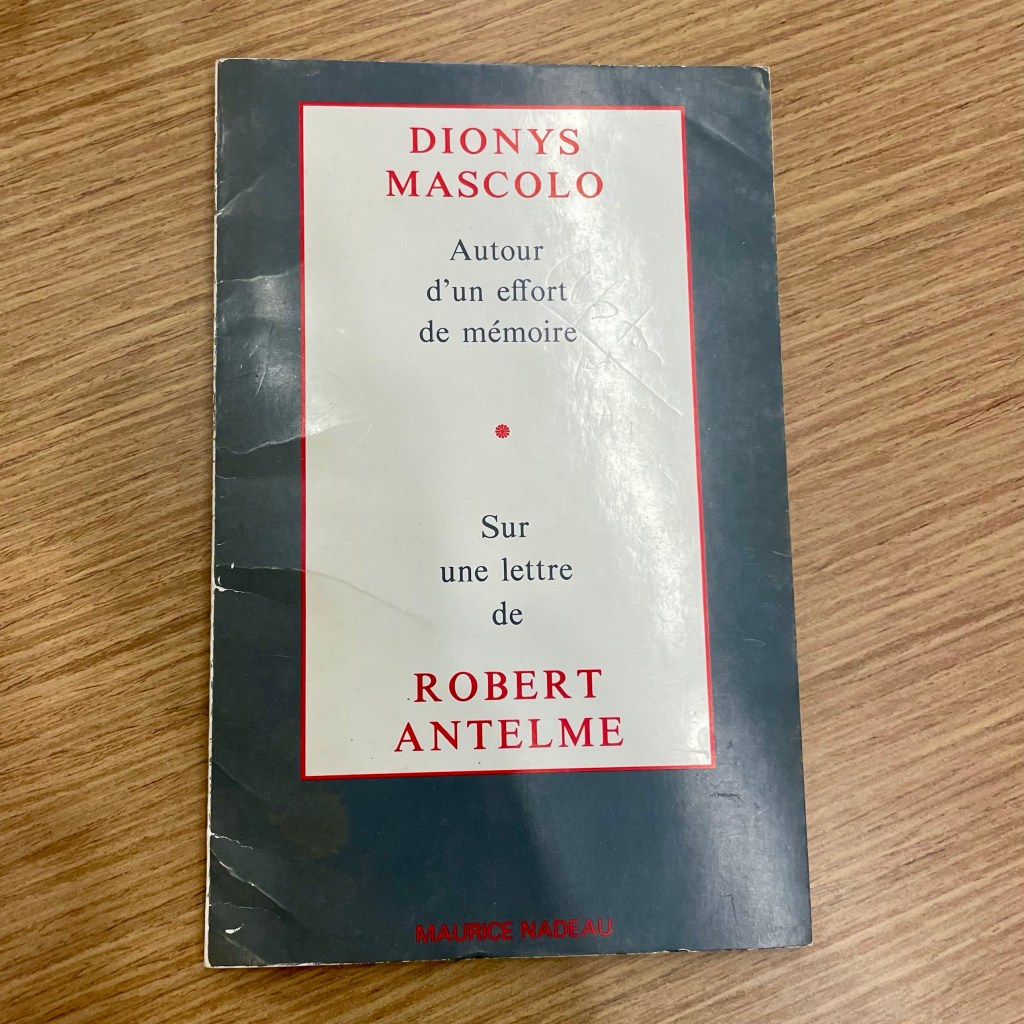
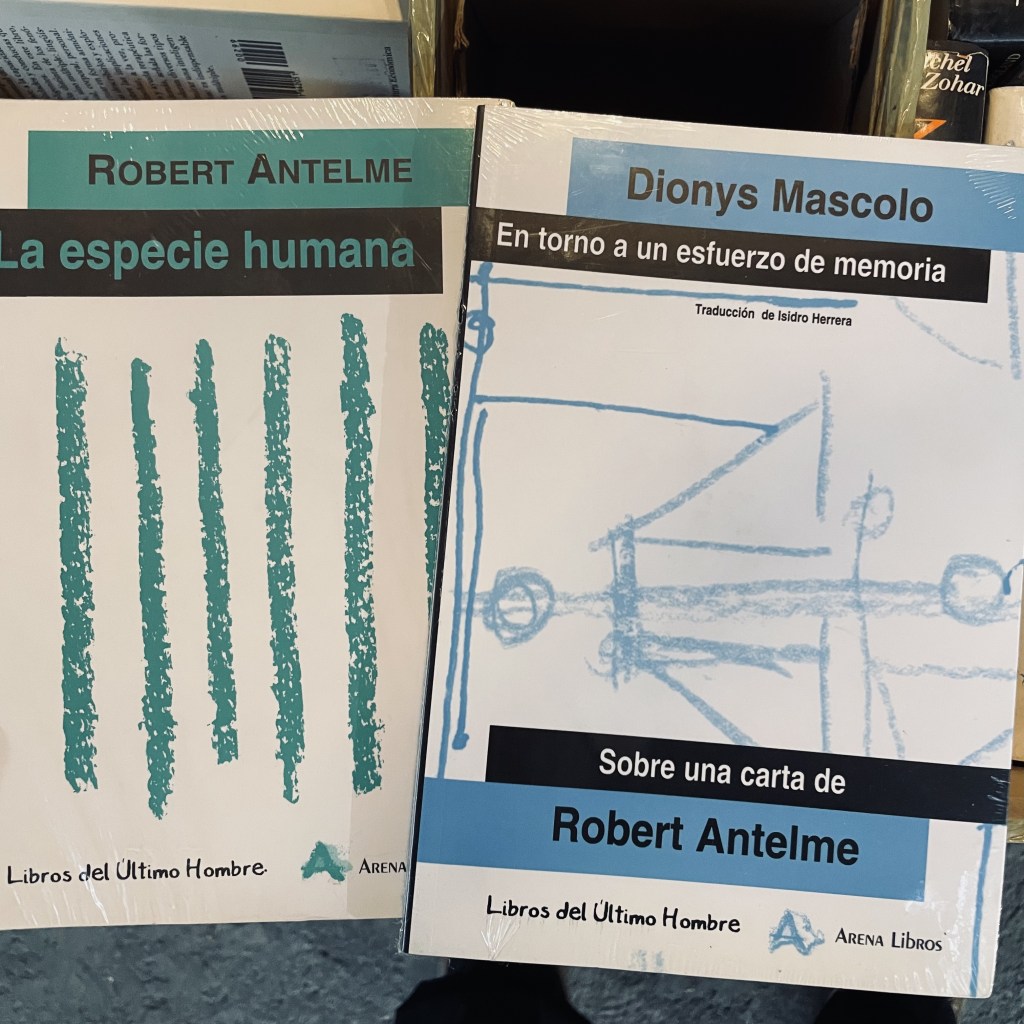
Rereading Dionys Mascolo’s Autour d’un effort de mémoire: sur une lettre de Robert Antelme (1987) in preparation for an upcoming course with Philippe Theophanidis, one gets the sense of beginning backwards or at the very end, since this late essay is a recapitulation of what the Rue Saint-Benoît Group embodied and stood for. And it is so obvious that for Mascolo what is at stake in Antelme’s letter is not a particular practice of confession (and the coupling of secrecy and extraction), but rather an integral register of an experience that belongs to “friendship in thought without reserve” [1]. And that it would not have been possible without friends, as simple as that. Of course, the condition of possibility of this shared thought in friendship has less to do with general principles, norms, or creative acts, and more with what Mascolo does not hesitate to qualify as “a sensibility that was common to us”.
What is this sensibility, and is it possible to describe it? This is a question that I do not think that is attempted to be resolved in Mascolo’s commentary nor in Antelme’s letter so consumed by its internal lacunae and effacement (I am definitely not capable of saying a word about it at the moment, and this might be one of the questions in the ongoing dialogue in the seminar). Mascolo does offer a little more when he states that this sensibility, however broad and partial, was always elevated against all totalitarianisms that were hegemonizing the political positions of the epoch. Obviously, it names the political totalitarianism (Fascist and state planned communism alike), but also the “the soul of the project” (‘est l’âme du projet et sa forme aboutie’) that must retract from it [2]. The last pages of Mascolo’s reflection is a shallow-deep, an insinuation, into the possibility of saying something in relation to this difficult proximity.
Hence, against total subsumption of life into political planning (whether on the right or left, whether ecclesiastical or in the name of the secularized forms of militant communist parties), Mascolo’s insistence on the ‘soul of the project’ is sustained by the “missing word” give that dispenses human necessities as infinite. He writes: “Et par mille et mille détours, il me (nous) fallait toujours en revenir au même point : Je suis ce qui me manque est la sentence que je porte (nous portons) inscrite à l’intérieur du front. La moindre des choses alors est de proposer que, sauf mensonge, elle vaut pour tout homme”. [3]. But what could it mean that “what I am” is always constituted by the missing word? It is definitely not a substantive attribute to a person (and thus what I can acquire), but a word that in its ideal absence and lack of epistemological validity stands as a form of seeking (zēteîn) that Nicoletta Di Vita has recently linked to the form of the ancient hymn [4]. The missing word is the passive and pure voice that calls out the rhetorical fiction of political totalitarianism. In other words, the missing word does not enact a present state of things, articulating the denomination in language with distinct objects of the world; it only has transformative weight when revealing what remains under the capes of morality.
This is why the experience of the camp constitutes a central threshold: on the one hand, it is an extreme and sharpened image of social alienation between classes; and, on the other, it is the experience that by depriving the human of its humanity it brings to an effective end the polarity between rich and poor that structured the economy of salvation and damnation of Western civilization. This is what Antelme describes in his essay “Poor Man – Proletarian – Deportee”, which according to Mascolo brings the rich to a psychotic night of desperation towards destruction and death of the specie. Hölderlin’s definition that “we have become poor in order to become rich” as a clement predicament in the face of the modern is here-forth suspended in the spiritual crisis generated by the social engineering whose most extreme case is the model of the camp.
And yet the missing word remains irreducible even after the corrupted stage of innocence and the impossibility of redemption. Mascolo, reader of Nietzsche, does not believe in the theos. This is why for him the missing word, far from being an apostrophe that offers consolation in the wake of the catastrophe, it remains concretely attached to the experience of the friend that no longer finds solace in abstract peace, but in the profound musicality of what remains inconsolable: “cette heureuse absence de paix qui est sa musique profonde, et que donne en partage l’être aimé, l’inconsolable qui console” [5]. This transfigured word – the unending capacity for hymn in the human, its nomoi mousikos – is both an excess to memory and appearance, and perhaps, more importantly, an excess to the experience of living and the dead. And is not this “seeking” passage of the missing word what the Rue Saint-Benoît Group was obsessively after?
__
Notes
1. Dionys Mascolo. Autour d’un effort de mémoire: sur une lettre de Robert Antelme (Maurice Nadeau, 1987), 82.
2. Ibid., 83.
3. Dionys Mascolo. Autour d’un effort…,82.
4. Nicoletta Di Vita, Il nome e la voce. Per una filosofia dell’inno (Neri Pozza, 2022), 27.
The Rue Saint-Benoît Group, organized by Marguerite Duras, Robert Antelme, and Dionys Mascolo and other fellow-travelers of the interwar years can hardly be defined as a political movement, a literary school, nor an intellectual community with a direct orientation or aesthetic program. In fact, the Saint-Benoît Group (transnational in its composition) understood itself as a shared experience of thought that gravitated under the words of the German poet Friedrich Hölderlin: “The life of the mind among friends, thought is formed in the exchange of the written word and for those who seek”. It is also known that Hölderlin was the quintessential poet dwelling in the fracture between tradition and modernity, the flight of the gods and the eclipse of the poetic in the wake of a consummated technological Prometheism. To affirm Hölderlin’s words entails to confront the difficult questions of language and the voice as conditions for thought. How can we think of an intellectual experience in which friendship becomes inseparable from thought; and, at the same time, when thought becomes a condition for the endurance of friendship? And to what extent could this double register allow for a reinvention of the autonomy of politics in the wake of the crisis of Humanism?
These are the enduring questions that the experiential setting of the Saint-Benoît Group bequeaths to us today. If the Saint-Benoît experience has remained opaque and invisible even within monumental historiographic narratives of twentieth-century ideas, it is because only seldom have these problems been rightly posed. Under the sign of a “friendship of thought” – a transfigurative plane that immediately resonates with the immaterial common intellect, the Heideggerian incursion on the task of thinking, and the revival of a sensible Platonism – the members of the Saint-Benoît Group witnessed the catastrophe of modern politics in real time; such as, although not limited to, the concentration camp, the postcolonial wars of liberation, communist totalitarianism, and the exhaustion of the fundamental categories of political Liberalism. Taking distance from the elaboration of a normative political theory, the Saint-Benoît Group favored the heterogeneity of stylistic endeavors and expressive acts in order to grapple with the crisis of experience. And it is to their specific scenes of writing that we must attend to in a systematic and careful way.
In this eight-week course we will explore the diversity of the writings of the group, including figures such as Dionys Mascolo, Robert Antelme, Marguerite Duras, Maurice Blanchot, Elio Vittorini and other fellow-travelers to explore questions concerning the nexus between experience and creation (both of us have worked on some of these writers intermittently in the past couple of years). To the extent that we still live among the ruins of the legitimacy of modern politics, the contestatory style of Saint-Benoît Group still raises the question about the human species within our civilizational collapse.
What type of authority emerges from their writings, communication, and imagination of a fractured humanity? And how could the concept of ‘revolution’ be transformed from its moral and technical elaborations that hegemonized the twentieth century? We are aware that the Saint-Benoît Group has no “lesson” to be extracted and made “actual”; rather, we are interested in what we would call a “gesture of thinking” that prepares the condition for a life in freedom within and beyond the contours of the polis.
*For those interested in registering for the eight week seminar beginning in February 2024, please consider signing up at 17/instituto de estudios críticos: https://17instituto.org, or by writing to extension@17edu.org.
The testimony of Michi Panero in Jaime Chaverri’s El desencanto (1976) still resonates today as a salient witness of the eclipse of the human race and its possibility of experience. I offer here a very straightforward translation of the last sequence of the documentary: “From my own experience, I fear that we will not achieve descendancy…we are the end of the species (fin de raza), an end that is far from being Wagnerian, a species that has been eroding with time. And we simply cannot go on…”. Although Michi uses the expression “fin de raza”, it is obvious that he is not referring to “race”, but rather evoking the human species or the ‘human race’ as a whole (in the same way that, for instance, Robert Antelme’s memoirs of the camp was rendered as The Human Race, originally in French L’Espèce humaine). If our epoch is frivolously obsessed with race and identity tribulations, it is simply because it has opted to suppress that the exhaustion of Man in the moment of the death of God has been set as a concrete end of the human species itself.
This is not necessarily due to a series of immanent threatening events that could put the species at extinction on earth – from ecological catastrophes to nuclear war and global epidemics, to other forms of unimaginable outbreaks – but more fundamentally because everywhere the end of the human is signaling that the human species merely occupy a bulky and flat space and time. In this sense, Michi’s existential witness is not about the decadence of the family structure (of an aristocratic Spanish family during the Franco Regime, which the film denounces as the epochal crisis of the family was becoming a reality in the West), but as Teresa Vilarós reminds us in her classic study, that from now on life will only be perceived as fossilized life, and thus devoid of any existence [1]. And I will add a complementary element to Vilarós’ analysis: there is no resurrection in the fossil residue, but only debris and decomposition of the most elemental kind.
Hence, the last of the human species will linger on for a while, but this is a separate question from what this transformation entails for the originary community of the species. The end of the species, insofar as it belongs to the trained to the regime of adaptation, will only relate through a process of abstraction of absolute expropriation. This is why increasingly today, in the wake of the ruins of politics, the social bond emerges as a brute force of inhuman mediation. In a way, socialization can only socialize the last reserve of the human species: its inhumanity.
If the end of the human species is rarely rationalized, it is due to the fact that within the regime of adaptation, the passage from the sense of belonging to the ‘human species’ into the community of inhumanity is intertwined and at times completely blurred. In fact, this is the same numbing of experience that Robert Antelme captured in The Human Race (1947): “For in fact everything happens in that world as though there were a number of human species, or, rather, as though belonging to a single human species wasn’t certain, as though you could join the species or leave it, could be halfway in it or belong to it fully, or never belong to it, try though you might for generations, divisions into races and classes being the canon of the species and sustaining the axiom we’re always prepared to use, the ultimate line of defense: ‘They aren’t people like us” [2]. The proliferation of the fictitious community today registers the absolute obsolescence of the human species rendered legible in the furious processes of adaptation and reproduction. Michi’s complaint – “somos un fin de raza” – should be inserted in its proper indictment. Un desencantamiento ante el mundo: the revealing of the inhumanity of the human species unleashed in the most natural ways imaginable against the world.
.
.
Notes
1. Teresa M. Vilarós. El mono del desencanto (Siglo XXI, 2018), 56.
2. Robert Antelme. The Human Race (Marlboro Press, 1998), 5.



 Infrapolitical Reflections