Casa Bayona’s pensive slave. by Gerardo Muñoz

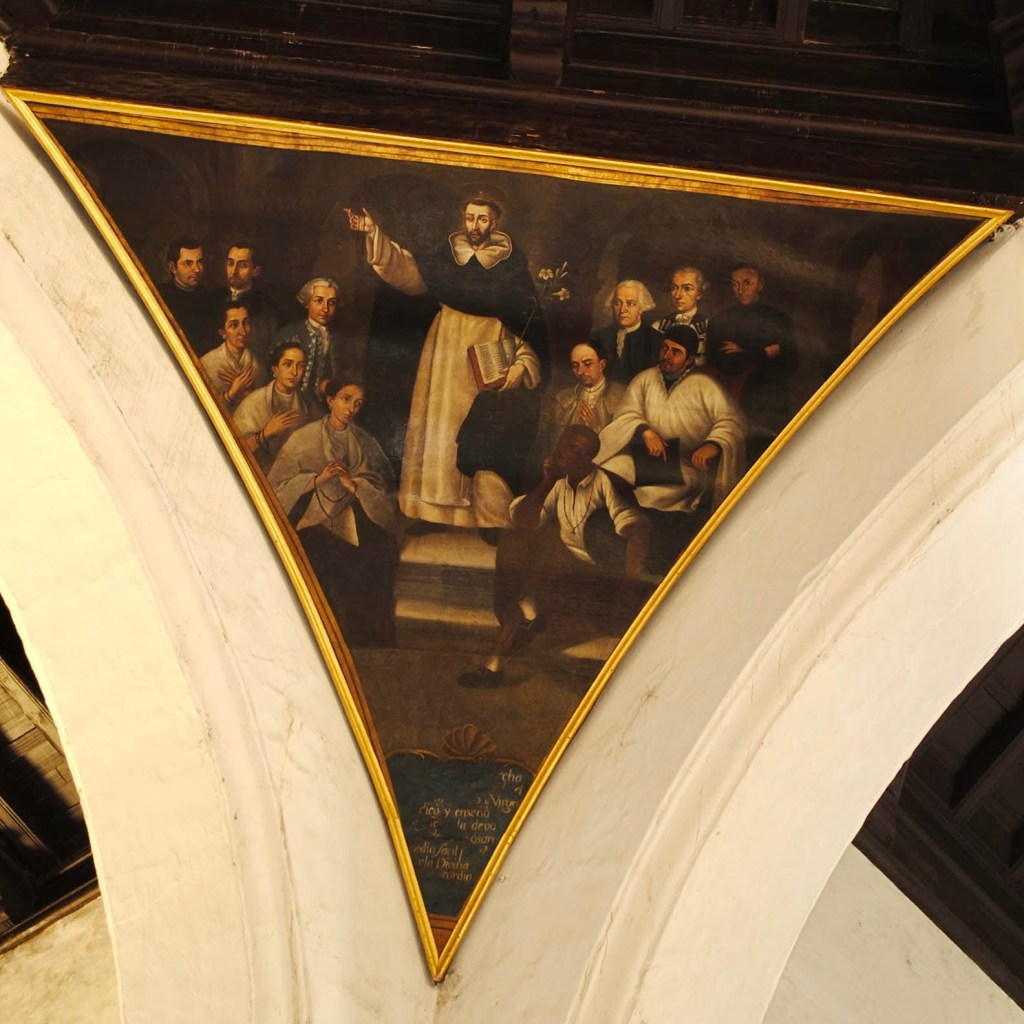
In the Church Santa María del Rosario of Havana there is a pendentive cycle completed in the 1770s painted by the baroque artist José Nicolás de Escalera – whom according to Guy Pérez Cisneros, was truly the first professional Cuban painter of the tradition – that includes a black slave in a pensive pose seating on a lower step, just below a Dominican priest who figures prominently in the middle of the picture holding a Bible and raising his right arm forward [1]. It has been noted that the figure of the black slave is also the first portrait of a slave in the New World, and its meaning has been highly disputed. The enigmatic slave or liberto portrait shows the man in a thinking pose, with a folded long white shirt, and what seems to be a wooden rosary hanging in plain sight. It is hard to make the details of his facial expressions, but it is obvious that his gaze is neither upwards nor directed at the viewer, but rather suspended, as if were, in a moment of attention and rest (and also listening?). The context here is fundamental, since Santa María del Rosario Church was commissioned by the Count of Bayona, a wealthy member of the sacarocracia (sugar plantation owner) after a previous church was burned to the ground by a slave revolt that took place in 1727 in an act of complete defiance to Christian indoctrination. 

The event that only has come down to us in just a handful of mentions and erasures of the colonial archive is featured prominently, as we know, in Manuel Moreno Fraginals’ El Ingenio when the historian documents the spiritual schism of the eighteenth century colonial plantations of the island. According to Fraginals’ historical account, the slave insurrection in the plantation took place in the wake of a theatrical enactment proposed by the Count of Casa Bayona in an act of repentance and humility aiming to mimic a well known moment of the Christian story: one day the Count washed the feet of twelve slaves, and when he finished he made them sat with him for dinner. Later that afternoon the slaves revolted and burnt down the whole sugar mill, including the chapel, to the ground. The episode ended with a plantation mayoral officer hunting down the runaway slaves, who was ordered to place the heads of the dead slaves high in spikes for the Count and everyone to see them [2]. It is an early staging of visibility and bodily dominion that the modern epoch will take to its final conclusion. 

The portrayal of human suffering was a symptom of the impossible hegemony of christianization of body and soul that the missionary Nicolás Duque de Estrada decades later will try to deploy in his pedagogical treatise Explicación de la doctirna cristiana acomoada a la capacidad de los negros bozales (1823), which argued that obedience of slaves could be achieved by implating “guilt” and work ethic in the affective interiority, in the forum internum of their souls. But even Estrada was of the fact that after sixteen hour workdays the Christian ascesis was imperceptible and little more than convoluted chatter to the ears of the slave. It is almost as if the slave, separated from the politico-theological inscription of salvation, was already outside the subjective domination of productive bondage and political freedom.

When Escalera was commissioned to do the cycle of frescos at Santa María del Rosario he was asked to combine a twofold narrative: the history of Christian salvation and the story of the Casa Bayona. At the center of the altar piece is the world as a common house or oikos, that carries history and its bodily sovereignty forward. One possible reading of the pensive slave shown in Santa María del Rosario’s pendentive is to assume that this figure is completely outside the eschatological vision embodying a sense of freedom that only painting could have documented in its unique and mute language. This raises the question about the relation between painting and freedom in which the figural emerges unmistakably fixed beyond historical narration. Although writing about Cézanne’s late work, Kurt Badt once suggested that there is no such a thing as the representation of freedom, but rather “painting generates a concept of freedom as two-faced: negatively, it is liberation from isolation and resistance, positively to the serious gentleness of freedom….expression in freedom to the scene from nature, which declares the world to be existing together, a mutual self-supporting and carrying of things” [3]. The pensive slave portrayed in the pendentive does not embody freedom understood as the spiritual accumulation of rights and duties known to the order of historical transformation; rather is an absolute pictorial appearance of freedom because it embodies, in its non-separation of life and thought, a static moment of a being that contemplates the liberty of his potency.

What is striking about the collective portrait where Escalera inserted the former slave is what we can call, following Bernard Berenson, a dimension of the ineloquent that appears just as “mute, with no urgent communication to make, and no thought of rousing us with look and gesture. If they express anything it is the character, essence rather than momentary feeling or purpose. They manifest potentiality rather than activity. It is enough that they exist in themselves” [4]. In the pensive gesture of his pose, the slave is the untouched existence and the revolt that rips the escathological narrative that ordains the interiors of Santa María del Rosario. Malraux once noted that the age of the divine disdained the realistic portrait of an ordinary person, because he was too distant and mundane from the stone conclave of the gaze of the gods. The slave’s inexpressive ‘naturalness’ refrains from partaking into a mood compensated by the semantic compulsion of the colonial painter, because his naturalness discloses the indestructible soul that has transfigured the realm of the divine. 

The unfathomable mystery of the pensive slave or liberto is the obscure and yet luminous portrait of a life in thought that is, at the same time, the thought of a life that is forever inexpressive, and as such the highest state of imperturbable freedom in the aftermath of worldly destruction. The ‘gentleness of freedom’ that Badt locates at the heart of painting is the imperative of the stream that carries, and yet restrains, thought and appearance into the figure of life. The freedom that anchors painting – because such freedom is never realized in painting except as vulgarity – becomes a tacit secret for which ultimately there is no image.  

Notes 

1.Guy Pérez Cisneros. Características de la evolución de la pintura en Cuba (Ministerio de Educación, 1959).

2. Manuel Moreno Fraginals. El Ingenio (Crítica, 2001), 99.

3. Kurt Badt. The Art of Cézanne (Faber & Faber, 1965), 314.

4. Bernard Berenson. Piero Della Francesca: The Ineloquent in Art (Chapman & Hall 1954), 7.

Unelevated politics. by Gerardo Muñoz

In a fragment from 1919 entitled “World and Time”, written around the time of the elaboration of the essay on the question of violence, Walter Benjamin offers his most succinct definition of politics: “My definition of politics: the fulfillment of unelevated [ungesteigerten] humanness” [1]. The ontological reduction is compact, and the three terms in it are carefully chosen: fulfillment, unelevation, and humanness, which indicates a ‘preparation for a profane politics’ at the threshold of secularization and its negation in a new “spiritual ornamentation”, as he would claim in the notes of “Capitalism and Religion”. The stress on the refusal of “elevation” (gesteigerten), however, does bring to bear that Benjamin’s refusal of a political ontology constrained in subjective and objective representation, which is why in the same fragment he connects the abutting of politics to a “living-corporality” [Leiblichkeit] of the human species. To retract from the cycle of civilizational violence, politics had to be reformed from the groundlessness of the energy of the living.

Hence, for Benjamin there is a metapolitical condition or archipolitics that plays out in refusing “elevated humanity”, which for him was at the source of the romantic response to the impasse of the critical enlightenment, placing the subject of knowledge and its self-reflective faculty at the center of the developing self-rationalization of the spiritual transcendence of the world in this new critical religion: “…the ideal of humanity by rising up to…that very law which, joined to earlier laws, assures an approximation to the eternal ideal of humanity” [2]. Hence, neither trascendental representation nor spiritualized immanence of order could, but unelevation of the “human possibilities” (Menschhaftigkeit). But such possibilities could only be disclosed beyond the pretensions of spiritual elevations of a unified consciousness, as Erich Unger had proposed in his Politics and Metaphysics (1921) around the same time to enact a “politics of exodus” for a common psychosocial regeneration. 

Benjamin’s proximity and distance from Unger’s position could perhaps inform why instead of writing a promised book that was going to be entitled True Politics (Die Wahre Politik) – allegedly containing two chapters “The destitution of power” and “Teleology without ultimate goal” – evolved into the landmark essay “Towards the critique of violence”, in which the frame of domination and the ontology of politics was recasted as a mediation about the folding of secularized annihilating violence, substance intrinsic to the philosophy of history and indestructible life of the soul (“annihilating only in a relative sense…never absolute with regard to the soul of the living”) [3]. Thus, one could say that accounting for the groundwork of “politics” meant accepting the constitutive verticality cosigned to modern philosophy of history, and its bipolar schematism between moral principles and sacrificial production. If Peter Fenves’ assumption is correct, Benjamin was not only inscribing a distance from Unger, but, more importantly, from Kant’s Toward Eternal Peace who defined his “true politics” as dependent on moral determination: “The true politics can therefore not take a step without having already paid homage to morality, and although politics by itself is a difficult art, its union with morality is no art all, for as soon as the two struggle against each other, morality into two cuts the knot that politics cannot dissolve – The right of human beings must be held sacred [heilig], however great a sacrifice this may yet the dominant power” [4].

The Kantian liquidation of politics to morality is hyperbolic to the modern epoch and its crisis – the crisis and enmity against the concept of the political, Carl Schmitt would claim in Political Theology (1922) – rendering modern politics and legitimacy hollow; something that Benjamin had understood well he saw to retract from the question of “politics” to that of a critico-metaphysical exploration waged on morality “as nothing other than the refraction of action in knowability, something from the region of knowledge…Morality is not ethos” [5]. Elevation could only have meant the production of a subject of knowledge and the specific (technical) arrangement of knowledges for subjection. On the contrary, the ethos was the necessary condition no longer for any “coming politics”, but rather for the disclosure of “the coming world” [die kommende Welt] itself. This means that working through the redemption of the world solicits a reversal from morality to ethics only to later transform the conditions of politics.

Let us return to the definition of politics as “unelevated [ungesteigerten] humanness”. What defines “unelevation”? From the ethical point of view it conjoins with the notion of “inclination” [Neigung] that Benjamin favors because of its unconditional valance that disarms the cycle of violence of the human community and its willful hostilities. The inclination rejects the paradigm of force because it an erotic mediation, that is, an affection of donation and love beyond exchange [6]. But inclination is only possible through language, as Benjamin had expressed in his “concept of politics” in a letter to Martin Buber from 1916: “I understand the concept of politics in its broadest sense…in this sense, therefore, language is only one means of more or less suggestively laying the groundwork for the motives that determine the person’s actions in his heart of hearts. Only the intensive aiming of words into the core of intrinsic silence is truly effective action” [7].  

Thus, the suspended elevation of the subject and higher order meant that its persuasive purity allows the inception of the “divine” as a «teleology without a goal» validated by the suspension of judgement of appearance. The intensification of the unelevation opens life to an ethical demand of a “living corporality” that roams the world’s crust beyond depredation where the force of autonomy of social practices does not risks the world of life forms and the soul. Indeed, at this point Benjamin does join Unger’s cardinal thesis: “Overcoming capitalism through wandering”. Or as he wrote even earlier about Hölderlin’s poetics: “[In the world of Hölderlin], the living are always stretching of space, the plane spread out within which destiny extends itself…it already comprehends the fulfillment of destiny” [8]. A politics oriented pending dowards to “unelevation”, inhabits the ground level of co-existence and cultivation dismissing the ontological derivatives or principles (archein) of ‘politics’ in order to conquer every possible destiny in the lawless fulfillment of the world.

Notes 

1. Walter Benjamin. “World and Time”, in Walter Benjamin: Toward the Critique of Violence: A Critical Edition (Stanford University Press, 2021), 74. 

2. Walter Benjamin. “The Concept of Criticism in German Romanticism”, in  Selected Writings, Volume 1, 1913-1926 (Harvard University Press, 1996), 138. 

3. Walter Benjamin. “Toward the Critique of Violence”, in Walter Benjamin: Toward the Critique of Violence: A Critical Edition (Stanford University Press, 2021), 58. 

4. Peter Fenves. “Introduction”, in Walter Benjamin: Toward the Critique of Violence: A Critical Edition (Stanford University Press, 2021), 18-19. 

5. Walter Benjamin. “Ethics, Applied to History”, in Walter Benjamin: Toward the Critique of Violence: A Critical Edition (Stanford University Press, 2021), 74. 

6. Walter Benjamin. “On Kantian Ethics”, in Walter Benjamin: Toward the Critique of Violence: A Critical Edition (Stanford University Press, 2021), 71. 

7. Walter Benjamin. “Letter to Martin Buber” (1916), in The Correspondence of Walter Benjamin (University of Chicago Press, 1994),  79-80.

8. Walter Benjamin. “Two Poems by Fredrich Hölderlin”, in Selected Writings, Volume 1, 1913-1926 (Harvard University Press, 1996), 26. 

The instrument stripped bare. On Adan Kovacsics’ Guerra y lenguaje (2025). by Gerardo Muñoz

Endless war and infinite strife is always preceded by the erosion and the putrid decomposition of language. Such is the thesis of Adan Kovacsics’ idiosyncratic and historically situated Guerra y lenguaje (Acantilado, 2025), which sets a specific date for the moment of such linguistic rot into consciousness in European modernity: Hugo von Hofmannsthal’s “Lord Chandos Letter” of 1902 in which civilizational decline signaled the total detachment of expression, making language flourish in the form of opinions resembling rotten mushrooms. For Hofmannsthal this event was neither accidental nor a temporary malady, but a tonality of existence that soon enough broadened like a “spreading rust” (Kovacsics 11). Just a few years later in his posthumous Persuasion and Rhetoric, Michelstaedter will describe this rusting of language as the triumph of “darkening ornaments” (kallopismata orphnes) of the epoch, liberating the destiny of language as a mere transactional exchange between “technical terms” mastered by everyone regardless of their idioms (it surprises the reader that the thinker of Gorizia is absent from Kovacsics’ Austro-Hungarian constellation on the crisis of language). 

The decline of an empire shimmering with languages and dialects across its territory began to suffer the malady of miscommunication that resulted in making language uninhabitable, throbbing in its empty chatter. Thus, the attempt to initiate an exodus from language began to appear everywhere according to Kovacsics: Fritz Mauthner drafts an encyclopedic treatise on the venereal misapprehension of language, Gustav Landauver battles in the trenches of linguistic scepticism and the mystical tradition in the name of revolution, while others like Hugo Ball attempts to flee from language altogether through the liberation of sounds and words, from the Dada avant-garde to his later Byzantine Christian asceticism. For his part, Karl Kraus in The last days of Mankind prefers to expose the surface of language as it becomes a regime regulated by opinion for bureaucratic administration over facts of reality. The nihilism that colors politics at the turn of the century is accompanied by the instrumentalization of language as the primordial technical apparatus that allows the flows of information through the acceleration of the autonomization of the linguistic mediation; as consequence, language began to arouse constant disbelief and doubt over the very essence of the sayable (Kovacsics 31). This throws light on contemporary debates about “misinformation” that, precisely because they are caught up on the epistemological determination proper to the linguistic crisis, it comes short to putting into perspective the range and depth of language over the problem of appearance now deprived of the expressive mediation between the speaking animal and phenomena, reducing experience to rhetorical commonalities or inter-social allocation of commands. 

Kovacsics’s Guerra y Lenguaje (2025) brings to bear – without totally exhausting the crushing weight of its archive and set of problems for thought – the immense significance of the first decade of the twentieth century at outset of the waning of the Austrian-Hungarian Empire, which has always been understood historically as the condition for the last configuration of European nationalism and its war-economies, but rarely in light of its functionalization of language. If read against the backdrop of Simone Weil’s “Are we heading for the proletarian revolution?” (1933) intervention about the “functional” dimension of the state form in the first decades of the twentieth century, Kovacsic’s essay ultimately helps us to define the concrete nature of functionality as the index of mobilization of ‘worlding’ through the commanding force of language. To deliver this point home, Kovacsics tells how language itself severed enunciation from action:

“La transformación que se produjo y que la ha alejado, como si un tablón se hubiese desprendido del muelle y se hubiera adentrado en el mar, no se debe a que otras gentes se impusieron en su día en Grecia, sino a un cambio radical en el uso concreto de la palabra. Es en la Gran Guerra cuando esa corriente inicial de la utilización del lenguaje como herramienta se consolida de manera definitiva. Es entonces cuando la palabra pasa a ser plenamente funcional y su papel se reduce a aportar argumentos para la acción o incluso a “parirla” mediante el tópico. Hemos visto hasta qué punto el silencio de Karl Kraus al comienzo de la contienda se debía a la percepción de este vínculo entre palabra y acción, al que no quería ni podía sumarse de ningún modo” (Kovacsics 76-77). 

Language does not disappear as much as it transforms itself into two vectors of social enforcement towards communication: functionality and rhetorical enthymemes. In this way, language is able to colonize reality and stabilize for the concrete order, or what Walter Benjamin called during those years the “bourgeois conception of language” hindering on causality and objectivity accelerating the collapse of its vocation to naming the exteriority of the world (Kovacsics 81). The totalization of this new rhetorical social structure becomes the main stage for the production of justification and competing regimes of fiction. But this implies no general theory or systematization of a linguistic science, but rather how language coincides with life in the form of an ethics. This is at the heart of the different attempts to retract language in the eclipse of empire and the new interstate fragmentation – which also entails grammatical and functional unifigies of national language – as a problem that concerns the limits of ethics. Ethics here cannot coincide with the general condition of ‘knowability’ that makes morality possible; rather, the problem of ethics can only reveal in turn the senseless of wanting to go beyond the facts of the world and allows us to dwell in one without completion.  The withdrawal from the language of propaganda and objectivity demanded an ethics of the sayable beyond the commodification and intentionality of words promoted by “war” and “ware” (commodity) that the West had continued to endure; a total communication of ends that decades later evolved into cybernetics as the warping of world into informational encoded relation.

Kovacsics reminds us that there is a story here of extreme violence and creative destruction, only comparable to nuclear fusion and the flaying of a human being, only that this time, unlike the myth of Marsyas, without ever reaching transcendence of redemption through the proximity of language to myth (Kovacsics 129). Underneath there is the body of language, stripped of its capacity for truth and reduced to functions of survival and needs oriented towards the homogeneity of the future. Towards the end of Guerra y lenguaje (2025), and glossing Hobbes’ notion of political authority that legitimated the modern interstate system to neutralize truth contents and the stasis over words, one cannot help but think that the date 1902 as a. arcana was an effective culmination rather than genesis of the modern, which means that the foul scent of the twentieth century was destined for decomposition since it had already stripped bared one of the most beautiful lacunae of the human species: being in language and the event of appearance became integrated into the worldly utopia of the machine.

As captured in Marcel Duchamp’s “The Bride Stripped Bare”, the obsolescence of language over time evolved into a candid instrument of social functions of proportional exchange, coordinated fortuitous relations, and increasing moral indictment that purported parodies of contested realities. Thus, the sickness is always unto language – a basic assumption that reveals the need for infrapolitical analysis before there is any political practice and categorial reinvention. The overexposure of language as an avatar of metaphoric communication for ends and needs of humankind brought itself bare and all encompassing in its appropriative force, but only at the expense of darkening and losing the world forever. 

Carlo Michelstaedter: Pain and the Social. A seminar with Revista Disenso. by Gerardo Muñoz

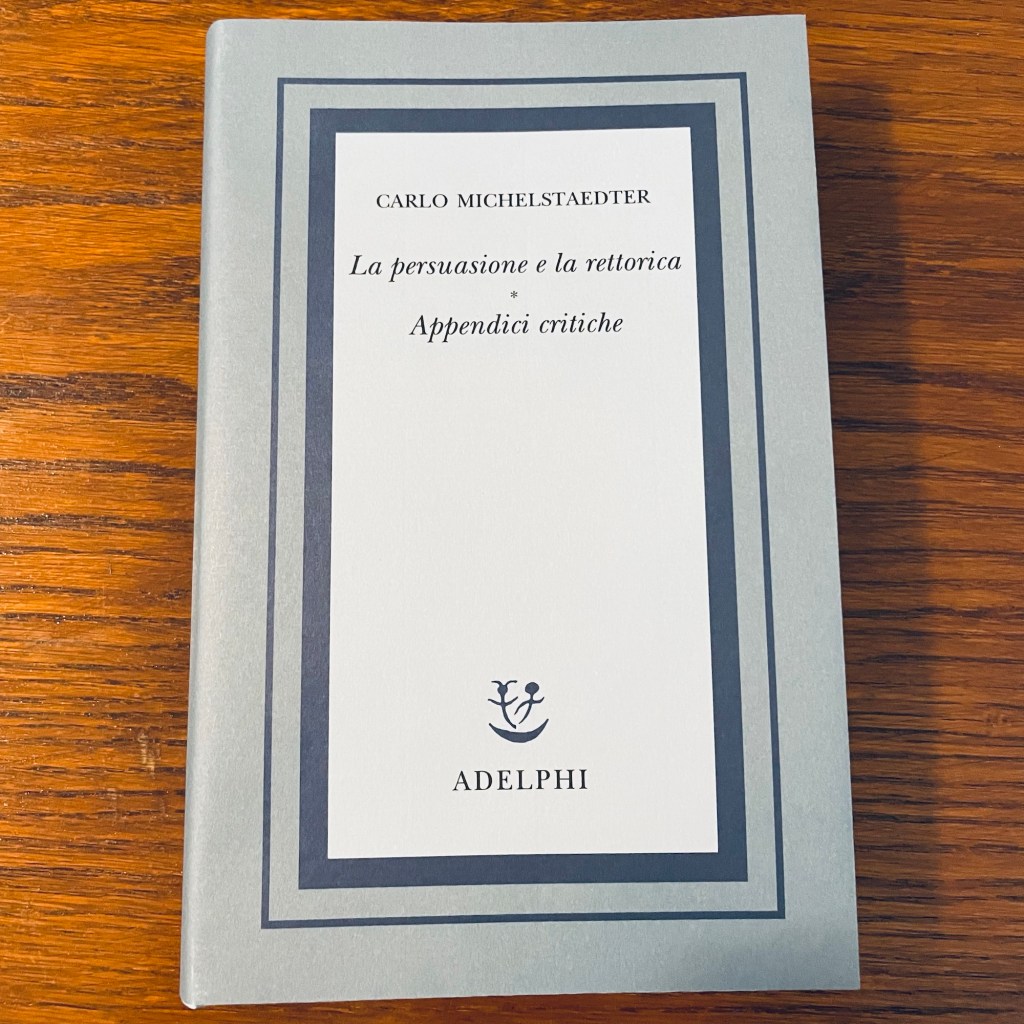
In the following months some of us will offer an eight week seminar exclusively dedicated to a close and analytical reading of the enigmatic work La persuasione e la rettorica (1910) by Italian thinker Carlo Michelsteadter (1887-1910). Ever since his death – as can be easily gasped by Giovanni Papini’s obituary in 1917 – there has been an aura of mystery around the infamous philosophical suicide of Michelsteadter that only parallels that of Socrates’ hemlock or Otto Weiniger’s self-inflected gunshot. Of course, we will be less interested in the biographical motives, and if push comes to shove attention to this detail will be elaborated in light of the nexus of his thought to the event of his death.  

La persuasione e la rettorica (1910) offers a unique theoretical elaboration about the civilizational decline of the “living” into the rhetorical deferment of life as realized in the organization of social alienation. And for Michaelsteadter there is no other purpose of rhetorical form than the absolute submission to the general abstraction that defaces the event of pain. It is no accident that he was also interested in the thematics of health and ancient techniques of pain-relief (the techné alupias, for instance), even if underdeveloped in his thinking given his sudden premature death. So, it is for us, his posthumous readers, to take these sets of issues and move them forward in our present any way we can. This is part of the task that motivates putting together this seminar after a series of conversations with friends and interlocutors.

La persuasione e la rettorica (1910) deploys the classical metaphysical tradition through the ancient poles of “rhetoric” and “persuasion”, where the second (the ancient Peithò) seeks to return the voice and expression to the problem of pain as an ineffable type of speech (Logos) that refuses the elevation of force that harbors the circulation of violence and the administration of social death. The ancient notion of the Peithò withdraws echoes of the mythical inception and the sacred, as also reminded by Aristophanes: “Persuasion’s only shrine is eloquent speech (Logos)…And I Persuasion (Peitho), the most lovely word” (The Frogs, 1391-1395). Where and how do we attune ourselves to the peitho today – the imperative of the eros of the word in the wake of the regime of social production of pain? 

In the aftermath of the collapse of the cycle of civilizational secularization, it is only obvious that all these questions stratified in the tradition once again become attractive and pertinent. In this light, we think that Michelstaedter’s thought still offers us a series of  significant hypotheses to think through the crisis of social man and the domination of the civil that colors our current predicament, where the question of “pain” is still an understudied problem. Throughout this course we will address notions such as rhetoric and persuasion, life and communication, nihilism and values, the logic of capital and the social bond, or the notion of world and pain. Our aspiration when approaching Carlo Michelsteadter’s work is to develop reflective conditions to address the thorny issue of an ethics of pain that so thickly enmeshed in our historical moment.

.

.

‡: Information about the registration to the seminar will be made available at Revista Disenso in upcoming days. The seminar will run every other week for a period of eight sessions (roughly from the beginning of September to early December, 2024).

A memory of Jean Franco (1924-2022). by Gerardo Muñoz

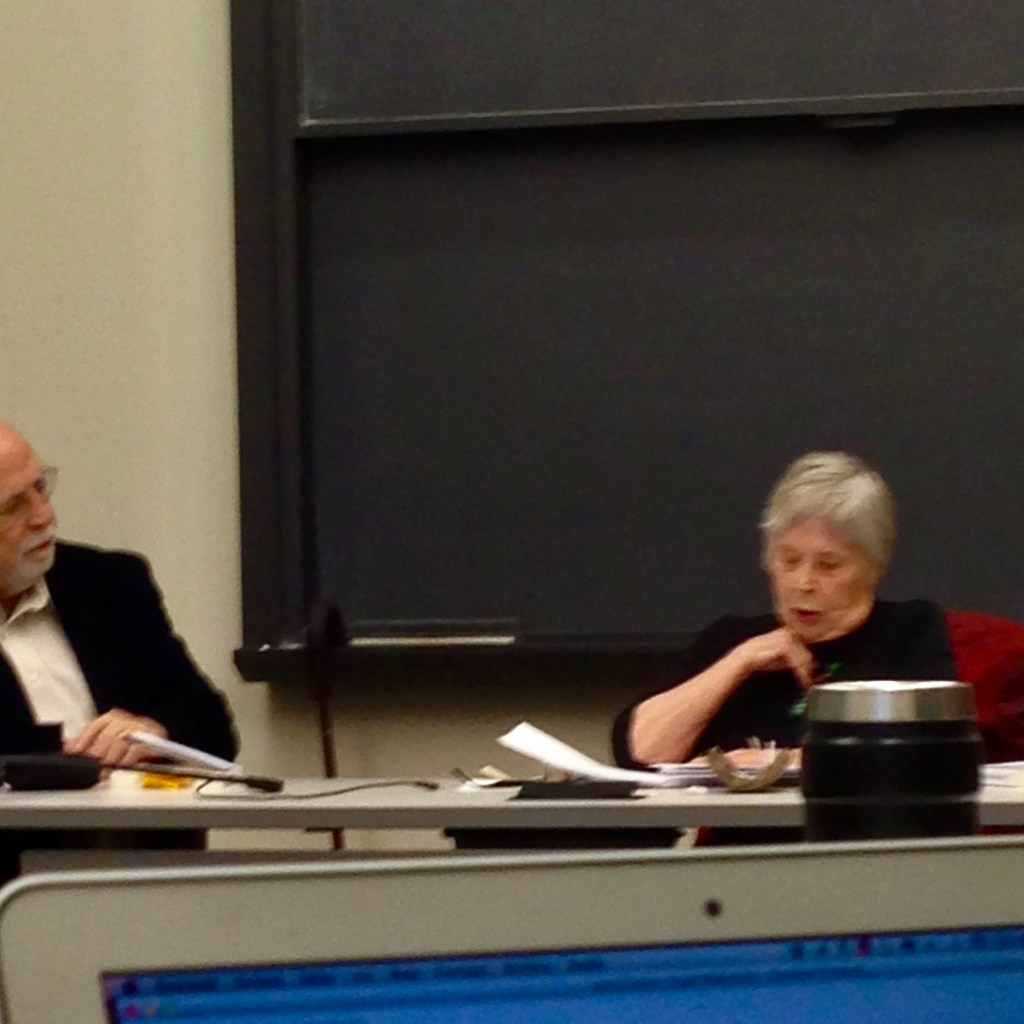
Jean Franco, pioneer of Latin American Cultural Studies and witness to its Cold War gigantomachy, passed away a couple of weeks in December at age 98. She remained lively and curious even at the very end of her scholarly life, and for some of us that saw her in action she embodied the memory of the century. The photograph above is of Jean’s visit to Arcadio Díaz Quiñones graduate seminar in the fall of 2015 where she discussed some of the main arguments of her last book Cruel Modernity (Duke U Press, 2014), a cartography showing the definite closure of the Latin American insomnia for political modernity in light of its most oblique mutations: narcoviolence, the emergence of a dualist state structure, and new global economic forces that putted an end to the vigil of the revolutionary enterprise. I write “definite” purposely, since Jean’s own The Decline and Fall of the Lettered City (Harvard U Press, 2002) already hinted at a certain exhaustion (to borrow the strategic term of Alberto Moreiras also writing during these years), most definitely a thorough disillusion, in the sense deployed by Claudio Magris, of cultural substitution for the belated state-making modernization. The function of “culture” (and its hegemonic state apparatus) was always insufficient, dragging behind, or simply put, unintentionally laboring for the cunning of a project forever postponed in the sweatshop of the newest ideologue, or for the hidden interests of the “local” marketplace of moral academicism. All of this has come crashing down rather quickly even if the demand for culturalist janitorial or housekeeping services are still in demand to sustain the illusion sans reve et sans merci.

What always impressed me about Franco’s scholarship was her intellectual honesty to record, even if through an adjacent detours and academic finesse, the destitution of all the main categories of the Latin American modern wardrobe: developmentalism, state-civil society relations, the intellectual, cultural hegemony, revolutionary violence, the “rights revolution”, and the intra-national spatiality (rural/metropolitan divide). From now on it is hard to say that there is a “task of the critic”, if we are to understand the critic in the Kantian aspiration of sponsoring modern values and perceptiveness to an enthusiastic disposition (definitely optimistic towards action) to transforming the present. As a witness to the twilight of the Latin American modern epoch, Franco univocally resisted the inflationary, value-driven, demand for politicity and ‘more politics’. This is why her attitude remained at the threshold of any given effective political panaceas or half-baked illusions.

Does her biographical experience say anything to this particular inclination? It is difficult to say, although as a witness of the century Jean had lived through the coup in Guatemala in 1954, visited the Cuban Revolution during its most “intense years” of the sugar cane milestone (La Zafra de los Diez Millones), and followed with attentiveness the rise and transformation of the Southern Cone dictatorships in the 1980s coupled with the irreversible social transformation of neoliberalism in the 1990s signaling the effective end to regional integration in the face of planetary unity. All of this to say that I find it hard – at least leaving aside the many nuances – to see in Jean’s scholarly witness an enthusiasm for the Latin American Pink Tide, the communal state, or abstract regional historicizing that could finally bring about the moral universe of the national-popular state (as if said moral realization would be anything worthwhile, which we some of us seriously doubt). If Jon Beasley-Murray once said that John Beverley was the “Latin American unconscious”, I guess it is fair to claim that Jean Franco was an authentic Latin americanist realist; that is, someone that was up to task to see in the face of the tragic, the cruel, and the heinous as the proper elements of the interregnum. Or to better qualify this: she was a worldly realist, leaving aside utopias and its abstractions. At the end end of the day, Leninists are also realists, or at least claim to be so. What places Jean’s earthly realism apart from the Leninist realism is the subtraction from the seduction of Idealization, which even in the name of the “idea” (“the idea of communism”, say) or “immanent higher causes” must bear and render effective the logic of sacrifice at whatever cost, even the real sense of freedom if demanded by the party, the leader, or the community. This is why at the closure of Latin American modernizing enterprise communitarian arrangements, posthistorical subjects / identities, or grand-spaces that mimic the constitution of Earth are foul dishes for a final banquet. It is always convenient to refuse them.


Going back to my conversations with Franco at Princeton, and some exchanges a few months later in a cafe near Columbia University, for her there was remaining only the anomic geography of Santa Teresa in Bolaño’s 2666, a novel that charts the current ongoing planetary civil war in the wake of the crisis of modern principles of political authority. I can recall one remark from Jean during these exchanges: “¿Y quién pudiera mirar hacia otra parte?” This is the general contour of her witnessing: how not to look somewhere else? In other words, how not to look here and now, into the abyss that is no longer regional or national, Latin American or cultural specific, but rather proper to our own civilization? A civilization is, after all, nothing but the organization of a civis, which has now abdicated to both the metropolitan dominium, as well as the campo santo of sacrificed life at the hand of techno-administrative operators (the new praetorian guard) of a well lighted and fully integrated Earth.

There is no alternative modernity, decolonial state, or hegemonic culture that will not serve to the compensatory and sadistic interests of the cruel policing of death and value, as the only masters in town. We are in Santa Teresa as a species of energy extraction. Can reflection be courageous enough to look through and against them? This is the lasting and eternal question that Franco left for those who are willing to see. It does not take much, although it amounts to everything: mirar / to gaze – in an opening where human form is lacking and categories are wretched – is the the most contemplative of all human actions. Whatever we make of it, this practice now becomes the daring task of the coming scholar.

Revolutionary becoming and infrapolitical distance: on Marcello Tarì’s There is no unhappy revolution: the communism of destitution (2021) by Gerardo Muñoz

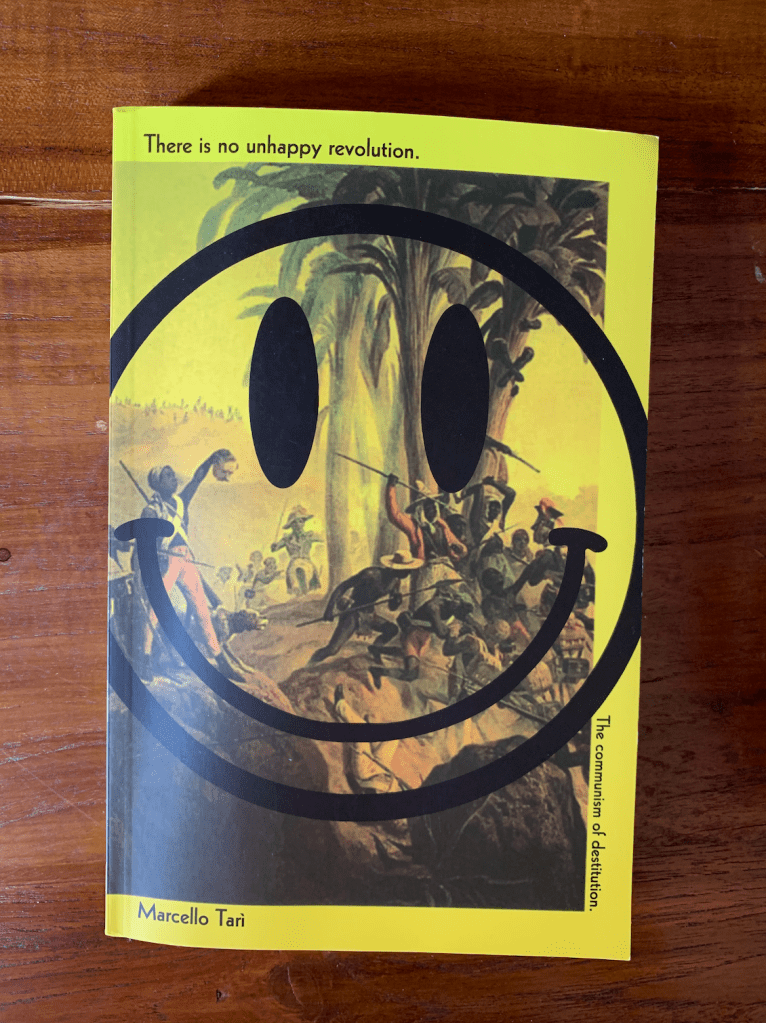
Marcello Tarì’s book There is no unhappy revolution: the communism of destitution (Common Notions, 2021), finally translated into English, is an important contribution in the ongoing discussions about politics and existence. It is also an exercise that pushes against the limits of contemporary political thought in the wake of the ruin of the grammars and vocabularies of the modern politics and the rise of the techno-biopolitics of governmentality. More importantly, the operation of Tarì’s book escapes the frame of “critique”, abandoning any false exits to regain the legacy of the Enlightenment and of “judgement” in hopes to reinstate the principles of thought and action in the genesis of the legitimation of the modern social contract. But the radicality of the horizon of destitution – which we have come to understand vis-à-vis the work of Giorgio Agamben, and the Invisible Committee – is first and foremost a thematization of the proximity between thinking and politics against the historical stagnation of a historical subsumed by the total technification of value (the principle of general equivalence). Since Tarì’s book is composed of a series of very heterogenous folds and intersections (literally a toolbox in the best sense of the term), in what follows I would like to sketch out a minor cartography to push the conditions forward that the book so elegantly proposes in three registers: the question of “revolutionary becoming” (the kernel of Tarì’s destituent gesture), the hermeneutics of contemporary domination, and the limits of political militancy.

Revolutionary becoming. Marcello Tarì correctly identifies the problem the epoch as fundamentally being about the problem of revolution. However, the notion of revolution must be understood outside the continuation of the modern horizon of the Leninist technique of the revolutionary vanguard nor party, the “revolution within the revolution”, and any appropriation of the “General Intellectual”. At the end of the day, these were all forms of scaling the desire as cathexis for the matrix of production. On the contrary, the problem of revolution is now understood in the true Copernican sense; mainly, how to inscribe an excentric apositionality within any field of totalization. When this is done, we no longer participate in History, but rather we are “freeing a line that will ultimately go down in History, but never coming from it”. Tarì argues that the field of confrontation today is no longer between different principles of organizing revolutionary strategies and even less about ideological critique; nor is communism an “Idea” (as it was thought just a decade ago in discussion that were philological rather than about thinking communism and life); the new epochal exigency is how to put “an end to the poverty of existence” (3). The potentiality of this transformation at the level of factical life, is what Tarì situates under the invariant of “communism”: “…not as an idea of the world, but the unraveling of a praxis within the world” (35). This communism requires a breakthrough in both temporal and spatial determinations, which prepares a dwelling in absolute relation with the outside (49). This revolutionary tonality is one closer to messianic interruption of historical time capable of destituting “actual state of things” governed the metaphysical apparatus of production and objetivation of the world, which depends on the production of the political subject. In an important moment of the book, Tarì writes: “…. only the revolutionary proletarian dimension can grasp the political as such, the true break from the current state of things. The real alternative to modern politics is thus not to be ground in what we usual can an “anti-politics”, which is merely a variation of the same there, but instead in a revolutionary becoming” (50).

The revolutionary becoming is a transformative intensity of singularization, which ceases to become a subject in virtue of becoming a “non-subject” of the political (67), which about a decade ago Alberto Moreiras announced to escape the dead end of the hegemony-subalternity controversy (one should note here that the fact that the Left today has fully subscribed the horizon of hegemony is something that I think it explains many of the deficits of the different experiments in a realization of a progressive political strategy). And this becoming revolutionary, in virtue of ceasing to be a subject (person, vanguard, multitude, worker) entails a new shift from action to use, and from technico-rationality to an opening of the sensible and singular means (metaxy). Again, Tarì’s continues as follows: “Becoming revolutionary…. means utilizing fantasy, freeing the imagination, and living all of this with the enthusiasm of a child” (75). The notion of “happiness” at stake in the book it is played out against the determination of the subject and the processes of incarnations (Karmy) that have haunted the modern revolutionary paradigm as always-already integrated into the metaphysics of the philosophy of history. 

 Metropolitan domination. Secondly, Tarì’s book locates the metastasis of domination at the level of a new spatial organization of the world in the apparatus of the metropolis. As we know the metropolis is not just an urban transformation of the Western form of the urbs and the polis, but rather the force of appropriation of the world into interconnectivity and surface in order to optimize, administer, and reproduce flows of the total fictionalization of life. The gesture towards the outside that crosses over Tarì’s book entails an exodus from the metropolitan structure that makes uninhabitable experience. This takes place by a process of domesticating its possibilities into the order of sameness (crisis of appearance) and translating our proximity with things into the regime of objects. What is stake in the metropolis – if we think of the most recent revolts in Santiago de Chile, Paris with the to the hinterlands of United States and Italy – if not precisely a response against the metropolitan machination “aiming at the destruction of every possibility of having any experience of the world and existence itself” (84). This why the intensity of any contemporary revolt today is proportional to the experiential texture of its composition and modes of evasion. Of course, Tarì correctly identifies the metropolis as an expanded field of cybernetic inter-connectivity, which, as I would argue is not merely the production of “bad substance” (to use Tiqqun’s Bloomian lexicon), but also a recursive dominion over the medium (metaxy) in which experience and the singular autopoiesis labors for the optimization and hylomorphic regimes that administer civil war. In this sense, destitution names an exodus from the metropolitan technical order and the sensible reproduction of the medium. It is in the outside the metropolis that the ongoing process of communization can free an infinite process of communization and forms of life.

Residual militancy and infrapolitics. But does not the exodus or the destitution of the metropolis – opening to singular experience, love, friendship, and the use of one’s disposable means and inclination – presuppose also a step back from a political determination, in other words, a fundamental separation from coterminous between existence and politics? At the end of the book, Tarì claims that “whenever anything reaches a certain level of intensity it becomes political” (117). But is the intensification of thinking or love or friendship always necessarily political? Tarì writes a few pages later that: “love is continually traversed by a line of extreme intensify, which makes it an exquisitely political affect” (126). But does not the politization of love depends on a certain commitment (a “faith”) to a residual militancy, even if it is a militancy posited as the principle of anarchy? But perhaps this is the difficulty at stake: since anarchy is only entails the “anarchy of phenomena” in reality, postulating a political principle as counter-exposition, however tenuous, might not be enough. For this reason, the crisis of appearance today needs a step back from the heliopoliticity of exposition. In an essay written a couple of years ago, Alberto Moreiras thematized this difficulty vis-à-vis Scürmann’s principle of anarchy, which I think is worth quoting: “The Schürmannian principle of anarchy could then be thought to be still the subjective reaction to the epochal dismantling of ontology (as metaphysics). But, if so, the principle of anarchy emerges, plainly, as principle, and principle of consciousness. Anarchy runs the risk of becoming yet another form of mastery, or rather: anarchy, as principle, is the last form of mastery.  At the transitional time, posited as such by the hypothesis of metaphysical closure, metaphysics still runs the show as consolation and consolidation” [1]. 

If politics remains the central condition of existence, then it follows that it depends on a second-degree militancy that can govern over the dispersion of the events and this ultimately transfers the force of steering (kubernates) to mitigate the crisis of thought and action in the sea of “absolute immanence”. But immense is also a contemporary fundamental fantasy [2]. Against all “faith” in absolute immanence we need to cut through in its letting be (poein kata phusin) of the abyssal relation between existence and politics. This originary separation is an infrapolitical step back that solicits a distance an irreducible distance between life, events, and community form. The commune would be a secondary condition of political organization, but the existential breakthrough never coincides with community, except as a “common solitude”. Secondly, the infrapolitical irreducibility between politics and existence wants to reject any compensatory temporal politico-theological substitution, which also includes the messianic as a paradigm still constitutive of the age of Christian community of salvation and the efficacy of deificatio. The existential time of attunement of appropriation with the improper escapes the doble-pole paradigm of political theology, which has been at the arcana of both philosophy of history as well as the messianic inversion. A communism of thought needs to produce a leap outside the politico-theological machine which has fueled History as narrativization and waged against happiness [3]. Attuning oneself to the encounter or the event against the closure of the principle of reality might be a way out from the “hegemonic phantasm” of the political, which sacrifices our infinite possibilities to the logistics of a central conflict. If civil war is the side of the repressed in Western politics, then in the epoch of the ruin of authority it opens an opportunity to undue the measurement (meson) proper to the “Social”, which is now broken at the fault lines as Idris Robinson has put it [4]. It is only in this way that we can move outside and beyond the originary positionality of the polis whose “essence never coincides with politics” [5]. The saving of this irreducible and invisible distance prepares a new absolute proximity between use and the world. 

.

.

Notes 

1. Alberto Moreiras. “A Negation of the Anarchy Principle, Política Comun, Vol. 2017: https://quod.lib.umich.edu/p/pc/12322227.0011.003?view=text;rgn=main

2. Lundi Matin. “Éléments de decivilisation” (3): “It is also about the creed of the dominant religion: absolute immanence. Doing itself, designed to obey the modes of proceeding from production, is in advance conforming and consecrated. On this sense, no matter what you do, you bend the spine in front of the cult dominant. If all things count, none has a price, and everything is sacrificeable.”. https://lundi.am/Elements-de-decivilisation-Partie-3

3. This is why Hegel claims in his lectures on the Philosophy of History that: “History is not the soil in which happiness grows. The periods of happiness in it are the blank pages of history”. The revolutionary overflow of happiness is only possible as an exodus from the theological political structure of historical production. Here the question of style is emerges as our defining element. 

4. Gerardo Muñoz. “The revolt eclipses whatever the world has to offer”: a conversation with Idris Robinson”, Tillfällighetsskrivande, May 2021: https://www.tillfallighet.org/tillfallighetsskrivande/the-revolt-eclipses-whatever-the-world-has-to-offernbsp-idris-robinson

5. Gerardo Muñoz. “Some Notes Regarding Hölderlin’s “Search for the Free Use of One’s Own”, January 2019: https://infrapoliticalreflections.org/2019/01/14/some-notes-regarding-holderlins-search-for-the-free-use-of-ones-own-by-gerardo-munoz/

Three ideas for a discussion on «Éléments de décivilisation» by Gerardo Muñoz.

[These are some preliminary notes for an ongoing discussion on Lundi Matin’sÉléments de décivilisation’’, a text that condenses a series of problems dealing with, although by no means, limited to infrapolitical reflection, the event, world, and the question of civilization in the wake of the ruin of hegemonic principles. This particular essay, more than content, raises the question of the status of the style of thought; and, in broad terms, I tend to link the notion of style to the constitution of an ethos. But let me offer three theses to open the discussion in very broad terms. What follows is the reconstruction of three brief points in a recent group meeting about this text.] 

i. The priority of the event. For me at least it is very important to consider that Éléments de décivilisation’’ moves away from at least two important precedents of a common intellectual orbit: messianism and the political theory of modern sovereignty. Of course, this is important for many reasons, but most it speaks to what I would call a strong opposition between thought and philosophy (favoring the first over the second). These two registers open important distinctions, such as, for instance, a displacement between historical temporality (messianism) to a notion of the taking place (the event or encounter) as exteriority. Whereas we were told that the “event is the enemy within Empire” (Gloss in Thesis 60 of Introduction à la guerre civile) , now we have a more through sketch about the way in which the form-of-life is not a category reducible to vitalism or the problem of the subject, but rather about the play between form and event. Here I think that Carlo Diano’s Forma ed evento (1952) is crucial as a backdrop that is not just philosophically (Aristotelian formalization against Stoic predication), but rather a sound position of thinking in relation to what has been passed down as “civilization”. 

ii. Civilization as a principle. Now, the question of civilization raises to a problem of thought insofar as is neither an ontological problem nor an operative idea in the history of intellectual concepts. Civilization becomes the apparatus by which the total regimen of production in any given epoch is structured to establish an order. And here order is both authority and police. To put it in juridical terms: the first secures legitimacy while the second posits the flexible energy of legality and execution. This is the same problem in the relation to the world. In other words, civilization means enclosing, domesticating, and producing. By the same token, civilization is the operative domain by which nomōs, history and the subject come together in virtue of their separation. Is not this the very issue in the Greek polis in the wake of the discovery of measurement, isonomy, and the distribution of the goods in which hegemony replaces the basileus (Vernant)? It is one of the merits of the text not having understood this problem at the level of an “archeology of Western political thought” (Agamben), but rather as an evolving transhistorical process that binds the axis of domination and power to the axis of anthropology and domestication. Civilization, then, would name the total apparatus of hegemony under which politics falls as a problem of metaphysical structure (I have tried this problem in recent positions here). Whether there is an assumed anthropological anarchy at the level of substance, capable of “inversion” (Camatte), is something that must be explored in further detail. 

iii. Happiness cuts absolute immanence. My last point. I would like to insist on something that Rodrigo Karmy mentioned recently: “Happiness is the unthought of the Weestern tradition”. I agree with Karmy not on the basis that there has not been any reflection of “happiness” in the tradition, but rather that this reflection has either been a) subordinated to politics or economics (Jeffersonian “happiness” conditioned by commerce); or, as a moral virtue of self-regulation and privation. But it seems to me that “Elements” wants to offer something else in a very novel way. It is here where the question of violence must be inscribed. A curious displacement since violence has been thought in relation to beauty, but not happiness. The violence at the level of forms puts us in proximity with the event at the end of life itself. In this sense, the Pacôme Thiellement footnote is important:

“l y a deux lumières: il y a la lumière d’avant la nuit et il y a la lumière d’après. Il y a celle qui était là au début, l’aube radieuse du jour d’avant, et puis il y a celle qui a lutté contre les ténèbres, la lumière qui naît de cette lutte : l’aube scintillante du jour d’après. Il n’y a pas seulement deux lumières, il y a aussi deux joies : il y a la joie d’avant la peine et il y a celle d’après. La joie originelle, la joie innocente, primitive, cette joie est sublime, mais c’est juste un cadeau de la vie, du ciel, du soleil… La joie qui vient après la peine, c’est le cadeau que tu te fais à toi-même : c’est la façon dont tu transformes ta peine en joie, l’innocence que tu réussis à faire renaître des jours d’amertume et des nuits de bile noire. C’est le moment où tu commences à vivre, mais vivre vraiment, parce que tu commences à renaître de toutes tes morts successives. C’est le moment où tu t’approches de la divinité ou du monde”. This position  – which I think it is prevalent throughout the text – allows the opening of a series of articulations:

a) it is no longer happiness an effect on the subject, which has only grown in the Spectacle or consumption; that is happiness as an exception to life.

b) it is not that happiness is a theological state of ‘blessed life’, which would presuppose the transmutation of sin and thus overcoming of the non-subject. This position depends on conditions of mythic-history and theology.

c) It is rather that happiness is the way in which the singular gathers his possibilities in use without enclosing the other possibles. To live a life among the fragmentation of the use of our disposed potentialities is a way to violently cut the seduction of absolute immanence in which style is diluted. Play could name the variations of use. But there is a second order risk in what constitutes “play”: a transfiguration of politic as civil war. The problem becomes how to think of ‘play’ (i. messianic abandonment, ii. political intensification – insurrection, or the separation between rhythm and voice, a poesis). I am interested in pushing for the third figure of play; a third figure in which the event and happiness impose a new division of souls, moving away from the separation from life.