The name Beatriz Viterbo. by Gerardo Muñoz

The central question that “The Aleph” raises is as banal as difficult to answer: who is Beatriz Viterbo? For one, she is dead. Borges’ Leibnizian experiment with the infinite point of the universe is that even assuming that we account for all the possible predicates of this person we still cannot exhaust who lurks behind “Beatriz Viterbo”. In a way, Beatriz remains encrypted in a house soon to be demolished, remaining unattainable and mysterious in the passing of the world. As we know, there have been critics that have taken up the detective task to understand the significance of the name Beatriz Viterbo by probing the story’s dedication to Estela Canto, who later became the rightful owner of the original manuscript, and that connects to Dante’s Divine Comedy in terms of its cantiche structure as well as the figure of Beatrice [1]. However, as Giorgio Agamben once said regarding the Italian poet, it is utterly senseless to attempt to identify a subject behind Beatrice, since what is at stake in Dante’s poetics, perhaps of all poetics, is the experiment of language as an experience of love [2]. What the name Beatriz Viterbo enacts is no different. 

Indeed, in Borges’ Beatriz Viterbo this experience of love is one that fundamentally lacks images and predicates of this world; which means that love, if to be held as an intensity of the living, in the name harbors the region between life and death, between memory and forgetting. These distinctions are not oppositional, but rather an angular index that defines erotic intensity; and, as we know, the name is the supreme vehicle of the impropriety of oneself because it precedes it. As Borges writes in “The theologians” also included in The Aleph: “There are some that look for love in a woman in order to forget her; in order to cease thinking about her” [3]. The fundamental formlessness of love does not depend on neither images nor acts, but on the enduring vocative or song (canto) that shines forth in the open secret of the name. 

This is why the portrait of the deceased is insufficient for the narrator of the story. In a moment that is the clearest parallelism to the concatenation of “things seen” in the aleph, the name appears four times in repetition: “Beaitriz, Beatriz Elena Viterbo, Beatriz querida, Beatriz perdida para siempre…” [4]. If Osip Mandelstam once remarked that the “eye is an instrument of thought”, one could say that the the voice of the name is the instance where language and thought coincide without remainder; a convergence of Heaven and Earth, of the dead and the living in the grain of the voice. There are no static images of Viterbo because her mysterious life, the unlived life with the narrator, is precisely the missing image guarded by the name. In the basement, facing upwards to peek into the aleph, we are told that he, Borges, will be able to “establish a dialogue with all the images of Beatriz” (“podrás entablar un diálogo con todas la imágenes de Beatriz”). But what the aleph cannot yield is the missing image that is only the event of his irreducible linguistic contact proper to his memory. Once again Maldelstam: “The word, the name, is a psyche…does not signify an object, but freely chooses, as though for a dwelling place, some beloved body. And around the thing the word hovers freely, like a soul around a body that has been abandoned but not forgotten” [5]. But what is not forgotten is not that quality or that image of a person, but the enduring rustling of a name that recalls the oldest human experience: the mystery of the voice.

It might also be for this reason that Beatriz Viterbo recalls not just Dante’s divine and eternal Muse, but the world of the dead; the vetus in ‘Viterbo’, that is, the oldest or ‘most ancient’ life that dwells in the underworld, because its direct provenance is the archaic Etruscan civilization [6]. If Beatrice, as the trope of transcendence beyond the Earth has been a repeated object of literary interpretation, Viterbo as the vetus burial has rarely generated any interest (if the house of Viterbo is being demolished, this also means that in her proper name is the burial site at the end of remembrance). 

In the cadence of the name “Beatriz Viterbo” we can hear the transit between the living and the dead, the invisible and the present, the possible predications as well as the defaced; a work of oblivion in virtue of its own caducity. “Me trabajó otra vez el olvido”, writes Borges towards the end evoking the erosion of forgetting in the void of nonpresence: the working of eros pushes to the end, towards absolute oblivion through the very accruing of remembrance. Life is this immemorial that is encrypted, as if were, in a handful of names. 

Notes 

1. Emir Rodríguez Monegal. Jorge Luis Borges : A Literary Biography (Paragon House, 1988), 414.

2. Giorgio Agamben. “No amanece el cantor”, in En torno a la obra de José Ángel Valente (Alianza Editorial, 1996), 49.

3. Jorge Luis Borges. “Los teólogos”, in El Aleph (Alianza Editorial, 1999), 50.

4. Jorge Luis Borges. “El Aleph”, in El Aleph (Alianza Editorial, 1999), 189. 

5. Osip Mandelstam. “The Word and Culture” (1921), Arion: A Journal of Humanities and the Classics, Vol. 2, No. 4, 1975, 531.

6. Adolfo Zavaroni. Etymological Dictionary of Etruscan Words (2024), 310.
Enamoured psyche. On Pablo Oyarzun’s Hölderlin, el recuerdo (2025). by Gerardo Muñoz

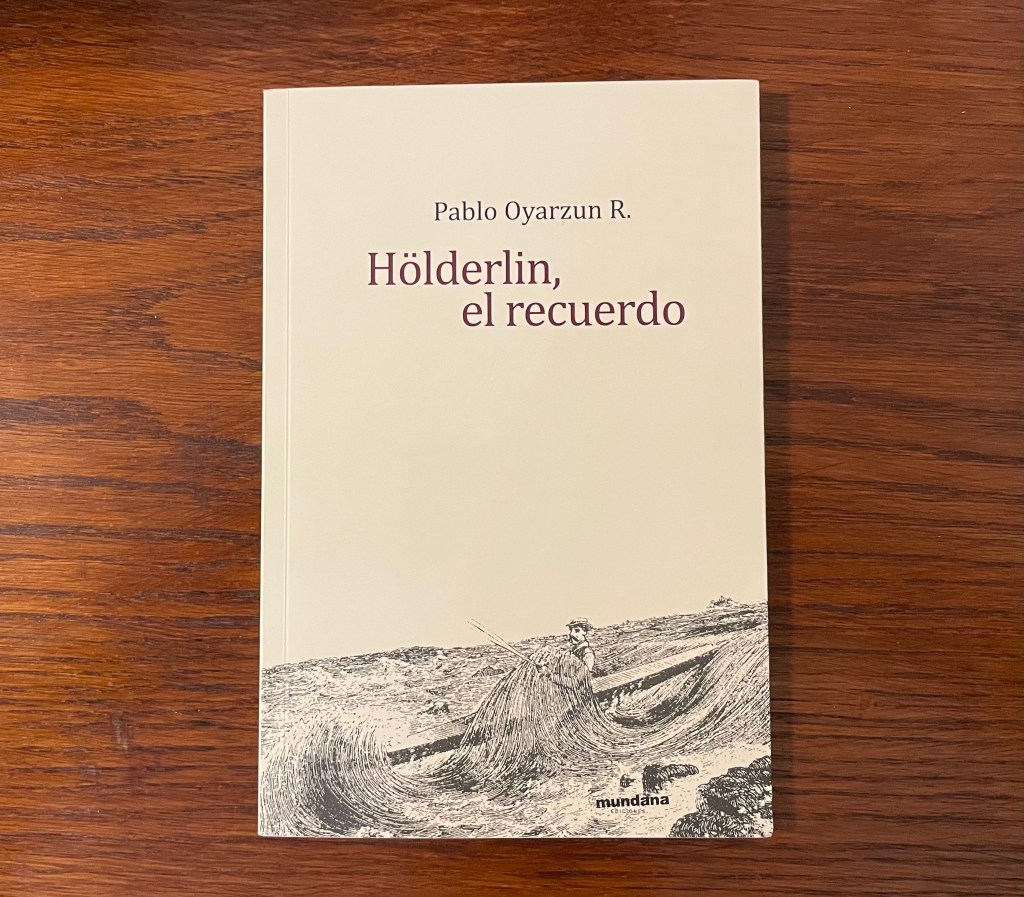
The concluding verses of Hölderlin’s “Andenken” (“Rembrance” or “Memoria”), “Yet what remains, the poets found” stands as one of the preeminent testaments of modern poetry, and in Heidegger’s famous characterization, as a declaration of the task of the poet. At least since the time of Stefan George and Max Kommerell, the figure of poet or Dichter, a hyperbolic figure of illumination and guidance caught in the net of poetry and philosophy, was already dependent on Hölderlin’s mysterious words. What remains in what the poet remembers and clears for foundation? What is the relationship between remembrance and what is ‘found’ or ‘established’? “Andenken / Remembrance” is a hymn from the late period, which means that it must be read in consistency with Höderlin’s poetological framework as it reaches its maximum degree of intensity in its declaration and deliverance. Pablo Oyarzun’s most recent Hölderlin, el recuerdo (Mudana ediciones, 2025) is a powerful and subtle contribution to the understanding of this poem that measures up to the task in its attention to lexicon and structure, metaphysical condensation, and the vortex of ‘memory’ that discloses the poem. One of the merits of Oyarzun’s philosophical hermeneutics, if we can call it that, resides in its refusal to incorporate philosophical doctrines to inform the major questions of the hymn; rather, he favors the very unfolding of the poem ramping its internal structure for possibilities (Oyarzun 18-19). Rereading “Remembrance” opens a path between philosophy and poetry in the dawn of the realization of metaphysics, whose price was paid by crushing the possible and the voice of the poem. 

For Oyarzun the poet’s remembrance is that of appropriation of what is proper, and thus inappropriable, and to which the hymn can only ‘thank’ in the way of thinking as figure in the face of the unfathomable. Following Heidegger’s reading to a point, to give thanks is also to welcome and greet that lets humans and things be in their truth; since greeting always assumes otherness as foreign into presence (Oyarzun 29-30). And in presence life acquires texture, depth, singularization, but also conversation; a reminder that will control the rhythm of Hölderlin’s hymn. What is brought to presence, then, is neither a possession nor a legible inheritance, but the non-synthetizable modulation of what is proper in virtue of being absolutely alien (Oyarzun 34). What is recalled in this poem that remembers and thinks the unthinkable? Is it just a stage for Hölderlin to poetically transfigure his well known travels in Bordeaux? Oyarzun tells us that even if that is to be taken into account, the foreigner path is only essential as a way of homecoming, making the site (and song) into the hymn (Oyarzun 42). There is relation to the absolute other, but only as transitory to becoming and divine destiny in the world: “…el espíritu ama, porque precisamente así, ensa autoalienación puede transitar a lo otro que lo otro, es decir, apropiarse de lo propio […] el pensamiento del Ereignis está condicionado estructuralmente poesía ex-propiación, por ese retraimiento, distracción o retiro (Entzug), solo puede el cual se da lo propio (Oyarzun 54-55). Höderlin’s poem sings from the lacuna of its own expropriation of the abode. And that abode is ultimately the unworking of remembrance and memory that is defaced in being absolutely intimate and irreducible.

In order to elucidate the contours of this memory and its oblivion, Oyarzun follows Dieter Heinrich observation that: “este movimiento [of remembrance as transcendence] conocedor de su propio curso y a la vez desviado del mismo, aspirando a un conocimiento en que algo perdurable (lasting), con gratitud, reine aún en la superación – esto es remembranza” (Oyarzun 61). What is remembrance if not what unweaves time? It is not an actual faculty of human psychology, nor a spectral incorporation of a missing object; rather, it is the non-syntheizable partition between language and the wound of existence; a separation that is only redeemed in the way of remembrance that deposes an ideal recollection of missing facts in preparation for recomposition. Oyarzun’s reading will depend on clearing the notion of severability as a condition for remembering and forgetting as it makes an entry into the poem’s final verse about the “fixating eyes of love” (den Blick heften). Helena Cortés Gabaudán translates it as “y el amor también fija aplicadamente los ojos” [1]. “Y también”, “but also”, a conjunction of persistence that Oyarzun reads as an inexorable attachment to memory and separation, and the memory of separation (Oyarzun 68). Because there is no sliding towards remembrance without departure, coming into the presence welcomes the memory that, in that very moment, has transformed our souls. 

Ultimately, for Oyarzun the vortex of Hölderlin’s “Andenken” is love understood as the supreme citation that enacts the place of both thanking and remembering: “Amar es recordar, frecuentar con el recuerdo (el pensamiento), lo amado, incluso allí donde lo amado está presente, porque así lo resguarda de la mera posesión y agradece su presencia. Amar es pensar-en, un modo, tal vez el más entrañable, de Andenken, amor” (Oyarzun 73-74). And this means that what remains and endures, as Adorno observed in his well known essay on parataxis in Hölderlin’s late poetry, is neither of the logical nor of the temporal indexes, but the event of language as originary creation and donation without contestation (Oyarzun 77). This is the instance where Hölderlin’s strange case of the divinization of the word – and this is the particularity of the hymn form, an element that is never teased out by Oyarzun – becomes absolute and intransigent. It is Höderlin’s absolute proximity with the classical world, but also its radical separation in the post-mythical world of dissenchantment. It can be said that that what endures ‘thanks’ the love of remembrance in its persistence of the word that does not allow history and the crisis of tradition: “en nombre de la cosa que queda, en la fragilidad de su tiempo, que es ese mismo quedar” (Oyarzun 79). 

The poem becomes the verbal and sayable site where the poetizing resides, as well as the greeting and farewell of departure, just like the spectral sailors of the poem. What endures intimately can be called love as a form of the immemorial (Oyarzun 80). And that is because in inscribing, or holding on to the irreducible origin, poetics becomes the supreme form of love – the love in separation – of an expropriated language that welcomes us home in conversation with friends. This attests to the spirit of Hölderlin’s well known letter to his friend Böhlendorff in 1802: “A los artistas les hace falta la psyche entre amigos, el nacimiento del pensamiento en la conversación y la carta. De lo contrario, no gozamos de nada de esto para nosotros mismos” [2]. And this intoxicated love in language that departs from separation situates Hölderlin as radically different from the Chirstian agape and its bond of perfect unity for securing salvation (Colossians 3:14). A salvation that Hölderlin overcame in the drama of Empedocles, enacting the impossible incorporation of the aorgic physis through the writing of the tragic myth. 

Now we are also able to understand why Hölderlin transited to the hymn as the supreme form of the poem; not because because it is the origin or its last stage, but a suspension of language retrieved is gathered in the two moments of salutation and farewell, celebration and lamentation [3]. The hymnal dimension of the poem becomes language as such, which Oyarzun calls the immemorial without ever alluding to the notion of hymn. Indeed, the love of remembrance only becomes possible as a disjointed factum of experience anchored in its abyssal noncorrespondence  (Oyarzun 84). Thus, to remember is to love the caducity of life – “este ya no es la signatura indeleble del amor”, as beautifully expressed by Oyarzun – in a world in which the testament of language awaits no resurrection. 

Notes 

1. Friedrich Hölderlin. Poesía esencial (La Oficina, 2017), Trad. Helena Cortés, 129. 

2. Friedrich Hölderlin. Correspondencia completa (Ediciones Hiperión, 1990), trads. Helena Cortés & Arturo Leyte, 554. 

3. Nicoletta Di Vita, Il nome e la voce: Per una filosofia dell’inno (Neri Pozza, 2022), 246-247.

Seeleenlärm or soul noise. by Gerardo Muñoz

In a letter written in 1969 to her friend Mary McCarthy, Hannah Arendt provides a striking description of the solitary condition of thought in language: “The silent dialogue of thought goes on between me and myself, but not between two selves. In thought, you are self-less – without age, without psychological attributes, not all as you say “really are” [1]. Thinking, she goes on to claim, puts into crisis all identity and nonsense, so that the inward searching can fold “outwardly” into the world. Arendt immediately notes that the passage from interiority to the outwardness does not express a fixed purpose; it is rather a motion through which “words become part of the world”. Thought can be said to express the coming into relation between language and world.

Further exploring the depth of the language that characterizes the “inner life” of thought, the philosopher immediately emphasizes its acoustic or tonal qualities, that is, “an inevitable noise of our apparatus, which Broch called Seeleenlärm, soul-noise. It is what makes us tick”. To be in thought, or in a way to thinking, means allowing the soul noise to buzz from beneath the skin. The Seeleenlärm does not coincide with language as concept or signification; it is rather the tear that allows for the emergence of language as imagination and thinking. 

This operation is nothing more than the relation of language to its own impossibility or muteness in the region of the Seeleenlärm, and what artificial models of language cannot replicate. And although Arendt compares the soul noise to other functional organs of biological existence, it is only obvious that the harmony of the soul lacks a physical compartment, and can only be expressed in the possibilities that language bestows to thinking. The notion of Seeleenlärm, if we are to call it that, appears not in philosophical context, but in a literary one; that is, in Hermann Broch’s “Zerline’s Tale”, in which the soul voice is understood as the lacuna of sensation, having nothing special in terms of intellectual faculty or knowledge collectiom, it is the sensation that fill people’s empty and boring lives” [2]. Seeleenlärm determines thought, but it is not thinking as such; it is more like the suspension of temporalization and judgement in every living being. This is why it is not even coterminous with the passions, let alone love. Perhaps the Seeleenlärm can be said to occupy a third component (tertium comparationis) through which the human being structures the mystery of his spirit [3]. Is this third component that dissolves the self for the place for ethics? In Broch’s modernist aspirations, attuning to the noise of the soul meant the aesthetic reduction of a symbol to mediate “understanding from one person to another”.

But it should be obvious that the  transition of Seeleenlärm to metaphoric understanding flattens the void into a conglomerate of selves that come into being by setting aside thought through the communication or artistic repression. In the reverse, one could imagine then that there is only thought when the suspension of any conglomerate or community ceases to communicate by resting on proximity to the hole of the soul voice in expression. The communication between souls – beyond the transport of the symbol, beyond separation ordered by discourse – can only be understood as the incommensurable in language. This is the instance where thinking takes flight because the invisible seeleenlärm transpires from its depths. 

Notes 

1. Hannah Arendt. Between Friends The Correspondence of Hannah Arendt and Mary McCarthy (Harcourt, 1995), 242-243.

2. Hermann Broch. “Zerline’s Tale”, in Selected Short Writings (Bloomsbury, 2006), 103.

3. Hermann Broch. “Some comments on the philosophy and technique of translating”, in Geist and Zeitgeist: The Spirit in an Unspiritual Age (Counterpoint, 2002), 122.

Pindar’s Fragment 180. by Gerardo Muñoz

Understanding what the ancient Greeks thought of sayability in language is no easy task, but in Pindar’s Fragment 180 we can confirm that the use of language must come to terms with the internal lacuna of silence. Pindar says as a way of recommendation: “Do not break out useless speech in front of everybody; there are times when the path of silence is most trustworthy, but lofty discourse holds the sting of domination” [1]. Although this fragment has been read as a form of “prudential speech”, it might be more interesting to read it as a form of the inception of the sublime in language, which Longinus, although not referring directly to the same fragment, inscribed it under the idea of being ‘tongueless’ or aglossīa, which like Ajax’s silence says significantly more in its restrain than from saying something directly. Language becomes useless – that is, it ceases to have any use with itself – if it becomes a tactic to diminish any given rhetorical order. It is no surprise that in our time the predominant use of language takes the form of a transaction through technical terms that has no use of its own. 

It has been shown that Pindar’s conception of language was not about representation, but rather about the voice or kompos that takes place whenever there is vibration or harmony in the collision or contact between two objects [2]. Of course, the truly originary collision in language is between the voice and the idea, where the cradle of language opens to its own poetic and ethical possibilities. Hence, if there is restraint and silence as constituent of language, it is because there is a rhythmic movement that accommodates without the intromission of an external force. Here, it is the well known definition of poetic creation that Pindar lays out in “Olympian 6”: “Upon my tongue I have the sensation of a clear-sounding whetstone, which I welcome as it comes over me with lovely streams of breath” [3]. What carries those streams of sounds?

The poet is not an independent creator with higher access to language; the poetic instance is only accessible to those who, in contact with inspiration, can sharpen their tongues to the use of one’s language. We are in language when we find ourselves in the direction of a “path of words” [4]. Thus, the contact of language is not with objects or entelechies of the visible world, it is first and foremost with the receiving movement of the voice as a “lovely streams of breath”. In this way, Pindar’s plea for silence is not to be understood as an active negation of “saying”, but of an internal lapse or suspension of language that allows the emergence of the truth of the voice. The absence of kompos turns language into an instrument that can only prepare and foment conflict and domination, seeking to overcome something that is ultimately captive of the common ground of an uninspired language. And this means that language without inspiration is not only a voice that has run astray from its rhythm, it is also a language that will only find war in its path. 

Notes 

1. Píndaro. “Fragmento 180”, in Obra completa (Cátedra, 2023), 410. 

2. Helga Kriegler. Untersuchungen zu den optischen und akustischen Daten der bacchylideischen Dichtung (Verlag Notring, 1969), 90.

3. Píndaro. “Olympian 6”, in Obra completa (Cátedra, 2023), 90. 

4. Píndaro. “Olympian 1”, in Obra completa (Cátedra, 2023), 90. 

God behind painting. by Gerardo Muñoz

In one of the glosses in Marginalia on theology, Erik Peterson provides a remarkable pictorial image of thought of death and resurrection through the activity of washing a bowl. Peterson writes: “When washing a dirty dish, our thoughts may turn to the dead, to the dead as a genus, as an inferior genus that perhaps unconsciously influences our actions, as angels and demons do in another way. This probably happens because the dead have something in common with dirty, unclean dishes. Imagine this cleanliness however you like: perhaps we can say that death as such is an act of purification. To think of death in this way, endowed among things – like a bowl – gleam just like the voice of god in the bush” [1]. It is a fragment where Peterson comes closest to the specific nature of painting: what is painting if not the transference of muteness to the gleaming of the visible that opens before our very eyes? And like the divine voice in the bush in Exodus, what does it take to grasp and see the divine between or behind a dirty bowl as it lays on our hands? If washing a dirty dish entails receiving the dead in our thought, the passive act of painting seems always to lay a claim about the mystery of presence outside language. 

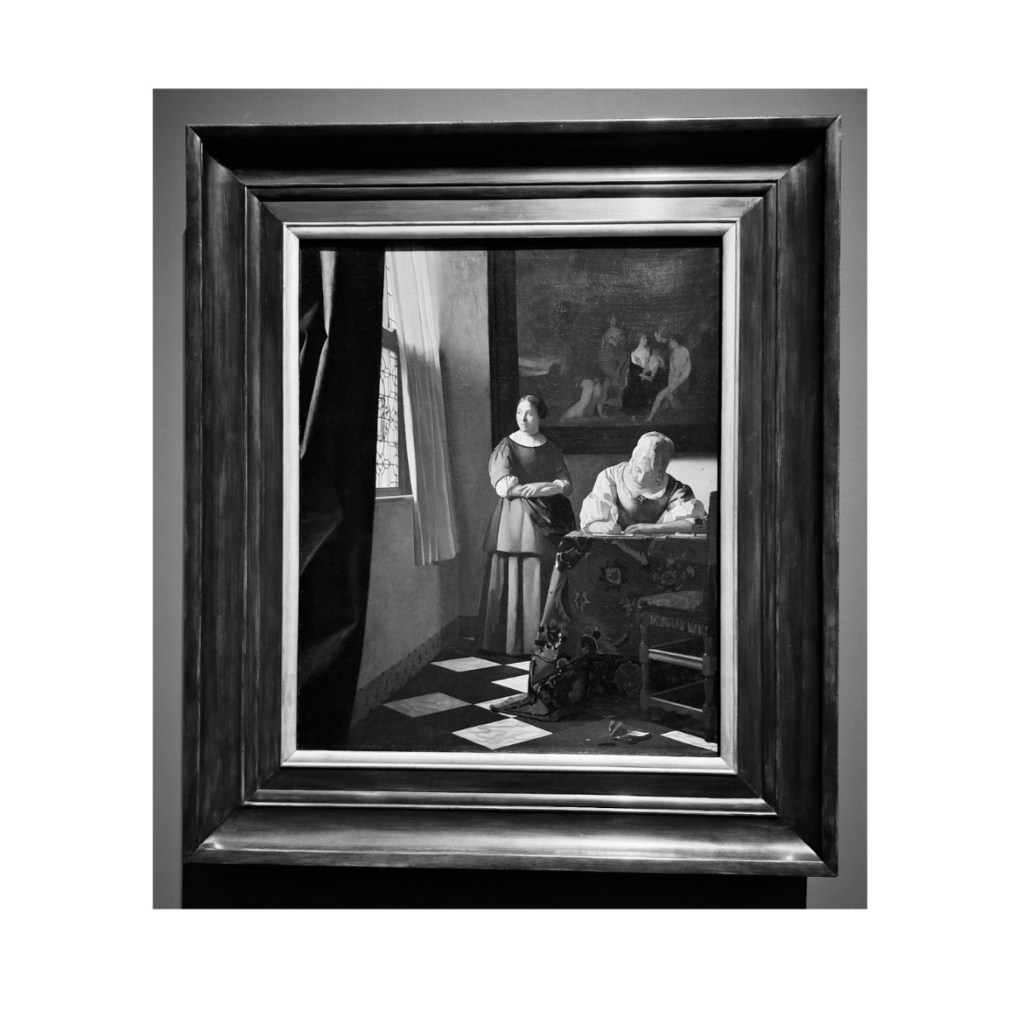
If I elevate Peterson’s remarks to a terrain that the one that he intended, is connected to two Vermeer’s pictures exhibited these days at the Frick Collection gathered around the theme of “letter writing”. In both pictures there is a lady seating at a table drafting a letter – one of them has already concluded it fully attentive to the visitor on her right side; the other a maid gazes at an open window  – but what is always unnerving in Vermeer’s work is the sense of the ineffable and impenetrable in the disclosure of the picture (an exposure that that is usually aided by a side curtain that welcomes us in). What is this impenetrable divinity that lurks in Vermeer picture in pure presence? Although we do not have a name for it, it is like the god that dwells in the dirty bowls or in the nocturnal bushes of Peterson’s gloss.

The painting does not speak in revealing, it only bear witness of the absolute fall of language as it becomes imperturbable in the picture. Contesting the vulgar interpretations on Vermeer’s Catholic conversion in Delft, Daniel Arasse notes that the vortex of his pictorial theology is bounded to the threshold in which images become alive (in the tradition of au vif) outside itself: “Vermeer’s painting are constructed such a way as tho render this life equally present inaccessible, near and impenetrable. What is seen is not a crete of nature observed, but a mystery within the painting itself” [2]. In Vermeer’s pictures, presence and the invisible collapse not through the inception of a metaphor of nature, but rather through the painting’s light when it casts a shadow beyond any instance of closure.

This is why in Vermeer’s paintings surfaces mandate an order of theatrical presence, while simultaneously making room for a perturbance that is forever barred from the conceptual. Unlike Giorgione’s “Three Philosophers”, Vermeer’s pictures are not endowed by the mysterious force of an alienated nature that man can measure and master; rather, the mystery resides in the whispering of the invisible that cosigns the amoris causa of the appearance of painting. If for Peterson what gleams in the dirty bowl is the cleansing of resurrection; what befalls Vermeer’s pictures can only be understood as the faith in the painterly emergence of appearance dependent on the path opened by its light.

The question of god as appearance is always posited as a challenge to the meaning of reality as totality no longer as what emerges in the open, but as what which retracts lagging behind. And we know that only appearance is seductive enough to stand for faith well beyond the fact of being visible [3]. Hence, a way to supreme subtlety of painting (picturae summa subtilitas): no longer a matter of perspective and contour, but of the mysterious indiscernibility that mounts depth between vision and the divinity of presence.

Notes 

1. Erik Peterson. “Fragmentos”, in Tratados Teológicos (Ediciones Cristiandad, 1966), 251-252.

2. Daniel Arasse. Vermeer: Faith in Painting (Princeton University Press, 1994), 75.

3. Consider Heidegger’s response to a question in the Zurich Seminar, 1951: “If I were yet to write a theology then the word ‘being’ would not be allowed to occur in it. Faith has no need of the thinking of being. If faith has recourse to it, it is already not faith. I believe that being can never be thought as the ground of God”. Séminare de Zurich (Paris, 1980), 60-61.

“An angel passed by”. by Gerardo Muñoz

In the Spanish language there is a wonderful idiom that has gone out of fashion in our times to express a sudden silence: “ha pasado un ángel”, or an angel passed by. The phrase is commonly used whenever a sudden silence imposes itself in the middle of a conversation, which leads to obvious discomfort and embarrassment among those engaged. It is almost as if the invisible angel reminds human beings that conversation rests as much in words as in silence; and that the shadow of silence sooner or later interrupts any communicative practice. According to historians and lexicographers, the inception of this idiom into Spanish remains a curious enigma, since although used in early modernity it does not have a Latinized version, and its origins can only be traced to classical Greek antiquity. In fact, Plutarch notes in his De garrulitate that whenever silence is introduced in a meeting it is said that Hermes has joined the company [1]. The angel thus stands for the nonpresence of language in language, just like an icon is the sublimation of presence in pictorial representation. 

We know that in Antiquity the angel as a minor divinity (angeloi) was a mediator between heaven and earth, only that in that moment that an ‘angel passed by’, it is not all clear on which side is there heaven and where earth [2]. In his beautiful book Angels & Saints (2020), Eliot Weinberger reminds us that for Saint Augustine the angels were first and foremost original gardeners of Paradise – given that they are free from felix culpa and sin – and that they are messengers between the living and the divine, as documented in the beggar Lazarous carried by angels to the bosom of Abraham [3]. Here it seems that the invisible inception of the angel relates fundamentally to the dead and conclusion, which also carries its aspiration in the lacunae of a conversation that reaches an impasse, and that for a moment effectively dies. 

The angel that accompanies the dead and the poor – and thus our structural poverty in language, being in the language that always lacks a grasping signifier – is also confirmed by lexicographer Alberto Buitrago, who in his entry on the idiom writes that the expression has its origins in the fact that in antiquity whenever a dead person was mentioned or brought up in conversation there was a silence held, because it was thought that his “spirit” (his angel) had become present in its nonpresence of language [4]. Although Buitrago does not provide any documentation for his assertion, it does bring to bear that whenever we are in communication, whether we like it or not, we are in the communion of angels that are expressing the soul of the dead through the litany of their names. 

This is why Antelme could suggest the similar enigmatic notion that being powerless and in poverty means to ‘have to forever be’ in a silence adjourned so that language can continue speaking. This is why perhaps the irruption of authentic silence has the effect of a certain petrification of the human expression, as masterfully captured in Velázquez’s Apollo in the Forge of Vulcan (1630). It is through silence that we encounter the divinity that for a moment places itself outside of language in order to contemplate it, letting the angel make his entrance. The language of computational machines is not only a language that has renounced its poetic and ethical instance; it is also a form of gated communication that has expelled itself from the angelic visitation of its own contemplation. 

Notes 

1. Plutarch. “Concerning Talkativeness” (De garrulitate), Moralia 6 (Loeb Classical Library, 1939 ) 502F.

2. Paula Fredriksen. Sin: The Early History of an Idea (Princeton University Press, 2012), 54.

3. Eliot Weinberger. Angels & Saints (New Directions, 2020), 30. 

4. Alberto Buitrago. Diccionario de dichos y frases hechas (Espasa, 2007), 333.

Charity and faith. by Gerardo Muñoz

In a letter dated from January of 1962 to his friend Carlos M. Luis, José Lezama Lima makes a case for the intimate relation between language and charity: “What lasts [la cantidad] is only possible through faith. Because what lasts with faith is charity. Omnis credit – believe all things. Charity is belief in anticipation. And what is poetry (the image), but this superabundance of charity that always presupposes creation? [1]. The question in the last sentence – a question that could have only come from a great poet – is not all naive, since it is also a slight displacement from the canonical source underlying the notion of charity. In fact, the expression caritas omnia credit comes from Saint Augustine’s Confessions (Book X, Section 3), where the Church Father treats the reception of his testimony to the rational knowledge of the “hearing of men” who will be attending to his words [2].

This means that for parole to be heard and enunciated in its original presence, there has to be a gathering in charity that makes not just ‘true’, but most importantly, a garment of faith in the occurrence of language. This means that for Lezama Lima, there was no distinction between “theological language” and “language as such”, or “poetic register”, since they are all participants in the mystery of charity, because only charity can welcome language as abode. Poetics as such is understood as facticity of parole. But for Lezama, the word depends on having grasped the motion of charity. 

Lezama’s test for Carlos M. Luis was quite high: if you lose your faith, you would have given up on language as creation. This was not a new problem for the poet who already in his essay “La dignidad de la poesía”, mentions caritas omnia credit, as a process of destruction of representational (merely transactional and duty driven language) communication that arrives at the order of charity through language as intangible and inexistent by virtue of transcending what does not exists, thus manifesting itself as possible [3]. This is the moment in which the charity of language appears as both presence and promise, and what Lezama calls “el resurgimiento del verbo” (the reemergence of the word). Poetics is thus neither the subject matter of poets, nor the master dogma of theologians; rather it is the faith in language that once enunciated it can only move towards a greater opacity of the shadow of mystery. This is why a great Christian theologian says that charity (agape) is partial knowledge of the divine, otherwise there will be only a detestable army of mere academics, scribes, and administrative experts  [4]. 

In other words, charity does not belong exclusively to the Saints, but it runs through All Souls and its dead. The long history of the Church has betrayed the parole of charity, going as far as transforming it into a social mechanism of distributed goods that has become known as the subsidiarity principle. But for Lezama Lima, in an esoteric pauline tone, charity had nothing to do with political absorption and pastoral power; it was fundamentally a problem of language as a relation of reciprocity between beings in order to subsist as species, to paraphrase a well versed French priest on the matter [5].

In our days we see that “believing in language” has become in the public the inverse: non-belief through credit; that is only after possessing it (I do not need to believe in you insofar your credit validates who you are). It has been noted that by a kind of philological accident in the history of secularization, the word charity in English came to be understood one handedly as almsgiving and subsidiarity over the original divine love, which is love supreme in language. A language that does not unify, but that creates ethical relations; in fact, this might be the only uninstructed means of allowing them to fruition. 

Notes 

1. José Lezama Lima. Cartas a Eloísa y otra correspondencia (Verbum, 2013), 324.

2. Saint Augustine. Confessions (Penguin Books, 1961), 208.

3. José Lezama Lima. “La dignidad de la poesía”, in Obras Completas, Tomo II (Aguilar Editor, 1977), 774.

4. Claude Tresmontant. Saint Paul and the mystery of Christ (Harper & Brothers, 1957), 157.

5.G. Desbuquois, S.J. Charity (Fides Publishers, 1965), 33.

On reciprocity. by Gerardo Muñoz

Surely friendship does not depend on obligations or frequency, but it does posit expectations on something like a movement of reciprocity. In fact, movement (κίνηση) and reciprocity are so intertwined that without it, there would not be any separation, only a compact bundle in unity without relations. But, what is at bottom reciprocity? If this notion merits anything thought at all, it must be removed from any conception of exchange in the manner of the quid pro quo and the the ius talionis, where at first sight reciprocity seems to reside as a form of levelling differentiated quantities. In social exchange there is levelling but surely there is no reciprocity except by the legal force enacted by the pressure of duties and obligations. Already in the nineteenth century, at outset of bourgeois society, Søren Kierkegaard with extreme lucidity denounced social levelling as a form of glittering vice: “The idolized positive principle of sociality in our time is the consuming, demoralizing principle, which in the thraldom of reflection transforms even virtues into vitia splendida. Levelling is not a single individual’s action but an activity of reflection in the hands of an abstract power” [1]. 

What is reciprocal in social exchange is no longer the incommensurable relation between beings, but the enactment of language saturated by its own completion, which is the aim of social organization. If there is no reciprocity in the age of kallopismata orphnes as the reduction of rhetorical language it is because there is no longer a missing word in the event of communication, given that, potentially, everything has been already communicated (it is obvious that today this process can only intensify with the planetary deployment of Artificial Intelligence). The only determination of reciprocity that should be of interest is the one that accounts for the lacunae in language that halts force of social levelling. To reciprocate does not mean to give each his due that defines the Western legal operation; it is rather the mutual codependency in the unforfeited event of language. 

At this point, an etymological observation might be useful. In On the Latin Language, Varro records reciproca as a condition of elasticity; that is, a present quality that allows a thing to return to the position from which it has started. Reciprocare thus entails to move to and fro, and to demand [2]. But if we adapt this observation into the sphere of language, we immediately notice that in language there is no previous position nor set origin, which means that reciprocity can only be the undisclosed and disclosed movement of language. Breathing, articulating, speaking: the animus that escapes from the mouth as a mirror of the god of words. The erosion of reciprocity in modern society, thus, goes deeper than the first appearance in fact that human beings are witnesses to a crisis of communication; more importantly, humans have ceased to sense reciprocity because they believe that there is only god where language is mute, and there is language when gods are extinct. Such is the long vigil of computing language as an idol that is neither divine nor of the essence of the human voice. To reciprocate today means to re-divinize the world through words; and through our words greet incoming worlds.

Notes 

1. Søren Kierkegaard. “The results of observing two ages”, in A Literary Review (Penguin, 2001), 76. 

2. Varro. On the Latin Language, Vol.1 (Loeb Classical Library, 1938), 335.

Introduction to José Bergamín’s For Nothing in the World (1937). by Gerardo Muñoz

The essay “Por nada del mundo. Anarquismo y Catolicismo”, by Spanish poet and essayist José Bergamín, should be read as a wartime reflection on the historical impasse of the Spanish Civil War. First published in Emmanuel Mounier’s Catholic journal Esprit in the 1937 April issue, the essay in its final version featured in Bergamín’s Mexican exile collection Detrás de la cruz: terrorismo y persecusión religiosa en España (Lucero, 1941). While on the surface Bergamín is responding to the struggle between secular political anarchism and traditionalist Spanish Catholicism intertwined at the heart of the civil war, the essay is also highly idiosyncratic in laying out the poet’s theological vision that permeates his entire body of work, and which can already be found, in nuce, in the fragments and aphorisms of his first book El cohete y la estrella (Índice, 1923). “Reality is the spirit, imagination, and thought…there is religiosity when it claims space positively”, he would write in the first pages of that book. 

The 1937 essay, along with his defense of illiteracy in “Decadadencia del analfabetismo” (1933), Bergamín argues for a living theology of the Spanish people (pueblo) that is neither imperial nor clerical, but rather always an excess to the imperial political theology that dominated the long historical narrative of Spanish modernity since the Reconquista. It was thanks to Bergamín’s genius that Catholicism appears connected to a habitual form of life of everyday people, their shared language, symbols, and experiences; and, ultimately the common imagination that grants them access to the world through the mystery of living and dying. In fact, as in “Decadencia” (1933), it is important to highlight the centrality of the term “pueblo”, which although translated as “people”, it coincides neither with the “People” of the unity of civil society nor the common historical identity of the Nation. For Bergamín, these determinations, in fact, were corrupted notions of pueblo. The pueblo is always the event that remains from the abstraction of political theology, and always pueblo minoría, a ‘minor people’ that dwells in the house of God within and beyond the mundane. This is why Bergamín would claim in the text that the pueblo is always ancilla mundi. In this light, Bergamín thought that political anarchism incapable of a revelation to the divine, and an imperial Church in charge of the administration of the “nothingness”, were two poles of the same vectorial force of modern nihilism. That was the color of his corruptio optimi pessima with clear echoes of Fridugisus’ De nihilo et tenebris

In “Por nada del mundo. Anarquismo y Catolicismo”, Bergamín’s theological position emerges as a third way to exit this historical poverty of relating to the theos. As Giorgio Agamben observes in a 1973 entry of Quaderni (Quodlibet, I, 2024, 46-47), for Bergamín the divine entails a corporeal cohabitation of a demon and an angel that expresses appearance of life, and thus the sensible and poetic mediation with the world of forms. In this sense, Bergamín’s theology differs fundamentally from the rational and canonical traditions, fostering the sensorial path of dramatic and divine beauty. This goes to the kernel of the 1937 essay: the rise of the Totalizing State (historical Fascism), was a corrupting form of theos insofar as it aimed at regulating the “nothingness” against the possibility of appearance and truth. But the word of God and the angelic hymns linger in the time of wreckage and devastation in its impatient drift towards anger in the world, which is still very much our own. Ultimately, Bergamín was convinced that the pueblo’s mute voice, resurfacing from the depths of pain, could dodge the abysmal fall into the tribulations of radical evil always too congenial with the survival of ‘this world’.

* This gloss was written to accompany the English translation of Bergamín’s “Por nada del mundo” forthcoming at New Personalism, summer 2025. 

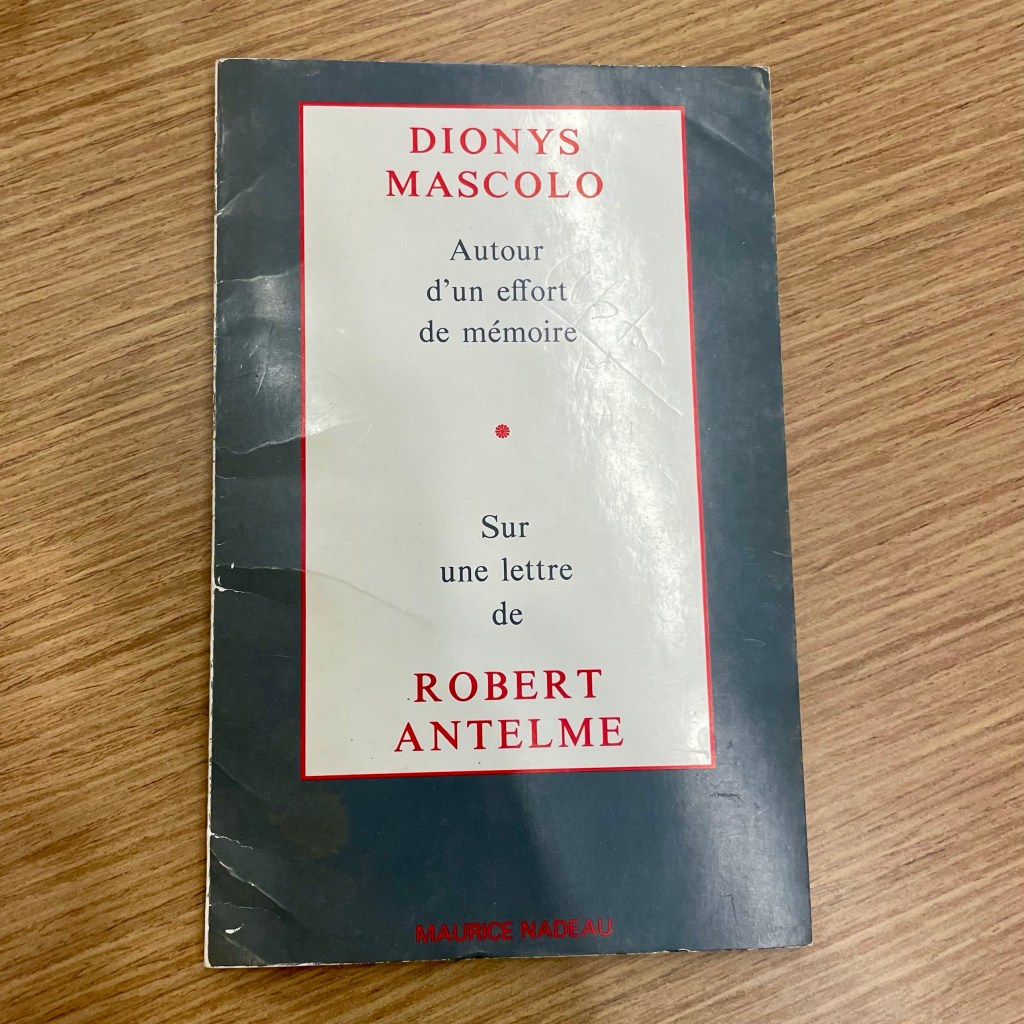
The missing word. A note on Dionys Mascolo’s Autour d’un effort de mémoire: sur une lettre de Robert Antelme (1987). by Gerardo Muñoz

Rereading Dionys Mascolo’s Autour d’un effort de mémoire: sur une lettre de Robert Antelme (1987) in preparation for an upcoming course with Philippe Theophanidis, one gets the sense of beginning backwards or at the very end, since this late essay is a recapitulation of what the Rue Saint-Benoît Group embodied and stood for. And it is so obvious that for Mascolo what is at stake in Antelme’s letter is not a particular practice of confession (and the coupling of secrecy and extraction), but rather an integral register of an experience that belongs to “friendship in thought without reserve” [1]. And that it would not have been possible without friends, as simple as that. Of course, the condition of possibility of this shared thought in friendship has less to do with general principles, norms, or creative acts, and more with what Mascolo does not hesitate to qualify as “a sensibility that was common to us”. 

What is this sensibility, and is it possible to describe it? This is a question that I do not think that is attempted to be resolved in Mascolo’s commentary nor in Antelme’s letter so consumed by its internal lacunae and effacement (I am definitely not capable of saying a word about it at the moment, and this might be one of the questions in the ongoing dialogue in the seminar). Mascolo does offer a little more when he states that this sensibility, however broad and partial, was always elevated against all totalitarianisms that were hegemonizing the political positions of the epoch. Obviously, it names the political totalitarianism (Fascist and state planned communism alike), but also the “the soul of the project” (‘est l’âme du projet  et sa forme aboutie’) that must retract from it [2]. The last pages of Mascolo’s reflection is a shallow-deep, an insinuation, into the possibility of saying something in relation to this difficult proximity. 

Hence, against total subsumption of life into political planning (whether on the right or left, whether ecclesiastical or in the name of the secularized forms of militant communist parties), Mascolo’s insistence on the ‘soul of the project’ is sustained by the “missing word” give that dispenses human necessities as infinite. He writes: “Et par mille et mille détours, il me (nous) fallait toujours en revenir au même point : Je suis ce qui me manque est la sentence que je porte (nous portons) inscrite à l’intérieur du front. La moindre des choses alors est de proposer que, sauf mensonge, elle vaut pour tout homme”. [3]. But what could it mean that “what I am” is always constituted by the missing word? It is definitely not a substantive attribute to a person (and thus what I can acquire), but a word that in its ideal absence and lack of epistemological validity stands as a form of seeking (zēteîn) that Nicoletta Di Vita has recently linked to the form of the ancient hymn [4]. The missing word is the passive and pure voice that calls out the rhetorical fiction of political totalitarianism. In other words, the missing word does not enact a present state of things, articulating the denomination in language with distinct objects of the world; it only has transformative weight when revealing what remains under the capes of morality.

This is why the experience of the camp constitutes a central threshold: on the one hand, it is an extreme and sharpened image of social alienation between classes; and, on the other, it is the experience that by depriving the human of its humanity it brings to an effective end the polarity between rich and poor that structured the economy of salvation and damnation of Western civilization. This is what Antelme describes in his essay “Poor Man – Proletarian – Deportee”, which according to Mascolo brings the rich to a psychotic night of desperation towards destruction and death of the specie. Hölderlin’s definition that “we have become poor in order to become rich” as a clement predicament in the face of the modern is here-forth suspended in the spiritual crisis generated by the social engineering whose most extreme case is the model of the camp.

And yet the missing word remains irreducible even after the corrupted stage of innocence and the impossibility of redemption. Mascolo, reader of Nietzsche, does not believe in the theos. This is why for him the missing word, far from being an apostrophe that offers consolation in the wake of the catastrophe, it remains concretely attached to the experience of the friend that no longer finds solace in abstract peace, but in the profound musicality of what remains inconsolable: “cette heureuse absence de paix qui est sa musique profonde, et que donne en partage l’être aimé, l’inconsolable qui console” [5]. This transfigured word – the unending capacity for hymn in the human, its nomoi mousikos – is both an excess to memory and appearance, and perhaps, more importantly, an excess to the experience of living and the dead. And is not this “seeking” passage of the missing word what the Rue Saint-Benoît Group was obsessively after?

Notes 

1. Dionys Mascolo. Autour d’un effort de mémoire: sur une lettre de Robert Antelme (Maurice Nadeau, 1987), 82.

2. Ibid., 83.

3. Dionys Mascolo. Autour d’un effort…,82.

4.  Nicoletta Di Vita, Il nome e la voce. Per una filosofia dell’inno (Neri Pozza, 2022), 27.

5. Dionys Mascolo. Autour d’un effort…, 89.