The bruised souls. by Gerardo Muñoz

Whenever a professional politician today evokes the ‘soul’ one must be immediately suspicious, as it tends to be an automatic lullaby for “national unity” or a dormant metaphor in a flowing stream of empty chatter. What could the soul mean to anyone – say, those millions that have now for the second time voted fairly and squarely Donald J. Trump to the Executive branch of the national government – only capable of giving attention to a series of onomatopoeic pop-words that are now ingrained in the linguistic acoustics of the American lexicon (“Bitcoin”, “Tiktok”, “Woke”, “Prime”, and the list could go on). The ongoing catastrophe is first and foremost within the texture of language, which is ultimately why it is also an ethical decomposition in which all other spheres of practical action (first and foremost, politics) amount to business as usual with its corresponding rhetorical bravura.

Suggesting continuity might perhaps be an understatement: it is now a business that does not need any sumptuous or veiled mediation; refracted upon its own absorption of its hyperproduction of fiction, the defeat of the communitarian salvation of Calvinism can only be expressed as a self-serving an ongoing destruction and self-annihilation. True, it could be claimed that ‘Americanism’  has always been this; the only difference is that today, already well into the century, it moves in a vector that directly rejects the world while making a full fledged program of its own making. Only a Society that has become fully moribund can celebrate its own death and decomposition; while the emancipated and well scripted villains of the act now have no shame but to reveal how the ultimate object of their conspiracy was the obliteration of the Earth.

“It is the time of the assassins”, TJ Clark writes echoing Henry Miller’s unjustly forgotten book on Rimbaud and the legitimation of the social bond, in which the homo homini lupi discloses itself from any all possible contact in the metropolis solely dependent on ad hoc hyperproduction of justifications required to fully commit to the illusion of legitimate action. Only that now the time of the assassins is perhaps an uncanny dark night of those without souls, as in the deranged characters of a McCarthy’ novel: they are willing to kill and be killed; they are beyond any contact with language, and “what do you say to a man that by his own admission has no soul? I’ve thought about it a great deal” [1]. And indeed, there is nothing to say and nothing to face: in the soulless dark night there are only hunters and those that are hunted; there is integration or pulverization; there is killing and there is humiliation before an ever increasing legal nexus coordinating the acquiescence of force. But perhaps this is the real arcana of the American soul that is only shimmering through in all of its glory.

Someone like D.H. Lawreence definitely thought so when writing about the novels of Finimore Cooper: “[The white american] lives by death, by killing the wild things of the air and earth…All the other stuff, the love, the democracy, the flooring into lust is a sort of by-play. The essential American soul is hard, isolate, stoic, and a killer. It has never yet melted” [2]. But in our days it has begun to melt, to fragment, and decompose in a heavy storm of pain and despair. And it continues to stand in the long winter of American civilization (the castle of Frozen is the allegory of the epoch) that now finds itself at the epochal threshold of the end of growth, only left with rampant nationalist impulses of self-affirmation that can only deepen the nihilist tonality of anguish and self-destruction, and the emergence of the bizarre as Jamie Merchant notes in his recent Endgame (2024). 

In his Reflections on America (1958), Jacques Maritain maintained that the spiritual patrimony of Americanism is that of being “bruised souls”, a community that came into being by double exclusion (hunted by their religion and rejected within a national polity), which in turn allowed to be compassionate to human suffering, and thus the hidden meaning of the wound was to be seeing in the “role played by immigration and poverty suffered in the Old World” [3]. Hence, for Maritain the condition for the healing soul of America resides in its opening to ongoing suffering of migrants, the dispossessed, and those in exodus from the psychic pressure of a social metabolism gone sour in every subject of civilizational decay as Erich Unger had proposed in his Politics and Metaphysics (1921).

 It comes to no one’s surprise, thus, that the decomposition of the American soul departs from the overt opposition to migration, as a figure of the grazing over the Earth, that must be vanquished and condemned by a planetary gnosticism undergoing in front our eyes. The Chrisitian modern state enters in this way into a concrete and visible process of artificial desecularization showing that “the Christian relation to the State…is in mad hostility to all of them, having in the end, to the destruction of them all. […]. And it is, simply, suicide. Suicide individual and en masse” [4].

The stakes are extremely clear: it is for the bruised and the brute (some have called it the barbarians, proprietors of strange tongues, keepers of the clandestine lacunae of language) to retreat from the fictive proliferation of appearances, the artificialization of reason that can promise success as the ultimate pinnacle of self-destruction. Inclined beneath the shadow of archaic Penia, the bruised and incurable souls might not find redemption in the American wasteland, but they will land somewhere between language and world. Not a program but a moving conviction.

Notes 

1. Cormac McCarthy. No Country For Old Man (Vintage, 2005), 8.

2. D.H.Lawrence. “Fenimore Cooper’s Leatherstocking Novels”, in Studies in Classic American Literature (Thomas Seltzer, 1923), 92. 

3. Jacques Maritain. Reflections on America (Scribners, 1958), 84-85. 

4. D.H. Lawrence. Apocalypse (Penguin Books, 1995), 148.

Pasiones de Giorgio Cesarano: introducción a un dossier. por Gerardo Muñoz

¿Es posible seguir insistiendo en la apertura del pensamiento contra el cierre de la época incrustada en la elipsis infernal de la supervivencia ventilada en las sombras del desierto nihílico y entregada a los aparatos de la reproducción social? Escribiendo en la convulsa década de los setenta – y que algunos pensadores han llamado, no sin razón, el “big bang” de la transformación geoeconómica del mundo donde la revolución queda finalmente liquidada – la apuesta de Giorgio Cesarano en Manuale di sopravvivenza (1974) -y su antecesor Apocalisse e rivoluzione (1973) co-escrito con Gianni Collu – sigue constituyendo un esfuerzo desmesurado y singular por encontrar una bifurcación por fuera de las anquilosadas formas de la antropomorfización capital que entonces ya aparecía como como el destino catastrófico de la especie humana reducido a la compulsiva maquinación de las totalidades ficticias [1]. 

En efecto, como observa Cesarano con un gran poder de síntesis: el triunfo revanchista de la fuerza de la subsunción real, en realidad, confirma que el verdadero y único objetivo del principio de equivalencia no tiene otro blanco que la usurpación de un mundo domesticado y desprovisto de acontecimientos. Un mundo hecho a la medida de las necesidades de sus inmates, tal y cómo lo había previsto John Cowper Powys en una de sus brillantes pesadillas literarias [2]. Pero este es el mundo que hemos heredado y que seguimos atravesando, aunque algunas décadas nos separen de la provocación que a la altura de 1974 Cesarano alzaba ante las herraduras dialécticas de la época. En realidad, era una provocación asumida desde la posibilidad de la afirmación de una gnosis – algo que, como sabemos había aprendido gracias al diálogo sostenido con algunos representantes de la corriente bordiguista de la cultura radical del pensamiento italiano y de su estrato poético, como lo confirma en La casa di Arimane (1979) de Domenico Ferla – aunque sin abandonar la posibilidad de un movimiento en retroceso de éxodo, capaz de integrar un nuevo programa de emancipación de la comunidad real de la especie (Gemeinwesen) contra todas las celdas de la objetualidad y sus satisfacciones reguladas.  

Un arduo primer paso: la retracción como rechazo de la hostilidad generalizada contra la presencia. Así, en un momento de Manual Cesarano podía escribía: “Ahora tener origen como fin es un programa perfectamente realista” [3]. Un realismo que optaba por abandonar el produccionismo apocalíptico al interior de la filosofía de la historia del capital en la metástasis de sus representaciones sociales. O bien, como escribe en uno de los momentos más emblemáticos contra la reificación del sujeto del saber y de la conciencia en Manual de supervivencia: “…el decrépito-infante Yo se tambalea….Se desvanecerá, morirá finalmente, lo mataremos cualquiera sea la máscara que lleve en ese instante. Porque el fin es el origen, el nacimiento de una comunidad-especie realizada, el nacimiento continuo de la presencia coherencia, la afirmación del ser inobjetivo….El fin del Yo marcará el principio de la presencia” [4]. Volver a la prehistoria, entonces, para desembotar el dominio cibernético de la optimización biopolítica administrativa de la vida que domicilia a la especie humana en el armazón de la producción de lo ficticio. Así, el vaciamiento paulatino de la vida tendrá en cada ápice de la simbolización el sol irradiante de la justificación y de la expansión del verosímil retórico de una comunidad abstracta. Por lo tanto, para Cesarano, la embestida contra la reificación del “Yo” debe su destitución a la intempestividad de la pasión del pensamiento como contraofensiva ante el ascenso depredador de la fuerza de la objetivación. Justo en este umbral Cesarano inscribe la partida para la época del agotamiento del reino de las formas y de la crisis de la legitimación política: “No es una clase de lo social, entonces, la que realizará la abolición de las clases emancipándose, sino que la negación de lo “social” y de sus clases, efectuada por el cuerpo proletarizado de la especie, emancipará a la especie de la “sociedad” como comunidad ficticia, prehumana” [5]. Apostar por particiones de valor social (el infinito juego de la hegemonía without end) solo podía perpetuar el espesor de la más rampante agonía.

De la misma manera que la crisis histórica validada por la astucia negativa del proceso infinito de acumulación apela a nuevas artes de estabilización y optimización de la abstracción Social (el paradigma de la unificación cibernética que Cesarano logra identificar en un momento de reestructuración de los propios mecanismos de la gobernabilidad del liberalismo tardío y de la consumación de la mediatización de los entes) de su propia incesante reproducción; para Cesarano toda “critica radicale” – que debe ser asumida como crítica en suspenso, más allá de todo sujeto posicional y posicionado en la estructura del movimiento humanista de la negatividad dialéctica – ya no se caracteriza por funcionamientos programáticos preelaborados mediante el rigor epistémico de la vanguardia militante o justificados en la divisa de la objetividad metodológica; se trata, en última instancia, de constituir espacios sensibles que despejen la desficcionalización absoluta de un movimiento existencial y de estilo cuyo único programa histórico se constataba mediante la inalienabilidad de la comunidad de la especie humana: la irreductibilidad de la pasión [6].

Si la modernidad consistió en la domesticación de las pasiones con el fin de impulsar el rendimiento objetivo y alienado de la diversificación de los intereses diagramados en el valor, ahora se trata de afirmar la liberación del yo como fractal de la no-objetualidad de mis pasiones sin que ésta sea entendida como una mera compensación traducida a la autonomía postromántica del arte [7]. La pasión del pensamiento en Cesarano es condición hiperbólica de una erótica que desoculta la chôra de lo inconmensurable; esto es, la distancia que marca el encuentro entre los restos del mundo natural y el uso vocativo de la lengua: “….ese paso de acercamiento, es abrazo de amor y de lucha, parece tanto más absurdo cuanto más lo cotidiano parece desierto. Es en este movimiento que cada uno podrá, encontrándose en la persistencia del deseo resistente a la aniquilación objetual, descubrir en sí mismo la presencia de ese programa histórico que es la pasión y sentirse listo” [8]. La autoafirmación de la génesis inconclusa de la pasión descentra el nudo gordiano de el terror de una vida sometida al proceso de adaptación en el que la máquina y la humanidad se cierran sobre si mismas.

Pero la pasión es el recurso que valida el recorrido ético de la apropiación de mi existencia; esto es, no es ni condición antropológica ni forma en la que puedo orientar mi relación con lo inefable del mundo. Y dado que nunca sabemos realmente qué constituye el objeto de la pasión – al menos que este dispuestos a abdicar la pasión a la matriz recursiva de lo objetual – la existencia sólo puede darse en la disponibilidad de la vida misma cuando ésta coexiste con la laguna de la pasión y del asombro en el mundo. Dicho en otras palabras, de nada vale “vivir por una pasión” como suele decir el automatismo retórico del contrabando de las pasiones y de la propaganda de agitación social; el valor absoluto radica allí donde la pasión se deja vivir en el movimiento finito de una vida que no puede ser otra, y que solo se mide con respeto a las propias conquistas o encuentros que marcan el ritmo de un destino. En este sentido, como escribe Cesarano en la glosa “Erotismo y Barbarie” (1974) que incluimos en este dossier: “La pasión es el sentido de lo sagrado que se demuestra como tal” [9]. La tonalidad sagrada de la pasión es aquello que no puede ser verbalizado como imperativo o veneración externa para la promoción servil de los hombres-masas orientados a la infinita idolatría sacrificial que, en el curso de la secularización cristiana, implicó el triunfo ficticio del ordenamiento del principio civil [10]. Para Cesarano, las pasiones de la especie es el no-lugar – de ahí que sea una chôra, un lugar de contacto imaginal con la expresión que solicita siempre en cada caso el umbral del afuera – mediante el cual la vida encuentra formas contra la supervivencia y la agobiante auto-aniquilación que el logos descarga sobre cada exigencia vital. 

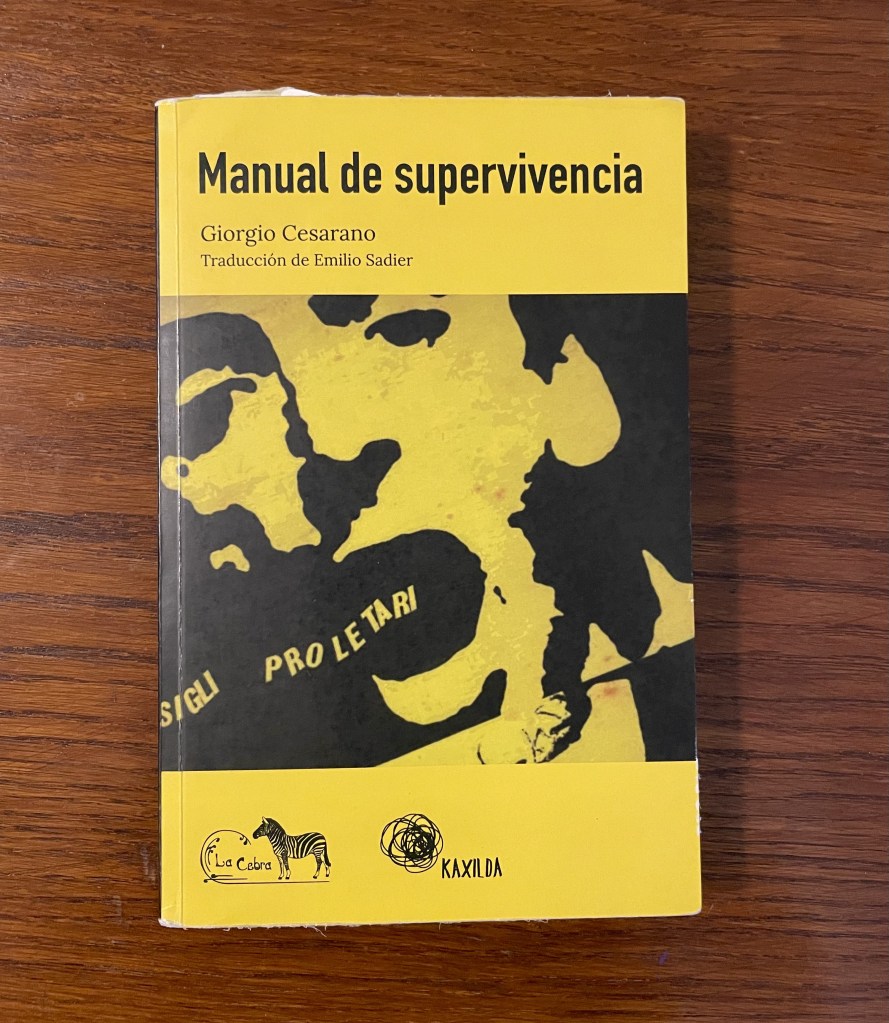
Sin muchos más rodeos podemos decir que el programa de la pasión sigue abierto en una época, la nuestra, cuyo régimen cibernético-administrativo sobre todos los ámbitos del viviente ha conseguido intensificarse con mayor ferocidad en el punto más álgido de nuestra civilización. Como si se tratase de un don fortuito, la excelente y cuidada traducción en castellano del mítico libro de Giorgio Cesarano por Emilio Sadier publicada en La Cebra y Kaxilda finalmente nos facilita una conversación que, a pesar de haber sido postergada durante tanto tiempo, regresa con la intensidad y el brillo de una voz entonada desde las catacumbas para confirmarnos que no todo ha quedado obliterado. Sobre esos restos se arremolina la ascesis singular de la pasión común de los hombres póstumos tras un mundo que se eclipsa. Y de este modo regresa la conquista singular de los encuentros, la despotencialización del ego, y el recogimiento de una morada en la insondable piel de las estrías del mundo. El dossier que presentamos a continuación sobre el pensamiento y la poética de Cesarano no pretende constituir otro gesto que aquel que contribuye, a su manera, a la continua “comunicación entre almas” al interior de una época que continúa encandilada en la fuerza de la objetivación y la producción de la impaciencia [11]. Y cómo intuía Cesarano en unos versos de su temprano L’erba bianca (1959): “…la buena canción tardó demasiado, pero había que esperar en el vacío para dejar resonar al corazón. Ahora lo sabes, hoy toda fortuna se ha disipado” [12]. ¿Nos hemos disipado también nosotros? Allí donde las pasiones toman la palabra y los tintes del alma dilatan su expresión las dudas para semejante interrogación disminuye y se disipa. Así, atravesados por el timbre de la pasión, moramos en la inesencia, pero sin realmente pertenecer a ella.  

*Esta es la introducción al dossier sobre el pensamiento de Giorgio Cesarano que preparé a raiz se la publicación en castellano de Manual de supervivencia (Kaxilda, La Cebra 2024), y de próxima aparición en la revista chilena Escrituras americana en la primavera de 2025.

Notas 

1. Willy Thayer. ‘”Fin del trabajo intelectual y fin idealista/capitalista de la historia en la ‘era de la subsunción real del capital’”, en El fragmento repetido: escritos en estado de excepción (ediciones metales pesados, 2008).

2. John Cowper Powys. The Inmates (Macdonald, 1952).

3. Giorgio Cesarano. Manual de supervivencia (La Cebra, Kaxilda 2023), 112.

4. Ibid., 49-50.

5. Ibid., 130.

6. Furio di Paola. “Dopo la dialettica”, Aut Aut, N.165-166, 1978, 63-103.

7. Para la elaboración de este argumento, ver el ensayo de Gianni Carchia, “Modernità anti-romantica”, en Pharmakos: Il mito trasfigurato (Ernani Stampatore, 1984), 9-13.

8. Giorgio Cesarano. Manual de supervivencia (La Cebra, Kaxilda 2023), 75.

9. Giorgio Cesarano. “Erotismo o Barbarie (1974)”, incluido en traducción al castellano en este dossier. 

10. Carlo Levi. Paura della libertà (Neri Pozza, 2018), 120.

11. Gianni Carchia. “Tragedia y persuasion: nota sobre Carlo Michelstaedter”, en Retórica de lo sublime (Editorial Tecnos, 1994), 35.

12. Giorgio Cesarano. “A un amico”: “So che per te di troppo tardarono / il bacio dell’amata e la buona canzone / ma bisognava saper asperttare / e lungamente e a vuoto lasciar risuonare il cuore. / Ora lo sai, chiusa ogni ventura.”, en L’erba bianca (Schwarz Editore, 1959), 39.

Vladimir Lossky’s third way. by Gerardo Muñoz

In his war diary Seven days on the roads of France June 1940 (2012), which recounts his itinerant vicissitudes in occupied France, the Russian theologian Vladimir Lossky makes an explicit case for the emergence of a third way beyond conservation and destruction, and its modern ideological avatars that led astray into the modern catastrophe; that is, the social revolution and conservative reaction cloaked under “traditionalism”. As it has been recently glossed, Lossky was not the only person from the East to be preoccupied with putting a halt to the eternal dialectical movement of destruction and conservation only fueling historical abstraction. Indeed, immediately in wake of the Russian Revolution, the poet Alexander Blok, in an epistolary exchange with Vladimir Mayakovsky, and anticipating the bewildering enthusiasm of the revolutionary energy, also demanded an effective exit from servitude so that “a third thing appears, equally dissimilar to construction and destruction” [1]. It matters little whether Lossky knew about Blok’s “third figure”, although it is at the same time impossible not to have it in mind when reading his own annotation in the June 16th entry of his diary, which does seem to offer a answer to Blok’s proposal:

“Nonetheless, revolutionaries are always in the wrong since, in their juvenile fervour for everything new, in their hopes for a better and a way of life built on justice they always base themselves on theories that are abstract and artificial, making a clean sweep of living tradition, which is after all, founded on the experience of centuries. Conservatives are always wrong, too…for in their desire to preservice ancient institutions that have withstood the test of time, they destroy the necessity of renewal and man’s yearning for a better way of life. Is there, then, a third way? Another destiny for society than of always being subject to the threat of revolutions which destroy life, or reactionary attitudes which mummify it? Or is this the inevitable fate of all terrestrial cities, the nature of their existence? In fact, only in the Church can we find both a Tradition that knows no revolution and at the same time, the impetus towards a new life that has no end. Which is why she is in possession of those infinite resources upon which may draw all who are called to govern the perishable cities of this world” [2]. 

It is no surprise that for both Blok and Lossky, the fundamental tension in the amphibology between conservation and rupture rests on the problem of “tradition”; given that, as Blok had also eloquently written in his letter to his fellow poet: “a breach with traditions is a tradition”. This is something that an artist like Kazimir Malevich understood well in his programmatic text about museums in the wake of the revolution (“On the Museum”, 1919): the turn into ashes of all the works of art altered their aura, but it left in place the topological frame and it still produced an image; in order words, the destructive artworks still demanded a museological space for storage, thus enacting new principles of the triumphant revolution. Understood in this sense, tradition is merely the retroactive accumulation of practices by the archē that orients its development retroactively from the point of view of the present with provisions towards the administration of the future. But, how did Lossky understand by the notion of “Tradition”? Rereading the fragment of his war diary entry, it would seem that this notion merely rests on the dogmatic transformations within the Church, and in this sense, a conceptual elucidation similar to the doctrinal exegesis not very different from John Henry Newman’s An essay on the development of Christian doctrine (1845). However, in his important essay “Tradition and Traditions”, Lossky attempts at defining the site and tension of the tradition, which he notes that in the language of theology it has been a term left vague and repeatedly undefined [3]. Lossky writes with sharp precision: “Tradition sometimes receives that of a teaching kept secret, not divulged, lest the mystery be profaned by the uninitiate” [4]. Thus, Tradition is the positive and textual scripture that registers the Word, but it is not exhausted in the positive scriptural authority. 

At the heart of Lossky’s argumentation about the theological meaning of Tradition, is the fact that it exceeds both textual sources and narrative mastery and transmission. In fact, the theology garment of Tradition belongs to the mystery of revelation shared in conspiracy, rumors or whispers [5]. And although, in his essay Lossky reaffirms himself that Tradition is the invisible intertwined with the Church – what keeps the “critical spirit of the institution” for the incorporation of new dogmatic definitions – it is nonetheless important to note that for the theologian, Tradition as “opposed to the reality of the word, it would be necessary to say that Tradition is Silence” [6]. In this sense, Tradition is that which is created and transmitted but that no one has the right nor the authority to speak through its incommunicable name. Is Tradition transmitted at all? If it is not through the written word, how can there be any continuity? This is the ultimate lacuna of the theological underpinning of Tradition for Lossky: Tradition can only be properly understood as the crafting of a “unique mode of receiving truth”; in order words, it names the contact between revelation and the witness who receives its ‘fullness of knowledge’, which far from mastering the totality, it points to “the external limit…the narrow door which leads to the knowledge of Truth” [7]. As Monica Ferrando has recently glossed from Plato’s philosophical corpus, any robust conception of Tradition should be understood as that which maintains an absolute inseparability between wonder and salvation, as well as bridging invention and received grace (charîs) [8]. One step at a time, we invent traditions whenever we are thinking through the abyss that separates our language from the inheritance bestowed upon us. Tradition moves in every ethical position of thought overcoming the pseudo-authorization of alienated and metaphorical knowledge of the past.

But if  the Church is no longer the institutional site for the keeping of the impossibility of the transmission and renewal of Tradition and revealed Truth – subsumed to the mysterium iniquitatis that works against the possibility of the rendition of the eternal life of a permanent vita nova  – it entails that one can still hold on to Lossky’s assertion that the task is to be attentive to the ossified expressions and reified appearances of Truth against the “living Spirit of Truth”. Hence, to insist on the restitution of the Church in our current predicament, would place us on the side of instrumentalized and subject-oriented salvation that turns away from the active kingdom that is the only passage from the world of the living to that of the dead. The traditionalists or integralists are incompetent representatives of the Tradition in this sense: as Von Balthasar once argued, they lack the humor and contact with the invisible to apprehend the mystery that arrives without solicitation, as pure depotentialization [9]. In a godless world of the secularized gnosis of political force – that is, after the fleeing of the gods – perhaps theology could only be understood as the path of Tradition of uncountable wonders and the event of speech that produces an unworldly sensation within this world. Tradition brings the world beyond its shape and legibility. In this sense, we are always participants of Truth that the world cannot retain, and thus keepers of an enduring secret that will ineluctably outlive us. 

Notes 

1. Philippe Theophanidis. “Alexander Blok: ‘A breach with traditions is a tradition'”, October 13, 2024: https://aphelis.net/breach-with-traditions-alexander-blok/ 

2. Vladimir Lossky. Seven days on the roads of France June 1940 (St. Vladimir’s Seminary Press, 2012), 54.

3. Vladimir Lossky. “Tradition and Traditions”, in In the image and likeness of God (St. Vladimir’s Seminary Press, 1974), 141.

4. Ibid., 144-145.

5. Ibid., 146.

6. Ibid., 150.

7. Ibid., 162. 

8. Monica Ferrando. “La libera grazie della tradizione”, in Un anno con Platone (Neri Pozza, 2024), 424.

9. Hans Urs Von Balthasar. The Office of Peter And the Structure of the Church (Ignatius Press, 2013), 403.

The pleasure of words: persuasion in Gorgias’ Encomium of Helen. by Gerardo Muñoz

In considering the reasons for Helen of Argos’ action, Gorgias’ Encomium introduces, after mentioning Chance and Necessity, the captivating force of persuasion that couples language and eros without remainder. It is nonetheless true that Gorgias is not interested in taking the role of public defender of Helen’s catastrophic actions (war itself), rather what he is after is the account of the word (logos) as a practice that can effectuate magical qualities, thus making “speech a powerful ruler…its achievements are superhuman; for it is able to stop fear and to remove sorrow, to create joy and to augment pity” [1]. The divine tonality constitutive of speech is not a matter of metaphors – even though metaphoric elevation might be in – but of  rhetorical art (technē) that triggers a somatic affection and movement when entering contact with someone else. For Gorgias, the event of speech is primordial and transformative; or, rather, it is only transformative because it can reach deep into the senses and the soul. And these are effects of creative enchantment for the human being. Not yet alienated from the mythos of nature, speech is the necessary artifice of ‘higher truth’ that is the life in persuasion. 

This is why for Gorgias there is a correlative nexus between persuasive speech and the ordering of the “mind as the ordering of drugs bears to the constitution of bodies”, which early scholars of the school of the Sophists such as Augusto Rostagni, read in light of the medical and spellbinding teaching of the philosopher-poet Empedocles, who might have been Gorgias’ teacher [2]. There is most definitely a healing dimension of the persuasive speech that compels a proximity between language and magic as the only possible – and possible because it is sayable – to access the inaccessible world of forms that Gorgias himself negates in his philosophical skepticism. (As we know, Gorgias was the author of a lost treatise of non-being of everything that Aristotles and other writers of Antiquity registered extensively). The triumph of deception for Gorgias was irreversible, a stated fact, which meant that only persuasion in speech allowed movement and seeking in the world. This is autopoetic dimension of Gorgias’ linguistic theory, which also confirms Michelsteadter’s thesis that there is no general science and ideal of language – language can only be created as much as the world in order to appropriate the ethos in life. It is no surprise, then, that a scholar like Jacqueline de Romilly has connected Gorgias’ persuasive speech to the sacred musical of orphism as a subterranean sensorial world before the rise of the legitimacy rhetorical koine of the polis. 

In other words, whereas the rhetorical order of the polis will be about the exchangeability of values through communicational units and coordination for the reproduction of social life, what is central for Gorgias, as reported by Sextus Empiricus, is that what is revealed is the usage of language as such in the exposition of the style of enunciation. Style becomes a formless reservoir of incantation and linguistic magic, which can multiple the uses while remaining neutral to a higher truth other than itself. As stated succinctly by de Romilly: “The sound of words is no longer mysterious; it no longer implies divine intervention or even produces irrational action. It is just style, and an intellectual display of skill. The only thing it appeals to is intellectual surprise, by stirring curiosity, attention, or excitement” [3]. Thus, the magical dimension of persuasive archaic speech is not suspended in the eternal polarity between truth and falsehood, but rather in the way in which reciprocity ceases to instrumentalize language to specific protorationalist ends previously crafted [4]. The “magic” of the event of speech liberates language from the fiction that there is something like an autonomous and  truth-content to ground its legitimacy. 

The persuasive texture of speech resembles a dress that must fit for every occasion of its enactment. This is why the Encomium of Helen ends with an affirmation of ‘self-amusement’ that folds the epideictic form of speech as a nourishment for the soul. The ambivalent speech can both cure and nourish, but on its other side it is also apaté or illusion in the world afterall. There is only apaté through the mediation of persuasion of the speech event, which means that any elaboration of absorbing the totality of the world through language can only further severe our distance from it. And is not at this threshold where the ethical question is inscribed? As the classicist Neus Galí asserts in a highly condensed synthesis: “In Gorgias’ thought, apaté or illusion is consubstantial with the world, allowing us to see it and communicate it” [5]. But a world vested in apraté is a non-world: it is only in language where we can move through different worlds, and persuasion is like the magical carpet or invisible cloak that allows us to zigzag between their nonexistent unfolding of our making. The impossibility of absorbing the mythos into the protorational dimension of the logos reappears in the eros of language as the remnant of enchantment that circumvents the deployment of justification, grammar, and the syllogistic mastery that soon enough will realize autonomous language as a representational science of logical proficiency. 

The persuaded speech or image – Gorgias even reaches for an ut pictura poesis mediation towards the end with an analogy about painters completing objects and forms – becomes the nonsite for those blessed souls. For Gorgias this is a supreme fiction; but one that insists on the irruption of passion in front of the ossification of what has been stabilized as a principle of reality. This is why there is a parallel between tragedy and persuasion in Gorgias’ fragmentary thought. As Plutarch records Gorgias’ words in one of his texts: “Tragedy with its myths and emotions has created a deception (apaté) such that its successful practionary is nearer to reality that the unsuccessful, and the man who lets himself be deceived is winner than he who does not …whoever has allowed himself to be deceived is wiser, for anyone not lacking in sensibility allows himself to be won by the pleasure of words” [6]. This ‘tragic transport’ enacts a “caesura in which the idea itself appears” (pure language)” [7]. It is this unfathomable and acoustic pleasure of poetic language that accounts for an exception to social exchange of  signification that will flatten speech to an uttermost decrepit and disposable utensil without passion, arousing neither celebration nor lamentation that allowed the human voice to dwell outside the chatter of the human. Or, as a twentieth century celebrated theologian writer will note in a Gorgosian tone: “For the truth is that language is not a scientific thing at all, but wholly an artistic thing… the tongue is not a reliable instrument, like a theodolite or a camera. The tongue is most truly an unruly member, as the wise saint has called it, a thing poetic and dangerous, like music or fire” [8].

Notes 

1. Gorgias. Encomium of Helen (Bristol Classical Press, 1982), 25.

2. Ibid., 29. 

3. Jacqueline De Romilly. Magic and Rhetoric in Ancient Greece (Harvard U Press, 1974), 20. 

4. Gianni Carchia. “Arte, magia, razionalità”, in La legittimazione dell’arte  (Guida, 1982), 204.

5. Neus Galí. Poesía silenciosa, pintura que habla (Acantilado, 1999), 193.

6. Plutarch. De gloria Atheniensium, Sec. 5, 351.

7. Fredrich Hölderlin. “Notes on the Oedipus”, in Essays and Letters (Penguin, 2009), 318.

8. G. K. Chesterton. G. F. Watts (Duckworth & Co, 1906), 90-91.

The decaying sublime. On Gónzalez Sainz’s Por así decirlo (2024). by Gerardo Muñoz

José González Sainz’s new collection of short stories, Por así decirlo (Anagrama, 2024) offers a magisterial elaboration of the ongoing nihilism that has absorbed humanity into an autonomous object of its own shipwreck. Throughout the stylistically intricate narratives, it is easy to see that for Sainz the problem is not just about the extinction of humanity – its decline and fall, but rather about stumbling into the spectacle as if nothing is taking place. The consummation of nothingness exerts itself into the very consciousness to the point that the death of the living becomes transactional for the ongoing fictions regulated by expectation and prevention. 

Obviously, these are broad strokes that say little of Sainz’s well-known narrative pointillism, in which not only every object but every distance is carved out and polished with striking vivacity (this opposition between style and worldliness underpins the sharp contrast of the process of absorption); but, there is a moment in the first story of the book that can arguably be elevated as an emblem of Sainz’s outlook towards a world that has ceased to be so. Without giving too much of the plot, the scene takes place in a plaza of a Spanish provincial town where a pseudo-conductor has taken over a classical music show and who will commit a horrifying act that day. The narrative will minimize the conductor’s act in order to focus on the mass of spectators who continue enjoying the spectacle with mounting euphoria. At the peak moment of the narrative event we read this elaboration on truth and music:

Había leído alguna vez que la verdad es el auténtico principio de la música, y que está conmueve no es tanto porque complaza al odio como porque expresa las verdaderas tonalidades afectivas del alma. Eso es, porque su objeto es el alma. Pero si el alma está hoy desfigurada, se dejó continuar, si ya no es más que su propio espectáculo o su farce o bien ya no es nada y a lo mejor, puestos a pensar, no lo ha sido nunca, por qué no iba  a ser lo que oía la verdadera musica. Se convenció y no se convenció; es decir, se convenció de que no estaba convencido de nada” (Sainz 45-46). 

Reacting to his own bewildered reaction to the spectators’ absorption in the fictitious, the character of the pater familias realizes that perhaps even the musical redemptive quality – and that for this very reason that Plato wanted to regulate the distinct tonalities of the instruments in the Laws to charm the souls of the youth- now encompasses an immense rhetorical environment where elucidation of the sublime of art’s truth becomes impossible. As the irreducible communication between souls fades away, there is only a vicarious subject that echoes the resonances of the intruder conductor. For anyone that reads the story, it is quite obvious that Sainz is rewriting Elias Canetti’s figure of the orchestra conductor from Crowds and Power (1983). As a hypoerbolic figure of absolute power and the ‘illusion of persuasion’, for Canetti the gestural figure of the orchestra conductor embodies mastery of the objectivation of the world who cuts through the two sides of the moral predicament: what should take place, and what will never occur [1]. And very much in the vein of the kubernetes, the conductor exerts his power as the unifier of the events in the world. In other words, the dominion of the orchestra conductor is absolutely omniscient: he can not only order what comes out in every instrument, but he can also regulate the effects of the musical discharge into an enchanted uniform audience.

The orchestra conductor is the figure of an acoustic mastery where the price to be paid will be the collapse of the original sublime (hypsos) unto the autonomous form silencing the truth of the soul. This is why Gianni Carchia, reading Longine’s treatise of the sublime, defines the ancient conception of musical redemption a the condition of the communication between souls capable of repairing maladies while moving towards love (eros)” [2]. And the narrator asks rather naively: “But why can’t I not enjoy this as well? What do I see?” (Sainz 47). However, Sainz’s intruder conductor depersonalizes Canetti’s figure, since it is no longer about an illusionary act of generalized hysteria or collective hypnotism; the experience of the truth, granted by the by the sublime (hypnos), has become a matter of the steering of opinion, and the transference of brute force of decomposition. Ultimately, it is also the decomposition of language that turns the pseudo-sublime as a vessel of meaning. The movement of the tragic suspended produces a life without accidents, and the word of Lukács: “a flat and sterile, an endless plan without any elevations…dull repose in the lap of dry common sense” [3]. Through the orchestra conductor, the allure of animation becomes the last resort to bear the crushing weight of the flatness of fictitious living.

In the threshold of total integration of the spectacle, the dialectical force of absorption that once provided grounds for the aesthetic veneration of the work of art, unleashes the form of artificial sublime to endure the absence of beauty and truth once guarantee by the soul’s touch with the melodic. The fall of the sublime into a movable feast of a social attraction discloses the last stage of humanity’s errancy: living in the wordless night of endurance to merely survive.

It is no surprise that, in fact, the story ends with the pater familias retreating to his home to sleep. And from that from that day on – that is, after the conflagration with the orchestra conductor – he will become a sort vigil watchman for his son who, drenched in sweat, recounts sleepless nights haunted by nightmares of the traumatic afternoon. And he concludes: “Velar, que hermosa palabra” (Sainz 51). A trembling insistence of the pulsating hypnos in the psychotic night of a collapsed humanity? Or, on the contrary, a self-reflection on the kalos that has dissipated only to return as a reified word? Is this Sainz’s last attempt to hand out to offer the possibility of an enacted sublime through proximity – it is the proximity of fathers and sons, after all – that gathers the pain in a silent and defaced nocturnal vigil? We do know from Longinus that in some cases, silence can also be more sublime than any words [4]. It could very well be that, at least today, this answer remains veiled (velada) in the intimacy of its own untransmittable experience.

Notes 

1. Elias Canetti. Masa y poder (Alianza editorial, 2013), 559.

2. Gianni Carchia. “De lo sublime de la poesía a la poesía de lo sublime: para una relectura del Pseudo-Longino”, en Retórica de lo sublime (Tecnos, 1994), 112.

3. Georg Lukács. “The metaphysics of tragedy”, in Soul and Form (Columbia University Press, 2010), 179.

4. Longinus. On the sublime (Clarendon Press, 1926), 14-15.

Commentary on Monica Ferrando & Michele Dantini’s dialogue on painting and theology. by Gerardo Muñoz

The fourth issue of the journal De Pictura (Quodlibet, 2024) has just been published, and among a dozen of illuminating articles there is a very substantive and rich conversation between Monica Ferrando and the art historian Michele Dantini on theology and painting that solicits required attention, and that I can only emphatically recommend. As the very title suggests, the conversation is about the unity (and posterior historical divorce?) between painting and theology in the Western tradition, but it is also about another problem that never goes out of fashion, if ever rarely attended by a handful of scholars: mainly,  the light of the genesis of modernity vis-à-vis the aesthetic mediation with Antiquity. (Is it fair to say that this is an undeveloped path in post-Nietzschean thought? For now this is a broad question that we can only bracket, and it is needless to say that Ferrando’s own work already amounts to an indispensable barrister to take up this very concern). Be it as it may, there are two problems that I want to flag from this conversation — these are idiosyncratic concerns, as perhaps all attempts to condense a vast area of study obviously are. 

First, there is an important moment in the exchange where the problem of “perfection” is discussed as a watershed schism between the politics of representation in the wake of post-Renaissance development of painting. A notion of “perfection” that derived from the theological sphere was unequivocally different from technical mastery; it was understood as a problem of distance and proximity of pathos inherited from the great tradition of Antiquity and its canons of beauty and virtue. How else to read Poussin’s one of a kind theory of the modes of the Ancient in his famous letter to Chantelou? Of course there is also Hölderlin’s gaze towards the Greeks and Pindaric poetry decades later in the dawn of the nineteenth century only to succumb into madness. The theology grounding distance is the condition of possibility of ‘aura’, but also what Ferrando, at the highest point in the conversation, superbly defines as: “…pura della differenze temendo di riconoscere e irriducibili” (137). The liquidation of perfection into mastery of the “work of art” (and perhaps work should be overly stressed, which is linked to all the metaphysical dispensations over creation) implied that “distance” would become standardized, homogeneous, autonomous to regulated form, and finally absorbed unto the objecthood of creator and spectator in the coupling the force of secularization. Whether it is the vicarious image of the Hollywood spectacle, or the factorization of the socialized art object in the Russian avant-garde, the movement towards absorption is one-directional and open to the validity of an external justification of truth. 

What I find interesting is that the emphasis on perfection allows us to say that painting clearly put into view the history of an error about representation and its negation. As it has been noted, in the outset of Protestantism – for instance in Noa Turell’s excellent Living Pictures: Jan van Eyck and Painting’s First Century (2020) – there took place a new struggle over representation of perfection oriented towards “bringing painting into life”. The Northern superiority hinges upon the effectual perfection of a new legibility of the world that suspends the distance between thought, hand and the idea of pictorial praxis. The valorization of justified truth in perfection is paid by the occlusion of the truth of unintentional appearance. And the consequences are catastrophic: Ferrando at one point claims that the painting is about retaining the invisible; an argument that she has also displayed in relation to Poussin’s landscapes in her L’oro e le ombre (2015). In other words, the development of the dialectical autonomization of the very unit of pictorial space is integrated only be rationalized as an obstacle to be wrestled with and eventually overcome (an endpoint being Jackson Pollock’s outpouring of the line into a vanishing mist over white space). Prometheus unbound. Indeed, über die linie.  The “farewell to modern painting” (so elegantly trumpeted by T.J.Clark at the turn of this century) remains right on track with the only caveat that it did not began in the “age of the machines”, but at the outset of the secularization polemic over the impasse of the responses to the crisis of transcendence and the eclipse of myth.

Now, the second point can be stated briefly: the extension of autonomization implied turning away from what the tradition has offered; especially a tradition that is “pre-historical”, according to Ferrando, since painting is previous to historical consciousness and not the other way around (painting is always without a grounding principle). In the words of Stevens, this tradition can be understood as the “love ascending the humane” that attests to the authenticity of what appears-there in the disclosure of the world. A definition of painting emerges here, although not pursued in the dialogue between Ferrando and Dantini. However, for Dantini this means that the whole history of art / pictorial representation needs to be rethought and reorganized and possibly returned to its proper theological sphere. Of course, it will depend on how we understand the vertical axis of theology converging with the horizontal axis of appearance.

A counterexample here comes to mind, a sort of historical false exit: the Baroque, as a post-Renaissance paradigm of response to the crisis of the erotic and pagan image of the Renaissance paid the price of its exuberance, elliptical contortion, expenditure, and ornamentation through a reified and excessive field of self-ordered theatricality. As shown by the exemplary study of the Jesuit discipline in light of the modern state, La política del cielo: clericalismo jesuita y estado moderno (1999) by Antonio Rivera, the ascesis of the counterreformation Company required the split between director and practitioner that already presupposed the modern autonomization of spheres of signification. The baroque supra-theology (imago naturans notwithstanding) was also a reified theology whose anxiety about annihilation and total absorption of the community of the faithful would further drain the invisible outlook of the theos. Or to use the image favored by Carlo Michelstaedter: “the lamp burns out by the insufficiency of oil, but it drowns by having too much oil”. It is no coincidence, then, that the polarity of absorption and theatrically, used to understand the revolution of French modern painting, can only bring to life anything and everything under the sun of pictorial representation except its own sense of distance between appearance and what always remains unfathomable in the world.

Techne alupias. by Gerardo Muñoz

In his Lives of Ten Orators, Plutarch dedicates an entry to the sophist and rhetorician Antiphon who, among other things, allegedly possessed a technique to deal with distress of the human soul (techne alupias) [1]. We know from historical sources that anxiety was already a common psychotic malady in the life of the polis, and it is most probable that Antiphon’s discourse treatment was reacting to this general phenomenon of his time. In the testimonia of Suda and Lucian there is agreement that Antiphon was a sort of language magician, a “speech-cook” (sic), who derived his powers from the interpretation of dreams, and in the words of the second, could unlock “the office of Sleep” [2]. Although his so-called pain-removing lectures have been lost, there is enough evidence that suggests that these rested on the archaic notion of “persuasion” (Peitho), whose main object was neither human psychology nor bodily somatic terrain, but rather psyche or the soul in the state of being. It is an art that has been lost – if something like “techne alupias” can be counted as a technique is plausible, given its irreducibility. In other words, what survives is only a lacuna of a philosophical ascesis that we should locate no so much as a conceptual problem, but as an ethical one. This is a task that today seems more needed than ever if we can agree that the fundamental tonality of social existence today is, precisely, the reproduction and endurance of pain, or what has been called the self-inflicted deaths of despair.

Much of the reflective work in this direction has been lacking, however in 1958 there was a publication entitled La curación por la palabra en la antigüedad clásica by the  Spanish physician and historian Pedro Lain Entralgo, which dedicated a whole section to Antiphon’s “techne alupias” as a fundamental strategy to treat an existential affliction. Recasting the opposition between nomos and physis as a general structure of Antiphon’s teaching, Entralgo seems to advance the hypothesis that the technique to alleviate affliction seeks to revoke the primacy of the normative conventions of the nomos towards the natural consension and causation of physis. In the most elaborate moment of his reconstruction of Antiphone’s techne alupias, Entralgo seems to project unto the opposition of nomos-physis, the rationalization of the sensible and the sensation of the corporeal through language: “Antifonte cree que para tal fin hay una «técnica» (tékhne alypías); más aún, práctica esa tékhné, informándose acerca de las causas de la aflicción y hablando al paciente en consecuencia. Actuando según las causas, la persuasión verbal logra eliminar la pena del alma: el pensamiento y la palabra del retórico sanador —su lógos— ordenan y racionalizan la vida anímica y corporal del afligido” [3]. 

But Entralgo stops short of elucidating what the language of persuasion entails in this specific elaboration. Is it just a form of compensatory mediation between nomos and physics, between soul and body dualism? The German classical philologist Julius Stenzel in an article dedicated to Antiphon in the 1920s had taken the contrary view; mainly, that the sophist’s treatment of pain does not aim at naturalizing the logos, nor at rationalizing nature (physis) for the event of affliction; it was rather an opening through language creating a new reality principle beyond all opposition, an undercurrent in which the taking place of language could only serve as the anemic nutrient [4]. Taking into account Stenzel’s intuition it becomes evident why Entralgo, as he concludes his gloss on Antiphon, seems to be skeptical of an existential techne alupias fully deprived of normative content, that is, situated outside the nomos that founded the polis so lavishly celebrated by Pindar. 

This was totally unconvincing to him, since it would seem to shake a bit the foundation of Western political civilization that needs to maintain the hylomorphism between soul and body, nomos and physis, happiness and deficiency towards a well balanced organic life. The prefix –*lup that derives from –luk should be understood as a lightening of human appearance converted into something ominous that must be contained and differentiated into a political program [5]. In this way, and if “techne alupias” is to be understood as the event of language, it is also the eruption of the involuntary form of language that “can prevent the autonomization of ethical action: pain is the “grace” that is communicated by acting. And it is, at the same time, the muteness that permits the realization of authentic communication: not that of abstract or arbitrary signs, but between souls. The obstinate, irreducible enigmaticity of pain is precisely what prevents Persuasion from falling back on the Christian morality of “sacrifice”, or of acting towards the direction of an end” [6].

This picture drawn by Gianni Carchia should reveal itself as fully contemporaneous, since today the two poles being offered (replicating the nomos and physis duality in updated versions) are on the one hand the moralization of a neo-Christian acceptance towards salvation; and, on the other, the secularized version of salvation in the form of the highly sophisticated techno-medical field. If both positions have as their central aim an offer to end pain, it is also true that they both renounce the ethical dimension of the sayable in language, which renders impossible a techne alupias to come to terms with our current abysmal sentiment. This means that no amount of prescribed pain-killers and medicalized strategies can come to terms with the soul’s angst. By choosing to erase pain from life of the soul, religious-medical integration univocally accepts the triumph of a living death.

Notes

1. Plutarch. “Lives of the Ten Orators”, in Plutarch’s Morals, V.5 (Little Brown and Company, 1874), 18-21.

2. Antiphon the Sophist. The Fragments (Cambridge University Press, 2002), ed. Gerard J. Pendrick, 96-97.

3. Pedro Lain Entralgo. La curación por la palabra en la antigüedad clásica (Revista de Occidente, 1958), 149.

4. Julius Stenzel. “Antiphon”(1924), in Paulys Realencyclopädie der classischen, Stuttgart, 33-43.

5. Hermann Usener. Götternamen (F. Cohen, 1896), 198-199.

6. Gianni Carchia. “Tragedia y persuasión: nota sobre Carlo Michelstaedter”, in Retórica de lo sublime (Técnos, 1990), 38.

The gardening of the soul. by Gerardo Muñoz

There is an untimely moment in Saint Teresa de Jesús’ Oraciones where she speaks metaphorically about her soul as a form of a flourishing garden. It is a description that also advises of a potential risk of the devastation of the garden; as if more than a locus amoenus, what is at stake is a sort of ethical activity that must be retained and nourished in prolonged periods of unexpected danger. We read in the Oraciones: “Y considerar el ser mi alma un huerto, y al Señor que se paseaba en él. Suplicábale aumentase el olor de las florecitas de virtudes, que comenzaban, á lo que parecía, á querer salir, y que fuese para su gloria, y las sustentase, pues yo no quería nada para mí, y cortase las que quisiese, que ya sabía habían de salir mejores. Digo cortar, porque vienen tiempos en el alma que no hay memoria de este huerto; todo parece está seco, y que no ha de haber agua para sustentar, ni parece hubo jamás en el alma cosa de virtud” [1]. The topic of the garden and gardening, as we know, was central to the culture of medieval monasteries, as anyone knows who has seen these places all over the Mediterranean world, and that today many of them have been turned into high-end hotels for global tourism. 

The monastic garden was both a site but also a nonsite, a sort of chorā that, as the Saint Pacomio (286-346) would write, it was the place where one could be closest to God, and where existence could experiment its true grace and happiness [2]. And what are the company of the gods of place if not the very nameless fleeting instance of our free relation with the world? This is the index of the ethical nourishment that has been entirely lost.

There is little doubt that Teresa was also conscious of the theology of gardening that her predecessors wrote, such as Walafrido Strabo’s Hortulus (840), which was undoubtedly the most important treatise on horticulture of the monastic tradition during the middle ages laying down the principles for a flourishing seasonal harvest. Like the abbess Hildegard von Bingen centuries before her, for Teresa a comprehensive understanding of “sickness” was not just a question of biological maladies of life, but more fundamentally an existential problem that must be cultivated like a gardener keeps a parcel of land flourishing like a transfigured memory of Arcadia. A space of shade and a surrounding for breathing. 

Santa Teresa extends the metaphor when she tells us that there are dark times where the garden is drying up; and, in fact, the soul itself could entirely forget that there was a garden. It is all too simple to say that this dried soulless wasteland is a mirror image of our epoch, where it becomes obvious that in the name of “ecological” administered apocalyptic time, we are entirely uprooted from any possibility of nourishing our garden. In fact, what just a few years ago seemed like exceptional and arbitrary measures of confinement, social distancing and artificialization of the human community, it is now clear that it amounts to not just the absorption of the world as such (this was already the project of formal capital), but rather the destruction of the ethical dimension of the non-world that binds us, at a distance with what remains outside of it.

Even Carmille Pisarro’s “Two Young Peasant Women” (1891), at the shadow of nascent industrialization, now seems to us as dumbstruck by a deep sense of acedia (disconnected and mute) foreshadowing the forthcoming vanishing of their life-world. After all, the aim of the machinist is to make the world soulless, said Landauer in Skepsis und mystik (1903). We have lost all space but we must conquer the chorā, which allows us to cultivate, once again, the soul against all expectancy of programmed obsolescence. Teresa’s huerto del alma persuades us in the stray direction that some, in reality, have never left. 

.

.

Notes 

1. Santa Teresa de Jesús. Obras de Santa Teresa de Jesús, Tomo I (Libreria Religiosa, 1887), 12.

2. Peter Seewald & Regula Freuler. Los jardines de los monjes (Editorial Elba, 2019), 99.

Dumb pain: Magris’ reading of Michelstaedter. by Gerardo Muñoz

It is only towards the end of his novella Un altro mare (1991) where Claudio Magris deploys a philosophical synthesis on the character and lesson of Carlo Michelsteadter. In the narrative, this occurs when historical time accelerates, and we cross from the crumbling of the Austrian-Hungarian Empire to the rise of Italian fascism and the confrontation between the German military occupation and the partisan forces and the postwar years. For Magris’ Gorizia characters this threshold leads the way into the historical epoché of a long civilizational decay and existential fatigue, where even the attempt to carve a ‘hide out’ (a community of salvation?) seems rather defeating. This is where Magris deploys his philosophical thesis – it must be quoted in full: 

“This too is dumb pain, a weight that falls and crushes, the delirium of believing that life is redeemable, the illusion of the “I” which finds liberation from the world’s madness by sinking to the level of brute existence. Fortunately life is a short, painful negative adverb – “non-being” – and not something everlasting. The eternal scorches that “non, that tiny, ferocious sting. To keep to oneself and to turn to flame – that is true liberation from every single changeable thing. And nothing is more changeable than man.” [1]. 

A dumb pain that crushes humanity forever. And where Magris writes in lapidary tone that nothing is “more changeable than man”, one can also read – it is impossible not to hear it – what Blanchot says of Antelme’s camp testimony: that man is indestructible because he can be infinitely destroyed. But for Magris the enduring (it might not be the proper word) lesson of Michaelsteadter’s thought is that it accounts the refusal of a trascendental delegated life on the side of the redeemable and the messianic, always too functional to the same historical – rhetorical architecture of Western rationality. Could the perspective of persuasion be an alternative to the outlook of redemption (Adorno)? We can leave this question hanging for the moment. Perhaps one of the “fundamental lies”, to put it in Nietzschean overtone, is to believe the political legend of contractualism in which the compensation for “fear” of the state of nature is solely cured by the entry to the historical time of the civilizational principle can overcome the sense of pain. 

The price to be paid for the Hobbesian logic is high: in other words, it is the dumbing of pain in life, which entails the course to optimize, suppress, and perhaps, in our contemporary vocabulary, to “medicalize” its symptoms (is not not health afterall the secularization of salvation). In English language, to speak of “dumbing” also entails “dumbing down” the quality of something or someone. Hence, the dumbing pain in which ‘life will go on without truly living’ in the reproduction of the Social will already presuppose a non-thinking life; a life that betrays and runs aways from the possibility of its ethical exposure. This is the befall towards historical time and the abstraction of positivism and value, by which precisely “every single thing” will become changeable and exchangeable for them to become legible. 

For Magris, the strategy of persuasion is not a political or social technology, it is rather a refusal of living in the time of the changeable and the civilizational organizational capacities to “hide ourselves from the reality of our own emptiness”, in which the promotion of pain is rendered oblivious through the working out of a life that has already accepted the reification of death [2]. If we are to follow John Ruskin to the letter, this is the spirit of the triumph of bourgeoisie civilizing enterprise: “vulgarity is one of the forms of Death”, he writes [3]. The acceptance of vulgar life does not mean the end of life in exceptional historical or spectacular moments (as frequently as they have become); it is the suppression of persuaded life after the fall of prophets, higher values, and transcendental principles that accumulate in useless rubble.

Vulgarity, then, is the aesthetic vortex of what social pain can only organize through the reproduction of realized self-defacement. It could very well be that what Magris says with and about Michelstaedter in Un altro mare (1991) runs parallel to what he calls the “impolitical anarchism” of Joseph Roth’s world colored by the irreducible fragments of individual feelings, passions, and working through the loneliness of pain that oscillates in the ocean of language that struggles to retain a world [4]. This is the life of the soul that before the eclipse of the modern eon (including the real existing communism, as Magris takes into account): resist, in full force, the spillover of ethical vulgarity to persuade oneself that, even after redemption, there are other irreducible paths towards death. 

Notes 

1. Claudio Magris. A Different Sea (Harper Collins, 1993), 86.

2. Ibid., 56.

3. John Ruskin. “On Vulgarity”, in Modern Painters (1860), V.5, 348.

4. Claudio Magris. Lontano da dove: Joseph Roth e la tradizione ebraico-orientale (Einaudi editore, 1971), 225.

American apocalypticism. On Pierpaolo Ascari’s Fine di mondo: dentro al rifugio antiatomico da giardino (2024). by Gerardo Muñoz

Pointing to a methodological clarification, Pierpaolo Ascari’s Fine di mondo: dentro al rifugio antiatomico da giardino (DeriveApprodi, 2024) opens with an untimely advice: the threat of atomic extermination of human life can only be told and appealed through the irony deployed in all areas of consumerist culture. Undoubtedly, this fits pretty well to the case on point, since American modernization is both the hotbed of Hollywood and the atomic bomb, two poles of the regime of a vicarious life consisted with Henry Adams’ well-known assertion that, in spite of everything, America civilizational passion has always been generalized optimism. And it is not surprising that Stanley Kubrick, when asked about the thesis of Dr. Strangelove (1964), also claimed that the only possible form to tell a story about the bomb of total extermination was through a black comedy (Ascari 11). This self-serving optimism is tested in Ascari’s Fine di mondo (2024) by looking at the construction of an apocalyptic underworld fantasy; that is, in the garden of anti-atomic sheltering that reveals the true arcana of modern Americanism as a subterfuge – but also a civil current in plain sight – parallel to the rise of mechanized labor under the conditions of the triumphant Fordism. Of course, now that our farewell to Fordism has been longed trumpeted, it does not take much to see that what remains is the infrastructure of schizophrenia and general terror in the social fabric that colors the specific tune of American apocalypticism. Ascari’s book is a superb elaboration of this tonality as historically rooted and articulated, but also open to its (pseudo)theological mutations undergoing in our present. 

On the surface, Ascari’s Fine di mondo (2024) is a short compendium of the civil responses and techniques towards atomic destruction and survival; but, more deeply, is also a history of Americanism as a historical project committed to a long process of civil domestication, enclosure, and endurance of survival. Of course, the nuances here are important to grasp the subtle hypothesis of Ascari’s working scene, since we also know that modernity at large (considering both its contingency and contradiction as features of its emergence) was also a process of an optimized gnosis through alienation and the enclosure of private property towards commerce stabilization and productive growth (the nomos). But for Ascari the specificity of the American nomoi through the lenses of atomic sheltering and refuge implies a microphysis; that is, a “way of life” validated through theological premises tailored in the organization of subjective deificatio (Ascari 23). This means that the apocalyptic apparatus driving American philosophy of history is not just one of realization towards the absolute objectivation of the world – even if such endeavor is necessary and preparatory – but rather that the sheltering and self-imposed domestication of human existence has become naturalized as a threshold of the conditions of finite human life. The paradigm of sheltering as the unit of survival is a form of self-regulation of grace that is consistent with the evangelical dispensationalism and technical election analyzed in Monica Ferrando’s recent important book.

The concrete examples abound in Ascari’s short but densely illustrated book: from the Civil Protection comic to the details of the emergence of “do it yourself” assemble manuals (discussed in the correspondence between Adorno and Sohn-Rethel); from the Hulk to Godzilla in a post-atomic bombed world; form the resilient speeches on atomic menace by JFK to a 1950s study conducted at Princeton University that reassured that “fathers” will get to know their children better in conditions of total sheltering even if it results in an “ethics of the jungle” (Ascari 34). Following Guy Oakes’ groundbreaking The Imaginary War: Civil Defense and American Cold War Culture (1994), what is distilled in Ascari’s pop culture puzzle is the panorama of the “Cold War” not as a war that did not take place between two imperial powers; but rather a total war that took place beneath the crust of the earth (and this is why the topoi of the refugee becomes so telling) and at the thicket of human existence waged as psychic management of the civil sphere. In fact, the “imaginary war” is nothing else than the stazion once social life that has yet to cease to exist in our days (Ascari 48-49). 

For Ascari this implied an interiorization of the ‘sublime’ in the reification of the social fabric, which cannot be divorced from the lobotomized subjectivity of the crisis of “social man” that Gianni Carchia identified as the steering project of post-enlightenment Romantic negativity. In the turbid vaults of the self-made man we encounter the liquidation of everything that is living and the projection of fictitious death that clings into “salvation” in spite of absolute destruction; because, after all, those that survive total destruction are only there to confirm the soteriological greatness of the American destiny (Ascari 78-79). The thorough “Ubu” dimension of American psychic political power definitely speaks to this well sedimented conviction of sacrificial subjectivity. Who does not remember the glorious chants for resilience and isolation of the American political elites during the peak of the COVID19 crisis management? If it came to no one’s surprise that a large majority of Americans accepted the pandemic arbitrary rules (monetized whenever needed, it goes without saying), it was because the American subjectivity has been adapted for quite too long to the ongoing separation of refugee and domestication. After reading Ascari, in fact, we think whether the emergency policies were not just another episode in the history of American sheltering now extended at a planetary scale.

There is another idiosyncrasy to American apocalypticism that must be accounted for. And this is introduced towards the end of Fine di mondo (2024), when Ascari quotes Ernesto De Martino about nuclear war; mainly, that when it comes to atomic annihilation there is no longer the symbolic mythic-ritualistic process of reintegration, but rather the mere technification of the hand that gathers scientific knowledge in convergence with the death drive” (Ascari 81). In other words, this technico-apocalypticism brings to absolute unity the originary response of the human species (the movement of the hand) with the organization of scientific rationality that, like Günther Anders saw, brings no re-symbolization of the principle of reality, but rather it can only reaffirm the layering of the principle of reality to govern over it (Ascari 85). In a way, if it as if the essence of American apocalypticism is instituted as if beyond time, since the endurance of a “time of the end” means that the triumphant death (and the dead fueling the demagoguery of its process) foreclosing the symbolization without an exit. Indeed, an apocalypse without redeeming kingdom. For Ascari the only anticipation – primordial mechanism of anthropological capacity – is that of “money”, and hence the dominance of the principle of general equivalence entails gaining the temporal illusion of some distance from the ongoing production of death. But it is evident to anyone today, as it was said not long ago, that the true dead are those petit bourgeoisie living in the American suburbs. And they keep coming as the embers of domestic happiness try to ferociously shut down the latency of a piercing pain. 

Yes, the nature of permanent apocalypticism confirms that the true and final object of techno-capitalist force has always been the possibility of multiple life worlds. And its erosion implies the endless possibility of ordering the life of the city, as Elon Musk just a couple of weeks ago told the former president of the Republican Party: “Hiroshima and Nagasaki were bombed and now they are full cities again. Yeah, it is not as scary as people think”. If the enterprise of civilization has largely been understood as springing from the crust of the earth upwards, one of the important lessons of Ascari’s Fine di mondo is that it trains us to look downwards and inwards as the cruxes of America’s persistent government over the garden of our souls.