De Certeau’s untold night. by Gerardo Muñoz

The highest poetic moment in Michel De Certeau’s La culture au pluriel (1974) appears in the concluding pages where the historian resorts to a hunting image: “Culture is an untold night in which the revolutions of earlier times are dormant, invisible, folded into practices – but fireflies, and sometimes great nocturnal birds, cutting through it – as thrusts and creations that trace the promise of another day to come” [1]. This is De Certeau’s trope that stands for culture as opening of possibilities, the shoreline where administrators and technicians (his own terms) do not dare to cross and will probably never adventure. This is the site (the night, la noche oscura, which has a ringtone of the mystical tradition that the author knew perfectly well) where De Certeau wants to posit the possibilities of new struggles of cultural alterities [2]. A book in 1974 means many things, but for De Certeau it is an incursion into the collapse of his historical present, already showing full fledged signs of the crisis of legitimation, erosion of institutional trust, and the decomposition of social forms across Western symbolic realities. It is the nascent confirmation of the ascent of real subsumption, a term that does not appear in De Certeau’s book, although it informs it, even if negatively (the Italian Fiat wildstrikes makes a surprising cameo in the last paragraphs). Where to look, then?  

De Certeau’s answer read today does bring much naivete: cultural alterity. But this notion, which is reworked and contested in concrete fields of human activities (the university and schools, the new technological society and communication, social practices intertwined in popular and elite culture, power relations and post-statist configurations) do not appeal to the identitarian cosmopolitan horizon prima facie anchored in the diversity administration of a well integrated, albeit exploited planetary humanity. One senses that for De Certeau the nineteenth century “Social Question” has become the “cultural question” as the unit of the national sovereign state wanes and reacts. With the crisis of legitimation as backdrop, De Certeau sees the rise of a new subjectivity that he calls the new “militants without a cause”, a battalion of “exiles” that will only tacitly accept credible cultural imprints [3]. He wants to work with “culture” because at bottom De Certeau is both a historian and a realist. This new erosion of civil society-State relations entails a “new exile is in the works” [4]. And for De Certeau the exile, since biblical times, is seeking a new Earth where to “land”. 

In 1974, De Certeau’s invitation was to create the conditions for pluralist cultural landings that will foster, in the night of waiting, a new politics. But, could the same be said today even assuming concrete situations and the infuriating image of migration as a token for the workings of hegemonic politics? Does Gaia not alert us that we must “land” somewhere else on Earth? The anger and dissatisfaction that De Certeau cautiously predicated head on is already here in the form of what some of us have theorized as ongoing social stasis that is integrated in every social mediation. In the global metastasis of the 1970s De Certeau could claim that “behind anger there is the desire to create a polis and a politics; there is a desire to organize the conditions of life….” [5].

We are far removed from this desire, and even the most prominent cycle of revolts of the decade have refused in the solicitation of a new politics or a political horizon; and, even if, almost like weeds in cracks of piled urban ruins, we see again and again the last residues of the desire for hegemonic representation of the totality (the People, the Movement, the Class). In this light – now it is our own epoche – culture can only be compensatory, and still very much a symptom of the closure of exteriority. “Where there is no longer an imaginable outside we lose the possibility of an inside”, Moreiras wrote at the turn of the century against every form of culturalism [6]. Of course, De Certeau was well aware of it, which is why his proposal to cultural alterity retains zones of hermeneutical ambiguity many decades later [7]. For instance, he writes when commenting on neo-nationalist regional movements (Quebec, Catalonia, Occitania) that “cultural claims appear to be a reminder and a compensation” [8]. 

And recent events have proven De Certeau correct: what is Catalan nationalism – whether left or right, although ideological division is not a substantive difference – if not a compensatory rhetorical ruse to mobilize regional political elites to feed off the stagnant resources of a waning state form? The rhetoric of “political foundation” in the Catalan case created an “cultural alterity” that depended on the high illusion of hegemonic politics; a politics solely based on the “bad faith” of escalating and superposing values (“Spanish” v. “Catalan”) as the combustion of a fractured political social contract that ultimately deepens its fragmentation. De Certeau noted – cited with the long Augustunian tradition of political liberalism – that politics cannot bring happiness, but only create its conditions. However, today even this liberal ideal fails to account for its true source: our metapolitical collapse at the twilight of secularization means that the revival of the “social bond” is not to be found in the demand of new political principles, however narrowly or broadly defined. De Certeau in 1974 aspired at giving politics one more chance pulling it to the facticial heterogeneity of culture: “a politics that discovers in the diversity of the sky a generical….linked to the ambition of beginning over again, that is, of living” [9].

And indeed, we must begin all over again, but is really the only possibility? I believe that there are symptoms elsewhere in La culture au pluriel, and these concern language. In the second chapter, referring to the crisis of speech, De Certeau refers to the “denaturing act” of speech, as communication enters the regimen of commercial language and new computational masteries (what Jaime Semprún called neo-language) [10]. The crisis of language in the ascent of a new expressivity renders communication obsolete and obtuse; parasitic, or mushroom-like, as Hugo Von Hofmenthal had already noted in his Letter to Lord Chandos. Speech becomes a new form of blasphemy, something confirmed in recent years in the United States, which takes itself also as the homeland of “Free Speech” is increasingly under heavy surveillance by constitutionalism of codified parameters of “time, place, and manner”.

De Certeau shows himself highly consternated about blasphemous language, which is also conspiratorial language; the language that dwells on the reverse of social normativity and legal codification. But this perhaps the only language today can properly speak of pain without recurring to the transactions of violence; especially of the numbing violence of a neo-language that can communicate “everything” insofar as it ceases to communicate to no one. Could the “untold night”, that is also the night of the “unthought”, be the site of the preservation of another use of language, of nurturing language, descending into the hymnic sources of the sayable – thus, inverting the denaturing of historical severability – a language embedded in silence, in the protofigure of the mystic, assuming “the immediacy of nature and experience, to contact of things, one by one, in their primal disorder”? [11]. Ultimately, whatever the night will tell will only be possible through and in language. 

Notes 

1. Michel De Certeau. Culture in the Plural (University of Minnesota Press, 1997), 138.

2. Ibid., 11.

3. Ibid., 7.

4. Ibid., 8.

5. Ibid., 11.

6.  Alberto Moreiras. The Exhaustion of Difference: The Politics of Latin American Cultural Studies (Duke U Press, 2001), 21. 

7. Michel De Certeau. Culture in the Plural (University of Minnesota Press, 1997), 78.

8. Ibid., 70. 

9. Michel De Certeau. Culture in the Plural (University of Minnesota Press, 1997), 100.

10. Jaime Semprún. Defensa e ilustración de la neolengua (Ediciones El Salmón, 2018). 

11. Nicola Chiaromonte. “An Age of Bad Faith”, in The Paradox of History (University of Pennsylvania Press, 1985), 148. On the hymnic dimension of human speech, see the study undertaken by Nicoletta Di Vita, Il nome e la voce. Per una filosofia dell’inno (Neri Pozza, 2022).

The social efficacy of Thomism. By Gerardo Muñoz

One of the merits of Sandor Agócs’ The troubled origins of the Italian Catholic Labor Movement (1988) is located on the question of Thomism during the rise of a national industrialization and the new centrality of the worker. This is a question that informs the very genesis of modern political thought, so I want to zoom in to the specifics: in Agócs’ narrative, the reinvention of Thomism goes hand in hand with the ‘social question’; that is, not just as the substrate for state legitimacy, but also as a supplement in the very mediation between the state and social incorporation. After reading Agócs a question lingers: what to make of the success story of social Thomism in the long history of modernity, that includes episodes from the both the left and the right; from the Italian Catholic Social Movement to Corporate Francoism, from the Pinochet Constitution drafted by Jaime Guzman to the most recent articulations of an interpretative common good in the contemporary American postliberal constitutional and interpretative balancing? One easy way out of the explanation is to delegate the answer to the historical uses (and misuses, depending who is defending what) of Aquinas’ thought, but that hardly answers the question. A while ago, John Finnis made a claim that could point to an important destination: 

“This grand metaphysical overview of reality, and of our knowledge (‘theoretical’ in the first two kinds of order, ‘practical’ in the second two) of it, has been as fundamental to the new classical natural law theory from its beginnings as it was to Aquinas. It enables us to identify as illegitimately reductionist almost all the streams of social-theoretical thought, including political and legal, that have emerged since early modernity. It helps in identifying the errors of those would-be followers of Aquinas who reject the new-classical natural law theory on the ground that it neglects or subordinates nature and metaphysics; the misunderstanding of Aquinas, and of the relation between practical and theoretical thought” [1]. 

For Finnis, although writing for legal theorists, Aquinas’ thought properly understood possesses a ‘metaphysical view of reality’, a sort of plasticity interlocking practical reason for action and morality that serves socio-theoretical ends. In other words, the thomistic plasticity for social legitimation can be connected to what Martin Heidegger held as ‘adequatio’ as a fixed point in the problem of Medieval representation of beings. And this means that thomism is always already a theory of legitimate ground for governing that reality. As Finnis suggests in different moments of his work, the lesson of Thomism is construed in its emphasis on the rule of law as the source for justice and fairness, and in this sense it was never alien to modern social contract. Karl Barth’s rhetorical question -“Why did Hegel not become for the Protestant world something similar to what Thomas Aquinas was for Roman Catholicism? – can now be understood in its most consequential light. 

Now it makes sense that Agócs refers to early twentieth century Italian Catholic Neo-Thomism as a “counterrevolution”, although he does not denote that this would be a second instance of counterrevolution with social prospects that the post-French Revolution figures (De Maistre, Bonald, and Donoso) could not meet in their antimodern stance. And here the divide is sharpened: whereas the counterrevolution post-1789 had very limited and unstable sources in social facts, Neo-Thomism offered a theory of law that was consistent with modern class dynamics supported towards social cohesion and stabilization proper to the ideal of the community centered in urban centers. If one defining feature of political modernity is reversibility, it would then make sense that thomistic natural law could rise to the demands of any given historical time to offer a nexus informed by the onto-theological structure of adequatio and analogia entis, whose proper end is the stabilization of social pressure. The second order ideological uses of Thomism (left, right, revolutionary, moral conservative, traditionalist, pre-post Vatican councils) are contingent to its malleable adequation generated by its own claim to natural morality. Heidegger once pointed in this direction when he claimed that Aquinas’ philosophical horizon was fundamentally the inception of metaphysics over theology as faith (that is actio and efficiency unto subjection) [2]. If modernity is the realization of onto-theology, then it can only make sense that Thomism takes as many garments as necessary to prevent gazing towards the abyss, becoming a manifold phosphorescent theory of social morality.

Notes 

1. John Finnis. “Aquinas and Natural Law Jurisprudence”, in Duke & George, Natural Law and Jurisprudence (Cambridge University Press, 2017), 32.

2. Jean Beaufret. Dialogue with Heidegger (Indiana University Press, 2006), 106.

“An angel passed by”. by Gerardo Muñoz

In the Spanish language there is a wonderful idiom that has gone out of fashion in our times to express a sudden silence: “ha pasado un ángel”, or an angel passed by. The phrase is commonly used whenever a sudden silence imposes itself in the middle of a conversation, which leads to obvious discomfort and embarrassment among those engaged. It is almost as if the invisible angel reminds human beings that conversation rests as much in words as in silence; and that the shadow of silence sooner or later interrupts any communicative practice. According to historians and lexicographers, the inception of this idiom into Spanish remains a curious enigma, since although used in early modernity it does not have a Latinized version, and its origins can only be traced to classical Greek antiquity. In fact, Plutarch notes in his De garrulitate that whenever silence is introduced in a meeting it is said that Hermes has joined the company [1]. The angel thus stands for the nonpresence of language in language, just like an icon is the sublimation of presence in pictorial representation. 

We know that in Antiquity the angel as a minor divinity (angeloi) was a mediator between heaven and earth, only that in that moment that an ‘angel passed by’, it is not all clear on which side is there heaven and where earth [2]. In his beautiful book Angels & Saints (2020), Eliot Weinberger reminds us that for Saint Augustine the angels were first and foremost original gardeners of Paradise – given that they are free from felix culpa and sin – and that they are messengers between the living and the divine, as documented in the beggar Lazarous carried by angels to the bosom of Abraham [3]. Here it seems that the invisible inception of the angel relates fundamentally to the dead and conclusion, which also carries its aspiration in the lacunae of a conversation that reaches an impasse, and that for a moment effectively dies. 

The angel that accompanies the dead and the poor – and thus our structural poverty in language, being in the language that always lacks a grasping signifier – is also confirmed by lexicographer Alberto Buitrago, who in his entry on the idiom writes that the expression has its origins in the fact that in antiquity whenever a dead person was mentioned or brought up in conversation there was a silence held, because it was thought that his “spirit” (his angel) had become present in its nonpresence of language [4]. Although Buitrago does not provide any documentation for his assertion, it does bring to bear that whenever we are in communication, whether we like it or not, we are in the communion of angels that are expressing the soul of the dead through the litany of their names. 

This is why Antelme could suggest the similar enigmatic notion that being powerless and in poverty means to ‘have to forever be’ in a silence adjourned so that language can continue speaking. This is why perhaps the irruption of authentic silence has the effect of a certain petrification of the human expression, as masterfully captured in Velázquez’s Apollo in the Forge of Vulcan (1630). It is through silence that we encounter the divinity that for a moment places itself outside of language in order to contemplate it, letting the angel make his entrance. The language of computational machines is not only a language that has renounced its poetic and ethical instance; it is also a form of gated communication that has expelled itself from the angelic visitation of its own contemplation. 

Notes 

1. Plutarch. “Concerning Talkativeness” (De garrulitate), Moralia 6 (Loeb Classical Library, 1939 ) 502F.

2. Paula Fredriksen. Sin: The Early History of an Idea (Princeton University Press, 2012), 54.

3. Eliot Weinberger. Angels & Saints (New Directions, 2020), 30. 

4. Alberto Buitrago. Diccionario de dichos y frases hechas (Espasa, 2007), 333.

Antelme’s smiling angel of Rheims. by Gerardo Muñoz

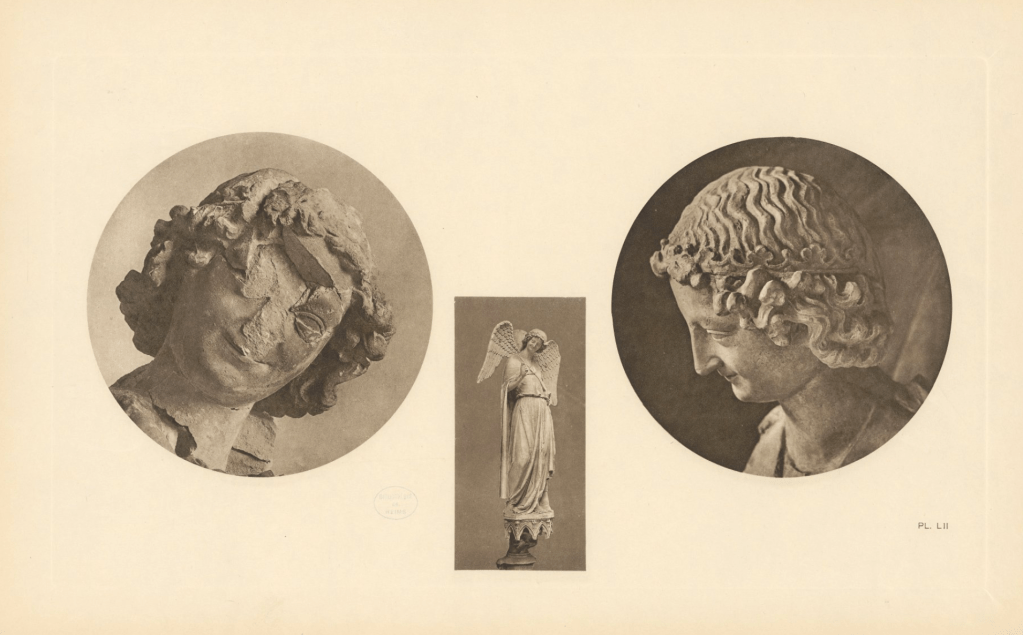
Among Robert Antelme’s posthumous writings the short text “L’ange au sourire” has a decisive place if we are to explain the transfigured theological experience of the French writer. To anyone familiar with French  architecture history the title should sound familiar, since the ‘l’ange au sourire’ was already a common expression used by French scholars of architecture during the interwar years. Charles Sarazin, arguably the most important scholar of the architecture of Reims, penned a separata titled “Le Sourire de Reims” (1929), in which he celebrated the mysterious smile of the angel Gabriel that was severely damaged due to shell fire of the Cathedral during the fall of 1914 [1]. But a decade prior to the destruction, art historian Arthur Gardner, in a detailed essay on the sculptures of the facade of the Rheims Cathedral, also took note of this angel’s gaze writing that: “…the angel Gabriel of the Annunciation in which the French smile has almost become a grin, the beginning of the contorted expressions frequently found over the border in Germany.” [2]. The particular aspect of this unique angel’s face that Antelme undresses from the cloak of authority is also wonderfully documented in the photographic book by Pierre Antony-Thouret, who also showed pictorial interest in the way that angel Gabriel was chipped in a large area of the right frontal relief (image 1) [3]. 

Image 1. Reims au lendemain de la guerre (1928), plate 52.

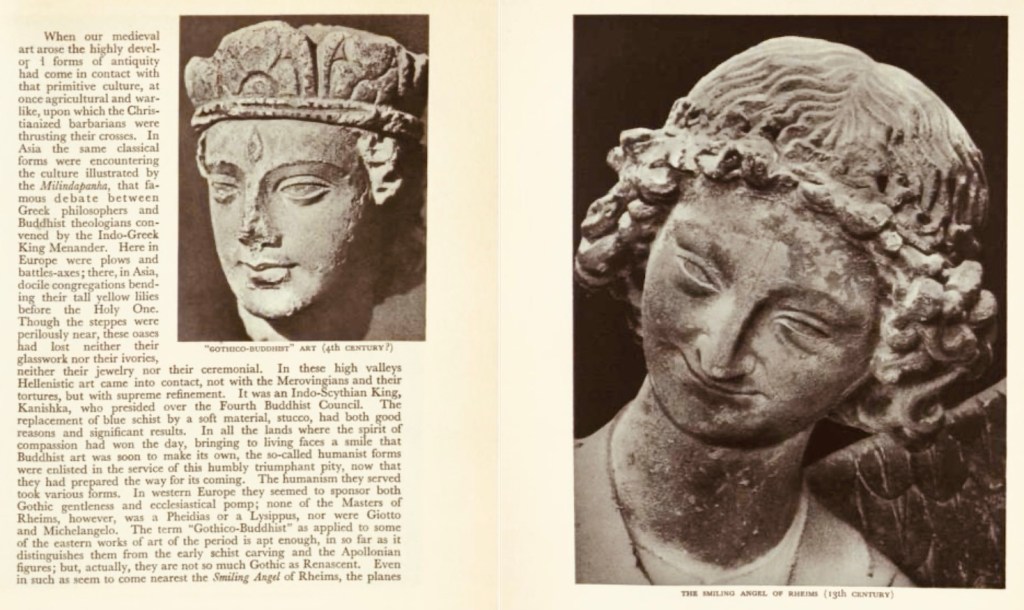
This curatorial context informs the historical background of Antelme’s reference to destruction and what he references as the crushed: “But not crushed by this building, or by that event, or by some power. It has always been crushed, crushed forever” [4]. For Antelme the tenuous, almost imperceptible, smile of the Angel of Rheims is what outlives absolute destruction because to be destroyed cannot be executed absolutely. It is the soul of existence that, because of its exteriority to history, is powerless “to have forever to be”.  Even if this being has become petrified and immobile from its original plastic appearance auf vif of sacred art. This is what Malraux captured in his brief mention of the  “L’ange au sourire” in The Voices of Silence (1951), where he also compares it to the Buddhist faces of Oriental sacred art (image 2): “The Smiling Angel of Rheims is a statue whose “stiffness” increased with every century; but at its birth it was a similar incarnate, a face that had suddenly come alive – like all faces sponsoring a discovery in the field of the lifelike” [5]. In order words, to see in the muteness of the face the nothingness that allows expressive relations to emerge in the open. This holds for Antelme’s description as well: “Radiant or hidden, inevitably it is there. Word, image, music: everything expresses it, and nothing. It lies at the heart of that realm where all relations are born. Forever starting anew. Possessing nothing, capable of nothing, it must be there, forever”. 

Image 2. Angel of Rheims in The Voices of Silence (1964).

But what Antelme was able to capture through the smiling angel of the Rheims Cathedral was not a problem of iconology of art forms, but rather the very essence of the theological problem of angels as it relates to the poetics of life itself. The angel is not a promythical figure scaled to a specific historical moment, but an instantiation of the divine appeals to the withdrawal the possibilities and modes of the human being. This is why Antelme can state that “the only transcendence is the relation between beings”. Even in its muteness, the theologica depth of the angel is the poetic speech of divinity through a surge in language that has no end, but only celebration or hymnology.

This is why Erik Peterson writes towards the end of  “The Book of Angels” about the intimate relation of angels in human existence: “A human being can draw near to the angels because the angel too – as its name already indicates – can draw near to humanity. […] The angels are more than poetic ornamentation left from the storehouse of popular fables, they belong to us. For us, they stand for a possibility of our being, a heightening and intensifying of our being – but for the possibility of a new faith…as a passion for mental clarity and an authentic existence” [6]. It is fair to say that, although the figure of the angel does not show again in Antelme’s work, all of his vision and witness accounts in the face of political horror must be placed in the endless vigil of a nocturnal life that is shared with the ethos of angels (utirur vigilis, angelorum vitam procul dubio meditatur). 

Notes 

1. Charles Sarazin. “Le Sourire de Reims” (s.l.n.d, 1929). 

2. Arthur Gardner. “The sculptures of Rheims Cathedral”, The Burlington Magazine for Connoisseurs, V.26, 1914, 64.

3. Pierre Antony-Thouret. Reims au lendemain de la guerre: la cathédrale mutilée, la ville dévastée (Jean Budry, 1928). 

4. Robert Antelme. Textes inédits sur l’Espèce humaine (Gallimard, 1996), 14.

5. Andre Malraux. The Voices of Silence (Secker & Warburg, 1964), 317. 

6. Erik Peterson. “The Book of Angels”, in Theological Tractates (Stanford University Press, 2011), 139.

Nuclear deterrence and Christian silence. by Gerardo Muñoz

Almost at the end of the Cold War, arguably the most important natural law jurist of the West, John Finnis, published a very acrimonious and provocative essay in dialogue with the Christian theological morality and dogmatic tradition entitled “Nuclear Deterrence and the End of Christendom” (1988). In many respects, this essay speaks volumes to our present, but it also solicits new questions around limits that have been severely traspassed in the current atomic age headed towards extinction. It is worth noting that from the outset, Finnis reminds us how a fellow Catholic liberal theologian, Jacques Maritain in a lecture of 1955, claimed with surprising conviction that “America is today the area in the world in which…the notion of Christian-inspired civilization is more part of the national heritage than any other spot-on earth. If there is any hope for the sprouting of a new Christendom in the modern world, it is in America…” [1]. If this sounds completely analogous to the current program of “national conservatism” that today animates American political elites, defined by the ruthless attempt at the convergence of instrumental Christian vocation and political imperium, it is because these prophetic words have been thoroughly realized. 

Finnis does not hesitate to put his thumb on the theological monstrosity maintained by Maritain at mid century – although he does not say it explicitly, it is a concrete restitution of imperial Eusebianism decades before denounced by Erik Peterson in his famous essay on political monotheism – that by accepting nuclear deterrence as a form of uncontested ‘minor evil’ in face of the Soviet menace Christians were endorsing heretic positions at odds with the teachings of the Second Vatican Council. As Finnis argues, the logical structure itself of nuclear deterrence, precisely due to its affirmative promise to exclude “target populations”, fails to differentiate between combatants and non-combatants in an endgame that promises the potential massacre of innocent human beings [2]. This means, first and foremost, that nuclear deterrence (as well as its new preventive forms that have become normalized among global hegemonic powers) terrorize human communities as a direct public act of forthcoming devastation [3]. 

Even though Finnis does not stop to reflect about the notion of “public act”, it is very clear that this action, insofar as it is a linguistic act, aims at the effective cancellation of the possibilities of language and communication. Nuclear deterrence and proliferation are instruments that speak publicly, and that by doing so, it contributes to the atrophy of human language. As a rebuttal to Maritain’s celebratory artificial gnosis, Finnis sees in the language of nuclear deterrence coincides with the language of ‘utopia’ as a new absolutization of morality. This means that Maritain’s philosophical error – which Finnis calls the “theologian’s position”, since it also implicates an official sector of the Church – is to abandon practical reason of allocated goods (including human life) in the name of a comprehensive aim of building a civilizational “Christendom” coupled in a national community [3]. But whoever fully identifies the spiritual-providential realm with the political-legislative order is already at the mercy of an utopian project embedded in the sacrificial structure promoted by nuclear deterrence.

Towards the end of his essay, Finnis laments (implicitly repeating Karl Barth’s well-known 1930s essay but in an opposite direction) that the relationship between Church and State from the point of view of the atomic age and nuclear deterrence has now been completely altered. From now on, the atomic age demands a Christian vocation based on conscience. Specifically, Finnis calls for a position of refusal and minoritarian observance against the general options of radical evil: “The choice to reverence human life by refusing to participate in public choices to destroy it, is thus a choice is material of the Kingdom and has real and truly lasting effects…even when worldly wisdoms understand it only as a choice of greater evil’ [4]. And citing Cardinal Ratzinger, Finnis endorses the position of Christians as “belonging to a minority” finding courage in nonconformity within the normative order of social space [5]. The Finnis-Ratzinger’s position was still oriented by a Catholic commitment to dogmatics and public reason and virtue, which depends on the luminosity of the subject of religion. 

But the objection of conscience is a subjective reduction of modern secularization. In this sense, it might be pertinent to compare Finnis’ position to Ivan Illich’s own stance in the wake of nuclear testing in Germany in the 1980s, which he witnessed in “horrified silence…in order to make the horror visible” [6]. For Illich, who had come to see the triumph of civilizational mysterium iniquitatis in the institutional deformity of the conspiratio of the human species towards controlled subjectivity (conjutario) amounting to “intolerable realities”. The language of Christian prophecy is not the same as the language of silence, because only in the second we can become witnesses through the voice of pain and experience, because pain can uplift a contact with the world without redemption. As Illich made clear in his text “The Eloquence of Silence”, it is through the condition of silence that the word can become flesh and prepare a new life. It is very telling that in a later footnote to the essay in the 2011 edition, Finnis appears doubtful about the religious ground stating that: “Over twenty years later, the unsatisfactory state of Catholic teaching on the matter remains just as it was in 1988” [7]. What changed? At the end of the eighteenth century Novalis had noted that for any orientation of public reason in the West to materialize there needs to be a substrate of the divine mystery, but this is precisely the substrate that desecularization has effectively untied and obliterated from the public. A public where general annihilation percolates without restraints.

Notes 

1. John Finnis. “Nuclear Deterrence and the End of Christendom” (1988), in Religion and Public Reasons, Collected Essays: Volume V (Oxford University Press, 2011), 

2. Ibid., 280. 

3. Ibid., 286-287.

4. Ibid., 288.

5. Ibid., 289.

6. David Cayley. Ivan Illich: An Intellectual Journal (The Penn State University Press, 2021), 80. 

7. John Finnis. “Nuclear Deterrence and the End of Christendom” (1988), 290. 

We are all mystics. by Gerardo Muñoz

It is too often that we hear a common critique raised against the theoretical skepticism of the primacy of politics in the form of an alleged prefigured “mysticism”, as if the destructive operation against sufficient political reason would entail an ineffable silence. It is a striking claim because there is some truth to it. But we must also question its assumption: can the proponents of political primacy ascertain a ground that can escape the mystical position that it seeks to avoid? The task of intellectual history is infinite and rewarding, but that does not mean this enterprise can positively mobilize a breakthrough within the epochal collapse of modern politics. If this is true, then it would follow that everyone is, more or less, a defaced mystic, insofar mysticism is the condition that runs against the limits of language and the current of the negative. In the same way an American judge famously said that ‘we are all [legal] originalists now’, one could very well say that ‘we are all mystics now’. It all depends where we put the emphasis and the tone. 

If we are to reject the totality of political administration and intraworldly legitimacy, this does not necessarily mean that we can immediately sketch what a coming politics would look like. According to Karl Barth in his Ethics, the position of mysticism always denotes a weak “us” that emerges from disobedience with respect to the world; concretely, against the system of planning and delegated orders (schools and the police). So mysticism is an archirealist position because it traverses the world, but only to depose the transcendental closure of its authority. In this way, the skepticism against the mystical position, perhaps unconsciously, is also an indirect skepticism against anti-social stance that is deficient from the vantage point of advantageous political realism. But the insistence of political realism is only anti-mystical on the surface, because it depends on an article of faith on the social reproduction and the overall general political economy between subjects and objects, value and the administration of life. 

The mystic cannot be confused with a guru, a magnetic theologian, nor a priest in robes. On the contrary, the mystic is a sibling to the pícaro, a figure of the Spanish Golden Age, that made his life unarrating the social protocols of the emergent social space, revealing and subverting the “autoridades postizas” (fictional authorities) of his epoch, according to the beautiful formulation of Santa Teresa de Ávila. Whoever has read any of the Spanish picarescas will immediately recall that the pícaro does not endorse static or monastic life of interiority, he upholds a temporality of life that coincides with the events of a world that becomes unfixed and betrayed. And the pícaro lives and outlives himself in this gestaltic confrontation. This vital mysticism in how he uses the world is more practical than any political justification for consensual common action.

It is worth noting that Carlo Michelstaedter in a gloss on courage and the persuaded life, divided the world – and his world was that of the Austro-Hungarian interregnum, a transitional epoch of decline filled with specters and monstrosities, very much like ours – between mystics and the dishonest or tricksters, but only the first could be named “heroes” because only them knew the secret of their unique persuasion unto death, renouncing to petty morality, self-interest, and social orders [1]. The mystic inhabits not just the silence that arrests the truth for which he cannot speak; more fundamentally, he also exerts, in every act, the task of freedom as embedded in thought and contemplation of the soul, that according to Michelsteadter is a personal struggle that bends to the real gnosis, “because to know oneself is ultimately to know the universe and to name it…only there is life” [2].

Notes 

1. Carlo Michelstaedter. La melodía del joven divino (Sexto Piso, 2009), 43. 

2. Ibid., 53.

Prados Such’s Dormido en la yerba (1953). by Gerardo Muñoz

Emilio Prados Such’s postwar book Dormido en la yerba (1953), long out of print since its publication, is the most clear and straightforward literary document of a poetic voice that stands as one of the foremost attempts at thinking the nexus of existence to the divine in the tradition of the twilight of the gods. Dormido en la yerba (1953), albeit its direct Lucretian overtone, does not enact a metaphoric appeal of a return to the physis of nature; rather for Prados, to dwell, imagine, and inhabit language is only possible in coexistence with the caducity of the natural world including life itself. In the poem that names the book, “Dormido en la yerba”, Prados writes that “La vida se te va / y tu te duermes sobre la hierba”, at first sight claim on appearance that seems to endorse the tempus fugit motif of the Spanish Renaissance verse. However, the temporal course in the poem is immediately redirected to a mysterious proximity that befalls existence in nature’s shadows, plunging the voice into the depth of the abyss that colors the caducity in a place. At this point, we note that Prado’s poetics is traversed by a mystical register that transfigures the temporal continuum with that of making of space that is eternal because it has neither end nor beginning. 

It is in this sense that Emilio Prados’ theological drift in his poetry is neither about making transcendence palpable through the animation of the world; nor does it imply the absolute immanence of the divine presence towards a new reenchantment of the world. The status of the liberated theos in Prados, like in the mythic understanding of the platonic “gods of place” (theos aisthetos), is an event that can only take place once existence is attuned to the minuscule surrounding of the world. This means that there is never a “God” as a matter of a divine economy that orients a moral predicament; rather, as Maria Zambrano argued in an essay on his work, Prados’ instantiation with the divine is always expressed in the most diminutive melody of the common things as they are. A way of multum in parvo such as the “diminuta yerba”. Hence, God is not the agent of creation of individuation, rather God is an “idea” that expresses in each thing that we are affected to, such as every blade of grass, the spacing of the clouds, the invisible direction of the wind, a human face.

The event of the divine, thus, is not a matter of mental or international faculty between objectivity and consciousness, existence and the natural world; the irruption of the divine names the genesis of appearance and disappearance. And this means that the divine (Dios) is ultimately an affection of the soul, that animation that provides birth and death as relations that move world. It is for this very reason that Zambrano could claim that the opaque sun irradiating Prado’s work is disclosed by the “dios que está naciendo”, or the god that is birthing [1]. Of course, the birth of God is far from being a transcendental revelation that weaves the history of salvation; in the manner of Meister Eckhart we can say that the god is nothing else but the affection that makes his birth take place in the soul like a harvest; that is, leafy, bright, and green [2]. God is the possibility of sensation in the world that is ineffable because it is always on the path of natality. For Prados, the eternal dimension of the birth of gods is only temporary because it presupposes spacing; it presupposes being thrown somewhere, like in the lucretian trope of lying happily above the grass. Above the grass and infinitely outside the world, dwelling and world are irreductible whenever they come into its uttermost nearness. To dwell – which is the central meaning of laying on the grass – on the crust of the Earth is to liberate God, and the liberation of God is what allows us entry into the world. 

As Prados wrote in a remarkable letter to his friend Zambrano in March of 1960: “Un cielo sin reposo” que es Dios: Dios no quiso morada y nosotros, como tú dices: edifica que te edifica… Y Dios, sin reposo. No buscamos reposo para Dios y nunca lo tendremos… En la guerra, me acuerdo, unos campesinos prendieron fuego a una iglesita en lo alto de un monte. Cuando bajaban, lo hacían como iluminados y decían: “¡Hemos libertado a Dios!” ¿No es hermoso eso?” [3]. To liberate God from dogmatic commands is also the liberation of world as detachment. There is dwelling for us, but never for the unresting divine presence of god. 

Notes 

1. Maria Zambrano. “Emilio Prados”, Cuadernos Americanos, Vol. 126, 1963, 165. 

2. Meister Eckhart. “Sermon 2”, in Selected Writings (Penguin Books, 1994), 116.

3. “Un cielo sin reposo. Emilio Prados y María Zambrano: correspondencia” (1998), El Colegio de Mexico: https://muse.jhu.edu/pub/320/oa_edited_volume/chapter/2584791 

The necessity of Penia. by Gerardo Muñoz

It is well known that Aristophanes’ late comic work on wealth, Plutus (388), provides us with what is perhaps the most dramatic and conceptual elaboration of the mythic personification of poverty (Penia) of late antiquity. What is remarkable is that in her self-presentation to the character Chremylus, Penia draws on a political parallelism that colors the ongoing crisis of governance of the ancient polis. If the Greek comedy is dependent on the function of the pólos (which is the vortex of movement that makes possible grasping the specificity of the being that is said), always prior to the arrangement of the polis, then it would follow that Aristophanes’ commentary on the centrality of Penia is neither mockery nor irony within the structure of the play, but rather an element fundamental to the historical presentation of the consciousness of historical public life. The emergence of Penia in Plutus is recorded in the lines 550-554 (a paraphrase might be adequate here): “Thrasybulus and Dionysius are one and the same according to you. No, my life is not like that and will never be. The beggar, whom you have depicted to us, never possesses anything. The poor man lives threfitly and attentively to his work; he has not got too much, but does not lack what he really needs” [1]. Poverty is an intimate relationship with needs; perhaps an unsaid relation, but one that must be accounted for nonetheless.

At her entrance into the play, we are told that Penia’s complexion is both mad (makaron) and tragic (tragōdikon); she could very well be an Erinyes companion from the underworld of the dead. Penia as a mythic figure is a fullfilled form of life. More importantly, what is crucial in the Plutus is that Penia defines herself in sharp contrast to the life of beggars or ptochos. This means that while the penetes is tied to a constitutive need as condition for a form of life; the ptochoi is a being that merely lives in a state of survival, and endures his absence of proper needs. Because Penia is contrasted to the destitute life embodied by ptochos, she can state in one moment primacy over wealth: “all your blessing….you have all that you need in abundance, thanks to me” [2]. Hence, as it has been noted, the irrevocable presence of Penia in the polis is the condition of possibility for Ploutus, god of wealth and abundance, shown in ancient representations as holding the flourishing cornucopia from the fertile harvest season. 

What is important to note is that the close and fluid relationship between Ploutus and Penia; that is, between abundance and need, far from being opposition is relational and nourished by its pólos. In this way, the being of need, the penetes, is only able to flourish if he is capable of attaining a free relation with its desire of its vital making, and not from an external power that can determine the functions directed to abstract modeling of population survival. If Aristophanes’ Penia is defined against the ptochos is not because there is a difference of degrees in terms of dispossession, negative or quantitative, but rather it is because it is a disjointed relationship between poverty as a transfigured life, and a life that become destitute because it has ceased to be attentive to its own needs. In the incommensurable ground of the polis, it could be said that the ptochoi were unformed lives that merely persisted in time on the margin of the system of relation of the human community, and for this reason they dwelled in a permanent state of apolis, since their only viable horizon was the result of economic abstraction for secondary needs. In other words, the beggars of the apolis are ultimately effects of economic forces that they do not control, precisely because they no longer have any existential relation with the realm of necessity, that is, with poverty as understood under the shadow of Penia. 

In this sense, the condition of beggar is an ultimate economic subjection that is already beyond the sufficient limitation of needs, and thus it has lost all contact with the world. It is has become deprived of the world without being truly dead. Here, one should not forget that as Plato registers the genetic relationship between Penia and Eros in an important moment of The Symposium: “Eros is the son of Poros and Penia, and partakes of the nature of both parents, the fertile vigor of the one, the wastrel neediness of the other. As he is a mean between mortal and immortal” [3]. But the erotic soul in the last resort is nothing but the desire for immortality; and, as a daimon, it mediates between passions and the beautiful, between the divine and the mortal, between need and wealth towards the depth of a harmous life [4]. As Sandrine Coin-Longeray has shown in her exemplary study, Penia (πενία) exceeds the effective qualification of the “good life” based on labour; rather it is a route of life that outlives itself in the erotic transfiguration of world towards the preservation of irreducible homeostasis of common life [5]. 

This is why Plato’s conception of the ‘happy city’ or the kallipolis was imagined as a deposition of the process of abstraction between “rich” and “poor” that ultimately has come to regulate the modern organization of social rationality proper to accumulation, production, and distribution to supply to rhe demand of ever expanding secondary needs in the general field of consumption. As Plato writes in Book III of The Laws in a section precisely dedicated to showing how to bring civil war to an end: “Because of all this, they were not intolerably poor, not driven by poverty to quarrel with each other; but presumably they did not grow rich either, in view of the prevailing lack of gold and silver. Now the community in which neither wealth nor poverty exists will generally produce the finest characters, because tendencies to violence and crime, and feelings of jealousy and envy, simply do not arise” [6]. The civilizational path undertaken by West since the rise of institutionalized isonomy could not be but exactly the opposite of the platonic deposition of the autonomy of alienated classes. Today it is all too apparent that every sphere of social reproduction stimulates a ferocious race to the bottom between a kleptocracy and a vast administered population of ptochoi that, precisely because they have no relation to Penia, is left pursuing compensatory reactions within the social mechanism of organized begging that they are forced to endure. Under the oblique light of Penia, it becomes clear that both redistributionist policies through state institutions, as well as the autonomous market initiatives of financial models tend to be two sides of the same defense of abstract abundance on the back of the human community of penetes

The negative subsumption of material needs, and thus of poverty into quantifiable assets that characterize abundance and growth at a civilizational scale – with the collaboration of all modern political ideologies without exception always oriented towards production – has contributed to thwart the path of Penia that is necessary to live freely between passions and needs. This is why in his 1945 lecture “Die Armut” (“Poverty”), Martin Heidegger, departing from a well-known intuition from Hölderlin, claimed that ‘being-poor’ does not mean the absence of some property or substance, but a relation to needs; because only in poverty do we preserve a free relation unto what we need (not-wedigkeit) as necessary. And only this can be taken as the true and ultimate wealth: ‘we have become poor in order to be rich’, means that only through the preserving necessity of Penia will there be a liberating dislocation for human life beyond the indigence of mere exchange and the endless struggle over material goods and the private property. As the world becomes a more vast wasteland of beggars and disposable bodies at the service of technology, Heidegger, in Eckhartian tenor, was not wrong to claim that poverty and Penia will ultimately be the ethical destiny of the people of the West only if they become attune to the divine overtone of poverty as their destiny. Thus, the only possible abundance in a declining world can be realized through the enduring necessity and disquiet return of the essence of poverty – to come near the nothing, because there we find the dearth of the earth. Indeed, as Penia says in Plutus before leaving the stage: “One day you will speedily send for me back” [7]. 

Notes 

1. Aristophanes. Plutus (Loeb 1946), 550-555, 421. 

2. Ibid., 501-511, 409.

3. Plato. The Symposium (Penguin Books, 1987), 203b, 82. 

4. F. M. Cornford. “The Doctrine of Eros in Plato’s Symposium” (1937), in The Unwritten Philosophy and Other Essays (Cambridge University Press, 1950), 74. 

5. Sandrine Coin-Longeray. Poésie de la richesse et de la pauvreté: Étude du vocabulaire de la richesse et de la pauvreté dans la poésie grecque antique, d’Homère à Aristophane: ἄφενος, ὄλβος, πλοῦτος, πενία, πτωχός (Publications de l’Université de Saint-Etienne, 2014), 153-56.

6. Plato. The Laws (Penguin Books, 1975), 122. 

7. Aristophanes. Plutus (Loeb 1946), 630, 421.

Dialogue with Jacques Camatte (1935-2025)

The passing of Jacques Camatte (1935-2025) a week ago from the writing of this text recalls a life that ostentatiously lingered in thought, and a thought that was entirely enmeshed and intertwined in the irreducibility of life. For some of us that had the good fortune to interact – however briefly and momentary, although every contact is always destinial and inescapable – Camatte transpired generosity and authenticity, and his voice evoked an almost Adanic happiness that has become rare among human beings. A common friend these days has recalled that somewhere in Camatte’s writing there is an endorsement of a capacious phrase from Chernyshevsky that could very well serve to remember his enduring ethical pursuit: ‘we have finally understood that the Earth is a place of life rather than judgement’. The opening the Earth as a dwelling place for life forms means that it is insufficient to conceive of domination as an organization of modes of production, since capital is first and foremost a spatial-temporal arrangement towards the future of the human species, and thus of a certain conquest of the world sensuous life. 

This was the outstanding triumph of real sumption: the modulated and ongoing alienation of the human community (Gemeinwesen) into a community of capital that has arrested time of life to the point of adjusting it to homogenized agony of historical time. Against the dynamic of revolution and counter-revolution that theologically exported the polarity of the eschaton and the ho katechon, already in the inception of 1970s Invariance Camatte called for an exteriority of any philosophy of history in order to rework of “a new relationship between human beings and nature”, and “breaking the lock that inhabits the creation of a new form of life”. The two citations in dialogue with each other come from “Against domestication” (1973) and the introduction to Urtext: frammento del testo originario di Critica dell’economia politica” (the 1977 Italian edition curated by Gianni Carchia), although these are variations from the depth of the emergence of the invariance of truth as a vantage point of the world. At the center is a form of life that renews the world that transitions beyond all forms of metaphysical logistics of appropriation, mere standing reserve, and the general arrangement for the mobilization of production. Any point of departure against domestication measures itself against the totality of this fluctuating dominion.

As it has been said of other great thinkers, Camatte’s ultimate passion was rooted in thinking one idea to the end and not of endorsing a system of concepts. For him it was the schism, that is, how to undo the historical process of domestication of a fictive community against the absorption of the increasing autonomization of fictive capital. The schism against the capitalist general equivalent also demands advancing a secondary schism against all humanism and its originary separation from nature. In schism, there is something of Gaunilo of Marmoutiers’ “thought of the word alone” that is receptive to the movement of the soul tries to account for the perceived voice. This precisely what Camatte carried as the lesson from Bordiga’s idiosyncratic original communist program: a movement against the historical benchmark of the development and political economy of growth, which will entail the exhaustion of the revolutionary horizon driven by an ideological political technification that tends to deepen the power towards the positionality of epochal nihilism expressed in the revitalization of strife and the ‘errancy of humanity’ (contrary to Martin Heidegger’s notion of errancy as a play between unconcealment and truth, for Camatte errancy is another name for the civilizational narrative that exemplifies the withering of the  human community into organized and protracted social reproduction and historical abstraction). Hence, as for Bordiga, Camatte conceived the ontology of communism as a world view (not as a political program oriented by concrete historical subject or distributive economic reproduction; not a soteriological dogma nor a transhistorical material idea); that is, broadly speaking, thinking the relationship between the human beings and the earth. A question more pressing than ever given the current planetary conflagration, which exposes the civilizational course that has lead to an inhospitable world where the survival of the human being has become the byproduct of an effective hostis of the community of capital integrated to the global surplus value accumulation.

In Camatte’s unrealized thought – but perhaps all forms of thinking are so – the bordigist gesture persists in locating the schism at the threshold of the force of real subsumption of the anthropomorphization of capital, where the notion of revolution itself is transfigured since, unlike Delacroix’s paradigmatic romantic painting, ‘liberty’ no longer guides the spirit of the “living”. Its redeeming voice also carries downwards unto the depth of the souls of the dead. Amadeo Bordiga himself in “Dialogato coi morti “(1956) writes that “The Revolution…it is always, in the course of an immense historical arc that will close as it opened and where it promised, where it has an appointment with many of the living, but certainly with the unborn, as with the dead: they knew that it never fails, never deceives”. True life can also take place with the nearness of that which seems remote (as Gustav Landauer once claimed: “For me, the dead also live”).

If both the collapse of the future and the increasing adaptation of social life has entered a gnostic dialectic of endless self-legitimation, it is paramount to capture not just the insurrectionary, but the resurrection flight in Camatte’s gesture that opens possibilities lodged in the dead as an emblem for the return to the world “full of joy and exuberant life”, as he wrote in an apostrophe in “Scatologie et résurrection” (1975): “I will draw from mother earth the vital and infinite power and I will resurface full of wisdom, joy and an exuberant life which will allow me to reach this human community…I will have left your world and been resurrected!” Does holding on to the unity of the Gemeinwesen require a theological undercurrent? Is not the passion for schism, and by the same token the stazion, the energy within the very dispensation withheld between mystery and revelation that has prompted the congenital forms of formal mediations and institutions for the political community? These are the questions that we are exposed to in the enduring task if we are to take seriously a continuous ‘dialogue with Camatte’, which carries the voices of the dead. Ultimately, any authentic conversation that dwells in thought does not have to invent anything new; we are depositories of an endless communication that is handed over, interrupted, and transmitted to anyone willing to hear and capable of being traversed by the shared word. 

In his last year of thinking, Camatte insisted on the notion of “inversion” in the wake of the civilizational phase of extinction, which would require deposing all forms of hostilities and bringing to an end the partisan positions invested in orienting technology and morality (nature) in their seditious defense of the real dominium over the passing of the world. For the current depressing (and depressed) times, writes Camattes in “Instauration du risque d’extinction” (2020), what could very well be a prelude to a return to the repressed allowing a return to the past to initiate an inversion that would allow liquidation of lall exhibition abandoning enmity. This is why, as he told me in an exchange that we undertook five years ago, “inversion cannot be a strategy, as it is totally outside of politics, which is the dynamic of organizing people, of controlling them”. A breakthrough, then, only as a mystical downwards leap into the past? Absolutely – but only insofar as the mystic is the ethical witness to his own openness to the word, and whose exodus from the social machination prepares a return to the world beyond the flattening and dominant language molded by rhetorical dishonesty or passive narcissism of the subjectivity.

This is why according to Carlo Michelstaedter to have courage in the world means to decide between two irreducible figures: the dishonest trickster, or the mystic in the desert. There are no third terms in between. And whereas the dishonest subject knows how to play the hand to his best outcome in each given moment; the mystic knows that his decisive moment is always commencing because the genesis of the human species has yet to take place. This beginning is always at the brink of an untimely auratic experience. And aura names the incommensurable distance from the rational containment of the world — unlike Teilhard de Chardin’s internal introspection in the noosphere that will bring the fullfilment of a spiritualized humanity upon Earth (realized in part by the unification of the sciences by cybernetics); in other words, an exodus from the temporal nominalism that inhabits another life attuned to its genesis: “devenu-devenant ce monde et sur cette vie autre au moment où s’effectue sa création”, he writes in “La séparation nécessaire et l’immense refus” (1979).

The visitation of Jacques Camatte in the world bears witness to that invisible freedom of the human species ready to jump and traverse the catastrophic trumpeting into the living and the dead, making possible the refractions of thinking as original texture of existence. From now on, the exodus from the immanence of this world will embrace a disempowered but perpetual dialogue with Camatte’s demure schism of the living. Indeed, we are always on the path to an earthly beginning. 

The world has been posthegemonic. by Gerardo Muñoz

In a recent text published at Verso Blog, entitled “The Coming Post-Hegemonic World”, Michael Hardt and Sandro Mezzadra make a case for a “turn to a post-hegemonic model” that will challenge the consensus of global in the coming era. In many ways, this era is already here with its diverse and multifaceted (in terms of intensities, forces, and leverages) of protracted and bizarre nationalisms, which as Jamie Merchant has teased out brilliantly, amount to desperate attempts to offer a belated response to the decline of growth as one more stage for containing rampant processes of accumulation via state capacities. For Hardt & Mezzadra, this “posthegemonic world to come” is characterized by a global spatial reconfiguration of capital – accommodating the logistics of regional spaces of influences and exchange across the planet – and on the other, an increasingly “domestic sphere of authoritarian rule” promoted by new accelerated initiatives at generating social homogeneity in the wake of rushing fragmentation hand in hand with a war regime that has utterly scrapped ideals about “strategic autonomy” in order to trumpet an arm race (nuclear weapons included), as it is currently unfolding in Europe. 

One can claim that this posthegemonic world is one that firmly assumes the consequences of two interdependent vectors that imploded within the project of political modernity: the end of  economic growth (thus validating the law of the fall of profit outlined in Capital V.III), and the liquidation of the principle of legitimacy that for two centuries accommodated the legislative sources of the state authority in democratic constituent power. For Hardt & Mezzadra posthegemony means global fragmentation, authoritarianism, and spatial remaking; however, one should also say that it means, the opening towards stagnation, the collapse of political unity of the state, and most recently the total discredit of the foolish leftist hypothesis that promoted a “rainbow social equivalent coalitions” to push for compensatory, and in every instance insufficient and moribound, populist resurgences elevated through the combustion of ethereal but effective rhetoric (in fact, my argument in a new short book, La fisura posthegemónica, is that the push for political hegemony of the last decades only cosigned forms of consensual totalization at the expense of the production of subalternization and social death).  

Even taken as a descriptive and normative condition of the current state of Western politics, the posthegemonic situation lays bare the reciprocal impasse of the claim of its opposition: in other words, one should also put to rest social mobilization that characterized the politics of High Modernity, since ultimately movements (and total mobilization as an apparatus of social energy transfer) presupposes that “every social structure, that it can receive what form required the needs of the political adventure…total mobilization signifies nothing other that the effort to reduce the social substance to a kind of plastic”, as Gérard Granel once defined it. Hence when Hardt & Mezzadra claim that the “effective rebellion must be rooted in social movements envisioning a life beyond the rule of capital”, they are inadvertently refusing to come to terms with the factical posthegemonic reality that they are describing, which is no longer driven by expansive economic growth, but rather by stagnation, and inoperativity at planetary scale that is maintained through the a global veneer of production into regimes of competitive accumulation (of territory, contractual debt, fiscal regulation, executive taxation or tariffs, and increasing arbitrary monetary regulations in the global system) for marginal profitability, as Paul Mattick argues in his recent The Return of Inflation (2023). 

This means that there is no outlook towards ‘social mobilization’ that does not serve the subjective productivity of real subsumption, since its ultimate goal is to anaxate social energy into the force of (un)productive labor. This form of dilatant mobilization can only serve the master of illusionary hegemony, and thus promote functional and unwarranted servitude everywhere. Indeed, only a reprobate can be immune to the moralist or the realist conditions of hegemony. If push comes to shove, the posthegemonic factical world of stagnation and political fragmentation already here proves that the ongoing irruption of non-movements are irreducible to the modern movement’s energy; and that life never fully coincides with political claim to rule and legitimacy, even less so in the becoming-world of Production. 

Ultimately, this posthegemonic fissure outlives the crumbling hegemonic world of principial High Modernism and no ‘international movement’ can piece it back together again. We are all posthegemonic now, but only if one takes up this predicament seriously and candidly.