The bruised souls. by Gerardo Muñoz

Whenever a professional politician today evokes the ‘soul’ one must be immediately suspicious, as it tends to be an automatic lullaby for “national unity” or a dormant metaphor in a flowing stream of empty chatter. What could the soul mean to anyone – say, those millions that have now for the second time voted fairly and squarely Donald J. Trump to the Executive branch of the national government – only capable of giving attention to a series of onomatopoeic pop-words that are now ingrained in the linguistic acoustics of the American lexicon (“Bitcoin”, “Tiktok”, “Woke”, “Prime”, and the list could go on). The ongoing catastrophe is first and foremost within the texture of language, which is ultimately why it is also an ethical decomposition in which all other spheres of practical action (first and foremost, politics) amount to business as usual with its corresponding rhetorical bravura.

Suggesting continuity might perhaps be an understatement: it is now a business that does not need any sumptuous or veiled mediation; refracted upon its own absorption of its hyperproduction of fiction, the defeat of the communitarian salvation of Calvinism can only be expressed as a self-serving an ongoing destruction and self-annihilation. True, it could be claimed that ‘Americanism’  has always been this; the only difference is that today, already well into the century, it moves in a vector that directly rejects the world while making a full fledged program of its own making. Only a Society that has become fully moribund can celebrate its own death and decomposition; while the emancipated and well scripted villains of the act now have no shame but to reveal how the ultimate object of their conspiracy was the obliteration of the Earth.

“It is the time of the assassins”, TJ Clark writes echoing Henry Miller’s unjustly forgotten book on Rimbaud and the legitimation of the social bond, in which the homo homini lupi discloses itself from any all possible contact in the metropolis solely dependent on ad hoc hyperproduction of justifications required to fully commit to the illusion of legitimate action. Only that now the time of the assassins is perhaps an uncanny dark night of those without souls, as in the deranged characters of a McCarthy’ novel: they are willing to kill and be killed; they are beyond any contact with language, and “what do you say to a man that by his own admission has no soul? I’ve thought about it a great deal” [1]. And indeed, there is nothing to say and nothing to face: in the soulless dark night there are only hunters and those that are hunted; there is integration or pulverization; there is killing and there is humiliation before an ever increasing legal nexus coordinating the acquiescence of force. But perhaps this is the real arcana of the American soul that is only shimmering through in all of its glory.

Someone like D.H. Lawreence definitely thought so when writing about the novels of Finimore Cooper: “[The white american] lives by death, by killing the wild things of the air and earth…All the other stuff, the love, the democracy, the flooring into lust is a sort of by-play. The essential American soul is hard, isolate, stoic, and a killer. It has never yet melted” [2]. But in our days it has begun to melt, to fragment, and decompose in a heavy storm of pain and despair. And it continues to stand in the long winter of American civilization (the castle of Frozen is the allegory of the epoch) that now finds itself at the epochal threshold of the end of growth, only left with rampant nationalist impulses of self-affirmation that can only deepen the nihilist tonality of anguish and self-destruction, and the emergence of the bizarre as Jamie Merchant notes in his recent Endgame (2024). 

In his Reflections on America (1958), Jacques Maritain maintained that the spiritual patrimony of Americanism is that of being “bruised souls”, a community that came into being by double exclusion (hunted by their religion and rejected within a national polity), which in turn allowed to be compassionate to human suffering, and thus the hidden meaning of the wound was to be seeing in the “role played by immigration and poverty suffered in the Old World” [3]. Hence, for Maritain the condition for the healing soul of America resides in its opening to ongoing suffering of migrants, the dispossessed, and those in exodus from the psychic pressure of a social metabolism gone sour in every subject of civilizational decay as Erich Unger had proposed in his Politics and Metaphysics (1921).

 It comes to no one’s surprise, thus, that the decomposition of the American soul departs from the overt opposition to migration, as a figure of the grazing over the Earth, that must be vanquished and condemned by a planetary gnosticism undergoing in front our eyes. The Chrisitian modern state enters in this way into a concrete and visible process of artificial desecularization showing that “the Christian relation to the State…is in mad hostility to all of them, having in the end, to the destruction of them all. […]. And it is, simply, suicide. Suicide individual and en masse” [4].

The stakes are extremely clear: it is for the bruised and the brute (some have called it the barbarians, proprietors of strange tongues, keepers of the clandestine lacunae of language) to retreat from the fictive proliferation of appearances, the artificialization of reason that can promise success as the ultimate pinnacle of self-destruction. Inclined beneath the shadow of archaic Penia, the bruised and incurable souls might not find redemption in the American wasteland, but they will land somewhere between language and world. Not a program but a moving conviction.

Notes 

1. Cormac McCarthy. No Country For Old Man (Vintage, 2005), 8.

2. D.H.Lawrence. “Fenimore Cooper’s Leatherstocking Novels”, in Studies in Classic American Literature (Thomas Seltzer, 1923), 92. 

3. Jacques Maritain. Reflections on America (Scribners, 1958), 84-85. 

4. D.H. Lawrence. Apocalypse (Penguin Books, 1995), 148.

Pasiones de Giorgio Cesarano: introducción a un dossier. por Gerardo Muñoz

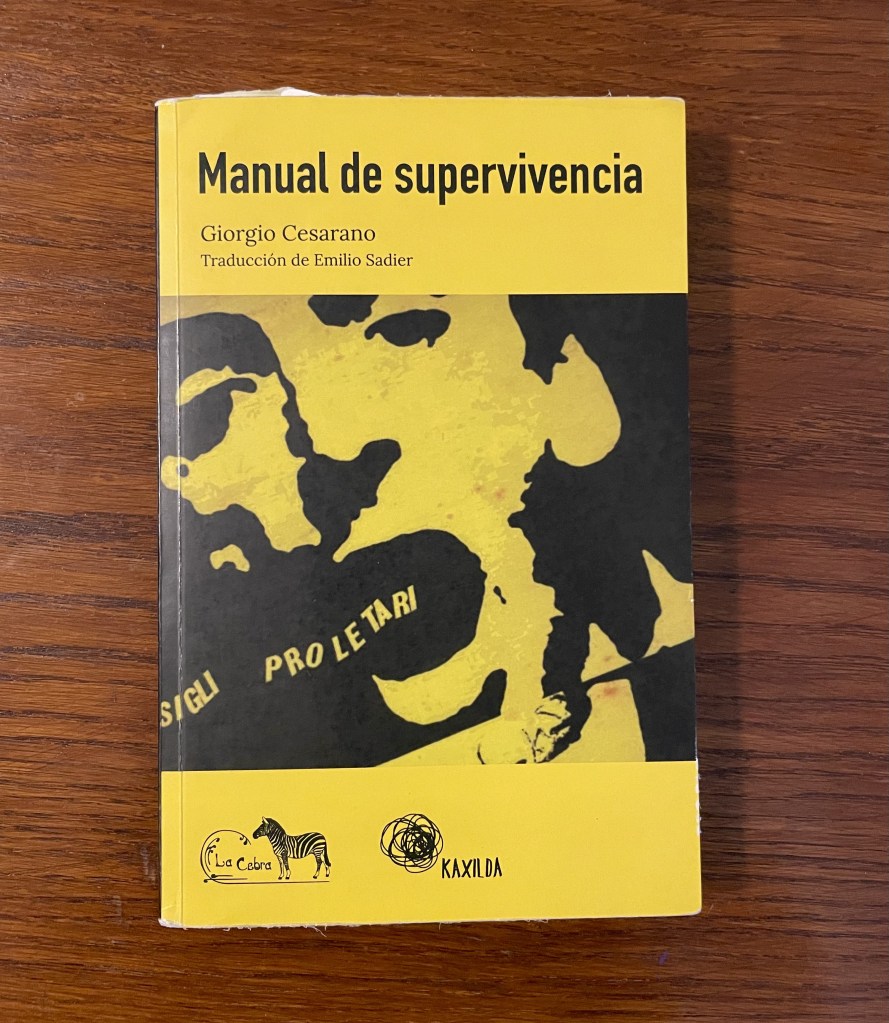
¿Es posible seguir insistiendo en la apertura del pensamiento contra el cierre de la época incrustada en la elipsis infernal de la supervivencia ventilada en las sombras del desierto nihílico y entregada a los aparatos de la reproducción social? Escribiendo en la convulsa década de los setenta – y que algunos pensadores han llamado, no sin razón, el “big bang” de la transformación geoeconómica del mundo donde la revolución queda finalmente liquidada – la apuesta de Giorgio Cesarano en Manuale di sopravvivenza (1974) -y su antecesor Apocalisse e rivoluzione (1973) co-escrito con Gianni Collu – sigue constituyendo un esfuerzo desmesurado y singular por encontrar una bifurcación por fuera de las anquilosadas formas de la antropomorfización capital que entonces ya aparecía como como el destino catastrófico de la especie humana reducido a la compulsiva maquinación de las totalidades ficticias [1]. 

En efecto, como observa Cesarano con un gran poder de síntesis: el triunfo revanchista de la fuerza de la subsunción real, en realidad, confirma que el verdadero y único objetivo del principio de equivalencia no tiene otro blanco que la usurpación de un mundo domesticado y desprovisto de acontecimientos. Un mundo hecho a la medida de las necesidades de sus inmates, tal y cómo lo había previsto John Cowper Powys en una de sus brillantes pesadillas literarias [2]. Pero este es el mundo que hemos heredado y que seguimos atravesando, aunque algunas décadas nos separen de la provocación que a la altura de 1974 Cesarano alzaba ante las herraduras dialécticas de la época. En realidad, era una provocación asumida desde la posibilidad de la afirmación de una gnosis – algo que, como sabemos había aprendido gracias al diálogo sostenido con algunos representantes de la corriente bordiguista de la cultura radical del pensamiento italiano y de su estrato poético, como lo confirma en La casa di Arimane (1979) de Domenico Ferla – aunque sin abandonar la posibilidad de un movimiento en retroceso de éxodo, capaz de integrar un nuevo programa de emancipación de la comunidad real de la especie (Gemeinwesen) contra todas las celdas de la objetualidad y sus satisfacciones reguladas.  

Un arduo primer paso: la retracción como rechazo de la hostilidad generalizada contra la presencia. Así, en un momento de Manual Cesarano podía escribía: “Ahora tener origen como fin es un programa perfectamente realista” [3]. Un realismo que optaba por abandonar el produccionismo apocalíptico al interior de la filosofía de la historia del capital en la metástasis de sus representaciones sociales. O bien, como escribe en uno de los momentos más emblemáticos contra la reificación del sujeto del saber y de la conciencia en Manual de supervivencia: “…el decrépito-infante Yo se tambalea….Se desvanecerá, morirá finalmente, lo mataremos cualquiera sea la máscara que lleve en ese instante. Porque el fin es el origen, el nacimiento de una comunidad-especie realizada, el nacimiento continuo de la presencia coherencia, la afirmación del ser inobjetivo….El fin del Yo marcará el principio de la presencia” [4]. Volver a la prehistoria, entonces, para desembotar el dominio cibernético de la optimización biopolítica administrativa de la vida que domicilia a la especie humana en el armazón de la producción de lo ficticio. Así, el vaciamiento paulatino de la vida tendrá en cada ápice de la simbolización el sol irradiante de la justificación y de la expansión del verosímil retórico de una comunidad abstracta. Por lo tanto, para Cesarano, la embestida contra la reificación del “Yo” debe su destitución a la intempestividad de la pasión del pensamiento como contraofensiva ante el ascenso depredador de la fuerza de la objetivación. Justo en este umbral Cesarano inscribe la partida para la época del agotamiento del reino de las formas y de la crisis de la legitimación política: “No es una clase de lo social, entonces, la que realizará la abolición de las clases emancipándose, sino que la negación de lo “social” y de sus clases, efectuada por el cuerpo proletarizado de la especie, emancipará a la especie de la “sociedad” como comunidad ficticia, prehumana” [5]. Apostar por particiones de valor social (el infinito juego de la hegemonía without end) solo podía perpetuar el espesor de la más rampante agonía.

De la misma manera que la crisis histórica validada por la astucia negativa del proceso infinito de acumulación apela a nuevas artes de estabilización y optimización de la abstracción Social (el paradigma de la unificación cibernética que Cesarano logra identificar en un momento de reestructuración de los propios mecanismos de la gobernabilidad del liberalismo tardío y de la consumación de la mediatización de los entes) de su propia incesante reproducción; para Cesarano toda “critica radicale” – que debe ser asumida como crítica en suspenso, más allá de todo sujeto posicional y posicionado en la estructura del movimiento humanista de la negatividad dialéctica – ya no se caracteriza por funcionamientos programáticos preelaborados mediante el rigor epistémico de la vanguardia militante o justificados en la divisa de la objetividad metodológica; se trata, en última instancia, de constituir espacios sensibles que despejen la desficcionalización absoluta de un movimiento existencial y de estilo cuyo único programa histórico se constataba mediante la inalienabilidad de la comunidad de la especie humana: la irreductibilidad de la pasión [6].

Si la modernidad consistió en la domesticación de las pasiones con el fin de impulsar el rendimiento objetivo y alienado de la diversificación de los intereses diagramados en el valor, ahora se trata de afirmar la liberación del yo como fractal de la no-objetualidad de mis pasiones sin que ésta sea entendida como una mera compensación traducida a la autonomía postromántica del arte [7]. La pasión del pensamiento en Cesarano es condición hiperbólica de una erótica que desoculta la chôra de lo inconmensurable; esto es, la distancia que marca el encuentro entre los restos del mundo natural y el uso vocativo de la lengua: “….ese paso de acercamiento, es abrazo de amor y de lucha, parece tanto más absurdo cuanto más lo cotidiano parece desierto. Es en este movimiento que cada uno podrá, encontrándose en la persistencia del deseo resistente a la aniquilación objetual, descubrir en sí mismo la presencia de ese programa histórico que es la pasión y sentirse listo” [8]. La autoafirmación de la génesis inconclusa de la pasión descentra el nudo gordiano de el terror de una vida sometida al proceso de adaptación en el que la máquina y la humanidad se cierran sobre si mismas.

Pero la pasión es el recurso que valida el recorrido ético de la apropiación de mi existencia; esto es, no es ni condición antropológica ni forma en la que puedo orientar mi relación con lo inefable del mundo. Y dado que nunca sabemos realmente qué constituye el objeto de la pasión – al menos que este dispuestos a abdicar la pasión a la matriz recursiva de lo objetual – la existencia sólo puede darse en la disponibilidad de la vida misma cuando ésta coexiste con la laguna de la pasión y del asombro en el mundo. Dicho en otras palabras, de nada vale “vivir por una pasión” como suele decir el automatismo retórico del contrabando de las pasiones y de la propaganda de agitación social; el valor absoluto radica allí donde la pasión se deja vivir en el movimiento finito de una vida que no puede ser otra, y que solo se mide con respeto a las propias conquistas o encuentros que marcan el ritmo de un destino. En este sentido, como escribe Cesarano en la glosa “Erotismo y Barbarie” (1974) que incluimos en este dossier: “La pasión es el sentido de lo sagrado que se demuestra como tal” [9]. La tonalidad sagrada de la pasión es aquello que no puede ser verbalizado como imperativo o veneración externa para la promoción servil de los hombres-masas orientados a la infinita idolatría sacrificial que, en el curso de la secularización cristiana, implicó el triunfo ficticio del ordenamiento del principio civil [10]. Para Cesarano, las pasiones de la especie es el no-lugar – de ahí que sea una chôra, un lugar de contacto imaginal con la expresión que solicita siempre en cada caso el umbral del afuera – mediante el cual la vida encuentra formas contra la supervivencia y la agobiante auto-aniquilación que el logos descarga sobre cada exigencia vital. 

Sin muchos más rodeos podemos decir que el programa de la pasión sigue abierto en una época, la nuestra, cuyo régimen cibernético-administrativo sobre todos los ámbitos del viviente ha conseguido intensificarse con mayor ferocidad en el punto más álgido de nuestra civilización. Como si se tratase de un don fortuito, la excelente y cuidada traducción en castellano del mítico libro de Giorgio Cesarano por Emilio Sadier publicada en La Cebra y Kaxilda finalmente nos facilita una conversación que, a pesar de haber sido postergada durante tanto tiempo, regresa con la intensidad y el brillo de una voz entonada desde las catacumbas para confirmarnos que no todo ha quedado obliterado. Sobre esos restos se arremolina la ascesis singular de la pasión común de los hombres póstumos tras un mundo que se eclipsa. Y de este modo regresa la conquista singular de los encuentros, la despotencialización del ego, y el recogimiento de una morada en la insondable piel de las estrías del mundo. El dossier que presentamos a continuación sobre el pensamiento y la poética de Cesarano no pretende constituir otro gesto que aquel que contribuye, a su manera, a la continua “comunicación entre almas” al interior de una época que continúa encandilada en la fuerza de la objetivación y la producción de la impaciencia [11]. Y cómo intuía Cesarano en unos versos de su temprano L’erba bianca (1959): “…la buena canción tardó demasiado, pero había que esperar en el vacío para dejar resonar al corazón. Ahora lo sabes, hoy toda fortuna se ha disipado” [12]. ¿Nos hemos disipado también nosotros? Allí donde las pasiones toman la palabra y los tintes del alma dilatan su expresión las dudas para semejante interrogación disminuye y se disipa. Así, atravesados por el timbre de la pasión, moramos en la inesencia, pero sin realmente pertenecer a ella.  

*Esta es la introducción al dossier sobre el pensamiento de Giorgio Cesarano que preparé a raiz se la publicación en castellano de Manual de supervivencia (Kaxilda, La Cebra 2024), y de próxima aparición en la revista chilena Escrituras americana en la primavera de 2025.

Notas 

1. Willy Thayer. ‘”Fin del trabajo intelectual y fin idealista/capitalista de la historia en la ‘era de la subsunción real del capital’”, en El fragmento repetido: escritos en estado de excepción (ediciones metales pesados, 2008).

2. John Cowper Powys. The Inmates (Macdonald, 1952).

3. Giorgio Cesarano. Manual de supervivencia (La Cebra, Kaxilda 2023), 112.

4. Ibid., 49-50.

5. Ibid., 130.

6. Furio di Paola. “Dopo la dialettica”, Aut Aut, N.165-166, 1978, 63-103.

7. Para la elaboración de este argumento, ver el ensayo de Gianni Carchia, “Modernità anti-romantica”, en Pharmakos: Il mito trasfigurato (Ernani Stampatore, 1984), 9-13.

8. Giorgio Cesarano. Manual de supervivencia (La Cebra, Kaxilda 2023), 75.

9. Giorgio Cesarano. “Erotismo o Barbarie (1974)”, incluido en traducción al castellano en este dossier. 

10. Carlo Levi. Paura della libertà (Neri Pozza, 2018), 120.

11. Gianni Carchia. “Tragedia y persuasion: nota sobre Carlo Michelstaedter”, en Retórica de lo sublime (Editorial Tecnos, 1994), 35.

12. Giorgio Cesarano. “A un amico”: “So che per te di troppo tardarono / il bacio dell’amata e la buona canzone / ma bisognava saper asperttare / e lungamente e a vuoto lasciar risuonare il cuore. / Ora lo sai, chiusa ogni ventura.”, en L’erba bianca (Schwarz Editore, 1959), 39.

The decaying sublime. On Gónzalez Sainz’s Por así decirlo (2024). by Gerardo Muñoz

José González Sainz’s new collection of short stories, Por así decirlo (Anagrama, 2024) offers a magisterial elaboration of the ongoing nihilism that has absorbed humanity into an autonomous object of its own shipwreck. Throughout the stylistically intricate narratives, it is easy to see that for Sainz the problem is not just about the extinction of humanity – its decline and fall, but rather about stumbling into the spectacle as if nothing is taking place. The consummation of nothingness exerts itself into the very consciousness to the point that the death of the living becomes transactional for the ongoing fictions regulated by expectation and prevention. 

Obviously, these are broad strokes that say little of Sainz’s well-known narrative pointillism, in which not only every object but every distance is carved out and polished with striking vivacity (this opposition between style and worldliness underpins the sharp contrast of the process of absorption); but, there is a moment in the first story of the book that can arguably be elevated as an emblem of Sainz’s outlook towards a world that has ceased to be so. Without giving too much of the plot, the scene takes place in a plaza of a Spanish provincial town where a pseudo-conductor has taken over a classical music show and who will commit a horrifying act that day. The narrative will minimize the conductor’s act in order to focus on the mass of spectators who continue enjoying the spectacle with mounting euphoria. At the peak moment of the narrative event we read this elaboration on truth and music:

Había leído alguna vez que la verdad es el auténtico principio de la música, y que está conmueve no es tanto porque complaza al odio como porque expresa las verdaderas tonalidades afectivas del alma. Eso es, porque su objeto es el alma. Pero si el alma está hoy desfigurada, se dejó continuar, si ya no es más que su propio espectáculo o su farce o bien ya no es nada y a lo mejor, puestos a pensar, no lo ha sido nunca, por qué no iba  a ser lo que oía la verdadera musica. Se convenció y no se convenció; es decir, se convenció de que no estaba convencido de nada” (Sainz 45-46). 

Reacting to his own bewildered reaction to the spectators’ absorption in the fictitious, the character of the pater familias realizes that perhaps even the musical redemptive quality – and that for this very reason that Plato wanted to regulate the distinct tonalities of the instruments in the Laws to charm the souls of the youth- now encompasses an immense rhetorical environment where elucidation of the sublime of art’s truth becomes impossible. As the irreducible communication between souls fades away, there is only a vicarious subject that echoes the resonances of the intruder conductor. For anyone that reads the story, it is quite obvious that Sainz is rewriting Elias Canetti’s figure of the orchestra conductor from Crowds and Power (1983). As a hypoerbolic figure of absolute power and the ‘illusion of persuasion’, for Canetti the gestural figure of the orchestra conductor embodies mastery of the objectivation of the world who cuts through the two sides of the moral predicament: what should take place, and what will never occur [1]. And very much in the vein of the kubernetes, the conductor exerts his power as the unifier of the events in the world. In other words, the dominion of the orchestra conductor is absolutely omniscient: he can not only order what comes out in every instrument, but he can also regulate the effects of the musical discharge into an enchanted uniform audience.

The orchestra conductor is the figure of an acoustic mastery where the price to be paid will be the collapse of the original sublime (hypsos) unto the autonomous form silencing the truth of the soul. This is why Gianni Carchia, reading Longine’s treatise of the sublime, defines the ancient conception of musical redemption a the condition of the communication between souls capable of repairing maladies while moving towards love (eros)” [2]. And the narrator asks rather naively: “But why can’t I not enjoy this as well? What do I see?” (Sainz 47). However, Sainz’s intruder conductor depersonalizes Canetti’s figure, since it is no longer about an illusionary act of generalized hysteria or collective hypnotism; the experience of the truth, granted by the by the sublime (hypnos), has become a matter of the steering of opinion, and the transference of brute force of decomposition. Ultimately, it is also the decomposition of language that turns the pseudo-sublime as a vessel of meaning. The movement of the tragic suspended produces a life without accidents, and the word of Lukács: “a flat and sterile, an endless plan without any elevations…dull repose in the lap of dry common sense” [3]. Through the orchestra conductor, the allure of animation becomes the last resort to bear the crushing weight of the flatness of fictitious living.

In the threshold of total integration of the spectacle, the dialectical force of absorption that once provided grounds for the aesthetic veneration of the work of art, unleashes the form of artificial sublime to endure the absence of beauty and truth once guarantee by the soul’s touch with the melodic. The fall of the sublime into a movable feast of a social attraction discloses the last stage of humanity’s errancy: living in the wordless night of endurance to merely survive.

It is no surprise that, in fact, the story ends with the pater familias retreating to his home to sleep. And from that from that day on – that is, after the conflagration with the orchestra conductor – he will become a sort vigil watchman for his son who, drenched in sweat, recounts sleepless nights haunted by nightmares of the traumatic afternoon. And he concludes: “Velar, que hermosa palabra” (Sainz 51). A trembling insistence of the pulsating hypnos in the psychotic night of a collapsed humanity? Or, on the contrary, a self-reflection on the kalos that has dissipated only to return as a reified word? Is this Sainz’s last attempt to hand out to offer the possibility of an enacted sublime through proximity – it is the proximity of fathers and sons, after all – that gathers the pain in a silent and defaced nocturnal vigil? We do know from Longinus that in some cases, silence can also be more sublime than any words [4]. It could very well be that, at least today, this answer remains veiled (velada) in the intimacy of its own untransmittable experience.

Notes 

1. Elias Canetti. Masa y poder (Alianza editorial, 2013), 559.

2. Gianni Carchia. “De lo sublime de la poesía a la poesía de lo sublime: para una relectura del Pseudo-Longino”, en Retórica de lo sublime (Tecnos, 1994), 112.

3. Georg Lukács. “The metaphysics of tragedy”, in Soul and Form (Columbia University Press, 2010), 179.

4. Longinus. On the sublime (Clarendon Press, 1926), 14-15.

Dumb pain: Magris’ reading of Michelstaedter. by Gerardo Muñoz

It is only towards the end of his novella Un altro mare (1991) where Claudio Magris deploys a philosophical synthesis on the character and lesson of Carlo Michelsteadter. In the narrative, this occurs when historical time accelerates, and we cross from the crumbling of the Austrian-Hungarian Empire to the rise of Italian fascism and the confrontation between the German military occupation and the partisan forces and the postwar years. For Magris’ Gorizia characters this threshold leads the way into the historical epoché of a long civilizational decay and existential fatigue, where even the attempt to carve a ‘hide out’ (a community of salvation?) seems rather defeating. This is where Magris deploys his philosophical thesis – it must be quoted in full: 

“This too is dumb pain, a weight that falls and crushes, the delirium of believing that life is redeemable, the illusion of the “I” which finds liberation from the world’s madness by sinking to the level of brute existence. Fortunately life is a short, painful negative adverb – “non-being” – and not something everlasting. The eternal scorches that “non, that tiny, ferocious sting. To keep to oneself and to turn to flame – that is true liberation from every single changeable thing. And nothing is more changeable than man.” [1]. 

A dumb pain that crushes humanity forever. And where Magris writes in lapidary tone that nothing is “more changeable than man”, one can also read – it is impossible not to hear it – what Blanchot says of Antelme’s camp testimony: that man is indestructible because he can be infinitely destroyed. But for Magris the enduring (it might not be the proper word) lesson of Michaelsteadter’s thought is that it accounts the refusal of a trascendental delegated life on the side of the redeemable and the messianic, always too functional to the same historical – rhetorical architecture of Western rationality. Could the perspective of persuasion be an alternative to the outlook of redemption (Adorno)? We can leave this question hanging for the moment. Perhaps one of the “fundamental lies”, to put it in Nietzschean overtone, is to believe the political legend of contractualism in which the compensation for “fear” of the state of nature is solely cured by the entry to the historical time of the civilizational principle can overcome the sense of pain. 

The price to be paid for the Hobbesian logic is high: in other words, it is the dumbing of pain in life, which entails the course to optimize, suppress, and perhaps, in our contemporary vocabulary, to “medicalize” its symptoms (is not not health afterall the secularization of salvation). In English language, to speak of “dumbing” also entails “dumbing down” the quality of something or someone. Hence, the dumbing pain in which ‘life will go on without truly living’ in the reproduction of the Social will already presuppose a non-thinking life; a life that betrays and runs aways from the possibility of its ethical exposure. This is the befall towards historical time and the abstraction of positivism and value, by which precisely “every single thing” will become changeable and exchangeable for them to become legible. 

For Magris, the strategy of persuasion is not a political or social technology, it is rather a refusal of living in the time of the changeable and the civilizational organizational capacities to “hide ourselves from the reality of our own emptiness”, in which the promotion of pain is rendered oblivious through the working out of a life that has already accepted the reification of death [2]. If we are to follow John Ruskin to the letter, this is the spirit of the triumph of bourgeoisie civilizing enterprise: “vulgarity is one of the forms of Death”, he writes [3]. The acceptance of vulgar life does not mean the end of life in exceptional historical or spectacular moments (as frequently as they have become); it is the suppression of persuaded life after the fall of prophets, higher values, and transcendental principles that accumulate in useless rubble.

Vulgarity, then, is the aesthetic vortex of what social pain can only organize through the reproduction of realized self-defacement. It could very well be that what Magris says with and about Michelstaedter in Un altro mare (1991) runs parallel to what he calls the “impolitical anarchism” of Joseph Roth’s world colored by the irreducible fragments of individual feelings, passions, and working through the loneliness of pain that oscillates in the ocean of language that struggles to retain a world [4]. This is the life of the soul that before the eclipse of the modern eon (including the real existing communism, as Magris takes into account): resist, in full force, the spillover of ethical vulgarity to persuade oneself that, even after redemption, there are other irreducible paths towards death. 

Notes 

1. Claudio Magris. A Different Sea (Harper Collins, 1993), 86.

2. Ibid., 56.

3. John Ruskin. “On Vulgarity”, in Modern Painters (1860), V.5, 348.

4. Claudio Magris. Lontano da dove: Joseph Roth e la tradizione ebraico-orientale (Einaudi editore, 1971), 225.

Carlo Michelstaedter: Pain and the Social. A seminar with Revista Disenso. by Gerardo Muñoz

In the following months some of us will offer an eight week seminar exclusively dedicated to a close and analytical reading of the enigmatic work La persuasione e la rettorica (1910) by Italian thinker Carlo Michelsteadter (1887-1910). Ever since his death – as can be easily gasped by Giovanni Papini’s obituary in 1917 – there has been an aura of mystery around the infamous philosophical suicide of Michelsteadter that only parallels that of Socrates’ hemlock or Otto Weiniger’s self-inflected gunshot. Of course, we will be less interested in the biographical motives, and if push comes to shove attention to this detail will be elaborated in light of the nexus of his thought to the event of his death.  

La persuasione e la rettorica (1910) offers a unique theoretical elaboration about the civilizational decline of the “living” into the rhetorical deferment of life as realized in the organization of social alienation. And for Michaelsteadter there is no other purpose of rhetorical form than the absolute submission to the general abstraction that defaces the event of pain. It is no accident that he was also interested in the thematics of health and ancient techniques of pain-relief (the techné alupias, for instance), even if underdeveloped in his thinking given his sudden premature death. So, it is for us, his posthumous readers, to take these sets of issues and move them forward in our present any way we can. This is part of the task that motivates putting together this seminar after a series of conversations with friends and interlocutors.

La persuasione e la rettorica (1910) deploys the classical metaphysical tradition through the ancient poles of “rhetoric” and “persuasion”, where the second (the ancient Peithò) seeks to return the voice and expression to the problem of pain as an ineffable type of speech (Logos) that refuses the elevation of force that harbors the circulation of violence and the administration of social death. The ancient notion of the Peithò withdraws echoes of the mythical inception and the sacred, as also reminded by Aristophanes: “Persuasion’s only shrine is eloquent speech (Logos)…And I Persuasion (Peitho), the most lovely word” (The Frogs, 1391-1395). Where and how do we attune ourselves to the peitho today – the imperative of the eros of the word in the wake of the regime of social production of pain? 

In the aftermath of the collapse of the cycle of civilizational secularization, it is only obvious that all these questions stratified in the tradition once again become attractive and pertinent. In this light, we think that Michelstaedter’s thought still offers us a series of  significant hypotheses to think through the crisis of social man and the domination of the civil that colors our current predicament, where the question of “pain” is still an understudied problem. Throughout this course we will address notions such as rhetoric and persuasion, life and communication, nihilism and values, the logic of capital and the social bond, or the notion of world and pain. Our aspiration when approaching Carlo Michelsteadter’s work is to develop reflective conditions to address the thorny issue of an ethics of pain that so thickly enmeshed in our historical moment.

.

.

‡: Information about the registration to the seminar will be made available at Revista Disenso in upcoming days. The seminar will run every other week for a period of eight sessions (roughly from the beginning of September to early December, 2024).

The absorption of the sky of politics. On Michele Garau’s Lo scisma da un mondo che muore: Jacques Camatte e la rivoluzione (2024). by Gerardo Muñoz

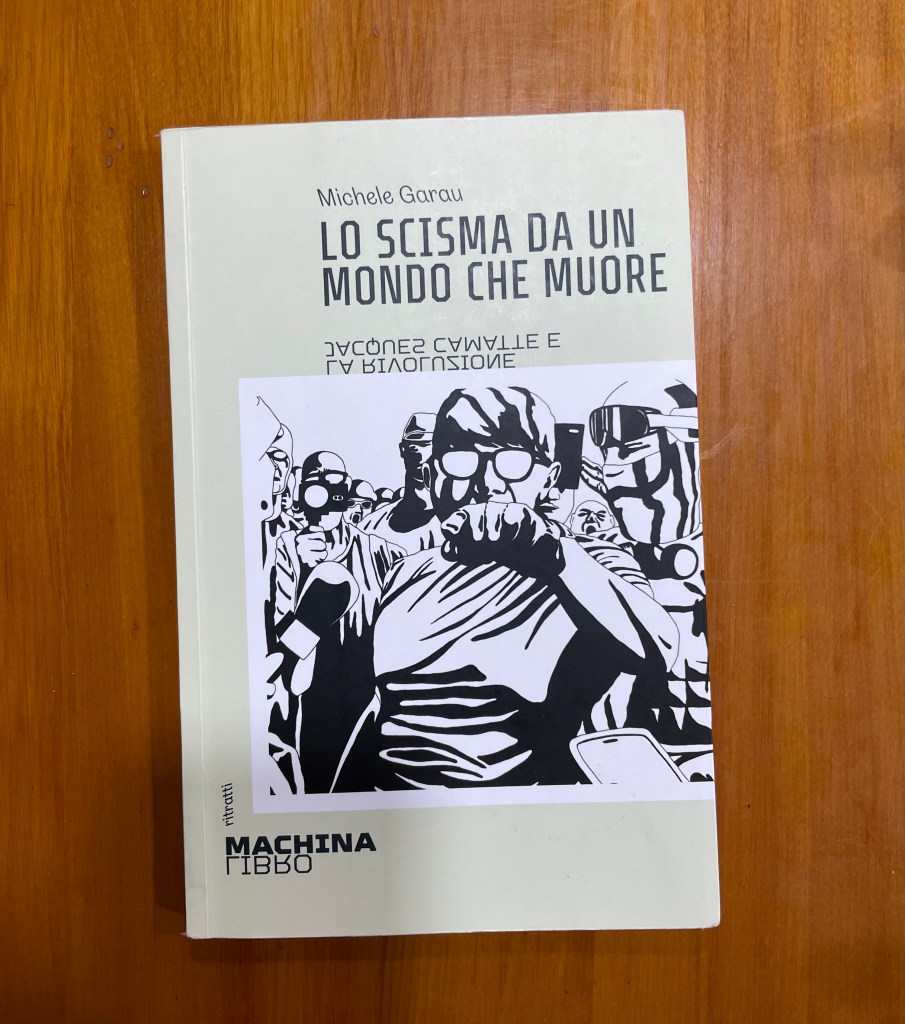
We must welcome that Michele Garau has written the first monograph on Jacques Camatte’s thought in any language, although the book, Lo scisma da un mondo che muore: Jacques Camatte e la rivoluzione (DeriveApprodi, 2024) it is also more ambitious than a mere philological reconstruction of the thinker of Invariance. Of course, not that there is anything particularly wrong with philological or archival work; rather, it is also that Lo scisma da un mondo che muore (2024) tries to think with Camatte (and also beyond some of his potential impasses) the historical bifurcation of a watershed moment in the history of humankind through the realization of the “capitalist revolution” as an autonomous colonization of every form of exteriority (Garau 7). If Camatte’s work has been only selectively considered in our ongoing discussions – while completely ignored at large by the so-called contemporary theory, which I guess it is an uplifting symptom – is precisely because he poses a challenge for a possible breakthrough in times of stagnation, while firmly announcing a much needed farewell to the modern revolution. But who would want to jump on that wagon when precisely voluntarism, prosthetic revolutionary cosmetic, and fictive communitarianism are all necessary platitudes to hold on to the illusion of ground right above the abyss? It is a rhetorical question, of course, but also one that Camatte move passed it in the in the decades of sixties and seventies observant to the material transformation of the working class, and the overall lesson of Amadeo Bordiga’s communism of the human species, which has also been rendered opaque and fossil-like by the victorious force of cultural hegemony and the whole grammatical structure of Gramsci’s thought in postwar political thought (and some will say well into our very present in the most recent cycle of failed left-populism). We said ‘farewell’ and this act, for Camatte after Bordiga’s teaching, means that the revolution has already taken place and must be perceived in the perspective of the crisis of negativity and the inception of the real absorption of capitalist development (Garau 14). 

Hence, new challenges lay ahead, which implies the abandonment of the historical and temporal productivity of revolutionary time – and Garau does an excellent mapping of bourgeois revolutionary thinking from Abbe Sieyès to Saint Just to later formulations of the Leninist paradigm of the dictatorship of the proletariat – which in the grand scene of modernity oriented the economy between form and function, but also between thought and action. If the epoch is said to be ‘anarchic’ is mainly because all these mediations and exclusive autonomous spheres have collapsed unto each other, and to favor one over the other is to work within the fiction of ideological reproduction at best. After Bordiga – Garau claims glossing Camatte, although there are nuances that I cannot consider in the space of this short commentary – the temporalization of the ius revolutionis can only bear in mind the crisis of presence (De Martino) as a suspension of exteriority that liberates right unto real subsumption. This means, following the recently polished phrase of Bordiga from his article “Tempo di abiuratori di scismi” (1965), that all revolutions are born and deployed as the affirmation of the schism. “Schism” or “scisma” — and one is reminded or taken back to a theological terrain, and not just as mitigated by the old ecclesiastical memories of the “Great Schism”, but because “schism” is also the “stazion” that fractures the visible-invisible legacy of form of the Church’s Trinitarian doctrine, and which is still the esoteric boiling point of the myth of political theology. This is a detour around Garau-Camatte-Bordiga’s intuition, since none of this is explicitly thematized in the book, nor should it be. It suffices that it opens to this question, given that Camatte’s own grammar of exhaustion – “extinction”, “inversion”, “autopoiesis”, “critique of organization”, “wandering” (erranza) – distill the echoes of an apocalyptic movement proper to the modern anthropological crisis, to put in terms of Ernesto de Martino.

Be as it may, the longue durée of civilizational development of Western revolutions (Edward Gibbon would claim at least since the reconstitution of the Christian Empire) there has been a process of adequation to invariant processes of capitalist accumulation that its substrate (whether permanent, uneven, natural law justified) becomes isomorphic to the structural needs of capitalist autonomization. In a cogent reading of Sieyes with Saint-Just in the framework of the French Revolution, Garau demonstrates how the genesis of modern politics and its categorial scaffolding (localization, constituent power, social unity, subject of rights, and representation) presuppose a thoroughly new vision to make the human community a clean slate for surface legibility (Garau 42). If the civil concept of the ancient polis was measurement and exchange; the crafting of high-modern state politics that took off in the eighteenth century was much thicker and spatially robust dynamics so that the ‘laws of commerce’ and population disciplining could come to fruition with its necessary infrastructural support. The schism was always a perturbation of the “sphere of politics” (and also of politics as a translucent sphere that can be observed, stabilized, and managed), and thus a great scandal.

Hence, the critique of political economy in the history of marxism was never able to untangle this mutual correspondence. For Garau at this point one can locate the difference between Camatte’s thought and Italian operaismo; given that Italian workerism at mid-century was never able to overcome the dialectic between the valence of value form and the theory of the production of capital. Whereas for Mario Tronti the struggle was still to be inscribed in to confrontation between the proletariat qua labor power; for Camatte the “invarianza” is not an permanent stage within the history of class struggle or Marxism, but of the human community and its resistance against the real subsumption of the material community (Garau 48). Decoupling the history of the working class as constitutive of productionism from the human community, allows Camatte, in the wake of Bordiga’s communism, to register the subsumption of capital as it collapses into dialectical negativity. Hence, communism is neither produced nor organized as operaismo always thought (Garau 26-27). And citing a passage from “Against domestication”, Garau argues that for Camatte the history of the proletariat struggle after 1945 is only the struggle to maintain the myth of the proletariat as the subject of a historical breakthrough (Garau 73). This is a staggering affirmation, and one that most definitely produces a theoretical schism. But the schism is also against the fictionalization of a subject of history, which has also been integrated into the emptying of social reality as we have come to know it in the final triumph of the fictive unto itself (Garau 93). 

There is the triumph of the fictive and expansive force of capital despotism, and then there is the struggle for the originary community (Gemeinwesen), which as Gianni Carchia argued in his “Glosa sull’umanismo” (1977) was still enmeshed in the contradiction between humanism and anti-humanism obstructing the vascular movement of non-identical fragments imploding the social. Is this getting at an impasse of Camatte’s own effort of thought to find an exit route? As an intelligent book, Lo scisma da un mondo che muore (2024), refuses to give an essay in the last three pages of the essay, although this difficulty is an object of attention. For instance, Garau writes in one of the clearest elaborations to tackle the problem directly: “La comunità deve allora essere riscoperta in una memoria della specie che finisce per radicarsi, questo è il rischio, esclusivamente in un bagaglio biologico. Nell’esaurimento delle strutture sociali preesistenti, dei linguaggi e degli schemi culturali, delle intelaiature rappresentative e cognitive, nella colonizzazione delle capacità psichiche, affettive, simboliche, è davvero possibile individuare un resto intoccabile dall’antropomorfosi del capitale che non debba essere, invece, creato dal nulla? C’è una «parte irriducibile», come scriveva Bataille, rispetto alle unità di misura del dispotismo economico? Non è semplice rispondere” (Garau 124).

In light of this rumination, Garau also attends to the cycle of contemporary revolts, which might stand as an instance of linguistic and existential struggle against domestication and the crisis of presence (Cesarano), and that might be capable of “absorbing the sky of politics into the most simple and elements components” (Garau 124-125). This is a great image, and one that has pictorial density and durability for thought even if it lacks specific elaboration. To absorb the open sky is to confront the exteriority of the world only as transfigured and brought back as a gathering of experience. The great German critic Kurt Badt comes to mind when writing about Constable: “the sky’s the organ of sentiment”. The embarrassing loss of the world today is fundamentally the destruction of the right attunement to our relation to the opening registered by what gleams above our heads. And perhaps this is a way to measure the capacity for non-movements rather than thinking that movements can disclose the sky. To this end, what could it mean to absorb the sky of politics – which is also a way to refuse the politics of sky, that is, the total planetary grand designs of geopolitical Tianxia? The irreductible may not be reduced to a substance, nor an ontological science nor a vitalist return to an originary community (if only mediated by the restriction of the archaic myth); but precisely that positionality of contact between what is exterior to life itself. To dislodge thought from all political plotting of objectivation and its plastic ligament of social adaptation. A life beyond itself that endures, and perhaps will outlive this dying world.

Morin’s autocritique and the human species. by Gerardo Muñoz

Edgar Morin’s memoir of the interwar years, Autocritique (1970), is a coherent elaboration of the early disaffection with the official culture of the Communist Party years, and the nihilist production of justifications to outlive the suppression of life into the abstraction of dogmatic principles. There are some harsh pages in Autocritique that color the general party-line position against the emerging critique of Stalinism. Let us just take this example: “The nonnegotiable and intransigent position against any anti-stalinsim would compensate for a life without principles with the enactment of a set of principles without life” [1]. It does not require much self-reflection to see that this formulation – the production of abstract reasoning in the name of boundless defense of principles – seeks to legitimize the dialectical ruse that indexes the general sense that “life does not live”, if one were to paraphrase Fernand Kürnberger. The self-assumed nihilism and bad faith denounced in the pages of Autocritique was not just that sacrifice was the abstract historical assumption of liberation, but rather that the reality of sacrifice was unbearable for many; specially for those who found themselves in a situation to suffer it [2]. And part of the memoiralist reconstruction by Morin is to leave all this behind, and in the effort to do so, also embrace a political option beyond the collapse of the historical utopia. 

Of course, there is some ambiguity here, and to put it in this way it is already a form of understatement. About halfway through the book, Morin recalls that Elio Vittorini had told them [Antelme and Mascolo, his two good buddies during the postwar years] that communist culture had a saturation of politicization within itself; and, already in 1949, this saturation of politics had calcified  into a “policing control within politics” [3]. In other words, the postwar Cold War context was the consummation of the static politics of the previous decade, only that now it was co-extensive with planetary gigantism as two formations of civilizational states (Americanism and the Soviet Union). Could there have been an option for a different political elaboration, to put in Morin’s own terms; that is, a communism without the iron law (and lawlessness) of objective-driven efficacy and efficiency? (This second was Morin’s term) [4]. Morin does not have a positive answer to this question at least in 1970. However, we can reconstruct a possible answer by taking into account at least two divergent symptoms. First, is Morin’s critical target: political stalinism as hyperbolic of the communist aspiration and necessary culmination, which had cut through the thicket of the gordian knot of historical dialetics movement for emancipation.

Let’s take this moment: “Stalinism was monstrous, I myself perceived in 1949. But this monstrosity had tainted the most admirable form conceived by man: communism. Now evil and good would intertwine in an intimate way….and the attempt to eliminate the cancer’s cause was not, at the sametime, also a form to suppress the fountain of life” [5]. If anything this is a symptom that for Morin, it seems to me, that communism cuts through political ideology, and cannot be contained otherwise. At the same time, the leveling of the critique at this height entails that Morin’s own leveled critique is still prey to ideological determinations blanketed as political rationality. In fact this is something that Autocritique never abandons; and, perhaps its retention indexes its impasse, which is also the impasse of the political subjectivity. 

The second symptom is that Morin never dares to mention Robert Antelme’s The Human Species as a touchtone memoir of the experience of the camp, and the camp as hyperbolic of the destruction of politicity. Of course, the strongest distillation of Antelme’s book is not waged at the level of political ideology, but rather about rather at the level of the human species as the final destination of infinite destruction (because he can be infinitely destroyed in virtue of its indestructible irreducibility) that brings back the indivisible origin of the human species. Of course, this rings true with Amadeo Borgida’s thesis that ideological determination puts emphasis on the individual (in positive or negative sense), whereas communism attends to the human species as the ground level of the species [6]. 

Needless to say, what is realized in both Stalinism and Nazism, albeit their different designs and orientations, is the confused struggle of the separation within what is unfathomable kernel of the human species (this is after all the naturalist project of Hitler’s Black Earth). And what Antelme discovers – although the verb discovering here is providing a scientific optic that is not too appropriate – is that the human species is at the ground of needs, but insofar as the need of the human species transcends itself to its biological reduction. Perhaps this is where the thorny question of “ethics” should be situated; a question that, in return, will also put in perspective our distance with the generation of Rue Saint Benoit and the humanist-nonhumanist polemic regarding the miraculous transcendence of human beings in the world. Was not this Antelme’s definition in the “The Smiling Angel”: “The only transcendence is the relation between beings”? Morin’s concluding remarks in Autocritique decisively go to the heart of this question, which is worth citing in full: 

“Ethics is an existential feeling, like the feeling of freedom, answered by every science, by every look at the past as well as by every forecast of the future, but which is the lifeblood of the lived present. And this sap of what has been lived, a paradoxical thing, is the presence in our inner core of the ought-to-be, of the ideal, of the negation, that is, of the virtual and the imaginary. And everything that eliminates the ought, the denial, the ideal, the imaginary and the virtual, concerns what is dead and fossilized. The only thing we can do is become aware of this contradiction. Perhaps a new conception of the world, where the relationship between what is called real and what is called virtual will have taken on a new meaning, will allow us to progress further.” [7]. 

At the end of Autocritique Morin seems ready to accept the magical and mystified dimension of reification, a necessary philosophical and practical technical anthropology invest a new ordered relationship with the world. But this is also symptomatic of Morin’s subjectivism and humanism that stops him at the nearness of the question of the human species. He never arrives there, or he stops too short. This is the distance that keeps illumination at hand; that is, that stubbornly insists on holding to modernity’s capacity for reinvention and, upholds the dialectics between critique and autonomous freedom. But, this is precisely what is no longer what could suffice the opening of “a new conception of the world today”, even if the gordian knot is precisely at the conjuncture of ethics, language, and existence. No subject without critique, and no critique without the emergence of a new subject. As such, self-critique becomes an unconvincing condition to advance towards a beaten and well known path.

Notes 

1. Edgar Morin. Autocrítica (Editorial Kairós, 1976), 117

2. Ibid., 45. 

3. Ibid., 163. 

4.Ibid., 72. 

5. Ibid., 162. 

6. Amadeo Bordiga. “Specie umana e crosta terrestre” (1952), in Drammi gialli e sinistri della moderna decadenza sociale (Iskra, 1978), 94.

7. Edgar Morin. Autocrítica (Editorial Kairós, 1976), 266-267.

On American despair. by Gerardo Muñoz

The rhetoric of “decadence” now prevalent in United States has reached such heights that, regardless of political orientation, it is clear that it has become a pretext for a desired take off and accession from the objective  stagnation and paralysis. Paradoxically, the assumption that there is “decadence” is revered as a moment of forthcoming light and rejuvenation; and, thus, as a “crisis” that can be identified and managed through the end. As it is well-known, for some critics of decadence the Golden age of American life was the landing on the moon and the population boom of the 1950s; technology and family. The elements are self-serving: to accelerate the reproduction of the human species, and to lead technological gigantism against new geopolitical competitors (AI, chip wars, Green economy, etc).

In the early twentieth century Americanism was a benefactor of private Fordism (everyone could enjoy his or her car, that is, their increasing isolation), but in principle things have not changed much a century later in terms of the outlook and the techno-administrative power. But the one thing that has changed is that the age of increasing productivity and formal production is no longer the objective coordinates of social relations; rather, depopulation and stagnation are the new variables that public powers that must be governed through its effective processes. Ultimately, this also implies that the waning of the high-modern state is no longer effective, and so the established discussion about “race to the bottom” fails to understand that there is no bottom. Hence, the only race is toward planetary destruction.   

And what is curious to note is that even those that have identified the epochal crisis of Liberalism can only exacerbate and contribute to the acceleration of the ongoing destruction with cultural and rhetorical veneers notwithstanding. The ‘postliberal’ commitment to the fantasy of a “new policy of re-industrialization” cunningly allows the autonomy of state-sovereign capacity as the main orientation within the growing desert of administrative functions. In fact, this is a fort da moment in which policy makers can be in favor of empowering the nexus between executive power and the federal bureaucracy; while, at the same time, the mouthpieces of these policies can promise a dismantling of the administrative state in a post-Chevron era. This schizophrenic position is not a symptom of mere anachronistic derailments of a political movements, it is also an expression of the desperate attempts of American failed (and to a large extent non-existent) political elites to find a formal mediation between state, administrative coordination, and constituent power, precisely because this nexus is broken and in shackles. 

And truth be told, no piecemeal or nudge-driven re-industrial protectionism is “enough” to cure the social angst and despair of contemporary American subjectivity at all levels of human experience. It has been two honest economists, Anne Case & Angus Deaton in the book Deaths of Despair and the Future of Capitalism (2021), who taken noted that what they call “deaths of despair” is the central social affection of contemporary America, which fuels the slow but steady self-annihilation of the life that no longer truly lives (and paralyzes the economic framework as well). And, in turn, what outlives the hegemony of social domination is the regulation of pain and despair as the last dispensation of this unliving.

The necessary oblivion of the social production of the deaths of despair is what remains necessary so that a pseudo-theological framework of imperial “decadence” can retain its competitive narratives in the abyss. The end of real forces of autonomous production have led the way into the production of pain, which as Gianni Carchia clearly saw in his reading of Michelstaedter (Retorica del sublime, 1990), is a form of active ethical communication between souls. For all the alleged talk about spiritualism, theology, and instrumentalized Christianity in times of “decadence”, the high point of Americanism remains a techno-administrative apparatus that can only produce and conceal the prolongation of social pain. Precisely, “the parabola of the impossible so that any notion of the ‘good’ fails to be affirmed in this world”. 

Holding on to painting. by Gerardo Muñoz

Paying a visit to a painter’s studio is a rare experience, but definitely gratifying. Or at least, it has been for a long time even before I could put it to words. At her studio, I confirm that Laura Carralero’s commitment to painting as a practical activity has an unfathomable dimension, and I was pleasantly surprised that she shared the same sentiment that our current epoch is not one in which painting has a minimal breathing space. And whenever painting emerges in the official market circuits of art, it seems that it is always already parasitical to some verbose rhetorical apparatus or heteronomic planning that distortions the painterly sentiment. But was not painting the task of speaking the engagement regarding  “mute things”, as Poussin would have it? There is little doubt that rhetorical inflation that thrives in mechanisms to legitimate art continuously devalorizes the mysterious proximity of painting with things in the world. We should reflect – or we should continue to reflect – about what it means to be in a point in the history of humankind where the obsolescence of painting and the disappearance of the dexterous achievement of the hand has thoroughly been realized (Focillon’s praise of the hand remains as actual as when it was first written: “The artist that cuts wood, twerks metal or rock keeps alive a very ancient human past that without which we would immediately cease to exist. Is not admirable to see in the mechanical age this stubborn human survivor of the ages of the hand?”) [1].

The task is immense and abnormal, and it defies (because it exceeds it) the theoretical concept and the absolutism of the philosopher. The engagement of the painters – a secret community that still exists here and there, in different geographies of the world – is precisely a keeping of the divine vortex of the human in the abyss without higher pretensions. And there is something stubbornly strange about painting against the mounting force of destruction. Although perhaps ‘resistance’ here means nothing but to hold on to the originary instance of appropriation of experience in the wake of the epochal mutation of anthropogenic composure; as if the end of the species is also pulsating its commencement.

Holding to painting is not just a substitute to the act of refusal (something that I have recently mapped out); rather, it refuses the very negation of the anthropological erosion in its soulful interaction with what it remains outside of language. To hold on to painting means to engage in the imperturbable: what discourse cannot mold and relocate; what previously is poor in language so that a new language, and thus a new world, could emerge anew among the rubble. In his forthcoming book Those Passions, T.J. Clark states, quite forcefully, that no political transformation or epochal breakthrough can emerge without a preliminary transformation in language; and, I am tempted to say, that practice of painting is the topoi in which eye, world, and hand come together in the very act of separation of said renewal.

The terror of painting – only aggravated in the last decades or so, although a process that took off the postwar years and continued into schools of art where militant pedagogues can only shout “don’t bother to paint!” – is the general stimulus of the reified world; a world in which the paradigm of “objethood” now stands as the compensatory empty experience for poignant idolization of nothingness and “mere stuff”. Sure, there is no return to painting in its grandiose historical sequences – Renaissance, French modern painting, the European Baroque, Van Eyck’s optical discoveries – which ultimately means that painting’s instantiation with the tradition is also bare and unexplored; or, absolutely uncharted whenever there the event of true painting. While I glance at Carralero’s diminutive wooden oil paintings I have this in mind at least. There is a return to the divinity of the icon, but it is not a restitution of its theological investiture and its purported liturgy; the pictorial exercise takes into account the structural void in which painting finds itself resisting, for better or worse, representational excess.

And this speaks, I take it, to the muteness of painting as such, which is also Carralero’s silence about the import of medieval icons into the present. In a way, the painterly operation (I realize that this expression is awful) is executed in a paradoxical redemption, since space always calls forth presentism, a here and now. One is reminded of Stevens’ verses in “Ordinary Evening in New Haven”: “To say good-bye to the past and to live and to be / in the present state of things as, say, to paint / In the present state of painting and not the state of thirty years ago”. The emphasis of the verse declines towards that injunction “as say, to paint”, which fixes a current state of being in the world where we are in it but outside of it. Is not this, precisely, another description of the “Just”? I am eager to work through painting’s stubborn position to this description, which means to hold on to the imperturbable. 

The imperturbable seems to me like a fitting term to grasp what Carralero is doing in her pictures, although with no pretensions to exhaust her pictorial adventure. The solemnity of the icon and its inverted gnosis yields something palpable as well as unattainable. What is being held is the vortex of painting’s mystery going back to Lascaux and ancient burial paintings. Carralero rationalizes her interest in medieval and Eastern European religious painting as a retreat from the unbreathable decay of contemporary pictorial practice as a general tendency. Here the renewal of painting is only possible through the sensible dimension of an integrative imagination. Hence, to live in the present, in the hour Stevens’ simile, is also to dwell in the flashes of painting’s general economy of sensible forms. A new history of freedom can take this as its point of departure; that is, to posit no longer the social functionalization of norms and rules for relations, but to expand the sensible space of the innumerable symbols of existence. 

In the well-known essay “The Pathology of Freedom”, Günther Anders says something significant about painting’s imperturbable nature: “Painting that fixes the aspect of a man or a thing in a picture seems as it were to repeat the act by which each thing is already condemned to itself” [2]. This “being-precisely-this” could be taken as the closure of contingency in relation to all possible forms; although it is also painting in which the contingency of the non-visible in the visible what arranges the possibility of what is precisely absolute contingent as absolute in each picture. This is why in great pictures we tend to feel that the consummation of form reveals as a necessary tradition that, by virtue of being thus, it assume the thisness of the particular rendition. This commitment that weighs heavy in each of Carralero’s paintings is a testamentary to the imperturbable even if we are already entering (or already in it) the eclipsing world of the mystery of the senses, a world that can no longer see the redeeming and unassuming vision that painting can offer.

Notes 
1. Henri Focillon. Elogio de la mano (UNAM, 2010), 131-132.

2. Günther Anders. “The Pathology of Freedom: An Essay on Non-Identification”, Deleuze Studies, Vol.3. 2009, 283.

From the beginning (after a Berlin meeting). by Gerardo Muñoz

I am sure that others will draw their point of inflection, but for me the stakes of a recent Berlin meeting (already commented here) was laid out during the very first session when one of the “non-participants” – let’s call it like this to embrace the spirit of the meeting – spoke audaciously about the current predicament: there has been a thorough loss, nothing but defeat that is both irreversible and consummated at the level of subjectivity. Some of us remembered that T.J. Clark more than a decade ago in the pages of New Left Review took a similar position and was grilled for it. This tends to happen to any gesture that dares to push thought forward. In any case, the non-participant went further and called for a “new beginning”, a start from scratch, alluding to the underrated Revolution and counterrevolutionary in Germany (1851) by F. Engels, in which in fact this language is very much present. Engels wrote in the first article (the book is a collection of pieces published anonymously in the wake of the 1848 revolutions): “If, then, we have been beaten, we have nothing else to do but to begin again from the beginning. And, fortunately, the probably very short interval of rest which is allowed us between the close of the first and the beginning of the second act of the movement, gives us time for a very necessary piece of work: the study of the causes that necessitated both the late outbreak and its defeat; causes that are not to be sought for in the accidental efforts, talents, faults, errors, or treacheries of some of the leaders, but in the general social state and conditions of existence of each of the convulsed nations” [1]. 

Of course, “social or national conditions” are not “trapped in amber”, and I think that today one cannot take the national, local, or even regional contexts as sufficient to explain failure. The failure is civilizational, and raising the question of the “beginning” (or new beginnings) has a heideggerian overtone that is not facetious, but it is consistent with any exploration in the quadrant of critical-metaphysical commitments for thought (infrapolitical reflection has thematized it) [2]. This elaboration could be very well idiosyncratic, but I think it provides “grip” to the problem by not making concessions to well known junior partners of abstract politicization and ideological backlogging that like the Tortoise in the parable still fantasize with a breakthrough via yet another “textualist interpretation”; one more sophisticated mapping of political ecology or a collective hegemonic political theory department; or even a policy redistribution of a new Green Deal towards a new accumulation regime [3]. Perhaps they themselves do not believe any of the lies – for my part I think that they do not – and they endorse it for the sake of “bad faith”. But just in case, I think that raising the threshold at the highest point (ontotheology, civilization, the constitution of the polis) is a litmus test of separation against the new secular priests. These negative conditions already open a door to go through.

But there are also positive conditions for this “new beginning”: reopening the ethical intensity in retreat of political subjection; rejection of public chatter and freeing fugitive marranos; elaborating strong descriptions of the metamorphoses of domination; and avoiding the “revolt” as a compensatory category for of ius revolutionis in the epoch of real subsumption [4]. At the end of the day, it should not be forgotten that an-archy also means the turbulence of phenomena, in which every fragment moves in the direction of experience poking through the objectification of the world. This is “inapparent”, but it is for this very reason what is fundamental and invariant. 

The ‘new beginning’ in the wake of collapse can only conquer life to traverse the hunger of meaning that propels the fictional machine of ongoing nihilism, as Giorgio Cesarano warned. There is no historical or moral beginning; there is only the beginning in which existence is able to expand the originary accumulation of a sensible ethos. And it is at the very end, or almost at the end of everything, that true beginning commences. Whoever does not start from the beginning is either understudying the epoch, or mastering the evermore painful social roles. It is only in the direction towards beginning that can avoid the crushing weight of the post-neolithic condition (Métraux) that calls for a divestment of what reality can contrive for us. 

Notes 

1. Fredrich Engels. Revolution and counter-revolution in Germany (FLP, 1977), 3.

2. Alberto Moreiras, “La cuarta vía” (2022): “¿No se hace necesario hoy pensar, por lo tanto, otro comienzo del pensamiento, proponer otro comienzo que nos sustraiga al peligro del colapso mismo del mundo?  Quienes se oponen a ello, llamándolo arrogancia o presunción, llamando veneno a la propuesta misma, no son para mí ya distinguibles del avestruz que hunde la cabeza en la arena al verse atacada”. https://infraphilosophy.com/2022/02/18/la-cuarta-via-entre-parmenides-y-la-obligacion-reflexiva-conferencia-para-la-universidad-de-arizona-spanish-and-portuguese-department-borrador-3/

3. Zeit Der Ökologie. Das neue Akkumulationsregime (2024).

4. Conspiracist Manifesto (Semiotexte, 2023), 341.