In Book V of his Latin Language, and immediately after commenting the duality of Earth and Sky, Varro writes an enduring and yet enigmatic gloss of worldly life. In Roland Kent’s translation from 1938 we read: “Inasmuch as the separation of life and body is the exitus, ‘way out’ for all creates born, from that comes exitium, ‘destruction’, just as when they ineunt ‘go into’ unity, it is their initia, ‘beginnings’ [1]. It is probable that Kent had to leave the latinized terms next to familiar reiteration of modern English in order to allow the text to breath in all of its complexity, for what is Varro ultimately attempting to tell us can very depending what we want to stress, and how we read in the scope of his discussion starting in section 58. Is it that life is always marked by the wound of separation with the natural world? Or that destruction and caducity (exitium) is a necessary condition for all new beginnings, as if life understood as an enclosed organism or entity is always insufficient, because of the order of excess at the very moment that it recognizes its propriety? This excess is what cannot be contained in neither life nor in social form or political mediation; it is the initia of thought in its relation to phenomena of the world but without ever being reduced in them. In this sense, there can only be a beginning in the passion that thought grants to the separation from the world.
This is perhaps what Pindar had in mind when writing in Isthmian 8 – in clear tone of his disenchantment before political strife – of a need to return to a shared language among friends (a language that cannot be that of the rhetorical antinomies of the polis): “It is always best to look at each thing right at our feet / for treacherous time hangs over men and twist awry the path of life. But even those things may be healed by men if freedom is with them; and a man should give care to [that] noble hope” [2]. In his commentary on these lines C.M. Bowra notes that the awry and treacherous time of life that Pindar refers is not just a personal account, but rather a state of the world of his own generation and friends [3]. Politics brings to ruin; it brings fear, but more importantly it brings oblivion to the nearness of each and every thing that stamps irreducibility. But what Bowra does not thematize is the central stress of these lines; mainly, that the Ancient poet makes a plea to the examination of proximity and nearness “look at each thing right at our feet”. The plea to take care of a true life harmonized is preoccupied with this lying out before our feet is so inapparent that it provides texture and rhythm to every appearance; it is so invisible that it can disclose the very possibility of the beginning or end of a visible world.
It seems that Pindar’s solicitation of proximity speaks to Varro’s initia; but not because there is something like a true origin or original position (a category that modern political thought later elevate to the physics of social stratification and positional distribution), but rather because another idea of “freedom” can be rethought from the excess of what appears spatially in the world; an absolute instance of appropriation beyond life. This is perhaps beautifully expressed in one of Cézanne’s most acute images of his creative process: “I breathe the virginity of the world…a sharp sense of nuances works on me. At that moment I am as one with my paintings” [4]. Before painting and creation there is a sensuous region in which the separation of objects and subjects do not longer sustain totality except as catastrophe or force.
This means that to disclose regions of life in the world is not just about the claim of autonomy and normativity of a place; on the contrary, it is the very inapparent, almost imperceptible, possibility that lies in the wrinkled proximity when we withdraw from things ad they seem. Quod natis exitus – because we are always exiled from each and every place, it is through the thinking of the inconspicuous of each and every being that revisitation of an ethical life calls on us from the outside. Ultimately, the ethical life is nothing but the imperative of «lech lechà» in a separation that unites when overcoming the deceit of time.
.
.
Notes
1. Varro. On the Latin Language, Books 5-7 (Loeb Classical Library, 1951), 59.
2. Pindar. “Isthmian 8”, in Pindar (Loeb Library, 1997), 211.
3. C.M. Bowra. Pindar (Oxford University Press, 1964), 114.
4. Joachim Gasquet. Cézanne: A memoir with conversations (Thames&Hudson, 1991), 45.
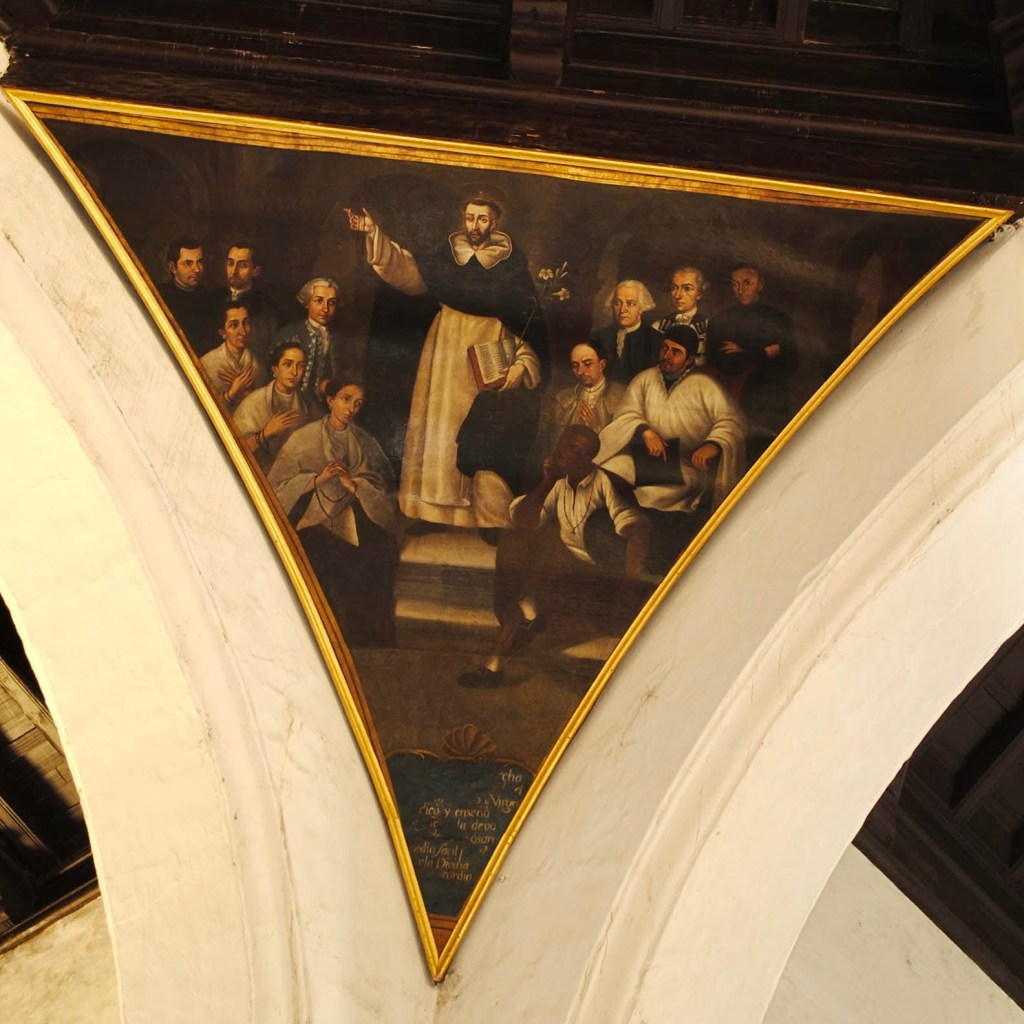
In the Church Santa María del Rosario of Havana there is a pendentive cycle completed in the 1770s painted by the baroque artist José Nicolás de Escalera – whom according to Guy Pérez Cisneros, was truly the first professional Cuban painter of the tradition – that includes a black slave in a pensive pose seating on a lower step, just below a Dominican priest who figures prominently in the middle of the picture holding a Bible and raising his right arm forward [1]. It has been noted that the figure of the black slave is also the first portrait of a slave in the New World, and its meaning has been highly disputed. The enigmatic slave or liberto portrait shows the man in a thinking pose, with a folded long white shirt, and what seems to be a wooden rosary hanging in plain sight. It is hard to make the details of his facial expressions, but it is obvious that his gaze is neither upwards nor directed at the viewer, but rather suspended, as if were, in a moment of attention and rest (and also listening?). The context here is fundamental, since Santa María del Rosario Church was commissioned by the Count of Bayona, a wealthy member of the sacarocracia (sugar plantation owner) after a previous church was burned to the ground by a slave revolt that took place in 1727 in an act of complete defiance to Christian indoctrination.
The event that only has come down to us in just a handful of mentions and erasures of the colonial archive is featured prominently, as we know, in Manuel Moreno Fraginals’ El Ingenio when the historian documents the spiritual schism of the eighteenth century colonial plantations of the island. According to Fraginals’ historical account, the slave insurrection in the plantation took place in the wake of a theatrical enactment proposed by the Count of Casa Bayona in an act of repentance and humility aiming to mimic a well known moment of the Christian story: one day the Count washed the feet of twelve slaves, and when he finished he made them sat with him for dinner. Later that afternoon the slaves revolted and burnt down the whole sugar mill, including the chapel, to the ground. The episode ended with a plantation mayoral officer hunting down the runaway slaves, who was ordered to place the heads of the dead slaves high in spikes for the Count and everyone to see them [2]. It is an early staging of visibility and bodily dominion that the modern epoch will take to its final conclusion.
The portrayal of human suffering was a symptom of the impossible hegemony of christianization of body and soul that the missionary Nicolás Duque de Estrada decades later will try to deploy in his pedagogical treatise Explicación de la doctirna cristiana acomoada a la capacidad de los negros bozales (1823), which argued that obedience of slaves could be achieved by implating “guilt” and work ethic in the affective interiority, in the forum internum of their souls. But even Estrada was of the fact that after sixteen hour workdays the Christian ascesis was imperceptible and little more than convoluted chatter to the ears of the slave. It is almost as if the slave, separated from the politico-theological inscription of salvation, was already outside the subjective domination of productive bondage and political freedom.
When Escalera was commissioned to do the cycle of frescos at Santa María del Rosario he was asked to combine a twofold narrative: the history of Christian salvation and the story of the Casa Bayona. At the center of the altar piece is the world as a common house or oikos, that carries history and its bodily sovereignty forward. One possible reading of the pensive slave shown in Santa María del Rosario’s pendentive is to assume that this figure is completely outside the eschatological vision embodying a sense of freedom that only painting could have documented in its unique and mute language. This raises the question about the relation between painting and freedom in which the figural emerges unmistakably fixed beyond historical narration. Although writing about Cézanne’s late work, Kurt Badt once suggested that there is no such a thing as the representation of freedom, but rather “painting generates a concept of freedom as two-faced: negatively, it is liberation from isolation and resistance, positively to the serious gentleness of freedom….expression in freedom to the scene from nature, which declares the world to be existing together, a mutual self-supporting and carrying of things” [3]. The pensive slave portrayed in the pendentive does not embody freedom understood as the spiritual accumulation of rights and duties known to the order of historical transformation; rather is an absolute pictorial appearance of freedom because it embodies, in its non-separation of life and thought, a static moment of a being that contemplates the liberty of his potency.
What is striking about the collective portrait where Escalera inserted the former slave is what we can call, following Bernard Berenson, a dimension of the ineloquent that appears just as “mute, with no urgent communication to make, and no thought of rousing us with look and gesture. If they express anything it is the character, essence rather than momentary feeling or purpose. They manifest potentiality rather than activity. It is enough that they exist in themselves” [4]. In the pensive gesture of his pose, the slave is the untouched existence and the revolt that rips the escathological narrative that ordains the interiors of Santa María del Rosario. Malraux once noted that the age of the divine disdained the realistic portrait of an ordinary person, because he was too distant and mundane from the stone conclave of the gaze of the gods. The slave’s inexpressive ‘naturalness’ refrains from partaking into a mood compensated by the semantic compulsion of the colonial painter, because his naturalness discloses the indestructible soul that has transfigured the realm of the divine.
The unfathomable mystery of the pensive slave or liberto is the obscure and yet luminous portrait of a life in thought that is, at the same time, the thought of a life that is forever inexpressive, and as such the highest state of imperturbable freedom in the aftermath of worldly destruction. The ‘gentleness of freedom’ that Badt locates at the heart of painting is the imperative of the stream that carries, and yet restrains, thought and appearance into the figure of life. The freedom that anchors painting – because such freedom is never realized in painting except as vulgarity – becomes a tacit secret for which ultimately there is no image.
.
.
Notes
1.Guy Pérez Cisneros. Características de la evolución de la pintura en Cuba (Ministerio de Educación, 1959).
2. Manuel Moreno Fraginals. El Ingenio (Crítica, 2001), 99.
3. Kurt Badt. The Art of Cézanne (Faber & Faber, 1965), 314.
4. Bernard Berenson. Piero Della Francesca: The Ineloquent in Art (Chapman & Hall 1954), 7.
In one of the glosses in Marginalia on theology, Erik Peterson provides a remarkable pictorial image of thought of death and resurrection through the activity of washing a bowl. Peterson writes: “When washing a dirty dish, our thoughts may turn to the dead, to the dead as a genus, as an inferior genus that perhaps unconsciously influences our actions, as angels and demons do in another way. This probably happens because the dead have something in common with dirty, unclean dishes. Imagine this cleanliness however you like: perhaps we can say that death as such is an act of purification. To think of death in this way, endowed among things – like a bowl – gleam just like the voice of god in the bush” [1]. It is a fragment where Peterson comes closest to the specific nature of painting: what is painting if not the transference of muteness to the gleaming of the visible that opens before our very eyes? And like the divine voice in the bush in Exodus, what does it take to grasp and see the divine between or behind a dirty bowl as it lays on our hands? If washing a dirty dish entails receiving the dead in our thought, the passive act of painting seems always to lay a claim about the mystery of presence outside language.
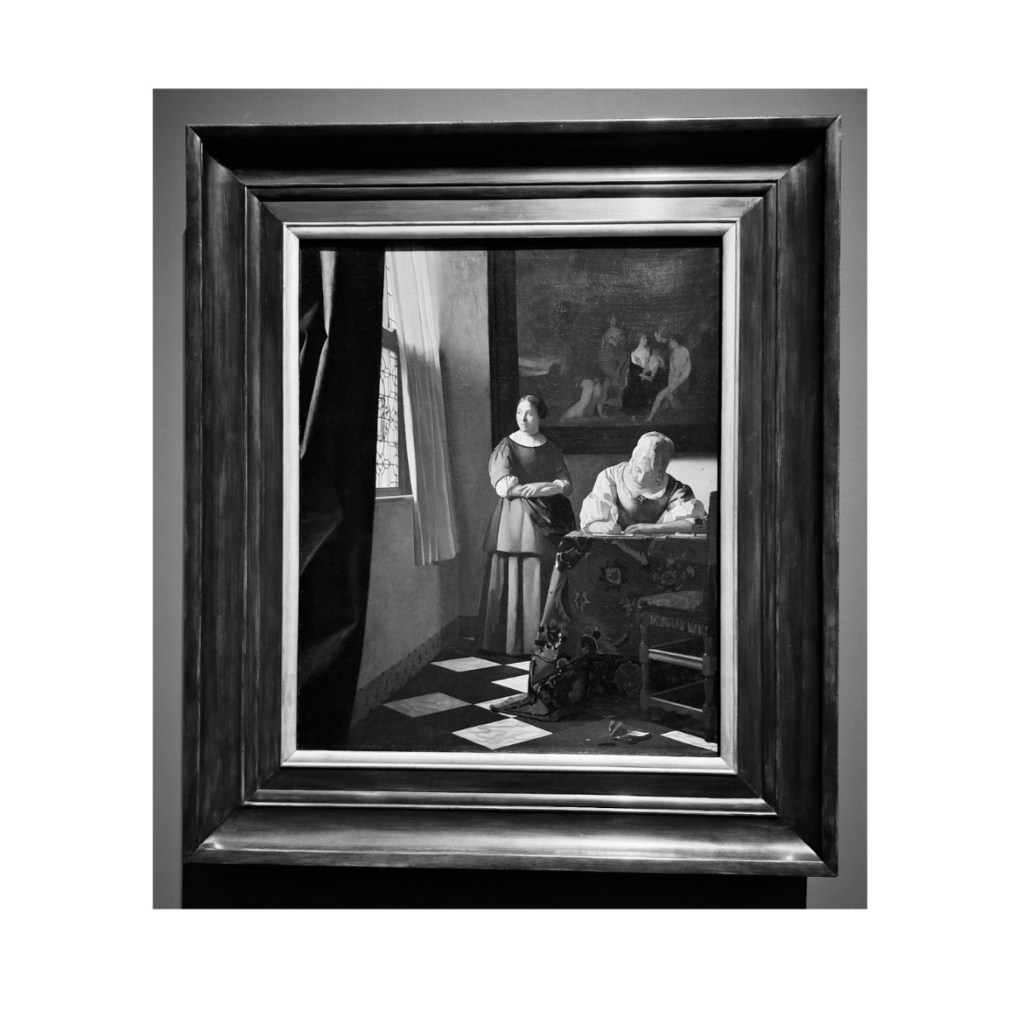
If I elevate Peterson’s remarks to a terrain that the one that he intended, is connected to two Vermeer’s pictures exhibited these days at the Frick Collection gathered around the theme of “letter writing”. In both pictures there is a lady seating at a table drafting a letter – one of them has already concluded it fully attentive to the visitor on her right side; the other a maid gazes at an open window – but what is always unnerving in Vermeer’s work is the sense of the ineffable and impenetrable in the disclosure of the picture (an exposure that that is usually aided by a side curtain that welcomes us in). What is this impenetrable divinity that lurks in Vermeer picture in pure presence? Although we do not have a name for it, it is like the god that dwells in the dirty bowls or in the nocturnal bushes of Peterson’s gloss.
The painting does not speak in revealing, it only bear witness of the absolute fall of language as it becomes imperturbable in the picture. Contesting the vulgar interpretations on Vermeer’s Catholic conversion in Delft, Daniel Arasse notes that the vortex of his pictorial theology is bounded to the threshold in which images become alive (in the tradition of au vif) outside itself: “Vermeer’s painting are constructed such a way as tho render this life equally present inaccessible, near and impenetrable. What is seen is not a crete of nature observed, but a mystery within the painting itself” [2]. In Vermeer’s pictures, presence and the invisible collapse not through the inception of a metaphor of nature, but rather through the painting’s light when it casts a shadow beyond any instance of closure.
This is why in Vermeer’s paintings surfaces mandate an order of theatrical presence, while simultaneously making room for a perturbance that is forever barred from the conceptual. Unlike Giorgione’s “Three Philosophers”, Vermeer’s pictures are not endowed by the mysterious force of an alienated nature that man can measure and master; rather, the mystery resides in the whispering of the invisible that cosigns the amoris causa of the appearance of painting. If for Peterson what gleams in the dirty bowl is the cleansing of resurrection; what befalls Vermeer’s pictures can only be understood as the faith in the painterly emergence of appearance dependent on the path opened by its light.
The question of god as appearance is always posited as a challenge to the meaning of reality as totality no longer as what emerges in the open, but as what which retracts lagging behind. And we know that only appearance is seductive enough to stand for faith well beyond the fact of being visible [3]. Hence, a way to supreme subtlety of painting (picturae summa subtilitas): no longer a matter of perspective and contour, but of the mysterious indiscernibility that mounts depth between vision and the divinity of presence.
.
.
Notes
1. Erik Peterson. “Fragmentos”, in Tratados Teológicos (Ediciones Cristiandad, 1966), 251-252.
2. Daniel Arasse. Vermeer: Faith in Painting (Princeton University Press, 1994), 75.
3. Consider Heidegger’s response to a question in the Zurich Seminar, 1951: “If I were yet to write a theology then the word ‘being’ would not be allowed to occur in it. Faith has no need of the thinking of being. If faith has recourse to it, it is already not faith. I believe that being can never be thought as the ground of God”. Séminare de Zurich (Paris, 1980), 60-61.
Michael Lobel’s new monograph on Van Gogh’s work, Van Gogh and the End of Nature (Yale University Press, 2024) undertakes a systematic effort, brilliantly argued and researched, at showing the redeeming visual capacities of the nineteenth century painter towards the natural world. If we call it redeeming it is because in more than one way, Van Gogh, in the last three decades of the modernizing century, was painting at the threshold of nature that soon enough was assaulted by the copious designs of modern industrialization, energy production, and the application of its effective scientific techniques over all spheres of life. It is the final culmination of the disenchantment of the world, and so also the moment of great temptations, such as standing up against it through the metaphorization of the imago naturae in one last desperate attempt at salvation through a reified ideal representation. Lobel’s art historical work shows us along the way that Van Gogh’s situation was far more complex, and that a French critic’s quip that he merely “captured nature with a soul” in his pictures requires specification and analytical comprehension within the context of the century of steam (Lobel 2).
In other words, Van Gogh is not a painter of a return to the conscience of the “Beautiful Soul” that has interiorized the exhaustion of artistic imagination; implicitly throughout Lobel’s monograph is the well grounded intuition that Van Gogh was an artist of the depth of vision without necessarily translation their specular commitment to the efficacy of realism. Immersed in his age as every artist obviously is, Van Gogh’s vision is mediated and conditioned by the effects of modernization that will severely affect the act of looking and gazing. This is not exclusively reduced to the new subject of labour production of the industrial age, although certainly there in his mining drawings, but also ecological transformations such as pollution, gaslight, geographical sites, the new chemistry of color pigments, and the tonality of human expressivity (the hues of a human face) in its new surroundings. Although there is no ambition in offering (or modifying) a theory of modernity in Lobel’s account of Van Gogh, one is reminded in the historical documentation the total and integral dimension of modernity in terms of its spatial totality: the essence of modernity was a revolution in the immanence of forms and perceptions that transcended the mere mechanization of the atmospheric designs.
Thus, when Van Gogh gazed at a peasant field and saw the isolated and orderly harvest he was simultaneously preferring the composition of the color palette of a painter that is now conscious of the material elements of his process of production (Lobel 9). But the colors return to the field, and this already provides us with a symptom of Van Gogh’s pictorial signature – which again runs implicitly throughout the book without ever coming to the forefront – about retaining the outlook towards nature and the natural world, which for the painter it becomes the enduring task to be resolved in manifold ways. But there is one way in which Van Gogh tries to tackle this drift to the infinite vanishing of nature: the capacity to move visually through space. To this end, Lobel does well to remind us that Van Gogh, perhaps more than any other artist of his time, was able to travel places thanks to the new rail system efficiently connecting regions and cities that made his work possible (Lobel 28). But besides the autobiographical standpoint, what is noteworthy is how Van Gogh trained his vision to capture industrial air pollution, trainlines, malformations of the land the end of Parisian Montmartre, and of course, the starry skies of Arles transformed by the new coal driven modern gas lamps. In all of these figural vistas, Van Gogh is always situated somewhere above the territory looking outwards, and in this way, attentive to the transformation of the exterior world; insisting whether there is any exteriority out there in the world at all (it does seem he thought there were).
Van Gogh prefigures as a painter of the eclipse of the world because it is a world in which the very notion of horizon (and thus of landscape) enters into a terminal crisis. Lobel brings to our attention Avenue de la Gare with Plane (1888) that captures this problem: here is a picture where the line of the horizon in the foreground mutates into the main PLM train line from Arles to Marseille (Lobel 33). The rail line cuts through the horizon becoming the new transcendental vector of progress; the axis of movement that carries the world forward. And yet there is something visually “earthly” in Van Gogh’s pictorial works that drives our gaze downwards; it is a symptom of its grounded vision, but also, for Lobel, of his tense relation with the temporal mobilization of modernity, as if seeking rest and detention (Lobel 43). What are the sources of this tension? Does it mean that it is never resolved? These are questions that are poorly tackled in Lobel’s book, and that remain attached strictly to art historical documentation and archival sources. But these are nonetheless fundamental questions de ayer y hoy, as the Spanish saying goes.
One could linger in the question of visual grounding in Van Gogh’s work – a perspective (although not just an optical question) that permeates his work, even when there is no outside field as a visual referent, such as the well known The Night Café (1888), where the billiard table seems to slide down towards the spectator, making the true and ultimate actor of the painting the intense and palpable wooden floor (Lobel 90). But the same could apply to the perspective of the Roi Canal or the starry skies over the Rhône, the examples abound. Is there something about vision and grounding that offers a point of entry into Van Gogh’s proposal to look into the cage of modernity one last time in order to find some non-space solace of the resting gaze? Could one argue that this “tension” – between horizontal closure and downwards grounding – his personal response to what T.J. Clark called when analyzing Pissarro, the “ongoing vileness of our epoch of transition”? [1]. It is hard to tell because, unlike Pissarro, Lobel tells us nothing about Van Gogh’s political views.
However, we do know that at a young age Van Gogh wanted to pursue theological studies that he soon gave up for visual arts (Lobel 74). Could it be that his insistence towards the ground is resolutely theological, as if he wanted to retain the god of place (theos aisthetos) as the ungraspable region for extraction and production, the new axiological order of the industrial age? Lobel’s does well to cite Victor Hugo at the beginning of the second chapter “Earth” about the outskirts quarries and sewages of Montmartre: “a variety of those misshapen fungi from the underside of civilization” (Lobel 68). It all seems that even when he was not attending to capture the limits of Montmartre, the fields of Arles, or the domestic spaces, Van Gogh’s provokes a downward descension into the ground that invites any participating space. Looking at the vanishing world one last time needs a ground from which to stand and retain a sensible distance; that very distance that the nascent bourgeois world will effectively dissolve giving up on the cohabitation between life and nature into generic and massive alienation.
The question of the ground perspective is also corroborated by Van Gogh’s interest in strong and emphatic hues for his picture, learning from the previous generation of artists that “all the colors that Impressionism has made fashionable are unstable” (Lobel 149). In other words, the effect of color for the Impressionists, including Seurat and Pissarro, is too dialectical, which means that the tension evolving from the ground is immediately resolved between color and form, the orderly and the interdependence of the composition for stable appearance. This allows us to consider that one of Van Gogh’s key signatures – his almost bombastic and expressive use of colors – have something intimate, and perhaps also secret, to the spatial-temporal closure of modernity and its contingencies. I do accept Lobel’s suggestion that Van Gogh seized the opportunity of new industrial non-natural hues in order to mitigate the coming lackluster world oriented towards production, extraction, and human survival. For Van Gogh color becomes the barrister to gaze firmly upon the fleeting temporization of the highly visible and transparent world of disenchantment and total organization.
But to say color is also an artifice or short for the insistence on light, which is not the light of the new immanent world, but certainly a painterly light that transcends immanence by insisting on the irrevocable character of places, arrangements, inhabitation, and contingency of phenomena. This is painting at its best against the vile epoch of transition, that has extended itself as the transition of the end of the modern epoch into our present. The ruins of Van Gogh’s industrial materials allow Michael Lobel to come full circle about Van Gogh’s inscription in the modern age (Lobel 153). But we should not let go of the idea that while materials do decompose and rot, the painter’s ultimate material utensil is nothing but light, and this means “a thinking of light, an image that is aware of the relation that light has with things. This matter is equally concrete”, as Monica Ferrando has recently advised [2]. Is not the descending lux the sensorial condition for disclosing the gradual proximity between vision and ground? It is with this exterior lighting as pictorial praxis that Van Gogh stood as a madman and a witness to the endless night of our disappearing our world.
.
.
Notes
1. T.J. Clark. “We Field-Women”, Farewell to an idea: Episodes from a History of Modernism (Yale University Press, 1999), 109.
2. Monica Ferrando. “From History to Anarchy: The Painting of Louis Comtois in the Thought of Reiner Schürmann”, Philosophy Today, Vol.68, Fall 2024, 875.
There is something to be said about the facticity of epochal decline, and the reiterated attempts to call for its overcoming. But both decline and renewal are so interconnected in the Western dispensation of community and institutional organization that any attempt to surpass only deepens and pushes onwards the pendular movement between rise and fall towards generic equilibrium and social stabilization. Oswald Spengler understood well that decline situates civilization at the center of Western internal historical development just as birth presupposes death; thus, civilization is merely the coagulation of vital energies to overcome the emergence of decline. The genesis of civilization into final decline should at least elicit a question to break this ongoing circularity: what does it mean to hold to decline without converting its minimal energy into the orientation of a new horizontal epoch? The end of growth (economic stagnation) realized in real subsumption and the autonomization of value also allows us to formulate the question in the following terms: what does it mean to seize the fall of the rate of profit affirming demobilization and the inoperative nature of life beyond its conversion into the movement of energetic production that characterized the epoch of production through the historical figure of the worker?
Ultimately, this is a question about how to represent (or how to avoid representation) an ethical orientation of life. At the turn of the twentieth century, it was noted that the ethical bourgeois form of life was conditioned by the sense of “community upon all men” around utility of life’s functions subsumed by work, and work as the sole purpose and meaning of life. The definite character of modern social life can be said to compensate for decline for giving up the incommensurability of life forms; that is, what Lukács also called the temporality of the “genius, in the sense that [the genius] can never be measured against anything, whether interior or exterior” [1]. Confronting this very question at the threshold of the crisis of the transmission of forms in Antiquity, Bernard Berenson in The Arch of Constantine: the Decline of Form (1954) offers a distinct position: the moment for seizing decline should be a deliberate prospect of gazing backwards; a facilis descensus that will disclose something entirely different deprived of the race towards “newness” promised by temporal futurity and its social spheres rhetorically organized. In a remarkable moment of his book, Berenson writes that: “Except in unique moments like the fifth century in Hellas or some three thousand years earlier in Egypt and Sumeria, conscious, deliberate, purposeful art is constantly looking backwards – renaissancing – if I may be allowed this uncouth but necessary verb-striving to recapture some phase of its choice in the art of the past, or at least to model itself or draw inspiration from it” [2].
In other words, there is only “renaissancing” if one is able to traverse the decline of the past in the fullest sense of its inheritance of its formal stratification. The perpetual infantilism of the modern ethical outlook is that it tries to claim its definite character in irreversibility in order to exit the downwards path of decline through abundance and vulgarity (and we know from Ruskin that vulgarity is one of the forms that death takes unto the living).
For Berenson there seems to be authentic renaissancing at the level of life forms – of that incommensurable generality of human concrete and practical creation – by holding on to epochal decline, and not through state cultural policies that have sedimented the disappearance of forms of art legitimized by a “critic that will discover a deep meaning, a strange beauty, a revelaning newness in what you have done” [3]. The vicious modern liquidation of the free interplaying creation of forms of life and their external model of appearances is paid with the ascension of the rhetorical utility that will alleviate, at least momentarily, the sentiment of the decline proper to the transmission of dissolution. Whatever redemption creation can offer in the muddled waters of decline, the modern autonomy of reified forms, pushing upwards towards “newness”, will separate the sensorial transformation of life to the homogenous representation of communitarian representative order that puts an end to mood and solitude.
What Berenson calls “renaissancing” of factical experience nourishes the unrealized instances of the tradition not towards the breakthrough of a historical epoch (something like a virtuous mythic age of “Renaissance”) that can be posited by way of general background principles nor through the enforcement of a common social morality; rather the incorporated memory of the past is transformed to its very end because in its liquidation “true life” beyond measure reemerges. Berenson will state quite enigmatically that “style cannot be manufactured by taking thought” independently [4]. This is what Hölderlin had in mind when in a moment of “The Fatherland in Decline” from his theory of the tragic and its passage of dissolution: “The new life, which was to dissolve and did in fact dissolve, is not actually the ideally old, the dissolution of which was necessary, exhibiting its peculiar character between being and nonbeing…thus dissolution, as necessary, when seen from the point of view of ideal remembrance” [5]. It is this remembrance of dissolution that reveals decline as a felicitous fall without judgment that brings the appearance of life outside the irreversibility of the modern historical progress that has accumulated the oblivion of possible worlds.
This is why Hölderlin will also claim in his “The Perspective from which we look at Antiquity” (1799) that the ‘general decline of all peoples’ is due to the inheritance of forms of “an almost boundless prior world, which we internalize either through learning or experience and exerts pressure on us” [6]. To take up decline in a serious way means that we proceed from the formlessness of life, and not from the mimetic drive that expresses, in the name of ‘originality and autonomy’, the civilizational alienation towards the most distant (Antiquity) and the most near (ethos). We can then say that in decline the most distant and the irreducible becoming allows the ascension of ethical life. In this way, we can authoritatively say that there is only hope and redemption in decline because new life flourishes in a time of prudens futuri temporis exitum (“Prudently the god covers the outcome of the future in dark night”) that will transcend itself by becoming into what ceases and ultimately is.
.
.
Notes
1. Georg Lukács. “The Bourgeois Way of Life and Art for Art’s Sake”, in Soul and Form (Columbia University Press, 2010), 76.
2. Bernard Berenson. The Arch of Constantine: the Decline of Form (1954), 36.
3. Ibid., 64.
4. Ibid., 22.
5. Friedrich Hölderlin. “The Fatherland in Decline”, in The Death of Empedocles (Suny Press, 2008), 154.
6. Friedrich Hölderlin. “The Perspective from which We Have to Look at Antiquity”, in Essays and Letters on Theory (Suny Press, 1988), 39-40.
There is always something ominous and shady that harbors the apparently simple narrative worlds of Jane Austen’s novels. It has been too long since I have read them thoroughly, so I have to take Julia Yost’s word for it, especially when it comes to her extensive citations and character judgments in her most recent book essay Jane Austen’s Darkness (Wiseblood 2024) solely dedicated to the British novelist. But Yost’ initial intuition – the vortex of her argumentative edifice – is to make Austen more than a critic of the modern social sphere. Departing from D.W. Harding’s “Regulated Hatred” (1940), for whom the the civility of the Social (its overcodification and transmutation of norms and values) means the regulation of averted passions, Austen’s darkness reveals that that moral order is already an artificial and fallen production of lesser evils. In the nascent historical epoch of the birth of the Social, the rhetorical order of the polis will translate the alleged ‘elemental topics’ of community life into the orderly scene of ongoing civilizational depredation, in which accumulation is just one of its avatars. Towards the end of her book, Yost cites Austen’s unfinished novel Sanditon as the height point of the end of the world of manners and sentiments into an “economy” that fulfills the “demand for everything” (Yost 65).
This is the moment in which the world will become the object solely justified by the movement of civilization itself. “Civilization, civilization, indeed”, says Mr. Parker in Sanditon. What is never clear in Austen’s work – and this is precisely the problem of the darkening hue that Yost wants to claim in her essay – is whether there civility of manners and sentiments proved insufficient for the civilizational force towards objectivation; or, rather, whether manners (and its Burkean ideal of the little platoon as corollary to modern liberal normative pressure) will become an indirect force within the new fabric of civil and state mediations. At any rate, this dialectical valance is an index of the dissonances of Austen’s social world, which allows us to see, in dialogic slow motion, the reduction of the taking place of the world into the transactional exchange of forms.
According to Yost there is a cure in Austen’s medical toolbox for the enduring the social disappearance of morality and conviction to elucidate the question of personal “spiritual fate”: marriage. Yost is emphatic: “Marriage is the heroine’s only defense against darkness and with one sparking exception, it is an uncertain one” (Yost 2). The institution of marriage in the wake of the nascent post-confessional state will be a regulatory intramural test by the forces of reaction, and it does not take reading Louis de Bonald’s treatise on divorce form 1801 to arrive at this conclusion. But the sacramental institution is not freed from its own internal contradictions; after all, marriage will only be a regulatory social practice within the stratified and regulated autonomous sphere of modern society.
The aspiration to elevate the moral sacramental praxis of the pre-confessional state will be staged within the topological arrangement of the social space in which domesticity becomes a site of potential imprisonment that, in the words of Austen’s Mansfield Park, “will deaden the sense of what was lost” (Yost 28). As Yost claims, domestic space during Asuten’s age becomes deleterious and of potential imprisonment. Topological closure entails that the outside is only possible through the inside (think of conditions for formal labor during classical industrialization), and that the inside has become become exteriority ordered by general process of rationalization and the liberation of the ego, as Theodor Adorno explains in his short “On the Problem of the Family” (1955). In fact, the historical social trend that Adorno identified as “[the transformation of the family] as a mere association of convenience, the more it loses those features of the ‘primary’ group which until recent developments were attributed to it as invariant” do not have to be circumscribed to the epochal crisis of the family in the zenith of Fordism; it is already in nuce in Austen’s desperate attempt to find a way to carve the depths of social domestication and biological maintenance.
For Yost, almost intuitively, marriage is a second-best (of course, she does not call it like this), because “poverty takes many forms; lack of a husband and children is one” (Yost 36). But can marriage absorbed by social totality provide an exit from the originary poverty of its anthropological decay? Even for Edmund Burke (as it was for De Bonald), domesticity is a triumph of anthropological freedom; but, only insofar as this anthropological condition accepts the decaying positioning of human existence both corporeality and linguistically. In other words, to speak of anthropological self-affirmation is already a retranslation of the oikos in an epoch in which the totalization of the “Social Man” will absolutely color the entire process of autonomization. In this sense, within the flashes of Austen’s world this color is oblique and hazily obscure. What does it mean to lose the appearance of the world once everything becomes legible, permissible, and exchangeable? Austen’s originality is to have been able to guide us in direction at a moment where everything was in the making.
Jane Austen’s Darkness is not only short but unpretentious; and, as part of lacking pretension theses here are rough and underdeveloped but they do carry weight. And some of them carry a lot of weight and durable resonances. This is the case towards the end where the “darkest” symptom of Austen’s scene of writing assigned to an effective degeneration of language that, according to Yost, paints Austen’s dark view of modernity: “Language genderates, as medical jargon makes a commercial purpose that folds itself healing purpose and the advertisement remedies become inexorable from the advertisement of maladies” (Yost 67). Yost here speaks almost in the register of Karl Marx writing in the pages of Rheinische Zeitung in 1842: “What is any illness except life that is hampered in its freedom? A perpetual physician would be an illness in which one would not even have the prospect of dying, but only of living. Let life die; death must not live”. The rise of the social figures of doctors and soldiers are expressive of the living body of the social fabric and its reduction into biopolitical administration. Yost plays with the idea that perhaps Austen’s last work is the revenge (this is perhaps too strong of a verb) against the expansion of the social mimicry induced by sentimental life (Yost 68). After all, the romantic subjective negation of the enlightenment shortcomings pays the price of arousing the vulgarity of competing feelings for the acceptance of social recognition.
This intuition unwrites the conceptual narrative regarding the taming of the passions and the privalining neutral space of diverging interests: the contract form of the new commerce society will tame passions while generalizing the social production of pain and circulation of hatred as sublation of the new. Thus the need to anesthetize language from its own capacity of the sayable; expiation will only take its form as either opinions or justifications. At this point, the sacralization of death and its unrestrained standardization will reasonably justify the condition for the overpowering of secular sacrificial history at that altar of abstraction (Progress, Growth, Freedom). Yost’s emphasis on Austen’s laughter as “salubrious” can be read as a comic exception from the stage of abstraction; the refusal of language to clog the imagination and the invisible into the codification of norms. In this distance, language embraces the pain of separation; and, like the laughter of the Thracian Woman, the incommunicable abandons the conceptual inertia of hostile protuberances of social life. And making way into the abyss clears up the heavy fog of darkness. At least a bit.
Victoria Cirlot’s vibrant short book, Taüll: liturgia y visión en los ábsides románicos catalanes (Mudito&Co, 2023) focuses on the well-known apse fresco panels of the Romanesque Saint Climent Church (Lleida) dating back to the twelfth century now housed in the Museo Nacional de Arte de Catalunya (MNAC), whose central figure is a Maesteis domini elevated to representation of the highest celestial cosmos. In another sense, Taüll should also be read (and perhaps the obligatory accent here is necessary) as a synthesis of Cirlot’s own work on the theological infusion of visuality and what it means to “see” and “being seeing” in a world that strives for legibility. Cirlot has no ‘presentist’ anxieties about the Romanesque period – its iconographic and overtly enigmatic depiction – but it is not difficult to think of the Christian temple as an aesthetic laboratory, or artist studio, in which the liturgical dimension functioned not much so much as a private space for the faithful, but rather as a site of encounters and vital experience (Cirlot 11).
The liturgical performance depended on visual arrangement that opened visions of the inner sense, which Cirlot quoting Saint Augustine calls acies anime — transcendence through a sensible awakening that encompassed all the senses. Following Pavel Floresnky in his study about the Church as the synthesis of the arts, Cirlot attempts to portray the impossible experience at Tüll as the site of the life of the spirit; that is, where the spirit is transformed and released (Cirlot 12). Before there is acclamation and synthesis, there is an unfathomable experience facilitated by the liturgical imagery which is a passage or a preparation of sorts.
It is almost impossible for us today – situated at the threshold of the autonomization of the arts and the division of its practices – to grasp the antecedent image (imago) through figures of what will only later be seen. Cirlot quotes Saint Paul to anchor this difficult chiasmatic movement of veiling-unveiling: “Now we see through a mirror, an enigma, but later we will see face to face (Cor.1.13) (Cirlot 22). Is the pictorial unveiling, or rather veiling, the juxtaposition of the image in space what will ultimately solve the enigma of unmediated appearance? And could appearance be released without its dependence on the mystery that prescribes the image making and destruction well into the totalization of modern pseudos at the art of depiction? There are conscious echos of Carchia’s thinking (in my reading of Cirlot, that is), which I think help to grant a bit more breathing space, as it were, to Cirlot’s unelaborated suggestion that “Pero la pintura es el fruto, no de una percepción sensible, sino del ojo visualiza eso que tiene que ser despertado en la interacción de los sentidos físicos” (Cirlot 23).
To paint, or the painterly activity, is the gathering of an inner vision, where there is no more separation between the autonomous senses (visions, touch, flavor). Cirlot notes how the detailing of the querubin angel having small eyes painting on their hands would confirm this thesis. The movement of the hands registers a vision that touches the proximity of the specular Glory of transcendence. Following Henry Corbin, Cirlot can remind us that the angel for the mystical tradition is an entity whose “being is only vision” (Cirlot 28). In turn, the all-seeing angel is not a bird’s view (I guess today we will also say a drone commanded from a computing application) that has total vision over the terrestrial grid; it is more a vision that is able to see each thing — given that his divine vision he can see God in everything, and things in themselves because the painterly eye can only look outwards through the inner eye of the heart (Cirlot 38). In fact, the heart’s eye is a retreat from the world of countable and visual things, as transcendence becomes the mere contact of the senses with the divine.
Part of the difficulty of grasping what is taking place at the Saint Climent of Taüll apse resides in a gesture that is the inversion of pictorial verisimilitude, if one is to take up Michael Fried’s thesis in Absorption and Theatricality (1980) as a reduction of disenchanted pictorial representation. In other words, the pictorial manifestation at Tüll is neither theatrical nor figural absorption for the spectators, but it was rather an experience with the liturgical mystery that strived in the liberation of the soul at the uncharted height of God itself (Cirlot 40). And perhaps of being a mode, among many, with the presence of God in things, and things and names as already expressing the unavowable nature of the divine. Cirlot’s thesis gains traction and depth at this point, since the central task of pictorial creation at Tüll is to find the means of granting visible to what must remain invisible (the Holy Trinity and the Eucharist mysterium) that breaks away from the implementation of imitatio naturae (Cirlot 44). This also speaks as to why Cirlot, with prudential reasons, never speaks of an aesthetic sublime that this pictorial commitment with the theos and experience clearly appears to reject. In the sublime construction, sense has been subordinated to the negative position, by which the return of representation will reveal itself in its erasure.
The seemingly absorptive theatricality does not stand up to the highest music of the aspirations at Tüll. Once again Florensky appears as a central interpretive key for Cirlot: the iconomic and atmospheric opening of Romanesque art frees contemplation to a degree in which vision and the outside of life entangle to such a degree that no autonomization of the ‘aesthetic experience’ can formalize the sensorial gathering of the invisible upwards where “el alma no podía descansar”, or where the soul knows no rest. One can also recall Kurt Badt when writing about Constable meteorological landscape: such opening in the picture is the true organ of sentiment. But “that world is long gone” – the world of visual liturgical at Taüll – concludes Cirlot, and something similar could be said of the practice of painting. The minimal lesson at Taüll is as simple as it is difficult: any access to the world today requires to divest from the hand of technē so that the hand of pictura can take hold of the fleeting mystery of a life experienced. Such is the enduring vital vision at Taüll.
Here is a little masterpiece by Pierre Bonnard at the Phillips Collection, “Interior with boy” (1910). Its simplicity does not shy away from the fact that it is a picture struggling with the problem of sensation as the highest task of painting. Bonnard is most definitely working on the threshold of Pissarro for whom the supreme mystery of a picture at the turn of the century is the act of wrestling with sensation as the world is coming to an eclipse. Or, to put it in a straightforward manner: departing from the objectivized world. If there is anything at the outset of the first decade of the twentieth century – from the stretch of 1890s to the 1910s – is the vibrant undertone of a conscious sense of what experience has become in the world. Painting, it would seem, takes up the challenge of this seeming aspect of life among things.
For Bonnard this means disclosing what appears for the first time: “to show what one sees when one enters a room all of a sudden”. And this is what “Interior with boy”(1910) is showing us: peeking into a room with a boy sitting at a table quietly reading or going through something. The object is dissolved. We are not sure what the boy is doing. But, does it matter? The painting works around this silent vortex (although silent might not be the exact word). The figure does emphatically grows out the different color blocks of the interior (there is a solid black line that makes his body stand out). The effort of painting is achieving the seemingly weightless there-ness of the figure, blending itself to its surround, and gathering a strong sense of its appearance.
As Bonnard would tell Matisse years later: “I see things differently every day, the sky, objects, everything changes continually; you can drown in it. But that is what brings life” [1]. For Bonnard it is not that painting gifts the events of the world with life; rather it brings the event of life away from the drowsiness of the temporal organization of its own elements. Painting is not disorganized for the sake of disorganization; it organizes life around its unmitigated appearance where form does not have the last word. Hence the insufficiency of the question “What is the boy really doing?”. The attempt to define it would ruin the experience of the painting – the subtle but well placed magenta hue connects a fragment of the back door with the boy’s downwards face, and finally to the left corner of the table. In a superficial sense the magenta is a schism of light coming through the picture, but it is also a diagonal that registers the dissonance of the painting, and thus, its ultimate mystery. Can painting integrate dissonance? The early Lúkacs seem to have thought against it. This is what he had to say in Soul and Form (1910):
“In painting there cannot be dissonance— it would destroy the form of painting, whose realm lies beyond all categories of the temporal process; in painting, dissonance has to be resolved, as it were, ante rem, it has to form an indissoluble unity with its resolution. But a true resolution— one that was truly realized— would be condemned to remain an unresolved dissonance in all eternity; it would make the work incomplete and thrust it back into vulgar life.” [2].
But does painting need to find a resolution to dissonance, or is it quite the contrary? Bonnard’s search for the ante rem is not the sensorial apprehension to this dilemma; it is what refuses recoiling to “vulgar life”. But the passage from Soul and Form (1910) allows me to claim that the vulgarity of life begins when things start to tip towards the end of appearance; that is, when the soul disappears and the only thing remaining is the aggregation of allocated forms for sake of ‘originality’. If anything is achieved, then, in Bonnard’s “Interior with boy” (1910) is that it folds the question of dissonance to the task of painting while acknowledging that the taking place of life is always unattainable; as invisible as the boy’s inscrutable undertaking can be.
.
.
Notes
1. Bonnard/Matisse Letters Between Friends: 1925-1946 (H.N. Abrams, 2007), 62. 2. Gyorgy Lukács. “Longing and Form”, in Soul and Form (Columbia University Press, 2010), 123.




 Infrapolitical Reflections