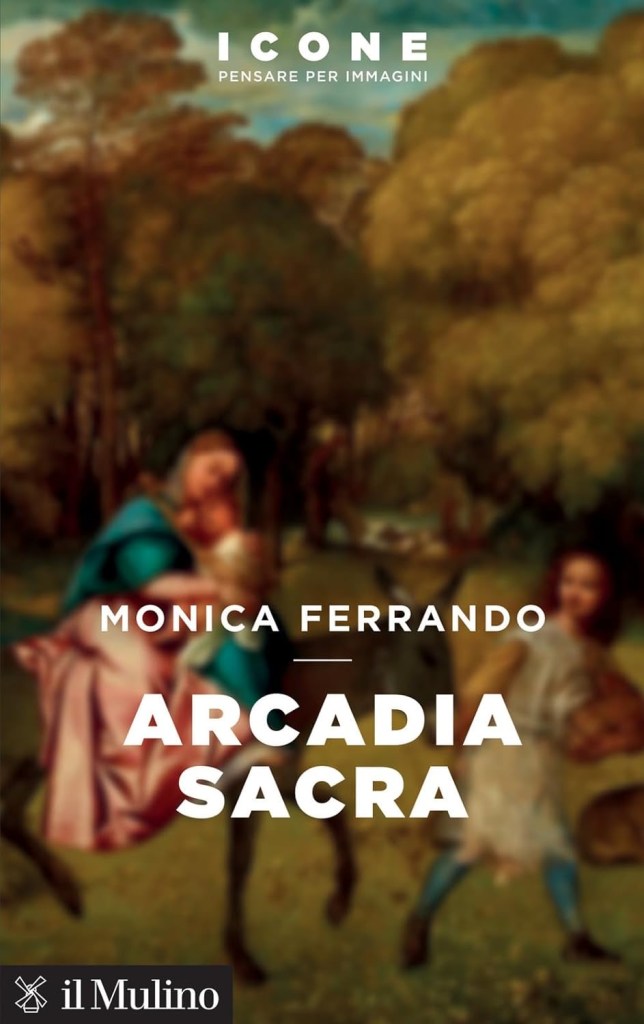
Living among the gods. On Monica Ferrando’s Arcadia Sacra (2024). by Gerardo Muñoz

For anyone familiar with the delicate thought of Monica Ferrando, the short book just published, Arcadia Sacra (Il Molino, 2024), makes it impossible not to read it in light of her the two previous works, the ambitious Il regno errante (Neri Pozza, 2018) that reconstructs the political paradigm of the nomos of Arcadia, and L’elezione e la sua ombra: Il cantico tradito (2022), which brought to light the corrupted meaning of a theopoetic understanding of “election” and its appropriation by an effective economic theology apparatus that governs over the destiny of the modern edifice. Arcadia Sacra continues Ferrando’s highly original reconstruction of the unforgettable myth of Arcadia within the obscure setting of secular  modernization in which painting itself has come into crisis to the point of utter obsolescence. We might be the first epoch in the history of humanity (or even prehistoric, since painting goes back to the non-original origin of the caves, as Ferrando has argued) in which painting itself is lacking and almost non-existent [1]. And although Ferrando does not allude to the present directly, it goes without saying that by choosing as her focal point Titian’s early picture “The Flight into Egypt” (1508), the vision deployed in the essay can only speak to us as urgently, where the thematics confronted by the Renaissance of Venetian painting returns to our present in a fractured flash: imperial conflagration, unlimited deployment of force, usurpation of territory and  multiplication of legal checkpoints, and the accelerated disconnection between architecture and nature, color the ongoing devastation of the vantage point of the landscape now eclipsed by the radiant artificial confinements of the contemporary metropolitan designs.  

Already during his postwar years in the United States, Theodor Adorno observed how the unbounded sadness of the American landscape has nothing to do with an inhuman romantic sublime; it was rather that the landscape feels as if it bears no traces of the human hand [2]. If Americanism configures the long lasting night of planetary nihilism; this is so, not only due to capitalist subsumption and production of human life, but fundamentally because of the inherent obliviousness of the  landscape that forecloses dwelling in the world. But the myth of Arcadia, as Ferrando will insists, is no utopia nor crafted rhetoric (the bucolic genre as an aesthetic compensation to the normative grid of the social bond); it is also the question about the earthly ground of existence, and the necessary attunement with the things that have been domesticated into order of the metaphysics of idolatry and objectivity (Ferrando 28). In this sense, Arcadia does not name another world to come; it is a world that has been registered many times, reappearing whenever the hand reaches out in proximity as if caressing the landscape’s skin.

The mytho-poetical deployment of Arcadia returns amidst a world in conflagration, and for Ferrando this has fundamental political implications insofar as it shows a way out from the grammar at the service of force and political dominion of commanders and soldiers – which is always already exercised as legitimate to coerce and to become a tool for the regulation of abstract mediations – into the voice of poets, painters, and shepherds (Ferrando 51). Arcadia reveals that the human species is a ductile animal that can sense by the ability to touch and use. This is why Arcadia stands as a third space outside the political dichotomy of empire and republicanism, between the struggle of usurpation and conquest, and the techno-political administration of common goods of social distribution and institutional delegation. The abstract humanism of the Renaissance, as Heidegger once claimed alluding to Machiavelli’s political thought, is also the commencement of a specific political technology rooted in certainty and justification that can only conceive representation as the ground for the production of an “effective truth” [3]. The virtuous homini militari of the Italian city states anticipate the neutralization of force as legitimate rule that will prepare the stage of modern political realism based on fear and normative rule of law. The final efficacy of force is to transform the sense of the world into a mere object, as Weil clearly understood it in her essay on Homer’s Iliad. One of the key insights of Ferrando’s Arcadia Sacra (2024) is that it shows that, parallel to the revolution in political technologies taking place in Renaissance Humanism, the image of Arcadia was being rediscovered in treatises and paintings in order to remain faithful to a different attunement of the nomoi, in which the philosophy of history of sacrifice, endless civil wars, and destruction of the Earth do not constitute true destiny (Ferrando 14). In an exoteric way – and it is so, because the craft of the painter is, precisely, depiction and figuration of the nakedness of what appears before our vision-  painters like Titian, Veronese, and Bellini, became witnesses to the acquiescence of the nomos mousikos, which far from soliciting the conceptual density of a theory of Justice; it registered the preeminent condition of poetizing nature of  living in the vanishing world. Indeed, it was in the musical nomos where the soul could establish the communication between exteriority and interiority within the gleaming order of things. 

If Heidegger in The Origin of the Work of Art suggests that the erection of work occupies the open space of this clearing; Ferrando will thematize how Boccaccio’s understanding of the Earth as radiantly divine was drawing upon the tradition of Arcadia will emerge as the pictorial space of the artists to disclose the vibrant sense of a necessary freedom (Ferrando 43). This means that living among the gods is not reducible to panentheism, if understood as oppositional to monotheism; rather, it was the opening to the event that gathered forms of life,  creations,  affections, and territories. In other words, there will always be gods whenever the world is not enclosed into the homogenous surface of a unified planetarity. And is not painting the quasi-originary activity of human anthropogenesis (the event of being in the world as such) the  sensible evidence that negates any conceptual and political translation directed towards action and justification? After all, painting is, among other things, the business of depicting mute things, as Nicolas Poussin famously claimed. 

But muteness must be qualified and expanded, since Arcadia is no asylum or final refuge of man. Titian’s “The Flight into Egypt” depicts a rite of passage, but also opens to a set of rhythmic connected activities that lead to the landscape. Thus, as Monica Ferrando reminds us, building from her previous Il regno errante, Arcadia is also the material experimentation of acoustic energy; music, or the the nomos mousikos, no longer guided by the command of political service, directed by attunement of the lyre and the syrinx, will speak the unwritten language of the human soul. Painting and music convergence at the nonsite of permanent formlessness. And it is rhythmic music allowing improvisation and experimentation that reimagines a different conception of the polis; a transfiguration of political life, in which the principle of civility in all of its complexity (citizenship, objective transference and negation, civilizational fortitude) will no longer articulate the principal axis of the human commonwealth. Neither a source of higher natural law nor a mere expansion of positive norms, the nomos of Arcadia for Ferrando entails: “inalterabile a unire intimamente musica e legge, entrambe  ágrapha, non scritte, se non nel cuore. L’interdipendenza tra modi della musica e nomoi della città, che sarebbe vano interpretare secondo un rapporto causale, trova nella stessa parola nomos un compendio inesauribile, ribadito nella Politeia: «Non si introducono mai cambiamenti nei modi della musica senza che se ne introducano nei più importanti nomoi della polis” (Ferrando 54). The separation of law from music – as Ferrando will say for poetry and philosophy in later pages – will ultimately lead to the moral struggle towards the rise of the fictitious (and whoever can impose it through their effective hegemony) against the emergence of the “love of thought” (l’amore del pensiero) (Ferrando 57). In this sense, the moralization of justice and its conversion into a specific historical grammar (lex scripta in the juridical apparatus) will ground the order of the polis in which the human will be absolutely sacred so that the sacred nearness between existence and the world – the atopia where the promise of happiness can take place – will vanish forever. As Carlo Levi saw clearly during the postwar years, the rise of the political administration of fear will coincide with the decline of painting as the source of being in liberty within the senses [4]. And, in our days, the historical termination of secularization can only be felt like an unending glacial interregnum (it is no surprise that Disney’s epochal blockbuster is precisely a defense of alienation of a cold being in a Frozen castle) in which the prehistoric reminiscence of the garden can only appear as an afterthought or mere representation, always out of reach, and viciously grazed by wild beasts before our own eyes.  

But seeing is already an exercise in prefiguration of a world that returns where painting stands as the medium for a mediation between the formlessness and the soul. This is why, above all, pictorial space is a privileged surface from which to flee our condition of unworldly inmates of our times. In a certain way, painting does not just bring to bear truth against the regime of calamitous fictions; it is also bears witness, as Ferrando states towards a high moment of Arcadia Sacra (2024), to the rediscovery of a new mental space that revives the attunement to a state of the world no longer reduced to the depredatory practices of civilizational extraction and consented servitude (Ferrando 77). The tradition of painting is not just a collection of forms and artistic conventions, but the ongoing concert that facilitates our movement (and being moved) towards happiness.

This is the promise of the itinerant Mary’s passive and inclined face in Titian’s early masterpiece. It does not come to surprise that for Ferrando, the mother dwells among the gods of peace, in contrast to the figures of the commander or the inquisitorial or priestly judge that monitor an endless narrative of intra-species civil war (Ferrando 63). It should not go without saying that at the same time that some contemporary scholars in the face of a historical crisis of legitimation attempt to revive the aura of the homini militari, the precepts of the ragion di stato and the technical virtues of the charismatic Prince; it has been the work of Monica Ferrando, in fully in display in Arcadia Sacra (2024), that invites us to turn to the counters of eros of painting that, almost stubbornly, transmit to us the infinite possibilities of life among the green blades of grass in Pan’s spiritual land (Ferrando 82) [5]. The sacredness of Arcadia resides in this unbounded exteriority that thanks to the mystery of the mother, is always commencing; and, having achieved happiness, it wants to know nothing about bring the world to conclusion. Beneath the arcana imperii (Rome) and the bylaws of the polis (Athens), the landscape of Arcadia remains a harmonious passage of our cohabitation.   

Notes 

1. Monica Ferrando. “Editoriale”, De pictura 3, 2020: https://www.quodlibet.it/rivista/9788822011643 

2. Theodor W. Adorno. Minima Moralia: Reflections on a Damaged Life (Verso, 2005), 73.

3. Martin Heidegger. Acerca de Ernst Jünger (El Hilo de Ariadna, 2013), 113.

4. Carlo Levi. “Paura della pittura” (1942).

5. I am thinking here of the works of several American  historians of political thought and  legal scholars in recent years that have mobilized efforts to restore a “neoclassical”, Renaissance centered political tradition, as a response to the crisis of modern liberalism. The most prominent list includes, although it is not limited to James Hankins’ Virtue Politics: Soulcraft and Statecraft in Renaissance Italy (Harvard U Press, 2020), Harvey Mansfield’s Machiavelli’s Effectual Truth (Cambridge U Press, 2023), and Adrian Vermuele’s endorsement of Renaissance imperial categories such as Ragion di stato, Lex Regia and the tradition of the Mirror of Princes, see his “Sacramental Liberalism and Region di Stato” (2019) and “The Many and the Few: On the American Lex Regia” (2023). The pastiche of this neoclassical investment made possible by rhetorical and hermeneutical deployments of instrumentalized myth, it is something that I have taken note of in “¿Revival de la tradición legal clásica?” (2022). Drawing a parallel to this classical absorption in American political thought, one could say that this is a reiteration of what Monica Ferrando herself has analyzed in her chapter on German Romantic Neoclassicism and the Winckelmann aesthetic project in her L’elezione e la sua ombra. Il cantico tradito (Neri Pozza, 2022), except now that it lacks aesthetic meditations (there is no Dichter als Führer), thus culminating in the direct exercise of applied executive force. 

On Cézanne’s pink stripe tablecloth. by Gerardo Muñoz

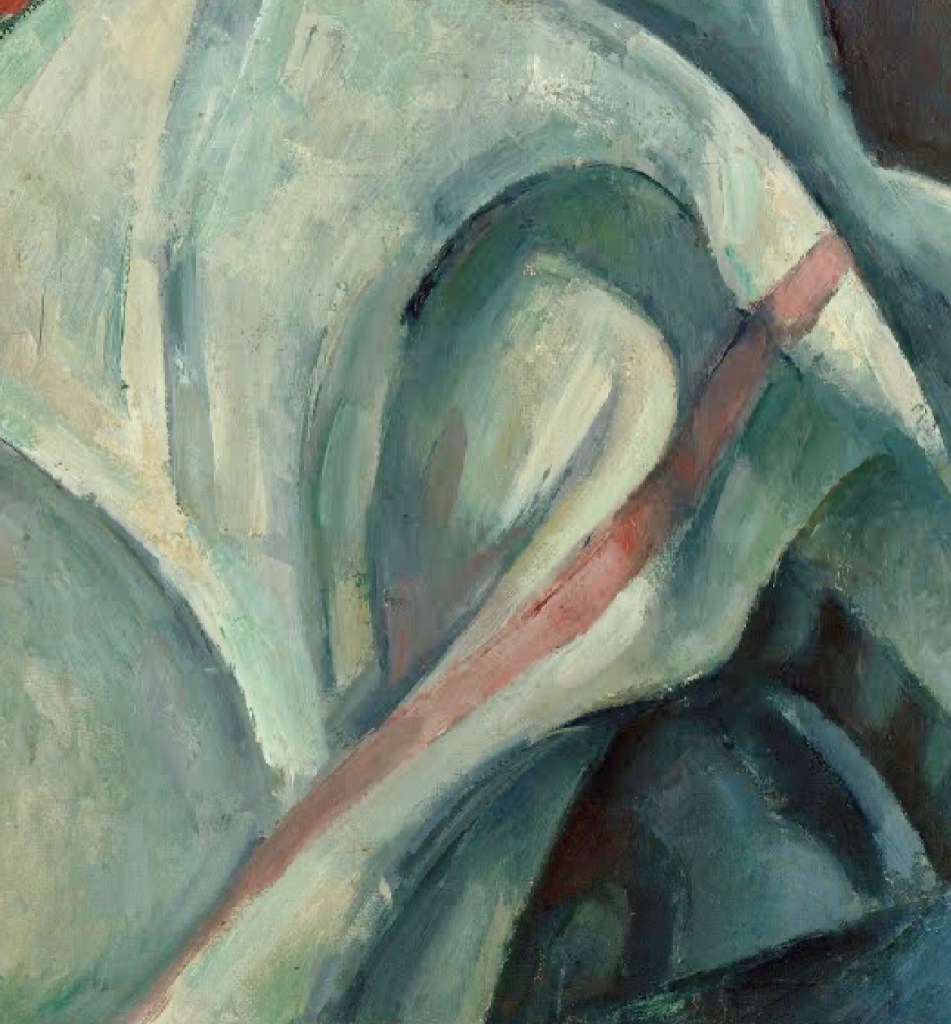
The title of the painting is “Still Life with Apples” (1894) housed at the Getty. Like many of Cézanne’s pictures of the 1890s we have a sense of immediately entering into an space warped by distance and nearness that lavishly seals the scene. We feel that something has taken place; after all these are pictures of an event, but only concealed to us. We are given the sense of that experience, which is the fundamental thing to depict for Cézanne. Now, if Clark is correct, then it is true that Cézanne’s still life painting was meant to annihilate the objectivity of the world through a study and stubborn simplicity; although simplicity never amounts to synthesis. On the contrary, what preserves sensation over absorption remains at a distance: this is the narrowing act of simplicity as a fact of style [1]. The depiction of appearance is a problem for Cézanne precisely because painting now stood (late nineteenth century), as Kurt Badt well observed, as the last metaphysical activity in the face of Western nihilism [2]. There is nihilism, an unbridled chaos – and thus painting aspired to accomplish a different form of order, a transfiguration through sense. A higher order subtracted from representation. Thus, the outpouring of sense was everything to Cézanne; nothingless than the attunement of the relationship between depiction and nature. Thus, nearness and distance stands a problem in the picture itself: what is most apparent is what Cézanne seeks to qualify through depth and singular brittle rigidity.

As he would write to his friend Émile Bernard: “In order to make progress in realization, there is only nature, and an eye educated by contact with it….I mean that in an oregon, an apple, a ball, a head, there is a culminating point, and this point is always the closet to our eye, the edges of objects recede towards a centre placed at eye level. With only a little bit of temperament one can be a lot of painter. All you need is an artistic sensibility. And doubtless this sensibility horrifies the bourgeois” [2]. This is Cézanne’s permanent struggle (a non-subjective position, that is, anti-Romantic) struggle: the impossibility to “realize” and to complete a picture as the heart of the mysterious vortex of the execution of depiction. This clears the entrypoint to the problem of the “last metaphysical activity in the wake of nihilism” that Badt consigns to the activity of painting: pictorial art can reveal the unrealizable in every work; but it is no less true that all works fundamentally have an asymptotic inclination to the potential of realizing the idea. The achievement of that impossible nearness attest to the achievement of painting (or to its consummated failure).

The unrealizable in Cézanne’s painting, however, is not merely indexing the unfinished gesture of the brush in a scene or a series of selected objects; rather it is the condition of possibility for entering into the world through a medial common existence between things, however fragmentary within the whole. The unrealizable dimension is never a conscious attempt for a spatial unity to be fulfilled; it is alienable by a stylistic reduction at the moment in which it ceases to belong to the painter’s cognition. This is why Cézanne’s pictorial project – more so than Pisarro’s anarchic affinities and political flirtations in the late nineteenth century – has radical consequences for an opening of freedom that is grounded on the senses (and what it means to be ‘free in the senses and the passion’, in each temperament), allowing experience to decompress the formalistic representational conditions of bourgeois civility. Indeed, Cézanne’s work – and the world it depicts, the opening towards things as a whole but through separation, having in common precisely alienability – does not aspire to be legible in the social, which is the ideal space of exchange and metaphorization, recognition and reification as image. The social is the limitless spatiality in which anything can enter, as anything can stand for any other thing. Or, to put it more concisely: painting seeks to let things be things in their interchangeable nature (without the anxiety over fixing an image of Nature).

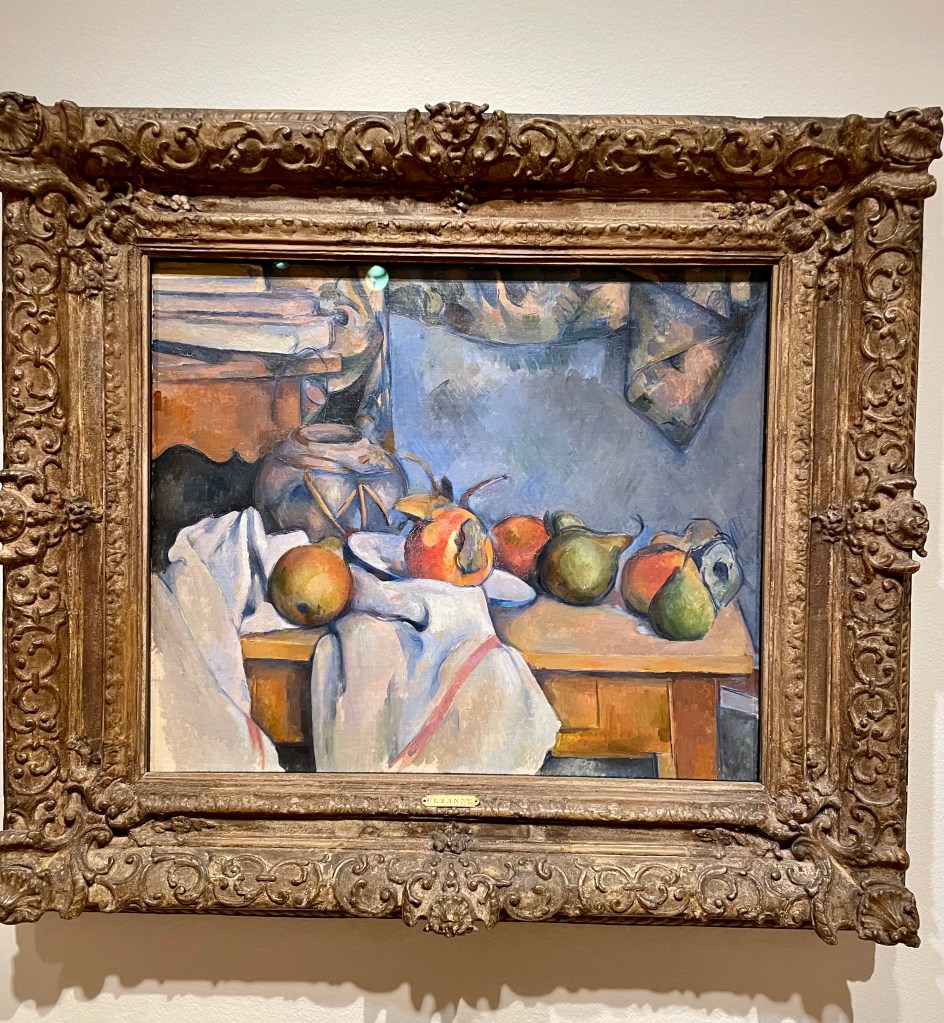
Paul Cézanne. “Ginger Pot with Pomegranate and Pears” (1893), Phillips Collection, Washington DC.

Cézanne inadvertently knows that whatever fate in the wake of nihilism awaits “painting” (soon to be utterly destroyed and displaced by the conceptual and object driven monstrosity of the modern vanguard), the effort to “realize” in painting meant holding to experience of depth as the only guarantee of an existential freedom. Surface and depth will remain on the side of the insistence of an appearance without predicates proper to theatricality. Kurt Badt poignantly captures this in Cézanne’s “old age style”: “There is no longer anything in our sensory experience of seeing which corresponds to what thus becoming visible; what is shown nis rather the visible picture of the concept of freedom. For the thing common to all these forms of the “style of old age” is two-faced: negatively it is a ligeration from isolation and resistance, possibly a liberation to the serious gentleness of freedom” [4]. And gentleness means letting things be: the serene elevation to irreducibility, upholding them only in the proclivity of its contact; never fully absorbed by surrounding and revealing its state of harmonious composition. The task of depiction in painting is the impossible task- but the task nonetheless thoroughly achievable through the hands of the painter – of coming as close as possible to what has actually been experienced. Having affirmed (not necessarily achieved) something like a fate-like divine temporality in painting is able to ground worldliness as transcendent only to let it fall immediately after. And what fate is to character, for Cézanne ‘that which is preserved unchanged’ is the supreme tonality of the pictorial task realized by the restraint of the artist [5].

But precisely to depict immobility, the forever permanent, the befallen weight of the conatus essendi (what preserves itself as such), painting has to mobilize a minimum motion for the confluence of objects, planes, and emergence of depth. The pink stripe tablecloths that appear in several of the 1890s still life paintings with fruits can be very well taken as a multum in parvo of the declension in every realization. In a sense, then, the pink strip is a signature, as if were, of the gathering of things and depth at the price of unrealizing the closure of integral depiction. It is precisely the pink stripe in which it becomes realizable in a single brushstroke that the place of the line appears otherwise, crowning the mystery of painting as the clearest manifestation of a different musical order. It is the mysteriously nature of painting, which barely introduces itself as a line substitute for a color (the color of the tablecloth as a thing) that, while remaining visible to the viewer, cannot but reveal the invisible; that is, the temperament of the artist attuned to the muteness of painting, to say with Poussin. And perhaps this is the highest moment of depiction in the search for the “integrity” of “wholeness” that, in turn, grants the instance of the unconcealment of truth. A lace plotting what has already been validated in the irrevocable thereness of the most inapparent existence: an eternal state in the world.

.

.

Notes 

1. Maurice Denis. “Cézanne II”, The Burlington Magazine for Connoisseurs, Feb, 1910, 279.

2. Kurt Badt. The Art of Cézanne (University of California Press, 1965), 181.

3. The Letters of Paul Cézanne (Getty Museum, 2013), 342. 

4. Kurt Badt. The Art of Cézanne (University of California Press, 1965), 313-314.

5. Ibid., 161.

Hölderlin on the serene life. by Gerardo Muñoz


In a letter from the beginning of 1799 addressed to his mother, Hölderlin makes a sort of confession that fully illuminates (in a multum in parvo fashion) what he understood as a quiet or serene life. Or at least, it allows to grasp how he comes to envision it and towards what end. At first sight, what is striking is its bare literalness, too strange for a poet, and too mundane if it were not for its intrinsic lyricism. It is a lyricism that comes forth effortlessly, which speaks to the quality of its furtive testimony. Literalness is also described in its engagement with the world – and, more fundamentally, the sufficient condition for sense to emerge. This is the fragment in question (from Helena Cortés’ translation of the correspondence):

“No quise rechazar de plano para tener por si acaso una vía de escape, y sobre todo puesto que se ofrece a buscarme una plaza que consiste en acompañar a la universidad a un jovencito. Conocer más mundo (conocer el pueblo alemán le es tan necesario, especialmente a todo el que quiera convertirse en un escritor alemán, como conocer el suelo al jardinero) es al fin y al cabo la única compensación que me puede ofrecer una situación tan fatigosa, y lo alejado del lugar, que de todos modos muy lejos no puede estar de alguna universidad, me parece más ventajoso que perjudicial durante un par de años en los que aun no puedo contar con gozar de una vida tranquila entre los míos”. [1]. 

There is little doubt that the world disclosed here is well within the bourgeois interiority: there is economic calculation and anticipation. At this time Hölderlin was being offered the position of a preceptor to a university student. But there is hardly only this. There is also the affirmation of fleeing from what this world has to offer – and this means quite a lot in the early quarters of the Enlightenment. Una vía de escape – for Hölderlin the way out is not merely from economic hardship, but also the possibility to retain a certain knowledge that he dares to qualify as “of the world”: “to know the world, which is the only compensation to a fatigued situation and the remoteness of place”. Loss of fixity to place demands access to the world.

This is not your expected aesthetic education of man. The subject of the Enlightenment – its commitment to historical abstraction and the possession of aesthetic form as mediation to totality – prevails at the epistemic register at the cost of rescinding the dislocation from nature. By contrast, the knowledge implicated in knowing thy world should be like that of the soil with the gardener (pay attention to how Hölderlin inverts subject and thing: it is the ground that becomes accustomed to the gardener, and not the other way around). But at the threshold of the eighteenth century, Hölderlin’s “vía de escape” was also compensatory to the fatigue of a nascent epoch of the subject. The compensation did not entail an excess of knowledge; it was rather knowledge a way to disengage with the presupositions grounding the historical epoch.

This seems to me the operation at work in Hölderlin’s epistolary confession. Carchia was right in positing Hölderlin’s poetological aspiration of spirit and nature was entirely pre-Olympian, which requires subtracting himself from the modern parody of cultic romanticism [2]. A way out appears in cleared space when serene life is finally realized between friends; that is, among those that I make as friends (“los míos”). Poetry and making are here at their closest proximity cutting through the thicket of experience. This is what it means to know thy world. At the center of Hölderlin’s ethics there is a sense of distance – the waiting for a serene life in which language will finally gather itself unto presence. Ultimately, this is the plain literalness that the 1799 letter offers us.

.

.

Notes

1. Friedrich Hölderlin. Correspondencia completa, traducción de Helena Cortés y Arturo Leyte (Libros Hiperión, 1990), 467.

2. Gianni Carchia. “Introduzione” to Walter Otto’s Il poeta e gli antichi dèi (Guida Editori, 1991), 8.

Jesus as gardener in the landscape. by Gerardo Muñoz

A reproduction of Titian’s early work “Noli Me Tangere” (~1514) cannot do justice to its majestical prudence if contemplated directly on the walls of the National Gallery. To use the terms “majestical prudence” might be a bit of a misnomer, but at least it allows to be slide into what entails the central enigma of the picture: its underemphasized contours of the biblical encounter from John 20:15, in which the resurrected Christ appears to Mary Magdalene as a gardener. A lot has been made about the Giorginesque influence on the picture, but it seems to me that the underemphasized composition speaks to the real triumph of Titian’s masterpiece. This is a triumph achieved not so much through the imports of allegory and pagan motifs, but rather as a complex web of distances untangled in the picture: the distance between Christ’s gaze with Magdalene’s upward look, but also the solitary tree inclined leftward, which compensates for the downwards light jerk movement of Christ as he takes distance to escape touching.

I have said nothing of the deep and overpainted deep blue sea in the background; or the receding landscape in the distance with a flock of sheep, high grasesses, barns, and a modest castle to the upper right side of the picture. A little man walks his dog, and we guess he is moving towards the sheep. Or perhaps not. The underemphasized and inconspicuous composition of the picture is precisely in the formulation of distances; invisible distances that allows the gathering of proximity. Only in this minimalist case can the painting be described as giorgenesque. Herbert Cook in his monograph on Giorgione captures this balance by what he calls invisible threads: “Peculiar, however, to an artist of genius is the subtlety of composition, which is held together by invisible threads, for nowhere else, perhaps, has Giorgione shown a greater mastery of line.” [1]. This is also a fair treatment of what holds up the elements in Titian’s picture.

Now, the invisible threads in “Noli me Tangere” do not merely substantiate the networks of lines; rather they also bring the picture to a point of a distant presence. This is what we are able to perceive when confronted with the painting in the walls of the National Gallery. There is another more straightforward way of stating the same: there is something “earthy” to Titian’s rendering of John 20:15, and by “earthy” we attempt to point to point at the distribution of distances between earth, sky, and landscape. This also implies how bodies move in it. It does not take much to document it: one could start by attending to Magdalene’s merciful arm raising to Christ’s cloaked body, followed by his holding of the hoe, which immediately swayes us to the tree. Magdalene’s left hand on an ointment vase reinstates the dowards movement to the ground. The earthly character is the tension elaborated by these distances – a very modern sensation that we will not get in the later pictures of resurrection in the glorious skies of redemption, as noted by Erwin Panoksky [2]. The earthly deposes the relieves of both glory and incarnation. Titian wants to give us the picture of a resurrection in a world that passes by as it retains its tranquility, which painting can only provide us through a non-emphatic incorporation of its distancing.

This could very well account for the assumption that “Noli Me Tangere” becomes a decisive “stepping stone in the evolution of modern culture…from the Byzantine theology to Pantheism and spiritual freedom” [3]. The fact that Renaissance painting was absorbent to the pagan myths is something that has been studied by the major art historians of the twentieth century, so one could also take Richter’s thesis somewhere else. Pantheism is not about the symbolic restitution of specific iconography or motifs, but it is rather the exposition of a particular experience: Jesus as gardener services the disclosure of an unmediated world granted by the perception of distances. The mistaken perception of Jesus as gardener can only be understood, even if momentarily, as undoing the work of Adam, only to be resumed and “served” (ābad) by the Savior [4]. But this might be reading too much “meaning” into the picture, which is deliberately underemphasized in its avoidance to allegorical weight.

To any modern attentive observer, it becomes impossible not to bring into the picture the early modern dispute between gardeners and architects. This opposition does not justify Titian’s “Noli Me Tangere’”, but it does serve (at least it serves me) to insist on the open relation between gardening and the disclosing of an unmediated world, which stands as a theological idiom of the picture. It is most definitely a picture of a resurrected life that is only apprehended by the possibility of immersing itself in the rhythms of the invisible that pertain the world. So, we do not have to wait for the late mysterious and dark Titian to find a full coincidence between painting and thought. “Noli me Tangere ” seems to tell us that there is thought whenever there is earthy grounding in the bifurcation between bodies and things in space.

And so, we can return to the thin blue sea on the left side of the painting, which magically brings all the earthly elements to the forefront. It is the ultimate distance, as well as the unbreachable region where all elements converge (pay attention to the vegetation and the clouds literally becoming blue) sharply on the horizon. It is also the most emphatic instance of the picture; the lacunae that guarantees the masterful structure of invisible threads that ultimately pins its intimate proximity to natural dissolution.

.

.

Notes 

1. Herbert Cook. Giorgione (George Bells & Sons, 1900), 41.

2. Erwin Panofsky. Problems in Titian: Mostly Iconographic (NYU Press, 1969), 40-41.

3. George M. Richter. “The problem of the Noli Me Tangere”, The Burlington Magazine for Connoisseurs, V.65, July 1934, 10.

4. Nicolas Wyatt. “When Adam Delved: The Meaning of Genesis III 2″, Vetus Testamentum, Vol.38, 1988, 121.

Hölderlin in Agamben. by Gerardo Muñoz

There is no question that Hölderlin occupies a central place in Giorgio Agamben’s work, although he always appears within a specific strategic deployment. Of course, it might be the case that Hölderlin is always present in instances where he is not directly cited or thematized, but in the following note I want to record four instances where Hölderlin appears in different phases of Agamben’s thinking. These notes are preliminary for a larger work in progress that looks at the status of the comic as a potential force for a transfigured politics, which is informed, although not limited by Hölderlin’s work. Hölderlin occupies, after all, the entry point to L’uso dei corpi (2014) in relation to the well-known maxim “the use of the proper”; the territory where the (modal) ontology will be measured. However, esoterically Agamben’s incorporation of the German poet suggest a ‘way out’ from the tragic politicity of modernity. It might useful here to recall Schmitt’s annotation in Glossarium about what Hölderlin symbolized in the larger picture of modern German thought: “Youth without Goethe (Max Kommerell), that was for us since 1910 in concrete youth with Hölderlin, i.e. the transition from optimistic-ironic-neutralizing genius (genialismus) to pessimistic-active-tragic genialism (genialismus). But it remained within the genialistic framework, yes, deepened it into infinite depths. Norbert von Hellingrath is more important than Stefan George and Rilke.” (18.5. 1948) [1]. To overturn Hölderlin as the figure of the tragic caesura and witness to the crisis of “distance” in modernity is most definitely at stake here in order to avoid (subjective) conditions for something like an Enlightenment renewal. More broadly, it could be productive to think of Hölderlin as the poetic site that grants Agamben a possibility of thinking the event beyond the dependency of messianism and history, now displaced by the relation between language and world. 

a) As early as in Stanzas (1977) Agamben writes about Hölderlin: “The name of Hölderlin – of a poet, that is, for whom poetry was above all problematic and whom often hoped that it could be raised to the level of the mēchane (mechanical instrumental) of the ancients so that its procedures could be calculate and taught – and the dialogue that with its utterance engages a thinker who no longer designs his own mediation with the name of “philosophy”, are invoked here to witness the urgency, for our culture, of rediscovering the unity of our own fragmented word” (xvii) [2]. Hölderlin occupies here the site of antiphilosophy, in which the event of language does not longer coincide with a structure of the subject, but of the potentiality of “saying”; a sayability in which fragmentation removes any commanding closure of language. The event of appearing and bring to conclusion (in the book on Paul, Agamben will associate it with the rhetorical figure of the enjambment in the poem) gains primacy over formalization. 

b) In another early book, L’uomo senza contenuto (1994) Agamben takes up the question of fragmentation of language in Hölderlin but this time provides a specific category: rhythm. On the chapter about the original structure of the work of art he writes: “Everything is rhythm, the entire destiny of man is one heavenly rhythm, must as every work of art is one rhythm, and everything swings from the poetizing lips of the god”. This statement was passed down to us by Hölderlin’s own hand. […]. What Hölderlin’s sentence says appears at first blush too obscure and general to tempt us to take into consideration in a philosophy query on the work of art. However, if we want to submit to its proper meaning, that is, if we want, in order to corrupt to it, to make it first of all into a problem for us, then the question that immediately arises is: what is rhythm, which Hölderlin attributes to the work of art as it original characteristic?” (94) [3]. So, the category of rhythm “holds men” epochally as a form of incommensurable distance with the world, which Agamben relates to an-archic original structure of dwelling. For Agamben this step-back to the “original site” vis-à-vis rhythm releases “art” as poesis from a productivist “destiny”. So, it would be obvious to say that rhythm, insofar it abolishes the production, it also thematizes the ethical life as the form of life (which is why Agamben also attaches Hölderlin as a counter-figure of the notion of “vocation”) [4]. There is no form of life without rhythm in nearness to the common ground. 

c) In Autoritratto nello studio (2017), Agamben glosses (a) and (b), that is, he recognizes the importance of Von Hellingrath reconstruction of the late Hölderlin of the Pindaric translations and the fragmentary syntax, but now situates him at the center of modernity. Agamben writes: “Walser noted, as Hölderlin before him, that the world had become simply unhabitable. And there was not even the possibility of amending it…I am convinced that Hölderlin in his last thirty years of this life was not unhappy, as some professors of literature tend to describe him. On the contrary, Hölderlin was able to dream at his house without worrying about duties. The Tubingen tower and the clinic of Herisau: these are two places that we should never cease to reflect upon. What took place behind these walls – the rejection of reason by these two poets [Walser and Hölderlin] – is the most powerful rejection against our civilization” (140-141) [5]. So here Hölderlin, like Walser, is an epochal gestalt capable of generating the separation between thinking and doing, world and experience, which became totalized in the legitimacy of the modern. What could be interpreted as ‘domestic interiority’ for the poet becomes a symptom of a radical form of dwelling at the end of reason subsumed by nihilism.

d) Finally, in a recent essay published this year entitled “Hölderlins antitragische Wendung”, Agamben goes a step further to qualify Hölderlin’s breakthrough, taking radical distance from his relation to the tragic and identifying him as a poet that must be read in a comic register. This is all the more surprising given that, as Agamben himself notes, there is almost no mention of comedy in Hölderlin’s prose, except in the review of Siegfried Schmid’s play The Heroine. And although it is true one could argue that Hölderlin undertook a destruction of the tragic poet in The death of Empedocles, as far as I am aware there has been no interpretation of Hölderlin as opening to the “comedy of life”, except for a brief mention, almost in passing, about his laughter by the Italian poet Andrea Zanzotto [6]. Agamben concludes his essay suggesting that: “With this concept of “ordinary life” I should like to conclude my reflections, at least for the time being. Isn’t it precisely this ordinary life, what in the thirty-six years in the tower, Hölderlin’s life and poetry – or his “poetry” – have persistently sought to carry it out in an exemplary and funny way? And isn’t “ordinary” life the same as the “living” life (to live according to habitus and habits), which is distant and perfect in the last tower poems: When people go into the distance, living life …?” In any case, if Hegel defines the idyll as “the half descriptive, half lyrical poems […] and mainly nature, the seasons, etc., the subject matter”; then the tower poems – this extreme, incomparable poetic legacy of the West – are an idyll of the genre” (40) [7]. And here Hölderlin appears not just as another figure in “the age of the poets” (and the genialismus‘ commanding force), but rather as the moment in which the problem of life opens to its inoperosità. The unity of humanity now navigates the fragmented reality not through the subject, but rather through the singular form of life. Comedy, then, in the idyll genre in which life is freed from both desire and liberty.

.

.

Notes 

1. Carl Schmitt. Glossarium: Aufzeichnungen aus den Jahren 1947 bis 1958 (Duncker & Humblot, 2015). 114.

2. Giorgio Agamben. Stanzas: Word and Phantasm in Western Culture (University of Minnesota Press, 1993).  

3. Giorgio Agamben. The Man without Content (Stanford U Press, 1999). 

4. Giorgio Agamben. “Vocazione e voce”, in La potenza del pensiero (Neri Pozza, 2005). 77-89.

5. Giorgio Agamben. Autoritratto nello studio (nottetempo, 2017). 

6. Andrea Zanzotto. “Con Hölderlin, una leggenda”, in Friedrich Hölderlin: Tutte le liriche (Mondadori, 2001). i-xxiv.

7. Giorgio Agamben. “Hölderlins antitragische Wendung”, Studi Germanici, 17, 2020. 27-40.