The love of painting. by Gerardo Muñoz

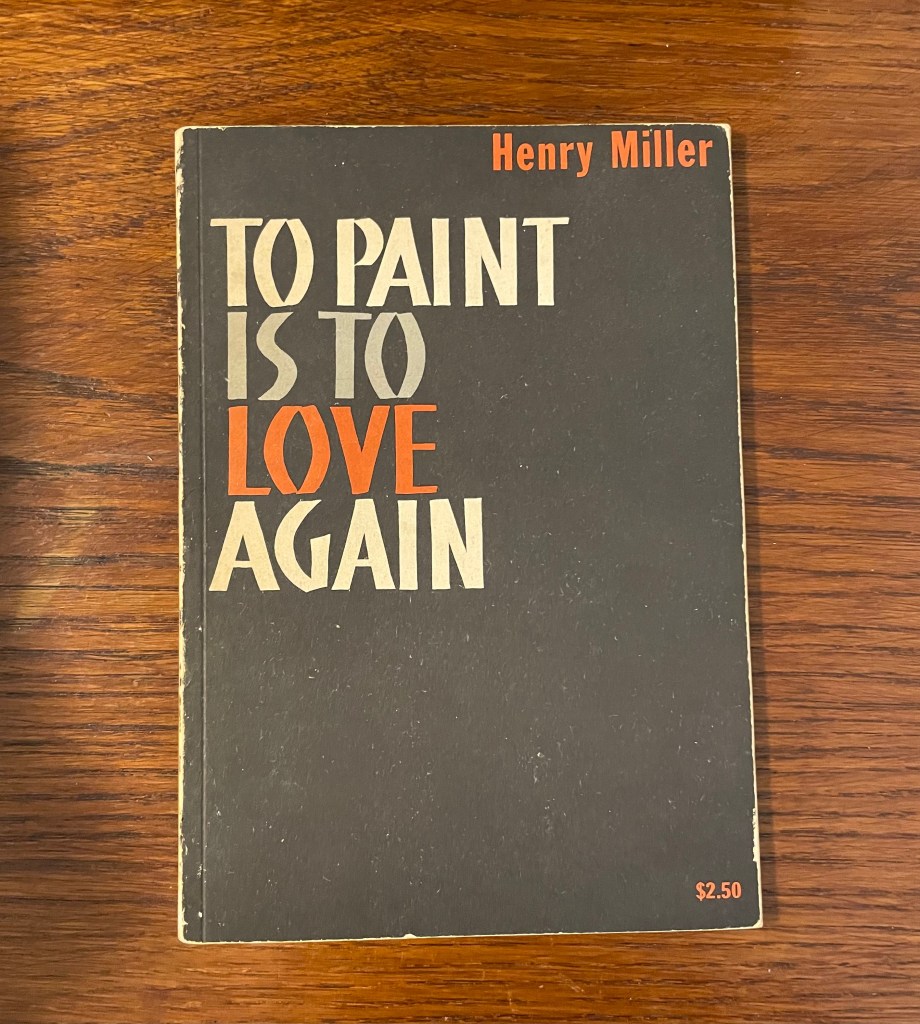
There might very well be an internal affinity between painting and love that at some point it becomes indistinguishable. A painterly picture can become love unquenched for that which remains persistently fixed and unrealizable. In one of the short essay books of his Big Sur period, Henry Miller asked this very question of painting. For him panting had a wondering origin that crosses the hand, undoing what we can easily enact. The erotic dimension of painting, thus, has nothing to do with the image or figure of the beloved, but rather with a specular limitation staged in the ability to allow the unseen to be incorporated in the visible scheme of the world. Only if we are able to see – and by the same token, only if there we are facing an event of painting – can something like use can be liberated from the constraints of mimetic compulsion. Miller writes in To Paint is to Love Again (1960): 

“To paint is to love again. It is only when we look with eyes of love that we see as the painter sees. His is a love, moreover, which is free of possessiveness. What the painter sees he is duty bound to share. Usually he makes us see and feel what ordinarily we ignore or are immune to a certain manner of approaching the world tells us, in effect, that nothing is vile or hideous, nothing is stale, flat or unpalatable unless it is our power of vision. To see is not merely to look. One must look-see .See into and around. Or, as John Marin, once put it – “art must show what goes on in the world” [1]. 

The place of painting for Miller is an imperturbable state that refuses to be fixated on objects, but in the invisible region (as in the figure of the chora) that allows for the thing in the world to be used. This is why Miller considered Japanese watercolor and prints an absolute primer of the pictorial: it taught him the appearance of worlds within the world, regionalizing the surroundings never logically stated unto itself, which in modernity it became the catastrophic horizon of autonomy towards its posterior liquidation. This is why Miller, very much like Carlo Levi, understood that the crisis of painting in the Western tradition ultimately signaled a general sense of social terror as a new phase of human desperation attenuated by the circulation of social fictions. 

At the height of the the closure of civilization, painting reemerged, if Kurt Badt’s axiom is correct, as the last metaphysical activity of human praxis. A metaphysical activity that holds on to the experience of belief in suspended appearance of originary anthropogenesis. For Miller, in painting as much as in love “one must be a true believer” [2]. And this assertion must be understood in the backdrop of Miller’s experiential retreat in the landscape of Big Sur: an experience away from the closure of American city life in research of a “feeling of aloness as spiritual achievement”, as a relation of oneself towards disclosure [3]. In this sense, the painter is a counter-social figure that, refusing to make stir in the world, turns to serenity, silence, and to the pressing contours of the unfathomable beyond any prefiguration. The believer in painting – who is a figure of belief in the desert, after the flight of the gods in the nocturnal vigil of history – is the thrust to the experience of things without barristers or shortcuts to what is revealed.

The age of automation in mid-century transformation of American industrial production serves as the historical backdrop of Miller’s indictment regarding the poverty and eventual disappearance of painting due to the autonomization of human praxis and the gigantic scale in spatial organization. Following Georges Duhamel’s prognosis in America: the menace (1931), he shared the intuition that the crisis of dexterity meant the impossibility of realizing painting, now situated beyond the grasp of human absorption [4]. A land without landscape that, as Adorno noted, bears no traces of the human hand. And this was seen already in the 1950s when the rise of abstract expressionism in North American announced not just the end of easel painting, but the funeral of the whole pictorial tradition. The barbarism of gigantic and unlimited Americanism would run counter to painting as a sensorial activity that embraced the vital limitations of its region. 

Miller’s insistence on painting was an eulogy to a life as experience – painting is indistinguishable from the hands and souls of the painters that he encountered and shared his life – and the value of poverty as absolute necessity for a life that regionalizes our contact with the world. It was through the love of painting that humanity could only restore its divine presence without rest.

Notes 

1. Henry Miller. To Paint is to Love Again (Cambria Books, 1960), 17. 

2. Ibid., 39

3. Henry Miller. Big Sur and the Oranges of Hieronymus Bosch (New Directions, 1957), 34.

4. Georges Duhamel. America: the menace (Houghton Mifflin, 1931), 85.

Gethsemane as experience. by Gerardo Muñoz

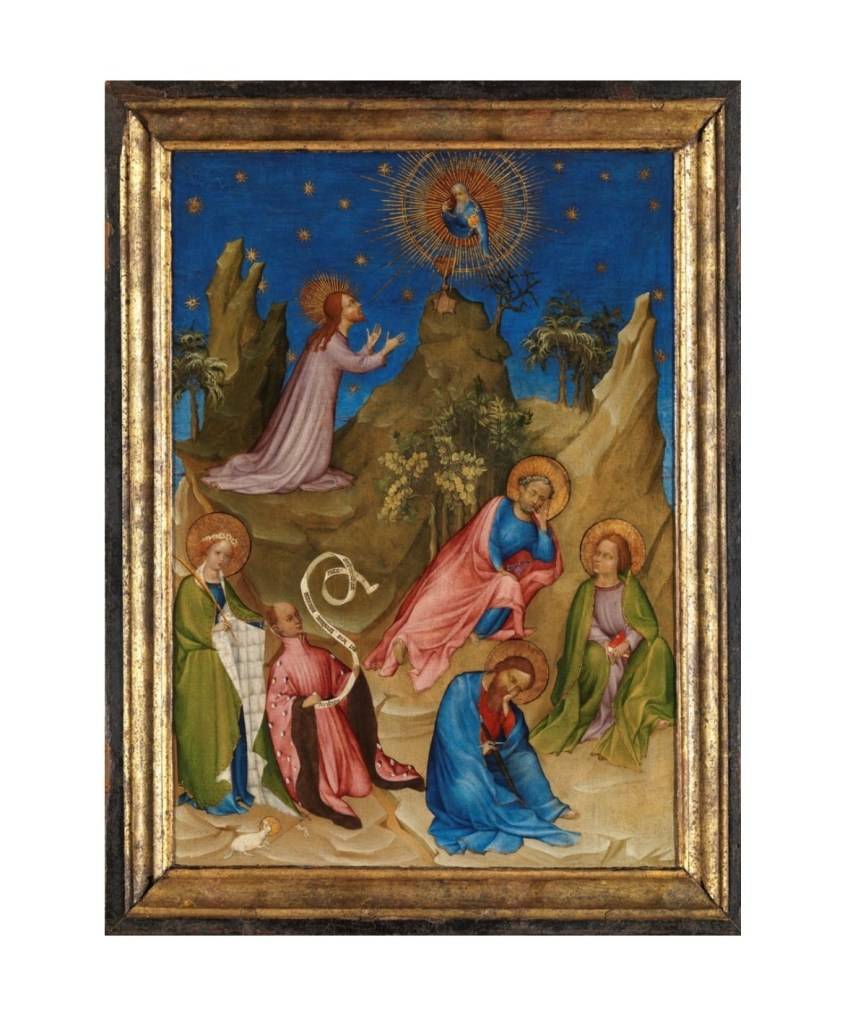
There is a panel in the Museo del Prado titled “Agony in the Garden”, attributed to the French painter Colart de Laon (1377) whose religious work barely survives (this panel is, in fact, one piece from an original triptych). The scene portrays the well known stay of Jesus in the Garden of Gethsamane on the Mount of Olives, where solitude and abandonment prepares the interval for the moment of transfiguration. If anything, Gethsamane is an experience of inwardness outside itself, which the painter has marvelously captured in the figure of Jesus raising his hands in supplication to the starry skies and god. Or so we think. The crisp blue tone of the sky immediately reminds the view of the vault of the Villa Farnesina that Fritz Saxl has interpreted as the transmission of a previous pagan astrological faith in the pictorial composition. The intense blue tone coupled with the emphatic stars arrest our imagination, but also that of the humane and worldly Christ.

What kind of experience is to look up into the firmament from man’s place on Earth and the cosmos? And what are we to make of the inability of the civilized human being to look into the blue depth not as a mirror of Nature, but of the non-totalizable and irreducible experience of solitude? It must be said that in a post-mythical world, the increasing loss of the opening of the sky goes hand in hand with the boundless loss of the Earth. And this is why we are tempted to read Colart de Laon’s picture as a gesture that renders legible the passage of the same movement: the Jesus that raises his hands outwards to the sky; and, simultaneously, the dozing Jesus that inhabits the contemplative state at the center bottom of the picture. To live in the world is defined neither by the experience of the time of arrival of the sky nor by the inward experience of the soul, but by the ability of transiting from one state to the other. And only there the worldly divine can be disclosed beyond the sclerosis of form.

This might also explain why Søren Kierkegaard following the German hymnist Gerhard Tersteegen could write in a gloss of his diaries that Jesus arises from the love feat into the path of Gethsemane: “It is always this way: Gethsemane lies closest to the highest bliss” [1]. The highest place is not the moment of absolute transcendence through faith; it is the secret that for Tersteegen expresses a kenotic hymn that empties life in the direction of poverty and death. In other words, the “highest bliss” is the experience of expropriation of every life; making life and death become indistinguishable in the vacillating night. A night beyond time and without god.  

Perhaps not just the “religious experience”, but all experience has as its central paradigm, the highest bliss in the face of death in which language can only account for it in its muteness and reverence. This is not an experience of vital teleology of humanity, but of a furtive relation. “Hacía sobre ella la experiencia”, as a Chilean writer once put it in the imperfect tense. But this can only mean to do an experience on the dissolution of oneself. 

Notes 

1. Søren Kierkegaard. Journals and Notebooks V.7 (Princeton University Press, 2014), 368.

God behind painting. by Gerardo Muñoz

In one of the glosses in Marginalia on theology, Erik Peterson provides a remarkable pictorial image of thought of death and resurrection through the activity of washing a bowl. Peterson writes: “When washing a dirty dish, our thoughts may turn to the dead, to the dead as a genus, as an inferior genus that perhaps unconsciously influences our actions, as angels and demons do in another way. This probably happens because the dead have something in common with dirty, unclean dishes. Imagine this cleanliness however you like: perhaps we can say that death as such is an act of purification. To think of death in this way, endowed among things – like a bowl – gleam just like the voice of god in the bush” [1]. It is a fragment where Peterson comes closest to the specific nature of painting: what is painting if not the transference of muteness to the gleaming of the visible that opens before our very eyes? And like the divine voice in the bush in Exodus, what does it take to grasp and see the divine between or behind a dirty bowl as it lays on our hands? If washing a dirty dish entails receiving the dead in our thought, the passive act of painting seems always to lay a claim about the mystery of presence outside language. 

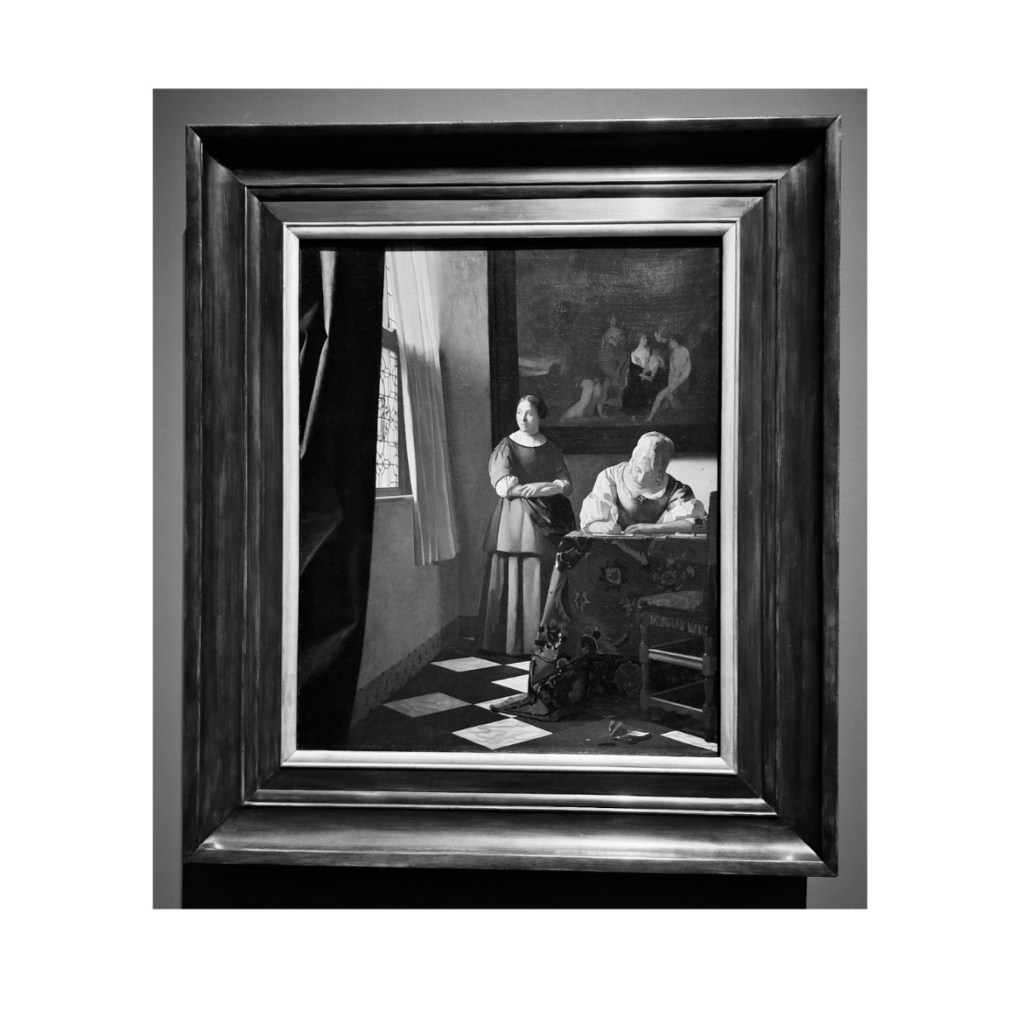
If I elevate Peterson’s remarks to a terrain that the one that he intended, is connected to two Vermeer’s pictures exhibited these days at the Frick Collection gathered around the theme of “letter writing”. In both pictures there is a lady seating at a table drafting a letter – one of them has already concluded it fully attentive to the visitor on her right side; the other a maid gazes at an open window  – but what is always unnerving in Vermeer’s work is the sense of the ineffable and impenetrable in the disclosure of the picture (an exposure that that is usually aided by a side curtain that welcomes us in). What is this impenetrable divinity that lurks in Vermeer picture in pure presence? Although we do not have a name for it, it is like the god that dwells in the dirty bowls or in the nocturnal bushes of Peterson’s gloss.

The painting does not speak in revealing, it only bear witness of the absolute fall of language as it becomes imperturbable in the picture. Contesting the vulgar interpretations on Vermeer’s Catholic conversion in Delft, Daniel Arasse notes that the vortex of his pictorial theology is bounded to the threshold in which images become alive (in the tradition of au vif) outside itself: “Vermeer’s painting are constructed such a way as tho render this life equally present inaccessible, near and impenetrable. What is seen is not a crete of nature observed, but a mystery within the painting itself” [2]. In Vermeer’s pictures, presence and the invisible collapse not through the inception of a metaphor of nature, but rather through the painting’s light when it casts a shadow beyond any instance of closure.

This is why in Vermeer’s paintings surfaces mandate an order of theatrical presence, while simultaneously making room for a perturbance that is forever barred from the conceptual. Unlike Giorgione’s “Three Philosophers”, Vermeer’s pictures are not endowed by the mysterious force of an alienated nature that man can measure and master; rather, the mystery resides in the whispering of the invisible that cosigns the amoris causa of the appearance of painting. If for Peterson what gleams in the dirty bowl is the cleansing of resurrection; what befalls Vermeer’s pictures can only be understood as the faith in the painterly emergence of appearance dependent on the path opened by its light.

The question of god as appearance is always posited as a challenge to the meaning of reality as totality no longer as what emerges in the open, but as what which retracts lagging behind. And we know that only appearance is seductive enough to stand for faith well beyond the fact of being visible [3]. Hence, a way to supreme subtlety of painting (picturae summa subtilitas): no longer a matter of perspective and contour, but of the mysterious indiscernibility that mounts depth between vision and the divinity of presence.

Notes 

1. Erik Peterson. “Fragmentos”, in Tratados Teológicos (Ediciones Cristiandad, 1966), 251-252.

2. Daniel Arasse. Vermeer: Faith in Painting (Princeton University Press, 1994), 75.

3. Consider Heidegger’s response to a question in the Zurich Seminar, 1951: “If I were yet to write a theology then the word ‘being’ would not be allowed to occur in it. Faith has no need of the thinking of being. If faith has recourse to it, it is already not faith. I believe that being can never be thought as the ground of God”. Séminare de Zurich (Paris, 1980), 60-61.

Prados Such’s Dormido en la yerba (1953). by Gerardo Muñoz

Emilio Prados Such’s postwar book Dormido en la yerba (1953), long out of print since its publication, is the most clear and straightforward literary document of a poetic voice that stands as one of the foremost attempts at thinking the nexus of existence to the divine in the tradition of the twilight of the gods. Dormido en la yerba (1953), albeit its direct Lucretian overtone, does not enact a metaphoric appeal of a return to the physis of nature; rather for Prados, to dwell, imagine, and inhabit language is only possible in coexistence with the caducity of the natural world including life itself. In the poem that names the book, “Dormido en la yerba”, Prados writes that “La vida se te va / y tu te duermes sobre la hierba”, at first sight claim on appearance that seems to endorse the tempus fugit motif of the Spanish Renaissance verse. However, the temporal course in the poem is immediately redirected to a mysterious proximity that befalls existence in nature’s shadows, plunging the voice into the depth of the abyss that colors the caducity in a place. At this point, we note that Prado’s poetics is traversed by a mystical register that transfigures the temporal continuum with that of making of space that is eternal because it has neither end nor beginning. 

It is in this sense that Emilio Prados’ theological drift in his poetry is neither about making transcendence palpable through the animation of the world; nor does it imply the absolute immanence of the divine presence towards a new reenchantment of the world. The status of the liberated theos in Prados, like in the mythic understanding of the platonic “gods of place” (theos aisthetos), is an event that can only take place once existence is attuned to the minuscule surrounding of the world. This means that there is never a “God” as a matter of a divine economy that orients a moral predicament; rather, as Maria Zambrano argued in an essay on his work, Prados’ instantiation with the divine is always expressed in the most diminutive melody of the common things as they are. A way of multum in parvo such as the “diminuta yerba”. Hence, God is not the agent of creation of individuation, rather God is an “idea” that expresses in each thing that we are affected to, such as every blade of grass, the spacing of the clouds, the invisible direction of the wind, a human face.

The event of the divine, thus, is not a matter of mental or international faculty between objectivity and consciousness, existence and the natural world; the irruption of the divine names the genesis of appearance and disappearance. And this means that the divine (Dios) is ultimately an affection of the soul, that animation that provides birth and death as relations that move world. It is for this very reason that Zambrano could claim that the opaque sun irradiating Prado’s work is disclosed by the “dios que está naciendo”, or the god that is birthing [1]. Of course, the birth of God is far from being a transcendental revelation that weaves the history of salvation; in the manner of Meister Eckhart we can say that the god is nothing else but the affection that makes his birth take place in the soul like a harvest; that is, leafy, bright, and green [2]. God is the possibility of sensation in the world that is ineffable because it is always on the path of natality. For Prados, the eternal dimension of the birth of gods is only temporary because it presupposes spacing; it presupposes being thrown somewhere, like in the lucretian trope of lying happily above the grass. Above the grass and infinitely outside the world, dwelling and world are irreductible whenever they come into its uttermost nearness. To dwell – which is the central meaning of laying on the grass – on the crust of the Earth is to liberate God, and the liberation of God is what allows us entry into the world. 

As Prados wrote in a remarkable letter to his friend Zambrano in March of 1960: “Un cielo sin reposo” que es Dios: Dios no quiso morada y nosotros, como tú dices: edifica que te edifica… Y Dios, sin reposo. No buscamos reposo para Dios y nunca lo tendremos… En la guerra, me acuerdo, unos campesinos prendieron fuego a una iglesita en lo alto de un monte. Cuando bajaban, lo hacían como iluminados y decían: “¡Hemos libertado a Dios!” ¿No es hermoso eso?” [3]. To liberate God from dogmatic commands is also the liberation of world as detachment. There is dwelling for us, but never for the unresting divine presence of god. 

Notes 

1. Maria Zambrano. “Emilio Prados”, Cuadernos Americanos, Vol. 126, 1963, 165. 

2. Meister Eckhart. “Sermon 2”, in Selected Writings (Penguin Books, 1994), 116.

3. “Un cielo sin reposo. Emilio Prados y María Zambrano: correspondencia” (1998), El Colegio de Mexico: https://muse.jhu.edu/pub/320/oa_edited_volume/chapter/2584791 

Ethics and chorâ. by Gerardo Muñoz


A few years ago, in a book I edited on the thought of Giorgio Agamben, I tried to suggest that his work was both an archeology of politics in the wake of the closure of metaphysics and a reopening of the problem of existence. Now it seems to me that this formulation did not go deep enough, insofar as I remained silent about about existence was inscribed into a problematic field of reflection. Agamben has continued writing many other books in recent years, and in reading them I have come to think that the question of existence is intimately tied to the problem of “ethics”, which continues to be underdeveloped in his philosophical writings, but then again probably all ethics is always underwritten, oblique, and fundamentally lacking an essence. As Agamben states in La comunità che viene (1990): “….the point of departure of any discourse on ethics is that there is no essence, no historical or spiritual vocation, no biopolitical destiny…This is the only reason why something like an ethics can exist, because it is clear that if humans were or had to be this or that substance…no ethical experience would be possible – there would be only tasks to be done” [1]. 

It is obvious that ethics is unequal to morality, and here Agamben implicitly (later it will become also explicit in his opuscule L’avventura) is taking a distance from the Goethean conflation of ethos into a substrate of nature in the Aristotelian tradition [2]. But in the 1990 essay, Agamben is still considering and grappling with “ethics” from a vantage point that I would call a high-level of generality that can only connect to the conceptual exploration of potentiality and potentiality with an unequal valence, still searching for its ground as it were. In more recent books, it has become evident that Agamben’s thinking on ethics achieves a new precision. It does not mean that it modifies or alters his conviction of the untamable and unprogrammatic potentiality of ethics against morality and nihilism, but it does put it in the specific light the terrain of language. I am thinking of this moment in Filosofia prima Filosofia ultima (2023), where he writes the following:

“What corresponds to is not a limit dimension of signification [“that which is said”], not even in the mystical form of a negation or a dark night, but an experience absolutely heterogeneous to that: not a logic but an ethics; not a logos but an ethics or a form of life. In other words, ethics is first and foremost the experience that reveals itself when we dwell in a fully nonintentional language. Far from being mute and ineffable, it is the speech we wrong when language frees itself from its suppositional pretension and address itself not as an object of a metalanguage but as the rhythm and scansion of a doing, a poesis” [3] 

In no other book has a view on ethics come forth with the same force and eloquence. Although, clearly, the passage is drenched in negative conditions («not mystical, not a logic, not a logos»), the thinker also advances towards a par construens orientation that allows him to push for a different route from the relationship of ethics and language arrested in two important paradigms of Western thought: that of the mystical ineffable experience, and that of Wittgestein’s suggestion in his 1929 lecture that the ethical question runs into the “boundaries of language” in its attempt to go beyond the world [4].

The mystical experience of the “dark night” – and which Agamben seems to be recapitulating here after early essay on this very question in an edition of San Juan De la Cruz’s poetry translated in Italian – is also, in the words of Gustav Landauer’s Skepsis und Mystik (1903), the immaterial symbol of what cannot be discussed any further [5]. And in the early essay on De la Cruz’s mystic poetry, Agamben positioned himself against the elevation of dichtung as an autonomous sphere of the language’s modern wreckage into discourse and rhetoric. In both conceptions, Agamben seems to suggest, the negative lack in language seems to hold back the event of language that is nothing more than the “sayable”. And this sayable is the non-articulated, and thus in suspended judgement before the world (although not beyond it) in the opening of the voice securing its own appearance without remainder or negative threshold of substantial lack.

There is something to be said about this ex-position in Agamben’s types of the ethical life in recent books; mainly, Pulcinella, Pinocchio, Hölderlin, and the formless peasantry of the Rabelaisian world. Is not common to all them, precisely, an experience of the taking place of language that, far from being divorced from the world, is able to makes its own chorā within the world? As we read in Il corpo della lingua 2024): “… is because there is no world, but always and constantly leaping worlds within worlds that sink into each other in a star-crossed blazon, which is the same sensitivity of God as a living and thinking being” [6].

The refinement around the question of ethics also illuminates the moment in L’uso dei corpi (2014) where Agamben, following French linguist Michel Bréal, attempts to secure the modal status of the “ethos” as a creative non-relation (and non-naturalist) of being, which is not only a matter of “suspension of a work of end”, but more positively, a dwelling in non-intententional use of language [7]. And is not this, precisely, the language of Persuasion (Peitho) in which the human touches the divine, an eternal life of speech that relates, in an angular manner, to Karl Barth’s suum cuique’ solace between life and death, happiness and pain? It is an open and intriguing question. The pure taking place of every thing – as God is, in fact, in all things – is the positive ethics of the chorā in which nothing is presupposed, and yet its ek-tasis never perturbes what, in fact, takes place in language.

Notes 

1. Giorgio Agamben. La comunità che viene (Einaudi, 1990). 

2. Giorgio Agamben. L’avventura (nottetempo, 2015), 11-12. 

3. Giorgio Agamben. Filosofia prima filosofia ultima (Einaudi, 2023), 74.

4. Ludwig Wittgestein. Lecture on Ethics (Wiley Blackwell, 2014), 119. 

5. Giorgio Agamben. “La ‘notte oscura’ di San Juan de la Cruz”, in Poesie (Einaudi, 1974), v-xiii.

6. Giorgio Agamben. Il corpo della lingua (Einaudi, 2024), 59.

7. Giorgio Agamben. L’uso dei corpi (Neri Pozza, 2014), 314.

Acies animi pictura. On Victoria Cirlot’s Taüll (2023). by Gerardo Muñoz

Victoria Cirlot’s vibrant short book, Taüll: liturgia y visión en los ábsides románicos catalanes (Mudito&Co, 2023) focuses on the well-known apse fresco panels of the Romanesque Saint Climent Church (Lleida) dating back to the twelfth century now housed in the Museo Nacional de Arte de Catalunya (MNAC), whose central figure is a Maesteis domini elevated to representation of the highest celestial cosmos. In another sense, Taüll should also be read (and perhaps the obligatory accent here is necessary) as a synthesis of Cirlot’s own work on the theological infusion of visuality and what it means to “see” and “being seeing” in a world that strives for legibility. Cirlot has no ‘presentist’ anxieties about the Romanesque period – its iconographic and overtly enigmatic depiction – but it is not difficult to think of the Christian temple as an aesthetic laboratory, or artist studio, in which the liturgical dimension functioned not much so much as a private space for the faithful, but rather as a site of encounters and vital experience (Cirlot 11). 

The liturgical performance depended on visual arrangement that opened visions of the inner sense, which Cirlot quoting Saint Augustine calls acies anime — transcendence through a sensible awakening that encompassed all the senses. Following Pavel Floresnky in his study about the Church as the synthesis of the arts, Cirlot attempts to portray the impossible experience at Tüll as the site of the life of the spirit; that is, where the spirit is transformed and released (Cirlot 12). Before there is acclamation and synthesis, there is an unfathomable experience facilitated by the liturgical imagery which is a passage or a preparation of sorts. 

It is almost impossible for us today – situated at the threshold of the autonomization of the arts and the division of its practices – to grasp the antecedent image (imago) through figures of what will only later be seen. Cirlot quotes Saint Paul to anchor this difficult chiasmatic movement of veiling-unveiling: “Now we see through a mirror, an enigma, but later we will see face to face (Cor.1.13) (Cirlot 22). Is the pictorial unveiling, or rather veiling, the juxtaposition of the image in space what will ultimately solve the enigma of unmediated appearance? And could appearance be released without its dependence on the mystery that prescribes the image making and destruction well into the totalization of modern pseudos at the art of depiction? There are conscious echos of Carchia’s thinking (in my reading of Cirlot, that is), which I think help to grant a bit more breathing space, as it were, to Cirlot’s unelaborated suggestion that “Pero la pintura es el fruto, no de una percepción sensible, sino del ojo visualiza eso que tiene que ser despertado en la interacción de los sentidos físicos” (Cirlot 23). 

To paint, or the painterly activity, is the gathering of an inner vision, where there is no more separation between the autonomous senses (visions, touch, flavor). Cirlot notes how the detailing of the querubin angel having small eyes painting on their hands would confirm this thesis. The movement of the hands registers a vision that touches the proximity of the specular Glory of transcendence. Following Henry Corbin, Cirlot can remind us that the angel for the mystical tradition is an entity whose “being is only vision” (Cirlot 28). In turn, the all-seeing angel is not a bird’s view (I guess today we will also say a drone commanded from a computing application) that has total vision over the terrestrial grid; it is more a vision that is able to see each thing — given that his divine vision he can see God in everything, and things in themselves because the painterly eye can only look outwards through the inner eye of the heart (Cirlot 38). In fact, the heart’s eye is a retreat from the world of countable and visual things, as transcendence becomes the mere contact of the senses with the divine. 

Part of the difficulty of grasping what is taking place at the Saint Climent of Taüll apse resides in a gesture that is the inversion of pictorial verisimilitude, if one is to take up Michael Fried’s thesis in Absorption and Theatricality (1980) as a reduction of disenchanted pictorial representation. In other words, the pictorial manifestation at Tüll is neither theatrical nor figural absorption for the spectators, but it was rather an experience with the liturgical mystery that strived in the liberation of the soul at the uncharted height of God itself (Cirlot 40).  And perhaps of being a mode, among many, with the presence of God in things, and things and names as already expressing the unavowable nature of the divine. Cirlot’s thesis gains traction and depth  at this point, since the central task of pictorial creation at Tüll is to find the means of granting visible to what must remain invisible (the Holy Trinity and the Eucharist mysterium) that breaks away from the implementation of imitatio naturae (Cirlot 44). This also speaks as to why Cirlot, with prudential reasons, never speaks of an aesthetic sublime that this pictorial commitment with the theos and experience clearly appears to reject. In the sublime construction, sense has been subordinated to the negative position, by which the return of representation will reveal itself in its erasure. 

The seemingly absorptive theatricality does not stand up to the highest music of the aspirations at Tüll. Once again Florensky appears as a central interpretive key for Cirlot: the iconomic and atmospheric opening of Romanesque art frees contemplation to a degree in which vision and the outside of life entangle to such a degree that no autonomization of the ‘aesthetic experience’ can formalize the sensorial gathering of the invisible upwards where “el alma no podía descansar”, or where the soul knows no rest. One can also recall Kurt Badt when writing about Constable meteorological landscape: such opening in the picture is the true organ of sentiment. But “that world is long gone” – the world of visual liturgical at Taüll – concludes Cirlot, and something similar could be said of the practice of painting. The minimal lesson at Taüll is as simple as it is difficult: any access to the world today requires to divest from the hand of technē so that the hand of pictura can take hold of the fleeting mystery of a life experienced. Such is the enduring vital vision at Taüll.