The love of painting. by Gerardo Muñoz

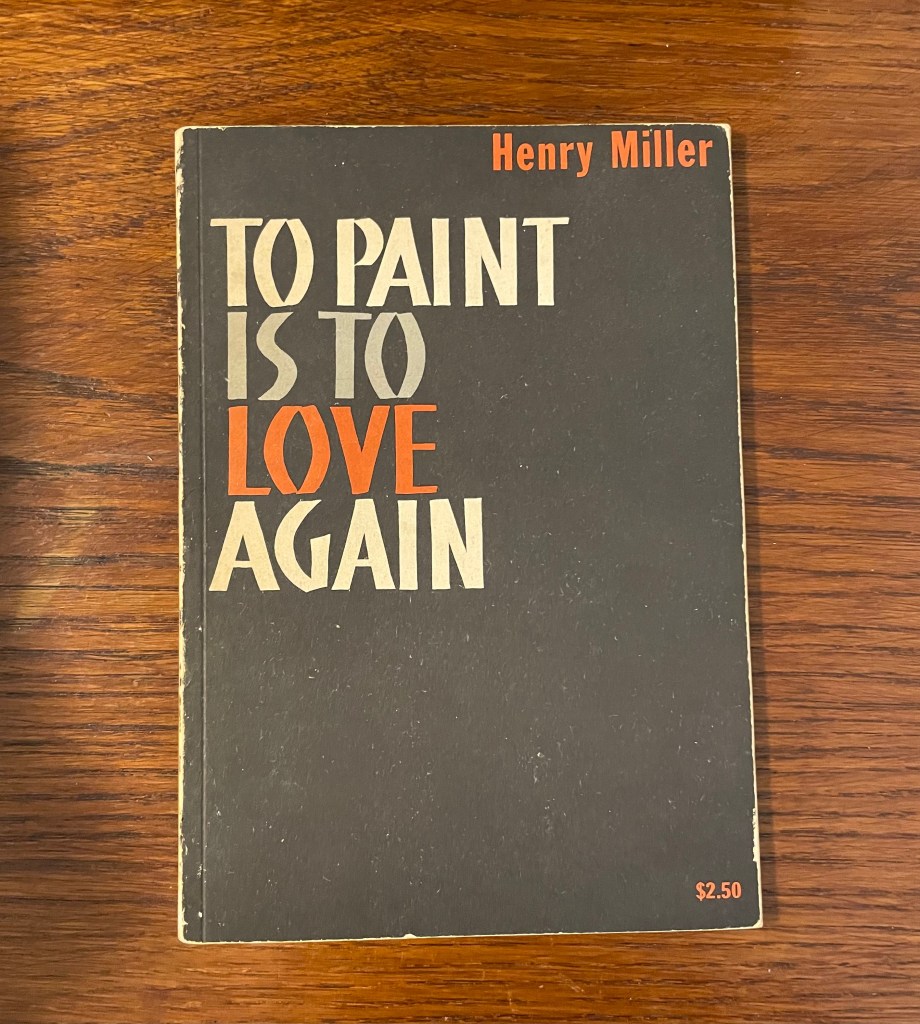
There might very well be an internal affinity between painting and love that at some point it becomes indistinguishable. A painterly picture can become love unquenched for that which remains persistently fixed and unrealizable. In one of the short essay books of his Big Sur period, Henry Miller asked this very question of painting. For him panting had a wondering origin that crosses the hand, undoing what we can easily enact. The erotic dimension of painting, thus, has nothing to do with the image or figure of the beloved, but rather with a specular limitation staged in the ability to allow the unseen to be incorporated in the visible scheme of the world. Only if we are able to see – and by the same token, only if there we are facing an event of painting – can something like use can be liberated from the constraints of mimetic compulsion. Miller writes in To Paint is to Love Again (1960): 

“To paint is to love again. It is only when we look with eyes of love that we see as the painter sees. His is a love, moreover, which is free of possessiveness. What the painter sees he is duty bound to share. Usually he makes us see and feel what ordinarily we ignore or are immune to a certain manner of approaching the world tells us, in effect, that nothing is vile or hideous, nothing is stale, flat or unpalatable unless it is our power of vision. To see is not merely to look. One must look-see .See into and around. Or, as John Marin, once put it – “art must show what goes on in the world” [1]. 

The place of painting for Miller is an imperturbable state that refuses to be fixated on objects, but in the invisible region (as in the figure of the chora) that allows for the thing in the world to be used. This is why Miller considered Japanese watercolor and prints an absolute primer of the pictorial: it taught him the appearance of worlds within the world, regionalizing the surroundings never logically stated unto itself, which in modernity it became the catastrophic horizon of autonomy towards its posterior liquidation. This is why Miller, very much like Carlo Levi, understood that the crisis of painting in the Western tradition ultimately signaled a general sense of social terror as a new phase of human desperation attenuated by the circulation of social fictions. 

At the height of the the closure of civilization, painting reemerged, if Kurt Badt’s axiom is correct, as the last metaphysical activity of human praxis. A metaphysical activity that holds on to the experience of belief in suspended appearance of originary anthropogenesis. For Miller, in painting as much as in love “one must be a true believer” [2]. And this assertion must be understood in the backdrop of Miller’s experiential retreat in the landscape of Big Sur: an experience away from the closure of American city life in research of a “feeling of aloness as spiritual achievement”, as a relation of oneself towards disclosure [3]. In this sense, the painter is a counter-social figure that, refusing to make stir in the world, turns to serenity, silence, and to the pressing contours of the unfathomable beyond any prefiguration. The believer in painting – who is a figure of belief in the desert, after the flight of the gods in the nocturnal vigil of history – is the thrust to the experience of things without barristers or shortcuts to what is revealed.

The age of automation in mid-century transformation of American industrial production serves as the historical backdrop of Miller’s indictment regarding the poverty and eventual disappearance of painting due to the autonomization of human praxis and the gigantic scale in spatial organization. Following Georges Duhamel’s prognosis in America: the menace (1931), he shared the intuition that the crisis of dexterity meant the impossibility of realizing painting, now situated beyond the grasp of human absorption [4]. A land without landscape that, as Adorno noted, bears no traces of the human hand. And this was seen already in the 1950s when the rise of abstract expressionism in North American announced not just the end of easel painting, but the funeral of the whole pictorial tradition. The barbarism of gigantic and unlimited Americanism would run counter to painting as a sensorial activity that embraced the vital limitations of its region. 

Miller’s insistence on painting was an eulogy to a life as experience – painting is indistinguishable from the hands and souls of the painters that he encountered and shared his life – and the value of poverty as absolute necessity for a life that regionalizes our contact with the world. It was through the love of painting that humanity could only restore its divine presence without rest.

Notes 

1. Henry Miller. To Paint is to Love Again (Cambria Books, 1960), 17. 

2. Ibid., 39

3. Henry Miller. Big Sur and the Oranges of Hieronymus Bosch (New Directions, 1957), 34.

4. Georges Duhamel. America: the menace (Houghton Mifflin, 1931), 85.

Zoning and the inalienable. By Gerardo Muñoz

The notion of “zoning” in American public law refers to the compartmentalization of land use (residential, governmental, industrial, among others), as well as the “zones” of the administrative framework that dispenses its delegated power. It is a common fact that the Fifth Amendment of the United States Constitution, which includes the “Taking Clause”, states that taking territory must always be equitable compensated. The Fourteenth Amendment included during Reconstruction implements a non-discriminatory standard into zoning as division of space for political representation, and what is usually referred as “redistricting” in any given state. This means that the operative semantic and legal field of “zoning” refers simultaneously to both land as property, and territory as a spatial index of political representation. Of course, modern revolutions, whether in 1776 or in 1789, were stealth transformations of space into these two tier units of alienated property and representation, as we know from the territorial census in the aftermath of the French Revolution.

Likewise, the framework of Americanism as a political civilization is that of landsurveying, which ultimately means not just to make coterminous sovereign authority to territorial limitations, but to make transactions between world forms (territory and its inhabitants). If “zoning” has become a fundamental point of contention in all spheres of American life – from housing to development, from political representation to governmental “taking”, from wildlife sites to the circulation of good and services of the metropolis – is because the essence of Calvinism was fundamentally a settler cosmos that reduced life to usurpation of territory. In this sense, Bruno Maçaes is right that in the age of planetary Americanism the predominant form of domination is world-building and world-destroying. The perpetual social war over “zoning” is precisely the movement of building and destroying life-worlds through the linguistic justification of the administrative legal apparatus. 

In his forgotten book Nomos and Physis: Origin and Meaning of One (1945) on the severability of the two notion of “order” in Ancient Greece, Felix Heinimann notes that the triumph of nomos over physis implied a separation from the world of “reality” and “deeds” from that of rhetorical language that came to dominate it (nomos). In the present, the separation between nomoi and physis is the void that is perpetually governed by the attenuation of zoning: the creation of artificial worlds, but, at the same time, the composition of artificial languages. But the paradox is the following: the world of nomoi ceases to have any contact with that of physis; and physis, the natural world, becomes an artificial life world only responsive to irreflexive and undetermined practices of social exchange. This means that zoning is the vector of force that constantly separates human beings from both the world and language, and ultimately stripped its “humanity” from the species-being. 

As the zoning process plunges extensively into all spheres of practical and intellectual relations of human beings, an increasingly grouping of unalienable life emerges in a polar night. Here solitude in language brings forth the warmth of the unalienable. Perhaps it is in this night, where a trivial amor mundi will be cultivated for other generations, as beautifully suggested by Tim Ingold. A vita nota that will only commence on the lines that are invisible and opaque to the shining surfaces of zoning.

Hypocrisy as last refuge. by Gerardo Muñoz

In an entry of Dopo Nietzsche (1974), Giorgio Colli states that after the overcoming of all values and taboos, the contending moral strife finds its highest value in hypocrisy. Colli goes on to say that “hypocrisy is the last bastion where moral forces have found their refuge” [1]. One can clearly see that for Colli hypocrisy as the highest value is quite distinct from morality, since it is the “refuge” where the contending moralities invest themselves in rhetorical encroachment. That hypocrisy has become – as Colli saw with clarity in the 1970s – the last alcove of humanity, means, for one thing, that the human species have ceased to have any faith in the language that they use, and that for this very reason there is only an estimation of rhetoric, procedure and technical terms abstracted from the sensible world. If understood as such, it would come to no surprise that the majority of public institutions in advanced societies are embracing, and for the most part promoting, the incorporation of Artificial Languages and Intelligence to organize the interactions of their lives. Ultimately, the order here is clear: it is not that new technological advances will lead to a rise in untruthfulness; rather, these instrumental mutations are a consequence of the deep hypocrisy that runs through the social bond.

In fact, one can only assume that Colli was pointing at something more profound and obscure in his gloss when he referred to hypocrisy as the last refuge, and in this sense he was pointing beyond Nietzsche. After all, Nietzsche understood hypocrisy as mimesis and appearance that if incorporated over a long period of time ceases to be hypocrisy to become real [2]. A series of good acts and deeds in the spirit of friendship makes a person benevolent. In the same way that Miguel de Unamuno’s San Manuel Bueno Martir through his public faith and habits, was a symbol of Catholic faith for all the believers of his tightly knit community in spite of his interior doubts (this is the Knight of Faith). Now, Colli is pointing to a second degree hypocrisy that is no longer explicated by mimicry, but by its dependence to an ethereal value that governs and justifies any set of given actions. The actions are no longer in relation to faith or non-faith, but are properly acts of “bad faith”, since they make belief captive to the justification of the highest moral value. This will be consistent with Nicola Chiaromonte’s description that the end of secularization is not an epoch lacking faith, but one that dwells in “bad faith”. 

And what is ultimately “bad faith”? It is the realm of hypocrisy that, due to its impossibility of communication, understands its mission waged on the petty negation of one value over another. It is a mutation of Goethe’s nemo contra deum nisi deus ipse into the sphere of prevailing forces. The civilizational stage of enlightened hypocrisy prepares the human being to renounce the use of language and unmediated appearance. This means that the triumph of the technoadministration of the world would not be possible without the alluring refuge of hypocrisy that conquers reality through the very means that renders inaccessible the real presence of the world. It is not that politics and politicians have become hypocritical; it is that politics can only subsist thanks to its refuge in hypocrisy. The hypocrite is the last figure that steers in unworldliness.  

Notes 

1. Giorgio Colli. Dopo Nietzsche (Adelphi Edizioni, 1974), 50.

2. Friedrich Nietzsche. Human, All Too Human (Cambridge U Press, 1996), 39-40.

Dialogue with Jacques Camatte (1935-2025)

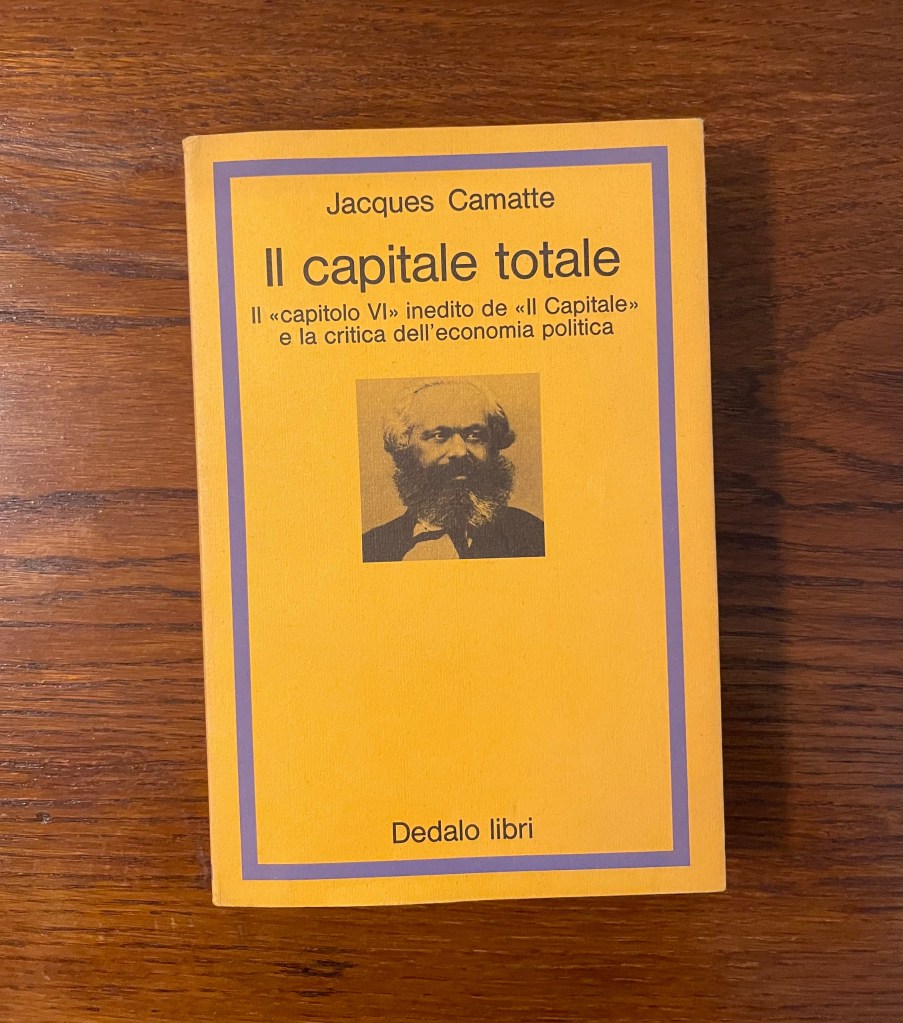
The passing of Jacques Camatte (1935-2025) a week ago from the writing of this text recalls a life that ostentatiously lingered in thought, and a thought that was entirely enmeshed and intertwined in the irreducibility of life. For some of us that had the good fortune to interact – however briefly and momentary, although every contact is always destinial and inescapable – Camatte transpired generosity and authenticity, and his voice evoked an almost Adanic happiness that has become rare among human beings. A common friend these days has recalled that somewhere in Camatte’s writing there is an endorsement of a capacious phrase from Chernyshevsky that could very well serve to remember his enduring ethical pursuit: ‘we have finally understood that the Earth is a place of life rather than judgement’. The opening the Earth as a dwelling place for life forms means that it is insufficient to conceive of domination as an organization of modes of production, since capital is first and foremost a spatial-temporal arrangement towards the future of the human species, and thus of a certain conquest of the world sensuous life. 

This was the outstanding triumph of real sumption: the modulated and ongoing alienation of the human community (Gemeinwesen) into a community of capital that has arrested time of life to the point of adjusting it to homogenized agony of historical time. Against the dynamic of revolution and counter-revolution that theologically exported the polarity of the eschaton and the ho katechon, already in the inception of 1970s Invariance Camatte called for an exteriority of any philosophy of history in order to rework of “a new relationship between human beings and nature”, and “breaking the lock that inhabits the creation of a new form of life”. The two citations in dialogue with each other come from “Against domestication” (1973) and the introduction to Urtext: frammento del testo originario di Critica dell’economia politica” (the 1977 Italian edition curated by Gianni Carchia), although these are variations from the depth of the emergence of the invariance of truth as a vantage point of the world. At the center is a form of life that renews the world that transitions beyond all forms of metaphysical logistics of appropriation, mere standing reserve, and the general arrangement for the mobilization of production. Any point of departure against domestication measures itself against the totality of this fluctuating dominion.

As it has been said of other great thinkers, Camatte’s ultimate passion was rooted in thinking one idea to the end and not of endorsing a system of concepts. For him it was the schism, that is, how to undo the historical process of domestication of a fictive community against the absorption of the increasing autonomization of fictive capital. The schism against the capitalist general equivalent also demands advancing a secondary schism against all humanism and its originary separation from nature. In schism, there is something of Gaunilo of Marmoutiers’ “thought of the word alone” that is receptive to the movement of the soul tries to account for the perceived voice. This precisely what Camatte carried as the lesson from Bordiga’s idiosyncratic original communist program: a movement against the historical benchmark of the development and political economy of growth, which will entail the exhaustion of the revolutionary horizon driven by an ideological political technification that tends to deepen the power towards the positionality of epochal nihilism expressed in the revitalization of strife and the ‘errancy of humanity’ (contrary to Martin Heidegger’s notion of errancy as a play between unconcealment and truth, for Camatte errancy is another name for the civilizational narrative that exemplifies the withering of the  human community into organized and protracted social reproduction and historical abstraction). Hence, as for Bordiga, Camatte conceived the ontology of communism as a world view (not as a political program oriented by concrete historical subject or distributive economic reproduction; not a soteriological dogma nor a transhistorical material idea); that is, broadly speaking, thinking the relationship between the human beings and the earth. A question more pressing than ever given the current planetary conflagration, which exposes the civilizational course that has lead to an inhospitable world where the survival of the human being has become the byproduct of an effective hostis of the community of capital integrated to the global surplus value accumulation.

In Camatte’s unrealized thought – but perhaps all forms of thinking are so – the bordigist gesture persists in locating the schism at the threshold of the force of real subsumption of the anthropomorphization of capital, where the notion of revolution itself is transfigured since, unlike Delacroix’s paradigmatic romantic painting, ‘liberty’ no longer guides the spirit of the “living”. Its redeeming voice also carries downwards unto the depth of the souls of the dead. Amadeo Bordiga himself in “Dialogato coi morti “(1956) writes that “The Revolution…it is always, in the course of an immense historical arc that will close as it opened and where it promised, where it has an appointment with many of the living, but certainly with the unborn, as with the dead: they knew that it never fails, never deceives”. True life can also take place with the nearness of that which seems remote (as Gustav Landauer once claimed: “For me, the dead also live”).

If both the collapse of the future and the increasing adaptation of social life has entered a gnostic dialectic of endless self-legitimation, it is paramount to capture not just the insurrectionary, but the resurrection flight in Camatte’s gesture that opens possibilities lodged in the dead as an emblem for the return to the world “full of joy and exuberant life”, as he wrote in an apostrophe in “Scatologie et résurrection” (1975): “I will draw from mother earth the vital and infinite power and I will resurface full of wisdom, joy and an exuberant life which will allow me to reach this human community…I will have left your world and been resurrected!” Does holding on to the unity of the Gemeinwesen require a theological undercurrent? Is not the passion for schism, and by the same token the stazion, the energy within the very dispensation withheld between mystery and revelation that has prompted the congenital forms of formal mediations and institutions for the political community? These are the questions that we are exposed to in the enduring task if we are to take seriously a continuous ‘dialogue with Camatte’, which carries the voices of the dead. Ultimately, any authentic conversation that dwells in thought does not have to invent anything new; we are depositories of an endless communication that is handed over, interrupted, and transmitted to anyone willing to hear and capable of being traversed by the shared word. 

In his last year of thinking, Camatte insisted on the notion of “inversion” in the wake of the civilizational phase of extinction, which would require deposing all forms of hostilities and bringing to an end the partisan positions invested in orienting technology and morality (nature) in their seditious defense of the real dominium over the passing of the world. For the current depressing (and depressed) times, writes Camattes in “Instauration du risque d’extinction” (2020), what could very well be a prelude to a return to the repressed allowing a return to the past to initiate an inversion that would allow liquidation of lall exhibition abandoning enmity. This is why, as he told me in an exchange that we undertook five years ago, “inversion cannot be a strategy, as it is totally outside of politics, which is the dynamic of organizing people, of controlling them”. A breakthrough, then, only as a mystical downwards leap into the past? Absolutely – but only insofar as the mystic is the ethical witness to his own openness to the word, and whose exodus from the social machination prepares a return to the world beyond the flattening and dominant language molded by rhetorical dishonesty or passive narcissism of the subjectivity.

This is why according to Carlo Michelstaedter to have courage in the world means to decide between two irreducible figures: the dishonest trickster, or the mystic in the desert. There are no third terms in between. And whereas the dishonest subject knows how to play the hand to his best outcome in each given moment; the mystic knows that his decisive moment is always commencing because the genesis of the human species has yet to take place. This beginning is always at the brink of an untimely auratic experience. And aura names the incommensurable distance from the rational containment of the world — unlike Teilhard de Chardin’s internal introspection in the noosphere that will bring the fullfilment of a spiritualized humanity upon Earth (realized in part by the unification of the sciences by cybernetics); in other words, an exodus from the temporal nominalism that inhabits another life attuned to its genesis: “devenu-devenant ce monde et sur cette vie autre au moment où s’effectue sa création”, he writes in “La séparation nécessaire et l’immense refus” (1979).

The visitation of Jacques Camatte in the world bears witness to that invisible freedom of the human species ready to jump and traverse the catastrophic trumpeting into the living and the dead, making possible the refractions of thinking as original texture of existence. From now on, the exodus from the immanence of this world will embrace a disempowered but perpetual dialogue with Camatte’s demure schism of the living. Indeed, we are always on the path to an earthly beginning. 

Unelevated politics. by Gerardo Muñoz

In a fragment from 1919 entitled “World and Time”, written around the time of the elaboration of the essay on the question of violence, Walter Benjamin offers his most succinct definition of politics: “My definition of politics: the fulfillment of unelevated [ungesteigerten] humanness” [1]. The ontological reduction is compact, and the three terms in it are carefully chosen: fulfillment, unelevation, and humanness, which indicates a ‘preparation for a profane politics’ at the threshold of secularization and its negation in a new “spiritual ornamentation”, as he would claim in the notes of “Capitalism and Religion”. The stress on the refusal of “elevation” (gesteigerten), however, does bring to bear that Benjamin’s refusal of a political ontology constrained in subjective and objective representation, which is why in the same fragment he connects the abutting of politics to a “living-corporality” [Leiblichkeit] of the human species. To retract from the cycle of civilizational violence, politics had to be reformed from the groundlessness of the energy of the living.

Hence, for Benjamin there is a metapolitical condition or archipolitics that plays out in refusing “elevated humanity”, which for him was at the source of the romantic response to the impasse of the critical enlightenment, placing the subject of knowledge and its self-reflective faculty at the center of the developing self-rationalization of the spiritual transcendence of the world in this new critical religion: “…the ideal of humanity by rising up to…that very law which, joined to earlier laws, assures an approximation to the eternal ideal of humanity” [2]. Hence, neither trascendental representation nor spiritualized immanence of order could, but unelevation of the “human possibilities” (Menschhaftigkeit). But such possibilities could only be disclosed beyond the pretensions of spiritual elevations of a unified consciousness, as Erich Unger had proposed in his Politics and Metaphysics (1921) around the same time to enact a “politics of exodus” for a common psychosocial regeneration. 

Benjamin’s proximity and distance from Unger’s position could perhaps inform why instead of writing a promised book that was going to be entitled True Politics (Die Wahre Politik) – allegedly containing two chapters “The destitution of power” and “Teleology without ultimate goal” – evolved into the landmark essay “Towards the critique of violence”, in which the frame of domination and the ontology of politics was recasted as a mediation about the folding of secularized annihilating violence, substance intrinsic to the philosophy of history and indestructible life of the soul (“annihilating only in a relative sense…never absolute with regard to the soul of the living”) [3]. Thus, one could say that accounting for the groundwork of “politics” meant accepting the constitutive verticality cosigned to modern philosophy of history, and its bipolar schematism between moral principles and sacrificial production. If Peter Fenves’ assumption is correct, Benjamin was not only inscribing a distance from Unger, but, more importantly, from Kant’s Toward Eternal Peace who defined his “true politics” as dependent on moral determination: “The true politics can therefore not take a step without having already paid homage to morality, and although politics by itself is a difficult art, its union with morality is no art all, for as soon as the two struggle against each other, morality into two cuts the knot that politics cannot dissolve – The right of human beings must be held sacred [heilig], however great a sacrifice this may yet the dominant power” [4].

The Kantian liquidation of politics to morality is hyperbolic to the modern epoch and its crisis – the crisis and enmity against the concept of the political, Carl Schmitt would claim in Political Theology (1922) – rendering modern politics and legitimacy hollow; something that Benjamin had understood well he saw to retract from the question of “politics” to that of a critico-metaphysical exploration waged on morality “as nothing other than the refraction of action in knowability, something from the region of knowledge…Morality is not ethos” [5]. Elevation could only have meant the production of a subject of knowledge and the specific (technical) arrangement of knowledges for subjection. On the contrary, the ethos was the necessary condition no longer for any “coming politics”, but rather for the disclosure of “the coming world” [die kommende Welt] itself. This means that working through the redemption of the world solicits a reversal from morality to ethics only to later transform the conditions of politics.

Let us return to the definition of politics as “unelevated [ungesteigerten] humanness”. What defines “unelevation”? From the ethical point of view it conjoins with the notion of “inclination” [Neigung] that Benjamin favors because of its unconditional valance that disarms the cycle of violence of the human community and its willful hostilities. The inclination rejects the paradigm of force because it an erotic mediation, that is, an affection of donation and love beyond exchange [6]. But inclination is only possible through language, as Benjamin had expressed in his “concept of politics” in a letter to Martin Buber from 1916: “I understand the concept of politics in its broadest sense…in this sense, therefore, language is only one means of more or less suggestively laying the groundwork for the motives that determine the person’s actions in his heart of hearts. Only the intensive aiming of words into the core of intrinsic silence is truly effective action” [7].  

Thus, the suspended elevation of the subject and higher order meant that its persuasive purity allows the inception of the “divine” as a «teleology without a goal» validated by the suspension of judgement of appearance. The intensification of the unelevation opens life to an ethical demand of a “living corporality” that roams the world’s crust beyond depredation where the force of autonomy of social practices does not risks the world of life forms and the soul. Indeed, at this point Benjamin does join Unger’s cardinal thesis: “Overcoming capitalism through wandering”. Or as he wrote even earlier about Hölderlin’s poetics: “[In the world of Hölderlin], the living are always stretching of space, the plane spread out within which destiny extends itself…it already comprehends the fulfillment of destiny” [8]. A politics oriented pending dowards to “unelevation”, inhabits the ground level of co-existence and cultivation dismissing the ontological derivatives or principles (archein) of ‘politics’ in order to conquer every possible destiny in the lawless fulfillment of the world.

Notes 

1. Walter Benjamin. “World and Time”, in Walter Benjamin: Toward the Critique of Violence: A Critical Edition (Stanford University Press, 2021), 74. 

2. Walter Benjamin. “The Concept of Criticism in German Romanticism”, in  Selected Writings, Volume 1, 1913-1926 (Harvard University Press, 1996), 138. 

3. Walter Benjamin. “Toward the Critique of Violence”, in Walter Benjamin: Toward the Critique of Violence: A Critical Edition (Stanford University Press, 2021), 58. 

4. Peter Fenves. “Introduction”, in Walter Benjamin: Toward the Critique of Violence: A Critical Edition (Stanford University Press, 2021), 18-19. 

5. Walter Benjamin. “Ethics, Applied to History”, in Walter Benjamin: Toward the Critique of Violence: A Critical Edition (Stanford University Press, 2021), 74. 

6. Walter Benjamin. “On Kantian Ethics”, in Walter Benjamin: Toward the Critique of Violence: A Critical Edition (Stanford University Press, 2021), 71. 

7. Walter Benjamin. “Letter to Martin Buber” (1916), in The Correspondence of Walter Benjamin (University of Chicago Press, 1994),  79-80.

8. Walter Benjamin. “Two Poems by Fredrich Hölderlin”, in Selected Writings, Volume 1, 1913-1926 (Harvard University Press, 1996), 26. 

The melody of the soul: on Guy de Pourtalès’ Nietzsche in Italy (2023). by Gerardo Muñoz

Nietzsche in Italy (Pushkin Press, 2023) by Guy de Pourtalès, originally published in 1929, has a particular texture that makes it inadequate to consider it a standard intellectual biography. Pourtalès does not follow the contours of the psychological and chronological construction; rather he is more interested in sketching out the telluric effects on the transformative tonality in the thinker’s soul. Nietzsche’s radiant affinity to Italy and “latinity” has been well known, and at stake there is the possibility of finding an exit from the grandiose enactments of the German romantic gestalt. For Pourtalès, “latinity” is the prescription that Nietzsche writes out for himself in order to maintain sanity in the world; and, ultimately, to find its own destiny and path in the face of modern nihilism. Sure thing, Italy is many things for Nietzsche: it is the zenith of his poetic relationship with the Wagners but also their farewell in Sorrento; it is Venetian music and pleasant weather; it is the open and physical form of a possible community of the Free Spirits and artistic expressivity. And Italy is also a refuge from brewing culture of force in the North through the Renaissance uomini singulari where music persists, as he writes to his friend Peter Gast: “Life without music is imply a mistake, enfeeblement, an exile” (94). Pourtalès narrative collage (the different vignettes of Nietzsche’s visits and residencies in the Italian geography) detects the philosopher’s fundamental existential homecoming: a melody of the soul in a world increasingly organized through the chaos as the essence of force. To be attuned to the melody of the soul becomes the task of the artist: “to hear and see beyond the vast “lost time” of humanity what others no longer hear or see, but just unwittingly hum as a tune, vague and wordless”, writes Pourtalès (41).

And if music is an aesthetic form of prophecy, Pourtalès’ sheds light on Nietzsche’s insistence to become a prophet of the age of nihilism: wrestling with the poignant homelessness in the human world of a postmythical age. Pourtalès insists that the “Italian experience” opens up for Nietzsche multiple possibilities to confront the Wagnerian solution through the concretion of the forced and unhealthy (these are Pourtalès’ terms) aesthetic formalization of the mythic redemption. The Nietzschean attempt (the beloved and unresolved versuch) is the final confrontation of “music versus music”, since “all philosophy is a series of events of the soul and finds its symbol only in music” (49) explains Pourtalès. This is what Italy seems to be providing Nietzsche with: the withdrawal from the intoxication of the “Wagnerian flame without being consumed by it” (66). This entails an acceptance to pain without instrumentalizing the rewards provided by the genial artistic form of the Gesamtkunstwerk and the enslaving commandments of Christianity. Wagner and Christianity now stand in the way of the path of destiny without paying dues to mimetic investments. This is Nietzche’s last battle, and thanks to Pourtalès we realize that Italy becomes the battleground for an ultimate detachment. But is it successful? Is Nietzsche as the artistic genialismus prophet able to accomplish the radical abandonment? 

This is the resolute ambiguity in Nietzche’s proximity and distance from the Italian tonality. Indeed, Nietzsche seems never to have abandoned the rhetoric of the genialismus. Pourtalès quotes him: “Italian genius is by far the one which makes the freest and most subtle use of what it has borrowed…..and is thus the richest genius, the one with the most to give” (89). At times Nietzsche’s words about Italians or latinity is a metonymic for Christianity, his ultimate confrontation after Wagner, because to overcome Christianity implies to embrace the melody of life. This is why for Nietzsche Jesus is a higher form of life, whose kingdom is, according to Pourtalès (resonating here with the late work of Von Balthasar), “that of children, his faith is without rancor and without reprimand; it lives, it is itself its own miracle and reward” (100). The transfiguration of Christianity becomes a path to arrive at the very attunement of life itself, although this requires understanding love so that the “Kingdom of heaven becomes a state of the heart” (100). This nomos of the heart is Nietzsche’s ultimate and impossible search; perhaps one that does not truly find the path to a proper homecoming. 

Was it due to Nietzsche’s failed efforts at finding the melody of the soul in his ruthless, cuerpo a cuerpo (“Dionysius against The Crucified”), struggle against Christianity? Were the terms of the prophetic transfiguration a mere illusion of guidance and redemptive incarnation? To put it in Cowper Powys’ lucid observation: “If Nietzsche had not been obsessed by Christianity he would have thought of Life before Christ came”. Pourtalès does provide us with another hypothesis: “Perhaps amongst the last things he [Nietzsche] understood was the profound speech of this piano, of this fiend, whose inner music he had always been the only one to hear. But no thought, no word emerged from this ruinate soul. Nietzsche expired, walled up his silence” (110-111). In Pourtalès’ interpretation, Nietzche’s lacked the central aspiration of melody of the soul: “knowing how to love”, which is obviously the unlearned lesson from the Italian landscape and the world of visuality. The fact that Nietzsche had no patience for painting according to Pourtalès says a lot regarding his incapability for an erotic mediation to escape spiraling towards madness in a desperate effort for completion. I am not saying that painting could have saved Nietzsche; but, as the last active metaphysical activity in modern nihilism (Kurt Badt), pictorial persistence is the ultimate exercise to hold on to the world from the point of view of one’s daimon. Pictorial persistence clears the illusionary strife over concepts of the tradition. Pourtalès’s Nietzsche in Italy (2023), even if only obliquely, is as lucid of a portrait as we might get in order to raise this question in a serious fashion.