Casa Bayona’s pensive slave. by Gerardo Muñoz

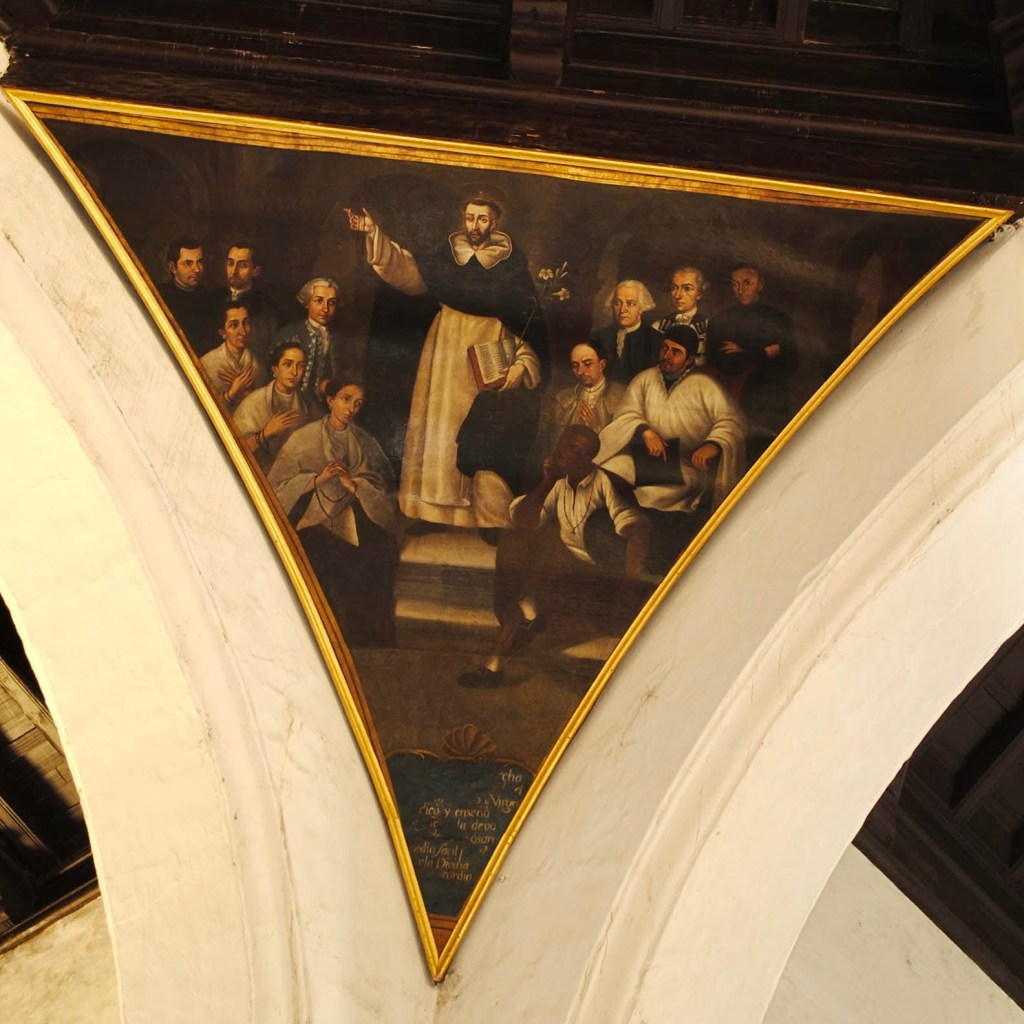
In the Church Santa María del Rosario of Havana there is a pendentive cycle completed in the 1770s painted by the baroque artist José Nicolás de Escalera – whom according to Guy Pérez Cisneros, was truly the first professional Cuban painter of the tradition – that includes a black slave in a pensive pose seating on a lower step, just below a Dominican priest who figures prominently in the middle of the picture holding a Bible and raising his right arm forward [1]. It has been noted that the figure of the black slave is also the first portrait of a slave in the New World, and its meaning has been highly disputed. The enigmatic slave or liberto portrait shows the man in a thinking pose, with a folded long white shirt, and what seems to be a wooden rosary hanging in plain sight. It is hard to make the details of his facial expressions, but it is obvious that his gaze is neither upwards nor directed at the viewer, but rather suspended, as if were, in a moment of attention and rest (and also listening?). The context here is fundamental, since Santa María del Rosario Church was commissioned by the Count of Bayona, a wealthy member of the sacarocracia (sugar plantation owner) after a previous church was burned to the ground by a slave revolt that took place in 1727 in an act of complete defiance to Christian indoctrination. 

The event that only has come down to us in just a handful of mentions and erasures of the colonial archive is featured prominently, as we know, in Manuel Moreno Fraginals’ El Ingenio when the historian documents the spiritual schism of the eighteenth century colonial plantations of the island. According to Fraginals’ historical account, the slave insurrection in the plantation took place in the wake of a theatrical enactment proposed by the Count of Casa Bayona in an act of repentance and humility aiming to mimic a well known moment of the Christian story: one day the Count washed the feet of twelve slaves, and when he finished he made them sat with him for dinner. Later that afternoon the slaves revolted and burnt down the whole sugar mill, including the chapel, to the ground. The episode ended with a plantation mayoral officer hunting down the runaway slaves, who was ordered to place the heads of the dead slaves high in spikes for the Count and everyone to see them [2]. It is an early staging of visibility and bodily dominion that the modern epoch will take to its final conclusion. 

The portrayal of human suffering was a symptom of the impossible hegemony of christianization of body and soul that the missionary Nicolás Duque de Estrada decades later will try to deploy in his pedagogical treatise Explicación de la doctirna cristiana acomoada a la capacidad de los negros bozales (1823), which argued that obedience of slaves could be achieved by implating “guilt” and work ethic in the affective interiority, in the forum internum of their souls. But even Estrada was of the fact that after sixteen hour workdays the Christian ascesis was imperceptible and little more than convoluted chatter to the ears of the slave. It is almost as if the slave, separated from the politico-theological inscription of salvation, was already outside the subjective domination of productive bondage and political freedom.

When Escalera was commissioned to do the cycle of frescos at Santa María del Rosario he was asked to combine a twofold narrative: the history of Christian salvation and the story of the Casa Bayona. At the center of the altar piece is the world as a common house or oikos, that carries history and its bodily sovereignty forward. One possible reading of the pensive slave shown in Santa María del Rosario’s pendentive is to assume that this figure is completely outside the eschatological vision embodying a sense of freedom that only painting could have documented in its unique and mute language. This raises the question about the relation between painting and freedom in which the figural emerges unmistakably fixed beyond historical narration. Although writing about Cézanne’s late work, Kurt Badt once suggested that there is no such a thing as the representation of freedom, but rather “painting generates a concept of freedom as two-faced: negatively, it is liberation from isolation and resistance, positively to the serious gentleness of freedom….expression in freedom to the scene from nature, which declares the world to be existing together, a mutual self-supporting and carrying of things” [3]. The pensive slave portrayed in the pendentive does not embody freedom understood as the spiritual accumulation of rights and duties known to the order of historical transformation; rather is an absolute pictorial appearance of freedom because it embodies, in its non-separation of life and thought, a static moment of a being that contemplates the liberty of his potency.

What is striking about the collective portrait where Escalera inserted the former slave is what we can call, following Bernard Berenson, a dimension of the ineloquent that appears just as “mute, with no urgent communication to make, and no thought of rousing us with look and gesture. If they express anything it is the character, essence rather than momentary feeling or purpose. They manifest potentiality rather than activity. It is enough that they exist in themselves” [4]. In the pensive gesture of his pose, the slave is the untouched existence and the revolt that rips the escathological narrative that ordains the interiors of Santa María del Rosario. Malraux once noted that the age of the divine disdained the realistic portrait of an ordinary person, because he was too distant and mundane from the stone conclave of the gaze of the gods. The slave’s inexpressive ‘naturalness’ refrains from partaking into a mood compensated by the semantic compulsion of the colonial painter, because his naturalness discloses the indestructible soul that has transfigured the realm of the divine. 

The unfathomable mystery of the pensive slave or liberto is the obscure and yet luminous portrait of a life in thought that is, at the same time, the thought of a life that is forever inexpressive, and as such the highest state of imperturbable freedom in the aftermath of worldly destruction. The ‘gentleness of freedom’ that Badt locates at the heart of painting is the imperative of the stream that carries, and yet restrains, thought and appearance into the figure of life. The freedom that anchors painting – because such freedom is never realized in painting except as vulgarity – becomes a tacit secret for which ultimately there is no image.  

Notes 

1.Guy Pérez Cisneros. Características de la evolución de la pintura en Cuba (Ministerio de Educación, 1959).

2. Manuel Moreno Fraginals. El Ingenio (Crítica, 2001), 99.

3. Kurt Badt. The Art of Cézanne (Faber & Faber, 1965), 314.

4. Bernard Berenson. Piero Della Francesca: The Ineloquent in Art (Chapman & Hall 1954), 7.

En apertura. Respuesta a comentarios sobre La fisura (2025) en Ñuñoa. Por Gerardo Muñoz

Lo que sigue a continuación es una síntesis escrita de mi réplica en la presentación de La fisura posthegemónica (Doblea Editores, 2025), en la que intervinieron Mauricio Amar, Ángel Octavio Álvarez, Miguel Ángel Hermosilla, y Lieta Vivaldi el 3 de octubre en Ñuñoa, Santiago de Chile. Esos comentarios aparecerán en el próximo número de la revista Escrituras Americanas.

Agradezco enormemente las intervenciones de mis amigos Ángel, Miguel Ángel, Lieta, Mauricio, porque en última instancia un libro no es nada sin la posibilidad de ser encarado y llevado fuera de sus límites. Mauricio Amar preguntaba por la apuesta general del libro, y quizás pueda decir algo sobre esto. Este libro se inspira en lo que me gustaría llamar la escritura del adiós o del farewell. Siempre me ha llamado la atención que, al comienzo de este siglo, dos pensadores que admiro profundamente escribieron por separado dos libros de farewell: me refiero a Farewell to an Idea (Yale U Press, 1999) de T.J. Clark, y The Exhaustion of Difference (Duke U Press, 2000) de Alberto Moreiras. Respectivamente, adiós al modernismo pictórico, y a la suma metareflexiva sobre América Latina. Al menos para mi La fisura es una forma de decirle adiós a cierta reflexión política contemporánea. Y decir adiós supone atravesar el problema; por eso mismo, el hilo del libro es un problema de hegemonía que ha dominado el horizonte reflexivo y práctico del pensamiento teórico.

Ya aludimos al colapso de las formas de mediación, y se nos suele olvidar que forma es política, y la política es sólo posible mediante una forma. Si queremos pensar contra la dominación, a espaldas del vector retórico de la hegemonía, debemos tomar muy en serio cómo la forma hoy solo cumple la tarea de la dominación sobre la existencia y la palabra. La insistencia compulsiva que las formas ofrecen desembocan en su cierre letal (en la jerga de Alex Karp) sobre cada uno de nosotros. Ángel Octavio veía que el problema se nos presentaba como salida a otra parte. ¿Pero, qué salida? 

Toda salida remite a una trascendencia menor: podemos salir al cielo como interioridad espiritualizada; o bien, podemos salir a un espacio demónico nocturno, un hacer noche, como versa el título del nuevo libro de Constanza Michelson. No deja de ser un síntoma de época que algunos hoy insistan en el vector de la espiritualización como vuelta a la tierra, aunque ésta sea el desierto en free fall que produce el declive (stagnation). El último Tronti, con el que tuve la suerte de intercambiar, lo recogía: el único combate hoy pasa por la interioridad (xeniteia). Pero el problema aquí es que el mundo no coincide con la Tierra. Y lo que interesa, entonces, ese justamente esa no-coincidencia, esa fisura, con respecto al mundo del viviente que hoy aparece como búsqueda de región. Y la región está en su acontecer fuera del mundo más que en el fuero interno. 

O podríamos decir que está en la apertura del paisaje. No hay salida a un lugar sometido a la viabilidad ecológica. O no puede terminar ahí. Al final de cuentas, como vio un pensador en su momento, la revolución industrial fue la segunda revolución, puesto que la primera había sido la relativa a la agricultura entendida como asentamiento en el terreno. En apertura entronizamos con el cielo; o, en la bellísima definición de Kurt Badt comentando la obra pictórica de Constable: “el cielo es el órgano de los sentimientos”. El cielo aquí no es el espejo mítico que habilita la autoafirmación que conduce al humanismo catastrófico; más bien, es el punto de fuga que no se dirime en las particiones del suelo. Es curioso que la dominación en curso ya está operando como el diseño geoespacial del cielo. Esto es lo que comparte la figura del palantir de la Inteligencia, así como la Tianxia, doctrina “Todo bajo el Cielo” del emergente imperio chino. En apertura mantenemos las intermediaciones entre cielo y suelo en el fin de nuestro tiempo. 

Painting, the last metaphysical activity. by Gerardo Muñoz

In his old book The Art of Cézanne (1965), the German art historian Kurt Badt makes a remarkable affirmation in dialogue with Hans Sedlmayr’s indictment about the crisis of modern art: “In him [Cézanne], in fact, painting ‘emerges as the last metaphysical activity within European nihilism – Nietzsche’s view of the great art of his time in general” [1]. Badt’s affirmation must be first understood contextually as a response to Sedlmayr’s thesis laid out in Verlust der Mitte (1951) that argues that the post-impressionist painter was the last attempt at visual order within the convoluted modern crisis of art, still committed to “represent what pure vision can discover in the visible world…without adulteration” [2]. The subtlety  of Badt’s disagreement with Sedlmayr is notable, since for him Cézanne does not stand for a painter of chaos and subjectivity; on the contrary, the painter unequivocally enters in relation to nihilism. At that instance painting and nihilism are positioned polemically face to face. So, what could painting as the last metaphysical activity mean after all? Why is it that painting obstructs or stuns the total exposure of nihilism? Instead of retracting painting to an ‘origin’, what if we understand its ontological contour as an excess within and beyond nihilism? 

In his recent book Tiempo roto (2024), Alberto Moreiras returns to Martin Heidegger’s Le Thor Seminar of 1969 to emphasize how in the epoch subsumed by the Gestell, and thus nihilism, the fundamental opening that exceeds the frame is an übermass, or overabundance of presence [3]. This might be a productive way to think about ‘painting as the last metaphysical activity’ in the era of Gestell, because it inscribes a relation to the visible always in relation to the appropriation of its excess. In the Zähringen seminar (1973) Heidegger will call this relation a phenomenology of the inapparent, which one could very well extend to the praxis of painting as the relation between unconcealment and concealment in the way that Daniel Aresse discusses it in the pictorial world of Vermeer (a polarity that in Cézanne no longer pertains to play of optic illusions but of the disclosure of the world). This cojoining of the inapparent is more beautiful than any possible world visible ordering, because it exceeds the frame of the visible [4]. In this way, Cézanne is not just a painter that exchanges roles with the thinker (as in the relationship between dichter and gedanke) it is rather that he remains the most faithful exponent of painting as the ontic region of the phenomenology of the inapparent or übermass. 

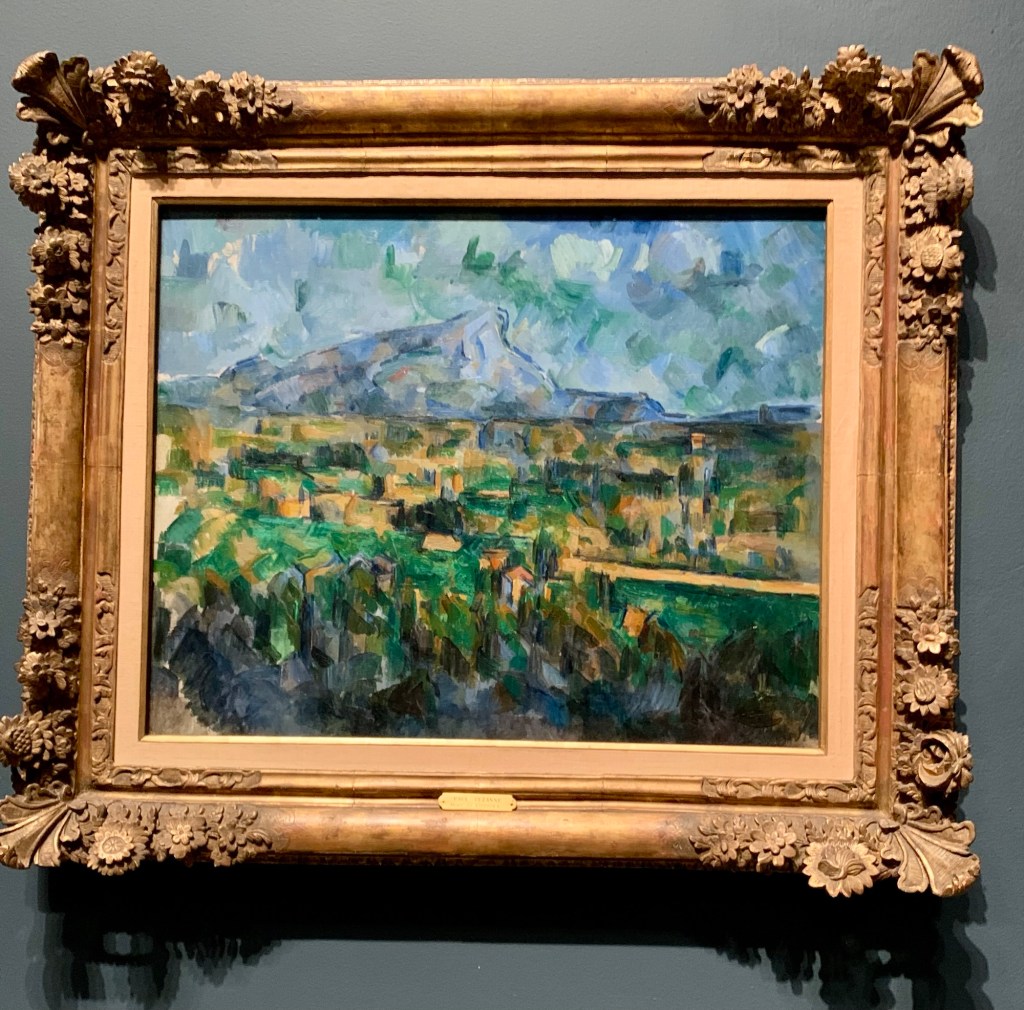
In a session of the Zollikon Seminars (May 1965), Heidegger introduces Cézanne’s landscape as a counterpoint of the hermeneutical circle of perception and calculative intuition. Heidegger writes quite succinctly: “For instance, a painting by Cézanne of Mont St. Victoire cannot be comprehended [erfassen] by calculation. Certainly, one could also conduct chemical research on such a picture. But if one would like to comprehend it as a work of art, one does not calculate, but sees it intuitively. Is the painting, therefore, something psychological, since we have just heard that the psychological is what can be comprehended intuitively? No, the painting is not something psychological. Obviously, the above-mentioned “simple principle” for distinguishing psyche and soma is not simple at all” [5]. This is so because for Heidegger the figure of the mountain (a figure among others) in Cézanne’s work is not the cause of the decision of painting; it is rather the ground (Grund) that orients a certain disposition towards the opening of any given form. One could say that the motif of the mountain is the ground that dispenses the relation to the excess or the inapparent while being entirely visible. 

As such, the activity of painting is not just a capacity or disposition that allows representation; on the contrary, the pictorial praxis qua praxis remains attached to the notion of truth as unconcealment and concealment in the hegemonic structure of Gestell and the objective sciences for which there is none. This allows to throw light into the rather underworked suggestion advanced by Badt that painting remains the last metaphysical activity of the arts, which does not presuppose understanding the “painterly” as a quality or autonomous sphere of human action, but rather an original gesture of presencing the non-presence, and in this way to remain in what I am willing to call the imperturbable.

It has been registered that at one point during the sessions at Le Thor, Heidegger also made the curious assertion that only Cézanne had taken a path towards thinking (in painting) similar to his own turning away from Western ontotheological dispensation into another beginning [6]. This might be because painting is neither the archaic residue of the human hand, nor the pictorial index of image; its fulfillment lies in the excessive proximity to truth that eternally reveals the permanence of the invisible. 

Notes 

1. Kurt Badt. The Art of Cezanne  (University of California Press, 1965), 181.

2. Hans Sedlmayr. Art in Crisis: The Lost Center (Transaction Publishers, 2007), 131.

3. Alberto Moreiras. Tiempo roto: vivir el antropoceno (Palinodia, 2024), 113.

4. Martin Heidegger. Four Seminars (Indiana University Press, 2003), 8.

5. Martin Heidegger. Zollikon Seminars (Northwestern University Press, 1987), 79.

6. Giorgio Agamben. Il tempo del pensiero (Giometti & Antonello, 2022), 57-60.

*Image: Mont Sainte-Victoire, by Paul Cézanne. Philadelphia Museum of Art. Photograph from personal archive.

Acies animi pictura. On Victoria Cirlot’s Taüll (2023). by Gerardo Muñoz

Victoria Cirlot’s vibrant short book, Taüll: liturgia y visión en los ábsides románicos catalanes (Mudito&Co, 2023) focuses on the well-known apse fresco panels of the Romanesque Saint Climent Church (Lleida) dating back to the twelfth century now housed in the Museo Nacional de Arte de Catalunya (MNAC), whose central figure is a Maesteis domini elevated to representation of the highest celestial cosmos. In another sense, Taüll should also be read (and perhaps the obligatory accent here is necessary) as a synthesis of Cirlot’s own work on the theological infusion of visuality and what it means to “see” and “being seeing” in a world that strives for legibility. Cirlot has no ‘presentist’ anxieties about the Romanesque period – its iconographic and overtly enigmatic depiction – but it is not difficult to think of the Christian temple as an aesthetic laboratory, or artist studio, in which the liturgical dimension functioned not much so much as a private space for the faithful, but rather as a site of encounters and vital experience (Cirlot 11). 

The liturgical performance depended on visual arrangement that opened visions of the inner sense, which Cirlot quoting Saint Augustine calls acies anime — transcendence through a sensible awakening that encompassed all the senses. Following Pavel Floresnky in his study about the Church as the synthesis of the arts, Cirlot attempts to portray the impossible experience at Tüll as the site of the life of the spirit; that is, where the spirit is transformed and released (Cirlot 12). Before there is acclamation and synthesis, there is an unfathomable experience facilitated by the liturgical imagery which is a passage or a preparation of sorts. 

It is almost impossible for us today – situated at the threshold of the autonomization of the arts and the division of its practices – to grasp the antecedent image (imago) through figures of what will only later be seen. Cirlot quotes Saint Paul to anchor this difficult chiasmatic movement of veiling-unveiling: “Now we see through a mirror, an enigma, but later we will see face to face (Cor.1.13) (Cirlot 22). Is the pictorial unveiling, or rather veiling, the juxtaposition of the image in space what will ultimately solve the enigma of unmediated appearance? And could appearance be released without its dependence on the mystery that prescribes the image making and destruction well into the totalization of modern pseudos at the art of depiction? There are conscious echos of Carchia’s thinking (in my reading of Cirlot, that is), which I think help to grant a bit more breathing space, as it were, to Cirlot’s unelaborated suggestion that “Pero la pintura es el fruto, no de una percepción sensible, sino del ojo visualiza eso que tiene que ser despertado en la interacción de los sentidos físicos” (Cirlot 23). 

To paint, or the painterly activity, is the gathering of an inner vision, where there is no more separation between the autonomous senses (visions, touch, flavor). Cirlot notes how the detailing of the querubin angel having small eyes painting on their hands would confirm this thesis. The movement of the hands registers a vision that touches the proximity of the specular Glory of transcendence. Following Henry Corbin, Cirlot can remind us that the angel for the mystical tradition is an entity whose “being is only vision” (Cirlot 28). In turn, the all-seeing angel is not a bird’s view (I guess today we will also say a drone commanded from a computing application) that has total vision over the terrestrial grid; it is more a vision that is able to see each thing — given that his divine vision he can see God in everything, and things in themselves because the painterly eye can only look outwards through the inner eye of the heart (Cirlot 38). In fact, the heart’s eye is a retreat from the world of countable and visual things, as transcendence becomes the mere contact of the senses with the divine. 

Part of the difficulty of grasping what is taking place at the Saint Climent of Taüll apse resides in a gesture that is the inversion of pictorial verisimilitude, if one is to take up Michael Fried’s thesis in Absorption and Theatricality (1980) as a reduction of disenchanted pictorial representation. In other words, the pictorial manifestation at Tüll is neither theatrical nor figural absorption for the spectators, but it was rather an experience with the liturgical mystery that strived in the liberation of the soul at the uncharted height of God itself (Cirlot 40).  And perhaps of being a mode, among many, with the presence of God in things, and things and names as already expressing the unavowable nature of the divine. Cirlot’s thesis gains traction and depth  at this point, since the central task of pictorial creation at Tüll is to find the means of granting visible to what must remain invisible (the Holy Trinity and the Eucharist mysterium) that breaks away from the implementation of imitatio naturae (Cirlot 44). This also speaks as to why Cirlot, with prudential reasons, never speaks of an aesthetic sublime that this pictorial commitment with the theos and experience clearly appears to reject. In the sublime construction, sense has been subordinated to the negative position, by which the return of representation will reveal itself in its erasure. 

The seemingly absorptive theatricality does not stand up to the highest music of the aspirations at Tüll. Once again Florensky appears as a central interpretive key for Cirlot: the iconomic and atmospheric opening of Romanesque art frees contemplation to a degree in which vision and the outside of life entangle to such a degree that no autonomization of the ‘aesthetic experience’ can formalize the sensorial gathering of the invisible upwards where “el alma no podía descansar”, or where the soul knows no rest. One can also recall Kurt Badt when writing about Constable meteorological landscape: such opening in the picture is the true organ of sentiment. But “that world is long gone” – the world of visual liturgical at Taüll – concludes Cirlot, and something similar could be said of the practice of painting. The minimal lesson at Taüll is as simple as it is difficult: any access to the world today requires to divest from the hand of technē so that the hand of pictura can take hold of the fleeting mystery of a life experienced. Such is the enduring vital vision at Taüll.

In search of an adventure. Commentary on Marguerite Duras’ The Little Horses of Tarquinia (1953). by Gerardo Muñoz

It is not until the last third part of Marguerite Duras’ The Little Horses of Tarquinia (1953) when the reader encounters a mention to the Etruscan relic alluded by Jacques, one of the characters in the circle of friends that vacation in Italy, who passes the days drinking ‘bitter camparis’ and complaining about the nauseating and scorching presence of the summer heat. And if it were not for the title of the novel the reader could easily dismiss it as a contingent regional reference: “I looked at the map last night…After leaving Rome, I could stop at Tarquinia to see Ludi’s little Etruscan horses. After all the time he has been bending our ears about them” [1]. The ‘little horses’ are brought out a few pages before the end of the novel where Ludi, their Italian friend, goes back and forth whether to go and show them the horses figurines or not. It goes without saying that it would be an enormous distaste to press on the Etruscan reference for any deeper meaning, or to claim that Duras deployed the ancient piece as a tongue in cheek symbol for the bunch of friends roaming around the beach shores. It clarifies very little or too much as an generic reading hypothesis.

In any case, what is relevant is that their trip to encounter the horses of Tarquinia never takes place stressing the real lacuna of the narrative, which is not so much paying a visit to an ancient civilization, as much as underlying a possibility, an afterthought, a pulsating desire towards its displacement; or, in a way, the outside of life that part of the real texture of existence. A reminder that life (a happier life?) is always somewhere else, and definitely away from the excruciating heat of an Italian summer in which no compensatory activity (drinking campari, chatter among friends, having food, meeting new faces) can wrestle the desire for exodus. In The Little Horses of Tarquinia (1953) very little happens in terms of the organization of the narrative, and that is precisely because the domain of the possible might have been Duras’ central commitment when writing the novel: nothing will happen, not even the fleeting thought of paying the visit to the tombs of the Etruscans. Thus, the heavy weight of a narrative without events opens the incandescent proximity between life and nihilism in a strangely accommodating setting. It is summer after all, which means tranquil life of boredom, repetition, serene gazing, and the monotonous. Children catching lizards or sleeping through the night, and very little else.

According to Laure Adler, Duras’ sea novels (The Sea Wall, Gibraltar, Little Horses) wanted to persist “in search of an adventure. But afterwards everything comes together to form a whole” [2]. This holds true only at a very rudimentary and superficial level, but it does not hold to any serious scrutiny. The Little Horses of Tarquinia (1953) is a novel in which the writing of adventure takes a very specific form: life detached from the event of the adventure. This is the reason why the adventure is not only missing from the sequence of contingent incidents, but rather it is alien to the character; as if the radical separation from character and destiny would be transplanted into a self-reflective consciousness arrested in time and space. The adventure at the closure of modern sensibility and its dialectical valence around a “worldview” is precisely that there is a coming to presence of the fact of this poverty of adventure has become its uttermost inexistence: “For a long time I had bright colored dreams of imaginary cities, where I could do what I liked, and look for adventure. But the dreams were not enough, and no I’ve turned a little mean” [3].

The end of the texture of adventure between world and existence marks the commencement of the self-autonomous subject that can narrativize the concrete order of his dreams precisely because he is convinced that they will never be accomplished in this world. After all, as Lukács claims in his Soul and Form, the adventure is no epic for epic’s sake, but a “communion of feeling, of experience, an infinitely powerful experience of the world’s many colored richness expressed in a varied series of endless adventures” [4]. In the adventure one freely becomes who one will be. Hence, the adventure named the freedom of sensible experience between language and world, coming to near convergence only so that its final separation could set to start the inconspicuous ethos of life. In this sense, the longing for adventure in Duras’ The Little Horses of Tarquinia could be said to allegorize the chattering of experience, whose tiny pieces are ultimately picked up by the synthetic apprehension of the dialogue of chatter among friends. The empty chatter takes place once the path of language as transformative of a life becomes separated from the course of the human species. The extreme comedy of the rhetorical dialogue is that it functions as a cure for the abyss of its own separation from life.

Hence, the “dia-logos” ends up suturing that dregs of the fictitious waste required to translate the language of meaning (logos) into practical action at the expense of a life that begins to move, inadvertently, across a groundless world [5]. This is why the central character in The Little Horses of Tarquinia (1953) calls the boundless dialogue that they are engaged in as “a confusion of voices…from open windows, and was dissipated in the sunshine” [6]. It is not that there is never continuity between what is being said; rather, it is that dialogue is always a re-statement of either the case, the command or the subjective piety that in the suppression of real pain proper to a alienated life can only engage in the melodramatic gossip over the accessories of life. In other words, dialogic communication can only speak in the name of quotidian vulgarity. Language becomes, as Duras writes in one of the most memorable lines of the novel: “an endless chain of reciprocal waiting” [7]. It does not take much to apprehend at this point the signifier rotation in every dialogue. Waiting, but towards what? The waiting is eternal and illusionary, since the capture into the sedentary surplus of “dialogue” has already taken you to the final destination where everything is sufficient; what remains is the generalized effect of unhappy consciousness from the irrevocable sense of abstraction.

The expressivity of the dialogues of the French bourgeoisie of The Little Horses of Tarquinia (1953) was already the indication that their wordlessness differs a whole lot from the musical infraworld of the Etruscans horses and tombs. Yes, something very precious was lost once civilization becomes entangled with the infinite realization of a schizophrenic subject that is the effect of endless chattering and utterly silence. In other words, the character of The Little Horses of Tarquinia (1953) talk quite a lot – they never stop talking – but they are not towards a path of language in search for a missing word that marks every true adventure. And this is the adventure where thought and language bind with one another in search for the unfathomable exteriority that is always unknown. And we know that for Duras the encounter with exteriority is the imprint of intelligence, the coefficient of real and enduring thinking. As one of the characters says at one point: “Possibly it may be that there is nothing that cuts one off from the unknown so much as friendship” [8]. I take it that for Duras the Party form (and even the obligations of fictive intellectual communities and all forms of political dilettantism) was very much her preoccupation here: the militancy of friendship could very well stage the last character in the play of historical nihilism. At the expense of avoiding being “nobody” anyone could assume the faceless “friend”, as soon enough cybernetics will end up promoting in their contactless subjective networks. The agonizing sun of a vacation (exclusive in its temporality) is already foreshadowing artificial radiation and nuclear reserve as the sole container of life on earth. In this scenario visiting Tarquinia is an escape of sorts – downwards to the night but also to a vita nova – although, ultimately, it does not take place. And Duras seems to tells us: true experience falls catastrophically on the other side of writing, on the unlived.

Against the therapeutic community of friendship, one can juxtapose the unpredictability of encounter in which no friend will be crushed by the rhetorical compression of the dia-logos and its discomfort. In friendship I can embrace and release without obligations. And if friendship exists it is through a negative community that is never one with allocated leisure time; and; like love, it does not solicit holidays: “you have to live with it fully, boredom and all, there is no holiday from it” [9]. In such scenario “we would not want to change the world”, but perhaps begin inhabiting it away from the sun of exposure and recognition that clears a menacing landscape without horizon. And if according to Kurt Badt, the sky is the organ of sentiment, then one must come to the conclusion that the characters of The Little Horses of Tarquinia (1953), as pathetic as they are, are congenital witnesses of this truth; even if they could only carry it for a moment in order to instantly betray it [10].

Notes

1. Marguerite Duras. The Little Horses of Tarquinia (Riverrun Press Inc, 1985), 54. 

2. Laure Adler. Marguerite Duras: A Life (University of Illinois Press, 1987), 187.

3. Marguerite Duras. The Little Horses of Tarquinia, 139.

4. Georgy Lukács, “Richness, Chaos, and Form”, in Soul and Form (Columbia University Press, 2010), 167.

5. Vincenzo Vitiello. “Sobre el lugar del lenguaje”, in La palabra hendida (Ediciones del Serbal, 1990), 164. 

6. Marguerite Duras. The Little Horses of Tarquinia, 149.

7. Ibid., 87.

8. Ibid., 84.

9. Ibid., 213.

10. Kurt Badt.  John Constable’s Clouds (Routledge & Kagan Paul, 1950), 101.

On Cézanne’s pink stripe tablecloth. by Gerardo Muñoz

The title of the painting is “Still Life with Apples” (1894) housed at the Getty. Like many of Cézanne’s pictures of the 1890s we have a sense of immediately entering into an space warped by distance and nearness that lavishly seals the scene. We feel that something has taken place; after all these are pictures of an event, but only concealed to us. We are given the sense of that experience, which is the fundamental thing to depict for Cézanne. Now, if Clark is correct, then it is true that Cézanne’s still life painting was meant to annihilate the objectivity of the world through a study and stubborn simplicity; although simplicity never amounts to synthesis. On the contrary, what preserves sensation over absorption remains at a distance: this is the narrowing act of simplicity as a fact of style [1]. The depiction of appearance is a problem for Cézanne precisely because painting now stood (late nineteenth century), as Kurt Badt well observed, as the last metaphysical activity in the face of Western nihilism [2]. There is nihilism, an unbridled chaos – and thus painting aspired to accomplish a different form of order, a transfiguration through sense. A higher order subtracted from representation. Thus, the outpouring of sense was everything to Cézanne; nothingless than the attunement of the relationship between depiction and nature. Thus, nearness and distance stands a problem in the picture itself: what is most apparent is what Cézanne seeks to qualify through depth and singular brittle rigidity.

As he would write to his friend Émile Bernard: “In order to make progress in realization, there is only nature, and an eye educated by contact with it….I mean that in an oregon, an apple, a ball, a head, there is a culminating point, and this point is always the closet to our eye, the edges of objects recede towards a centre placed at eye level. With only a little bit of temperament one can be a lot of painter. All you need is an artistic sensibility. And doubtless this sensibility horrifies the bourgeois” [2]. This is Cézanne’s permanent struggle (a non-subjective position, that is, anti-Romantic) struggle: the impossibility to “realize” and to complete a picture as the heart of the mysterious vortex of the execution of depiction. This clears the entrypoint to the problem of the “last metaphysical activity in the wake of nihilism” that Badt consigns to the activity of painting: pictorial art can reveal the unrealizable in every work; but it is no less true that all works fundamentally have an asymptotic inclination to the potential of realizing the idea. The achievement of that impossible nearness attest to the achievement of painting (or to its consummated failure).

The unrealizable in Cézanne’s painting, however, is not merely indexing the unfinished gesture of the brush in a scene or a series of selected objects; rather it is the condition of possibility for entering into the world through a medial common existence between things, however fragmentary within the whole. The unrealizable dimension is never a conscious attempt for a spatial unity to be fulfilled; it is alienable by a stylistic reduction at the moment in which it ceases to belong to the painter’s cognition. This is why Cézanne’s pictorial project – more so than Pisarro’s anarchic affinities and political flirtations in the late nineteenth century – has radical consequences for an opening of freedom that is grounded on the senses (and what it means to be ‘free in the senses and the passion’, in each temperament), allowing experience to decompress the formalistic representational conditions of bourgeois civility. Indeed, Cézanne’s work – and the world it depicts, the opening towards things as a whole but through separation, having in common precisely alienability – does not aspire to be legible in the social, which is the ideal space of exchange and metaphorization, recognition and reification as image. The social is the limitless spatiality in which anything can enter, as anything can stand for any other thing. Or, to put it more concisely: painting seeks to let things be things in their interchangeable nature (without the anxiety over fixing an image of Nature).

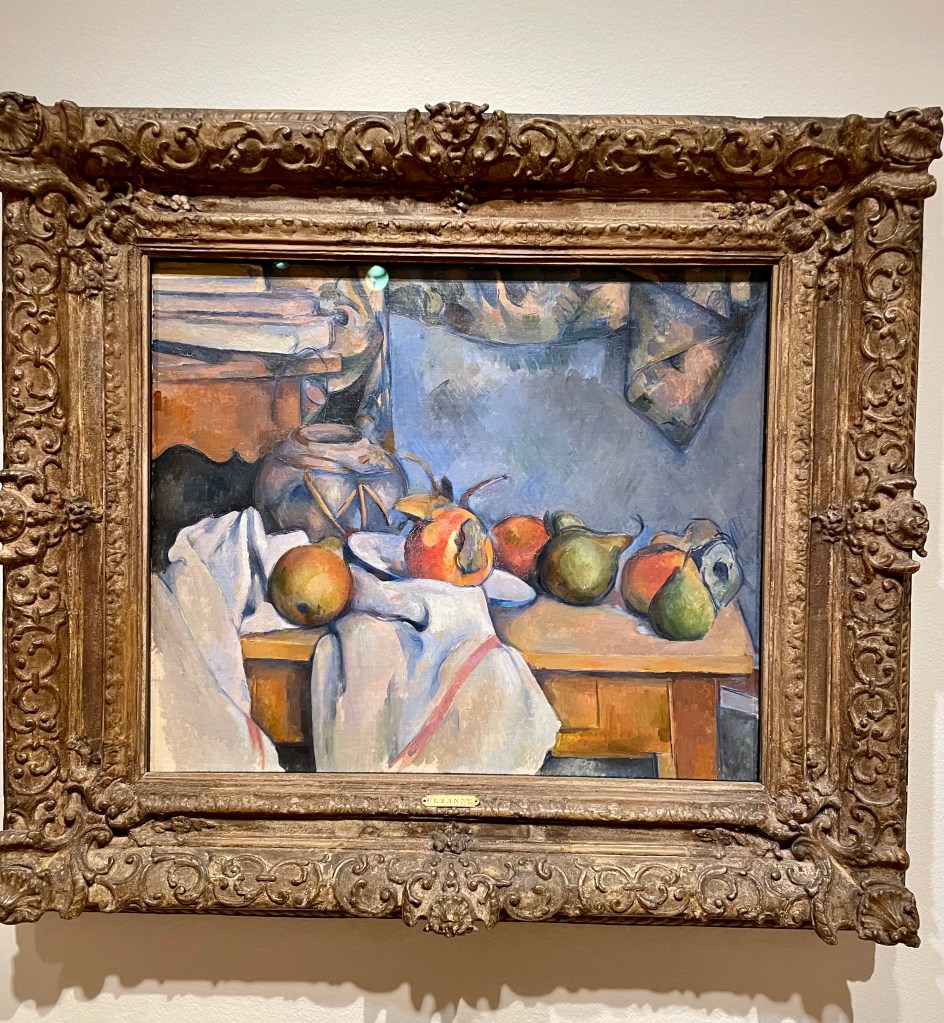
Paul Cézanne. “Ginger Pot with Pomegranate and Pears” (1893), Phillips Collection, Washington DC.

Cézanne inadvertently knows that whatever fate in the wake of nihilism awaits “painting” (soon to be utterly destroyed and displaced by the conceptual and object driven monstrosity of the modern vanguard), the effort to “realize” in painting meant holding to experience of depth as the only guarantee of an existential freedom. Surface and depth will remain on the side of the insistence of an appearance without predicates proper to theatricality. Kurt Badt poignantly captures this in Cézanne’s “old age style”: “There is no longer anything in our sensory experience of seeing which corresponds to what thus becoming visible; what is shown nis rather the visible picture of the concept of freedom. For the thing common to all these forms of the “style of old age” is two-faced: negatively it is a ligeration from isolation and resistance, possibly a liberation to the serious gentleness of freedom” [4]. And gentleness means letting things be: the serene elevation to irreducibility, upholding them only in the proclivity of its contact; never fully absorbed by surrounding and revealing its state of harmonious composition. The task of depiction in painting is the impossible task- but the task nonetheless thoroughly achievable through the hands of the painter – of coming as close as possible to what has actually been experienced. Having affirmed (not necessarily achieved) something like a fate-like divine temporality in painting is able to ground worldliness as transcendent only to let it fall immediately after. And what fate is to character, for Cézanne ‘that which is preserved unchanged’ is the supreme tonality of the pictorial task realized by the restraint of the artist [5].

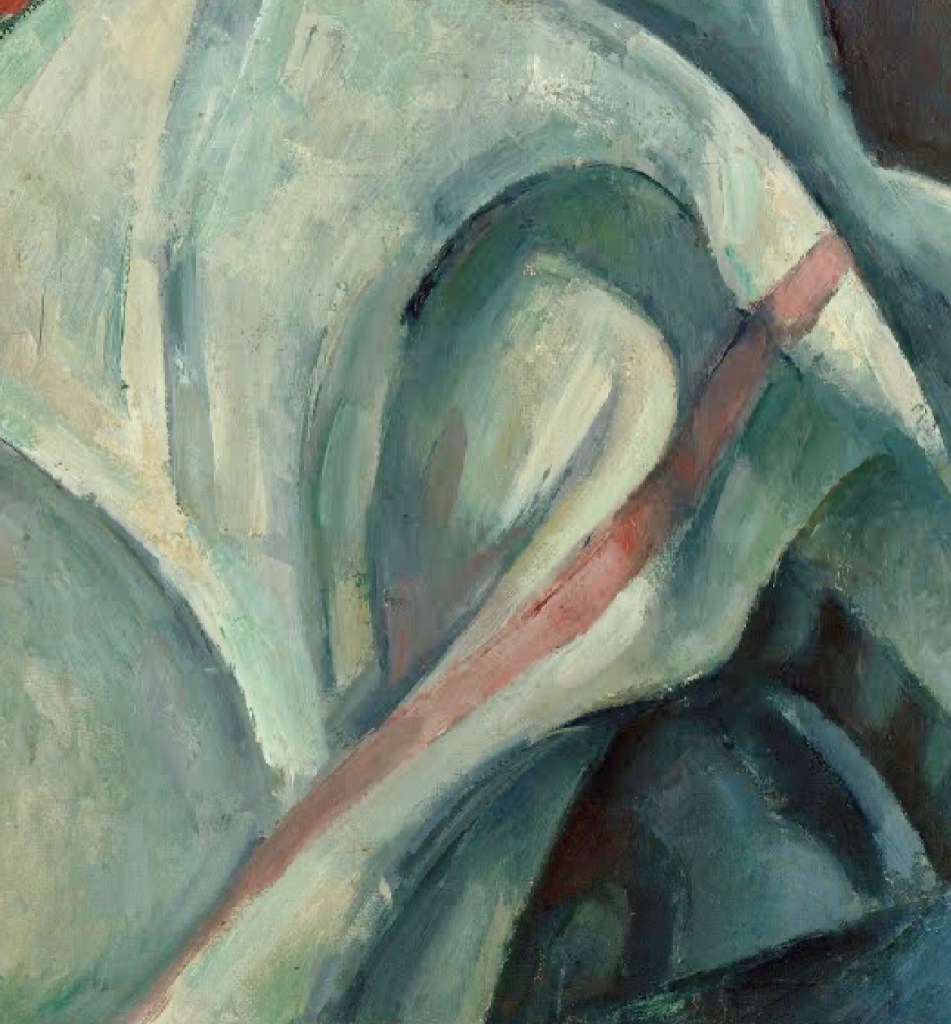
But precisely to depict immobility, the forever permanent, the befallen weight of the conatus essendi (what preserves itself as such), painting has to mobilize a minimum motion for the confluence of objects, planes, and emergence of depth. The pink stripe tablecloths that appear in several of the 1890s still life paintings with fruits can be very well taken as a multum in parvo of the declension in every realization. In a sense, then, the pink strip is a signature, as if were, of the gathering of things and depth at the price of unrealizing the closure of integral depiction. It is precisely the pink stripe in which it becomes realizable in a single brushstroke that the place of the line appears otherwise, crowning the mystery of painting as the clearest manifestation of a different musical order. It is the mysteriously nature of painting, which barely introduces itself as a line substitute for a color (the color of the tablecloth as a thing) that, while remaining visible to the viewer, cannot but reveal the invisible; that is, the temperament of the artist attuned to the muteness of painting, to say with Poussin. And perhaps this is the highest moment of depiction in the search for the “integrity” of “wholeness” that, in turn, grants the instance of the unconcealment of truth. A lace plotting what has already been validated in the irrevocable thereness of the most inapparent existence: an eternal state in the world.

.

.

Notes 

1. Maurice Denis. “Cézanne II”, The Burlington Magazine for Connoisseurs, Feb, 1910, 279.

2. Kurt Badt. The Art of Cézanne (University of California Press, 1965), 181.

3. The Letters of Paul Cézanne (Getty Museum, 2013), 342. 

4. Kurt Badt. The Art of Cézanne (University of California Press, 1965), 313-314.

5. Ibid., 161.