Morin’s autocritique and the human species. by Gerardo Muñoz

Edgar Morin’s memoir of the interwar years, Autocritique (1970), is a coherent elaboration of the early disaffection with the official culture of the Communist Party years, and the nihilist production of justifications to outlive the suppression of life into the abstraction of dogmatic principles. There are some harsh pages in Autocritique that color the general party-line position against the emerging critique of Stalinism. Let us just take this example: “The nonnegotiable and intransigent position against any anti-stalinsim would compensate for a life without principles with the enactment of a set of principles without life” [1]. It does not require much self-reflection to see that this formulation – the production of abstract reasoning in the name of boundless defense of principles – seeks to legitimize the dialectical ruse that indexes the general sense that “life does not live”, if one were to paraphrase Fernand Kürnberger. The self-assumed nihilism and bad faith denounced in the pages of Autocritique was not just that sacrifice was the abstract historical assumption of liberation, but rather that the reality of sacrifice was unbearable for many; specially for those who found themselves in a situation to suffer it [2]. And part of the memoiralist reconstruction by Morin is to leave all this behind, and in the effort to do so, also embrace a political option beyond the collapse of the historical utopia. 

Of course, there is some ambiguity here, and to put it in this way it is already a form of understatement. About halfway through the book, Morin recalls that Elio Vittorini had told them [Antelme and Mascolo, his two good buddies during the postwar years] that communist culture had a saturation of politicization within itself; and, already in 1949, this saturation of politics had calcified  into a “policing control within politics” [3]. In other words, the postwar Cold War context was the consummation of the static politics of the previous decade, only that now it was co-extensive with planetary gigantism as two formations of civilizational states (Americanism and the Soviet Union). Could there have been an option for a different political elaboration, to put in Morin’s own terms; that is, a communism without the iron law (and lawlessness) of objective-driven efficacy and efficiency? (This second was Morin’s term) [4]. Morin does not have a positive answer to this question at least in 1970. However, we can reconstruct a possible answer by taking into account at least two divergent symptoms. First, is Morin’s critical target: political stalinism as hyperbolic of the communist aspiration and necessary culmination, which had cut through the thicket of the gordian knot of historical dialetics movement for emancipation.

Let’s take this moment: “Stalinism was monstrous, I myself perceived in 1949. But this monstrosity had tainted the most admirable form conceived by man: communism. Now evil and good would intertwine in an intimate way….and the attempt to eliminate the cancer’s cause was not, at the sametime, also a form to suppress the fountain of life” [5]. If anything this is a symptom that for Morin, it seems to me, that communism cuts through political ideology, and cannot be contained otherwise. At the same time, the leveling of the critique at this height entails that Morin’s own leveled critique is still prey to ideological determinations blanketed as political rationality. In fact this is something that Autocritique never abandons; and, perhaps its retention indexes its impasse, which is also the impasse of the political subjectivity. 

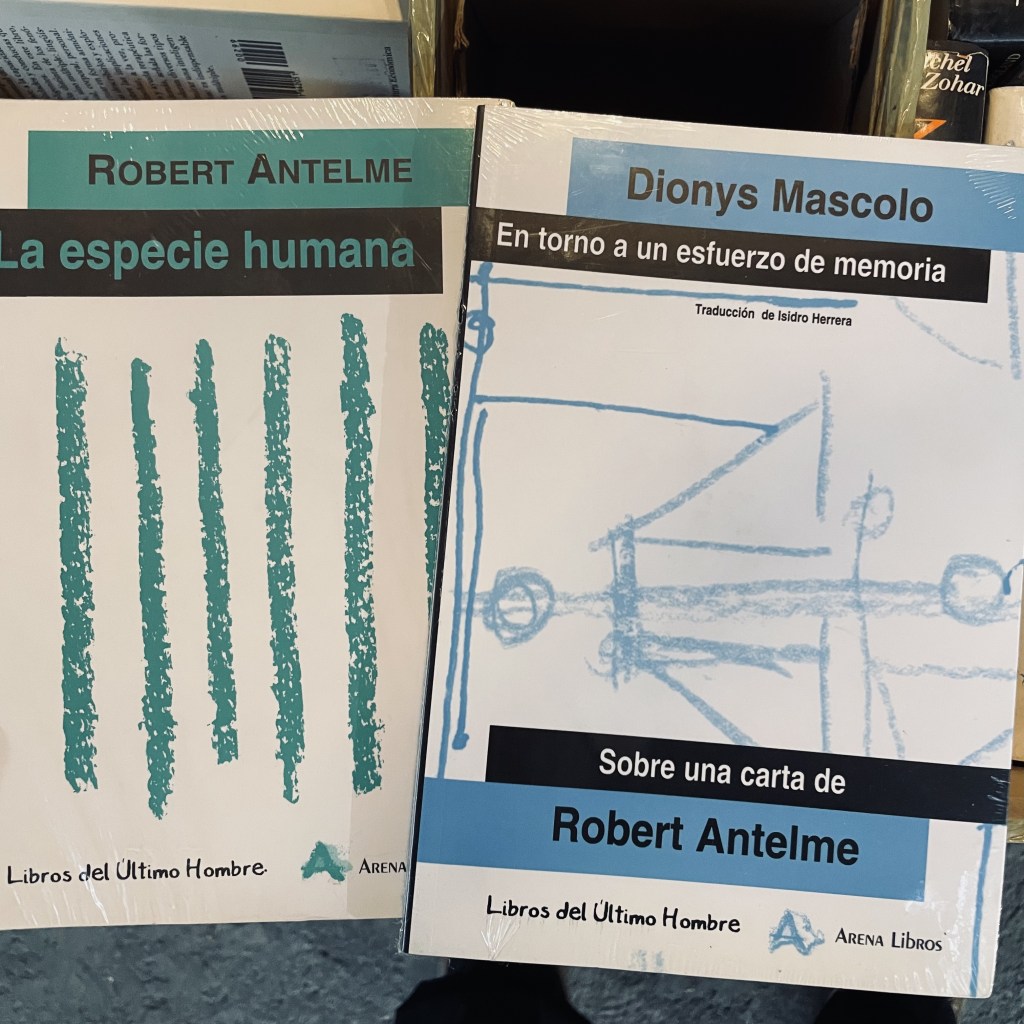
The second symptom is that Morin never dares to mention Robert Antelme’s The Human Species as a touchtone memoir of the experience of the camp, and the camp as hyperbolic of the destruction of politicity. Of course, the strongest distillation of Antelme’s book is not waged at the level of political ideology, but rather about rather at the level of the human species as the final destination of infinite destruction (because he can be infinitely destroyed in virtue of its indestructible irreducibility) that brings back the indivisible origin of the human species. Of course, this rings true with Amadeo Borgida’s thesis that ideological determination puts emphasis on the individual (in positive or negative sense), whereas communism attends to the human species as the ground level of the species [6]. 

Needless to say, what is realized in both Stalinism and Nazism, albeit their different designs and orientations, is the confused struggle of the separation within what is unfathomable kernel of the human species (this is after all the naturalist project of Hitler’s Black Earth). And what Antelme discovers – although the verb discovering here is providing a scientific optic that is not too appropriate – is that the human species is at the ground of needs, but insofar as the need of the human species transcends itself to its biological reduction. Perhaps this is where the thorny question of “ethics” should be situated; a question that, in return, will also put in perspective our distance with the generation of Rue Saint Benoit and the humanist-nonhumanist polemic regarding the miraculous transcendence of human beings in the world. Was not this Antelme’s definition in the “The Smiling Angel”: “The only transcendence is the relation between beings”? Morin’s concluding remarks in Autocritique decisively go to the heart of this question, which is worth citing in full: 

“Ethics is an existential feeling, like the feeling of freedom, answered by every science, by every look at the past as well as by every forecast of the future, but which is the lifeblood of the lived present. And this sap of what has been lived, a paradoxical thing, is the presence in our inner core of the ought-to-be, of the ideal, of the negation, that is, of the virtual and the imaginary. And everything that eliminates the ought, the denial, the ideal, the imaginary and the virtual, concerns what is dead and fossilized. The only thing we can do is become aware of this contradiction. Perhaps a new conception of the world, where the relationship between what is called real and what is called virtual will have taken on a new meaning, will allow us to progress further.” [7]. 

At the end of Autocritique Morin seems ready to accept the magical and mystified dimension of reification, a necessary philosophical and practical technical anthropology invest a new ordered relationship with the world. But this is also symptomatic of Morin’s subjectivism and humanism that stops him at the nearness of the question of the human species. He never arrives there, or he stops too short. This is the distance that keeps illumination at hand; that is, that stubbornly insists on holding to modernity’s capacity for reinvention and, upholds the dialectics between critique and autonomous freedom. But, this is precisely what is no longer what could suffice the opening of “a new conception of the world today”, even if the gordian knot is precisely at the conjuncture of ethics, language, and existence. No subject without critique, and no critique without the emergence of a new subject. As such, self-critique becomes an unconvincing condition to advance towards a beaten and well known path.

Notes 

1. Edgar Morin. Autocrítica (Editorial Kairós, 1976), 117

2. Ibid., 45. 

3. Ibid., 163. 

4.Ibid., 72. 

5. Ibid., 162. 

6. Amadeo Bordiga. “Specie umana e crosta terrestre” (1952), in Drammi gialli e sinistri della moderna decadenza sociale (Iskra, 1978), 94.

7. Edgar Morin. Autocrítica (Editorial Kairós, 1976), 266-267.

Holding on to painting. by Gerardo Muñoz

Paying a visit to a painter’s studio is a rare experience, but definitely gratifying. Or at least, it has been for a long time even before I could put it to words. At her studio, I confirm that Laura Carralero’s commitment to painting as a practical activity has an unfathomable dimension, and I was pleasantly surprised that she shared the same sentiment that our current epoch is not one in which painting has a minimal breathing space. And whenever painting emerges in the official market circuits of art, it seems that it is always already parasitical to some verbose rhetorical apparatus or heteronomic planning that distortions the painterly sentiment. But was not painting the task of speaking the engagement regarding  “mute things”, as Poussin would have it? There is little doubt that rhetorical inflation that thrives in mechanisms to legitimate art continuously devalorizes the mysterious proximity of painting with things in the world. We should reflect – or we should continue to reflect – about what it means to be in a point in the history of humankind where the obsolescence of painting and the disappearance of the dexterous achievement of the hand has thoroughly been realized (Focillon’s praise of the hand remains as actual as when it was first written: “The artist that cuts wood, twerks metal or rock keeps alive a very ancient human past that without which we would immediately cease to exist. Is not admirable to see in the mechanical age this stubborn human survivor of the ages of the hand?”) [1].

The task is immense and abnormal, and it defies (because it exceeds it) the theoretical concept and the absolutism of the philosopher. The engagement of the painters – a secret community that still exists here and there, in different geographies of the world – is precisely a keeping of the divine vortex of the human in the abyss without higher pretensions. And there is something stubbornly strange about painting against the mounting force of destruction. Although perhaps ‘resistance’ here means nothing but to hold on to the originary instance of appropriation of experience in the wake of the epochal mutation of anthropogenic composure; as if the end of the species is also pulsating its commencement.

Holding to painting is not just a substitute to the act of refusal (something that I have recently mapped out); rather, it refuses the very negation of the anthropological erosion in its soulful interaction with what it remains outside of language. To hold on to painting means to engage in the imperturbable: what discourse cannot mold and relocate; what previously is poor in language so that a new language, and thus a new world, could emerge anew among the rubble. In his forthcoming book Those Passions, T.J. Clark states, quite forcefully, that no political transformation or epochal breakthrough can emerge without a preliminary transformation in language; and, I am tempted to say, that practice of painting is the topoi in which eye, world, and hand come together in the very act of separation of said renewal.

The terror of painting – only aggravated in the last decades or so, although a process that took off the postwar years and continued into schools of art where militant pedagogues can only shout “don’t bother to paint!” – is the general stimulus of the reified world; a world in which the paradigm of “objethood” now stands as the compensatory empty experience for poignant idolization of nothingness and “mere stuff”. Sure, there is no return to painting in its grandiose historical sequences – Renaissance, French modern painting, the European Baroque, Van Eyck’s optical discoveries – which ultimately means that painting’s instantiation with the tradition is also bare and unexplored; or, absolutely uncharted whenever there the event of true painting. While I glance at Carralero’s diminutive wooden oil paintings I have this in mind at least. There is a return to the divinity of the icon, but it is not a restitution of its theological investiture and its purported liturgy; the pictorial exercise takes into account the structural void in which painting finds itself resisting, for better or worse, representational excess.

And this speaks, I take it, to the muteness of painting as such, which is also Carralero’s silence about the import of medieval icons into the present. In a way, the painterly operation (I realize that this expression is awful) is executed in a paradoxical redemption, since space always calls forth presentism, a here and now. One is reminded of Stevens’ verses in “Ordinary Evening in New Haven”: “To say good-bye to the past and to live and to be / in the present state of things as, say, to paint / In the present state of painting and not the state of thirty years ago”. The emphasis of the verse declines towards that injunction “as say, to paint”, which fixes a current state of being in the world where we are in it but outside of it. Is not this, precisely, another description of the “Just”? I am eager to work through painting’s stubborn position to this description, which means to hold on to the imperturbable. 

The imperturbable seems to me like a fitting term to grasp what Carralero is doing in her pictures, although with no pretensions to exhaust her pictorial adventure. The solemnity of the icon and its inverted gnosis yields something palpable as well as unattainable. What is being held is the vortex of painting’s mystery going back to Lascaux and ancient burial paintings. Carralero rationalizes her interest in medieval and Eastern European religious painting as a retreat from the unbreathable decay of contemporary pictorial practice as a general tendency. Here the renewal of painting is only possible through the sensible dimension of an integrative imagination. Hence, to live in the present, in the hour Stevens’ simile, is also to dwell in the flashes of painting’s general economy of sensible forms. A new history of freedom can take this as its point of departure; that is, to posit no longer the social functionalization of norms and rules for relations, but to expand the sensible space of the innumerable symbols of existence. 

In the well-known essay “The Pathology of Freedom”, Günther Anders says something significant about painting’s imperturbable nature: “Painting that fixes the aspect of a man or a thing in a picture seems as it were to repeat the act by which each thing is already condemned to itself” [2]. This “being-precisely-this” could be taken as the closure of contingency in relation to all possible forms; although it is also painting in which the contingency of the non-visible in the visible what arranges the possibility of what is precisely absolute contingent as absolute in each picture. This is why in great pictures we tend to feel that the consummation of form reveals as a necessary tradition that, by virtue of being thus, it assume the thisness of the particular rendition. This commitment that weighs heavy in each of Carralero’s paintings is a testamentary to the imperturbable even if we are already entering (or already in it) the eclipsing world of the mystery of the senses, a world that can no longer see the redeeming and unassuming vision that painting can offer.

Notes 
1. Henri Focillon. Elogio de la mano (UNAM, 2010), 131-132.

2. Günther Anders. “The Pathology of Freedom: An Essay on Non-Identification”, Deleuze Studies, Vol.3. 2009, 283.

Pasternak’s symbolism and immortality. by Gerardo Muñoz

“Symbolism and immortality”, was the title of a talk that a very young Boris Pasternak gave in 1913 to a group of students, although the paper was finalized around 1917. It has been known that the integral version was destroyed or misplaced, and only a synthesis was preserved in the author’s papers, which provides access to the thicket of the argument, which concerned ultimately the immortality of artistic creation and the transhistorical participation of the human species in the enduring process. Pasternak himself inscribes this lecture at the heights of his ars poetica: “My main purpose was to put forward the proposal that perhaps this maximally subjective and universally human corner or lot of the soul was art’s immemorial area of activity and its chief content. And, further, that although the artist is of course mortal like everybody else, the happiness of existence which he has felt is immortal and can be felt through his works by others centuries after him” [1]. Unlike the contentious positions about the creative genius and the orientation of the poet (dichter als Führer) that soon enough will inform the thick aura of European modernism in the age of dissonance, for Pasternak in the 1910s (the same decade as the early Lukacs and the youthful Michelstaedter), creation concerned a gathering of experience outside subjectivity; it was fundamentally the experience of the outside beyond the subject, which could only be cultivated by the poetic sensibility’s relation to that outside. It is not clear where there was a figural specificity to the notion of “poet” that Pasternak advances; but, what is essential, is that the poetic task was only possible through a spiritual formation and deployment of symbolization, that is, of the transfigurative use of language. 

Pasternak does not distinguish between vulgar and crafted poetic language; rather he uses the term symbolism to account for the sensible immortal reservoir that is transmitted in the stratification of the genesis of the human race. It is not of minor importance that Pasternak is writing in the dawn of a concrete materialist revolution, in which possession is only registered, counted, and even “destroyed” as mere “stuff”, thus incapable of solving the crisis of the transmission of tradition and blind to the problem of sense. Indeed, perhaps the revolution can only deepen the epochal crisis of symbolization. Pastnark will write affirmatively: “Immortality takes possession of the contents of the soul…in pure form this is what symbolism teaches” [2]. In a conception that is strikingly similar to Warburg & Saxl’s conception of the symbol (and history now designed as a study of the coagulation of symbologies) as a surplus discharged of energy as the reservoir of human sensation and formulas of imagination (the pathos formulae); the attunement towards symbolization never amounts to an accumulation of meaning and narration, but rather it is what preserves the earliest and purest stages of human expression, as argued by Saxl [3].

This is why there is no immortality except in the beginning: the real process of the anthrogenesis is only accessible in those moments of passion and experience while “being observant and drawing from nature”, Pasternak will claim in his talk. The immortality to be retained, it seems now clear, is not that of a future and postponed soteriological communal “life”; it is rather a life that clings to the ordinary and intuitive symbolism that resists the monstrous numbing of fictitious life commanded by the blackmail of the reality principle required by orderability. In this light, perhaps Alfred Metraux is right in that going beyond the neolithic age marked a catastrophic wandering for human beings. (And is not the poetic instantiation a painful reminder of this?)

The stratification of symbolism was of a higher reality; a playful dance between the figure and the non-figural, between the visible and the invisible, between the countable and the non-countable. Pasternak situates this tendency under the sign of “theos“, a religious character in which the texture of the soul is able to find some breathing space as condition of possibility for the opening of symbolism. Modernity is many things at once, but for Pasternak what was being “withered away” at the altar of morality and politics, Church and State (his terms verbatim) was precisely the historical draught of the symbolic man: “The communion of mortals is immortal and that life is symbolic, because it is full of meaning” [4]. This means that there is no community of salvation that serves as the general economy transport between the two kingdoms; if there is a Kingdom it is only of the symbolization of the irreducibility of souls, that can only enjoy immortality in the renunciation of what the materialist and survivalist life is capable of offering in detriment of the experiential possibilities of creation and language when grasping the sense of deathlessness. 

In the life of civil society you will live organized only unto death, without any experience of immortal death of any other, given that death has become mere transaction, a burdensome logistical ritual, a common spectacle. And this is why Pasternak, unlike the Cold War pawn that sometimes he was forced to embody, gradually became convinced that poetic existence could only take place outside the Social with no role or mission to subscribe to: “Do not reserve a poet’s position: it is a dangerous, if not empty” [5]. What was at stake was not a “new life” but a second birth (title of his own poetry collection, Vtoroe Roshdenie from 1934) to plunge into the depth of symbolization. The task is not to invent anything “new” (that modern fetishism), but to regain the life of the soul where the origin commences: “…and here art stops, And earth and fate breath in your face” [6]. It is a mysterious and impossible portrait of a face that reckons with the passing of the symbol and its absolute mystery. The very texture of expressivity that, against all odds, lingers on.

Notes 

1. Boris Pasternak. An essay in Autobiography (Collins and Harvill Press, 1919), 69.

2. Boris Pasternak. “Symbolism and immortality”, in The Marsh of Gold: Pasternak’s Writing on Inspiration and Creation (2008), 40-41.

3. Fritz Saxl. “The expressive gestures of Fine Arts”, in Lectures V1-V2 (Warburg Institute, 1957). 

4. Boris Pasternak. “Foreword”, in Selected Poems (Penguin Books, 1983), 14.

5.  Boris Pasternak. “To a Friend”, in  Selected Poems (Penguin Books, 1983), 100.

6. Boris Pasternak. “Second Birth”, in Selected Poems (Penguin Books, 1983), 109.

The irreducible in language: a note on Robert Antelme’s L’espèce humaine (1947). by Gerardo Muñoz

At the outset of L’espéce humaine (1947), Robert Antelme discloses the difficulty between language and experience that lays at the heart of the book, and which is never thoroughly assumed at the level of form in the novel. L’espèce humaine (1947) is ultimately not an account about the impossibility of describing what took place in the camps; from the banal physical violence to the desperate hunger, from the microaggressions to the slightest movements and carnage of bodies in space; from the joyful smiles in the most miserable of scenario where the ultimate goal was for the human life to slowly rot; the sequence of actions engage in no struggle to bring to a crisis the level of representation. And Antelme goes into painstaking efforts to give us a full picture of what took place, only to never talk about it again in writing or in personal conversations as Marguerite Duras tells us [1]. So, what to make of Antelme’s initial affirmation in the “Forword” where he states that: “…during the first days after our return, I think we were all prey to a genuine delirium. We wanted at last to speak, to be heard. We were told that by itself our physical appearance was eloquent enough; but we had only just returned, with us brought back our memory of our experience, an experience that was still very much alive and we felt a frantic desire to describe it as such as it had been…[..]. No sooner would we begin to tell our story than we would be checking over it. And then, even to us, what we had to tell would start to seem unimaginable” [2]. The unimaginable for Antelme is a sort of threshold of language; a limit for the unrestricted, that is, for what could allow for an experiment of language after the catastrophe, or in the wake of the civilizational catastrophe that is consummated in the camp. 

This delirium and anxiety over language – to tell it now and how it happened and to tell “the world”, only to immediately acknowledge the impossible task of doing so – does not take place at the order of the narrative; it is first and foremost something that we get a glimpse of at the end of the book as the liberating soldiers enter the rubbled towns only to encounter the incontinence of the survivors “talk and talk, and pretty soon he isn’t listening anymore” [3]. At that moment, the face to face between human beings will follow “to a kind of infinite, untransmittable knowledge”, Antelme tells us [4]. But what type of untransmittable and nocturnal knowledge is Antelme referring to here? It is not about some ethical exigency of the defacement of experience through linguistic construction; it is rather the torrential and densely weight of description and events, that numbs and deposes language in the very mediation of its effective sayability. The experience of human suffering and domination is untransmittable not because there is a deficit in language or the effacement of representation; but, on the contrary, precisely because there an excess of language that flattens irreducible suffering to an anaphoric socialization of speech that tacitly accepts inhumanity at face value. And that socialized distribution of speech underserves suffering, in virtue of equalizing an expansive chatter that neutralizes in survival the inherent pain of the irreducible human species within the imposible ordeal of total annihilation. 

Antelme’s L’espéce humaine  is stubbornly nominalistic in its thick descriptions of things and events, and it wants to avoid metaphoric transports. He prefers to call things as he sees it and get to the thicket of things in the most nauseating of repetitions. In a way, the hellish atmosphere of the concentration camp resides in the slow moving degradation of human life deprived of the world. However, there is one moment where Antelme resorts to calling a situation ‘hell’; that is, precisely, to an account of the transparent use of language, the raw incontinence and commanding force towards exteriority, as if there is no longer a caesura or separation between being and language once enunciation has been homogenized as commanding force. This is a language without a secret or unsaid, moving against the outside of consciousness in the same depretatory form as the same administrative machinery that has lifeless bodies as its target. In this way, language being turned into the force of speech will not only foreclose itself to the world, but it will signal the very intangibility by virtue of the flattening of verbal communication as an immediate and furious call to an annihilation of appearance. Antelme writes in this admirable moment – one of those instances where description of the state of things is incepted by the negation of the very conditions that allow for the narrative order: 

“Degradation, and flabbiness of language. Mouths whence nothing any longer ever came that was ordered, or strong enough to last. A weakly woven cloth fraying to bits. Stencens succeeded one another, contradicted one another, expressed a kind of belched up wrtnessness; a bile of words. They were all jumbled together: the son of a bitch who’d done it, the wife left on her own, food, drink, the old lady’s tear, the fuck in the ass, and so on; the same mouth could say it all, one thing after the other. It came forth all by itself; it would be empty. It only stopped at night. Hell must be like that, a place where everything that’s said, everythat’s expressed, comes forth equalized with everything else, homogenized, like a drunkard’s puke” [5]. 

The incontinence of language at the limit of what can be said is a secondary hell; that is, the last contortion that the inhumanity of the human can offer outwards in order to outlive in a moment of minimal pleasure, since the absolute pain of a glacial existence has been deprived of any real contact with the world and things. It is a linguistic hell – the looping language of the camp, will only mirror also the linguistic codification that around the same years will be elevated to the paradigm of cybernetics and the regime of information theory – will now appear as a unified block of application, enforcement and extraction. Hence, we should take Antelme at his word: language has become “flabby”, and it is a “puke”. It is circulation without sense, as in the looping mechanics of the furnaces charted by the Nazi engineers that appears in the recent sequence of the film Zone of interest (2023). It is not that sayability loses it claim to the autonomy of its form before an event; it is also that by virtue of its own degradation against the erasure of events, it can only be unified, packed, homogenized and rendered into equivalence in the wake of the absolute triumph of the historical project of alienation and external objectivity.  

The passage of the old hymnal texture of language as solace and lamentation could only entail the conservation of communication, which for Theodor Adorno writing during the same years as Antelme (1946-1947) will deduce as the “techniques of insolence enabling each individual to spread around him the glacial atmosphere whose shelter he can thrive” [6]. That the experience of the camp for Antelme ultimately meant that the “executioner can kill a man but cannot change him into something else”, must be placed in tension with the epochal transformation of a hellish experience of language at the service of the nihilistic service of equivalence that unveils its purest semblance at the camp [7]. The unitary reduction between the “socialized Man” and the “deportee” enters into a proper focus that Antelme was able to grasp with uttermost honesty: “…that there is no inherent difference between the “normal” system of man’s exploitation and that of the camps. That the camps are simply a shepherd image of the more or less hidden hell in which most people still live” [8]. At the risk of an overtly mannerist claim, it seems to me that the kernel of Antelme’s intellectual effort is to withdraw from the condition of hell that is condensed in the block of ice fixated in the ruinous material of language [9]. Memory, experience, friendship, truth, writing, the soul – these are all tools to chip against the brute reification of the glacial subjection at the price of ultimate solitude. Is there anything else worth a shot? In the last pages of L’espéce humaine, Antelme returns to the question of “freedom”, only to claim that “to be free” implies to “say no to everything” – and could we also refuse the language as it declines into flabbiness, equivalence, and its putrid decline, as overflowing mountain of trash that covers up the ongoing pain of the human species? [10].  

Sure thing, the hölderlinean enduring and difficult task of the “free use of one’s own” appears here with some urgency as the requirement of traversing the attunement to pain. Antelme seems to have wanted to offer a negative theology to “forever starting anew”, in which the irreducible of human sayability is posited as the condition of the “only transcendence between beings” [11]. “To speak, in a word, is to seek the source of meaning in the prefix that the words exile, exodus, existence, exteriority, and estrangement are committed to unfolding in various modes of experience;  a prefix that for us designates distance and separation” [12]. Aren’t distance and separation two conditional criteria for grounding the irreducible? The habitation of the speaking being can harbor the contours of the unfathomable expression on the reverse of social tribulations, which is always the primal nomos of equivalence. Allowing the expansion of the irreducible as a the site of an ordinary accumulation of freedom preserves a sensible region for what takes place (“whatever happens”and is not this taking place the opening of the non-site of the chorá?) in a language attuned to the relentless event that has forever touched us. This is already the site of the unimaginable beyond and away from the language of survival that permeates everything in both times of peace and of war. 

Notes 

1. Marguerite Duras. El dolor (Alianza editorial, 2019 ), 71.

2. Robert Antelme. The Human Race (The Malboro Press, 1998), 3.

3. Ibid., 289.

4.Ibid., 290.

5.  Ibid., 135. 

6.  Theodor Adorno. Minima Moralia: Reflections from the damaged life (Verso, 2020), 33

7. Robert Antelme. The Human Race (The Malboro Press, 1998), 220.

8. Robert Antelme. “Poor Man – Proletarian – Deportee”, in On Robert Antelme’s The Human Race Essays and Commentary (The Marlboro Press, 2003), 22. Dionys Mascolo makes more or less the same claim in Autour d’un effort de mémoire: sur une lettre de Robert Antelme (1987) when speaking about the stratification of species in the camps and the division of classes in society: “l’intuition aveuglante de tous les survivants est celle d’avoir fait quant à eux, sous une forme extrême, cette expérience: que l’organisation de la société en classes telle que nous la vivons est déjà une image de la division de cette société en espèces, comme dans les camps”, 87.

9. Robert Antelme. “Revenge?”, in On Robert Antelme’s The Human Race Essays and Commentary (The Marlboro Press, 2003), 15.

10.  Robert Antelme. The Human Race (The Malboro Press, 1998), 291..

11. Robert Antelme. “The Smiling Angel: Rheims Cathedral”, in On Robert Antelme’s The Human Race Essays and Commentary (The Marlboro Press, 2003), 10. 

12. Maurice Blanchot. “The Indestructible”, in The Infinite Conversation (University of Minnesota Press, 1992). 

Thrasymachus, the paradigm of force. by Gerardo Muñoz

Few characters are more memorable in the first book of Plato’s The Republic than the sophist Thrasymachus, whose shadow is still very much looming around us given that it is obvious that today everything in our contemporary world is optimized through force. Thrasymachus’s strict identification of reserve power (potentia) with justice (ius) is in many respects prophetic, since it already subordinates the ideal of justice with practical reason and effective norms, a crowning achievement of modern political power. This is why Leo Strauss could claim in The City and Man that Thrasymachus’ position is ultimately a defense of the thesis of “legal positivism” that brings to fruition the legitimate order and the police powers of the city. In other words, Thrasymachus discovered that the requirements for the permanence of an active social order of a police entails the mediation of the two dimensions of legal authority: obedience and the internal recognition of a secondary rule that liquidates the possibility of raising the question of what is “just” (now internal to the organization of internal powers). If the aim of “justice” becomes the optimal application of effective rules and norms that provide the services of the city, then political rule becomes an infallible and uncontested logic. Politics is ultimately force, and force is the energy organized by politics in the city. 

As Strauss writes: “Thrasymachus acts like the city, he resembles the city, and this means according to a way reasonably acceptable to both…Thrasymachus is the city. It is because he is the city that he maintains the thesis of the city regarding justice and that he is angry at Socrates for his antagonism to the thesis of the city. Thrasymachus’ rhetoric was especially concerned with both arousing and appeasing the angry passions of the multitude, with both attacking a man’s character and counteracting such attacks, as well as with play-acting as an ingredient of oratory” [1]. Well before the general equivalent of contractual commercial relations, Thrasymachus’ rhetorical deployment functioned as a techne alupias against the unwarranted passions of human beings. And, contrary to the common opinion that separates the craft of sophistry from the unity of rational discourse (logos), Thrasymachus’ defense of force presupposes the autonomy of language in the rhetorical construction (very much like modern poetry centuries later) to serve as the hospice of rational pondering in the polis. To make language the exclusive battle ground: even in antiquity it was said of Thrasymachus, “you are just like your name, bold in battle”. And Plato wanted to hold on to this picture. This ultimately means – and it is still at the center of our contemporary predicament – that the coming of the “Social man” in the city is only possible on the condition of a primary transformation of the event of language and the speaking being. This is why if Thrasymachus was the “pioneer of rhetoric and elocution”, as it has been claimed, it is only because his appeal to the pragmatics of political power was mediated by the invention of the ‘mystery of the prose style’; that is, of reducing the non-grammatical mediation to the orderability of a prose adjusted as an instrument to the world [2]. The enslavement of the passions is the commencement of the social prose in which we are forced to act in our alienated roles.

Only when language becomes rhetorical communication it is possible to grasp the world as a case of an entity of legibility and knowability, where reasons (inclusive and exclusive, that is, as what can be delegated for my own interests) and political rule converge without residue. What will become obvious through the cybernetic dominion over “information”, it was first elaborated as the pressure of rhetoric where the logical force of predication took its force to disclaim myth as the unappropriated experience of worldly phenomena. The art of rhetoric does not render “truth” obsolete; it rather incorporates theoretical and systemic deductions – a flattening of logos without myth -, so that the event of truth can no longer stand as the unsurveyed horizon of the intelligibility [3]. The consolidation of force means this much: that Thrasymachus’ prose of the world is not just an exclusive political program of the “fictitious”, as much as a program for the total attainability of the world; a world that by becoming fully accessible and objective, it pays the high price of eclipsing the presence of things, and the event of truth and naming in language. A world without kallipolis that will only distribute and perpetuate ad infinitum injustice as the corollary for the triumph of immanence of force.

Notes 

1. Leo Strauss. The City and Man (University of Chicago Press, 1964), 78.

2. Bromley Smith. “Thrasymachus: a pioneer rhetorician”, Quarterly Journal of Speech, 1927.

3. Gianni Carchia. “La persuasión y la retórica de los sofistas”, in Retórica de lo sublime (Tecnos, 1994), 60.

In search of an adventure. Commentary on Marguerite Duras’ The Little Horses of Tarquinia (1953). by Gerardo Muñoz

It is not until the last third part of Marguerite Duras’ The Little Horses of Tarquinia (1953) when the reader encounters a mention to the Etruscan relic alluded by Jacques, one of the characters in the circle of friends that vacation in Italy, who passes the days drinking ‘bitter camparis’ and complaining about the nauseating and scorching presence of the summer heat. And if it were not for the title of the novel the reader could easily dismiss it as a contingent regional reference: “I looked at the map last night…After leaving Rome, I could stop at Tarquinia to see Ludi’s little Etruscan horses. After all the time he has been bending our ears about them” [1]. The ‘little horses’ are brought out a few pages before the end of the novel where Ludi, their Italian friend, goes back and forth whether to go and show them the horses figurines or not. It goes without saying that it would be an enormous distaste to press on the Etruscan reference for any deeper meaning, or to claim that Duras deployed the ancient piece as a tongue in cheek symbol for the bunch of friends roaming around the beach shores. It clarifies very little or too much as an generic reading hypothesis.

In any case, what is relevant is that their trip to encounter the horses of Tarquinia never takes place stressing the real lacuna of the narrative, which is not so much paying a visit to an ancient civilization, as much as underlying a possibility, an afterthought, a pulsating desire towards its displacement; or, in a way, the outside of life that part of the real texture of existence. A reminder that life (a happier life?) is always somewhere else, and definitely away from the excruciating heat of an Italian summer in which no compensatory activity (drinking campari, chatter among friends, having food, meeting new faces) can wrestle the desire for exodus. In The Little Horses of Tarquinia (1953) very little happens in terms of the organization of the narrative, and that is precisely because the domain of the possible might have been Duras’ central commitment when writing the novel: nothing will happen, not even the fleeting thought of paying the visit to the tombs of the Etruscans. Thus, the heavy weight of a narrative without events opens the incandescent proximity between life and nihilism in a strangely accommodating setting. It is summer after all, which means tranquil life of boredom, repetition, serene gazing, and the monotonous. Children catching lizards or sleeping through the night, and very little else.

According to Laure Adler, Duras’ sea novels (The Sea Wall, Gibraltar, Little Horses) wanted to persist “in search of an adventure. But afterwards everything comes together to form a whole” [2]. This holds true only at a very rudimentary and superficial level, but it does not hold to any serious scrutiny. The Little Horses of Tarquinia (1953) is a novel in which the writing of adventure takes a very specific form: life detached from the event of the adventure. This is the reason why the adventure is not only missing from the sequence of contingent incidents, but rather it is alien to the character; as if the radical separation from character and destiny would be transplanted into a self-reflective consciousness arrested in time and space. The adventure at the closure of modern sensibility and its dialectical valence around a “worldview” is precisely that there is a coming to presence of the fact of this poverty of adventure has become its uttermost inexistence: “For a long time I had bright colored dreams of imaginary cities, where I could do what I liked, and look for adventure. But the dreams were not enough, and no I’ve turned a little mean” [3].

The end of the texture of adventure between world and existence marks the commencement of the self-autonomous subject that can narrativize the concrete order of his dreams precisely because he is convinced that they will never be accomplished in this world. After all, as Lukács claims in his Soul and Form, the adventure is no epic for epic’s sake, but a “communion of feeling, of experience, an infinitely powerful experience of the world’s many colored richness expressed in a varied series of endless adventures” [4]. In the adventure one freely becomes who one will be. Hence, the adventure named the freedom of sensible experience between language and world, coming to near convergence only so that its final separation could set to start the inconspicuous ethos of life. In this sense, the longing for adventure in Duras’ The Little Horses of Tarquinia could be said to allegorize the chattering of experience, whose tiny pieces are ultimately picked up by the synthetic apprehension of the dialogue of chatter among friends. The empty chatter takes place once the path of language as transformative of a life becomes separated from the course of the human species. The extreme comedy of the rhetorical dialogue is that it functions as a cure for the abyss of its own separation from life.

Hence, the “dia-logos” ends up suturing that dregs of the fictitious waste required to translate the language of meaning (logos) into practical action at the expense of a life that begins to move, inadvertently, across a groundless world [5]. This is why the central character in The Little Horses of Tarquinia (1953) calls the boundless dialogue that they are engaged in as “a confusion of voices…from open windows, and was dissipated in the sunshine” [6]. It is not that there is never continuity between what is being said; rather, it is that dialogue is always a re-statement of either the case, the command or the subjective piety that in the suppression of real pain proper to a alienated life can only engage in the melodramatic gossip over the accessories of life. In other words, dialogic communication can only speak in the name of quotidian vulgarity. Language becomes, as Duras writes in one of the most memorable lines of the novel: “an endless chain of reciprocal waiting” [7]. It does not take much to apprehend at this point the signifier rotation in every dialogue. Waiting, but towards what? The waiting is eternal and illusionary, since the capture into the sedentary surplus of “dialogue” has already taken you to the final destination where everything is sufficient; what remains is the generalized effect of unhappy consciousness from the irrevocable sense of abstraction.

The expressivity of the dialogues of the French bourgeoisie of The Little Horses of Tarquinia (1953) was already the indication that their wordlessness differs a whole lot from the musical infraworld of the Etruscans horses and tombs. Yes, something very precious was lost once civilization becomes entangled with the infinite realization of a schizophrenic subject that is the effect of endless chattering and utterly silence. In other words, the character of The Little Horses of Tarquinia (1953) talk quite a lot – they never stop talking – but they are not towards a path of language in search for a missing word that marks every true adventure. And this is the adventure where thought and language bind with one another in search for the unfathomable exteriority that is always unknown. And we know that for Duras the encounter with exteriority is the imprint of intelligence, the coefficient of real and enduring thinking. As one of the characters says at one point: “Possibly it may be that there is nothing that cuts one off from the unknown so much as friendship” [8]. I take it that for Duras the Party form (and even the obligations of fictive intellectual communities and all forms of political dilettantism) was very much her preoccupation here: the militancy of friendship could very well stage the last character in the play of historical nihilism. At the expense of avoiding being “nobody” anyone could assume the faceless “friend”, as soon enough cybernetics will end up promoting in their contactless subjective networks. The agonizing sun of a vacation (exclusive in its temporality) is already foreshadowing artificial radiation and nuclear reserve as the sole container of life on earth. In this scenario visiting Tarquinia is an escape of sorts – downwards to the night but also to a vita nova – although, ultimately, it does not take place. And Duras seems to tells us: true experience falls catastrophically on the other side of writing, on the unlived.

Against the therapeutic community of friendship, one can juxtapose the unpredictability of encounter in which no friend will be crushed by the rhetorical compression of the dia-logos and its discomfort. In friendship I can embrace and release without obligations. And if friendship exists it is through a negative community that is never one with allocated leisure time; and; like love, it does not solicit holidays: “you have to live with it fully, boredom and all, there is no holiday from it” [9]. In such scenario “we would not want to change the world”, but perhaps begin inhabiting it away from the sun of exposure and recognition that clears a menacing landscape without horizon. And if according to Kurt Badt, the sky is the organ of sentiment, then one must come to the conclusion that the characters of The Little Horses of Tarquinia (1953), as pathetic as they are, are congenital witnesses of this truth; even if they could only carry it for a moment in order to instantly betray it [10].

Notes

1. Marguerite Duras. The Little Horses of Tarquinia (Riverrun Press Inc, 1985), 54. 

2. Laure Adler. Marguerite Duras: A Life (University of Illinois Press, 1987), 187.

3. Marguerite Duras. The Little Horses of Tarquinia, 139.

4. Georgy Lukács, “Richness, Chaos, and Form”, in Soul and Form (Columbia University Press, 2010), 167.

5. Vincenzo Vitiello. “Sobre el lugar del lenguaje”, in La palabra hendida (Ediciones del Serbal, 1990), 164. 

6. Marguerite Duras. The Little Horses of Tarquinia, 149.

7. Ibid., 87.

8. Ibid., 84.

9. Ibid., 213.

10. Kurt Badt.  John Constable’s Clouds (Routledge & Kagan Paul, 1950), 101.

Name and Liberty. by Gerardo Muñoz

Back in the fall of 2020, we discussed a book entitled Intifada: una topología de la imaginación popular (2020), written by Rodrigo Karmy, which considered the implications between the forms of contemporary revolts for the common imagination. It has been said with good reasons that the health-administrative controls deployed during the COVID-19 brought to a halt the high tides of revolts against the experiential discontent in the social fabric. The wearing out and domestication of experience has proved, at least for now, its stealth efficacy and unilateral success. However, what some of us did not see at the time was that this energy over protracted containment was also being waged at the very substance of language. This has now come forth in the wake of recent events at university campuses where administrative authorities, opinion writers, and legal analysts have suggested that a particular word, “intifada”, should be proscribed and effaced from campus life. One should not waste time considering the etymology, semantic reach, and political deployment of this term – for this there is already Karmy’s elegant and dense articulation of the term.

What has completely gone unnoticed in the current chatter about “intifada” is the fact that the full realization of a “rhetorical society” entails, necessarily, an ongoing preventive civil war over what is perceived as “sayable”. This means that containment does not only reach to the moment the realization of action (and its reason or justification of an act); but rather that it fully extends about what might be said potentially. The various calls – on the left and right, from the legal analysts to the pundits and some of the academic administrations – against “intifada” is not merely substantive (or at least it does not stop at this specific threshold); it is a preventive reaction against the very possibility of the name and naming. The act of naming is intimately related to the exterior events in the world; therefore, the proscription of naming is one more step in the domestication process in which the human specie is tore not only from establishing a contact with the world, but also incapable of accessing it through the specific density of naming.  

The paradoxical situation of this interregnum is that, on one hand, the collapse of modern political authority that founds the Liberal State (non veritas facit legem) as an overcoming of language and truths, has led straight into the rhetoric inflation where naming is sacrificed and language codified into a second order normativity that imposes arbitrary obligations on what is licit and illicit. This is why the First Amendment of the United States Constitution – and total constitutionalism writ large – becomes the construction zone that allows the contingent justification of “time, place, and manner” under the civil right of “freedom of speech”, which turns naming into an ominous and terrible shadow; an unwarranted apostrophe. The almost anecdotal proscription over “intifada” reveals the heteronomic dominion over interiority; that is, over the possibility of saying.

I can recall how Quentin Skinner told some of us at Princeton years ago that a fundamental characteristic of unfreedom, broadly considered, begins when you think twice about whether it is convenient or prudent to say what you think. Of course, I do not think he favored a position of imprudence and generalized cacophony. I take it that he meant that the end of liberty begins when the possibility of naming disappears: “Between the motion and the act falls the shadow”. Fixation and transparency is the evolving grammar of the day. Can language subsist in such an impoverished minimum overseen by the general governmental logistics? As a preamble, one can say that in the current moment any conception of liberty begins with the opaque exercise of naming.

The Rue Saint-Benoît Group. Introduction for a 2024 seminar. by Gerardo Muñoz & Philippe Theophanidis.

The Rue Saint-Benoît Group, organized by Marguerite Duras, Robert Antelme, and Dionys Mascolo and other fellow-travelers of the interwar years can hardly be defined as a political movement, a literary school, nor an intellectual community with a direct orientation or aesthetic program. In fact, the Saint-Benoît Group (transnational in its composition) understood itself as a shared experience of thought that gravitated under the words of the German poet Friedrich Hölderlin: “The life of the mind among friends, thought is formed in the exchange of the written word and for those who seek”. It is also known that Hölderlin was the quintessential poet dwelling in the fracture between tradition and modernity, the flight of the gods and the eclipse of the poetic in the wake of a consummated technological Prometheism. To affirm Hölderlin’s words entails to confront the difficult questions of language and the voice as conditions for thought. How can we think of an intellectual experience in which friendship becomes inseparable from thought; and, at the same time, when thought becomes a condition for the endurance of friendship? And to what extent could this double register allow for a reinvention of the autonomy of politics in the wake of the crisis of Humanism? 

These are the enduring questions that the experiential setting of the Saint-Benoît Group bequeaths to us today. If the Saint-Benoît experience has remained opaque and invisible even within monumental historiographic narratives of twentieth-century ideas, it is because only seldom have these problems been rightly posed. Under the sign of a “friendship of thought” – a transfigurative plane that immediately resonates with the immaterial common intellect, the Heideggerian incursion on the task of thinking, and the revival of a sensible Platonism – the members of the Saint-Benoît Group witnessed the catastrophe of modern politics in real time; such as, although not limited to, the concentration camp, the postcolonial wars of liberation, communist totalitarianism, and the exhaustion of the fundamental categories of political Liberalism. Taking distance from the elaboration of a normative political theory, the Saint-Benoît Group favored the heterogeneity of stylistic endeavors and expressive acts in order to grapple with the crisis of experience. And it is to their specific scenes of writing that we must attend to in a systematic and careful way. 

In this eight-week course we will explore the diversity of the writings of the group, including figures such as Dionys Mascolo, Robert Antelme, Marguerite Duras, Maurice Blanchot, Elio Vittorini and other fellow-travelers to explore questions concerning the nexus between experience and creation (both of us have worked on some of these writers intermittently in the past couple of years). To the extent that we still live among the ruins of the legitimacy of modern politics, the contestatory style of Saint-Benoît Group still raises the question about the human species within our civilizational collapse.

What type of authority emerges from their writings, communication, and imagination of a fractured humanity? And how could the concept of ‘revolution’ be transformed from its moral and technical elaborations that hegemonized the twentieth century? We are aware that the Saint-Benoît Group has no “lesson” to be extracted and made “actual”; rather, we are interested in what we would call a “gesture of thinking” that prepares the condition for a life in freedom within and beyond the contours of the polis

*For those interested in registering for the eight week seminar beginning in February 2024, please consider signing up at 17/instituto de estudios críticos: https://17instituto.org, or by writing to extension@17edu.org.

Hölderlin’s song. Provisional annotations. by Gerardo Muñoz

There is a moment in Hölderlin’s late hymn “Friedensfeier” (1801) where communication is strictly defined as becoming a song. The verses in question are about midway into the poem, and we read read the following: 

“Viel hat von Morgen an, 

Seit ein Gespräch wir sind und hören voneinander, 

Erfahren der Mensch; bald sind wir aber Gesang.”

“Mucho ha, desde la mañana, 

desde que diálogo somos y oímos unos de otros, 

aprendido el ser humano; pronto empero seremos canto”.

This is the Spanish rendition by the Venezuelan poet and translator Verónica Jaffé [1]. These lines stand for Hölderlin’s unique effort during the years 1800-1804 to substantially qualify what he had confessed to his mother as his true task: to live a serene or quiet life. I think this Spanish translation is much closer to the original German. Jaffé hangs on the present perfect with conviction: “Mucho ha…”, as if knowledge remained at a distance in the metric while becoming a temporal duration, a form of experience. This is the poetic “strict mediacy” for Hölderlin that can only be cultivated [2]. And it is only through the duration of experience that one will become a song (“seremos canto”). We are not yet there, hence the apostrophe. In the late period, duration meant dealing directly with Pindar. Thus, the song is something other than language – even if announced through language. But it is a paratactic dispersion that seeks to free the pure voice. In one of the “Pindar fragments”, this is what Hölderlin claims: “then only the difference between species makes a division in nature, so that everything is therefore more song and pure voice than accent of need or on the other hand language”. [3]

I am caught up in the moment of “division in nature”. The subtraction from representational language allows for the true appearance of a more originary separation, where the song can finally emerge in its proper attunement with the world. The becoming song is another form of separation, which institutes the passage from the Empedocles (tragic sacrifice) to the Pindaric relation to the divine. This is the “highest” poetic challenge for Hölderlin – an impossible task after the fleeing of the gods. It is definitely maddening. Nevertheless, the song remains. It puts us in nearness in a postmythical world without recoiling back to the image of the tragic. Indeed, as Hölderlin says in passing in “The Ground of Empedocles”, his time already “did not demand a song” [4]. The passion for natural unity was an Olympic illusion whose retribution could only become romantic debris as the exclusive possession of the dichter. On the contrary, the clearing for the song has emancipated itself from the exclusivity of the modern autonomy of dichtung as mimetically separated from the experience of life. This is what the song wants to pursue before the closure of a significant (and signifying) world. Fundamentally, this means a subtraction from the continuum of language, and thus a form of prophecy as elaborated by Gianni Carchia in a difficult passage from “Dialettica dell’immagine”: 

“Where music and prophecy, in the inexhaustibility of their tension – an endless effort to overcome the Babel dissipation of language by freeing the residual state of the unexpressed – testify to a disposition to meet precisely in what passes, in pure transience, the need for salvation and the idea of fulfillment, beauty as a totalitarian and exclusive appearance is, on the other hand, nothing but the product of an arrest in the dynamics of the spirit which withdraws from the horror of worldly laceration to seek refuge on the scene circular and static of the eternal”. [5]

If the song addresses the prophetic it is because language has fallen to the fictitious needs that arrest the experience of the human being into the exclusivity of rhetorical force and poetic genius. Is not the song a refusal of both? A refusal now aimed at the “highest” task – that is, the serene life? Against the exclusivity of appearance that Carchia points to, what appears discloses a different sense of law. A few verses in the same poem, in fact, we are confronted with the “law of destiny”: when there is serenity (or peace) there are also words. And a few lines after: “the law of love” is equilibrium from “here” to the “sky”. What appears there is the landscape that comes through in a pictorial depiction: “[Sein bild….Und der Himmel word wie eines Mahlers Haus Wenn seine Gemälde sind aufgestellt] / “[su cuadro e imagen….y el cielo se vuelve como de un pintor una casa cuando sus cuadros de exponen]”.

Does not this also speak to the insufficiency of language, which justifies the step into a folded painting? There is a painting and a vanishing image, but also the painter marveled at gleaming finished masterpieces. Is painting the original placeholder for the song as originary attunement of life? Perhaps. But in its enactment it also means that the song is impossible to disclose except through pictorial invocation. It is a painting of a life in the world, and nothing less. The transfiguration of the law places men no longer into undisputed submission, whether in its positive or natural determinations, but rather of a “strict mediacy” that is ethical in nature. A third way of the law that does not renounce the problem of separation.

Monica Ferrando has insisted upon the enormous importance of this conception: the fact that Pindar’s nomoi, in fact, relates to the nomos mousikos, which is fundamentally dependent on gathering substance of the song [6]. The strict mediacy finds itself between the mortal and the immortal. It is definitely not a “return to the state of nature”, and I do not see how it could be reduced to “genius”, except as an ethics whereby appearing is no longer at the service of objectivity [7]. Adorno was of course right: it is a ruthless effort to deal with disentanglement of nature – and the nature of reason – but only insofar as it is a return to the song. Or, at least, to have a path toward the song: a lyricism of the indestructible against the closure of a finite time dispensed and enclosed.

.

.

Notes

1.  Friedrich Hölderlin. “Fiesta de Paz”, in Cantos hespéricos (La Laguna de Campona, 2016), Traducción y Versiones Libres de Veronica Jaffé, 93. I thank Philippe Theophanidis the exchange initial exchanges on these verses.

2. Friedrich Hölderlin. “Pindar fragments”, in Essays and Letters (Penguin Classics, 2009), 566. Kindle Version. 

3.Ibid., 565.

4. Friedrich Hölderlin. “The Ground of the Empedocles”, in Essays and Letters (Penguin Classics, 2009), 465. Kindle Version. 

5. Gianni Carchia. “Dialettica dell’immagine: note sull’estetica biblica e cristiana”, in Legittimazione dell’arte (Guida Editori, 1982), 21.

6. Lucia Dell’Aia. “Il Regno d’Arcadia: intervista a Monica Ferrando”, in Il mito dell’Arcadia (Ledizioni, 2023), 121. 

7. T.W. Adorno. “Parataxis: On Hölderlin’s Late Poetry”, in Notes to Literature (Columbia University Press, 1992), 148-149.

Hölderlin on the serene life. by Gerardo Muñoz


In a letter from the beginning of 1799 addressed to his mother, Hölderlin makes a sort of confession that fully illuminates (in a multum in parvo fashion) what he understood as a quiet or serene life. Or at least, it allows to grasp how he comes to envision it and towards what end. At first sight, what is striking is its bare literalness, too strange for a poet, and too mundane if it were not for its intrinsic lyricism. It is a lyricism that comes forth effortlessly, which speaks to the quality of its furtive testimony. Literalness is also described in its engagement with the world – and, more fundamentally, the sufficient condition for sense to emerge. This is the fragment in question (from Helena Cortés’ translation of the correspondence):

“No quise rechazar de plano para tener por si acaso una vía de escape, y sobre todo puesto que se ofrece a buscarme una plaza que consiste en acompañar a la universidad a un jovencito. Conocer más mundo (conocer el pueblo alemán le es tan necesario, especialmente a todo el que quiera convertirse en un escritor alemán, como conocer el suelo al jardinero) es al fin y al cabo la única compensación que me puede ofrecer una situación tan fatigosa, y lo alejado del lugar, que de todos modos muy lejos no puede estar de alguna universidad, me parece más ventajoso que perjudicial durante un par de años en los que aun no puedo contar con gozar de una vida tranquila entre los míos”. [1]. 

There is little doubt that the world disclosed here is well within the bourgeois interiority: there is economic calculation and anticipation. At this time Hölderlin was being offered the position of a preceptor to a university student. But there is hardly only this. There is also the affirmation of fleeing from what this world has to offer – and this means quite a lot in the early quarters of the Enlightenment. Una vía de escape – for Hölderlin the way out is not merely from economic hardship, but also the possibility to retain a certain knowledge that he dares to qualify as “of the world”: “to know the world, which is the only compensation to a fatigued situation and the remoteness of place”. Loss of fixity to place demands access to the world.

This is not your expected aesthetic education of man. The subject of the Enlightenment – its commitment to historical abstraction and the possession of aesthetic form as mediation to totality – prevails at the epistemic register at the cost of rescinding the dislocation from nature. By contrast, the knowledge implicated in knowing thy world should be like that of the soil with the gardener (pay attention to how Hölderlin inverts subject and thing: it is the ground that becomes accustomed to the gardener, and not the other way around). But at the threshold of the eighteenth century, Hölderlin’s “vía de escape” was also compensatory to the fatigue of a nascent epoch of the subject. The compensation did not entail an excess of knowledge; it was rather knowledge a way to disengage with the presupositions grounding the historical epoch.

This seems to me the operation at work in Hölderlin’s epistolary confession. Carchia was right in positing Hölderlin’s poetological aspiration of spirit and nature was entirely pre-Olympian, which requires subtracting himself from the modern parody of cultic romanticism [2]. A way out appears in cleared space when serene life is finally realized between friends; that is, among those that I make as friends (“los míos”). Poetry and making are here at their closest proximity cutting through the thicket of experience. This is what it means to know thy world. At the center of Hölderlin’s ethics there is a sense of distance – the waiting for a serene life in which language will finally gather itself unto presence. Ultimately, this is the plain literalness that the 1799 letter offers us.

.

.

Notes

1. Friedrich Hölderlin. Correspondencia completa, traducción de Helena Cortés y Arturo Leyte (Libros Hiperión, 1990), 467.

2. Gianni Carchia. “Introduzione” to Walter Otto’s Il poeta e gli antichi dèi (Guida Editori, 1991), 8.