In an entry of Dopo Nietzsche (1974), Giorgio Colli states that after the overcoming of all values and taboos, the contending moral strife finds its highest value in hypocrisy. Colli goes on to say that “hypocrisy is the last bastion where moral forces have found their refuge” [1]. One can clearly see that for Colli hypocrisy as the highest value is quite distinct from morality, since it is the “refuge” where the contending moralities invest themselves in rhetorical encroachment. That hypocrisy has become – as Colli saw with clarity in the 1970s – the last alcove of humanity, means, for one thing, that the human species have ceased to have any faith in the language that they use, and that for this very reason there is only an estimation of rhetoric, procedure and technical terms abstracted from the sensible world. If understood as such, it would come to no surprise that the majority of public institutions in advanced societies are embracing, and for the most part promoting, the incorporation of Artificial Languages and Intelligence to organize the interactions of their lives. Ultimately, the order here is clear: it is not that new technological advances will lead to a rise in untruthfulness; rather, these instrumental mutations are a consequence of the deep hypocrisy that runs through the social bond.
In fact, one can only assume that Colli was pointing at something more profound and obscure in his gloss when he referred to hypocrisy as the last refuge, and in this sense he was pointing beyond Nietzsche. After all, Nietzsche understood hypocrisy as mimesis and appearance that if incorporated over a long period of time ceases to be hypocrisy to become real [2]. A series of good acts and deeds in the spirit of friendship makes a person benevolent. In the same way that Miguel de Unamuno’s San Manuel Bueno Martir through his public faith and habits, was a symbol of Catholic faith for all the believers of his tightly knit community in spite of his interior doubts (this is the Knight of Faith). Now, Colli is pointing to a second degree hypocrisy that is no longer explicated by mimicry, but by its dependence to an ethereal value that governs and justifies any set of given actions. The actions are no longer in relation to faith or non-faith, but are properly acts of “bad faith”, since they make belief captive to the justification of the highest moral value. This will be consistent with Nicola Chiaromonte’s description that the end of secularization is not an epoch lacking faith, but one that dwells in “bad faith”.
And what is ultimately “bad faith”? It is the realm of hypocrisy that, due to its impossibility of communication, understands its mission waged on the petty negation of one value over another. It is a mutation of Goethe’s nemo contra deum nisi deus ipse into the sphere of prevailing forces. The civilizational stage of enlightened hypocrisy prepares the human being to renounce the use of language and unmediated appearance. This means that the triumph of the technoadministration of the world would not be possible without the alluring refuge of hypocrisy that conquers reality through the very means that renders inaccessible the real presence of the world. It is not that politics and politicians have become hypocritical; it is that politics can only subsist thanks to its refuge in hypocrisy. The hypocrite is the last figure that steers in unworldliness.
..
Notes
1. Giorgio Colli. Dopo Nietzsche (Adelphi Edizioni, 1974), 50.
2. Friedrich Nietzsche. Human, All Too Human (Cambridge U Press, 1996), 39-40.
In a fragment from 1919 entitled “World and Time”, written around the time of the elaboration of the essay on the question of violence, Walter Benjamin offers his most succinct definition of politics: “My definition of politics: the fulfillment of unelevated [ungesteigerten] humanness” [1]. The ontological reduction is compact, and the three terms in it are carefully chosen: fulfillment, unelevation, and humanness, which indicates a ‘preparation for a profane politics’ at the threshold of secularization and its negation in a new “spiritual ornamentation”, as he would claim in the notes of “Capitalism and Religion”. The stress on the refusal of “elevation” (gesteigerten), however, does bring to bear that Benjamin’s refusal of a political ontology constrained in subjective and objective representation, which is why in the same fragment he connects the abutting of politics to a “living-corporality” [Leiblichkeit] of the human species. To retract from the cycle of civilizational violence, politics had to be reformed from the groundlessness of the energy of the living.
Hence, for Benjamin there is a metapolitical condition or archipolitics that plays out in refusing “elevated humanity”, which for him was at the source of the romantic response to the impasse of the critical enlightenment, placing the subject of knowledge and its self-reflective faculty at the center of the developing self-rationalization of the spiritual transcendence of the world in this new critical religion: “…the ideal of humanity by rising up to…that very law which, joined to earlier laws, assures an approximation to the eternal ideal of humanity” [2]. Hence, neither trascendental representation nor spiritualized immanence of order could, but unelevation of the “human possibilities” (Menschhaftigkeit). But such possibilities could only be disclosed beyond the pretensions of spiritual elevations of a unified consciousness, as Erich Unger had proposed in his Politics and Metaphysics (1921) around the same time to enact a “politics of exodus” for a common psychosocial regeneration.
Benjamin’s proximity and distance from Unger’s position could perhaps inform why instead of writing a promised book that was going to be entitled True Politics (Die Wahre Politik) – allegedly containing two chapters “The destitution of power” and “Teleology without ultimate goal” – evolved into the landmark essay “Towards the critique of violence”, in which the frame of domination and the ontology of politics was recasted as a mediation about the folding of secularized annihilating violence, substance intrinsic to the philosophy of history and indestructible life of the soul (“annihilating only in a relative sense…never absolute with regard to the soul of the living”) [3]. Thus, one could say that accounting for the groundwork of “politics” meant accepting the constitutive verticality cosigned to modern philosophy of history, and its bipolar schematism between moral principles and sacrificial production. If Peter Fenves’ assumption is correct, Benjamin was not only inscribing a distance from Unger, but, more importantly, from Kant’s Toward Eternal Peace who defined his “true politics” as dependent on moral determination: “The true politics can therefore not take a step without having already paid homage to morality, and although politics by itself is a difficult art, its union with morality is no art all, for as soon as the two struggle against each other, morality into two cuts the knot that politics cannot dissolve – The right of human beings must be held sacred [heilig], however great a sacrifice this may yet the dominant power” [4].
The Kantian liquidation of politics to morality is hyperbolic to the modern epoch and its crisis – the crisis and enmity against the concept of the political, Carl Schmitt would claim in Political Theology (1922) – rendering modern politics and legitimacy hollow; something that Benjamin had understood well he saw to retract from the question of “politics” to that of a critico-metaphysical exploration waged on morality “as nothing other than the refraction of action in knowability, something from the region of knowledge…Morality is not ethos” [5]. Elevation could only have meant the production of a subject of knowledge and the specific (technical) arrangement of knowledges for subjection. On the contrary, the ethos was the necessary condition no longer for any “coming politics”, but rather for the disclosure of “the coming world” [die kommende Welt] itself. This means that working through the redemption of the world solicits a reversal from morality to ethics only to later transform the conditions of politics.
Let us return to the definition of politics as “unelevated [ungesteigerten] humanness”. What defines “unelevation”? From the ethical point of view it conjoins with the notion of “inclination” [Neigung] that Benjamin favors because of its unconditional valance that disarms the cycle of violence of the human community and its willful hostilities. The inclination rejects the paradigm of force because it an erotic mediation, that is, an affection of donation and love beyond exchange [6]. But inclination is only possible through language, as Benjamin had expressed in his “concept of politics” in a letter to Martin Buber from 1916: “I understand the concept of politics in its broadest sense…in this sense, therefore, language is only one means of more or less suggestively laying the groundwork for the motives that determine the person’s actions in his heart of hearts. Only the intensive aiming of words into the core of intrinsic silence is truly effective action” [7].
Thus, the suspended elevation of the subject and higher order meant that its persuasive purity allows the inception of the “divine” as a «teleology without a goal» validated by the suspension of judgement of appearance. The intensification of the unelevation opens life to an ethical demand of a “living corporality” that roams the world’s crust beyond depredation where the force of autonomy of social practices does not risks the world of life forms and the soul. Indeed, at this point Benjamin does join Unger’s cardinal thesis: “Overcoming capitalism through wandering”. Or as he wrote even earlier about Hölderlin’s poetics: “[In the world of Hölderlin], the living are always stretching of space, the plane spread out within which destiny extends itself…it already comprehends the fulfillment of destiny” [8]. A politics oriented pending dowards to “unelevation”, inhabits the ground level of co-existence and cultivation dismissing the ontological derivatives or principles (archein) of ‘politics’ in order to conquer every possible destiny in the lawless fulfillment of the world.
.
.
Notes
1. Walter Benjamin. “World and Time”, in Walter Benjamin: Toward the Critique of Violence: A Critical Edition (Stanford University Press, 2021), 74.
2. Walter Benjamin. “The Concept of Criticism in German Romanticism”, in Selected Writings, Volume 1, 1913-1926 (Harvard University Press, 1996), 138.
3. Walter Benjamin. “Toward the Critique of Violence”, in Walter Benjamin: Toward the Critique of Violence: A Critical Edition (Stanford University Press, 2021), 58.
4. Peter Fenves. “Introduction”, in Walter Benjamin: Toward the Critique of Violence: A Critical Edition (Stanford University Press, 2021), 18-19.
5. Walter Benjamin. “Ethics, Applied to History”, in Walter Benjamin: Toward the Critique of Violence: A Critical Edition (Stanford University Press, 2021), 74.
6. Walter Benjamin. “On Kantian Ethics”, in Walter Benjamin: Toward the Critique of Violence: A Critical Edition (Stanford University Press, 2021), 71.
7. Walter Benjamin. “Letter to Martin Buber” (1916), in The Correspondence of Walter Benjamin (University of Chicago Press, 1994), 79-80.
8. Walter Benjamin. “Two Poems by Fredrich Hölderlin”, in Selected Writings, Volume 1, 1913-1926 (Harvard University Press, 1996), 26.
In his Lives of Ten Orators, Plutarch dedicates an entry to the sophist and rhetorician Antiphon who, among other things, allegedly possessed a technique to deal with distress of the human soul (techne alupias) [1]. We know from historical sources that anxiety was already a common psychotic malady in the life of the polis, and it is most probable that Antiphon’s discourse treatment was reacting to this general phenomenon of his time. In the testimonia of Suda and Lucian there is agreement that Antiphon was a sort of language magician, a “speech-cook” (sic), who derived his powers from the interpretation of dreams, and in the words of the second, could unlock “the office of Sleep” [2]. Although his so-called pain-removing lectures have been lost, there is enough evidence that suggests that these rested on the archaic notion of “persuasion” (Peitho), whose main object was neither human psychology nor bodily somatic terrain, but rather psyche or the soul in the state of being. It is an art that has been lost – if something like “techne alupias” can be counted as a technique is plausible, given its irreducibility. In other words, what survives is only a lacuna of a philosophical ascesis that we should locate no so much as a conceptual problem, but as an ethical one. This is a task that today seems more needed than ever if we can agree that the fundamental tonality of social existence today is, precisely, the reproduction and endurance of pain, or what has been called the self-inflicted deaths of despair.
Much of the reflective work in this direction has been lacking, however in 1958 there was a publication entitled La curación por la palabra en la antigüedad clásica by the Spanish physician and historian Pedro Lain Entralgo, which dedicated a whole section to Antiphon’s “techne alupias” as a fundamental strategy to treat an existential affliction. Recasting the opposition between nomos and physis as a general structure of Antiphon’s teaching, Entralgo seems to advance the hypothesis that the technique to alleviate affliction seeks to revoke the primacy of the normative conventions of the nomos towards the natural consension and causation of physis. In the most elaborate moment of his reconstruction of Antiphone’s techne alupias, Entralgo seems to project unto the opposition of nomos-physis, the rationalization of the sensible and the sensation of the corporeal through language: “Antifonte cree que para tal fin hay una «técnica» (tékhne alypías); más aún, práctica esa tékhné, informándose acerca de las causas de la aflicción y hablando al paciente en consecuencia. Actuando según las causas, la persuasión verbal logra eliminar la pena del alma: el pensamiento y la palabra del retórico sanador —su lógos— ordenan y racionalizan la vida anímica y corporal del afligido” [3].
But Entralgo stops short of elucidating what the language of persuasion entails in this specific elaboration. Is it just a form of compensatory mediation between nomos and physics, between soul and body dualism? The German classical philologist Julius Stenzel in an article dedicated to Antiphon in the 1920s had taken the contrary view; mainly, that the sophist’s treatment of pain does not aim at naturalizing the logos, nor at rationalizing nature (physis) for the event of affliction; it was rather an opening through language creating a new reality principle beyond all opposition, an undercurrent in which the taking place of language could only serve as the anemic nutrient [4]. Taking into account Stenzel’s intuition it becomes evident why Entralgo, as he concludes his gloss on Antiphon, seems to be skeptical of an existential techne alupias fully deprived of normative content, that is, situated outside the nomos that founded the polis so lavishly celebrated by Pindar.
This was totally unconvincing to him, since it would seem to shake a bit the foundation of Western political civilization that needs to maintain the hylomorphism between soul and body, nomos and physis, happiness and deficiency towards a well balanced organic life. The prefix –*lup that derives from –luk should be understood as a lightening of human appearance converted into something ominous that must be contained and differentiated into a political program [5]. In this way, and if “techne alupias” is to be understood as the event of language, it is also the eruption of the involuntary form of language that “can prevent the autonomization of ethical action: pain is the “grace” that is communicated by acting. And it is, at the same time, the muteness that permits the realization of authentic communication: not that of abstract or arbitrary signs, but between souls. The obstinate, irreducible enigmaticity of pain is precisely what prevents Persuasion from falling back on the Christian morality of “sacrifice”, or of acting towards the direction of an end” [6].
This picture drawn by Gianni Carchia should reveal itself as fully contemporaneous, since today the two poles being offered (replicating the nomos and physis duality in updated versions) are on the one hand the moralization of a neo-Christian acceptance towards salvation; and, on the other, the secularized version of salvation in the form of the highly sophisticated techno-medical field. If both positions have as their central aim an offer to end pain, it is also true that they both renounce the ethical dimension of the sayable in language, which renders impossible a techne alupias to come to terms with our current abysmal sentiment. This means that no amount of prescribed pain-killers and medicalized strategies can come to terms with the soul’s angst. By choosing to erase pain from life of the soul, religious-medical integration univocally accepts the triumph of a living death.
.
.
Notes
1. Plutarch. “Lives of the Ten Orators”, in Plutarch’s Morals, V.5 (Little Brown and Company, 1874), 18-21.
2. Antiphon the Sophist. The Fragments (Cambridge University Press, 2002), ed. Gerard J. Pendrick, 96-97.
3. Pedro Lain Entralgo. La curación por la palabra en la antigüedad clásica (Revista de Occidente, 1958), 149.
4. Julius Stenzel. “Antiphon”(1924), in Paulys Realencyclopädie der classischen, Stuttgart, 33-43.
5. Hermann Usener. Götternamen (F. Cohen, 1896), 198-199.
6. Gianni Carchia. “Tragedia y persuasión: nota sobre Carlo Michelstaedter”, in Retórica de lo sublime (Técnos, 1990), 38.
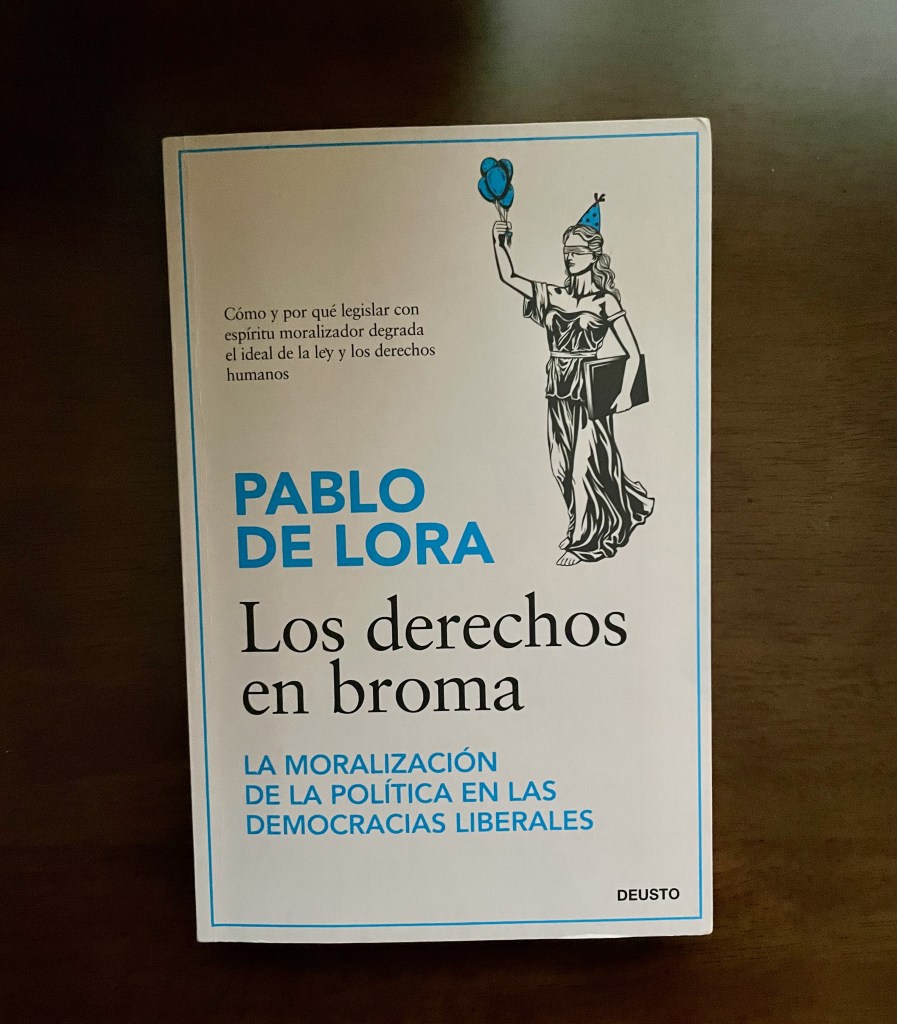
The crisis of the liberal legislative state is almost as old as the very project of the modern liberal state itself. And if we are to believe Carl Schmitt, the rise of the supreme values of the French revolution and ‘human rights’ (with its corollary of universal recognition within its normative system) also meant walking the fine line from the political theology of generative reform to the nihilism of ius revolutionis commanded by new discharges of individual will, political and technical movements, and immanent forces bringing the collapse of the separation between state and civil society. We are still living under its protracted shadow, albeit with a different intensity and intent. In his new book Los derechos en broma: la moralización de la política en las democracias liberales (Deusto, 2023), Pablo De Lora co-shares this point of departure, while daring to suggest a new sequence after the collapse of modern political form and legal order: we are currently living under a particular epochal transformation that is anti-legalist (sic) in nature – precisely because of its surplus of legal motorization – that erects a “nursery state” for the totality of the political community’s reasons and justification for action (De Lora 23).
Although De Lora case studies shown are almost entirely derived from the Spanish and Latin American contemporary social contexts, I do think that his sharp diagnosis could be extended to the epoch itself without blurring the important nuances. This is an epoch of a reigning “emphatic constitutionalism” (Laporta) or the total Constitution (Loughlin), at the same time that it no longer takes too much effort to imagine a political community devoid of a legislative body, as one eminent constitutional scholar has said repeatedly [1]. We are already here. In other words, whether by excess or deficit, the overall purpose of moral driven legislation announces the internal transformation of modern politics as we know it, extending itself to a civilizational regression from the ideals and norms of the Enlightenment rooted in the fiction of the citizen, the binding of the social contract, and the invention of the principle of sovereign authority.
De Lora does not quite says it in this way, but I think I am not diverting too much of his cartography when extracting some of the central consequences of these internal moral substitutions that are palpable everywhere across the West: ecological legislation that increases social conductivity and expansion of natural destruction; ‘feminist’ anti-sexual aggression that leads to lowering of sentences for convicted sexual predators; the inflationary instrumental use of “Human Rights” for persons and things, but only defined narrowly by those that, under the thick haze of institutional hegemony, can deprive their political adversaries and enemies of the most basic legal guarantees of due process transforming them into non-persons. These ‘moral substitutions’ is part of the “ironic” and “futile” consequence of the sacralization of morality whose end is the management of the “social model” at all costs. According to Pablo De Lora, within the limits of confronting a social dilemma such as disability, the specificity of the “case” is turned on its head; what matters is the overall structural design of the social order and its infinite adaptive changes (De Lora 71-72).
This mutation generates all sorts of unintended consequences when the rhetoric of “social benefit” takes the lead. As De Lora writes: “No hay apoyo anticipado a la discapacidad mental sin reconocimiento de que el discapacitado mental no puede ejercer su autonomía en el futuro. Dicho de otro modo, la institución de las voluntades anticipada de la lógica desideratum de modelo “médico” de la discapacidad mental que se rehuye en beneficio del modelo social” (De Lora 85). And in spite of normative incoherence within an institutional system, the deflection to the “social model” requires ever-expanding commands, rules, principles, and hyper-amendments to guide the adverse proliferation of reasons for action within the social state (in the United States this is soften by the police powers of inter-agency statutes of the administrative state through cost&benefit balancing of discretionary principles under the supervision of the executive branch). This transformation entails the collapse of the internal mediation between the validity of norms and its foundation in social facts as in the classical construction. Thus, the expansion of value-driven legislation that also requires of specific adjudicative constitutional theories, such as legal interpretation and the theory of balancing of principles advocated by Robert Alexy, the sponsors of social neo-constitutionalism, but also the embedded dialogic ideological positions of constitutional scholars such as Roberto Gargarella (or in the United States context, the work of Mark Tushnet and the so-called anti-originalist ‘living constitutionalists’).
All things considered, the fundamental problem for De Lora is that this specific transformation enacts what he calls a “Estado parvulario” or ‘nursery state’ that he defines as: “El que denominado “Estado parvulario” da pábulo a que el poder público, en sus diversos instancias y encarnaciones, escamotee las realidades y consecuencias que conllevan algunas discapacidad per oa que lo haga de manera internamente inconsistente: tratando a los menores como adultos, pero sólo simbólicamente, y, en cambio, de manera efectiva, a todos los ciudada como menores, congénitamente desvalidos, incapaces de encarar la realidad” (De Lora 87). In the framework of the nursery state within its specific moral legislative apparatus, children become adults and the mature civil society regresses to an infantile stage. And like in a nursery setting, the democratic virtues pave the way for new dramatic effects where the function of rhetorical annunciation – so central for the any credentials of moral hegemony – forecloses the void between morality and politics in the wake of the unification that the social model requires to begin with (De Lora 89).
This slippery slope can only lead straight to a sacralization of the political system that runs co-extensively with the infinite expansion of social rights; which, in turn, leads to an ever increasing conflict over the assumptions regarding its social facts (De Lora 151). In this narrow form, De Lora is audacious when citing Martin Loughlin’s recent indictment from his Against Constitutionalism (2022): “En la era de la Constitución total, el gobierno bajo el imperio de la ley ya no significa el gobierno sujeto a reglas formales independientemente pulgadas. Significa gobierno de acuerdo con principios abstractos de legalidad que adquieren significado sólo cuando son insuflados con valores…” (De Lora 188). And we know perhaps too well that values cannot be reasoned, but only weighted; values are commanded and taxed on the permanent devalorization of other values. This is why the rise of the value fabric of constitutionalism coincides with the ‘weighting’ proportionality of principles of law’s ideal social efficacy, to paraphrase Robert Alexy’s influential position as claim for “anti positivist legal justice” [2]. The nursery social state cannot be corrected merely from the position of the legislator; it can also be tracked as a triumph of moral jurisprudential theories of law that seek to overcome (and provide answers) to the overall crisis of institutional authority that characterized the so-called ordered liberty of the moderns.
Is there anything to be done beyond a description? It is quite clear that Pablo De Lora’s ambition is not so much the proposition of a new political or legal philosophy as much as the sketch of the current epochal predicament in its current practice. This is already enough to welcome a robust analytical discussion of our predicament in Los derechos en broma (2023). However, there is a cobweb of affinities in De Lora’s own position towards the end of the book that, even if not fully developed, must be registered as a mode of conclusion. First, there is an affinity with John Hart Ely’s deferential conception of judicial power that aims at overseeing the procedural mechanism for the democratic deliberation and legislation over a hot-button issues. In this vein, De Lora shares Akhil Amar’s position regarding the overturning of Roe in the Dobbs’ decision; a conception that fully embodies judicial deference to diverse legislative majorities [3]. Secondly, De Lora favors a judicial minimalism associated with the doctrinal theory sponsored by James Bradley Thayer over the practice of judicial review of the Court (De Lora 233). And last, but not least, De Lora sees transformative potential in John Rawls’ assertion in his late Political Liberalism (1993) that the use of public reason is a comprehensive doctrine to deal with our fundamental disagreements and contentions over shared political values (De Lora 241).
I am not sure how deep or for how long does De Lora wants to go with Rawls; however, it is important to remember – and specially given the treatment of the ‘social model’ in the morality presented in Los derechos en broma (2023) – that insofar as social paternalism is concerned, Rawls’ late liberal political philosophy at the heart of the crisis of the secular liberal state amounts to a political conception that, as Eric Nelson has brilliantly shown, abandons the commitment of individual non-cooperation or refusal to cooperate with unjust moral legislative burdens, and thus making everyone stuck in the same ship [4]. This ship is the management and balancing of the totalization of the values being trafficked in the Social as ‘egalitarian’, although they are fully endowed as a seterological scheme of “election” (and who is elected) balanced by secondary compensations.
On a larger canvas, if the current political structure is defined as a nursery state of social rights, then this means that appealing to ideal positions of justified reasons, “diaphanous” deliberation, and well crafted citizen arguments belong to the age of maturity of the Enlightenment, but not to the stage of social infantile disorder. And demanding political qualifications to the contemporary citizen today is not only naif, but at odds with what what institutional thinking requires. In other words, the concrete transformation of the post-liberal state is one of permanent optimization of conflict, which is why John Gray has lucidly defined the (contemporary) ‘new Leviathans’ are “engineers of the soul” with broad and sweeping capacities to govern over every inch of the social space [5]. In the wake of these institutional mutations, the call endorse a “moral critique” might be taken as a post-enlightened lullaby that among the blasting and striding cries of infants of the nursery will most likely just pass unheard.
One of the most illuminating talks at a recent workshop at Kingston University (hosted by the Centre for Modern in Modern European Thought) on institution, legal philosophy, and political thought, was Michele Spanò’s archaeology of the institution of patrimony entitled “Patrimony and the Legal Institution of Subjectivity”. Spanò’s work for some of us has been of extreme importance in thinking about roman law, the historical school of the German legal tradition, as well as the work of Yan Thomas whom he has edited and translated for Quodlibet. Although Spanò’s lecture was based primary on notes and part of a larger project on the ‘invention of subjective rights’, it made a few transitions that thematized the legal infrastructure of property that will be perhaps fundamental to understand, and radically transform, the problem of political economy and the logic of the capital coding that Katharina Pistor has recently explored in our post-sovereign present (I have discussed some aspects of imperial coding of capital here). But it is in the invention of “patrimony” in Roman law, where for Spanò a new epochal conception between things, persons, and reality (-res) was established as a relational matrix that he termined, following the Italian legal philosopher Riccardo Orestano, a conception of law without a subject [1]. This infrastructure of a relation without a central subject of authority – a problem too complex to analyze in this simple side note – revises and displaces the more modernist-style discussion on natural law and positive law, but also intra-conceptual determinations such as the subjects and the impersonal, between rights and obligations, which are part of the long dure Roman-modern matrix of the patrimonial foundation. For me there were at least three important elements that derive from Michele Spanò’s work, which I will leave here for some future elaboration in upcoming writing project on the problem of patrimonial and civil as roman categories of modern juristic-political thought and the American context.
1. The relationality or nexus of the conception of the patrimony (a. every person has a patrimony, b. all patrimony belongs to a person, c. there is a relation between obligation and patrimony) is an early form of exchange value; in fact, it is the equivalent structure that designs the total apparatus of social reproduction and the passage from the polis to the domus (housing / domestication). In this sense, Roman law of patrimony is not about substance or morality, but about the circulation, organization, and exchange of metaphoric value codified. This ensemble appears very similar to what will later be Ernesto Laclau’s theory of hegemony. If this is so, then hegemony is not about political “articulation”, but rather its “politics” is a mere veneer for a spectral patrimony. There is no patrimony without the work of hegemony, and the form of hegemony is a reduction of value that keeps it off from the autonomy of the political. In this light, it makes sense that even a Marxist political economist like former Vice-President of Bolivia, Álvaro García Linera, understood statecraft as the development of and from “patrimonialism”, which entailed necessarily the devastation of the ecological life world [2]. The patrimonial form will ultimately transform the exteriority of the natural world into an object at the service of value.
2. Spanò offered a typology of patrimony in two phases: a. For whom is the patrimony (the personalist type), and b. For what (the functionalist type). In a certain sense, we are now in a term phase of legal adjudication: c. what are the costs and benefits of the management of a patrimony? This entails the logistics of ‘creative destruction’ (Schumpeter) into the very interiority of the legal rationality based on balancing and equity functions. For the paradigm of the cost & benefit equity the problem is no longer posed as a question of function or proprietary, but rather of thorough administration and optimization: to what extent can the risk and security of a patrimony can render X costs in relation to Y benefits of Z of the socialbody? Here the abstraction of the regulation of patrimony coincides fully with the domination of the social space into the juridical logistics. The distinction between private and public law spheres of the European legal traditions (ius commune and Common Law) collapses. As we have suggested in recent investigations, this collapse today is expressed on the rise of administrative law as a restituted Lex Regia.
3. Finally, the collapse implies a chiasmatic movement in the history of the archaeology of Western domination: Roman law and modern positivist law, subject and object, production of rationality and extraction of resources for production of life, the limitations of Roman Law on property and Canon Law on statutes and morality. If medieval canon law of the Church was quenched in the wells of Roman Law, then the question regarding the modern state (its presuppositions, its conditions, crisis, and collapse) amounts to the problem of institution of patrimony as a regulatory of principle of rationality and network of the legislation between spheres (legality, economic, political, rational, instrumental, etc). If there is something to be today against and beyond “hegemony” (no longer an index of politics or culture), then the problem of the patrimonial framework must be understood as a juridical-economic paradigm in which “politics” is incapable of responding to. On the contrary, it could well be that the crisis of politics is an effect of this complex archaeology that, for some of us, Spanò’s work has already started to grasp in light of the return of ‘principles’ for social maintenance.
.
.
Notes
1. Riccardo Orestano. “Diritti soggettivi e diritti senza soggetto”, Jus: Rivista di Scienze Giuridiche, 2, 1960.
2. Alvaro García Linera. Geopolítica de la Amazonía: Poder hacendal-Patrimonial y acumulación capitalista (Vicepresidencia del Estado de Bolivia, 2013).
In his chapter on the radical theology of abundance and ethics of Karl Barth, Mårten Björk discloses a central concept to the reformist theologian: the suum cuique, a term that prima facie could be rendered in natural law definition of legal justice, inherited from Roman lawyer Ulpian, as “may all get their due”. In the thomist tradition the legal notion of epikeia promptly became equity as the moral supervision of law’s principle (ius) understood as the application of the fair and the objective good. The justification of the balancing of aequum became a regulatory mediation on the grounds of a fictive principle of nature as moral reasoning, which has been well documented by Stephen Humphreys [1]. What makes Barth’s drawing on the notion of suum cuique in his interwar pamphlet Church and State (originally entitled Justification and Law, 1938), on the contrary, is precisely that it is not reducible to equity, but rather as Björk explains it: “the limit to our life, a limit brought forth by death itself, is in the end the vast chams that posits the creature as create of God…and this has ethical and political consequences” [2]. This is telling, and my aim here is to supplement the discussion in “Abundance and Scarcity” by showing its radical asymmetry with the reasonableness of the natural law. Barth’s anti-activist Church (although not neutral in the wake of the total state of the 30s) and apathy towards morality, stands as a sui generis bearing.
First, in the moral natural law tradition of equity (epikeia) “giving each one their due” becomes a strict legal-authoritative command principle on the reasonableness of nature centered on the ontology of the person. It is quite the opposite for Barth who does not favor a constant moral adjudication, since the separation between Church and State presupposes a previous divine justification that belongs exclusively to the Church, but not to the state. In fact, law practiced on the condition of natural principles will undermine the authority of the liberal positivist state, which Barth defends vehemently, making the case for its coherence with the teachings of the New Testament: “The democratic conception of the state is justifiable expansion of the of the New Testament…Christians must not only endure the earthly state but they must will it as a just state, not as a “Pilate” state” [3]. It is not surprising, then, that Barth wrote this tract openly defending the authority of the modern positivist state, contrasting it to the anti-statist unjust pretarian judgement of the trial of Jesus. This makes sense given that the pretorian ius honorarium could be understood, at least in part, as belonging to the tradition of the moral balancing of equity between morality and norms (just as the two irreducible kingdoms) [4]. Barth’s defense of the positivist state is even contrasted to natural law, which for Barth is incommensurable with the word of God: “We cannot measure what law is [in the State] by any idea of natural law…” [5].
Accepting the primacy of the equity of a substantive bonum will not only serve to override the authority of the state, but also, and more importantly, to flatten out theology’s monopoly over divine justification. At this point Barth is quite explicitly in saying that this is what took place – and I think he is correct, specially if we take into account that the degenerate legality in Nazi Germany and Stalinist Russia was not an abuse of positivism, but a consequence of the open-ended common and natural law principles to the point of distortion – in the wake of fascism and Bolshevism in the interwar years of Europe. Barth writes with this in mind against artificial heavens on earth, as part of a hyperbolic “politicizing from above”:
“Fascism and Bolshevism alike will be dethroned and the true order of human affairs will arise. Not as heaven (not even a miniature heaven) on earth! No, this “true order” will be able to arise only upon this earth and within the present age, but this will take the place really and truly, already upon this earth, and this present age, in this world of sin and sinners…this is what the Church has to offer to the state…” [6].
The political domination of the total state amounted to a conflation between the lapsarian condition of man and the theology of eternal life. The passage or mediation between the two dimensions, which he also described as a “tailor made garment” was the suum cuique, understood as a limit to life and death beyond morality and biological reductions. Barth insisted on the principle of separation in face of every temptation of technico-rational closures. Thus, by externalizing divine justification to the sphere of theological eternity, Barth’s conception of “giving one’s due” was radically disambiguated from the Nazi motto “Jedem das Seine” (to each his own) in the concentration camp of Buchenwald in 1937, made possible by the opened force of common law adjudication against the state positivist authority (understood by Nazi legal scholars as “too Jewish”). This was the barbaric dereliction of duty of the state becoming what Barth called a “clerical state” [7]. Barth’s ethical limit on finite and eternal life, so well reconstructed in Björk’s brilliant monograph, can only be a witness to a ‘world passeth away’ to which no priestly jurists have the last word unless catastrophic consequences are expected. The ethical response to the lapsarian condition was a radical drift from the dangers of natural absolute rationalism that was directly implicated in the arousal of immanent powers and the reduction of the population as mere administration of doctrine of last things through consciousness and not grace. The suum cuique introduced a radical exteriority in which all men became “strangers” (to the Church, national identity, the community, to the social) whose proper involvement pertained to the eternal mystery of life and death.
.
.
Notes
1. Stephen Humphreys. “Equity before ‘Equity’”, Modern Law Review, 2022, 1-37.
2. Mårten Björk. The politics of immortality in Rosenzweig, Barth, and Goldberg: Theology and Resistance Between 1914-1945 (Bloomsbury, 2022), 115.
3. Karl Barth. “Church and State”, in Community, State, and Church (Anchor Books, 1960), 146.
A rebuttal against the notion of enemy frequently hinges on conflating the enemy with total enmity. It usually takes the form of a hypothetical: once an enemy is declared as such, is there anything that can deter the escalation into total enmity? The historical record provides analytical reassurance to the hypothetical, but it does not eliminate its generality, since its ultimate probe is conditioned by an ideal of conceptual purity. Not every hypothetical is idealistic, but every hypothetical exerted from purity is. This concerns any understanding of politics, given that the notion of the enemy presupposes an impure origin of conflict, threats, disorder, or unjustified propensity towards evil. If the enemy is best understood as an operative principle between repression and totalization of enmity, it also entails a rejection of purity as sacralization of the political.
The argument from purity has been deployed with equal force by both Liberalism and Marxism, although they are not the only two contenders. Whereas the first suppresses the enemy from civility and economic utility; for the second, there are no necessary enemies given that politics is a process that will culminate in moral emancipation. For both Liberalism and Marxism, the problem of separation is fixed in two opposite poles: for Liberalism the separation is originary and consubstantial to the genesis of modernity as the separation of Church and State; for Marxism, the separation comes to end in the future collapse of the alienation of ideal and manual labor, and state and civil society. The argument from purity liquidates the enemy as the operative function because it doesn’t consider conflict intra muros on its merits. It is always surpassed or to come.
From the argument of impurity, the notion of the enemy demands that the political be understood as here and now (more than temporal it is topological: externality). Let us consider Shakespeare’s Hamlet. It is a tragedy that stages the friction between the suppression of the political enemy in medieval society and the not-yet autonomy of the political of the moderns. In an old essay Leo Lowenstein noted that Hamlet is an existential limbo as to whether to judge and execute his father’s murderer, or to desist in his decision of revenge and become paranoid crossing the line into madness [1]. The world of Hamlet’s indecision is no longer that of imperium theologiae where the enemy is an entity to be deposed of; but rather it vacillates because it knows the fracture between wrongdoing and action, legality and legitimacy. The malaise of Hamlet condition is the impossibility of enemy mediation: “Shakespeare’s theatre, in general, and his Hamlet, in particular, are no longer ecclesiastical, in the medieval sense. On the other hand, they are not yet a political state theatre, in the concrete sense state and politics acquired on the Continent as a result of the development of state sovereignty.” [2]. The intrusion of historical time reminds us that original separation will not be enough in the face of a concrete conflict.
The tragic dimension in Hamlet is given negatively: the paralysis of not being able to establish the proper mediation to deal with political enmity. This paralysis – or the inconceivable regicide of naturalist theologians – can only amount to madness. Indeed, one becomes one’s enemy, because the enemy (the usurper King) lacks the mediation with its exteriority: “Hamlet is of the faction that is wronged / His madness is poor Hamlet’s enemy…That I have shot my arrow o’er the house / And hurt my brother” [3]. What does it mean to be one’s own enemy, and who could decide here? The incapability of generating an external hostis will prompt bad consciousness and perpetual resentment.
From the side of impurity, the enemy as “one’s own form” means a depersonalization of the political and the neutralization of the stasiological force that places reasons, justifications, and actions as primary ends. But a civil war waged on internal reasons do not imply mediation. From the argument of purity the dismissal of the enemy is no longer Hamlet’s negativity; it turns itself into subjectivism and unfettered self-autonomy that will require not the judge but the priest, and not political form but the police.
.
.
Notes
1. Leo Lowenstein. “Terror’s Atomization of Man”, Commentary, 1946, 7.
2. Carl Schmitt. Hamlet or Hecuba: The Intrusion of the Time into the Play (Telos Press, 2009), 51.
3. William Shakespeare. The Tragedy of Hamlet (Signet Classics, 1987), 168.
Nowhere in his published work does John Rawls treats the concept of civil war explicitly or by that matter in relation of his concept of political liberalism, although it is central to genesis. In a Spring semester of 1969 lecture at Harvard University, which remains for the most part unknown and only alluded by specialists of his (although never subject to substantive treatment), “Moral Problems: Nations and War”, Rawls takes up the problem on its merits [1]. This is a lecture that took place in the wake of the Vietnam war, the post-1968 context, and during the years of the definite settling of “global civil war” intensifying in every corner of the world. There is little that Rawls when treating the problem of war within the tradition of liberalism, was also aware of the factical nature of war of his present; that is, the transformation of war as a legitimate declaration between nations (at that point outlawed by the international Kellogg-Briand Pact) to a predominately a war within nations, that is, a permanent civil war. In this lecture – which one does not need to summarize given its broad historical strokes and technical determinations – Rawls crafts an typology wars in international law, as construed by the ius gentium, a theme that will later be the subject of his late book in international relations principles Laws of the People (1993). What is surprising is that in this typology, Rawls defines civil war as a thorough conflict aiming at “social justice” to transform the state. A civil war, then, is no longer what precedes the foundation of ‘legitimate authority’ proper to sovereignty, but it is rather the means by which something like “justice” becomes the mediation of the “Social”.
From this it follows, that for Rawls civil wars either neither wars of aggression or wars of sessions, two forms that would be exclusionary to his definition grounded on ‘Justice’. Hence, the “justification” of civil war could only be a just war insofar as its aim grounded in social justice as the effective realization of the well-being of all the inhabitants of the polity. For Rawls this was the ‘active’ continuation of the ideal of the French Revolution of 1789. Indeed, one could claim that for Rawls civil war is the continuation of revolution after the principle of universal recognition was achieved through rights. The ideal of Justice, then, was never the well-ordered natural law theory of revolutionary change (endorsed by many Jacobins, such as Saint-Just), but rather an intra-level recognition of social rules within the plural system of value differences. Coinciding with the development of positive law as grounded in social facts and guided by a ‘rule of recognition’ (in H.L.A Hart’s well-known elaboration), Rawls’ theory of civil war was the mechanism for a social fact-based conception of justice that was predicated in the optimization of risks, regulations, and re-distrubution of post-recognition equity of the activist state. Indeed, social justice insofar it was no longer merely sovereign authority, took the function of social facts through the administration of a permanent social civil war.
Neither an event nor an exception, civil war for Rawls is a free-standing metapolitical paradigm of the new “transformative” conception of the Social ordered purposely around the principle of Justice. Paradoxically, the conditions of promoting “social justice” (whose echoes we still hear today from the political class as well as from the jargon of academic political ideology) is not limited to the “veil of ignorance” or the “originary position” for social action, but rather in the actualization of a latent stasiological paradigm. This esoteric unity is neither an exception nor a deviation from Rawls’ mature political thinking around social justice; but as all true political paradigms, an invariant mode of his thinking. This is why he points in the 1969 lecture the Spanish civil war as paradigm of stasis as social justice, and in his essay “My religion”, the American Civil War led by the exceptional executive authority of Abraham Lincoln as necessary to the “original sin” of human slavery [2]. And as Eric Nelson has convincingly argued, the anti-pelagian conception of sin in Rawls’ thought amounts to a secularized theodicy of social force: a regulatory physics in the aftermath of the crisis of the sovereign state. Although ignored by Nelson, the full picture of Rawlsian conception of the “Social” is not complete if one does not take into account the stasiological paradigm that legitimizes the aims of social justice. And if the internal conflict is latent within the Trinitarian ontology (as Political Theology II suggests) there is little doubt that the transformative model of Liberalism rather than moving the conditions of politics forward, ends up descending to the terrain of Christian political theology that it never abandoned.
But is it even ‘transformative’ within the conditions of the Christian model that it allegedly secularized? Is the primacy on social justice on civil war truly a political theology, or rather the consequential triumph of theology over the institutionality to restrain the ballistic aspiration of social hegemony? Both questions collapse if tested on the grounds offered by Carl Schmitt regarding both political theology and the critique of moral neutralization of values as direct application of the principle of Justice, which would turn social relations into pure subjection, a form of Homo homini Radbruch (Rabruch referring to the Radbruch formula of an unjust of law as non-law, thus requiring principles) [3]. What is “just” to a hegemonic stance indicates a clear crisis of institutional deficiency in the face of what values determine the scope and content of the “Just”.
Similarly, the transformative conception of Rawlsian “activist liberalism” is closer to the realism of latent civil war than what the Christian idea required on a thing and minimalist basis; which, according to Ladner implied retreat form the social as well as from liturgical participation. On the contrary, rather than moral unity, reform entailed a separation, solus ad solum, in order to transform the habits and costumes without direct enforcement [4]. Contrary to the Christian monastic ius reformandi, Rawls’ renovation of political liberalism, vis-à-vis the civil war paradigm, accepted the hellish reality of the social by affirming “social justice” as the only real means for subjective social cohesion. And if the just war principle stood largely under the guidance of positive sovereign rules and commands; the deployment of justice of civil war will be based on the exertion of principles and higher content without end. The true efficacy of civil war alien to the concept of the political, made possible a regime of socialization on the mere basis of values stratification and moral abstraction.
.
.
Notes
1. John Rawls. “Moral Problems: Nations and War”, Spring 1969, Harvard University. Harvard U Library Archives.
2. John Rawls. “On my religion”, in A brief inquiry into the meaning of sin and faith (Harvard U Press, 2009), 263.
3. Carl Schmitt. “Un jurista frente a sí mismo: entrevista de Fulco Lanchester a Carl Schmitt”, Carl-Schmitt-Studien, 1. Jg. 2017, 212.
4. Gerhart B. Ladner. The Idea of Reform: Its Impact on Christian Thought and Action (Harper Torchbooks, 1969), 322.
This is the final entry on the mini-series of interventions within the framework of the course that I am teaching at 17 instituto on contemporary Italian political thought. In this last fourth installment we had a very rich and productive conversation with Idris Robinson (University of New Mexico) on the philosophy of work of logic developed by the Italian thinker Enzo Melandri. Melandri’s work remains largely unknown, aside from the recent new editions of his major works at Quodlibet, and the recent monograph Le Forme Dell’Analogia: Studi Sulla Filosofia Di Enzo Melandri (2014) by Angelo Bonfanti. Idris’ doctoral dissertation (hopefully a book in the near future) will be a major contribution in a rising interest on Melandri’s work on logic, politics, and history, and its dialogues with the work of Wittgenstein, Foucault, and Agamben. As Idris Robinson recalled, the work of Melandri would have been entirely unknown if it weren’t for Agamben’s book on method, Signatura rerum, which uses Melandri’s work on analogy and paradigms as conditions for his own archeological method. This whole terrain remains to be explored, as Philippe Theophanidis suggested, given that it has been for the most part ignored in all the main works on the Agamben’s thought (including Villacañas’ otherwise excellent essay on method, history, and archaeology in the recent collective volume that I edited). But to the extent that Enzo Melandri’s work remains to be translated into English, Idris’ lecture serves as an important introduction to some of the key elements of his work, even if there is a lot to fill in and discuss from now on. All of the questions regarding Agamben’s method should emerge from this terrain, rather than the exhausted and ambiguous mantra of “critical theory”.
1. First, Idris Robinson suggested that Melandri’s central contribution departed from the distinction of two major path of Western logic: linear logic, which comes full circle in symbolic logic and formalization at the turn of the twentieth century (Russell, Frege, Wittgenstein); and analogical logic, which remains suppressed, but subterranean latency for problems of bivalence and the excluded middle against all preconditions of the identity-difference polarity. Like Agamben would later do with his rereading of energeia/dunamis opposition in Aristotle, Melandri was also a strong reader of Aristotle’s logic and the categories in order to advance a series of logical alternatives (not by any means the only ones, and not necessarily distributed equally): a) a different conception of the principle of identity (p / -p), b) gradations of contradictions (p / -p), c) inclusion of a middle or third as failure of bivalence, d) continuity and gradation, and e) the equivocity of meaning. All of these should not be taken at face value or even as complete abandonment of linear logic. Needless to say, these elements supply analogic logic an exit from linear reductions of formal logic and its presuppositions on the grounds of identity and negation to secure general ends and goods. By working within the paradigm of analogy, Melandri is said to account for indetermination and modality, which do not divide form and matter as opposites as in the linear model of the Aristotelian canons of medieval philosophy (Aquinas as its foremost representative) to the more analytical models of twentieth century logic.
2. The work of analogical logic allows Idris Robison to take up the question of form (he referred to it as morphology) as a problem of experience and specular observation of the world. Essentially this is the difference between Goethe and Newton in their explorations of colors, whereas the paradigmatic assumptions of Goethe aligned him with the logic of analogy by favoring deviations, gradation, and middle terms when thinking about the sensible problem of colors as an immanent series in nature (a method continued in Benjamin’s constellation images in his study of nineteenth century, but one could also think of Aby Warburg’s pathosformel as index of Western Art). Whereas Newton made an experiment and deduced the range of colors from a prism; Goethe was able to engage in observation (Idris alluded to his descriptions in his Italian diaries entries) in changing phenomena and organize it as such.
3. As a methodological question, what is important is how the paradigm becomes the unity for regulating (perhaps not the happiest of words) and constructing the indeterminate zone between thinking and the world, and in this way avoiding the abyss of pure relativism (or the arbitrary, I would also add). In this sense, the Goethe example stands for the problem of paradigm, but it does not necessarily entail – at least in my view – that his work is in itself free-standing for analogical transformation of life and thought. At the end of the day, Goethe is also famous for claiming that “All theory is gray, forever green is the tree of life”, which could explain why Giorgio Agamben in his most recent book on Holderlin’s final year juxtaposes the chronicle of Hölderlin modal and dwelling life (the parataxis is analogic poetics with respect to language) with the diplomatic and successful life of Goethe (the linear logic here could also be transposed with the ideal of destiny becoming ‘political’, as it is appears in his meeting with Napoleon). In any case, the logic of analogy and the reduction of paradigms becomes crucial to account for two distinct problems (at least this is my first reading, and I am in no way speaking on behalf of Idris Robinson’s thesis): to hold on to a stratification of history (open to configuration of mediums – images); and, on the other, a ground for logic, but only insofar as they are neither at the level of historical necessity and negation (philosophy of history), nor about linear logic that dispenses moral ends according to some “natural law”. From this premises, it should be interesting to explore Agamben’s archeology and ethics as a third path that diverges from both rationalization and the moral standing of understanding the just or the good.
4. Finally, I think two major problems emerge from a first preliminary confrontation with Melandri’s work, which we are only beginning to see how they “operate” in Agamben work, although at some point one should also confront the work on its own merits: on the one hand, the logic of analogy provides us with a truly historical method that is sensible to forms and stratification of the imagination that does not depend on conceptual history (in the manner of R. Koselleck), and even less on teleological historical progression. At the level of content, the analogical paradigm is consistent with trumping (suggested by Philippe Theophanidis) the hylomorphic conjunction of Western metaphysics, and thus contributing to a logical infrastructure for the form of life that abandons the primacy of ends and realization. What could this design entail for the transformation of our political categories? Does this necessarily imply that analogical legislating is always about political ontology! Does it require interpretation or a qualification of truth-validity? Or rather, does analogy favors the event instead of formal principles that have subsumed the grammar of politics and its negations (yes, also revolutionary politics, a problem also present in Della Sala’s paper)? Sure, extrapolating these questions to the field of politics is perhaps too hasty to fully repeal deontological concerns. Perhaps analogical analysis requires, precisely, a distance from the subsumption of political ontology at the center of thought. But to be able to answer these questions we need to further explore the work of Melandri. Idris Robinson’s lecture has provided us an excellent starting point§.
.
Notes
§ Idris Robinson’s intervention on Melandri and the discussion should be available in the next days at the 17/instituto YouTube channel.
Gramcsi’s turning away from economic primacy of the Third International meant that he had to endorse a robust principle of “politics” to suture the separation (and there crisis thereof) between theory and praxis, which is also a division of action and thought. In a certain way, going back to Machiavelli’s writings or Croce’s Hegelian Idealism is a way to introduce a total politics suture over philosophy and life. This becomes clear when in Notebook 8, while glossing Croce “Hidden God”, Gramsci asks rhetorically but with force: “In what sense can one speak of the identity of history with politics and say that therefore all life is politics? How could one conceive of the whole system of superstructures as (a system of) political distinctions, thus introducing the nothing of distinction in the philosophy of praxis? Can one even speak of a dialectic of distincts? (271).
It becomes rather obvious that what has passed as the great Gramscian novelty – mainly, the emphasis on “superstructure” as a way to relax the mechanistic economic structure of capitalist development driving the laws of History – in fact, it rests on a metaphysical principle rooted in the total politics over life. In other words, Gramscianism means, if anything, a new totalization of political domination over the texture of life and every singular destiny. This conceptual maneuver is nothing original if placed in the epochal framework of what Alain Badiou called the “ecstatic politics” of the 1930s, in which politics (and later legality) became the instrument to suture philosophy and life.
It is almost as if Gramscian political life becomes the new instrument for the age of total mobilization and the worker insofar as life is nothing but the site of immanence that must be reintegrated, conducted, and translated as co-terminus with full political activity. At the moment where “life” was fleeing from the organic reproduction of capitalist development unto autonomous forms (Camatte), the Gramscian emphasis on “superstructure” became the progressive technology to “contain” its eventual dispersion. Again, in the same section 60 of the eighth notebook this insight is explicit: “One must say that political activity is, precisely, the first moment or first level of the superstructures; it’s the moment in which all the superstructures are still in the unmediated phase of mere affirmation – willful, inchoate, and rudimentary” (271). The question solicited here is where does the “class struggle” fit in this picture, if at all?
If superstructural political life is not the site of the horizon of the working class’ emancipation, this could only entail, as Jacques Camatte understood it very early on, that the conduction of the communist party in politics demanded that militants and the working class had to act as if the communist society was a “living fact”. In turn, this meant that there was a clear “reformist” transmutation, since one could discard (in fact, as later authors of the so-called post-foundational theory of hegemony demanded, it *had to be discarded*) the horizon of revolutionary emancipation. What is surprising is that even today a reformist declination of ecstatic politics is announced and branded as “true radical political thought”, when it is just a mere inversion and reorganization of capitalist value organization. On the contrary, the total politics of the superstructure over life could only mean, as Íñigo Errejón repeated recently, merely a “struggle between opposite values”; in other words, it is no longer a transformation of the world instead of interpreting it, but a mere gaming of values to facilitate the occupation of the state.
This could explain why, many pages later in Notebook 8 Gramsci could define hegemony as the crystallization of morality. He writes univocally: “Hegemony” means a determinate system of moral life [conception of life] and therefore history is “religious” history along the lines of Croce’s “state-church” principle” (373). And of course, history is always “a struggle between two hegemonies”, whose main nexus is the unity of rulers and the ruled (373). Gramsci gives this unification without separation the label of “patriotism”, which amounts to a direct secularized form of the medieval pro patria mori. This is the vortex that organizes the ecstatic political dominium over life in every hegemonic order.






 Infrapolitical Reflections